O R I G I N A L P A P E R
The youngest basic oceanic magmatism in the Alps (Late Cretaceous
;
Chiavenna unit, Central Alps): geochronological constraints
and geodynamic significance
Received: 20 January 2003 / Accepted: 12 May 2003 / Published online: 10 September 2003 Ó Springer-Verlag 2003
Abstract Cathodoluminescence-controlled radiometric dating (U–Pb SHRIMP) was carried out on zircon do-mains from metabasic rocks of the Chiavenna unit, a major mafic/ultramafic-bearing unit in the Central Alps. Co-magmatic zircon domains from amphibolites near Chiavenna and Prata areas yielded weighted mean
206
Pb/238U ages at 93.0±2.0 and 93.9±1.8 Ma, respec-tively, interpreted as the age of crystallization of the magmatic protoliths. These ages fit well with the time of late spreading in the Valais Ocean, as suggested by previous paleogeographic reconstructions. Inherited zircon grains and/or core domains (Permo-Triassic, Carboniferous, Proterozoic) are abundant, indicating proximity of the Chiavenna unit to thinned continental crust. This is in line with the origin of this unit from subcontinental mantle sources, as suggested previously on petrological and structural grounds. Metamorphic zircon domains from one amphibolite near Chiaven-na yielded a weighted mean 206Pb/238U age at 37.1±0.9 Ma, identical to the 38.5±0.9 Ma SHRIMP age of an amphibolitized eclogite of the Antrona ophi-olites (Valais domain, Western Alps). Precise metamor-phic ages were difficult to obtain from the composite (poly)metamorphic rim domains of the Prata amphibo-lite. This is attributed to the location of the Prata area close to the granulite-facies Gruf unit (metamorphosed at ca. 33 Ma) and to the 24–25 Ma old Novate granite, where metamorphic/fluid events probably caused multi-ple resetting to various degrees. The ca. 93 Ma old
magmatism, identified for the first time in the Chiavenna unit, is the youngest basic oceanic magmatism reported in the Alps. The 37.1±0.9 Ma old metamorphism in the Chiavenna unit, attributed to the Valais domain, con-firms the model suggesting stepwise younging of meta-morphic ages from the south (Adriatic plate) to the north (European plate). It is older than metamorphism in the European margin (ca. 35–31 Ma) lying to the north of the Valais domain and younger than that in the Piemont–Ligurian Ocean (ca. 44–45 Ma) lying to the south of the Valais domain.
Introduction
Multidisciplinary studies of ophiolitic, mafic/ultramafic rock associations in the Alps suggest the former exis-tence of at least two oceans, originally located between Europe and Africa (Adria): (1) the Piemont–Ligurian Ocean, representing the Mesozoic Tethys, which opened from the Middle Jurassic onward (e.g., De Wever and Baumgartner 1995) and (2) the Valais trough, located NW of the Brianc¸onnais peninsula, probably opening from the Late Jurassic—Early Cretaceous onward (e.g., Frisch 1979; Tru¨mpy 1980; Stampfli et al. 1998). Sub-duction/collision of these ocean basins and intervening microcontinent(s) in response to convergence between Europe and Africa (Adria) resulted in the formation of the Alpine chain, characterized by a high complexity of nappe structures (e.g., Tru¨mpy 1975; Platt 1986; Le Pichon et al. 1988; Schmid et al. 1996a; Escher et al. 1997; Stampfli et al. 1998; Froitzheim 2001). Unraveling the pre-orogenic paleogeography and the complex Al-pine tectono-metamorphic processes is a complicated and challenging task. Due to this complexity, a series of different models have been suggested for the evolution-ary history of the Alps over the many years of geological research (see e.g., review articles by Escher et al. 1997 or Froitzheim 2001 and references cited therein). Figure 1 shows one of these models with a schematic cross section DOI 10.1007/s00410-003-0485-7
Anthi Liati Æ Dieter Gebauer Æ C. Mark Fanning
Editorial responsibility: W. Schreyer A. Liati (&) Æ D. Gebauer
Institute of Isotope Geology and Mineral Resources, Swiss Federal Institute of Technology (ETH), Sonneggstrasse 5,
8092 Zurich, Switzerland E-mail: [email protected] C. M. Fanning
Research School of Earth Sciences,
The Australian National University, Mills Road , Canberra, ACT 0200, Australia
of the paleogeographical situation in the Western and Central Alps, before the onset of convergence between Africa and Europe. The model is mainly based on a series of geochronological data (see summary by Gebauer 1999). The paleogeographic position, time of formation, and southward subduction of the Piemont– Ligurian Ocean are generally agreed on in the different
models. In contrast, there are controversial views and missing information regarding the Valais Ocean, i.e., its paleogeographic extent, size, age, and duration of spreading, as well as metamorphic age(s) and grade(s). It is generally accepted that, however, the Valais basin was a small ocean SSE of Europe, separated from the main Piemont–Ligurian Ocean by the Brianc¸onnais peninsula. Rifting/spreading processes at the site of future devel-opment of the Valais basin probably started in Late Jurassic times (e.g., Schmid et al. 1990; Stampfli et al. 1998 and references therein).
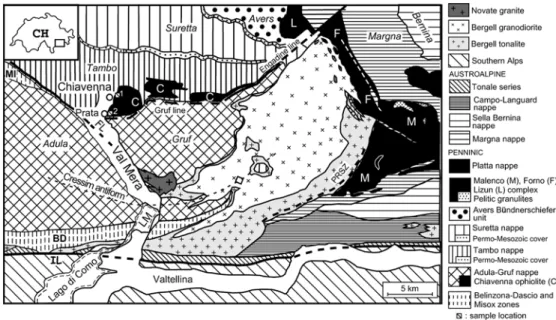
The area studied within the framework of the present paper belongs to the Chiavenna unit, Central Alps (Figs. 2 and 3), classically considered to belong to the Valais Ocean, in the prolongation of the so-called Misox zone (e.g., Schmid et al. 1996b). This zone is undoubt-edly considered to contain rocks of the Valais basin (see below). Here we present geochronological data on me-tabasic rocks from two localities of the Chiavenna unit: (1) close to the town of Chiavenna, and (2) close to the village of Prata (Fig. 3). Our aim was to determine the age of the protolith formation of the amphibolites, as well as their age of metamorphism, because the knowl-edge of the absolute time of magmatism and meta-morphism are very crucial for paleogeographic reconstructions. We applied the U–Pb ion microprobe dating (SHRIMP) technique to analyze magmatic and metamorphic zircon domains in sectioned zircon grains. In order to get information about the origin of zircons (e.g., magmatic, metamorphic) and to distinguish between the magmatic and metamorphic domains we used cathodoluminescence imaging of the zircon crystals selected for dating.
Fig. 1 Schematic profile from the European to the Adriatic plate (NW–SE) representing a model for the pre-orogenic situation in the area of the Central and Western Alps. This model is based on a series of radiometric data (mainly SHRIMP) for both protolith and metamorphic ages (see also text). Gray domains Continental crust; black domains oceanic crust; V Valais basin; Br Brianc¸onnais microcontinent; P-L Piemont–Ligurian basin; Se Sesia fragment; CaCanavese basin
Fig. 2 Map of the Western and Central Alps with the different paleogeographic units, summarizing the radiometric data for the protolith (numbers in regular fonts) and metamorphic ages (numbers in italics) of ophiolitic rocks from the Piemont–Ligurian basin and the Valais basin. Sm–Nd and Lu–Hf data are not included in this figure due to their inconsistencies (see text). The map is from Froitzheim et al. (1996). The internal massifs, Dora Maira, Gran Paradiso, and Monte Rosa, are given here as having a European provenance. This is based on a series of radiometric data (see summary by Gebauer 1999) and on a recent tectonic model by Froitzheim (2001). 1 Peters and Stettler (1987); 2 Bill et al. (1997); 3 Rubatto et al. (1998); 4 Liati and Gebauer (2001); 5 Stucki (2001); 6 Costa and Caby (2001); 7 Liati et al. (2002); 8 Schaltegger et al. (2002); 9 Rubatto and Hermann (2003); 10 Liati et al. (2003)
Geological setting
The Chiavenna unit is situated along the southeastern Swiss–Italian border. It is one of the four Penninic units that form a nappe stack in the Central Alps. These units are, from top to bottom and with increasing metamor-phic grade, the Suretta and Tambo nappes, the Chiav-enna unit, and the Gruf unit (Fig. 3). The ChiavChiav-enna unit consists mainly of metaperidotites, amphibolites, metagabbros, and rare carbonate rocks. It lies tectoni-cally above the Gruf unit to the south and below the Tambo nappe to the north (e.g., Wenk 1955; Froitzheim and Manatchal 1996; Schmid et al. 1996a). The Gruf unit consists of high-grade, upper amphibolite- to granulite-facies metamorphic rocks (migmatitic gneisses, metapelites, amphibolites, and calc-silicate marbles) and is thought to represent the southeastern continuation of the Adula nappe (see e.g., overview papers by Schmid et al. 1996a; Frey and Ferreiro-Ma¨hlmann 1999). This view was recently confirmed by geochronological data on felsic granulites from the Gruf unit (Liati and Gebauer 2002), which reveal a metamorphic age at 32.7±0.5 Ma, identical to ages for granulite-facies events of crustal and mantle rocks of the Adula–Cima Lunga nappe system (e.g., Alpe Arami or Cima di Gagnone; Gebauer 1994, 1996). The Tambo nappe, located between the overlying Adula nappe and the underlying Suretta nappe, consists mainly of paragneisses intruded by the Permian Truzzo granite (e.g., Gulson 1973; Marquer et al. 1998). It shows increasing metamorphic grade from middle greenschist-facies in the north to lower-middle amphibolite-greenschist-facies in the south-southeast.
Generally, the Chiavenna unit and, with less confi-dence, also the Bellinzona–Dascio zone, which is re-stricted to the Southern Steep Belt (a zone of steeply north-dipping foliated rocks bounded by the Insubric
line at its southern margin; Milnes 1974) have been considered to represent the Valais (north Penninic) su-ture zone (e.g., Schmid et al. 1996b). The mafic–ultra-mafic rocks of the Chiavenna unit were interpreted to represent an inverse ophiolite sequence (Schmutz 1974). They have also been considered as an ‘‘incomplete’’ ophiolite sequence, where subcontinental mantle rocks instead of typical oceanic lithosphere are tectonically exposed on an ocean floor and covered by tholeiitic N-type MORBs (Talerico 2001). Similarly, Huber and Marquer (1998) consider the mafic/ultramafic rocks of the Chiavenna unit as subcontinental to oceanic in ori-gin exposed along normal faults on a thinned conti-nental margin.
A progressive metamorphism under PT conditions ranging from 3–4 kbar, 520 °C in the north to tempera-tures up to 700°C in the south is suggested by Schmutz (1974). Also, Talerico (2001) suggests a progressive metamorphic evolution at temperature conditions vary-ing between ca. 500°C in the northern part and ca. 700 °C in the southern part of the Chiavenna unit. This latter author distinguishes a dynamic metamorphic event followed by a static thermal overprint related to the emplacement of the hot Gruf unit, which is known to have suffered up to granulite-facies conditions (e.g., summary of Huber and Marquer 1998). It cannot be excluded that the Chiavenna unit has undergone high-pressure meta-morphism prior to the amphibolite-facies overprint because of the presence of blueschists and eclogites in the Misox zone (considered as a prolongation of the Chiavenna unit to the north, probably representing the same oceanic suture), which record pressures of ca.11–13 kbar (Oberha¨nsli 1978; Heinrich 1983; Ring 1992). This possibility is strengthened by our petrographic observations of the amphibolites from the Chiavenna unit (see below, section Description of the samples dated). Fig. 3 Tectonic map with the
area of the Chiavenna unit, Central Alps, and surrounding tectonic units, showing the locations of the samples dated (map from Schmid et al. 1996a). FLForcola Line; IL: Insubric Line; PRSZ: Preda Rossa Shear Zone; MI: Misox zone; BD: Bellinzona–Dascio zone; LM: Lago di Mezzola
Existing radiometric data on Central and Western Alpine ophiolites
U–Pb, Sm–Nd, Lu–Hf, and Ar–Ar radiometric data for the crystallization and metamorphism of ophiolitic rocks are available for several areas of the Western and Cen-tral Alps (Fig. 2). Crystallization ages for rocks inter-preted to belong to the Piemont–Ligurian Ocean (e.g., Arosa zone, Platta nappe, Zermatt-Saas Fee, Monviso, Gets nappe) range mainly between 148±2 Ma in the Montgene`vre to 166±1 in the Gets Nappe (Peters and Stettler 1987; Bill et al. 1997; Rubatto and Gebauer 1999; Amato et al. 1999; Liati and Gebauer 2001; Costa and Caby 2001; Stucki 2001; Liati et al. 2002; Schal-tegger et al. 2002; Rubatto and Hermann 2003; Fig. 2). Radiometric ages of 148±3 and 141±6 Ma (U–Pb on zircon by SHRIMP) from two plagiogranites of the Bellinzona–Dascio zone are attributed to the Piemont– Ligurian Ocean and were interpreted to represent some of the youngest magmatic activity in this ocean (Stucki 2001). It should be mentioned that, however, the Bellinzona–Dascio zone has been attributed also to the ‘‘Valais Ocean and distal European margin’’ by Schmid et al. (1996b; their Plate 1), on structural grounds. Metamorphic zircon ages (SHRIMP) of 44.1±0.7 and 45±1 Ma are reported for the eclogite-facies metamor-phism in the areas of Zermatt and Mont Viso, respec-tively (Rubatto et al. 1998; Rubatto and Hermann 2003). For Zermatt, distinctly different Sm–Nd and Lu– Hf ‘‘ages’’ of 40.6±2.6 and 49.0±3.3 Ma, respectively, have been obtained for identical eclogite samples and, in both cases, interpreted to date UHP-metamorphism (Amato et al. 1999; Lapen et al. 2002). Even significantly different Sm–Nd ages were published for different sam-ples of the Zermatt–Saas ophiolites (49±4 Ma by Mayer et al. 1999 and 40.6±2.6 Ma by Amato et al. 1999) and in both cases interpreted to reflect (U)HP metamorphism. Earlier, imprecise Sm–Nd mineral data of 52±18 Ma were published by Bowtell et al. (1994) and were also interpreted to reflect the age of eclogite-facies metamorphism. Similar inconsistencies between and amongst Sm–Nd and Lu–Hf data on one side and the regionally consistent U–Pb SHRIMP data on the other side have been also published for the Piemont– Ligurian ophiolites of Monviso (49.1±1.2 Ma: Lu–Hf by Ducheˆne et al. 1997 and 60±12 Ma, resp. 62±9 Ma: Sm–Nd by Cliff et al. 1998 versus 45±1 Ma: U–Pb SHRIMP by Rubatto and Hermann 2003). The scatter of the Sm–Nd- and Lu–Hf-age data may be explained if one considers the problems with complete chemical dissolution of minerals and whole rocks (including spike equilibration) and especially with isotopic disequilib-rium between and amongst minerals and mineral inclu-sions during metamorphism. This applies especially for the common presence of for example pre-metamorphic, i.e., inherited and/or magmatic domains of zircon crys-tals. Such pre-metamorphic zircon domains carry a major or at least a considerable amount of the
whole-rock budget of, mainly, Hf and/or Nd that is unlikely to have equilibrated with other minerals during metamorphism(s). Based on the above discussion, we prefer here the SHRIMP data as most reliable, as there is also very good evidence (e.g., high-pressure inclusions) that they reflect (U)HP metamorphism (e.g., Rubatto et al. 1998; Rubatto and Hermann 2003).
Regarding the age of the Valais basin, paleontological data from the sedimentary cover, as well as structural data, suggest that it did not open before Late Jurassic– Early Cretaceous times (Frisch 1979; Stampfli 1993; Florineth and Froitzheim 1994; Steinmann 1994). Radiometric data are scarce. Preliminary SHRIMP U–Pb ages on magmatic domains of zircons from an eclogite of the Antrona ophiolites (considered as belonging to the Valais ocean; e.g., Froitzheim 2001) yielded scattered ages, clustering around 133 Ma (Liati and Gebauer 2001). An additional, more complete (SHRIMP) dataset, how-ever, on metabasic rocks from the northernmost, central, and southernmost parts of the Antrona ophiolites show that they are ca. 155 Ma old (Liati et al. 2003; see also summary of radiometric data in Fig. 2). Regarding the metamorphic age of the Antrona ophiolites, SHRIMP-data at 38.5±0.9 and 40.4±0.7 Ma are reported for amphibolitized eclogites in the Passo del Mottone area (Liati and Gebauer 2001) and immediately south of the Monte Rosa nappe (Bocchetta delle Pisse area; Liati et al. 2002; see also below and Fig. 2).
A series of 39Ar/40Ar amphibole data from various amphibolites of the Chiavenna unit are reported by Talerico (2001): edenite-poor amphiboles interpreted as ‘‘index minerals of an Eocene regional medium tem-perature metamorphism’’ gave 45–47 Ma. Various Mg-hornblendes gave an age range of 30–35 Ma interpreted to reflect a nearly static high-temperature thermal overprint ‘‘associated with regional thermal changes contemporaneous to the emplacement of the Masino– Bregaglia intrusions’’ (30–32 Ma).
Description of the samples dated
Five amphibolite samples were collected for dating from the Chiavenna unit, four of them ca. 300 m ENE of the town center of Chiavenna and one ca. 1.5 km ESE of Prata, along the Schiesone valley (Fig. 3). The amphib-olites sampled close to Chiavenna town are medium to fine grained and show a well expressed orientation of the minerals along the schistosity. The amphibolite collected in the area of Prata is coarse to medium grained and generally does not show a well-expressed mineral ori-entation. Its macroscopic textural appearance charac-terizes this rock as a metagabbro (see also Huber and Marquer 1998 and below, section CL patterns and morphology of zircons). Four out of these five amphibolite samples contained zircons.
The petrography and petrology of the Chiavenna unit have been studied in detail (Schmutz 1974; Tale-rico 2001). The same is true also for the geochemistry
of basic/ultrabasic rocks of this unit (Du¨rr et al. 1993; Talerico 2001). A detailed petrological and geochemi-cal study is beyond the scope of this paper. Here, we briefly comment on the petrography of the samples dated by SHRIMP. For comparison with the literature data, we also give whole-rock chemical analyses for major and trace elements of two amphibolite samples, one from Chiavenna and one from Prata (Table 1).
The amphibolites dated from the outcrop close to the town of Chiavenna consist mainly of hornblende and plagioclase. Their common mineral assemblage is hornblende–plagioclase–biotite–zoisite–sphene ± rutile–quartz ± apatite–opaques ± zircon. Fine inter-growths (symplectites) of amphibole + plagioclase
were observed inside diablastic hornblende, a charac-teristic feature commonly found in overprinted HP metabasites. No relics of the pre-existing mineral that gave rise to these symplectites are preserved. Worth mentioning is also the presence of rutile in these amphibolites. Rutile is commonly the Ti phase in high-pressure metabasites, according to empirical observa-tions and experimental data (e.g., Hellman and Green 1979), although it may be present also in amphibolites that have not been subjected to high-pressure meta-morphism. Although not a proof, the presence of rutile in the dated amphibolites of Chiavenna suggests that they may have seen higher pressure than that indicated by their current mineralogical composition. These observations may be considered as a hint to look in more detail for HP relics in the rocks of the Chiavenna unit, especially considering the fact that its northern prolongation, the Misox zone, contains blueschists and eclogites (Oberha¨nsli 1978; Heinrich 1983; Ring 1992). It may well be that the Chiavenna unit has been overprinted much stronger than the Misox zone, espe-cially in its southern parts, during the ca. 33 Ma old (Liati and Gebauer 2002) granulite-facies metamor-phism of the neighboring Gruf unit, possibly leading to almost complete obliteration of eventual high-pressure minerals and/or mineral textures. In addition, a 24–25 Ma old reheating and fluid event (Gebauer 1996; Liati et al. 2000) triggered by the emplacement of the Novate granite, to the south of the Chiavenna unit, may have contributed to destruction of subduction-related high-pressure relics.
Microscopic study of the Prata amphibolite shows that it is a coarse- to medium-grained rock with some leucocratic (plagioclase-rich) parts containing coarser grained hornblende. It consists mainly of hornblende and plagioclase, roughly in equal amounts. Opaque minerals, probably ilmenite ± magnetite, are abundant. Minor amounts of biotite, quartz, rutile, and zircon are also present.
Chemical analyses of two amphibolites (one close to Chiavenna town and one close to Prata; Fig. 3) are given in Table 1. The Prata amphibolite shows textural characteristics indicative of a gabbroic precursor (see above). The whole-rock analyses of major and trace elements by XRF were performed at the Mineralogy and Petrology Institute, University of Bonn. Both samples show absolute major and trace element abun-dances closely resembling those of mid-ocean ridge basalts. This is mainly true for the so-called incom-patible ‘‘immobile’’ elements, such as Ti, P, Zr, Y, Nb (compare with Saunders and Tarney 1984; Hofmann 1988; Sun and McDonough 1989). Previous studies showed that the protoliths of the amphibolites of the Chiavenna unit are tholeiitic in composition with N-type MORB affinities (Du¨rr et al. 1993; Talerico 2001). The bulk chemistry of the dated samples, therefore, is in agreement with geochemical data reported for this unit in the literature, which indicate an oceanic setting of formation.
Table 1 Whole-rock analyses of amphibolites from the unit of Chiavenna, close to Ciavenna town (CHI6) and close to Prata (PRA1). FeO* Total Fe as FeO
CHI6 PRA1 wt% SiO2 49.11 49.12 TiO2 1.38 1.55 Al2O3 15.96 16.65 FeO* 9.31 10.22 MnO 0.18 0.17 MgO 8.73 8.38 CaO 10.95 9.68 Na2O 2.93 3.44 K2O 0.20 0.24 P2O5 0.10 0.06 SO3 0.01 0.01 LOI 0.94 1.5 Total 99.80 101.03 M-value 51 48 (ppm) Rb 8 15 Sr 152 192 Ba 46 65 Sc 31 35 Y 32 33 Zr 84 98 Nb 3 7 Cr 326 306 Ni 78 107 Co 69 93 Pb 3 3 V 256 275 Cu 25 47 Zn 78 116 Ga 16 15 As 4 4 Mo 2 2 Sn 7 17 La 5 5 Ce 6 6 Pr 3 3 Nd 3 3 Sm 3 3 Hf 2 4 Ta 2 9 W 191 299 Bi 3 3 Th 9 3 U 2 3
Dating technique and data evaluation SHRIMP II
The age data were obtained on SHRIMP II at the Geological Survey of Canada (GSC) in Ottawa and at the Research School of Earth Sciences (RSES), The Australian National University (ANU), Canberra. The spot size used for analysis was about 20 lm, with a few exceptions where a ca. 10 lm spot was used because of the very small size of some zircon crystals and domains. For data collection, seven scans through the critical mass range were made. U/Pb ratios at the GSC were calibrated relative to standard BR266, which is a piece of a Sri Lankan gem-quality zircon (see Stern and Amelin 2003). For the samples analyzed at ANU, U/Pb ratios were calibrated relative to AS3 reference zircon (Paces and Miller 1993), while U and Th concentrations were cal-culated relative to SL13 (e.g., Compston et al. 1992; Williams 1998).
Cathodoluminescence (CL) imaging
All CL-pictures were taken from a split screen on a CamScan CS 4 scanning electron microscope (SEM) at ETH in Zu¨rich operating at 13 kV. The SEM is equipped with an ellipsoidal mirror that is located close to the sample within the vacuum chamber and that can be adjusted by electro-motors. The sample, thus, can be located in one focal point while the second focal point lies outside the sample chamber. Here, the CL light enters a highly sensitive photo multiplier through a quartz glass-vacuum window and a light channel. The signal of the photo multiplier is then used to produce the CL picture via a video-amplifier. Secondary electron (SE)-pic-tures were produced simultaneously with the CL pic(SE)-pic-tures using a different detector. In general, weak CL emission (dark colors in the picture) means high amounts of minor and trace elements; strong CL emission (light colors in the picture) means low amounts of minor and trace elements, including U (e.g., Sommerauer 1974). Thus, the U contents can be qualitatively predicted via CL.
Data evaluation
Data were corrected for common Pb using the 204Pb
207
Pb and208Pb correction method (see Williams 1998). Although the resulting ages are identical within error limits, we finally use the207Pb correction for the zircons of young age. Because this correction is based on the assumption of concordance, the data are graphically presented on Tera–Wasserburg (TW) diagrams (Tera and Wasserburg 1972), where total 207Pb/206Pb vs. the calibrated total 238U/206Pb is plotted. This diagram has also the advantage of fast estimation of the amount of common lead of the individual analyses, directly from the plot. The amount of common Pb was calculated using the isotope composition of common Pb obtained from the model of Cumming and Richards (1975). The ages of the inherited zircons (Paleozoic and older) are given as 204-corrected 206Pb/238U ages for analytically concordant data and as 204-corrected 207Pb/206Pb ages for analytically discordant data (Table 2). The
207
Pb/206Pb ages are minimum ages for the magmatic formation of these oscillatory zoned domains.
For the weighted mean age calculations, as well as for the diagrams presented in this paper, the Isoplot/Ex computer program (version 2.4) was used (Ludwig
2000). Errors on the weighted mean ages in Table 2, text, and figures are given at the 95% confidence level. For single analyses (Table 2), 1r errors are given.
CL-patterns and morphology of zircons
Amphibolites near Chiavenna town (CHI3, CHI4, CHI5, CHI6)
One of the Chiavenna amphibolite samples (CHI5) contained no zircons. In samples CHI3 and CHI4, the zircons are small (typically ca. 50 lm long and ca. 30 lm wide; two grains are a little bigger: ca. 90 lm long and ca. 50 lm wide). Three grains of sample CHI4 consist of a single domain with a relatively homogeneous CL pattern, interpreted as entirely metamorphic (Fig. 4C). All other zircon grains are oscillatory zoned, indicating that they precipitated in a melt. These oscillatory zoned zircons proved to be all inherited, as evidenced by the SHRIMP-ages, which were different for each crystal analyzed (see below). This was the case also for sample CHI3. In sample CHI6, the zircon grains are also rela-tively small, prismatic (80–100 lm long and 60–70 lm wide), and more or less euhedral. Two zircon grains of this sample consist, to a large extent, of a single oscil-latory zoned domain surrounded at the outermost parts by a very thin (a few micrometers broad) metamorphic rim, bright in CL (e.g., Fig. 4A). One grain consists of an inner (inherited) core surrounded by a relatively broad oscillatory domain of magmatic origin and at the outermost part a very thin CL-bright metamorphic rim (Fig. 4B). The CL oscillatory pattern of the zircons of sample CHI6 is interpreted as co-magmatic. The rela-tively small size of the zircon crystals can be considered as an indication that the protolith of this amphibolite was rather a sub-volcanic rock or a dyke (e.g., dolerite or fine-grained gabbro) where zircons could not grow large in the relatively rapidly cooling basic melt.
Amphibolite near Prata (metagabbro, PRA1)
Sixteen zircon crystals were recovered from the amphibolite near Prata. They are relatively large, pris-matic (usually between 100 and 350 lm long and 50 and 100 lm wide), and more or less euhedral. The majority of them consist largely (sometimes almost entirely) of an oscillatory zoned, magmatically formed domain sur-rounded by a very thin metamorphic rim, bright in CL (Fig. 5A, B). Where this rim gets broader, one can dis-tinguish two rim domains, probably corresponding to different ‘‘generations’’: an inner, CL-brighter and an outer CL-darker rim (e.g., Fig. 5C, upper part of crys-tal). For a few grains this composite metamorphic rim was broad enough to fit a SHRIMP spot. It was, how-ever, not possible to analyze each individual rim ‘‘gen-eration’’ separately. The crystal size, in combination with the relatively euhedral shape of the zircons, are in
Table 2 U, Th, Pb SHRIMP data for co-magmatic, inherited and metamorphic zircons from the Chiavenna and Prata amphibolites (Chiavenna unit, Central Alps). WM Weighted mean; error on WM is given at the 95% confidence level. Uncertainties are given at the 1r level. Analyses in italics are not considered for the WM calculation (see text). For sample PRA1 two weighted mean ages
are calculated: one considering analyses 27–32 and one assuming Pb-loss for analyses 28, 30, 32 (see text). The ages for analyses 10– 13 are 204-corrected207Pb/206Pb ages; those for analyses 9, 18, and
49 are 204-corrected206Pb/238U ages (see text, section Data eval-uation). The complete dataset is available by the authors upon request
Sample U Th Th/U rad.Pb f206a 238U/206Pb 207Pb/206Pb Age
(ppm) (ppm) (ppm) (1r) (1r) (Ma) Uncorrected Uncorrected 206Pb/238U Chiavenna amphibolites Co-magmatic domains 1. CHI6-4.1 872 334 0.40 13 0.01 68.21±1.37 0.05657±0.0007 92.8±1.9 2. CHI6-3.1 881 257 0.30 12 0.04 66.51±1.39 0.0827±0.0017 92.0±1.9 3. CHI6-3.2 628 246 0.41 10 0.02 66.45±1.46 0.0611±0.0024 94.7±2.1 4. CHI6-2.1 781 225 0.30 11 0.01 69.07±1.62 0.0520±0.0007 92.2±2.2 5. CHI6-4.3 1263 679 0.56 21 0.00 64.52±1.49 0.0506±0.0005 98.83±2.3 6. CHI6-3.3 793 113 0.15 9 0.23 70.45±5.83 0.2321±0.0062 69.7±5.8 WM: 93.0±2.0 Ma Inherited domains 7. CHI6-1.1 8,080 1,734 0.22 304 0.00 25.66±1.07 0.0510±0.0014 247±10 8. CHI6-1.2 1,550 316 0.21 63 0.00 23.53±0.91 0.0531±0.0007 268±10 9. CHI6-4.2 454 140 0.32 43 0.00 10.50±0.24 0.0593±0.0003 586±13 10.b CHI3-B1.1 2,042 57 0.03 200 0.00 4.564±0.049 0.1374±0.0005 2,189±6 11.b CHI3-3.1 88 66 0.75 18 0.01 3.067±0.054 0.1239±0.0012 1,987±19 12.b CHI3-4.1 1,647 38 0.02 94 0.01 8.989±0.118 0.1525±0.0019 2,358±23 13.b CHI3-5.1 577 648 1.12 34 0.01 11.48±0.14 0.0628±0.0008 660±31 14.b CHI3-2.2 800 647 0.81 46 0.00 16.58±0.23 0.0570±0.0011 376±5 15.b CHI3-1.1 2,333 298 0.13 71 0.00 17.11±0.20 0.0548±0.0007 366±4 16.b CHI3-1.2 3,860 37 0.01 82 0.01 23.19±0.32 0.0526±0.0003 272±4 17.b CHI3-1.3 3,828 32 0.01 127 0.02 22.99±0.30 0.0548±0.0007 274±4 18.b CHI4-B1.1 399 314 0.79 56 0.00 4.931±0.059 0.0824±0.0006 1,190±13 Metamorphic domains 19. CHI4-1.1A 30 0.3 0.01 0 0.03 163.44±4.59 0.0739±0.0047 38.1±1.1 20. CHI4-1.2 30 0.4 0.02 0 0.03 168.23±3.97 0.0717±0.0057 37.1±0.9 21. CHI4-4.1 13 0.1 0.01 0 0.23 133.58±4.09 0.2371±0.0114 37.3±1.3 22. CHI4-4.2 24 0.4 0.02 0 0.07 164.54±13.94 0.1044±0.0061 36.4±3.1 23. CHI4-4.3 9 0.1 0.01 0 0.18 143.30±3.59 0.2016±0.0121 36.7±1.1 24.b CHI4-1.1 34 0 0.01 0 0.13 154.49±9.03 0.1481±0.0125 36.3±2.2 25.b CHI4-5.1 228 2 0.01 1 0.07 162.72±4.96 0.1025±0.0079 36.7±1.2 WM: 37.1±0.9 Ma Prata amphibolite Co-magmatic domains 26. PRA1-11.1 1,338 777 0.60 21 0.00 68.56±1.01 0.0485±0.0007 93.3±1.4 27. PRA1-8.4 1,900 2,023 1.10 32 0.00 72.88±1.65 0.0498±0.0004 87.6±2.0 28. PRA1-8.5 447 118 0.27 6 0.01 67.45±1.09 0.0518±0.0006 94.4±1.5 29. PRA1-8.6 989 391 0.41 14 0.01 71.64±1.23 0.0511±0.0004 89.0±1.5 30. PRA1-8.1 1,093 428 0.40 16 0.01 66.76±1.34 0.0592±0.0012 94.5±1.9 31. PRA1-8.3 995 356 0.37 14 0.00 70.91±1.03 0.0479±0.0003 90.3±1.3 32. PRA1-11.2 2,597 1,834 0.73 39 0.00 73.63±1.40 0.0486±0.0008 86.9±1.6
WM of analyses 26–31:91.6±2.8 Ma; WM excluding analyses 27, 29, 31, 32:93.9±1.8 Ma Inherited domains 33. PRA1-4.1 604 167 0.29 26 0.01 22.91±0.45 0.0609±0.0007 272±5 34. PRA1-5.1 346 205 0.61 18 0.01 21.08±0.39 0.0623±0.0018 295±5 35. PRA1-7A.1 283 124 0.45 14 0.00 21.21±0.36 0.0540±0.0008 296±5 36. PRA1-7B.1 575 182 0.33 24 0.00 23.89±0.38 0.0536±0.0003 264±4 37. PRA1-7C.1 164 48 0.31 7 0.00 22.08±0.42 0.0530±0.0008 285±5 38. PRA1-2.1 304 75 0.26 12 0.00 25.47±0.41 0.0551±0.0008 247±4 39. PRA1-4.2 280 95 0.35 10 0.00 27.77±0.42 0.0518±0.0005 228±3 40. PRA1-5.2 279 116 0.43 13 0.00 21.67±0.35 0.0520±0.0004 291±5 41. PRA1-1A.1 2,259 520 0.24 107 0.00 20.55±0.36 0.0523±0.0005 306±5 42. PRA1-9.1 308 114 0.38 12 0.03 25.67±0.35 0.0668±0.0005 242±3 43. PRA1-3.1 338 193 0.59 16 0.00 23.25±0.34 0.0544±0.0006 271±4 44. PRA1-10.1 4,650 68 0.02 171 0.00 24.61±0.40 0.0517±0.0005 257±4 45. PRA1-12B.1 2,000 323 0.17 80 0.00 23.78±0.52 0.0515±0.0009 266±6 46. PRA1-1B.1 276 106 0.40 10 0.01 26.36±0.85 0.0556±0.0017 239±8 47. PRA1-11.3 5,046 412 0.08 191 0.00 24.53±0.50 0.0505±0.0005 258±5 48. PRA1-11.4 2,435 109 0.05 87 0.00 25.61±1.86 0.0524±0.0020 247±18 49. PRA1-12A.1 358 366 1.06 43 0.00 10.00±0.40 0.06120±0.0017 614±23
line with a gabbroic origin of this rock because such large co-magmatic zircons are very unlikely to grow from rapidly cooling basaltic melts.
SHRIMP results and interpretation
The SHRIMP results are listed in Table 2.
Amphibolites close to Chiavenna town
Nine data points were obtained from the four zircon grains of the amphibolite CHI6. Five of them are from the oscillatory zoned, co-magmatic domains, three from inherited domains, and one is a mixed analysis of the narrow, CL-bright metamorphic rim (analysis 6) and the neighboring older core (Fig. 4A). On a Tera–Wasser-burg diagram, four analyses from the co-magmatic domains plot along a mixing line with common Pb and
calibrated total 238U/206Pb as end members (Fig. 6A). They yield a weighted mean 206Pb/238U age at 93.0±2.0 Ma (MSWD: 0.35; error at 95% c.l.), which is interpreted as the age of crystallization of the magmatic (doleritic?) protolith. Analyses 5 and 6 of Table 2 were not considered for the weighted mean age calculation because, as shown by post-SHRIMP CL studies, the analyzed spot clearly touches two different neighboring domains thereby yielding mixed ‘‘ages’’ (Fig. 4A: left-most spot; 4B: lowerleft-most spot). Two SHRIMP analyses on another grain yielded238U/206Pb ages of 247±10 and 268±10 Ma (error: 1r) indicating that this grain is inherited. Finally, the core domain of grain 4 (Table 2, analysis 9) yielded a Precambrian age (587±13 Ma, 1r). Our attempts to date the protolith age of the amphibolite samples CHI3 and CHI4 failed: we ob-tained different (apparent) ages (Proterozoic to Triassic; Table 2) from all zircon grains, which are obviously all inherited. This is an additional indication that the pro-toliths of these amphibolites were rather subvolcanic rocks or basalts (see also above, section CL patterns and morphology of zircons). The distribution of ages ob-tained from the inherited zircon grains or domains of the amphibolites near Chiavenna town are shown in the histogram of Fig. 7.
Seven analyses on three different entirely metamor-phic zircon grains from sample CHI4 are plotted on the TW diagram of Fig. 6B. The data plot along a mixing line with common Pb and calibrated total238U/206Pb as end members intersecting the concordia at a weighted mean 238U/206Pb age of 37.1±0.9 Ma (MSWD: 0.21), Fig. 4 Cathodoluminescence (CL) pictures of two co-magmatic
zircon crystals (A, B) and one entirely metamorphic zircon crystal (C) from the amphibolites of Chiavenna. As shown in pictures A and B, zircons consist essentially of magmatic, oscillatory domains. In A, a CL-bright metamorphic rim, getting broader on the middle left side of the crystal, can be seen. The SHRIMP-spot was located on both the metamorphic and the magmatic domain of the crystal and, therefore, yielded a mixed ‘‘age’’ of 69.7±5.8 Ma. In B, the lowermost spot slightly touches an old (Precambrian) inherited core and, therefore, yields a mixed ‘‘age’’ of 98.8±2.3 Ma, which is a little older than the ca. 93-Ma co-magmatic domain
Table 2 (Contd.)
Sample U Th Th/U rad.Pb f206a 238U/206Pb 207Pb/206Pb Age
(ppm) (ppm) (ppm) (1r) (1r) (Ma) Uncorrected Uncorrected 206Pb/238U Metamorphic domains 50. PRA1-12A.2 807 4 0.01 3 0.05 187.94±3.69 0.0636±0.0009 33.5±0.7 51. PRA1-9.2 576 113 0.20 3 0.07 198.30±2.92 0.0951±0.0020 30.4±0.5 52. PRA1-3.3 108 27 0.26 0 0.27 189.48±4.02 0.1794±0.0091 28.2±0.7 53. PRA1-3.4 155 33 0.22 1 0.03 197.56±4.94 0.1628±0.0065 27.8±0.7
af206denotes the percentage of206Pb that is common Pb. b
interpreted as the age of metamorphism. This age is within error identical to the 38.5±0.9 Ma age of meta-morphism reported for an amphibolitized eclogite of the Antrona ophiolites, at Passo del Mottone (Liati and Gebauer 2001).
Amphibolite close to Prata (metagabbro, PRA1) Twenty-eight analyses were obtained from 16 different zircon grains recovered from this rock. Seven of them are from the youngest oscillatory zoned, co-magmatic domains. On a TW diagram (Fig. 8), six analyses plot along a mixing line (dashed line) with common Pb and calibrated total 238U/206Pb as end members. One anal-ysis plots on the right side of this mixing line (dashed ellipse), probably due to Pb loss attributed to subsequent metamorphism(s). The weighted mean age of the six analytically concordant spots is 91.6±2.8 Ma (error at 95% c.l.) and has excess scatter (MSWD: 3.1). It is interpreted as the time of crystallization of the gabbroic protolith. This age is identical to that obtained for the formation of the protolith of the amphibolite close to the town of Chiavenna. Although all spots considered here for the weighted mean age calculation overlap within limits of error and fit statistically on a single mixing line (Fig. 8, dashed line), it is possible that three analyses (27, 29, and 31 of Table 2; gray ellipses of Fig. 8) may show minor lead loss during subsequent metamor-phism(s). If this is true, the three remaining analyses
(the three left-most ellipses in Fig. 8; analyses 26, 28, and 30 of Table 2) yield a weighted mean age at 93.9±1.8 Ma (with no excess scatter; MSWD: 0.21) instead of the above obtained 91.6±2.8 Ma. Although Fig. 5A–C Cathodoluminescence (CL) pictures of zircon crystals
from the metagabbro of Prata (Chiavenna unit). Crystal A consists of an entirely oscillatory domain interpreted as co-magmatic, surrounded by a very thin metamorphic rim, bright in CL. Crystal B consists of an inherited, Permian core surrounded by a co-magmatic, Late Cretaceous domain, which is in turn surrounded by a very thin, outermost metamorphic rim, bright in CL. Note that the uppermost right spot age at 86.9±1.6 Ma is likely to be a result of Pb loss, probably due to its position at the outermost part of the crystal. Crystal C consists of an inherited Proterozoic core and a metamorphic rim. Note that the metamorphic rim consists of an inner CL-brighter and an outer CL-darker domain, probably formed during distinct metamorphic/fluid events (see text). The analyzed rim spot lies on both generations of metamorphic domains, thus yielding a mixed metamorphic "age". The dashed linein B and C is drawn to outline the crystal limits
Fig. 6 Tera–Wasserburg diagrams with data of zircons from two amphibolites of Chiavenna. In A four analyses from the co-magmatic, oscillatory zoned zircon domains plot along a mixing line with common Pb (composition from the model of Cumming and Richards 1975) and 238U/206Pb as end members, intersecting the concordia curve at 93.0±2.0 Ma. In B seven analyzed spots from metamorphic domains are plotted. They intersect the concordia curve at 37.1±0.9 Ma, thus indicating a major fluid/ metamorphic event at that time (see text). Errors on the ellipses are 2r. WM Weighted mean; error on the weighted mean is given at the 95% confidence level
both weighted mean ages are identical within error limits, we prefer the higher because of its more precise weighted mean age and because we consider minor Pb loss as a very likely scenario (see above).
Sixteen analyses from inherited magmatic domains of the Prata amphibolite yielded a few Carboniferous, but mainly Permo-Triassic ages ranging from 306±5 to 228±3 Ma (1r; Table 2; Figs. 7 and 9). These largely Permo-Triassic ages found in the inherited zircons are probably correlated with mantle-melting (metasomatic/ metamorphic) events due to the well known late-and post-Hercynian rifting episodes (see summary by Schaltegger and Gebauer 1999). The Wetherill
concordia diagrams of Fig. 9, which include mainly Permo-Triassic and few Upper Carboniferous zircon analyses, show the existence of both concordant (over-lapping ellipses referring to analyses on the same zircon grains) and at least partly discordant (not overlapping ellipses) ages in the time range between ca. 305 and ca. 228 Ma, for two amphibolites close to the town of Chiavenna (samples CHI3 and CHI6) and one close to Prata (sample PRA1). It is interesting that we have not obtained any (apparent) ages between ca. 230 and ca. 93 Ma from these zircons (Figs. 7 and 9). The lack of data in this time range (230–ca. 93 Ma) strengthens the view that the Permo-Triassic ages are related to rifting processes and not to variable Pb loss during Eocene metamorphism and Oligocene overprinting, in which case one would expect scattering between ca. 230 and ca. 93 Ma. Very similar observations have previously been made for zircons from mainly felsic Hercynian rocks of various parts of the Central and Western Alps (e.g., Fig. 7 Age distribution of inherited zircons and zircon domains
from the amphibolites of Chiavenna and Prata. A high age concentration is observed between 220 and 300 Ma, probably due to mantle melting episodes related to rifting processes at that time (see text)
Fig. 8 Tera–Wasserburg diagram with data of zircons from the amphibolite of Prata (metagabbro). Six analyses from the co-magmatic, oscillatory zoned zircon domains plot along a mixing line (dashed line) with common Pb (composition from the model of Cumming and Richards 1975) and 238U/206Pb as end members, intersecting the concordia curve at 91.6±2.8 Ma. One spot (dashed ellipse) plots to the right side of the mixing line, due to Pb loss. Three spots (gray filled ellipses) may have also suffered Pb loss. If these three spots are omitted, a more precise weighted mean age of 93.9±1.8 Ma is obtained (see also text)
Fig. 9 Concordia diagrams of inherited, mainly Permo-Triassic zircon domains from the amphibolites of Chiavenna A and Prata B showing possible Pb-loss from ca. 305 down to 228 Ma. Both concordant ages (e.g., CHI6: crystal 1, CHI3: crystal 1 in 9A or crystals 5 and 11 in 9B) and discordant ages (crystal 4 in 9B) are identified. Gray ellipses of 9B correspond to analyses on different crystals. They may be related to rifting episodes as young as ca. 230 Ma known from other areas of the Alps (see text)
summary by Schaltegger and Gebauer 1999). Moreover, the existence of a large number of inherited zircons (Fig. 7) in the amphibolite of Prata and in those of Chiavenna (CHI3, CHI4) strongly favors the proximity of the Chiavenna unit to continental crust. Therefore, an origin of the ‘‘ophiolites’’ from stripped subcontinental mantle sources, rifted in the Permo-Triassic and suc-cessively exposed during progressive Mesozoic ocean-ization, already suggested for certain rocks by Huber and Marquer (1998) and Talerico (2001), is supported by our data mainly on the metagabbro of Prata.
Huber and Marquer (1998), in their paleogeographic interpretation for the Chiavenna unit, suggested that the Chiavenna metagabbros intruded near the mantle–crust boundary before the Mesozoic extension. Our new SHRIMP data on co-magmatic and inherited zircons from both types of amphibolites at Chiavenna and Prata (section Description of the samples dated) partly support this hypothesis: the presence of large amounts of Permo-Triassic oscillatory zircons and zircon domains mainly in the metagabbro of Prata indicates partial mantle melting episodes at that time, indirectly implying the presence of gabbroic intrusions near the crust-mantle boundary, associated to Permo-Triassic rifting. However, the assumption of the above authors that the ‘‘overlying basalts’’ are related to the first stages of the Valais Ocean opening is not confirmed by our data. In fact, these fine-grained, layered amphibolites, at least for the samples dated, which do not derive from basalts but from intrusive rocks (e.g., dolerites or fine-grained gabbros: sample CHI6 and gabbros: sample PRA1) rather reflect late stages of formation of Valais Oceanic crust. This follows from the presence of co-magmatic ca. 93 Ma old zircons that would not crystallize in rapidly cooled basalts.
As for the age of metamorphism of the Prata meta-gabbro, it was possible to obtain four analyses from three metamorphic rims due to the very few available metamorphic domains. They yielded Oligocene ages of 28.2±0.7, 27.8±0.7, 33.5±0.7, and 30.4±0.5 Ma (1r). According to the post-SHRIMP CL study, all spots are located within composite (poly)metamorphic rims con-sisting of two types of metamorphic domains (a CL-darker and a CL-brighter domain; e.g., Fig. 5C). This indicates that the rock was affected by at least two metamorphic/fluid events at different times. Therefore, the metamorphic ages that we obtained from these composite rims are mixed ages. Although these data cannot provide precisely the time of each metamorphic event or episode, they indicate that the last metamor-phic/fluid event should have taken place after 27.8±0.7 Ma, the youngest ‘‘age’’ obtained by the composite metamorphic rims. The most likely age of the post-27.8 Ma metamorphic domains is 24–25 Ma, which corresponds to the time of intrusion of the Novate granite (Liati et al. 2000) and to the age of numerous pegmatite dykes in the southern steep belt that caused considerable fluid flow and reheating (e.g., Gebauer 1996). Similarly, the 33.3±0.7 Ma mixed analysis gives a minimum age for the older metamorphic domain. The
most likely age of this metamorphic domain is 37.1±0.9 Ma, the age of the first regional metamor-phism of the Chiavenna unit (see above). Of course, a ca. 33 Ma metamorphic event related to the granulite-facies metamorphism in the neighboring Gruf complex may also have played a role for the post-37.1±0.9 Ma old overprints. Such a scenario may well explain the numerous multigrain 39Ar/40Ar data of Talerico (2001) obtained from different hornblende mixtures containing hornblende of different chemical compositions. Al-though there is a concentration of ages of hornblende mixtures in the range 30 to 35 Ma, there are also step ages below 30 Ma and a concentration of ages at 45– 47 Ma. These older ages are not supported by the SHRIMP-data and we interpret them as a result of excess Ar often found in metamorphic terranes, espe-cially in HP rocks (e.g., Kelley et al. 1994). For the data of Talerico (2001) that are below 35 Ma, we think that inherited Ar and/or mixing of different hornblende generations and domains are the most plausible causes for the observed data scatter.
Geodynamic implications and discussion
The ca. 93 Ma (Late Cretaceous) age obtained for the time of crystallization of the magmatic protoliths of the amphibolites from the Chiavenna unit, Central Alps, record the youngest oceanic magmatism ever reported in the Alps. These amphibolites occur in a unit including abundant mafic/ultramafic rocks with oceanic (MORB) geochemical affinities (Du¨rr et al. 1993; Talerico 2001), interpreted earlier as remnants of (also) ophiolitic origin (Schmutz 1974; Huber and Marquer 1998; Schmid et al. 1997). In the following, we discuss the different aspects and geodynamic implications resulting from the new protolith and metamorphic ages obtained in this study and compare them with previous age data on oceanic rocks from the North-Penninic, Valais Ocean.
As mentioned in the Introduction several models have been proposed for the paleogeographic recon-struction and geodynamic evolution of the Alps (see e.g., summary by Escher et al. 1997; Froitzheim 2001). Here, we describe briefly the model based mainly on a series of geochronological data obtained over the last ca. 10 years in key areas of the Alps. This model involves generally the existence of successive subduction/collision episodes propagating from SSE to NNW direction (see e.g., Rubatto et al. 1998; Gebauer 1999). The main geotectonic domains involved in this scheme are, from south to north, the Adriatic plate (including the South-ern Alps and thinned continental margins, such as the Sesia zone, and the Austroalpine nappes), the Piemont– Ligurian Ocean, the Brianc¸onnais microcontinent (a peninsula connected to Iberia), the Valais Ocean and, finally, the European plate (Fig. 10). In these different paleogeographic domains, peak metamorphic ages get younger from the SSE to the NNW, i.e. from the Sesia zone in the south (subduction at ca. 65 Ma) through the
oceanic Piemont–Ligurian metamorphic rocks (subduc-tion at ca. 44–45 Ma), the oceanic Valais metamorphic rocks (high-pressure and following amphibolite grade metamorphism between ca. 40–37 Ma) to the European margin (high-pressure and subsequent granulite- and amphibolite-grade metamorphism between ca. 35– 31 Ma; for details and references see Fig. 10 and Gebauer 1999). This model is in agreement with the paleogeographic origin of the above mentioned units, as well as with lithological and structural evidence (e.g., Froitzheim 2001).
The 37.1±0.9 Ma metamorphic age obtained for the amphibolites of the Chiavenna unit is within error identical to the 38.5±0.9 Ma age reported for HP-metamorphism related to subduction of the Valais Ocean (Fig. 2; Antrona ophiolites: area of Passo del Mottone; Liati and Gebauer 2001). Subduction of oce-anic crust to (U)HP conditions in the Piemont–Ligurian Ocean is reported at ca. 44–45 Ma (Rubatto et al. 1998; Rubatto and Hermann 2003). Another published Sm–Nd age of 40.6±2.6 Ma (Amato et al. 1999) and a Lu–Hf age of 49.0±3.3 Ma (Lapen et al. 2002) are interpreted here to be the result of the lack of isotopic homogenization and/or mixing of real and apparent ages of different mineral components (see also the sec-tion Existing radiometric data on Central and Western ophiolites above and Rubatto and Hermann 2003). Therefore, based mainly on its metamorphic age, the Chiavenna unit is considered to be part of the Valais domain, in agreement with previous geological argu-ments (see the Introduction).
Regarding the age of ca. 93 Ma obtained for the protoliths of two amphibolites of the Chiavenna unit and how this age relates to the time of formation of the Valais oceanic crust, an overview of the literature data reveals the following: opening of the northern part of the
Central Atlantic during the Late Jurassic caused west-ward drift of Iberia, Sardinia, Corsica and the Brianc¸-onnais peninsula relative to the northern Eurasian plate (e.g., Frisch 1979; Stampfli 1993, his Fig. 8 or Rosen-baum et al. 2002). As a result of this westward motion, the Valais Ocean started to open north of the eastwards developing Brianc¸onnais peninsula, at least partly within existing Jurassic Piemont–Ligurian oceanic crust (Stampfli 1993). According to kinematic models by e.g., Srivastava et al. (1990), Malod and Mauffret (1990), Sibuet and Colette (1991), or Gradstein et al. (1994), spreading in the Valais Ocean lasted from the Barremo– Aptian (beginning of Barremian: ca. 116 Ma) to the Albo–Cenomanian (end of Cenomanian: ca. 91 Ma). Thus, the ca. 93 Ma ages obtained for the crystallization time of the mafic protoliths of the Chiavenna unit would represent late stages of spreading in the Valais Ocean.
The abundance of inherited zircons of variable ages (mainly Permo-Triassic, but also Carboniferous, Cam-brian, and Proterozoic) within the investigated rocks indicates Late Cretaceous (93 Ma) partial mantle melting within subcontinental mantle or generally MORB-type mantle close to a continental margin. This finding supports further the view that the Chiavenna rocks formed close to a thinned continental crust and, therefore, originated from stripped subcontinental mantle, tectonically exposed during progressive ocean-ization (compare Huber and Marquer 1998; Talerico 2001).
Of high importance is also the protolith age of 93.4±1.7 Ma (identical to our 93.0±2.0 and 93.9 ±1.8 Ma protolith ages) and HP-metamorphic age of 40.4±0.7 Ma (comparable to our metamorphic age of 37.1±0.9 Ma) reported for an amphibolitized eclogite associated with ultramafic rocks in the Western Alps, at the southern tectonic contact to the Monte Rosa nappe (Bochetta delle Pise area, Fig. 2; Liati et al. 2002). This rock comes from a tectonic unit newly defined on structural grounds (named ‘‘Balma unit’’; Froitzheim, personal communication), interpreted to belong to the Valais Ocean, based on the paleogeographic recon-struction of Froitzheim (2001). This interpretation is strengthened by the 40.4±0.7 Ma age of HP-metamor-phism of this 93.4±1.7 Ma old amphibolitized eclogite, which strongly argues for subduction of the Valais, and not of the Piemont–Ligurian oceanic crust, for which peak metamorphic conditions were dated at 44–45 Ma (Rubatto et al. 1998; Rubatto and Hermann 2003). Therefore, the ca. 93 Ma oceanic magmatism is not re-stricted to the Valais domain in the Central Alps, but is more widespread in the Alpine orogen.
Besides the above mentioned ca. 93 Ma old protolith-and ca. 37–40 Ma old metamorphic ages, other recently obtained SHRIMP-data from areas generally accepted to belong to the Valais domain (metabasic rocks from the northernmost, central, and southernmost parts of the Antrona ophiolites; see data summarized in Fig. 2) yielded amphibolite protolith ages at ca. 155 Ma (Liati et al. 2003). These ca. 155 Ma ages are in contradiction Fig. 10 Schematic profile from the European to the Adriatic plate
(NW–SE) representing a model for the pre-orogenic situation in the area of the Central and Western Alps. This model is based on a series of radiometric data (mainly SHRIMP) for both protolith and metamorphic ages. Numbers on black background are protolith ages for ophiolitic rocks. Numbers on gray background are metamorphic ages: numbers in black refer to amphibolite facies ages, those in whiterefer to HP stages of metamorphism. Radiometric data are as follows: for the European margin they include Alpe Arami (Gebauer 1996), Dora Maira (Gebauer et al. 1997) and Monte Rosa (Rubatto and Gebauer 1999); for the Valais basin they include the Antrona ophiolites, Western Alps (Liati and Gebauer 2001), ophiolites of Valais origin south of the Monte Rosa nappe, Western Alps (Liati et al. 2002) and this study. For localities and references regarding the Piemont–Ligurian Ocean see Fig. 2; for the Sesia zone data are from Rubatto et al. (1999). Gray domains Continental crust; black domains oceanic crust; V Valais basin; Br Brianc¸onnais microcontinent; P-L Piemont–Ligurian basin; SeSesia fragment; Ca Canavese basin
with a ca. 116–91 Ma old Valais basin (lithostratigraphic age; Stampfli et al. 1998) and rather fit with the age of Piemont–Ligurian crust (165–148 Ma). On the other hand, the subduction age of the Antrona ophiolites is ca. 38 Ma (Liati and Gebauer 2001), which does not fit to the age of subduction of the Piemont–Ligurian oceanic crust (44–45 Ma). This apparent contradiction could be solved if we invoke the existence of Valais oceanic crust inside Piemont–Ligurian oceanic crust, as suggested earlier by Stampfli (1993). Such a scenario can explain the presence of oceanic crust of Piemont–Ligurian age present in a paleogeographic position occupied by the Valais domain, as it is likely to be the case for the Antrona ophiolites described above.
Conclusions
1. The Late Cretaceous crystallization ages (93.0±2.0 and 93.9±1.8 Ma) of the magmatic protoliths of the amphibolites from the Chiavenna unit (Central Alps) are the first record of the youngest oceanic basic magmatism in the Alps.
2. Metamorphism of the Chiavenna unit took place at 37.1±0.9 Ma, which is identical, within errors, to the 38.5±0.9 Ma age of HP-metamorphism of an am-phibolitized eclogite from the Antrona ophiolites (Liati and Gebauer 2001). The new 37.1±0.9 Ma age of metamorphism for the Chiavenna unit (generally accepted to belong to the Valais domain) strongly argues that also the Antrona ophiolites belong paleogeographically and tectonically to the Valais domain. Thus, the new data for metamorphism (ca. 37–40 Ma) and oceanic magmatism (ca. 93 Ma) of the Valais domain, together with the Piemont–Ligu-rian protolith age of ca. 155 Ma of the Antrona ophiolites (Liati et al. 2003) imply that Valais oceanic crust must have formed during Upper Cretaceous times, at least partly, within existing Jurassic Pie-mont–Ligurian oceanic crust, as assumed earlier by Stampfli (1993). Both oceanic crusts in this part of the Valais domain must have been then subducted and metamorphosed between ca. 40–37 Ma.
3. The Chiavenna unit is confirmed to be attributed to the Valais Ocean situated between the European and the Brianc¸onnais continental crust. Geochronologi-cally, this is based on the protolith ages (ca. 93 Ma) and especially on the age of metamorphism (ca. 37 Ma) of the amphibolites. This metamorphism is older than metamorphism of the European margin (Adula–Gruf nappe) to the north, subducted and metamorphosed under eclogite- and amphibolite-fa-cies conditions between 35–31 Ma. It is younger than metamorphism of the Brianc¸onnais microcontinent to the south, which probably occurred between ca. 44 and 40 Ma and also younger than (U)HP metamor-phism of the Piemont–Ligurian oceanic crust at 44–45 Ma (see Fig. 10). The new ages confirm the
model of stepwise younger metamorphic ages from the SSE to the NNW (Fig. 10), which is thought to be due to successive subduction/collision stages in the area of the Central and Western Alps.
4. The presence of abundant inherited zircons and zir-con domains (Late Hercynian, Hercynian, Caledo-nian, Pan-African, and Proterozoic) in the ca. 93 Ma old protoliths of the Chiavenna amphibolites (Fig. 7) clearly indicates the proximity of the Chiavenna unit to a thinned continental crust. It is also in line with the Late Cretaceous (93 Ma) partial mantle melting related to the formation of the gabbroic and doleritic protoliths of the Chiavenna amphibolites occurring in the subcontinental mantle. Thus, the view that the Chiavenna unit originates from stripped subconti-nental mantle tectonically exposed during progressive oceanization (Huber and Marquer 1998; Talerico 2001) is in tune with our data.
Acknowledgements We very much appreciate the help of M. Hamilton and R.A. Stern during various stages of the SHRIMP work. R. Huber is thanked for her help in part of the field work and for discussions. W. Wittwer is cordially thanked for zircon sepa-ration. Numerous fruitful discussions with N. Froitzheim, Bonn, as well as his help with the geochemical analyses are greatly appre-ciated. Constructive comments by V. Trommsdorff, Zu¨rich, on an early draft of the manuscript, as well as by W. Frisch, Tu¨bingen and A. Mo¨ller, Potsdam, who reviewed this paper, are gratefully acknowledged. Many thanks also to W. Schreyer, Bochum, for the editorial support. This study was supported by a grant of the Swiss National Science Foundation (20-52662.99).
References
Amato JM, Johnson CM, Baumgartner LP, Beard BL (1999) Ra-pid exhumation of the Zermatt-Saas ophiolite deduced from high-precision Sm–Nd and Rb–Sr geochronology. Earth Planet Sci Lett 171:425–438.
Bill M, Bussy F, Cosca M, Masson H, Hunziker JC (1997) High-precision U–Pb and 40Ar/39Ar dating of the Alpine ophiolite
(Gets nappe, French Alps). Eclogae Geol Helv 90:43–54 Bowtell SA, Cliff RA, Barnicoat AC (1994) Sm–Nd isotopic
evi-dence on the age of eclogitisation in the Zermatt-Saas ophiolite. J Metamorph Geol 12:187–196
Cliff RA, Barnicoat AC, Inger S (1998) Early Tertiary eclogite-facies metamorphism in the Monviso ophiolite. J Metamorph Geol 16:447–455
Compston W, Williams IS, Kirschvink JL, Zichao Z, Guogan M (1992) Zircon U–Pb ages for the Early Cambrian time-scale. J Geol Soc Lond 149:171–184
Costa S, Caby R (2001) Evolution of the Ligurian Tethys in the Western Alps: Sm/Nd and U/Pb geochronology and rare-earth element geochemistry of the Montgene`vre ophiolite (France). Chem Geol 175:449–466
Cumming GL, Richards GR (1975) Ore lead isotope ratios in a continuously changing Earth. Earth Planet Sci Lett 28:155– 171
De Wever P, Baumgartner PO (1995) Radiolarians from the base of the Supra-ophiolitic Schistes Lustre´s Formation in the Alps (Saint-Ve´ran, France and Traversiera Massif, Italy). In: Baumgartner PO, O’Dogerthy L, Gorican S, Urquhart E, Pillevuit A, De Wever P (eds) Middle Jurassic to Lower Cre-taceous Radiolaria of Tethys: occurrences, systematics, bio-chronology. Me´m Ge´ol (Lausanne) 23:725–730
Ducheˆne S, Blichert-Toft J, Luais B, Te´louk P, Lardeuaux JM, Albare`de F (1997) The Lu–Hf dating of garnets and the ages of the Alpine high-pressure metamorphism. Nature 387:586– 589
Du¨rr SB, Ring U, Frisch W (1993) Geochemistry and geodynamic significance of Northern Penninic ophiolites from the Central Alps. Schweiz Mineral Petrogr Mitt 73:407–419
Escher A, Hunziker J-C, Marthaler M, Mason H, Sartori M, Stech (1997) A geologic framework and structural evolution of the western Swiss–Italian Alps, in: Pfiffner OA, Lehner P, Heitz-mann PZ, Mueler S, Steck A (eds) Deep structure of the Swiss Alps: results of NRP 20, Birkha¨user, Basel, pp 205–221 Florineth D, Froitzheim N (1994) Transition from continental to
oceanic basement in the Tasna nappe (Engadine window, Graubu¨nden, Switzerland): evidence for Early Cretaceous opening of the Valais Ocean. Schweiz Mineral Petrogr Mitt 74:134–137
Frey M, Ferreiro-Ma¨hlmann R (1999) Alpine metamorphism of the Central Alps. Schweiz Mineral Petrogr Mitt 79:135–154 Frisch W (1979) Tectonic progradation and plate tectonic
evolu-tion of the Alps. Tectonophysics 60:121–139
Froitzheim N (2001) Origin of the Monte Rosa nappe in the Pen-nine Alps: a new working hypothesis. Geol Soc Am Bull 113:604–614
Froitzheim N, Manatschal G (1996) Kinematics of Jurassic rifting, mantle exhumation, and passive-margin formation in the Austroalpine and Penninic nappes (eastern Switzerland). Geol Soc Am Bull 108:1120–1133
Froitzheim N, Schmid S, Frey M (1996) Mesozoic paleogeography and the timing of eclogite-facies metamorphism in the Alps: a working hypothesis. Eclogae Geol Helv 89:81–110
Gebauer D (1994) A P–T–t path for some high-pressure ultramafic/ mafic rock associations and their felsic country-rocks based on SHRIMP-dating of magmatic and metamorphic zircon do-mains. Example: Central Swiss Alps. Extended abstract version for 16th general meeting of IMA, Pisa, Italy, 4–9 Sept, Abstr Vol, pp 139–140
Gebauer D (1996) A P–T–t path for an (ultra?-) high-pressure ultramafic/mafic rock association and its country rocks based on SHRIMP-dating of magmatic and metamorphic zircon do-mains. Example: Alpe Arami (Central Swiss Alps). In: Earth processes: reading the isotopic code. Geophys Monogr 95:107– 111
Gebauer D (1999) Alpine geochronology of the Central and Wes-tern Alps: new constraints for a complex geodynamic evolution. Schweiz Mineral Petrogr Mitt 79:191–208
Gebauer D, Schertl H-P, Brix M, Schreyer W (1997) 35 Ma old ultrahigh-pressure metamorphism and evidence for very rapid exhumation in the Dora Maira Massif, Western Alps. Lithos 41:35–24
Gradstein FM, Agterberg FP, Ogg JG, Hardenbol S, Vanveen P, Thierry J, Huang ZH (1994) A Mesozoic time-scale. J Geophys Res Solid Earth 99(B12):24051–24074
Gulson BL (1973) Age relations in the Bergell region of the South-East Swiss Alps: with some geochemical comparisons. Eclogae Geol Helv 66:293–313
Heinrich CA (1983) Die regionale Hochdruckmetamorphose der Aduladecke, Zentralalpen, Schweiz. Dissertation, ETH Zu¨rich, No 7282
Hellman PL, Green TH (1979) The role of sphene as an accessory phase in the high pressure partial melting of hydrous mafic compositions. Earth Planet Sci Lett 42:191–201
Hofmann AW (1988) Chemical differentiation of the Earth: the relationship between mantle, continental crust, and oceanic crust. Earth Planet Sci Lett 90:297–314
Huber RK, Marquer D (1998) The tectonometamorphic history of the peridotitic Chiavenna unit from Mesozoic to Tertiary tec-tonics: a restoration controlled by melt polarity indicators (Eastern Swiss Alps). Tectonophysics 296:205–223
Kelley SP, Arnaud NO, Okay AI, (1994) Anomalously old Ar–Ar ages in high pressure metamorphic terrains. Mineral Mag 58A:468–469
Lapen TJ, Mahlen NJ, Johnson CM, Beard BL, Baumgartner LP (2002) Lu–Hf geochronology of UHP metamorphism in the Zermatt–Saas ophiolite, Lago de Cignana, Italy. Abstracts of the 12th Annual Goldschmidt Conference. Geochim Cosmo-chim Acta 66:A431
Le Pichon X, Bergerat F, Roulet M-J (1988) Plate kinematics and tectonics leading to the Alpine belt formation; a new analysis. In: Clark SP, Burchfiel BC, Suppe J (eds) Processes in conti-nental lithospheric deformation. Geol Soc Am Spec Paper 218:111–131
Liati A, Gebauer D (2001) U–Pb SHRIMP-dating of zircon do-mains from eclogites of Antrona (Western Alps): evidence for a Valais Ocean origin. EUG 11. J Conf Abstr 6:600
Liati A, Gebauer D (2002) The Gruf Complex (Central Alps) as part of the Adula nappe: geochronological evidence and geo-dynamic significance. Eur J Mineral 14(1):101
Liati A, Gebauer D, Fanning M (2000) U–Pb SHRIMP dating of zircon from the Novate granite (Bergell, Central Alps): evidence for Oligocene-Miocene magmatism, Jurassic/Cretaceous conti-nental rifting and opening of the Valais trough. Schweiz Min-eral Petrogr Mitt 80:305–316
Liati A, Gebauer D, Froitzheim N (2002) Late Cretaceous basic oceanic magmatism in the Valais ocean, Western and Central Alps: geochronological evidence and paleogeographic implica-tions. Annual Meeting of the Swiss Academy of Natural Sci-ences, Davos, Abstr vol 1:26
Liati A, Gebauer D, Froitzheim N, Fanning M (2003) Origin and Geodynamic significance of metabasic rocks from the Antrona ophiolites (Western Alps): new insights from SHRIMP-dating. EUG12. J Conf Abstr EAE03-A-12648
Ludwig K (2000) User’s manual for Isoplot/Ex, version 2.4. A geochronological toolkit for Microsoft Excel. Berkeley Geo-chronological Center, Spec Publ no 1a
Malod JA, Mauffret (1990) A Iberian plate motion during the Mesozoic. Tectonophysics 184:261–278
Marquer D, Challandes N, Schaltegger U (1998) Early Permian granitoid magmatism in Brianconnais terranes: Truzzo granite and Roffna rhyolite (Eastern Penninic nappes, Swiss and Italian Alps). Schweiz Mineral Petrogr Mitt 78:397–414
Mayer A, Abouchami W, Dal Piaz DV (1999) Eocene Sm–Nd age for the eclogitic metamorphism of the Zermatt–Saas ophiolite in Ayas valley, Western Alps. Eur Union Geosci 10 Abstr Vol 809
Milnes AG (1974) Structure of the Pennine Zone (Central Alps): a new working hypothesis. Geol Soc Am Bull 85:1727–1732 Oberha¨nsli R (1978) Chemische Untersuchungen an
Glaukophan-fu¨hrenden basischen Gesteinen aus den Bu¨ndnerschiefern Graubu¨ndens. Schweiz Mineral Petrogr Mitt 58:139–156 Paces JB, Miller JD (1993) Precise U–Pb ages of Duluth
Complex and related mafic intrusions, northeastern Minnesota: geochronological insights to physical, petrogenetic, paleo-magnetic, and tectonomagmatic process associated with the 1.1 Ga Midcontinent Rift System. J Geophys Res 98:13997– 14013
Peters T, Stettler A (1987) Radiometric age, thermobarometry and mode of emplacement of the Totalp peridotite in the Eastern Swiss Alps. Schweiz Mineral Petrogr Mitt 67:285–294 Platt JP (1986) Dynamics of orogenic wedges and the uplift of
high-pressure metamorphic rocks. Geol Soc Am Bull 97:1037– 1053
Ring U (1992) The Alpine geodynamic evolution of Penninic nappes in the eastern Central Alps: geothermobarometric and kinematic data. J Metamorph Geol 10:33–53
Rosenbaum G, Lister GS, Duboz C (2002) Relative motions of Africa, Iberia and Europe during Alpine orogeny. Tectono-physics 359:117–129
Rubatto D, Gebauer D (1999) Eo/Oligocene (35 Ma) high-pressure metamorphism in the Gornergrat Zone (Monte Rosa, Western Alps): implications for paleogeography. Schweiz Mineral Petrogr Mitt 79:353–362
Rubatto D, Hermann J (2003) Zircon formation during fluid cir-culation in eclogites (Monviso, Western Alps): implication for
Zr and Hf budget in subduction zones. Geochim Cosmochim Acta (in press)
Rubatto D, Gebauer D, Fanning M (1998) Jurassic formation and Eocene subduction of the Zermatt-Saas Fee ophiolites: impli-cations for the geodynamic evolution of the Central and Wes-tern Alps. Contrib Mineral Petrol 132:269–287
Rubatto D, Gebauer D, Compagnoni R (1999) Dating of eclogite-facies zircons: the age of Alpine metamorphism in the Sesia-Lanzo Zone (Western Alps). Earth Planet Sci Lett 167:141–158 Saunders AD, Tarney J (1984) Geochemical characteristics of
basaltic volcanism within back-arc basins. In: Kokelaar BP, Howells MF (eds) Marginal basin geology. Spec Publ Geol Soc Lond 16:59–76
Schaltegger U, Gebauer D (1999) Pre-Alpine geochronology of the Central, Western and Southern Alps. Schweiz Mineral Petrogr Mitt 79:79–88
Schaltegger U, Desmurs L, Mantschal G, Mu¨ntener O, Meier M, Frank M, Bernoulli D (2002) The transition from rifting to sea-floor spreading within a magma-poor rifted margin: field and isotopic constraints. Terra Nova 14:156–162
Schmid SM, Ru¨ck P, Schreurs G (1990) The significance of the Schams nappes for the reconstruction of the paleotectonic and orogenic evolution of he Penninic zone along the NFP 20-East traverse (Grisons, Eastern Switzerland). Mem Soc Geol Suisse 1:263–287
Schmid SM, Berger A, Davidson C, Giere´ R, Hermann J, Ni-evergelt P, Pusching R, Rosenberg C (1996a) The Bergell pluton (Southern Switzerland, Northern Italy): overview accompany-ing a geological–tectonic map of the intrusion and surroundaccompany-ing country rocks. Schweiz Mineral Petrogr Mitt 76:329–355 Schmid SM, Pfiffner OA, Froitzheim N, Scho¨nborn G, Kissling E
(1996b) Geophysical-geological transect and tectonic evolution of the Swiss–Italian Alps. Tectonics 15:1036–1064
Schmid SM, Pfiffner OA, Schreurs G (1997) Rifting and collision in the Penninic zone of eastern Switzerland. In: Pfiffner OA, Lehner P, Heitzmann PZ, Mueler S, Steck A (eds) Deep structure of the Swiss Alps: results of NRP 20. Birkha¨user, Basel, pp 160–185
Schmutz HU (1974) Der mafitit-Ultramafitit-Komplex zwischen Chiavenna und Val Bondasca (Prov. Sondrio, Italien; Kt. Graubu¨nden, Schweiz). Dissertation, ETH Zu¨rich, No 5231 Sibuet JC, Colette BJ (1991) Triple junctions of Bay of Biscay and
North Atlantic. New constraints on the kinematic evolution. Geology 19:522–525
Sommerauer J (1974) Trace elements distribution patterns and mineralogical stability of zircons: an application for combined electron microprobe techniques. Electron Microsc Soc S Afr Proc 4:71–72
Srivastava SP, Roest WR, Kovacs LC, Oakay G, Levesque S, Verhoef J, Macnab R (1990) Motion of Iberia since the Late Jurassic. Results from detailed aeromagnetic measurements in Newfoundland Basin. Tectonophysics 184:229–260
Stampfli GM (1993) Le Brianc¸onnais, terrain exotique dans les Alpes? Eclogae Geol Helv 86:1-45
Stampfli GM, Mosar J, Marquer D, Marchant R, Baudin T, Borel G (1998) Subduction and obduction processes in the Swiss Alps. Tectonophysics 296:159–204
Steinmann M (1994) Die Nordpenninischen Bu¨ndnerschiefer der Zentralalpen Graubu¨ndens: Tektonik, Stratigraphie und Beckenentwicklung. Dissertation, ETH Zu¨rich, No 10668 Stern RA, Amelin Y (2003) Assessment of errors in SIMS zircon
U–Pb geochronology using a natural zircon standard and NIST SRM 610 glass. Chem Geol 1–32
Stucki A (2001) High grade Mesozoic ophiolites of the Southern Steep Belt, Central Alps. Dissertation, ETH Zu¨rich, No 14206
Sun S, McDonough WF (1989) Chemical and isotopic
systematics of oceanic basalts: implications for mantle com-position and processes. In: Saunders AD, Norry MJ (eds) Magmatism in the ocean basins. Spec Publ Geol Soc Lond 42:313–345
Talerico C (2001) Petrological and chemical investigation of a metamorphosed oceanic crust-mantle section (Chiavenna, Bergell Alps). Dissertation, ETH Zu¨rich, No 13934
Tera F, Wasserburg GJ (1972) U–Th–Pb systematics in three Apollo 14 basalts and the problem of initial Pb in lunar rocks. Earth Planet Sci Lett 14:281–304
Tru¨mpy R (1975) Penninic–Austroalpine boundary in the Swiss Alps: a presumed former continental margin and its problems. Am J Sci 275:209–238
Tru¨mpy R (1980) Geology of Switzerland, a guide book. Part A: an outline of the geology of Switzerland. Scweiz Geol Komm, Wepf, Basel
Wenk E (1955) Eine Strukturkarte der Tessiner Alpen. Schweiz Mineral Petrogr Mitt 35:139–152
Williams IS (1998) U–Th–Pb Geochronology by ion microprobe. In: McKibben MA, Shanks WC III, Ridley WI (eds) Applica-tions of microanalytical techniques to understanding mineral-izing processes. Rev Econ Geol 7:1–35