Using Resistant Prey Demonstrates That Bt Plants Producing Cry1Ac,
Cry2Ab, and Cry1F Have No Negative Effects on Geocoris punctipes
and Orius insidiosus
JUN-CE TIAN,1,2LI-PING LONG,1,3XIANG-PING WANG,1,4STEVEN E. NARANJO,5JO¨RG ROMEIS,6 RICHARD L. HELLMICH,7,8PING WANG,1ANDANTHONY M. SHELTON1,9
Environ. Entomol. 43(1): 242Ð251 (2014); DOI: http://dx.doi.org/10.1603/EN13184
ABSTRACT Geocoris punctipes(Say) and Orius insidiosus (Say) are generalist predators found in a wide range of crops, including cotton (Gossypium hirsutum L.) and maize (Zea mays L.), where they provide important biological control services by feeding on an array of pests, including eggs and small larvae of caterpillars. A high percentage of cotton and maize in the United States and several other countries are transgenic cultivars that produce one or more of the insecticidal Cry proteins of Bacillus thuringiensisBerliner (Bt). Here we quantify effects of three Cry proteins on the life history of these predators over two generations when they are exposed to these Cry proteins indirectly through their prey. To eliminate the confounding prey quality effects that can be introduced by Bt-susceptible prey, we used Cry1Ac/Cry2Ab-resistant Trichoplusia ni (Hu¨bner) and Cry1 F-resistant Spodoptera fru-giperda(J.E. Smith) in a series of tri-trophic studies. Survival, development, adult mass, fecundity, and fertility were similar when predators consumed larvae feeding on Cry1Ac/Cry2Ab cotton or Cry1 F maize compared with prey feeding on isogenic or near-isogenic cotton or maize. Repeated exposure of the same initial cohort over a second generation also resulted in no differences in life-history traits when feeding on non-Bt- or Bt-fed prey. Enzyme-linked immunosorbent assay showed that predators were exposed to Bt Cry proteins from their prey and that these proteins became increasingly diluted as they moved up the food chain. Results show a clear lack of effect of three common and widespread Cry proteins on these two important predator species. The use of resistant insects to eliminate prey quality effects provides a robust and meaningful assessment of exposure and hazard.
KEY WORDS transgenic Bt crop, Trichoplusia ni, Spodoptera frugiperda, biological control service, prey quality
The adoption of insect-resistant transgenic crops pro-ducing the insecticidal proteins of Bacillus thuringien-sisBerliner (Bt) continues to grow rapidly on a global scale. Cotton (Gossypium hirsutum L.) and maize (Zea maysL.), the two Bt crops currently under
commer-cial production, were grown on nearly 70 million hect-ares in 27 countries in 2012 (James 2012). In the United States, Bt cotton and Bt maize represent⬇77 and 67% of total crop production, respectively (USDA-NASS 2012). These genetically engineered crops have been associated with large increases in yield and substantial reductions in insecticide use for key Lepidoptera throughout most adopting countries (Fernandez-Cor-nejo and Caswell 2006, Wu et al. 2008, Brookes and Barfoot 2012, Kathage and Qaim 2012). A large body of literature also has shown that the Bt proteins pro-duced in these crops and others are selective against lepidopteran and coleopteran pests, while having little to no effect on a wide range of nontarget arthropods (Romeis et al. 2006, Marvier et al. 2007, Wolfenbarger et al. 2008, Naranjo 2009). Nonetheless, concerns about effects on nontarget organisms persist (Lo¨vei et al. 2009).
Generalist arthropod predators represent a very im-portant component of the biological control services in agriculture (Symondson et al. 2002). Many species are common residents in a number of agronomic and horticultural crops, where they feed on key pests and 1Department of Entomology, Cornell University, New York State
Agricultural Experiment Station (NYSAES), 630 W. North St., Ge-neva, NY 14456.
2Department of Entomology, State Key Laboratory Breeding Base for Zhejiang Sustainable Pest and Disease Control, Institute of Plant Protection and Microbiology, Zhejiang Academy of Agricultural Sci-ences, Hangzhou, China 310000.
3Department of Entomology, Rice Research Institute, Guangxi Academy of Agricultural Sciences, Nanning, Guangxi, China 530007. 4Department of Entomology, College of Agriculture, Yangtze Uni-versity, Jingzhou, Hubei, China 434001.
5USDAÐARS, Arid-Land Agricultural Research Center, 21881 N. Cardon Lane, Maricopa, AZ 85138.
6Biosafety Program, Agroscope Reckenholz-Ta¨nikon Research Station ART, Zu¨rich, 8046, Switzerland.
7USDAÐARS, Corn Insects and Crop Genetics Research Unit, Iowa State University, 110 Genetics Laboratory, Iowa State University, Ames, IA 50011.
8Department of Entomology, Iowa State University, 110 Genetics Laboratory, Iowa State University, Ames, IA 50011.
9Corresponding author, e-mail: [email protected].
effectively suppress secondary and other minor pests. Geocoris punctipes(Say) (big-eyed bug, Hemiptera: Geocoridae) and Orius insidiosus (Say) (insidious ßower bug, Hemiptera: Anthocoridae) are among the most abundant and cosmopolitan species of generalist predators in the United States and are frequently found in cotton (Whitcomb and Bell 1964, Ehler 1977, Wilson and Gutierrez 1980, Head et al. 2005, Naranjo 2005, Torres and Ruberson 2005) and maize (Dicke and Jarvis 1962, Coll and Bottrell 1991, Dively 2005, Pilcher et al. 2005). Both predators feed on a wide range of small-sized prey, including eggs and small caterpillars, several of which are the targets of Bt cotton and Bt maize (Whitcomb and Bell 1964, Or-phanides et al. 1971, Crocker and Whitcomb 1980, Corey et al. 1998, Naranjo and Hagler 1998, Torres and Ruberson 2006, Bickerton and Hamilton 2012). These predators also function as omnivores and feed directly on plant sap, nectar, and pollen (Naranjo and Gibson 1996, Coll 1998). Thus, G. punctipes and O. insidiosus are potentially exposed to Bt proteins in plants through several pathways in nature.
The consumption of prey that have fed on the Bt crop and ingested Bt proteins represents a critical route of exposure to arthropod natural enemies. This so-called tri-trophic exposure pathway has been ex-amined in a number of different arthropod predators and parasitoids (reviewed by Romeis et al. 2006, Naranjo 2009). When a prey or host species that is susceptible to Bt proteins feeds on a Bt crop or Bt-containing diet, it typically suffers deleterious effects including mortality, but also sublethal effects such as reduced growth and vigor, if the insect is only partially susceptible (Dutton et al. 2005, Ramirez-Romero et al. 2007, Sanders et al. 2007, Torres and Ruberson 2008). In turn, predators or parasitoids offered such prey or hosts sometimes suffer negative effects on various life-history traits. These negative effects can confound an assessment of the direct effects of the Bt protein on that natural enemy (Romeis et al. 2006, Naranjo 2009, Shelton et al. 2009, Romeis et al. 2013). An approach to eliminate these potential prey/host quality-medi-ated effects is to use prey or hosts that are either not susceptible to the Bt proteins under investigation (Zwahlen et al. 2000, Bernal et al. 2002, Dutton et al. 2002, Bai et al. 2006, A´ lvarez-Alfageme et al. 2011) or use prey or hosts that have evolved resistance to these Bt proteins (Ferry et al. 2006; Chen et al. 2008; Lawo et al. 2010; Li et al. 2011; Tian et al. 2012, 2013). In either approach, the natural enemy can then be ex-posed to realistic levels of Bt proteins but not simul-taneously suffer from any associated prey or host qual-ity-mediated effects.
While the effects of Bt cotton and maize have been examined for G. punctipes and O. insidiosus as part of larger community studies in the Þeld (Bhatti et al. 2005, Dively 2005, Head et al. 2005, Naranjo 2005, Pilcher et al. 2005, Torres and Ruberson 2005), there have been relatively few studies examining the effects of Bt proteins on these species under controlled con-ditions in the laboratory (Pilcher et al. 1997, Armer et al. 2000, Al-Deeb et al. 2001, Ponsard et al. 2002, Torres
and Ruberson 2006, Duan et al. 2008) and even fewer that have examined realistic exposure to Bt proteins through their prey (Al-Deeb et al. 2001, Ponsard et al. 2002, Torres and Ruberson 2006).
The objectives of this study were to quantitatively assess the effects of three Bt Cry proteins commonly found in currently grown Bt cotton and Bt maize cultivars on G. punctipes and O. insidiosus via tri-trophic exposure routes. To eliminate potential con-founding effects of prey quality, we took advantage of cultures of two lepidopteran prey that have evolved resistance to certain Cry proteins either in the Þeld, Cry1 F-resistant Spodoptera frugiperda (J.E. Smith), or through greenhouse or laboratory selection, Cry1Ac/ Cry2Ab-resistant Trichoplusia ni (Hu¨bner) (both Lepidoptera: Noctuidae). We quantiÞed nymphal sur-vival and development, as well as adult mass, sursur-vival, fecundity, and fertility, over two consecutive gener-ations of exposure.
Materials and Methods
Plants. Seeds of Bt cotton (Event 15895), which
carries genes coding for Cry1Ac and Cry2Ab, and the corresponding nontransformed near-isoline Stonev-ille 474, were obtained from the Monsanto Company (St. Louis, MO). The two cotton varieties were grown in 6-liter plastic pots with Cornell Mix potting soil (Boodley and Sheldrake 1977) in greenhouses at Cor-nellÕs New York State Agricultural Experiment Station (NYSAES). Approximately 6 g of Osmocote Plus pat-terned release fertilizer (Scotts, Marysville, OH) was placed in each pot and 500 ml of Power-Gro liquid fertilizer (Wilson Laboratories Inc., Dundas, ON, Canada) was applied weekly. When cotton reached the 12-leaf stage, cotton leaves were used to feed T. ni. All cotton plants were grown in the same greenhouse at 27⫾ 2⬚C under a photoperiod of 16:8 (L:D) h.
Seeds of Bt maize (Mycogen 2A517), producing Cry1 F protein, and the corresponding nontrans-formed near-isoline (Mycogen 2A496) were obtained from Dow AgroSciences (Indianapolis, IN) and grown in the greenhouses at NYSAES. The two maize vari-eties were grown in Ray Leach Cone-tainer cells (di-ameter 3.8 cm; depth 21 cm; volume 164 ml) (Stuewe & Sons, Tangent, OR) with Cornell Mix and 500 ml of Power-Gro liquid fertilizer was applied weekly. When maize reached the V5 stage, leaves were used to feed S. frugiperda.All maize plants were grown in the same greenhouse at 21⫾ 2⬚C under a photoperiod of 16:8 (L:D) h.
Insects. A Bt-susceptible T. ni strain was maintained
on an artiÞcial diet in the laboratory for⬎20 yr with-out exposure to Bt toxin. The Cry1Ac/Cry2Ab-resis-tant strain (GLEN-BGII) was originally collected from commercial greenhouses in British Columbia, Canada, and further selected on Bollgard II foliage in the laboratory (Kain et al. 2004).
A Cry1 F-resistant strain of S. frugiperda was ob-tained from Dow AgroSciences and mainob-tained on an artiÞcial diet. This strain developed resistance to Cry1 F maize in Puerto Rico (Storer et al. 2010) and is able
to complete its life cycle on Cry1 F maize (Tian et al. 2012).
Eggs of G. punctipes and O. insidiosus were obtained from the U.S. Department of AgricultureÐAgricultural Research Service (USDAÐARS), Maricopa, AZ (SEN laboratory), where they had been reared on eggs of Pectinophora gossypiella (Saunders) (Lepidoptera: Gelechiidae) and Ephestia kuehniella (Zeller) (Lepi-doptera: Pyralidae) and green bean pods for⬎20 yr with annual introductions of wild stock. Insects were reared on eggs of Bt-susceptible Plutella xylostella L. (Lepidoptera: Plutellidae) reared on an artiÞcial diet (Shelton et al. 1991) and green bean pods for several generations before testing. Newly hatched Þrst-instar nymphs were used to initiate bioassays.
All insects were maintained in a climatic chamber at 27⫾ 1⬚C and 50 ⫾ 10% RH, under a photoperiod of 16:8 (L:D) h. All experiments were conducted under these conditions as well.
Prey-mediated Effects of Cry1Ac/Cry2Ab Cotton on G. punctipes. Newly hatched Þrst-instar G.
punc-tipeswere individually kept in 30-ml cups with a piece of a non-Bt cotton leaf and supplied with Bt-suscep-tible T. ni eggs. A water-saturated cotton ball was provided on the bottom of each cup to maintain hu-midity and provide moisture for the predator. Eggs were supplied every 2 d and G. punctipes mortality and molt were checked daily. When G. punctipes reached the fourth instar, they were supplied with Bt-suscep-tible T. ni fed non-Bt cotton, Cry1Ac/Cry2Ab-resis-tant T. ni fed non-Bt cotton, or Cry1Ac/Cry2Ab-re-sistant T. ni fed Cry1Ac/Cry2Ab cotton. Newly hatched T. ni larvae were allowed to feed on their respective cotton plants for 2 d before providing them as prey. In preliminary studies, we determined that fourth-instar G. punctipes were able to consistently attack and eat 2-d-old prey. A piece of a non-Bt cotton leaf was placed in each cup to provide food for the larvae before they were consumed by the predator. We used non-Bt leaf material because we did not want to confound any tri-trophic effect by using Bt plants during this stage. Prey and cotton leaves were changed daily and G. punctipes mortality and molting were recorded daily. The gender of newly emerged adults was determined and insects were weighed. The ex-periment was initiated with 30 G. punctipes nymphs for each treatment.
To assess fecundity, 10 mating pairs of newly emerged G. punctipes adults from each treatment were kept individually in petri dishes (diameter 9 cm). Adults were supplied with Bt-susceptible T. ni fed non-Bt cotton, Cry1Ac/Cry2Ab-resistant T. ni fed non-Bt cot-ton, or Cry1Ac/Cry2Ab-resistant T. ni fed Cry1Ac/ Cry2Ab cotton and a piece of a non-Bt cotton leaf for 20 d. Their prey were larvae that had fed on their respective cotton plants for 2 d following eclosion. Small cotton pads (5 mm by 5 mm), provided as an oviposition substrate, were collected daily. The num-ber of eggs was counted under a microscope. The number of adults surviving the 20-d oviposition period also was noted. To estimate egg-hatching rates, 30 eggs from each treatment were separated from a cotton pad
and transferred into individual 30-ml cups where they were monitored until they hatched. Three replications were used.
The offspring (F2 of G. punctipes) underwent an-other generation of testing, as described earlier.
Prey-mediated Effects of Cry1 F Maize on G.
punc-tipes. Bioassays were carried out as described earlier
but using the Cry1 F-resistant S. frugiperda strain and Cry1 F maize and nontransformed maize plants.
Prey-mediated Effects of Cry1Ac/Cry2Ab Cotton on O. insidiosus. Newly emerged Þrst-instar O.
insi-diosus were kept individually in 30-ml cups with a piece of a non-Bt cotton leaf and supplied with T. ni eggs. A water-saturated cotton ball was provided on the bottom of each cup to maintain humidity and provide moisture for the predator. Eggs were supplied every 2 d and O. insidiosus mortality and molting were checked twice daily. When O. insidiosus reached the Þfth instar, they were supplied with Bt-susceptible T. nifed non-Bt cotton, Cry1Ac/Cry2Ab-resistant T. ni fed non-Bt cotton, or Cry1Ac/Cry2Ab-resistant T. ni fed Cry1Ac/Cry2Ab cotton. Newly hatched larvae were allowed to feed on their respective cotton plants for 2 d before providing them as prey. In preliminary studies, we determined that Þfth-instar O. insidiosus were able to consistently attack and eat 2-d-old prey. A piece of control cotton leaf was placed in each cup to provide food for the prey and additional nutrition for the predator. Again, we used non-Bt leaf material because we did not want to confound any tri-trophic effect by using Bt plants during this stage. Prey and cotton leaves were changed daily and O. insidiosus mortality and molting were recorded twice daily. The gender of newly emerged adults was determined and the insects were weighed. The experiment was initi-ated with 30 O. insidiosus nymphs for each treatment. For assessing fecundity, 10 mating pairs of newly emerged O. insidiosus adults from each treatment were kept individually in 30-ml cups. A green bean pod section was present in all cups as an oviposition substrate. Adults were supplied with Bt-susceptible T. nifed non-Bt cotton, Cry1Ac/Cry2Ab-resistant T. ni fed non-Bt cotton, or Cry1Ac/Cry2Ab-resistant T. ni fed Cry1Ac/Cry2Ab cotton and a piece of a non-Bt cotton leaf for 14 d. As before, these prey larvae were allowed to Þrst feed on their respective treatment plants for 2 d before exposure to predators. Green beans were changed daily, and O. insidiosus eggs were counted under a microscope. The number of adults surviving the 14-d oviposition period was noted.
To estimate egg-hatching rates, 10 green bean sec-tions from each treatment were randomly selected and transferred into individual 30-ml cups. Newly hatched nymphs were recorded until hatching ceased; unhatched eggs were then counted under a micro-scope.
The offspring (F2 of O. insidiosus) underwent an-other generation of testing, as described earlier.
Prey-mediated Effects of Cry1 F Maize on O.
insi-diosus. Bioassays were carried out as described earlier
Cry1 F maize and nontransformed near-isogenic maize plants.
Bt Protein Residue in Insects. For each bioassay,
another 50 Þrst-instar G. punctipes and O. insidiosus were reared for each treatment as described earlier. Emerging adults were supplied with treatment prey for 10 additional d. Three samples units (10 Ð15 insects per sample unit) from each treatment were collected. Three sample units of Bt and non-Bt crop leaves (20 mg per sample unit) and prey (T. ni and S. frugiperda, 20 mg per sample unit) that were used in bioassays were also collected. Bt protein concentrations were determined by enzyme-linked immunosorbent assay (ELISA) using Cry1Ac and Cry2Ab detection kits from EnviroLogix (Portland, ME) and Cry1 F detec-tion kits from Agdia (Elkhart, IN). Kits were identiÞed as QualiPlate Kit for Cry1Ab/Cry1Ac - AP 003 CRBS, QuantiPlate Kit for Cry2A - AP 005, and Bt-Cry1 F ELISA Kit (Quantitative) PSP 11700.
Before analysis, all insects were washed with phos-phate-buffered saline with Tween 20 (PBST) buffer (137 mM NaCl, 2.7 mM KCl, 10 mM Na2HPO4, 2 mM KH2PO4, 0.05% Tween-20, pH 7.4) four times to re-move any Bt protein from the surface. Leaf samples were diluted at a rate of 1:1,000 (mg sample:l PBST buffer) and fully ground with a mortar and pestle. Insect samples were diluted at a rate of 1:20 (mg sample: l PBST buffer) in 1.5-ml centrifuge tubes, and ground by hand using a plastic pestle. ELISA was performed according to the manufacturerÕs instruc-tions. Because no puriÞed Cry1Ac protein was pro-vided in the Cry1Ac kit, Cry1Ab was purchased from M. Carey (Department of Biochemistry, Case West-ern Reserve University, Cleveland, OH). PuriÞed Cry1Ab protein samples at concentrations of 0, 0.1, 0.2, 0.4, 0.8, 1.6, 3.2, and 6.4 ng/g were used as calibrators. We ran the negative controls (samples from non-Bt treatment) and absorbance readings double the neg-ative control were considered positive.
Statistical Analyses. Data on nymphal and adult
sur-vival of G. punctipes and O. insidiosus were analyzed using the Wilcoxon test for homogeneity. Data on other life-history parameters of T. ni-fed G. punctipes and O. insidiosus were subjected to one-way analysis of variance (ANOVA) and the Tukey honestly signif-icant difference test was used to separate means. Data on life-history parameters of S. frugiperda-fed G. punc-tipesand O. insidiosus were analyzed using the Student t-test. Bt protein levels in plant tissues and insects were analyzed using one-way ANOVA and Tukey test or Student t-test, as appropriate. Before analysis, all pro-portional data were arcsine square root transformed, as necessary, but untransformed means are presented. All statistical analyses were performed with SAS ver-sion 9.1 (SAS Institute 2001). For all tests,␣ ⫽ 0.05.
Results
Prey-mediated Effects of Cry1Ac/Cry2Ab Cotton on G. punctipes. Newly hatched G. punctipes reached
the fourth instar feeding on T. ni eggs for 12Ð14 d. Then Bt-susceptible T. ni that were fed non-Bt cotton,
Cry1Ac/Cry2Ab-resistant T. ni fed non-Bt cotton, or Cry1Ac/Cry2Ab-resistant T. ni fed Cry1Ac/Cry2Ab cotton were supplied to G. punctipes. No signiÞcant differences were detected for any life-history param-eter of G. punctipes (including survival, development time, adults weight, fecundity, and fertility) among the three treatments over two generations (Table 1). In this experiment, as with the others listed later, we observed the predators eating the prey and the prey were dead after being consumed by the predator.
Prey-mediated Effects of Cry1 F Maize on G.
punc-tipes. Cry1 F-resistant S. frugiperda that fed on non-Bt
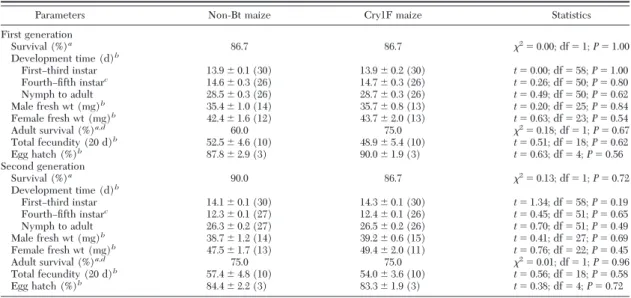
maize or Bt maize were supplied to G. punctipes when they reached the fourth instar feeding on S. frugiperda eggs. As before, there were no signiÞcant differences observed for any of the life-history parameters of G. punctipesbetween the control (non-Bt) maize treat-ment and the Cry1 F maize treattreat-ment over two gen-erations (Table 2).
Prey-mediated Effects of Cry1Ac/Cry2Ab Cotton on O. insidiosus. O. insidiosus nymphs reached the
Þfth instar feeding on T. ni eggs for 5.5Ð7 d whereupon they were provided Bt-susceptible T. ni fed on non-Bt cotton, Cry1Ab/Cry2Ab-resistant T. ni fed on non-Bt cotton, or Cry1Ab/Cry2Ab-resistant T. ni fed on Cry1Ab/Cry2Ab cotton. The different prey provided did not have an effect on any of the life-history parameters of O. insidiosus over two generations (Table 3).
Prey-mediated Effects of Cry1 F Maize on O.
insi-diosus. Newly hatched O. insidiosus nymphs supplied
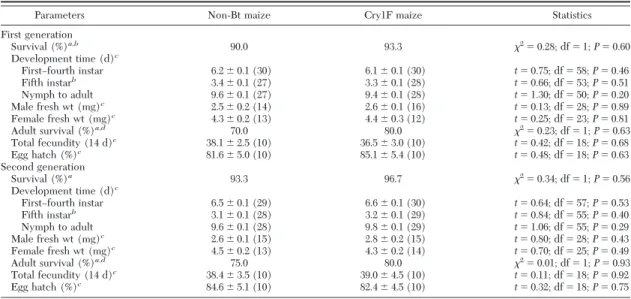
with S. frugiperda eggs reached the Þfth instar in⬇6 d. The predators were then provided Cry1 F-resistant S. frugiperdathat fed on non-Bt maize or Cry1 F maize. No signiÞcant differences were detected for any life-history parameters in the Þrst or second generation (Table 4).
Bt Proteins Levels in Bt Crops, Prey, and Predators.
Bt cotton leaves contained high levels of Cry1Ab and Cry2Ab (Table 5). T. ni contained 20-fold lower levels of Cry1Ac and 23-fold lower levels of Cry2Ab com-pared with Bt cotton leaves. Only trace amounts were detected in G. punctipes and O. insidiosus for Cry1Ac (levels below the limit of quantiÞcation of 0.1 ng/g), and the average concentrations of Cry2Ab protein in G. punctipes and O. insidiosus were 47- and 37-fold lower than those in T. ni, respectively.
Similar results were found in Bt maize treatments (Table 5). Cry1 F protein levels in S. frugiperda were 7-fold lower than in Cry1 F maize leaves. Average concentrations of Cry1 F protein in G. punctipes and O. insidiosus were 54- and 27-fold lower compared with S. frugiperda, respectively.
As expected, no Bt proteins were detected in non-Bt plants, prey fed non-Bt plants, or predators fed prey from non-Bt plants.
Discussion
Our results demonstrate that neither G. punctipes nor O. insidiosus, two widely distributed generalist predators inhabiting cotton and maize, are affected by
three common Bt Cry proteins found in many Bt cotton and Bt maize crops in the United States and elsewhere when exposed through intoxicated prey. The predators were chronically exposed to these three Cry proteins via a natural pathway in realistic
worst-case exposure conditions over the course of two consecutive generations. The ability to elimi-nate any potential prey-quality-mediated effects through the use of Bt-resistant target prey was a major advantage and allowed us to focus evaluation
Table 1. Tri-trophic effects on life-history parameters (meanⴞ SE) of Geocoris punctipes when fed Trichoplusia ni larvae that were reared on Cry1Ac/Cry2Ab or non-Bt isoline cotton leaves over two generations
Parameters Control cotton Susceptible T. ni Control cotton Resistant T. ni Cry1Ac/Cry2Ab cotton Resistant T. ni Statistics First generation Survival (%)a 96.7 93.3 100.0 2⫽ 1.99; df ⫽ 2; P ⫽ 0.37 Development time (d)b FirstÐthird instar 13.1⫾ 0.1 (30) 13.1⫾ 0.2 (30) 13.2⫾ 0.2 (30) F⫽ 0.08; df ⫽ 2, 89; P ⫽ 0.93 FourthÐÞfth instarc 13.1⫾ 0.1 (29) 13.2⫾ 0.2 (28) 13.2⫾ 0.2 (30) F⫽ 0.04; df ⫽ 2, 86; P ⫽ 0.96 Nymph to adult 26.2⫾ 0.2 (29) 26.3⫾ 0.3 (28) 26.4⫾ 0.3 (30) F⫽ 0.12; df ⫽ 2, 86; P ⫽ 0.89 Male fresh wt (mg)b 32.8⫾ 0.1 (15) 34.0⫾ 0.1 (12) 32.9⫾ 0.1 (15) F⫽ 0.74; df ⫽ 2, 41; P ⫽ 0.49 Female fresh wt (mg)b 46.8⫾ 0.1 (14) 45.1⫾ 0.1 (16) 43.3⫾ 0.1 (15) F⫽ 2.81; df ⫽ 2, 44; P ⫽ 0.07 Adult survival (%)a,d 75.0 75.0 80.0 2⫽ 0.22; df ⫽ 2; P ⫽ 0.89 Total fecundity (20 d)b 51.6⫾ 2.4 (10) 46.3⫾ 4.6 (10) 48.3⫾ 1.7 (10) F⫽ 0.73; df ⫽ 2, 29; P ⫽ 0.49 Egg hatch (%)b 74.4⫾ 2.9 (3) 83.3⫾ 5.1 (3) 82.2⫾ 4.8 (3) F⫽ 1.21; df ⫽ 2, 8; P ⫽ 0.36 Second generation Survival (%)a 86.7 83.3 90.0 2⫽ 0.62; df ⫽ 2; P ⫽ 0.73 Development time (d)b FirstÐthird instar 14.6⫾ 0.2 (28) 14.9⫾ 0.2 (28) 14.5⫾ 0.2 (29) F⫽ 0.84; df ⫽ 2, 84; P ⫽ 0.43 FourthÐÞfth instarc 13.0⫾ 0.2 (26) 13.2⫾ 0.2 (25) 12.8⫾ 0.2 (27) F⫽ 1.40; df ⫽ 2, 76; P ⫽ 0.25 Nymph to adult 27.7⫾ 1.3 (26) 28.0⫾ 1.5 (25) 27.4⫾ 1.2 (27) F⫽ 1.76; df ⫽ 2, 76; P ⫽ 0.18 Male fresh wt (mg)b 34.2⫾ 0.1 (15) 35.1⫾ 0.1 (12) 36.1⫾ 0.1 (17) F⫽ 1.37; df ⫽ 2, 43; P ⫽ 0.27 Female fresh wt (mg)b 43.5⫾ 0.1 (11) 46.7⫾ 0.2 (13) 46.0⫾ 0.2 (10) F⫽ 1.25; df ⫽ 2, 33; P ⫽ 0.30 Adult survival (%)a,d 85.0 80.0 80.0 2⫽ 0.24; df ⫽ 2; P ⫽ 0.89 Total fecundity (20 d)b 57.7⫾ 8.2 (10) 51.8⫾ 7.6 (10) 52.4⫾ 7.3 (10) F⫽ 0.18; df ⫽ 2, 29; P ⫽ 0.84 Egg hatch (%)b 86.7⫾ 3.9 (3) 85.6⫾ 2.9 (3) 87.8⫾ 3.9 (3) F⫽ 0.13; df ⫽ 2, 8; P ⫽ 0.88
Number of replications is given in parentheses; exp initiated with 30 nymphs in each treatment.
aWilcoxon test. bOne-way ANOVA.
cPredators were exposed to T. ni larvae at the beginning of the fourth instar. dBased on survival during the Þrst 20 d of adult life.
Table 2. Tri-trophic effects on life-table parameters (meanⴞ SE) of Geocoris punctipes when fed Cry1F-resistant Spodoptera
frugiperda larvae that were reared on Cry1F maize leaves or non-Bt maize leaves over two generations
Parameters Non-Bt maize Cry1F maize Statistics
First generation Survival (%)a 86.7 86.7 2 ⫽ 0.00; df ⫽ 1; P ⫽ 1.00 Development time (d)b FirstÐthird instar 13.9⫾ 0.1 (30) 13.9⫾ 0.2 (30) t⫽ 0.00; df ⫽ 58; P ⫽ 1.00 FourthÐÞfth instarc 14.6⫾ 0.3 (26) 14.7⫾ 0.3 (26) t⫽ 0.26; df ⫽ 50; P ⫽ 0.80 Nymph to adult 28.5⫾ 0.3 (26) 28.7⫾ 0.3 (26) t⫽ 0.49; df ⫽ 50; P ⫽ 0.62 Male fresh wt (mg)b 35.4⫾ 1.0 (14) 35.7⫾ 0.8 (13) t⫽ 0.20; df ⫽ 25; P ⫽ 0.84 Female fresh wt (mg)b 42.4⫾ 1.6 (12) 43.7⫾ 2.0 (13) t⫽ 0.63; df ⫽ 23; P ⫽ 0.54 Adult survival (%)a,d 60.0 75.0 2 ⫽ 0.18; df ⫽ 1; P ⫽ 0.67 Total fecundity (20 d)b 52.5⫾ 4.6 (10) 48.9⫾ 5.4 (10) t⫽ 0.51; df ⫽ 18; P ⫽ 0.62 Egg hatch (%)b 87.8⫾ 2.9 (3) 90.0⫾ 1.9 (3) t⫽ 0.63; df ⫽ 4; P ⫽ 0.56 Second generation Survival (%)a 90.0 86.7 2 ⫽ 0.13; df ⫽ 1; P ⫽ 0.72 Development time (d)b FirstÐthird instar 14.1⫾ 0.1 (30) 14.3⫾ 0.1 (30) t⫽ 1.34; df ⫽ 58; P ⫽ 0.19 FourthÐÞfth instarc 12.3⫾ 0.1 (27) 12.4⫾ 0.1 (26) t⫽ 0.45; df ⫽ 51; P ⫽ 0.65 Nymph to adult 26.3⫾ 0.2 (27) 26.5⫾ 0.2 (26) t⫽ 0.70; df ⫽ 51; P ⫽ 0.49 Male fresh wt (mg)b 38.7⫾ 1.2 (14) 39.2⫾ 0.6 (15) t⫽ 0.41; df ⫽ 27; P ⫽ 0.69 Female fresh wt (mg)b 47.5⫾ 1.7 (13) 49.4⫾ 2.0 (11) t⫽ 0.76; df ⫽ 22; P ⫽ 0.45 Adult survival (%)a,d 75.0 75.0 2 ⫽ 0.01; df ⫽ 1; P ⫽ 0.96 Total fecundity (20 d)b 57.4⫾ 4.8 (10) 54.0⫾ 3.6 (10) t⫽ 0.56; df ⫽ 18; P ⫽ 0.58 Egg hatch (%)b 84.4⫾ 2.2 (3) 83.3⫾ 1.9 (3) t⫽ 0.38; df ⫽ 4; P ⫽ 0.72 Number of replications is given in parentheses; exp initiated with 30 larvae in each treatment.
aWilcoxon test. bStudent t-test ANOVA.
cPredators were exposed to S. frugiperda larvae at the beginning of the fourth instar. dBased on survival during the Þrst 20 d of adult life.
on the Cry proteins, as the predators would be exposed to them in the Þeld.
Our results are consistent with other studies of O. insidiosus exposed to Bt proteins through various routes. Al-Deeb et al. (2001) found no effects on
development, survival, and adult mass when predators were exposed to Ostrinia nubilalis (Hu¨bner) (Lepi-doptera: Crambidae) larvae feeding on an artiÞcial diet spiked with Dipel, a commercial formulation con-taining multiple Cry1 and Cry2 Bt proteins, compared
Table 3. Tri-trophic effects on life-table parameters (meanⴞ SE) of Orius insidiosus when fed Trichoplusia ni larvae that were reared on Cry1Ac/Cry2Ab or non-Bt isoline cotton leaves over two generations
Parameters Control cotton Susceptible T. ni Control cotton Resistant T. ni Cry1Ac/Cry2Ab cotton Resistant T. ni Statistics First generation Survival (%)a,b 93.3 96.7 96.7 2⫽ 0.52; df ⫽ 2; P ⫽ 0.77 Development time (d)c FirstÐfourth instar 6.1⫾ 0.1 (30) 6.0⫾ 0.1 (30) 6.1⫾ 0.1 (30) F⫽ 0.20; df ⫽ 2, 89; P ⫽ 0.81 Fifth instarb 3.3⫾ 0.1 (28) 3.3⫾ 0.1 (29) 3.2⫾ 0.1 (29) F⫽ 0.17; df ⫽ 2, 85; P ⫽ 0.84 Nymph to adult 9.4⫾ 0.1 (28) 9.3⫾ 0.1 (29) 9.3⫾ 0.1 (29) F⫽ 0.07; df ⫽ 2, 86; P ⫽ 0.93 Male fresh wt (mg)c 2.7⫾ 0.2 (15) 2.3⫾ 0.2 (16) 2.7⫾ 0.2 (16) F⫽ 1.16; df ⫽ 2, 46; P ⫽ 0.32 Female fresh wt (mg)c 4.2⫾ 0.3 (13) 4.3⫾ 0.3 (13) 4.1⫾ 0.3 (13) F⫽ 0.16; df ⫽ 2, 38; P ⫽ 0.85 Adult survival (%)a,b 80.0 85.0 75.0 2⫽ 0.03; df ⫽ 2; P ⫽ 0.98 Total fecundity (14 d)c 35.3⫾ 4.2 (10) 32.3⫾ 3.3 (10) 37.9⫾ 3.6 (10) F⫽ 0.56; df ⫽ 2, 29; P ⫽ 0.58 Egg hatch (%)c 80.6⫾ 5.0 (10) 82.9⫾ 5.3 (10) 83.5⫾ 4.8 (10) F⫽ 0.16; df ⫽ 2, 29; P ⫽ 0.85 Second generation Survival (%)a 83.3 86.7 93.3 2⫽ 1.33; df ⫽ 2; P ⫽ 0.51 Development time (d)c FirstÐfourth instar 6.5⫾ 0.1 (27) 6.7⫾ 0.1 (28) 6.6⫾ 0.1 (28) F⫽ 1.42; df ⫽ 2, 82; P ⫽ 0.25 Fifth instarb 3.0⫾ 0.1 (25) 3.2⫾ 0.1 (26) 3.1⫾ 0.1 (28) F⫽ 1.83; df ⫽ 2, 78; P ⫽ 0.17 Nymph to adult 9.5⫾ 0.1 (25) 9.9⫾ 0.1 (26) 9.7⫾ 0.1 (28) F⫽ 2.09; df ⫽ 2, 78; P ⫽ 0.13 Male fresh wt (mg)c 2.7⫾ 0.2 (13) 2.5⫾ 0.2 (14) 2.6⫾ 0.1 (15) F⫽ 0.40; df ⫽ 2, 41; P ⫽ 0.67 Female fresh wt (mg)c 4.3⫾ 0.3 (12) 4.6⫾ 0.3 (12) 4.4⫾ 0.2 (13) F⫽ 0.17; df ⫽ 2, 36; P ⫽ 0.84 Adult survival (%)a,d 85.0 75.0 85.0 2⫽ 0.78; df ⫽ 2; P ⫽ 0.68 Total fecundity (14 d)c 41.9⫾ 4.2 (10) 38.0⫾ 4.7 (10) 40.0⫾ 4.0 (10) F⫽ 0.20; df ⫽ 2, 29; P ⫽ 0.82 Egg hatch (%)c 79.1⫾ 5.0 (10) 80.9⫾ 4.3 (10) 81.3⫾ 5.2 (10) F⫽ 0.08; df ⫽ 2, 29; P ⫽ 0.93
Number of replications is given in parentheses; exp initiated with 30 nymphs in each treatment.
aWilcoxon test.
bPredators were exposed to T. ni larvae at the beginning of the Þfth instar. cOne-way ANOVA.
dBased on survival during the Þrst 14 d of adult life.
Table 4. Tri-trophic effects on life-table parameters (meanⴞ SE) of Orius insidiosus when fed Cry1F-resistant Spodoptera frugiperda larvae that were reared on Cry1F maize leaves or non-Bt maize leaves over two generations
Parameters Non-Bt maize Cry1F maize Statistics
First generation Survival (%)a,b 90.0 93.3 2 ⫽ 0.28; df ⫽ 1; P ⫽ 0.60 Development time (d)c FirstÐfourth instar 6.2⫾ 0.1 (30) 6.1⫾ 0.1 (30) t⫽ 0.75; df ⫽ 58; P ⫽ 0.46 Fifth instarb 3.4⫾ 0.1 (27) 3.3⫾ 0.1 (28) t⫽ 0.66; df ⫽ 53; P ⫽ 0.51 Nymph to adult 9.6⫾ 0.1 (27) 9.4⫾ 0.1 (28) t⫽ 1.30; df ⫽ 50; P ⫽ 0.20 Male fresh wt (mg)c 2.5⫾ 0.2 (14) 2.6⫾ 0.1 (16) t⫽ 0.13; df ⫽ 28; P ⫽ 0.89 Female fresh wt (mg)c 4.3⫾ 0.2 (13) 4.4⫾ 0.3 (12) t⫽ 0.25; df ⫽ 23; P ⫽ 0.81 Adult survival (%)a,d 70.0 80.0 2 ⫽ 0.23; df ⫽ 1; P ⫽ 0.63 Total fecundity (14 d)c 38.1⫾ 2.5 (10) 36.5⫾ 3.0 (10) t⫽ 0.42; df ⫽ 18; P ⫽ 0.68 Egg hatch (%)c 81.6⫾ 5.0 (10) 85.1⫾ 5.4 (10) t⫽ 0.48; df ⫽ 18; P ⫽ 0.63 Second generation Survival (%)a 93.3 96.7 2 ⫽ 0.34; df ⫽ 1; P ⫽ 0.56 Development time (d)c FirstÐfourth instar 6.5⫾ 0.1 (29) 6.6⫾ 0.1 (30) t⫽ 0.64; df ⫽ 57; P ⫽ 0.53 Fifth instarb 3.1⫾ 0.1 (28) 3.2⫾ 0.1 (29) t⫽ 0.84; df ⫽ 55; P ⫽ 0.40 Nymph to adult 9.6⫾ 0.1 (28) 9.8⫾ 0.1 (29) t⫽ 1.06; df ⫽ 55; P ⫽ 0.29 Male fresh wt (mg)c 2.6⫾ 0.1 (15) 2.8⫾ 0.2 (15) t⫽ 0.80; df ⫽ 28; P ⫽ 0.43 Female fresh wt (mg)c 4.5⫾ 0.2 (13) 4.3⫾ 0.2 (14) t⫽ 0.70; df ⫽ 25; P ⫽ 0.49 Adult survival (%)a,d 75.0 80.0 2 ⫽ 0.01; df ⫽ 1; P ⫽ 0.93 Total fecundity (14 d)c 38.4⫾ 3.5 (10) 39.0⫾ 4.5 (10) t⫽ 0.11; df ⫽ 18; P ⫽ 0.92 Egg hatch (%)c 84.6⫾ 5.1 (10) 82.4⫾ 4.5 (10) t⫽ 0.32; df ⫽ 18; P ⫽ 0.75 Number of replications is given in parentheses; exp initiated with 30 larvae in each treatment.
aWilcoxon test.
bPredators were exposed to S. frugiperda larvae at the beginning of the Þfth instar. cStudent t-test ANOVA.
with a control diet containing no Bt proteins. There were also no effects on O. insidiosus development or survival when predators were provided pollen from Cry1Ab Bt maize (Pilcher et al. 1997). Duan et al. (2008) reported a similar lack of effect using Cry3Bb1 protein in a bee pollen diet. Studies with other species of Orius also have reported neutral effects of various Cry proteins (Cry1Ac, Cry1Ab, Cry2Ab, Cry3A) on various life-history traits using direct exposure through spiked diets (Gonzalez-Zamora et al. 2007), plant foliage and pollen (Armer et al. 2000, Pons et al. 2004, Lumbierres et al. 2012), and intoxicated prey (Zwahlen et al. 2000, Obrist et al. 2006, Gonzalez-Zamora et al. 2007, Lumbierres et al. 2012). Zhang et al. (2008) reported subtle negative effects on some life-history traits and prey consumption for Orius sau-teri(Poppius) (Hemiptera: Anthocoridae) using in-toxicated aphids as prey. However, it is questionable if the predator was exposed to Cry proteins, given that aphids in general contain no or only trace amounts of Cry protein when feeding on Bt plants (Romeis and Meissle 2011) and exposure in neither the aphids nor predators was conÞrmed. In contrast, Lumbierres et al. (2012) demonstrated that Cry1Ab consumption, directly from the plant or through intoxicated prey, actually increased development rates and fecundity in Orius majusculusReuter.
Fewer studies have examined G. punctipes and
Geo-coris spp. in general. Ponsard et al. (2002) reported
that longevity of Þeld-collected adult G. punctipes and Orius tristicolor(White) (Hemiptera: Anthocoridae) of unknown age was reduced by 27 and 28%, respec-tively, when they were exposed to Cry1Ac via a tri-trophic exposure using susceptible Spodoptera exigua (Hu¨bner) (Lepidoptera: Noctuidae) feeding on Bt cotton leaves. However, they did not assess the effects of Bt cotton on the prey larvae. Spodoptera spp. are known to be at least partially susceptible to this Cry protein (Ramirez-Romero et al. 2007, Torres and Ru-berson 2008) and very likely suffered some ill effects from feeding on Bt cotton. In addition, Ponsard et al. (2002) used a mixture of two unrelated non-Bt cotton cultivars as controls, potentially introducing other plant-mediated qualities into their study system. Fi-nally, their results varied greatly between trials, in part due to the use of a laboratory colony source in the fourth trial for G. punctipes and the fact that essential
moisture was not provided to either insect in the Þrst two trials. In contrast, Torres and Ruberson (2006) found no differences in development, survival, adult mass, or fecundity of G. punctipes fed on S. exigua larvae that had been reared on Bt (Cry1Ac) cotton compared with larvae fed on a non-Bt control, even though they did show that S. exigua larvae were a poorer host for this predator compared with eggs of Helicoverpa (Boddie) (Lepidoptera: Noctuidae). In both the (Ponsard et al. 2002, Torres and Ruberson 2006,) studies, G. punctipes were provided access to both intoxicated prey and to Bt plant material, but their individual contributions were not assessed. How-ever, Armer et al. (2000) showed no effect of Cry3A on Geocoris spp. when predators were provided access to Bt potato foliage. Our Þndings clearly show the lack of any negative effects of multiple Cry proteins on a broad range of life-history traits, including adult sur-vival, when potential prey quality effects are removed. This suggests that the average 17% reduction in G. punctipeson Bt cotton reported by Naranjo 2005 over a 5-yr Þeld study was likely due to other factors such as reductions in caterpillar prey, as originally sug-gested by the author, rather than Bt toxicity.
We found that the concentration of various Cry proteins declined rapidly as they moved through the food chain. Titers of Cry1Ac, Cry2Ab, and Cry1 F declined 7Ð23-fold from plant tissue to prey and then another 27Ð54-fold in the predators. Levels of Cry1Ac in the two predators were below the level of quanti-Þcation. Similarly, Torres and Ruberson (2006) and Torres et al. (2006) failed to detect Cry1Ac in G. punctipesexposed through intoxicated S. exigua, even though the prey contained levels of the protein cor-responding to⬎70% of that found in the plant. Armer et al. (2000) also failed to detect Bt proteins in Geo-coris spp. and O. tristicolor feeding directly on Bt potato foliage. Torres and Ruberson (2008) were able to detect titers of Cry1Ac in both G. punctipes and O. insidiosusfrom tri-trophic exposures through both spi-der mites and thrips feeding on Bt cotton and these levels represented only a 6 Ð11-fold reduction from the prey. Finally, it has been shown in other species of Orius that these predators readily pick up Cry1Ab from plant or prey sources, albeit at declining levels compared with plant or prey titers (Obrist et al. 2006, Meissle and Romeis 2009, Lumbierres et al. 2012).
Table 5. Bt protein levels (g/g fresh wt) in Bt crops (cotton and maize), prey (Trichoplusia ni and Spodoptera frugiperda), and predators (Geocoris punctipes and Orius insidiosus)
Sample Cotton Maize
Cry1Aca Cry2Abb Cry1Fb
Leaves 1.37⫾ 0.21a 23.4⫾ 2.1a 3.12⫾ 0.19a
Prey 0.067⫾ 0.07b 1.03⫾ 0.14b 0.43⫾ 0.04b G. punctipes Tracec 0.022⫾ 0.002c 0.008⫾ 0.001c O. insidiosus Tracec 0.028⫾ 0.005c 0.016⫾ 0.002c Statistical analysis t⫽ 6.32; df ⫽ 4; P ⫽ 0.02 F⫽ 1024; df ⫽ 3,11; P ⬍ 0.01 F⫽ 586; df ⫽ 3, 11; P ⬍ 0.01
Prey: T. ni for cotton, S. frugiperda for maize.
aMeans (⫾SE) within a column followed by different letters are signiÞcantly different (Student t-test, P ⬍ 0.05); N ⫽ 3. bMeans (⫾SE) within a column followed by different letters are signiÞcantly different (one-way ANOVA, P ⬍ 0.05); N ⫽ 3. cLevels detected were below the level of quantiÞcation (0.1 ng/g).
While different prey species appear to inßuence the transfer of certain Cry proteins, we believe that the predators in our study were deÞnitely exposed to all the Bt proteins we tested based on ELISA results for Cry1Ac, Cry2Ab, and Cry1 F. Furthermore, our pre-vious studies have demonstrated that these proteins were biologically active after T. ni had fed on Cry1Ab/ Cry2Ac cotton (Li et al. 2011) and S. frugiperda had fed on Cry1 F maize (Tian et al. 2012).
As with any study, questions remain. The current study did not include time-series analyses of retention of the Cry toxins in the guts of the prey larvae, so that we could quantify the actual exposure level of the Bt proteins to the predator. Because risk to the predator is a function of hazard (inherent toxicity of the pro-tein)⫻ exposure, we cannot be sure of the importance of each in these tri-trophic studies. Table 5 indicates that both predators contained Bt proteins when they had preyed on caterpillars that fed on Bt plants ex-pressing these proteins (albeit in trace amounts for Cry1Ac). Whether the proteins were inherently non-toxic to the predators or whether the dose of the proteins was not sufÞcient to cause harm is impossible to determine from these studies. However, the impor-tant conclusion is that predators were exposed to prey that had consumed Bt proteins in what we consider realistic worst-case exposure conditions and the de-velopment, survivorship, and reproduction of the predators were not affected.
There is some controversy about the concept of direct and indirect effects of Bt proteins in the liter-ature. The indirect effects of Bt proteins, acting through deleterious effects on the target prey or hosts that a natural enemy may consume, may occur in the Þeld. Such indirect effects could result as a conse-quence of any pest management tactic that has a direct effect on the prey or host. This includes insecticide effects, other host plant resistance factors (including defensive reactions triggered by herbivory), and par-asitism, all of which could cause direct mortality of the prey or host or induce sublethal effects that would alter their quality as food for a predator or parasitoid. Indirect effects also are manifested by the absence of target prey or hosts of specialist natural enemies when the control technology is highly effective (see Wolfenbarger et al. 2008). Outside of instances where the target prey or hosts are largely absent from the cropÑand thus too are specialist natural enemiesÑ the impacts of indirect effects are unclear. Analyses of extant data in multiple Bt crops suggest a general lack of changes in natural enemy abundance (Marvier et al. 2007, Wolfenbarger et al. 2008, Naranjo 2009) and biological control function (Naranjo 2009) in Bt crops. However, indirect prey quality-mediated effects observed in laboratory studies are sometimes incor-rectly assumed to represent direct toxic effects (Lo¨vei et al. 2009). Based on the meta-analyses of Naranjo (2009), Shelton et al. (2009) estimated that⬇63% of all studies examining Bt protein effects on natural enemies via tri-trophic exposures used susceptible prey or hosts that were potentially compromised and could interfere with a valid assessment of direct toxic
effects. Our prior analyses (Romeis et al. 2006, Naranjo 2009) further suggest that arthropod predators are less susceptible to prey quality effects than parasitoids. Nonetheless, the use of Bt-resistant prey here, as in other studies (Ferry et al. 2006; Chen et al. 2008; Lawo et al. 2010; Li et al. 2011; Tian et al. 2012, 2013), eliminates any such confounding effects and allows for a more accurate assessment of direct exposure to and hazard of Bt Cry proteins.
Acknowledgments
This project was supported by the Biotechnology Risk Assessment Program Competitive Grant 2010-33522-21772 from the USDA, National Institute of Food and Agriculture. We thank H. Collins, M. Cheung, and A. Seto for technical assistance.
References Cited
Al-Deeb, M., G. Wilde, and R. Higgins. 2001. No effect of
Bacillus thuringiensiscorn and Bacillus thuringiensis on the predator Orius insidiosus (Hemiptera: Anthocori-dae). Environ. Entomol. 30: 625Ð 629.
A´ lvarez-Alfageme, F., F. Bigler, and J. Romeis. 2011. Labo-ratory toxicity studies demonstrate no adverse effects of Cry1Ab and Cry3Bb1 to larvae of Adalia bipunctata (Co-leoptera: Coccinellidae): the importance of study design. Transgenic Res. 20: 467Ð 479.
Armer, C. A., R. E. Berry, and M. Kogan. 2000. Longevity of phytophagous heteropteran predators feeding on trans-genic Bt-potato plants. Entomol. Exp. Appl. 95: 329 Ð333. Bai, Y. Y., M. X. Jiang, J. A. Cheng, and D. Wang. 2006. Effects of CrylAb toxin on Propylea japonica (Thunberg) (Coleoptera: Coccinellidae) through its prey,
Nilapar-vata lugens(Homoptera: Delphacidae), feeding on trans-genic Bt rice. Environ. Entomol. 35: 1130 Ð1136. Bernal, C. C., R. M. Aguda, and M. B. Cohen. 2002. Effect of
rice lines transformed with Bacillus thuringiensis toxin genes on the brown planthopper and its predator
Cyrto-rhinus lividipennis.Entomol. Exp. Appl. 102: 21Ð28. Bhatti, M. A., J. Duan, G. P. Head, C. Jiang, M. J. McKee, T. E.
Nickson, C. L. Pilcher, and C. D. Pilcher. 2005. Field evaluation of the impact of corn rootworm (Coleoptera: Chrysomelidae)Ðprotected Bt corn on foliage-dwelling arthropods. Environ. Entomol. 34: 1336 Ð1345.
Bickerton, M., and G. Hamilton. 2012. Effects of intercrop-ping with ßowering plants on predation of Ostrinia
nu-bilalis(Lepidoptera: Crambidae) eggs by generalist pred-ators in bell peppers. Environ. Entomol. 41: 612Ð 620. Boodley, J. W., and R. Sheldrake. 1977. Cornell peat-like
mixes for commercial plant growing. Cornell University Cooperation Extension Division Information Bulletin 43, Cornell University, Ithaca, NY.
Brookes, G., and P. Barfoot. 2012. GM crops: global socio-economic and environmental impacts 1996 Ð2010, p. 187. PG Economics Ltd, Dorchester, United Kingdom. Chen, M., J. Z. Zhao, H. L. Collins, E. D. Earle, J. Cao, and
A. M. Shelton. 2008. A critical assessment of the effects of Bt transgenic plants on parasitoids. PLoS ONE 3: e2284. doi:10.1371/journal.pone.0002284.
Coll, M. 1998. Living and feeding on plants in predatory heteroptera, pp. 89 Ð129. In M. Coll and J. Ruberson (eds.), Predatory heteroptera: their ecology and use in biological control. Thomas Say Symposium Proceedings Entomology Society of America, Lanham, MD.
Coll, M., and D. G. Bottrell. 1991. Microhabitat and re-source selection of the European corn borer (Lepidop-tera: Pyralidae) and its natural enemies in Maryland fruit corn. Environ. Entomol. 20: 526 Ð533.
Corey, D., S. Kambhampati, and G. Wilde. 1998. Electro-phoretic analysis of Orius insidiosus (Hemiptera: Antho-coridae) feeding habits in Þeld corn. J. Kans. Entomol. Soc. 71: 11Ð17.
Crocker, R. L., and W. H. Whitcomb. 1980. Feeding niches of the big-eyed bugs Geocoris bullatus, G. punctipes, and
G. uliginosus(Hemiptera: Lygaeidae: Geocorinae). En-viron. Entomol. 9: 508 Ð513.
Dicke, F. F., and J. L. Jarvis. 1962. The habits and seasonal abundance of Orius insidiosus (Say) (Hemiptera-Het-eroptera: Anthocoridae) on corn. J. Kans. Entomol. Soc. 35: 339 Ð344.
Dively, G. P. 2005. Impact of transgenic VIP3A x Cry1Ab lepidopteran-resistant Þeld corn on the nontarget arthro-pod community. Environ. Entomol. 34: 1267Ð1291. Dutton, A., H. Klein, J. Romeis, and F. Bigler. 2002. Uptake
of Bt-toxin by herbivores feeding on transgenic maize and consequences for the predator Chrysoperlacarnea. Ecol. Entomol. 27: 441Ð 447.
Dutton, A., J. Romeis, and F. Bigler. 2005. Effects of Bt maize expressing Cry1Ab and Bt spray on Spodoptera
littoralis.Entomol. Exp. Appl. 114: 161Ð169.
Duan, J. J., D. Teixeira, J. E. Huesing, and C. J. Jiang. 2008. Assessing the risk to nontarget organisms from Bt corn resistant to corn rootworms (Coleoptera: Chrysomeli-dae): tier-I testing with Oriusinsidiosus (Heteroptera: Anthocoridae). Environ. Entomol. 37: 838 Ð 844. Ehler, L. E. 1977. Natural enemies of cabbage looper on
cotton in the San Joaquin Valley. Hilgardia 45: 73Ð106. Fernandez-Cornejo, J., and M. Caswell. 2006. The Þrst
de-cade of genetically engineered crops in the United States. US Department of Agriculture Economic Research Ser-vice, Economic Information Bulletin 11, Washington DC. Ferry, N., E. Mulligan, C. N. Stewart, B. Tabashnik, G. Port, and A.M.R. Gatehouse. 2006. Prey-mediated effects of transgenic canola on a beneÞcial, non-target, carabid bee-tle. Transgenic Res. 15: 501Ð514.
Gonzalez-Zamora, J. E., S. Camunez, and C. Avilla. 2007. Effects of Bacillus thuringiensis cry toxins on develop-mental and reproductive characteristics of the predator
Orius albidipennis(Hemiptera: Anthocoridae) under lab-oratory conditions. Environ. Entomol. 36: 1246 Ð1253. Head, G., M. Moar, M. Eubanks, B. Freeman, J. Ruberson, A.
Hagerty, and S. Turnipseed. 2005. A multiyear, large-scale comparison of arthropod populations on commer-cially managed Bt and non-Bt cotton Þelds. Environ. Entomol. 34: 1257Ð1266.
James, C. 2012. Global status of commercialized bio-tech/GM crops: 2012. ISAAA briefs No. 44. ISAAA, Ithaca, NY.
Kain, W. C., J. Z. Zhao, A. F. Janmaat, J. Myers, A. M. Shelton, and P. Wang. 2004. Inheritance of resistance to Bacillus
thuringiensisCry1Ac toxin in a greenhouse-derived strain of cabbage looper (Lepidoptera: Noctuidae). J. Econ. Entomol. 97: 2073Ð2078.
Kathage, J., and M. Qaim. 2012. Economic impacts and im-pact dynamics of Bt (Bacillus thuringiensis) cotton in India. Proc. Natl. Acad. Sci. U.S.A. 109: 11652Ð11656. Lawo, N. C., F. L. Wa¨ckers, and J. Romeis. 2010.
Charac-terizing indirect prey-quality mediated effects of a Bt crop on predatory larvae of the green lacewing,
Chrysoperla carnea.J. Insect Physiol. 56: 1702Ð1710. Li, Y. H., J. Romeis, P. Wang, Y. Peng, and A. M. Shelton.
2011. A comprehensive assessment of the effects of Bt
cotton on Coleomegilla maculata demonstrates no detri-mental effects by Cry1Ac and Cry2Ab. PLoS ONE 6: e22185. doi:10.1371/journal.pone.0022185.
Lo¨vei, G. L., D. A. Andow, and S. Arpaia. 2009. Transgenic insecticidal crops and natural enemies: a detailed review of laboratory studies. Environ. Entomol. 38: 293Ð306. Lumbierres, B., R. Albajes, and X. Pons. 2012. Positive
ef-fect of Cry1ab-expressing Bt maize on the development and reproduction of the predator Orius majusculus under laboratory conditions. Biol. Control 63: 150 Ð156. Marvier, M., C. McCreedy, J. Regetz, and P. Kareiva. 2007.
A meta-analysis of effects of Bt cotton and maize on nontarget invertebrates. Science 316: 1475Ð1477. Meissle, M., and J. Romeis. 2009. The web-building spider
Theridion impressum(Araneae: Theridiidae) is not ad-versely affected by Bt maize resistant to corn rootworms. Plant Biotech. J. 7: 645Ð 656.
Naranjo, S. E. 2005. Long-term assessment of the effects of transgenic Bt cotton on the abundance of nontarget ar-thropod natural enemies. Environ. Entomol. 34: 1193Ð 1210.
Naranjo, S. E. 2009. Impacts of Bt crops on non-target or-ganisms and insecticide use patterns. CAB Rev. Perspect. Agric. Vet. Sci. Nutr. Nat. Resour. 4: 011. doi:10.1079/ PAVSNNR20094011.
Naranjo, S. E., and R. L. Gibson. 1996. Phytophagy in pre-daceous heteroptera: effects on life history and population dynamics, pp. 57Ð93. In O. Alomar and R. N. Wiedenmann (eds.), Zoophytophagous heteroptera: implications for life history and integrated pest management. Proceedings of Thomas Say Publications in Entomology, Entomological Society of America, Lanham, MD.
Naranjo, S. E., and J. R. Hagler. 1998. Characterizing and estimating the impact of heteropteran predation, pp. 170 Ð 197. In M. Coll and J. Ruberson (eds.), Predatory het-eroptera: their ecology and use in biological control. Thomas Say Symposium Proceedings of Entomological Society of Am., Lanham, MD.
Obrist, L. B., A. Dutton, R. Albajes, and F. Bigler. 2006. Exposure of arthropod predators to Cry1Ab toxin in Bt maize Þelds. Ecol. Entomol. 31: 143Ð154.
Orphanides, G. M., D. Gonzalez, and B. R. Barlett. 1971. IdentiÞcation and evaluation of pink bollworm predators in southern California. J. Econ. Entomol. 64: 421Ð 424. Pilcher, C. D., J. J. Obrycki, M. E. Rice, and L. C. Lewis. 1997.
Preimaginal development, survival, and Þeld abundance of insect predators on transgenic Bacillus thuringiensis corn. Environ. Entomol. 26: 446 Ð 454.
Pilcher, C. D., M. E. Rice, and J. J. Obrycki. 2005. Impact of transgenic Bacillus thuringiensis corn and crop phenology on Þve nontarget arthropods. Environ. Entomol. 34: 1302Ð 1316.
Pons, X., B. Lumbierres, C. Lopez, and R. Albajes. 2004. No effects of Bt maize on the development of Orius
majus-culus.IOBC WPRS Bull. 27: 131Ð136.
Ponsard, S., A. P. Gutierrez, and N. J. Mills. 2002. Effect of Bt-toxin (Cry1Ac) in transgenic cotton on the adult lon-gevity of four heteropteran predators. Environ. Entomol. 31: 1197Ð1205.
Ramirez-Romero, R., J. S. Bernal, J. Chaufaux, and L. Kaiser. 2007. Impact assessment of Bt-maize on a moth parasi-toid, Cotesia marginiventris (Hymenoptera: Braconidae), via host exposure to puriÞed Cry1Ab protein or Bt-plants. Crop Prot. 26: 953Ð962.
Romeis, J., M. Meissle, and F. Bigler. 2006. Transgenic crops expressing Bacillus thuringiensis toxins and biological control. Nat. Biotechnol. 24: 63Ð71.
Romeis, J., and M. Meissle. 2011. Non-target risk assessment of Bt cropsÐCry protein uptake by aphids. J. Appl. Ento-mol. 135: 1Ð 6.
Romeis, J., R., M. McLean, and A. M. Shelton. 2013. When bad science makes good headlines: the case of Bt crops. Nat. Biotechnol. 37: 386 Ð387.
Sanders, C. J., J. K. Pell, G. M. Poppy, A. Raybould, M. Garcia-Alonso, and T. H. Schuler. 2007. Host-plant me-diated effects of transgenic maize on the insect parasitoid
Campoletis sonorensis(Hymenoptera: Ichneumonidae). Biol. Control 40: 362Ð369.
SAS Institute. 2001. PROC userÕs manual, 6th ed. SAS In-stitute, Cary, NC.
Shelton, A. M., R. J. Cooley, M. K. Kroening, W. T. Wilsey, and S. D. Eigenbrode. 1991. Comparative analysis of two rearing procedures for diamondback moth, Plutella
xy-lostella (Lepidoptera: Plutellidae). J. Entomol. Sci. 26: 17Ð26.
Shelton, A. M., S. E. Naranjo, J. Romeis, R. L. Hellmich, J. D. Wolt, B. A. Federici, R. Albajes, F. Bigler, E.P.J. Burgess, G. P. Dively, et al. 2009. Appropriate analytical methods are necessary to assess non-target effects of insecticidal proteins in GM crops through meta-analysis (response to Andow et al.). Environ. Entomol. 38: 1533Ð1538. Storer, N. P., J. M. Babcock, M. Schlenz, T. Meade, G. D.
Thompson, J. W. Bing, and R. M. Huckaba. 2010. Dis-covery and characterization of Þeld resistance to Bt Maize: Spodoptera frugiperda (Lepidoptera: Noctuidae) in Puerto Rico. J. Econ. Entomol. 103: 1031Ð1038. Symondson, W.O.C., K. D. Sunderland, and M. H.
Green-stone. 2002. Can generalist predators be effective bio-control agents? Annu. Rev. Entomol. 47: 561Ð594. Tian, J. C., H. C. Collins, J. Romeis, S. E. Naranjo, R. L.
Hellmich, and A. M. Shelton. 2012. Using Þeld-evolved resistance to Cry1F maize in a lepidopteran pest to dem-onstrate no adverse effects of Cry1F on one if its major predators. Transgenic Res. 21: 1303Ð1310.
Tian, J.-C., X.-P. Wang, L.-P. Long, J. Romeis, S. E. Naranjo, R. L. Hellmich, P. Wang, E. D. Earle, and A. M. Shelton. 2013. Bt crops producing Cry1Ac, Cry2Ab and Cry1F do not harm the green lacewing, Chrysoperla rufilabris. PLoS ONE 8: e60125.
Torres, J. B., and J. R. Ruberson. 2005. Canopy- and ground-dwelling predatory arthropods in commercial Bt and
non-Bt cotton Þelds: patterns and mechanisms. Environ. Entomol. 34: 1242Ð1256.
Torres, J. B., and J. R. Ruberson. 2006. Interactions of Bt-cotton and the omnivorous big-eyed bug Geocoris
punc-tipes(Say), a key predator in cotton Þelds. Biol. Control 39: 47Ð57.
Torres, J. B., and J. R. Ruberson. 2008. Interactions of
Ba-cillus thuringiensis Cry1Ac toxin in genetically engi-neered cotton with predatory heteropterans. Transgenic Res. 17: 345Ð354.
Torres, J. B., J. R. Ruberson, and M. J. Adang. 2006. Expres-sion of Bacillus thuringiensis Cry1Ac protein in cotton plants, acquisition by pests and predators: a tritrophic analysis. Agric. For. Entomol. 8: 191Ð202.
[USDA-NASS] U.S. Department of Agriculture-NASS. 2012. Acreage. (http://usda01.library.cornell.edu/usda/current/ Acre/Acre-06-29-2012.pdf).
Whitcomb, W. H., and K. Bell. 1964. Predaceous insects, spiders and mites of Arkansas cotton Þelds. Ark. Agric. Exp. Sta. Bull. 690: 1Ð 84.
Wilson, L. T., and A. P. Gutierrez. 1980. Within-plant dis-tribution of predators on cotton: comments on sampling and predator efÞciencies. Hilgardia 48: 3Ð11.
Wolfenbarger, L. L., S. E. Naranjo, J. G. Lundgren, R. J. Bitzer, and L. S. Watrud. 2008. Bt crops effects on func-tional guilds of non-target arthropods: a meta-analysis. PLoS ONE 3: e2118. doi:10.1371/journal.pone.0002118. Wu, K. M., Y. H. Lu, H. Q. Feng, Y. Y. Jiang, and J. Z. Zhao.
2008. Suppression of cotton bollworm in multiple crops in china in areas with Bt toxin-containing cotton. Science 321: 1676 Ð1678.
Zhang, G. F., F. H. Wan, S. T. Murphy, J. Y. Guo, and W. X. Liu. 2008. Reproductive biology of two nontarget insect species, Aphis gossypii (Homoptera: Aphididae) and
Orius sauteri (Hemiptera: Anthocoridae), on Bt and non-Bt cotton cultivars. Environ. Entomol. 37: 1035Ð1042. Zwahlen, C., W. Nentwig, F. Bigler, and A. Hilbeck. 2000. Tritrophic interactions of transgenic Bacillus
thuringien-sis corn, Anaphothrips obscurus(Thysanoptera: Thripi-dae), and the predator Orius majusculus (Heteroptera: Anthocoridae). Environ. Entomol. 29: 846 Ð 850.