International Journal of Technology Assessment in Health Care, 9:4 (1993), 505-513. Copyright © 1993 Cambridge University Press. Printed in the U.S.A.
REVISITING THE MOST INFORMED
CONSUMER OF SURGICAL SERVICES
The Physician-Patient
Gianfranco Domenighetti
Antoine Casabianca
Department of Social Affairs, Cantonal Health Office
Felix Gutzwiller
University of Zurich
Sebastiano Martinoli
Ospedale Regionale di Lugano
Abstract
Little is known about the consumption of medical and surgical services by the most informed consumer in the health care market: the physician-patient. Such knowledge should be important for the under-standing of the role of information on consumption, supplier-induced demand, the doctor-patient rela-tionship, unnecessary medical services, and the adequacy of professional practices to the real health needs of the "ordinary patient." We measured by questionnaire the standardized consumption of seven common surgical procedures. Except for appendectomy, the age- and sex-standardized consumption for each of the common surgical procedures was always significantly higher in the general population than for the "gold standard" of physician-patients. The data suggest that (a) contrary to prior research, doctors have much lower rates of surgery than does the general population; and (b) in a fee-for-services health care market without financial barriers to medical care, less-informed patients are greater con-sumers of common surgical procedures.
Studies on consumption of medical and surgical care by "physician-patients" are scarce, despite the key position of the medical doctor, as a most informed consumer, to recognize the risks as well as the benefits of health services. Only the use of psychoactive substances by members of the medical profession appears to be of major interest, judging by the number of articles and studies published in medical journals (about 40 references, according to MEDLINE).
However, knowledge about the use of other medical services by physicians could shed light on important issues, such as the influence of information on consumption,
We are indebted to the physicians, lawyers, and general-population respondents who completed the ques-tionnaire; to Rodolfo Saracci, MD, from IARC, Lyon for useful comments on the manuscript; to Luigi Di Giacinto, who managed the computer aspects of the work; to Elio Geninasca for graphic assistance; and to Manuela Perucchi for bibliographic research.
supplier-induced demand, the doctor-patient relationship, and the adequacy of pro-fessional practices. In contrast, the "ordinary" patient is notoriously lacking in infor-mation about the quantity and the quality of the "health goods" necessary to maintain, restore, and improve health. In this view, physician consumption of care could repre-sent a reference "use value" in particular as an indicator of physician-induced demand; it can therefore be regarded as a "gold standard" for standardized comparisons of use rates among different populations (7).
About 20 years ago, Bunker and Brown published a study (5) in which the consumption of surgical services by physicians, lawyers, Protestant ministers, busi-nessmen, and the general population was compared. To our knowledge, that study was the only one to investigate this field. The Bunker and Brown study, which sug-gested that "as the public becomes more fully informed, the demand for surgical services will increase," has received great attention, particularly among health econo-mists. The study was cited in the chapter on supplier-induced demand of one of the main texts on health economics (11) and received attention in many articles and studies (55 citations according to Science Citation Index).
We conducted a similar study assuming consumption by physician-patients as a gold standard for our comparative analysis and using (in contrast to Bunker and Brown's study) strictly the same methodology in collecting data on surgical rates for physicians, lawyers, and the general population. These consumers act in a homoge-nous fee-for-service health care market (Switzerland) in which financial barriers to medical care for the whole population were largely removed 80 years ago.
SUBJECTS AND METHODS
Seven common surgical procedures were selected: tonsillectomy, appendectomy, dila-tation and curettage, hysterectomy, herniorrhaphy, hemorrhoidectomy, and chole-cystectomy. These procedures account for about 25% of all surgical procedures performed in Canton Ticino, Switzerland.
The following population groups (adult: 30-69 years old, "children": 0-39 years old) were included in the study.
1. Physicians (N = 1,522): all male physicians authorized to practice in Canton Ticino, Swit-zerland (N = 332); all female physicians authorized to practice in Ticino and (to reach a sufficient number of cases) in the Swiss cantons of Aargau, Basel City, Bern, Fribourg, Geneva, Neuchatel, Sant-Gallen, and Vaud (N = 433); all male (N = 369) and female (N = 388) children of male physicians of Canton Ticino.
2. Lawyers (N = 826): all lawyers authorized to practice in Canton Ticino (N = 259), their spouses (N = 188), and their male (N = 193) and female (N = 186) children.
3. General population (N = 2,960): a representative sample of the Ticino general population drawn from the WHO MONICA Project (male, N = 746; female, N = 808) and their male (N = 728) and female (N = 678) children. The methodology of the Ticino WHO MONICA Project sampling has been described elsewhere (13).
The survey was performed with mailed questionnaires (self-administered and anonymous with a separate reply card) from June through October 1987 for Ticino male physicians, selected Swiss cantons' female physicians, Ticino male lawyers, and the Ticino general population MONICA sample. After recall (January 1988), the final response rates were 86% for male physicians, 82% for female physicians, 90% for male lawyers, and 95% for the MONICA general population sample.
The physician as a surgical patient
Table 1. Comparison Key Between Groups
Surgical procedure Tonsillectomy Appendectomy
Dilatation and curettage Hysterectomy Herniorrhaphy Hemorrhoidectomy Cholecystectomy "Gold CPhys CPhys FPhys FPhys TPhys TPhys TPhys standard" [N = 757] [N = 757] [N = 433] [N = 433] [N = 765] [N = 765] [N = 765] CLaw CLaw FLaw FLaw TLaw TLaw TLaw Comparative groups [N = 379] [N = 379] [N = 188] [N = 188] [N = 447] [N = 447] [N = 447] CGP [N = 1406] CGP [N = 1406] FGP [N = 808] FGP [N = 808] TGP [N = 1554] TGP [N = 1554] TGP [N = 1554] Abbreviations: CPhys = male and female children of physicians; FPhys = female physicians; TPhys = total male and female physicians; CLaw = male and female children of lawyers; CGP = male and female children of the general population respondents; FLaw = spouses of lawyers; FGP = fe-male respondents in the sample of the general population; TLaw = total fe-male lawyers and their spouses; TGP = total male and female respondents in the adult sample of the general population.
The questionnaire requested the following information for each group: year of birth; profession (for the general population sample only); medical specialty (for physicians only); marital status; number of children; whether close relatives or friends were physicians; whether and at what age respondent, spouse, and children had under-gone each of the specified operations (tonsillectomy and appendectomy for children only). For nonphysician respondents, lay terms were included—e.g., appendix re-moval for appendectomy, etc. The ages of spouses and children were included.
The comparative analyses among the groups were based on the proportion of respondents, spouses, or children in each group who were reported to have had the operation. The groups differed in mean age and in the gender mix. As the risk of having a surgical procedure varies according to those specific exposure factors, all operation rates were adjusted by age and sex to a standard population. The reference population used for standardization was the Ticino general population, composed of 11% males and 17% females, ages 30-39; 38% males and 39% females, ages 40-49; 31% males and 30% females, ages 50-59; and 20% males and 14% females, ages 60-69. For children, the proportions were 11% males and 12% females (ages 0-9); 36% males and 35% females, ages 10-19; 36% males and 37% females, ages 20-29; and 17% males and 16% females, ages 30-39. The proportion of males was 48% and of females was 52% for adult participants and, respectively, 52% and 48% for children. Specific surgical rates were calculated for each of the age and sex groups for all of the adults and children in the study. Those rates then were applied to the standard population to calculate comparable prevalence rates within the analyzed groups for each surgical procedure. The difference in operation rates between physi-cians, lawyers, and the general population was analyzed by the chi-square test, and the standard errors of the age- and sex-adjusted operation rates were calculated.
To compare the prevalence of common surgical procedures, the groups listed in Table 1 were from the "physician population" and therefore were considered the gold standard. Consequently we compared the gold standard groups to the compara-tive groups, as shown in Table 1, for each surgical procedure.
The effectiveness index, presented with the surgical-use rates in Table 2, is the ratio of the standardized patient consumption to the physician-patient consumption. The index was named DOME (7) because it intends to measure the diversity of medical effectiveness.
Tabl e 2 . Surgica l Rate s (i n percentages ) an d Valu e o f th e Effectivenes s Inde x (DOME) a Surgica l procedur e Tonsillectom y Appendectom y Dilatatio n an d curettag e Hysterectom y Herniorrhaph y Hemorrhoidectom y Cholecystectom y Physician-patien t ("gol d standard" ) Rat e (standar d error ) Inde x 21.9 2 ( ± 1.51 ) 13.3 3 ( ± 1.23 ) 33.7 1 ( ± 2.27 ) 9.9 6 ( ± 1.43 ) 4. 5 ( ± 0.75 ) 2. 4 ( ± 0.56 ) 2.7 3 ( ± 0.58 ) 1 1 1 1 1 1 1 Lawyer s Rat e (standar d error ) 24.5 6 ( ± 2.21 ) 12.2 8 ( ± 1.68 ) 35. 8 ( ± 3.50 ) 8.4 5 ( ± 2.03 ) 5. 1 ( ± 1.04 ) 3. 1 ( ± 0.82 ) 2.8 2 ( ± 0.78 ) Inde x 1.1 2 0.9 2 1.0 6 0.8 5 1.1 3 1.2 9 1.0 3 P< h NS C N S N S N S N S N S N S Genera l Rat e (standar d error ) 31.9 8 ( ± 1.24 ) 12.2 4 ( ± 0.87 ) 40. 1 ( ± 1.72 ) 15. 7 ( ± 1.28 ) 6. 9 ( ± 0.64 ) 4. 4 ( ± 0.52 ) 5.0 3 ( ± 0.56 ) populatio n Inde x 1.4 6 0.9 2 1.1 9 1.5 8 1.5 3 1.8 3 1.8 4 fX 0.0 N 0.0 0.0 0.0 0.0 0.0 a Fo r detail s regardin g th e compositio n o f th e compariso n group s fo r eac h procedure , se e Tabl e 1 . b Statistica l significanc e fo r eac h compariso n grou p wa s calculate d relativ e t o th e "physician-patient " group . c N S = no t significant .
The physician as a surgical patient Assuming that
Patient consumption _ PC (i) Physician-patient consumption PPC (i) where (i) represents the type of consumption measured, we will find: • adequacy of care and optimal effectiveness, if DOME = 1;
• a trend toward overconsumption and waste of resources, if DOME > 1; and • a trend toward underconsumption and lack of care, if DOME < 1.
In this study, the "ordinary" patient consumption and physician consumption are expressed in standardized rates for each of the common surgical procedures that we analyzed.
RESULTS
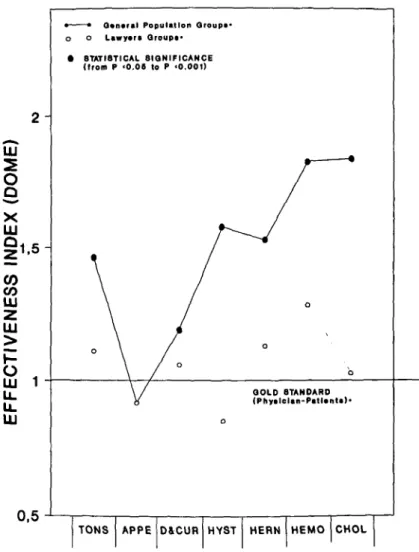
Table 2 shows the surgical procedures performed on physicians and their families (gold standard), lawyers and their families, and the general population. The data are presented by standardized rates and values of the effectiveness index (DOME). Figure 1 gives a graphic display of the index value. For each procedure considered (except appendectomy), the standardized rate for the general population was higher than that for the physicians (from 19% to 84% higher). For six of those procedures, the differences reach statistical significance (from/? < .05 top < .001). By contrast, lawyers had no surgical rate significantly different from those found for physician-patients. Appendectomy appears to be the most adequate surgical procedure per-formed. There were no sex-specific differences in surgical rates for tonsillectomy, herniorrhaphy, or hemorrhoidectomy. However, for cholecystectomy, the difference in rates between physicians and the general population (index value = 1.84; p < .02) was entirely due to the large differences between the female rate in the general population and in the physicians (female physicians = 1.96%, female participants from the general population = 6.45%; p < .001). Table 3 presents the total overcon-sumption calculated for the general population and lawyers relative to the gold stan-dard represented by the physician-patients for the seven common surgical procedures considered in the study. The general population accounts for an excess of 32.7% (p < .001) and lawyers for a not statistically significant 5%.
DISCUSSION
In our view, this study does not suffer from any major methodological bias. The survey was performed using the same procedure for all of the participants, the same variables were used to describe the surgical procedures, and lay terms were included for the nonphysician respondents.
The very high response rates (from 82-95%) indicate that there is only a small potential for selection bias. No additional effort was therefore undertaken to collect supplementary information regarding nonresponders. Designating physician con-sumption as the gold standard does not imply that this is the proper standard for appropriate, effective care; there is no information on outcomes in relation to the rates. However, as the standard is the real rate observed, it does give an important indication of physician-induced demand.
2 -Ul
O
Q X UJ !i,5-CO UJz
UJu.
u.
UJ 0,5Q*n«ral Population Groups* Lawyort Qroupa* • STATISTICAL SIGNIFICANCE
(from P <0.06 to P <0.001)
QOLD STANDARD
(Phytlelan-PatUnta)-TONS APPE D&CUR HYST HERN HEMO CHOL
Figure 1. Graphic display of effectiveness index (DOME) of surgical consumption. Value
1 is the reference value (gold standard) for each surgical procedure equivalent to the
standardized rate for the physician-patient. For details regarding the composition of the comparison groups for each surgical procedure, see Table 1.
Table 3. Total Overconsumption (in percentage) of Common Surgical Procedures Relative
to the Physican-patient Consumption
Groups Lawyers (N = 826) General population (N = 2960) Overconsumption Statistical significance + 5% NS + 32.7% p < .001 NS = not significant.
Furthermore, the study has been carried out in a country (Switzerland) where physicians are paid on a fee-for-service basis and where almost no financial barriers prevent less affluent people from obtaining medical care. The Swiss health insurance
The physician as a surgical patient system allows everybody the opportunity to benefit from any "scientifically proven" diagnostic and therapeutic service (10). As explanatory variables for differences in use, economic factors could in this case only act on the supply, not on the demand, side. Another explanation could be possible confounding through different rates of disease between social and occupational groups. However, there is little evidence for important differences in underlying disease rates among the procedures studied. Thus, the differences that we found seem to represent real differences in use between the groups that we examined.
Therefore, some conclusions can be drawn about the role of information on consumption, the problems of the supplier-induced demand, the patient-doctor rela-tionship, unnecessary medical services, and the adequacy of the medical activity to the health needs of the consumers.
The main conclusion of this study is that in a fee-for-service health care market without financial barriers to medical care, less-informed patients have the highest consumption of common surgical procedures. This result directly contradicts the study performed 20 years ago by Bunker and Brown (5) which also considered physi-cian-patient consumption to be a gold standard. Our study suggests, in contrast, that as the public becomes more informed, the demand for common surgical proce-dures will decrease.
To explain these conflicting findings, certain factors should be considered. First, methodological differences exist between the two studies. Bunker and Brown analyzed the consumption of physicians, lawyers, Protestant ministers, and businessmen of Santa Clara and some other California counties using a standardized questionnaire for determining the prevalence of surgical care in these "professional" groups. The surgical rates from U.S. hospital-discharge data were used to estimate the consump-tion of the general populaconsump-tion. A life-long surgical history was obtained by quesconsump-tion- question-naire for each of the professional subjects interviewed in California.
The extrapolation of hospital-discharge data, however, as a cross-sectional view of a given situation at a specific point in time may incorrectly estimate the surgical rates in the population due to possible time trends in the probability of surgery. Therefore, the major factor that could explain the conflicting results in the two studies is the fact that the U.S. health care market had then, as today, considerable financial barriers preventing the whole population (particularly less affluent groups) from benefiting from medical care (1;2;9).
Not surprisingly, Bunker and Brown found, even beyond the methodological problem cited above, that "overall operation rates for physicians and the other profes-sional groups studied were estimated to be 25% to 30% higher than for the country as a whole." Furthermore, if one considers that the professional groups analyzed "lived in a geographic area of high physician and bed-to-population ratios and high per capita income," their overconsumption, compared to the whole U.S. population, is not very surprising.
Bunker and Brown also tried to compare the surgical consumption of their Cali-fornia professionals with that of the general population living in the English region of Oxford. This kind of comparison has to be interpreted with caution, as the organi-zation and financing of medical care in the United States and the United Kingdom differs (in the United Kingdom, the doctor is not paid on a fee-for-service basis, which is the case in the United States, and the U.K. patient must consult a general practitioner before seeing a specialist). Additionally, there are differences in practice style, philosophy, and notions of appropriate medical and surgical procedures be-tween U.S. and U.K. doctors (3; 12).
The same author (Bunker) suggested in a previous study (4) that the greater surgical activity in the United States as compared to the United Kingdom was due, among other reasons, to the "fee-for-services, solo practice and a more aggressive therapeutic approach (which) appear to contribute to the greater number of opera-tions in the United States."
Therefore, it seems that the main conclusion of Bunker and Brown's study could be amended from "as the public becomes more informed, the demand for surgical services will increase" (5) into "if the financial barriers to medical care are removed, the demand for surgical services will increase." This latter interpretation seems to be confirmed by Bombardier et al. (2), who observed that "the introduction of public programmes aimed at reducing inequalities in the access to medical care leads to a large increase in surgical use among disadvantaged groups." She also states that education has a negative effect on the use of surgical services.
Dick et al. (6) similarly explain the dramatic increase of hysterectomies in the Canadian province of Saskatchewan between 1964 and 1971 as a consequence of the introduction of compulsory health insurance in Canada.
In Switzerland, we observed an important decrease in the hysterectomy rate after a public information campaign (8), which suggests that the more the public is informed, the less likely it is to ask for surgical care. This conclusion is in accordance with the findings of the present study.
If we consider the comparison between population and physician consumption illustrated by the effectiveness index presented in the methodological part of this paper, it is likely that the Bunker and Brown study has not shown a lack of information but rather a lack or deficiency of care for the whole U.S. population, due to economic barriers to medical care and to the lack of universal health insurance.
An intriguing finding in our study seems to be shared by Bunker and Brown: lawyers seem to have the lowest rate of common surgical procedures in comparison with other professional groups. To look for an explanation, we drew from the general population sample of our study a subgroup of liberal professionals, managers, and their children (N = 590), and we calculated surgical consumption rates in the same way. This group showed a global overconsumption, as compared to the gold standard defined as the surgical standardized prevalence of the doctors' population, of ± 25% (p < .001) while the lawyers showed a nonsignificant overconsumption of only + 5%. This last result, to be confirmed by other studies, suggests that lawyers seem to be considered by their physicians as "special patients" and thus that the medical profession could be more prudent in their evaluation of lawyers' indications for elective surgery. This is because the lawyer could be a "risky" patient, being potentially able to cause more legal troubles to the physician than most ordinary patients, should the surgery result in an adverse event or outcome. The similarity of the prevalence between physicians and lawyers may also be regarded as indirect evidence that the physician-patient's consumption could represent a reference use value, in particular as an indicator of physician-induced demand. In fact, physician behavior does not appear to be changed significantly in a situation in which the appreciation of risks and benefits of the procedure could be, for the reasons given above, of equally important personal value.
Finally, the results seem to indicate that the most coherence exists today regarding the indications for appendectomy — where differences are small.
Overall, this study suggests that as economic barriers to health care are removed and qualified information becomes more widely available, demand for surgical ser-vices may decrease and tend to reach the level of physician-patient consumption.
The physician as a surgical patient
REFERENCES
1. Blendon, R. J.,& Edwards, J. N. Caring for the uninsured: Choices for reform (editorial). Journal of the American Medical Association, 1991, 265, 2563-65.
2. Bombardier, C , Fuchs, V. R., Lillard, L. A., & Warner, K. E. Socioeconomic factors affecting the utilization of surgical operations. New England Journal of Medicine, 1977, 297, 699-705.
3. Brook, R. H., Kosecoff, J. B., Park, R. E., et al. Diagnosis and treatment of coronary disease: Comparison of doctors' attitudes in the USA and the UK. Lancet, 1988, i, 750-53. 4. Bunker, J. P. Surgical manpower: A comparison of operations and surgeons in the United
States and in England and Wales. New England Journal of Medicine, 1970, 282, 135-44. 5. Bunker, J. P., & Brown, B. W. The physician-patient as an informed consumer of surgical
services. New England Journal of Medicine, 1974, 290, 1051-55.
6. Dick, F. J., Murphy, F. A., Murphy, J. K., et al. Effect of surveillance on the number of hysterectomies in the province of Saskatchewan. New England Journal of Medicine,
1977, 296, 1326-28.
7. Domenighetti, G., Casabianca, A., & Berthoud, S. La consommation medicale des mede-cins peut-elle etre un indicateur d'efficacite'? In W. Van Eimeren, R. Engelbrecht, and Ch. D. Flage (eds.), System science in health care. Berlin: Springer Verlag, 1984,1063-65. 8. Domenighetti, G., Luraschi, P., Casabianca, A., etal. Effect of an information campaign
by the mass media on hysterectomy rates. Lancet, 1988, ii, 1470-73.
9. Hayward, R. A., Shapiro, M. F., Freeman, H. E., & Corey, C. R. Inequities in health services among insured Americans: Do working-age adults have less access to medical care than the elderly? New England Journal of Medicine, 1988, 318, 1507-12.
10. Legge federale sull'assicurazione contro le malattie del 13 giugno 1911, articolo 12 (Federal Health Insurance Law of 13 June 1911, article 12).
11. McGuire, A., Henderson, J., & Mooney, G. The economics of health care: An introductory text. New York: Routledge and Kegan Paul, 1988.
12. McPherson, K., Wennberg, J. E., Howind, O. B., et al. Small-area variations in the use of common surgical procedures: An international comparison of New England, England, and Norway. New England Journal of Medicine, 1982, 307, 1310-14.
13. Wietlisbach, V. Theorie et pratique de l'echantillonage: L'exemple de l'enquete MONICA. Sozial-und Praeventivmedizin, 1987, 32, 52-62.