People’s Democratic Republic of Algeria
Ministry of Higher Education and Scientific Research
8 MAI 1945 UNIVERSITY / GUELMA ةملاق \ 1945 يام 8 ةعماج FACULTY OF LETTERS AND LANGUAGES تاغللا وبادلآا ةيلك DEPARTMENT OF LETTERS & ENGLISH LANGUAGE ةيزيلجنلاا ةغللا و بادلآا مسق
Option: Linguistics
Improving The Quality OF Classroom Discourse in The
Algerian Secondary School.
Case Study of Third Year Students at Chaalal Messaoud Secondary
School -Guelma-
A Dissertation Submitted to the Department of Letters and English Language in Partial Fulfillment of the Requirements for the Degree of Master in Anglophone Language,
Literature, and Civilizations.
Submitted by: Supervised by:
NAHAL Dounyazad Ms. DOUAFER Imane
BOARD OF EXAMINERS
Chairwoman: Ms. EL-AGGOUNE Amina (M.A.B) University of 8 Mai 1945Guelma Supervisor: Ms.DOUAFER Imane (M.A.B) University of 8 Mai 1945- Guelma Examiner: Mrs. BENYOUNES Djahida (M.A.A) University of 8 Mai 1945- Guelma
I DEDICATION
I dedicate this dissertation to:
My beloved family.
My dear father and dear mother who educated me from childhood to be honest, respectful and Polite.
My brothers; Ali and Haron.
My sisters; Radia, Samiha, Besma and especially Fadia.
My grandmother, aunts and uncles.
My husband and his parents.
To all my teachers.
To my closest cousine Souad and her daughter Maram.
II ACKNOWLEDGEMENTS
Above all, all thanks to Allah for giving me strength and patience to complete my
dissertation.
I would like to express my deepest gratitude to my supervisor, Miss. Douafer Imane for her grateful support, help, constructive guidance, and informative comments throughout
the completion of this work.
I would like also to express my sincere gratitude and appreciation to the members of the jury who have accepted to evaluate my dissertation.
I gratefully wish to thank all my teachers without exception
My special thanks go to Mrs. Abdaoui Mounia for her informative comments and guidance.
I am thankful to Third Year Secondary school students who accepted to answer the
III ABSTRACT
The present study aims at investigating the causes of the students’ silence in third year English classes at Chaalal Messaoud secondary school in Guelma. It focuses mainly on the learners’ opportunities to speak in the classroom and the quality of classroom discourse. To reach these aims, two methods of data collection were utilized: a classroom observation and a students’ questionnaire which includes sixty (60) third year secondary school students that are analyzed quantitatively and qualitatively. In the present study we hypothesize that the main reason behind learners’ poor performance in the speaking skill would be the lack of interaction in the classroom. First, data utilized for the present study were taken in order to report the quality of students’ interaction both with their teacher and with each other. This study was carried out with three teachers of English language in third year classes in Chaalal Messaoud secondary school. The observational study that lasted for one hour per a session. Second, a questionnaire was administred to third year secondary school students. It aims at knowing the causes behind their poor performance in English language classes. On the one hand, the analysis of the classroom observation findings reveals that secondary school teachers are dominating almost the whole talking time of the classroom. On the other hand, the analysis of students’ qestionnaire shows the different causes behind the students silence in the classroom discourse.
IV LIST OF ABBREVIATIONS
CC: Communicative Competence
CD: Classroom Discourse
CLT: Communicative Language Teaching EFL: English Foreign Learners
FL: Foreign Language
FLL: Foreign Language Learning
IH: Interaction Hypothesis
L2: Second Language
SLA: Second Language Acquisition SLL: Second Language Learning
V LIST OF FIGURES AND TABLES
Figure 1.1: Interaction between Teacher and Students……….7
Figure 1.2: Interaction between Students……….9
Table 3.1: Students’ Gender………...44
Table 3.2: Years of Studying English……….44
Table 3.3: Participation in Class……….45
Table 3.4: The Importance of Classroom Participation………..46
Table 3.5: The Meaning of Classroom Participation for Students………..47
Table 3.6: Students’ Behaviour in Raised Discussion ………...48
Table 3.7: Students’ Views about their Role in the Class Discussion………49
Table 3.8: Students’ Causes for Participation in the Classroom……….50
Table 3.9: Speaking Anxiety in the Classroom………..51
Table 3.10: Students’ Participation and Speaking Anxiety………51
Table 3.11: Students’ Participation and Self Confidence………...52
Table 3.12: Students’ Worry and Participation inthe Classroom………...53
Table 3.13: Participation and Shy Students’………...53
Table3.14:Classroom Participation and Students’ Attention to the Information Offered………54
VI
Table 3.16: Teachers’ Attitudes towards Learnes’ Participation………56
Table 3.17: The Wait-Time’s Length Provided for Students to Answer Questions…...57
Table 3.18: Teachers’ Sellection of Participants in the class………..58
Table 3.19: Teachers’ Attitudes When Dealing with their Students………..…58
Table 3.20: The Influence of Teachers’ Negative Comments on Students’ Speech…..59
VII CONTENTS DEDICATION……….…i ACKNOWLEDGEMENTS………...…ii ABSTRACT………...iii LIST ABBREVIATIONS………..iv
LIST OF FIGURES AND TABLES ……….v
TABLE OF CONTENTS……….….vi
GENERALINTRODUCTION 1. Statement of the problem………..1
2. Aims of the Study……….…2
3. Research Questions………...2
4. Research Hypothesis………2
5. Methodology……….3
6. Significance of the Study………..………3
7. Structure of the Dissertation……….4
CHAPTER ONE: CLASSROOM DISCOURSE Introduction 1.1 Definition of Classroom Discourse………5
1.2 Forms of Oral Interaction………..6
1.2.1 Teacher-Learner Interaction……….7
VIII
1.3 Reception-based Theories………...….…10
1.3.1Comprehensible Input and Second Language Acquisition….……….10
1.4 Production-based Theories………...…11
1.4.1 The Importance of Output in L2 Acquisition……….…11
1.4.2 The Interaction hypothesis……….…12
1.4.3 The Discourse Hypothesis……….……….14
1.4.4 Communicative Language Teaching……….………...…15
1.4.5 Communicative Competence……….17
1.5 Communicativ The Quality of Classroom Interactione Comp………....17
1.5.1 Definition of Teacher Talk ………...……….18
1.5.2 Quantity and Quality of Teacher’s Talk………..…...18
Conclusion CHAPTER TWO: SPEAKING SKILL Introduction 2.1 Definition of Speaking Skill………..………..…21
2.2 The Importance of Teaching Speakin……….…………21
2.3 Speaking Difficulties in………..23
2.3.1 Inhibition………...23
2.3.2 Low Irregular Participation………...24
2.3.3 Nothing to Say………..…24
2.3.4 Using the Mother Tongue……….…25
2.4 Causes of Students’ Silence in the Classroom………….………25
IX
Anxiety
The Characteristics of Foreign Language Anxious Learners Limited Linguistic Competence
The Learners’ Self-confidence / Self-Esteem Learners’ shyness
The learners’ Beliefs about Language Learning
2.4.2 Environmental Factors………....…..…33
Teacher’s Role in Classroom Interaction Conclusion CHAPTER THREE: FIELD INVESTIGATION Introduction 3.1 Research Methodology and Tools………...………36
3.2 Classroom Observation Findings and Com……….………39
3.3 Discussion of the Observation Findings………..42
3.4 Analysis of Students Questionnaire………..43
3.5 Discussion of the Questionnaire Findings………61
3.6 Pedagogical Implication………...62
3.6.1 The Role of the Teacher in Encouraging Learners’ Participation…………62
3.6.2 The Role of the Students When Participating in the Classroom……….…63
X
GENERAL CONCLUSION………...…64-65
REFERENCES ………....66-70
APPENDICES
Appendixe 1: Students’ Questionnaire.
French Summary
GENERAL INTRODUCTION
1. Statement of the Problem 2. Aims of the Study
3. Research Questions 4. Research Hypothesis 5. Methodology
6. Significance of the Study 7. Structure of the Dissertation
1 GENERAL INTRODUCTION
1. Statement of the Problem
Classroom discourse is an important requirement for classroom learning environment. It is one of the most essential aspects that has gained the interest of many researchers, especially those who belong to the field of language learning and teaching. As well as, it has an essential role in developing the communicative competence in foreign language classes. Moreover, it is crucial because it can be used as a strategy of education that provides an opportunity for students to be involved in the learning process. In addition, it helps to understand how the classroom activities make a good interaction between the teacher and his students.
Besides, the ultimate aim of the majority of EFL learners is the mastery of the oral proficiency. Teachers try to give each of their students the opportunity to interact with each other in order to improve their abilities of speaking the language both inside and outside the classroom.
Furthermore, the majority of third year learners in the Algerian secondary school always encounter some obstacles while learning a foreign language, because of different reasons that may hinder their success in speaking the language effectively. Among the most influential reasons behind learners' poor performance are: the lack of oral communicative activities in the classroom and the lack of confidence to use the language because learners do not have enough vocabulary and grammar rules. This inspires the current study to see how teachers deal with these problems of communication, especially how to get their learners involved in the classroom discourse in order to be able to communicate fluently. As well as, to find out the main reasons behind students’ silence in the classroom.
2 2. Aims of the Study
The aim of the current study is to investigate the causes of the poor performance of third year learners in Algerian secondary schools. In other words, the main aim is to focus on the opportunities that are offered to the learners in the classroom in order to be able to speak the FL correctly, which means to investigate the quality of classroom discourse.
3. Research Questions
This study attempts to answer:
1. What is the quality of interaction that is provided for learners at this stage of learning?
2. What are the causes behind learners’ silence in the classroom?
4. Research Hypothesis
The majority of the learners face various difficulties in the classroom context, this leads the researcher to make the following hypothesis:
We hypothesize that the main reason behind learners’ poor performance in the speaking skill would be the lack of interaction in the classroom.
5. Methodology
In order to answer the research questions and to fulfill the research aims, two research methods are utilized to provide data for the present study. The first method is the use of a classroom observation with a random sample of sixty (60) third year students at Chaalal secondary school. Whereas, the second method is a questionnaire for the students of the same sample.
3
Through the first method of data collection which is classroom observation; the researcher observes a number of sessions in which she sheds light on the classroom discourse between the teacher and his students. Whereas, the second tool of data collection is a questionnaire submitted for secondary school students in order to find out their causes of silence in the classroom English sessions.
6. Significance of the Study
The present study has examined the main problems and obstacles learners face when making conversations either inside or outside the classroom. In fact, it is a very problematic issue which needs to be tackled to decrease this gap between the language classroom instructions and the communicative competence of learners.
Learning a foreign language has different aspects, and the most crucial one for the majority of learners is the mastery of the oral proficiency. It is considered as a complex activity to be developed because most of learners face problems in speaking that is highly noticed in their classroom conversations.
7. Structure of the Dissertation
The dissertation is composed of three chapters besides to a general introduction and a general conclusion. A general introduction contains the statement of the problem, the aims of the study, the research questions, the research hypothesis, the methodology, the significance of the study and the structure of the dissertation.
The first chapter is devoted to classroom discourse. It provides a general overview about classroom discourse and a set of definitions of the notion. Then, it explains the main forms of oral interaction. Besides, it deals with the significance of the classroom discourse in the context of both reception-based and production-based theories. It also
4
presents the quality and the quantity of classroom interaction as well as teacher talk. The second chapter deals with the speaking skill. It includes definition of speaking, the importance of teaching the speaking skill, in addition to its main difficulties in FLL. Then, it sheds light on the major causes of students’ silence in the classroom. The last chapter is concerned with the field of study, it encompasses data analysis, discussion and findings. In other words, it deals with the analysis of the classroom observation and students' questionnaire results. In addition, it offers some pedagogical implications.
CHAPTER ONE: CLASSROOM DISCOURSE / AN OVERVIEW
Introduction
1.1 Definition of Classroom Discourse 1.2 Forms of Oral Interaction
1.2.1 Teacher-Learner Interaction 1.2.2 Learner-Learner Interaction 1.3 Reception-based Theories
1.3.1 Comprehensible Input and Second Language Acquisition 1.4 Production-based Theories
1.4.1 The Importance of Output in L2 Acquisition 1.4.2 The Interaction hypothesis
1.4.3 The Discourse Hypothesis
1.4.4 Communicative Language Teaching 1.4.5 Communicative Competence
1.5 The Quality of Classroom Interaction 1.5.1 Quality and Quantity of Teacher Talk
5 Introduction
This chapter presents an overview of classroom discourse. It starts by giving its definition and precising its oral forms, especially teacher-learner and learner-learner interaction. Then, it outlines the different hypotheses related to SLA. Finally, it describes the quality and quantity of classroom interaction, teacher talk, and their contribution to the field of language learning.
1.1 Definition of Classroom Discourse
Classrom discourse (CD) is an important aspect in the process of FLL. It embodies the communication that occurs between the teacher and the learners, or between the learners inside the classroom. It refers to the language used by teachers and their students for the sake of communication to one another in the classroom. Besides, there are mainly two different types of classroom discourse; written and spoken discourse. According to Edwards and Westgate (1994: 78), CD refers to the oral interaction that takes place between teachers and students, or among students with or without the teacher in the classroom. The interaction that exists between the teachers and their students makes a common body of knowledge, helps to identify their roles and relatinships, and to be aware of their involvement as participants in the classroom. So, learning can occur when students interacte with their teacher inside the classroom setting.
Similarly, Cook (1989) stated that CD is ‘‘ the language in use’’(6). Since CD is a particular type of discourse that takes place in the classroom setting, Nunan (1993) sees it as the distinctive type of discourse that occurs in classrooms.
6
On the one hand, Strobelberger (2012) explained that communication plays a central role in classroom. Firstly, she stated that the spoken language is a significant tool for learning through which much of teaching takes place. Secondly, it is the responsibility of one person to make a control of all talk in the classrooms. Thirdly, language is a significant part of all the members’ identities.
Furthermore, she viewed classroom communication, which is an example of institutional talk, varied from normal conversation in different ways.
First, due to the fact that CD's orientation is objective this means that it is unlike the non-didactic regular converstaion. it is done aiming at reaching the objectives of curriculum, learning and teaching. Second, CD is considered as an ordinary dialogic mode. Third, CD is described by particular orgnisational features of the school like public organization which is represented by the teacher, who ‘‘is the person institutionally invested with the most talking rights.’’(Gil, 2002 cited in Strobelberger, 2012: 11).
However, CD stays cooperative problem despite the fact that the relationship among learners and teachers lacked balance and power. “CD is a collectively built enterprise where meanings of different types are constructed moment by moment.” (Gil, 2002 cited in Strobelberger, 2012: 11).
On the other hand, CD has an influence on the learning process. Skidmore (2006) indicates that CD is ‘‘one of the most important influences on students’ experinces of learning in schools.’’ (Cited in Strobelberger 2012: 5). Similarly, Pierson (2008) views it as an essential tool used to fulfill the goals of education. It is the most significant medium which helps in delievering classroom instructions effectively.
7 1.2 Forms of Oral Interaction
According to Thurmond (2003), classroom interaction involves four types of interaction: course content interaction, learner interaction, learner-teacher interaction and learner- technology interaction, since classroom interaction has a considerable significance in the field of FLL. In this research. Two major types are to be highlighted in the current chapter.
1.2.1Teacher-Learner Interaction
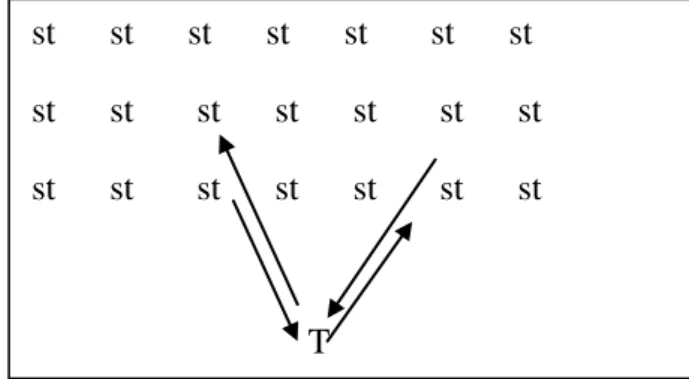
Teacher-learner interaction as Coulthard (1977) indicates, has obtained a great deal from teachers in an extensive variety of disciplines. It takes place between the teacher and one learner or many other learners, that is to say the teacher participates in some kinds of interaction. S/he discusses with his students the content of the course, uses students’ ideas, asks questions, lectures them, offers them instructions, and criticizes or justifies students’ talk especially responses. In addition, the students will benefit from their teachers’ experience on how to interact in an efficient way. Scrivener (2005: 85) supplies with the following diagram to illustrate this type of interaction.
Figure 1.1: Interaction between teacher and students
Key
Teacher interacts with student
st st st st st st st st st st st st st st st st st st st st st
8
Student interacts with teacher St: Student
T: Teacher
In this type of interaction, all learners require similar interaction when the teacher gives instructions either with the entire group or small classes. A substantial step in improving language is giving students enough opportunities to communicate with their teacher and negociate meaning. Many studies and researches in the field of interaction concentrate on the interactive discourse between students participating in SLL tasks where negociation of meaning is the central point. This term ‘negociation of meaning’ refers to the verbal exchanges when the speakers intend to overcome the breakdown in communication. In addition, they say that negociation of meaning is the focal point of discourse structure. Within the classroom context, learners must make the linguistic production more understandable for other learners in the class, consequently they can interact with each other. (Ellis and Barkhuizen, 2005).
During teacher-learner interaction, the students attemp to speak and listen in front of their teachers. Because of this, the teacher ought to think about his way of interacting which has a significant role in the learning and teaching process. According to Harmer (2009), teachers should concentrate on three main points when talking to their students. First, all the learners must understand the language they use, which means that an understandable output must be given to all learners from different levels. Second, teachers should think carefully of what will be said for their students due to the fact that their speech is taken into consideration as a source for learners. Finally, teachers require to specify the various ways through which they will speak to learners among them the intonation, voice, and tone.
9 1.2.2 Learner-Learner Interaction
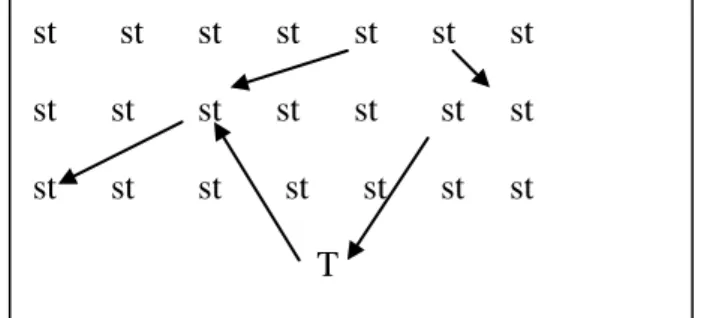
This type of interaction is considered as indispensible place in which cooperation is permitted and knowledge is built. Many theories of learning maintain that different ideas are actively shared and skills are better improved interactions between learners. Moore (1989: 4) asserted that such kinds of interaction are happening, ‘‘between one learner and another one, alone or in a group, with or without the presence of the instructor.’’ As it is explained in the following diagram by Scrivener (2005: 86)
Figure 2: Interaction between Students Key
Student-student interaction St Student
T Teacher
According to Johnson (1995), if student-student interaction is constructive and well managed, then it can be considered as a significant factor for enhancing educational achievement of students and for developing social competencies. In addition, collaborative learning can improve the learners’ capacities. As a result, through this type of interaction; the students will make social relationship, where the sense of excommunication is minimized within classrooms.
Naegle paula (2002: 128) confirms that “talking students with their peers about the content of the course is a powerful way for them to reinforce what they have learned.”
st st st st st st st st st st st st st st st st st st st st st
10
Hence, teachers must use this type of interaction between his students since it motivates the communiaction between them that is to say to be active participants.
1.3 Reception-based Theories
1.3.1 Comprehensible Input and Second Language Acquisition
The input hypothesis was closely linked to the first version of Interaction Hypothesis. For instance, Krashen (1985) reported that: ‘‘when learners are exposed to language that they can mostly understand but which still contains forms that they do not know, they will, in time, aquire such new forms naturally from the input they hear and read’’. The input hypothesis is one of the most outstanding theories that is important to language learning. Simply, it indicates the kind of language that the learner is exposed to, it shapes a precondition for learning within which it gives an important proof, and helps learners to shape linguistic hypotheses.
It is the most known reception-based theory. Comprehensible input is a term coined by Krashen (1985, cited by Leaver &Willis, 24 :298) which refers to the spoken form of the target language that can be understood by learners, however, not all the words or structures are intelligble. According to Krashen, learners will acquire a second language when they obtain ‘comprehensible input’ that has a hight level in contrast to their current level. He states that: ‘‘…we acquire only when we understand language that contains structure that is far a little from where we are…’’(21). He points to this type of input as the following formula’i+1’. For example, if the learner is at the level (i) this represents his current level of improving the interlanguage. In addition, the (+1) is an important type of inpiut that is defying however it is not crushing the learner. Hence, like this situation learners can aquire such kind of input only with some efforts.
1.4 Production-based Theories
11
comprehensible input is insufficient for SLA. Barnes (1992), supposed that learning is a reciprocal discussion between what will teachers say ? And what learners assume to comprehend in the classroom ? It is evident that production-based theories assert the reality that a language is gained if only learners try it.
1.4.1 The Importance of Output in Second Language Acquisition
By the mid 1980’s, Swain came with the output hypothesis that is also known as the comprehensible output hypothesis. She observed that comprehensible input has gained a great deal of attention.
Swain (1985) put an important hypothesis based on her study of Cannadian immersion learners who learned French language for a long period of time. She clarified that although those students recieved a great quantity of input for a period of seven years, they lacked proficiency in the target language. In other words, they were far from native speaker usage. She declared: ‘‘after seven years of this comprehensible input, the target system has not been fully acquired” (246). Thus, she descovered that the comprehensible input is not enough to gain fluency and accuracy in the target language as natives. (Cited in Hall & Verplaetse, 2000).
Swain (1985) suggested that the language needs practice through producing it, especially, when the students participate in an understandable output, so they will improve their cognitive capacities. In her view, the students must be pushed by their teachers to use the language deeper than the input does.
The Comprehensible Output hypothesis stated that learners acquire the language well when they try to relocate a message. However, whenever they face obstacles, they have to attempt it once again. As a result, learners will reach the correct form of their
12
utterances. For that reason, learners learn the new structure because they have already produced it. Moreover, learning takes place when learners notice that there exist a gap of linguistic knowledge between what learners need to transmit and their ability to transmit it. In addition, the output shows a crucial significnace to the learning process as it forces the students to utilize their rational process to say sentences more than the input does, and it authorizes them in monitoring their acquisition in order to reach their communicative goals. Eventually, through the learner’s output and the interlocutor’s response to that output, the learner can modify his or her language use (Hall& Verplaetse, 2000: 4). Swain also claims that language acquisition is improved by language production, due to the fact that learners have already experienced comunicative failure. So they are obliged to make use of their own output in a more specific way which is suitable and cohesive.
1.4.2 Interaction Hypothesis
Long (1983) suggested another important reception-based theory which is known as the interaction hypothesis (IH). It has a great influence in the field of SLA. Long makes use of both the input and the output hypotheses in SLA. The input hypothesis stressed learners’ needs to interact in conversations in order to achieve a comprehensible input; whereas, the output hypothesis stressed the learners’ needs for speaking and making use of language, while the interaction hypothesis attempts to combine both hypotheses taking into consideration the fact that interaction is not just a tool that helps learners to practise what they have already learnerd; but also a tool that helps them to study the language as well.
Long(1983) presented his theory to highlight the significant role of interaction in SLA. It is one of the theories which stressed that the best way to learn FL on L2 is
13
through the individual interaction. This latter, enhances face-to-face interaction which gives learners opportunity to speak, receive comprehensible input and modify their output too. Moreover, interaction hypothesis is based on the concept of negociation of meaning, which is considered as a central component in the field of SLA. It proposed that when L2 learners negociate meaning with other speakers who are more adept L2 users learning can happen. Long believes that there are various points in the process of negociation of meaning:
The first point is that interaction hypothesis is interested in a specific kind of interaction which is known as the negociation of meaning, while each contributor participates in the discussion. The second point is the negative feedback, where the understanding of a word’s meaning is not an easy task for some participants, so they will ask for explanation. In this case, the contributor attempts to clarify for those who miss understanding by using examples, or paraphrasing the meaning in order to maintain comprehension. This is known as the modified output. What promote the understandability of input is that, when participants try to change the language to understand each other asfacilitating or giving explanation this shapes the input understandability and makes learners concious about the difference that exists in their L2.
Furthermore, the key features of SLA suggested by IH are known as ‘checks’ which means, during the interaction learners check with other speakers that there exists a gap in their knowledge. They are named ‘modification checks’. Long (1983) proposed that during the negociation of meaning, the conversational modifications used by learners which make the comprehensible input improve learners advance in the target language and acquisition as well. They are classified into three most significant categories:
14
Clarification check is the learner’s request for more information about the difficult words. Then, confirmation check is about the learner’s request whether others understanding of meaning is correct or not. In addition to comprehension check in which the learners request other interlocutors if they comprehend what is said. That is to say, the learner’s goal is to check if the message is understood.
1.4.3 The Discourse Hypothesis
Discourse Hypothesis concentrates on the different factors that contribute in the field of SLA. This hypothesis was proposed by Givon (1979). He suggested that in various social situations, learners will acquire the type of language they face whether inside or outside the classroom context. For example, when the students participate in formal language discourse, they will learn only that type of language. However, when they shave access to informal language discourse, they will acquire competence to perform only the type of language that exists in that context. Teachers should expose their learners to a variety of communicative contexts to help them acquire different linguistic competencies. Furthermore, the fundamental claim of this hypothesis is that the language will be acquired in a more natural manner, where it is requested to master the reccurent items of language that may happen.
1.4.4 Communicative Language Teaching
Communicative language teaching (CLT) or what is called the communicative approach, is generally described as a wide approach in the field of langauage teaching. CLT dated back to the late 1960’s. It occured as a result of changes within the teaching tradition of British people. Many linguists in Britain took part in putting the basis of the communicative approach. Its main aims are to make the communicative competence the purpose of language teaching, and to put steps to master all the skills
15
that recognize communication and connection of the language components stressed by Hymes (1972). Moreover, it concentrates on communicative needs of learners make them able to use the language in real conversation. Also, to have independent learners and to make a particular classroom context where the negociation of meaning occurs. Because of the fact that both of negociation and interaction are regarded as significant steps during the acquisition of a target language.
CLT also puts a great emphasis on learners because when they interact and exchange ideas between each other they learn language well. Consequently, communication plays an important role. According to Brown and Yule (1983) communication is characterized by two main aims:
When using language in order to initiate a conversation and make contact, this is the interactional function. And when using language in order to make an exchange of information, it is the transactional function.
CLT interests in the role of the teacher and gives him priority in the classroom.Breen and Cadlin (1980: 94) indicated that:
The teacher has two main roles: the first role is to facilitate the communication process between all participants and various activities and texts. The second role is to act as an important participant within the learning-teaching group.
The communicative approach stressed the idea that teachers must facilitate the process of learning for their learners and lead them rather than be a relaible power. So, learners are responsible in monitoring their learning. As a result, CLT is a learner – centered approach within which the learner has a great importance in the process of learning and he must be a dynamic participant.
CLT enhances the use of real-life situations that require learners to communicate. The teacher is responsible to create a situation in the classroom where learners are
16
required to face in real life situations, because this helps them to acquire the language well. The communicative approach tries to put students in new situations where expecting new things in classroom context that differ from their own reactions. Unlike the audio lingual method that depends on repeating the same exercices. Imitating the real-life cases increasingly, students are stimulating themselves because they want to communicate in main subjects.
1.4.5 Communicative Competence
Canale and Swain (1980) define the term communicative competence (CC) as the ability to fulfill communication aims by using the language in a suitable and proper way. The intended result of the process of language learning is not the ability to communicate with language as natives, but rather it is the ability to be proficient in using language.
Canale and Swain (1980), divided the CC into four main parts. They include:
Grammatical Competence includes the knowledge of grammar rules, vocabulary, formation of words, and syntax, in addition to the way we use them. In addition, sociolinguistic competence that includes the knowledge of the sociocultural rules in order to be an adept language user, such as the relationship between learners in various sociolinguistic contexts. Also, discourse competence includes the knowledge of the rules of analyzing different types of texts to make them coherent. Finally, strategic competence which includes the knowledge of how to master the different strategies of communication in L2 which are basically used to manipulate lack of communication.
1.5 The Quality of Classroom Discourse
17
teacher’s talk gives learners opportunities to interact meaningfully, or does not which means do teacher provide FL learners’ with enough opportunities to communicate language naturally ? This part of research gives the relevent aspects of classroom interacrtion in the process of language learning. Moreover, it tries to find the features of teacher’s talk which give genuine interaction various opportunities in the classroom language.
1.5.1Definition of Teacher Talk
Lynch (1996) points out that teacher’s talk is the language typically used by teachers in L2 classroom. He believes that few teachers think that advanced learners are not concerned with this type of device. Whereas, it is beneficial for other learners in communication. Ellis (1994) refers to the mass of classroom research that investigated the teacher's talk and points the changes while L2 learners are addressed in the classroom. He adds that many researchers have given a great deal of interest to teacher’s talk, due to the fact that it affects the L2 acquisition. In addition, he assertes that the learning process and studends’ comprehension are affected by teacher’s talk too.
In the classroom context, teacher’s talk is supposed to be one of the most important ways by which teachers transmit information to their learners. However, they believe that what learners will face when communicating with native speakers is away from teacher’s talk. Allwright &Bailey (1991).
1.5.2 Quantity and Quality of Teacher’s Talk
Cullen (1998: 179) depicts teacher’s talk by saying that in the context of EFL classroom, teacher’s talk was regarded as an unsafe part for teachers of language.
18
‘Good’ teacher talk is necessarily mean ‘Little’ teacher talk becuase it was believed that teachers who took too much time when talking, prevented their students from opportunities to interact and communicate freely. A big concern that put on teacher talk has changed from an interest of quantity to an interest of quality.
Accordingly, Richards & Lockhart (1996) discuss that a fundamental support to make language comprehensible and learners’ production easy is through an efficient teacher talk.
Thornbury (1996) confirms that the central point that is taken into consideration by teachers is to which level teacher talk supports the classroom atmosphere, where comunication occurs. So, he attempts to describe communicative teacher’s talk by questionning the authenticity and the way of using authentic communication out of the class. (Cited in Cullen, 1998).
Researchers use the terms, ‘authentic’, ‘genuine’ and ‘natural’ interchangibaly as they were used in FL. They use them without giving a clear definition to each term. Seedhouse (1996). However, genuine communication or authentic communication is defined as to negociate meaning and to deliver information in unssufficient manner, for instance confirmation checks, negociation by many interlocutors, and it is the role of the speaker to decide about to interact or not. Nunan (1987: 137, cited in Cullen1998).
Nunan (1987) tried to use features of communicativeness as those that are mentioned in the previous definition of genuine communication. In order to assess if the classrooms that are assumed to be communicative classes were found communicative classes or not.
19
the classroom context. Nunan (1987) discusses that the interaction in different communicative classes is uncommunicative, which meansthat because the teacher is interested in the correct formation of his/her learners participation in the lesson rather than the information itself. Also, Cullen (1998) in the classroom context, requests which try to give defintion to communicative talk should precise only what is communicative. In other words, the teacher gives feedback to his learners by focusing on the content than the correct form of the message.
Negociation of meaning and negociation by many interlocutors are those features that describes genuine communication. They were considered as the main cause to be integrated in classroom discourse and to assess its communicativeness if those features were really presented.
Allwright & Bailey (1987) noticed that teacher’s talk takes control of the entire classroom in various classrooms, in which there exist only little chances to use language in an authentic way. Bellack (1966) supports the previous idea by supposing four classroom discourse moves; structing, reacting and soliciting which are related to the teacher. Whereas, responding is related to students’ privilege. (Cited by Allwright & Bailey, 1991).
Conclusion
This chapter includes the main theoretical basis of the term CD, starting from the various definitions of the term which were provided by famous scholars. Moving to its classification into two main forms; discourse between the teacher and learners, and discourse between learners. Then, it highlights many CD theories and hypotheses to show its significance; especially, students’ classroom oral proficiency. Additionally, much greater interest has been given to the quality of classroom interaction, and mainly
20
to teacher’s talk.
CHAPTER TOW: Speaking Skill
Introduction
2.1 Definition of Speaking
2.2 The Importance of Teaching Speaking
2.3 Speaking Difficulties in FLL
2.3.1 Inhibition
2.3.2 Low Irregular participation
2.3.3 Nothing to Say
2.3.4 Mother Tongue Use
2.4 Causes of Students’ Silence in the Classroom 2.4.1 Individual Factors
1. Anxiety
Fear of Negative Assessment Anxiety of Test
Apprehention to Communicate
The Characteristics of Foreign Language Anxious Learners 2. Limited Linguistic competence
3. The learners’ Self-confidence/ self-esteem 4. Learners’ shyness
5. The learners’ Beliefs about language learning 2.4.2 Environmental Factors
Teachers’ Role in Classroom Interaction