Social Learning Processes in Swiss Soil Protection
—
The
‘From Farmer - To Farmer’ Project
Flurina Schneider&Patricia Fry&Thomas Ledermann& Stephan Rist
Published online: 9 July 2009
# Springer Science + Business Media, LLC 2009
Abstract Social learning approaches have become a prom-inent focus in studies related to sustainable agriculture. In order to better understand the potential of social learning for more sustainable development, the present study assessed the processes, effects and facilitating elements of interaction related to social learning in the context of Swiss soil protection and the innovative‘From Farmer - To Farmer’ project. The study reveals that social learning contributes to fundamental transformations of patterns of interactions. However, the study also demonstrates that a learning-oriented understand-ing of sustainable development implies includunderstand-ing analysis of the institutional environments in which the organizations of the individual representatives of face-to-face-based social learning processes are operating. This has shown to be a decisive element when face-to-face-based learning processes of the organisations’ representatives are translated into organisational learning. Moreover, the study revealed that this was achieved not directly through formalisation of new lines of institutionalised cooperation but by establishing links in a‘boundary space’ trying out new forms of collaboration, aiming at social learning and co-production of knowledge. It
is argued that further research on social learning processes should give greater emphasis to this intermediary level of ‘boundary spaces’.
Keywords Knowledge co-production . Social learning . Soil conservation . From farmer to farmer . Boundary space
Introduction
Soil degradation is among the major environmental threats to the sustainability of agriculture in Europe (Helming et al. 2006; Van-Champ et al. 2004). Soil erosion has been increasing in Switzerland since the 1950s. An estimated 20% of the cultivated land has been affected by soil erosion since 1990 (Ledermann et al.2008; Mosimann et al.1990; Prasuhn and Grünig2001). Emerging off-site impacts since the mid-1970s, for example the eutrophication of various Swiss lakes, and extensive research activities brought the issue to the public’s attention (Prasuhn and Weisskopf 2004a; Weisshaidinger and Leser2006). Subsequently,—in the context of the general reorientation of Swiss agricultural policy in 1993—several legal regulations regarding soil protection and sustainable land resource management have been introduced. However, soil conservation measures have only scarcely been applied to date in agricultural practice, and soil erosion damage can still regularly be observed (Ledermann and Schneider 2008; Ledermann et al.2008). In many other European countries, the problem setting related to conservation agriculture is very similar to the situation observed in Switzerland (Auzet2003; Boardmann and Poesen 2006).
The research that we present here aims to analyse this phenomenon and to identify alternative ways of implemen-tation. For this reason, we first characterise governmental F. Schneider (*)
:
T. Ledermann:
S. RistCDE—Centre for Development and Environment, University of Bern, Bern, Switzerland e-mail: [email protected] URL:www.cde.unibe.ch T. Ledermann URL:www.cde.unibe.ch S. Rist URL:www.cde.unibe.ch P. Fry
Knowledge Management Environment LLC, Zürich, Switzerland
soil protection implementation strategies in Switzerland by linking them to current scientific debates on communication and rural innovation. In this way, we designate the concepts of‘co-production of knowledge’ and ‘social learning’ as a suitable theoretical framework. After presenting the re-search methods, we further analyse soil protection strategies that concern available space for social learning. The paper then focuses on the process of social learning in the‘From Farmer - To Farmer’ project—a project which seeks to facilitate the spread of soil conservation measures by bridging the gap between farmers’, experts and scientists’ knowledge. Finally, conclusions will be drawn on the potential of social learning and co-production of knowledge for more sustainable soil cultivation.
In analysing the limited success of soil protection in Switzerland, three obstacles were found:
1. Soil protection has been perceived in past primarily as a technical task. The major efforts have gone into understanding the bio-physical dimension of soil erosion and soil protection as well as the quest for technological solutions. Technological solutions such as no-tillage, mulch tillage or strip tillage are essential in the quest for sustainable agriculture; however, they are not the answer in themselves. Technological solutions need to be integrated with broad cultural, social, political and economic transformations (Schneider et al. 2009). Against this background the current emphasis on the technical dimension should be complemented with a focus on human activity and social processes (see Woodhill and Röling2000). 2. As a consequence, soil protection strategies are based
on the concept of knowledge transfer: Implementation of innovation is regarded as a linear, one-dimensional process, where technologies are developed by research and transferred by extension services to the farmers (Carr and Wilkinson2005; Roux et al.2006). Scientists are thus conceived of as producers of new knowledge and farmers as adopters. However, in practice the ‘knowledge system of agriculture’ (Blum 1994) is much more complex. A number of recent publications propose alternative forms of knowledge production (Funtowicz and Ravetz 1993, 1994; Gibbons et al. 1995; Kates et al. 2001; Nowotny et al.2001; Rist et al. 2007; Steyaert et al. 2007; Warner 2008). From different starting points, all these authors agree that knowledge creation in post-modern society should be conceived of as a process of co-production of knowl-edge between academic and non-academic actors. For the case of agriculture in general and soil protection in particular this means that the quest for sustainable soil cultivation should be understood as process of knowl-edge co-production between farmers, experts and
scientists. Thus, this model goes clearly beyond the paradigm of knowledge transfer underlying classical systems of agricultural extension. While the transfer model is underpinned by assumptions of positivist science such as the existence of an objective and value-free description of external reality, conceptions of co-production of knowledge build on constructivist understandings.
3. Soil protection policies have therefore emphasised mainly the ecological and agro-economical dimension of soil degradation and soil conservation. However, as we have shown in other research (Schneider et al. 2009), farmers perceive soil erosion and soil conserva-tion measures against the background of their taken-for-granted life-world at large. Even if farmers frequently discuss aspects of institutional, economic, ecological and agronomic relevance, theses aspects cannot be understood apart from socio-cultural and aesthetic elements, including social values and norms, professional ethics, and their philosophy of life.
Hence it is evident that the underlying values, norms and meanings of the different actors, as well as their explicit and tacit conceptions of knowledge and human action, play crucial roles in the current problem of implementing Swiss soil protection. We deduce from this that in innovating sustainable agriculture, the central question should move from how farmers learn a new technique most efficiently to how farmers, scientists and advisors can collaborate (Coughenour 2003), re-negotiate existing and co-create new meanings for soil erosion and soil conservation.
Transformation of the values, norms, rules and power relationships that govern the use of agricultural soils can be addressed by the concept of ‘social learning’: In recent years, social learning approaches have become a prominent focus in studies related to sustainable agriculture and natural resource management (Altieri 2004; Davidson-Hunt 2006; Eshuis and Stuiver 2005; Jiggins et al. 2007; Röling and Wagemakers 2000; Roux 1997; Tàbara and Pahl-Wostl 2007; Warner2007,2008). The social learning approach represents a philosophy focusing on participatory processes of social change. This means integrating the knowledge of different people, whether they are farmers, scientists or experts. Changes emerge when actors‘change their minds’ through critical thinking, interactions and dialogue with others. This involves questioning the assumptions that underlie human actions and concepts (Woodhill and Röling 2000). As stated by Röling (2002), it is necessary to move from individual “multiple cogni-tions” to interrelated “collective and distributed cognition” and to an understanding of group processes to capture the essence of social learning. In this sense, Rist et al. (2006) define social learning processes as the simultaneous
transformation of cognitive, social and emotional compe-tences as well as of social capital which includes attitudes and values related to collective or individual social actors emerging from the joint search for more sustainable management of natural resources at the interface between the world of rural actors, experts and public administration. Nonaka et al. (2001) combine the learning dimension with an understanding of knowledge creation which they describe as continuous, spiralling process of conversions between tacit and explicit forms of knowledge. The distinction between tacit and explicit forms of knowledge is a fundamental basis of their theory. According Nonaka et al. (2001), explicit knowledge can be expressed in words and can therefore be transferred in the form of data, scientific formulae or manuals. By contrast, tacit knowl-edge (also called embodied knowlknowl-edge or knowlknowl-edge by experience (Reichert et al. 2000) is highly personal and hard to formalise, making it difficult to communicate. However, tacit knowledge is deeply rooted in the actions and experiences of individuals as well as in their ideals, values or emotions. Against this background, the authors mentioned conceptualise knowledge creation not as static management of existing explicit knowledge, but as dynamic management of the process of creating knowledge out of knowledge. They argue for understanding knowledge creation as a continuous self-transcending process which must be‘nurtured’ rather than ‘managed’.
Methodology
What kind of research is needed to overcome the above-mentioned shortcomings regarding implementation of soil conservation in the context of sustainable development and long-term sustainability of agricultural resources? There is growing agreement that transdisciplinary research is an appropriate form of research when searching for solutions to‘real world problems’ with a high degree of complexity, uncertainty and controversy (Hurni and Wiesmann 2004; Klein 2001; Pohl 2008; Rist et al. 2007; Woodhill and Röling 2000). Transdisciplinary research aims at trans-gressing the boundaries between scientific disciplines and between science and practice in order to contribute to more sustainable development.
In this sense, researchers collaborated with the ‘From Farmer - To Farmer’ project and jointly co-produced new knowledge. The researchers investigated processes related to social learning in the project and its accompanying group by means of participatory observation, document analysis, group discussion, and qualitative interviews with all regular participants in the ‘accompanying group’ (for a further description of this group see Chapter 3.2). At the same time the researchers actively participated in this accompanying
group. As a result, the social science perspective continuously enriched the debates and the researchers themselves learned about the perspectives and knowl-edge of other participants. Moreover, preliminary re-search results were regularly brought back to the group. This facilitated continuous reflection on the ongoing activities as well as refinement of the project. As a consequence, the approach of the present study is part of what Burawoy (1998) calls a ‘reflexive model of science’ which embraces not detachment but engagement as the broad road to knowledge.
Soil Protection in Switzerland and the‘From Farmer -To Farmer’ Project
Soil Protection in Switzerland
Switzerland is one of the few European countries that has established a comprehensive legal framework to enhance implementation of soil conservation measures on a large scale (Prasuhn and Weisskopf 2004b). Soil protection is made explicit in several national laws passed by the Swiss parliament. Some of these laws are enforced by the Federal Office for Agriculture (FOAG), others by the Federal Office for the Environment (FOEN). Practical implementa-tion of soil protecimplementa-tion, nevertheless, is within the compe-tence of cantonal authorities such as the soil protection agencies and agricultural offices. Soil protection agencies are responsible for evaluating impacts on the soil in general and arranging necessary measures. Agricultural entities are responsible for implementing regulations governing agri-cultural direct payments, which state that farmers who intend to receive direct payments must take suitable protection measures against soil erosion.
However, it is largely unclear how these laws are to be enforced. They stipulate that erosion should be avoided but they do not say how this is to be done. In consequence, the responsible cantonal authorities implement soil protection with varying intensity and different approaches. The adopted strategies range from ‘top-down risk-oriented approaches’ based on soil erosion risk maps to ‘top-down damage-oriented approaches’ based on reporting of con-crete soil erosion damage to ‘participatory oriented approaches’ based on management contracts and counsel-ling interviews.
Besides the national and cantonal authorities already mentioned, several other actors play important roles when it comes to protecting agricultural soils, namely farmers and their organisations, educational establishments, and re-search stations (Blum1994).
By analysing the situation of soil protection in Switzer-land in regard to spaces for social learning between farmers,
experts and scientists, we found that social learning is often impeded primarily for four reasons:
1. Lack of possibilities for interaction (e.g. time, space). Collaboration between actors involved in soil protection and agriculture and actors at the local, regional and national levels is traditionally weak. There are few spaces where these actors regularly meet and collectively develop new knowledge and strategies. Most meetings of this kind take place between actors at the administrative level (e.g. experts in agriculture and soil protection): farmers are usually not involved. When farmers are involved it is generally in the context of knowledge transfer activities that represent hierarchies and power relations characteristic of top-down approaches to innovation.
2. The involved actor groups have different life-worlds, working methods, interests and priorities. While farmers are primarily interested in producing food based on a culturally defined form of life and government agencies are interested in protecting soils, soil scientists focus on producing theories about soil functions and processes. Furthermore, few agricultural organisations are sensitised to the need for soil protection, while many others do not consider it a priority (Fry2001).
3. There is a lack of trust between different actor groups. Experiences with top-down implementation meth-ods in agriculture reveal the prejudices of all actors involved: Farmers fear that institutional actors will impose something on them which does not correspond to their life-world. Representatives of soil conservation agencies sus-pect actors in agriculture of blocking any discussion of more sustainable agriculture. Representatives of agricultural agencies worry that soil conservation actors will only make demands for further restrictions on farming. In other words, all actors are afraid, that other actors act from their perspective only and do not take the concerns of others seriously.
4. Scientific knowledge is seen as superior to other forms of knowledge. Farmers’ knowledge is mostly characterised as ‘know-how’ and not appreciated by science, because it does not comply with traditional scientific criteria (Fry 2001). Co-production of knowledge, however, requires that scientific knowledge is not privileged over farmers’ knowledge.
While agricultural and environmental policies of Switzerland have been defined autonomously with regard to Europe, basic features of the respective European and Swiss policy frameworks are rather similar (e.g. high degrees of protectionism, direct payments for ecological and other services, strong presence of public regulation). This fact allows suggesting that this Swiss case study gives insights that are also applicable to the wider context of EU.
The‘From Farmer - To Farmer’ Project
Several cantonal agencies and federal offices concerned with soil protection and agriculture, farmers’ assemblies, agricultural schools and research institutions have tried to enhance the spread of soil conservation through an innovative ‘farmer-to-farmer approach’. The approach is based on the insight that farmers, experts and scientists have different perspectives on soil, work with different methods, and speak another language. Therefore, farmers are expected to learn more easily from the experiences of other farmers who have already integrated soil protection on their farms (Fry 2001). To valorise this knowledge, the ‘From Farmer - To Farmer’ project was established between 2001 and 2007. The project sought to identify farmers’ knowledge about conservation agriculture and to commu-nicate this knowledge in farmers’ networks by means of story-telling and film (Fry 2004).1
The project was accompanied and shaped by an ‘accompanying group’ built by participants representing farmers, experts and scientists. It thus represented a typical multi-actor and multi-level situation related to sustainable agriculture (Table 1).
Fundamental transformations within the project and its accompanying group as well as the involved institutions led us to conceive of the ‘From Farmer - To Farmer’ project as an interesting case study of initially unintended processes of social learning and co-production of knowl-edge. In order to characterise social learning and co-production of knowledge we will first describe the project’s development by reconstructing the oral and recorded debate among the people involved. Then we will identify the main effects of social learning processes and subsequently elements that facilitated these processes. These three aspects are highly interrelated and separated only for analytical reasons.
Development of the‘From Farmer - To Farmer’ Project The project’s development can be divided into four phases: a conceptual phase, a pilot phase, a film production phase, and a film dissemination phase. The overview (Table 2) reveals that these four phases differ regarding content and activities, formally participating actor groups, and the predominant aim and underlying knowledge concepts of the participants. During all these phases, however, farmers’,
0
While‘farmer to farmer’-approaches are well-known in the South, especially in Latin America (see Holt-Giménez2006), in Europe this approach is relatively unknown. Consequently,—as will be showed later—the project leader developed the ‘from farmer–to farmer’ project mainly independently of the Latin American experiences.
experts’ and scientists’ knowledge was relevant and social learning and co-production continually increased.
Conceptual Phase
The project was initiated by the future project leader who elaborated the projects design based on her experience working in a cantonal soil protection agency and her insights from social science research about the different perspectives of farmers, experts and scientists related to soil fertility (Fry2001). In this early phase, the project aimed to promote soil protection within agriculture by developing decision-making aids togeth-er with farmtogeth-ers. This should allow farmtogeth-ers to betttogeth-er assess soil quality, as with the rarely adopted examination aids developed by soil experts (e.g. spade test). Several cantonal soil protection agencies and the Federal Office for the Environ-ment were interested in the unconventional approach. The approach, we argue, was coherent for most of these actors, as it corresponded to their experience that farmers have other perspectives and languages, to their aims in implementing soil protection, and to their underlying concepts of unilateral knowledge transfer. This is reflected in the question‘How can farmers’ learning processes related to better soil management be facilitated more efficiently?’
Two soil protection agencies and the Federal Office for the Environment financed the project in this initial phase on the condition that actors in agriculture, especially the Federal Office for Agriculture, supported the project as well. This was a quite challenging task, as most agricultural organisations were not interested in the issue of‘soil protection’. Eventually, they were convinced by the project’s focus on the perspectives
of farmers. After personal discussions with representatives of agricultural organisations, the project’s design was adapted according to the concerns expressed. In place of the question of‘soil protection’, farmers’ views and actions were put at the centre of the project. This shift in the focus was reflected in the renaming of the project, from‘Farmers Decision-Making Aids for Physical Soil Protection’ to ‘From Farmer - To Farmer’.
During the conceptual phase the idea of building an accompanying group was proposed by the Agridea exten-sion service. The accompanying group was meant to ensure interconnectedness within the knowledge system of agri-culture and soil protection, to support the project with different kinds of knowledge, and to help disseminate the knowledge in related agricultural networks. Furthermore, the accompanying group was established explicitly to facilitate learning between representatives of agriculture and soil protection. However, it was assumed that the experts involved would verify farmers’ knowledge. Pilot Phase
In a next step the Federal Office for Agriculture, the Federal Office for the Environment and ten cantonal soil protection agencies agreed to finance a pilot project, where the effectiveness of the ‘from farmer - to farmer approach’ would be proven. All planned working steps were to be tested, from investigating farmers’ sustainable soil cultiva-tion strategies to the diffusion of this knowledge in farmers’ networks. Cantonal soil protection agencies and agricultural schools helped to identify farmers who had broad experi-ence in soil conservation. Their knowledge, gathered over Table 1 Participants in the accompanying group of the‘From Farmer - To Farmer’ project
Actor groups Participants from Thematic focus
Soil protection
Agriculture Socio-economic issues
Farmers’ organisation Swiss Farmers’ Union x
Association of Integrated Production (IP-Suisse) x Association for Organic Agriculture (Bio-Suisse) x Association for Agritechnology (SVLT) x Experts of public administration
(regional level)
Bernese soil Protection Agency (SPA BE) x
Agridea extension service x
Two agricultural schools x
Experts of public administration (national level)
Federal Office for Agriculture (FOAG) x Federal Office for the Environment (FOEN) x
Science Centre for Development and Environment of the University of Bern (CDE)
x Swiss Federal Institute for Forest, Snow and Landscape
Research (WSL)
years of collaboration with soil conservation experts, was identified and tapped by the project team, which inter-viewed farmers in their fields and produced a short pilot film. Subsequently, the film was presented in an agricultural school and at an assembly of a local machinery ring. Evaluation of these presentations by means of a question-naire further encouraged the project approach.
In parallel, the project leader conducted a social science investigation of farmers’ networks to determine the most efficient way of subsequently distributing the films. This way, the strategies and experiences of existing and successful agricultural networks, such as a cantonal program promoting conservation agriculture and the cus-tomers of agricultural contractors, were integrated into the project.
In this phase, the first reunions of the accompanying group took place. Many different actors from soil protection and agriculture participated. Discussions in this group were about fundamental elements of the project’s approach and often controversial: How can the effectiveness of the project be verified? Are all relevant actors involved in the project? How can the traditional tensions between agricul-ture and soil conservation been mitigated? Is film a good means of knowledge transfer?
Film Production Phase
The aim of this phase was to jointly produce profes-sional films about farmers’ experiences with soil conservation. While the film was initially seen as one Table 2 Overview of the development of the‘From Farmer - To Farmer’ project
Main features Phases
Conceptual phase Pilot phase Film production phase
Film dissemination phase
Main content and activities
Developing decision-making aids for farmers
Developing means for bringing soil protection to agriculture Investigating sustainable soil cultivation strategies used by farmers and producing films Disseminating farmers’ soil cultivation knowledge in farmers’ networks by means of film Developing a sound project concept Proving the effectiveness of the approach Integrating actors from
agriculture Participating actor
groups
Soil protection (public organisations)
Soil protection (public organisations)
Soil protection (public organisations)
Soil protection (public organisations) [Agriculture (public organisations and professional associations)] Agriculture (public organisations) Agriculture (public organisations) Agriculture (public organisations)
Social science [Agriculture (professional associations)]
Agriculture (professional associations)
Agriculture (professional associations
Social science Social science Social science Predominant aims and
underlying knowledge conceptions Knowledge transfer by new methods Knowledge transfer by new methods Knowledge exchange between farmers Facilitating farmers’, experts and scientists learning Facilitating farmers’ learning Facilitating farmers’ learning Facilitating farmers’ learning
Social learning between farmers, experts and scientists
Knowledge exchange between farmers Relevant forms of
knowledge
Farmers’, experts’ and scientists’ knowledge
about agriculture, soil protection and education/learning
Relative importance of the social learning processes and co-production of knowledge
means among others for the diffusion of farmers’ experiences, it was now becoming a central focus in collaboration between the actors involved, mainly because of positive experience with the pilot film in the previous phase.
The films were produced by a team consisting of the project leader and audio-visual professionals in close collaboration with the farmers involved and the accompa-nying group. All three actively participated in the creation of the films’ concept, contents, and form. Drafts of the films were presented to the farmers and the accompanying group. Farmers, experts and scientists discussed what issues might appeal to the target group, what content corre-sponded with soil protection, and what other issues should be included. Discussions in the accompanying group turned more and more from attempts to come to terms with the project approach to concrete questions about the project’s realisation.
By end of 2006 production of the films was finished with an opening event, which took place at the annual meeting of the agricultural organisation SVLT. The project initially only carried out by actors from soil protection turned into a project being part of agriculture.
With the initiation of this phase a close partnership with a university institute was established. This allowed engage-ment with social scientists who joined the accompanying group and began to analyse the social learning processes related to the project (see section on methodology). Transdisciplinary research within the project facilitated continuous reflection on ongoing activities and refinement of the project.
Film Dissemination Phase
The aim of this phase was the presentation of the films in farmers’ assemblies. The farmers’ organisations involved activated their networks in order to create space to present the films and facilitate discussions and learning processes among farmers. This process is still ongoing and the subject of other publication.
Meetings of the accompanying group and transdisci-plinary research also continued in this phase. Joint reflection in the accompanying group caused growing awareness of the effects of the films: participants realised that the films not only had an impact on farmers, but that they influenced first of all the participants in the accompanying group and their respective home institutions. The participants became increasingly convinced that learning is needed not only with farmers but among all participants.
In the following section we shall describe the effects of the processes of social learning and co-production of knowledge in greater detail.
Effects of the Social Learning Processes
Mutual Understanding and Trust
All interviewed actors stated that they gained greater degrees of trust and mutual understanding of the views and room for manoeuvre of the other participants.
An administrative representative described the process of confidence building in this way:
“We know each other, all are well minded. At the beginning we had to find a way to cope. One had to think more before one said something. A straightfor-wardness appeared– mutual trust developed. (...) You do not need to bluff. You realise that everybody comes out of a different field with different expert knowledge.”
The related process of growing mutual understanding was expressed by a farmer as follows:
“You begin to gain understanding of their (experts’) concerns and points of view. You look at the world more broadly and begin to see why people do things differently elsewhere. Why people from the federal government act as they do. And why they can’t do otherwise. You believe you understand clearly why you think as you do. But to consider another opinion and be able to say,“yes, in principle he’s also right” – this is a path we need to pursue further.”
Broader Understanding of the Issue
The emergence of mutual understanding and trust came along with a broader view of the situation and an increased understanding of the key issues related to soil conservation. Some participants stated that they gained new insights about technical issues related to soil, soil erosion or soil conservation. Others claimed to have complemented their knowledge about soil conservation by learning more about social processes, e.g. the importance of integrating farmers in governmental implementation strategies from the begin-ning. However, all participants stressed personal discus-sions with other‘experts’ that tackled the questions of soil conservation from different standpoints. An agricultural expert expressed this as follows:
“It is interesting to see how each individual views things; people are very important to me. One may represent a didactic viewpoint, another may be involved in a global network, and a third may base his argument on statistics...Much is clear from theory or practice, but it are the connections ...it isn’t really that I gain new knowledge but that my own
knowledge is put in another context or becomes more deeply ingrained in my own awareness.”
The participants contextualised their existing knowledge, taking into account a broader range of perspectives. At the same time, existing and new knowledge was better embodied in the persons involved. This reveals the importance of the tacit and explicit dimensions of the knowledge creation process.
Scrutinising Approaches and Underlying Knowledge Conceptions
In parallel to the processes described above, some of the involved administrative representatives started to scrutinise their approaches. The representative of the Federal office for Environment, for example, stated that while interacting with farmers in the field he learned about their reality and thus critically reflected on their own institutional imple-mentation strategy as too limited:
“After (the group meetings) I saw much clearer how direct drilling works. Of course one had read about it before. But when you are there yourself you see how the farmers explain the machines. When you are with the farmers on their fields you also see the difficulties: The complexity of their decisions, with heavy soils for instance. Mostly we confront them with a specific problem and they have to cope with the whole crop rotation, the weather, that they get it done in time ....” By-and-by, all participants were sensitised to the‘From Farmer - To Farmer’ project’s participatory approach. While at the beginning the majority saw the project as a means to the end of transferring soil conservation to farmers, albeit with unconventional methods, they came more and more to realise that integration of farmers is not only better for dissemination, but also brings better solutions. They also started to realise that social learning and co-production of knowledge are needed to overcome the contradictions between sectoralised forms of knowledge.
Although the philosophy of knowledge transfer and its underlying positivist knowledge conception is deeply embedded in the thinking and acting of farmers, experts and scientists, there is clear evidence that participants have gradually been changing their knowledge conception. This is especially true for actors who already had partly constructivist knowledge conceptions on a tacit level: A cantonal soil protection agency, for example, designed their implementation strategy while taking account of different kinds of knowledge, but they could not name the underlying principles. Collaborating with the‘From Farmer - to Farmer’ project, their representative learned to express the underlying assumptions of their implementation
strate-gy and to argue with it. Some actors with an initially positivist knowledge conception gradually changed it as well. For example, an administrative representative who primarily questioned the project’s approach experienced to some degree the value of integrating farmers’ knowledge and working with the unconventional approach.
Improved Collaboration for Better Solutions
All participants stressed the achievement of successful collaboration between actors representing farmers, researchers, experts and administrative representatives. The participants learned that collaboration with“others” is possible and meaningful. They described collaboration as a common quest for better solutions to soil degradation. A farmer put it as follows:
“You feel that everyone knows it won’t be easy. And we can achieve something together only step-by-step. You could feel that already in this group. No one said, “it must be like this.” When scientists have something to say, it simply becomes a directive. But here you feel involved in a common search for solutions with practitioners: “what is possible? And what is not possible?”
Beyond concrete collaboration in the context of joint production of the film, the participants used their new contacts in different intensities: Some had almost no further contacts, others stated that they contacted key persons more easily, and still others started to work together in new projects or programs. The most far-reaching example of a newly established collaboration positively influenced by the experiences in the ‘From Farmer - To Farmer’ project is a novel project where exponents of organic agriculture and the no-tillage soil conservation system work together in the context of a national resource protection programme. This is quite exceptional, as there have been traditional tensions between the two parties regarding different notions about the use of chemicals. Both the representative of organic agriculture and the representative of no-tillage, are con-vinced that this would not have been possible without the establishment of personal contacts and the positive experi-ences in the‘From Farmer - to Farmer’ project.
Film as an Intermediary Object
The films can be regarded as visible expressions of the common quest for better solutions and the related social learning process. Discussions in the accompanying group and with the involved farmers in the field directly influenced the design and content of the films. This can be concluded from analysis of the group meetings, as well as from how the participants see the process. While in the
beginning there were controversial discussions about the elements to be presented in the film (e.g. the use of the plough) and the possibilities of using the films for knowledge exchange, in the end all participants developed a certain feeling of ownership of the project and the films. The films become the linking element between the individual participants: They became an ‘intermediary object’. In speaking of intermediary objects we follow the definition of Vinck (1999), who introduces the term for objects which are produced when actors change their perception of an issue and come to a shared understanding. Intermediary objects are characterised by their ability to federate people around a concrete entity and thus to launch collective action, on the one hand, and the ability to circulate from one place to another, on the other hand (Steyaert et al. 2007). Intermediary objects in the form of films have the advantage of conveying explicit as well as tacit elements.
Positive Connotation of the Issue‘Soil’
The ‘From Farmer - To Farmer’ project stimulated discussion of soil conservation issues in agriculture. Soil protection was linked to the idea‘from farmer - to farmer’ to a certain degree. It is no longer just a request coming from environmental protection advocates; it became a matter of concern to farmers. Furthermore, the films convey not only technical facts but also a certain emotional ambience. Both elements contributed to a more positive connotation of soil protection in agriculture. For example, several participants who have been in regular contact with the Federal Office for Agriculture observed that it is easier today to debate questions related to soil protection with this federal office. The representative of the Office himself put it as follows:
“The project served internally as a door-opener for the Federal Office of Agriculture. Now when I bring up the topic of soils, everyone knows, ah, yes, soil: From Farmer - To Farmer, the films, direct seeding...Goodwill has been generated. The internal effect in the end is perhaps as great as the external. Management tools have been created here: if you stimulate internal awareness about soil and arouse sympathy for the topic you then have a chance to implement actual tools that can have an effect. Film is a very different medium: film appeals to our senses and reaches people in another way that somehow inspires confidence.”
Change of Agendas and Approaches of Institutions
The‘From Farmer - To Farmer’ project not only provided space for learning by the involved participants, it also had
effects on the agendas and approaches of the involved organisations and the establishment of new projects and programs. Impacts concerned further activities with the aim of improving the project’s efficiency, including the organisa-tion of film presentaorganisa-tions, the establishment of training courses for extension workers, and the prolongation and expansion of the project to the French-speaking part of Switzerland and to new issues such as pasture management. Furthermore, the participatory design of the project served implicitly or explicitly as a model for new projects in related fields such as a project about the re-use of excavated material in a cantonal soil protection agency, and the national resource program of the Federal Office for Agriculture supporting farmers’ initiatives for more sustainable agriculture. The latter program represents a fundamental change in the governmental imple-mentation strategy. So far, impleimple-mentation of measures for sustainable agriculture has been based on a system of incentives, control and sanctions. The new program provides a new and still small space where farmers, experts and scientists work together.
These new projects and programs can be regarded as new spaces for social learning where farmers, experts and scientists collaborate and co-produce knowledge for more sustainable development (see the chapter on improved collaboration for better solutions). They link different organisations and actor groups within a boundary space between them. In this process, the films proved to play an important role. As ‘intermediary objects’ they helped the participants to communicate to their organisations the individual learning processes in the accompanying group. Presentations of the films opened space allowing learning processes to emerge among the other members of the organisations by positively influencing the institutional environment, resulting in more positive connotations associated with soil issues and farmers’ respective knowl-edge about it (Fig. 1).
Facilitation of Social Learning and Co-Production of Knowledge
The processes described above occurred by no means automatically and not in all cases. Analysis revealed that social learning cannot be imposed upon the actors. Instead, the conditions for the emergence of social learning can be positively influenced. Spaces for social learning within the ‘From Farmer - To Farmer’ project proved to have been shaped by four highly interrelated main characteristics:
Collaboration Beyond Traditional Political Tensions
The opportunity to meet in a context removed from current political struggles and traditional institutional tensions and
power relationships turned out to be an essential element enabling social learning. The ‘From Farmer - To Farmer’ project provided space and time for individual actors to interact under novel auspices. A representative of the Federal Office for the Environment described this as follows:
“We had always had contact with the Federal Office for Agriculture. Contact and disputes, with the disputes being more frequent. They usually tried to cut off everything that grew out of an environmental perspective and to postpone it, so they would have to do as little as possible. We did have joint projects, but usually in the sense of negotiating who would concede more. Our collaboration in the‘From Farmer - To Farmer’ project, by contrast, was very good because we both pulled in the same direction.”
Against the background of such experiences, the question arises of how distinct actors could be convinced to enter into collaboration. This was due to the sound
management of the project leader, which enabled all these actors to find an ‘entrance’ to the project: for some actors this entrance was‘soil conservation’ (mainly actors in soil protection), for others ‘the from farmer - to farmer approach’ (mainly actors in agriculture) and for still others the underlying ‘theoretical foundations’ (actors in social science). The project leader invested a lot of time and energy in bilateral meetings to establish personal relations, to identify the participants’ plans and goals, and to integrate them into the project. In doing so, the project leader was supported by several early participants who personally knew other actors.
Finding common interests and liaisons not only livened up the project but also created a new basis for collaboration and social learning. This process was facilitated by the fact that the subject of producing a film for farmers went beyond the traditional debates on (ecological) direct pay-ments. At the same time, intensified social learning was shown to be impeded if the distance between the actors was too great due to varying interests, aims or life-worlds. This Bio Suisse* Project ‘re-use of excavated material’ Resource programme: ‚Project Soil’ Farmers’ organisations Public administration Science
Spaces for learning between farmers, experts and scientists
Interactions/social learning processes within the ‘From Farmer – To Farmer’ project Interactions/social learning processes beyond the ‘From Farmer – To Farmer’ project
…. Actors B …. …. Actors C FOAG* SPA BE* ‘From Farmer - To Farmer’ Project …. …. Actors A Time
* SPA BE: Bernese soil Protection Agency FOAG: Federal Office for Agriculture
Bio Suisse: Association for Organic Agriculture (Bio-Suisse) Fig. 1 Two examples of new
spaces for social learning pro-cesses and co-production of knowledge
was also true if the participants acted mainly as representa-tives of their institutions. In these cases, participants were stuck in negotiating institutional interests.
An Atmosphere of Trust that Led to Acknowledgement of Farmers’, Experts’ and Scientists’ Views and Knowledge An atmosphere of trust where farmers’, experts’ and scientists’ views and knowledge are taken seriously was one of the most important elements enabling social learning in the ‘From Farmer - To Farmer’ project. The development of such an atmosphere took time. It evolved through specific forms of collaboration, the engagement of the project leader, and as a result of the attitudes of the participating actors. For instance, the project leader organised situations where specific actors were addressed as ‘experts’: e.g. most meetings of the accompanying group started in the field, where farmers naturally have the role of specialists. This helped the participants to respect the competence and knowledge of the other (non-scientific) actors and, at the same time, to experience respect for their own knowledge. Actively integrating actors with different perspectives and knowl-edge and allowing them to be part of the process was an important element. In cases where this did not work out, group processes were shown to develop a life of their own with the result that participants were excluded and social learning was thus impeded.
In addition, intermediary persons proved to play a crucial role. Several participants, including the project leader, had experiences in various fields such as agricultural practice and science or soil protection and agriculture. They knew different life-worlds, forms of knowledge and institutions and thus could build bridges between the distinct actors. Analysis of the accompa-nying group meetings showed that the mediating inter-ventions of these persons fundamentally shaped the dialogue between the distinct participants. Intermediary persons, therefore, can be regarded as important facili-tators of social learning processes.
Communication and Interaction Beyond the Knowledge Systems to which the Actors Belong
The emergence of social learning was facilitated by forms of collaboration that enabled communication and interac-tion beyond the knowledge systems to which actors formally belonged: This basically means forms of collab-oration that integrate the life-worlds of the actors. Creating films about farmers practicing soil conservation made the personal experiences of the farmers the starting point for many discussions in the accompanying group. This also encouraged the participants with a scientific background to
discuss soil protection on the level of personal experience rather than on the level of ‘objectified’ scientific results. The effect of these personal interactions was described by a farmer as follows:
“...when some official simply implements a law without having any relation to its impacts, but here there was a different feeling. I also felt that a representative of the Federal Office was trying to understand farmers’ concerns – thanks to the films, among other things. The films affected us first. They were in a language everyone could understand but not primitive; this initiated a process of mutual under-standing.”
This kind of interaction did not primarily take place during the formal meetings, but during the more informal sessions such as coffee breaks, common lunches, field trips, and travel. It related to the establishment of personal relations and the emergence of emotional qualities. Many participants expressed the importance of meeting other participants in their own locations and thus becoming acquainted with their life-world and their institutional context. A soil protection expert expressed this as follows:
“You could have really good discussions. At meetings where the participants were located, I felt that something was developing and there would be no turning back. Even that XX could express himself the way he did– which I hadn’t thought possible – even critically with regard to certain steps in mechaniza-tion, and that we experienced each other as human beings. I think we all benefited from the mutual respect that developed – even though we all repre-sented different positions. Everyone felt that we had a goal and that we were working towards it jointly.” The willingness to get involved in these kinds of interactions was shown to have been determined by the participants’ knowledge conceptions: Actors with underly-ing constructivist knowledge conceptions believed that different people could have different life-worlds and knowledge. Consequently, they were more likely to be open to learn from other participants and to reflect their own position. Actors with underlying positivist knowledge conceptions tended to devalue the project and its approach as backwards-looking and romanticising traditional farm-ers’ knowledge. For them, farmfarm-ers’ knowledge cannot really be innovative and thus there is no value in social learning. In the same way, social learning proved to be difficult if there was strong agreement between actors in the same field. Under these circumstances, discussions focused on specialised details and interactions based on personal experience were not possible.
Possibilities for Creating and Sharing Tacit and Explicit Knowledge
The analysis revealed that social learning in the ‘From Farmer - To Farmer’ project encompassed creating and sharing of tacit and explicit forms of knowledge. Both forms of knowledge were equally important and were shown to be intrinsically linked to each other. Learning on an explicit level, for example, was interlinked with the emergence of the partly tacit elements of personal attach-ment, trust and mutual understanding. Creation and sharing of the two forms of knowledge was enabled by space and time for joint‘experience’ as well as ‘reflection’. Personal experience during informal meetings in the field, the use of story-telling methods, active collaboration on a specific product and interactions on the life-world level facilitated the involvement of tacit knowledge. Joint reflection, on the other hand, took place through dialogue within the group and helped to articulate tacit knowledge, working experi-ences, ideas, and preliminary feelings. Joint reflection was facilitated by the continuous transdisciplinary research as well as by the project leader’s sensitive moderation of
discussions. The meetings were moderated in such a way that critical subjects could be addressed and solved in the group.
However, the effect of joint experience and reflection in biannual meetings depended on the participants’ possibil-ities for linking novel understanding with experience in ‘normal’ daily or working life: For example, increasing awareness of integrating farmers in implementation pro-cesses can be traced back to the social learning process in the project but must also be seen in the context of ongoing debates on participatory approaches stimulated by long-term experience in international development cooperation.
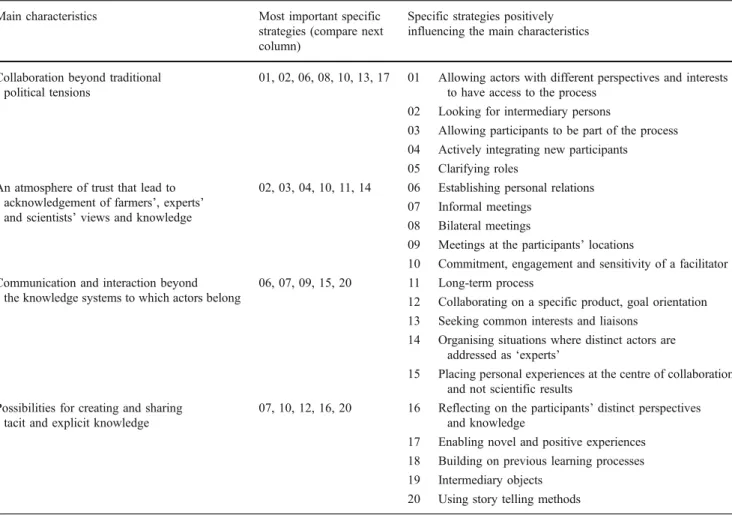
The main characteristics explored proved to be inten-tionally created by the project leader. However, in many cases they emerged spontaneously. In both cases—in the words of Nonaka et al. (2001)—it was important to ‘find’ and ‘energise’ spaces where social learning between different actors occurred spontaneously in daily life. We found in this study that creating, finding and energising spaces for social learning aiming at co-production of knowledge was positively influenced by the specific strategies summarised in Table 3. All of these strategies
Table 3 Main characteristics and related strategies shaping spaces for social learning Main characteristics Most important specific
strategies (compare next column)
Specific strategies positively influencing the main characteristics
Collaboration beyond traditional political tensions
01, 02, 06, 08, 10, 13, 17 01 Allowing actors with different perspectives and interests to have access to the process
02 Looking for intermediary persons
03 Allowing participants to be part of the process 04 Actively integrating new participants 05 Clarifying roles
An atmosphere of trust that lead to acknowledgement of farmers’, experts’ and scientists’ views and knowledge
02, 03, 04, 10, 11, 14 06 Establishing personal relations 07 Informal meetings
08 Bilateral meetings
09 Meetings at the participants’ locations
10 Commitment, engagement and sensitivity of a facilitator Communication and interaction beyond
the knowledge systems to which actors belong
06, 07, 09, 15, 20 11 Long-term process
12 Collaborating on a specific product, goal orientation 13 Seeking common interests and liaisons
14 Organising situations where distinct actors are addressed as‘experts’
15 Placing personal experiences at the centre of collaboration and not scientific results
Possibilities for creating and sharing tacit and explicit knowledge
07, 10, 12, 16, 20 16 Reflecting on the participants’ distinct perspectives and knowledge
17 Enabling novel and positive experiences 18 Building on previous learning processes 19 Intermediary objects
influenced all four main characteristics described. However, some of them—as listed in Table3—proved to be of special importance.
Conclusion
The limitations of the generally adopted knowledge transfer approach in promoting soil conservation motivated us to investigate an alternative way of implementation which is based on co-production of knowledge and social learning. The study on the ‘From Farmer - To Farmer’ project revealed that processes of social learning led to fundamen-tal transformations in patterns and atmospheres of inter-actions between the actors involved. They can be related to three different levels: (1) face-to-face interactions within the project, (2) interactions within the involved organisations, and (3) interactions within the boundary spaces existing between organisations.
Transformations on the level of face-to-face interactions were mainly associated with joint film production. They encompassed the emergence of mutual understanding, trust, improved relations, a broader and more contextualised understanding of the problem of soil conservation, as well as transformations in the underlying conceptions of knowledge. The study thus underpins, for the case of Switzerland, the results of an investigation of the main dimensions of social learning processes, carried out in the context of developing countries. Rist et al. (2006) showed that social learning processes must be understood as the simultaneous and actor-specific transformation of cognitive, social and emotional competences and the social capital through which actors are bound together.
These transformations occurred by no means automati-cally, and not in all cases. We identified four highly interlinked core characteristics that shaped social learning and co-production of knowledge: Collaboration beyond traditional political tensions; an atmosphere of trust where farmers’, experts’ and scientists’ views and knowledge are taken seriously; communication and interaction beyond the knowledge systems to which the actors belong; and possibilities for creating and sharing tacit and explicit knowledge.
As a consequence of the face-to-face learning processes emerging from the joint film production, some participants began to scrutinise other existing implementation schemes and to search for alternatives based on the newly gained insights. They reorganised existing and created new projects within the room for maneuver they had, by gradually transforming their institutional approaches from understanding implementation not as unilateral process of knowledge transfer, but as a pathway to co-production of knowledge between farmers, experts and scientists. By
translating processes of social learning created in the context of the ‘From Farmer - To Farmer’ project to their organisations, the films played an important role as intermediary objects. Furthermore, presentations of the films opened spaces for organisational learning by posi-tively influencing the institutional environment, resulting in more positive connotations of soil protection and farmers’ respective knowledge about it.
The newly established projects themselves can be regarded as spaces for social learning where farmers, experts and scientists collaborate and co-produce knowledge for more sustainable development. Different organisations and actor groups become linked through these new learning spaces located in a boundary space between them. While these new alliances were first created in a rather informal way, in a second step they were concretised to specific new projects as part of a more formalised inter-institutional process of negotiation and learning. In this way, social learning processes involving individual participants could be propagated beyond the face-to-face interactions within the ‘From Farmer - To Farmer’ project to further learning on the level of the institutions and their boundary spaces.
Summarising the above findings we conclude that social learning resulting in co-production of knowledge between farmers, experts and scientists becomes essential for jointly moving towards more sustainable agriculture.
Policy Implications
In view of the great potential of processes of social learning and co-production of knowledge, we can highlight three important implications for governmental soil conservation strategies: – Soil protection strategies should place more emphasis on
social processes, the emergence of trust, and mutual understanding, as well as on the tacit dimensions of knowledge creation. This means, for example, integrating intermediary persons who can build bridges between different kinds of actors and taking into account that certain types of knowledge can be created and commu-nicated only through sharing time and space together. – In this regard, implementation strategies should be based
on a dynamic interrelation between finding spaces where learning processes between farmers, experts and scientists occur in agricultural practice (e.g. farmers’ networks) and enriching them, thus creating new spaces to actively enhance social learning.
– Soil protection agencies should see themselves not as managers but as facilitators in a dynamic process of knowledge emergence between farmers, experts and scientists. In this perspective not only the farmers but also the experts and the scientists are part of the learning process.
Scientific Implications
Most articles published over the last decades have focused on social learning processes on the level of face-to face interactions, in which individual actors collectively recon-ceptualise the definition of present situations in order to create more common ground for collective action (e.g. Buck 2003; Schusler et al. 2003). Far less attention has been given to the role of learning in shaping social institutions or the way institutions and organisations interact. This is true for social norms and values, public, private, and civic sector organisations, and political and economic structures (Woodhill 2002). This study demon-strates that a learning-oriented understanding of sustainable development implies including analysis of the institutional environments in which the organisations of individual representatives of face-to-face-based social learning pro-cesses operate. The degree to which organisational struc-tures are able to respond positively to the social learning processes in which their individual members are involved has proven to be a decisive factor in making it possible to turn the face-to-face-based learning processes of the organisations’ representatives towards forms of more organisational learning. Moreover, the study revealed that this was achieved not directly through formalisation of new lines of institutionalised cooperation; instead, it was achieved by establishing links in a boundary space by trying out new forms and content in collaboration aiming at social learning and co-production of knowledge.
To better understand the elements and processes that contribute to propagation of face-to-face social learning processes, and to changes at the institutional level, we argue that further research should emphasize elements and processes related to this boundary space, including inter-mediary persons and objects.
Acknowledgement The project is affiliated to the COST Action 634 (On- and Off-site Environmental Impacts of Runoff and Erosion). The authors wish to thank the Swiss State Secretariat for Education and Research SER for financing the study, and the Federal Office for the Environment FOEN, the Federal Office for Agriculture FOAG and the Swiss National Centre of Competence in Research North-South (NCCR North-South) for their financial contributions.
We like to thank Tobias Buser and Karina Liechti for many fruitful discussions and helpful comments to earlier versions of this article.
References
Altieri, M. A. (2004). Linking Ecologists and Traditional Farmers in the Search for Sustainable Agriculture. Frontiers in Ecology and the Environment 2(1): 35–42. doi:10.1890/1540-9295(2004)002 [0035:LEATFI]2.0.CO;2.
Auzet, A. -V. (2003). From soil erosion knowledge to soil protection and runoff prevention - COST 623. In Boix-Fayos, C., Dorren,
L., and Imeson, A. C. (eds.), Briefing papers of the first SCAPE workshop. Scape Office, Amsterdam, pp. 27–29.
Blum, A. (1994). Das landwirtschaftliche Wissenssystem der Schweiz. AGRARForschung 1(11–12): 507–510.
Boardmann, J., and Poesen, J. (2006). Soil Erosion in Europe. Wiley, Chichester.
Buck, L. E. (2003). Strengthening natural resource institutions in Africa - Applying social learning to reconciling poverty reduction and environmental management., Proceedings of the International Workshop on Reconciling Rural Poverty Reduction and Resource Conservation: Identifying Relationships. Cornell University Press, Remedies, pp. 1–27.
Burawoy, M. (1998). The Extended Case Method. Sociological Theory 16(1): 4–33. doi:10.1111/0735-2751.00040.
Carr, A., and Wilkinson, R. (2005). Beyond Participation: Boundary Organizations as a New Space for Farmers and Scientists to Interact. Society and Natural Resources 18(3): 255–265. doi:10.1080/08941920590908123.
Coughenour, M. C. (2003). Innovating Conservation Agriculture: The Case of No-Till Cropping. Rural Sociology 68(2): 278–304.
http://search.ebscohost.com/login.aspx?direct=true&db= sih&AN=9750179&site=ehost-live.
Davidson-Hunt, I. J. (2006). Adaptive Learning Networks: Develop-ing Resource Management Knowledge through Social LearnDevelop-ing Forums. Human Ecology 34(4): 593–614.
Eshuis, J., and Stuiver, M. (2005). Learning in Context Through Conflict and Alignment: Farmers and Scientists in Search of Sustainable Agriculture. Agriculture And Human Values 22(2): 137–148. doi:10.1007/s10460-004-8274-0.
Fry, P. (2001). Bodenfruchtbarkeit - Bauernsicht und Forscherblick. Margraf Verlag, Weikersheim.
Fry, P. (2004). Von Bauern - für Bauern: Ein neuer Ansatz fördert den mechanischen Bodenschutz in der Landwirtschaft. BGS Bulletin 27: 91–96.
Funtowicz, S. O., and Ravetz, J. R. (1993). Science For The Post-Normal Age. Futures 25(7): 739–755. doi:10.1016/0016-3287(93)90022-L. Funtowicz, S. O., and Ravetz, J. R. (1994). The Worth Of A Songbird - Ecological Economics As A Post-Normal Science. Ecological Economics 10(3): 197–207. doi:10.1016/0921-8009(94)90108-2. Gibbons, M., Limoges, C., and Nowotny, H. (1995). The New Production of Knowledge: The Dynamics of Science and Research in Contemporary Societies. Sage, London.
Helming, K., Rubio, J. L., and Boardman, J. (2006). Soil Erosion Across Europe: Research Approaches and Perspectives. Catena 68(2–3): 71–72.
Holt-Giménez, E. (2006). Campesino a Campesino: Voices from Latin America's Farmer to Farmer Movement for Sustainable Agricul-ture. Oakland: Oakland.
Hurni, H., and Wiesmann, U. (2004). Towards transdisciplinarity in sustainability-oriented research for development. In Hurni, H., Wiesmann, U., and Schertenleib, R. (eds.), Research for Mitigating Syndromes of Global Change Geogaphica Bernensia, Bern, pp. 31–41.
Jiggins, J., van Slobbe, E., and Röling, N. (2007). The organisation of social learning in response to perceptions of crisis in the water sector of The Netherlands. Environmental Science & Policy 10 (6): 526. doi:10.1016/j.envsci.2006.12.006.
Kates, R. W., Clark, W. C., Corell, R., Hall, J. M., Jaeger, C. C., Lowe, I., McCarthy, J. J., Schellnhuber, H. J., Bolin, B., Dickson, N. M., Faucheux, S., Gallopin, G. C., Grubler, A., Huntley, B., Jager, J., Jodha, N. S., Kasperson, R. E., Mabogunje, A., Matson, P., Mooney, H., Moore Iii, B., O'Riordan, T., and Svedlin, U. (2001). Environment and Development: Sustainability Science. Science 292(5517): 641–642. doi:10.1126/science.1059386. Klein, J. T. (2001). Transdisciplinarity: Joint Problem Solving among
Ledermann, T., and Schneider, F. (2008). Verbreitung der Direktsaat in der Schweiz. AGRARForschung 15(8): 372–377. http://www. agrarforschung.ch/.
Ledermann, T., Herweg, K., Liniger, H., Schneider, F., Hurni, H., and Prasuhn, V. (2008). Erosion damage mapping. Assessing current soil erosion damage in Switzerland. In Dazzi, C., and Costantini, E. (eds.), The soils of tomorrow. Advances in Geoecology 39, 263–284.
Mosimann, T., Crole-Rees, A., Maillard, A., Neyroud, J. -A., Thöni, M., Musy, A., and Rohr, W., (1990). Bodenerosion im Schwei-zerischen Mittelland. Ausmass und Gegenmassnahmen. Liebefeld-Bern.
Nonaka, I., Konno, N., and Toyama, R. (2001). Emergence of“Ba”. A conceptual framework for the continuous and self-transcending process of knowledge creation. In Nonaka, I. (ed.), Knowledge emergence. Social, technical, and evolutionary dimensions of knowledge creation. Oxford University Press, New York, pp. 13– 29.
Nowotny, H., Gibbons, M., and Scott, P. (2001). Re-thinking Science: Knowledge and the Public in an Age of Uncertainity. Polity, Cambridge.
Pohl, C. (2008). From Science to Policy Through Transdisciplinary Research. Environmental Science & Policy 11(1): 46. doi:10.1016/j.envsci.2007.06.001.
Prasuhn, V., and Grünig, K. (2001). Evaluation der Ökomassnahmen -Phosphorbelastung der Oberflächengewässer durch Bodenero-sion. FAL-Schriftenreihe Nr. 37, Zürich-Reckenholz.
Prasuhn, V., and Weisskopf, P. (2004a). Current approaches and methods to measure, monitor and model agricultural soil erosion in Switzerland. paper presented at Agricultural Impacts on Soil Erosion and Soil Biodiversity: Developing Indicators for Policy Analysis., Rome, Italy.
Prasuhn, V., and Weisskopf, P. (eds.), (2004b). Current approaches and methods to measure, monitor and model agricultural soil erosion in Switzerland.
Reichert, D., Fry, P., Heid, C., and Steinemann, U. (2000). Wissenschaft als Erfahrungswissen. Deutscher Universitäts-Ver-lag, Wiesbaden.
Rist, S., Chiddambaranathan, M., Escobar, C., and Wiesmann, U. (2006).“It Was Hard to Come to Mutual Understanding” The Multidimensionality of Sociallearning Processes Concerned with Sustainable Natural Resource Use in India, Africa and Latin America. Journal of Systemic Practice and Action Research 19: 219–237. doi:10.1007/s11213-006-9014-8.
Rist, S., Chiddambaranathan, M., Escobar, C., Wiesmann, U., and Zimmermann, A. (2007). Moving from Sustainable Management to Sustainable Governance of Natural Resources: The Role of Social Learning Processes in Rural India, Bolivia and Mali. Journal of Rural Studies 23: 23–37. doi:10.1016/j.jrur stud.2006.02.006.
Röling, N. G. (2002). Beyond the aggregation of individual preferences. Moving from multiple to distributed cognition in resource dilemmas. In Leeuwis, C., and Pyburn, R. (eds.), Wheelbarrows Full of Frogs: Social Learning in Rural Resource Management. Koninklijke Van Gorcum BV, Assen, pp. 25–47. Röling, N. G., and Wagemakers, M. A. E. (2000). A new practice:
facilitating sustainable agriculture. In Röling, N. G., and
Wagemakers, M. A. E. (eds.), Facilitating Sustainable Agriculture. Cambridge University Press, Cambridge, New York, pp. 3–22. Roux, M. (1997). Lernprozesse für eine nachhaltige Landwirtschaft in
Kulturlandschaften. LBL, Lindau.
Roux, D. J., Rogers, K. H., Biggs, H. C., Ashton, P. J., and Sergeant, A. (2006). Bridging the science-management divide: moving from unidirectional knowledge transfer to knowledge interfacing and sharing. Ecology and Society 11(1): Article 4 [online] URL:
http://www.ecologyandsociety.org/vol11/iss11/art14/. [online] URL:
Schneider, F., Ledermann, T., Fry, P., and Rist, S. (2009). Soil conservation in Swiss agriculture—Approaching abstract and symbolic meanings in farmers’ life-worlds. Land Use Policy. Corrected proof.
Schusler, T. M., Decker, D. J., and Pfeffer, M. J. (2003). Social Learning for Collaborative Natural Resource Management. Society and Natural Resources 16(4): 309–326. doi:10.1080/08941920390178874
Steyaert, P., Barzman, M., Billaud, J. P., Brives, H., Hubert, B., Ollivier, G., and Roche, B. (2007). The Role of Knowledge and Research in Facilitating Social Learning among Stakeholders in Natural Resources Management in the French Atlantic Coastal Wetlands. Environmental Science & Policy 10(6): 537–550. doi:10.1016/j.envsci.2007.01.012.
Tàbara, J. D., and Pahl-Wostl, C. (2007). Sustainability Learning in Natural Resource Use and Management. Ecology and Society 12 (2): 3. [online] URL: http://www.ecologyandsociety.org/vol12/ iss12/art13/. [online] URL:.
Van-Champ, L., Bujarrabal, B., Gentile, A. R., Jones, R. J. A., Montanarella, L., Olazabal, C., and Selvaradjou, S. (2004). Volume - II. Erosion. Reports of the Technical Working Groups. European Commission European Environment Agency. Vinck, D. (1999). Les objets intermédiaires dans les réseaux de
coopération scientifique. Contribution à la prise en compte des objets dans les dynamiques sociales. Revue française de socio-logie 2(40): 385–414. http://www.persee.fr/web/revues/home/ prescript/article/rfsoc_0035–2969_1999_num_40_2_5173. Warner, K. D. (2007). Agroecology in Action: Extending Alternative
Agriculture Through Social Networks. MIT Press, Cambridge, Massachusets.
Warner, K. D. (2008). Agroecology as Participatory Science. Emerging Alternatives to Technology Transfer Extension Prac-tice. Science, Technology & Human Values 33(6): 754–777. doi:10.1177/0162243907309851.
Weisshaidinger, R., and Leser, H. (2006). Switzerland. In Boardmann, J., and Poesen, J. (eds.), Soil erosion in Europe. John Wiley, Chichester, pp. 231–244.
Woodhill, J. (2002). Sustainability, social learning and the democratic imperative. Lessons from the Australian landcare movement. In Leeuwis, C., and Pyburn, R. (eds.), Wheelbarrows Full of Frogs: Social Learning in Rural Resource Management Koninklijke Van Gorcum BV, Assen, pp. 317–331.
Woodhill, J., and Röling, N. G. (2000). The second wing of the eagle: the human dimension in learning our way to more sustainable futures. In Röling, N. G., and Wagemakers, M. A. E. (eds.), Facilitating sustainable Agriculture. Participatory learning and adaptive management in times of environmental uncertainty. Cambridge University Press, Cambridge, pp. 46–72.