
Hydrogen-bonded
Metalla-assemblies
Thèse présentée à la Faculté des Sciences,
Pour l’obtention du grade de Docteur ès Sciences
Fan ZHANG
Titulaire d’un Master de Chimie supramoléculaire de l’Université de Strasbourg, France
Membres du jury :
Prof. Bruno THERRIEN Directeur de thèse, Université de Neuchâtel
Prof. Robert DESCHENAUX Rapporteur interne, Université de Neuchâtel
Prof. David MONCHAUD Rapporteur externe, Université de Bourgogne
2000 Neuchâtel – Suisse Tél : + 41 (0)32 718 21 00 E-mail : [email protected]
IMPRIMATUR POUR THESE DE DOCTORAT
La Faculté des sciences de l'Université de Neuchâtel
autorise l'impression de la présente thèse soutenue par
Madame Fan ZHANG
Titre:
“Hydrogen-bonded
Metalla-assemblies”
sur le rapport des membres du jury composé comme suit:
• Prof. associé, Bruno Therrien, directeur de thèse, Université de Neuchâtel, Suisse
• Prof. Robert Deschenaux, Université de Neuchâtel, Suisse • Dr David Monchaud, CNRS, Université de Dijon, France
C’est grâce à l’aide de nombreuses personnes que j’ai pu mener ce travail doctoral à son terme. De ce fait, mes souhaits les plus chers seront de remercier vivement toutes les personnes de l’institut de chimie à l’université de Neuchâtel.
Je souhaite en premier lieu adresser mes plus sincères remerciements à mon directeur de thèse, le Professeur Bruno THERRIEN, pour m’avoir accueillie dans son laboratoire en tant que doctorante, pour le temps qu’il m’a consacré tout au long de cette thèse, pour ses conseils et sa guidance, pour la confiance qu’il m’a accordé, ainsi que pour son soutien financier.
Je remercie l’entreprise « Cytrozene Paris » pour m’avoir apporté son soutien financier, ce qui m’a permis de finir ma thèse.
Mes remerciements vont également à Professeur Robert DESCHENAUX et Professeur David MONCHAUD pour avoir accepté de faire partie de mon jury de thèse. Je souhaiterais exprimer ma gratitude aux Professeur Robert DESCHENAUX, Professeur Stephan VON REUSS et Professeur Edith JOSEPH.
Je souhaiterais exprimer ma gratitude à mon époux Minghui YUAN pour son soutien quotidien et dans le domaine de la chimie.
J’adresse également mes remerciements à tous les collègues que j’ai rencontrés dans notre groupe : Marie GASCHARD, Vidya MANNANCHERRIL, Dr. Cristina ALVARINO BOUZA, Dr. Bing SUN, Dr. Thomas CHEMINEL, Dr. David STIBAL.
Je tiens également à remercier Dr. SUTOUR Sylvain Aime Roger pour son aide lors des analyses de RMN.
Je remercie également les collègues de l’institut de chimie: Mathilde MONACHON, Magdalena ALBELDA BERENGUER, Lidia MATHYS, Celia BERGAME, Rocio RIVERA SANCHEZ, Dr. Siva BANDI, Giau LE Hoang, Yassine CHADI Ahmed, Aurelien BILLOT.
Enfin, mes remerciements vont à ma famille qui m’a apporté le soutien économique pour étudier et vivre à l’étranger, ainsi qu’à mes amis en Chine et ici, qui m’accompagnent dans ma vie.
Hydrogen bonds are the most utilized non-covalent interactions in biological systems, due to their directionality, stability, reversibility and diversity. The weak strength of hydrogen-bond can be modified by combining several hydrogen bonds in the same unit, like in the melamine∙cyanuric/barbituric acid rosette-type system.
Arene ruthenium metalla-assemblies have showed a great biological potential. Inspired by the combination of hydrogen bonding and metal complexation from the group of de Mendoza, we have recently prepared a series of hydrogen-bonded metalla-assemblies. Therefore, to further investigate hydrogen-bonded metalla-assemblies, we used the melamine/barbituric rosette-type system with piano-stool complexes or dinuclear metalla-clips. The introduction of a pyridyl group on the barbituric acid moiety or the melamine moiety allows coordination of metals at the periphery of the rosette.
New rosette-type metalla-assemblies have been prepared and characterized. Neutral and cationic trinuclear rosette-type metalla-assemblies have been synthesized, as well as hetero-hexanuclear rosette-type metalla-assemblies. Coordination of dinuclear metalla-clips has produced cationic hexanuclear metalla-assemblies. Overall, rosette-type assemblies with piano-stool complexes offer great opportunities in the field of supramolecular chemistry.
Rosettes, Hydrogen bonds, Ruthenium, Rhodium, Iridium, Piano-stool complexes, Metalla-clips, Metal coordination, Self-assembly.
Mots Clés
Rosette, Liaison hydrogène, Ruthénium, Rhodium, Iridium, Métallo-clip, Complexe
Table of Contents
Chapter 1
Introduction ... 1
1.1 Hydrogen bonding ... 1
1.1.1 Definition ... 1
1.1.2 Properties and characteristics ... 3
1.1.3 Hydrogen-bonded complexes in biological chemistry ... 9
1.1.4 Hydrogen-bonded complexes in synthetic chemistry... 12
1.1.5 Combinations of hydrogen bonds and metal coordinations ... 17
1.1.6 Melamine•cyanuric/barbituric acid self-assemblies ... 19
1.2 Supramolecular chemistry ... 29
1.2.1 General introduction ... 29
1.2.2 Tools of supramolecular chemistry ... 29
1.2.3 Categories of supramolecular chemistry ... 30
1.3 Coordination chemistry ... 34
1.3.1 Element ruthenium ... 34
1.3.2 Mononuclear arene ruthenium complexes ... 35
1.3.3 Dinuclear arene ruthenium clips ... 39
1.3.4 Multinuclear arene ruthenium complexes ... 42
1.3.5 Cyclopentadienyl rhodium/iridium complexes ... 46
1.4 Aim of this thesis ... 50
Chapter 2
Coordination of piano-stool complexes to a hydrogen-bonded
rosette-type assembly ... 53
2.1 General introduction ... 53
2.2 Synthesis ... 55
2.2.2 Synthesis of neutral trinuclear hydrogen-bonded metalla-assemblies ... 56
2.2.3 Synthesis of cationic trinuclear hydrogen-bonded metalla-assemblies ... 58
2.3 Characterizations ... 60
2.3.1 Proton and carbon NMR spectroscopy ... 60
2.3.2 DOSY NMR spectroscopy ... 65 2.3.3 IR spectroscopy ... 67 2.3.4 UV spectroscopy ... 68 2.3.5 RX spectroscopy ... 70 2.3.6 Mass spectroscopy ... 70
2.4 Conclusion ... 71
Chapter 3
Using a hydrogen-bonded rosette-type scaffold to generate
heteronuclear metalla-assemblies ... 73
3.1 General introduction... 73
3.2 Synthesis ... 75
3.2.1 Synthesis of rosette-type ligands ... 75
3.2.2 Synthesis of trinuclear hydrogen-bonded metalla-assemblies ... 76
3.2.3 Synthesis of hexanuclear hydrogen-bonded metalla-assemblies ... 78
3.3 Characterizations ... 80
3.3.1 Proton and carbon NMR spectroscopy ... 80
3.3.2 DOSY NMR spectroscopy ... 86 3.3.3 NOESY NMR spectroscopy ... 88 3.3.4 IR spectroscopy ... 89 3.3.5 UV spectroscopy ... 89 3.3.6 Mass spectroscopy ... 91
3.4 Conclusion ... 92
Chapter 4
Coordination of dinuclear complexes to a hydrogen-bonded
rosette-type assembly ... 93
4.1 General introduction ... 93
4.2 Synthesis ... 94
4.2.1 Synthesis of the bis-functionalized melamine ligand ... 94
4.2.2 Synthesis of dinuclear melamine-type metalla-assemblies ... 96
4.2.3 Synthesis of cationic hexanuclear hydrogen-bonded metalla-assemblies ... 97
4.3 Characterizations ... 99
4.3.1 Proton and carbon NMR spectroscopy ... 99
4.3.2 DOSY NMR spectroscopy ... 101 4.3.3 IR spectroscopy ... 102 4.3.4 UV spectroscopy ... 102 4.3.5 Mass spectroscopy ... 104 4.3.6 Concentration effects ... 106
4.4 Conclusion ... 108
Chapter 5
Conclusions and perspectives ... 109
5.1 Conclusions ... 109
5.2 Perspectives ... 111
Chapter 6
Experimental ... 113
6.1 General remarks ... 113
6.2 Syntheses and characterizations ... 114
6.2.1 Neutral and cationic trinuclear metalla-assemblies ... 114
6.2.2 Neutral hexanuclear metalla-assemblies ... 123
6.2.3 Cationic hexanuclear metalla-assemblies ... 133
Chapter 7
References ... 147
List of abbreviations ... 157
List of structures ... 161
List of figures ... 169
List of schemes ... 173
List of tables ... 175
Chapter 1
Introduction
1.1 Hydrogen bonding
1.1.1 Definition
Hydrogen bonds are the most important interactions in supramolecular chemistry, and it is widely used in chemical, biological and physical science. The term ‘‘hydrogen
bond’’ was first mentioned by Bernal in 1935,[1]
followed by Huggins in 1936.[2] The first definition was given by Pauling in 1939,[3] only then the hydrogen-bond theory started to display an important role in the understanding of some natural substances, such as water, proteins, sugars and so on. Since the 1970s, many researchers have changed their focusing field from theoretical chemistry to biochemistry and materials science.[4-5] And in 1997, the IUPAC defined hydrogen bonds in the ‘‘Compendium of Chemical Terminology’’.[6] Then the definition of hydrogen bonds was updated and detailed in 2011. The new definition says: ‘The hydrogen bond is an attractive interaction between a hydrogen atom from a molecule or a molecular fragment X-H in which X is more electronegative than H, and an atom or a group of atoms in the same or a different molecule, in which there is evidence of bond formation.’[7] Until now, there are almost 100 years of history about ‘‘hydrogen bond’’ interactions, but it is still a growing research area.
The hydrogen-bonded system generally contains three parts (Figure 1). Hydrogen atom is necessary and it connects to an atom D (donor) by a covalent bond and is attracted at the same time by another atom A (acceptor). The dipole-dipole interaction between the hydrogen atom and atom A is defined as ‘‘Hydrogen bonding’’.[8] Atoms D and A are electronegative atoms, their electronegativity is larger than that of hydrogen. Examples are C, N, O, S and Cl with electronegativity of respectively C: 2.55, H: 2.20, N: 3.04, O: 3.44, S: 2.58, Cl: 3.16.[9] In such systems, atom D can be considered as the ‘‘donor’’, due to its strong electronegativity, the electrons around the hydrogen atom are pulled towards D, giving a partially negative charge to atom D (δ-) and a partially positive charge to the hydrogen atom (δ+).[10] Generally, atom A is an atom or an anion, or a fragment (A-B), with a lone pair of electrons. This lone pair attracts the hydrogen atom, therefore atom A can be considered as the ‘‘acceptor’’.[7] Therefore hydrogen-bonded systems are generally expressed as D-H∙∙∙A systems.
Figure 1: Components of a hydrogen-bonded system
1.1.2 Properties and characteristics
Hydrogen bonds have special properties in comparison with other non-covalent interactions, such as directionality, reversibility, stability and diversity. Several characteristics of hydrogen bonds will now be introduced.
The orientation of hydrogen bonds is defined from the hydrogen-bond donor towards the hydrogen-bond acceptor, so it can be determined for each hydrogen-bond donor/acceptor pairs. Another important factor is the D-H
∙∙∙
A angle. This angle is usually equal or close to 180°, and should preferably be more than 110°. For example, the hydrogen-bond angle of the hydrogen fluoride dimer is 171.21° (Figure 2).[7]Figure 2: Representation of hydrogen bond in the hydrogen fluoride dimer
Hydrogen bonds are much weaker than other non-covalent interactions, except for ‘van der Waals’ interactions. Furthermore, covalent bonds are almost ten times stronger than hydrogen bonds.[11] So the hydrogen bond has been defined as a relatively weak interaction, but it has a wide range of interaction strengths. Depending on various
D
H
:A
Hydrogen-bond donor Hydrogen-bond acceptor Covalent bond Hydrogen bonding δ- δ+ Electronegative atom Electronegative atom Electron lone pairB
F
H
F
H
171.21°strengths, a classification of hydrogen bonds was proposed by Jeffrey.[12] This classification can help us to analyze hydrogen bonds qualitatively in different structures.
Hydrogen bonds were divided into three types by Jeffrey (Table 1), a strong interaction with a strength of 14 – 40 kcal mol-1, a moderate interaction with a strength of 4 – 15 kcal mol-1 and a weak interaction with a strength of less than 4 kcal mol-1. The strong hydrogen bond is similar to a covalent bond; its bond length is close to the bond length of DH. The shape of strong hydrogen bonds is almost linear, for example the [F
∙∙∙
H∙∙∙
F]- has a strength of 38.6 kcal mol-1 with a D-H∙∙∙
A angle of 171.21°.[13] This type of hydrogen bonds is usually formed between a strong acid and a good hydrogen-bond acceptor, or a strong base and a good hydrogen-hydrogen-bond donor. Moderate hydrogen bonds form between neutral hydrogen-bond donor and neutral hydrogen-bond acceptor via electron lone pairs.[9] Hydrogen bonds formed by acids, alcohols, phenols and hydrates in biological molecules show moderate interaction. The bond length of moderate hydrogen bonds is longer than that of D-H, and their shape is slightly bent, like the [O-H∙∙∙
O=C], and [O-H∙∙∙O-H].[14] Then weak hydrogen bonds are electrostatic, with a bond length two or three times longer than that of D-H. The shape of weak hydrogen bonds is non-linear. Normally, weak hydrogen bonds can form between weak hydrogen-bond donor and strong hydrogen-bond acceptor (C-H∙∙∙O=C), strong hydrogen-bond donor and weak hydrogen-bond acceptor (O-H∙∙∙C=C), or weak hydrogen-bond donor and weak hydrogen-bond acceptor (C≡C-H∙∙∙C≡C). These weak hydrogen bonds always play a role of stabilizing the molecular structures.From another point of view, we can observe that the stronger the hydrogen bond is, the shorter the distance between hydrogen atom and hydrogen-bond acceptor are, and also that the shape of hydrogen bonds is closer to linear. Through this rule, we can better characterize hydrogen bonds.[12]
Strong Moderate Weak D-H
∙∙∙
Ainteraction
Mainly covalent Mainly
electrostatic Electrostatic Bond lengths dDH ≈ dHA dDH < dHA dDH << dHA dHA (Å ) 1.2 – 1.5 1.5 – 2.2 2.2 – 3.2 dDA (Å ) 2.2 – 2.5 2.5 – 3.2 3.2 – 4.0 Bond angles [°] 175 – 180 130 – 180 90 – 150 Bond energy (kcal mol-1) 14 – 40 4 – 15 < 4 1 H NMR chemical shift downfield (ppm) 14 – 22 < 14 – Examples Gas-phase dimers with strong acids or strong bases Acid salts Proton sponges Pseudohydrates HF complexes Acids Alcohols Phenols Hydrates All biological molecules Gas-phase dimers with weak acids or weak bases Minor components of 3-center bonds C – H∙∙∙O/N bonds O/N – H∙∙∙π bonds Table 1: Classification and properties of hydrogen bonds
Solvent is a factor that cannot be ignored in any interacting systems, especially in hydrogen-bonded systems. The hydrogen-bonding interaction strongly depends on the solvent. In other words, the strength of hydrogen bonds will be influenced in protic and polar solvents such as water. Hydrogen bonds are easy to break in these solvents. Hunter’s group studied a hydrogen-bonded system between perfluoro-tert-butyl alcohol and tri-n-butylphosphine oxide, and its association constants in different solvents were published (Figure 3).[15] Results showed that their association constants in carbon
tetrachloride and cyclohexane were better than those in other polar solvents, because of limited competitions with hydrogen bonds for nonpolar solvents.
Figure 3: Association constants in different solvents of the hydrogen-bonded system
perfluoro-tert-butyl alcohol and tri-n-butylphosphine oxide[15]
Therefore, most hydrogen-bonded systems are analyzed in chloroform, toluene and cyclohexane.[16] However, the poor solubility of some hydrogen-bonded systems in these solvents can be problematic. In 2008, the strength of hydrogen-bonded assemblies was increased by Rehm and Schmuck, through combinations with other interactions such as hydrophobic contacts, metal-ligand interactions or ion-pair formations,[17] thus offering the possibility to use other solvents to study hydrogen-bonded systems.
As we know, hydrogen bonds are relatively weak interactions, the most direct method to increase its strength is the combination of several hydrogen bonds together.[18] Therefore, a wide range of double, triple and quadruple hydrogen-bonded systems has been synthesized and studied. The cooperativity gives a much stronger system than single hydrogen bond.[10]
The strength of the single hydrogen bond depends on the basicity of the hydrogen-bond donor and the acidity of the hydrogen-bond acceptor.[19] However, for multi-hydrogen-bonded systems, the strength can be increased by multiplying hydrogen bonds.[20] Some examples are listed in Figure 4, we can see that UPy dimer with four
Solvents Association constants
(Ka in M-1) DMSO 6.8 × 10⁻¹ Acetonitrile 1.6 × 10² THF 2.4 × 10² Nitromethane 1.5 × 10³ CHCl3 2.7 × 10³ CCl4 7.6 × 10⁴ Cyclohexane >105
hydrogen bonds is more stable than G-C with three hydrogen bonds, and G-C is more stable than A-T with two hydrogen bonds.
A-T G-C Upy dimer
Ka = 102M-1 Ka = 104 – 105M-1 Ka > 106M-1 Figure 4: Multi-hydrogen-bonded systems and their association constants
The number of hydrogen bonds is not the unique factor affecting the strength of multi-hydrogen-bonded systems. Intramolecular hydrogen bonds, preorganizations, secondary interactions, tautomerizations and electronic substituent effects cannot be ignored.
In recent years, scientists are more attracted by triple and quadruple hydrogen-bonded systems, because they are good linkers for constructing supramolecular assemblies. Secondary interactions exist almost in all triple and quadruple hydrogen-bonded systems. Therefore we need to study these secondary interactions.
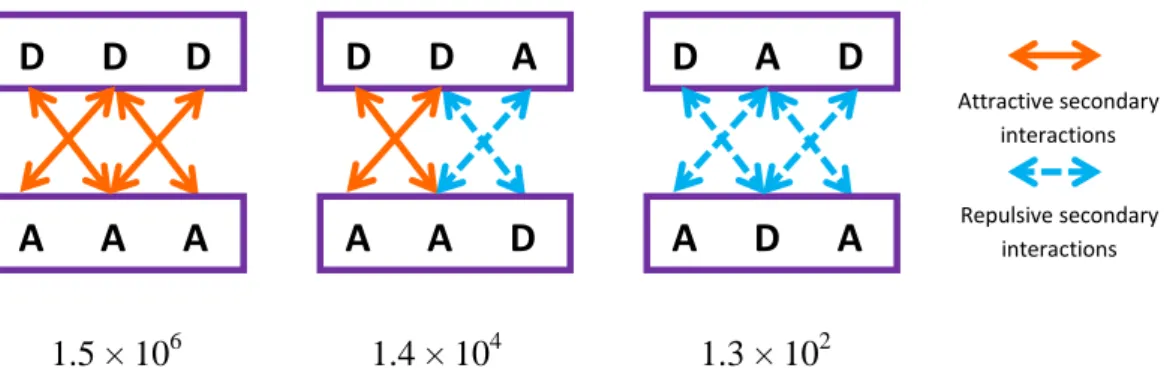
Secondary electrostatic interactions were identified by the group of Jorgensen in 1990.[21] Due to partial charges on adjacent atoms, attractions and repulsions occur and have an effect on the stability of the multi-hydrogen-bonded system.[22] The strength of a multi-hydrogen-bonded system will be stronger, if there is more attractive secondary electrostatic interactions. On the contrary, the higher the number of secondary repulsions is, the weaker the strength will be. Thus DDD-AAA array with only attractive interactions is more stable than the ADA-DAD and AAD-DDA arrays (Figure 5).[23]
1.5 × 10⁶ 1.4 × 10⁴ 1.3 × 10²
Figure 5: Arrangements of triple hydrogen-bonded systems and their predicted stability constants (in M-1) in chloroform
The same rule can be applied in quadruple hydrogen-bonded systems. In six quadruple hydrogen-bonded dimers, four of them are complementary arrays and two of them are self-complementary arrays (Figure 6). Through studies of multi-hydrogen-bonded systems, Schneider predicted that the primary interaction increases the stability by -8.0 kJ mol-1, the attractive secondary interaction gives -2.9 kJ mol-1 and the repulsive secondary interaction weakened the system by +2.9 kJ mol-1.[23]
D D D
A A A
D D A
A A D
D A D
A D A
Attractive secondary interactions Repulsive secondary interactionsComplementary Arrays:
3.9 × 10⁸ 3.6 × 10⁶ 3.3 × 10⁴ 3.3 × 10⁴ Self-Complementary Arrays:
3.6 × 10⁶ 3.1 × 10²
Figure 6: Arrangements of quadruple hydrogen-bonded systems and their predicted stability constants (in M-1) in chloroform[18]
1.1.3 Hydrogen-bonded complexes in biological chemistry
The idea of exploiting hydrogen bonds in supramolecular chemistry comes from nature. In nature, the most evident example is water (Figure 7). The oxygen atom in a water molecule provides two lone pairs of electrons that can form two hydrogen bonds with other water molecules. Therefore, four hydrogen bonds are obtained for each water molecule.
The crystal structure of ice is affected by hydrogen bonds. Because of cavities in the open hexagonal lattice of ice, the density of ice is less than the density of water. That is the reason why ice always floats on liquid water.
The boiling point of water is also affected by hydrogen bonds. As we all know, the boiling point of water is 100°C. It is higher than the boiling point of fluorhydric acid which has only two hydrogen bonds within one molecule of fluorhydric acid. To reach the gas state, they need to break their hydrogen bonds. Therefore they have relatively
D D D D
A A A A
D D D A
A A A D
D D A D
A A D A
D A A D
A D D A
D D A A
A A D D
A D A D
D A D A
Attractive secondary interactions Repulsive secondary interactionshigh boiling points compared to similar molecules without hydrogen bonds, such as hydrogen sulfide and methane.[24]
Figure 7: Tetrahedrally-placed hydrogen bonds in water molecules
When we mention hydrogen bonds, we have to mention DNA and proteins (Figure 8).[25] Two strands of DNA are held together by hydrogen bonds and π-π stacking interactions, thus giving a stable double helical structure of DNA. Hydrogen bonds are observed between either adenine and thymine, or guanine and cytosine, which are the four basic components of DNA. These mutually complementary hydrogen-bonded pairs are called Watson-Crick base pairs, and were first identified in 1953.[26] The G-C pair with three hydrogen bonds is more stable than the A-T pair with only two hydrogen bonds, as mentioned previously. The mainly used hydrogen bond is N-H∙∙∙O/N with a length of about 2.8 – 2.9 Å. In total, the G-C pair has the same length as the A-T pair. Therefore, they form a perfect double helix self-assembly.[27]
Figure 8: The DNA double helix, G-C and A-T pairs
2.84 Å 2.84 Å 2.92 Å 2.82 Å 2.91 Å 10.85 Å
The first structure of a protein was published by the group of Pauling in 1951 (Figure 9).[28] In the protein secondary structures, the most basic structure motifs are α helices and β sheets. They are constituted by repeating N-H∙∙∙O=C hydrogen bonds.[29]
α helix β sheets
Figure 9 : Structures of α helix[30] and β sheets
In addition, the interesting structure of G-quadruplex was detected with crystallographic methods by the group of Gellert in 1962 (Figure 10).[31] Four guanines are associated through eight hydrogen bonds to form a square planar structure called quartet of guanines.[32] Each guanine possesses two hydrogen-bond donors and two hydrogen-bond acceptors, thus they can link each other in a tetrameric way. The cooperativity improves an average energy for hydrogen bonds from 0.22 to 0.42 eV in G-quartet.[33] Furthermore, the presence of a cation like potassium in the middle can stabilize this structure.[34]
In fact, G-rich repetitive sequences do not exist as quartet of guanines, they exist in biological systems as a more complicated structure. Three quartets of guanines superimposed from top to bottom to form the G-quadruplex by π-π stacking interactions. These stacked tetrads align themselves to generate a right-handed helical twist. These G-rich repetitive sequences are mainly located at the end of chromosomes and a protein, with a reverse transcriptase activity.[35] Its formation can inhibit telomerase activity of cancer cells.
Figure 10: Structure of G-quadruplex[35]
1.1.4 Hydrogen-bonded complexes in synthetic chemistry
Inspired from biomolecules, novel designs of hydrogen-bonded assemblies can give numbers of novel applications. In the 1980s and the 1990s, a wide range of hydrogen-bonded assemblies was synthesized through designing multi-hydrogen-bonded modules. Heterocycles containing nitrogen and cycles with nitrogen functional groups were mainly used to design hydrogen-bonded modules, for example, compounds based on amides,[36-37] ureas,[38-39] imides,[40-41] and so on.
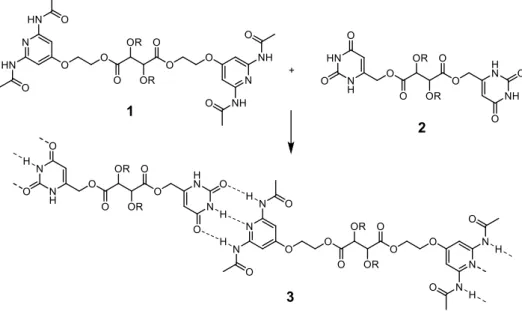
Triple hydrogen-bonded systems can be formed between pyridine-2,6-diyldiacetamide and uracil (Scheme 1). On this basis, tartaric acid linked bidentate derivative 1 and uracil bidentate derivative 2 were synthesized by Lehn’s group.[42] The spontaneous association between these two complementary units promoted the formation of a polymolecular entity 3. Liquid crystalline properties were shown by polymer 3, but not for compounds 1 or 2 alone.[43]
Quartet of guanines
= Three quartets of guanines = G-quadruplex
G-quadruplex DNA
Scheme 1: Self-assembly of the poly-supramolecular species 3
In 1988, a receptor of barbiturates including two 2,6-diamidopyridine units was synthesized by the group of Hamilton (Figure 11).[44] Two triple hydrogen-bonded systems were incorporated in this receptor, thus the selectivity for the barbiturate family of drugs was increased. The binding strength between the receptor and the substrate reached up to 105 M-1.[45] Hamilton’s receptor is a successful example in supramolecular chemistry, and has extensive applications in the domain of supramolecular polymers. In summary, the combination of several hydrogen-bonded systems in one molecule makes the whole system more stable, and supplies the lack of strengths for ADA-DAD arrays. This structure will be introduced in more detail later.
In 2008, 5-membered heterocycles were used to replace 6-membered rings for the formation of DDA arrays by the group of Hisamatsu[46] and the group of Wilson (Figure 12).[47] This replacement avoids influences from intramolecular hydrogen-bonded interactions on the formation of compounds containing DDA-AAD arrays. Then, the group of Wilson found that the stability of hydrogen-bonded compounds was modified by changing the substituents in each array. The stability of hydrogen-bonded compounds could reach up to 8 × 10⁴ M-1.[48]
Ka = (1.9 ± 0.8) × 103 M-1 (86 ± 34) × 103 M-1
Figure 12: DDA-AAD hydrogen-bonded systems and their association constants
The DDD-AAA hydrogen-bonded system is the most stable one, but their complicated structures are difficult to synthesize. Some examples are known (Figure 13):[49-51] among them, the most stable one was synthesized by the group of Leigh through protonated diaminopyridine as DDD arrays. The stability constant of this compound reached 3 × 10¹⁰ M-1.[52]
Ka > 105 M-1 Ka = 2 × 10⁷ M-1 Ka = 2.4 × 10⁴ M-1 Ka = 3 × 10¹⁰ M-1 Figure 13: DDD-AAA hydrogen-bonded systems and their association constants
Six combinations of quadruple hydrogen-bonded systems can be designed. Among them, DDDD-AAAA, DDDA-AAAD and DDAD-AADA arrays have been rarely published, due to their synthetic difficulties and scarce applications.
The DADA-ADAD hydrogen-bonded system is considered as the least stable system, because of six additional repulsions according to Jorgensen’s theory of secondary interactions. A series of DADA-ADAD hydrogen-bonded systems was synthesized by the group of Meijer. When they designed their hydrogen-bonded system, they found that two amides with the trans configuration were replaced by amides with cis configuration in compound 6, because of electrostatic repulsions between carbonyl groups and nitrogen atoms in the triazine ring (Scheme 2). Thus only dimer 7 was found and analyzed, and its dimeric constant was only 37 M-1.[53]
Scheme 2: Conformational equilibrium of diacylated 2,4-diaminotriazines 6 and the dimer 7 with additional repulsive electrostatic interactions
Subsequently, an amide group was removed to form a DADA array, see compound 8 (Figure 14). An intramolecular hydrogen-bonding interaction was used to preorganize arrays in dimers 9 and 10, thus their dimeric constants were significantly improved.[54]
R = Ar(OC12H25)3 R = Ar(OC12H25)3
Kd = 530 M-1 Kd = 2 × 10⁴ M-1 Kd = 2 × 10⁵ M-1 Figure 14: Quadruple hydrogen-bonded systems synthesized by the group of Meijer
In the case of the deazapterin (DeAP) 11 hydrogen-bonded system, the group of Zimmerman found that the presence of 2,7-diamido-1,8-naphthyridines (14) broke the dimeric system of DeAP and formed new DAAD-ADDA systems with 14 (Figure 15).[55] The group of Zimmerman developed a series of DAAD-ADDA systems based on 14. For example, the system formed between butylurea of guanosine (UG) 12 which used imidazole in place of the pyridine ring in DeAP 11[56-57] and ureido-7-deazaguanine (DeUG) 13 which used pyrrole in place of the pyridine ring in DeAP
11.[58] When UG and DeUG are alone, their dimeric constants are small, 230 M-1 for UG 12 and 880 M-1 for DeUG 13. However, they can form stable heterodimers with DAN 14, their association constants can reach 3 × 10⁸ M-1 for 12-14 dimer and 1.9 × 10⁸ M-1 for 13-14 dimer. The structure of 13-14 dimer was confirmed by X-ray spectroscopy and showed a zipper-like hydrogen-bonded assembly.[59]
Figure 15: The DeAP 11, quadruple hydrogen-bonded heterodimers based on UG 12, DeUG 13 and DAN 14
Recently, the DDAA-AADD array is the most widely developed system in all quadruple hydrogen-bonded systems. This array has only one secondary repulsion, thus it has a relatively stable structure, and involves a relatively simple synthesis. In numerous DDAA-AADD arrays, the UPy (ureidopyrimidinone) dimer is the most successful one (Figure 16). The intramolecular hydrogen-bonded interaction is used to fix and form favorable dimers. Therefore, the dimeric constant of UPy is more than 107 M-1.[60] Different substituents were added and thereby improved solubility and functionality to the dimeric systems.[39, 61] UPy systems were widely used in supramolecular and material sciences, due to their excellent performance.[62]
Kd > 107 M-1
Figure 16: UPy dimers with different substituents
1.1.5 Combinations of hydrogen bonds and metal
coordinations
Metal-ligand and hydrogen bonds are two effective methods to establish supramolecular architectures and to control molecular self-assemblies.[63] The combination of hydrogen bonds and metal coordinations was already demonstrated and used in the 1990s.[64-66]
The UPy dimer was also used to form supramolecular structures with metal coordinations by the genius idea from the group of De Mendoza (Figure 17).[67] Square planar cis-coordinated Pd(II) species were chosen for the formation of neutral cyclic arrangements based on the pioneer work of Fujita and Stang.[68-69] Upon mixing equimolecular amounts of Pd(II) complexes and UPy dimers with two coordinated sites, neutral molecular squares and triangles were formed. This work reminds us that
structural changes, steric factors and solubility issues need to be considered for the design of molecular architectures.
Figure 17: Structures of Pd (II) cyclic aggregates: propeller-shaped triangle, propeller-shaped square, tubular-shaped tetramer[67]
The UPy dimer also serves an important role in the formation of supramolecular polymers. A fast and easy synthesis was used to establish complicated structures by the group of Stang, where bis (phosphine) Pt(II) rhomboidal or hexagonal metallacycles were connected by UPy dimers to form linear chains or cross-linked supramolecular polymers (Figure 18).[70] In this synthesis, the number of steps was reduced due to the contribution of hydrogen-bonded interactions.[71]
Figure 18: Representations of the linear supramolecular polyrhomboid and the cross-linked supramolecular hexagonal network[70]
Thus 2-ureido-4-[1H]-pyrimidinone (UPy) being the most popular, this scaffold was chosen by our team to design arene ruthenium metalla-assemblies (Figure 19). Several cationic arene ruthenium cages were synthesized, characterized and investigated by rotating frame overhauser effect NMR measurements.[72] The arene ruthenium rectangles remained stable in solution owing to the DDAA hydrogen-bonded array of ureido-pyrimidone dimers. These successful examples demonstrate that even monodentate ligands can be considered as scaffold for designing supramolecular assemblies.[73]
Figure 19: Structures of synthesized cationic arene ruthenium cages
1.1.6 Melamine•cyanuric/barbituric acid self-assemblies
The melamine∙cyanuric acid (M∙CA) lattice was formed by the reaction between melamine with DAD bonded arrays and cyanuric acid with ADA hydrogen-bonded arrays.[74] These two components were mixed in a 1:1 ratio leading to a stable, insoluble complex (Figure 20).[75] Three types of aggregates are contained in this lattice: cyclic rosettes,[76-77] linear tapes[78-79] and crinkled tapes.[80]
Figure 20: Structure of melamine∙cyanuric acid lattice
The melamine∙cyanuric acid/barbituric acid (M∙CA/BA) pair was widely investigated by the group of Whitesides.[75, 81-82] Two concepts were demonstrated for the preferential formation of cyclic rosettes (Figure 21).[83] The covalent preorganization concept connected three melamines by a central ‘hub’ spacer and formed a cap upon the rosette.[75] The peripheral crowding concept used melamines with sterically bulky substituents as walls to promote the formation of single rosette.[76] The most widely used substituent is tert-butylphenyl that provides favorable steric interaction to form rosette structures.[84]
Figure 21: Rosette structures forming selectively by covalent preorganization or by peripheral crowding
In 2001, a theoretical model for the self-assembly of melamine and cyanuric/barbituric acid derivatives into rosettes and tapes was reported by the group of Timmerman.[85] All possible stereoisomeric tape structures were considered for the calculations. Their studies showed that the internal energy of the rosette structure was affected sensitively through changes in parameters, thus impacting the tape/rosette ratio. After the investigation of these calculations, the concept of peripheral crowding was questioned and the concentration ratio was suggested to be the key element.[86]
The tape-like structures possess undefined shape and size, and limited solubility. However, these disadvantages do not exist for rosette motifs. Therefore, rosettes are more attractive than tape-like structures for scientists in the field.[10] The six-membered rosette with complementary hydrogen-bonded pairs can be formed between heterocyclic motifs M and CA/BA, which is hold together by 18 hydrogen bonds through complementary centrosymmetric ADA-DAD hydrogen-bonded arrays. M∙CA/BA rosettes were extensively studied by the groups of Whitesides,[83] Timmerman[10] and Yagai.[87]
One of the most well-known rosette was the one formed between N,N’-bis(4-tert-butylphenyl) melamine (ME) and barbital (BA) that was synthesized by the group of Whitesides in 1994 (Scheme 3).[80] One equivalent of ME was mixed with one equivalent of BA in chloroform, to form the rosette (ME)3∙(BA)3. In this system,
concentrations of both reactants need to be higher than 4 mM, if not, the disassembly of rosette (ME)3∙(BA)3 will occur in solution. Similar observations were made for another
hydrogen-bonded trimer synthesized by the group of Zimmerman in 1992.[88] Rosette (ME)3∙(BA)3 demonstrated a better solubility than each reactant in chloroform which is
a nonpolar and aprotic solvent. The self-assembly of (M)3∙(CA/BA)3, which is led by
polar hydrogen bonds, prefers the formation of soluble rosettes over insoluble tapes.
Scheme 3: Self-assembly of rosette (ME)3∙(BA)3
A series of analytic methods was used by the group of Whitesides to comfirm the structure of the rosette. 1H NMR is the most direct method, signals of hydrogen bonds can be observed in the spectrum. Vapor pressure osmometry (VPO) can be used to predict the average molecular weight of the rosettes.[89] Another method to determine the molecular weight of rosettes is gel permeation chromatographic (GPC). But this method was unsuccessful for the molecular weight determination of rosette (ME)3∙(BA)3, because of its good thermodynamic stability.[80] Crystals of rosette
(ME)3∙(BA)3 were obtained through slow evaporation of a solution containing ME/BA
(1:1) in isopropyl alcohol/toluene (1:1), and the X-ray structure was determined (Figure 22).
Figure 22: X-ray crystal structure and packing structure of (ME)3∙(BA)3rosette [80]
In 1997, four aggregates based on (M)3∙(CA)3 rosettes were synthesized and
characterized by the group of Whitesides (Figure 23).[90] Zinc tetraphenyl porphyrin units (ZnTPP) were added at the periphery of the rosettes by coordination to the imidazole groups. Aggregates with ZnTPP were demonstrated to be more stable than aggregates with free imidazole groups.
Figure 23: Structures of aggregates with free imidazoles or ZnTPP[90]
In the same year, the metalla-dendrimer associated with (M)3∙(BA)3 was
constructed by the group of Reinhoudt (Figure 24).[91] 2-D NOESY experiments were used to confirm the structure of the rosette, strong cross signals were found between the three hydrogen bonds in the rosette. This was the first nanosized assembly formed by the combination of hydrogen bonds and metal coordinations.
Figure 24: Structure of the discrete rosette with palladium coordination[91]
In 2004, gold atoms were inserted into the double rosette structure through phosphane addition at the periphery of the melamine unit (Figure 25).[92] Six Au(I)Cl moieties were incorporated into hydrogen-bonded rosette assemblies. This rosette was extremely stable in the solid state.
Figure 25: Structure of double rosettes containing six Au(I) atoms[92]
In the same year, free porphyrin and Zn(II) porphyrin derivatives were prepared by the group of Li (Figure 26).[93] The presence of large porphyrins stabilized the rosettes. Therefore, these porphyrin rosettes were found to be more stable than the rosette initially synthesized by the group of Whitesides. The results show that rosette (M)3∙(CA/BA)3 can be used to generate supramolecular receptors by binding large
Figure 26: Structures of rosettes with porphyrins[93]
Three strategies were used to add Zn(II) porphyrins around rosettes. The first one was by connecting the porphyrin to the CA structure (Figure 27). The second method used the coordination of Zn(II) over the melamine or BA unit through the addition of pyridines. These ideas are extremely useful for our design of hydrogen-bonded metalla-assemblies.
All above mentioned examples show the feasibility of the combination between (M)3∙(CA/BA)3 rosettes and metal coordinations.
Stimuli-responsive properties were found for several (M)3∙(CA/BA)3 rosettes
with π-conjugated systems, due to the possibility of dynamically rearranging hydrogen-bonded patterns.[87]
Photoswitching properties were first found in the M∙BA assembly by the group of Kitamura in 2003 (Scheme 4).[94] The isomerization of azobenzenes through UV-irradiation suppressed transformation from soluble cyclic rosette into insoluble tape-like polymers. Owing to the thermodynamic stability of rosette 15 in solution, the stability was further increased upon the photoisomerization of the azobenzene groups.
Scheme 4:Transformation of rosette 15 by UV-irradiation[94]
Soon after, a more complicated rosette 16 with azobenzenes accompanying the E → Z isomerization through photoirradiation was synthesized by the same group (Figure 28).[95] This rosette 16 is stable in chloroform, toluene and methylcyclohexane.
Figure 28: Structure of rosette 16
Another disk-shaped aggregate with azobenzene was investigated by the same group in 2005 (Scheme 5).[96] The columnar aggregate of rosette 17 in cyclohexane was dissociated and reformed through trans-cis isomerization by UV-irradiation of the azobenzene group.
Scheme 5: Formation of aggregates on the basis of rosette 17[96]
Heating-induced rosette-type assembly was explored by the group of Yagai in 2012 (Figure 29).[97] Perylene 3,4,9,10-tetracarboxylic acid bisimide (PBI) was added to the cyanuric acid part for the formation of rosette 18. The transformation from columnar assemblies of rosettes to lamellar assemblies of linear tapes occurred by increasing the temperature.
Figure 29: Thermoresponsive aggregates of rosette 18[97]
These stimuli-responsive self-assemblies mentioned above can be used for the design of smart nanomaterials.
Rosette 19 was formed by a collaborative work of Yagai and Ajayaghosh (Scheme 6).[98] A self-organisation in aliphatic solvent between the melamine-derivative
20 with the substituent oligo(p-phenyleneethynylene) (OPE) and cyanurate 21 provides
the desired rosette 19. Toroidal nanoobjects were detected by atomic force microscopy (AFM). This rosette system may possibly be used for the design of artificial light-harvesting nanodevices.
Scheme 6: Formation of rosette 19[98] Rosette 19
1.2 Supramolecular chemistry
1.2.1 General introduction
In 1987, Jean-Marie Lehn, Donald J. Cram and Charles J. Pedersen won the Nobel Prize in chemistry for their contributions in supramolecular chemistry. Since this Nobel Prize, the field of supramolecular chemistry has become more and more widely investigated and applied.[99] In 2016, James Fraser Stoddart, Bernard L. Feringa and Jean-Pierre Sauvage were awarded the Nobel Prize in Chemistry for molecular machines based on supramolecular chemistry.[100] And after nearly thirty years of development, supramolecular chemistry has now evolved to supramolecular science. This interdisciplinary science covers chemical, physical, biological and material areas.[101]
A definition of supramolecular chemistry was provided by Lehn in the book “Supramolecular chemistry-concepts and perspectives”: ‘Beyond molecular chemistry based on the covalent bond there lies the field of supramolecular chemistry, whose goal it is to gain control over the intermolecular bond.’ This means that the supramolecular chemistry based on molecular interactions is focused on the synthesis of complicated system associating two or more molecules, owing to its highest efficiency and selectivity.[102]
1.2.2 Tools of supramolecular chemistry
Molecules that are held together by non-covalent interactions are called supramolecules. Non-covalent interactions are normally weaker than covalent interactions (250 – 800 kJ mol-1), but their cooperativities can help them to form stable supramolecular complexes. A list of non-covalent interactions is provided in Table 2 with their relative strengths.[103-104]
Interaction Strength (kJ mol-1) Ion - ion 200 – 300 Ion - dipole 50 – 200 Dipole – dipole 5 – 50 Hydrogen bonding 4 – 120 Cation - π 5 – 80 π - π 0 – 50
Van der Waals < 5
Hydrophobic < 50
Coordination bonding 50 – 150
Table 2: Summary of supramolecular interactions
1.2.3 Categories of supramolecular chemistry
Supramolecular chemistry can be divided in two categories: host-guest chemistry and self-assembly.[104]
The concept of ‘host-guest chemistry’ was first proposed by Cram in 1974, while investigating enzymatic systems.[105] The substrate selectivity of enzymes can be simulated to design complexes composed of organic compounds. To design host-guest systems, matching sizes, shapes and electronic properties that can provide strong bindings between hosts and guests are crucial.[106]
Some common supramolecular host molecules have been found since 1967. A series of crown ethers was synthesized by the group of Pedersen and their cavity size was controlled by the number of repetitive motifs (Figure 30).[107-108] Then cryptands were synthesized by the group of Lehn in 1969.[109-110] Spheroids were synthesized and investigated by the group of Cram.[111] Soon after, complexation rates and equilibria were investigated between host molecules and ions.[112]
Crown ether Cryptand Spheroid Calixarene
Figure 30: Typical supramolecular host molecules
Obviously, supramolecular interactions can be used in host-guest systems. For example, Van der Waals interactions can be increased by extending the contact surface between the host and the guest. Acceptors or donors of hydrogen bonds can be inserted into host molecules, and guest molecules can be attracted by adding complementary sites (Scheme 7). Ion dipole interactions were the first interactions used in host-guest systems.[108] The electrostatic interaction between two ions can also be used in such system. Additionally, combinations of several interactions are common to obtain stable complexes.
Scheme 7: Supramolecular interactions used in host-guest systems[113]
Receptor Substrate Complex
Receptor Substrate Complex Receptor Substrate Complex
Receptor Substrate Complex Receptor Substrate Complex
Receptor Substrate Complex Hydrogen bonding
Van der Waals
Self-assembly was first defined as the convergent process from which a supramolecular species forms spontaneously from its components.[114] Then self-assembly was redefined by the group of Steed in 2009 “as the spontaneous and reversible association of molecules or ions to form larger, more complex supramolecular entities according to the intrinsic information contained in the molecules themselves”.[9] But self-asembly is not only confined to supramolecular chemistry, it is ubiquitous throughout life.
The first self-assembling macrocycle formed upon coordination chemistry was reported by the group of Maverick in 1984 (Figure 31).[115] This work showed how simple self-assemblies can be formed when using metal coordinations. Soon after, another macrocycle was synthesized by the same group.[116]
Figure 31: Self-assemblies synthesized by the group of Maverick
Then Saalfrank’s tetrahedral iron-malonate assembly was published in 1993 (Figure 32).[117] Pyridyl ligands were used as skeletons for most of this study. For example, Lehn’s cylindrical box was based on copper (I) and coordination of 2,2’-bipyridine.[118] Fujita and Ogura’s square box was based on palladium (II) and coordination of 4,4’-bipyridine,[119]
which can be extended into cubes. A supramolecular cube was formed through the combination of eight octahedral metal ‘corners’ and twelve ligand ‘edges’ by the group of Thomas in 1998.[120]
Thus, the brilliant value of self-assemblies was demonstrated for the formation of large complexes.
Multiple hydrogen-bonding interactions have been demonstrated to be useful for the formation of closed self-assembled spherical molecules or capsules.[122] Reversible dimerization was used for the formation of bowl-shaped molecules through the presence of hydrogen bonds. A relatively large bowl-shaped molecule was synthesized by the group of Rebek in 1996 (Figure 33).[123] Glycoluril units were used to provide two donors and two acceptors groups for self-complementary structures. When three glycoluril units were attached to a triphenylene core, two molecules could be assembled by twelve hydrogen bonds, thus forming a large capsule (22). Some aromatic guests like cyclohexane were encapsulated in the cavity of this bowl-shaped capsule.
Figure 33: Structure of a bowl-shaped assembly 22[123]
Self-assembling capsules were defined by the group of Rebek in 1997 ‘‘as receptors with enclosed cavities that are formed by the reversible noncovalent interaction of two or more, not necessarily identical, subunits’’.[124] Utilizations of non-covalent reversible interactions can offer opportunities for ‘catch-and-release’ of a guest to control drug delivery or reactivity.[125] Therefore, a series of capsules was self-assembled through hydrogen bonds.
One common example is capsules formed by calixarenes. A self-assembling heterodimeric system was reported by the group of Reinhoudt (Figure 34). The tetrasubstituted calixarene with pyridyl groups and the other calixarene with carboxylic acid groups were combined through four hydrogen bonds.[126]
+
Figure 34: Structure of calixarenes based capsule
Another example was the supramolecular capsule constructed by resorcinarene-based cavitands functionalized with acetamido groups, which was reported by the group of Aakeroy in 2011 (Figure 35).[127] In this case, chelating effects at the cavitands were created to avoid the formation of co-products from polymerization. Two c-pentyltetra(2-acetamidopyridyl-5-ethynyl) cavitands were held together by three self-complementary NH∙∙∙O=C hydrogen bonds to give this capsule. In their investigation, three ethanol molecules, two methanol, and one toluene were trapped in the cavity of this capsule.
Figure 35: Assembly of two cavitands and crystal structures of a resorcinarene-based capsule[127]
1.3 Coordination chemistry
1.3.1 Element ruthenium
Ruthenium, derived from the latinised name of Russia, was discovered by Karl Karlovitch Klaus in 1844. It was the last ‘platinum metal’ to be discovered.[128] Ruthenium is a rare transition metal, it is only the 74th most abundant metal on Earth.
and/or 2
Ruthenium has the symbol Ru, molecular weight 101.07 g/mol,[129] and atomic number 44. It is in group 8 and period 5 in the periodic table with its electronic configuration [Kr] 4d7 5s1.[130] Ruthenium has a wide range of oxidation states from -II {[Ru(CO)4]2-}
to +VIII (RuO4).[131] Principal oxidation states for ruthenium are +II and +III.
Ruthenium (III) is the best-known oxidation state, and its complexes are generally octahedral {[Ru(H2O)6]3+} and distorted tetrahedral [Ru2(CH2SiMe3)6]. Ru(II) is the
second most common oxidation state. It forms complexes with ligands based on group 15 or 16 elements. Ru(II) complexes are normally octahedral {[Ru(bpy)3]2+},
pseudo-tetrahedral [(arene)RuCl2(PPh3)] and trigonal bipyramidal [RuHCl(PPh3)3], apart from
complexes like [RuCl2(PPh3)3], which are square pyramidal because of their
stereochemically blocked coordination positions.[132] Ruthenium containing complexes have potential applications in catalytic chemistry, biology and medicine.
1.3.2 Mononuclear arene ruthenium complexes
Mononuclear arene ruthenium complexes with a piano-stool structure are the most studied complexes in the large family of ruthenium (Figure 36), [133] they possess potential biological applications. In this type of complexes, the arene can be considered as the seat of the piano-stool and the other three ligands as the legs. Because arenes are able to occupy three coordination sites, the three remaining sites are available for different ligands.[134] Because of their structural similarity, this type of complexes can also be called half-sandwich complexes. In such complexes, the arenes prevent oxidation from Ru(II) to Ru(III). Furthermore, arenes with extended ring systems can potentially interact with DNA.[135] The other coordination sites can be used to introduce desired properties.[133] Normally, ligands with N-, O-, S-, or P-donor groups are easily introduced, labilities of these ligands offer more possibilities in self-assemblies[136] and catalytic processes.[137] In particular, chelate ligands can increase the stability of the complexes and modulate the electronic properties of the metal center.[138]
Figure 36: Piano-stool and the typical structure of mononuclear arene ruthenium complexes
The first arene ruthenium complex [(η6-mesitylene]2Ru](BPh4)2 was synthesized
by Fischer and Böttcher in 1957 through a redox reaction from RuCl3 and Al.[139] In
1967, the synthesis of [(η6-C6H6)RuCl2]x was reported by Winkhaus and Singer. This
polymeric complex was obtained from RuCl3∙nH2O (Scheme 8), the most common
precursor in the synthesis of arene ruthenium complexes. [(η6-C6H6)RuCl2]x is a red
powder, poorly defined chemically but very versatile synthesized.[140-141] Subsequently, a dimeric structure was suggested by Zelonka and Baird.[142] Soon after, a series of brown, diamagnetic complexes with the general formula [(η6-arene)RuCl2] were
prepared through methanolic or ethanolic RuCl3 with the appropriate
cyclohexa-1,3-diene or cyclohexa-1,4-cyclohexa-1,3-diene. The para-cymene complex was demonstrated by osmometry to be dimeric in chloroform.[143] Eventually, Bennett confirmed the dimeric structure of [(η6-C6H6)Ru(μ-Cl)Cl]2 in 1974, where two Ru(II) are linked by two
chloride bridges (Scheme 8).[144]
Scheme 8: Synthesis and structure of benzene ruthenium complex
Meanwhile the most common procedure to prepare standard dimeric arene ruthenium complexes with chloride bridges was found by the same group. The reaction between RuCl3∙nH2O and a cyclohexadiene derivative in EtOH/H2O can give different
arene ruthenium complexes.[144] Another procedure implies arene exchange, a method that can be used to synthesize ruthenium complexes with electronically rich arenes.[145] Starting from dinuclear arene ruthenium complexes, the electronically rich arenes can
replace the original arenes at high temperature to form the desired arene ruthenium dimers (Scheme 9).
Scheme 9: Methods to synthesize chloro-bridged arene ruthenium complexes
A wide range of half-sandwich piano-stool complexes was synthesized using dinuclear chloride-bridged arene ruthenium complexes [(η6-arene)Ru(μ-Cl)Cl]2 as the
reactant (Scheme 10). Because of the easy cleavage of the chloride bridges, especially in coordinating solvents, solvated monomeric derivatives can be formed.[146]
Scheme 10: Methods to synthesize half-sandwich piano-stool complexes
The biological potential of arene ruthenium complexes has been extensively investigated by the groups of Dyson[147] and Sadler.[148-149] In their early studies, RAPTA-C and RM175 were considered as promising compounds for anticancer applications.[149]
The RAPTA family is characterized by their half-sandwich piano-stool structure (Figure 37). Their unique properties are obtained by the coordination of the monodentate PTA (1,3,5-triaza-7-phosphaadamantane) ligand. PTA is an hydrophilic ligand, thus water solubility can be increased.[150] The first RAPTA complex was [Ru(cym)Cl2(PTA)] abbreviated as RAPTA-C.[151] Although a poor anticancer activity
was observed in vitro, an in vivo study showed promising antimetastatic activities.[152] The number and weight of solid lung metastases were reduced in mice bearing the MCa mammary carcinoma. Then several new RAPTA complexes were reported and investigated for anticancer activities in vitro.[153] Further studies of RAPTA-C showed anti-tumor activities in human ovarian and colorectal carcinomas, where an inhibition of angiogenesis was observed.[154-155]
Figure 37: Structures of RAPTA complexes
The half-sandwich arene ruthenium complexes, abbreviated as RM or HC, have been synthesized by the group of Sadler in 2001[156] (Figure 38), and their biological properties investigated by the same group in 2002.[157] This type of arene ruthenium complexes is bonded by a chelate diamine ligand and a labile ligand.[158] RM175 and HC29 have both shown good activities in vitro in human ovarian cancer cells, which is comparable to carboplatin. In this family, the most active complex is HC11, which allows an activity comparable to cisplatin. During their investigations, the presence of a stable ligand (chelate), a more hydrophobic arene ligand (possibly to enhance cellular penetration) and a labile ligand, were identified as necessary components to design active anticancer complexes.[157]
Figure 38: Structures of arene ruthenium complexes with chelate diamine ligands
1.3.3 Dinuclear arene ruthenium clips
Dinuclear arene ruthenium clips bridged by OO∩OO or ON∩NO have been widely used by our group to construct more complicated supramolecular structures, such as metalla-rectangles, metalla-prisms and metalla-cubes. Since the first OO∩OO clip and its arene ruthenium metalla-rectangle was synthesized by Süss-Fink in 1997 (Scheme 11),[159] our group developed metalla-cages via the strategy used in this paper. The activation of metalla-clips can be achieved by adding silver triflate, thus the chloride ligands are abstracted to form silver chloride, which is then removed by filtration. The dicationic intermediate with coordinations of solvent molecules can easily react with pyridyl-based ligands.[160] One of the dicationic intermediates with coordinations of methanol has been isolated and characterized.[161]
Scheme 11: Synthesis of arene ruthenium metalla-rectangle [(cym)4Ru4(C2O4)2(bpy)2](4CF3SO3)
The general synthetic method to prepare arene ruthenium clips uses chloride-bridged arene ruthenium complex [(η6-arene)Ru(μ-Cl)Cl]2 as starting materials. The
activation of this complex is performed by cleavage of two chloride bridges, and one equivalent of the desired quinone ligand can replace two chloride bridges (Scheme 12).
Quinones with a weak reactivity need the addition of sodium acetate to react. Another type of bridges is ON∩NO bridges, which can be synthesized with the same reactant and desired ON∩NO ligands in the presence of weak bases [diisopropylethylamine (DIPEA) or NEt3].
Scheme 12: Method to synthesize arene ruthenium clips with OO∩OO or ON∩NO bridges
Another type of clips with two carboxylic acid bridges was synthesized by the group of Severin in 2010 (Scheme 13).[162] Their synthesis is similar to ours with the same reactant and the presences of two equivalents of the desired carboxylic acid ligands and silver acetate.
Scheme 13: Method to synthesize arene ruthenium clips with carboxylic acid bridges
Several OO∩OO bridged arene ruthenium clips have been used in our group[160], such as [Ru2(η6-arene)2(oxalato)Cl2],[159] [Ru2(η6-arene)2(dhbq)Cl2] (dhbq:
2,5-dihydroxy-1,4-benzoquinonato),[163] [Ru2(η6-arene)2(dchq)Cl2] (dchq:
5,8-dihydroxy-1,4-naphthoquinonato),[165] [Ru2(η6-arene)2(dhaq)Cl2] (dhaq:
9,10-dihydroxy-1,4-anthraquinonato),[166] and [Ru2(η6-arene)2(dhtq)Cl2] (dhtq:
6,11-dihydroxynaphthacene-5,12-dionato).[167] To increase the size of the assembly and to encapsulate various ‘guest’ compounds, arene ruthenium clips possess different lengths (Figure 39).
Figure 39: OO∩OO bridged dinuclear arene ruthenium clips
The ON∩NO derivatives show similar properties,[168] but offer more synthetic possibilities to insert functional groups. Some arene ruthenium cationic cages formed by these clips showed great selectivity for cancerous cells.[169] Thus developments of this type of clips are necessary for biological optimization.[169] Some ON∩NO arene ruthenium clips were synthesized by our group and others, such as [Ru2(cym)2(μ-L)Cl2]
[H2L: diethyl-1,2-diazenedicarboxylate, bis(2-hydroxyethyl)oxamide,
N,N’-bisethanediamide,[169] dihexyloxalamide or dioctyloxalamide][170] (Figure 40).
Figure 40: ON∩NO bridged dinuclear arene ruthenium clips 3.7 Å
5.5 Å
Dicarboxylate-bridged ruthenium clips opened a new domain for the synthesis of arene ruthenium cages (Figure 41). They can be used to synthesize neutral arene ruthenium cages and offer access to more complex molecular architectures.[171] The dicarboxylate spacers were chosen owing to the lability of the carboxylate donor groups and their flexible coordination geometries.[172] Furthermore, one of them prepared from 3,6-dimethoxynaphtalene-2,7-dicarboxylic acid can reach a length of 10.9 Å and its metalla-prism can encapsulate two coronene molecules.[162]
Figure 41: Dicarboxylate-bridged dinuclear arene ruthenium clips
1.3.4 Multinuclear arene ruthenium complexes
From dinuclear arene ruthenium clips, different rectangles, metalla-prisms and metalla-cubes can be synthesized through metal-ligand coordinations. Coordination-driven supramolecular complexes were principally pioneered by the groups of Fujita[136] and Stang.[173] The Pd(II) square complexes were quantitatively synthesized by the group of Fujita in 1990.[119] The geometry of transition metal centers and the rigidity of electron-rich organic ligands are two important features to design this type of supramolecular metalla-cages.[174] It took five years, to extend 2D supramolecular structures to 3D structures.[175] These Pd(II) M6L4 octahedral 3D
structures showed high solubility in water, strong bindings with ‘guest’ molecules through hydrophobic interactions, and large cavities,[136] which inspired many groups, including ours.
The desired 2D and 3D supramolecular assemblies are obtained by combining the appropriate building blocks. Different pyridyl spacers, which were widely used by the groups of Fujita[176] and Stang[177-178] to form Pd(II) or Pt(II) metalla-assemblies,
were chosen by our group for the design of arene-ruthenium metalla-cages (Table 3). Pyridyl spacers play a crucial role to determine the geometry of the arene ruthenium metalla-assembly. For example, linear bipyridyl ligands have two coordination sites at a 180° angle, thus arene ruthenium rectangles are formed by the combination of two bipyridyl ligands with two arene ruthenium clips. A wide range of multinuclear arene ruthenium cages was reported by our group.[179]
Arene Ruthenium Clips Spacer ligands Metalla-cages Structures Angle 180° Metalla-rectangle 120° Metalla-prism 90° Metalla-cube
Table 3: Strategies for syntheses of metalla-cages from arene ruthenium clips with spacer ligands
A series of metalla-rectangles with the general formula [Ru4(η6
-arene)4(OO∩OO)2(N∩N)2](CF3SO3)4 (η6-arene = para-cymene, hmb; OO∩OO = dobq,
dClobq; N∩N = pyrazine (pyr), 4-4’-bipyridine (bpy), 1,2-bis(4-pyridyl)ethylene (bpe)) was synthesized by our group.[180] Their anticancer activities were tested against the
A2780 ovarian cancer cell line. The metalla-rectangle
Ru Ru Ru Ru Ru Ru Ru Ru Ru Ru Ru Ru Ru Ru Ru Ru Ru Ru Ru Ru
[Ru4(hmb)4(dobq)2(bpe)2](CF3SO3)4 showed the best activity (Figure 42). Importantly,
these metalla-rectangles showed good selectivity towards tumor cells over normal cells. In addition, the formation mechanisms of such metalla-rectangles were also investigated.[181]
Figure 42: Structure of metalla-rectangle [Ru4(hmb)4(dobq)2(bpe)2](CF3SO3)4
The first arene ruthenium metalla-prism synthesized by our group was the oxalato-bridged para-cymene ruthenium prism.[182] Then the chloro-bridged para-cymene ruthenium prism was synthesized.[183] But no guest molecule could be encapsulated in these two prisms, because of a limited length between the two tpt panels. To overcome this limitation, the dobq-bridged para-cymene ruthenium prism was synthesized and showed good ability for encapsulations.[184] A series of encapsulations was achieved,[185] and the encapsulation was realized during the synthesis of the prism.
A ‘‘Trojan horse’’ strategy was suggested for cancer treatment, as non water soluble drugs were encapsulated in the hydrophobic cavity of the metalla-prisms for transport and release into cancer cells (Scheme 14).[186] Metalla-prisms were isolated as trifluoromethanesulonate salts, thus presenting good solubility in water. [187-188]
In their biological tests, the cytotoxicity of the prism was increased after encapsulations of complexes [Pt(acac)2], [Pd(acac)2] or pyrenyl derivatives. And highly
cytotoxic systems were obtained through changing functional groups at the edge of the pyrenyl compounds.[189]
Scheme 14: Synthesis of the dobq-bridged para-cymene ruthenium prism with encapsulations of pyrenyl derivatives or complexes
Arene ruthenium metalla-cubes, larger than metalla-prisms, were synthesized to increase the size of the metalla-assemblies. The metalla-cube [Ru8(cym)(dhnq)4(tpvb)2](CF3SO3)8 (tpvb: 1,2,4,5-tetrakis[2-(4-pyridyl)vinylbenzene])
can be used to encapsulate porphin, a photosensitizer (Figure 43).[190] This system showed hypochromism properties towards the photosensitizer inside the cavity. Thus the phototoxic effect can be hidden during encapsulation.[191]
Figure 43: Encapsulated porphin in the cavity of metalla-cube [Ru8(cym)(dhnq)4(tpvb)2](CF3SO3)8
![Figure 3: Association constants in different solvents of the hydrogen-bonded system perfluoro- perfluoro-tert-butyl alcohol and tri-n-butylphosphine oxide [15]](https://thumb-eu.123doks.com/thumbv2/123doknet/14828611.618687/20.892.176.751.228.518/association-constants-different-solvents-hydrogen-perfluoro-perfluoro-butylphosphine.webp)
![Figure 6: Arrangements of quadruple hydrogen-bonded systems and their predicted stability constants (in M -1 ) in chloroform [18]](https://thumb-eu.123doks.com/thumbv2/123doknet/14828611.618687/23.892.157.763.147.593/figure-arrangements-quadruple-hydrogen-predicted-stability-constants-chloroform.webp)

![Figure 17: Structures of Pd (II) cyclic aggregates: propeller-shaped triangle, propeller-shaped square, tubular-shaped tetramer [67]](https://thumb-eu.123doks.com/thumbv2/123doknet/14828611.618687/32.892.167.694.186.489/figure-structures-aggregates-propeller-triangle-propeller-tubular-tetramer.webp)


![Figure 26: Structures of rosettes with porphyrins [93]](https://thumb-eu.123doks.com/thumbv2/123doknet/14828611.618687/39.892.201.732.109.623/figure-structures-rosettes-porphyrins.webp)
![Figure 29: Thermoresponsive aggregates of rosette 18 [97]](https://thumb-eu.123doks.com/thumbv2/123doknet/14828611.618687/42.892.126.718.100.409/figure-thermoresponsive-aggregates-of-rosette.webp)