Cantonal
variations of integration policy and
their
impact on immigrant educational inequality
Anita
Manatschal
a,*
and Isabelle Stadelmann-Steffen
baBerne University, Institute of Political Science, Lerchenweg 38, CH-3000 Bern 9.
E-mail: [email protected]
bBerne University, Institute of Political Science, Lerchenweg 36, CH-3000 Bern 9.
E-mail: [email protected] *Corresponding author.
Abstract
Migration policy regimes are mainly analysed from an international comparative perspective, whereas subnational policy variations, although they are parti-cularly pronounced in federal states, remain largely neglected. By transferring an inter-national concept of integration policy to Switzerland’s cantonal level, we show that cantonal variations of integration policy are not only considerable but even occasionally exceed international variance. Subsequent outcome analyses further undermine the rele-vance of cantonal integration polices, suggesting that liberal and culturally pluralist poli-cies moderate immigrant educational inequality in schools. As the results of our Bayesian multilevel analyses show, a combination of different policy aspects representing inclusive cantonal integration policies has the greatest potential to ameliorate immigrants’ equal opportunities in school. Accounting for immigrants’ heterogeneity in terms of linguistic and social background moreover reveals that integration policy differently affects various groups of immigrants.Keywords: cantonal integration policy; immigrant educational inequality; subnational comparison; Bayesian multilevel analysis
Introduction
Comparative studies analysing citizenship or integration regimes focus commonly on the national level. Among the classical contributions to the migration literature we find many case studies, comparing the respective policy regimes between two countries (cf. Brubaker, 1992; Favell, 2001). These studies were followed by more quantitatively oriented small-N approaches such as Koopmans et al’s (2005) comparison of integration policies in France, Britain, Germany, Switzerland and
the Netherlands, or Howard’s (2006) citizenship policy indicator for the former 15 EU countries. Currently, several ongoing research projects cover citizenship, immigration or integration policies in a large number of countries (cf. Niessen et al, 2007; Boucher et al, 2011; Vink and Bauböck, 2013).
At the same time, only few studies are paying attention to subnational variations of integration policy, although they are particularly pronounced in federal immi-grant states such as the United States, Canada, Australia, Germany, Belgium or Switzerland (cf. Akgün and Tränhardt, 2001).1 As a consequence, the dominant national focus of migration studies often implies a rough simplification of considerable subnational policy heterogeneity. By transferring an international concept of integra-tion policy to Switzerland’s cantonal level, we intend to capture this subnational policy variety and to highlight its relevance. We reach this aim in two steps. In thefirst step, the empirical evidence resulting from our theoretical conceptualization and empirical measurement of cantonal integration policy shall illustrate that subnational variations of integration policy are considerable, with single policy indicators even exceeding international variance. Thus, when it comes to integration policy, cantons, and not the federal level, are the right context to analyse integration policies in Switzerland. In the second step, we turn to the question of potential implications of this subnational policy variation by assessing the impact of cantonal integration policies on immigrant pupils’ school integration. The comparative analysis of cantonal policies lends itself quite well to the demands of a most similar systems research design (cf. Przeworski and Teune, 1970). A similar degree of comparability is hardly reachable at the international level, where more often than not a vast amount of control variables poses serious methodological challenges (cf. Fennema and Tillie, 2001).
Considering that educational policy research commonly focuses on social educa-tional inequality (Schlicht et al, 2010; Stadelmann-Steffen, 2012), immigrants’ disadvantage constitutes a hitherto neglected aspect of educational inequality. Immigrant educational inequality, that is, inequality between immigrant and native students, is particularly pronounced in countries with former guest-worker pro-grammes such as Switzerland or Germany, which have resulted in a large influx of low-skilled immigration since the 1960s (Lavenex, 2004; Entorf and Minoiu, 2005). Empirical evidence arising from the ‘Programme for International Student Assessment’ (PISA) 2006 corroborates this assumption for the Swiss case, where on average mathematical performance of children with immigrant background is 10 per cent lower compared with native pupils. Moreover, this educational disadvantage substantially varies in two respects. On the one hand, immigrant heterogeneity is large, meaning that not all immigrant children are equally disadvantaged in school. On the other hand, there are pronounced inter-cantonal variations of immigrant educational inequality. The PISA data reveal that, although the difference between immigrant and native students explains almost 20 per cent of individual variance in mathematical performance in the canton of Zurich, this proportion of explained variance amounts to less than 5 per cent in Valais, Jura and
Neuchâtel. These differences demonstrate that the immigrant disadvantage in schools cannot solely be ascribed to individual-level characteristics related to immigrant status, but demands for a structural or political explanation at the cantonal level.
The article is organized as follows. In the next section, we discuss the theoretical background of our empirical analysis. Thereby, we derive hypotheses specifying how cantonal integration policy might moderate immigrant educational inequality among Swiss cantons and we elaborate on our conceptualization of cantonal integration policy. We then explain the measurement of our variables and the methodological approach of Bayesian multilevel analysis. After presenting the results we conclude the article with a discussion of the majorfindings.
Integration Policy and Immigrant Educational Inequality
Drawing on works in political science as well as educational sociology (cf. Dronkers, 1993; Becker, 2000), we follow a policy-centred approach to investigate how different policies in the Swiss cantons moderate educational inequality between immigrants and native pupils. Basically, we start from the assumption that persistent differences in integration policy in the subnational units of Switzerland are related to varying degrees of immigrant educational inequalities in the Swiss cantons. This corresponds to a neo-institutionalist approach, which posits that institutional rules, procedures and conventions mould individual preferences, thereby encouraging or limiting beha-vioural options by means of certain incentive mechanisms (Hall and Taylor, 1996; Ostrom, 1999). By applying this neo-institutionalist approach to policy outputs, we adopt Pierson’s (2006) perspective, whereby policies are likely to have a more immediate impact on citizen’s everyday lives than the formal structure of the state, which is commonly defined as institution. Furthermore, it is assumed that the integration context does not influence all pupils in the same way; instead, the effects of integration policies can be expected to vary depending on individual resources, values and behavioural patterns (Schmid, 1984, p. 281). As a consequence, we aim to understand the micro-mechanisms behind the macro-relationships observed (Hedstörm and Swedberg, 1996, p. 131)– that is, how the relationship between national back-ground and educational performance is moderated by integration policy variables.
Why and how should integration policies be particularly effective instruments to foster educational equality in schools? First of all, integration or citizenship regimes are more than just legal regulations, as they embody collective concepts of inclusion by defining who belongs to a specific community and who does not. As such, integration policies represent common cultural and historically rooted understand-ings of immigrant rights and obligations (Favell, 2001; Giugni and Passy, 2003). The Swiss case is a paradigmatic example for this interrelatedness of culture and policy: cantonal integration policies reflect regional cultural notions of belonging, which in turn correspond to people’s attitudes towards immigrants within cantons
(Manatschal, 2012). It seems plausible that these comprehensive cantonal integration philosophies permeate all areas of daily life, including the educational system. This assumption is shared by education scholars, who identify the cultural and political integration context of a nation-state as a determining factor of a specific school structure and the organization of the national educational curricula (Hansen and Wenning, 2003; Dupriez and Dumay, 2006; Fossati, 2011).
Although the relevance of immigrant-specific policies such as integration policies has been highlighted in earlier studies on immigrant educational performance (cf. Levels et al, 2008), empirical evidence on the topic is still scarce. Levels et al (2008, p. 848) use a rather indirect proxy to account for potential effects of integration regimes by controlling for effects of left-wing parties on immigrant educational performance, assuming that left-wing governments are more likely to implement policies to counter discrimination than are right-wing or centrist governments. The authors find no effect of this proxy on immigrants’ educational performance. Similarly, recent studies using more concise and complex measurements of national integration polices found no relevant effects of these policies on immigrants’ performance in school (Fossati, 2011; Schlicht-Schmälzle and Möller, 2011). However, all these studies account solely for effects of national integration policies, which particularly in federal states with decentralized education and integration regimes, such as Germany, Belgium or Switzerland, appears not to be the appropriate analytical level when investigating the political determinants of immigrant educa-tional inequality (Schlicht et al, 2010, p. 52; Prokic-Breuer and Dronkers, 2012). Accordingly, the present study aims at a systematic test of whether integration policy impacts on immigrant educational inequality, based on an adequate, meaning subnational comparative research design and using a direct and comprehensive measurement of cantonal integration policies. Furthermore, we also opt for a more subtle approach regarding the immigrant target group, as immigrant children form of course no homogeneous group, but vary substantially in their school opportunities depending on their ethnic and social background. We must consider that integration policy may not affect all of them in the same way. Accordingly, we present our theoretical argument in two steps. First, we discuss the potential resources provided by cantonal integration policies in general, constituting positive or negative incentives for immigrants’ school integration. Second, we differentiate between different groups of immigrants in terms of linguistic skills and human capital in order to arrive at more nuanced group-specific hypotheses.
Hypotheses
Basically, one could think of two contrasting ways of how integration policies impact on immigrants’ educational performance. On the one hand, liberal and culturally pluralist policies, which respect and foster cultural diversity and grant immigrants
relatively easy access to participatory rights within the host society, can be expected to lead to better integration results. Given that under such a context immigrants enjoy more extensive rights than under more restrictive and culturally monistic policy conditions, it can be assumed that immigrants are more likely to reach the ideal of equal opportunities in such a permissive integration policy environment (cf. Schlicht-Schmälzle and Möller, 2011). Such policies can therefore be expected to reduce inequality between immigrants and natives in the societal and economic life. Against the background of previous empirical findings regarding social inequality in education (Schlicht et al, 2010; Stadelmann-Steffen, 2012), these additional resources of immigrant households should be crucial in providing immigrant children equal opportunities in school. A second argument supporting this view arises from the perspective of social closure (Helbling, 2008), which is inherent to integration policies. According to this perspective, liberal and culturally pluralist integration policies are sometimes considered as inclusive, as immigrants’ access to the host society is facilitated by these policies, whereas restrictive and culturally monistic policies, which are more demanding, are seen as potentially exclusive (Eggert and Murigande, 2004). Relating this idea of social closure to the educational system, where it is assumed that integrative, inclusive educational systems are more successful in overcoming educational inequality than exclusive systems (Dupriez and Dumay, 2006; Fossati, 2011), we therefore assume that liberal and culturally pluralist integration policies reduce immigrant educational inequality, as these policies are more inclusive and foster equal opportunities for immigrants (Hypothesis 1).
On the other hand, liberal and culturally pluralist integration policies may have unintended negative implications. More recently, such policies have been criticized for their segregationist potential, as they might reinforce the most regressive aspects of minority cultures. In this view, positive discrimination of specific immigrant groups, which is considered one of the core tenets of multiculturalist integration policies, can lead to counterproductive results as it might aggravate and solidify societal differences instead of overcoming them (Ireland, 2006; Koopmans, 2010). In a similar vein, educational sociologists assume that differential treatment of immigrant students rather increases educational inequality (Gomolla and Radtke, 2002; Dupriez and Dumay, 2006; Fossati, 2011). We thus formulate a contrasting hypothesis regarding the effect of integration policy on immigrant educational inequality. Considering the differential potential of liberal and culturally pluralist integration policies, we expect these policies to further aggravate the problem of immigrant educational inequality (Hypothesis 2).
As mentioned above, these general hypotheses may not apply to all immigrant groups in the same way. In the following, we focus on two aspects of immigrants’ background, which can be expected to particularly influence the way these pupils are affected by, and can profit from integration policy.
The first relevant aspect is a student’s language. On the basis of the need for integration it can be hypothesized that children with a different linguistic background
need more effort to integrate or to be integrated, and might therefore dependent more strongly on the support of cantonal integration policies. On the other hand and when relying on how much immigrant students actually profit from cantonal integration policy, we could come to the contrary expectation, namely, that immigrants speaking the local language have better chances for de facto integration. From this perspective, the design of cantonal integration policy should most strongly moderate educational chances of this immigrant group.
Second, immigrants are very heterogeneous with respect to their social status. The focus is commonly on the social disadvantages of low-skilled immigrants, and the increasing group of well-educated, high-skilled immigrants is often neglected. Again, it is reasonable to assume that these differences have an influence on how the policy context matters for immigrants’ educational opportunities. Applying the idea of a need for integration to social differences, we can assume that a successful integration policy will most strongly improve the educational chances of low-skilled immigrants. In contrast, it can also be argued that these immigrants will probably not profit so much from cantonal integration policies, as their preconditions are just too bad, whereas immigrants with higher social status will be better able to benefit from specific policy measures.
Summarizing these comments we hypothesize that integration policy differently affects specific linguistic and social immigrant groups in their educational chances, while we forgo specifying exact expectations about the actual differences and their directions.
Conceptualization of cantonal integration policy
To conceptualize cantonal integration policies, we transferred an internationally established notion of integration policy to Switzerland’s cantonal level. Thereby, we drew on the conceptual framework elaborated by Koopmans and colleagues (Koopmans et al, 2005; Koopmans, 2010), which covers to a large extent similar components as the‘Migrant Integration Policy Index’ (MIPEX).
Basically, this multidimensional conceptualization of integration policy builds on a broad and encompassing understanding of citizenship going beyond the aspect of naturalization. According to this reading, citizenship is defined in an open and comprehensive manner, as an interaction of rights and obligations towards any given state, thereby creating an area of legal equality between native and new citizens (cf. Brubaker, 1992; Kleger and D’Amato, 1995; Tilly, 1995; Koopmans and Kriesi, 1997). Such an extended understanding of citizenship includes not only civic, political and social rights (Marshall, 1950) but also aspects of belonging or difference in terms of cultural rights and obligations (Kymlicka, 1999; Koopmans et al, 2005). Furthermore, the concept of citizenship implies the feature of inclusion and exclusion, appearing as something exclusive from the outside, whereas it is inclusive
from the inside (cf. Kleger and D’Amato, 1995; Eggert and Murigande, 2004; Helbling, 2008). Assuming that integration policies may be more or less inclusive or exclusive, variations of integration policy can be captured in terms of varying degrees of ease or difficulty of immigrants’ access to broad citizenship rights and obligations.
Table 1 gives an overview on all the components of integration policy accounted for at the cantonal level. According to Koopmans et al (2005), the different policy components mentioned above correspond to two dimensions: either they address all immigrants equally (individual equality dimension), or they are directed towards specific ethnic or religious groups (cultural difference dimension).2The individual equality dimension captures the following components, which correspond largely to the categories of the MIPEX (Niessen et al, 2007; Koopmans, 2010): access to nationality, civic–political rights and anti-discrimination. Referring to the second MIPEX edition and also following Koopmans (2010), we complement this dimen-sion by two components, namely, family reunion and access to the labour market. By contrast, we did not include the MIPEX category long-term residence, as no variance exists at the cantonal level for this category. Similarly, we do not integrate the most recent policy strand of the third MIPEX edition, education, as immigrant-specific education policies are not pronounced at the cantonal level.3
Table 1:International and cantonal concepts of integration policy compared
International framework Cantonal framework
Dimension Components Theoretical policy categories
Individual equality (MIPEX)
Access to nationality Political participation
Civic–political rights Integration policy index Access to the labour market Socio-structural rights
Family reunion Family reunion
Anti-discrimination Anti-discrimination
Long-term residence —
Education —
Cultural difference Cultural integration requirements
Religious rights outside public institutions
Cultural (religious) rights and obligations
Religious rights inside public institutions
— Group-specific political
representation rights
— Affirmative action in the labour market
—
Source: Own illustration. International framework based on components of Koopmans et al (2005) and the MIPEX (cf. Koopmans, 2010), cantonal framework based on Manatschal (2011).
9 > > > > > > > > > = > > > > > > > > > ;
Basically, the components of the individual equality dimension cover the aspects of citizenship delineated by Marshall (1950): access to nationality refers to the narrow civic aspect of citizenship (civic rights), whereas its political aspect is captured by the component political participation ( political rights). One might argue that civic and political rights both account for political aspects of integration policy. This assumption is corroborated by an exploratory factor analysis based on the cantonal data, where civic and political rights both load highly on the same factor (Manatschal, 2011). Accordingly, we aggregated the two components, creating the category civic–political rights.
As some scholars consider the right to work and equal opportunities in the labour market a social right (cf. Castles and Davidson, 2000), and as in Switzerland integration into the labour market is officially seen as structural integration (cf. BFM, 2006; TAK, 2009), we refer to access to the labour market as socio-structural right. The case seems less clear for the remaining components, family reunion and anti-discrimination, which might be considered social (cf. Entzinger, 2000) or civil rights (cf. Castles and Davidson, 2000). Thus, we do not specify these two components further.
The lower part of Table 1 shows that the cultural difference dimension of Koopmans et al (2005) can only partially be captured at the cantonal level. Support of cultural difference through specific policy measures is much more restricted in typically assimilationist countries like Switzerland compared with traditionally multiculturalist countries such as the Netherlands (Kleger and D’Amato, 1995; Koopmans et al, 2005; Skenderovic, 2009). Thefirst component, cultural integration requirements, corresponds to the assimilationist demand for cultural adaptation. Not surprisingly, this component is pronounced in Switzerland, exhibiting, however, clear variation between cantons. Besides cultural integration requirements, only scarce religious minority rights supporting cultural diversity are granted within certain cantons. In line with Koopmans et al (2005), we aggregated cultural obligations and religious rights, creating thereby the policy category cultural rights and obligations. The remaining components from the original international frame-work of Koopmans et al (2005) on the cultural difference dimension, cultural rights in public institutions, group-specific political representation rights and affirmative action in the labour market, do barely or not at all exist in Switzerland, and are therefore discarded from our concept.
Data and Research Design
In the remainder of the article, the hypotheses presented above will be empirically tested. The analyses are based on Swiss data from the 2006 PISA study, which contains individual student as well as school-level data. Representative cantonal data are available for 14 of the 26 Swiss cantons. Unfortunately, PISA Switzerland does not provide a cantonal identifier for pupils in the other 12 cantons, meaning that in
these cases students cannot be assigned to their home cantons. The following analyses will therefore be based on the 14 cantons for which a representative cantonal sample exists. As it is our aim to estimate immigrant inequality in terms of school performance gap between immigrants and natives, we analyse both immigrant and native students in these cantons. In so doing, our study differs from existing studies in thisfield, which focus on immigrant school performance as such (Dronkers and de Heus, 2013; van Tubergen and Werfhorst, 2007; Levels et al, 2008). The sample also allows one to distinguish between the French- and German-speaking parts of the bilingual cantons of Berne and Valais. The final sample consists of 17 560 15-year-old pupils in 399 schools in 14 cantons, whereby two representative samples of the French- and the German-speaking parts of Berne and Valais are distinguished. The effective number of units at Level 3 is therefore 16.4
The dependent variable in the statistical model is individual educational performance, measured using the mathematical test score (mean plausible value) in PISA following Levels et al (2008). Although the mathematical test score is of course only one aspect of students’ school performance, we argue that mathematics is the most appropriate subject to compare. First, mathematics is the most‘universal’ subject and is largely independent from canton-specific – mainly linguistic–cultural – characteristics, whereas tests for language skills are per definition not identical due to Switzerland’s different language regions. Second, and considering that almost half of the immigrant population (46 per cent) in Switzerland’s Latin region stems from a Romanic country, whereas only one quart (24 per cent) of immigrants in German-speaking Switzerland are of Germanic descent, comparing linguistic test scores may be problematic (but see robustness check in the result section).
The parameter of interest is, however, not the dependent variable, but immigrant educational inequality, that is, the relationship between immigrant background and educational performance. This can be perceived as a canton-specific indicator influenced by contextual factors. The central independent variable at the individual level is thus a pupil’s immigration background.
A common indicator to account for immigrants’ heterogeneity would be their country of origin (cf. Dronkers and de Heus, 2013; Levels et al, 2008). Unfortu-nately, this information is not available in our cantonal PISA data.5 In order to capture immigrants’ heterogeneity, we therefore create six groups of immigrant children based on their parents’ educational achievements (low, medium, high) as well as whether they speak another than the PISA test language at home. This provides us with a six-category variable accounting for different possible social and linguistic backgrounds. We refrain from distinguishingfirst- and second-generation immigrants, which would render our model overly complex. Further analyses not presented demonstrate that the educational and linguistic background does account for most part of immigrant heterogeneity in Switzerland, whereas the distinction betweenfirst- and second-generation immigrants does not further add to this picture.
In Switzerland, apparently, a child’s chances at school depend on where he/she comes from (socially and linguistically) in thefirst place, although it does not matter whether he/she was born here or not (Table 2).
Our central independent variable at the context level is cantonal integration policy. The three categories as discussed in the theoretical part– civic–political and socio-structural rights, as well as cultural rights and obligations– constitute additive indices based on various indicators measured at the cantonal level. Civic–political rights include the aspect of political participation rights captured by non-nationals’ right to vote, the cantonal provision of an immigrant commission and the civic aspect of immigrants’ access to nationality, which is measured in terms of required residence, costs, facilitated procedures and right of appeal for naturalization. Cultural rights and obligations include, on the one hand, indicators measuring varying degrees of cultural adaptation, which might be required for naturalization or long-term residence, and, on the other, immigrant-specific religious rights. These religious rights, in turn, capture cantonal dispositions regarding Islamic burials as well as the legal tendency towards recognition of minorities’ religions (Christmann, 2010). The focus on Islam is not only in line with the international framework (Koopmans et al, 2005; Koopmans, 2010), but it is furthermore justified by the fact that Islam constitutes, besides the Christian confessions, the second largest religious commu-nity in Switzerland (Mahnig, 2000). Socio-structural rights stand for the cantonal openness towards immigrants regarding an employment in the cantonal administra-tion, teaching positions, the policy service or the cantonal judiciary. The component family reunion is finally covered by the varying extent of facilitation for EU-nationals and requirements regarding the housing situation of the applicant (Achermann, 2004), whereas anti-discrimination measures the presence or absence of a respective clause in cantonal laws or constitutions.
Table 2:Categories of immigrant pupils Parental
education Language spoken at home
Low Medium High
Other language Group 1: 482 (for example, unskilled worker
Albanian, Turkish)
Group 3: 483 (for example, Southern
European craftsman)
Group 5: 500 (for example, American
engineer) PISA test
language
Group 2: 473 (for example, unskilled worker
German/French)
Group 4: 496 (for example, nurse,
German/French)
Group 6: 527 (for example, German/
French doctor) Note: Six groups of immigrant children based on the language spoken at home and parents’ education and their average mathematical achievement in the data set used (Swiss natives: 552). In brackets: ideal typical example of parents’ socio-ethnic background.
We code the integration policy indicators by attributing continuous values from 0 to 1, and apply dummies whenever such a differentiation is not feasible, which we consider an effective strategy to avoid measurement error due to arbitrary dichotomization (cf. Goertz, 2006). For additive index creation, the z-transformed standardized values have been used. Positive values denote more liberal policies, providing easier access for immigrants to the respective rights, whereas negative values stand for more restrictive integration policies with more difficult access to these rights, or higher cultural obligations, respectively. Although data for most indicators stem from our own data collection, we occasionally rely on data from secondary sources or official documents. This implies that not all data are available for one particular year, so the time span covered by our data goes from 2004 to 2008 (cf. codebook in Appendix A2). However, a look at single indicators reveals that they represent rather stable policy patterns over time.
Subnational policy variation as measured by our integration policy index is substantial and comparable to international variance. Figure 1 illustrates this fact using the example of the indicator ‘residence requirements for naturalization’ (in years), for which subnational policy variance, although based on a smaller number of observations, even exceeds international variance. We chose this particular indicator, as access to nationality constitutes a crucial component of citizenship and integration regimes (cf. Koopmans et al, 2005, p. 49) and because ‘years’ represent a measurement unit that is directly comparable to international data. Other potentially influential factors from the individual, school and cantonal levels should be considered as controlling variables. At the individual level, we control for gender, language spoken at home (whether it is different from the PISA test language) and parental highest education (seven levels of education, high values indicate high levels of parental education), which have shown to be crucial predictors of individual school success in previous studies. We also consider the type of national programme a pupil’s class belongs to, which indicates the actual ability level to which a student is assigned. A student may be in a class with higher, intermediate
2 4 6 8 10 12
Cantonal variance (Mean = 4.77, SD = 2.35, N = 26)
International variance (Mean = 7, SD = 2.24, N = 33)
years
Zurich Nidwald
Belgium Switzerland
Figure 1:Variance of cantonal and international residence requirements for naturalization (in years). Notes: Own illustration based on cantonal data for 26 cantonal residence requirements from Manatschal (2011) and international data on 33 national residence requirements from the EUDO citizenship observatory, see Vink and Bauböck (2013). SD= standard deviation. In our PISA sample, which includes only 14 cantons (cf. Footnote 4), cantonal variance ranges from 2 years (Zurich) to 6 years (Neuchâtel, Thurgovia).
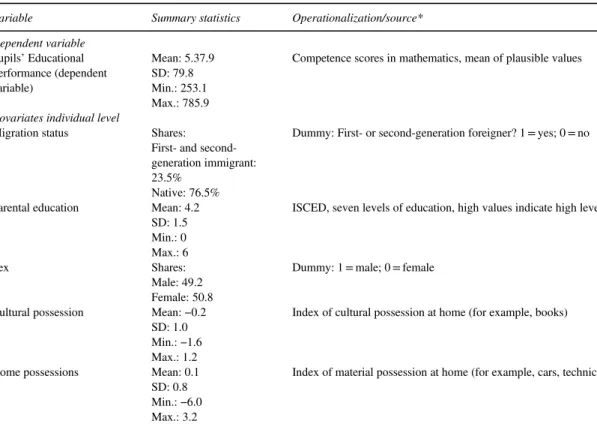
or basic requirements, or in a heterogeneous (meaning mixed requirements) class. We control for the following school-level variables: whether a school is a public or private school6, and the proportion of foreigners in a school. Finally, the level of cantonal urbanization is used as a control variable at the cantonal level, as it has been demonstrated to be an important indicator of canton’s economic and socio-structural conditions (Steffen, 2005).7More detailed information on all variables, their operationalization as well as the summary statistics can be found in Appendix A2. For the measurement of the contextual variables, we chose a point in time before 2006 that is relevant for the cohort of PISA 2006.
We apply random intercept and random slope models, implying that individual behaviour and its determinants can vary between schools and cantons (Jones, 1997; Steenbergen and Jones, 2002). More precisely, the cantonal random intercept captures the canton-specific level of school performance and can thus be seen as an indicator for the overall educational success of a cantonal system. In addition, cross-level interactions are calculated in order to model the aforementioned parameters of interest: how the effect of immigrant background is moderated by contextual factors. In fact, our main focus does not lie on the dependent variable (educational performance) as such, but on the coefficients measuring immigrant status (that is, the gap in school performance between native and immigrant students) and how the estimated differences between immigrants and natives change as cantonal integration policy varies.
The effect of immigration is estimated to vary across different levels of a given policy indicator. More precisely, the hypotheses would be confirmed if one (or both) of the following condition(s) is (are) fulfilled (Brambor et al, 2006):
1. The marginal effect of immigrant background substantially decreases (or increases if an inequality-fostering effect is postulated) as the value of a given policy variable increases. In Bayesian terms, we have to look at the proportion of iterations that produced smaller (higher) marginal effects at a low level of the policy variables compared with high values of the respective policy indicator. 2. The marginal effect of immigrant background loses its systematic influence
(or gains influence if an inequality fostering effect is expected) for higher levels of a given policy variable.
We use a Bayesian estimation approach, as it has been shown to perform better than maximum likelihood, particularly in the case of multilevel models with a small number of cases at the higher level(s) (Browne and Draper, 2006). For an easy interpretation of the Bayesian estimation results, the mean and the standard deviation of the posterior distribution are presented, which can be interpreted like in a standard regression situation: the mean is the average effect of an independent variable on the outcome variable and the standard deviation gives a sense of the statistical reliability of this estimate. Moreover, the 90 per cent credible intervals are provided, which are the Bayesian equivalent to confidence intervals in a standard regression context.
Empirical Results
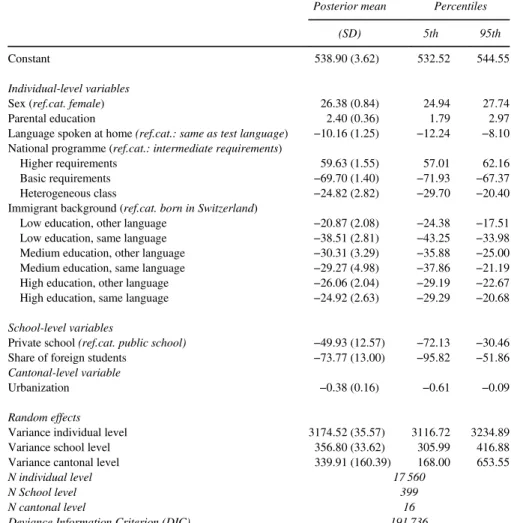
We present a two-stage procedure to examine how integration policy moderates the relationship between immigration background and school success. In the first analytical step, we set out a basic model that includes individual and contextual variables based on previous research (see Appendix A1). Although the model largely confirms these earlier studies (for example, Stadelmann-Steffen, 2012), we will only discuss thefinding that is crucial in the context of this article: immigration background is clearly related to school success; all groups of immigrant children systematically exhibit lower mathematical success than their native Swiss counter-parts. There are, however, considerable differences between immigrant groups. Whereas children with low educational background speaking German or French at home (for example, immigrants from Northern Africa in the French-speaking part of Switzerland) as well as children from the medium social class speaking a different language at home (for example, former guest-worker immigrants) exhibit particularly low mathematical performance, students from higher social classes tend to perform better. The question therefore arises of whether the cantonal integration policy context affects these different immigrant groups differently and mainly whether and for whom it has the potential to reduce educational inequality. At this point, it is important to emphasize that these initial results also show that the ‘immigration penalty’ is not a pure educational disadvantage based on lower social status and/or a foreign language. Although we use these two variables for assigning children to the different immigrant groups (that is, approximating different origin countries and socio-economic conditions), we still control for these factors in the models. In so doing, our immigrant variable measures the additional disadvantage the different immigrant groups have given their social and linguistic background.
In the second step, we proceed by adding the integration policy index to expand the basic model and to estimate cross-level interactions with immigration back-ground.8Figure 2 illustrates the marginal effects of the different immigrant groups as the value of the overall integration policy index changes.
On the one hand, the graphs demonstrate a clear pattern: for all groups of immigrants the‘penalty’ is lower if a canton pursues a liberal and culturally pluralist integration policy. The probability that the immigrant penalty differs between cantons with restrictive and culturally monistic compared with liberal and culturally pluralist integration regimes amounts to between 83 and 100 per cent, depending on the immigrant group we are looking at. On the other hand, thefigure shows clear differences between groups. The slope is in fact steepest, that is, the reduction in immigrant inequality is highest, for immigrants from the lowest educational stratum (both speaking the test or another language at home) as well as for children with medium-educated parents speaking the test language at home. Thus, our results suggest,first, that those who are most disadvantaged socially profit most from liberal cantonal integration policies and, second, that speaking the host language is a good
precondition for an equalizing effect of cantonal integration policy. For the medium-educated group speaking a different language at home, the relationship is not systematic at the 90 per cent level. This group, for instance, may represent children from former guest-worker countries like Italy, Spain or Portugal, which are no longer substantially influenced by different integration policies, as these immigrant families have been living in Switzerland for a relatively long time. They are already quite well established and do not further profit from a multicultural and liberal environ-ment. Overall, the group-specific differences illustrate that the combination of language and social status helps indeed to differentiate between structurally different immigrant groups.
In further analyses not presented here, the robustness of ourfindings has been put to additional tests (see also Footnote 6). First, the inclusion of general education policies (see Stadelmann-Steffen, 2012) did not influence the estimated effects presented in this contribution. Second and more importantly, we tested whether our results are robust against the inclusion of language region. This is not an easy task in the Swiss context, as, as already mentioned, cultural–linguistic region and cantonal integration policy are highly interrelated (cf. Manatschal, 2012). Generally, we would argue that there is no theoretical reason to assume that language region per se Figure 2:Marginal effect of immigrant background as the integration policy context changes.
Notes: Marginal posterior distributions (last 1000 iterations); black line: mean, grey lines: 90 per cent credible interval (5 and 95 per cent percentiles). All models control for individual, school and cantonal variables as shown in Table A1 as well as the integration policy index and the respective cross-level interaction. Bayesian estimation: 200 000 iterations, thinning: 1; burn-in: 50 000, uniform priors, no signs of non-convergence.‘Probability that ME differs’ indicates the share of iterations for which the marginal effect of immigrant background is larger if the values of the policy index varies from 1 standard deviation below the mean (−0.1) to 1 standard deviation above the mean (0.5).
should have an impact on educational inequality. If language region matters, the causal chain can be expected to go via policy outputs (that is, cultural preferences and values lead to more inclusive or more restrictive integration policy). Omitting the language variable would therefore not bias our estimation. Given this theoretical argument, on the one hand, and the strong empirical correlation between language region and integration policy on the other, we used informative priors to empirically test our argument. The results of these estimations are provided by the authors upon request and clearly confirm the robustness of this article’s findings and conclusions. Second, we estimated further models in which possible confounders at the contextual level (the share of first-generation immigrants, cantonal education policy) were integrated. The analyses showed that these variables are not systematically related to either immigrant inequality or integration policy.
Third, we conducted analyses at the categorical policy level (that is, civic–political and socio-structural rights as well as cultural rights and obligations) instead of the overall integration policy index. The analyses for the three policy categories corroborate the general pattern observed at the index level, although the effects are less pronounced when considering only single policy categories. Finally, we estimated the same model using reading competences as the dependent variable. The resulting picture was almost identical with the one presented in the article. With one exception: inequality of the immigrant group six (high-educated parents speaking the test language at home) was not systematically related to its school success. This can be explained by the fact that this group (for example, high-educated German immigrants) may even be advantaged in reading compared with Swiss pupils and does therefore not depend on a multicultural and liberal integration policy. Overall, these additional estimations strongly support our conclusion of existing and substantial policy effects.
Discussion
Against the background of a predominant national focus of migration research, this article aimed at illustrating the relevance of subnational variations of integration policy. By transferring an international concept to Switzerland’s cantonal level, we were able to show that subnational variations of integration policy are not only comparable to, but occasionally even exceed international variance for the same policy indicator. Furthermore, the policy outcome analyses presented in this article suggest that cantonal integration policies do matter, meaning that they have relevant implications for immigrant integration in schools.
The empirical results arising from our Bayesian multilevel analyses based on cantonal data on integration policy as well as PISA data for 14 cantons corroborate our assumption that these policies have the potential to moderate immigrant educational inequality. Starting from this general observation, the empirical analyses
conducted here allow us to draw more specific conclusions. First, the results show that more liberal and culturally pluralist integration policies coincide with lower immigrant educational inequality. This pattern turned out to be robust for different social and linguistic immigrant groups, lending thus strong support to our first hypothesis. It seems like liberal and culturally pluralist policies are overall more inclusive, facilitating thereby equal educational opportunities for immigrants. By contrast, when it comes to Switzerland’s education system, fear of a segregationist potential of multiculturalist policies appears ungrounded.
Second, the distinction between different social and linguistic immigrant groups turned out to be revealing. Our empirical results suggest that certain groups of immigrants profit more than others from an inclusive cantonal integration context. Group differences corroborate the relevance of language proficiency for successful integration. Moreover, we also found the socially most disadvantaged group to be particularly and positively affected by liberal and culturally pluralist integration policies. As our data and the analytical approach chosen do not allow for a more precise measurement of immigrants’ heterogeneity, that is, considering their country or origin or further distinguishing betweenfirst- and second-generation foreigners, more research disentangling the complex pattern of immigrants’ characteristics and its role in successful integration would be desirable.
Finally, another limitation of our study is with regard to the small number of contextual units, which severally constrains the complexity of the models to be estimated. This is not a weakness of our analyses presented, but a reality (also of many other comparative studies) that must be considered when interpreting and discussing ourfindings. The merits of our contribution must not be underestimated but should mainly be seen in terms of revealing patterns of relationships between integration policy and immigrant inequality; at the same time, further research based on larger data sets is necessary to allow real causal conclusions.
As the results of our article could show, subnational variations of integration policy are not only considerable, but also relevant. Thus, international migration research should not neglect this subnational policy heterogeneity in federal states, especially when considering the local nature of immigrant integration processes, which might be driven more by local or regional polices than by national integration regimes.
About the Authors
Anita Manatschal is Senior Researcher and Lecturer at the Chair of Political Sociology of the Institute of Political Science at Berne University. Her research interests embrace (sub-)national comparative politics, migration and integration policy, volunteering and social capital. Her research has been, or is about to be
published in Journals such as Ethnic and Racial Studies, Swiss Political Science Review and Journal of Ethnic and Migration Studies.
Isabelle Stadelmann-Steffenis Assistant Professor in Comparative Politics with the University of Bern. Her main research interests concern comparative welfare state research, inequality, civic engagement and the Swiss political system. Her articles have appeared in journals such as Governance, European Sociological Review, European Union Politics, Political Behavior, Electoral Studies, Nonprofit and Voluntary Sector Quarterly, Environmental Politics, Political Studies or Journal of Social Policy.
Notes
1 However, an increasing interest in the topic can be observed most recently. Besides the forthcoming volume on‘Immigrant Integration in Federations’, edited by Christian Joppke and Leslie Seidle, another edited volume on‘Immigration Regulation in Federal States: Challenges and Responses in Comparative Perspective’, edited by Sasha Baglay and Delphine Nakache, is currently in preparation.
2 In their most recent article, Koopmans et al (2012) present a refined version of their conceptual framework, where single policy components are no longer restricted to one dimension, either the cultural or the individual equality dimension, but may exhibit indicators on both dimensions. As an exploratory factor analysis based on our cantonal data suggests that cultural or religious policy components load on other factors than policy components from the individual equality dimension (cf. Manatschal, 2011), we consider the classical approach offered by Koopmans et al (2005) more suitable for the cantonal context. 3 Instead, and as Swiss cantons retain almost full jurisdiction over education policy (BFS, 2005; Stadelmann-Steffen, 2012), we control for a couple of general education policies that turned out to be relevant in the case of immigrant educational inequality (see robustness discussion in the empirical part). 4 The following cantons are included: Argovia, Basle-Country, Basle-Town, Bern (German- and French-speaking part), Fribourg, Geneva, Neuchâtel, Schaffhausen, St. Gall, Thurgovia, Ticino, Vaud, Valais (German- and French-speaking part) and Zurich.
5 Although the Swiss part of the international PISA data set 2006 indeed contains information on the parents’ and pupils’ country of birth, the extended (that is, cantonal) Swiss PISA data used here do not provide these indicators.
6 In the PISA sample for Switzerland, only 6 per cent of all schools are private schools. In reality, less than 4 per cent of pupils are enrolled in private schools (Source: BFS, Statistisches Lexikon der Schweiz), which are generally required to enrol a proportional number of pupils from all social strata in order to receive public funding.
7 We would like to mention that the integration of more controlling variables on the contextual level would be desirable, but is not feasible given the small number of cases at Level 2. In particular, we cannot model more than one variable at a time as cross-level interaction. The modelling of just one cross-level interaction (as in the model presented) results in the estimation of seven parameters (main effect, plus interactions with the six immigrant categories). We therefore did extensive robustness checks testing confounders that could be related to either immigrant inequality or integration policy (see also page 14f ). Although these tests (including language region, the share offirst-generation immigrants as well as education and school policies) do not question the results presented in the following, we do not insist on the notion of causality. The merits of our contribution should mainly be seen in terms of revealing patterns of correlation between integration policy and immigrant inequality, and further research based on larger data sets is necessary to allow real causal conclusions.
8 Random slopes have been tested for the immigrant variables at the individual level. As the slope variances proved to be negligible and in order to avoid a too complex model on Level 2, we refrained from integrating random slopes in the models presented here (Snijders and Bosker, 2012, p. 155).
References
Achermann, A. (2004) Integration und Habitat: Die‘angemessene Wohnung’ als Voraussetzung für den Familiennachzug. Bern, Switzerland: EKA.
Akgün, L. and Tränhardt, D. (2001) Integrationspolitik in föderalistischen Systemen. Münster, Germany: Lit. Becker, R. (2000) Klassenlage und Bildungsentscheidungen. Kölner Zeitschrift für Soziologie und
Sozialpsychologie 52(3): 450–475.
BFM. (2006) Probleme der Integration von Ausländerinnen und Ausländern in der Schweiz. Bestande-saufnahme der Fakten, Ursachen, Risikogruppen, Massnahmen und des integrationspolitischen Handlungsbedarfs. Bern, Switzerland: Bundesamt für Migration im Auftrag des Departementvorstehers EJPD.
BFS. (2005) PISA 2003. Einflussfaktoren auf die kantonalen Ergebnisse. BFS Aktuell, 15.
Boucher, A., Challen, S. and Thielemann, E. (2011) Measuring and comparing migration, asylum and naturalisation policies: The International Migration Policy and Law Analysis (IMPALA) Project. Paper presented at the ECPR General Conference, August. Reykjavik, Iceland.
Brambor, T., Roberts Clark, W. and Golder, M. (2006) Understanding interaction models: Improving empirical analyses. Political Analysis 14(1): 63–82.
Browne, W.J. and Draper, D. (2006) A comparison of Bayesian and likelihood-based methods forfitting multilevel models. Bayesian Analysis 1(3): 473–514.
Brubaker, R. (1992) Citizenship and Nationhood in France and Germany. Cambridge, MA: Harvard University Press.
Castles, S. and Davidson, A. (2000) Citizenship and Migration: Globalization and the Politics of Belonging. New York: Routledge.
Christmann, A. (2010) Damoklesschwert Referendum? Die indirekte Wirkung ausgebauter Volksrechte auf die Rechte religiöser Minderheiten. Swiss Political Science Review 16(1): 1–41.
Dronkers, J. (1993) Educational-reform in the Netherlands– Did it change the impact of parental occupation and education? Sociology of Education 66(4): 262–277.
Dronkers, J. and de Heus, M. (2013) The educational performance of children of immigrants in sixteen OECD countries. In: M.H. Lopez and M. Siegel (eds.) A World in Motion: Trends in Migration and Migration Policy. Oxford: Oxford University Press.
Dupriez, V. and Dumay, X. (2006) Inequalities in school systems: Effect of school structure or of society structure? Comparative Education 42(2): 243–260.
Eggert, N. and Murigande, A. (2004) Modèles de citoyenneté et mobilisation politique des migrants en Suisse: Le rôle des cantons. Swiss Political Science Review 10(4): 125–145.
Entorf, H. and Minoiu, N. (2005) What a difference immigration policy makes: A comparison of PISA Scores in Europe and Traditional countries of immigration. German Economic Review 6(3): 355–376.
Entzinger, H. (2000) The dynamics of integration policies: A multidimensional model. In: R. Koopmans and P. Statham (eds.) Challenging Immigration and Ethnic Relations Politics: Comparative European Perspectives. Oxford: Oxford University Press, pp. 97–118.
Favell, A. (2001) Philosophies of Integration: Immigration and the Idea of Citizenship in France and Britain. Basingstoke, UK: Palgrave Macmillan.
Fennema, M. and Tillie, J. (2001) Civic community, political participation and political trust of ethnic groups. Connections 24(1): 26–41.
Fossati, F. (2011) The effect of integration and social democratic welfare states on immigrants’ educational attainment: A multilevel estimate. Journal of European Social Policy 21(5): 391–412.
Giugni, M. and Passy, F. (2003) Staatsbürgerschaftsmodelle und Mobilisierung der Immigranten in der Schweiz und in Frankreich in Hinblick auf politische Gelegenheitsstrukturen. In: H.-R. Wicker, R. Fibbi and W. Haug (eds.) Migration und die Schweiz. Zürich, Switzerland: Seismo, pp. 109–138. Goertz, G. (2006) Social Science Concepts. A User’s Guide. Princeton, NJ: Princeton University Press. Gomolla, M. and Radtke, F.-O. (2002) Institutionelle Diskriminierung: Die Herstellung ethnischer
Differenz in der Schule. Opladen, Germany: Leske und Budrich.
Hall, P.A. and Taylor, R.C.R. (1996) Political science and the three new institutionalisms. Political Studies 44(5): 936–957.
Hansen, G. and Wenning, N. (2003) Schulpolitik für andere Ethnien in Deutschland. Zwischen Autonomie und Unterdrückung, Münster. New York, München, Berlin: Waxmann.
Hedstörm, P. and Swedberg, R. (1996) Rational choice, empirical research, and the sociological tradition. European Sociological Review 12(2): 127–146.
Helbling, M. (2008) Practising Citizenship and Heterogeneous Nationhood: Naturalisations in Swiss Municipalities. Amsterdam, The Netherlands: Amsterdam University Press.
Howard, M.M. (2006) Comparative citizenship: An agenda for cross-national research. Perspectives on Politics 3(4): 443–455.
Ireland, P. (2006) Institutions, political opportunity structures, and the shaping of migration policies in Western Europe. In: M. Giugni and F. Passy (eds.) Dialogues on Migration Policy. Lanham, MD: Lexington Books, pp. 137–155.
Jones, K. (1997) Multilevel approaches to modelling contextuality. From nuisance to substance in the analysis of voting behaviour. In: G.P. Westert and R.N. Verhoeff (eds.) Places and People: Multilevel Modelling in Geographical Research. Utrecht, the Netherlands: KNAG/Netherlands Geographical Studies, pp. 19–43.
Kleger, H. and D’Amato, G. (1995) Staatsbürgerschaft und Einbürgerung – oder: Wer ist ein Bürger? Ein Vergleich zwischen Deutschland, Frankreich und der Schweiz. Journal für Sozialforschung 35(3/4): 259–281. Koopmans, R. (2010) Tradeoffs between equality and difference: Immigrant integration, multiculturalism and the welfare state in cross-national perspective. Journal of Ethnic and Migration Studies 36(1): 1–26. Koopmans, R. and Kriesi, H. (1997) Citoyenneté, identité nationale et mobilisation de l'extrême droite. Une comparaison entre la France, l’Allemagne, les Pays-Bas et la Suisse. In: P. Birnbaum (ed.) Sociologie des nationalismes. Paris, France: Presses Universitaires de France, pp. 205–324.
Koopmans, R., Statham, P., Giugni, M. and Passy, F. (2005) Contested Citizenship: Immigration and Cultural Diversity in Europe. Minneapolis, London: University of Minnesota Press.
Koopmans, R., Michaelowski, I. and Waibel, S. (2012) Citizenship rights for immigrants: National political processes and cross-national convergence in Western Europe, 1980–2008. American Journal of Sociology 117(4): 1202–1245.
Kymlicka, W. (1999) Multikulturalismus und Demokratie. Über Minderheiten in Staaten und Nationen. Hamburg, Germany: Rotbuch Verlag.
Lavenex, S. (2004) Whither the liberal democratic model? Immigration politics in Switzerland and Japan. Swiss Political Science Review 10(3): 179–209.
Levels, M. and Dronkers, J. (2008) Immigrant children’s educational achievement in Western Countries: Origin, destination, and community effects on mathematical performance. American Sociological Review 73(5): 835–853.
Mahnig, H. (2000) L’intégration institutionelle des Musulmans en Suisse: l'exemple de Bâle-Ville, Berne, Genève, Neuchâtel et Zurich. TANGRAM, Bulletin der Eidgenössischen Kommission gegen Rassismus 8: 102–111.
Manatschal, A. (2011) Taking cantonal variations of integration policy seriously– Or how to validate international concepts at the subnational comparative level. Swiss Political Science Review 17(3): 336–357.
Manatschal, A. (2012) Path dependent or dynamic? Cantonal integration policies between regional citizenship traditions and right populist party politics. Ethnic and Racial Studies 35(2): 281–297. Marshall, T. H. (1950) Citizenship and Social Class and Other Essays. Cambridge, UK: Cambridge
University Press.
Niessen, J., Huddleston, T., Citron, L., Geddes, A. and Jacobs, D. (2007) Migrant Integration Policy Index II. British Council and Migration Policy Group, http://www.mipex.eu/sites/default/files/downloads/ migrant_integration_policy_index_mipex_ii-2007.pdf, accessed 24 April 2013.
Ostrom, E. (1999) Institutional rational choice: An assessment of the institutional analysis and develop-ment framework. In: P.A. Sabatier (ed.) Theories of the Policy Process. Boulder, CO: Westview Press, pp. 35–71.
Pierson, P. (2006) Public policies as institutions. In: I. Shapiro, S. Skowronek and D. Galvin (eds.) Rethinking Political Institutions: The Art of the State. New York and London: New York University Press, pp. 114–131.
Prokic-Breuer, T. and Dronkers, J. (2012) The high performance of Dutch and Flemish 15-year-old native pupils: Explaining country differences in math scores between highly stratifed educational systems. ROA Research Memorandum Nr. 8. Maastricht University, Maastricht, The Netherlands.
Przeworski, A. and Teune, H. (1970) The Logic of Comparative Social Inquiry. New York: Wiley-Interscience.
Schlicht-Schmälzle, R. and Möller, S. (2011) Inequality in education between migrants and natives: The effectiveness of integration policy in the Western EU member states. Annual Conference of the Political Studies Association. 19–21 April, London.
Schlicht, R., Stadelmann-Steffen, I. and Freitag, M. (2010) Educational inequality in the EU: The effectiveness of the national education policy. European Union Politics 11(1): 29–59.
Schmid, G. (1984) The political economy of labor market disrimination. In: G. Schmid and R. Weitzel (eds.) Sex Discrimination and Equal Opportunity: The Labour Market and Employment Policy. Aldershot, UK: Gower Publishing Company, pp. 264–308.
Skenderovic, D. (2009) The Radical Right in Switzerland: Continuity and Change, 1945–2000. New York: Berghahn Books.
Snijders, T.A.B. and Bosker, R.J. (2012) Multilevel Analysis: An Introduction to Basic and Advanced Multilevel Modeling. Los Angeles, CA: Sage Publishers.
Stadelmann-Steffen, I. (2012) Education policy and educational inequality– Evidence from the Swiss laboratory. European Sociological Review 28(3): 379–393.
Steenbergen, M. and Jones, B.S. (2002) Modeling multilevel data structures. Amercian Journal of Political Science 46(1): 218–237.
Steffen, I. (2005) Determinanten der Arbeitslosigkeit in den Schweizer Kantonen. Eine empirische Analyse zu den Disparitäten in den kantonalen Arbeitslosenquoten. Swiss Political Science Review 11(2): 27–54.
TAK. (2009) Weiterentwicklungen der schweizerischen Integrationspolitik. Bericht und Empfehlungen der TAK vom 29. Juni. Bern, Tripartite Agglomerationskonferenz.
Tilly, C. (1995) Citizenship, identity and social history. International Review of Social History 40(3): 1–17.
van Tubergen, F. and Werfhorst, v.d. (2007) Postimmigration investments in education: A study of immigrants in the Netherlands. Demography 44(4): 883–898.
Vink, M.P. and Bauböck, R. (2013) Citizenship configurations. Analysing the multiple purposes of citizenship regimes in 33 European states. Comparative European Politics 11(5): 621–648.
Appendix
Table A1: The basic model
Posterior mean Percentiles
(SD) 5th 95th
Constant 538.90 (3.62) 532.52 544.55
Individual-level variables
Sex (ref.cat. female) 26.38 (0.84) 24.94 27.74
Parental education 2.40 (0.36) 1.79 2.97
Language spoken at home (ref.cat.: same as test language) −10.16 (1.25) −12.24 −8.10 National programme (ref.cat.: intermediate requirements)
Higher requirements 59.63 (1.55) 57.01 62.16
Basic requirements −69.70 (1.40) −71.93 −67.37
Heterogeneous class −24.82 (2.82) −29.70 −20.40
Immigrant background (ref.cat. born in Switzerland)
Low education, other language −20.87 (2.08) −24.38 −17.51
Low education, same language −38.51 (2.81) −43.25 −33.98
Medium education, other language −30.31 (3.29) −35.88 −25.00
Medium education, same language −29.27 (4.98) −37.86 −21.19
High education, other language −26.06 (2.04) −29.19 −22.67
High education, same language −24.92 (2.63) −29.29 −20.68
School-level variables
Private school (ref.cat. public school) −49.93 (12.57) −72.13 −30.46
Share of foreign students −73.77 (13.00) −95.82 −51.86
Cantonal-level variable
Urbanization −0.38 (0.16) −0.61 −0.09
Random effects
Variance individual level 3174.52 (35.57) 3116.72 3234.89
Variance school level 356.80 (33.62) 305.99 416.88
Variance cantonal level 339.91 (160.39) 168.00 653.55
N individual level 17 560
N School level 399
N cantonal level 16
Deviance Information Criterion (DIC) 191 736
Notes: Posterior means (standard deviations in brackets) as well as 90 per cent credible intervals (last 1000 iterations). Estimates from Bayesian estimation (200 000 iterations, thinning: 1; burn-in: 50 000, uniform priors, no signs of non-convergence).
Table A2: Variables, operationalization, sources and summary statistics
Variable Summary statistics Operationalization/source*
Dependent variable Pupils’ Educational Performance (dependent variable) Mean: 5.37.9 SD: 79.8 Min.: 253.1 Max.: 785.9
Competence scores in mathematics, mean of plausible values
Covariates individual level
Migration status Shares:
First- and second-generation immigrant: 23.5%
Native: 76.5%
Dummy: First- or second-generation foreigner? 1= yes; 0 = no
Parental education Mean: 4.2
SD: 1.5 Min.: 0 Max.: 6
ISCED, seven levels of education, high values indicate high levels of parental education
Sex Shares:
Male: 49.2 Female: 50.8
Dummy: 1= male; 0 = female
Cultural possession Mean:−0.2
SD: 1.0 Min.:−1.6 Max.: 1.2
Index of cultural possession at home (for example, books)
Home possessions Mean: 0.1
SD: 0.8 Min.:−6.0 Max.: 3.2
home: 66.5%
Other language spoken at home: 33.5%
National programme Shares:
Higher requirements: 40.5% Intermediate requirements: 26.4% Basic requirements: 19.9% Heterogeneous classes: 23.3%
National programme of a pupil’s school class: four categories: Homogeneous class with higher requirements; homogeneous class with intermediate requirements; homogeneous class with basic requirements; heterogeneous class
Covariates school level
Proportion of foreigners Mean: 0.1 SD: 0.1 Min.: 0 Max.: 0.6
Proportion offirst-generation foreigner in a school (Source: Own calculation based on the 2006 PISA survey)
Private schools Shares:
Public school: 96.9% Private school: 6.1%
Dummy variable: 0= public school, 1 = private school (Source: PISA 2006, school questionnaire data)
Streaming Shares:
No streaming: 30.0% (Some) streaming: 70.0%
Dummy variable: 0= No streaming at all in grade 9; 1 = (Some) streaming between classes in grade 9 (Source: PISA 2006, school questionnaire data)
Covariates cantonal level
Integration policy index Mean: 0.06 SD: 0.28 Min.:−0.54 Max.: 0.76
Additive index based on thefive policy components below
Additive index based on
Civic–political rights Mean: 0.0 SD:
0.6
(1) Political participation, non-nationals’ right to vote (additive index): (a) Right to vote in cantonal votes or elections: 0= no, 1 = yes; (b) Right to run for cantonal office: 0 = no, 1= yes; (c) Compulsory versus optional adoption of cantonal regulation by
Table A2: continued
Variable Summary statistics Operationalization/source*
Min.:−1.4 Max.: 1.0
municipalities: 0= optional, 1 = compulsory; (d) Right to vote in local votes or elections: 0= no, 1 = yes; (e) Right to run for local office: 0 = no, 1 = yes; (f) Required period of residence: 0= >10 years, 0.5 = <10 years, 1 = no requirement; (g) Required residence permit status: 0= permit C, 0.5 = <permit C, 1 = no residence permit required) (2) Cantonal provision of immigrants’ commission: 0 = no commission, 0.5 = ad hoc
commission, 0.75= traditional permanent commission founded after 2002, 1 = permanent commission founded before 2002
(3) Access to nationality (additive index): (a) Period of residence: 0= >12 years, 0.2 = 10 years, 0.4= 8 years, 0.6 = 6 years, 0.8 = 8 years, 1 = 2 years; (b) Fee: 0 = >2000 CHF, 0.25= <2000 CHF, 0.5 = <1000 CHF, 0.75 = 500 CHF, 1 = <500 CHF; (c) Facilitated procedure (dummy): 0= no, 1 = yes; (d) Right of appeal (dummy): 0 = no, 1 = yes
Socio-structural rights Mean: 0.0
SD: 0.6 Min.:−1.7 Max.: 1.2
Additive index based on migrants’ access to cantonal employment in administration, teaching positions, police service and judiciary. Coding for each indicator: 0= no access, 0.5 = very restricted access, 0.75= restricted access, 1 = unrestricted access
Additive index based on Cultural rights and obligations Mean: 0.0
SD: 0.5 Min.:−1.16 Max.: 0.73
(1) Cultural requirements for naturalization:
○ Degree of integration required for naturalization: 0 = more restrictive, 0.5 = equal, 1= less restrictive than national citizenship law (Source: Own survey of 26 cantonal citizenship laws)
○ Cantonal implementation of integration agreement: 0 = systematic, 0.5 = partial, 1 = no application of integration agreement
○ Number of Islamic cemeteries in cantons (0–2)
○ Timespan of existence of Islamic cemeteries: 0 = none, 0.5 = built between 2005 and 2008, 0.75= built between 2000 and 2005, 1 = built before 2000)
(b) Legal tendency for recognition of minorities’ religions: continuous variables from 0 to 1
Additive index based on
Family reunion Mean: 0.0
SD: 0.69 Min.:−0.83 Max.: 1.34
(1) Cantonal requirements regarding housing situation. Coding: cantonal definition of the criteria‘appropriate living place’ for family reunion, 0.25 = restrictive, 0.5 = moderate, 0.75= permissive criteria, 1 = no criteria
(2) Differing criteria for EU- and third country nationals. 0= indifferent, 0.5 = differing procedure, 1= more permissive towards EU-nationals
Anti-discrimination Mean: 0.0
SD: 0.99 Min.:−1.57 Max.: 1.11
Additive index based on cantonal anti-discrimination regulation in constitution and/or laws. Coding: 0= none, 0.75 = constitution or law, 1 = constitution and law
Urbanization Mean: 54.6
SD: 30.8 Min.: 0 Max.: 100
Proportion of cantonal population living in agglomerations or isolated cities (more than 10 000 inhabitants), 2001 (Source: BFS, Statistisches Lexikon, www.badac.ch, 15 November 2009)
Class size Mean: 26.1
SD: 2.2 Min.: 22 Max.: 30
Maximal class size in primary school, 2000
Hours taught at school Mean:−0.0
SD: 47.7 Min.:−75.0 Max.: 81.7
Average number of our taught at school per year. Weighted average of number of hours taught at school in primary and secondary school, Mean centred
*All individual- and school-level variables are taken from the Swiss data set of the 2006 PISA survey. For data sources of thefive components of the integration policy index please refer to Manatschal (2011).