HAL Id: hal-03017749
https://hal.archives-ouvertes.fr/hal-03017749
Submitted on 21 Nov 2020
HAL is a multi-disciplinary open access
archive for the deposit and dissemination of
sci-entific research documents, whether they are
pub-lished or not. The documents may come from
teaching and research institutions in France or
abroad, or from public or private research centers.
L’archive ouverte pluridisciplinaire HAL, est
destinée au dépôt et à la diffusion de documents
scientifiques de niveau recherche, publiés ou non,
émanant des établissements d’enseignement et de
recherche français ou étrangers, des laboratoires
publics ou privés.
A dense PIV system: a solution for rapid data
assimilation
Pierre Chatelier, Antonios Giannopoulos, Jean-Luc Aider
To cite this version:
Pierre Chatelier, Antonios Giannopoulos, Jean-Luc Aider. A dense PIV system: a solution for rapid
data assimilation. 3rd Workshop and Challenge on Data Assimilation & CFD Processing for PIV and
LPT, Nov 2020, PARIS (en virtuel), France. pp.9 - 10. �hal-03017749�
3rd Workshop and Challenge on Data Assimilation & CFD Processing for PIV and LPT November 19-20, 2020, Paris, France
! "#$%# &'( %)%*#+, - %./0*1.$ 2.3 3-41"
"-*--%%1+1/-*1.$
Antonios Giannopoulos1 , 2, Pierre Chatelier3 and Jean-Luc Aider1
Email: [email protected]
1Laboratoire de Physique et Mécanique des Milieux Hétérogènes (PMMH), CNRS UMR7636, ESPCI Paris,
PSL Université, Sorbonne Université, Université Paris Diderot, Sorbonne Paris Cité, 75005 Paris, France
2 Photon Lines, Parc Pereire Bat B, 99 rue Pereire, 78100 Saint-Germain-en-Laye, France 3 See Fast Technologies, 99 rue Péreire Parc Péreire, Bât.B, 78100 Saint-Germain-en-Laye
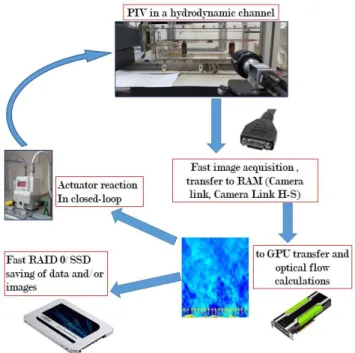
The presented system is developed around the image acquisition and processing platform Eyemotion, developed by SeeFast Technologies. Eyemotion is a native code software, with built-in image processing tools adapted for large data flows. It can be used for actuator signal sending and receiving, laser-camera synchronization and real-time image post-processing. We developed a plugin extension of the said software in a .NET platform, integrating a dense 2D-2C Lukas-Kanade Optical Flow (LKOF) PIV algorithm, implemented in CUDA functions. The algorithm was first developed at ONERA [1] and later adapted for the real-time calculation case by PMMH lab[2]. One vector per pixel is calculated, with a precision of the order of a tenth of a pixel and a maximum displacement of up to 20 pixels. The goal of the system is also the real-time calculation of other velocity-derived variables calculations, like vorticity field, !ci criterion and scalar values like the recirculation area, or the sum of the kinetic energy of the field. The system can be used in real-time mode, during image acquisition, or offline in post-processing mode. A continuous and pulsating laser mode was designed and integrated. A high and low calculation speed option can be selected for hardware and software parameters of the system, depending on the application. The only PIV parameters for the user are the kernel radius, the pyramid level size and the number of Gauss-Newton iterations [1]; no further complicated filters or spurious vector rejection process is applied. The presented setup shows great potential in the fast PIV calculation, large data-base creation (suitable for data-hungry machine learning methods), and PIV setup diagnostic with relatively low disk space occupancy. The optimal setup consists of a high-speed camera, an optimal GPU, and a RAID0 disk configuration. Different versions of the system have been proven already to facilitate neural-network system identification experiments[3], as well as machine learning closed-loop control experiments[4]. The present LKOF algorithm has also be applied in different type of experiments, not only PIV images; an example of an application in a blood platelets flow experiment is presented in figure 3.
3rd Workshop and Challenge on Data Assimilation & CFD Processing for PIV and LPT November 19-20, 2020, Paris, France
The system spatial resolution and computational time has been validated using synthetic PIV images and various hydro/aerodynamic datasets (turbulent boundary layer, backward-facing step and grid turbulence wind tunnel experiments); it shows great potential for post-processing speed-up and saving in hard space. A real-time field saving option has been integrated, in order to avoid saving images and save disk space; fields are saved in a low disk space format. Particularly for 16 bit images, the value of Mb(field)/Mb(image) ratio is around 1, which shows that a saving of order 50% disk space can be achived. It has been tested for various image sizes up to 16 Mp and various GPUs. A multi-GPU calculation option is also being investigated.
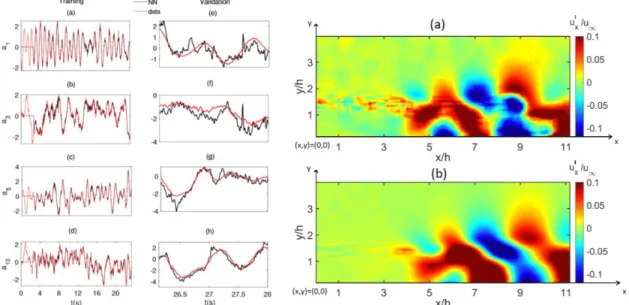
Fig. 2 POD coefficient prediction for neural-network training and validation dataset (left), and velocity field reconstruction (right) for experimental, time-resolved Backward Facing Step flow (Reh=1385).
Fig. 3 Blood platelets flow image (left) velocity field calculation (right) Experiment from: L.Bellebon, PMMH.
References
[1] Champagnat et Al(2011) Fast and accurate PIV computation using highly parallel iterative correlation maximization Exp Fluids (2011) 50:1169!1182 ,DOI 10.1007/s00348-011-1054-x.
[2] Gautier, N. & Aider, J.-L., Real-time planar flow velocity field measurements using an optical flow algorithm implemented on GPU, Journal of Visualization, 1-10, 2014.
[3] A. Giannopoulos, J.-L. Aider, Prediction of the dynamics of a backward-facing step flow using focused time-delay neural networks and particle image velocimetry data-sets, International Journal of Heat and Fluid Flow, Volume 82, 2020, 108533, ISSN 0142-727X.
[4] N. Gautier, J.- L. Aider, T. Duriez, B. Noack, M. Segond, M. Abel Closed-loop separation using Machine Learning , J. Fluid. Mech, 770, 442 ! 457 (2015).