HAL Id: tel-00542657
https://tel.archives-ouvertes.fr/tel-00542657v2
Submitted on 20 Jan 2011HAL is a multi-disciplinary open access archive for the deposit and dissemination of sci-entific research documents, whether they are pub-lished or not. The documents may come from teaching and research institutions in France or abroad, or from public or private research centers.
L’archive ouverte pluridisciplinaire HAL, est destinée au dépôt et à la diffusion de documents scientifiques de niveau recherche, publiés ou non, émanant des établissements d’enseignement et de recherche français ou étrangers, des laboratoires publics ou privés.
(POMs) FOR MOLECULAR MEMORY DEVICES
COMPATIBLE WITH A CMOS PROCESSING
Nicoleta Joo
To cite this version:
Nicoleta Joo. NEW FUNCTIONALIZED POLYOXOMETALATES (POMs) FOR MOLECULAR MEMORY DEVICES COMPATIBLE WITH A CMOS PROCESSING. Material chemistry. Université Joseph-Fourier - Grenoble I, 2010. English. �tel-00542657v2�
THÈSE
Pour obtenir le grade de
DOCTEUR DE L’UNIVERITÉ DE GRENOBLE
Spécialité « Chimie Inorganique et Bio‐Inorganique »
Arrêté ministériel : 7 août 2006
Présentée et soutenue publiquement par
NICOLETA JOO
le 3 Septembre 2010
NOUVEAUX DÉRIVÉS DE POLYOXOMÉTALLATES (POMs) POUR
DES MÉMOIRES MOLÉCULAIRES COMPATIBLES AVEC DES
PROCÉDÉS DE FABRICATION CMOS
Thèse dirigée par
DR Gérard BIDAN
et codirigée par
Dr. Guillaume NONGLATON
JURY
M. Pierre Mialane
M. Tim McCormack
M. Jean‐Christophe Lacroix
M. Guy Royal
Mme. Anna Proust
M. Gérard Bidan
M. Guillaume Nonglaton
Professeur, Université Versailles Saint Quentin
en Yvelines
Docteur, Dundalk Institute of Technology
Professeur, Université Paris Diderot
Professeur, Université Joseph Fourier
Professeur, Université Pierre et Marie Curie
Directeur de Recherche, CEA‐Grenoble, INAC
Docteur, CEA‐Grenoble, LETI
Président
Rapporteur
Rapporteur
Examinateurs
Thèse préparée au sein du
Laboratoire LETI
dans l’
Ecole Doctorale Chimie et Science du
Ph.D. Thesis
NEW FUNCTIONALIZED POLYOXOMETALATES (POMs) FOR
MOLECULAR MEMORY DEVICES COMPATIBLE WITH A CMOS
PROCESSING
Ph.D. Student
NICOLETA JOO
Public Defence: September the 3
rd, 2010
PhD advisor:
Dr. DR GÉRARD BIDAN
Supervisor:
Dr. GUILLAUME NONGLATON
Scientific advisors:
Prof. Dr. ANNA PROUST
Dr. RENÉ THOUVENOT
Prof. Dr. PIERRE GOUZERH
To Elena, Francisc,
Alexandra and Sorin.
ACKNOWLEDGMENTS
This thesis would not have been possible without their permanent involvement:
First of all, I sincerely thank to my PhD advisor DR Gérard Bidan, for giving me the opportunity to develop this work, for his generous support, guidance, encouragements and friendship during the course of this research.
I would like to express my sincere appreciation to my jury committee members for their kindness and patience to read my PhD thesis and for their considerations on it.
I would like to thank Prof. Anna Proust, Dr. René Thouvenot and Prof. Pierre Gouzerh from Pierre and Marie Curie University, Paris, France, for accepting me to work in their team during my 5 month stage in Paris. I would also like to thank them for their help, kindness, ideas and helpful discussions. I would like to acknowledge the help, encouragements and friendship from Dr. Guillaume Nonglaton.
I want to thank Prof. Isabelle Schuster for her kindness, comments and useful advices during CHEMtronics meetings. Also thanks to Dr. Françoise Vinet and Dr. Christine Peponet for welcoming me in the LETI/LFCM laboratory.
Thanks go also to Tech. Séverine Renaudineau for permanently ensure the polyoxometalates precursors supply during these three years of thesis.
I am thankful to Dr. Julien Buckley for the electrical measurements and helpful discussions, to Dr. Nevine Rochat for the ATR measurements, to Dr. Christophe Lecitra for the ellipsometry measurements, and to Dr. Pierre Alain Bayle for the NMR measurements.
A number of other people have made my stay in a foreign country possible and enjoyable. My thanks in this regard go to Pommier family, my friends: Marius, Olga, Paul and Helga. Thanks also to my colleagues from LFCM, INAC and Marie and Pierre Curie University: Dr. Adeline Leyris, Dr. Yanxia Hou, Dr. Régis Barattin, Tech. Caroline Seraine, Dr. Fabien Lefloch, Dr. Cécile Halte, Dr. Gilles Marchand, Dr.
Gheorghe, Dr. Carmen Paraschiv for all their support on professional and personal level.
I am also thankful to Prof. Mariana Rusu for introducing me to the wonderful field of polyoxometalates.
Special thanks to Sorin Puscas and Alexandra Joo for support, encouragements and help during my three years stay in France and to my parents for all their love and support.
The work and results reported in this publication were obtained with research funding from the European Community under the Sixth Framework Programme for the Marie Curie Host Fellowships for Early Stage Research Training (EST) “CHEMTRONICS” Contract Number MEST‐CT‐2005‐020513.
Abstract – The microelectronics industry is presently close to the limit of this minimization trend dictated by both laws of physics and the cost of production. It is possible that electronically functional molecular components can not only address the ultimate limits of possible miniaturization but also provide promising new methodologies for novel architectures. The aim of the present thesis is to study the miniaturization of non‐volatile memory devices, FLASH type, by replacing the floating gate with monolayers of redox molecules, polyoxometalates. Towards this goal I was engaged in a program aimed at constructing devices that use the properties of polyoxometalates (POMs) to store information. In a general approach, a redox‐active molecule attached to an electroactive surface serves as the active storage medium, and information is stored in the discrete redox states of the POM molecule.
This work is organized in four parts and begins with a short introduction into the molecular memory and polyoxometalates fields. It continues with the experimental results systematized in part 2, synthesis and characterization of functionalized polyoxometalates, part 3, polyoxometalates modified electrodes and part 4, electrical investigation of the polyoxometalates modified capacitors. Each part contains an abstract written in English and French.
The first part contains an introduction in the molecular electronics, the state of the art in the molecular memory is also presented and particularly the redox monolayers used as charge storage media in a memory device. Since the functionalized polyoxometalates constitute an important topic in this thesis, the hybrid polyoxometalates are reviewed and especially their electrochemical properties are stressed. Because of their reversible redox behavior, discrete structures in size from subnanometer to a few nanometers, and good solubility and stability in aqueous and organic solvents, POMs have been used widely as the inorganic components in functional molecular materials. An introduction into the polyoxometalates based materials is presented with an emphasis on in their electrical properties.
One of the most challenging objectives of the second part of the thesis is that of obtaining POMs derivatives with predetermined structures and properties. The derivatisation of POMs frameworks by replacing/derivatising the oxo ligands is an important aim since this it allows a much greater degree of control, potentially allowing the simultaneous exploitation of self assembly of the POMs fragments, and step wise synthesis to introduce pendant functionalities. However, the most common route to the
integration of POMs into functional architectures and devices rests on inorganic/organic hybrids. The second part describes the synthesis, the spectroscopic characterization and the electrochemical behavior in solution of some functionalized polyoxometalates. The surface attachment groups are synthetically designed for the molecule to attach on specific surfaces via covalent bonds.
The third part addresses the elaboration of a monolayer of POMs on silicon surface to form uniform and dense active storage medium. The attachment of polyoxometalate molecules onto the silicon surface by different linkers and using various grafting routes is described. The polyoxometalate modified silicon wafers were characterized by means of cyclic voltammetry (CV), X‐ray photoelectron spectroscopy (XPS) and attenuated total reflection infrared spectroscopy (ATR‐IR).
The fourth and last part contains information about the characterization of an electrode‐molecule‐silicon (EMS) capacitor which can provide critical information on the feasibility of using charge‐trapping molecules in memory devices. Characterization by conventional capacitance and conductance techniques showed very high capacitance and conductance peaks associated with charging and discharging of electrons into and from discrete levels in the monolayer owing to the presence of the redox‐active polyoxometalates.
Résumé – L’industrie de la microélectronique est aujourd’hui très proche de la limite de la tendance de
miniaturisation dictée par les lois de la physique et les coûts de production. Il est possible que le composant moléculaire fonctionnalisé puisse non seulement répondre aux limites ultimes de miniaturisation mais aussi fournir de nouvelles méthodes prometteuses pour les nouvelles architectures. L'objectif de cette thèse est d'étudier la miniaturisationdes dispositifs à mémoire non‐volatile, de type FLASH, en remplaçant la grille flottante avec des monocouches de molécules redox, les polyoxométallates.
Dans ce but, j'ai été engagé dans un programme visant à construire des dispositifs qui utilisent les propriétés des polyoxométallates (POMs) pour stocker des informations.Dans une approche générale, une molécule redox‐active fixée à une surface d'électrode de silicium sert de support de stockage actif, et l'information est stockée dans les états d'oxydo‐réduction discrets de la molécule (POM).
Ce travail est organisé en quatre parties et commence par une brève introduction sur les mémoires moléculaires et les polyoxométallates. Il continue avec les résultats expérimentaux systématisés: en partie 2 : la synthèse et la caractérisation des polyoxométallates fonctionnalisés; en partie 3, les électrodes modifiées par des polyoxométallates et en partie 4, l’étude électrique des condensateurs modifiés par des polyoxométallates. Chaque partie contient un résumé rédigé en anglais et en français.
La première partie contient une introduction à l'électronique moléculaire. L'état de l'art sur les mémoires moléculaires est également présenté, notamment les monocouches redox utilisées comme supports de stockage de charges dans un dispositif de mémoire. Étant donné que les polyoxométallates fonctionnalisés constituent un sujet important dans cette thèse, les polyoxométallates hybrides sont examinés et en particulier leurs propriétés électrochimiques. En raison de leur comportement redox réversible, de leurs structures discrètes de taille du subnanométrique à quelques nanomètres, et d’une bonne solubilité et stabilité en milieux aqueux et solvants organiques, les POMs ont été largement utilisés comme composants inorganiques dans des matériaux moléculaires. Une introduction sur les matériaux basés sur les polyoxométallates est présentée et plus particulièrement sur leurs propriétés électriques.
L'un des objectifs les plus difficiles de la deuxième partie de la thèse est l'obtention de dérivés POMs avec des structures et des propriétés prédéterminées.La fonctionnalisation des structures de POMs en remplaçant les ligands oxo par des molécules organiques est un objectif important car cela permet un plus grand degré de contrôle, permettant potentiellement l'exploitation simultanée des auto‐ assemblages des fragments POMs, et la synthèse par étapes pour introduire des fonctionnalités sur la structure des POMs. Néanmoins, la route la plus commune pour l'intégration des POMs dans des architectures fonctionnelles ou des dispositifs repose sur des hybrides inorganiques/organiques. La deuxième partie décrit la synthèse, la caractérisation spectroscopique et le comportement électrochimique en solution de certains polyoxométallates fonctionnalisés.Les groupes d’attachement à la surface sont synthétiquement conçus pour que la molécule s’attache sur des surfaces spécifiques par des liaisons covalentes.
La troisième partie aborde l'élaboration d'une monocouche des POMs sur la surface de silicium pour former un milieu de stockage actif uniforme et dense.La fixation des molécules de polyoxométallates sur la surface de silicium par différents espaceurs utilisant différentes voies de greffage est décrite. Les surfaces de silicium modifiées par des polyoxométallates ont été caractérisées par voltamétrie cyclique (CV), spectrométrie de photoélectrons induits par rayons X (XPS) et spectrométrie infrarouge par réflexion totale atténuée (ATR‐IR).
La quatrième et dernière partie contient des informations sur la caractérisation d'un condensateur de type électrode‐molécule‐silicium (EMS) qui peut fournir des informations critiques sur la possibilité d'utiliser le piégeage des charges par des molécules dans des dispositifs de mémoire. La caractérisation par des techniques de capacitance et de conductance conventionnelle ont montré des pics très élevés de capacitance et de conductance associée à la charge et la décharge d'électrons dans les niveaux discrets de la monocouche en raison de la présence de la couche de polyoxométallates redox‐actifs.
TABLE OF CONTENT
1. First Part – Introduction………..………. 3 1.1. MOLECULAR ELECTRONICS – A GENERAL OVERVIEW………. 3 1.1.1. Introduction……… 3 1.1.2. Specificity of molecular electronics……… 7 1.1.3. Functional molecules for molecular electronics……… 8 1.2. MOLECULAR MEMORIES……….. 15 1.2.1. Non‐volatile flash memory……….. 15 1.3. POLYOXOMETALATES………. 22 1.3.1. Definition………. 22 1.3.2. FUNCTIONALIZED POLYOXOMETALATES……… 25 1.4. ELECTROCHEMICAL PROPERTIES OF POMs………. 30 1.4.1. General Overview……….. 30 1.4.2. Electrochemical behavior of functionalized polyoxometalates………. 31 1.5. POLYOXOMETALATES BASED MATERIALS……… 32 1.5.1. Introduction……… 32 1.5.2. ELECTRONICS PROPERTIES OF POMs – based MATERIALS……… 36 1.6. CONCLUSIONS………. 41 2. Second Part – Synthesis and Characterization of Functionalized Polyoxometalates……….………. 45 2.1. INTRODUCTION……….. 45 2.2. OBJECTIVES……… 46 2.3. RESULTS AND DISCUSSIONS……….. 48 2.3.1. Synthetic Routes for Organosilyl Derivatives……….. 48 2.3.1.1. Spectroscopic Characterization………. 50 2.3.1.2. Electrochemical Behavior in Solution at the Glassy Carbon Electrode……….. 66 2.3.2. Synthetic Routes for Organogermyl Derivatives……….. 71 2.3.2.1. Spectroscopic Characterization………. 72 2.3.2.2. Electrochemical Behavior in Solution at the Glassy Carbon Electrode……….. 81 2.3.3. Synthetic Routes for Organostannyl Derivatives………. 86 2.3.3.1. Spectroscopic Characterization………. 87 2.3.4. Electrochemical Behavior in Solution at the Silicon Electrode……… 912.4. CONCLUSIONS………. 100 3. Third Part – Polyoxometalates Modified Electrodes………. 103 3.1. INTRODUCTION……….. 103 3.2. FUNCTIONALIZATION METHODS……… 104 3.2.1. HYDROSILYLATION PROCESS……….. 104 3.2.1.1. Hydrogen‐terminated crystalline silicon………...…...……. 104 3.2.1.2. Introduction………. 105 3.2.2. SILANIZATION PROCESS………. 106 3.2.3. MULTI‐STEPS IMMOBILIZATION PROCEDURES... 107 3.2.4. ELECTROCHEMICAL METHODS... 107 3.2.4.1. Terminal ethynyl (C≡C) as reactant... 107 3.2.4.2. Diazonium chemistry... 108 3.2.4.3. Immobilization into conducting polymers... 110 3.3. RESULTS AND DISCUSSION………. 112 3.3.1. HYDROSILYLATION PROCESS (Method A)………. 112 3.3.2. MULTI‐STEPS GRAFTING PROCEDURES……….. 118 3.3.2.1. Hydrosilylation (Method B)... 118 3.3.2.2. Peptidic bond formation via silanization (Method C)... 120 3.3.2.3. “Click” Chemistry (Method D)... 123 3.3.3. ELECTROCHEMICAL METHODS………. 129 3.3.3.1. Terminal ethynyl (C≡C) as reactant (Method E)... 129 3.3.3.2. Diazonium chemistry (Method F)………. 131 3.3.3.3. Immobillization into conducting polymers (Method G)……… 149 3.4. CONCLUSIONS... 163 4. Fourth Part – Electrical Investigation of the Polyoxometalates Modified Capacitors... 167 4.1. INTRODUCTION... 167 4.2. RESULTS AND DISCUSSIONS... 170 4.3. CONCLUSIONS... 174 GENERAL CONCLUSIONS………... 177 5. Fifth Part – Experimental... 181 Appendix... 215
P
P
a
a
r
r
t
t
1
1
I
I
N
N
T
T
R
R
O
O
D
D
U
U
C
C
T
T
I
I
O
O
N
N
1. First Part – Introduction
Abstract – An introduction in the molecular electronics and the state of the art in the molecular memory is presented within this chapter. Since the functionalized polyoxometalates constitute an important topic in this thesis, the hybrid polyoxometalates are reviewed and especially their electrochemical properties are stressed. Because of their impressive set of properties, POMs have been used widely as the inorganic components in functional molecular materials. An introduction into the polyoxometalates based materials is presented with an emphasis on in their electrical properties.
Résumé – Dans ce chapitre une introduction à l'électronique moléculaire et l'état de l'art sur les mémoires moléculaires est également présenté. Étant donné que les polyoxométallates fonctionnalisés constituent un sujet important dans cette thèse, les polyoxométallates hybrides sont examinés et en particulier leurs propriétés électrochimiques. En raison de leur ensemble impressionnant de propriétés, les POM ont été largement utilisés comme composants inorganiques dans des matériaux moléculaires.Une introduction sur les matériaux basés sur les polyoxométallates est présentée et plus particulièrement sur leurs propriétés électriques.
1.1. MOLECULAR ELECTRONICS – A GENERAL OVERVIEW
1.1.1. IntroductionWhen the microprocessor emerged 40 years ago, its impact on the semiconductor and computer industries was far from clear – and its ultimate impact not only on business of all kinds but also on everyday people was unthinkable. Indeed the microprocessors have transformed modern society. They affect the way we work and play, the way we travel and communicate, they offer remarkable processing power at remarkably low cost due to their progressive miniaturization.
The evolution of microprocessors has been known to follow Moore’s Law when it comes to steadily increasing performance over the years. This law suggests that the complexity of an integrated circuit, with respect to minimum component cost, doubles every 24 months (Figure 1). This dictum has generally proven true since the early 1970s. Figure 1. Moore’s law which predicts that the number of transistors can be placed inexpensively on an integrated circuit will double approximately every two years. (image published by Intel Corporation) Figure 2 depicts the reduction in size of amplification devices used in electronic circuits over the last century, and the further size reduction potential of molecules. Currently, integrated circuits can be produced with a resolution greater than 100 nm. Therefore, molecular electronics could be considered as the ultimate target to follow for the ongoing miniaturization trend in electronic circuitry. Figure 2. Miniaturization of amplification devices used in electronic circuits over the last century. From left to the right starting with the vacuum tube over the transistor to current integrated circuits.1
1
N. Weibel, S. Grunder, M. Mayor, Functional molecules in electronic circuits, Org. Biomol. Chem. 2007, 5, 2343‐2353.
The miniaturization trend known as Moore’s law is only driven by the prospect of reducing the price per unit – more chips per silicon wafer reduces production costs. The latest International
Technology Roadmap for Semiconductors2 predicts that such scaling down approach will be pursued further in the nannoelectronics regime, and the 11 nm node technology will be reached by 2022. However, maintaining such aggressive top‐down trend is getting increasingly difficult both technologycally and economically. Under these circumstances present nanoelectronics research is characterized by the migration of reasearch from pure down‐scaling to the quest of new functionalities and other heterogenous technologies – referred to as ‘More Moore’ domains. The quest has become more urgent over the last decade, as traditional silicon circuitry continues to shrink towards a point where it can no longer function. Researchers hope to avoid this problem by using molecules and small chemical groups to create billions devices that could easily fit in the space of a current chip. Molecular electronics has developed to a mature research area in the past few years due to the increasing availability of investigative tools and the hope for appealing solutions at lower cost. With the contributions of physical and synthetic chemistry it has been possible over the last few years to correlate successfully molecular structure with physical properties, and design and synthesize tailor‐made functional molecules which have been tried to use for electronic devices. Modern molecular electronics began in 1974 when Aviram and Ratner3 proposed a theoretical molecular rectifier based on an asymmetric molecular tunneling junction. A rectifier or diode is an important component in electronics that allows an electric current to flow in one direction, but blocks it in the opposite direction. They proposed the model molecule shown in Figure 3, (a). This molecule is composed of an electron‐donor moiety, tetrathiafulvalene, and an electron acceptor moiety, tetracyanoquinodimethane, connected by methylene bridges. This structure is a molecular analogue of a p‐n junction device (Figure 3, (b)). Indeed, the authors calculated the theoretical current‐voltage (I‐V) characteristics for this molecule and predicted the rectification behavior (Figure 3, (c)). Their contribution is very significant as a first step toward a molecular device.
2
http://www.itrs.net/Links/2007ITRS/Home2007.htm
(a) (b) (c) Figure 3. Explanation of molecular rectifier: (a) model molecule proposed by Aviram and Ratner, (b) p‐n junction, and (c) calculated I‐V characteristics.3 The past fifty years has witnessed continuous memory density increases and lower cost per bit, which has been powered by the startling downscaling of silicon memory devices. This trend, however, may soon end due to physical and technical limitations. This is because, as the projected size of the transistors goes down to 20 nm or below, the physics of the transistor leads to unacceptable power dissipation. In addition, technological and economic factors impose severe limits on the integration process. Continued growth of the semiconductor industry will likely rely on breakthroughs in both electronic materials and also device concepts. Extensive efforts have been devoted to address these two issues, and molecular memory is considered particularly promising. Such a memory has the potential to work on a few electrons at molecular scale and therefore promises low‐power and ultradense systems. Important advancements have been made in this field since its conception. Multilevel molecular memory devices were proposed and demonstrated for data storage up to three bits per cell, in contrast to the standard one‐bit‐per‐cell technology. This conceptual breakthrough in molecular memory yielded devices with on/off ratios exceeding 104 and retention times of 600 h.4 The description of such devices is explained as follows.
4 C. Li, W. Fan, B. Lei, D. Zhang, S. Han, T. Tang, X. Liu, Z. Liu, S. Asano, M. Meyyappan, J. Han, C. Zhou, Multilevel memory based on molecular devices, Appl. Phys. Lett. 2004, 84, 1949‐1951.
1.1.2. Specificity of molecular electronics
It is well known that semiconductor devices are fabricated from the “top‐down” approach that employs a variety of sophisticated lithographic and etch techniques to pattern a substrate. This approach has become increasingly challenging as feature size decreases. In particular, at nanometer scale, the electronic properties of semiconductor structures fabricated via conventional lithographic processes are increasingly difficult to control. In contrast, molecules are synthesized from the
“bottom‐up” approach that builds small structures from the atomic, molecular, or single device level.
It in principle allows a very precise positioning of collections of atoms or molecules with specific functionalities. For example, one can selectively add an oxygen atom to a molecule with a precision far greater than an oxidation step in microfabrication using state of the art lithography and etching. Chemical synthesis makes it possible to make large quantities of nanometer‐size molecules with the same uniformity but at significantly less cost, compared to other batch‐fabrication processes such as microlithography. One can envision that in assembling molecular circuits, instead of building individual components on a chip one will synthesize molecules with structures possessing desired electronic configurations and attach/interconnect them into an electronic circuit using surface attachment techniques like self‐assembly. Self‐assembly is a phenomenon in which atoms, molecules, or groups of molecules arrange themselves spontaneously into regular patterns and even relatively
complex systems without outside intervention.
Essentially all electronic processes in nature, from photosynthesis to signal transduction, occur in molecular structures. For electronics applications, molecular structures have four major advantages:
− Size. The size scale of molecules is between 0.5 and 10 nm, a scale that permits functional nanostructures with accompanying advantages in cost, efficiency, and power dissipation.
− Assembly and recognition. One can exploit specific intermolecular interactions to form structures by nano‐scale self‐assembly. Molecular recognition can be used to modify electronic behavior, providing both switching and sensing capabilities on the single‐molecule scale.
− Dynamical stereochemistry. Many molecules have multiple distinct stable geometric structures or isomers (an example is the rotaxane molecule, in which a rectangular slider has two stable binding sites along a linear track). Such geometric isomers can have distinct optical and electronic properties. Another example is the retinal molecule switches between two stable structures, a process that transduces light into a chemoelectrical pulse and allows vision.
− Synthetic tailorability. By choice of composition and geometry, one can extensively vary a molecule’s transport, binding, optical, and structural properties. The tools of molecular synthesis are highly developed. 5 Molecules have disadvantages, though, such as instability at high temperatures. But overall, the four advantages render molecules ideal for electronics applications, as Richard Feynman noted in his famous 1959 speech, “There is Plenty of Room at the Bottom”. In the present manuscript we explore the potential of polyoxometalates as suitable components for the fabrication of molecular devices, since they fulfill all the advantages of a molecule and exhibit high stability at elevated
temperatures.
1.1.3. Functional molecules for molecular electronics
To date, many molecules with wonderful electronic properties have been identified and more with desired properties are being synthesized in chemistry labs. In addition to electronic properties, many molecules posses rich optical, magnetic, thermoelectric, electromechanical and molecular recognition properties, which may lead to new devices that are not possible using conventional materials or approaches (Figure 4). Figure 4. Illustration of a single molecule attached to two electrodes as a basic component in molecular electronics. Electron transport through the molecule may be controlled electrically, magnetically, optically, mechanically, chemically and electrochemically, leading to various potential device applications.6
Molecules designed and synthesized to be integrated into electronic circuits and to perform an electronic function are presented in this chapter. The ability of the chemist to correlate function with
5
J. R. Heath, M. A. Ratner, Molecular Electronics, Physics Today 2003, 43‐49.
structure, to design and to provide tailor‐made functional molecules is central to molecular electronics. Several examples of such molecules will be illustrated as follows. They are classified in molecular rectifiers and switches comprising light‐activated, redox active and hysteretic elements.
Molecule based rectifying systems
As already discussed in the introduction, rectification is of particular interest for the modular assembly of molecular devices. Since the principle of a molecular electronic device was proposed by Aviram and Ratner in 1974 (Figure 3), several molecular diodes have been realized.
(a) (b) (c) Figure 5. The zwitterionic molecule(a), sandwiched between Al electrodes (b), displaying rectification, plot of current vs applied voltage.8
To ensure correct functioning of the device, the donor and acceptor units need to be electronically separated from one another; if not, the two units interact and one single donor level is predicted. When the D‐σ‐A molecule is assembled between two metal electrodes M1 and M2, should
form the rectifier M1|D‐σ‐A|M2, with easy electron transfer from M2 to M1 because of the “down‐hill”
tunnelling from excited state D+‐σ‐A‐ to the ground state D0‐σ‐A0.7 Metal‐D‐σ‐A‐metal molecular devices have been assembled with molecular films between two parallel planar electrodes, profiting from the self‐assembly properties of amphiphilic molecules in Langmuir‐Blodgett films at the water‐ air interface. Metzger investigated the zwitteronic molecule (Figure 5), carrying a positive charge on a
7
R. M. Metzger, Electrical Rectification by a Molecule: The Advent of Unimolecular Electronic Device, Acc. Chem.
quinolinium part a negative charge on a dicyanomethylene moiety in a Langmuir‐Blodgett film between two aluminium electrodes. This is the first proven two‐terminal molecular device.8 Light‐activated molecular switches Light turns out to be an attractive physical stimulus as it can be easily addressed in various media with short response times. Photochromic systems displaying light‐induced reversible transformation (e.g. an isomerisation) accompanied by spectral changes in absorption are particularly appealing (Figure 6). The most prominent photoswitches are dithienylethene derivatives, which have been investigated in detail by Irie.9 The most striking feature of the compounds is their resistance to fatigue. The coloration/decoloration cycle could be repeated more than 104 times without loss of their spectral features due to side reactions or decomposition. Their absorption properties, together with their stability features, make them ideal subunits for material displaying light‐activated alteration of physical properties. In solution, the open‐ring isomer can be irradiated with UV light to form the close‐ring isomer. The open‐state can be reached again by exposing the close‐ring isomer to visible light (Figure 6).
Figure 6. Principle of reversible photoswitching between the open ring (open) and the closed ring
(close) isomers of a dithienylethene in solution.
The two isomers offer different absorption spectrum that of the closed form extends towards longer wavelengths up to the visible region, suggesting the delocalization of π‐electrons over the entire structure in the close‐ring isomer. In open‐ring isomer, delocalization of π‐electrons is restricted to each half of the molecule and electronic communication through the unsaturated bond of the middle ring is interrupted. Functionalized with suitable anchor groups and immobilized
8 R. M. Metzger, B. Chen, U. Höpfner, M. V. Lakshmikantham, D. Vuillaume, T. Kawai, X. Wu, H. Tachibana, T. V.
Hughes, H. Sakurai, J. W. Baldwin, C. Hosch, M. P. Cava, L. Brehmer, G. J. Ashwell, Unimolecular Electrical Rectification in Hexadecylquinolinium Tricyanoquinodimethanide, J. Am. Chem. Soc. 1997, 119, 10455‐10466.
between two electrodes in a junction, the close‐ring would then correspond to the “ON” state while the less conducting form open‐ring would be referred as to the “OFF” state. Both, thermal stability and fatigue resistance are indispensable for applications to optoelectronic devices, such as memories and switches.
Electrochemically‐activated molecular switches
In analogy with to the optically addressed dithienylethene derivatives, the conjugation through a redox chromophore may be addressed electrochemically. A model anthraquinone system bearing thioacetyl end groups for gold electrode binding is described by Hummelen and coworkers.10 The anthraquinone‐based molecular wire can be reversibly switched from cross conjugated (low conductance “OFF”) to linear conjugated (high conductance “ON”) (Figure 7, (a)). The molecular wire consists of the central electrochemical active moiety as a conjugation divider and is functionalized with terminal acetyl‐protected sulfur anchor groups. (a) (b) Figure 7. Antraquinone based molecular wire proposed as potential electrochemically addressable molecular switch. The extent of expected π‐delocalization in the oxidized (left) and reduced (right) form is represented in red and blue, respectively (a). Cyclic voltammogram of the anthraquinone derivative (b).10
Cyclic voltammetry investigations displayed a two‐step reversible redox process with a semiquinone intermediate upon reduction to the hydroquinone dianion (Figure 7, (b)). Considerable differences are reported for the absorption spectra of the fully conjugated reduced state and the oxidized state already pointing at the differences of delocalization of the chromophore’s π‐system. Molecular orbital calculations have further supported the proposed switch, but transport
10
E. H. van Dijk, D. J. T. Myles, M. H. van der Veen, J. C. Hummelen, Synthesis and Properties of an Antraquinone‐Based Redox Switch for Molecular Electronics, Org. Lett. 2006, 8, 2333‐2336.
investigation through an immobilized molecule in an electrochemically junction have, to the best of my knowledge, not been reported yet.
Voltage‐activated hysteretic molecular switches
To achieve hysteretic switching in molecular devices, Stoddart and coworkers11 , 12 combined electrochemical triggered systems with supramolecular rearrangement reactions. These most advanced and sophisticated hysteretic molecular switches are based on interlocked supermolecules like catenanes or rotaxanes. The goal here is to design a molecule that, at specific voltage, switches from a stable structure (isomer) to another, metastable isomer with a different conductivity and remains in the latter state until either another voltage pulse is applied or thermal fluctuation causes a return to the original isomer. The two states of the molecule correspond to the “ON” and “OFF” states of the switch, and the finite stability of the metastable state leads to a hysteretic current/voltage response that forms the basis of the switch. (a) “ON” “OFF” (b) Figure 8.Structural formula of a representative bistable catenane molecule (a) and the operating principle (b).
The bistable rotaxanes (Figure 9 (a)) behave as switches by incorporating two different recognition sites for the ring and the ring can be induced by applying modest voltages to move from one site to the other site and then reside there for many minutes. Consequently these molecules turn into on (high conductivity) state from off (low conductivity state). Operating principle is almost similar for catenanes (Figure 8). In catenane the circumrotation of macrocyclic components through each other cavities can be reversible controlled by oxidation/reduction of a metal ion introduced in the macrocyclic structure. The relative movements of the interlocked components of such catenanes and
11 Y. Luo, C. P. Collier, J. O. Jeppesen, K. A. Nielsen, E. Delonno, G. Ho, J. Perkins, H.‐R. Tseng, T. Yamamoto, J. F. Stoddart, J. R. Heath, Two‐Dimensional Molecular Electronics Circuits, Chem. Phys. Chem. 2002, 3, 519‐525. 12 J. E. Green, J. W. Choi, A. Boukai, Y. Bunimovich, E. Johnston‐Halperin, E. Delonno, Y. Luo, B. A. Sheriff, K. Xu, Y. S. Shin, H.‐R. Tseng, J. F. Stoddart, J. R. Heath, A 160‐kilobit molecular electronic memory patterned at 1011 bits per square centimeter, Nature 2007, 445, 414‐417.
rotaxanes can be controlled from outside by means of chemical, electrochemically, and/or photochemical stimuli, if one introduce some chemically, electrochemically active groups which will represent the on and off state.
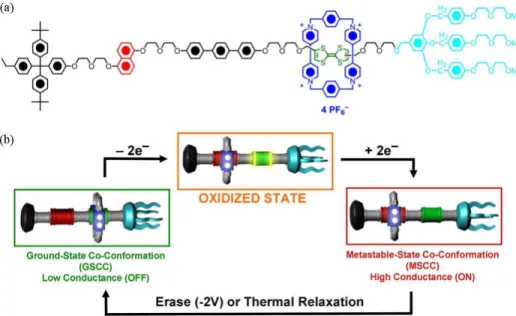
The switching mechanism is discussed briefly with the rotaxane molecule (Figure 9) as an example. It is based on oxidation of tetrathiafulvalene (TTF) unit (green) to the TTF+1 or TTF+2, followed by Coulombic repulsion‐driven motion of the tetracationic cyclophane (CBQT4+) ring (blue) so that it encircles the dioxynaphthalene (DNP) unit (red). The TTF+ is reduced back to the TTF0 oxidation state to form the metastable state co‐conformer, which is high‐conductance. After reducing the TTF unit back to its initial state, the CBQT4+ ring remains at the DNP unit for a while providing the required hysteretic features.
Figure 9. Rotaxane molecule. (a) Structural formula of a representative bistable rotaxane used in
molecular electronic devices. (b) Switching mechanism of a rotaxane molecule. In the OFF (ground) state, the tetracationic CBPQT4+ ring encircles the electron‐rich TTF unit. Oxidation of the TTF unit produces its dication (TTF2+), which results in Coulombic repulsion of the CBPQT4+ ring to the neutral DNP site. Two electron reduction of the TTF2+ back to its neutral form results in a metastable ON state
in which the CBPQT4+ has not yet returned to the more favourable TTF station.13, 14
In this approach, the switching element is a metal/molecule/metal sandwich junction wherein molecules are placed at the cross section of two nanoscale metal wires. This sandwich molecular device has two stable, highly‐retentive and reversible states: high‐resistance state and low‐resistance
state.13, 14 An example of this memory was recently shown by the Hewlett Packard Research group. This example consisted of an 8 × 8 crossbar circuit,15 where a monolayer of the [2]rotaxane molecules was sandwiched between bottom Ti (3 nm)/Pt (5 nm) and top Ti (11nm)/ Pt(5 nm) nanowires. The basic element in the circuit is the Pt/rotaxane/Ti junction formed at each cross point that acts as a reversible and nonvolatile switch, and 64 such switches are connected to form 8 × 8 crossbar circuit within a 1 μm2 area (Figure 10).
Figure 10. Crossbar architecture for a memory using molecular switches. An information bit is stored in the resistance of the rotaxane molecule at each intersection of a top and bottom bitline.17
This approach has the advantage of architectural simplicity and potential of high density via fabrication of highly dense nanowires. However, it has two major disadvantages including high rate of defective switching elements and the difficulty in controlling metal/molecule interface. However, as shown in their recent publications,16, 17 the earlier results on electron transport phenomena in metal/molecule/metal junction may not be truly molecular but instead be dominated by electrode reactions with molecules.
13 Y. Chen, D. A. A. Ohlberg, X. Li, D. R. Stewart, R. S. Williams, J. O. Jeppesen, K. A. Nielsen, J. F. Stoddart, D. L. Olynick, E. Anderson, Nanoscale molecular‐switch devices fabricated by imprint lithography, Appl. Phys. Lett.
2003, 82, 1610‐1612.
14 C. P. Collier, E. W. Wong, M. Belohradsky, F. M. Raymo, J. F. Stoddart, P. J. Kuekes, R. S. Williams, J. R. Heath,
Ellectronically Configurable Molecular‐Based Logic Gates, Science 1999, 285, 391‐394.
15 Y. Chen, G.‐Y. Jung, D. A. A. Ohlberg, X. Li, D. R. Stewart, J. O. Jeppesen, K. A. Nielsen, J. F. Stoddart, R. S.
Williams, Nanoscale molecular‐switch crossbar circuits, Nanotechnology 2003, 14, 462‐468.
16
D. R. Stewart, D. A. A. Ohlberg, P. A. Beck, Y. Chen, R. S. Williams, J. O. Jeppesen, K. A. Nielsen, J. F. Stoddart, Molecule‐Independent Electrical Switching in Pt/Organic Monolayer/Ti devices, Nano Lett. 2004, 4, 133‐136.
1.2. MOLECULAR MEMORIES
The workhorse of today’s electronic computer is the metal‐oxide‐semiconductor transistor, or MOSFET; the basic structure of a silicon MOSFET is shown in Figure 11. The transistor, which is based on the transport of electrons in a solid, comprises three electrodes (anode, cathod and gate), two of which serve as an electron reservoir: the source, which acts as the emitter filament of an electron tube, the drain, which acts as the collector plate, with the gate as “controller”.
V
Figure 11. Schematic diagram of a MOSFET. In this context, ‘More Moore’ is not sufficient anymore; ‘More than Moore’ is required to meet such challenges, to enable implementation of new functionalities while making the resulting subsystems smaller, lighter, more cost effective and more power efficient. The ‘More than Moore’ domain deals with hybrid co‐ integration of conventional Si CMOS and many other technologies, such as mechanics, fluidics, optics, etc. Such hybrid components will integrate nano‐objects or molecules in “classical” CMOS devices.1.2.1. Non‐volatile flash memory
Flash memory is a type of non‐volatile memory with many applications like: USB keys, MP3 players, cell phones etc. It was discovered in 1984 by Fujio Masuoka at Toshiba. Since flash memory is non‐
volatile, no power is needed to maintain the information stored in the chip. This type of memory
device can be electrically erased and reprogrammed. A typical example of flash memory device is the MOSFET. Channel Source Drain G
V
SV
D Metal OxideThe market for non‐volatile memory devices is growing rapidly. Today, the vast majority of non‐ volatile memory devices are based on the floating gate device which is facing serious scaling limitations. An alternative path is to replace the floating gate by a charge trapping material. The integration of a layer of polyoxometalates into such hybrid components is the main objective of the present thesis. Figure 12. Cross section of Flash Memory cell.
A flash memory device contains a MOSFET transistor plus a floating gate situated between the gate and the channel (Figure 12). The floating gate is surrounded by insulators and traps the electrons inside it (∼50 years). Flash memory costs far less and therefore has become the dominant technology wherever a significant amount of non‐volatile, solid state storage is needed. In addition, flash memory offers fast read access times and better kinetic shock resistance than hard disks. These characteristics explain the popularity of flash memory in portable devices. Another feature of flash memory is that when packaged in a "memory card," it is enormously durable, being able to withstand intense pressure, extremes of temperature, and even immersion in water.
The extensive use of this kind of devices requires miniaturization. A very important issue in the scaling process is linked to the stored charges leakage through the oxide tunnel as the thickness of the latest decreases. Among the various approaches towards building new smaller and high‐ performance devices, the hybrid silicon/molecular approach, the use of redox active molecules instead of the silicon floating gate seems to be a promising solution. Channel Source Drain Oxide VD VS Metal VG Floating gate Poly-n+
Si(100) Si(100)
+ + +
Oxidation Reduction
Neutral reduced state Charged oxidized state
"0" "1"
Figure 13. The operating principle of a memory device based on redox molecules.
So, the redox‐active molecules are incorporated into silicon structures to generate a new class of electronic devices. These redox‐active molecules, which can be design to self‐assemble on surfaces as monolayers, exhibit charge storage states at distinct voltages. Application of an oxidizing voltage causes the redox‐active monolayer to lose electrons, resulting in a positively charged monolayer. When a reducing voltage is applied, electrons are transferred to the molecules to the neutral state
(Figure 13). The two states “0” and “1” are defined by the presence or absence of electrons into the
floating gate.
1.2.1.1. Hybrid CMOS/Molecular Memory
Hybrid complementary metal oxide semiconductor (CMOS)/molecular memory devices are based on a dynamic random‐access memory (DRAM) architecture, are fast, have high density, and exhibit low power consumption. These devices use a well‐characterized charge storage mechanism to store information based on the intrinsic properties of molecules attached to a CMOS platform. The molecules are designed in a rational way to have known electrical properties and can be incorporated into CMOS devices with only minor modification of existing fabrication methods. Each memory element contains a monolayer of molecules (typically 100,000‐1,000,000) to store charge; this process yields a structure that has many times the charge density of a typical DRAM capacitor, obviating the necessity for a trench or stacked capacitor geometry. The magnitude of voltage required to remove each electron is quantized (typically a few hundred millivolts per state), making it much easier to put molecules in a known state and to detect that state with low‐power operation. Existing devices have charge retention times that are >1000 times that of semiconductors, and nonvolatile strategies based on simple modifications of existing systems are possible. All of these
devices are ultimately scalable to molecular dimensions and will enable the production of memory products as small as state‐of‐the‐art lithography will allow.18
Storage of multiple bits on a single memory cell multiplies the density in the same space and has received increasingly more attention from the semiconductor industry. These devices rely on hot electron injection from the channel into the floating gate through a tunneling oxide layer, and different memory states are represented by different amount of charge stored. Further decreasing the cell size or increasing the number of levels for higher density, however, is extremely difficult, as the complicated device structure and the topdown fabrication approach inevitably leads to significant device variation and a blurring of the multiple levels. Molecular electronics may offer a solution to this scaling limit by taking advantage of the bottom‐up self‐assembling process. Discrete multilevels naturally exist in an ensemble of redox‐active molecules, or even one molecule containing multiple redox centers. (a)
(b)
Figure 14. Structure of the Si‐tethered porphyrin molecule (a). The operating principle of a porphyrin based molecular memory device, information is stored by removing electrons from the porphyrins units (b).19, 20 Several universities and a number of companies (Hewlett Packard, ZettaCore) have announced work on molecular memories. ZettaCore molecular memory (Figure 14)19, 20 is based on the properties of specially‐designed molecules. These molecules are used to store information by adding or removing
18 W. G. Kuhr, A. R. Gallo, R. W. Manning, C. W. Rhodine, Molecular Memories Based on a CMOS Platform, MRS Bulletin 2004, 838‐842. 19 Q. Li, S. Surthi, G. Mathur, S. Gowda, Q. Zhao, T. A. Sorenson, R. C. Tenent, K. Muthukumaran, J. S. Lindsey, V. Misra, Multi‐bit storage properties of porphyrin monolayers on SiO2, Appl. Phys. Lett. 2004, 85, 1829‐1831. 20
Q. Li, G. Mathur, S. Gowda, S. Surthi, Q. Zhao, L. Yu, J. S. Lindsey, D. F. Bocian, V. Misra, Multibit Memory Using Self‐Assembly of Mixed Ferrocene/Porphyrin Monolayers on Silicon, Adv. Mater. 2004, 16, 133‐137.
electrons and then detecting the charge state of the molecule. The molecules, called multi‐porphyrin nanostructures, can be oxidized and reduced (electrons removed or replaced) in a way that is stable, reproducible, and reversible. 21, 22, 23 In this way, molecules can be used as reliable memory locations for electronic devices. In many ways, each molecule acts like an individual capacitor device, similar to a conventional capacitor, but storing only a few electrons of charge that are accessible only at specific, quantized voltage levels. The key difference between ZettaCore memory and conventional memory is that as the size of a memory element becomes smaller using conventional electronic manufacturing, the properties of those semiconductor or polymer materials change in undesirable ways. In the ZettaCore approach the properties of these molecular capacitors remain the same. This allows scaling to very small size elements.
In 2004, two teams from University of Southern California and NASA,24 have reported a multilevel molecular memory device for nonvolatile data storage application, which can store up to three bits (eight levels) per cell, in contrast to the standard one‐bit‐per‐cell (two levels) technology. A self‐ assembled monolayer of Fe2+‐terpyridine molecules was formed on a 10 nm In2O3 nanowire. Charges
were precisely placed at up to eight discrete levels in redox active molecules self‐assembled on single‐ crystal semiconducting nanowire field‐effect transistors. Gate voltage pulses and current sensing were used for writing and reading operations, respectively. Charge storage stability was tested up to retention of 600 h and on/off ratios exceeding 104. The data storage can be carried out by altering the population of the reduced/oxidized molecules, while the readout can be implemented by measuring the conduction of the nanowire. A two‐level memory has been demonstrated before with excellent performance.25, 26 21 K. M. Roth, N. Dontha, R. B. Dabke, D. T. Gryko, C. Clausen, J. S. Lindsey, D. F. Bocian, W. G. Kuhr, Molecular approach toward information storage based on the redox properties of porphyrins in self‐assembled monolayers, J. Vac. Sci. Technol. B 2000, 18, 2359‐2364. 22 Z. Liu, A. A. Yasseri, J. S. Lindsey, D. F. Bocian, Molecular Memories That Survive Silicon Device Processing and Real‐World Operation, Science 2003, 302, 1543‐1545. 23 Q. Li, G. Mathur, M. Homsi, S. Surthi, V. Misra, V. Malinovskii, K.‐H. Schweikart, L. Yu, J. S. Lindsey, Z. Liu, R. B Dabke, A. Yasseri, D. F. Bocian, W. G. Kuhr, Capacitance and conductance characterization of ferrocene‐ containing self‐assembled monolayers on silicon surfaces for memory applications, Appl. Phys. Lett. 2002, 81, 1494‐1496.
24
C. Li, W. Fan, B. Lei, D. Zhang, S. Han, T. Tang, X. Liu, Z. Liu, S. Asano, M. Meyyappan, J. Han, C. Zhou, Multilevel memory based on molecular devices, Appl. Phys. Lett. 2004, 84, 1949‐1951.
25 X. Duan, Y. Huang, C. M. Lieber, Nonvolatile Memory and Programmable Logic from Molecule‐Gated
Nanowires, Nano Lett. 2002, 2, 487‐490.²
26
C. Li, B. Lei, W. Fan, D. Zhang, M. Meyyappan, C. Zhou, Molecular Memory Based on Nanowire‐Molecular Wire Heterostructures, J. Nanosci. Nanotechnol. 2007, 7, 138‐150.
Figure 15. (a) Fabrication process of the memory device. An as‐fabricated In2O3 nanowire was first immersed in a solution of the porphyrin molecules, and self‐assembly was employed to coat the In2O3 nanowire with porphyrin molecules. (b) Molecule structure of the porphyrins used in this process. (c) SEM image of an In2O3 nanowire device.27
Figure 16. I‐Vg characteristics of In2O3 nanowire
device decorated with Co‐porphyrins (a) and non‐ metallated porphyrins (b), respectively. Insets:
structures of the corresponding porphyrins.27
Figure 15 and Figure 16 describes in detail memory studies that have been carried out based on
In2O3 nanowires coated with self‐assembled monolayers of porphyrins. Devices with redox‐active Co‐
metallated porphyrins coatings exhibited proeminent memory effects. These devices exhibited reliable operation with significant on/off ratios and were electronically programmable and erasable. While devices with Co‐porphyrin coatings showed efficient memory operation, pronounced hysteresis in the I‐Vg sweeps, the analogous non‐metallated porphyrin coated nanowire devices exhibited no
memory effects (Figure 16). A largely metal‐centered oxidation (e.g. Co2+/3+) appears to be important for achieving a memory effect in these devices.
27 C. Li, J. Ly, B. Lei, W. Fan, D. Zhang, J. Han, M. Meyyappan, M. Thompson, C. Zhou, Data Storage Studies on Nanowire Transistors with Self‐Assembled Porphyrin Molecules, J. Phys. Chem. B 2004, 108, 9646‐9649.
1.2.1.2. Approaches Towards Multibit Memory in One Cell
The availability of charged states at distinct voltages is highly advantageous for memory applications. One strategy to increase memory density entails a multibit approach wherein the charge‐storage element contains molecules with multiple redox states. There are several ways to obtain multiple redox states:
Synthesis of molecule with multiple redox states. Such complex molecules include ferrocene‐ porphyrin conjugate bearing a single tether,28, 29 strongly/weakly bonded porphyrins,30, 31 triple deckers of porphyrin,32 and dyad of triple deckers.33 This approach is limited only by the requirements for chemical synthesis of the covalently linked multi‐redox molecule.
Mixed monolayers. An alternative and perhaps simpler strategy for achieving multibit functionality is afforded by mixing in one monolayer different redox‐active molecules whose potentials are well‐ separated. It has been demonstrated this method using mixed SAMs of Fc‐BzOH and Por‐BzOH on the Si surface to achieve a four‐state (two‐bit) memory element. The four states include the neutral state and three distinct cationic states obtained upon oxidation of Fc‐BzOH (monopositive) and Por‐BzOH (monopositive, dipositive) molecules.
28 R. S. Loewe, A. Ambroise, K. Muthukumaran, K. Padmaja, A. B. Lysenko, G. Mathur, Q. Li, D. F. Bocian, V. Misra, J. S. Lindsey, Porphyrins Bearing Mono or Trpodal Benzylphosphonic Acid Tethers for Attachment to Oxide Surfaces, J. Org. Chem. 2004, 69, 1453‐1460. 29 D. T. Gryko, C. Clausen, K. M. Roth, N. Dontha, D. F. Bocian, W. G. Kuhr, J. S. Lindsey, Synthesis of “Porphyrin‐ Linker‐Thiol” Molecules with Diverse Linkers for Studies of Molecular‐Based Information Storage, J. Org. Chem. 2000, 65, 7345‐7355. 30 C. Clausen, D. T. Gryko, A. A. Yasseri, J. R. Diers, D. F. Bocian, W. G. Kuhr, J. S. Lindsey, Investigation of Tightly Coupled Porphyrin Arrays Comprised of Identical Monomers for Multibit Information Storage, J. Org. Chem.
2000, 65, 7371‐7378.
31
C. Clausen, D. T. Gryko, R. B. Dabke, N. Dontha, D. F. Bocian, W. G. Kuhr, J. S. Lindsey, Synthesis of Thiol‐ Derivatized Porphyrin Dimers and Trimers for Studies of Architectural Effects on Multibit Information Storage, J.
Org. Chem. 2000, 65, 7363‐7370.
32 A. Balakumar, A. B. Lysenko, C. Carcel, V. L. Malinovskii, D. T. Gryko, K.‐H. Schweikart, R. S. Loewe, A. A.
Yasseri, Z. Liu, D. F. Bocian, J. S. Lindsey, Diverse Redox‐Active Molecules Bearing O‐, S‐, or Se‐Terminated Tethers for Attachment to Silicon in Studies of Molecular Information Storage, J. Org. Chem. 2004, 69, 1435‐ 1443.
33
K.‐H. Schweikart, V. L. Malinovskii, J. R. Diers, A. A. Yasseri, D. F. Bocian, W. G. Kuhr, J. S. Lindsey, Design, synthesis, and characterization of prototypical multistate counters in three distinct architectures, J. Mater.
![Figure 23. The IR spectrum of the [PW 9 O 34 (tBuSiO) 3 Ge(CH 2 ) 2 CO 2 H] 3‐ anion (14).](https://thumb-eu.123doks.com/thumbv2/123doknet/12701583.355666/88.918.255.661.244.542/figure-ir-spectrum-pw-tbusio-ge-ch-anion.webp)
![Figure 25. The IR spectrum of the [PW 9 O 34 (tBuSiO) 3 Ge(CH 2 ) 2 CONHCH 2 ‐C≡C‐C 6 H 4 ‐N 3 Et 2 ] 3‐ anion (17).](https://thumb-eu.123doks.com/thumbv2/123doknet/12701583.355666/89.918.254.660.110.457/figure-ir-spectrum-pw-tbusio-ge-conhch-anion.webp)
![Figure 35. The IR spectrum of the [PW 11 O 39 Ge(CH 2 ) 2 CONHCH 2 ‐C≡CH] anion (22).](https://thumb-eu.123doks.com/thumbv2/123doknet/12701583.355666/95.918.253.654.741.1041/figure-ir-spectrum-pw-ge-ch-conhch-anion.webp)
![Table 9. Infrared data (cm ‐1 ) for the germyl compounds derived from [PW 11 O 39 ] 7‐ anion (1).](https://thumb-eu.123doks.com/thumbv2/123doknet/12701583.355666/96.918.255.662.134.456/table-infrared-data-germyl-compounds-derived-pw-anion.webp)