Comparing Tropospheric Warming
in Climate Models and Satellite Data
The MIT Faculty has made this article openly available.
Please share
how this access benefits you. Your story matters.
Citation
Santer, Benjamin D. et al. “Comparing Tropospheric Warming
in Climate Models and Satellite Data.” Journal of Climate 30, 1
(January 2017): 373–392 © 2017 American Meteorological Society
As Published
http://dx.doi.org/10.1175/jcli-d-16-0333.1
Publisher
American Meteorological Society
Version
Final published version
Citable link
http://hdl.handle.net/1721.1/111171
Terms of Use
Article is made available in accordance with the publisher's
policy and may be subject to US copyright law. Please refer to the
publisher's site for terms of use.
Comparing Tropospheric Warming in Climate Models and Satellite Data
BENJAMIND. SANTER,aSUSANSOLOMON,bGIULIANAPALLOTTA,aCARLMEARS,c STEPHENPO-CHEDLEY,dQIANGFU,dFRANKWENTZ,cCHENG-ZHIZOU,eJEFFREYPAINTER,a
IVANACVIJANOVIC,aANDCÉLINEBONFILSa
aProgram for Climate Model Diagnosis and Intercomparison, Lawrence Livermore National Laboratory,
Livermore, California
bEarth, Atmospheric, and Planetary Sciences, Massachusetts Institute of Technology, Cambridge, Massachusetts cRemote Sensing Systems, Santa Rosa, California
dDepartment of Atmospheric Sciences, University of Washington, Seattle, Washington eCenter for Satellite Applications and Research, NOAA/NESDIS, Camp Springs, Maryland
(Manuscript received 25 April 2016, in final form 20 September 2016) ABSTRACT
Updated and improved satellite retrievals of the temperature of the mid-to-upper troposphere (TMT) are used to address key questions about the size and significance of TMT trends, agreement with model-derived TMT values, and whether models and satellite data show similar vertical profiles of warming. A recent study claimed that TMT trends over 1979 and 2015 are 3 times larger in climate models than in satellite data but did not correct for the contribution TMT trends receive from stratospheric cooling. Here, it is shown that the average ratio of modeled and observed TMT trends is sensitive to both satellite data uncertainties and model–data differences in stratospheric cooling. When the impact of lower-stratospheric cooling on TMT is accounted for, and when the most recent versions of satellite datasets are used, the previously claimed ratio of three between simulated and observed near-global TMT trends is reduced to approximately 1.7. Next, the validity of the statement that satellite data show no significant tropospheric warming over the last 18 years is assessed. This claim is not supported by the current analysis: in five out of six corrected satellite TMT records, significant global-scale tropospheric warming has occurred within the last 18 years. Finally, long-standing concerns are examined regarding discrepancies in modeled and observed vertical profiles of warming in the tropical atmosphere. It is shown that amplification of tropical warming between the lower and mid-to-upper tropo-sphere is now in close agreement in the average of 37 climate models and in one updated satellite record.
1. Introduction
Reliable thermometer measurements of large-scale changes in Earth’s surface temperature are available for over a century. These measurements document warming of roughly 0.858C since 1880, with the three warmest decades in the most recent portion of the re-cord (IPCC 2013). In global average terms, 2015 was the warmest year in surface temperature datasets (Tollefson 2016). Satellite-based estimates of trends in
tropospheric temperature cover a shorter period of time (from late 1978 to the present) but also provide independent confirmation of planetary-scale warming (Zou et al. 2006;Christy et al. 2007;Mears et al. 2011;
Po-Chedley et al. 2015;Mears and Wentz 2016). Although observational and model temperature data provide compelling evidence for the existence of a ‘‘dis-cernible human influence’’ on global climate (Santer et al. 1995;Karl et al. 2006;Hegerl et al. 2007;Bindoff et al. 2013), studies of temperature change continue to yield interesting and important scientific puzzles. Examples of such puzzles include apparent differences between surface and tropospheric warming rates in observational records (Yulaeva and Wallace 1994; Hurrell and Trenberth 1998;National Research Council 2000;Gaffen et al. 2000;Santer et al. 2000;Hegerl and Wallace 2002;
Karl et al. 2006) and differences between modeled and observed warming trends (National Research Council 2000;Gaffen et al. 2000;Hegerl and Wallace 2002;Karl
Supplemental information related to this paper is avail-able at the Journals Online website:http://dx.doi.org/10.1175/ JCLI-D-16-0333.s1.
Corresponding author e-mail: Benjamin D. Santer, santer1@llnl. gov
Denotes Open Access content.
1 JANUARY2017 S A N T E R E T A L . 373
DOI: 10.1175/JCLI-D-16-0333.1 Ó 2017 American Meteorological Society
et al. 2006;Easterling and Wehner 2009;Fu et al. 2011;
Santer et al. 2011;Po-Chedley and Fu 2012b). The causes of such differences remain the subject of both scientific interest (IPCC 2013;Fyfe et al. 2016;Lewandowsky et al. 2016) and political attention (U.S. Senate 2015).
The present study focuses on differences between satellite- and model-based estimates of tropospheric temperature change. We assess the validity of two highly publicized claims: that modeled tropospheric warming is a factor of 3–4 larger than in satellite and radiosonde observations (Christy 2015) and that sat-ellite tropospheric temperature data show no statis-tically significant warming over the last 18 years (U.S. Senate 2015). We also address long-standing concerns regarding differences in the vertical structure of tro-pospheric warming in models and satellite data. Such differences are particularly pronounced in the tropics (Santer et al. 2000; Gaffen et al. 2000; Hegerl and Wallace 2002;Fu and Johanson 2005;Johanson and Fu 2006;Karl et al. 2006;Fu et al. 2011;Po-Chedley and Fu 2012b). We rely exclusively on satellite mea-surements of atmospheric temperature; we do not compare model results with radiosonde-based atmo-spheric temperature measurements, as has been done in a number of previous studies (Gaffen et al. 2000;
Hegerl and Wallace 2002; Thorne et al. 2007, 2011;
Santer et al. 2008;Lott et al. 2013).
2. Satellite and model temperature data
Since late 1978, satellite-based microwave tem-perature sounders have measured the microwave emissions from oxygen molecules. These emissions are proportional to the temperature of broad layers of the atmosphere (Mears et al. 2011). The two claims mentioned above (Christy 2015; U.S. Senate 2015) focused on trends in the temperature of the mid-to-upper troposphere (TMT), which extends to ap-proximately 18 km above Earth’s surface (Karl et al. 2006). Here, we analyze TMT data from four differ-ent research groups: Remote Sensing Systems (RSS;
Mears and Wentz 2016), the Center for Satellite Applications and Research (STAR;Zou et al. 2006), the University of Alabama at Huntsville (UAH;
Christy et al. 2007), and the University of Wash-ington (UW; Po-Chedley et al. 2015). We also con-sider satellite estimates of the temperature of the lower stratosphere (TLS) and the temperature of the lower troposphere (TLT), which span approximate altitude ranges from 14 to 29 km and from the surface to 8 km (respectively).
Previous scientific assessments (National Research Council 2000;Karl et al. 2006;IPCC 2013) have highlighted
the large structural uncertainties in satellite estimates of tropospheric temperature change. The major uncertainties arise because the satellite TMT record is based on mea-surements made by more than 10 different satellites; over their lifetimes, most of these satellites experience orbital decay (Wentz and Schabel 1998) and orbital drift (Mears and Wentz 2005). These orbital changes affect the mea-surements of microwave emissions, primarily because of gradual shifts in the time of day at which measurements are made. Adjustments for such shifts in measurement time are large and involve many subjective decisions (Mears and Wentz 2005,2016;Mears et al. 2011;Karl et al. 2006;
Zou et al. 2006,2009;Zou and Wang 2011;Christy et al. 2007;Po-Chedley et al. 2015). Further adjustments to the raw data are necessary for drifts in the onboard calibration of the microwave measurements (Mears et al. 2003; Po-Chedley and Fu 2012a;Zou et al. 2009;Zou and Wang 2011) and for the transition between earlier and more so-phisticated versions of the microwave sounders (Mears and Wentz 2016).
Multiple dataset versions are available for the tem-perature records produced by RSS, UAH, and STAR (see the supplemental material). Newer dataset versions incorporate adjustments for problems identified after public release of earlier datasets and are likely to rep-resent improved estimates of atmospheric temperature change. Use of multiple dataset versions highlights the evolutionary nature of satellite temperature datasets—an evolution paced by advances in identifying and cor-recting the complex nonclimatic factors affecting these measurements.1This corrective process is ongoing.
Satellite TMT measurements receive a contribution from the stratosphere (Spencer and Christy 1992;Fu et al. 2004;Fu and Johanson 2004,2005;Johanson and Fu 2006). Large, anthropogenically driven cooling of the lower stratosphere (Solomon 1999;Karl et al. 2006;
Ramaswamy et al. 2006; IPCC 2013; Santer et al. 2013b) can contribute significantly to TMT trends (Fu et al. 2004;Fu and Johanson 2005;Fu et al. 2011; Po-Chedley and Fu 2012b; Po-Chedley et al. 2015). A regression-based method has been used to correct TMT data for this contribution (Fu et al. 2004;Fu and Johanson 2005). The efficacy of this approach was validated with both observed and model atmospheric temperature data (Fu and Johanson 2004;Gillett et al. 2004;Kiehl et al. 2005). We employ the same regression approach here to derive corrected tropospheric
1For RSS, UAH, and STAR, the newer TMT versions used here
only became available in 2016; currently available model-versus-data comparisons relied exclusively on older model-versus-dataset versions (Fu et al. 2011;Po-Chedley and Fu 2012b;Santer et al. 2013a,b).
temperatures (TMTcr) from satellite and model TMT
datasets (seeappendix A).
Model atmospheric temperatures were available from phase 5 of the Coupled Model Intercomparison Project (CMIP5;Taylor et al. 2012). We analyzed simulations of externally forced climate change performed with 37 different CMIP5 models. The simulations have esti-mated historical changes in natural and anthropogenic external forcing from the mid-1800s to 2005. From 2006 to the end of the twenty-first century, changes in an-thropogenic greenhouse gases and aerosols are pre-scribed according to the representative concentration pathway 8.5 (RCP8.5), which has radiative forcing of roughly 8.5 W m22by 2100. We also used preindustrial control runs (with no changes in external influences on climate) from 36 models to obtain information on natural internal climate variability. To facilitate the direct com-parison of satellite data with model output, ‘‘synthetic’’ satellite temperatures were calculated from all model simulations (Santer et al. 2013b). The model atmospheric temperature data analyzed here are fully described in the supplemental material and in Tables 1–4 of the supple-mental material, together with information on the forc-ings used in the simulations of historical climate change.2 To avoid truncating comparisons between modeled and observed atmospheric temperature trends in De-cember 2005, we spliced together synthetic satellite temperatures from the historical simulations and the RCP8.5 runs.3Splicing allows us to compare actual and synthetic temperature changes over the full 37-yr length of the satellite record. We use the label ‘‘ALL18.5’’ to identify these spliced simulations.
3. Atmospheric temperature time series
We consider first the time series of changes in simu-lated and observed atmospheric temperature over the satellite era (Fig. 1). Our focus is on temperatures av-eraged over a near-global domain and over the tropics. In the lower stratosphere (Figs. 1a,b), the ALL18.5
simulations and the satellite data are both characterized by overall cooling in response to human-caused de-creases in stratospheric ozone and inde-creases in carbon dioxide (Solomon 1999;Karl et al. 2006;Ramaswamy et al. 2006). This long-term stratospheric cooling trend is punctuated by short-term (1–2 yr) lower-stratospheric
warming arising from the eruptions of El Chichón in 1982 and Mount Pinatubo in 1991 (Robock 2000;
Ramaswamy et al. 2006;Santer et al. 2013b). The size of this short-term warming is very similar in the satellite data and the multimodel average of the ALL18.5 sim-ulations, but this apparent agreement arises from com-pensating errors (see the supplemental material).
Since 1979, mid- to upper-tropospheric temperature has increased in both the observations and the ALL18.5 integrations, with larger warming in the simulations (Figs. 1c–f). Another prominent feature of the TMT and TMTcrtime series is cooling caused by the eruptions of
El Chichón and Mount Pinatubo (Robock 2000;Santer et al. 2001; Wigley et al. 2005;Thompson et al. 2009;
Santer et al. 2013b,2014). Volcanic cooling of the tro-posphere is noticeably less noisy in the multimodel av-erage than in the observations for well-understood reasons (see the supplemental material).
Correction of TMT for lower-stratospheric cooling is expected to increase overall trends in mid-to-upper-tropospheric temperature (Fu et al. 2004,2011;Fu and Johanson 2005;Po-Chedley and Fu 2012b). Simple visual comparison of the TMT and TMTcrtemperature time
se-ries for near-global averages (cf.Figs. 1c and 1e) and for tropical averages (cf.Figs. 1d and 1f) does not reveal how this correction affects the level of consistency between model and observed tropospheric warming trends. In the following, we provide a quantitative assessment of the im-pact of TMT correction on model–data trend consistency.
4. Trend ratios
A key aspect of our analysis framework is that we consider the sensitivity of linear temperature trends (and of model–data trend ratios) to different choices of the start date and the trend length L (Santer et al. 2011). Rather than focusing on one limited subset of the tem-perature time series inFig. 1, such as the last 18 years of TMT records (U.S. Senate 2015), our strategy here is to examine all possible 18-yr temperature trends during the satellite era (seeappendix B). Since temperature trends on 18-yr time scales have no special diagnostic value, we vary L in increments of 1 year, from a minimum of 10 years to a maximum of 37 years (the full length of the satellite records). This allows us to compare the average values of modeled and observed temperature trends on a range of different time scales, while accounting for the effect of monthly and interannual variability on linear trend estimates. Our strategy reduces the chance of making incorrect statistical inferences based on analysis of a single arbitrarily selected trend.
Figures 2a and 2bshow the averages of the sampling distributions of L-year trends for near-global TMT and
2Detailed information on the implementation of external
forc-ings in the full ensemble of CMIP5 models is available in a limited number of cases only (e.g., for stratospheric ozone forcing; see
Eyring et al. 2013).
3The RCP8.5 simulations were typically initiated from
condi-tions of the climate system at the end of the historical run.
TMTcrdata. The distribution average trends bo(k, l) and
bf(l) are for the observations and the forced ALL18.5
simulations, respectively, where the indices k and l span the number of observational datasets and the number of values of L (seeappendix B).4We consider first TMT results that have not been corrected for lower-stratospheric cooling (Fig. 2a). At all time scales con-sidered, simulated TMT trends are larger than satellite TMT trends. Only the values of bo(k, l) for RSS version
4.0 and STAR versions 3.0 and 4.0 are consistently
within the 5th–95th percentile range of model estimates of externally forced TMT trends.5
Correcting for lower-stratospheric cooling (Fig. 2b) increases the size of mid-to-upper-tropospheric warming FIG. 1. Time series of monthly mean anomalies in atmospheric temperature over January 1979–December 2016
(simulations) and January 1979–June 2016 (observations). Results are spatially averaged over (left) a near-global domain, and (right) over the tropics. Temperature estimates for (a),(b) the lower stratosphere and (c),(d) the mid-to-upper troposphere were obtained from satellite-based microwave sounders. Correcting TMT for stratospheric cooling yields TMTcr, which is more representative of true changes in (e),(f) mid-to-upper-tropospheric
temper-ature. Model synthetic TLS and TMT data were computed using vertical weighting functions that approximate the satellite-based vertical sampling of the lower stratosphere and mid-to-upper troposphere. Synthetic satellite temperatures are from 49 simulations of externally forced climate change performed with 37 different CMIP5 models. All anomalies are relative to climatological monthly means calculated over January 1979–December 2015.
4Here, the single overbar in b
o(k, l) indicates the average of a
distribution of L-year trends. The double overbar in bf(l)
signifies a distribution average as well as an average over models and ALL18.5 realizations.
5In a companion paper, we evaluate the statistical significance of
differences between tropospheric temperature trends in individual satellite datasets and in the multimodel average of the ALL18.5 simulations (B. Santer et al. 2016, unpublished manuscript). We show that the statistical significance of these trend differences is highly sensitive to the analysis time scale L and to the trend start date. Over the first 15 years of the twenty-first century, differences between modeled and observed tropospheric warming rates are highly significant and are unlikely to be explained by internal vari-ability alone. In contrast, model-versus-observed trend differences in the last two decades of the twentieth century are generally con-sistent with internal variability.
trends (Fu et al. 2004, 2011;Fu and Johanson 2004,
2005; Johanson and Fu 2006; Karl et al. 2006; Po-Chedley and Fu 2012b). TMT correction also system-atically reduces R(k, l), the ratio between modeled and observed L-year temperature trends (Figs. 2c,d). The reason for this reduction is that in all satellite datasets examined here, the observed lower-stratospheric cooling is larger than in the average of the ALL18.5 simulations6(Figs. 3a,c).
This discrepancy between satellite and model TLS trends arises from multiple factors: the underestimation of
observed stratospheric ozone loss in many of the CMIP5 ALL18.5 runs (Solomon et al. 2012;Hassler et al. 2013;
Eyring et al. 2013;Young et al. 2014), model–data dif-ferences in stratospheric water vapor changes (Solomon et al. 2010;Gilford et al. 2016), and different phasing of stratospheric internal variability in the real world and the model simulations (Gilford et al. 2016). The systematic model–data differences in lower-stratospheric cooling in
Fig. 3hamper reliable estimation of the relative sizes of simulated and observed tropospheric warming. If tropo-spheric trend comparisons are the primary scientific focus, then the use of uncorrected TMT data (as inChristy 2015) leads to erroneous conclusions.
As a simple measure of overall consistency between model and satellite trends, we compute R(k), where the overbar indicates a model–data trend ratio that is averaged over all values of the trend length L. Using trends in near-global averages of uncorrected TMT data, we obtain R(k) FIG. 2. Comparison of average simulated and observed trends in near-global tropospheric temperature as
a function of the trend length L. Results are for (a),(c) uncorrected TMT and (b),(d) TMTcr. The average of all
maximally overlapping L-year trends in a given observed time series (calculated separately for each satellite dataset and each L-year time scale of interest) is shown in (a) and (b), together with the multimodel average trend results from the spliced historical and RCP8.5 runs. Values of the trend ratio R(k, l) in (c) and (d) provide information on the relative sizes of temperature trends in the externally forced simulations and the satellite observations (seeappendix B; k and l are indices over satellite datasets and values of the time scale L). The gray line in (c) and (d) shows the model–observed trend ratio of 3 reported for near-global TMT comparisons (Christy 2015).
6Lower-stratospheric cooling in radiosonde data is also larger
than in the multimodel average of the externally forced simulations (Seidel et al. 2016). As expected, the observational datasets with the largest cooling of the lower stratosphere (UAH versions 5.6 and 6.0) show the largest decrease in trend ratios after TMT is corrected (see Table 5 in the supplemental material).
values of 2.58 and 1.61 for RSS versions 3.3 and 4.0, 1.73 and 1.54 for STAR versions 3.0 and 4.0, and 3.67 and 3.10 for the earlier and most recent versions of the UAH temperature data (Fig. 2cand Table 5 of the supplemental material). Correcting TMT for stratospheric cooling re-duces these R(k) values to 2.09, 1.46, 1.55, 1.42, 2.38, and 2.25, respectively, and brings simulated and satellite-inferred tropospheric warming trends into closer agree-ment (Fig. 2d). The impact of observational uncertainties on R(k) is also reduced.
A recent study byChristy (2015)reported that global warming of the mid-to-upper troposphere is a factor of 3 larger in models than in observations; that is, R(k)’ 3 for TMT trends over the full satellite era. This finding is only supported by model–data comparisons relying on uncorrected UAH TMT data. It is not supported by comparisons involving uncorrected STAR or RSS TMT data (Fig. 2c). After correcting TMT for stratospheric cooling, the claim that R(k)’ 3 does not hold for any model–data trend comparisons. If the observational average of R(k) [denoted here by R , where the double overbar denotes averaging of R(k, l) over both the number of observational datasets and the number of trend lengths considered] is calculated with all six
versions of the near-global TMTcr time series, then
R5 1. 86. The average trend ratio is even lower if only the three most recent TMTcrversions are used in this
calculation (R5 1. 71; see Fig. 2d and Table 5 of the supplemental material). Values of R are relatively in-sensitive to different reasonable processing choices, such as the exclusion of ALL18.5 simulations lacking explicit treatment of the radiative effects of strato-spheric volcanic aerosols (see section 1.2.2 of the sup-plemental material).
We obtain qualitatively similar results for TMT data averaged over the tropics (Fig. 4). As in the case of near-global averages, correcting tropical TMT for strato-spheric cooling (Figs. 3b,d) systematically reduces R(k) (Figs. 4c,dand Table 5 in the supplemental material). The statement that model tropical TMT trends over the satellite era are a factor of 4 larger than in observations (Christy 2015) holds only for the uncorrected UAH TMT data (Fig. 4c). All model–data trend comparisons with corrected tropical-average TMT datasets yield R(k) values less than 4: 2.39 and 1.72 for RSS versions 3.3 and 4.0, 1.84 and 1.52 for STAR versions 3.0 and 4.0, 3.73 and 3.24 for the earlier and most recent UAH dataset versions, and approximately 1.96 for UW FIG. 3. (a),(b) Average trends and (c),(d) trend ratios in the TLS. All results were calculated using simulated and
observed monthly mean TLS time series spatially averaged (a),(c) over a near-global domain and (b),(d) over the tropics. The analysis is for temperature trends on time scales ranging from 10 to 37 yr. Refer toFig. 2andappendix Bfor analysis details.
(Fig. 4d). Averaging these ratios yields R5 2. 29 if all observational datasets are used and R5 2. 11 if only the most recent dataset versions are employed.
Although accounting for stratospheric cooling effects on TMT brings modeled and observed tropospheric warming trends into better agreement, values of R(k) in
Figs. 2dand4dare still sufficiently large to be of scien-tific concern. These concerns are not new. Differences in the size of simulated and observed warming trends— both in the troposphere and at Earth’s surface—have been the subject of scientific attention since the late 1990s (National Research Council 2000; Hegerl and Wallace 2002; Hegerl et al. 2007;Karl et al. 2006;Fu et al. 2004, 2011; Santer et al. 2011, 2013b, 2014;
Solomon et al. 2011;Po-Chedley and Fu 2012b;IPCC 2013;Fyfe et al. 2013a,2016).
The message from this large body of research is that temperature trend differences have multiple explana-tions. These explanations are not mutually exclusive. They include model errors in the response to external forcing (Trenberth and Fasullo 2010), systematic model errors in the forcings themselves (Solomon et al. 2010,
2011,2012;Kopp and Lean 2011;Shindell et al. 2013;
Hassler et al. 2013;Eyring et al. 2013;Young et al. 2014;
Santer et al. 2014;Smith et al. 2016), residual errors in satellite temperature records (Wentz and Schabel 1998;
Mears and Wentz 2005,2016;Mears et al. 2003,2011;
Zou et al. 2006,2009;Zou and Wang 2011;Po-Chedley and Fu 2012a; Po-Chedley et al. 2015) and in surface temperature data (Morice et al. 2012;Cowtan and Way 2014;Karl et al. 2015), and differences in the phasing of internal climate variability in the ‘‘many worlds’’ of the simulations and the single world of the observations (Fyfe et al. 2013a,2016;Kosaka and Xie 2013;Meehl et al. 2014; England et al. 2014; Risbey et al. 2014;
Steinman et al. 2015; Trenberth 2015; Gilford et al. 2016). It is incorrect to assert that a large model error in the climate sensitivity to greenhouse gases is the only or most plausible explanation for differences in simulated and observed warming rates (Christy 2015).
We also compare satellite and model trends for TLT (Fig. 5). Unlike TMT, TLT is far less contaminated by lower-stratospheric cooling (Spencer and Christy 1992;
Fu et al. 2011) and is thus relatively unaffected by FIG. 4. As inFig. 2, but for TMT and TMTcrdata spatially averaged over a tropical domain. The gray line in (c) and
(d) shows the model–observed trend ratio of 4 reported byChristy (2015)for tropical TMT comparisons.
differences between modeled and observed lower-stratospheric temperature trends. For near-global TLT data, values of the average model–data trend ratio R(k) range from 1.80 to 2.31 (Fig. 5c). This is well below the ratio of 3 claimed for near-global TMT trends (Christy 2015). Similarly, tropical TLT data (Fig. 5d) yield R(k) values ranging from 2.35 to 3.21, which are consistently below the ratio of 4 reported by Christy (2015) for tropical TMT trends. As in the case of TMT, differences between simulated and observed TLT trends are due to multiple factors (see above).
5. Significance of tropospheric warming trends Next, we examine the statement that ‘‘according to the satellite data, there has been no significant global warming for the past 18 years’’ (U.S. Senate 2015). Our concern is with two specific issues arising from this statement: whether a single, arbitrarily selected 18-yr period is statistically representative of all possible 18-yr periods in the full satellite record, and whether the claim of no significant warming over the last 18 years is valid. Consider first the representativeness of a single tem-perature trend calculated over the last 18 years. One of the dominant modes of internal climate variability is El
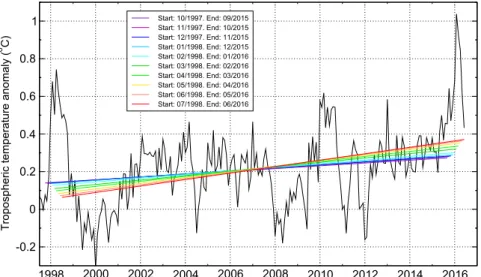
Niño–Southern Oscillation. El Niño is the warm phase of this mode of variability. Large El Niño events are characterized by warming of the eastern equatorial Pa-cific Ocean, followed by global-scale warming of the troposphere after a lag of roughly 4–6 months (Santer et al. 2001;Wigley et al. 2005;Thompson et al. 2009). One of the largest El Niño events of the twentieth cen-tury occurred during the winter–spring season of 1997/ 98, with peak global-mean tropospheric warming in April 1998 and a gradual decay to more normal condi-tions by the fall of 1998 (Fig. 6). For a selected trend length of 18 years (216 months) and a trend start date of January 1998, the trend end date is in December 2015. A time horizon of the last 18 years, therefore, yields an anomalously warm trend start point because of the un-usually large 1997/98 El Niño.
To explore the trend dependence on the trend length L and the trend start and end dates, we show maximally overlapping near-global TMTcrtrends for seven
differ-ent values of L (15–21 yr). Values of bo(i, k, l) (the linear
trend for the ith overlapping L-year segment of the kth observed TMTcrtime series, and for the lth value of L)
are plotted inFig. 7, left. For each overlapping trend, satellite dataset, and trend length L, we use CMIP5 control runs to calculate the probability pc(i, k, l)0that
FIG. 5. As inFig. 2, but for average trends and trend ratios in TLT. Seeappendix Bfor further details. Note that the NOAA/STAR and UW research groups do not produce a TLT dataset. RSS provides two versions of their TMT dataset (versions 3.3 and v4.0), but for TLT only one dataset is currently available (version 3.3).
the observed warming trend could have been caused by internal climate variability alone (see appendix B). Values of pc(i, k, l)0are given inFig. 7, right.
As expected, shorter trends are more affected by in-terannual variability and thus yield a wider range of trend values (Santer et al. 2011). Even for the short, 15-yr trends inFig. 7a, however, it is difficult to obtain periods with tropospheric cooling. The occurrence of cooling periods is related to the length of L relative to the phasing of specific events. There are two groups of negative 15-yr TMTcr
trends: the first group of trends has end points close to the maximum cooling caused by the Mount Pinatubo erup-tion; the second group of trends has start points close to the warming ‘‘spike’’ associated with the 1997/98 El Niño. As L increases beyond 15 yr, the influence from Mount Pi-natubo on trend end points diminishes, and the first group of negative trends disappears. In the second group, nega-tive trends persist out to trend lengths of 17 yr, but are highly unusual for L5 18 yr, and occur in only two of the six satellite dataset versions7(Fig. 7g).
For L$ 19 yr, all near-global TMTcrtrends are
posi-tive in every satellite dataset. At these longer time scales, the impact of seasonal and interannual temper-ature anomalies is damped, and gradual tropospheric warming is more reliably sampled. For values of L 5 21 yr, almost all observed warming trends are signifi-cantly larger (at the 10% level or better) than 21-yr warming trends inferred from model estimates of in-ternal variability (Fig. 7n).
Figure 7illustrates that it is no longer valid to claim that satellite TMT data show ‘‘no significant global warming for the past 18 years’’ (U.S. Senate 2015). In five of the six versions of the satellite TMTcrtime series, the most
re-cent 216-month warming trends attain significance at the 10% level or better.8Trend significance is partly due to the fact that these recent periods sample warming asso-ciated with the 2015/16 El Niño event, which contributed to the record-breaking annual global-mean surface tem-perature in 2015 (Pidcock 2016;Tollefson 2016). Signifi-cance also arises because the start point of the most recent 216-month trend is less influenced by the anoma-lous warmth of the 1997/98 El Niño and is beginning to sample the cooler conditions caused by the La Niña in 1999/2000 (seeFig. 6).
Other claims of ‘‘no significant warming over the last X years’’ are also sensitive to the choice of starting point and analysis time scale. For example, statements made in 2013 (2014) that satellite data show no significant global warming over the last 16 (17) years would be incorrect if made today. In four (six) satellite TMTcr
datasets, the most recent 16 (17)-yr warming trends are now significantly larger (at the 10% level or better) than the estimated warming from natural internal climate variability (Figs. 7d,f). Furthermore, a possible 2017 claim FIG. 6. Recent 18-yr (216-month) trends in TMTcr. Results are for RSS version 4.0. Trends
were calculated from the time series of monthly mean anomalies of near-global TMTcrdata.
The most recent 18-yr trend ends in June 2016.
7Both are older dataset versions (RSS version 3.3 and STAR
version 3.0).
8Significance is attained for 216-month trends ending in the
following months: June 2016 (RSS version 3.3), January 2016 through June 2016 inclusive (RSS version 4.0), March 2016 through June 2016 inclusive (STAR version 4.0 and UAH version 5.6), and May 2016 and June 2016 (UAH version 6.0). None of the most recent near-global TMTcrtrends show significant warming in the
older version (version 3.0) of the STAR dataset.
of no significant warming over the last 19 years would not be supported by three of the six satellite datasets (Fig. 7j). While Fig. 7 shows estimates of the significance of tropospheric warming for individual L-year observed
trends, it is also useful to consider the mean significance levels. For the kth satellite dataset and lth trend length L, we simply average the individual pc(i, k, l)0 values
over i, the index of maximally overlapping L-year trends FIG. 7. Satellite trends in near-global averages of (left) TMTcrand (right) associated p values. (top)–(bottom)
Results are for trend lengths of L5 15–21 yr. Trends are from a ‘‘sliding window’’ analysis, where the L-year window advances by one month at a time. The final month of each satellite TMTcrtime series is June 2016. Results
are plotted on the trend end date. The p values are for tests of the null hypothesis that an individual observed L-year warming trend could have been generated by internal variability alone (seeappendix B). The rejection region for this hypothesis (at a stipulated 10% significance level) is shaded in gray. The y-axis range was extended to20.06 to facilitate visual display of p values at or close to zero.
in the observations (see appendix B). This yields the average probability pc(k, l)0 that the warming trends in a
particular satellite dataset (and for a selected L-year time scale) could be due to internal variability alone (Santer et al. 2011). Values of pc(k, l)0identify the time
scale at which we might expect an observed warming trend to surpass (and remain above) the level of model-estimated internal variability. We refer to this subse-quently as the detection time scale. It is assessed here at a stipulated significance level of 10%.
In the uncorrected near-global TMT data, this time scale is 19 and 16 yr for RSS versions 3.3 and 4.0, 18 and 16 yr for STAR versions 3.0 and 4.0, and 22 and 20 yr for UAH versions 5.6 and 6.0 (Fig. 8a). Correcting TMT for stratospheric cooling generally yields shorter detection time scales for the tropospheric warming trends esti-mated from these satellite datasets (18, 15, 17, 15, 18, and 18 yr, respectively;Fig. 8b). It also reduces the range of observational uncertainty in the detection time scale.
In tropical-mean TMT data, internal climate noise is larger than for near-global averages of TMT (not shown). Detection time scales for uncorrected tropical TMT data are therefore longer than for uncorrected near-global TMT, ranging from 18 yr for STAR version 4.0 to 37 yr for UAH version 5.6 (Fig. 8c). As in the case of the near-global results, correcting tropical TMT for stratospheric cooling leads to systematically shorter (and more similar) detection time scales, which range from 17 to 24 yr (Fig. 8d). The credibility of these detection time scales [and of the pc(i, k, l)0 values inFig. 7] is critically dependent on the
reliability of model-based estimates of the natural vari-ability of tropospheric temperature, particularly on mul-tidecadal time scales. In previous work, we found no evidence that current climate models systematically un-derestimate the amplitude of observed tropospheric tem-perature variability on 5–20-yr time scales (Santer et al. 2011, 2013b). In fact, our results suggest that CMIP5 models overestimate observed temperature variability on these time scales (Santer et al. 2013b), which implies that our statistical significance estimates are conservative. If the results from such variability comparisons are confirmed, the true pc(i, k, l)0values may be lower than inFig. 7, and
the true detection time scales may be shorter than inFig. 8.
6. Amplification of tropical warming with increasing altitude
Finally, it is of interest to examine how well current cli-mate models perform in capturing observed relationships between trends in TLT and TMT (Fu et al. 2004,2011;
Fu and Johanson 2004,2005;Po-Chedley and Fu 2012b). In the tropics, moist thermodynamic processes amplify surface warming, yielding peak warming at roughly
200 hPa (Yulaeva and Wallace 1994;Hegerl and Wallace 2002;Stone and Carlson 1979;Santer et al. 2005). We expect, therefore, that after correcting TMT for lower-stratospheric cooling, the warming of the tropical mid-to-upper troposphere should exceed the warming in the tropical lower troposphere. Such tropical amplification occurs for any surface warming; it is not a unique signa-ture of greenhouse gas (GHG)-induced warming, as has been incorrectly claimed (Christy 2015).
The ratio between tropical TMTcrand TLT trends RMT/LT
has been used to assess model performance in capturing observed amplification behavior (Fu and Johanson 2005;
Fu et al. 2011;Po-Chedley and Fu 2012b). From theory (Stone and Carlson 1979) and basic physical principles (Santer et al. 2005;Held and Soden 2006), we expect that models and satellite observations should have values of RMT/LT . 1. Using corrected TMT data, two previous
studies confirmed this expectation (Fu et al. 2011; Po-Chedley and Fu 2012b). However, this earlier work also found that RMT/LTwas significantly smaller in satellite data
than in three different multimodel ensembles. The two investigations were unable to determine whether discrep-ancies between modeled and satellite-based RMT/LTvalues
were due to systematic errors in model amplification be-havior, residual errors in the satellite TMTcrand TLT data,
or a combination of these factors.
Here, we calculate RMT/LT, the time scale–average
TMTcr/TLT trend ratio. Since STAR and UW do not
produce TLT datasets, and version 4.0 of the RSS TLT dataset is not yet available, only three satellite datasets analyzed here can be used to compute internally consis-tent9 values of RMT/LT. As in Fu et al. (2011) and Po-Chedley and Fu (2012b), the use of corrected TMT data increases RMT/LTin these three satellite datasets (cf.Figs. 9a and 9b). But in contrast to the results from the two earlier studies, RSS version 3.3 now yields RMT/LT5 1. 149, which is
within 2% of the CMIP5 value of RMT/LT5 1. 172. For RSS,
therefore, we no longer find evidence of a serious mismatch between simulated and observed amplification behavior in the tropical troposphere. SincePo-Chedley and Fu (2012b)
also relied on CMIP5 simulations and on version 3.3 of the corrected RSS tropospheric temperature data, the fact that we obtained closer agreement between RSS and model average RMT/LTvalues appears to be primarily related to the
availability of a longer observational record.
In contrast, UAH-based RMT/LTvalues of 1.013 and 1.030
(for UAH versions 5.6 and 6.0, respectively) are now even
9Internally consistent denotes use of the same dataset versions
of TLS, TMT, and TLT for calculating ratios between tropical TMTcrand TLT trends. Internally consistent amplification ratios
can be calculated with temperature data from RSS version 3.3 and UAH versions 5.6 and 6.0.
lower than the UAH results in Fu et al. (2011) and Po-Chedley and Fu (2012b)and are 13%–14% smaller than the CMIP5 RMT/LTvalue. On the longest time scales (35–37 yr),
version 6.0 of the UAH TMTcr and TLT datasets yields
tropical TMTcr/TLT trend ratios ,1 (Fig. 9b). Such
be-havior is difficult to reconcile with basic physical principles (Stone and Carlson 1979), with model simulations ( Po-Chedley and Fu 2012b;Held and Soden 2006;Thorne et al. 2007;Flannaghan et al. 2014), or with satellite estimates of tropical amplification on monthly to interannual time scales (Yulaeva and Wallace 1994;Hegerl and Wallace 2002; Santer et al. 2005; Karl et al. 2006). Taken to-gether, these results suggest that residual errors in the UAH TMTcr and TLT datasets10 are the most likely
explanation for UAH RMT/LTvalues close to unity, as well
as for UAH TMTcrtrends that are smaller than surface
temperature trends over tropical oceans (Po-Chedley et al. 2015).
7. Summary
We have provided a detailed, updated comparison of atmospheric temperature trends in satellite observa-tions and model simulaobserva-tions. Our study explores the sensitivity of these comparisons to current un-certainties in a number of different factors: climate model simulations of internal variability and the re-sponse to external forcing; the satellite datasets chosen; the selected time scale, start, and end dates of tem-perature trends; and the correction of TMT data for stratospheric cooling. We also examined three is-sues that have been the focus of scientific attention (National Research Council 2000; Karl et al. 2006; FIG. 8. Determination of the trend length L (yr) at which observed trends in TMT are significantly larger than
trends arising from natural internal variability. Results are for temperature data spatially averaged (a),(b) over a near-global domain (82.58N–82.58S) and (c),(d) over the tropics (208N–208S). Tropospheric temperature data are (left) uncorrected and (right) corrected for stratospheric cooling effects. Rather than assessing the statistical sig-nificance of individual observed L-year trends, the results displayed here are (separately for each satellite dataset) the average p values for all maximally overlapping L-year trends. For example, the results shown in (a) (for time scales of 15–21 yr) are simply averages over the index i of the results inFig. 7, right. Gray shading denotes the rejection region (at a stipulated 10% significance level) for the null hypothesis that the average observed L-year trend could have been generated by internal variability alone. Seeappendix Bfor further details.
10If UAH data were excluded from the calculation of
satellite-and time-scale-average trend ratios, R would be 1.63 for near-global averages of TMTcrand 1.90 for tropical averages of TMTcr.
IPCC 2013) and political inquiry (U.S. Senate 2015): 1) the relative sizes of tropospheric warming trends in model simulations and satellite data; 2) the statistical significance of recent tropospheric warming trends; and 3) whether current climate models are capable of capturing the observed amplification of warming in the tropical atmosphere.
With regard to the first issue, we have shown that R (the ratio between simulated and observed TMT trends)11is sensitive to current uncertainties in satellite TMT data and to systematic model–data differences in the size of lower-stratospheric cooling trends. When the impact of lower-stratospheric cooling on TMT is accounted for, and the most recent versions of satellite datasets are used, the previously claimed ratio of 3 between simulated and observed near-global TMT trends (Christy 2015) is reduced to approximately 1.7. In the tropics, correcting for stratospheric cooling and using recent satellite data reduces the reported trend ratio from 4 (Christy 2015) to approximately 2.1. Po-tential explanations for the remaining model–data differences in warming rates include the combined ef-fects of model response errors (Trenberth and Fasullo 2010), model forcing errors (Solomon et al. 2010,2011,
2012;Kopp and Lean 2011;Shindell et al. 2013;Hassler et al. 2013;Eyring et al. 2013;Young et al. 2014;Santer et al. 2014;Smith et al. 2016), errors in satellite tem-perature data (Wentz and Schabel 1998; Mears and Wentz 2005,2016;Mears et al. 2003,2011;Zou et al. 2006,2009;Zou and Wang 2011;Po-Chedley and Fu 2012a;Po-Chedley et al. 2015), and different phasing of internal climate variability in simulations and the ob-servations (Fyfe et al. 2013a, 2016; Kosaka and Xie 2013; Meehl et al. 2011, 2014; England et al. 2014;
Risbey et al. 2014; Steinman et al. 2015; Trenberth 2015;Gilford et al. 2016).
The second issue relates to the claim that satellite data show ‘‘no significant global warming for the past 18 years’’ (U.S. Senate 2015). The last 18 years are strongly influenced by the anomalous warmth at the beginning of the period and are not representative of the full 37-yr TMT dataset. In all satellite datasets an-alyzed here, most 18-yr periods show significant tro-pospheric warming. But even in the context of the last 18 years, the ‘‘no significant warming’’ claim is invalid: five out of six satellite TMT datasets that have been corrected for stratospheric cooling now yield sig-nificant global-scale warming for the most recent 216-month trends.
The third issue—model–data differences in the verti-cal structure of atmospheric temperature change in the deep tropics—is a long-standing scientific concern (National Research Council 2000;Gaffen et al. 2000; FIG. 9. Values of RMT/LTare calculated for satellite datasets and model externally forced simulations and for
(a) TMT and (b) TMTcr. The ratios are simply the uncorrected and corrected tropical TMT trends inFigs. 4a and 4b
divided by the tropical TLT trends inFig. 5b(which do not require correction for lower-stratospheric cooling). The value of RMT/LTis given as a function of the trend length L. As in the case of results shown inFigs. 2,3,4, and5,
trends were calculated using all maximally overlapping L-year trends rather than a single L-year trend only. The dotted black line indicates an RMT/LTvalue of 1. Values above the line denote amplification of lower-tropospheric
temperature trends in the mid-to-upper troposphere.
11Here, R represents an average over 1) different analysis time
scales and trend start dates; 2) different CMIP5 models and dif-ferent initial condition realizations of the ALL18.5 simulation; and 3) different satellite datasets.
Hegerl and Wallace 2002;Santer et al. 2000,2005;Fu and Johanson 2005;Karl et al. 2006;Held and Soden 2006;Johanson and Fu 2006;Thorne et al. 2007,2011;Fu et al. 2011;Po-Chedley and Fu 2012b;Flannaghan et al. 2014). Because of moist thermodynamic processes, warming of the tropical ocean surface is amplified aloft, with peak warming in the upper troposphere (Yulaeva and Wallace 1994;Hegerl and Wallace 2002;Santer et al. 2005;Held and Soden 2006). Previous work with shorter temperature records investigated warming of TMTcr
rel-ative to the lower troposphere and identified statistically significant differences between simulated and observed amplification behavior in the tropics (Fu et al. 2011; Po-Chedley and Fu 2012b). Such statistically significant dif-ferences no longer exist in one updated satellite dataset.
Based on the information presented here, prospects appear to be favorable for reconciling remaining differ-ences in simulated and observed tropospheric temperature trends. Errors in model estimates of key anthropogenic and natural influences are now better understood (Solomon et al. 2010,2011,2012;Kopp and Lean 2011;
Vernier et al. 2011;Neely et al. 2013;Shindell et al. 2013;
Hassler et al. 2013;Eyring et al. 2013;Young et al. 2014). This improved understanding has led to simulations of historical climate with improved representation of forcings (Solomon et al. 2011;Fyfe et al. 2013b;Haywood et al. 2014;Santer et al. 2014;Schmidt et al. 2014). There is also better understanding of the role of different realizations of internal variability in the real world and the ‘‘model world’’ (Fyfe et al. 2013a,2016; Kosaka and Xie 2013;
Meehl et al. 2011,2014;England et al. 2014;Risbey et al. 2014;Huber and Knutti 2014;Marotzke and Forster 2015;
Steinman et al. 2015;Trenberth 2015;Gilford et al. 2016). On the data side, encouraging progress has been made in identifying nonclimatic artifacts in satellite tempera-tures and in understanding why different research groups have divergent trend estimates (Wentz and Schabel 1998;
Mears and Wentz 2005,2016;Mears et al. 2003,2011;Zou et al. 2006,2009;Zou and Wang 2011;Po-Chedley and Fu 2012b;Po-Chedley et al. 2015). There is real potential to reconcile these ‘‘between group’’ trend differences by applying physically based constraints. Examples of such constraints include adherence to theoretically predicted tropical amplification behavior (Stone and Carlson 1979;
Fu and Johanson 2005;Santer et al. 2005;Held and Soden 2006;Karl et al. 2006; Po-Chedley et al. 2015), consis-tency of amplification ratios across a range of time scales (Yulaeva and Wallace 1994; Hegerl and Wallace 2002;
Wentz and Schabel 2000;Santer et al. 2005), and the co-variability between tropospheric temperature and in-dependently monitored water vapor (Wentz and Schabel 2000; Mears et al. 2007; Mears and Wentz 2016). The challenge in such complex science is to ensure that the best
scientific understanding is accurately represented to all stakeholders.
Acknowledgments. We acknowledge the World Cli-mate Research Programme’s Working Group on Cou-pled Modelling, which is responsible for CMIP, and we thank the climate modeling groups for producing and making available their model output. For CMIP, the U.S. Department of Energy’s Program for Climate Model Diagnosis and Intercomparison (PCMDI) provides co-ordinating support and led development of software infrastructure in partnership with the Global Organiza-tion for Earth System Science Portals. At LLNL, Philip Cameron-Smith and Paul Durack provided helpful comments, and Charles Doutriaux and Tony Hoang supplied computational support. Work at LLNL was performed under the auspices of the U.S. Department of Energy under Contract DE-AC52-07NA27344 (B.D.S. and J.P.) and under LDRD 14-ERD-095 (B.D.S. and G.P.); C.B. and I.C. were supported by the DOE/OBER Early Career Research Program Award SCW1295. Out-side of LLNL, support was provided by the Ellen Swal-low Richards Professorship at MIT (S.S.); the UW IGERT Program on Ocean Change, NSF 1068838 (S.P-C.); NASA Grant NNX13AN49G (Q.F.); the NASA Earth Science Directorate under the Satellite Calibra-tion Interconsistency Studies program, NASA Grant NNH12CF05C (C.M. and F.J.W.); and NOAA Grant NESDIS-NESDISPO-2009-2001589 (SDS-09-15) and the NOAA/STAR CalVal Program through the Satellite Me-teorology and Climatology Division (C-Z.Z).
APPENDIX A
Method Used for Correcting TMT Data Trends in TMT estimated from microwave sounders receive a substantial contribution from the cooling of the lower stratosphere (Fu et al. 2004;Fu and Johanson 2004,
2005;Johanson and Fu 2006).Fu et al. (2004)developed a regression-based approach for removing the bulk of this stratospheric cooling component of TMT. Here, we refer to this ‘‘corrected’’ versionA1of TMT as TMTcr. TheFu et al. (2004) correction method has been validated with both observed and model atmospheric temperature data (Fu and Johanson 2004;Gillett et al. 2004;Kiehl et al. 2005).
A1In other publications (Fu and Johanson 2005; Po-Chedley
et al. 2015), TMTcris designated as the temperature of the tropical
troposphere (TTT) or as T24(since it is generated using brightness
temperatures estimated with the emissions measurements obtained from channels 2 and 4 of microwave sounders).
Correction was performed locally at each model and observational grid point. Corrected gridpoint data were then spatially averaged over tropical and near-global domains. For calculating tropical averages of TMTcr, we
employed the same regression coefficients used byFu and Johanson (2005)in their Eq. (1b):
TMTcr5 a24TMT1 (1 2 a24)TLS , (A1) where a245 1.1. Subsequent work byJohanson and Fu (2006)obtained very similar estimatesA2of a24for
cal-culations involving tropical-average TLS and TMT data. For a near-global domain, TMT trends receive a larger contribution from high-latitude stratospheric cooling,A3 so a24is larger (Fu et al. 2004;Johanson and Fu 2006). In Fu et al. (2004)andJohanson and Fu (2006), a24’ 1.15
was applied directly to near-global averages of TMT and TLS. Since we are performing corrections on local (gridpoint) data, we used a245 1.1 between 308N and
308S and a245 1.2 poleward of 308 in both hemispheres.
This is approximately equivalent to using a245 1.15 for
globally averaged data. The main text discusses results obtained with this correction method (referred to as Mlat
in Table 5 of the supplemental material).
As a sensitivity test, we also performed corrections of satellite and model TMT data with a245 1.1 at all
lati-tudes (i.e., with removal of less stratospheric cooling in the extratropics). This has relatively small impact on values of R(k), the time-scale average of the model-versus-observed temperature trend ratios for the kth observa-tional dataset (see Table 5 in the supplemental material). These results suggest that the R(k) values shown in the main text are robust to different plausible choices of a24.
Finally, we note that model and observational temperature data were processed in exactly the same way; that is, model-versus-observed differences in TMTcrtrends are not
attrib-utable to differences in the applied regression coefficients. APPENDIX B
Statistical Analysis a. Terminology
1) ACRONYMS
MMA Multimodel average.
MMSD Multimodel sampling distribution.
CTL CMIP5 control run with no year-to-year changes in external forcings.
ALL18.5 CMIP5 historical simulation (with com-bined natural and anthropogenic forc-ings) spliced with RCP8.5 run.
2) SUBSCRIPTS o Satellite observations.
c Output from model control runs. f Output from model forced experiments.
3) INDICES
i Index over number of maximally overlapping trends in observations.
j Index over number of models (for control run ana-lyses) or over number of models and forced run realizations (for ALL18.5 analyses).
k Index over number of observed satellite datasets. l Index over number of selected values of the trend
length L (10, 11,. . . , 37).
4) SAMPLE SIZES
L Length of trend-fitting period (yr). NL Number of values of L considered.
No(l) Number of overlapping trends in observed
dataset for lth value of trend length L. Nc(l) Number of overlapping trends in control run
MMSD for lth value of trend length L. Nf(l) Number of overlapping trends in ALL18.5
MMSD for lth value of trend length L. Nc(j, l) Number of overlapping trends in jth model
control run for lth value of trend length L. Nf(j, l) Number of overlapping trends in jth model
ALL18.5 run for lth value of trend length L. Nobs Number of observational datasets (varies
ac-cording to atmospheric layer considered). Nmodel Number of models (36 for control runs, 37 for
ALL18.5 runs).
5) SUMMATION VARIABLES
Kc(i, k, l) For ith overlapping L-year segment of
time series, kth observational dataset, and lth value of the trend length L, the number of overlapping L-year trends in control run MMSD greater than bo(i, k, l).
A2See Table 1 inJohanson and Fu (2006).
A3This is due to two effects: the tropopause is lower at
mid-to-high latitudes than in the tropics, and stratospheric cooling over the satellite era is larger at high latitudes than in the tropics (Santer et al. 2013b).
Kc(i, j, k, l) For ith overlapping L-year segment of
time series, kth observational dataset, and lth value of the trend length L, the number of overlapping L-year trends in jth model control run greater than bo(i, k, l).
6) LINEAR TRENDS
bo(i, k, l) Least-squares linear trend for ith
over-lapping L-year segment of time series, kth observational dataset, and lth value of the trend length L.
bf(i, j, l) Least-squares linear trend for ith
over-lapping L-year segment of time series, jth model ALL18.5 time series, and lth value of the trend length L.
bo(k, l) Average (over index i) of bo(i, k, l).
bf(j, l) Average (over index i) of bf(i, j, l).
bf(l) Average (over combined realization and
model index j) of bf( j, l).
7) STATISTICS FOR MODEL-VERSUS-OBSERVED
TREND COMPARISONS
pc(i, k, l) Unweighted p value for comparison
of bo(i, k, l) and control run MMSD.
pc(i, j, k, l) The p value for comparison of bo(i, k, l) and
jth model control run.
pc(i, k, l)0 Weighted p value, model average of pc(i, j, k, l).
pc(k, l)0 Weighted p value, average over index i of
pc(i, k, l)0.
8) TREND RATIOS
R(k, l) Model–observed trend ratio, bf(l)/bo(k, l).
R(k) Average (over all NLvalues of the trend length
L) of R(k, l).
R Average (over all Noobservational datasets) of
R(k).
b. Introduction
We compare trends in spatial averages of model and satellite temperature data.B1 Although all trends are calculated with monthly mean data, we simplify the
discussion by referring to L-year trends (rather than to L-month trends).B2 Trend comparisons are on time scales ranging from 10 to 37 yr, in increments of 1 yr.
As used here and subsequently, ‘‘maximally over-lapping trends’’ indicates that an L-year sliding window is being used for trend calculations, with the window advancing in increments of one month until the end of the current window reaches the final month of the time series. For L5 10 yr, for example, the first trend is over January 1979–December 1988, the second trend is over February 1979–January 1989, etc.
Statistical analyses are performed separately for each of the four temperature variables of interest (TLS, TMT, TMTcr, and TLT). We do not explicitly include the
se-lected layer-average temperature in our notation. We employ another notational simplification for analysis of the ALL18.5 simulations: we specify that j is a com-bined index over models and over realizations of the ALL18.5 run.B3For the control runs, each model ana-lyzed here has one realization of the preindustrial con-trol run, so j is an index over models only.
Anomalies in the ALL18.5 runs were defined relative to climatological monthly means over the 444-month period from January 1979 to December 2015. Control run anomalies were defined relative to climatological monthly means over the full length of each model’s control integration (see Table 4 in the supplemental material).
c. Calculation of p values
We seek to determine whether a selected satellite temperature trend is unusually large relative to model-based estimates of temperature trends arising from natural internal climate variability. Internal variability estimates are obtained from CMIP5 control runs. As in our previous work (Santer et al. 2011), we assess the significance of observed warming trends using both un-weighted and un-weighted p values. Weighted p values are distinguished by the use of prime notation and account for intermodel differences in the length of the control run.
Consider first the unweighted p value pc(i, k, l):
B1For any given trend length L and for each selected analysis
period, it is assumed that the externally forced component in a temperature time series is well represented by a linear trend.
B2This avoids the less transparent use of 432-month trends,
444-month trends, etc.
B3For example, the CCSM4 model has three different
realizations of the spliced ALL18.5 run (see Table 3 in the sup-plemental material). In the L 5 10 yr case, and for maximally overlapping trends calculated over January 1979–December 2015, CCSM4 provides 3253 3 samples of forced temperature trends for a given atmospheric layer, and Nf(j, l)5 975. All 975 trends
were used in computing the average of CCSM’s sampling distri-bution of 120-month trends.
pc(i, k, l)5 Kc(i, k, l)/Nc(l) for i5 1, . . . , No(l); k5 1, . . . , Nobs; l5 1, . . . , NL, (B1) where i, k, and l are, respectively, indices over the number of maximally overlapping observed trends, the number of satellite datasets, and the number of selected values of the trend length L. The summation variable Kc
(i, k, l) is the number of trends in the MMSD of control run trends that are larger than bo(i, k, l), the ith
over-lapping trend for the kth observed dataset and the lth value of the trend length L. The sample sizes Nc(l) and
No(l) are, respectively, the total number of overlapping
trends in the MMSD of control run trends and the total number of overlapping observed trends in the 444-month analysis period. Both Nc(l) and No(l) are a
function of the selected trend length L. For L5 10 yr, Nc(l)5 168 758, and No(l)5 325.
The time series of spatially averaged temperature anomalies from individual models are not concatenated prior to trend calculation (which could spuriously inflate trends spanning the ‘‘splice point’’ between two differ-ent model control runs). Instead, overlapping trends are calculated separately for each individual model control run, and each model’s temperature trends are then ac-cumulated in a multimodel trend distribution.
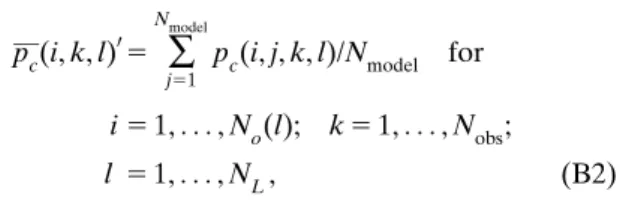
In the weighted version, individual pc(i, j, k, l) values
are first calculated separately for each model control run, then summed over all models, and finally averaged:
pc(i, k, l)05
å
Nmodel
j51 pc(i, j, k, l)/Nmodel for
i5 1, . . . , No(l); k5 1, . . . , Nobs;
l 5 1, . . . , NL, (B2)
where j is the index over Nmodel, the number of CMIP5
models with preindustrial control runs from which syn-thetic MSU temperatures could be calculated (here, Nmodel5 36). The individual pc(i, j, k, l) values for each
model are calculated as follows:
pc(i, j, k, l)5 Kc(i, j, k, l)/Nc(j, l) for i5 1, . . . , No(l); j5 1, . . . , Nmodel; k5 1, . . . , Nobs; l5 1, . . . , NL. (B3) Here, Kc(i, j, k, l) is the number of L-year trends in the
preindustrial control run that are larger than bo(i, k, l)
(for the ith overlapping observed trend, the jth model control run, the kth observational dataset, and the lth value of the trend length L).
Values of pc(i, k, l) and pc(i, k, l)0are very similar,
indicating that intermodel differences in control run
length do not distort our estimates of whether ob-served atmospheric temperature trends are large rel-ative to trends arising from internally generated variability. We only discuss weighted pc(i, k, l)0values
in the main text.
Figure 8 displays time scale–average p values. For each of the selected L-year time scales of interest, we simply average the No(l) individual values of pc(i, k, l)0
over the index i:
pc(k, l)05
å
No(l) i51 pc(i, k, l) 0/N o(l) for k5 1, . . . , Nobs; l5 1, . . . , NL. (B4) Our use of maximally overlapping trends has the ad-vantage of reducing the impact of seasonal and in-terannual noise on underlying atmospheric temperature trends, both in the observations and in the model control runs. However, it has the disadvantage of decreasing the statistical independence of trend samples. While non-independence of samples is an important issue in formal statistical significance testing, it is not a serious concern here. This is because pc(i, k, l)0is not used as a basis forformal statistical tests. Instead, it simply provides useful information on whether observed atmospheric temper-ature trends are unusually large relative to model-based estimates of unforced trends. Furthermore, we process observed temperature data and model output in iden-tical ways, with the same overlap between successive L-year trends.
The key point is that whether we employ overlapping or nonoverlapping control run trends has very small impact on estimates of pc(i, k, l)0. This suggests that the
sample sizes of nonoverlapping trends in the CMIP5 control runs are adequate for obtaining reasonable es-timates of p values.B4
d. Calculation of trend ratios
Our R(k, l) statistic measures the similarity between temperature trends in externally forced simulations and satellite data. For each observational dataset and L-year time scale of interest, we form the ratio between the model and time scale average of ALL18.5 trends, and the time scale average of observed trends:
B4In the case of the observations, however, the use of
non-overlapping segments of satellite records does not adequately capture the large impact of interannual variability on relatively short trends. For example, the 1979–2015 analysis period contains only three nonoverlapping trends $10 yr and #12 yr, two non-overlapping trends $13 yr and #18 yr, and only one non-overlapping trend$19 yr and #37 yr. This is why we focus on maximally overlapping observed trends.
R(k, l)5 bf(l)/bo(k, l) for
k5 1, . . . , Nobs; l5 1, . . . , NL. (B5) The double overbar in bf(l) denotes two separate
av-eraging operations. The first avav-eraging step is over the index i (where i runs over the number of maximally overlapping L-year trends in an individual ALL18.5 realization). This yields bf( j, l), where j is the joint index
over ALL18.5 realizations and CMIP5 models. The second averaging step is first over the number of re-alizations (for CMIP5 models with more than one ALL18.5 realization) and then over the number of models with spliced ALL18.5 runs. The observed mean L-year trend bo(k, l) is defined similarly but only involves
averaging over the index i. Both bf(l) and bo(k, l) are
calculated from temperature time series spanning the same 444-month period (January 1979–December 2015). Results for R(k, l) are shown inFigs. 2c,d,3c,d,4c,d, and5c,d. In the main text, we also discuss R(k). This is simply the average (over all 28 time scales considered)B5 of the individual R(k, l) values. The observational av-erage of R(k) is R . Table 5 of the supplemental material provides values of R calculated with all observational dataset versions and with newer satellite data only.
REFERENCES
Bindoff, N. L., and Coauthors, 2013: Detection and attribution of climate change: From global to regional. Climate Change 2013: The Physical Science Basis, T. F. Stocker, et al., Eds., Cambridge University Press, 867–952. [Available online athttps://www.ipcc. ch/pdf/assessment-report/ar5/wg1/WG1AR5_Chapter10_FINAL. pdf.]
Christy, J. R., 2015: Testimony. Data or dogma? Promoting open inquiry in the debate over the magnitude of human impact on Earth’s climate. Hearing in front of the U.S. Senate Com-mittee on Commerce, Science, and Transportation, Sub-committee on Space, Science, and Competitiveness, 8 December 2015. [Available online at https://www.commerce.senate.gov/ public/_cache/files/fcbf4cb6-3128-4fdc-b524-7f2ad4944c1d/ 80931BD995AF75BA7B819A51ADA9CE99.dr.-john-christy-testimony.pdf.]
——, W. B. Norris, R. W. Spencer, and J. J. Hnilo, 2007: Tropo-spheric temperature change since 1979 from tropical radio-sonde and satellite measurements. J. Geophys. Res., 112, D06102, doi:10.1029/2005JD006881.
Cowtan, K., and R. G. Way, 2014: Coverage bias in the HadCRUT4 temperature series and its impact on recent temperature trends. Quart. J. Roy. Meteor. Soc., 140, 1935–1944, doi:10.1002/ qj.2297.
Easterling, D. R., and M. F. Wehner, 2009: Is the climate warming or cooling? Geophys. Res. Lett., 36, L08706, doi:10.1029/ 2009GL037810.
England, M. H., and Coauthors, 2014: Recent intensification of wind-driven circulation in the Pacific and the ongoing warm-ing hiatus. Nat. Climate Change, 4, 222–227, doi:10.1038/ nclimate2106.
Eyring, V., and Coauthors, 2013: Long-term ozone changes and associated climate impacts in CMIP5 simulations. J. Geophys. Res., 118, 5029–5060, doi:10.1002/jgrd.50316.
Flannaghan, T. J., S. Fueglistaler, I. M. Held, S. Po-Chedley, B. Wyman, and M. Zhao, 2014: Tropical temperature trends in atmospheric general circulation model simulations and the impact of uncertainties in observed SSTs. J. Geophys. Res. Atmos., 119, 13 327–13 337, doi:10.1002/2014JD022365. Fu, Q., and C. M. Johanson, 2004: Stratospheric influences on
MSU-derived tropospheric temperature trends: A direct error analysis. J. Climate, 17, 4636–4640, doi:10.1175/JCLI-3267.1. ——, and ——, 2005: Satellite-derived vertical dependence of
tropical tropospheric temperature trends. Geophys. Res. Lett., 32, L10703, doi:10.1029/2004GL022266.
——, ——, S. G. Warren, and D. J. Seidel, 2004: Contribution of stratospheric cooling to satellite-inferred tropospheric tem-perature trends. Nature, 429, 55–58, doi:10.1038/nature02524. ——, S. Manabe, and C. M. Johanson, 2011: On the warming in the tropical upper troposphere: Models versus observations. Geophys. Res. Lett., 38, L15704, doi:10.1029/2011GL048101. Fyfe, J. C., N. P. Gillett, and F. W. Zwiers, 2013a: Overestimated
global warming over the past 20 years. Nat. Climate Change, 3, 767–769, doi:10.1038/nclimate1972.
——, K. von Salzen, J. N. S. Cole, N. P. Gillett, and J.-P. Vernier, 2013b: Surface response to stratospheric aerosol changes in a coupled atmosphere–ocean model. Geophys. Res. Lett., 40, 584–588, doi:10.1002/grl.50156.
——, and Coauthors, 2016: Making sense of the early-2000s warming slowdown. Nat. Climate Change, 6, 224–228, doi:10.1038/nclimate2938.
Gaffen, D. J., B. D. Santer, J. S. Boyle, J. R. Christy, N. E. Graham, and R. J. Ross, 2000: Multidecadal changes in the vertical structure of the tropical troposphere. Science, 287, 1242–1245, doi:10.1126/science.287.5456.1242.
Gilford, D., S. Solomon, and R. W. Portman, 2016: Radiative im-pacts of the 2011 abrupt drops in water vapor and ozone in the tropical tropopause layer. J. Climate, 29, 595–612, doi:10.1175/ JCLI-D-15-0167.1.
Gillett, N. P., B. D. Santer, and A. J. Weaver, 2004: Quantifying the influence of stratospheric cooling on satellite-derived tropospheric temperature trends. Nature, 432, doi:10.1038/nature03209. Hassler, B., P. J. Young, R. W. Portmann, G. E. Bodeker, J. S.
Daniel, K. H. Rosenlof, and S. Solomon, 2013: Comparison of three vertically resolved ozone data sets: Climatology, trends and radiative forcings. Atmos. Chem. Phys., 13, 5533–5550, doi:10.5194/acp-13-5533-2013.
Haywood, J. M., A. Jones, and G. S. Jones, 2014: The impact of volcanic eruptions in the period 2000–2013 on global mean temperature trends evaluated in the HadGEM2-ES climate model. Atmos. Sci. Lett., 15, 92–96, doi:10.1002/asl2.471. Hegerl, G. C., and J. M. Wallace, 2002: Influence of patterns of
climate variability on the difference between satellite and surface temperature trends. J. Climate, 15, 2412–2428, doi:10.1175/1520-0442(2002)015,2412:IOPOCV.2.0.CO;2. ——, and Coauthors, 2007: Understanding and attributing climate
change. Climate Change 2007: The Physical Science Basis, S. Solomon, et al., Eds., Cambridge University Press, 663–745. [Available online at https://www.ipcc.ch/pdf/assessment-report/ar4/wg1/ar4-wg1-chapter9.pdf.]
B5In other words, over the R(k, l) values for L5 10, 11, . . ., 37.