The Compact RCS / Antenna Range at MIT Lincoln Laboratory
The MIT Faculty has made this article openly available.
Please share
how this access benefits you. Your story matters.
Citation
Shields, Mike. “The compact RCS / antenna range at MIT Lincoln
Laboratory.” Antennas and Propagation, 2009. EuCAP 2009. 3rd
European Conference on. 2009. 939-943. ©2009 IEEE.
Publisher
Institute of Electrical and Electronics Engineers
Version
Final published version
Citable link
http://hdl.handle.net/1721.1/61651
Terms of Use
Article is made available in accordance with the publisher's
policy and may be subject to US copyright law. Please refer to the
publisher's site for terms of use.
The Compact RCS / Antenna Range at MIT Lincoln
Laboratory
Mike Shields
#MIT Lincoln Laboratory244 Wood Street, Lexington, MA USA 02420-9185
This work was sponsored under U.S. Air Force Contract #FA8721-05-C-0002. Opinions, interpretations, conclusions and recommendations are those of the author and not necessarily endorsed by the United States Government.
Abstract— A new compact range with a state-of-the-art
instrumentation system was installed at Lincoln Laboratory and is currently in use. This paper describes the chamber with varied-height absorber, the rolled-edge reflector and instrumentation system. Recently acquired target supports are also described, including a low-RCS, “ogive” tower with a low RCS positioner.
I. INTRODUCTION
Lincoln Laboratory has maintained several antenna and radar cross section (RCS) measurement facilities in its history [1]. In 1997, a small group was commissioned to assess Laboratory antenna ranges. This group was charged to identify current and future users and their needs, survey existing capabilities, consider consolidation of existing facilities, closing of the outdoor facility on leased land and potential new facilities. The study of measurement needs and upgrades/relocations continued for the next few years and included new needs of phased array characterization, including STAP (space-time adaptive processing) performance and EMC characterization. As a result of the study, it was decided to close the leased outdoor facility and build an indoor collection of chambers to replace it with significantly enhanced testing capabilities. [2] The flagship of this new facility would be a large, compact range that covered 0.4 to 100 GHz and be capable of accurately measuring targets up to 3.27 m (12 foot) in diameter [3].
Among the institutions surveyed for candidate designs for this facility was the Ohio State University ElectroScience Laboratory (ESL), known for designing of compact ranges and instrumentation systems. Professor W. D. Burnside was retained as a consultant and provided a design for a large chamber with non-uniform height absorber and a 7.32m x 7.32m (24 foot x 24 foot), rolled-edge reflector [3]. Lehman Chambers was hired to construct the chamber and oversee work by MI-Technologies, who was contracted for the reflector and antenna / target positioners and controllers and Cumings Microwave, who provided the absorber.
II. CHAMBER DESCRIPTION
An artist’s rendering of the compact range facility is shown in Figure 1. The antenna/target handling room (antechamber) has dimensions 9.15 m (30-foot) length by 13.42 m (44-foot)
width by 11.56m (38-foot) height and is electromagnetically shielded. A large gantry/crane is used to move personnel, equipment, and test objects to test to and from the test
Figure 1
Artists Conception of Compact Range and Anteroom Positioner. Small cuts in the absorber floor covering allow the gantry to move into the room without disturbing the absorber. Two independent air conditioning systems provide temperature and humidity control to close tolerances (±2°C) to maintain stable conditions for RCS background subtraction and to maintain the reflector surface. The reflector, feed, and target support structures are located on a common concrete slab, isolated from the remaining floor to mitigate vibration effects that could degrade the ability to subtract the RCS background.
The compact range anechoic chamber is large, 20.12 m (66 foot) long by 13.41 m (44 foot) wide by 11.59m (38 foot) high, and employs both wedge- and pyramidal-shaped absorber on the walls, floor, ceiling, and support structures. Wedge absorber, employed in the target region has varying heights from 91.4 cm (36 inches) to 111.8 cm (44 inches) as determined by a Chebychev polynomial [6, 7]. The height variation reduces the constructive addition of reflections from the tips of the wedges to the back wall. The chamber back wall is covered with pyramidal absorber. An early-warning fire and detection system, and telescopic sprinkler head
system are used as part of the fire protection system, and all the microwave absorber is fire retardant.
The main feature of the compact range is the 7.31 m (24-ft) square reflector shown in Figures 2 and 3. This is a
rolled-edge design, where the center 3.66 m (12 foot), approximately
square section is a perfect offset parabola with a surface error of less than 51 !m (0.002-in) rms surface. As the distance from this center section increases, the surface slowly deviates from the perfect parabola until, at the edge, the surface rolls around until its normal points almost toward the wall behind the reflector. The first four derivatives of the surface contour are controlled to ensure that this transition from pure paraboloid to the rolled edge is sufficiently smooth to reduce the ripple in the reflected plane wave. This is attained at the expense of significantly illuminating the walls, ceiling and floor. The absorber quality and treatment are crucial with this reflector design.
As shown in Figure 2, the reflector consists of seven panels, a center 3.66 m (12-foot) square panel, four corner panels and two side panels. Each panel was constructed on a frame of aluminum honeycomb panels arranged in an eggcrate structure whose initial surface was the approximate desired shape. A thin layer of fiberglass was bonded to this frame which was covered by a layer of epoxy. The epoxy was then machined to the desired surface shape. Thermo-couples were embedded under the surface of the epoxy for temperature monitoring and each panel was temperature cycled three times in a large oven to relieve manufacture stresses.
Figure 2
3.66-m Reflector and Support Structure Schematic with Surface Tolerance Requirements
The steel structure was assembled in the chamber and aligned to the chamber’s main axes before being secured to the floor. The panels were then individually mounted and
aligned to the room and then secured to their neighbors and hand finished to meet the surface tolerance. Each panel, except the center one, is attached to the backup structure with a mount that permits translation in a plane perpendicular to the surface. The center panel is secured to the backup structure with a large diameter pin that does not allow movement. This scheme should eliminate deformations that could occur under temperature extremes due to differential thermal expansion of the steel support structure and the aluminium/fiberglass reflector.
After application of silver paint, a final measurement of the surface was made that showed the RMS error to be within 30.5!m (0.0012 in) over the 3.05m x 3.05m (10 ft by 10 ft) parabolic section, 51 !m (0.002 in) over the first transition section (0 to 71 cm outboard of the parabolic section) and 50.8!m (0.0021 in) over the second transition section (71 cm to 142 cm) outboard of the parabolic section. Finally, a thin coat of white, Latex paint was applied to the surface and absorber was attached to the support structure resulting in the finished unit shown in Figure 3.
Installed Reflector III. INSTRUMENTATION SYSTEM
Once the chamber construction was complete, a system capable of measuring antennas and RCS targets was procured. This instrumentation system was to have frequency coverage commensurate with the design of the Compact Range reflector, 400 MHz to 100 GHz, and take full advantage of the 12-foot diameter quiet zone of the chamber. A custom radar system design was preferred, because it could be maintained and upgraded as needed by Lincoln Laboratory personnel. The Ohio State University ElectroScience Laboratory (ESL) was selected as the vendor based on their experience with RCS systemsfor numerous organizations over a period of decades.
The proposed ESL radar system was based one in use in their chamber in Columbus, Ohio [10], which can scan 2000 frequencies per second, substantially shortening the measurement time over the existing, RF network analyzer based, Lincoln compact range radar system. In addition, this ESL system had high dynamic range, an internal test and diagnostic capability and a graphic user interface (GUI)-based operations software.
Table 1 shows the required RCS sensitivity performance and the operating bands. In addition, the system was required to have sufficient long-term stability to maintain 30 dB background subtraction over a 24-hr period, an easy-to-use GUI and based on a PC with a Windows operating system. A built-in-test capability, allowing failure identification to the subsystem level, was to be included.
TABLE 1
SYSTEM RCSSENSITIVITY
Frequency Coverage
Noise Floor Signal
Bandwidth 0.4 – 2 GHz -82 dBsm 1 kHz 2 – 18 GHz -70 dBsm 100 Hz 18 - 26 GHz -55 dBsm 10 Hz 26 – 40 GHz -50 dBsm 10 Hz 40 – 50 GHz -26 dBsm 10 Hz 55 – 65 GHz -25 dBsm 10 Hz 90 – 100 GHz -20 dBsm 10 Hz
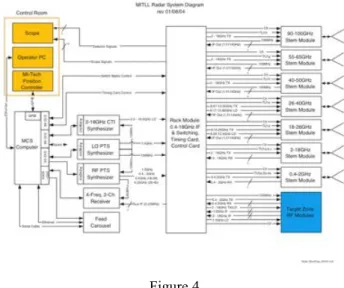
The instrumentation system is a pulsed, dual channel, dual-conversion, heterodyne transceiver with an 11.6 MHz. A digital back-end is employed that provides digital filtering and data storage. This back-end records I/Q data for the center four harmonics of the PRF for both receiver channels, providing additional signal processing gain if these are coherently summed. A rapid frequency scan capability is achieved using a very high-speed commercial frequency synthesizer which covers the 2 – 18 GHz band. The basic RF system operates from 2-18 GHz with 2W as transmit power
and high-speed, T/R switches. Higher frequencies are attained through either multiplication (18-26 GHz and 26-40 GHz) or by mixing (40-50 GHz, 55-65 GHz and 90-100 GHz) the 2-18 GHz signals. These higher band, up / down conversion schemes are duplicated in remote, “target zone” modules that are attached to antennas under test. The use of these modules reduces system losses associated with routing signals above 18 GHz from the receiving antenna to the instrumentation system. A block diagram of the instrumentation system is shown in Figure 4.
Figure 4
Instrumentation System Block Diagram
The system includes versatile switching that can dedicate either of the receiver channels to be the reference as well as permit multiple measurements to be made at each frequency. This second feature is achieved by changing the switch timing between measurements and allows, for example, a second target in the chamber to be used for the reference at the higher bands. Although this is a potentially useful feature, it has proved difficult to implement in practice because of low return signal levels. The instrumentation system also can control multiple external switches as part of the measurement scheme. For example, these switches can be used to access each element in a small phased array under test. Finally, detected RF is routed to an oscilloscope in the control room to permit adjustment and monitoring of the RF pulses.
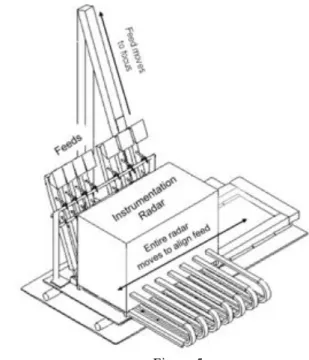
A unique feature of this system is the automated positioning of the feed horns. The instrumentation system is contained in three shelves of a large box, 122 cm (48 in) x 91 cm (36 in) x 107 cm (42 in) high, which is mounted to a dual rail, permitting it to move horizontally. Attached to this box are the feeds for the 7 bands. An aluminium structure is fixed to the floor which contains a single rail system capable of lifting one of the feeds to the reflector focus. To change operating bands, the entire radar translates horizontally until the desired feed is aligned with the fixed structure. The rail in this structure then grabs knobs on the desired feed and lifts it to the focal point. The rail system allows adjustment of the feed in one axis perpendicular to the focal line and adjustments in
the other two axes must be done by manually installing shims. Figure 5 is a schematic of the system and Figure 6 shows the installed unit, which contains the RF components, the three synthesizers, the timing unit, the digital receiver and the control computer. Communication from the control computer to the positioner controllers is accomplished using a fiber-optic GPIB unit. Operation from the control room is attained by a remote connection to this control computer.
Figure 5
Schematic of Feed Positioning System
Figure 6
Feed Positioning System in Chamber IV. TARGET POSITIONER AND SUPPORTS
The chamber has a large azimuth-over-elevation positioner buried in the floor. It is capable of full rotation in azimuth and,
with the slide table mounted, approximately +/- 5 degrees in elevation. A large fiberglass tower with an azimuth-over-elevation positioner on top is located. The upper positioner is canted at 45 degrees to permit roll angle rotation. This system, delivered with the chamber is capable of supporting large antennas or targets but also scatters a large amount of energy into the chamber. It is used primarily for high-gain antennas, where the scattering has minimal effect on the measurement, Figure 7. We have fabricated a conical tower from two blocks of Styrofoam (we cannot find sufficiently large blocks to accommodate the 5.73m (19 feet) height by 1.22 m (4 feet) base diameter), Figure 8. In addition to this support, we have procured a 5.73 m (19 feet) tall tower and a 5.2m (17 feet) tall tower made from a proprietary, low density foam from Systems Research and Development Corporation, Figure 9. These three foam towers include a base that scatters energy reflected from a target out to the wall absorber rather than back towards the target. Finally, we have procured a low-RCS tower with an ogive cross-section with a low-low-RCS head that contains a polarization positioner above an azimuth-over-elevation positioner with limited azimuth-over-elevation motion. This system is shown in Figure 10.
Figure 7
Figure 8
Foam Support Tower (Made in Two Halves)
Figure 9
Custom Foam Tower (one of two)
Figure 10
Low-RCS Tower with Low-RCS Positioner ACKNOWLEDGMENT
We wish to gratefully acknowledge the contributions of the Lincoln Laboratory staff; Dr. Peter Kao, Gregg Sandy, Paul Theophelakes, Rich Cotillo and Tom Guttadauro and the ESL contributors; Dr. W. Dennis Burnside (RF, chamber & reflector design), Dr. Frank Paynter (management & software), Dr. The-Hong Lee (EM analysis), Dr. Chi-Chih Chen (feed design), Grant Hampson (digital receiver design) and Willie Theunison (control software).
REFERENCES
[1] A. Cohen and A. W. Maltese, “Lincoln Laboratory Antenna Test Range”, Microwave Journal, v.4, pp 57-65, April 1961.
[2] A. J. Fenn, M. W. Shields, and G. A. Somers, “Introduction to the New Lincoln Laboratory Suite of Ranges”, Antenna Measurement Techniques Association, 26th Annual Meeting, Atlanta, GA, Oct. 2004.
[3] M.W. Shields and A.J. Fenn, “A New Compact Range Facility for Antenna and Radar Target Measurements”, Lincoln Laboratory Journal, vol. 17, no. 2, pp 381-291, 2007
[4] T-H Lee, W.D. Burnside, I.J. Gupta, A.J. Fenn and G. A. Somers, “Blended Rolled Edge Reflector Design for the New Compact Range at MIT Lincoln Laboratory,” Antenna Measurement Techniques Association, 26th Annual Meeting Atlanta, GA. Oct. 2004.
[5] I.J. Gupta, K. P. Ericksen and W.D. Burnside, “A Method to Design Blended Rolled Edges for Compact Range Reflectors,” in IEEE Trans. Antennas and Propagation, Vol 44., No. 1, pp 853-861, June, 1990. [6] T-H. Lee and W.D. Burnside, “Performance Trade-off Between
Serrated Edge and Blended Rolled Edge Compact Range Reflectors” IEEE Trans. Antennas and Propagation, Vol 44, no. 1, pp87-96, Jan. 1996.
[7] J-R.J. Gau, W.D. Burnside and M. Glireath, “Chebyshev Multilevel Absorber Design Concept”, Trans. Antennas and Propagation, vol45, no. 8, pp 1286-1293, August 1997.
[8] R. Silz, “Design of the GE Aircraft Engine Compact Range Facility” Antennas and Propagation Society International Symposium, 2001 Digest, vol 4, pp 432-435, July 2001
[9] J.R. Proctor, D.R.Smith, P.F.Martin, G.A. Somers, M.W. Shields, and A.J. Fenn, “Compact Range Rolled Edge Reflector Design, Fabrication, Installation and Mechanical Qualification” Antennas Measurement Techniques Association, 256th Annual Meeting, Atlanta, GA, Oct. 2004.
[10] W.D. Burnside, T. Barnum, P. Bohley, W. Lin, M. Poirier and P. Swetnam, “Operating Manual for OSU/ESL Transciever System”, The Ohio State University ElectrosScience Laboratory Technical Report 719493, Feb. 1989