Computational Formulation, Modeling and
Evaluation of Human-Robot Team Training ARCaW
Techniques
by
Stefanos Z. Nikolaidis
OF TECHNOLOGYMAR 20 2014
LIBRARIES
Submitted to the Department of Aeronautics and Astronautics
in partial fulfillment of the requirements for the degree of
Master of Science in Aeronautics and Astronautics
at the
MASSACHUSETTS INSTITUTE OF TECHNOLOGY
February 2014
©
Massachusetts Institute of Technology 2014. All rights reserved.
Author...
Department of Aeronautics a d Astronautics
;nuary 28, 2014
C ertified by ...
...
Julie A. Shah
Assistant Professor of Aeronautics and Astronautics
Thesis Supervisor
Accepted by ....
Paulo C. Lozano
Associate Professor of Aeronautics and Astronautics
Chair, Graduate Program Committee
Computational Formulation, Modeling and Evaluation of
Human-Robot Team Training Techniques
by
Stefanos Z. Nikolaidis
Submitted to the Department of Aeronautics and Astronautics on January 28, 2014, in partial fulfillment of the
requirements for the degree of
Master of Science in Aeronautics and Astronautics
Abstract
This thesis is focused on designing mechanisms for programming robots and train-ing people to perform human-robot collaborative tasks, drawtrain-ing upon insights from practices widely used in human teams.
First, we design and evaluate human-robot cross-training, a strategy used and validated for effective human team training. Cross-training is an interactive planning method in which a human and a robot iteratively switch roles to learn a shared plan for a collaborative task. We present a computational formulation of the robot mental model, which encodes the sequence of robot actions towards task completion and the robot expectation over the preferred human actions, and show that it is quantitatively comparable to the human mental model that captures the interrole knowledge held by the human. Additionally, we propose a quantitative measure of human-robot mental model convergence, and an objective metric of mental model similarity. Based on this encoding, we formulate human-robot cross-training and evaluate it in human subject experiments (n = 36). We compare human-robot cross-training to standard
reinforcement learning techniques, and show that cross-training provides statistically significant improvements in quantitative team performance measures. Additionally, significant differences emerge in the perceived robot performance and human trust. Finally, we discuss the objective measure of human-robot mental model convergence as a method to dynamically assess errors in human actions. This study supports the hypothesis that effective and fluent human-robot teaming may be best achieved by modeling effective practices for human teamwork.
We also investigate the robustness of the learned policies to randomness in human behavior. We show that the learned policies are not robust to changes in the human behavior after the training phase. For this reason, we introduce a new framework that enables a robot to learn a robust policy to perform a collaborative task with a human.The human preference is modeled as a hidden variable in a Mixed Observabil-ity Markov Decision Process, which is inferred from joint-action demonstrations of a collaborative task. The framework automatically learns a user model from training data, and uses this model to plan an execution policy that is robust to changes in the
human teammate's behavior. We compare the effectiveness of the proposed frame-work to previous techniques that plan in state-space, using data from the human subject experiments in which human and robot teams trained together to perform a place-and-drill task. Results demonstrate the robustness of the learned policy to increasing deviations in human behavior.
Thesis Supervisor: Julie A. Shah
Acknowledgments
Personal Acknowledgments
I would like to thank my advisor, Professor Julie Shah, for her fantastic supervision, guidance and support. Julie has been my role model of a young talented researcher, who has always reminded me that both intelligence and genuine interest for the students are necessary for a successful educator. Her constructive feedback has always been to the point and has defined the content of this thesis. Moreover, her kindness and enthusiasm have been an invisible force pushing me forward full-speed. It suffices to say that our Tuesday afternoon meeting has been one of my most cheerful times of the week! Looking back to when it all started, I am grateful for the amount of knowledge, technical and presentation skills and maturity that she helped me achieve. It has been truly a privilege.
Nothing of this would have been possible without the friendship and help of the Interactive Robotics Group in all aspects of my graduate life. Special thanks to Pem Lasota for being a great labmate and a companion in our gourmet marathons in France, to Dr. Jim Boerkoel for his essential feedback on research and karaoke nights in Tokyo, and to Ramya Ramakrishnan and Abhizna Butchibabu for the wonderful surprise party for my birthday!
I would also like to thank Professor Nick Roy, for giving me the opportunity to join the meetings of the Robust Robotics Group and share ideas with such a brilliant
group of people! I am also thankful to Dr. Brad Knox for his essential feedback and our very exciting discussions.
Finally, I cannot thank enough my parents, Zachos and Efi, and my sister, Evelina, for their unconditioned love and support.
Funding
Funding for this work was partially provided by ABB. I would also like to acknowledge the Onassis Foundation as a sponsor.
Contents
1 Introduction 11
2 Human-Human and Human-Robot Team Training Practices 15
2.1 Human Team Training Practices ... . 15
2.2 Human-Robot Team Training ... ... 18
3 Mental Model Formulation 23 3.1 Shared Mental Models in Human Teams ... ... 23
3.2 Robot Mental Model Formulated as MDP .... ... 24
3.3 Evaluation of Mental Model Convergence ... 25
3.4 Human-Robot Mental Model Similarity ... 26
4 Human-Robot Cross-Training 27 4.1 Cross-Training Emulation in Human-Robot Team ... 28
4.1.1 Human-Robot Cross-Training Algorithm ... 28
4.1.2 Forward Phase ... ... 30
4.1.3 Rotation Phase ... 30
4.1.4 Reinforcement Learning with Human Reward Assignment . . 31
4.2 Human-Robot Teaming Experiments ... ... 32
4.2.1 Experiment Hypotheses ... ... 32
4.2.2 Experiment Setting ... ... 33
4.2.3 Human-Robot Interactive Training . . . . 34
4.3 Results and Discussion . . . . 36
4.3.1 Quantitative Measures . . . . 37
4.3.2 Qualitative Measures . . . . 39
4.3.3 Fluency Metrics on Task Execution . . . . 40
4.3.4 Transfer of Learning Experience from Virtual to Actual Envi-ronm ent . . . . 42
4.4 Post-hoc Experimental Analysis . . . . 43
4.4.1 Dynamic Error Detection Using Entropy Rate . . . . 43
4.4.2 Algorithmic Performance . . . . 46
4.5 C onclusion . . . . 48
5 Efficient Model Learning for Human-Robot Collaborative Tasks 51 5.1 Introduction . . . . 51
5.2 Relevant Work . . . . 52
5.3 M ethod . . . . 55
5.4 Clustering of Human Types . . . . 57
5.5 Mixed Observability Markov Decision Process Learning and Planning 62 5.5.1 MOMDP Formulation . . . . 62
5.5.2 Belief-State Estimation . . . . 63
5.5.3 Inverse Reinforcement Learning . . . . 64
5.5.4 Policy Computation . . . . 66
5.6 Evaluation . . . . 67
5.7 Performance of Clustering of Human Types . . . . 69
5.7.1 Robustness of Computed Policy . . . . 69
5.7.2 Quality of Learned Model . . . . 71
5.8 Conclusion . . . . 72
6 Conclusion and Future Work 73 6.1 C onclusion . . . . 73
List of Figures
1-1 (Left) Coriolis Composite Placement Robot; (Right) Robotic Thermal
Spraying of Parts . . . . 11
4-1 Human-Robot Cross-Training Algorithm . . . . 29
4-2 Forward Phase of the Cross-Training Algorithm . . . . 31
4-3 Rotation Phase of the Cross-Training Algorithm. . . . . 32
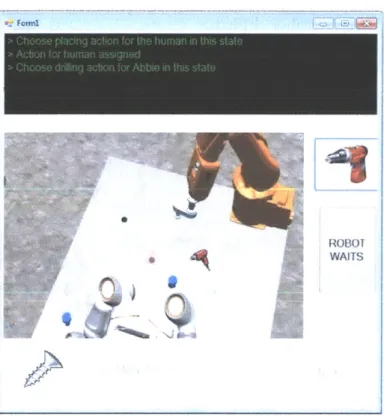
4-4 Human-Robot Interactive Planning Using ABB RobotStudio Virtual Environment. The human participant controls the white anthropo-morphic "Frida" robot on the left, to work with the orange industrial robot, "Abbie," on the right. . . . . 35
4-5 Human-Robot Mental Model Elicitation Tool . . . . 36
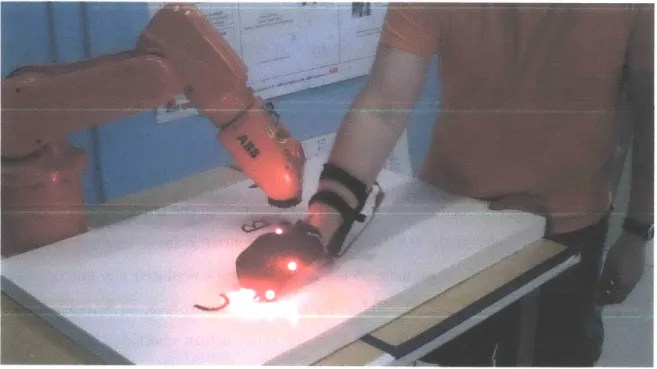
4-6 Human-Robot Task Execution . . . . 37
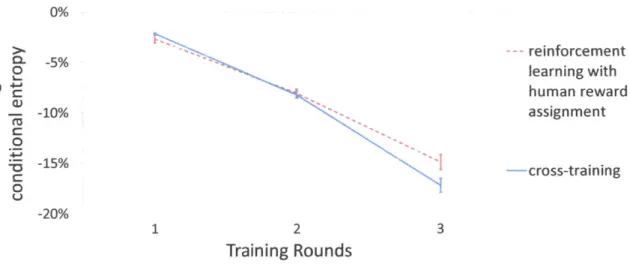
4-7 Human-Robot Mental Model Convergence. The graph shows the per-cent decrease of entropy rate over training rounds. . . . . 38
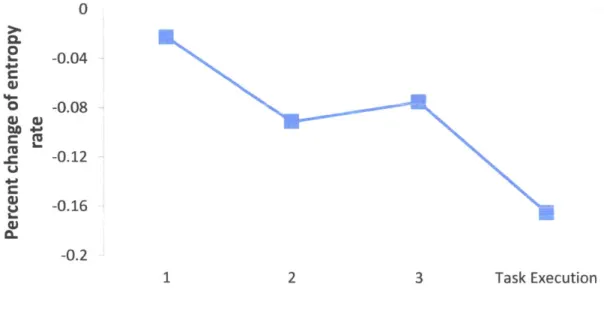
4-8 Entropy-rate of subject 1. The change in the participant's strategy is illustrated by an increase in the entropy-rate at the third round. . 45 4-9 Entropy-rate of subject 2. The change in the participant's strategy is illustrated by an increase in the entropy-rate at task execution. . . . 46
4-10 Entropy-rate of subject 3. The entropy-rate does not increase when a change in the sequence occurs in states irrelevant to the user preference. 47 5-1 Framework flowchart . . . . 57
5-2 Clustering Transition Matrices using EM . . . . 59
5-4 Task execution from a human-robot team on a place-and-drill task. . 68 5-5 Accumulated reward averaged over 18 iterations of cross-validation,
one for each human subject. The plotted lines illustrate the perfor-mance of a policy of a MOMDP model handcoded by a domain expert, the learned policy of the automatically generated MOMDP model us-ing the proposed framework, and the learned policy from the Human-Robot Cross-Training algorithm. The x-axis represents the probability of the human taking a random action, instead of replaying the action he actually took in the task-execution phase with the robot. For each subject, we ran 100 simulated iterations of task execution. . . . . 71
Chapter 1
Introduction
Traditionally, industrial robots in manufacturing and assembly work in isolation from people. When this is not possible, the work is done manually. We envision a new class of manufacturing processes that achieve significant economic and ergonomic benefit through robotic assistance in manual processes. For example, mechanics in automotive and aircraft assembly spend a significant portion of their time retrieving and staging tools and parts for each job. A robotic assistant can provide productivity benefit by performing these non-value-added tasks for the worker. Other concepts for human and robot co-work envision large industrial robotic systems (examples in Fig. 1-1) that operate in the same physical space as human mechanics, as efficient and productive teammates.
Figure 1-1: (Left) Coriolis Composite Placement Robot; (Right) Robotic Thermal Spraying of Parts
When humans work in teams, it is crucial for the members to develop fluent team behavior. We believe that the same holds for robot teammates, if they are to perform in a similarly fluent manner as members of a human-robot team. Learning from demonstration
[5]
is one technique for robot training that has received significant attention. In this approach, the human explicitly teaches the robot a skill or specific task [6, 1, 42, 15, 3]. However, the focus is on one-way skill transfer from a human to a robot, rather than a mutual adaptation process for learning fluency in joint-action. In many other works, the human interacts with the robot by providing high-level feedback or guidance [10, 26, 17, 54], but this kind of interaction does not resemble the teamwork processes naturally observed when human teams train together on interdependent tasks [34].In this thesis, we focus on mechanisms inspired by human team training practices for programming robots and training people onto working together in collaborative tasks. Firstwe propose a training framework that leverages methods from human fac-tors engineering, with the goal of achieving convergent team behavior during training and team fluency at task execution, as it is perceived by the human partner and is assessed by quantitative team performance metrics. Training with an actual robot on shared-location collaborative tasks could be dangerous or cost-prohibitive. Contrary to prior work, the training is done in a virtual environment, and we evaluate the team fluency when the human does the task with the actual robot after the training. Second, we expand the computational model, so that the robot can act robustly to deviations in the expected human behavior.
We computationally encode a teaming model that captures knowledge about the role of the robot and the human team member. The encoded model is quantitatively comparable to the human mental model, which represents the interrole knowledge held by the human [34]. Additionally, we propose quantitative measures to assess human-robot mental model convergence, as it emerges through a training process, as well as mental model similarity between the human and the robot. We then introduce a human-robot interactive planning method which emulates cross-training, a training strategy widely used in human teams [34]. We compare human-robot cross-training
to standard reinforcement learning algorithms through a large-scale experiment of 36 human subjects, and we show that cross-training improves quantitative measures of human-robot mental model convergence (p = 0.04) and mental model similarity
(p < 0.01). Post-hoc experimental analysis shows that the proposed metric of mental model convergence could be used for dynamic human error detection. Additionally, a post-experimental survey shows statistically significant differences in perceived robot performance and trust in the robot (p < 0.01). Finally, we observe a significant improvement in team fluency metrics, including an increase of 71% in concurrent motion (p = 0.02) and a decrease of 41% in human idle time (p = 0.04), during the actual human-robot task execution phase that succeeds the human-robot interactive planning process. The improvement in team fluency is indicative of a transfer of the learning experience from a virtual environment to working with an actual robot.
In the next section, we discuss examples of human-robot interaction that motivate our work, and we place our work in context of other related work in Chapter 2. Chap-ter 3 presents our computational formulation of the human-robot teaming model, as well as methods to assess mental model convergence and similarity. Chapter 4 in-troduces human-robot interactive planning using cross-training, and describes the human subject experiments. In the same chapter we present and discuss the ex-periment results, which show a significant improvement in team performance using cross-training, as compared to standard reinforcement learning techniques. In Chap-ter 5, we exploit the fact that people generally have very few dominant preferences. Therefore, we formulate the interaction as a Mixed-Observability Markov Decision Process (MOMDP) framework, and show that planning in belief-space is more robust compared to planning in state-space. Finally, we conclude and present future work in Chapter 6.
Chapter 2
Human-Human and Human-Robot
Team Training Practices
Our work is heavily inspired by human team training practices, applied prior to the execution of tasks or missions, with the goal of improving human team performance. We first present an overview of human team training techniques, and then review previous work on human-robot training.
2.1
Human Team Training Practices
In high-intensity domains, such as manufacturing, military and medical operations, there is a variety of tasks that are too complex or cognitively demanding to be per-formed by individuals working alone. To function as a team, individuals must coor-dinate their activities; simply bringing together several people to accomplish a task is not enough. Adaptive teams are able to coordinate their activities, not only under routine conditions, but also under novel conditions for which the teams have not been explicitly trained. Poor team coordination has been related to major system failures, such as in the cases of Three Mile Island and Chernobyl [161, where deficiencies in interaction and coordination resulted in failure to adapt to changes in the task envi-ronment. Studies of team training practices have mainly focused on improving team performance, particularly in response to novel event patterns.
One such technique is procedural training: A form of process training in which "operators in complex systems are positively reinforced (through feedback) to fol-low a standard sequence of actions each time a particular stimulus is encountered." [20] Trainees practice by repetitively following prespecified procedures, with the goal of learning to respond automatically to stimuli. The underlying assumption is that training in this manner reduces the incidence of errors and enhances performance [22]. Procedural training is prevalent in medical, manufacturing and military set-tings, for tasks in which deviations from complicated procedures can be catastrophic. Whereas this type of training enables team members to reflexively react under stress-ful conditions and a heavy workload, it is argued that it can also limit a team's ability to transfer training to novel situations, leading to poor performance when the actual task execution conditions do not match the training conditions [20].
In cross-training, another common technique, team members are trained for each other's roles and responsibilities, in addition to their own [9]. There are three types of cross-training: (a) positional clarification, (b) positional modeling, and (c) posi-tional rotation. Posiposi-tional clarification involves verbally presenting team members with information about their teammates jobs through lecture or discussion. Posi-tional modeling includes observations of team-members' roles through videotape or direct observation. Positional rotation is the most in-depth form of cross-training. Findings [34, 13] suggest that positional rotation cross-training, defined as "learn-ing interpositional information by switch"learn-ing work roles," is strongly correlated with improvement in human team performance, as it provides individuals with hands-on knowledge about the roles and responsibilities of their teammates [34]. Positional rotation cross-training has been used by military tactical teams, as well as aviation crews. It has been argued that shared expectations, resulting from the development of shared knowledge, allow team members to generate predictions for appropriate behavior under novel conditions and in cases when there is uncertainty in the infor-mation flow [34]. The proposed human-robot cross-training algorithm is inspired by the positional-rotation type of training practice. Whereas in this work we do not examine novel situations in tasks performed by human-robot teams, uncertainty is
present due to the inherent lack of transparency between human and robot. Addition-ally, task execution following training is conducted in an actual environment, which is inherently different to the virtual environment where training takes place. From an algorithmic point of view, switching roles has the additional benefit of enabling the human to directly demonstrate his preference, as explained in Section 4.4.2.
While cross-training is feasible for small teams, it can become impractical as teams grow in size. Recently, Gorman et al. introduced perturbation training [20]. Using this approach, standard coordination procedures are disrupted multiple times during the training process, forcing team members to coordinate in novel ways to achieve their objective. Perturbation training aims to counteract habituation associated with task processes a possible outcome of procedural training. It is inspired by prior work in motor and verbal learning, and is aimed at improving team performance under novel post-training conditions [48]. A form of perturbation training was examined in [21], in which teams were trained to perform a repetitive command-and-control task during two training rounds. Teams that changed members for the second round developed higher quality team processes after training, compared to teams that main-tained the same members during both rounds. Gorman et al. used a different form of perturbation for an air reconnaissance task, by temporarily limiting communication between team members and disabling available equipment [20]. The performance of teams that received perturbation-training was compared to those that received pro-cedural or cross-training. Whereas teams that cross-trained exhibited an increase in interpositional teamwork knowledge across sessions and performed better in one of three missions than those that underwent procedural training, those that received perturbation training exhibited better performance in two of three missions. The Gor-man study suggests that perturbation training is a very promising training method, although a larger variety of experinients may be required to obtain conclusive evi-dence. We believe that it would be interesting to introduce perturbation training in a human-robot team setting, but leave the notion for future investigation.
2.2
Human-Robot Team Training
While there has been extensive work conducted on human team training techniques, in human-robot team settings training has focused on one-way knowledge given by a human teacher to a robot apprentice. An example of this method is the SARSA(A) reinforcement learning approach, where the reward signal is interactively assigned by the human. This technique falls into the category of learning wherein the human and machine engage in high-level evaluation and feedback.
In some approaches within this category, a human trainer assigns positive re-inforcement signals [10] to a virtual character - a method also known as "clicker training." The state space is represented by a percept tree, which maintains a hierar-chical representation of sensory input. The leaf nodes represent the highest degree of specialization, and the root node matches any sensory input. Similarly, state-action pairs consisting of percepts that generate the same action are organized hierarchically, according to the specificity of the percept. Each state-action pair is assigned a reward depending on whether it has good, bad or indifferent consequences. The structure of the percept tree and the rewards is refined interactively by a human trainer. A sim-ilar approach is detailed in [26], wherein clicker training is used to train four-legged robots. In this proposed system, the behavior of the robot is implemented through a hierarchical tree of schemata, where each schema is constituted by a set of acti-vation conditions and a set of executable actions. Human feedback is then used to create new behaviors through the combination of existing ones. The robot maintains a user-specific model of human behavior that is updated through interaction and af-fects the probability of transitions between different schemata. A user model is also learned in [17], simultaneously with a dialog manager policy in a robotic wheelchair application. The model is encoded in the transition and observation functions and rewards of a Partially Observable Markov Decision Process framework. The hidden state represents the user's intent; that is, the places where the user would like the wheelchair to go. The human interacts with the system by giving verbal commands, as well as a scalar reward after each robot action.
Other methods, such as TAMER-RL [28, 29], support the use of human input to guide a traditional reinforcement learning agent in maximizing an environmental reward. The TAMER framework is based upon two insights into how humans assign rewards: First, human reward is delayed according to the time it takes the trainer to evaluate behavior and deliver feedback. Second, a human assigns rewards after considering their long-term effects; in that sense, the reward value more resembles a state-action value than an environmental reward in the manner of a Markov Decision Process (MDP) framework [51]. SARSA(A) is augmented by different approaches of combining human reward in TAMER-RL, and their effectiveness is tested through experiments involving a mountain-car and cart-pole task. Q-Learning with Interactive Rewards [54] is identical to our version of SARSA(A), if we remove eligibility traces on SARSA and set a greedy policy for both algorithms. In this case, the algorithm has been applied to teach a virtual agent to cook from a recipe, with the human assigning rewards to the agent by moving the green slider on a vertical bar. A modified version
[541
incorporating human guidance has been empirically shown to significantly improve several dimensions of learning. That version of the algorithm resulted in fewer failures, as the learning process was focused on smaller, more relevant parts of the state-space.The other category for learning in human-robot teams involves a human provid-ing demonstrations to the machine. Work involvprovid-ing learnprovid-ing from demonstration includes systems that learn a general policy for a task by passively observing a hu-man expert executing that task. For example, in [14] the system learns a Gaussian Mixture Model for each action class, using human demonstrations as training data. Each new datapoint is assigned to a mixture class according to maximum likelihood. The algorithm also returns a confidence measure, used by the agent to request ad-ditional demonstrations. This proposed algorithm is improved through automatic selection of multiple confidence thresholds in [15]. More recently, Gaussian Mixture Models
[3]
have been used to teach a skill to a robot during experiments in which a human physically guides the robot through a trajectory; this approach is known as "kinesthetic teaching." These experiments have shown that guiding a robot armthrough keyframes is a more effective method of teaching means-oriented skills, such as performing gestures, than guiding the robot through the entire trajectory. This is partially due to the difficulty in smoothly manipulating a heavy robot arm. However, demonstrating an entire trajectory has been more successful for goal-oriented skills, such as pick-and-place tasks.
Another approach to robot training is to teach a plan to the robot. In [42], the authors assume that the robot has an available set of low-level behaviors. Given this assumption, the goal is then for the robot to build a high-level task representation of a more complex, sequentially structured task using its existing behavior set. The robot learns the necessary tasks by creating a link between observations and robot behaviors that achieve the observed effects. Used in addition to human demonstra-tions, instructional feedback focuses the learning process on the relevant aspects of a demonstration. In [42], experiments in which a Pioneer 2-DX mobile robot attempts to complete a pick-and-place task validate the correctness of learned representations.
In another training method, the robot learns a system model that consists of a transition model from state s given action a, T(s'/s, a), and a reward function R(s) which maps states to a scalar reward. Using this system model, a policy that maps states to actions can maximize the finite- or infinite-horizon accumulated reward. Atkeson and Schaal consider the problem of having a robot arm follow a demon-strated trajectory [6]. In their paper, the robot learns the transition model through repeated attempts to execute the task, and the reward function is modeled so as to quadratically penalize deviation from the desired trajectory. A priori human knowl-edge was used to divide a vertical balancing task into a swing-up component and a balancing component. Results from experiments indicate improved performance compared to simply mimicking demonstrated motions.
Apprenticeship learning [1] generalizes to task planning applications, employing a Markov decision process framework. In this method, the algorithm assumes that the expert tries to maximize a "true" unknown reward function that can be expressed as a linear combination of known "features". A quadratic program is solved iteratively to find feature weights that attempt to match the expected feature counts of the
resulting policy with those of the expert demonstrations. Experiment results using this approach indicate that robot performance is similar to that of the expert, even though the expert reward function may not be recovered. This work falls into the category of inverse reinforcement learning (IRL), wherein the MDP state reward function is derived from observed expert demonstrations [40]. In multi-agent settings, state-of-the-art behavior modeling based on the game-theoretic notion of regret and the principle of maximum entropy has accurately predicted future behavior in newly encountered domains
[561.
Our proposed human-robot cross-training algorithm uses the same inputs as
Q-learning with Interactive Rewards [54]. However, rather than asking the human to explicitly provide feedback to the robot, the human feedback is instead provided im-plicitly by having the human switch roles with the robot, in a manner similar to effective human team-training practices. This part of training resembles Inverse Re-inforcement Learning [40], as the state reward function is learned by human demon-strations when the human and robot switch roles. A key difference from previous work, however, is that we focus on collaborative tasks wherein robot and human actions are interdependent. Therefore, the outcome of the robot actions depends on the human actions, and leads to a learned model of human actions encoded in the Transition Probabilities of a Markov Decision Process Framework similar to that observed in [17]. By following a human-team inspired approach, we support the mutual co-adaptation of both the human and robot, and focus on the team-fluency in shared-location, joint-action collaborative tasks, rather than the optimization of agent performance metrics.
Chapter 3
Mental Model Formulation
In this chapter, we describe the concept of shared mental models in human teams, and then computationally encode a mental model for the robot as a Markov Decision Process. Based on this encoding, we then introduce an objective measure - the entropy rate of the Markov chain - to evaluate the convergence of the human and robot mental models. Finally, we propose a metric for human-robot mental model similarity inspired by shared mental model elicitation techniques in human teams.
3.1
Shared Mental Models in Human Teams
The literature presents various definitions for the concept of shared mental models [31]. Marks et al. [34] state that mental models represent "the content and organi-zation of interrole knowledge held by team members within a performance setting." According to [37], mental models are "mechanisms whereby humans generate descrip-tions of system purpose and form, explanadescrip-tions of system functioning and observed system states, and prediction of future system states, ... and they help people to describe, explain, and predict events in their environment." The objective of team training is to foster similar or shared mental models, as empirical evidence suggests that mental model similarity improves coordination processes, which, in turn, en-hances team performance. Most researchers agree that there are multiple types of mental models shared among team members. [37] state that one type is
technol-ogy/equipment mental models that capture the dynamics and control of the tech-nology among team members. Task mental models describe and organize knowledge about how a task is accomplished in terms of procedures and task strategies, whereas team interaction models describe the roles and responsibilities of team members. Fi-nally, team mental models capture team-specific knowledge of teammates, such as their skills and preferences. In this work, we refer to robot mental model as the learned sequence of robot actions toward task completion, as well as the expectation that the robot has for human actions. We computationally encode this model as a Markov Decision Process (MDP) [47].
3.2
Robot Mental Model Formulated as MDP
We describe how a robot teaming model can be computationally encoded as a Markov Decision Process. A Markov decision process is a tuple
{S,
A, T, R}, wherein:" S is a finite set of world states; it models the set of world environment
config-urations.
* A is a finite set of actions; this is the set of actions the robot can execute.
" T : S x A -+ IIH(S) is the state transition function, giving a probability
dis-tribution over world states for each world state and action; the state transition function models the uncertainty that the robot has in the human action. For a given robot action a, the human's next choice of action yields a stochastic transition from state s to a state s'. We write the probability of this transition as T(s, a, s'). In this formulation, human behavior is the cause of randomness in our model, although this can be extended to include stochasticity from the environment or the robot actions.
" R : S x A -+ R is the reward function, giving the expected immediate re-ward gained by performing each action in each state. We write R(s, a) for the
The policy 7r of the robot is the assignment of an action 'r(s) at every state s. The optimal policy 7r* can be calculated using dynamic programming [47]. Under this formulation, the role of the robot is represented by the optimal policy -r*, whereas robot knowledge of the role of the human co-worker is represented by the transition probabilities T.
3.3
Evaluation of Mental Model Convergence
As the mental models of the human and robot converge, we expect the human and robot to perform similar patterns of actions. This means that the same states will be visited frequently and robot uncertainty about human action selection will decrease. Additionally, if the mental models of the human and the robot converge, the patterns of actions performed will match the human preference, as elicited after the training.
To evaluate the convergence of the robot's computational teaming model and the human mental model, we assume a uniform prior and compute the entropy rate [18] of the Markov chain (Eq. 3.1). The Markov chain is induced by specifying a policy 7F
in the MDP framework. For the policy 7r, we use the robot actions that match human preference as elicited by the human after training with the robot. Additionally, we use the states s E S that match the preferred sequence of configurations for task completion. For a finite state Markov chain X with initial state so and transition probability matrix T, the entropy rate is always well-defined [181. It is equal to the sum of the entropies of the transition probabilities T(s. ir(s), s'),for all s E 5, weighted by the probability of the occurrence of each state according to the stationary distribution p of the chain (Equation 3.1).
H(X) - Ep(s) 1 T(s, 7r (s), s')log [T(s, 7r (s), s')] (3.1)
sES s'ES
Interestingly, the conditional entropy given by Eq. 3.1 also represents the un-certainty of the robot about the action selection of the human, which we expect to decrease as human and robot train together. This measure can be generalized to
encode situations in which the human has multiple preferences or acts stochastically. In Section 4.4.1, we conduct a post-hoc analysis indicating entropy evolution over time in such cases. The entropy rate appears to be particularly sensitive to changes in human strategy, and reflects the resulting increase in robot uncertainty about the next actions of the human. We propose that these results provide intriguing first sup-port for the potential use of entropy rate as a component of a human error detection mechanism.
3.4
Human-Robot Mental Model Similarity
Given the formulation of the robot mental model, we propose a similarity metric between human and robot mental models based on prior work [31] on shared mental model elicitation for human teams. In a military simulation study
[35],
each partici-pant was asked to annotate a sequence of actions that he and his teammates should follow to achieve mission completion. The degree of mental model similarity was then calculated by assessing the overlap in action sequences selected by each of the team members. We generalize this approach in a human-robot team setting: In our study, the participant annotates a sequence of actions that he or she thinks the human and robot should perform in order to complete the assigned task. We then elicit the sim-ilarity of the human and robot mental models by determining the ratio of annotated robot actions matching the actions assigned by optimal policy to the total number of robot actions required for task completion. This describes how well human preference for robot actions matches the actual optimal policy for the MDP.Chapter 4
Human-Robot Cross-Training
In the computational encoding of the mental model for the robot described in the previous chapter, expert knowledge about task execution is encoded in the assign-ment of rewards R, and in the priors on the transition probabilities T that encode the expected human behavior. This knowledge can be derived from task specifica-tions or from observation of expert human teams. However, rewards and transition probabilities finely tuned to one human worker are not likely to generalize to an-other human worker, since each worker develops his or her own highly individualized method for performing manual tasks. In other words, a robot that works with one person according to another person's preferences is not likely to be good teammate. Empirical evidence suggests that mental model similarity improves coordination pro-cesses, which in turn enhance team performance [34]. Mental model similarity is particularly important under conditions in which communication is difficult due to excessive workload, time pressure or another environmental feature, as teams are unable to engage in necessary strategizing in these circumstances [36]. Shared or similar mental models are important in such cases, as they allow team members to predict the information and resource requirements of their teammates. In the case of a human-robot team, communication is difficult for different reasons: Transparency in the interaction between human and robot is an unsolved problem, mainly due to the technical challenges inherent in the exchange of information about high-level goals and intentions between human and robot. We therefore hypothesize that a
shared-mental model for a human-robot team will improve team performance in actual task execution. Cross-training [34] is a validated and widely used mechanism for conveying shared mental models in human teams; we emulate the cross-training process that takes place among human team-members by having the human and robot train to-gether in a virtual environment. We use a virtual environment because, especially in high-intensity applications, it is infeasible or cost-prohibitive for a robot to perform the human's role in an actual environment, and vice versa.
4.1
Cross-Training Emulation in Human-Robot Team
We emulate positional rotation in human teams by having the human and robot iteratively switch roles. We name the phase in which the human and robot roles match those of the actual task execution as the forward phase, and the phase in which the human and robot roles are switched as the rotation phase. In order for the computational teaming model of the robot to converge with the human mental model:
1. The robot must have an accurate estimate of the role of the human in performing the task. We use the human-robot forward phase of the training process to update our estimation of the transition probabilities that encode the expected human behavior.
2. The actions of the robot must match the human preference. We accomplish this by including human inputs in the rotation phase to update the reward assignments.
4.1.1
Human-Robot Cross-Training Algorithm
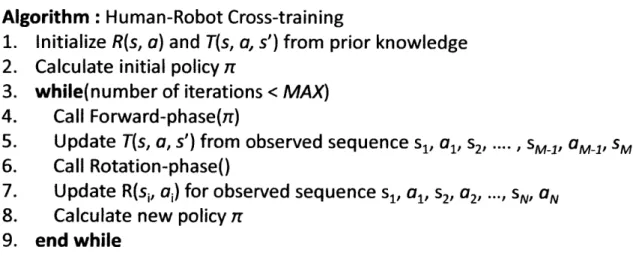
The Human-Robot Cross-training algorithm is summarized in Figure 4-1. In Line 1, rewards R(s, a) and transition probabilities T(s, a, s') are initialized from prior knowledge about the task. In Line 2, an initial policy 7r is calculated for the robot; we used value iteration [47] in our implementation. In Line 4, the Forward-phase
Algorithm : Human-Robot Cross-training
1. Initialize R(s, a) and T(s, a, s') from prior knowledge 2. Calculate initial policy n
3. while(number of iterations < MAX)
4. Call Forward-phase(n)
5. Update T(s, a, s') from observed sequence s,, a,, S2., sm_,. am-1, sM 6. Call Rotation-phase()
7. Update R(si, aj) for observed sequence sl, a,, S2, a
2, ..., sNY aN
8. Calculate new policy rr 9. end while
Figure 4-1: Human-Robot Cross-Training Algorithm
function is called, where the human and robot train for the task. The robot chooses its actions depending on the current policy ir, and the observed state-action sequence is recorded. In Line 5, T(s, a, s') are updated based on the observed state-action sequence. T(s, a, s') describes the probability that, for a task configuration modeled by state s and robot action a, the human will perform an action such that the next state will be s'.
In the rotation phase (Line 6), the human and robot switch task roles. In this phase, the observed actions a E A are the actions performed by the human worker, whereas the states s E S remain the same. In Line 7, the rewards R(s, a) are updated for each observed state s and human action a. We then use the new estimates for R(s, a) and T(s, a, s') to update the current policy (Line 8). The new optimal policy is computed using standard dynamic programming techniques
[47].
In our implementation, we update the rewards (Line 7) as follows:
R(s, a) = R(s, a) + r (4.1)
The value of the constant r needs to be large enough, compared to the initial values of R(s, a), for the humans actions to affect the robot's policy. Note that our goal is not to examine the best way to update the rewards, as this has proven to be task-dependent
the reward update of Eq. 4.1 as an example. Knox and Stone [28] evaluate eight methods for combining human inputs with MDP reward in a reinforcement learning framework. Alternatively, inverse reinforcement learning algorithms could be used to estimate the MDP rewards from human input [1].
We iterate the forward and rotation phases for a fixed number of MAX iterations, or until a convergence criterion is met.
4.1.2
Forward Phase
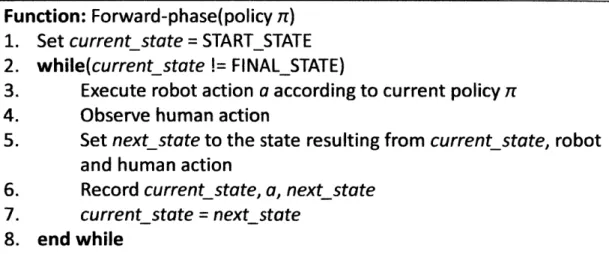
The pseudocode of the forward phase is presented in Figure 4-2. In Line 1, the current state is initialized to the start step of the task episode. The FINALSTATE in Line 2 is the terminal state of the task episode. In Line 3, the robot executes an action a assigned to a state s, based on the current policy ir. The human action is observed (Line 4) and the next-state variable is set according to the currentstate, the robot action a and the human action. In our implementation, we use a look-up table that sets the next state for each state and action combination. Alternatively, the next state could be directly observed after the human and robot finish executing their actions. The state, action, and next state of the current time-step are recorded (Line 6).
4.1.3
Rotation Phase
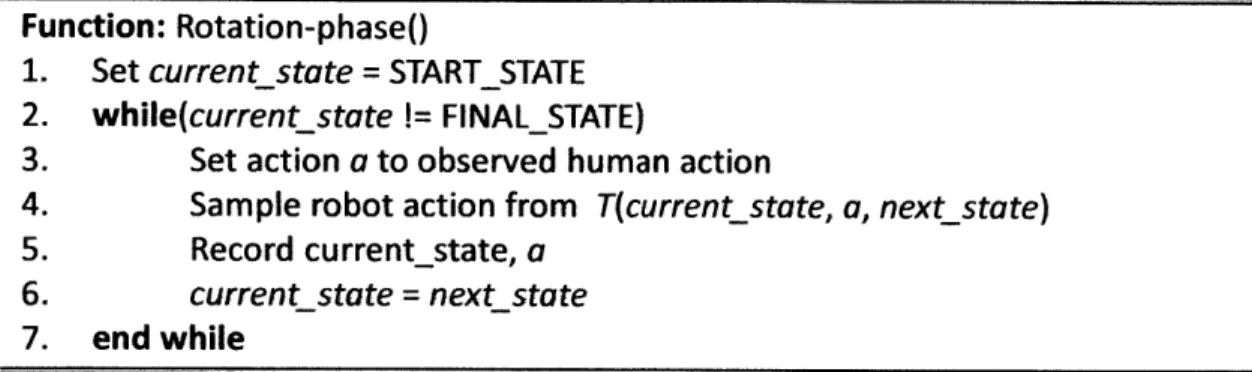
The pseudocode of the rotation phase is presented in Figure 4-3. In Line 3, the action a is the observed human action. In Line 4, a robot action is sampled from the transition probability distribution T(s, a, s').
Just as the transition probability distributions of the MDP are updated after the forward phase, the robot policy is updated to match the humans expectations after the rotation phase. This process emulates how a human mental model would change while working with a partner. A key feature of the cross-training approach is that it also provides an opportunity for the human to adapt to the behavior of the robot.
Function: Forward-phase(policy n?) 1. Set currentstate = STARTSTATE 2. while(currentstate != FINALSTATE)
3. Execute robot action a according to current policy n 4. Observe human action
5. Set nextstate to the state resulting from currentstate, robot and human action
6. Record currentstate, a, nextstate
7. currentstate = nextstate
8. end while
Figure 4-2: Forward Phase of the Cross-Training Algorithm
4.1.4 Reinforcement Learning with Human Reward
Assign-ment
We compare the proposed formulation to the interactive reinforcement learning ap-proach, wherein the reward signal of an agent is determined by interaction with a human teacher [55]. We use SARSA(A) with greedy policy [51] as the reinforcement learning algorithm, due to its popularity and applicability to a wide variety of tasks. In particular, SARSA(A) has been used to benchmark TAMER framework [27], as well as to test TAMER-RL [28, 29]. Variations of SARSA have been used to teach a mobile robot to deliver objects [46], for navigation of a humanoid robot [39] and in an interactive learning framework, wherein the user gives rewards to the robot through verbal commands [53]. Furthermore, our implementation of SARSA(A) would be identical to Q-Learning with Interactive Rewards [54], if we removed eligibility traces on SARSA and, in the case of a greedy policy, for both algorithms.
After each robot action, the human is asked to assign a good, neutral, or bad reward
{-+r,
0, -r}. In our current implementation, we set the value of r, the reward signal assigned by the human, to be identical to the value of the reward update in cross-training (Eq. 4.1 in Section 4.1) for comparison purposes.Function: Rotation-phase(
1. Set currentstate = STARTSTATE
2. while(currentstate != FINALSTATE)
3. Set action a to observed human action
4. Sample robot action from T(currentstate, a, nextstate)
5. Record currentstate, a
6. currentstate = nextstate
7. end while
Figure 4-3: Rotation Phase of the Cross-Training Algorithm.
4.2
Human-Robot Teaming Experiments
We conducted a large-scale experiment (n = 36) to compare human-robot cross-training to standard reinforcement learning techniques.
4.2.1
Experiment Hypotheses
The experiment tested the following four hypotheses about human-robot team per-formance:
" Hypothesis 1: Human-robot interactive planning with cross-training will im-prove quantitative measures of human-robot mental model convergence and mental model similarity compared to human-robot interactive planning using reinforcement learning with human reward assignment. We base this hypothesis on prior work indicating that cross-training improves similarity of mental models among human team members [34, 13].
" Hypothesis 2: Participants who cross-trained with the robot will agree more strongly that the robot acted according to their preferences, compared to participants who trained with the robot by assigning rewards. Furthermore, we hypothesize that they will agree more strongly that the robot is trustwor-thy. We base this hypothesis upon prior work [49] that indicated that humans
find the robot more trustworthy when it emulates the effective coordination behaviors observed in human teams.
" Hypothesis 3: Human-robot interactive planning with cross-training will im-prove team-fluency metrics on task-execution compared to human-robot interactive planning using reinforcement learning with human reward assign-ment. We base this hypothesis on the wide usage of cross-training to improve performance in human teams [34}.
* Hypothesis 4: The learning experience within a virtual environment of training with a robot will transfer to an improvement in team fluency metrics and subjective performance measures, when working with the actual robot at the task execution phase.
4.2.2
Experiment Setting
As a proof of concept, we applied the proposed framework to train a team of one human and one robot to perform a simple place-and-drill task. In the task, there were three positions that could either remain empty or have a screw placed or drilled into them. The human's potential actions included either the placement of a screw in one of the empty holes, or waiting (no-action), while the robot could either drill each placed screw or wait.
Although this task is simple, we found it adequate for the testing of our framework as there is a sufficient variety of ways to accomplish the task among different per-sons. For example, some participants preferred to place all screws in sequence from right-to-left and then have them drilled in the same sequence, while others preferred to place and drill each screw before moving on to the next. For the humans who preferred to place all three screws first before drilling, there are 3! x 3! = 36 different potential orderings for the placement and drilling of the screws. For those who anno-tated as their preference to have a screw drilled immediately after placement, there are 3! = 6 different possible orderings. Therefore, there are a total of 36
+
6 = 42 different potential orderings for these two high-level strategies. This is a lower boundon the possible human preferences for this task, as it does not include the case of a mixed strategy, where the human preferred to have the robot drill one screw imme-diately after placement, but only drill the remaining screws after they had all been placed. The participants consisted of 36 subjects recruited from MIT. Videos of the experiment can be found at: http://tiny.cc/5q685w
4.2.3
Human-Robot Interactive Training
Before initiating training, all participants were asked to describe, both verbally and in written form, their preferred method of executing the task. We then initialized the robot policy using a set of prespecified policies, in a way clearly different from the participant's preference. We did this to avoid the potential trivial case in which the initial policy of the robot matches the preferred policy of the user, and also to evaluate mental model convergence starting from different human and robot mental models.
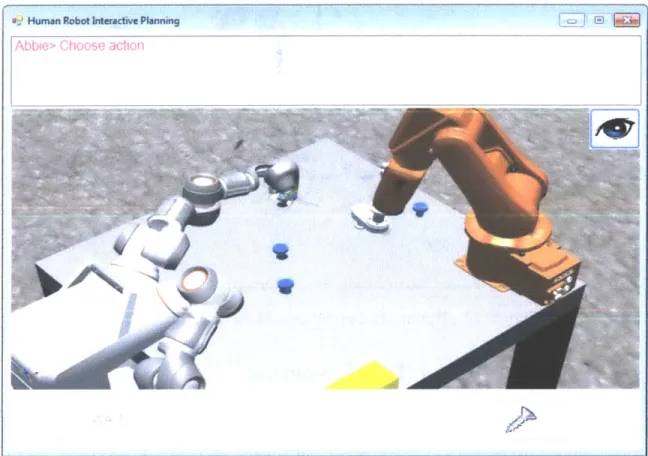
The participants were randomly assigned to two groups: Group A and Group B. Each participant then underwent a training session within the ABB RobotStudio virtual environment, where the human controlled the white anthropomorphic "Frida" robot depicted on the left in (Figure 4-4) while working with the orange industrial robot, "Abbie," on the right. The human chose an action in discrete time steps and observed the outcome by watching "Frida" move concurrently with "Abbie." The motions of both human and robot actions were predefined, and there was a single motion for each action.
Depending on the assigned group, the participant underwent one of the following training sessions:
1. Cross-training session (Group A): The participant iteratively switched positions with the virtual robot, placing the screws during the forward phase and drilling during the rotation phase.
2. Reinforcement learning with human reward assignment session (Group B): This is the standard reinforcement learning approach, wherein the participant placed
screws and the robot drilled at all iterations, with the participant assigning a positive, zero, or negative reward after each robot action [17].
Figure 4-4: Human-Robot Interactive Planning Using ABB RobotStudio Virtual En-vironment. The human participant controls the white anthropomorphic "Frida" robot on the left, to work with the orange industrial robot, "Abbie," on the right.
For the cross-training session, the policy update (Line 8 of Figure 4-1, Section ??) was performed using value iteration with a discount factor of 0.9. The SARSA(A) parameters in the standard notation of SARSA [51] were empirically tuned (A =
0.9, y = 0.9, a = 0.3) for optimal task performance.
After the training session, the mental model of all participants was assessed using the method described in Section 3.4. For each workbench configuration through task completion, participants were asked to choose a placing action and their preference for an accompanying robot drilling action, based on the training they had experienced together (Figure 4-5).
a: Human Robot Intvactive Planning
Abbie> Choose action
Ow jMW
ai Foi ml
ROBOT
WAITS
Figure 4-5: Human-Robot Mental Model Elicitation Tool
4.2.4
Human-Robot Task Execution
We then asked all participants to perform the place-and-drill task with the actual robot, Abbie. To recognize the actions of the human, we used a Phasespace motion-capture system of eight cameras [451 that tracked the motion of a Phasespace glove worn by the participant (Figure 4-6). Abbie executed the policy as learned from the training sessions. The task execution was videotaped and later analyzed for team fluency metrics. Finally, all participants were asked to respond to a post-experiment survey.
4.3
Results and Discussion
Results of the human subject experiments indicate that the proposed cross-training method outperforms standard reinforcement learning in a variety of quantitative and qualitative measures. This is the first evidence that human-robot teamwork is im-proved when a human and robot train together by switching roles in a manner similar
Figure 4-6: Human-Robot Task Execution
to effective human team training practices. Unless stated otherwise, all the p-values in this section are computed for two-tailed, unpaired t-tests with unequal variance.
4.3.1
Quantitative
MeasuresMental Model Similarity
As described in Section 3.4, we computed the mental model similarity metric as the ratio of human drilling actions matching the actions assigned by the robot policy to the total number of drilling actions required for task completion. Participants in Group A had an average ratio of 0.96, compared to an average ratio of 0.75 in Group B (p < 0.01). This shows that participants who cross-trained with the robot developed mental models more similar to the robot teaming model than participants who trained with the robot by assigning rewards.
Mental Model Convergence
Mental model similarity was also reflected by similar patterns of actions observed during the training process, and by decreased robot uncertainty about the human's
action selection, as computed by the entropy rate of the Markov Decision Process (Section 3.3). We computed the entropy rate at each training round using the pre-ferred robot policy, as elicited by the human with the mental model elicitation tool (Figure 4-5 of Section 4.2.3). Since the initial value of the entropy rate varies for different robot policies, we used the mean percent decrease across all participants of each group as a metric to compare cross-training to reinforcement learning with human reward assignment. To calculate the entropy rate in the human reward assign-ment session, we updated the transition probability matrix T from the observed state and action sequences, in a manner identical to how we calculated the entropy-rate for the cross-training session. We did so for comparison purposes, as SARSA(A) is a model-free algorithm and does not use T in the robot action selection [51].
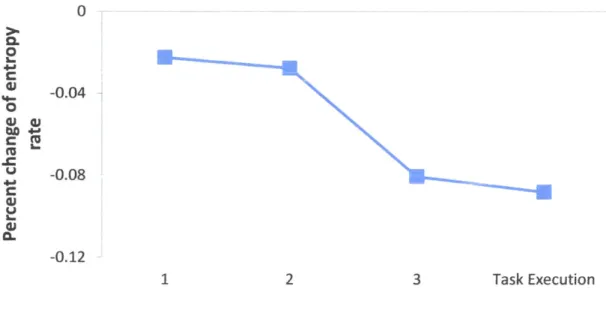
Figure 4-7 shows the entropy rate after each training round for participants in both groups. We considered only the 28 participants who did not change their preference. The difference between the two groups after the last training round is statistically significant (p = 0.04), indicating that the robot's uncertainty about the human par-ticipant's actions after training was significantly lower for the cross-training group than in the group that used reinforcement learning with human reward assignment.
0% --- reinforcement 0 -5% 0 olearning with human reward -10% assignment -15% -cross-training o~0 -20% 1 2 3 Training Rounds
Figure 4-7: Human-Robot Mental Model Convergence. The graph shows the percent decrease of entropy rate over training rounds.
We noticed that the cross-training session lasted slightly longer than the rein-forcement learning with human reward assignment session, as switching roles took more time on average than assigning a reward after each robot action. Since partic-ipants often interrupted training to interact with the experimenters, we were unable to reliably measure the training time for the two groups.
The above results support our first hypothesis: Cross-training improves quantita-tive measures of human-robot mental model convergence.
4.3.2
Qualitative Measures
After each training round, each participant was asked to rate his or her agreement with the following statement on a five-point Likert scale: "In this round, Abbie performed her role exactly according to my preference, drilling the screws at the right time and in the right sequence." Participants were also asked to respond to a survey upon completion of the experiment. Subjects who cross-trained and then executed the task with Abbie (Group A) selected a significantly higher mark on the Likert scale than those who trained with Abbie using the standard reinforcement learning method (Group B) for the following statements:
" "In this round, Abbie performed her role exactly according to my preference, drilling the screws at the right time and in the right sequence.":
(For the final training round) Group A: 4.52 [SD=0.96]; Group B: 2.71 [SD=1.21]; p < 0.01
" "In the actual task execution, Abbie performed her role exactly according to my preference, drilling the screws at the right time and in the right sequence.": Group A: 4.74 {SD=0.45]; Group B: 3.12 {SD=1.45]; p < 0.01
" "I trusted Abbie to do the right thing at the right time.": Group A: 3.84 [SD=0.83]; Group B: 2.82 [SD=1.01]; p < 0.01 " "Abbie is trustworthy.":
" "Abbie does not understand how I am trying to execute the task.": Group A: 1.89 [SD=0.88]; Group B: 3.24 [SD=0.97]; p < 0.01 " "Abbie perceives accurately what my preferences are.":
Group A: 4.16 [SD-0.761; Group B: 2.76 [SD=1.03}; p < 0.01
The p-values above are computed for a two-tailed Mann-Whitney-Wilcoxon test. The results show that participants in Group A agreed more strongly that Abbie had learned their preferences, compared to those in Group B. Furthermore, cross-training had a positive impact on their trust in Abbie, in accordance with prior work [49]. This supports Hypothesis 2 of Section 4.2.1. The two groups did not differ significantly when subjects were asked whether they themselves were "responsible for most of the things that the team did well on this task," whether they were "comfortable working in close proximity with Abbie" or whether they and Abbie "were working toward mutually agreed upon goals."
4.3.3
Fluency Metrics on Task Execution
We elicited the fluency of the teamwork by measuring the concurrent motion of the hu-man and robot and the huhu-man idle time during the task execution phase, as proposed in [23]. The measurements of the above metrics were evaluated by an independent analyst who did not know the purposes of the experiment, nor whether a participant had been a member of Group A or B. Additionally, we automatically computed the robot idle time and human-robot distance. Since these metrics are affected by the human's preferred way of performing the task, we used only the subset of partici-pants who self-reported their preferred strategy as "while Abbie is drilling a screw, I will place the next one." This subset consisted of 20 participants and was the largest subset of participants who reported the same preference on task execution.
Concurrent Motion
We measured the time duration in which both human and robot were concurrently in motion during the task execution phase, and found that participants in Group A who