HAL Id: hal-01148949
https://hal.inria.fr/hal-01148949
Preprint submitted on 13 May 2015HAL is a multi-disciplinary open access archive for the deposit and dissemination of sci-entific research documents, whether they are pub-lished or not. The documents may come from teaching and research institutions in France or abroad, or from public or private research centers.
L’archive ouverte pluridisciplinaire HAL, est destinée au dépôt et à la diffusion de documents scientifiques de niveau recherche, publiés ou non, émanant des établissements d’enseignement et de recherche français ou étrangers, des laboratoires publics ou privés.
Algebra [Ongoing work]
Stéphane Fetcher, Luigi Liquori
To cite this version:
Stéphane Fetcher, Luigi Liquori. Mini-Foc A Kernel Calculus for Certified Computer Algebra [Ongoing work]. 2005. �hal-01148949�
Mini-Foc: A Kernel Calculus
for Certified Computer Algebra
[Ongoing Work]
St´
ephane Fechter
aand Luigi Liquori
ba LIP6, Universit´e Paris VI b INRIA Sophia Antipolis
Abstract
The Foc language is designed to bring solutions on the reliability of the software, in particular on the development and the reusing of certified libraries, especially for Certified Computer Algebra.
The Foc project aims at building an environment to develop certified computer algebra libraries. The project develops a language called Foc, where any implemen-tation must come with a proof of its correctness. This includes of course pre- and post- condition statements, but also proofs of purely mathematical theorems. In this context, reusability of the code, but also of the correctness proofs is of very important concern: a tool written for mathematical Groups should be available for the mathematical Rings, provided the system knows that every Ring is a Group, wich can be faithfully modeled by suitable subtyping relation.
For this, this formal language allows to implement certified components called Collections. These collections are specified and implemented step by step: the programmer describes formally – the properties of the algorithm, – the context in which they are executed, – the data representation and proves formally that the implemented algorithms satisfies the specified properties. This programming paradigm implies the use of classic oriented-object features and the use of module features like interfaces and encapsulation of data representation.
This conception of the object oriented programming brings the question where the Foc language is situated in relation to others more classic object-oriented languages. To answer to this question, we propose a kernel of Foc called Mini-Foc. With this kernel, we are interested by the programming aspect of Foc (proof aspect are left to suitable extensions)
Thus, the main ingredients of Mini-Foc, are multiple inheritance, late binding, overriding, interfaces and encapsulation of the data representation. We specify
This is a preliminary version. The final version will be published in Electronic Notes in Theoretical Computer Science
formally the syntax, the semantics and the type system.
Key words: Certified Computer Algebra, Existential-types, Object Orientation, Syntax, Operational semantics, Type system
1
Introduction
This paper is in relation to the problem of the reliability of the software. In particular, we are interested by the development of certified libraries. More-over, we like to develop them by reusing other certified libraries. The Foc language provides solutions for this problem. Its purpose is to give the pos-sibility to build algebraic structures with a stop of specification, a step of development and a step of proof, and by using object oriented features. These structures may be used in a safety way. For this, Foc provides a mechanism of encapsulation to protect the representation of invariants described in the structures.
The collections and species are the two notions of package units provided by Foc. A collection can be seen as an abstract data type, that is a module containing the definition of a type, called the carrier-type, a set of functions manipulating values (whose the types is the same of the carrier-type), called the entities of the species and a set of properties with their proofs. The concrete definition of the carrier-type is hidden for the end users: it is encap-sulated. This encapsulation is fundamental to ensure that the invariant on the data representation associated with the collection (e.g. the entities are even natural numbers) is never broken. A collection is the ultimate refinement of specifications introduced step by step with different abstraction levels. Such a specification unit is called a species: it specifies a carrier-type, functions and properties (both called the methods of the species). Carrier-type and methods may be defined or only declared. In the latter case, the definition of the function is given later in more concrete species, and similarly the proof of a property can be deferred. Species come with late binding: the defini-tion of a funcdefini-tion may use a funcdefini-tion that is only declared at this level. A complete species is a species whose the methods are defined and for each prop-erty, a proof must be provided. A collection built from a complete species. A species B refines a species A if the methods introduced in A and/or the carrier-type of A are made more concrete (more defined) in B. This form of refinement is completed with the inheritance mechanism, that allows us to build a new species from one or more existing species. The new species inherits the carrier-type and the methods of the inherited species. The new species can also specify new methods or redefine inherited ones.
Carrier-type, multiple inheritance, late binding, encapsulation, refinement are the elementary ingredients of our approach that ensure that the generated code satisfies the specified properties. The purpose of this paper is to formalize these elementary ingredients in order to fit with oriented-object languages. For
this, we formally define the type system and semantics of the core language we call Mini-Foc.
The presentation is intentionally kept informal, with few definitions, no full type systems in appendix and no theorems. Quite simply, the main aim of this paper is to introduce and set the formal basis of the Foc language through a minimal but still powerful kernel calculus Mini-Foc, and compare existing systems concerning languages/calculi suitable for certified computer algebra.
Road Map.
The Section 1 presents the pseudo-terms and types of Mini-Foc. Section 2 present an informal overview of Mini-Foc; Section 3 presents an operational semantics, while Section 4 presents the typing rules. Lastly, Section 5 presents related works and conclude. A full page dedicated to the Foc project can be found in
http://www-spi.lip6.fr/foc/index-en.html.
2
An overview of Mini-Foc
In this section, we illustrate some features of Foc trough Mini-Foc. The exam-ples of this section are simple sets equipped with some operations.
Abuse of notations for the examples
To simplify the examples, in addition to Lambda-calculus expressions, we use local definitions let x=e and y=e and ... in e `a la Caml. And we use the conditional expression if x then y else z (if the expression x is true then the expression y is evaluated else it is the expression z). Moreover, in order to name the collection we use a global let. Also we add the symbols + and *, which are respectively the addition and the multiplication operations on the integers. And the == is added for the equality test on two integers.
The op set species
The Mini-Foc environment allows to describe these sets by following a generic way: spec op_set in { rep α = int; sig neutral : α; sig op : α -> α -> α; def id : α -> α = λself.λx.x; }
The species op set represents a set having an element neutral, equipped with a binary operation op and the identity function id. The representation of elements for this set is given by the type int (the type for the integers) introduced by the notation rep α = int. This type is called the carrier type.
At this level of abstraction, neutral and op are declarations of the species op set. On the other hand, a definition is given for id. In this case, id is a method of the species op set. The expression to define a method, begins always by a λx where x represents the self reference. To avoid confusions, this variable is written with self for the examples. For the rest of examples, when self is not used, to simplify, we omit λself in the method definitions. The type variable α, introduced with rep α = int, is an alias for the carrier type. It is used to define the types of declarations and methods. Also, it allows to distinguish an integer of our working set from any integers.
The types of declarations and methods don’t take in account the variable self. For example the definition of id (that is λself.λx.x) have the type α -> α, that is the type for λx.x expression.
The add set and add set species
Mini-Foc allows to write other species by inheritance. For the examples, we write species in order to give a definition for the declarations neutral and op.
spec add_set inh op_set in { rep α = int;
def neutral : α = 0 ;
def op : α -> α -> α = λx.λy.x+y; }
The species add set inherits of the method id. And the declarations neutral and op from add set, are defined respectively by the number 0 and the func-tion λx.λy.x+y.
The method neutral have the type int, the method op have the type int -> int -> int and the method id have the type int -> int. These types, obtained by replacing α by int, give an internal vision of the species add set. But for an outside vision, we just know that the method neutral have the type α, the method op have the type α -> α -> α and the method id have the type α -> α. The set of name methods with their types, by forgetting to replace α by the carrier type, is called the interface of the species.
For our examples, we give an other derivation of the species op set: spec mult_set inh op_set in {
rep α = int;
def neutral : α = 1 ;
def op : α -> α -> α = λx.λy.x*y ; }
The modulo 2 species
Mini-Foc allows to redefine methods as it shows below: spec modulo_2 inh add_set in {
rep α = int;
let r = x+y in if r == 2 then self!neutral else r ; def one : α = 1; }
The method op has been redefined with a new expression. In this definition, the method neutral is used by invoking it on the variable self. Mini-Foc pro-vides the late binding for the methods. That is the last definition of neutral, will be considered when the method op will be invoked. Thus, it’s not necessar-ily that self!neutral refers to the definition situated in the species add set. On the other hand, Mini-Foc doesn’t provide the possibility to regive an in-stance for the variable α unless it’s the same that the previous one. Indeed, if we write rep α = bool in the species modulo 2, then the typing for the methods is broken. An other intuitive reason is that we work on a underlying set whose the representation of elements is fixed. As this representation is given by a type (the carrier type), then this type will never change.
The some set species
Mini-Foc provides also multi-inheritance possibilities: spec some_set inh add_set; mult_set in {
rep α = int;
def eq : α -> α -> bool=λx.λy.x == y; }
The species some set inherits from add set and mult set. The methods of add set are redefined in mult set. By convention, they are the methods of mult set which are conserved.
The cartesian species
Lastly, Mini-Foc provides the possibility to write parameterized species as the species cartesian:
spec cartesian (c1 is op_set, c2 is op_set) inh op_set in { rep α = c1!rep * c2!rep;
def first : α -> c1!rep = λx.fst(x); def second : α -> c1!rep = λx. snd(x); def neutral : α = (c1!neutral , c2!neutral); def op : α -> α -> α = λx.λy.
let l1 = self!first x and l2 = self!first y and r1 = self!second x and r2 = self!second x in ( c1!op l1 l2 , c2!op r1 r2); }
The above species gets two parameters c1 and c2 precised by the species op set. On c1 and c2, we can invoke the methods of op set as it is done in the methods neutral and op. On the other hand, through c1 and c2, we have just access to the interface of the species op set. Moreover the interface linked to c1 and the one linked to c2 are considered as different. Thus, for example, the expression c1!id c2!neutral is badly typed. On the other hand, c1!id
c1!neutral is well typed since the invocation methods are done on the same parameter.
In the species cartesian, we define the carrier type with the cartesian product of c1!rep and c2!rep. The annotation c1!rep means that we refers to the carrier type linked the parameter c1. c1!rep and c2!rep can be also used to define the types of declarations and methods (e.g. the methods first and second).
Creation collections from above species
The species add set, mult set, modulo set and some set are complete species. That is species whose the carrier type is given and all methods are defined (there are not any declarations). From such species, we can create collection. For example:
let col_add = impl add_set ;; let col_mult = impl mult_set ;;
The collections col add and col mult are created respectively from the species add set, mult set. On the collection col add, we know just the interface of the species add set. Likewise for col mult whose the interface is different of the one for col add. On a collection, we can invoke methods:
col_add ! op col_add ! neutral col_add ! neutral
On the other hand, since col add have the interface of add set, it is forbidden to give integers in argument for the methods op. In spite of the carrier type definition is int in the species add set.
The interfaces of col add and col mult is the same that the species op set. Thus, we can create a new collection from cartesian by applying it these two collections:
let col_cart = impl cartesian(coll_add,coll_mult) ;;
Also, it is possible to apply on cartesian, collections having most methods than the interface of op set. For example, we can apply collections cre-ated from modulo 2 whose the method one is not included in the interface of op set.
3
Pseudo-terms and types
This section present the syntax and the operational semantics of Mini-Foc.
Notational conventions
In this paper the symbols x, y, . . . range over the set X of variables, the symbol S ranges over the set S of species names, and ST over species table. The symbols m, n, . . . range over the set M of method names. The symbol κ ranges over the set K of constants. The symbols α, β, γ, . . . range over the set
V of type-variables. All symbols can be indexed.
Also, for two vectors mr and mt, we use the letter m and t in index in order
to distinguish these two vectors.
Syntax
An Mini-Foc program is a pair (ST, e) of a species table, and an expression. The syntax of type in Mini-Foc is as follows:
τ ::= ι | α | τ → τ | τ ∗ τ | First-Order Types
x ! rep | ∃α.τ | hrep α=τ ; sig m:τ ; def m:τ i Mini-Foc Types
The syntax of types is composed of two parts: first-order types and types peculiar to Mini-Foc. A first-order type can be an atomic type ι for the con-stants, a type-variable (for existential-types, to be defined below), or an arrow type or a cartesian type. The types proper to Mini-Foc can be a record-type, a representation-type or an existential-type. Intuitively:
• a record-type has the form hrep α=τ ; sig m:τ ; def m:τ i that is the type of
collection, which is typically an instance of a species. The terms def m:τ are the types of defined methods. And the terms sig m:τ are the types of declared methods (a kind of virtual). The keyword rep introduces the carrier-type τ of the collection. In the types τ of sig m:τ and def m:τ , α can occurs free (i.e. rep acts as a binder for α). Note that the carrier-type is not recursive.
• an existential-type ∃α.τ is typically the type of a species (the type τ being
a record-type). Thanks to this type, we can abstract the carrier-type of collection, a particularity of a collection.
• a x ! rep type is generally used in the carrier-type definition of parameterized
species. The variable x denotes a collection in the current context. The variable x in x ! rep denotes (with a little abuse of notation) the carrier type of x. Thus when the variable x will be instanced by a collection, x ! rep will have to replaced by the carrier-type of this collection.
The syntax of species tables and expression are as follows:
ST ::= spec S (x is S , y:τ ) inh S in {rep α=τ ; sig m:τ ; def m:τ =λx.e}
e ::= e ! m | impl S(e , e) | hrep α=τ , def m:τ =λx.ei
κ | x | λx.e | e e | e , e | fix(λx.e)
• A species S is made of (formal) parameters (x is S , y:τ ), i.e. a list of inherited
species S introduced by inh and a body {rep α=τ ; sig m:τ ; def m:τ =λx.e}. The body of species introduces the definition of the carrier-type by rep α=τ ,
the declarations by sig m:τ (m is the name of the declaration and τ its type), and methods by def m:τ =λx.e (m is the name of the method, λx.e is its definition and τ its type). The variable x, bound by λ, in the definition of a method, is used for the self reference. Like the type of collection, all occurrences of α in the type of declarations and methods, are bound by rep and can be substituted by the carrier-type τ , in order to obtain a “runnable” collection.
A species S take two types of parameters. The first type of parameter is x is S. An instance of this parameter will have to be a collection whose the interface is the one of the species S. And, in the body of the species, we have just an abstract vision of S when we use the parameter x.
The second type of parameter has the classical meaning as in any con-structor `a la new and have the form x:τ . An instance x ∈ x of this parameter will have to be an expression of type τ ∈ τ .
• The expressions e of the Mini-Foc language is divided in Lambda-calculus
ex-pressions and the proper exex-pressions of the language. The Lambda-calculus expressions are classical. There are constants given by κ, variables x, ab-stractions λx.e, applications e e, products e , e and the recursive function fix(λx.e).
• The main Mini-Foc expression is the collection hrep α=τ , def m:τ =λx.ei
that can be viewed like a complete object. Like a species, def m:τ =λx.e are the methods of the collection. On the other hand, unlike species, a collection doesn’t possess declaration (i.e. no virtual methods). Moreover, the methods are distinct. The carrier-type of a collection is also introduced by rep α=τ . And all occurrences of α in the types of methods are bound by rep. A collection is destined to be abstracted, on the carrier-type, for its final users.
• The second Mini-Foc expression is impl S(e1, e2). It allows to create a new
collection from species S. Since a species take some parameters, then we must pass in argument the list e1 of collections, and the list e2 of
Lambda-calculus expressions.
• Lastly, as in any “decent” object-oriented calculus, the e ! m allows to invoke
a method m on a collection.
4
Operational Semantics
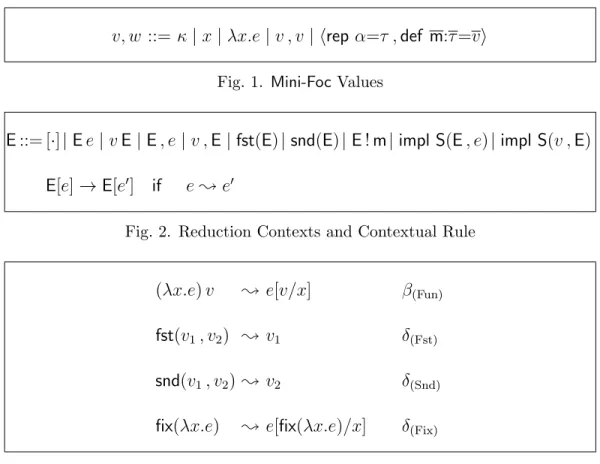
We present a classical small-step operational semantics for the pure functional call-by value fragment of Mini-Foc. The semantics is described by a set of small-step reduction rules (see Figure3and4) and a set of evaluation contexts (see Figure 2). Thus the evaluation of an expression, if it terminates, can be visualized step-by-step until obtaining an expression that can’t be reduced anymore. The values are described in the Figure1; a value can be a constant κ, a variable x, an abstraction λx.e or a pair of value v , v. A value can be also
v, w ::= κ | x | λx.e | v , v | hrep α=τ , def m:τ =vi
Fig. 1. Mini-Foc Values
E ::= [·] | E e | v E | E , e | v , E | fst(E) | snd(E) | E ! m | impl S(E , e) | impl S(v , E)
E[e] → E[e0] if e; e0
Fig. 2. Reduction Contexts and Contextual Rule
(λx.e) v ; e[v/x] β(Fun)
fst(v1, v2) ; v1 δ(Fst)
snd(v1, v2) ; v2 δ(Snd)
fix(λx.e) ; e[fix(λx.e)/x] δ(Fix)
Fig. 3. Mini-Foc Lambda-like Rules
a collection (i.e. an object) hrep α=τ , def m:τ =vi whose the methods are also values (recall that method-bodies are functions whose first parameter is the object itself, and that functions are values). There are two types of small-step reduction rules :
• The first type of rules, in the Figure 3, are the classic rules of
Lambda-calculus. The rule β(Fun) is the beta reduction. The expression (λx.e) v is
reduced by replacing all free occurrence of x in e, by the value v. The rules δ(Fst) and δ(Snd) are respectively, the left and right projection on the pair of
values. And the rule δ(Fix) apply the fix point operator on the an abstraction
λx.e by replacing all free occurrences of x in e by fix(λx.e) itself.
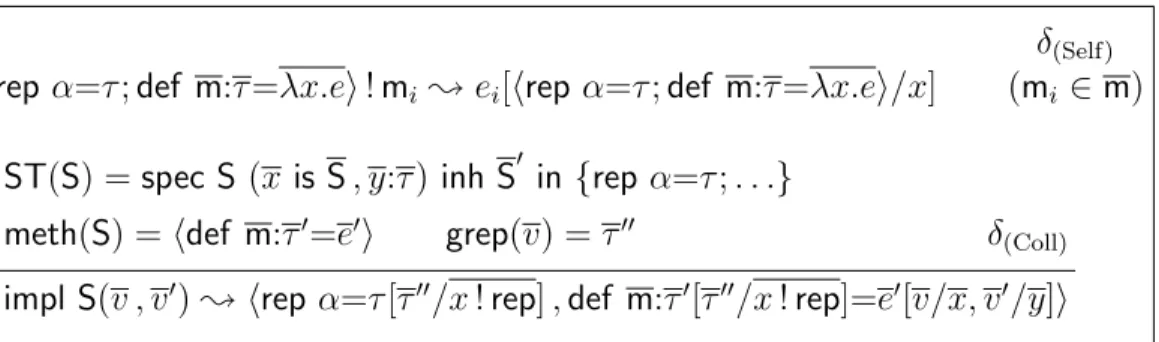
• The second type of rules, in the Figure4, evaluates proper Mini-Foc
expres-sions. The rule δ(Self) allows to reduce an invocation of a method mi on a
collection hrep α=τ ; def m:τ =λx.ei. For this, we retrieve the definition λx.ei
corresponding to the method mi in the list m:τ =λx.e. The free occurrences
of x in ei represents the self reference. Thus, these occurrences of x in ei are
replaced by the collection itself in order to obtain the output expression.
• The δ(Coll) rule is used to reduce the creation of collection from a species
S. This rule must retrieve the species S in the species table ST. By using the function meth (see Figure ??) on the species S, we return all methods m:τ0=e0 of the species. Thanks to the function meth, the returned methods are distinct and correspond to the multi-inheritance of the species. Free
hrep α=τ ; def m:τ =λx.ei ! mi ; ei[hrep α=τ ; def m:τ =λx.ei/x]
δ(Self)
(mi ∈ m)
ST(S) = spec S (x is S , y:τ ) inh S0 in {rep α=τ ; . . .}
meth(S) = hdef m:τ0=e0i grep(v) = τ00 δ(Coll)
impl S(v , v0); hrep α=τ[τ00/x ! rep] , def m:τ0[τ00/x ! rep]=e0[v/x, v0/y]i
Fig. 4. Mini-Foc ad hoc Rules
occurrences of parameters x and y may be in these methods. In this case, for the output result, x or replaced by the collection values v and the y are replaced by the Lambda-calculus values v0. Then, free occurrences of x ! rep (the carrier-type references of parameter x) may be in the carrier-type τ and the method types of the species S. Thus, these special variables must be replaced by the carrier-types of collections v. The function grep allows to return these carrier-types from v.
In the Figure ??, we define formally the functions grep and meth.
• The function grep takes in parameter a list of collection in order to return
the list of their carrier-types.
• The function meth takes in parameter a species S in order to return the list
of all its declarations and methods. Moreover, declarations and methods are distinct. If this list have not declarations, then the species S is complete. This property is used in the rule δ(Coll) (see Figure 4) in order to precise
that the creation of a collection must be done from a complete species.
• The function meth collects the inherited method according to the choosen
politics to deal with multiple inheritance (in case of conflict right-most method is selected by the dynamic lookup algorithm). Thus, when a method is redefined, it’s the right-st definition that is chosen. For this, the definition of meth usesF binary operation defined according to the rules (R2L), which returns the union of two lists of declarations and methods. In this returned list, if a method is redefined, then the most at the right one is preserved. And if a declaration possesses a correspondant method, then it is removed.
5
Type system
The typing rules, presented in the Figures6and7, allow to certify or not that an expression is well-typed in a given context. Formally, it is given by the relation Γ ` e : τ : the expression e is well typed with the type τ under the context Γ. This context is a typing environment defined by:
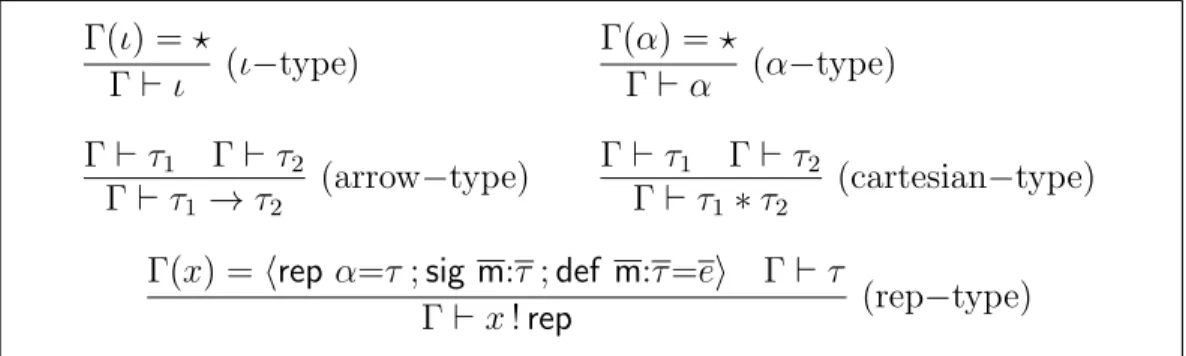
Γ(ι) = ? Γ ` ι (ι−type) Γ(α) = ? Γ ` α (α−type) Γ ` τ1 Γ ` τ2 Γ ` τ1 → τ2 (arrow−type) Γ ` τ1 Γ ` τ2 Γ ` τ1∗ τ2 (cartesian−type)
Γ(x) = hrep α=τ ; sig m:τ ; def m:τ =ei Γ ` τ
Γ ` x ! rep (rep−type)
Fig. 5. Mini-Foc well Formed Types
Γ(κ) = ι Γ ` κ : ι (Cst) Γ(x) = τ Γ ` x : τ (Var) Γ , x : τ1 ` e : τ2 Γ ` λx.e : τ1 → τ2 (Abst) Γ ` e1 : τ1 → τ2 Γ ` e2 : τ1 Γ ` e1e2 : τ2 (Apply) Γ ` e1 : τ1 Γ ` e2 : τ2 Γ ` e1, e2 : τ1∗ τ2 (Pair) Γ, x:τ ` e : τ Γ ` fix(λx.e) : τ (Fix)
Fig. 6. Lambda-calculus First-order Typing Rules
A typing environment is composed of variables x associated with their Mini-Foc type and composed of type-variables associated with their sort ?. It is also composed of constants κ associated with their Mini-Foc type and composed of the constant types ι assiocated with their sort ?.
We provide a function fresh, that takes in argument a typing environment Γ, in order to return a fresh type variable in relation to Γ.
The collections and species are expressions that use types in order to define the carrier-type and specify the types of methods. In relation to the context, these types must valid. For this, the relation Γ ` τ , presented in Figure 5
verify that the type τ is valid under the typing environment Γ. Not any types can be used to define the carrier-type or the type of a method. Only constant types, type-variables, carrier-type references and their arrows and cartesian types, are accepted. Moreover, a type variable α is valid if α is present in the actual typing environment. And a carrier-type reference x ! rep is valid if the collection variable x is present in the actual typing environment. The type of x, that is hrep α=τ ; sig m:τ ; def m:τ =ei, introducing a carrier type τ must be also valid.
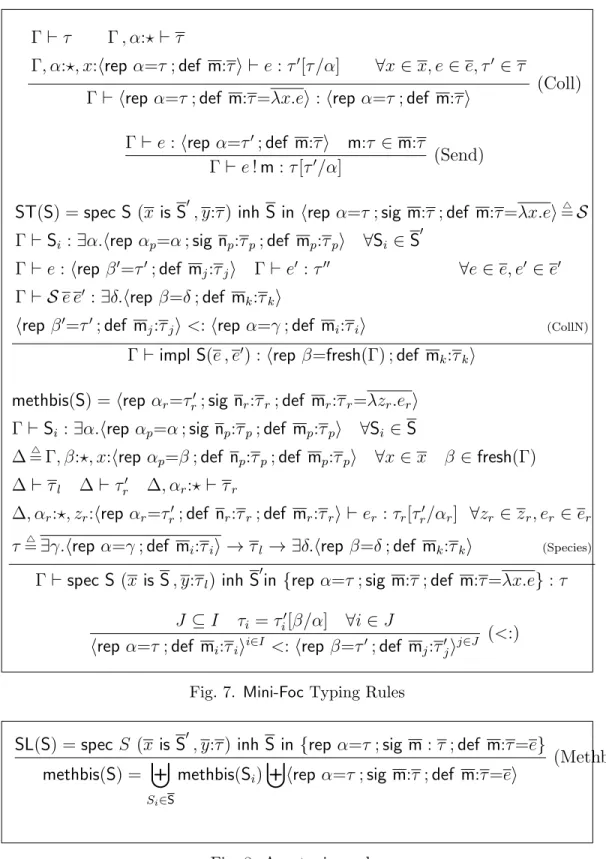
The rules for first-order typing of λ-expressions, described in Figure 6, are standard and they need no comment. The rules for Foc expressions are described in Figure 7. More precisely:
• The rule (Coll) allows to type a collection hrep α=τ ; def m:τ =λx.ei.
Intu-itively, a collection is well type under two conditions. The first condition is the carrier-type and the method types must be valid in relation to the
Γ ` τ Γ , α:? ` τ
Γ, α:?, x:hrep α=τ ; def m:τ i ` e : τ0[τ /α] ∀x ∈ x, e ∈ e, τ0 ∈ τ
Γ ` hrep α=τ ; def m:τ =λx.ei : hrep α=τ ; def m:τ i (Coll)
Γ ` e : hrep α=τ0; def m:τ i m:τ ∈ m:τ
Γ ` e ! m : τ [τ0/α] (Send)
ST(S) = spec S (x is S0, y:τ ) inh S in hrep α=τ ; sig m:τ ; def m:τ =λx.ei=4S Γ ` Si : ∃α.hrep αp=α ; sig np:τp; def mp:τpi ∀Si ∈ S
0
Γ ` e : hrep β0=τ0; def mj:τji Γ ` e0 : τ00 ∀e ∈ e, e0 ∈ e0
Γ ` S e e0 : ∃δ.hrep β=δ ; def mk:τki
hrep β0=τ0; def m
j:τji <: hrep α=γ ; def mi:τii (CollN)
Γ ` impl S(e , e0) : hrep β=fresh(Γ) ; def mk:τki
methbis(S) = hrep αr=τr0; sig nr:τr; def mr:τr=λzr.eri
Γ ` Si : ∃α.hrep αp=α ; sig np:τp; def mp:τpi ∀Si ∈ S
∆=4Γ, β:?, x:hrep αp=β ; def np:τp; def mp:τpi ∀x ∈ x β ∈ fresh(Γ)
∆ ` τl ∆ ` τr0 ∆, αr:? ` τr
∆, αr:?, zr:hrep αr=τr0; def nr:τr; def mr:τri ` er : τr[τr0/αr] ∀zr ∈ zr, er ∈ er
τ=4∃γ.hrep α=γ ; def mi:τii → τl→ ∃δ.hrep β=δ ; def mk:τki (Species)
Γ ` spec S (x is S , y:τl) inh S 0
in {rep α=τ ; sig m:τ ; def m:τ =λx.e} : τ
J ⊆ I τi = τi0[β/α] ∀i ∈ J
hrep α=τ ; def mi:τiii∈I <: hrep β=τ0; def mj:τ0jij∈J
(<:)
Fig. 7. Mini-Foc Typing Rules
SL(S) = spec S (x is S0, y:τ ) inh S in {rep α=τ ; sig m : τ ; def m:τ =e} methbis(S) = ]
Si∈S
methbis(Si)
]
hrep α=τ ; sig m:τ ; def m:τ =ei (Methb)
Fig. 8. Aux typing rules
actual context. The second condition is every method definition must be well typed. And the type of these definitions must correspond to the types given by the developer. As every method definition can refer to the col-lection itself, the typing is done in the actual typing environment extended
with the type of the collection itself.
Formally, we verify the carrier-type τ in the current typing environment Γ. And we verify the method types given by the developer, by extending Γ with α:?. This extension is necessary to indicate that the type-variable α refers to the carrier-type τ and it’s not free. Then, every method definition λx.e must be verified. As the bound variable x represents the collection itself, the expression e must be typed in the current environment extended with the collection type hrep α=τ ; def m:τ i. The type of the expression e must be the type given by the user whose all free occurrences of α are replaced by the carrier-type τ . That is the type of e must be τ0[τ /α]. Lastly, the returned type for the collection is hrep α=τ ; def m:τ i.
• The rule (Send) is used to type an invocation of a method m on an expression
e. Intuitively, an invocation of m on e, is valid if it exists a correspondent definition brought by e. Formally, the type of the expression e must be the one of a collection hrep α=τ0; def m:τ i. Then, the method m must be in m in order to retrieve the correspondent type τ . In this type, free occurrences of α that refers to the carrier-type, may exist. Thus the type returned for e ! m is τ with all occurrences of α replaced by the carrier-type τ0.
• The rule (CollN) is used to type the creation of a collection from a species
S eventually applied with collections e and an expressions e0. Intuitively, a collection can be created from impl S(e, e0) if the species S is complete. Moreover, for every parameter x is S0of the species S, the interface of e (from e) must correspond to the one of the species S0. More precisely, we fetch the species S in the species table ST, and then we typecheck it by providing all needed actual parameters. As expected, the type of a species must be an existential-type ∃δ.hrep β=δ ; def mk:τki representing the type of body of the
species S. Of course, the arguments must be well typed according to the type of the species S. Moreover, a “width-subtyping” relation must exist between hrep αp=α ; sig np:τp; def mp:τpi (from the type of the species S0 used for the
parameters) and hrep β0=τ0; def mj:τji (the type of collection arguments).
For this, we use the relation <: defined in the Figure7according to the rule (<:). It imposes that nn and mn are included in mj. Then, for any m:τ of
mn:τnand mn:τn, and for the correspondent m:τ0 of mj:τj, τ and τ0 must be
equal modulo α, β0. Thanks to this relation, we verify that the interface of the collection passed in argument, is the one expected by the correspondent parameter. Moreover, the collection may have more methods than expected ones by the parameter. Lastly, the type returned for the new collection is hrep β=fresh(Γ) ; def mk:τki that is the type ∃δ.hrep β=δ ; def mk:τki where δ
is replaced by a fresh variable in relation to the actual typing environment.
• Lastly, the rule (Species), allows to type a species
spec S (x is S , y:τ ) inh S0 in {rep α=τ ; sig m:τ ; def m:τ =λx.e}
rede-fined through the multi-inheritance. Then, the types of declarations and methods must be also valid. If the methods are redefined, or the decla-rations re-given, then their type must be preserved. Indeed, if there isn’t these constraints, the type soundness may be broken. Lastly, the definitions of methods must be have types respecting ones given by the developer.
Formally, we must retrieve the carrier-type, all declarations and methods of the species. For this, the function methbis(S) is used. Intuitively, this function resemble and works similarly to the function meth. It returns the carrier type, all declarations and method of the species S. But it verifies for multiple method names (from declarations and/or methods) that the types are the same. Moreover, if a method is redefined, the old definition is conserved. It allows to verify that every definition, for a given method, preserves the type of the method.
Then we must type every definition method of the species. This typing must be done in the actual typing environment extended with variables cor-responding to parameters, and with the variable representing the underlying collection of the species. But before to do these extension, we must verify for the parameters x is S, that every Si of S is well typed. And we must
verify for the parameters y:τl, that τl are valid. Then, we must verify that
the carrier-type τr0 and the declaration and method types τr of the species
S are valid.
Thus, the type of Simust be ∃α.hrep αp=α ; sig np:τp; def mp:τpi. Thus we
can verify the validity of τl, τr0 and τr, in the environment Γ extended with
collection variables x:hrep αp=β ; def np:τp; def mp:τpi with x ∈ x, where β
are fresh type-variables in relation to Γ. Indeed, occurrences of x ! rep can appear in τl, and τr0 and τr. We remark, that the sig np:τp are transformed
in def np:τp in order that the variables x ∈ x represent the collections.
As it is stated previously, every definition method erfrom def m : τ =λzr.er
correspondent, must be typed in the actual environment Γ extended with the variables corresponding to parameters and with the variable represent-ing the underlyrepresent-ing collection of the species. In particular, this last variable must zr with the type hrep αr=τr0; def nr:τr; def mr:τri. On this type, we
remark that sig nr:τr has been transformed in def nr:τr in order to the type
of zr represents well a collection type.
The type returned for er must equal to τr where all free occurrences of
αr is replaced by the carrier-type τr0.
Lastly, the type returned for the species, is an arrow type whose the first components correspond to the collection parameters, the second components correspond to the Lambda-calculus parameter and the last component is the an existential-type.
6
Relative works and conclusion
In the first part of this paper, we have informally presented Mini-Foc. We have been interested in classic object oriented features like multi-inheritance, late binding, redefinition methods, self references. But also other features like the carrier type, the interface and the abstraction have been presented. These features are particular to Mini-Foc.
The main difference with the classical object oriented languages, is that the species (comparable to classes) and the collections (comparable to objects) don’t provide state. Instead of that, the species and collections provides con-structions around representation of elements for sets. This representation is given by a type called the carrier type. For the outside world of the sets, the carrier type is abstract. In practice, it allows to avoid to break invariant representation. In order to provide these abstraction mechanism, we use the existential type. We have been inspired by ideas in [PT94] where the autors use the existential type to encapsulate the state of objects.
This version of Mini-Foc doesn’t provide all features of Foc. For future versions, Mini-Foc will be extended to provide the proof aspects. In particular, these future version must provide more control on self reference. Indeed, it brings inconsistences. Already, analyses are provided in [Pre03,PD02] to avoid it. Thanks to these analyses, every method call is certified to terminate. These analyses look like the ones done for mixins, in particular ones presented in [HL02]. The authors extend their type system with dependency graphs. If a type derivation tree is built with a graph having at least a cycle, then the tree is considered like inconsistent.
Some relative works can be also found in [Fechter01,Fechter02,FD04]. The
aims of these papers was to bring the Foc conceptions to provide a model near of Objective ML [RV98]. Lastly, a tentative to proof formally the type soundness of a minimalist model with some Foc features has been proposed in [FB04].
References
[FB04] St´ephane Fechter and Olivier Boite. BBFoC. Rapport de recherche LIP6 2004/002, Laboratoire d’Informatique de Paris VI, 2004.
[FD04] S´ephane Fechter and Catherine Dubois. Vers une d´efinition formelle du langage Foc. Rapport de recherche LIP6 2004/001, Laboratoire d’Informatique de Paris VI, 2004.
[Fechter01] St´ephane Fechter. Une s´emantique pour FoC. Rapport de D.E.A., Universit´e Paris 6, Septembre 2001. http://www-spi.lip6.fr/˜fechter. [Fechter02] St´ephane Fechter. An object-oriented model for the certified computer
algebra library. Paper presented at FMOODS 2002 PhD workshop, March 2002. http://www-spi.lip6.fr/˜fechter.
[HL02] Tom Hirschowitz and Xavier Leroy. Mixin modules in a call-by-value setting. In European Symposium on Programming, pages 6–20, 2002. [PD02] Virgile Prevosto and Damien Doligez. Inheritance of algorithms and
proofs in the computer algebra library foc. Journal of Automated Reasoning, 29(3-4):337–363, 2002. Special Issue on Mechanising and Automating Mathematics, In Honor of N.G. de Bruijn.
[Pre03] Virgile Prevosto. Conception et implantation du langage Foc pour le d´eveloppement de logiciels certifi´es. PhD thesis, Universit´e Paris VI, 2003.
[PT94] Benjamin C. Pierce and David N. Turner. Simple type-theoretic foundations for object-oriented programming. Journal of Functional Programming, 4(2):207–247, 1994.
[RV98] Didier R´emy and J´erome Vouillon. Objective ML: An effective object-oriented extension to ML. Theory and Practice of Object Systems, 4(1):p. 27–50, 1998.