FEBRUARY 1985 LIDS-P-1444
DESCRIPTOR VARIABLE ANALYSIS OF A NETWORK MODEL OF A FOOD PROCESSING AND DISTRIBUTION SECTOR1
by
Djordjija B. Petkovski2 Alexander H. Levis3
ABSTRACT
ALINET, a network modeling system, is used as a tool for analyzing energy use in wheat production and processing in a Yugoslav enterprise. The basic structure of the model is that of a material flow network where nodes represent the specific state of the material at that stage and links represent the processes that the material is undergoing. The descriptor variable approach has been used for determining the steady state flow of commodities through the system when decentralized decisions are taken into account. It is shown that supply and demand functions can be determined at the subsystem level, thus decomposing the problem of solving for 'the equilibrium.
1) This work was supported in part by the U.S.-Yugoslav Joint Board on Scientific and Technological Cooperation under Grant YOR-83/068.
2) Faculty of Technical Sciences, Veljka Vlahovica 3, 2100 Novi Sad, Yugoslavia.
1. INTRODUCTION
The rise in energy prices during the last decade and the limited availability of specific fuels have made it imperative that energy use in major sectors of the economy be examined to identify opportunities for conservation and for the introduction of energy conserving technologies. This has been the primary motivation for the development of ALINET, a network model of the food processing and distribution sector [1], [2]. Agricultural commodities flow through the networks the processing of these commodities is represented by a sequence of transformations, each of which changes the state of the material. A state is represented by a node, while transformations or processes are represented by links or branches. The use of node and links results in the representation of the food processing and distribution sector by a directed graph.
A new software package has been developed for determination of the steady state flow of commodities through the system. The descriptor variable representation [3], [4] that exploits system structure has been used. In this case, prices and quantities of commodities are considered as descriptor variables. This representation allows the consideration of chained structure, i.e., the system can be decomposed into a chain of subsystems. The motivation for identifying the chain structure and for using a descriptor variable formulation is that the overall equilibrium problem can be solved in a decentralized manner.
To demonstrate ALINET's use and the applicability of the related methodologies a pilot project was carried out with the cooperation of a Yugoslav enterprise.
2. THE FLOW MODEL
A new version of the computer software of ALINET has been developed so that it can be run in a limited computer environment, i.e., on a class of mini computers, such as Honeywell's Level 6 or Digital Equipment's PDP11
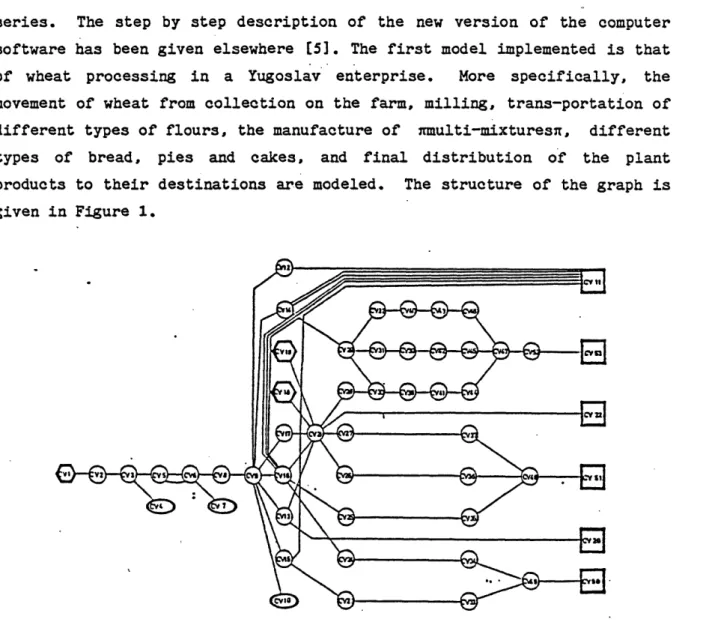
series. The step by step description of the new version of the computer software has been given elsewhere [5]. The first model implemented is that of wheat processing in a Yugoslav enterprise. More specifically, the movement of wheat from collection on the farm, milling, trans-portation of different types of flours, the manufacture of rmulti-mixturesn, different
types of bread, pies and cakes, and final distribution of the plant products to their destinations are modeled. The structure of the graph is given in Figure 1.
Figure 1. Structure of ALINET graph for Yugoslav Enterprise
Once the structure of the graph has been established, the supplies at the source nodes, the allocation coefficients for each link, and the attributes of the processes depicted by the links must be determined. The allocation coefficient denotes the fraction of the supply at the node allocated to each outgoing link. With the supplies specified at the source nodes and the prices and allocation coefficient estimated for each link,
May 1984. The simulation results were then compared to the data to verify that the model calculates material flows accurately.
The total amount of each energy form used in the system was obtained by summing over all links. The total direct energy use, by fuel type, and the cost from farm to consumer are given in Table 1. It includes energy used for transportation, drying and milling of grain, transportation of flours, multi-mixture manufacture, baking, and final product distribution. More detailed discussion of the material flows and energy use in the system has been given elsewhere [6].
TABLE 1. DIRECT ENERGY USE FROM FARM TO CONSUMER
ENERGY COST
Electricity 8433 MWh 19.228x10' din
Natural Gas 869713 Nm3 7.879x10' din
Diesel 54692 lit 2.6492x10' din
3. THE EQUILIBRIUM MODEL
In a typical national or regional model, there are many suppliers of commodities, many processing plants, and many consumers. One of the basic uses of a model such as ALINET is for the determination of the steady state flow of commodities through the system when the decentralized nature of the economic decisions is taken into account.
The standard modeling approach, using state-space systems, is not generally applicable for many economic systems which differ fundamentally from general physical systems. Therefore, there are cases where new concepts and methods need to be developed. An approach to the modeling, analysis and design of large-scale systems that exploits system structure is the descriptor variable one. It has been shown by Stengel [4], that the descriptor variable representation is particularly useful in determining the equilibrium of large-scale economic systems consisting of a supplier
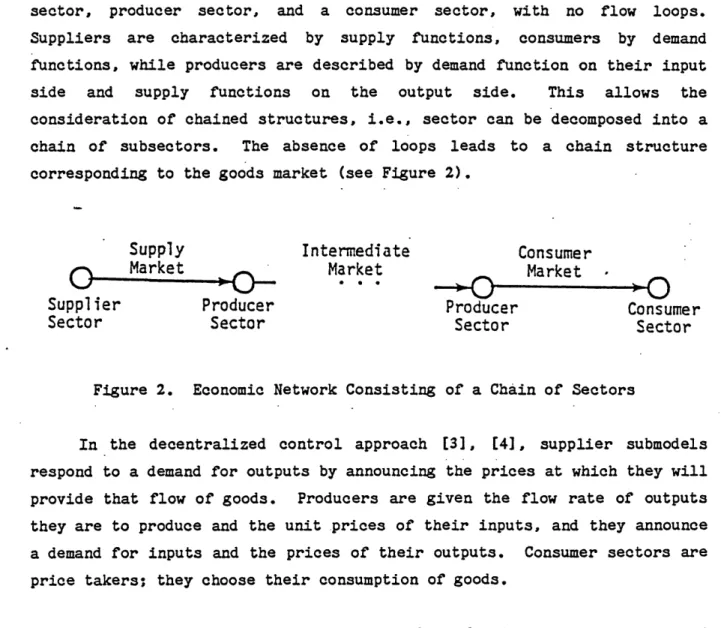
sector, producer sector, and a consumer sector, with no flow loops. Suppliers are characterized by supply functions, consumers by demand functions, while producers are described by demand function on their input side and supply functions on the output side. This allows the consideration of chained structures, i.e., sector can be decomposed into a chain of subsectors. The absence of loops leads to a chain structure corresponding to the goods market (see Figure 2).
Supply
Intermediate
Consumer
0_Market
Market
Market
Supplier
Producer
Producer
Consumer
Sector
Sector
Sector
Sector
Figure 2. Economic Network Consisting of a Chain of Sectors
In the decentralized control approach [3], [4], supplier submodels
respond to a demand for outputs by announcing the prices at which they will
provide that flow of goods. Producers are given the flow rate of outputs
they are to produce and the unit prices of their inputs, and they announce
a demand for inputs and the prices of their outputs. Consumer sectors are
price takers; they choose their consumption of goods.
Let qi be a vector representing the flow of outputs in sector i and
let Pi be the vector of corresponding prices. The model for suppliers in
index set o is given byPo = fo + Soqo (1)
The producers in index set i, 1 ( j ( 4 is given by
qi-1 = gi-1 + Ai-lPi- + Biqi Pi = fi + Ci-lPi-1 + Diqi (2)
characterized by
q4 g4 + R4p4 (3)
The overall system can be written as A p = f, where (4)
I -S o 0 0 0 0 0 0 0 O P fo -Ao I O -B1 0 0 0 0 0 0 qo go -CO 0 I -D1 0 0 0 0 0 0 p0 f1 0 0 -A1 I 0 -B2 0 0 0 0 q1 gl 0 0 -C1 0 I -D2 0 0 0 P2 f2 A 0 0 0 0 -A2 0= q2 f = g2 0 0 0 0 -C2 0 I -D3 0 0 P3 f3 0 0 0 0 0 0 -A3 I 0 -B4 q3 g3 0 0 0 0 0 0 -C3 0 I -D4 P4 f4 0 O 0 0 0 0 0 0 -R4 I q4
g4
(5)The system (5) is solvable if and only if the matrix A is nonsingular. However, due to the high dimensionality of this matrix, it is useful to establish properties for the submatrices in (5) that insure stability and allow an efficient solution of the equilibrium flows and prices.
The motivation for identifying the chain structure and for using a descriptor variable formulation is that the overall equilibrium problem can be solved in a decentralized manner. Instead of a single large problem, a series of small problems, one for each subsector, can be solved. In each individual problem, only those relationships that affect its two adjacent subsectors are considered. In this case, sufficient conditions for solvability of the network are that Sk be positive definite and Rk be negative definite for all k, 0 ( k ( 4, where each Sk is determined recursively from So by,
Sk+1 = Ck(I-SkAk)- SkBk+ l+Dk (6)
and each Rk is determined recursively from R4 by,
Rk_1 = Bk(I-RkDk)-lRkCk-lAkl (7)
The corresponding values for the quantities and prices for sector 2, q2 and P2, are given in Table 2. The same results were obtained when the whole system of equations was solved directly.
TABLE 2. PRODUCER 2: QUANTITIES AND PRICES FOR EQUILIBRIUM
q2 = (8506, 1711, 8930, 16830, 301.9, 356.6, 423.5, 41.72, 3463, 202.5, 252.8, 3835, 4195, 7.703)
P2 = (8500, 28450, 24750, 26850, 168000, 188600, 20480, 27000, 36700, 27000, 27000, 92500, 46250, 30000, 5000)
5. REFERENCES
[1] A. H. Levis, I. S. Levis, E. R. Ducot, 'Energy Conservation Analysis in the Food Processing Sector: A Simulation Approach," Int. Journal of Policy Analysis and Information Systems, Vol. IV, No. 1, 1980. [2] A. H. Levis, E. R. Ducot, F. Webster and I. S. Levis, 'ALINET: A Model
of Assessing Energy Conservation Opportunities in Food Processing," Proc. ASAE National Energy Symposium, Kansas City, MO, September 1980. [3] D. G. Luenberger, "Dynamic Equations in Descriptor Form," IEEE Trans.
on Automatic Control, AC-22, No. 3, June 1977.
t4] D. N. Stengel, "Descriptor Analysis of Economic Systems," Ph.D. Thesis, Dept. of Engineering-Economic Systems, Stanford University, Stanford, CA, August 1978.
[5] D. Marganovic, DJ. Petkovski, D. Kukolj and T. Janos, "A Network Model for the Analysis of Energy Conservation Opportunities in the Food Processing Systems," XXVIII Yugoslav Conference ETAN, June 1984.
[6] DJ. Petkovski and A. H. Levis, "A Network Model for Assessing Energy Conservation Opportunities in Food Processing Annual Report for L984/85, U.S.-Yugoslav Joint Board on Scientific and Technological Cooperation, 1985.