DECISION SUPPORT TOOL FOR DYNAMIC WORKFORCE
SCHEDULING IN MANUFACTURING ENVIRONMENTS
by Radhika Malik
S.B, Computer Science and Mathematics, MIT (2012)
Submitted to the Department of Electrical Engineering and Computer Science in partial fulfillment of the requirements for the degree of
Master of Engineering in Electrical Engineering and Computer Science at the
MASSACHUSETTS INSTITUTE OF TECHNOLOGY May 2013
© 2013 Radhika Malik. All rights reserved.
ARCUNEs
The author hereby grants to MIT permission to reproduce and to distribute publicly paper and electronic copies of this thesis document in whole or in part in any medium now known or
hereafter created.
A uthor ... ...
Radhika Malik Department of Electrical Engineering and Computer Science May 24, 2013
Certified by ... .... Associat
Accepted by ...
Mary L. C ings e Professor of Aeronautics and Aseautics Thesis Supervisor
F
Prof. Dennis M. Freeman a, Masters of Engineering Thesis Committee
DECISION SUPPORT TOOL FOR DYNAMIC WORKFORCE
SCHEDULING IN MANUFACTURING ENVIRONMENTS
by Radhika Malik
Submitted to the Department of Electrical Engineering and Computer Science on May 24, 2013 in partial fulfillment of the requirements for the
degree of Master of Engineering in Electrical Engineering and Computer Science.
ABSTRACT
Scheduling for production in manufacturing environments requires an immense amount of planning. A large number of factors such as part availability, production cost, space
constraints and labor supply must be taken into account. Considering these factors, tasks are scheduled into shifts and allocated the required human resources. However, when actual production begins, the original schedule must be updated regularly due to the dynamic nature of the environment. An enormous challenge in these rapidly changing environments is the re-allocation of workers to tasks in real-time due to events such as worker absences, emergent tasks and unanticipated delays. The focus of this thesis is the development of a decision
support tool that can assist shift supervisors to rapidly generate new worker-task assignments during a shift to ensure that production stays on track.
This research discusses the systems engineering development process of the
aforementioned decision support tool including the initial planning and analysis, the interface design, and the resource allocation algorithm. The development process was iterative, with evaluations and feedback at every step facilitating the refinement of the tool. Emphasis was laid on creating a collaborative framework between the human operator and the automated planning algorithm. While automated planning algorithms are a critical component of resource allocation systems since they can solve complex multivariate scheduling problems much faster than humans, they are inherently brittle and unable to respond to uncertainties in dynamic environments. Thus, in this system, the human operator is given high-level planning tasks and the ability to set goals, while the automation handles the creation of the detailed planning and scheduling assignments. Another factor that was stressed was the inclusion of ergonomic risk. Worker-task assignments that do not take into account ergonomic risk exposure can lead to repetitive stress injuries over time, causing manufacturing plants to
incur substantial medical expenses. Any system that allocates (or re-allocates) workers to tasks must take into account the ergonomic risk that workers are subjected to due to the tasks they perform in the given shift.
production floor. The evaluations yielded positive results. Both the management and the representative users were able to identify the applicability of the tool immediately, and all individuals agreed that the system could be very useful in real production environments. The shift supervisors from the shop floor affirmed that the tool captured all major pieces of information they consider while making re-planning decisions. To better assess the potential of the tool and to refine it further, future research should initiate pilot studies to compare the proposed tool with current methods used for decision-making, which are paper schedules and best judgment of human operators.
Thesis Supervisor: Mary L. Cummings
ACKNOWLEDGEMENTS
Although a thesis only bears the name of the author on its cover page, there is usually a long list of people who have played a role in ensuring the author is able to get to the end; this is especially true for this thesis. I am extremely fortunate to have a large number of people who supported me in my endeavor. I'll try my best to thank all everyone who helped me along the way.
When I think about anything I've been able to accomplish in life, I realize not even a fraction of it would have been possible without the unconditional love and support of my parents. Mom, Dad, it was your dream that I study at MIT and without you, I wouldn't even have been able to think of getting in here, let alone successfully attain two degrees. Thank you so much for always motivating me to give my best at everything I do, for always believing in me and for just being there no matter what. Even though I find it hard to say it, not a day goes by without me being thankful for having such wonderful parents. Thanks also to my brother Raghav. Our relationship isn't typical for siblings but I'm really glad to have you close by, especially since Mom and Dad are so far away. I really appreciate you always being available when I need you for anything at all.
While family is the most important support system in your life, friends come a close second. Friends are especially crucial for an international student since so far away from home, it's your friends here who become your family. Thanks so much to all the incredible friends I've made during the last five years at MIT. I've been very lucky to have met and befriended such great people in the formative years of my life. We've all matured together, gone through good times and bad. I really hope to stay friends with a lot of you even after we move to far away places. A special shout out to my amazing friend Afrah, without whom, I would have really struggled during M.Eng year. Thanks also to all my high school friends who've been another great source of support throughout. It's amazing how we've been able to stay close despite all being in different places and I appreciate having you guys in my life.
Many people have told me that having great mentors can help you develop both professionally and personally. In the last year, I was incredibly lucky to have found an inspiring mentor in my thesis supervisor, Professor Missy Cummings. Professor, I consider myself truly fortunate to be supervised by someone so brilliant and so invested in her students. Despite being physically away from campus, you were always available anytime I needed guidance. You pushed me to do better at every phase of the project, helped me tackle obstacles and ensured that I was able to accomplish a lot by the end. You are one of the most inspiring people I've ever met.
Another mentor I must thank is my post-doctoral supervisor, Dr. Erin Solovey. Erin, thanks so much for being such an invaluable resource in the last year and a half. You were always available to guide me, not only in work, but also in trying to figure out what I wanted to do after I graduate. I've really learnt a lot from you, both professionally and personally, and I
I also wish to thank my undergraduate advisor in Course 6, Professor Christopher Terman. Prof Terman, you've been a great resource as I tried to find my way through academics at MIT, always being available for advice and support.
I've been a part of the HAL community for about 4 semesters and have really enjoyed it. Thanks to all my fellow HALiens for making my HAL experience so great. Also thanks to the HAL admin staff for helping me coordinate all the logistics required at different points during the project
Finally, thank you to Boeing for sponsoring my research work. A special thank you to Rich Gardner for all the time and effort in helping me coordinate all the visits to Boeing to get all the information I needed. Rich, you went out of your way multiple times to assist me, and I really do appreciate all of it.
TABLE OF
CONTENTS
Abstract 3 Acknowledgements 5 Table of Contents 7 List of Figures 11 List of Tables 13 List of Acronyms 15 Chapter 1: Introduction 17 1.1 Motivation 171.1.1 Worker Absence Recovery 17
1.1.2 Ergonomics in Manufacturing 19
1.2 Problem Statement 20
1.3 Research Objective 22
1.4 Research Methodology 22
1.5 Thesis Organization 23
Chapter 2: Background and Related Work 25
2.1 Ergonomics in Scheduling for Manufacturing Operations 25
2.1.1 Assessing Ergonomic Risk 26
2.2 Dynamic Workforce Scheduling 32
2.3 Chapter Summary 37
Chapter 3: Planning and Analysis 39
3.1 Planning 40
3.2 Hybrid Cognitive Task Analysis 40
3.2.1 Scenario Task Overview 41
3.2.2 Event Flow Diagrams 44
3.2.3 Decision Ladders 47
3.2.4 Situation Awareness Requirements 49
3.2.5 Information and Functional Requirements 49
3.3 Chapter Summary 54
Chapter 4: Interface Design 55
4.1 Information Display Configuration 56
4.1.1 Worker Display 56
4.1.2 Master Schedule 59
4.1.3 Schedule Statistics 61
4.2 Re-plan Configuration 62
4.3 Schedule Review Configuration 63
4.4 Chapter Summary 69
Chapter 5: The Automated Planner 71
5.1 Problem Definition 71
5.1.1 Workers 71
5.1.2 Tasks 72
5.1.3 Objective and Constraints 73
5.3 Communicating with the Interface 78
5.4 Algorithm Performance 80
5.4.1 Data Generation 80
5.4.2 Algorithm Testing 81
5.5 Chapter Summary 87
Chapter 6: System Evaluation 89
6.1 Pluralistic Walkthroughs 89
6.1.1 Industrial Engineers for 787 Operations 91
6.1.2 Senior IT Leadership for Boeing Commercial Applications 92
6.1.3 Senior Manager (and Former Shop Lead) of Work Scheduling for 777 Operations 92
6.1.4 Industrial Engineers in 777 Body Structures Division 94
6.1.5 Industrial Engineer for P-8 Military Operations 94
6.2 Cognitive Walkthroughs 95 6.2.1 Walkthrough Process 95 6.2.2 Quantitative Results 97 6.2.3 Qualitative Feedback 100 6.3 Chapter Summary 102 Chapter 7: Conclusion 103 7.1 Thesis Summary 103 7.3 Future Work 105 7.2.1 System Evaluation 105 7.2.2 Interface design 105 7.2.3 Planning Algorithm 106
Appendix B: Usability Questionnaire
References 113
LIST OF FIGURES
Figure 3.1: Phases in the D esign Process ... 39
Figure 3.2: A Description of the hCTA Process ... 41
Figure 3.3: Elements Used in the Event Flow Diagram. ... 43
Figure 3.4: Event Flow Diagram for the Monitoring Phase ... 45
Figure 3.5: Event Flow Diagram for the Automated Re-Plan Phase... 46
Figure 3.6: Symbols Used for the Modified Decision Ladder... 48
Figure 3.7: Decision ladder with Display Elements for Decision of Whether System Proposed Schedule is A cceptable or N ot... 50
Figure 4.1: Elements of the Information Display Configuration... 57
Figure 4.2: Table of Scheduled Workers in Worker Display ... 57
Figure 4.3: Pop-up to Toggle Worker Availability... 57
Figure 4.4: The M aster Schedule... 60
Figure 4.5: Configural Displays to View Shift Statistics... 61
Figure 4.6: Pop-up Dialog for Planning Options to Invoke the Automated Planner... 64
Figure 4.7: Second Planning Option (Plan with Selected Additional Workers)... 65
Figure 4.8: Third Planning Option (Suggest Workers to Call In)... 66
Figure 4.9: Schedule Review Configuration... 68
Figure 5.1: Description of Generic Backtrack Search to Solve CSP's... 75
Figure 5.2: Description of Planning Algorithm that Uses Backtrack Search to Assign Workers to T ask s ... 7 5 Figure 5.3: Dialog Displayed While Planning Algorithm is Executing ... 86
Figure 6.1: The Design Process Used in the Development of this Tool... 91 Figure 6.2: Box Plots of Questionnaire Responses Related to Perceived Simplicity and Ease of
U se ... 9 8 Figure 6.3: Box Plots of Questionnaire Responses Related to Quality of Display Elements... 99
LIST
OFTABLES
Table 3.1: Tasks for M onitoring Phase... 42
Table 3.2: Tasks for Re-Planning Phase ... 42
Table 3.3: Tasks for Automated Re-Plan... 43
Table 3.4: Levels of A utom ation [60]... 48
Table 3.5: Situation Awareness Requirements ... 51
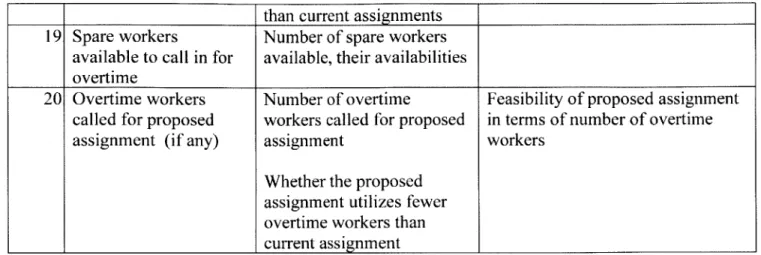
Table 3.6: Information and Functional Requirements for the Display ... 53
Table 4.1: IR's Satisfied by Various Components of the Display... 69
Table 5.1: Results of Algorithm for Planning Option 1 (Planning with Existing Shift Workers) 83 Table 5.2: Results of Algorithm for Planning Option 3 (Suggest Workers to Call In)... 83
Table 5.3: Results of Traversing More of the Solution Space to Find Solutions that Require F ew er Spare W orkers... 85
Table 6.1: IRs Implemented in Prototype for Cognitive Walkthrough ... 97
LIST OF ACRONYMS
ALBP: Assembly Line Balancing Problem BCA: Boeing Commercial Airplanes BR&T: Boeing Research and Technology BT: British Telecommunications
CSP: Constraint Satisfaction Problem DFS: Depth-First search
EAWS: European Assembly Worksheet EFD: Event Flow Diagram
EJRSP: The Ergonomic Job Rotation Scheduling Problem HAL: Humans and Automation Laboratory
hCTA: hybrid Cognitive Task Analysis
IE: Industrial Engineering, Industrial Engineer ILP: Integer Linear Program
IR: Information Requirement JSI: Job Severity Index
MORE: Metodo de Orientacion de Rotaciones Ergonomic MRV: Minimum Remaining Values
NIOSH: National Institute for Occupational Safety and He OCRA: Occupational Repetitive Action
OSHA: Occupational Safety and Health Administration REBA: Rapid Entire Body Assessment
as
RRT: Rapidly exploring Random Trees
RTWSA: Real-Time Work Schedule Adjustment SAR: Situation Awareness Requirement
CHAPTER
1:
INTRODUCTION
1.1 MOTIVATION
1.1.1 WORKER ABSENCE RECOVERY
In current manufacturing systems, extensive planning is done to split tasks into shifts based on
factors such as availability of parts, production costs and labor at hand. Further planning is done to allocate workers to tasks within a given shift. In order to meet defined production milestones,
it is important that tasks scheduled in each shift be completely staffed according to the planned
worker requirement. However, many times shift supervisors must deal with the situation where one or more workers assigned to the shift cannot cover all or a part of their shift. Unplanned
employee absences in the U.S. production sector cause 1.9% lost work-time rate, which
measures hours workers are absent for as a percent of hours usually worked [1].
Staffing losses from unplanned absences have the potential to disrupt operations.
Absence recovery, or the managerial response to short-notice staffing losses due to unplanned
absences, first acknowledges unanticipated capacity losses, then generates and evaluates feasible
alternatives to replace the lost capacity, and finally selects and implements an appropriate option.
There are two main types of absence recovery methodologies: passive absence recovery and
active absence recovery [2]. In passive recovery, organizations simply dissolve the work of
missing employees among the existing shift workers. This option is usually selected in small
Active absence recovery can be accomplished with several strategies including holdover
overtime (keeping existing workers on duty a few extra hours beyond the scheduled end of their shift), call-in workers (activating an on-call employee not scheduled for the shift), and temporary external workers contracted to cover unplanned absences [4] [2]. The absence recovery approach employed at any firm must take into account differences in employee capabilities, availability constraints, and associated costs.
Regardless of whether the recovery mechanism employed is active or passive, ideally, absence recovery mitigates the effects of unplanned absences without a serious impact on
employees or production rates. In most organizations, the basic absence recovery process is very similar in that after learning of an unplanned absence, managers first evaluate feasible
alternatives for covering the loss of productive capacity (including "do nothing") by weighing the costs and benefits of each, selecting the most promising option and then implementing it [3]. In most manufacturing processes, the cost-benefit analysis of each feasible alternative depends greatly on real-time factors including the capabilities of workers present, availability of workers for overtime at a short notice, the cost of schedule delays, the priorities of understaffed tasks as well as the preferences of shift supervisors. As a result, there is no one solution that can be designed for worker absence recovery for all shifts even within the same manufacturing plant. Instead what is needed is a decision support tool that can enable shift supervisors to analyze the possible alternatives for absence recovery in real-time, and to generate a feasible worker-task assignment for the given shift. The worker-task assignment produced must attempt to staff all tasks given the constraints of the scheduling environment, or in case no such complete
1.1.2 ERGONOMICS IN MANUFACTURING
The Occupational Safety and Health Administration (OSHA) agency of the US Department of
Labor estimates that there were over 300,000 work-related musculoskeletal disorder (WMSD)
cases in the United States, which accounted for 33 percent of all work-related injury and illness
cases in 2011[5]. Further, workers who sustained musculoskeletal disorders required a median of
eleven days to recover before returning to work, compared to eight days for other work-related
injuries. Also, the manufacturing industry registered one of the highest incidences of workers
taking days away from work due to work-related injuries. It is estimated that employers spend as
much as $20 billion a year on direct costs for WMSD-related workers' compensation [6], and
even more for indirect costs, such as those associated with hiring and training replacement
workers, lower worker productivity and higher defect rates in work. In addition to these
monetary effects, the OSHA reports that WMSDs often impose a substantial personal toll on
affected workers who can no longer work or sometimes even perform simple personal tasks
required in their daily lives.
Scientific evidence associates WMSDs with stresses to various body parts caused by the
way certain tasks are performed. The positioning of the body and the type of physical work that
must be done to complete a job may cause persistent pain and lead to deterioration of the
affected joints and muscles. The longer the worker must maintain a fixed posture, repeat the
same movements, experience vibration, exert force, or handle heavy items, the greater the chance
that such a disorder will occur. These job-related stresses are referred to as "workplace risk
factors" or "ergonomic risks", and exposure to these risk factors, particularly in combination, significantly increases an employee's chance of developing WMSDs. In the last few years, there
measures such as non-hazardous working conditions, limited exposure to toxic substances and adequate rest time [7]. Moreover, management of manufacturing firms also realized that reducing ergonomic risks results in overall higher satisfaction of workers, increased company
loyalty, less absenteeism and consequently higher productivity and less failures (e.g. [8]; [4]; [9]).
Worker-task assignments that do not take into account ergonomics risk exposure can lead to repetitive stress injuries over time causing manufacturing plants to incur substantial medical expenses. Any system that plans or re-plans worker-task assignments, including systems that are used for worker absence recovery, should take into account the ergonomic risk that workers are subjected to due to the tasks they perform in the given shift. The benefits of incorporating ergonomic risk in assigning workers to tasks include reduced worker injuries, decreased delays in manufacturing, more efficient scheduling and reduced manpower costs, enhanced productivity and worker morale as well as improved quality of production.
Currently, there is no decision support tool in the open literature that assists shift supervisors to effectively address worker absenteeism and ensure that tasks in a shift are
completed, while at the same time assesses the ergonomic risk workers could be subjected to as a result of changes in task assignments. The development of such a tool is the objective of this
thesis.
1.2
PROBLEM STATEMENTThe goal of this project is to design and develop a decision support tool that enables shift
supervisors to re-plan an already constructed shift schedule and decide the best way to cover last-minute gaps in the schedule, without significantly impacting the ergonomic risk to workers. The
tool should enable shift supervisors to answer questions such as
-1. If one or more workers are missing on a given day, is it possible to distribute the tasks among other workers already assigned to the shift or should they bring in additional workers (possibly resulting in overtime)?
2. If bringing in additional workers is essential, how many workers are required? Further, who is most suited to performing the tasks that are understaffed?
3. What would the impact be on ergonomic risk exposure if the work were distributed among the existing workers versus the case where additional workers are called in? 4. In case the supervisor does not want to bring in the required number of additional
workers required or if an adequate number of additional workers are not available, how can the tasks be assigned such that a maximum number of tasks are staffed, and workers are not subject to high ergonomic risk? Also, what is the resultant impact on the schedule in terms of tasks staffed and ergonomic risk in these situations?
5. What would the impact on the schedule in terms of delays in task completion and
ergonomic risk be if the supervisor forces the system to assign certain workers to a given task?
To answer the above questions, the tool would have to take as input such variables as the existing workers in the shift, additional workers who can be called in if required, along with each
worker's availability, their skills and certifications as well as any medical restrictions they may have due to history of light duty or work-related compensation. On the tasks' side, the system
should take into account in the tasks that need to be to be staffed in the shift, their respective priorities and scheduled times, as well as the risk each task poses to workers.
1.3 RESEARCH OBJECTIVE
The primary objective of this research effort is the development of a decision support tool that re-plans worker-task assignments and allows shift supervisors to collaborate with an automated algorithm to effectively manage worker absences and also control ergonomic risk exposure.
1.4
RESEARCH METHODOLOGYThe problem statement was investigated via the following research objectives (each of these will be elaborated upon in subsequent
chapters)-" Objective 1: Conduct a cognitive task analysis to generate the information and functional requirements for a decision support tool that re-plans worker-task assignments during a shift while mitigating ergonomic risk exposure. Following a human-systems engineering approach, display requirements are generated through a hybrid Cognitive Task Analysis (hCTA) [10].
- Objective 2: Use the results of the task analysis to develop a user interface that allows shift supervisor to work together with an automated planning algorithm for the purpose of assigning workers to tasks to cover last-minute gaps in the shift schedule without
subjecting workers to high ergonomic risk. The interface is developed using an iterative design methodology, a specialization of the spiral model for software development [11] for user interface design. A sequence of prototypes is designed, with each iteration having a higher accuracy and fidelity than the previous. Each prototype is evaluated for usability and user feedback is incorporated at each stage.
an attempt to staff the maximum number of tasks given the constraints of the scheduling environment and the preferences of the shift supervisor.
Objective 4: Evaluate the interface using usability inspection methods such as heuristic evaluations, pluralistic walkthroughs and cognitive walkthroughs.
1.5
THESIS ORGANIZATIONChapter 1, Introduction, describes the motivation, problem statement, research questions and research methodology of this work.
Chapter 2, Background, summarizes research done in the areas of ergonomic risk
management during scheduling for manufacturing operations as well as dynamic scheduling (specifically dynamic workforce scheduling) including both computational approaches to solving the real-time workforce scheduling problem, and decision support tools previously developed for this purpose.
Chapter 3, Planning and Analysis, details the process undertaken to conceptualize the design of the decision support tool. The application of the hybrid Cognitive Task Analysis (hCTA) process to generate the information and functional requirements is elucidated.
Chapter 4, Interface Design, introduces the main components of the interface. The various human factors elements utilized in the design of the display are examined and the shift supervisor's interactions with the interface are also detailed.
Chapter 5, Planning Algorithm, provides an overview of the scheduling problem formulated mathematically as an optimization problem, describes how the problem was solved
overall evaluation of the system. The interface is assessed using pluralistic walkthroughs and cognitive walkthroughs, which analyze the cognitive processes required to perform the various functions of the interface.
Chapter 7, Conclusion, summarizes the motivation, objectives, and key findings of this research initiative. Suggestions for future work are also provided.
CHAPTER 2: BACKGROUND AND RELATED WORK
This chapter presents a detailed discussion of existing work in ergonomics for manufacturing operations as well as dynamic workforce scheduling in the presence of real-time events. The chapter consists of two main parts; the first part discusses ergonomics in scheduling for a manufacturing environment, outlining common techniques used to manage ergonomic risks including job rotation scheduling and assembly line balancing. The second part of the chapter delves into previous attempts at dynamic workforce scheduling, both computational approaches to solving the problem, as well as the development of decision support tools for this purpose.
2.1
ERGONOMICS IN SCHEDULING FOR MANUFACTURINGOPERATIONS
Prevention of Work-Related Musculoskeletal Disorders (WMSDs) has become an important objective for companies with manufacturing plants, and involves reducing worker exposure to ergonomic risk factors such as prolonged awkward postures, heavy lifting, repetitive movements, exposure to vibration and other potentially harmful work conditions [12]. Research to mitigate ergonomic risk in production environments is expansive and includes approaches such as
redesigning tasks, assigning off-days for workers and incorporating rest pauses to reduce fatigue. For the purpose of scheduling jobs or assigning workers to jobs with ergonomic constraints in mind, research literature primarily focuses on job rotation scheduling and assembly line
balancing. In this section, I first review common ways to assess ergonomic risk to workers and then discuss the different scheduling techniques to mitigate these risks.
2.1.1 ASSESSING ERGONOMIC RISK
There are several ergonomic evaluation methods that have been developed to determine the level of risk to which workers are exposed. For lifting tasks, examples include the Job Severity Index (JSI) [13], a measure that relates the lifting required for a task to a worker's lifting capacity, the NIOSH (National Institute for Occupational Safety and Health) lifting equation [14] that
associates the current load weight in a job to the general recommended load weight, and the Siemens lifting index [15], an index that is similar to the JSI but incorporates additional
information about demographic characteristics and fitness of workers. For estimating ergonomic risk in tasks involving upper limbs, popular methods include the OCRA (Occupational
Repetitive Action) index [16] a unit that estimates ergonomic risk separately for each hand, and the Job Strain Index [17], a similar measure but with additional parameters for task speed and strain duration. For other tasks, common methods include the European Assembly Worksheet (EAWS) [6], a methodology used widely in the European automobile industry that assesses the repetitive task load separately for the whole body and the upper limbs by considering factors
such as posture, frequency and duration of repetitions, the Rapid Entire Body Assessment (REBA), a way to record working postures for the primary segments of the entire body, and Sue Rodgers' Muscle Fatigue Analysis [18], a means to assess the amount of fatigue that
accumulates in muscles during various work patterns.
Smith et al. [19] developed and patented a method that collects data related to tasks (such as task duration, count, force required etc.) and computes the ergonomic risk score for each task
split into six risk broad categories, namely lifting, hand/arm stress, working overhead,
pushing/pulling, bending, and kneeling. These six categories were selected since their research showed that these represent the six types of activities that account almost 90 percent of worker
injuries in an aircraft manufacturing plant. Using these numbers for individual tasks, daily accumulation of ergonomic risk in each category is assessed for workers as the sum of risks of all the tasks they work on during a day of production. This is the approach used in this thesis
since it covers the majority of causes of injuries in a large-scale manufacturing plant. Appendix A describes these ergonomic risk score assessments more in detail. However, it is worth noting that the tool we developed is independent of the method used to estimate ergonomic risk and can be easily adapted to other measures.
2.1.2 JOB ROTATION SCHEDULING
Job rotation, defined as a schedule design system that allows employees to rotate between different tasks, allows for scheduling operations such that workers are exposed to periodic variations in tasks; job rotation aims to ensure that the demands of jobs do not exceed the
capabilities of workers. This practice has become widely adopted in manufacturing systems. One of the most important factors for its extensive adoption is its ability to balance ergonomic risks
swiftly at low or even no costs. Jorgensen et al. [20], in a survey of job rotation in the Midwest US manufacturing firms, found balanced ergonomic risks to be one of the two most important perceived benefits from implementing a job rotation scheduling. In this review, I focus on job rotation approaches that have been used in production systems to minimize ergonomic risks
associated with WMSDs; there is also literature that minimizes other kinds of ergonomic risks such as noise exposure [21], [22].
The ergonomic job rotation scheduling problem (EJRSP), introduced by Carnahan et al. [23], involves balancing ergonomic risk between workers by minimizing the ergonomic load for the worker highest at risk; Carnahan et al. [23] propose a distribution of workloads using integer programming and genetic algorithms, where four workers are allocated to four operations involving lifting using the Job Severity Index (JSI). Building upon their work,
Tharmmaphomphilas and Norman [24] used integer programming to present a method for analyzing different job rotation interval lengths in order to determine the proper job interval for various workplace settings. Although the majority of work on solving the EJRSP has focused on genetic algorithms and integer programming, other approaches have been applied as well. For example, Seekiner and Kurt [25] applied a simulated annealing algorithm and then an ant colony algorithm [26] to generate rotation schedules to solve the problem of balancing the workload among workers; each job is given a predefined workload and the goal of the algorithm is to minimize the cumulative workload any given worker is subject to.
To maximize the benefits from job rotation, Diego-Mas et al. [27] proposed a genetic algorithm that includes multiple criteria that together aim to ensure that the muscle groups
involved in the various jobs performed by a worker in the different rotations are not the same, the content of the jobs to be performed involves an effective change of activity, and the preferences and abilities of the workers for certain jobs is taken into account. Their genetic algorithm takes
into account all these factors and outputs a job rotation schedule with eighteen workers rotating between eighteen workstations according to a pre-decided number of rotations, and each rotation having a predetermined duration. They implemented their algorithm on a software system called
MORE ('Metodo de Orientacion de Rotaciones Ergonomicas') that takes in data related to workers and workstations as input along with parameters of the required output rotation
schedule, and computes a new rotation schedule. The resultant schedule is presented to the human planner graphically. Furthermore, the planner is allowed to make manual changes to the input parameters and see the effects of the variation on the generated rotation schedules, thus allowing him/her to deal with situations that require a change to a worker's job assignment without having to modify the complete job rotation schedule. This tool was the only one that I came across in literature that aims to assist a human planner in ergonomically planning worker schedules, and can also be used for recovery planning in case of worker absences. However, the authors' approach is specific to job rotation scheduling where the output schedule must include workers moving between workstations according to some predetermined rotation specifications.
There have been several studies that have attempted to analyze the effects of job rotation scheduling on ergonomic criteria. There is no definitive conclusion on whether the strategy helps in reducing health risks. Some studies show that using job rotation programs may not be as effective at reducing biomechanical injury risk factors as expected; for example Frazer et al. [28] demonstrated that in some situations, the practice can raise the risk of reporting low back pain. In their study of job rotation in a refuse collecting department, Kuijer et al. [29] found a positive effect of job rotation on the perceived, energetic and postural load. The follow-up study [30] confirmed that job rotation reduces the need for recovery, but was inconclusive about the risk of low back complaints due to possible selection effects in assigning workers to the groups. The study also found that rotating groups of workers had more than two times higher risk of reporting low back complains than non-rotating groups. Aptel et al. [31] found that job rotation has a positive impact on psychosocial factors but is relatively ineffective in relation to musculoskeletal disorders prevention.
assignments in case of worker absences, and manage ergonomic risk without being limited to implementing specific rotation schedules, which are less flexible and also require significant cross-training among workers. This approach relies on the premise that keeping the daily
ergonomic risk exposure to workers below a critical level by assigning them different kinds of tasks sufficiently mitigates ergonomic risk without having to adhere to defined rotation schedules
(Appendix A). While the tool may ultimately result in situations where workers rotate through the type of tasks they perform so that the stress on different muscles balances, workers will not
have to adhere to fixed rotation schedules of a defined interval length and predetermined job variations.
2.1.3 ASSEMBLY LINE BALANCING
The assembly line is a production system, where a set of tasks with fixed operation times has to be distributed among a set of workstations arranged sequentially with each workstation having a set of tasks associated with it (known as station workload). Each work piece moves down the line at a fixed rate such that each station has access to a work piece for a constant time span (known as cycle time) in which an operator at the workstation must perform all tasks associated with that station. Each station has a constraint that the total time required to perform all the associated tasks for a work piece must always be less than the cycle time. The Assembly Line Balancing Problem (ALBP) is to assign tasks to workstations on an assembly line such that constraints including cycle time and task precedence relations are met, while optimizing other goals such as minimizing time or cost, or maximizing capacity or profit. A feasible task assignment is called a (line) balance.
literature, though they are becoming increasingly important in practice [6]. Some works that incorporate ergonomics into assembly line balancing include Miralles et al. [32] as well as Costa and Miralles [33], who introduce and analyze a problem of assigning workloads to stations and to workers with different abilities and disabilities. Carnahan et al. [34] examine an assignment of a certain class of tasks (such as gripping tasks) along with its influence on fatigue and recovery dynamics of workers in an assembly line. Hilla [35] showed that if ergonomic risks are detected, re-balancing of the assembly line is recommended as an effective method in the short-run. Building upon Hilla's work, Otto and Scholl [6] present the first attempt to incorporate
ergonomic risk estimation methods already used in practice into assembly line balancing models. Their experiments indicate that re-balancing often leads to a substantial mitigation of ergonomic risks. There have also been works that have focused on incorporating job rotation scheduling as a means to re-balance assembly lines such as the work of Otto and Scholl [36].
While the approach in this thesis is more in line with assembly line re-balancing than with job rotation scheduling, this work is more general than assembly line re-balancing.
Assembly line re-balancing methods are specific to assembly line production environments with predetermined workstations arranged sequentially and work pieces moving through the line. The goal of all ergonomics-related approaches in these environments is to ergonomically assign tasks to the workstations (and consequently to workers). This thesis attempts to develop a decision support tool that, given a set of tasks and a set of workers, enables shift supervisors to
ergonomically re-assign workers to tasks during worker absences and other dynamic events on the shop floor. It is worth pointing out that current assembly line balancing literature includes little discussion of worker absence recovery mechanisms. The tool described in this theses can be adapted for re-planning worker-task assignments to cope with worker absences in an assembly
line environment by adding in additional requirements and constraints that are specific to assembly lines such as station workload and cycle time constraints.
2.2 DYNAMIC WORKFORCE SCHEDULING
Scheduling is defined as the allocation of resources to jobs over time, and is a decision-making process with the goal of optimizing one or more objectives [37]. The objectives may include the minimization of the completion time of jobs, mean flow time, lateness of jobs, processing cost, etc. Scheduling plays an important role in many manufacturing and production systems. Since manufacturing systems operate in dynamic environments, inevitable unpredictable real-time events may cause a change in the scheduled plans, and the optimal or near-optimal schedules with respect to the estimated data may become obsolete during execution. The problem of scheduling in the presence of real-time events is termed dynamic scheduling [38].
A significant volume of research on the issues of scheduling with execution uncertainties has been developed, and the different existing approaches can be classified into four main categories [39-42]: completely reactive scheduling, predictive-reactive scheduling, robust predictive-reactive scheduling, and robust pro-active scheduling. In reactive scheduling, no firm schedule is generated in advance and decisions are made locally in real-time. In
predictive-reactive scheduling, a schedule is first generated with the objective of optimizing performance
without considering unpredictable events; the schedule is then modified during execution in response to real-time events. However, in this approach, the new schedule may deviate
significantly from the original schedule, which can seriously affect other activities that are based on the original schedule. Robust predictive-reactive scheduling tries to overcome this problem by generating predictive-reactive schedules that minimize the effects of disruption on the current
schedule. Finally, robust pro-active scheduling approaches focus on building schedules, which satisfy performance requirements predictably in a dynamic environment, while at the same time providing the schedule the ability to absorb some level of uncertainty such that in case
unpredictable events occur, rescheduling is not always required.
Although considerable research relating to dynamic scheduling in both production and service environments has been done, most of the work has focused on how to effectively shift jobs around (both between shifts and also within a given shift) and not on re-planning the
assignment of workers to tasks. The work in this thesis focuses on dynamic workforce
scheduling, particularly the allocation of workers to jobs in real-time. In the problem of dynamic workforce scheduling, there has been some work done in service environments. Academic
research has focused on how to develop optimal work shifts, decide shift staffing and assign staff in advance of the day of service. For example, Thompson [43] did some initial work on real-time schedule adjustments in a restaurant environment to determine the optimal time for managers to schedule shift changes or break times. Thompson [44] also did some work to determine, early in the day, whether the actual demand for staff during the day would match the forecasted demand, allowing managers to detect in time whether they need to bring in more workers that day.
Specifically for worker absence recovery, Easton and Goodale [3] performed a
comparison of various absence recovery strategies such as scheduling holdover overtime, calling in other workers and calling in temporary workers from external agencies. They simulated a service environment in which worker absence causes the actual staffing to be lower than the forecasted demand for staff and studied the impact on expected profit based on the absence recovery mechanism employed. Among other things, their simulations showed that holdover overtime generally outperforms call-ins or external temporary workers because it allows
managers to apply precise amounts (increments as small as one worker-hour) of overtime labor. Hur et al. [45] introduce the Real-Time Work Schedule Adjustment (RTWSA), which is defined as the modification of the planned work schedule on a real-time basis to cope with unexpected demand changes and/or disruptions of labor supply. The scenario they consider is a fast-food restaurant with three workstations to be staffed according to the predicted demand. The
parameters that can be changed as a result of a change in demand include modifications to station assignments, break times, worker start or end times, shift lengths and shift assignments. They proposed a mathematical formulation of the real-time adjustment decision, developed efficient heuristic solution approaches, and evaluated the relative effectiveness of the heuristics versus experienced service managers. Their studies showed that experienced managers' decisions were effective, but computer-based heuristic approaches could provide further improvements in profitability, particularly when the difference in actual workload is very different from the estimated workload before the day. The RTWSA has been further studied in other service
industries including agent staffing in call centers [46], nurse scheduling in hospital inpatient units [47], [48].
Apart from literature that has looked at the RTWSA as an optimization problem, there have also been some interfaces designed for dynamic workforce management, particularly in the service industry. Lesaint et al. [49] developed a dynamic workforce management tool for British Telecommunications (BT) that manages field operations of technicians who have to serve
customers and repair network faults. The system attempts to schedule tasks, assign technicians to each task, dispatch work by informing a technician of his/her next assignment, and then finally monitor the work using feedback information on the progress of tasks. The problem inherently is very uncertain since real-time events such as new jobs in the system, job cancellation, variable
task execution times and modified worker availability necessitate periodic re-planning. The dynamic scheduler in the system employs a predictive-reactive approach to scheduling using constraint propagation, local search and simulated annealing to solve the optimization problem, with a new schedule is generated every 20-30 minutes. Moreover, supervisors can also visualize the tasks both geographically and temporally. This tool, known as TASKFORCE, enabled BT to reduce operational costs, improve customer satisfaction and enhance employee productivity.
Another decision support interface for dynamic workforce scheduling is one designed by Mirrazavi and Beringer [50] who developed a web-based workforce management system for labor scheduling in a supermarket. Their work discusses all the business requirements presented to them by Sainsbury's Supermarkets Ltd. and then details their workforce management system. The core of the system is to first predict staff demand for each department in the store and then consider factors such as employee contractual details (days off, wages etc.), worker preferences, and employee skills to decide the schedule for each employee. The scheduling determines not only details about shifts including length and breaks but also which department the employee should staff. While the focus of the tool is to enable planners to develop long term (monthly) staff planning and allocation plans it does have component that permits flexible scheduling for daily and weekly operations to periodically cope with unplanned events such as worker absences.
A limitation of the systems that have tried to solve the dynamic workforce scheduling problem is the lack of human-automation collaboration in this domain. While the works that have studied the RTWSA have focused solely on the optimization algorithms that can be used to solve dynamic workforce scheduling problems, the decision support tools simply use algorithms to construct new schedules and display it to the human planner without involving the planner in the scheduling process. Recent studies have shown that systems that allow high-level interaction
between human operators and automated planning systems have seen increases in overall system performance than both humans performing the planning manually and purely automated systems. An example of such a study is one by Cummings et al. [51] that looked at human-automation collaboration in the problem of controlling a network of unmanned vehicles. They compared the overall mission performance of a human guiding a set of decentralized automated planners to that of a perfectly compliant human who simply accepts the schedule proposed by the automated planners, and observed that the performance of the human-on-the-loop system was significantly better.
While automated planning algorithms are a critical component of planning and resource allocation systems since they can solve complex multivariate scheduling problems much faster than humans, they can only take into account quantifiable variables that were identified by
developers in the design stage [52]. In a dynamic production or service environment, new events and variables come up regularly that the automated planners do not account for and as a result systems that only leverage automation are inherently brittle and unable to respond to
uncertainties in these dynamic environments. In such environments, more important than trying to find an optimal solution based on a pre-defined objective function, it is critical that the system work with the human to try and find a 'satisficing'[53] assignment based on the preferences of the human planner and the real-time events in the environment. The key in this collaboration is the appropriate allocation of tasks between human and automation; human operators are given high-level planning tasks and the ability to set goals, while the automation handles the creation of the detailed planning and scheduling assignments.
2.3
CHAPTER SUMMARYIn this chapter, I discussed prior work that has been undertaken in the fields of ergonomics in manufacturing and dynamic workforce scheduling. While there has been extensive work done to consider ergonomics in manufacturing settings, most of the work in ergonomic scheduling has been confined to job rotation scheduling and assembly line re-balancing. In dynamic workforce scheduling, there have been several attempts to model and solve the planning problem as an optimization problem and there have also been a few decision support tools to aid human planners in the process. However, in both ergonomic scheduling and dynamic workforce scheduling approaches, little research has explored human-automation collaboration. Furthermore, no previous work has combined dynamic workforce scheduling and worker absence recovery with ergonomics planning. This research identifies a unique opportunity to work at the intersection of ergonomics and worker absence recovery by leveraging collaborative techniques between a human operator and an automated planning algorithm.
In this thesis, I attempt to develop a decision support tool that will aid human operators who have to schedule jobs in a large-scale manufacturing environment to manage their
workforce in real-time. More specifically, I will be dealing with predictive-reactive scheduling of workers; that is, starting from a pre-generated schedule, the worker schedule must be updated in real-time as a response to events such as worker absences and other dynamic events. Based on the supervisor's preferences and domain expertise, the scheduling can be robust to minimize changes to the existing worker-task assignments or a new assignment altogether can also be generated. The goal of the system is to staff as many tasks as possible while also managing worker ergonomic risk exposure. Also, the tool leverages both the expertise of a human operator and the computational power of an automated algorithm. While the scenario considered focuses
on a manufacturing-related application, the tool is generic enough to be easily adaptable to any environment that has similar characteristics: a set of workers, a set of tasks to be staffed and a set of constraints and objectives that can change based on the real-time events in the environment.
CHAPTER
3:
PLANNING AND ANALYSIS
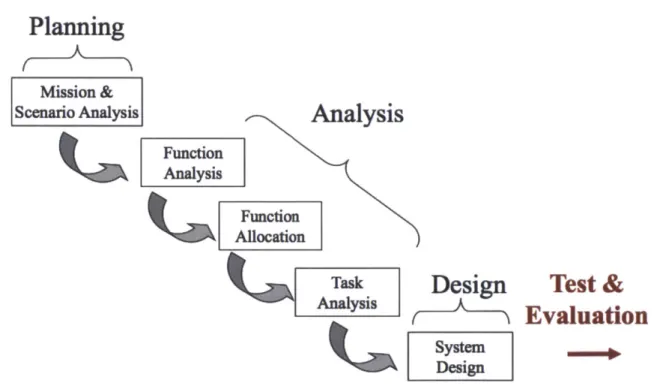
This chapter details the process undertaken to develop the decision support tool. The development process includes three main phases: planning, analysis and design. Figure 3.1 illustrates the different phases in the conceptualization of an initial design for the system
interface. After the initial design is developed, it is tested and evaluated using various techniques discussed in Chapter 6.
Planning
Mission &Scenario Analysis
Function t'q Analysis FundtionC
q5
AllocationTask
Design
Test &
tQ~~ Anlyi
Evaluation
k'4 Desig
3.1
PLANNING
This research began with a planning phase, which included initial conversations with researchers from Boeing. Through these conversations, I gauged that in most manufacturing environments, there are existing systems to solve the complex optimization problems behind planning
production, which include the identification of tasks required to be performed, organization of tasks into shifts, and the initial assignment of workers to tasks. However, once the shift begins and the dynamic component of scheduling begins, the re-planning component is mostly done by humans using paper charts and best judgment. Hence, shift supervisors who make these complex decisions of how to re-assign tasks to workers in a constantly changing production environment would benefit from a decision support tool. Further, in most manufacturing plants, ergonomic risk is not incorporated either in the planning or the re-planning decisions. To mitigate injuries to workers, incorporation of ergonomic constraints is essential for worker-task re-assignments. The observations from the planning phase were confirmed during the pluralistic walkthrough in the testing phase described in Chapter 6.
3.2
HYBRID COGNITIVE TASK ANALYSISFor the analysis phase of the design process, which includes Function Analysis, Function Allocation and Task Analysis, the Hybrid Cognitive Task Analysis (hCTA) method was used.
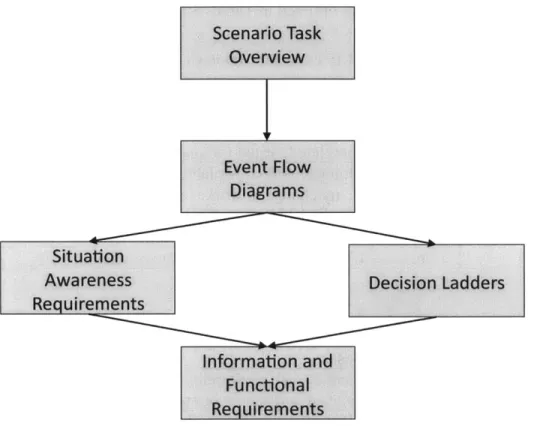
The goal of the hCTA process is to generate the information and functional for the design of the interface of a complex system starting from a high level task description. The hCTA consists of the following components: 1) Scenario Task Overview, 2) Event Flow Diagrams, 3) Situational Awareness Requirements, 4) Decision Ladders (and jointly, display requirements and levels of
automation), and finally, 5) Information and Functional Requirements [10]. The hCTA process attempts to define the cognitive workflow of an operator in a complex environment, deriving a complete set of requirements necessary to meet system goals from operational tasks. The process is illustrated in Figure 3.2.
Scenario Task
Overview
Event Flow
Diagrams
SituationAwareness Decision Ladders
Requirements
Information and
Functional
Requirements
Figure 3.2: A Description of the hCTA Process [551
3.2.1 SCENARIO TASK OVERVIEW
A scenario task overview attempts to formalize the overall system functionality into a set of
distinct tasks and phases. Tasks are grouped together into phases either temporally or
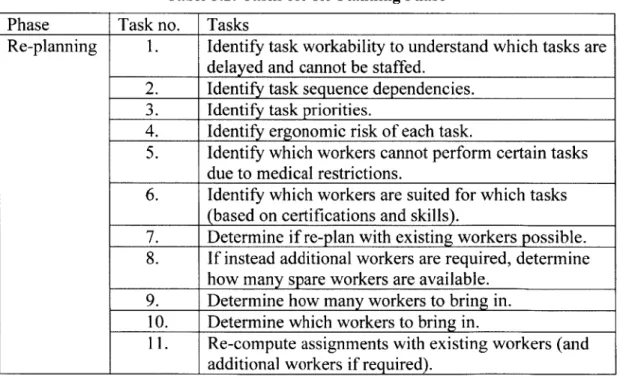
In the situation of allocating workers to tasks in real-time, there are two main phases: Monitoring and Re-planning. In the Monitoring phase, the shift supervisor is continuously monitoring the status of tasks and workers; this phase is meant to support the shift supervisor's decision to re-plan. Once the supervisor initiates a re-plan, the re-planning phase begins. The tasks involved in these two phases are outlined in Tables 3.1 and 3.2
Table 3.1: Tasks for Monitoring Phase Phase Task no. Tasks
Monitoring 1. Monitor status for all tasks.
2. If any change in task status (e.g. held up, in progress, completed, tested for quality), document.
3. Monitor worker availabilities.
4. If any change in worker availabilities, document and re-calculate task staffing.
5. If any tasks understaffed, judge need to re-plan. 6. If re-plan need arises, initiate re-plan.
Table 3.2: Tasks for Re-Planning Phase Phase Task no. Tasks
Re-planning 1. Identify task workability to understand which tasks are delayed and cannot be staffed.
2. Identify task sequence dependencies. 3. Identify task priorities.
4. Identify ergonomic risk of each task.
5. Identify which workers cannot perform certain tasks
due to medical restrictions.
6. Identify which workers are suited for which tasks (based on certifications and skills).
7. Determine if re-plan with existing workers possible. 8. If instead additional workers are required, determine
how many spare workers are available.
9. Determine how many workers to bring in. 10. Determine which workers to bring in.
11. Re-compute assignments with existing workers (and
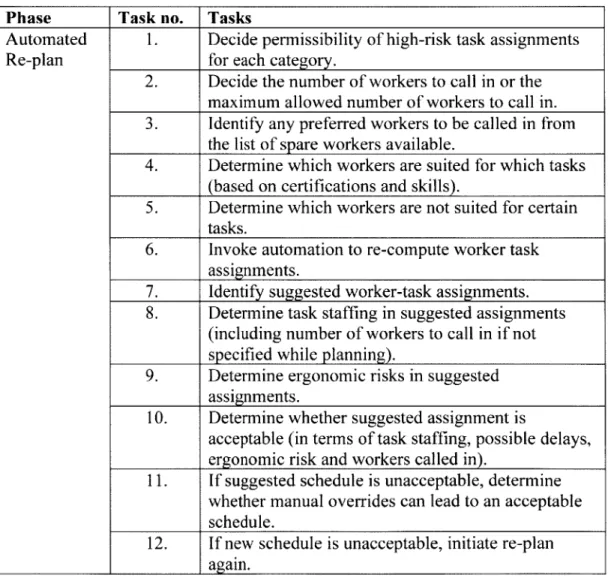
Since the inclusion of an automated planning algorithm serves to offload operator re-planning tasks, it changes the how an operator performs the tasks and subtasks during the re-planning process. Thus, I describe another phase, known as Automated Re-plan to augment the Re-plan phase. In this new phase, rather than creating specific assignments for the shift, the human operator manages inputs to and guides the performance of an automated algorithm that help him/her to find feasible solutions. The scenario task overview for the automated re-plan phase is described in Table 3.3.
Table 3.3: Tasks for Automated Re-Plan
Phase Task no. ITasks
Automated Re-plan
1. Decide permissibility of high-risk task assignments for each category.
2. Decide the number of workers to call in or the maximum allowed number of workers to call in. 3. Identify any preferred workers to be called in from
the list of spare workers available.
4. Determine which workers are suited for which tasks (based on certifications and skills).
5. Determine which workers are not suited for certain tasks.
6. Invoke automation to re-compute worker task assignments.
7. Identify suggested worker-task assignments. 8. Determine task staffing in suggested assignments
(including number of workers to call in if not specified while planning).
9. Determine ergonomic risks in suggested assignments.
10. Determine whether suggested assignment is
acceptable (in terms of task staffing, possible delays, ergonomic risk and workers called in).
11. If suggested schedule is unacceptable, determine whether manual overrides can lead to an acceptable schedule.
12. If new schedule is unacceptable, initiate re-plan again.
3.2.2 EVENT FLOW DIAGRAMS
An Event Flow Diagram (EFD) provides a finer level of specification of operator tasks that eventually produce a set of informational requirements for the user interface. It represents the temporal constraints of events and tasks that occur within a specific phase. The elements of EFD's used in this work include:
- Processes - normal interactions between the human and the system. - Loops - processes that occur iteratively till a pre-determined event occurs. - Phase blocks - other event-flow diagrams accessible from the current diagram. - Decisions - simple rule-based decisions or complex knowledge-based judgments
with many dynamic variables.
- Transitions - transitions between various components of the EFD.
Elements in the EFD are depicted using different shapes illustrated in Figure 3.3. Process, decision and loop blocks are labeled with alphanumeric codes so that they can be cross-referenced throughout the rest of the hCTA process. The labels consist of a single letter (P for processes, D for decisions, L for loops) and a number.
I constructed Event Flow Diagrams for the two phases: Monitoring (Figure 3.4), and Automated Re-plan (Figure 3.5).
Process Decision Loop
Phase
Transition
Automated Re- Yes Re-plan
planning phase required?
D2
Figure 3.4: Event Flow Diagram for the Monitoring Phase
Monitoring phase
Maintain Document and
awareness of Monitor Change in task status update task
progress of task status status
tasks P1 L P2
Maintain Change in worker Document and
awareness of Monitor availability update worker
worker worker availability
availabilities availability
_I_ L P4
Is any task
< understaffed Yes Judge need to
? re-plan
P5 D1I
Determine Specify for each task Invoke
Automated permissibility of Bring in No any preferred automation to
Re-plan high-risk task additional workers? workers (based on compute
assignments P6 D3 skills/certifications) assignmentsP8
No Yes
Know
what Yes Specify
Change an propose workers D4 workers to
assignment in schedule be to bring bring in
proposed Yes madesD nP
acceptable
assignments with manual No
manujally P6changes?
ny limit oSpecify Specify
number of Yes maximumprfrd
workers D5 number of
who can be workers to bring workers to
No rought in in. P10 bring in pl,
NoI
Determine Determine task Identify
Prped 6rgonomic e risk staffing in suggested
cetule? D6in suggested suggested worker-task
accepableassignments assignments assignments
P141 P13, P12
Accept proposed
schedule as new Monitoring
working Phase
schedule P15
3.2.3 DECISION LADDERS
Decision Ladders are tools that aid in capturing the states of knowledge and information-processing activities that are necessary to reach a decision. In the hCTA process, Decision
ladders are created for complex decisions identified in the Event Flow Diagram. The aim of the Decision Ladder is to understand the information required to best support the human decision-maker [56]. Each Decision Ladder depicts the entire decision-making process, starting from the observation and identification of an anomalous state to interpretation and evaluation of the ultimate goal in addressing the decision and finally, determination and execution of the correct response.
In a Decision Ladder, the decision-making process is categorized using three levels of human behavior: skill-based behavior, rule-based behavior and knowledge-based behavior [57].
Skill-based behavior includes unconscious control, rule-based behavior utilizes rules that a human decision-maker has learned from previous experience and knowledge-based behavior involves using environment cues and individual goals to make decisions.
A Decision Ladder traditionally includes two different shapes: boxes and ovals. While boxes illustrate the information-processing activities, ovals signify the knowledge produced by those activities. In the original hCTA process, two iterations of a Decision Ladder are
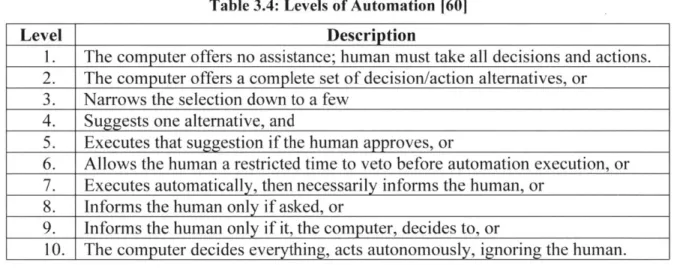
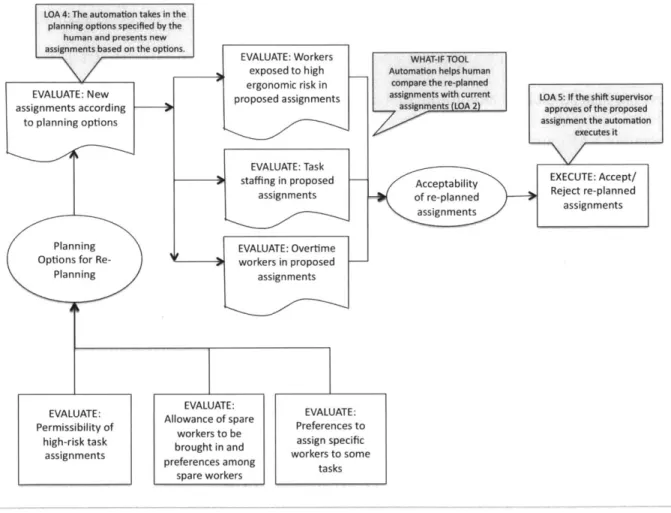
constructed: one is a ladder annotated with display requirements for various components in the decision-making process and the other is a ladder incorporating annotations about potential levels of automation from the levels of automation defined by Sheridan and Verplank [58].
These levels of automation range from the human being in complete control of the system to the automation being entirely in charge, and are summarized in Table 3.5.
![Figure 3.3: Elements Used in the Event Flow Diagram. [65]](https://thumb-eu.123doks.com/thumbv2/123doknet/14670254.556648/44.918.296.638.850.1014/figure-elements-used-event-flow-diagram.webp)