Design and Implementation of an MMO
The MIT Faculty has made this article openly available.
Please share
how this access benefits you. Your story matters.
Citation
Rosenheck, Louisa, Susannah Gordon-Messer, Jody
Clarke-Midura, and Eric Klopfer. “Design and Implementation of an MMO.”
Handbook of Research on Gaming Trends in P-12 Education (n.d.):
33–54.
As Published
http://dx.doi.org/10.4018/978-1-4666-9629-7.ch002
Publisher
Information Science Reference
Version
Author's final manuscript
Citable link
http://hdl.handle.net/1721.1/109851
Terms of Use
Creative Commons Attribution-Noncommercial-Share Alike
Detailed Terms
http://creativecommons.org/licenses/by-nc-sa/4.0/
Design and Implementation of an MMO:
Approaches to Support Inquiry Learning with Games
Louisa Rosenheck
Massachusetts Institute of Technology, USA
Susannah Gordon-Messer
Massachusetts Institute of Technology, USA
Jody Clarke-Midura
Utah State University, USA
Eric Klopfer
Massachusetts Institute of Technology, USA
ABSTRACT
Games can be a powerful tool for learning not only content knowledge but also skills and ways of thinking. In a classroom, the instructional design that goes into the implementation of a learning game is as important as the game itself. The Radix Endeavor is a multiplayer online game for inquiry-based STEM learning in which players explore mathematical and biological systems and use their
understanding of those systems to solve problems in a virtual world. This chapter will present case studies of teachers implementing Radix in their classroom with a wide variety of formats, approaches, and learning goals. The authors will examine how key elements of an implementation impact student and teacher experiences and support problem-solving and inquiry learning. The chapter will explain the importance of implementation decisions, which will aid teachers and instructional designers integrating game-based learning into their own curriculum.
Keywords: Learning Games, Inquiry, Game-based Curriculum, Implementation, Massively Multiplayer Online Game, Biology, Problem-solving, Teachers, Education Arcade, The Radix Endeavor
INTRODUCTION
Multiple research studies support the idea that games are powerful tools for learning (e.g. Clark, Tanner-Smith, Killingsworth, in press; Wouters et al, 2013; Squire, 2011; Steinkuehler & Duncan, 2008). Well-designed games provide scaffolding and motivation for a player to learn skills and apply knowledge in service of meeting specified goals. In addition, they create a safe space to fail, enabling players to take risks they might not take in other learning environments (Gee, 2003). However, how games are implemented in classrooms affects the learning and engagement outcomes and therefore their efficacy. The problem is that teachers do not always know how to integrate games into their teaching. For example, Fishman et al (2014), found that 33% of the teachers they surveyed as part of the A-Games Project claimed that not being sure how to integrate games into instruction was a barrier to using them. This is a difficult problem to solve because a game that works well in one context may not work well in another. As such, rather than simply identifying successful games for learning, the learning games community must also identify types of successful implementations for games.
Critiquing an implementation is no easy task given the wide array of factors within classrooms and schools. The ideal implementation model for a given game will depend on the goals of the game and how those goals can be met. Whether that model will be successful with a given group of students will depend
on what the students are accustomed to and how they respond to changes in their teacher’s approach. There are many options for an implementation of even one game, and how that is carried out can have a great effect on the experiences of both students and teachers. The experience of a game or any educational intervention, rather than simply exposure to it, is what ultimately leads to learning and growth. Therefore, implementation style is a key piece in planning any successful game-based learning unit.
It is pointless to try to designate a “best” implementation for learning games, or even one specific game, in the classroom. We can however catalog different types of implementation models and call attention to important considerations and how they may impact the overall experience. We can begin to identify approaches that do or don’t support problem-solving and inquiry learning. In this chapter, the authors take the game The Radix Endeavor as an example. Radix is a multiplayer online game for inquiry-based STEM learning developed at the MIT Education Arcade. It has been implemented in a number of different ways as part of a pilot research study. After taking a close look at the goals of the game and the player experience, five case studies of Radix teachers will be presented. We will describe the ways in which these teachers implemented Radix in their classroom, along with how they made those decisions. Most importantly, each case study will show the types of interactions that occurred in the classroom – between teachers, students, and the game itself – as a way to characterize the experience for those involved. The case studies will highlight many of the waysthat one game can be used, and present choices that led to either successful or frustrating classroom experiences. After considering each teacher’s case study we will draw out common themes and identify important factors and the effects they have on teachers’ and students’ experiences as well as on learning outcomes. The goal of this chapter is to highlight the importance of each implementation-related decision that a teacher makes, as well as to gain a clearer picture of the types of approaches that support deep learning and inquiry activities. Doing this will aid teachers and instructional designers who are integrating game-based learning into their own curriculum.
BACKGROUND
Massively Multiplayer Online Games (MMOGs) are open worlds that encourage exploration and experimentation. Learning in these environments is often situated in problem spaces that involve
hypothesizing, probing, observing, reflecting, and recycling these steps (Gee, 2003). Typically in a game of this genre, players find themselves in an unfamiliar virtual world but equipped with an array of tools and in-game abilities. They are presented with a series of tasks, often called quests, which set specific goals but don’t tell the players exactly how to accomplish those goals. In order to progress, players must experiment with the tools at hand to see how they can interact with the world and its inhabitants. Through this process of experimentation and discovery, they construct an understanding of the world’s underlying systems and how to work within them to accomplish their goals and complete quests. While in the world, players in an MMO can see the avatars of other players nearby, and are commonly motivated to chat with each other togive each other advice or even collaborate on quests.
The unique affordances of massively multiplayer environments have been shown to foster scientific thinking, scientific identity and inquiry skills both inside and outside of the educational gaming space in places like Quest Atlantis, Whyville and River City (Kafai, Quintero & Feldon, 2010; Barab, 2007; Ketelhut 2007; Ketelhut et al. 2007; Nelson et al. 2007). Since the game world is massive and persistent, the open ended game play encourages a sustained investment in “systems based reasoning, model-based reasoning, [and] evaluative epistemology in which knowledge is treated as an open-ended process of evaluation and argument” (Steinkuehler & Duncan, 2008). To capitalize on the affordances of MMOs and build on the commonalities between this type of game and authentic science inquiry, the designers of The Radix Endeavor set out to design an environment that deeply integrates STEM practices as core game mechanics and allows players to learn by doing in authentic contexts.
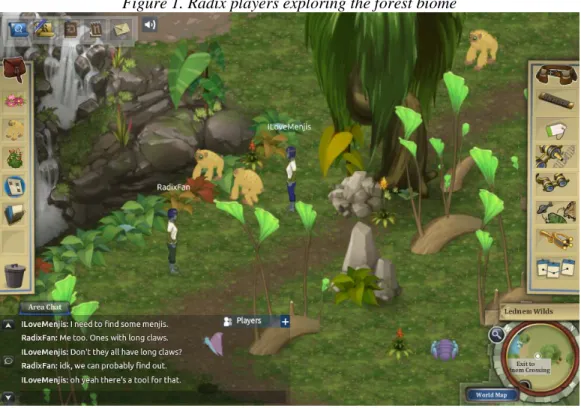
Figure 1. Radix players exploring the forest biome
To support these goals, the Radix game world is designed around systems that players can interact with and manipulate. Figure 1 shows players in the forest region, one of the five distinct biomes with unique fauna, flora, structures, and characters. In each of these biomes, players can engage in activities such as collecting data to compare the heights of plants in different regions. They can also experiment with running simulations to see how a species in a biome has evolved over time and manipulate variables to test out changes in the environment, as seen in figure 2. Players also have a variety of tools that allow them to engage in the authentic practices of biologists and mathematicians. Some of the tools are open-ended and creative, allowing players to draw geometric objects on scale maps, build fences, or create and share food web diagrams. The gameplay is centered on quests that target specific content areas in biology and math. These quests are designed to encourage players to explore the different systems and biomes as well as to engage in inquiry, problem-solving, and collaborative learning in order to complete the task and provide evidence needed to support their solution.
When a new player enters the Radix game, she finds herself in a grassland biome on the island of Ysola, an earth-like world full of fictional plants and animals. She is likely to see the avatars of other players moving around the world working on tasks in the same area. There is a character nearby with an exclamation point over her head, so she talks to her to take on her first challenge, which starts the series of introductory quests. Once she has completed those quests she will be familiar with navigating the world, talking with in-game characters, and using the basic tools for collecting objects, examining them, and analyzing data about them. From there, a wide array of other questlines is unlocked. The player can explore any topic area she is interested in, or the specific ones that her teacher has asked her to work on. Each questline starts with one of the island’s residents explaining some problem or question that is causing the people trouble. This way, the game’s challenges are situated in a contextual narrative that gives the player a reason to care, and a motivation to solve problems that will save the island or its people. The player will then use her tools to explore the environment, ostensibly “messing around” but in reality experimenting and making discoveries. Through collecting and analyzing data, the player gains an understanding of the mathematical and biological systems embedded within the game world, such as Mendelian genetics or evolution. Once she understands each system, she can adjust the inputs to that system in order to get the outputs necessary to solve the problem. She then returns to the character in need of help to turn in an artifact or explain a solution, which requires not only an answer but also data that explains how they know their solution will work. Quests take place across the Radix world in rich biomes, with different tools becoming useful in different domains. This brief overview provides a sense of the format of the game and the player’s experience, setting the stage to next understand how STEM content and practices are embedded into the inquiry-based play style of Radix.
The virtual Radix world provides an environment where students can gain both content knowledge and the skills and practices critical to science understanding. The game covers four topics in biology: genetics, ecology, evolution and human body systems. These content areas were carefully selected to complement what students might be able to do in a hands-on lab, with simulations and longer time-scale activities that are only possible in a virtual world. The particular content for each of the topic areas is aligned with standards from the Next Generation Science Standards (NGSS) for high school and middle school, including an emphasis on science practices. The NGSS encourage the teaching of cross cutting concepts
such as model building and practices such as investigation, interpreting data and evaluating information, which are incorporated into game tasks. In the evolution questlines, players collect data about the traits of animals in different regions of the world in order to learn about adaptation. As the players investigate, they study patterns, interpret data, and construct explanations - all key practices laid out in the NGSS. Throughout all of the questlines in the game, players must use 21st century skills such as collaboration and critical thinking in order to solve problems. This emphasis on skill and practices is critical to students as they learn concepts from science, and Radix provides an innovative place for students to engage with these skills.
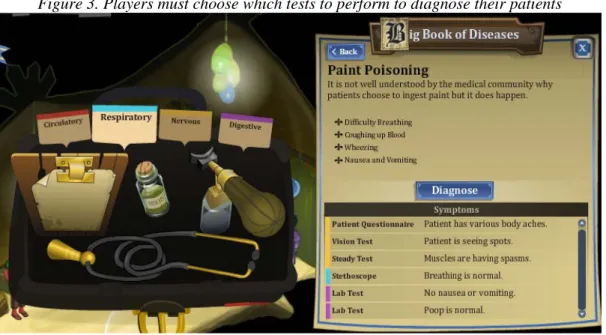
One of the key components in designing the game content and quests was to create a space where students could practice inquiry. This means that when players encounter a problem in the game, they must think through how to solve the problem and determine their own course of action. For example, in the human body systems quests shown in figure 3, players diagnose and treat islanders by making decisions about which body systems to test and which tests they would like to do. They are not directed step by step, but rather are free to decide how best to make their discoveries and what path they would like to take.
Figure 3. Players must choose which tests to perform to diagnose their patients
Although Radix was designed to create a space that fosters inquiry learning and exploration, a completely open-ended game would leave players confused about where to start and what to work on. Therefore, in regards to the player experience, game designers aimed to strike a balance between directed quests and open-ended experimentation. In many quests, this means that a problem is presented to the player, and a question is posed. Often the game goes so far as to suggest a tool that may be useful in solving the problem, and players are aware of what type of artifact they are expected to turn in. As for what to do and how to solve the problem though, players are on their own to experiment and see what works before ultimately settling on a solution. This creates a space for inquiry activities that may take some students outside of their comfort zone, but provides the opportunity for authentic discovery and problem-solving.
IMPLEMENTATION
Radix launched as a free tool available across the US and internationally in late January of 2014. Teachers were encouraged to sign up for an account and begin to use the game as they saw fit in their classroom. At the time of writing this chapter, Radix had over 12,000 user accounts, and was being played in all 50 states and 7 different countries. While the game was designed with high school math and biology teachers
in mind, Radix has been used by upper elementary, middle, and high school teachers as well as by a few instructors at community colleges and universities. Outside of the formal school environment, the game has also been picked up by various after school groups, enrichment programs, and the homeschool community who are using it with a wide variety of ages.
Figure 4. The bridge curriculum shows standards alignment
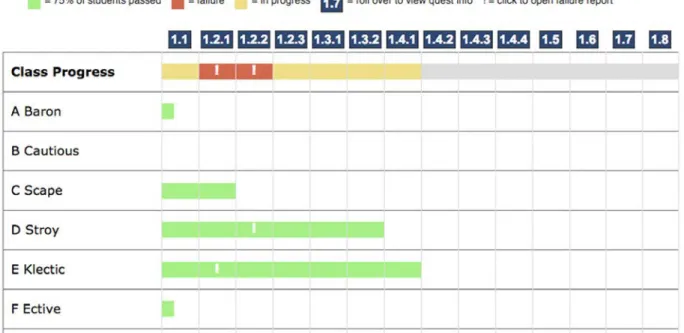
Radix was not designed to be a stand-alone game. It was designed as a supplemental tool for teachers to use in conjunction with other curricula. Therefore, the game provides many important resources for teachers. There is a teacher dashboard with links to resources, tutorials, and tools for monitoring student play. Every questline in the game has curriculum materials that accompany it. One element of these materials lists both the standards and the practices that are covered for the particular questline, as seen in figure 4. This gives teachers an easy way to see how the game aligns with standards already being covered and is particularly helpful for those teachers who are required to turn in lesson plans detailing what standards will be addressed daily in class. Additionally, these curriculum materials contain a set of “connecting questions” for every quest. The connecting questions are meant to help students reflect on their gameplay experience. Teachers can watch videos showing how to use the tools or explaining the main purpose of a quest. They can also track their students’ progress in the game in real time, with focused information provided around students’ “quest failures.” As shown in figure 5, teachers can see when students are struggling with quests and may need help or review on specific content. Those content areas are highlighted and linked back to the teacher resource section.
When Radix launched, teachers were offered both online and face-to-face professional development, much of which focused on the inquiry-based nature of the game. They also had access to webinars and virtual office hours throughout the pilot period, which provided a chance to vent frustrations, share successes, and get help from staff and peers. When they signed up for the pilot, teachers were given several suggested implementation models, and the ones they actually used spanned an even wider range of possibilities. There are teachers who used it as an introduction to material, some who used it during a unit and some who used it as an assessment at the end of a unit. Some used only one quest line while others had students play the material freely over the course of several months.
Radix is designed for students to first play and explore and then reflect. The reflection piece is critical for their learning. For example, in the genetics quests students explore the traits and varieties of different species in the virtual world, experimenting with different genetic crosses and the resulting offspring, shown in figure 6. However, the game does not explicitly mention genotypes and phenotypes, or directly explain the relevant inheritance patterns. It is up to the teacher to do this through classroom discussion, small group work, or individual student reflection. The game provides students with hands-on experiences of the systems that they can later connect to vocabulary and concepts through discussions. For example, a teacher may say, “Remember in Radix when you were breeding glumbugs and you had babies with medium antennae, not only long and short? That is an example of incomplete dominance.” The role of teachers in implementing Radix is to help students form these links and provide the time and space for reflection during game play.
RESEARCH DESIGN
The research presented in this chapter was part of a larger pilot that has collected a wide range of data including what students did in the game (log data), pre and post assessments of content, student interviews, teacher interviews, teacher surveys, and classroom observation data. In order to learn more about how teachers were integrating Radix into their curriculum and what that looks like in the classroom, the research team invited teachers participating in the pilot to opt into this research. Participation involved allowing researchers to conduct classroom observations, student interviews, and teacher interviews, and completing a teacher survey. Due to logistics, 10 teachers and 27 classrooms were selected for the observations and student interviews. However, an additional 10 teachers completed surveys and video conference interviews. These teachers received ongoing support from Radix staff and were encouraged to experiment with the type of implementation they thought would work best for their students. The data presented in this chapter focuses specifically on the teacher survey, classroom observations, and interviews with those teachers and their students.
The classroom observation protocol focuses on the types of interactions teachers have with their students during the Radix session in order to understand how often teachers address the whole class, give direct instructions to individual students, provide guiding questions to a group of students, etc. The student interviews were conducted during class in 5-minute segments during which students were asked to
explain what quest they were playing and what they thought they were learning. The teacher interviews were conducted after completing the implementation, and the protocol attempted to understand how teachers made their implementation decisions, what they and the students struggled with, and how students did or didn’t make connections across topics. The teacher survey asked about their comfort level using Radix, how they used it, and what kind of supports they used.
This study did not aim to draw conclusions about the most effective implementation methods. Rather, the goal was to catalog some of the different implementation models, analyze their pros and cons, and examine the effects that various factors in the classroom had on each other. By understanding the effects of certain implementation choices, researchers hoped to identify the types of pedagogical approaches that can best support an inquiry-based game like Radix.
IMPLEMENTATION FINDINGS
From the observation, interview, and survey data, there emerged two main dimensions on which teachers’ methods greatly differed: format and approach. Choices in these two areas impacted the ways in which teachers were able to facilitate transfer and create a student-led learning experience, and it is therefore important to make these explicit.
The format of a Radix implementation describes when and where students play. The following formats cover most of the implementations seen in the pilot study.
● In class: By far the most common format, teachers took their class to the computer lab, used a laptop cart, or students’ own computers in 1-to-1 schools. They used class time to have all the students log in and play Radix. Usually students were asked to play through specific assigned questlines but they worked at their own pace. This format let teachers help students that needed it and keep them on task, but it took up valuable class time.
● Out of class: Possibly the least common format, teachers assigned their students to play Radix outside of class time, as homework or extra credit. They decided whether to require certain quests and how to translate that work into grades. While teachers were encouraged to use this format in order to save class time for discussion and facilitating transfer, the main roadblock was that too many students didn’t have internet access outside of school.
● Blended: Sometimes teachers used a blended format, where they started students off playing Radix in class in order to make sure they could log in and knew how to use the basic tools of the game. Then they asked students to finish the quests at some point after class. This seemed to work well for some students but not as well for others, potentially causing a larger disparity between the progress of each student.
●
After school program: There were a small number of groups who used Radix in after schoolprograms rather than a formal class environment. In these cases, students played during the after school program time, in a computer lab or on a set of laptops, and were often given free reign to play any and all of the quests that interested them. Despite not having specific content goals, students responded well to this level of autonomy.
The approach of a Radix implementation is harder to define. This factor describes a teaching philosophy that influences how a teacher interacts with and guides the students. The two extreme ends of the spectrum can be described, but in reality it is just that – a spectrum – and teachers may fall at different points along it and even vary at different times in a day.
● Traditional Approach: This describes the times when the teacher had the information and the students got that information from the teacher. It fits with the “sage on the stage” model where information flows in one direction and there is typically a correct answer. In a Radix
they should do or what the right answer was, and teachers often provided as much information as they could to help students make their way through the game.
●
Inquiry-based Approach: This describes the times when the students were working to constructtheir own knowledge, with the teacher asking guiding questions and promoting collaboration. It fits with the “guide on the side” model where the teacher helps students think through their ideas and provides resources, but wants them to figure out a solution on their own, especially when there are multiple possible solutions to a problem. In a Radix implementation characterized by an inquiry-based approach, students often explained their strategies to each other, and teachers often stood back or did more listening than talking.
There are appropriate times for each of these approaches, but when to use which method should be a conscious choice rather than simply a default. The important idea is that the approach a teacher takes has a very strong influence on how students experience the game, as the following case studies will illustrate.
CASE STUDIES
The following five case studies of Radix teachers illustrate different combinations of format and approach in their implementations, and describe the implications on the student and teacher experiences.
Case Study 1: The Traditional Teacher
Name: Jessica
Subject/Grade Level: 10th grade biology Location: Northeast US
Type of School: Urban/rural mix, 40% free or reduced lunch Technology Environment: 1 to 1 laptops
Technology Comfort Level: Willing to try new things but often anxious about the time required Format: In-class
Approach: Traditional
Among the Radix teachers, Jessica is a clear example of a teacher who wants to promote inquiry learning but hasn’t yet made the shift away from a teacher-centered classroom. In preparation for her biology students to use Radix, she dutifully created a number of guides available to them via Google Docs. These guides included a list of the quests she asked them to complete, a list of tools they would need to use in those quests, and even detailed walkthrough instructions describing how to complete the quests. In class, she began by projecting the game and giving a demo of how to start the evolution questline. She then had students play on their individual laptops, asking them to complete the quests during the class period. Students began to play and they had many questions. Where is the critter catcher tool? How do I get to Lednem Wilds? How many menjis do I need to investigate? What should I do next? Is this right? Hands were continuously raised and Jessica hustled busily from student to student explaining what she
understood of how to progress through the tasks. In interviews about their Radix experience, students were asked how they figured out what to do in the game and for more than half of the students, their first response was either “My teacher told me.” or “I read it in my teacher’s instruction sheet.” While there is nothing inherently negative about these interactions, they do demonstrate a traditional, teacher-centered classroom culture. The teacher was the sole source of information in the classroom, all knowledge transmission went through her, and students were in search of a “right answer.”
How did this approach play out in a Radix implementation? Students were frustrated because of the disconnect between their expectations and their assignment. They were used to a linear path of learning where the teacher outlined what they needed to do and defined the steps to completion. Radix, however, is more open-ended and requires exploration and inquiry, skills that students didn’t expect, and perhaps
weren’t able to apply. Jessica was flustered and had difficulty responding to all of her students’ questions – an ultimately unsustainable practice to keep up during gameplay. Those questions were focused on the technical aspects or mechanics of the game, with very little discussion of the actual biology concepts being explored. Overall, the class had an emphasis on checking off the steps on the list rather than solving interesting problems. This seemed largely due to the classroom culture both teacher and students were used to – lectures, book work, and proscribed lab assignments were the norm for these biology students. Additionally, the documents Jessica provided to help students along the way set expectations that this was another activity that could be completed by simply following instructions and getting to the “correct” answer. While this may be an effective approach in certain settings, Radix and other inquiry-based activities don’t fit that mold and it seemed to frustrate both teacher and students, resulting in an implementation deemed unsuccessful.
After some discussion with Jessica about how much work it was for her to keep the students going and how reluctantly they were playing the game, she agreed to let one of the Radix staff model a different approach for her next class, which was another section of the same course with students from the same school population. With this class, the facilitator skipped over the whole-class introduction and
encouraged students to jump right in and play. Students began with much the same type of interactions as the first class. They asked questions about the game mechanics and what to do. However, instead of running around trying to answer every question, the facilitator took a step back. She asked students guiding questions and encouraged them to get up and go see if their classmates had figured that part out. She asked students that were further ahead to explain to each other why the data analyzer tool worked the way it did, rather than simply which settings to choose. In this way, she managed the class in a way more consistent with an inquiry-based approach, trying to guide students to keep trying and figure out what to do on their own or with each other’s help. Compared with the first class, this one had many more students talking to each other about Radix. Students were similarly frustrated at first, but once they began to really dig in, there were more “aha”s and “I get it!”s to be heard. They were beginning to take ownership of their game experience, and interacting with the game on a deeper level, to the point where the facilitator could lead a discussion about evolution with students providing evidence they remembered from the game. The second class, while by no means perfect, began to take on a very different character than the first class – one that included problem-solving and collaboration.
We present these contrasting classrooms not to show that the key to a successful Radix implementation is having a Radix staff member run the show, but rather to illustrate two key points. The first is that existing classroom culture has a huge impact on the expectations students have around any new activity. However, culture shifts can occur with a few basic changes in teaching style and a commitment to keeping it up. The second is that a given learning game implemented with a clashing approach may appear not to work, and should not be discounted but rather have its classroom ecosystem more carefully examined. Jessica was open-minded enough that she was willing to engage in some self-reflection. In a debrief interview she said, “That was really a fun and interesting time watching the students enjoy learning and really helped me to know how to guide them from here in the game.” By sitting back and being an observer, she could see that what felt like giving up control could actually lead to deeper learning and a more relaxed atmosphere. This also gave her the confidence to continue using Radix and to practice developing an inquiry-based approach to teaching.
Case Study 2: Transfer Techniques
Name: Nancy
Subject/Grade Level: 9th grade honors biology Location: Northeast US
Technology Environment: Difficult-to-book computer lab, a few laptops in her own classroom Technology Comfort Level: An early adopter, passionate about the power of games for learning Format: Blended
Approach: Somewhat inquiry-based
One of the big questions around Radix and many other educational games is where does the transfer happen? Students play through the game and get very good at playing that game, but can they apply concepts they explored in the game world to other situations? We know that transfer often doesn’t happen spontaneously, and that’s where Nancy’s implementation of Radix comes into play. Class time and computer lab time is always limited, but Nancy put a lot of effort into trying different ways to get students to connect Radix to other activities and ideas.
Nancy is an experienced teacher who works hard to make her lessons as hands-on and student-led as possible. She says students don’t always love that because for many of them it’s easier and more comforting to do straightforward book work, but she knows that inquiry-based activities lead to deeper learning and provide an opportunity to practice important skills and competencies. Nancy’s typical strategy for teaching a given topic is to provide a variety of different modalities and types of experiences that involve the content, then ask her students to connect and reflect on what they’ve learned.
Nancy booked the computer lab when she could, so that all of her students could play Radix while she kept them on task. Early in the school year, she only used an in-class format and in order to support her students’ learning of the game, she answered many of their questions about technical aspects of the game, much as Jessica did in the first case study. However, in post-class interviews with Nancy, she recognized that she was giving a lot more direct instruction about the game than she really wanted to, and she felt that was mainly because it was early in the year. Sure enough, as the semester progressed Nancy adjusted both her approach and format. Once students were more comfortable with the basics of the Radix world, she spent class time talking in more depth with individual students that were stuck on the content or needed guidance. The other students responded well to her suggestions of using her as a sounding board for whatever they were stuck on, and they often looked to their classmates for help progressing through the game. It’s not that her students were all model pupils, but she worked hard to create an environment where they could work both independently and collaboratively when they needed to. Nancy felt that one of the benefits of Radix was that students could work through the quests at their own pace. Naturally, that led to everyone being at different places by the end of the class. For this reason, Nancy decided to move to a more blended format where students could finish what they didn’t complete in the game on her classroom computers after school, or at home if they had internet access there. This seemed to provide the most flexibility for students to go at their own pace and work in the environment that best suited them.
The most interesting part of Nancy’s method however, was that her integration of Radix into her
classroom didn’t stop there. Once all students had a chance to experience the challenges of the game and solve some of the problems, she looked for opportunities to synthesize what was presented in the game, connect it to other class activities, and model how to use that knowledge to solve new problems. Nancy’s methods for doing this were simple, but quite powerful. Three examples of methods she experimented with are described here.
● Where possible, Nancy took class time to facilitate discussion around problem-solving strategies in the game or to have students summarize their Radix discoveries in order to describe biology concepts in their own words. As all teachers know, the drawbacks of class discussion are that it can be hard to find class time and more importantly not all students’ voices will be heard. ● As an alternate approach, which gave every individual student a chance to reflect on their Radix
experience and get feedback from their teacher, Nancy sometimes assigned students to respond to journal prompts related to recent quests. For example, after an ecology questline she asked them:
Why would animals found in different locations have different food sources? This method took a format students were familiar with, their reflection journals, and used it to encourage students to reflect on what they did in Radix and why their discoveries there mattered.
●
Another strategy Nancy had been developing in conjunction with Radix and other areas of her teaching was to design inquiry-based short answer questions. These questions started with what students learned in Radix and took it a step further so that students had to predict what they thought would happen in a new situation. One example of this type of scenario is: What do you think might happen if a group of menjis migrated from the grassland to an area that was full of deep caves that contained an easy source of food for the menjis? This question didn’t have a correct answer and students couldn’t find the answers in Radix or in a book. Rather, they had to take what they knew to make an educated guess about what adaptations might develop. By handing in their response to questions like this, Nancy could then assess whether they actually understood what they were doing in the game and challenge them to some higher-order critical thinking.These three strategies were just some of the ways in which Nancy experimented with her Radix
implementation. This type of experimentation is extremely important in game-based learning, and good teachers do this in every new lesson they introduce into their curriculum. Instructional designers can provide the software, the professional development, and even supporting curricular materials, but
ultimately each teacher must try a variety of things to see what works best for her students. This is exactly what Nancy has done with Radix, and as a result, her students learned to engage with the game in a deeper way and apply their in-game discoveries to other contexts. This type of implementation and the promising results Nancy got underscore the importance of incorporating transfer activities into a game-based curriculum like Radix.
Case Study 3: Team Teachers
Names: Steve and Sam
Subject/Grade Level: 7th grade life science Location: Northeast US
Type of School: Rural, 52% free or reduced lunch Technology Environment: 1 to 1 laptops
Technology Comfort Level: Moderate tech experience, excited about new ways to engage students
Format: Blended
Approach: Student-directed
Often the teachers participating in the Radix pilot were sole implementers in their school. This can make it difficult for teachers who feel they are “going it alone.” While there is a larger Radix community, it is helpful to have close colleagues to turn to when issues arise ranging from technical problems to how best to support students through a particular quest. This case presents a situation where two middle school science teachers teamed up to support their students as they played through Radix.
Steve and Sam are enthusiastic teachers who are always up for something new and place a heavy emphasis on having their students be responsible for their own learning. They didn’t want to spend the majority of their Radix class time answering questions about how to use tools and navigate around the world. To help the students manage their play experience as well as to help them along, the two teachers set up a wiki page to be used by all of their students. This page gave the students information about the game, listed the quests they were supposed to complete as well as linked to all of the tutorial videos for the different tools in the game. During classroom observations, the teachers were frequently heard
referring students to the page the minute they had questions about how to use in-game tools. Students were also encouraged to ask each other questions and to move around the room to see what others were doing as they played through. All classrooms used the “ask three before me” rule where the students were required to have asked three classmates before they could come to the teacher for help. In this way, Steve and Sam worked to build a community of practice among students figuring out how to make their way through Radix.
Both teachers worked hard to foster an environment of independent learning in the class rather than a culture where the teacher held all of the answers. Their frequent response to student questions was “Well, what have you tried?” This resulted in a classroom environment where the students felt like they were the ones figuring things out for the first time. Students reported that while the game was challenging at times, they felt very satisfied when they finally figured things out on their own. There was a particular level of satisfaction that came from being the first person in the class to figure out how to solve a certain quest. Steve and Sam’s classrooms were noisy, a healthy mix of chatter, frustration and excitement.
When they began discussing their implementation, they decided together to primarily let students have a free play experience. They assigned the same quests to both classes, but agreed that the students were free to play in any order they would like. This would make it harder to keep track of where the students were at all times, but they felt that with a large group playing, there would always be some other students working on the same material. Students played during class, during study hall periods, and at home if they wanted to. Chat permissions were set so that the students could talk with anyone from the same school, allowing the students from different classes to interact in the world even though they would otherwise not interact in the classroom. During visits to both classrooms, students reported that it was nice to be able to work on school work with friends who were in another class and wouldn’t usually have the same
classwork or homework. This indicates that students enjoyed being a part of the Radix community in their school.
One of the key successes to Steve and Sam’s implementation was how they supported each other. Beyond just sharing the wiki resources, they regularly checked in with each other about how their students were responding to the game. They compared student progress and even had a bit of friendly competition about whose students were completing more quests. They also went to each other if there were certain parts of the game that were mystifying their students. On occasion, one would walk into the other’s classroom to check in on whether anyone had figured out how to use the population survey tool or how to handle a student who had thrown away a critical data summary needed for a quest. They also commented that it was easier to get administrative support given that there were multiple teachers using the game. They introduced their tech support officer to Radix and moved on to persuade their math teachers to try using the game as well. For Steve and Sam, creating their own community of practice of Radix teachers, however small it may have been, was a key component of their implementation. Their concerted effort shows just how valuable Radix can be when used by multiple teachers in a school.
Case Study 4: Designs for Learning
Name: Jeff
Subject/Grade Level: 9-12th grade, 21st century skills and video game design Location: Northeast US
Type of School: Suburban, 36% free or reduced lunch Technology Environment: Computer lab
Technology Comfort Level: Low, but with access to tech coordinator support Format: After school program
Though Radix was designed primarily to be a formal education tool, it was used in after school programs as well. In the spring of 2014, Radix was used as the basis for an after school class in video game design. The focus of the program was on 21st century skills and giving students experiences after school that they otherwise would not have. Jeff emphasized that this was a program designed for “a group of students who haven’t been targeted by other after school activities such as sports or drama.” In the course, Radix was used as a model to help kids learn about the different stages in designing a game, and as a final project students were asked to make a paper prototype of their own educational game. This acted as the hook to encourage students to analyze what learning was going on in Radix, and then apply those observations to their own designs.
The after school program took place two afternoons a week, with hour-long sessions for 12 weeks. On any given day, there were between 8 and 15 students in attendance, the majority of which were avid gamers and excited to learn about the process of game design. The course took place in one of the
computer labs in the school, but the room was set up such that the students could either be working on the computers or at a large table in the middle of the room. Students in computer labs often have trouble focusing on non-computer tasks when they are still seated in front of the machines so having the extra space provided an excellent place in which to conduct discussions and work on projects.
During the initial weeks of the program the students played Radix and gave feedback about each aspect of the game that they could identify – mechanics, tools, art style, etc. Jeff facilitated discussions about the feedback and the students also completed written questions. This feedback was passed along to the Radix team, but the real value of this exercise was to motivate students to think critically about the design decisions that went into Radix. They began to understand why those decisions were made and how they impacted gameplay and learning, ultimately resulting in students coming to think like designers.
To take this a step further, and to prepare for designing their own games, the students spent four sessions coming up with ideas for new elements for Radix. They were asked to create the following:
● One new tool to be used for either math or biology ● One new plant or animal for the world
● One food web for an area of the island
●
Danger/toxicity levels for a set of plants in a certain regionThese were short tasks. Students were not asked to design an entirely new tool, but rather to think about what might make the game more engaging and add to both the biology content in the game as well as the overall play experience. The students worked in pairs to brainstorm their additional game content. Students then shared out their ideas and with some prompting, challenged each other to think about what their designs would add to the game beyond the common response of “We thought it would be really cool if…”. Jeff reported that he was surprised at how much the students had taken to playing Radix—coming early, staying late, and even playing at home on their own in order to really dive in to the game.
As the culminating activity, the students worked in pairs to design and create a paper prototype for an educational game. This gave them hands on experience with the early stages of game design. Jeff was very hands-off as the students began designing their games, letting them take ownership of their work. Once the students had finished a minimally playable game, they had a chance to play test each other’s projects and give feedback. Jeff got more involved at this stage, playing along with the students, but gave limited feedback, purposely letting the majority of it come from peers. By the end of the session students were struck by how difficult it was to make a really great game. With Jeff’s facilitation, they had taken the experience of playing Radix to a deeper level by reflecting on the designs and intentions of the game. They also practiced 21st century skills like critical thinking, creativity, and collaboration by designing
their own games inspired by Radix. Jeff’s after school program is a great example of an alterative Radix implementation where the game was used not as the content delivery method but as an “object to think with,” (Papert, 1980) in a way that matched his students’ interests and learning goals.
Case Study 5: The Need for Community Supports
Name: A group of OHS instructors Subject/Grade Level: 9-12th grade STEM Location: Western US
Type of School: Blended learning (online and in-person)
Technology Environment: Home computers, individual on-site computers Technology Comfort Level: High
Format: Primarily virtual classroom Approach: Free play
Virtual and distance learning high schools are slowly becoming more common as parents, students and teachers look for alternative ways to earn a high school education. One virtual high school decided to implement Radix as part of their curriculum in the spring of 2014. Radix was set up as its own course that students could enroll in for credit, but was not integrated with existing math or biology classes. In order to support the students as they played, OHS instructors set up a web site with detailed instructions for the students. Before students began to play, they were instructed to watch a series of YouTube videos including a trailer of the game as well as several tutorial videos explaining navigation and tool use in Radix. To direct them in their gameplay, the website had a document that listed all of the assigned quests, summaries of those quests and links to additional videos for how to use quest specific tools.
The requirements of the course were based on quest completion. In order to get credit in science, they had to complete all of the biology quests and to receive math credit, they needed to complete all of the math quests. In order to receive credit in both areas, students needed to complete all 110 quests in the game. The Radix course began with 50 students enrolled, but ended with only five who had successfully completed all of those assigned quests. There was no requirement around the sequence in which to complete the quests and there were no checkpoints throughout the semester, so students were free to play when and how they liked. OHS instructors were available throughout the semester to provide support both through online chat as well as in person to students who came to work at the various site locations. However, the OHS instructors said that having students playing all different quests at different times made it difficult to provide adequate support. They felt that they weren’t comfortable enough with the game to be able to provide support for every quest and that tracking progress to know where students were at all times got complicated. Whereas teachers in other schools often encouraged their students to use each other as a resource for solving problems in the game, the distributed nature of the virtual classroom meant that there wasn’t a readily available community for these students to tap into.
When researchers met with a group of OHS instructors upon completion, they discussed the challenges they had encountered throughout the semester and concerns regarding the low completion rate.
Unfortunately data was not collected on the causes for the high attrition rate in the course, but it is reasonable to hypothesize that lack of teacher and peer support could be a main factor. Radix was not designed as standalone curriculum, and the need for connections to biology content and support for student communication becomes even more evident in an online course format. A school like OHS might consider incorporating the game into existing math and biology courses as supplemental material rather than having students’ ability to pass a course be entirely dependent on one game. They might also be able to come up with innovative ways to connect students within the game and encourage collaboration across distances. Creating an implementation in which Radix could be effective in this format would take some
additional instructional design but could be well worth it for the benefit of students in a self-paced course of study.
DISCUSSION
These case studies of teachers who have designed implementations of The Radix Endeavor illustrate a number of interesting differences and also highlight some commonalities. It is apparent that there is not one right way to use a game like this, and there is no clear path to finding the best implementation. In this pilot, teachers were given materials on gameplay and curriculum, offered professional development opportunities, and had access to Radix staff, but there was no required format or method. As a result, teachers used this opportunity to explore how Radix could work best in their environment and for their students, and they helped researchers learn a number of lessons about practices that do and don’t support an inquiry-based game for learning. The most important lessons are described here.
Lesson 1: Radix can work in many different ways.
Each of the formats used by Radix teachers, such as in class, out of class, and during after school programs, gave students an opportunity to explore the game world and make discoveries in science and math. Nancy used her in class time for gameplay and out of class time for transfer activities in specific content areas. Steve and Sam used in class time as well but gave their students free reign to explore the content. The OHS students essentially only had unguided out of class time, though they were required to explore not only anything in the game, but in fact everything. Jeff used informal learning time on Radix to explore an entirely different domain. These implementations had a variety of formats, student
requirements, and available resources, but the teachers were all mostly happy with how Radix worked in their classrooms. This suggests that in the appropriate ecosystem, any of these combinations can support a successful Radix implementation.
Lesson 2: The implementation’s design should match its goals.
The implementation of an educational intervention involves many factors in its design. As discussed, the Radix Endeavor can work in a variety of formats and with any number of other elements such as different types of pacing, required milestones, and accompanying curriculum. However, this doesn’t mean that they can all work in any combination. Every teacher should be able to clearly state the goals of the implementation, and these may vary widely. Jessica wanted her students to learn about natural selection and be able to identify evolutionary patterns. Nancy wanted her students to be able to think critically about science-related problems they may encounter. Jeff wanted his students to understand all that goes into game design. OHS instructors wanted their students to gain content knowledge in both biology and math. Given these disparate goals, they made corresponding choices in how to support their students during their Radix experience. Nancy included specific activities designed to connect Radix to other experiences and facilitate transfer. Jeff’s students compared their experience in Radix to other types of games they played. These choices made sense as ways for the teachers to help their students reach the learning goals. OHS on the other hand, required their students to complete every quest in the game in order to get credit, despite integrating the game into a course with few constraints and few supports. This suggests that students who are more interested in certain topic areas, or who struggled with others, might not be able to pass the class. Missing some area of the game does not negate learning in other areas, but setting up the requirements in this way may have led to students disengaging from all areas and dropping out of the class. This is an example of an implementation design choice that did not necessarily match or support the learning goals. In cases such as this, where final completion numbers of the course were low, it may look like Radix as a tool did not engage students and made it too hard for them to pass the class,
when in reality the teachers simply needed a more critical eye on the implementation, or perhaps another chance at iteration. By identifying what went wrong and whether or not it was due to something inherent in Radix, then making adjustments to support specific goals, teachers can build a stronger and more effective implementation.
Lesson 3: An inquiry-based approach supports an inquiry-based game.
While these case studies display a number of different formats that can be successful, this may not be the case when it comes to approach. We see a common theme where the approach categorized as more traditional tends to cause frustration and confusion. In Jessica’s class, students and the teacher herself were bogged down by game logistics because it wasn’t feasible for Jessica to be the sole source of
guidance for both gameplay and content. This dynamic was also seen in a number of other classrooms not profiled here, and in those classrooms as well it often felt to the teacher like Radix wasn’t “working.” However, this dynamic is not necessarily a result of the game itself, but rather the interaction between the game and the approach. In contrast to Jessica, Steve and Sam chose to avoid directly answering students’ questions about how to do specific things, thereby encouraging them to persist on their own or seek other sources such as classmates or the wiki. Removing the option to obtain the “right” answer from the teacher, and instead responding with guiding questions and encouragement, creates a more inquiry-based environment. In these classrooms that led to students feeling more ownership over their learning and showing more excitement at each accomplishment. For this reason, the case studies suggest that the teacher’s pedagogical approach has a significant impact on the implementation.
Thoughtful choices on how to interact with students can strongly support a specific implementation, but another factor that plays a big role is the existing classroom culture. In Jessica’s class, it wasn’t only the expectations she set for the students during Radix play time that led them to expect every answer from her. It was a classroom culture that she, and everyone else involved in the students’ educational careers, had built over time. Students in most of these schools are used to the traditional model of learning in a classroom and they naturally expect that to apply in new activities as well. To change that assumption takes consistency and a strong belief in inquiry learning. A teacher with a traditional approach who would like to implement Radix in the classroom is absolutely capable of doing so but needs to be committed to setting shared expectations and building a classroom culture around more independent, inquiry-based learning.
Lesson 4: Radix cannot exist in a vacuum.
Despite being a large-scale game with hours of gameplay, by design Radix doesn’t work as a standalone tool or teacher replacement. In cases where teachers expected students to understand inheritance patterns or natural selection simply from playing the game during a few class periods, they were often
disappointed with the tool. Radix can provide a meaningful foundation as students’ initial experience with a topic area, and it is a place to explore and engage in a variety of math and science practices. Despite this, one tool on its own can’t easily facilitate transfer or ensure reflection and synthesis of ideas. This was well understood by teachers like Nancy and Jeff. Nancy created her own bridge materials and treated Radix as one valuable experience in a collection of biology activities. Jeff selected Radix as one example of an educational game to be analyzed and to inspire students in their own game design. These are examples of integrating Radix into an ecosystem where each piece connects to and supports the other pieces, combining content learning and skill building to create a more meaningful and comprehensive learning experience.
Games are often designed as a social experience, and Radix provides key opportunities to hypothesize about systems in the game and rework those theories together with peers. Because of this, a community of practice around a game can be just as important as the game itself. In a face-to-face classroom these communities may emerge organically, though as we’ve seen in Steve and Sam’s classes, even in brick and mortar schools some facilitation is often necessary to create a strong community. Steve and Sam did this by starting a wiki for students to use together, and by explicitly and consistently reminding students to ask each other for help. In an online course, with a group of students who may not know each other and don’t interact regularly, it becomes even more important for a teacher or facilitator to model that community of practice and help it grow. This was a key piece that was missing in the OHS implementation, where teachers did their best to support students but did not connect students who could support each other. Building a community of practice is not an easy task and community management may be a new skill for many teachers. However, looking at the difference between students engaging in inquiry in Radix on their own versus with the support of a community shows that communities of practice can have a great impact on the student experience. Therefore, there is value to be added by teachers who can consciously
incorporate this into their implementations of learning games.
Lesson 6: Teacher supports are essential.
As with any new learning tool, teachers need to feel that they are well informed and supported as they try to implement something new in the classroom. The bridge materials developed to accompany the game were critical to helping teachers with their implementation. The standards alignment information helped the teachers to better understand the learning objectives of the game and ensured administrators that this was a worthwhile use of class time. The connecting questions helped teachers facilitate transfer between the game and content learning in the classroom. The video walkthroughs allowed teachers to easily see how to play through a quest, helped students figure out how to use certain tools.
In addition to these resources, face-to-face professional development and online support is crucial for an intervention that asks teachers to change their approach. Being able to model implementations as in the case of Jessica’s class helped teachers see how to realize the full potential of the game. Webinars and virtual office hours that were offered throughout the pilot period let teachers ask questions about anything ranging from technical issues to content. Through these, teachers like Nancy were able to share their experiences with others and the after school students were able to ask questions of the Radix staff directly. These events worked to build a supportive community for teachers using Radix in individual schools, which turned out to be a key resource for teachers’ implementation choices and their own
professional development. It is this combination of readily available materials and social supports that can make the difference between an unsuccessful and at times difficult implementation, and one in which the teacher experiences the value of a tool such as Radix.
CONCLUSION
The Radix Endeavor is a game that was designed to foster an inquiry-based experience with STEM content and practices. As described, there are features in the game that are meant to support the inquiry process, but there are many more external elements that are necessary for a successful implementation of the game. Teachers need to consider how the game fits into their classroom culture and pay attention to how that impacts the interactions among students and teachers. They also need to carefully plan activities or experiences outside of the game to take students to the next level of conceptual understanding.
Additionally they need to consciously foster the growth of communities of practice around the game. The case studies presented serve as examples of how the same game can appear frustrating when not well supported, but very valuable when thoughtfully implemented.
It may seem like common sense that an educational intervention should be well supported and thoughtfully implemented, but unfortunately it is not always the case due to time constraints and standards requirements. Many teachers tend to choose games that are more standalone and require less customization. This style of game can ensure that students are learning on their own simply by spending time in front of the computer. When it comes to game-based learning and educational technologies, certainly there are tools out there that fit this description. Starfall and Coolmath are sites with small, focused games that are commonly found in classrooms (Takeuchi & Vaala, 2014), and some teachers will gravitate toward those, deeming them more feasible to implement and more effective as a learning tool.
Radix doesn’t fit the bill as a standalone type of tool. Instead, the stories of teachers like Nancy, and Steve and Sam, suggest that the most successful implementations are the ones where teachers match their approach to the game, and find the right connections between the in-game and out-of-game experiences. They lead discussions and construct assignments that facilitate transfer. They provide resources with the right balance of guidance and open-endedness. They monitor their responses to create a culture of exploration and peer support. All of this takes time and energy in the preparation and the execution to match the class’s needs and goals. In the end though, these are the teachers that feel they have provided their students with a unique and rich learning experience. Their students are not only mastering specific topics in biology, but they are learning to ask questions, evaluate information sources, locate resources for problem-solving, and apply these skills to new contexts. They are taking ownership of their learning, experiencing the satisfaction of solving problems independently, and building 21st century skills. This is
the learning that lies at the heart of an immersive, experiential game like Radix and to get all this out of the experience, implementation matters.
New literacies such as the ones described above are essential in this digital age where information is readily available but needs to be synthesized and applied. New emphasis is being placed on teaching these skills in schools to enable students to adapt and thrive in an ever-changing society. In order to effectively teach these different types of skills, new pedagogical approaches must also be developed – approaches that match the learning goals and support deep thinking in ways that traditional classroom instruction hasn’t done. Games, including inquiry-based experiences such as Radix, are tools that are gaining in popularity for building 21st century skills. However, the pedagogical approaches and implementation
methods to support them and ensure that the learning goals are met are still in the early stages of
development. The next steps in educational research in this area should include exploring the rich variety of practices being used, and gaining an understanding of the approaches that can best support deep learning experiences. Doing so will enable more teachers to learn to effectively implement inquiry-based games, thereby supporting the movement toward student-centered classrooms fostering deep learning.
REFERENCES
Barab S.A., Sadler T., Heiselt C., Hickey D., & Zuiker, S. (2007). Relating narrative, inquiry, and inscriptions: A framework for socio- scientific inquiry. Journal of Science and Educational Technology, 16(1), 59–82.
Clark, D. B., Tanner-Smith, E., & Killingsworth, S. (revised and resubmitted). Digital games, design, and learning: A systematic review and meta-analysis. Review of Educational Research.
Fishman, B., Riconscente, M., Snider, R., Tsai, T., & Plass, J. (2014). Empowering Educators: Supporting Student Progress in the Classroom with Digital Games. Ann Arbor: University of Michigan. gamesandlearning.umich.edu/agames
Gee, J. P. (2003). What video games have to teach us about learning and literacy. New York: Palgrave/Macmillan.
Kafai, Y. B., Quintero, M., and Feldon, D., (2010). Investigating the ''why'' in whypox : Casual and systematic explorations of a virtual epidemic. Games and Culture, 5(1), 116-135.
Ketelhut, D.J. (2007). The impact of student self-efficacy on scientific inquiry skills: An exploratory investigation in River City, a multi- user virtual environment. Journal of Science Education and Technology, 16(1), 99–111.
Ketelhut, D.J., Dede, C., Clarke, J., Nelson, B., & Bowman, C. (2007). Studying situated learning in a multi-user virtual environment. In: Baker E, Dickieson J, Wulfeck W, O’Neil H (eds), Assessment of problem solving using simulations. Mahwah, NJ : Lawrence Erlbaum Associates.
Nelson, B., Ketelhut, D. J., Clarke, J., Dieterle, E., Dede, C., & Erlandson, B. (in press). Robust design strategies for scaling educational innovations: The River City MUVE case study. In B. E. Shelton & D. A. Wiley (Eds.),The educational design and use of computer simulation games. Rotterdam, The Netherlands: Sense Press.
Papert, S. (1980). Mindstorms: Children, computers, and powerful ideas. Basic Books, Inc..
Squire, K. (2011). Video games and learning: Teaching and participatory culture in the digital age. New York: Teachers College Press.
Steinkuehler, C., & Duncan, S. (2008). Scientific habits of mind in virtual worlds. Journal of Science Education and Technology, 17(6), 530-543.
Takeuchi, L. M., & Vaala, S. (2014). Level up learning: A national survey on teaching with digital games. New York: The Joan Ganz Cooney Center at Sesame Workshop.
Wouters, P., van Nimwegen, C., van Oostendorp, H., & van der Spek, E. D. (2013). A meta- Analysis of the Cognitive and Motivational Effects of Serious Games. Journal of Educational Psychology, 105, 249-265.