THE DEMOCRATIC AND POPULAR REPUBLIC OF ALGERIA MINISTRY OF HIGHER EDUCATION AND SCIENTIFIC RESEARCH UNIVERSITY OF
ABDELHAMID IBN BADID MOSTAGANEM FACULTY OF FOREIGN LANGUAGES
DEPARTMENT OF ENGLISH LANGUAGE
A Dissertation Submitted in Partial Fulfilment for the Requirement of
Master Degree in Didactics of Foreign Languages
Presented by Supervised by
Gouaich Hadj Charef. Prof.Benneghrouzi.F.Z.
Members of the Board:
President: Ms. Kharroubi Mounira UNIVERSITY OF MOSTAGANEM Supervisor: Prof.Benneghrouzi Fatima Zohra UNIVERSITY OF MOSTAGANEM Examinor: Ms. Bentamra Soumia UNIVERSITY OF MOSTAGANEM
Academic Year: 2019-2020
Teaching Grammar Creatively (Using
Discovery, Consolidation and Use Model)
I Dedications
In memory of my lovely uncle (God bless his soul), I dedicate my dissertation work to my family and many friends.
A special feeling of gratitude to my loving parents for their words of encouragement push for tenacity for providing me with unfailing support and continuous encouragement throughout
my years of study and through the process of researching and writing this dissertation. This accomplishment would not have been possible without them.
To all my friends Ben. Hamid, Dr. Khineche, S. and Dr. Larbi, N. with whom I shared the university life with its lights and shadows.
II Acknowledgments
I would like first to thank my supervisor Prof Benneghreouzi F. Z. for her understanding and precious pieces of advice. The door to Ms. Bentamra, S. was always open whenever I ran into a trouble spot or had a question about my research or writing. She steered me in the right direction whenever she thought I needed it.
A big thanks goes to Ms. kharroubi and Ms. Bentamra for accepting to read and evaluate my work.
I would like also to thank the secondary school teachers and students who were involved in the validation survey for this research. Without their passionate participation and input, the validation survey could not have been successfully conducted.
A special thanks goes to Ms. Silarbi, H. and all my friends Ben. Hamid and Chenin Amira Chahrazed for their helpful comments and encouragement to complete this work.
Finally, I must thank Ms. Bekaddouri, Dr. Khineche, and Ms.Bentamra for being my teachers along these years.
III Abstract
While there is generally a great interest in how English language is taught in the classroom, the question arises as to how can grammar be taught creatively. The aim of the present work is to provide teachers with a creative way of teaching grammar which is Discovery, Consolidation and Use with regarding pronunciation as an essentiel part. As the creative model is highlighted, the study also aims to uncover the mismatch between the teacher’s way of teaching and students’ way of learning. To fulfill the purpose of the study, both quantitative and qualitative research method were used to collect data. Teachers’ questionnaire and interview were used to collect data about teachers’ methodology in teaching grammar and whether they seem creative or not, at the same time if they are using the Discovery Consolidation and Use technique or not. Some examples about how to teach grammar using a creative technique were presented. Students’ questionnaire was used as a tool in order to collect data about students’ attitudes towards grammar and the way they are taught. The results have shown that teachers lack of creativity in their teaching of grammar and they follow the same methods which became old fashioned… which affect negatively thre students’ performance, outcome and competence in using the language. In addition, teachers ought to apply the Discovery consolidation and use technique with regard to the pronunciation so that they help their students to increase their level in grammar and they become motivated, aware in learning grammar and competent in using the language appropiately.
Key words: Teaching grammar creatively, discovery, consolidation, use, pronunciation, secondary schools.
IV List of Abbreviations
GTM: Grammar Translation Method PPP: Presentation Practice Produce DCU: Discovery Consolidation Use MFP: Meaning Form Pronunciation CLT: Communicative Language Teaching
V List of Graphs
Graph 2.1: Teachers’ Teaching Experience………23
Graph 2.2: Possible Reasons for Grammar Importance………..………24
Garph 2.3: Representation of the Grammatical Structure………..…….……25
Graph 2.4: Introducing the Use of the Grammatical Structure……….……..25
Graph 2.5: The Way of Introducing the Use of the Grammatical Structure…………...……26
Graph 2.6: The Basic Course of Grammar Teaching……….….……26
Graph 2. 7: Importance of Pronunciation in Teaching Grammar………27
Garph 2. 8: Pronunciation in Grammar Lesson………...……27
Graph 2.9: How Do You Teach Grammar………..……28
Graph 2.10: Language Skills in Grammar………..……28
Graph 2.11: Preparing Grammar Lesson………29
Graph 2.12: Students Level in Grammar………30
Garph 2.13: The Difference between The Grammatical Structures………...………31
Graph 2.14: The Present Way of Teaching and the Language Skills……….……31
Graph 2.15: Students Reaction towards Learning Grammar………..……32
Graph 2.16: Students Engagement……….………32
Graph 2.17: Students Satesfaction……….………33
Garph 2.18: Students’ Point of View about Explaning the Rule………33
Graph 2.19: Students’ Opinion about Discovering the Rule………..……34
Graph 2.20: Grammar in Fostering the Language Skills………34
Graph 2.21: Teachers Correction of Students’ Grammatical Mistakes………..………35
VI List of Figures
Figure 1.1: The Function of Deductive and Inductive Approach………..……..10 Figure 1.2: The PPP Model………..12 Figure 1.3: The Process of Teaching Grammar Creatively……….……18
VII List of Tables
Table 1.1: Aspects of teaching the Grammatical Structures in Connection to Language Skills……….7 Table 2.2: Grammar Is a Hard Activity to Accomplish………29
VIII Table of Contents
Dedications ... Error! Bookmark not defined. Acknowledgments ... Error! Bookmark not defined. Abstract ... Error! Bookmark not defined. List of Abbreviations ... Error! Bookmark not defined. List of Graphs ... Error! Bookmark not defined. List of Figures ... Error! Bookmark not defined. List of Tables ... Error! Bookmark not defined. Table of Contents ... Error! Bookmark not defined. General Introduction……..……….1
Chapter One: Literature Review
1. Introduction: ... Error! Bookmark not defined. 1.1. Definition of Grammar: ... Error! Bookmark not defined. 1.2. Grammar in English Languge Teaching: ... Error! Bookmark not defined. 1.3. Grammar in Relation to Language Skills: ... Error! Bookmark not defined. 1.4. Approaches and Methods in Teaching Grammar: ... Error! Bookmark not defined. 1.4.1. The Grammar Translation Method: ... Error! Bookmark not defined. 1.4.2. The Deductive Approach: ... Error! Bookmark not defined. 1.4.3. The Inductive Approach:... Error! Bookmark not defined. 1.4.4. The Communicative Approach: ... Error! Bookmark not defined. 1.4.5. The PPP Model: ... Error! Bookmark not defined. 1.5. Difficulties in Teaching Grammar: ... Error! Bookmark not defined. 1.6. Creativity in Teaching: ... Error! Bookmark not defined. 1.7. Teaching Grammar Creatively:... Error! Bookmark not defined. 1.8. Language Awareness Raising and Teaching Grammar: Error! Bookmark not defined. 1.9. The Discovery, Consolidation and Use in Teaching Grammar: ... Error! Bookmark not defined.
1.10. Conclusion: ... Error! Bookmark not defined. Chapter Two: Methodology and Data Analysis
2. Introduction: ... Error! Bookmark not defined. 2.1. Research Design:... Error! Bookmark not defined. 2.2. Participants: ... Error! Bookmark not defined. 2.3. Data Collection Instruments: ... Error! Bookmark not defined.
IX 2.3.1. Students’ Questionnaire: ... Error! Bookmark not defined. 2.3.2. Teachers’ Questionnaire: ... Error! Bookmark not defined. 2.3.3. Teachers’ Interview: ... Error! Bookmark not defined. 2.4. Data Analysis: ... Error! Bookmark not defined. 2.4.1. Teachers’ Questionnaire Analysis: ... Error! Bookmark not defined. 2.4.2. Students’ Questionnaire Analysis: ... Error! Bookmark not defined. 2.4.3. Teachers’ Interview Analysis: ... Error! Bookmark not defined. 2.4.3.1. An Example of Using the Discovery, Consolidation and Use………...36 2.5. Conclusion: ... Error! Bookmark not defined.
Chapter Three: Discussion of Results and Recommendations
3. Introduction: ... Error! Bookmark not defined. 3.1. Interpretation of Results: ... Error! Bookmark not defined. 3.1.1. Interpretation of Teachers’ Questionnaire: ... Error! Bookmark not defined. 3.1.2. Interpretation of Teachers Interview: ... Error! Bookmark not defined. 3.1.1. Interpretation of Students’ Questionnaire: ... Error! Bookmark not defined. 3.2. General Discussion: ... Error! Bookmark not defined. 3.3. Suggestions and Recommendations: ... Error! Bookmark not defined. 3.3.1. A Suggested activity with an example : ... Error! Bookmark not defined. 3.4. Limitations: ... Error! Bookmark not defined. 3.5. Conclusion: ... Error! Bookmark not defined. General Conclusion: ... Error! Bookmark not defined. List of References
Appendices
1 General Introduction:
Thanks to globalization English has become a worldwide language and it has dominated all the fields in general and education in particular and that is the case in Algeria. Teaching English as a foreign language focuses more on making the student able to use the language appropriately and here comes the role of teaching grammar because “Without grammar, language does not exist”, say Nassaji and Fotos (2011, p. 1). However, this has not always been a problem. One of the most hated topics in the field of language teaching has been grammar and that what impacts negatively on the performance of the teacher and in a big range on the outcome of the student.
Many students know a lot of vocabulary but when it comes to speaking or writing a simple paragraph, it may appear that they have issues in putting the words in the right place and here it is revealed that they have shallow knowledge about grammar. This could be related to both the teacher’s methods and the techniques that are used when teaching grammar inside the classroom which has a negative impact on students’ performance. The lessons might be boring and the student feels the same routine which is to read the example and follow the rules and memorise them whithout any sense of interaction between him and the teacher or even with his classmates.
Also, the problem was not in grammar but in the way it was being taught, most of the time grammar was about parsing or diagramming. Adding to that, teachers may have no subject knowledge about grammar nor any idea of how to teach it creatively; publishers also stepped in it to fill the gap. They look they do not have background knowledge of how to approach grammar because they do not know how English language works and this has a negative impact on student literacy outcomes. Some publishers feel happy to sell hundreads of grammar workbooks in order to make teachers feel insecure. Many exercices even in the textbooks consist of out-context grammar exercices which urge children to underline nouns, verbs and circle the adjective and that could be a time wasting work which results a shallow knowledge gained by students.
Despite the fact that most teachers have knowledge about what methods, approaches and different techniques are used to teach grammar, the level of the student in this module reveals a defisiency in both spoken and written skills. Regardless the fact that grammar plays an important component in the Algerian schools (Middle and Secondary schools). It is admitted that grammar use of first year students at university is far from satisfactory. Such an
2 outcome pushes us to question the methodology of teachers while teaching grammar which means how they are teaching this module and even they are following the right regulation there might be no result concerning student level in grammar. That is why teachers need to be creative, they need to bring original and interesting ways of teaching grammar in order to make the lesson stimulate learners' minds and make it easy to grasp in a meaningful way.
The main concern of this work is to provide teachers with some useful and creative techniques to help the learner better cope with English grammar.The present study is based on the following issues:
1- How is grammar taught and what is meant by creative teaching? 2- Why do some teachers find difficulties in teaching grammar ?
3- Why do some students have a deficiency in grammar whether in writing or speaking? 4- What are the innovative ways to teach grammar in a creative way?
These research questions can be combined in the following hypotheses:
1- The methods that are used became old fashioned and they do not help the student to be competent in grammar which means that teachers are not able to bring innovative and creative models to teach grammar.
2- There is lack of coordination between grammar and speaking skill especially in pronunciation.
3- Students can respond in a high level if the teacher raises their consciousness about any grammatical feauture.
To reach the aforesaid objectives, this case study collected qualitative and quantitative data from two research instruments: two questionnaires as primary tool for the sake of collecting data; the first questionnaire will be addressed for teachers of secondary schools, adding to that an interview in order to gain deeper information. The second one is administrated to secondary school students. The data were analyzed and led to interesting results.
This work is divided into three chapters. The first chapter draws a sketch on the theoritical background of the grammar and grammar teaching methods and approaches with
3 relation to the language skills. Besides, it represents the creativity in teaching and how to reach to the level of creativity in teaching grammar. The second chapter that is the practical side describes the research tools (questionnaires to both teachers and secondary school students and an interview) and the research design to be used. It concerns with the analysis of the questionnaire and the interview and an example of how to teach grammar creatively. The third chapter deals with the interpretation of the results and the pedagogical recommendations of how could a teacher be creative in teaching grammar with a suggested activity to remedy the target situation.
Chapter One
5 1. Introduction:
Teaching grammar has been playing a major role in enhancing both of the language skills and the communicative competence for the learners; however, it seems that the majority of students find it boring due to the same way of teaching and the way they are taught grammar mainly it is all about memorising the rules in each lesson. Regarding teaching grammar, teachers ought to be creative and provide innovative ways pedagogically so that the lesson would be presented in a meaningful and in an interesting way to the students.
In this chapter, we are going to define grammar, identify its situation in language teaching and deal with approaches and methods to teach grammar. Also in this chapter, we will draw the reader’s attention to what creativity is and what is meant by teaching grammar in a creative way providing some interesting ideas and innovative ways in order to show how to approach grammar in the classroom in a meaningful way.
1.1. Definition of Grammar:
From a historical view, grammar in etymology comes from its Greek expression (grammatikē technē), which means "art of letters" and through time this definition has changed to what is known today
.
Many linguists have failed to provide the field of language
teaching with an appropriate picture of what grammar is, that grammar which has dominated the field of language teaching for decades and was once the most important point in English language teaching. So, it seems difficult to provide a perfect definition to what grammar is because it is not fixed over times and many grammarians gave different points of view towards grammar; this difficult definition could only be justified as a fact that:Linguistic notions of grammar have changed over time…and this has significantly increased the number of components that could be called „grammar‟. In short, definitions of grammar and grammatical knowledge have changed over time and across context, and I expect this will be no different in the future (Purpura, 2004, p. 50, 51)
So, how could grammar be defined?
According to Thornbury (1999, p.1) “grammar is partly the study of what forms (or structures) are possible in a language”. In other words, grammar is treated as a coin with two faces which represents morphosyntax. Morphology is the study of words’ structure and syntax
6 is the study of how words and phrases are arranged and put to form a sentence. In addition, according to Penny Ur (1998, p. 4), grammar can be defined by changing and joining different words so that longer units of meaning can be constructed. Furthermore, in Oxford Advanced Learner’s Dictionary, Grammar refers to: the study or the science of rules for forming words and combining them into sentences. This is the general definition of grammar, while in the field of education, Lowth (1762) sees that grammar teaches us to speak properly and enable us to judge every form of construction in a right or a wrong way.
1.2. Grammar in English Languge Teaching:
From a historical view, Latin and Greek were dominating on the languge learning tradition for many centuries. At that time, the focus was on learning its grammar using a method known as the Grammar Translation Method. It was about gaining the grammatical knowledge using translation as a mean in another way. In the past “Grammar was used to mean the analysis of a language system, and the study of grammar was... thought to be sufficient for learners to actually acquire another language” (Rutherford, 1988, cited in Purpura, 2004, p. 1)
Nowadays, teaching English became crucial. In order to communicate effectively, one ought to be competent in grammar because it is the key to understand any verbal communication so that we can transmit our thoughts in a clear and an effective way. Thornbury (1999, p. 15) claims: “Grammar; (…) provides the learner with the means to generate a potentially enormous number of original sentences”. That is, grammar helps learners to produce many different sentences with limited words. Moreover, a specefic attention is given to grammar in the domain of languge teaching.
The teaching of grammar is intricately bound up with the teaching of meaning.it is not sufficient to enable the learner to produce grammatical sentences; he must know when and how to use them
(Corder 1973, p. 335)
According to Cordor’s ponit of view, it seems that teaching of grammar is interconnected with the teaching of meaning, in that it is very important to understand the grammatical forms in order to know how to use them. At the same time, Singh (2008) said that "the teaching of grammar is the teaching of the rules of grammar as part of language education. In the context of the second language instruction, the teaching of grammar is generally aimed at imparting the learners’ knowledge and ability to use the language
7 grammatically correctly "(p. 98). Thus, despite the fact of how grammar was treated in the teaching field, however, it seems that it imposed itself and proved its importance and we may say that grammar has significance in teaching English. Therefore, it is necessary to possess a good command over the language.
1.3. Grammar in Relation to Language Skills:
When it comes to teaching grammar (grammatical structures), we ought to integrate language skills which are listening, speaking, reading and writing. Here when we teach, we should be getting the learners recognise the structure whether in a spoken or written form; at the same time, the student should produce a meaningful sentence in a context and know when to use it.
Basically, language skills are devided into receptive skills which are listening and reading and the productive skills which are speaking and writing. It should be noted that the integration of language skills in grammar will improve those skills themselves especially in writing; the student will be able to produce a well-structured formed sentence and accomplish different levels of discourse analysis. In reading, the student will be able to recognise the written forms, evaluate and understand different texts. So, grammar provides an effectiveness of the text and an insight into the meaning too.
Skills Form Meaning
Listening Perception and recognition of the spoken form of the structure.
Comprehension of what the spoken structure means in the context.
Speaking Production of well-formed
examples in speech.
Use the structure to convey meaning in speech.
Reading Perception and recognition
of the written form.
Comprehension of what the written structure means in the context.
Writing Production well-formed
examples in writing.
Use of structure to convey meaning in writing.
Table 1.1: Aspects of the Teaching of Grammar Structures in Connection to Language Skills (UR, 1988 :6)
8 From the table, it seems that the concern of teaching/learning process is concerned with the four skills in two distinct levels namely form and meaning. In that case, many didacticians (Ur 1988; Thomson and Martinet, 1960) agree that the knowledge of the four skills and the different grammar structures are tied together. At this level, it would be clearer to consider two types of skills known as receptive skills and productive skills; speaking and writing are both essentiel and should be conceived by both teachers and students because they allow them to produce a well-formed structure in a spoken or a written way, while listening and reading are about the ability to perceive the adequate forms as good as possible of both spoken and written structures.
1.4. Approaches and Methods in Teaching Grammar:
English language teaching in Algeria has witnessed the implementation of different methods and approaches to teach grammar.
1.4.1. The Grammar Translation Method:
It is often referred to as the classical method as it was first used in the teaching of Latin and Greek in the 19th century. This method was used for reading and developing foreign language literature under the form of reading passages for grammar rules, vacabulary and translation with the help of the teacher. So, the main focus was on reading and writing without giving a matter to speaking or listening. Rules on its use were explained, and it was exemplified by sample sentences (Richards and Rodgers 2001, p. 4). Basically, the teacher’s role is just to guide because the student works on memorising rules and manipulation of both the morphology and the syntax. One of the primary characteristics of the Grammar-Translation Method (GTM) was the studying of foreign languages in order to be intellectual. The tools that Grammar-Translation employs are detailed analysis of grammar rules, which is followed by their application to the task of translating in and out of the target language. Therefore, the grammatical rules are learned in a deductive way which means the teacher presents the rules followed by a practice and a task by doing drills and translatig sentences of the target language; here, students must be accurate and not fluent in translating the sentences into their target language and vice-versa.
1.4.2. The Deductive Approach:
According to Thornbury, (1999, p. 29) ‘‘a deductive approach (rule-driven) starts with the presentation of a rule and is followed by examples in which the rule is applied’’. A
9 deductive approach is when the rule is presented and the language is based on the rule. (Here, the Teacher gives the rule). In other words, the former is more teacher-centred and the latter is more learner-centred. According to Thornbury (1999), the deductive approach is defined as the way in which the grammar is taught where the students are involved with a general rule then apply it to specific language examples and it bottom-up approach which is moving from the specific points to the more general. So this approach is a teacher-centred approach, where the teacher just teaches everything while the students just sit and listen and the students’ involvement is very less and this approach is the more standard teaching style, where the teacher starts by explaining the rules that govern each point of the grammar lesson. The teacher shows the rules, and then passes to give lessons that hold those rules. For example, when it comes to teaching verbs like “was and were”, the teacher just explains and gives sentences that include the words was and were.
What the teacher teaches: I was You were They were We were He/she/it was
After that he asks the students to make their own sentences which include the words was and were, this is to make sure that the student understands what the teacher has taught. What makes the deductive approach beneficial is time saving and it allows to have extra time in order to practice on language items especially if the classroom contains a great deal of low level.
1.4.3. The Inductive Approach:
It is more to student-centred where the student will be more involved in the lesson. Inductive approach is very effective because it requires students to process and analyse data. This approach is also known as the bottom-up method. Students, especially those without recent educational backgrounds, such as adult learners, they are considered as beginners often learn more readily using this method. You teach grammar through a discovery process, allowing students to discover how the rules function over the course of various exercises. For
10 example, teaching the past tense, the teacher divides his students into groups of five students then he distributes each group with twenty small pieces of paper with an action verb written on each of it. Ten of the words are past tense and the other ten is present tense. Students are then required to divide the past tense from the present tense at the same time they need to make sentences for all the words. After that, the teacher checks whether it is right or wrong.
Figure1.1: The Function of Deductive and Inductive Approach 1.4.4. The Communicative Approach:
Clearly, grammar is considered as a set of rules for combining words to express meaning which requires having a communicative grammatical competence which is the ability to use and understand a structure in a variety of situations spontaneously. That is why teachers aim to treat grammar as a means of communication. It is recognised that the view of language as communication could not easily be adequately contained in the form-oriented, sentence-based linguistic of the time (Candlin, 1978, p. vii). At the same time, Allen and Widdowson claim that the language should be presented in such a way as to reveal its character as communication (1976, p. 59).
It seems that language is not just concerned with the grammatical knowledge but in present day society it is perceived as a means of communication; this does not mean that grammar should be dismissed but it means that grammar should have a great deal of attention in language teaching (Yalden, 1987). Lately, in this teaching methodology, grammar is taught communicatively. Brown (2001) mentions that “grammatical patterns are matched to particular communicative meanings so that learners can see the connection between form and
function”. Students can learn how to select the correct pattern to express their ideas and feelings. They learn how to apply grammar rules into different speaking situations (Brown, 2001). He summarized the essence of CLT thus:
deductive general specefic
11 It is based on the notion of the learners as communicators, naturally endowed with the ability to learn languages. It seeks to provide learners with the target language system. It is assumed that learners will have to prepare to use the target language (orally and in written form) in many predictable and unpredictable acts of communication which arise both in classroom interaction and in real-world situations, whether concurrent with language training or subsequent to it.
1.4.5. The PPP Model:
According to Harmer (2001, p. 86) “a variation on Audiolingualism in British-based teaching and elsewhere is the procedure most often referred to as PPP which stands for presentation, practice, production”. It is a method for sequencing and organising the lesson into three clear stages so that each stage flows nicely into the next stage and it is pedagogical because each stage is built on the next one. From the triangle, the teacher talking time is smaller at the begining and student talking time expands at the last stage.
Nassaji and Fotos (2011) in this field describe the PPP method on this way: The presentation stage is where the grammatical points are presented using a text or stories or a dialogue in order to make it familiar to the student. The next stage of this model is the practice stage where learners do different kinds of controlled practices at the same time drawing their attention to specific structures. The last stage, is the production stage, learners are given more freedom to use what they learnt in the previous stages and in communicative activities so that they could develop their fluency.
However, it seems that despite that teachers are aware of this model and how they use it inside the classroom, there might be no progress in teaching grammar and the attitude towards learning or teaching grammar is the same and the misuse of the PPP model cause pedagogical problems. One of the problems of PPP is that it requires a great amount of teacher control, because of its extreme focus on accuracy. This kind of approach is based on the belief that fluency comes out of accuracy.The language students are expected to produce in the practice stage is, therefore, severely restricted making meaning unimportant or at least subordinate to the form identified by the teacher (Willis, 1996). At the same time, as soon as the focus is on real communication, students will inevitably progress; using language they are more familiar with and comfortable to them. It is quite clear that PPP does not perform its intended function and if students continue using this language then their communicative competence may not be enhanced because the main focus is on comfomity. At this level,
12 students would give impression that they are comfortable with the new language in this way they could either not be able to produce the language in a correct way or even will not produce it at all.
Figure1.2. The PPP Model 1.5. Difficulties in Teaching Grammar:
It seems that students have an unpleasant memory especially when they hear the word rules it makes them feel like they are studying mathematics because they suppose to learn the grammar for pleasure and just to have a competence in their way of speaking and that is why they carry a negative attitude towards grammar; however, this cause an issue to many teachers and they have been raising several questions along their teaching career in how to make them enjoy the grammar lecture; how could i provide the right atmosphere to my students; how do i make the the lesson more interesting and deliver the message in more meaningful way.
The issue of class size, the pedagogical norms should be from 20 to 25 students per class however it s not conformed at all because it has been noticed that many teachers have a wide class size range (30-40). Another problem that faces most teachers is poor standard students. Students suppose to have background information and basic rules which they have learnt in previous years. Therefore, if the teacher does not know the level of his student there will be no fruitful outcomes as he will not be able to raise a structure over a feeble foundation.
Teachers face a lot of problems in teaching grammar as students do not understand the concept of grammar such as the terms and how to apply it in their sentences; adding to that, teachers realised that most students are able to recall grammatical rules accurately but fail to
present
practice
produce
13 achieve such grammatical accuracy when applying the grammar. Furthermore, at the level of using grammatical terminology; too much explanaition of grammar may be clear to teachers but leaves the student groping for help and this is why teachers face problems in teaching grammar when not all students can understand and apply the terminologies in their learning.
One of the difficulties that the teachers face in teaching grammar is the selection of suitable examples to teach grammatical rules and forms. In the old traditional grammar, the examples used for explaining the rules were of foreign contexts for the students. So, to make things more accessible, the teacher of grammar has to make his teaching significant and it should meet his learners’ needs through contextualizing his teaching using examples derived from the learners’ own lives and experiences (socio-cultural situations).
A vital element of grammar instruction is to give correct and appropriate examples that should focus on a particular topic so that the students are interested, motivated and in contact with the information they have. Also, they would be more engaged and involved in the teaching process. Furthermore, another challenge for the teacher is to decide the amount of rules to be taught to the learners. The teacher should select those grammatical rules and patterns which have greater communicative potential because, overloading the learners with rules would make the learning process of the language difficult and it would have retarding effect on the learners.
Moreover, it is the teacher duty to choose only the significant grammatical rules and patterns which help the students manage with the different communicational situations. In addition to that, one of the problems generally faced by most of the teachers of English is the weak level of the students. Sometimes, students are unaware of the basic rules and structural patterns of grammar which they are supposed to have learnt at previous levels. So in this case, if the teacher directly starts his explanation about a certain rule without knowing the level of the students, his efforts would be pointless (waste of time) and it will not bear any fruits. To avoid this widely spread problem, the teacher should start from the simple grammatical terms and then he advances towards the complex ones. Besides, the teacher has to provide regular practice of the grammatical rules to the students by asking them to use and relate those rules to their real life situations.
14 1.6. Creativity in Teaching:
When teaching languages, teachers face many problems at the level of classroom and lesson explanation and here they are required to be more ceative in order to avoid teaching breakdowns but first what does creativity mean?
First of all, we ought to understand the concept of creativity. According to the Oxford English Dictionary, creativity is defined as the use of skill and imagination to produce something new or to produce art. Creativity is a cluster of skills that are needed to produce ideas that are both original and valuable (Sternberg, 2001). In other words, we may say that creativity is the ability to produce a work in more appropriate way and most importantly, since students get bored despite their teachers are competent but they just turned to be reluctant. This could be referring to their feelings and attitudes towards their teachers’ methods and techniques which became old fashioned and they might not be responding to their teachers’ instructions on the right way. Adding to that, teaching creatively has been defined that ‘‘teachers using imaginative approaches to make learning more interesting, exciting and effective” (Naccce, 1999). In this way, the teacher ought to look to the teaching process from different angles in order to be creative because since teaching is an art then the meaning of creativity in teaching cannot be roaming too far from teachers. In educational settings, creativity is seen as a special approach that involves both creative teaching and learning strategies.
In addition, it is very important to understand that creativity does not refer only to imagination but it is also building new ideas in relation to the old ones which means the ability to see familiar things in new ways. In other words, it is about how to move beyond the basics and take the teaching process to another level at the same time a creative teacher could allow students to further their thinking so they are not stuck inside the box and gives students an attitude to try something new. Thus, creativity seems to support students led discovery, with support from the teacher. Bee Tin (2007) finds that through creativity, learners “become themselves” in the foreign language, and Hadfeld and Hadfeld (1990) see that “by thinking up new ideas of their own in the foreign language, students begin to make a personal investment in the language. In a way they begin to “own” part of it, so they are no longer “foreigners”.
15 1.7. Teaching Grammar Creatively:
Teaching grammar has witnessed among these last years that students at different levels (middle, secondary and university) still struggle with grammar whether in spoken or written form and this could be related to many reasons, particularly that is why teachers ought to bring new aspects, new ways and here we may say they ought to be creative in the way they teach grammar lessons because students could be attached and attracted to what is new, so what if teachers apply creativity in teaching grammar; the lesson would be interesting and motivating.
Creativity has a great importance and a big impact on teaching grammar; those who chose to be professional teachers cannot perform teaching but artistically to teach creatively one needs to broaden his/ her mind and amplify his/ her repertoire of how to involve the student to the flow of the lesson. Meaning, their teaching cannot be effective or competent unless it is performed with art, proficiency and gracefulness. Furthermore, the majority of the students nowdays do not have the pleasure of learning grammar, may be it seems so because grammar and rules on a big deal are taught mathematically and here comes the idea behind creative teaching is that learners need to learn subconsciously. In this way, we need to make sure that while the teacher only provides a frame in which the learners work, students find the language and discover the rules for themselves and this is referred to as Awareness-raising. This learner-led method seems to be more effective because these self-done discoveries of rules lead the student to manage, design and mostly reorganise his knowledge. Thus, the learners would not find difficulties in remembering grammatical rules and by this they could apply them correctly in both spoken and written way.
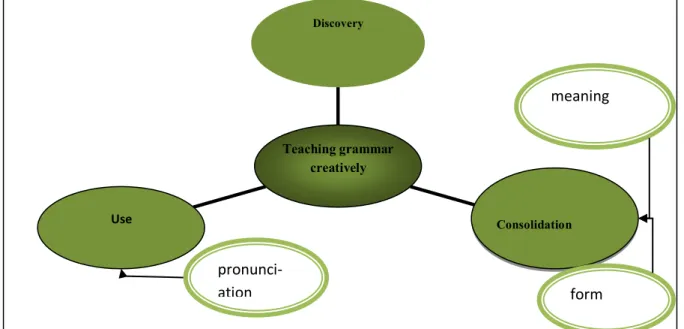
In addition, the grammar lessons are divided into two sections, besides language awareness activities one needs to make sure about applying creative grammar practice. These two sections can be used separatly depending on what the teacher intends to do. Thus, we could say that it would be better if rules were applied subconsciously, rather than knowing them by heart. Thus, in order to be a creative teacher, it is suggested to coin two main important techniques known as Discovery, Consolidation and Use (DCU) and Meaning, Form and Pronunciation (MFP).
16 1.8. Language Awareness Raising and Teaching Grammar:
To raise something to consciousness means to make someone aware of something. CR tasks are thus designed to raise the learners’ Language Awareness (LA) (Svalberg 2009, 2012). As many teachers used to teach, it seems that with the traditional model or method (PPP), students find themselves not ready to take and grasp the grammatical point especially at the first stage which is presentation. Language awareness pedagogy can enable teachers and learners to learn beyond the surface of a language in ways which knowledge-based approaches alone can never reach (Bolitho et al., 2003) which means that when considering language awareness as an approach, it would develop the learners’ meantal ability and then it will lead for better insight about how language works. Meanwhile, in teaching grammar; teachers teach the grammatical points but they cannot make the learners learn them as an old saying ‘‘you can take the horse to the water but you cannot make it drink’’. Adding to that, teachers need to make a time lag between understanding grammar structure and the ability to produce them acccurately.
1.9. The Discovery, Consolidation and Use in Teaching Grammar:
It is a good way to approach any grammatical point especially if the students are not familiar with it, at this level the teacher ought to build a bridge between what was known and what is unknown. In other words, any grammar point that a teacher intends to teach, has to start with a language that students are comfortable with. A language that they already know and master very well. Meaning that any example that a teacher chooses to use in the introduction of any grammar point has to be basic, factual, and simple used as a bridge to cross from the known to the unknown. Also, involving students as authentic examples within the introduction of the grammar point is advisable to keep students interested, motivated and engaged at the same time the topics and examples have to be connected specifically to their world and field of study as well.
(Gernegross, p.7) sees that these three sections lead us to reject the traditionl method (the PPP which is usually used by the majority of teachers).
a) Discovery: While the teacher provides the content to the students, they discover the grammatical point by themselves and the teacher here ought to guide and offer some directions if it is needed. Later, the teacher provides another passage that uses the target structure and checks their errors. Recent studies have shown that students remember
17 information well when they discover it by themselves. In other words, we would say it sticks to their minds better rather than receiving it direcly from the teacher.
b) Consolidation: In this stage, in the purpose of improving student grammatical knowledge and communicative skills we introduce this stage which is called consolidation as a part of the learning/teaching process. When teachers encourage the learners to discover the rules by themselves without teacher's help to tell them the rule directly. After the learners go through discovering it, the teachers may consolidate the rule to avoid students’ wrong conclusion about it; at the same time, he starts by providing a clear context which shows the meaning whether with pictures or something else.
c) Use: At this level, learners are required to put the new grammatical point in use, however, it should be relevant to their daily life because language becomes memorable when it is owned. Any teacher here ought to take into consideration that he needs to prepare examples in order to facilitate any point to the learner, at the same time, the teacher should provide a feedback before taking a step to correct students’ errors and always correct with a sensitivity and discretion. For instance, a student describes where he visited a beautiful city, teacher: wonderful! You must have visited the whole country...by the way we say i TOOK pictures and not i take because here you are talking about something that happend in the past. Adding to that, most of the teachers nowadays often focus exclusively on the written form when presenting a new language that is why here comes the importance of the pronunciation for example the stress shift between a verb and an adjective (preSent is a verb---Present is an adjective).
18 Figure 1.3: The Process of Teaching Grammar Creatively
1.10. Conclusion:
This chapter was concerned with highlighting the important keys of the theoretical side of creativity in teaching grammar which may take grammar to another level and make the teacher introduce any grammatical aspect in a meaningful way that runs with students’ ability to grasp.It is noticible that among university students after years of study grammar, they were not equipped in secondary schools to write or to speak correctly because grammar remains compulsory. The next chapter will focus on the description of the different tools that the research will deal with in order to gain more information about the teaching of grammar in a creative way by describing the suggested technique and the questionnaires then analyzing the answers. Use Consolidation Discovery Teaching grammar creatively pronunci-ation meaning form
Chapter Two
Methodology and Data
Analysis
20 2. Introduction:
Being a creative teacher has a crucial value in the domain of education; therefore, to validate the hypotheses posed by the researcher, valuable research tools known as questionnaire and interview were used in order to attain work’s rationale. These tools were dedicated to both teachers and students. In this chapter, data sources were combined to be useful in this work, that is why in order to elicit both students and teachers experience and perception, two questionnaires were distributed.The results have been analysed qualitatively and quantitatively and the data collected were iterpreted so that the chapter is terminated by providing it with some suggestions for the application of creative teaching in grammar.
2.1. Research Design:
In order to achieve the research’s objectives, we have chosen more than one research tool because it is proved that such variation in reasoning research tools investigate the work. These tools are namely; an interview and two structured questionnaires for both teachers and students. This research is quantitative and qualitative since it required the form of different types of questions.
2.2. Participants:
In order to accomplish the results study, it requires two participants namely teachers and students. The teachers who responded to both of the questionnaire and the interview were nine teachers of different Secondary schools. They are different in terms of teaching experience at the secondary school level. The purpose behind this was to know how they teach grammar at the same time to check wether they use innovative way in teaching or not at secondary school level. The other participants which are students, they were 21 Students and the majority belong to one secondary school. Students who were given the questionnaire are studying in secondary school. The reason why they are chosen is that they are considered as learners because at the level of the university they will master the language and not learn the basics.
2.3. Data Collection Instruments:
For this study, two data collection instrumets have been used: questionnaires for both students and teachers, and an interview with teachers only.
21 2.3.1. Students’ Questionnaire:
This questionnaire involved different questions. It was distributed to students of secondary school. The objective of this questionnaire is to obtain data about students’ awareness, attitudes towards learning grammar and also to figure out the problems and difficulties they face; at the same time we tried to reveal whether they are satisfied about the way they are taught grammar or not. Some questions are translated into arabic so that the students would be able to understand the idea of any question.
Question (1) intends to see whether they like grammar or not.
Question (2) was designed to know the level of the students.
Question (3) was directed to test the grammatical competence with a simple question which was about the difference between « she is gone and she is went ».
Questions (7), (8), and (9) seek to obtain data about their attitudes towards their teachers’ way of teaching.
Question (10) and (11) attempt to see whether students received the care when it come to pronunciation and correction of their grammatical mistakes.
2.3.2. Teachers’ Questionnaire:
A questionnaire was designed for teachers in order to know how they deal with grammar teaching; their beliefs and opinions about some areas of interest in grammar. Each question is dealt separatly and the answers were analysed in the end, results emerging were disscussed and summarized in order to allow drawing the main conclusion.
Question (1) intends to reveal teachers’ perspectives on grammar and how they see grammar from different angles.
Question (2) was asked in order to see whether teachers focus on students’ language skills or they just take it because it is a part of the cirrriculum.
Question (4) attempts to know what different obstacles that may face teachers in their teaching of grammar.
22 Question (05) is structured to know where grammar is integrated and implemented within the four skills, whether in listening, speaking, reading or writing or for some teachers, it is integrated within all the skills.
Question (6) intends to know which method or procedure or in general what methodology is used to teach grammar.
Question (7) seeks to know whether teachers integrate pronunciation or they just focus on the written form.
Question (8) intends to know whether teachers consider the process of teaching grammar easy or they face difficulties and obstacles when presenting the grammar lesson. Also, they are asked to mention some of them and explain their answers.
Question (9) is directed to know whether teachers teach grammar inductively, deductively or using the PPT Model.
Question (10) attempts to discover the skills in which grammar is included. Question (12) seeks to know whether teaching grammar is an easy task or not. 2.3.3. Teachers’ Interview:
In order to validate the research, an interview was sent to secondary school teachers. The main purpose behind using this tool is to go deeper in the way grammar is taught so that the investigation could support the study results. Questions were intended to see how they react towards their way of teaching and what they would change in the domain of teaching grammar.
2.4. Data Analysis:
After data collection, the obtained results have been analysed as the following: 2.4.1. Teachers’ Questionnaire Analysis:
23 Graph 2.1: Teachers’ Teaching Experience.
The teachers that were given the questionnaire had different experiences in the
educational field. They were both males and females. From nine teachers, 6 teachers (66.7%) informed that they have been teaching for more than 5 years and 3 teachers (33.3%) taught less than 5 years. That is to say, the majority of teachers have experience.
Question 2: how can you define grammar:
Since this question is open-ended, the teachers definitions are the following:
« Grammar is the backbone of English language. » « It's the structural form of a language. »
« Grammar is the study of language structure, function of speech parts while combined together and the purpose of using the language code. »
« It is one of the branches that studies language. It is the way to write the sentence according to specific rules. »
Question 3: In your opinion, what are the main reasons that make grammar important in language learning ?
33% 67%
less than five years
more than five years
24 Graph 2.2: Possible Reasons for Grammar Importance.
As it is shwon above, the result shows that the nine teachers see that the importance of learning grammar for 100 percent supports the language skills.
Question 4: What are the difficulties you have faced when teaching grammar?
Teaching grammar plays a major role in language teaching and it is considered as an important element that must be learnt in teaching the language. Some teachers see that it is because:
« Students' poor level of knowlegde, lack of motivation, not developing habit of selfstudy. » « Using the textbook which sometimes hold non-contextualised activities and that is what makes my students not engaged. »
« Poor background of students. Most of students depend on translation to understand when teaching rules. »
« Technical problems. It is hard to teach grammar without technology. »
Question 5: Do you present your grammatical structure both in speech and writing? reinforcement of language proficiency it is part of the cyrriculum/syllabus it supportd the language skills
25 Graph 2.3: Representation of the Grammatical Structure
The results show that the majority of the teachers present grammatical structure in both speech and writing and they represent teachers the highest ratio (77.8%). However the rest
teachers (22.2. %) represent it most of time in writing
Question 6: do you introduce the use of the grammatical structures to your pupils ?
Graph 2.4: Introducing the Use of the Grammatical Structure.
As it is shown from the result, 7 teachers (77.8%) introduce the use of grammatical structure but there are 2 teachers (22.2%) who admitted that they do not introduce the use. At the same time, those who introduce the use with the regard to both the rules and students’ level and they were the rest 2 teachers.
Question 6.1: do you introduce…
78% 22%
speech and writing writing
78% 22%
26 Graph 2.5: The Way of Introducing the Use of the Grammatical Structure
Question 7: Do you think the grammar teaching on the basic course is:
Graph 2.6: The Basic Course of Grammar Teaching.
From the results, five teachers (55.6%) say that the basic course is too little. May be it is related to the courses that found in textbook or as they justify: « The activities that are
provided do not match learners' needs and the context ». Two teachers (22.2%) say is too a
lot and they justify that: « Sometimes we find more than five grammar points in one sequence;
there is no balance between the aspects of language ». The other two teachers find it
appropriate (22.2%).
Question 8: pronunciation is important in teaching grammar. 40%
40% 20%
the uses that you find in the textbook or syllabus only the different uses of structure the number depends on the complexity of the structure 22% 56% 22%
27 Graph 2.7: Importance of Pronunciation in Teaching Grammar
As it is shown in the graph, from 9 teachers there are two teachers (22.2%) who strongly agree that pronunciation is important in teaching grammar and 3 teachers (33.3%) agree too however 2 teachers (22.2%) they strongly disagree with that and may be they think that grammar matters just in writing.
Question 9: Do you take into consideration pronunciation during grammar lesson?
Graph 2.8: Pronunciation in Grammar Lesson
From nine teachers, 5 teachers (55.6%) inform that they do not integrate pronunciation in their grammar teaching and 4 teachers who represent (44.4%) show that they integrate it in grammar lesson. 22% 11% 11% 34% 22% strongly disagree disagree neutral agree strongly agree 44% 56% yes no
28 Question 9: How do you teach grammar?
Graph 2.9: How to Teach Grammar.
In this question, teachers were allowed to tick more than one choice. It intends to know what common way of teaching grammar. (77.8%) of teachers follow the PPP model in their teaching whereas 22.2% use to teach grammar inductively and the rest of teacher each one of them goes with deductive approach.one teacher prefer using integrative grammar courses and a teacher prefers a way which supports the understanding of the students.
Question 11: In which skill is grammar included?
Graph 2.10: Language Skills in Grammar
In this question teachers were allowed to tick more than one answer. It is found that 88.9% see that writing skill is included in grammar and 77.8% chose the reading skill. 55.6% say that listening is included also in grammar. However, only 44.4% see that speaking is included in grammar. 0 2 4 6 8 the ppp model deductively inductively 0 2 4 6 8 reading writing speaking listening
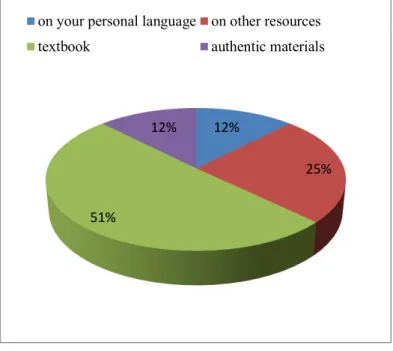
29 Question 12: What do you rely on in preparing your grammar lessons?
Graph 2.11: Preparing Grammar Lesson.
From the results, it seems that the majority of teachers who represent 51% rely on textbook to prepare their grammar lessons. 25% rely on other resourses. 12.5% rely on personal knowledge and the rest which represent 12.5% they rely on authentic material. Question 12: do you think that grammar is a hard activity to accomplish? Justify your answer.
yes 5 56%
no 4 44%
Table 2.2. Grammar Is a Hard Activity to Accomplish
5 teachers out of nine say yes, it is a hard activity to accomplish. Grammar is an important aspect in English teaching and thus the result shows that five teachers (55.5%). T They justified their answer as follows:
« Somehow yes because it is not easy to plant the grammatical point to a student who prefers activities that are related to his daily life ».
« Students do not know how to use rules and that because they do not apply what they have learnt in their daily life».
12%
25%
51%
12%
on your personal language on other resources textbook authentic materials
30 The other ones which represent 44.5 % do not find it as a hard activity and they justify as follow:
« No, it just needs good preparation ».
« The success of the mission depends on the ability of the teacher to find it create their resources».
« Not too hard but learners’ previous knowledge is too limited and we constantly need to review different structures before to tackle the one that is intended in the course ».
Question 13: how could you define a creative teacher?
Because of the importance of creativity in teacher, this question saught to know how teachers could possibly see creativity and their answers were as follow:
« A creative teacher is the one who tries to deal with the content of the syllabus from different perspectives and who always tries to use different teaching materials and techniques ».
« A creative teacher is the one who brings new ideas and adds to the way he teaches so that it becomes interesting to his students ».
« The creative teacher is the one who uses resources to create their own different lesson ». 2.4.2. Students’ Questionnaire Analysis:
The present section is devoted to the analysis of the data collected from the students’ questionnaire and each question is treated separately for methodological convenience.
Question 1: how is your level in grammar ?
Graph 2.12: Students Level in Grammar. 71%
29% 0%
31 Twenty one students who answered this questionnaire, 71.4% confess that their level is average whereas the others who represent 28.6% show that they have a good level in grammar.
Question 2: are you able to make the difference between "she is gone" and "she is went"?
Graph 2.13: The Difference between the Grammatical Structures
Students who represent 77% say that they can not make the difference in use between the two presented sentences. However, the rest which were only 10 students (23%) say that they can not differenciate between she is gone and she is went.
Question 3: does the present way of teaching grammar help you when you: read, listen, speak or write.
Graph 2.14: The Present Way of Teaching and the Language Skills 23% 77% yes no both write spe… 8 11 2
32 As it is noticed above, 11 students (52.4%) consider that the presnt way of teaching grammar helps them to both speak and write, wheras 8 students (31.1%) do not share the same opinion which means that the grammar taugh helps them only for writing and the rest (09.5%) 2 students assured that it helps them only for speaking.
Question 4: When your teacher tells you:" you are going to study grammar today" you are thinking…
Graph 2. 15. Students Reaction towards Learning Grammar.
The collected data show that 13 students (61.9%) say it is fine to study grammar whereas 6 students (38.1%) reveal that grammar is not their favourite subject .
Question 5: when you have a grammar lesson, are you engaged during a class?
Graph 2.16: Students Engagement.
According to the results above, 13 students (61.9%) say that they were quitely engaged; however, 6 students (28.6%) say that they are not engaged at all and only 2 students (9.5%) seem that they are very engaged.
Question 6: are you satisfied about the way you are taught grammar? 62%
38%
it is fine it is not my favorite module
62% 38%
33 Graph 2.17: Students Satisfaction
The data show that 11 students (52.4%) do not feel satisfied about grammar teaching and 10 students (47.6%) feel satisfied about the way they are taught grammar.
Question 7: learning grammar is better when the teacher gives explanation of grammatical rules before doing the task ?.
Graph 2.18: Students’ Point of View about Explaning the Rule.
From the data collected, it is noticed that the majority of the students 12 students (57.1%) agree with this idea,5 students (23.8%) strongly agree for getting explanation before the task. However, only 2 students who represent 9.5% strongly disagree.
Question 8: I prefer to discover the rule by myself rather than learn it directly from my teacher.
48% 52%
very satesfied quite satesfied not satesfied at all
9%10% 57% 24% strongly disagree disagree neutral agree strongly agree
34 Graph 2.19: Students’ Opinion about Discovering the Rule.
The results show that 10 students (47.6%) agree and 6 students (28.6%) strongly agree on the idea of discovering the rule rather than get it directly from the teacher at the same time 6 students (28.6%) strongly agree. 14.36% which represents 3 students disagree with that. 2 students (9.5%) strongly disagree to discover the rules by themselves.
Question 9: Grammar fosters students’ ability in…
Graph 2.20: Grammar in Fostering the Language Skills.
Students were allowed to tick more than one choice. Among the whole number of the students (21 students) 81% chose writing skill, 66.7% went with speaking, and 28.6% ticked listening and the same thing went with reading (28.6%).
9% 14% 48% 29% strongly disagree disagree neutral agree strongly agree 0 5 10 15 20 speaking listening writing reading
35 Question10: does your teacher correct your grammatical mistakes?
Graph 2.21: Teachers Correction of Students’ Grammatical Mistakes
As it is apparent in the above figure, 81% answered that their teacher sometimes correct their grammatical mistakes and 14.3% answered always. The rest which represent only 4.8 % answered with never. It means the majority sometimes have feedback from their teachers.
Question 11: does your teacher teach you how to pronunce such words during grammar lesson.
Graph 2.22: Pronunciation During Grammar Lessons
Among 21 students, 11 students (52%) say that they are not taught how to pronunce whereas only 48% of the students say that they are taught pronunciation during the lesson of grammar.
Question 12: what are the difficulties you may have in grammar? Their answers were reported as follow:
14%
81% 5%
always somtimes never
48% 52%
36 « There are many rules and they differ, I usually rather to do tasks before to be ready ».
« I never used to focus during the class and the teacher was not good in teaching the correct way or interrested in us to understand but only to finish the lesson and leave. And that is the reason why i lost the desire not to learn it but to attend the class ».
« Sometimes it is easy to write but hard when i speak and the problem of using tenses ». 2.4.3. Teachers’ Interview Analysis:
The interview was meant to be sent to teachers. It contains questions that could help in a deeper investigation about the way grammar taught and the presented one.
1) what are the main weaknesses in grammar that you have noticed in your student?
Their answers were mainly about sentence structure and distinguishing parts of speech.
2) in brief, describe the way you teach the past simple.
« I give students a few sentences talking about past events then I isolate the verbs and let them discover the difference between regular and irregular verbs ».
3) What do you think is an effective way of teaching grammar? Why? Most of the teachers share the same idea which is
« Teaching it in context using relevant examples and in an inductive way ».
4) Have you heard about Discovery, consolidation and use in teaching grammar before?
All of them have not heard about this model before.
2.4.3.1. An Example of Using the Discovery, Consolidation and Use: Teaching past tense creatively:
Past tense for narrative.
Aim: to review past simple and ask questions in the past. Time: 40 to 50 minutes
Objective of the lesson: pupils will be able to talk about events and narrate using past simple and form questions in a correct way.