HAL Id: hal-00915879
https://hal.inria.fr/hal-00915879
Submitted on 26 Jul 2019HAL is a multi-disciplinary open access archive for the deposit and dissemination of sci-entific research documents, whether they are pub-lished or not. The documents may come from teaching and research institutions in France or abroad, or from public or private research centers.
L’archive ouverte pluridisciplinaire HAL, est destinée au dépôt et à la diffusion de documents scientifiques de niveau recherche, publiés ou non, émanant des établissements d’enseignement et de recherche français ou étrangers, des laboratoires publics ou privés.
Detecting Bipolar Semantic Relations among Natural
Language Arguments with Textual Entailment: a Study
Elena Cabrio, Serena Villata
To cite this version:
Elena Cabrio, Serena Villata. Detecting Bipolar Semantic Relations among Natural Language Ar-guments with Textual Entailment: a Study. Joint Symposium on Semantic Processing (JSSP-2013), Nov 2013, Trento, Italy. �hal-00915879�
Detecting Bipolar Semantic Relations among Natural Language
Arguments with Textual Entailment: a Study.
Elena Cabrio and Serena Villata INRIA
2004 Route des Lucioles BP93 06902 Sophia-Antipolis cedex, France.
{elena.cabrio, serena.villata}@inria.fr
Abstract
In the knowledge representation and rea-soning research area, argumentation the-ory aims at representing and reasoning over information items called arguments. In everyday life, arguments are reasons to believe and reasons to act, and they are usually expressed in natural language. Even if ad-hoc natural language examples are often provided in argumentation theory works, no automated processing of such natural language arguments is carried out, making it impossible to exploit the results of this research area in real world scenar-ios. In this paper, we propose to adopt tex-tual entailment to address this issue. In particular, we discuss and evaluate, on a sample of natural language arguments ex-tracted from Debatepedia, the support and attack relations among arguments in bipo-lar abstract argumentation with respect to the more specific notions of textual entail-ment and contradiction.
1 Introduction
Until recent years, the idea of “argumentation” as the process of creating arguments for and against competing claims was a subject of interest to philosophers and lawyers. In recent years, how-ever, there has been a growth of interest in the subject from formal and technical perspectives in Artificial Intelligence, and a wide use of argumen-tation technologies in practical applications. How-ever, such applications are always constrained by the fact that natural language arguments cannot be automatically processed by such argumentation technologies. Arguments are usually presented ei-ther as the abstract nodes of a directed graph where the edges represent the relations of attack and sup-port (e.g., in abstract argumentation theory (Dung,
1995) and in bipolar argumentation (Cayrol and Lagasquie-Schiex, 2005)) or as a set of premises which lead to a certain conclusion thanks to the application of a number of inference rules (e.g., in structured approaches to argumentation as AS-PIC (Prakken, 2010)). Natural language argu-ments are usually used in such works to provide
ad-hoc examples to help the reader in the
under-standing of the rationale behind the formal ap-proach which is then introduced, but the need to find automatic ways to process natural language arguments to detect the semantic relations among them is becoming more and more important.
To fill this gap, we propose to investigate se-mantic inference approaches in Natural Language Processing (NLP) in search of a suitable compu-tational framework to account for bipolar argu-mentation models. In particular, in this paper, we study how bipolar semantic relations among
nat-ural language arguments can be discovered in an automated way using textual entailment. This
is-sue breaks down into the following research ques-tions: (1) what is the relation between the no-tion of support in bipolar argumentano-tion and the notion of Textual Entailment (TE) in NLP?, and given that additional attacks have been proposed in the literature to highlight possible inconsisten-cies arising among sets of arguments connected by supports and attacks (2) what is the distribution and thus the inner semantics of such additional at-tacks in real data?
First, we study the relation among the notion of support in bipolar argumentation (Cayrol and Lagasquie-Schiex, 2005), and the notion of TE in NLP (Dagan et al., 2009). In a recent pro-posal, (Cabrio and Villata, 2012) represent the TE relation extracted from NL texts as a support re-lation in bipolar argumentation. This is a strong assumption, and we aim at verifying on a sample of real data from Debatepedia whether it is always the case that support is equivalent to TE. In
partic-ular, for addressing this issue, we focus both on the relations between support and entailment, and on the relations between attack and contradiction. We show that TE and contradiction are more specific concepts than support and attack, but still hold in most of the argument pairs.
Second, starting from the comparative study ad-dressed by (Cayrol and Lagasquie-Schiex, 2011), we consider four additional attacks proposed in the literature: supported (if argument a supports argu-ment b and b attacks arguargu-ment c, then a attacks c) and secondary (if a supports b and c attacks a, then
cattacks b) attacks (Cayrol and Lagasquie-Schiex,
2010), mediated attacks (Boella et al., 2010) (if
a supports b and c attacks b, then c attacks a),
and extended attacks (Nouioua and Risch, 2010; Nouioua and Risch, 2011) (if a supports b and a attacks c, then b attacks c). We investigate the dis-tribution of these attacks in NL debates basing on a data set extracted from Debatepedia, and we show that all these models are verified in human debates, even if with a different frequency.
The benefit of the proposed analysis is twofold. First, it is used to verify, through a data driven evaluation, the “goodness” of the proposed mod-els of bipolar argumentation to be used in real set-tings, going beyond ad hoc NL examples. Sec-ond, it can be used to guide the construction of cognitive agents whose major need is to achieve a behavior as close as possible to the human one. Thanks to such a kind of analysis, we highlight that the mutual influence of these two related re-search areas can actually bring to textual entail-ment more than just an application scenario, but it opens further challenges to be addressed with a joint effort by the two research communities.
The paper is organized as follows. Section 2 summarizes the basic notions of bipolar argumen-tation, and describes the four kinds of additional attacks we consider in this paper. Section 3 de-scribes the experimental setting, and addresses the analysis of the meaning of support and attack in natural language dialogues, as well as the compar-ative study on the existing additional attacks. 2 Bipolar argumentation
We provide the basic concepts of Dung’s (1995) abstract argumentation.
Definition 1 (Abstract argumentation framework)
An abstract argumentation framework (AF) is a pair !A, →# where A is a set of elements called
arguments and →⊆ A × A is a binary relation called attack. We say that an argument a attacks an argument b if and only if (a, b) ∈→.
Dung presents several acceptability semantics that produce zero, one, or several sets of accepted arguments called extensions. For more details, see (Dung, 1995).
Bipolar argumentation frameworks, firstly pro-posed by (Cayrol and Lagasquie-Schiex, 2005), extend Dung’s framework taking into account both the attack relation and the support relation. In par-ticular, an abstract bipolar argumentation frame-work is a labeled directed graph, with two labels indicating either attack or support. In this paper, we represent the attack relation by a → b, and the support relation by a!!" b.
Definition 2 (Bipolar argumentation framework)
A bipolar argumentation framework (BAF) is a tuple !A, →, !!"# where A is the set of elements called arguments, and two binary relations over Aare called attack and support, respectively.
(Cayrol and Lagasquie-Schiex, 2011) address a formal analysis of the models of support in bipolar argumentation to achieve a better understanding of this notion and its uses. In the rest of the paper, we will adopt their terminology to refer to addi-tional attacks, i.e., complex attacks. (Cayrol and Schiex, 2005; Cayrol and Lagasquie-Schiex, 2010) argue about the emergence of new kinds of attacks from the interaction between the attacks and supports in BAF. In particular, they specify two kinds of complex attacks called
sec-ondary and supported attacks, respectively.
Definition 3 (Secondary and supported attacks)
Let BAF = !A, →, !!"# where a, b ∈ A. A supported attack for b by a is a sequence a1R1. . . Rn−1an, n ≥ 3, with a1 = a, an = b,
such that ∀i = 1 . . . n − 2, Ri =!!" and
Rn−1 =→. A secondary attack for b by a is a sequence a1R1. . . Rn−1an, n ≥ 3, with
a1 = a, an = b, such that R1 =→ and
∀i = 2 . . . n-1,Ri=!!".
According to the above definition, these attacks hold in the first two cases depicted in Figure 1, where there is a supported attack from a to c, and there is a secondary attack from c to b.
The support relation has been specialized in other approaches where new complex attacks emerging from the combination of existing attacks and supports are proposed. (Boella et al., 2010)
b c
a c a b a b c b a c
Supported attack Secondary attack
(Extended attack 1) Mediated attack Extended attack 2
Figure 1: Additional attacks emerging from the interaction of supports and attacks. propose a deductive view of support in abstract
ar-gumentation where, given the support a!!" b the acceptance of a implies the acceptance of b, and the rejection of b implies the rejection of a. They introduce a new kind of complex attack called
me-diated attacks (Figure 1).
Definition 4 (Mediated attacks) Let
BAF = !A, →, !!"# where a, b ∈ A. A mediated attack on b by a is a sequence a1R1. . . Rn−2an−1 and anRn−1an−1, n ≥ 3,
with a1 = a, an−1 = b, an = c, such that
Rn−1 =→ and ∀i = 1 . . . n-2, Ri =!!".
(Nouioua and Risch, 2010; Nouioua and Risch, 2011) propose, instead, an account of support called necessary support. In this framework, given
a!!" b then the acceptance of a is necessary to get
the acceptance of b, i.e., the acceptance of b im-plies the acceptance of a. They introduce two new kinds of complex attacks called extended attacks (Figure 1). Note that the first kind of extended attacks is equivalent to the secondary attacks in-troduced by (Cayrol and Lagasquie-Schiex, 2005; Cayrol and Lagasquie-Schiex, 2010), and that the second case is the dual of supported attacks. Definition 5 (Extended attacks) Let
BAF = !A, →, !!"# where a, b ∈ A. An extended attack on b by a is a sequence a1R1a2R2. . . Rnan, n ≥ 3, with a1 = a, an = b,
such that R1 =→ and ∀i = 2 . . . n, Ri =!!", or
a sequence a1R1. . . Rnan and a1Rpap, n ≥ 2,
with an = a, ap = b, such that Rp =→ and
∀i = 1 . . . n, Ri =!!".
All these models of support in bipolar argumen-tation address the problem of how computing the set of extensions from the extended framework providing different kinds of solutions, i.e., intro-ducing the notion of safety in BAF (Cayrol and Lagasquie-Schiex, 2005), or computing the exten-sions in the meta-level (Boella et al., 2010; Cay-rol and Lagasquie-Schiex, 2010). In this paper, we are not interested in discussing and evaluating these different solutions. Our aim is to evaluate how much these different models of support occur and are effectively “exploited” in NL dialogues,
to provide a better understanding of the notion of support and attack in bipolar argumentation.
We are aware that the notion of support is a controversial one in the field of argumentation theory. In particular, another view of support sees this relation as a relation holding among the premises and the conclusion of a structured ar-gument, and not as another relation among the arguments (Prakken, 2010). However, given the amount of attention bipolar argumentation is re-ceiving in the literature (Rahwan and Simari, 2009), a better account of this kind of frameworks is required.
Another approach to support has been proposed by (Oren and Norman, 2008; Oren et al., 2010) where they distinguish among prima-facie argu-ments and standard ones. They show how a set of arguments described using Dung’s argumentation framework can be mapped from and to an argu-mentation framework that includes both attack and support relations. The idea is that an argument can be accepted only if there is an evidence support-ing it, i.e., evidence is represented by means of
prima-facie arguments. In this paper, we
concen-trate our analysis on the abstract models of bipolar argumentation proposed in the literature (Cayrol and Lagasquie-Schiex, 2010; Boella et al., 2010; Nouioua and Risch, 2011), and we leave as future work the account of support in structured argu-mentation and the model proposed by (Oren and Norman, 2008; Oren et al., 2010).
3 Empirical studies on NL debates
Starting from (Cabrio and Villata, 2012), as a case study to carry out our analysis we select Debate-pedia1, the Wikipedia of debates. Specifically,
De-batepedia is an encyclopedia of pro and con ar-guments where users can freely contribute to on-line discussions about critical issues. We collect a sample of the discussions extracting a set of ar-guments from Debatepedia topics, as described in Section 3.1. Even if our data set cannot be exhaus-tive, the methodology we apply for the arguments extraction aims at preserving the original structure
of the debate, to make it as representative as possi-ble of human daily natural language interactions.
Two different empirical studies are then pre-sented in this section. The first one (Section 3.2) starts from (Cabrio and Villata, 2012), and ex-plores the relation among the notion of support and attack in bipolar argumentation, and the
se-mantic inferences as defined in the NLP research
field. The second analysis (Section 3.3) starts in-stead from the comparative study of (Cayrol and Lagasquie-Schiex, 2011) of the four complex at-tacks proposed in the literature, and investigates their distribution in NL debates.
3.1 Data set
To have a stable version of the data to perform our studies, we build a reference data set extracting a sample of debates from Debatepedia2. Here, the
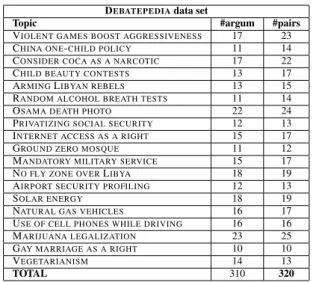
users manually insert their arguments in the col-umn PRO if they agree with the issue under dis-cussion, or in the column CON if they disagree. To make our sample of NL debates comparable with current works in the literature, e.g. (Wyner and van Engers, 2010; Carenini and Moore, 2006; Cabrio and Villata, 2012), we select the same top-ics as (Cabrio and Villata, 2012), since this is the only freely available data set of natural language arguments (Table 1, column Topics). To create the Debatepedia data set, for each topic of our sample we apply the following procedure:
1. the main issue (i.e., the title of the debate in its affirmative form) is considered as the start-ing argument;
2. each user opinion is extracted and considered as an argument;
3. since attack and support are binary relations, the arguments are coupled with:
(a) the starting argument, or
(b) other arguments in the same discussion to which the most recent argument refers (e.g., when a user opinion supports or at-tacks an argument previously expressed by another user), following the chrono-logical order (we maintain the dialogue structure);
4. the resulting pairs of arguments are then tagged with the appropriate relation, i.e.,
at-tack or support.
2http://bit.ly/VZIs6M
To show a step-by-step application of the pro-cedure, let us consider the debated issue Can
coca be classified as a narcotic?. At step 1, we
transform its title into the affirmative form, and we consider it as the starting argument(a):
(a) Coca can be classified as a narcotic.
At step 2, we extract all the users opinions on this issue (PRO and CON), e.g.,(b), (c) and (d):
(b) In 1992 the World Health Organization’s Expert
Committee on Drug Dependence (ECDD) undertook a ’prereview’ of coca leaf at its 28th meeting. The 28th ECDD report concluded that, “the coca leaf is appropriately scheduled as a narcotic under the Single Convention on Narcotic Drugs, 1961, since cocaine is readily extractable from the leaf.” This ease of extraction makes coca and cocaine inextricably linked. Therefore, because cocaine is defined as a narcotic, coca must also be defined in this way.
(c) Coca in its natural state is not a narcotic. What is absurd
about the 1961 convention is that it considers the coca leaf in its natural, unaltered state to be a narcotic. The paste or the concentrate that is extracted from the coca leaf, commonly known as cocaine, is indeed a narcotic, but the plant itself is not.
(d) Coca is not cocaine. Coca is distinct from cocaine.
Coca is a natural leaf with very mild effects when chewed. Cocaine is a highly processed and concentrated drug using derivatives from coca, and therefore should not be considered as a narcotic.
At step 3a we couple the arguments (b) and (d) with the starting issue since they are directly linked with it, and at step 3b we couple argument (c) with argument (b), and arguments (d) with ar-gument (c) since they follow one another in the discussion. At step 4, the resulting pairs of argu-ments are then tagged with the appropriate rela-tion: (b) supports (a), (d) attacks (a), (c) attacks (b) and (d) supports (c).
Table 1 reports the number of arguments and pairs we extracted applying the extraction method-ology described before to all the mentioned top-ics. In total, our data set contains 310 different arguments and 320 argument pairs (179 express-ing the support relation among the involved ar-guments, and 141 expressing the attack relation). We consider the obtained data set as representative
of human debates in a non-controlled setting (De-batepedia users position their arguments w.r.t. the others as PRO or CON, the data are not biased), and therefore we use it for our empirical studies.
DEBATEPEDIAdata set
Topic #argum #pairs
VIOLENT GAMES BOOST AGGRESSIVENESS 17 23
CHINA ONE-CHILD POLICY 11 14
CONSIDER COCA AS A NARCOTIC 17 22
CHILD BEAUTY CONTESTS 13 17
ARMINGLIBYAN REBELS 13 15
RANDOM ALCOHOL BREATH TESTS 11 14
OSAMA DEATH PHOTO 22 24
PRIVATIZING SOCIAL SECURITY 12 13
INTERNET ACCESS AS A RIGHT 15 17
GROUND ZERO MOSQUE 11 12
MANDATORY MILITARY SERVICE 15 17
NO FLY ZONE OVERLIBYA 18 19
AIRPORT SECURITY PROFILING 12 13
SOLAR ENERGY 18 19
NATURAL GAS VEHICLES 16 17
USE OF CELL PHONES WHILE DRIVING 16 16
MARIJUANA LEGALIZATION 23 25
GAY MARRIAGE AS A RIGHT 10 10
VEGETARIANISM 14 13
TOTAL 310 320
Table 1: Debatepedia data set. 3.2 First study: support and TE
Our first empirical study aims at a better un-derstanding of the relation among the notion of support in bipolar argumentation (Cayrol and Lagasquie-Schiex, 2011), and the definition of se-mantic inference in NLP (in particular, the more specific notion of TE) (Dagan et al., 2009). In a recent work, (Cabrio and Villata, 2012) propose to combine NLP and Dung-like abstract argumenta-tion to generate the arguments from NL text, and compute the accepted ones. They represent the TE relation as a support relation in BAF. Even if they narrow their work by considering only favorable arguments implying another argument, explicitly stating that arguments supporting another argu-ment but without inferring it are out of the scope of that work, the assumption that there exists an identity between support and TE is still a claim to verify.
3.2.1 Textual Entailment
The notion of TE has been defined as a directional relation between two textual fragments, termed
text (T) and hypothesis (H), respectively (Dagan
et al., 2009). The relation holds (i.e. T ⇒ H) whenever the truth of one text fragment follows from the other, as interpreted by a typical lan-guage user. Let us consider for instance the two textual fragments (a) and (b) from Debatepedia. According to the TE framework we set (b) as T
and(a) as H:
(b) !→ T: In 1992 the World Health Organization’s Expert
Committee on Drug Dependence (ECDD) undertook a ’pre-review’ of coca leaf at its 28th meeting. [. . . ] This ease of ex-traction makes coca and cocaine inextricably linked. There-fore, because cocaine is defined as a narcotic, coca must also be defined in this way.
(a)!→ H: Coca can be classified as a narcotic.
A human reading T would infer that H is most likely true (i.e. the meaning of H can be derived from the meaning of T, so the entailment holds). On the contrary, if we consider Debatepedia examples(a) and (d), and we set (d) as T and (a) as H, there is a contradiction between T and H:
(d) !→ T: Coca is not cocaine. Coca is distinct from cocaine.
Coca is a natural leaf with very mild effects when chewed. Cocaine is a highly processed and concentrated drug using derivatives from coca, and therefore should not be considered as a narcotic.
(a)!→ H: Coca can be classified as a narcotic.
(de Marneffe et al., 2008) provide a definition of contradiction for the TE task, claiming that it oc-curs when two sentences i) are extremely unlikely to be true simultaneously, and ii) involve the same event. As an applied framework, TE has been pro-posed to capture major semantic inference needs across NLP applications (e.g., question answering, information extraction).
3.2.2 Analysis on the Debatepedia data set Based on the TE definition, an annotator with skills in linguistics has carried out a first phase of annotation of the Debatepedia data set (Sec-tion 3.1). The goal of such annota(Sec-tion is to indi-vidually consider each pair of support and attack among arguments, and to additionally tag them as
entailment, contradiction or null. The null
judg-ment can be assigned in case an argujudg-ment is sup-porting another argument without inferring it, or the argument is attacking another argument with-out contradicting it. As exemplified above, a cor-rect entailment pair is(b) entails (a), while a con-tradiction is(d) contradicts (a). A null judgment is assigned to(d) - (c), since the former argument supports the latter without inferring it. Our data set is an extended version of (Cabrio and Villata, 2012)’s one allowing for a deeper investigation.
calculated the inter-annotator agreement. Another annotator with skills in linguistics has therefore in-dependently annotated a sample of 100 pairs of the data set. To calculate the inter-rater agreement we used Cohen’s kappa coefficient (Carletta, 1996). For NLP tasks, the agreement is considered as sig-nificant when κ >0.6. We calculated the inter-annotator agreement on the argument pairs tagged as support and attacks by both annotators. For supports, we calculated the agreement between the pairs tagged as entailment and as null (i.e. no entailment); for the contradictions, the agreement between the pairs tagged as contradiction and as
null (i.e. no contradiction). Applying κ to our
data, the agreement for our task is κ = 0.74, that is a satisfactory agreement.
Table 2 reports the results of the annotation on our Debatepedia data set, as resulting after a rec-onciliation phase carried out by the annotators.
Relations %arguments (#arg) support - entailment (null)+ entailment 61.6 (111)38.4 (69)
attack - contradiction (null)+ contradiction 71.4 (100)28.6 (40)
Table 2: Support and TE on Debatepedia data set. On the 320 pairs of the data set, 180 repre-sent a support relation, while 140 are attacks. Considering only the supports, we can see that 111 argument pairs (i.e., 61.6%) are an actual entailment, while in 38.4% of the cases the first argument of the pair supports the second one without inferring it (as for example (d) - (c)). With respect to the attacks, we can notice that 100 argument pairs (i.e., 71.4%) are both attack and contradiction, while only the 28.6% of the argument pairs does not contradict the arguments they are attacking, as in the following example:
(e) Coca chewing is bad for human health. The decision to
ban coca chewing fifty years ago was based on a 1950 report elaborated by the UN Commission of Inquiry on the Coca Leaf with a mandate from ECOSOC: “We believe that the daily, inveterate use of coca leaves by chewing is thoroughly noxious and therefore detrimental”.
(f) Chewing coca offers an energy boost. Coca provides an
energy boost for working or for combating fatigue and cold.
Differently from the relationship between support-entailment, the difference between attack and contradiction is more subtle, and it is not al-ways straightforward to say when an argument
at-tacks another argument without contradicting it. In the example, we consider that(e) does not ex-plicitly contradict (f) even if it attacks (f), since chewing coca can offer an energy boost, and still be bad for human health. As we can notice from the results in Table 2, this kind of attacks is less frequent than the attacks-contradictions.
Considering the TE three way scenario
(entail-ment, contradiction, unknown) to map TE relation
with bipolar argumentation, argument pairs con-nected by a relation of support (but where the first argument does not entail the second one), and ar-gument pairs connected by a relation of attack (but where the first argument does not contradict the second one) have to be mapped as unknown pairs in the TE framework. The unknown relation in TE refers to the T-H pairs where the entailment can-not be determined because the truth of H cancan-not be verified on the basis of the content of T. This is a broad definition, that can apply also to pairs of non related sentences (that are considered as unre-lated arguments in bipolar argumentation).
From an application viewpoint, as highlighted in (Reed and Grasso, 2007; Heras et al., 2010), ar-gumentation theory should be used as a tool in on-line discussions applications to identify the rela-tions among the statements, and to provide a struc-ture to the dialogue to easily evaluate the user’s opinions. Starting from the methodology pro-posed by (Cabrio and Villata, 2012) for passing from NL arguments to a Dung’s system towards a fully automated system to identify the accepted ar-guments, our study demonstrates that applying the TE approach would be productive in the 66% of the Debatepedia data set. Other techniques should be investigated to cover the other cases, for in-stance measuring the semantic relatedness of the two propositions, e.g., Latent Semantics Analysis techniques (Landauer et al., 1997).
3.3 Second study: complex attacks
As a second step of our survey, we carry out a comparative evaluation of the four proposals of at-tacks suggested in the literature, and we investi-gate their distribution and meaning on the sample of NL arguments.
3.3.1 Analysis on the Debatepedia data set Relying on the additional attacks (Section 2), and the original AF of each topic in our data set (Ta-ble 1), the following procedure is applied: the
re-spectively) attacks are added, and the argument pairs resulting from coupling the arguments linked by this relation are collected in the data set “sup-ported (secondary, mediated, and extended, re-spectively) attack”.
Collecting the arguments pairs generated from the different types of complex attacks in separate data sets allows us to independently analyze each type, and to perform a more accurate evaluation.3
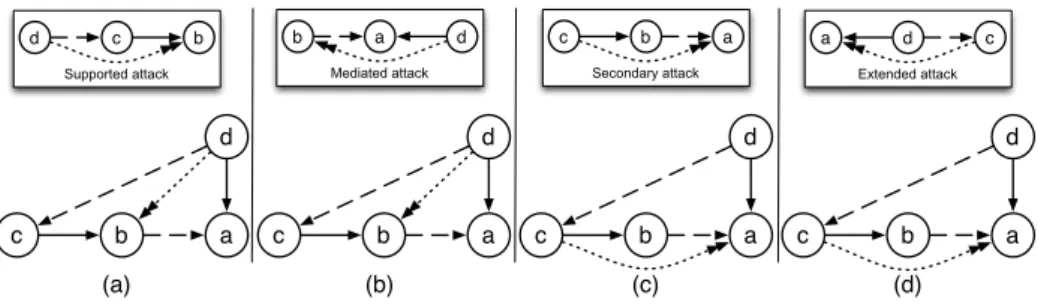
Figures 2a-d show the four AFs resulting from the addition of the complex attacks in the example
Can coca be classified as a narcotic?. The reader
may observe that the AF in Figure 2a, where the supported attack is introduced, is the same of Fig-ure 2b where the mediated attack is introduced. Notice that, even if the attack which is introduced is the same, i.e., d attacks b, this is due to different interactions among supports and attacks (as high-lighted in the figure), i.e., in the case of supported attacks this is due to the support from d to c and the attack from c to b, while in the case of medi-ated attacks this is due to the support from b to a and the attack from d to a.
A second annotation phase is then carried out on the data set, to verify if the generated arguments pairs of the four data sets are actually attacks (i.e., if the models of complex attacks proposed in the literature are represented in real data). More specifically, an arguments pair result-ing from the application of a complex attack can be annotated as: attack (if it is a correct attack) or as unrelated (in case the meanings of the two arguments are not in conflict). For instance, the pair (g)-(h) resulting from the insertion of a supported attack, cannot be considered as an attack since the arguments are considering two different aspects of the issue.
(g) Chewing coca offers an energy boost. Coca provides an
energy boost for working or for combating fatigue and cold.
(h) Coca can be classified as a narcotic.
In the annotation, attacks are then annotated also as contradiction (if the first argument con-tradicts the other) or null (in case the first argu-ment does not contradict the arguargu-ment it is at-tacking, as in the example(e)-(f) showed in Sec-tion 3.2.2). Due to the complexity of the anno-tation, the same annotation task has been indepen-dently carried out also by a second annotator, so as
3Freely available at http://bit.ly/VZIs6M
to compute inter-annotator agreement. It has been calculated on a sample of 80 argument pairs (20 pairs randomly extracted from each of the “com-plex attacks” data set), and it has the goal to as-sess the validity of the annotation task (counting when the judges agree on the same annotation). We calculated the inter-annotator agreement for our annotation task in two steps. We (i) verify the agreement of the two judges on the argument pairs classification attacks/unrelated, and (ii) consider only the argument pairs tagged as attacks by both annotators, and we verify the agreement between the pairs tagged as contradiction and as null (i.e. non contradiction). Applying κ to our data, the agreement for the first step is κ = 0.77, while for the second step κ = 0.71. Both agreements are satisfactory, although they reflect the higher com-plexity of the second annotation task
(contradic-tion/null), as pointed out in Section 3.2.2.
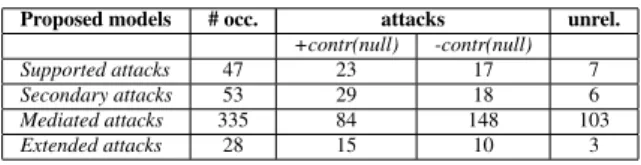
The distribution of complex attacks in the De-batepedia data set, as resulting after a reconcilia-tion phase carried out by the annotators, is shown in Table 3. As can be noticed, the mediated attack is the most frequent type of attack, generating 335 new arguments pairs in the NL sample we consid-ered (i.e., the conditions that allow the application of this kind of complex attacks appear more fre-quently in real debates). Together with the
sec-ondary attacks, they appear in the AFs of all the
debated topics. On the contrary, extended attacks are added in 11 out of 19 topics, and supported at-tacks in 17 out of 19 topics. Considering all the topics, on average only 6 pairs generated from the additional attacks were already present in the orig-inal data set, meaning that considering also these attacks is a way to hugely enrich our data set.
Proposed models # occ. attacks unrel.
+contr(null) -contr(null)
Supported attacks 47 23 17 7
Secondary attacks 53 29 18 6
Mediated attacks 335 84 148 103
Extended attacks 28 15 10 3
Table 3: Complex attacks distribution in our data. Figure 3 graphically represents the complex at-tacks distribution. Considering the first step of the annotation (i.e. attacks vs unrelated), the fig-ure shows that the latter case is very infrequent, and that (except for the mediated attack) on av-erage only 10% of the argument pairs are tagged as unrelated. This observation can be considered as a proof of concept of the four theoretical mod-els of complex attacks we analyzed. Due to the
c a d b c b d Supported attack c a d b a d b Mediated attack c a d b b a c Secondary attack c a d b d c a Extended attack (a) (b) (c) (d)
Figure 2: Example of bipolar argumentation framework with the introduction of supported attacks. fact that the conditions for the application of the
mediated attacks are verified more often in the
data, it has the drawback of generating more un-related pairs. Still, the number of successful cases is high enough to consider this kind of attack as representative of human interactions. Considering the second step of the annotation (i.e., attacks as
contradiction or null), we can see that results are
in line with those reported in our first study (Ta-ble 2), meaning that also among complex attacks the same distribution is maintained.
!"##$% &'(#)% !*++,-$#. !#/,0.'-1 2#.3'$#. 45$#0.#. 6 76 %66 %76 866 876 966 976 !"#$%&'$( )*+,"'#&(-.'-," /*+,"'#&(-.'-,"
Figure 3: Complex attacks distribution in our data. 4 Concluding remarks
In this paper, we provide a further step towards a better comprehension of the support and attack notions in bipolar argumentation (invoked by the community, e.g. (Cayrol and Lagasquie-Schiex, 2011)) by evaluating them against naturally
oc-curring data extracted from NL online debates.
The results show that the support relation includes the TE relation, i.e. it is more general (in about 60% of the argument pairs in relation of support, also TE holds). Similarly, the study on the attack-contradiction relations shows that the attack rela-tion is more general than the contradicrela-tion (as un-derlined by (de Marneffe et al., 2008)): in about 70% of the attacks also contradiction holds.
The proposed study shows that the research cried out on semantic inferences in NLP, and ar-gumentation theory in knowledge representation could fruitfully influence each other, raising new open challenges with a significant potential im-pact on the future interactions among humans and machines. On the one side, NLP provides to the argumentation theory community i) textual infer-ence paradigms like TE that make inferinfer-ence algo-rithms and tools available to automatically process NL arguments, and to detect the semantic relations linking them, and ii) annotated natural language corpora that can be investigated in depth to prove the proposed formal models on naturally occurring data. On the other side, argumentation theory can provide to TE, and in general to NLP approaches to semantic inference, a new framework where the semantic relations are not only identified between pairs of textual fragments, but such pairs are also part of an argumentation graph that provides an overall view of the arguments’ interactions such that the influences of the arguments on the others emerge, even if they are not direct (see the addi-tional attacks in Section 3.3, and (Berant et al., 2012)’s work on the structural constraints of TE in the context of entailment graphs). Formal mod-els of argumentation are also proposed to check the consistency of a set of information items rep-resented as the nodes of an argumentation graph, allowing for the detection of the precise portions of the graph where the inconsistency arises (e.g., argument a supports and attacks the same argu-ment). This would open new challenges for TE, that in the original definition considers the T-H pairs as “self-contained” (i.e., the meaning of H has to be derived from the meaning of T). On the contrary, in arguments extracted from human lin-guistic interactions a lot is left implicit (follow-ing Grice’s conversational Maxim of Quantity), and anaphoric expressions should be solved to cor-rectly assign semantic relations among arguments.
References
Jonathan Berant, Ido Dagan, Meni Adler, and Jacob Goldberger. 2012. Efficient tree-based approxima-tion for entailment graph learning. In ACL (1), pages 117–125.
Guido Boella, Dov M. Gabbay, Leendert van der Torre, and Serena Villata. 2010. Support in abstract argu-mentation. In Procs of COMMA, Frontiers in
Arti-ficial Intelligence and Applications 216, pages 111–
122.
Elena Cabrio and Serena Villata. 2012. Natural lan-guage arguments: A combined approach. In Procs
of ECAI, Frontiers in Artificial Intelligence and Ap-plications 242, pages 205–210.
Giuseppe Carenini and Johanna D. Moore. 2006. Gen-erating and evaluating evaluative arguments. Artif.
Intell., 170(11):925–952.
Jean Carletta. 1996. Assessing agreement on classifi-cation tasks: the kappa statistic. Comput. Linguist., 22(2):249–254.
Claudette Cayrol and Marie-Christine Lagasquie-Schiex. 2005. On the acceptability of arguments in bipolar argumentation frameworks. In Procs of
ECSQARU, LNCS 3571, pages 378–389.
Claudette Cayrol and Marie-Christine Lagasquie-Schiex. 2010. Coalitions of arguments: A tool for handling bipolar argumentation frameworks. Int. J.
Intell. Syst., 25(1):83–109.
Claudette Cayrol and Marie-Christine Lagasquie-Schiex. 2011. Bipolarity in argumentation graphs: Towards a better understanding. In Procs of SUM,
LNCS 6929, pages 137–148.
Ido Dagan, Bill Dolan, Bernardo Magnini, and Dan Roth. 2009. Recognizing textual entailment: Ratio-nal, evaluation and approaches. Natural Language
Engineering (JNLE), 15(04):i–xvii.
Marie-Catherine de Marneffe, Anna N. Rafferty, and Christopher D. Manning. 2008. Finding contradic-tions in text. In Procs of ACL.
Phan M. Dung. 1995. On the acceptability of argu-ments and its fundamental role in nonmonotonic rea-soning, logic programming and n-person games.
Ar-tif. Intell., 77(2):321–358.
Stella Heras, Katie Atkinson, Vicente J. Botti, Floriana Grasso, Vicente Juli´an, and Peter McBurney. 2010. How argumentation can enhance dialogues in social networks. In Procs of COMMA, Frontiers in
Artifi-cial Intelligence and Applications 216, pages 267–
274.
Thomas K. Landauer, Darrell Laham, Bob Rehder, and M. E. Schreiner. 1997. How well can passage mean-ing be derived without usmean-ing word order? a com-parison of latent semantic analysis and humans. In
Procs of CSS, pages 412–417.
Farid Nouioua and Vincent Risch. 2010. Bipolar ar-gumentation frameworks with specialized supports. In Procs of ICTAI, pages 215–218. IEEE Computer Society.
Farid Nouioua and Vincent Risch. 2011. Argumenta-tion frameworks with necessities. In Procs of SUM,
LNCS 6929, pages 163–176.
Nir Oren and Timothy J. Norman. 2008. Seman-tics for evidence-based argumentation. In Procs of
COMMA, Frontiers in Artificial Intelligence and Ap-plications 172, pages 276–284.
Nir Oren, Chris Reed, and Michael Luck. 2010. Mov-ing between argumentation frameworks. In Procs
of COMMA, Frontiers in Artificial Intelligence and Applications 216, pages 379–390.
Henry Prakken. 2010. An abstract framework for ar-gumentation with structured arguments. Argument
& Computation, 1:93–124.
Iyad Rahwan and Guillermo Simari, editors. 2009.
Ar-gumentation in Artificial Intelligence. Springer.
Chris Reed and Floriana Grasso. 2007. Recent ad-vances in computational models of natural argu-ment. Int. J. Intell. Syst., 22(1):1–15.
Adam Wyner and Tom van Engers. 2010. A frame-work for enriched, controlled on-line discussion fo-rums for e-government policy-making. In Procs of