Marguerite F.L. Horton
PART II
Part 1 of this article, which appeared in Vol. 1, No. 2 of the Journal, outlined sorne basic concepts of structural linguistics and considered the applications that Leonard Bloomfield, Charles C. Fries, and Carl Lefevre have made of these to the teaching of be-ginning reading. Part II explores sorne research related to linguistic approaches to reading teaching and attempts to assess the present place of linguistics in the reading programme.
*
*
*
What Experimental Evidence Exists as to the Values of
Lin-guistic Approaches to Beginning Reading?
Reading materials have reflected sorne intuitive use of phone-mic principles since the day of McGuffey, while "sentence" and "e:x;perience methods" have emphasized sorne of the approaches un-derlined by Lefevre. Present directions, however, embody the fi l'st significant attempts to apply linguistic principles directly to mate-rials and methods of teaching reading in the public schools, and as yet there is no real body of experimental evidence as to their effect-iveness. Below, are summaries of sorne studies pertinent to the linguists' views of reading.
The linguists quoted earlier al! l'aise implicitly the question of reading readiness when they state that the child is ready to read when he has audio-lingual mastery of his native tongue. This mastery they impute to the average age of four or five, with three and seven as outside limits. In a 1962 article, Holmes1 raises two
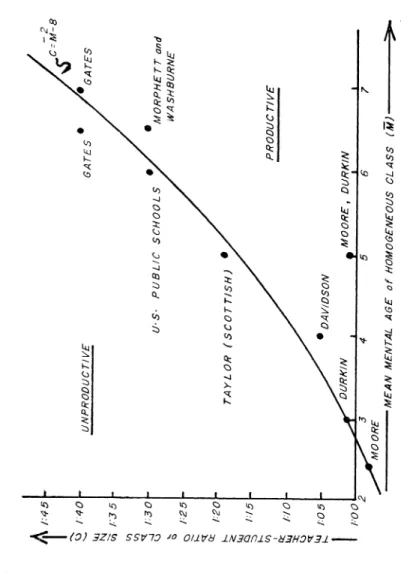
questions: "When can the child learn to read, and when should he learn to read?" The second question lies within the fields of values, psychology, and sociology; on the first question Holmes pulls to-gether much research in the field. As his frequency graph re-produced below indicates, the age at which children can be taught prod'uctively to read appears to be a function of the variables of mental age, teacher-pupil ratio, and methods and materials used.
MARGUERITE F. L. HORTON
55
~ <\JI I~"
" § I--~ I--Q:; i<J:::' :t:1l) ~ "-Il..~ Q:;", i:: ~~ I.J ...•
•
~ I~ "-\1) C ltJ Q:;~
Ct) 1-- Il.. Ct)'"
'"
I!l§
\0 -.J '> Cl ~ ~ c c ~ c ~ ~ c '-> 10 ~ -.J ... ::t: Il) ::t: .... :::. Ct) <) Il.. i:: i<J 1-- I!l Ct) C'"
:::, '-> -.J Ct) 'II- ~ ~ ' -~ Q:; i:: c ~ '> -.J ~ :::. ~ >-'"
"1: i<J Q:; 1-- ~ Q.. <: :::. c C\J 10 C 10 C 10 10 C 10 C 'II- "1- ~ 1<) C\J C\J-
z;: c ~ .:..:.-
-.:. ;,;. ;,;. "'--
-.:.< - ( 0 ) 3Z/S SS'rI7:J ./0 OI.1'r1H
J.N30nJ.S-H3H:J'rI3J.--Fig. 1. The curve conservatively divides unproductive from productiv6 teacher-student ratios for beginning the teaching of reading to homo-geneous classes of varying mean mental ages. For Moore's two to three ryear olds, it appears as if a tea.cher plus an electric typewriter, pro-jector, and tape recorder for each pupü is equivalent to a two-to-one teacher-student ratio!
(Graph reprinted with permission of J. A. Holmes and the Interna-tional Reading Association.)
the day, contrasts with Durkin's results with three-year-olds in a two-to-one pupil teacher situation, and Moore's work with electronic equipment with two-and-8t-half year-olds. Research has yet to show the suitability of present linguistic materials and methods for the teaching of reading at specific age levels.
Linguistic Soundness of Current
BasalReader Materials
Lefcourt', analysing five basal reading series published between 1959 and 1962, suggests that vocabulary control and meaning content are the main criteria of their reading matter. She makes a plea for more Iinguistic insight into sentence patterns and structure in future texts. This is echoed in Strickland's3 studies of children's spoken language in relationship to sentence structure of basal readers.Clymer4 uses four "widely-used" but unnamed basal series to
point out Iinguistic inconsistencies in phonie teaching, both among and within series. Analysis of forty-five most commonly presented syllabication and pronunciation generalizations show that only twenty-three of these can be applied with 75% consistency to basic reader vocabulary. For instance, the widely-drilled "rule" that in a vowel digraph the first vowel is long and the second silent tests out at only 45% consistency. Wardhaugh5 further illustrates linguistic
weakness of current word attack procedures. Using syllabication principles, the chiId arrives at /mit'
+
tenz' / as the pronunciation units of the wordmittens,
where normal pronunciation is/mit'enz/. There appears to he a real need for the assistance of linguists in structuring reading materials.Role of Grapheme-Phoneme Correspondence
Studies of many types exist on the role of grapheme-phoneme correspondence in the reading process. Exploratory team studies at Cornell University8 have led to a whole sequence of investigations of the perceptual aspects of word-recognition. Gibson7 and others,
using lists of pronounceable and unpronounceable letter combina-tions with adult subjects, suggest that the most productive unit of word-perception for the skilled reader is a spelling pattern within a word that has a fixed grapheme-to-phoneme correspondence, rather than single letters or whole words. The authors conclude that emphasis on such patterns may facilitate learning to read. Under the same CorneIl study, Levin and Watson" explored Bloomfield's assumption that the teaching of reading should begin with graphie units with only one phonemic response to a letter and proceed by stages to semi-regular and irregular graphemic units. They assumed
MARGUERITE F. L. HORTON 57 the negative hypothesis on the grounds that better transfer to un-controlled reading materials could he expected if irregular elements appeared from the start. Artificial orthography was used with chil-dren (at the Grade Three level) to avoid interference from previous learning. Results showed no significance in the transfer test be-tween subjects trained on regular and variant words. The authors, however, interpret data from the training exercises to indicate a significant difference in number of learning trials and errors in favour of the group trained on variable words.
Tensuan and Davis9 report a large scale controlIed experiment
in Philippine schools, comparing "cartilla" method (essentially phonemic) with a combination method using sight approach sup-ported by phonic analysis. Mean differences favouring combination groups were statistically insignificant, and the conclusion drawn that even in a language of very high phoneme-grapheme consistency (Tagalog), there is no superiority in a strictly phonic method of initial teaching. In the "cartilla" group, there was a higher mean correlation between MA and achievement than in the "combination" group.
Studies of school practices by Henderson and by Morgan and Light10 suggest the need to follow through longitudinally on growth
in reading and to measure in terms of long-term objectives hefore assuming the superiority of methods or materials. Studies of groups entering Grade Four indicated that apparent gains in mean achieve-ment attributed to intensive training in phoneme-grapheme corre-spondence in Grade One had largely disappeared. .
Studies of Direct Linguistic Approaches
In a recent doctoral study, Dolanl1 compared reading
achieve-ment of Grade Four pupiIs whose reading programme had been supplemented through four years of instruction with intensive phonemic training on the Bloomfield pattern, and a control group taught entirely by standard "developmental" materials. Significant differences in most reading skills (and especially in word recogni-tion) were found in favour of the experimental group. Since no ex-perimental controls of the teaching situation had been established, however, the writer suggests that differences may not necessarily be due to the phonemic nature of the supplementary materials. A more clearly defined and systematic application of principles of learning in the word-recognition programme and the provision for teachers of supplemental materials and exercises may have provided for greater teaching efficiency for the experimental groups.
Ruddell12 has reported on the first stages of a demonstration
study carefully designed to control population and Hawthorne ef-fects of novelty of materials and teacher stimulation. Achievement
phoneme correspondence; one with the basal reading materials sup-plemented by lessons in intonation, sentence patterns and word-function; one with the phonemic materials similarly supplemented.
Results at the end of the Grade One year showed significantly higher achievement in word reading and regular word-identifica-tion for groups using the phonemic materials over those on basal reader programme. Contrary to hypothesis, however, no significant differences appeared between these two groups in irregulOl1' word identification. Comparisons of achievement in paragraph reading showed significantly higher means for groups on basal readers over those using the basal readers supplemented with the sentence-struc-ture mate rials. On the other hand, significant differences in the same skiIl favoured the phonemic programme supplemented with the structural materials over the same programme unsupplemented. Data of this study were considered interim, awaiting longitu-dinal development of the experiment. Mean tendencies factored out of the study suggested hypotheses for further investigation of the effectiveness of the differing programmes in terms of the sex and level of M.A., C.A., and socio-economic background of pupils. A question that undoubtedly needs to be asked in evaluating reading materials and methods (linguistic as weIl as others) is, "For what particular groups or individuals may these be most valu able ?"
Conclusions
Little conclusive evidence is available at the moment as to the values of linguistic approaches to beginning reading. Much inter-disciplinary exchange seems necessary to place the proposaIs of the linguists in a framework of learning theory and proved practice. For this reason, schools need to suspend verdict, neither rejecting basic premises because materials are currently weak or limited, nor plunging into linguistic reading programmes without careful assess-ment and try-out.
Structural linguistics as a science has found its place in the disciplines and in the teaching of foreign languages. !ts possibiIities for helping elementary achool children learn to read in the native tongue need to be fully explored and exploited along the excellent principles laid down by Strickland13• She proposes two lines of ac-tion to be carried through on the basis of rigorous research: the first covera the work that the linguists need to undertake to provide the schools with the understandings and background necessary for sound Iinguistic approaches; the second suggests the specific inter-disciplinary research necessary at this point to explore and test out
MARGUERITE F. L. HORTON 59
theory, materials, practice. Healthy indication of the beginning of such research is evident in the literature.
The writer would suggest that the great contribution of lin-guistics to the teaching of reading may not eventually lie in reading methodology p'er se, but in broader and deeper insights into the nature and process of language on the part of both pupils and teach-ers. Snch understanding may lead to the integration of the elements of language arts programmes in the schools, so that interrelated learning of reading, writing, oral and written language becomes a reality rather than a pious hope.
The problem of sound curriculum for the preparation of teach-ers going into elementary school is a knotty one. The secondary teacher needs a grasp of the structure and content of his own field, a foundation in learning theory and psychology, and experience in building method and techniques in the framework of some consist-ent philosophy. What are the needs of the elemconsist-entary teacher who must lay the groundwork with young children for aIl the subject disciplines under present school practice? New programmes in ele-mentary school mathematics have shown too clearly the needs of the elementary teacher in subject background. Of how many subjects can he have reasonable mastery?
If, under present practice (and this is another field of investiga-tion) priority can be assigned anywhere, it must go to developing understanding of the principles of language and language learning. The mastery of communication in the native tongue in aIl its aspects is a major goal of the elementary school.
It will be necessary, then, to find ways of introducing back-ground in linguistics into the teacher's undergraduate training. Whether or not linguistic approaches become part of the school cur-riculum, the grasp of the most fundamental principles of the struc-ture and process of English is essential if the teacher is to become anything but a recipe-follower of the prescription of manuals and teaching guides. Most programmes for elementary teachers already provide some form of course in language and composition. Building these courses on a sound linguistic basis, and introducing the basic concepts of phonemics, morphemics and modern syntax is the first step toward sounder language teaching. As high schools move fur-ther into linguistic programmes in English, the needs for furfur-ther study can be investigated.
What of linguistics in curriculum and instruction courses in reading? This paper has produced no evidence to suggest that the broad developmental concepts of reading teaching should be aban-doned. These, and their implementation should continue to be the core of such courses. Specific linguistic approaches should be
exam-to meet the many and varied needs of children.
References
1. J. A. Holmes, "When Should and Could Johnny Learn to Read?"
Challenge and Experiment in Reading, (ed. J. A. Figurel), New
York: IRA, 1962, pp. 237-241.
2. A. Lefcourt, "Linguistics and Elementary School Textbooks,"
Ele-mentary English, Vol. XXXX, Oct. 1963.
3. R. C. Strickland, "The Language of Elementary School Children,"
Bulletin of the School of Education, Indiana University, Vol 38, No.
4,1962.
4. T. Clymer, "Utility of Phonic Generalizations in the Primary Grades," The Reading Teacher, Vol. XVI, Jan. 1963, pp. 252-8.
5. R. Wardhaugh, "Syl-Iab-i-ca-tion," Elementary English, Vol. XLIII,
Nov., 1966.
6. Cornell University, A Basic Research Program in Reading: Co-operative Study and Research Project Number 639, Bound Manu-script, Ithaca, N.Y., Cornell University, 1963.
7. Ibid. E. Gibson, A. Pick, H. Osser, M. Hammond, "The Role of
Grapheme-Phoneme Correspondence in the Perception of W ords." (Also published in American Journal of Psychology, Dec. 1962).
8. Ibid. H. Levin and J. S. Watson, "The Learning of Variable
Graphe-me-to-Phoneme Correspondence."
9. E. S. Tensuan and F. B. Davis, "Phonic Methods Versus
Combina-tion Methods in Teaching Beginning Reading," The Reading
Teach-er, Vol. 18, Oct. 1964.
10. E. F. Morgan, Jr., and M. Light, "A Statistical Evaluation of Two Programmes of Reading Instruction," Journal of Educational
Re-search, Vol. 5, Oct. 1963. Note: Henderson is cited in this study.
11. Sister M. G. Dolan, "Linguistics in the Teaching of Reading,"
Read-ing Research Quartely, Vol. 1, Summer, 1966.
12. R. B. Ruddell, "Summary of the Effects of Four Programs of Reading Instruction with Varying Emphasis on the Regularity of Grapheme-Phoneme Correspondences and the Relationship of Lan-guage Structure to Meaning on Achievement in First Grade Read-ing." Unpub. manuscript, University of California.
13. R. Strickland, "The Contribution of Structural Linguistics to the Teaching of Reading, Writing, and Grammar in the Elementary School," Bulletin of the School of Education, Vol. 40, No. 1. (Indiana University, 1964).