HAL Id: hal-01646986
https://hal.archives-ouvertes.fr/hal-01646986
Submitted on 4 Aug 2020
HAL is a multi-disciplinary open access
archive for the deposit and dissemination of
sci-entific research documents, whether they are
pub-lished or not. The documents may come from
teaching and research institutions in France or
abroad, or from public or private research centers.
L’archive ouverte pluridisciplinaire HAL, est
destinée au dépôt et à la diffusion de documents
scientifiques de niveau recherche, publiés ou non,
émanant des établissements d’enseignement et de
recherche français ou étrangers, des laboratoires
publics ou privés.
Two-dimensional simulations of a curved shock:
Self-consistent formation of the electron foreshock
Philippe Savoini, Bertrand Lembège
To cite this version:
Philippe Savoini, Bertrand Lembège. Two-dimensional simulations of a curved shock: Self-consistent
formation of the electron foreshock. Journal of Geophysical Research Space Physics, American
Geo-physical Union/Wiley, 2001, 106 (A7), pp.12975 - 12992. �10.1029/2001JA900007�. �hal-01646986�
JOURNAL OF GEOPHYSICAL RESEARCH, VOL. 106, NO. A7, PAGES 12,975-12,992, JULY 1, 2001
Two-dimensional
simulations
of a curved
shock'
Self-consistent
formation
of the electron
foreshock
Philippe S•voini •nd Bertrand Lemb•ge
Centre d'6tude des Environnements Terrestre et Plan6taires, CNRS, Universit6 de Versailles-St Quentin, V61izy, France
Abstract. A collisionless curved shock is analyzed in a supercritical regime with the help of a two-dimensional electromagnetic full particle code. Curvature effects are included self-consistently and allow one to follow continuously the transition from a narrow and step-like strictly perpendicular shock to a wider and more turbulent oblique shock within the quasi-perpendicular range 65 ø < OB,, < 90 ø. Present
results reproduce the formation of the electron foreshock without any simplifying
assumptions. In agreement with experimental data, local bump-on-tail parallel distribution functions are well recovered in the foreshock region and correspond to electrons backstreaming along the magnetic field lines. Present detailed analysisshows
that local back-streaming
distributions
have two components:
(i) a high
parallel energy component corresponding to back-streaming electrons characterizedby a field-aligned
bump-in-tail or beam signature,
and (ii) a low-energy
parallel
component
characterized
by a loss
cone
signature
(mirrored
electron). Two types of
bump-in-tail patterns, broad and narrow, are identified at short and large distances from the curved shock, respectively, and are due to different contributions of these two components according to the local impact of the time-of-flight effects. Present results allow one to identify more clearly the nature of the bump-in-tailpattern evidenced
experimentally
(narrow type). These also confirm
that mirroring
electrons make the dominant contribution to the bump-in-tail pattern in the total distribution in agreement with previous studies. Results suggest that low and high parallel energy populations are intimately related and may contribute together to the upstream wave turbulence.1. Introduction
The foreshock is the region of space extending be- tween the curved shock layer and the upstream mag- netic field lines tangent to the shock; this region is char- acterized by the presence of energetic particles back- streaming upstream away from the shock front along magnetic field lines connected to the curved shock. Since the early seventies, this region has been exten-
sively studied both theoritically [Leroy and Mangehey,
1984; Wu, 1984; Cairns, 1987; Krauss-Vatban and Wu,
1989; Fitzenreiter et al., 1990] and experimentally IFil-
bert and Kellogg, 1979; Anderson et al., 1979; Ander- son, 1981; Parks et al., 1981; Feldman et al., 1973, 1982,
1983; Klimas, 1985], and more recently, this region has
been studied with the WIND spacecraft, which provides in situ measurements of high sensitivity and resolution
[Fitzenreiter et al., 1996; Lepping et al., 1995; Slavin et al., 1996; Yin et al., 1998a], and the GEOTAIL mission [Kasaba et al., 1997].
Copyright 2001 by the American Geophysical Union.
Paper number 2001JA900007.
0148-0227/01/2001JA900007 $09.00
The general consensus is that the foreshock electron
population is composed of incoming solar wind electrons
and a small number of bow shock modified electrons
that stream back into the upstream region. These back-
streaming electrons have two components, which can
be described in terms of time of flight and generalized mirroring processes as follows:
1. One component corresponds to electrons which, after interacting with the shock front, succeed to es- cape from the front and stream back along upstream magnetic field lines. Moreover, these electrons are con- vected back with magnetic field lines because of the
earthward motion of the solar wind (E x B drift caused by the solar wind's motional electric field) and are spa-
tially diffuse acc.ording to their parallel velocities. Then the velocity distribution at a given upstream observa- tion point is the sum of contributions determined by ve- locity characteristics connecting different source points
on the curved shock to the observer location. The ef-
fect analyzed by Filbert and Kellog [1979] and further developed by Cairns [1987] is called the time-of-flight
mechanism.
2. The other component corresponds to electrons which are mirror reflected by the shock front. Indeed,
12,976 SAVOINI AND LEMBlb, GE: 2-D SIMULATION OF ELECTRON FORESHOCK
the shock front can be seen as a moving magnetic mir- ror structure, depending on which reference frame the process is viewed. It is convenient to discuss the mir-
ror reflection process in the deHoffman-Teller (dHT)
frame defined by a motional transformation along the shock surface in which the flow of the upstream plasma is parallel to the magnetic field and the induced mo-
tional electric field vanishes. Electron acceleration has
been analyzed theoretically in dHT by Leroy and Man-
geney [1984] and Wu [1984], who assumed an elastic
encounter between electrons and a moving plane shock
front. Krauss-Varban and Wu [1989] have shown that
efficiency of this acceleration mechanism is similar in
both dHT and normal incident (NI) frames. This en-
ergization mechanism is also called fast Fermi process
[Wu, 1984] or gradient-B drift process [Krauss-Varban and Wu, 1989], since the reflection mechanism can be
very efficient and does not require multiple interactions with the shock. The theory has shown satisfactory agreement with observational data and emphasizes the importance of the nearly perpendicular shocks as natu- ral energizers of the solar wind electrons population.
In summary, theory predicts that electron energiza- tion by mirror effects is weakly sensitive to the shock structure but is quite sensitive to the shock wave ge-
ometry (through a 1/cos0B• term), at least when the
shock is nearly perpendicular; OB• is the angle between the shock normal and the upstream magnetostatic field.
Two main consequences can be deduced [Leroy and Mangehey, 1984; Wu, 1984]:
1. The average
kinetic
parallel
energy
per
reflected
electron increases rapidly with 0B• as:< Erll >m2
meVupstream
2
/ COS
20Bn
(1)
in the observer's frame.2. In the case of an incoming Maxwellian distribu- tion function, the density of reflected electrons decreases
as exp[-1/cos2(O•3•],
when 0•3,approaches
90
ø. As
a consequence, the number of reflected electrons tends toward 0 at the leading edge of the foreshock, i.e., the magnetic field line tangent to the curved shock front. These calculations have been refined later by Krauss- Vatban and Wu [1989], who expressed the gain of ki-
netic energy versus both the initial energy and pitch angle.
Even if a good qualitative agreement with observa- tion is obtained, it is pertinent to resume the assump- tions used in the analytical works which are not always justified:
1. The theory has been established for angles 0•3, large enough to simplify the calculations and is only
valid around 900 . Nevertheless, the acceleration mech- anism is very sensitive to the angle 0•3, even a small deviation of 0 induces strong variation of the energy
gain (through
the term COS-20Bn
of equation
(1)).
2. Calculations ignore the effect of finite excursion time of electrons in the shock wave during reflection;
in particular, no loss of energy due to waves-electrons interaction is considered during the reflection process.
3. The electron magnetic moment •u is assumed
to be conserved in the reflection process (adiabatic the- ory). First, such an assumption is valid only when the
gyroradius of a convected electron is much smaller than the width of the shock transition layer, which can be inaccurate for high inflow velocities. Second, the as- sumption does not account for magnetic and electric fluctuations seen by the particles during their time of flight in the vicinity of the shock front.
4. Shock front is assumed to be stationary. As al-
ready evidenced by planar one-dimensional (i-D) Leroy et al. [1982] for hybrid simulations and Lemb•ge and Dawson [1987] for full-particle simulations and by two-
dimensional
(2-D) simulations
[Lemb•ge
and Savoini,
1992], the shock front is nonstationary. Two sources of nonstationarity have to be considered [Lemb•ge and Savoini, 1992]: First, the shock front suffers a self-
reformation over a typical timescale of the order of the
ion gyroperiod < •ci >ramp (calculated from the mean value of the magnetic field in the ramp); second, the
front itself exhibits a rippled pattern which moves in time along the shock front direction. Until now, the impact of this shock front nonstationarity on electron acceleration processes has not been analyzed and is still
unknown.
More recently, analytical models of cylindrical and spherical shocks with zero and nonzero thickness have been investigated by Vandas [1995a, 1995b]. These
studies examine the energy gain of reflected individ- ual electrons in the presence of a curved shock in or- der to generalize theoretical results obtained in previ- ous works. The model is based on strong assumptions. First, it solves electron motion in the shock layer with the adiabatic approximation, and it approximates the curved shock near the tangent point of the upstream
magnetic field by a plane shock with varying B• (the
normal component of the magnetic field at the shock
front). Second, it does not take into account the elec- trostatic field (Etx) and the noncoplanar magnetic field
in the shock layer, which are known to play an impor- tant role in the electron dynamic. In this model, the energy gain of reflected electrons is strongly affected by the curvature and, more particularly, is lower than that at a corresponding plane shock. Shock curvature de- creases the time spent by the particle within the shock
layer and so does its total energy gain. A compari-
son with experimental data leads to comparable levels of fluxes for interplanetary shocks but shows sore, dis- crepancies for the Earth's bow shock.
Numerical studies have already investigated the mag-
netic mirror reflection process with test particles and
shock
profiles
issued
from hybrid simulations
[Krauss-
Vatban and Wu, 1989; Krauss-Varban and Burgess, 1991]. Simulations have been done with a one-dimens-ional hybrid code with macroparticle ions and an in-
SAVOINI AND LEMB]•GE: 2-D SIMULATION OF ELECTRON FORESHOCK 12,977
the shock is well established, energetic electrons which
are assumed
to participate
in the reflection
process
are
injected as test particles and are followed during sev- eral ion gyroperiods. Such simulations are not self- consistent, since this requires the use of full particle codes. In addition, these do not take into account the global curvature of a shock (which requires a 2-D ge- ometry), and these only allow one to investigate the
vicinity of 900 through a model where spatial curva- ture of the electromagnetic components is introduced
via cosine functions. Both Maxwellian and n functions
are used to describe the incident electron population. A reasonable agreement is obtained with experimental data in producing the observed large fluxes of reflected electrons at the Earth's bow shock. Nevertheless, the intrinsic limitations of such hybrid simulations are obvi- ous. The bow shock has a two-dimensional curved pat- tern, and electron foreshock cannot be reproduced with oblique planar shock simulations. In addition, reflected electrons back-streaming along the interplanetary mag- netic field will experience a time-dependent angle 0B,• which can modify the effectiveness of the acceleration
process.
The purpose of the present paper is to present results obtained from full-particle simulations of a 2-D curved shock, where self-consistent features are fully involved and allow one to reproduce the electron foreshock with- out restrictive or ad-hoc assumptions.
The organization of the paper is as follows. Condi- tions of numerical simulations and the method for gen- erating the curved shock are described in section 2. Sec- tion 3 presents the main numerical results; local elec- tron distribution functions are analyzed in detail and are compared to experimental data in section 4. Fi- nally, discussion and concluding remarks are given in
section 5.
2. Numerical Description
Present simulations have been performed with a 2-1/2 dimensional, fully electromagnetic, relativistic particle code using standard finite-size particle techniques. De-
tails have been already given by Lernb•ge and Savoini
[1992]
and $avoini and Lemb&ge
[1994]. Basic
proper-
ties of the numerical code can be summarized as follows. The simulation box is divided into two parts, vacuumand plasma. Fields are separated into two sets: The electromagnetic transverse components, hereinafter de- noted by a subscript "t", reflect the induced effects and
are solutions of the full set of Maxwells' equations, and
the electrostatic longitudinal components, hereinafter
denoted by a subscript "l", result from the space-charge effects and are solutions of Poisson's equation. Nonperi- odic conditions are applied along the x direction within
the simulation box and, periodic conditions are used
along
the y direction. Leng•ths
of the plasma
simula-
tion box are L• - 768 and Ly - 1024, which represent
40 and 53 ion inertial lengths
(Y/Spi), respectively.
All
quantities with tildes are in normalized units.
The curved shock is created by using a cylindrical
magnetic piston localized in the vacuum part of the
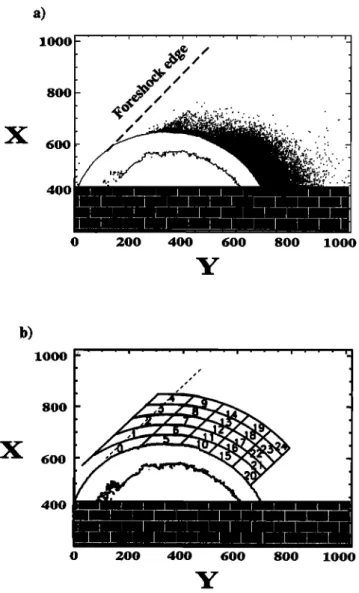
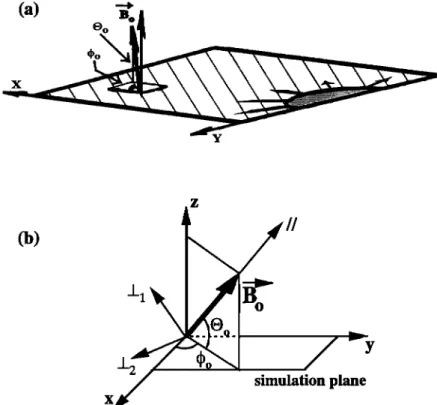
simulation box. This procedure turns out to be very ef- ficient and rapid in terms of computer time. The curved shock propagates through the X- Y simulation plane as illustrated in Figure la.
One important
poi•nt
concerns
the orientation
of the
magnetostatic field Bo, which is partially lying outsidethe simulation plane. We define two angles as shown in Figure lb' q•o and 0o provide the relative orienta- tion of the magnetic field lines within and outside the
X- Y plane,
respectivel•y.
More precisely,
•o is defined
between the projected Bo field (within the simulation plane) and X axis, while 0o is defined between the mag-netostatic field Bo and the projection of this field within the simulation plane.
The curvature of the shock front imposes a continuous
variation in the orientation of the local shock normal (always lying within the simulation plane, as illustrated by small arrows in Figure la); this implies an angle
between the upstream magnetic field Bo and ff defined by the relation:
0•,• - arccos
[cos
0o (cos
•o cos
• + sin •o sin •)], (2)
where • is the angle between ff and the X axis. The present study is made for 0o - 650 and •o - 45 ø. The finite value of 0o means that the curved shock is ana- lyzed within a restricted quasi-perpendicular range, i.e., with 0•,• varying from 900 to 650 where the electron ac- celeration is efiqcient, as • varies from •o - 900 to •o.
Such a configuration provides the accessibility for the electrons to flow along the magnetic field lines outside the simulation plane and to have a moderate projected displacement within the X- Y plane. Preliminary sim-
ulations have shown that the case 0•,• - 0 ø (i.e., with Bo fully lying within the simulation plane, 0o - 0 ø)
cannot be reproduced at present time with a reason- able CPU cost, since electrons flow immediately along the field lines before the curved shock is really formed. The radius of the magnetic cylinder has been cho- sen carefully so that, after a short transient period t <_ 0.2Yci, the curvature radius Rc of the shock is much larger than the ion Larmor radius, i.e., R• _> 34•i
(m 200•); Y• is the upstream ion gyroperiod. Sizes
of the simulation box and the time of the run are
large enough to cover all characteristic space scales and
timescales for both particle species (tsimul - 1.1Y•i), and so that dynamics of the shock is independent of initial conditions. At the present stage of the study, it is im- portant to point out that only the electron foreshock is investigated. The analysis of the ion foreshock is out of the scope of the paper, since it requires access to
a larger angular region (below 65 ø) and also a much longer simulation time (several Y•).
The simulation follows 8,388,608 particles with a
time
step
0.065• and
an unrealistic
mass
ratio
mi/m• -
12,978 SAVOINI AND LEMB•GE: 2-D SIMULATION OF ELECTRON FORESHOCK •o 3('
(b)
//11
simulation planeFigure 1. (a) Sketch of the reference set used in the 2-D simulation. Local 5 vectors nor-
real to the curved shock front are illustrated by arrows. The magnetostatic field Bo is lying partially outside the simulation plane; its orientation is defined by two angles outside and inside the simulation plane, respectively namely, 0o : 650 and &o : 45 ø. For reference, straight lines represent the projection of the magnetic field lines within the simulation plan.
(b) Details of the reference set used in the simulation code. In this study, directions II, l•, and
2_2, are respectively defined with respect to the upstream magnetic field Bo.
tions are summarized as follows: light velocity 5- 3, temperature ratio between ion and electron population
Te/Ti - 1.58, thermal
momentum
•the,• -- 0.3 for elec-
trons (where c• denotes the x, y, and z components,respectively)
and •thi,• -- 0.037 for ions.
The ratio /Y of the kinetic to the magnetic pressure and the Alfv•n velocity are /Ye - 0.24, /Yi - 0.15, and
v• - 0.23, respectively . The shock is in a supercritical
regime; as reference, the Alfv•n Mach number measured at0B•-900 isMA--3.
3. Numerical Results
In order to clarify the presentation we will focus first
on the salient features of the curved shock obtained in
present 2-D simulations and, second, on the formation
and characteristics of the electron foreshock
3.1. Salient Features of Curved Shock
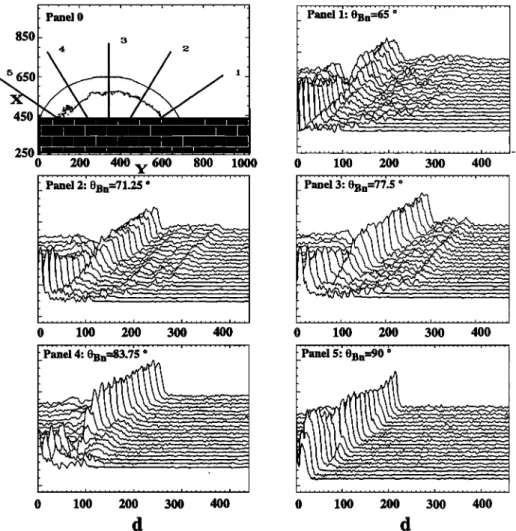
Main characteristics of the self-consistent curved shock
are illustrated in Figure 2, where are plotted time se-
quences of the profiles of the main magnetic component
Bz versus distance through the shock front for different propagation angles, from OB• = 650 to OB• = 90 ø. For
reference, the X- Y simulation plane is plotted (panel
0) at the last time of the run •= 1.1Yci,
on which
are in-
dicated
the directions
of the slices
(straight
lines) used
for plotting the Bz profiles. The length of these slices in
panel 0 corresponds to the length "d" of the sampling
region used for the B• profiles in the other panels. In short, the well-known characteristics of a supercrit- ical perpendicular shock, i.e., the foot-ramp-overshoot- undershoot pattern, are well recovered at 0B,• = 900
(panel 5). A comparison
with ion phase
space
(not
shown here) confirms that the foot is well related to a noticeable number of reflected ions. An interesting fea- ture is that the accumulation of reflected ions in time isresponsible for the cyclic reformation of the shock front. This self-reformation has been already observed for a
planar quasi-perpendicular shock in 1-D [Lembdge and
Dawson, 1987] and 2-D [Lemb•ge
and Savoini, 1992]
full-particle simulations. The time period of this cyclicreformation
is about < Yci >ramp. As emphasized
by
Lembdge and Savoini [1992] with planar shock, thiscyclic modulation
(foot and overshoot)
disappears
for
large deviations from 900 . Similar behavior is also evi- denced for the present curved shock; no cyclic reforma- tion persists for angles below OBn = 85 ø.
Several other features of a supercritical shock are well recovered in present simulations but are not detailed in the present paper. However, some quantitative results
SAVOINI AND LEMBl•GE: 2-D SIMULATION OF ELECTRON FORESHOCK Panel 850 45O 25O
0
200 400y600
800 1000
... ! ... [ ... i.,.• ... 1,,, ' Panel 2:0Bn=71.25 ø . ... i ... ! ... i ... i,., 0 100 200 300 400...
... i ... t ... ! ... i,,, 0 100 200 300 400 d ' 'P•nei i; b•=6g •, ... 0 100 200 300 400 ' pa,i ... ß p•nei •; •B•9o. • ... _ ... i ... i ... • ... I ... 0 100 200 300 400 dFigure 2. Time sequences of the local magnetic field component Bz versus distance d for different
angles of propagation 0B• from 650 (panel 1) to 900 (panel 5). Within each panel the separation
time
between
profiles
is A•- 245•. For
reference,
the location
of the shock
front
within
the
X - Y simulation plane is shown in panel 0 at a late time (t - 1.1•ci); straight lines of length d (labeled 1-5) represent the different directions (slices) along which local profiles of Bz component
are plotted in panels 1-5.
12,979
curvature effects of the shock in a self-consistent way. As expected, the magnetic field profile continuously
evolves
from a well-defined,
step-like
pattern (charac-
terized
by a narrow
thickness)
for OBn
- 90 ø, to a more
turbulent
type profile
(lying
over
a wider
space
range
in
the upstream
region)
as OBn
decreases.
A turbulent
field
pattern appears upstream of the ramp for OBn _• 77.5 ø.The identification
and analysis
of the upstream
turbu-
lence are out of the scope of this paper, but waves seem well correlated with the existence of the electron fore-shock
detailed
in the section
3.2. Such
an enhanced
up-
stream turbulence
is characteristic
of a curved
shock,
since
its level was much weaker
in 1-D and 2-D pla-
nar simulations for similar plasma conditions even fora large
deviation
angle
of the shock
normal
(OBn
- 550
from Lemb•ge
and $avoini
[1992]).
A further
compara-
tive analysis between planar and curved shocks will berequired on this point.
Present
study is restricted
to the electron
foreshock,
which implies that other electron-ion foreshock mecha-
nisms
are not considered
herein. The relative
simplicity
of the present
foreshock
formation
related
to one specie
mainly (i.e., electrons)
allows
us to investigate
in detail
the basic
physical
processes
involved
into the generation
and the acceleration of this particular population. 3.2. Main Features of the Electron ForeshockFor a comparison with numerical results it is useful to summarize briefly the characteristics of the electron
foreshock as observed in the experimental data. Obser- vations have confirmed many of the basic features of the
electron
foreshock
which
were
observed
or predicted
ear-
lier (Filbert
end Kellogg
[1979]
for a first global
picture;
Ogilvie
et el. [1971],
Feldmen
et el. [1973];
Anderson
I1981],
Fitzenreiter
et el. [1984,
1990,
1996];
Yin et el.
[1998a],
Klimes
I1985],
Onseger
end Thomsen
I1991]
and Fitzenreiter [1995] for reviews and the references
inside). Figure
3 [from
Fitzenreiter
et el., 1990]
is a
12,980 SAVOINI AND LEMBgGE' 2-D SIMULATION OF ELECTRON FORESHOCK Panel 1 • 51- 22i31:30 ' .I. _ . o16 -17 -- ...=*. ß , -•" - /'i'", ß 3; -•s- / ß ,.. ß o .2o- i i ' ',,,. : '.. <.0 -2;I r• -22 - '
"- -23
--
. .,.,.,.::>'
-24
-
/
i
ß
U. -26 -' .-=s!'- ./"
i
"..
-29 '.301-7_1
I _1 •._1. I. I I ½.
-15 0 VII (10 3 KM/S) I 15-15 Panel 2 !...1. I J'.' !5 -15 Panel 3 22:31:48 •. 1 '. ' --ß
ß
15 15 • i' 'J-'-•-I !' .17 - •9 t/) -2 ..' • .22 - / : -23 - '"i•....24
-25 ,./"'
0 .26 - -28 -29 .30 Panel 4 •-2:3'1:$8 ' , !.;, of ,-. ..,•
.o i '!I ' ß I ':"- I! I"J o I i I - ß t i I 5 ,... ,. I I I ! V,, (10 a KMIS) 2; Panel 5:3•:07"
:' ,:':'•
ß
,"'
o•..io •'o
Iß .*
... 1 15 15 0 15 ' Panel 6 TFigure 3. Local electron distribution measured by ISEE satellite when crossing the edge of the
electron foreshock from [Fitzenreiter et al., 1990]. Panels 1 and 6 correspond to measurements
made in the solar wind, while panels 2-5 are for measurements at different distances within the foreshock. Panel 4 corresponds to a measurement made deeply within the foreshock.
tion measured by ISEE 1 from the solar wind (panels 1
and 6) into the electron
foreshock
(panels
2-5).
Near the leading edge of the foreshock, only electrons with high parallel velocities succeed to reach the up- stream observation point. Other electrons with lower parallel velocity are swept downstream further from the
leading edge by the incident solar wind flow. As a re- sult, a secondary peak in the parallel electron distri-
bution function is well observed when approaching the
leading
edge of the foreshock
(panel 2). The resulting
bump-on-tail distribution function is characteristic of
SAVOINI AND LEMB•GE' 2-D SIMULATION OF ELECTRON FORESHOCK 12,981
plasma wave emission associated with the electrostatic turbulence observed in the foreshock. In particular, beam-like streaming electrons have been shown to drive Langmuir-like waves near the local electron plasma fre- quency, which can be coupled to produce electromag-
netic radiation
near fp• and 2 fp• [Fredericks
et al., 1971;
Scarf et al., 1971; Canu, 1989, 1990; Bale et al., 1997; Cairns and Robinson, 1997; Cairns et al., 1997; Kasaba et al., 1997; Schriver et al., 1997; Yin et al., 1998b;
Cairns and Robinson, 1999]. Deeper in the foreshock (less energetic), electrons escaping from the shock front
do have less time to propagate far upstream, and the bump moves downward in parallel velocity until it dis-
appears in the core of the distribution (panels 3 and 4). A deeper insight of Figure 3 suggests that two dif-
ferent populations may contribute to the local distri-
bution function: a loss cone pattern (well evidenced at a certain distance from the leading edge) and a bump-
in-tail pattern for high parallel energy electrons. All
these characteristics of the Earth's electron foreshock
have to be fully recovered in present 2-D self-consistent
simulations.
The following procedure has been used for identifying the electron foreshock in our 2-D simulations, without any ad hoc assumption. One important step consists in determining as precisely as possible the energetic elec- tron population backstreaming upstream away from the shock front. For so doing, three selection criteria have
been used: (1) Electrons have to be. upstream of the shock front at the end of the run; (2) these must have
interacted with the shock front during the runtime and
(3) during this interaction, these are supposed to have
gained enough energy to be differentiated from back- ground ambient electrons. For the purpose of clarity these criteria may be presented in terms of two main
successive conditions:
1. The first condition is the selection in loca-
tion. First, at a late time of the run (herein, 1.17ci), one
selects all electrons which are located upstream of the shock without any other a priori assumption. This elec- tron population includes both all backstreaming elec-
trons which have suffered reflection with the shock front
at previous times and electrons located upstream to the shock front which did not yet interact with the shock front at that time. Second, among this population we select only those which are located in the area swept by the shock front during the simulation from an early time. This procedure eliminates all upstream electrons which did not yet interact with the shock front from this early ti. me to late time 1.1•ci.
2. The second condition is the selection in en-
ergy. One selects only those electrons which have gained enough kinetic energy in the acceleration pro-
cesses to reach at least six times the initial thermal en-
ergy Etherreal -- 0.135.
The advantage of the present method is to eliminate
safely electrons which do not have high contrast with respect to the background solar wind distribution, i.e.,
having a kinetic energy Ek < 0.8. Some electrons con-
tributing to the foreshock but having energy less than
that imposed by the second criteria may be not selected.
However, such a selection turns out to be safe enough to consider all selected electrons as the foreshock com-
ponent, independently of their locations within the up-
stream region and/or of the energization processes re- sponsible for their energetic backstreaming.
3.3. Identification of the Electron Foreshock
Location
Figure 4a plots the locations of selected electrons at
the end of the simulation (t - 1.1•ci). As reference,
the curved shock front is plotted in the X-Y simulation
x
a) 1000 ....8oo
600 4.00 0 200 400 600 800 1000Y
b)x
lOOO 800 600 400 0 200 400 600 800 1000Y
Figure 4. (a) Locations of foreshock electrons within
the simulation
plane at time •'- 1.1Yci.
All these
elec-
trons are selected by both criteria used herein versus
locations
and kinetic
energy,
respectively
(to see text),
and the electrons are located upstream of the bow shock and within the edge of the foreshock. This foreshock
limit fits quite well with the projected
magnetic
field
line tangent
to the curved
front (thick dashed
line).
(b) Sketch
showing
the foreshock
region
sampled
with
25 boxes
(mainly aligned
along
the projected
magnetic
field lines) used to compute local electron distributions.12,982 SAVOINI AND LEMBI•GE: 2-D SIMULATION OF ELECTRON FORESHOCK
plane with the projected magnetic field line tangent to the bow shock, which defines the leading edge of the foreshock. Several important points may be stressed: First, all selected electrons are well located within the upstream region of the shock front and downstream to the tangent line. These characteristics fit quite well with the expected location of the electron foreshock. Second, these also confirm that high-energy electrons can be detected only within a restricted area upstream to the shock front. Third, as predicted by the theory, the density of selected electrons decreases drastically as OBn increases to 90 ø. Only a few electrons are present when approaching the tangent line, in agreement both
with theory [Filbert and Kellogg, 1979; Cairns, 1987; Wu, 1984; Leroy and Mangehey, 1984] and experimen- tal observations [Anderson et al., 1979; Feldman et al., 1983; Fitzenreiter et al., 1990]. The total number of backstreaming selected electrons represents m 1% of
the total number of the "incident" solar wind particles. However, let us note that this value does not represent strictly the real percentage of foreshock electrons, since some of these may be eliminated by the selection criteria
used herein.
As evidenced in Figure 4a, no backstreaming elec- trons can be observed at the leading edge of the fore-
shock (m 90ø). This lack of particles can be due to
either the physical reasons at the leading edge or the limited number of particles per cell used in the simu- lation. This particular region will be studied in more details by using a much higher number of particles per
cell and/or by limiting the angle range of 0Br, around
900 only, instead of 650 - 90 ø.
In order to analyze in detail the dynamics of back- streaming electrons, the overall foreshock area is di- vided into 25 small sampling boxes within which lo- cal electron distributions are computed. The extent of the whole upstream sampling region is restricted to limits where backstreaming electrons have been iden-
tified (Figure 4a is used as a reference). The size of
each small sampling box has been chosen so that it is
small enough to follow the progressive changes in lo- cal distributions (both in local angle 0s,• and in dis- tance with respect to the shock front) but large enough to satisfy some reasonable statistics. Shape and lo- cations of sampling boxes are aligned along the mag- netic field lines projected within the simulation plane
as shown in Figure 4b. This disposal allows one to
keep roughly the same size for all sampling boxes in order to reproduce a constant sampling rate performed
in real satellite measurements. Then, five main different
directions of sampling have been analyzed correspond-
ing to boxes located nearest to the curved shock front
(used as reference
boxes);
more precisely,
these direc-
tions pass through the middle of the boxes. These cor-
respond to directions 0St, m 900 (near the edge of the foreshock), 83.750 , 77.50 , 71.250 , and 650 , respectively, these are defined by boxes numbered 0, 5, 10, 15, and
20. Before presenting results on local distribution func-
tions, it is important to check whether time-of-flight
effects are correctly included in the present simulationframe.
3.4. Time of Flight Effects
Before comparing the numerical results with experi- mental data, it is worth pointing out that the time-of-
flight effect described in the literature [Asbr{dg½ ½! cd.,
1968; Filbert and Kellogg, 1979; Cairns, 1987; Fitzenre-
iter et al., 1990] is fully included in the present simula-
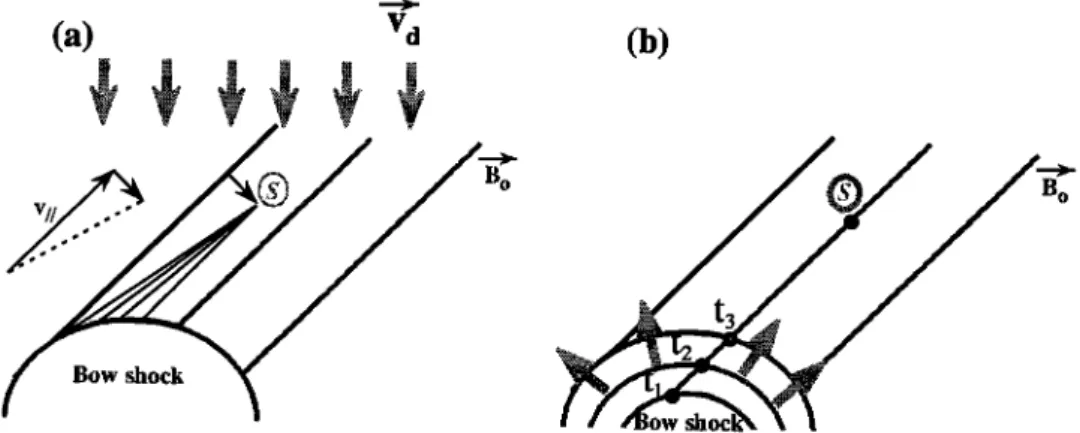
tion as illustrated in Figure 5.
The time-of-flight effect is an important feature of
the foreshock and can be understood as a ballistic ef-
fect which is mainly due to the convection of the up- stream magnetic field lines by the incoming solar wind which carries away the backstreaming electrons into
the deeper region of the foreshock (Figure 5a). As a
result, backstreaming electrons measured farther from the shock front come from different parts of the curved shock depending on their respective parallel velocity.
Fast electrons come from the field line connected di-
rectly from the nearest point of the curved shock to
(a)
Bow shock
(b)
Figure 5. Sketch
illustrating
the comparison
of time-of-flight
effects
in (a) observational
results
and (b) present
numerical
simulations.
"S"
indicates
the location
of an observer
within the fore-
shock
region. For reference,
straight lines represent
the projection
of the magnetic
field lines
SAVOINI AND LEMB•GE' 2-D SIMULATION OF ELECTRON FORESHOCK 12,983
the observer location (S point), while slower electrons come from field lines connected from other parts of the curved shock to this S point. Then, the electron distri- bution function measured locally by a spacecraft in the upstream region includes electrons coming from differ- ent parts of the curved shock characterized by different OB• propagation angles.
In the solar wind frame (i.e., frame of the present simulation) an equivalent situation is obtained as a
given magnetic field line connected from the expanding curved shock to the observer point S will scan different angles OBn in time, as illustrated by the shock normal
directions at points •, •2, and •3 (see Figure 5b). Then, a direct comparison between experimental and numer- ical distributions can be performed and is reported in Figures 6, 8, 9, and 10.
4. Local Electron Distribution Function
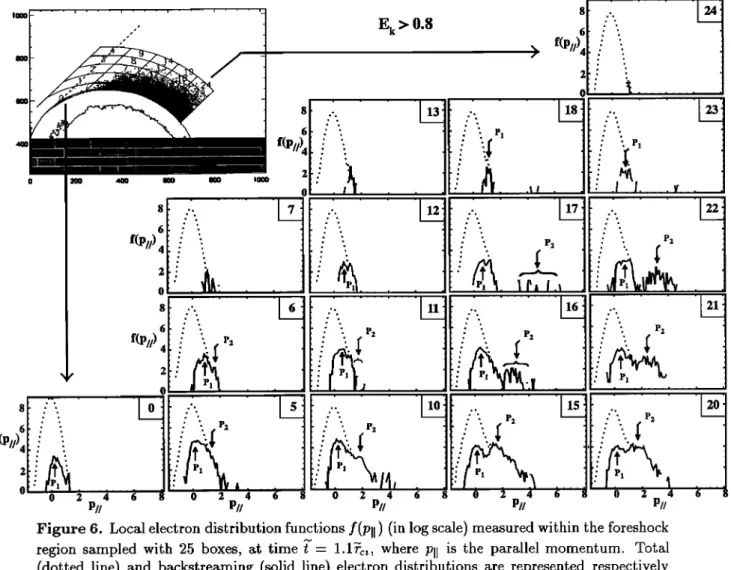
Local distribution functions can be computed in the different sampling boxes by superimposing Figure 4b onto Figure 4a. It clearly appears that distribution functions cannot be measured accurately along the edge
of the foreshock (boxes 1, 2, 3, 4, 8, and 9) and too far from the shock front (boxes 14-19), since the number of selected electrons is too low (or even null).
4.1. Total Distribution and Back-streaming
Electron Distribution
Reduced
parallel
f(Pll) distributions
calculated
from
f(PlI,P•-) are reported
in Figure
6. Within each
box,
both the total distribution, hereinafter
noted ft (in-
cluding solar wind and Back-streaming electrons), andthe Back-streaming electrons' distribution, hereinafter noted lb, are plotted. Let us note that the dotted line
(representing the total distribution) is mixed with the solid line (representing the Back-streaming electrons)
in the high-velocity range since it involves these ener- getic electrons. The comparison between Figures 3 and 6 shows a very good qualitative agreement with experi- mental data, which can be summarized as follows: The
total parallel
distribution
ft(pll
) (dotted
line) exhibits
a
characteristic bump-on-tail pattern observed in-situ in the different sampling boxes. For the purpose of clar- ity, we will analyze local distributions, first, versus pro- gressive deviation from 90 ø and for boxes nearest to the curved shock front, and, second, versus relative distance
from the shock front.
4.1.1. Variation versus angle. Sampling boxes
versus angle near the shock front allow one to stress the following features:
1. In the vicinity of the leading edge (box 0), Back-
streaming electrons have still low energy and are imbed- ded within the main core of the upstream undisturbed distribution; in addition, the number of these electrons
is weak. These form a relatively cold (narrow) popula-
tion animated with an averaged weak parallel drift ve-
locity. No bump-in-tail pattern (or cold electron beam pattern) can be evidenced too near the leading edge of
the foreshock.
However, for more oblique direction, the bump pat- tern is clearly identified and is even amplified quite well
for large deviations from 90 ø (boxes 5, 10, 15 and 20). This is in contrast with the fact that it is expected to disappear more deeply within the foreshock. Such a dis- crepancy may be explained by remembering that more
oblique direction (i.e., measurements made presently very near the curved shock front) should not be con-
fused with measurements made more deeply within the foreshock as mentioned in experimental works. Such
last measurements include also variation in distance
with respect to the shock front itself, a fact which can be reproduced too by the present sampling measurements.
2. As angle deviates from 90 ø , the Back-streaming population has a much higher density, an increasing thermal momentum, and an increasing parallel drift mo-
mentum
< Pll >' These
electrons
mainly form a bump-
in-tail with a momentum sign opposite to that observed in experimental data, since present simulations are in the solar wind frame. The relatively narrow extent of the field-aligned suprathermal distribution in box 0 be-
comes much broader (heating) as evidenced in boxes 5, 10, 15, and 20. This feature persists also at different distances from the shock front (boxes 6, 11, 16, and 21). Such a broadening evidenced with further pene-
tration within the foreshock is in good agreement with
the observations of Feldman et al. [1983].
3. Two different population components can be clearly identified in the Back-streaming population. When deviating from the leading edge of the foreshock,
the well-pronounced, single-peaked distribution (P• in boxes 0 and 5) is progressively replaced by a double- peaked distribution (P• and P2 in boxes 10, 15, and 20). This change has two consequences: First, this sug-
gests the necessity for analyzing separately high and
low parallel energetic electrons (as already mentioned for experimental results of Figure 3). This point will
be developed in section 4.2. Second, with more oblique deviation, electrons of peak P2 depart from the distri- bution tail and are responsible for the formation of a bump-in-tail around a finite-averaged parallel drift mo- mentum. For large deviation from 900 this drift in-
creases
and reaches
a maximum
value < Pll >• 1.5
(boxes 15 and 20); in contrast, peak P• stays always centered around a null drift velocity. When 0B,• ap- proaches 65 ø, the depletion between peaks P• and P2becomes partially filled in (box 20).
In summary, these results can be interpreted as a progressive transformation of the bulk energy of Back- streaming electrons into thermal energy as the direction
with the shock normal is strongly oblique (boxes 5, 10, 15, and 20). Such features can be understood if one con-
siders that electrons located around the leading edge of
12,984 SAVOINI AND LEMB•GE' 2-D SIMULATION OF ELECTRON FORESHOCK
0.8
o 20o 8f(P/)
! ,
0 f o 2 P//-17!
'1 51
A . . • 8 4 6 8ß
0 2 4 6 8 P// P2f(P//)4
118: ....
ß[23:
ß . ßß i P1
ß: .1•1. . v .
ß ' . . -122:
' ' :'
'".
' r2' '[
211
i •
. . .
ß .,11[
__
t'[/i. __.
6 8 0 2 4 6 P//Figure 6. Local
electron
distribution
functions
f(Pll) (in log scale)
measured
within
the foreshock
region
sampled
with 25 boxes,
at time t - 1.1'rci,
where
Pll is the parallel
momentum.
Total
(dotted line) and backstreaming
(solid line) electron
distributions
are represented
respectively
within each sampling box labeled from 0 to 24. For reference, the left-hand top panel showslocations of the curved shock front, of the backstreaming electrons, and of the sampling boxes
within the simulation
plane (see
also
Figure
4b for precise
labels
of sampling
boxes);
the foreshock
edge
is illustrated
by the projected
magnetic
field line tangent
to the curved
front (dashed
line)
fiected (and accelerated) more recently than those of
other groups. As a consequence, these did not have enough time to interact with the ambient solar wind plasma; this is in agreement with the absence of up-
stream turbulence observed as OB, approaches 900 (see Figure 2). Then, results of boxes 0, 5, or 6 can be con- sidered as characteristic distribution functions just after the reflection process and before driving various elec- trostatic and electromagnetic instabilities. In contrast, electrons of boxes located at more oblique angles have left the shock front much before those of boxes 0, 5, and 6 and have enough time to trigger some instabilities. As a consequence, these fluctuations cause some diffusion
in energy (and in pitch angle) as shown in boxes 10,
15, and 20 and 11, 16, and 21. This behavior seems to be well confirmed by the presence of upstream electro- static and electromagnetic wave activity evidenced for
0e• _< 77.50 (Figure 2).
4.1.2. Variation versus distance. Let us con-
sider the direction centered around the projected field
line starting from the curved shock front at 0B, m 65 ø.
Results clearly show that the bump-in-tail (box 20) is
progressively replaced by a well-pronounced beam pat-
tern (separated
from the main distribution)
as the dis-
tance from the shock front increases (boxes 20-23). Inother words, the parallel drift of high-energy electrons
(peak P2) strongly increases, that is, only the most en-
ergetic electrons can be observed at large distances from the shock front, but their density decreases rapidly with distance, and no field-aligned beam pattern can be iden-
tified too far from the front (box 24). As 0B• increases
to 90 o , the beam pattern can be partially identified over much shorter distances from the front, which can explain the difficulty for evidencing clearly such a lo- cal feature in experimental data. Similarly, low-energy
electrons also suffer an increasing parallel drift (peak P•) as the distance from both the foreshock edge and
the bow shock increases. As a consequence, two differ- ent bump-in-tail patterns may be identified in the total
distribution
ft(pll
) at different
locations
where
mecha-
SAVOINI AND LEMB•GE' 2-D SIMULATION OF ELECTRON FORESHOCK 12,985 nisms of formation largely differ; both patterns result
from time-of-flight effects.
A relatively narrow bump-in-tail pattern is pres- ent both for large deviations from the leading edge of the foreshock and large angle; it is mainly due to the
contribution of shifted peak P• (as in boxes 18 and 23).
Such a distribution can also be observed for short de-
viation and nearer to the shock front (see boxes 6 and
In contrast, for any oblique deviations from 900 but very near of the shock front, a much broadened bump- in-tail pattern is evidenced; it is only due to the con-
tribution of the shifted peak Pa (boxes 5, 10, 15, and 20). However, when penetrating deeply within the fore- shock region (i.e., by combining both large deviations and large distance from the shock front), the resulting wide bump-in-tail pattern tends to be much narrower until being smoothed out within the total distribution for two combined reasons: absence of high-energy elec-
trons (no Pa peak) and finite parallel drift of low-energy electrons (i.e., peak P•). These results illustrate the
progressive disappearance of the bump-in-tail pattern to be compared with that evidenced in experimental
data as detailed in section 5.
Unlike the parallel distribution, the perpendicular
distribution ft(pñ) (not shown herein) exhibits a fiat-
top pattern which enlarges the tails of the incoming
Maxwellian distribution. This feature is almost un-
changed for any direction and almost any distance from the shock front. However, a loss cone type pattern ap- pears at small oblique deviations from 90ø; this will be analyzed in more details in section 4.2. At a large de-
viation from 90 ø, the only change in ft(p_k) is a slight
decrease in the width of the fiat-top distribution, as the
distance from the curved shock front increases.
4.2. Low and High Parallel Energy
Distributions
Until now, we have only analyzed the behavior of Back-streaming electrons according to their locations.
Both experimental (Figure 3) and present numerical re- sults (Figure 6a) emphasize differencies in the parallel
distribution function which suggest that one perform a more detailed investigation of local distributions versus the level of parallel kinetic energy.
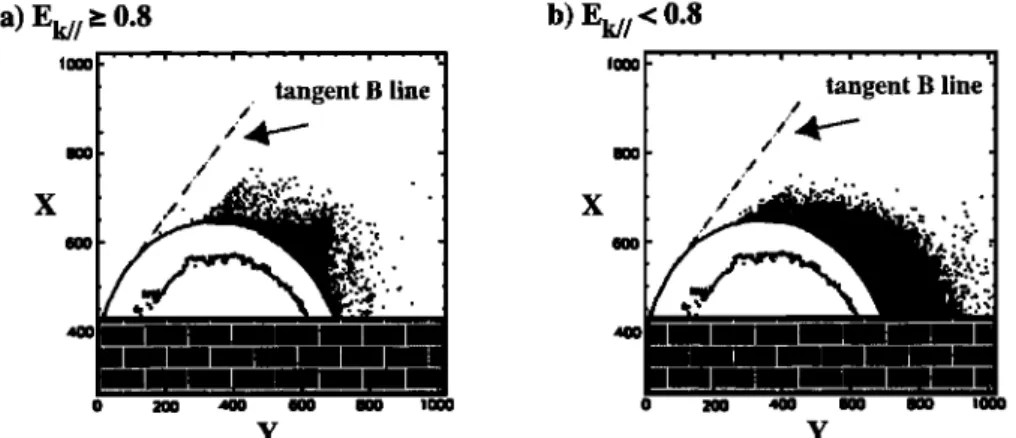
We have separated all selected Back-streaming elec-
trons (Figure 4a) into two groups, with parallel kinetic
energy
Ekl[ higher
and lower
than 0.8. Locations
of se-
lected electrons are shown in Figures 7a and 7b, respec-
tively. This selection
in Ekll corresponds
to momentum
value Iplll • 1.2, where
peak Pa departs
clearly
from
the tail of ft(Pll) in box 10 of Figure
6. This procedure
allows one to identify more clearly the characteristics of electrons contributing to peaks P• and Pa. It is im- portant to stress that this selection does not invoke any assumption on the perpendicular velocity component.
Again, one applies a spatial distribution
of sampling
boxes
within the foreshock
region
(from boxes
1 to 24)
identical to that used in Figures 4b and 6.Figure 7 shows that results obtained in section 4.1
still persist for each separate population. First, density
of each population strongly increases as 0B• decreases from 90 o to 65 ø. Second, each population exhibits an
effective limit near the foreshock edge along which den-
sity is almost null. However, important differences are evidenced between both populations and are summa-
rized as follows:
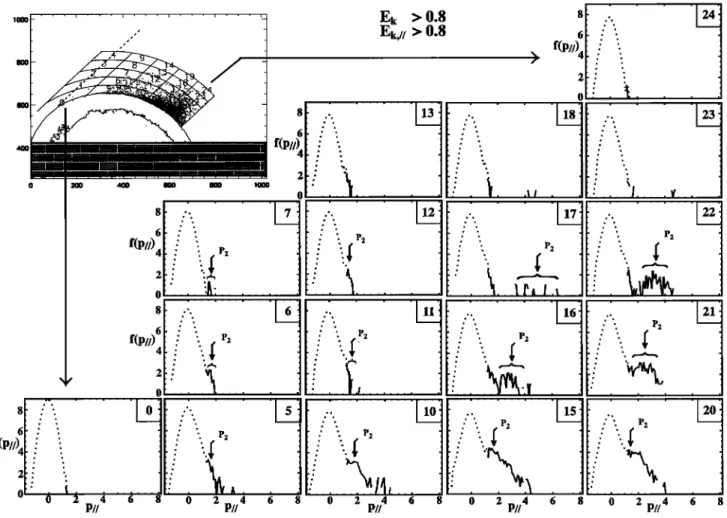
4.2.1. Case E•i I > 0.8 (Figures 7a and 8). High
parallel kinetic energy electrons represent ,,• 26% of lb.The spatial distribution of these electrons is not homo- geneous. These strongly accumulate along the projec-
tion of the magnetic field Bo in the simulation plane
(Figure 7a), which corresponds
to the extreme
region
of excursion where electrons can stream freely. These electrons are mainly responsible for the wide bump-in-tail in the total distribution
ft(Pll
) at short
distances
of the shock front as shown in Figure 8. As discussed in section 4.1, this bump (peak Pa) is progressively re- placed by a beam-like pattern in some regions of the foreshock. Corresponding perpendicular distributiona) Ek//_>
0.8
/ tangent
B line
///•
.. ,- ,, •.•...: . X /. '.,..•:'/,
'..
Yb) Ek//< 0.8
.../ tangent
B line
,t ß x •0111111111111111 YFigure 7. Locations of foreshock electrons within the simulation plane at time t - 1.1Y•i, for (a) high parallel kinetic energy and (b) low parallel kinetic energy. The foreshock edge is illustrated by the projected magnetic field line tangent to the curved front (dashed line).
12,986 SAVOINI AND LEMB•GE: 2-D SIMULATION OF ELECTRON FORESHOCK ... Ek > 0.8
Ek,// > 0.8
-
....
...
8 :....
.7 •
f(P//)
4
' P2
2
0. . itt: .
.
•
8 2 o 8f(p//)6
4 2 0 0 2 4 6 8 0 2 6 8 0 2 6 8p//
p//4
p//4
0 2 4 6 8 p// 0 2 p// 4 6 8Figure 8. Figure similar to Figure 6 for backstreaming electrons selected with high parallel kinetic energy
/high(p_t_)
(not shown
herein)
does
not exhibit
any loss
cone signature but rather a Gaussian-like shape (cen- tered around 0). This shape tends to be replaced by aflat-top-like pattern as both propagation angle becomes more oblique and the distance increases from the shock
front.
The absence of loss cone structure in the perpendic- ular distribution suggests different possibilities, which
can be summarized as follow:
1. The reflection process for this population is not a mirror reflection, and another reflection mechanism has to be invoked to explain the observation of this high parallel energy electron component. One expla- nation is that electrons penetrate the shock front and find conditions for spending some time to interact with local macroscopic fields. Since the shock front is nonsta- tionary and non-homogeneous, these may find some ap- propriate conditions to be reinjected upstream at later times and to escape with some energy high enough to be selected in the electron foreshock population.
2. The reflection process is a mirror reflection, and wave scattering destroys the loss cone signature until producing a Gaussian perpendicular distribution
function. Absence of loss cone evidenced in our results
almost everywhere could suggest a very efficient and
rapid, local wave-particle scattering process. However, such a process has not enough time to produce a Gaus- sian shape as compared to the short time of electrons escaping from the front and propagating upstream along
the magnetic field lines (formation of field-aligned beam or bump-in-tail even very close to the shock front). Nev-
ertheless, the precise impact of the high wave activ- ity observed upstream of the shock front on mirrored- reflected electrons has not been analyzed in details yet.
3. High-energy Back-streaming electrons corre-
spond to leaked electrons (originating from the down- stream region) which fill up the loss cone distribution (herein Px population). Indeed, electron leakage from
the magnetosheath region has been invoked in previous
works but seems not to be important [Fitzenreiter et al., 1990]. One simplified approach to check this possibility
is that after interacting locally with downstream waves, leaked electrons are supposed to have enough parallel energy to be able to overcome the electrostatic barrier
in order to cross back the shock front from downstream
to upstream region. By assuming that adiabatic invari- ant is conserved ,through the shock crossing, one ex- pects that the perpendicular downstream temperature will be lower than its upstream value. For so doing, local distribution function has been calculated in sampling
SAVOINI AND LEMB•GE: 2-D SIMULATION OF ELECTRON FORESHOCK 12,987 Ek > 0.8
Ek,// < 0.8
4110.... I'-_
.... I ....
f(P.l_l)
4
8 6f(P-I-1)
4
2 0 . . 8 20! 6f(P.t.1)4
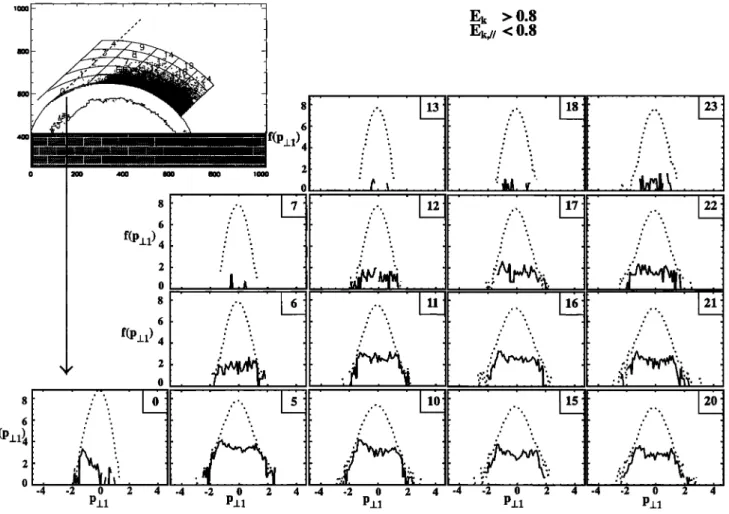
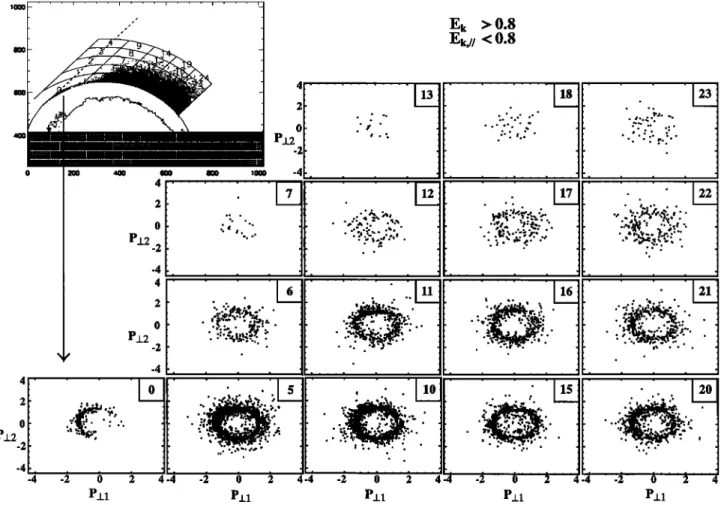
2 0 -4 -2 0 2 4 -4 -2 0 2 ,i -4 -2 0 2 4 -4 -2 0 2 4 -4 -2 0 2 4 P.t_l P_t_l P.t_l P.t_l P.t_lFigure 9a. Figure
similar
to Figure
6 for perpendicular
distributions
flow
(p•_•)
of backstreaming
electrons selected with low parallel kinetic energy only, where p•_• is the perpendicular momentum
component (direction defined in Figure lb).
boxes
extended
from upstream
(subscript
"u") to down-
stream (subscript "d") regions. Both downstream and upstream perpendicular distributions exhibit Gaussian shape with associated temperature T•_d (calculated forP2 population
only) and Tll,,
, respectively.
Results
show
that T•_•/Tll,• = 0.9, which contradicts
conservation
of the first adiabatic invariant (with a magnetic jump Bd/B,• = 2.7). Then, by default, present results donot support a leakage process from the magnetosheath as being dominant, since it does not account for the
perpendicular distribution of the high-energy P2 pop-
ulation; rather, this result supports that wave-particle
scattering (upstream turbulence) may contribute to this population.
A more rigorous approach is necessary, and all three
possibilities can be fully analyzed by following the time
histories of reflected electrons; this work is lefSt for a further study. At the present time, the respective con-
tribution of the two main dominant processes invoked
herein, namely, acceleration by macroscopic fields at the
shock front and wave-particle scattering by upstream
turbulence, is not yet determined.
4.2.2. Case
E•l
I < 0.8 (Figures
7b and 9). The
behavior of low parallel kinetic energy electrons is corn-
pletely different, which means that different reflection mechanisms must be invoked. This population forms
the main part of the fb population
(m 74%). In con-
trast with the previous
population
(Figure
7a), the spa-
tial distribution of these electrons is relatively muchmore homogeneous
(Figure 7b) throughout
the whole
electron foreshock region (although their density stillstrongly
increases,
as OBr•
decreases
from 900 to 65ø).
Characteristics of the corresponding parallel distribu-tion function
floW(Pll)
correspond
to those
of peak
P•
(Figure 6) discussed in section 4.1.
Complementary
information
is obtained
in studying
the perpendicular component of the distribution func-
tion fløW(p_c)
represented
in Figure
9a. The striking
feature is the evidence of a characteristic loss cone sig-
nature. It is important to remember that no selection
criteria has been used on the perpendicular
velocity
component; in other words, such a pattern is the con- sequence of a real process. This allows us to claim that
magnetic
reflection
process
is the main source
of the
energization for this population. As is well known and
described by the theory, magnetic reflection is respon- sible for loss-cone signature by selecting the most en-
![Figure 3. Local electron distribution measured by ISEE satellite when crossing the edge of the electron foreshock from [Fitzenreiter et al., 1990]](https://thumb-eu.123doks.com/thumbv2/123doknet/14796344.603980/7.943.194.751.95.925/electron-distribution-measured-satellite-crossing-electron-foreshock-fitzenreiter.webp)