HAL Id: hal-00301620
https://hal.archives-ouvertes.fr/hal-00301620
Submitted on 14 Jul 2005HAL is a multi-disciplinary open access
archive for the deposit and dissemination of sci-entific research documents, whether they are pub-lished or not. The documents may come from teaching and research institutions in France or abroad, or from public or private research centers.
L’archive ouverte pluridisciplinaire HAL, est destinée au dépôt et à la diffusion de documents scientifiques de niveau recherche, publiés ou non, émanant des établissements d’enseignement et de recherche français ou étrangers, des laboratoires publics ou privés.
CCN activation and cloud processing in simplified
sectional aerosol models with low size resolution
H. Korhonen, V.-M. Kerminen, K. E. J. Lehtinen, M. Kulmala
To cite this version:
H. Korhonen, V.-M. Kerminen, K. E. J. Lehtinen, M. Kulmala. CCN activation and cloud processing in simplified sectional aerosol models with low size resolution. Atmospheric Chemistry and Physics Discussions, European Geosciences Union, 2005, 5 (4), pp.4871-4892. �hal-00301620�
ACPD
5, 4871–4892, 2005 Clouds in low resolution models H. Korhonen et al. Title Page Abstract Introduction Conclusions References Tables Figures J I J I Back CloseFull Screen / Esc
Print Version Interactive Discussion
EGU
Atmos. Chem. Phys. Discuss., 5, 4871–4892, 2005 www.atmos-chem-phys.org/acpd/5/4871/
SRef-ID: 1680-7375/acpd/2005-5-4871 European Geosciences Union
Atmospheric Chemistry and Physics Discussions
CCN activation and cloud processing in
simplified sectional aerosol models with
low size resolution
H. Korhonen1, V.-M. Kerminen1, K. E. J. Lehtinen2, and M. Kulmala3
1
Climate and Global Change, Finnish Meteorological Institute, Sahaajankatu 20 E, FI-00880 Helsinki, Finland
2
University of Kuopio and Finnish Meteorological Institute, Department of Applied Physics, P.O. Box 1627, FI-70211 Kuopio, Finland
3
Department of Physical Sciences, University of Helsinki, P.O.Box 64, FI-00014 Helsinki, Finland
Received: 25 May 2005 – Accepted: 6 June 2005 – Published: 14 July 2005 Correspondence to: H. Korhonen ([email protected])
ACPD
5, 4871–4892, 2005 Clouds in low resolution models H. Korhonen et al. Title Page Abstract Introduction Conclusions References Tables Figures J I J I Back CloseFull Screen / Esc
Print Version Interactive Discussion
EGU Abstract
We investigate the influence of low size resolution, typical to sectional aerosol models in large scale applications, on cloud droplet activation and cloud processing of aerosol particles. A simplified cloud scheme with five approaches to determine the fraction of activated particles is compared with a detailed reference model under different
at-5
mospheric conditions. In general, activation approaches which assume a distribution profile within the critical model size sections predict the cloud droplet concentration most accurately under clean and moderately polluted conditions. In such cases, the deviation from the reference simulations is below 15% except for very low updraft ve-locities. In highly polluted cases, the concentration of cloud droplets is significantly
10
overestimated due to the inability of the simplified scheme to account for the kinetic limitations of the droplet growth. Of the profiles examined, taking into account the local shape of the particle size distribution is the most accurate although in most cases the shape of the profile has little relevance. While the low resolution cloud model cannot reproduce the details of the out-of-the-cloud aerosol size distribution, it captures well
15
the amount of sulphate produced in aqueous-phase reactions as well as the distribu-tion of the sulphate between the cloud droplets. Overall, the simplified cloud scheme with low size resolution performs well for clean and moderately polluted regions that cover most of the Earth’s surface and is therefore suitable for large scale models.
1. Introduction 20
Clouds affect the climate system of the Earth in many important ways. They are a major component in the hydrological cycle and therefore partly control the atmospheric concentration of the most important greenhouse gas, water (Ramanathan et al., 2001). In addition, clouds reduce the amount of sunlight that reaches the Earth’s surface, thus cooling the climate, while at the same time they absorb outgoing long-wave radiation
25
com-ACPD
5, 4871–4892, 2005 Clouds in low resolution models H. Korhonen et al. Title Page Abstract Introduction Conclusions References Tables Figures J I J I Back CloseFull Screen / Esc
Print Version Interactive Discussion
EGU
position of atmospheric aerosol particles e.g. through chemical reactions taking place in cloud water. Furthermore, precipitating clouds are an effective removal mechanism of atmospheric particles (Andronache, 2004).
Aerosol particles, in their part, act as cloud condensation nuclei (CCN) and can thus greatly influence the climatic properties of the clouds, such as albedo and
life-5
time. However, the global climate forcing resulting from aerosol-cloud interactions, also called the indirect aerosol effect, remains poorly quantified (Lohmann and Fe-ichter, 2005; Rotstayn and Liu, 2005; Sekiguchi et al., 2003). Some of the uncertainty surrounding the magnitude of the indirect effect rises from inadequate understanding of the complex relationship between aerosol and droplet concentrations. However,
10
also the great computational expense associated with detailed simulations of relevant phenomena prevents reliable assessments of the forcing with regional and global at-mospheric models.
Most large scale models cannot afford to solve the physical and chemical processes related to clouds from the first principles but have to resort to simplified
parameteri-15
zations. One example of such simplifications is that the models do not typically solve the profile of the cloud supersaturation, S, resulting from cooling of the rising air par-cel on one hand and from condensation loss of water onto activated droplets on the other, dynamically. Instead, it is customary to diagnose the number of activated parti-cles from the maximum supersaturation, Smax, reached during the cloud cycle, i.e. to
20
assume that all particles whose critical supersaturation, Scri t, is lower than Smax will activate. For this purpose, several parameterizations have been developed to link the aerosol distribution to the value of maximum supersaturation reached inside the cloud (e.g. Nenes and Seinfeld, 2003; Abdul-Razzak and Ghan, 2002; Abdul-Razzak et al, 2000).
25
Another important source of uncertainty in large scale simulations of aerosol-cloud interactions stems from the simplified representation of the aerosol size distribution. In sectional aerosol modules for 3D models, the number of particle size sections is typically limited to below or around 20 (Spracklen et al., 2005; Rodriguez and Dabdub,
ACPD
5, 4871–4892, 2005 Clouds in low resolution models H. Korhonen et al. Title Page Abstract Introduction Conclusions References Tables Figures J I J I Back CloseFull Screen / Esc
Print Version Interactive Discussion
EGU
2004; Zhang et al., 2004; Bessagnet et al., 2004). Such a poor size resolution can capture only the general features of the particle distribution, and for example the con-centration of cloud droplets or the mass and surface area of cloud processed aerosol can differ notably from a detailed solution (Zhang et al., 2002).
In this study, we will further investigate the effect that a low sectional size resolution
5
in models has on CCN activation and cloud processing of aerosol particles. In partic-ular, we introduce a simplified cloud scheme and compare five ways to determine the fraction of particles that activate to cloud droplets under different atmospheric condi-tions. These five activation schemes are evaluated against a detailed adiabatic cloud model based on their prediction of cloud droplet concentration and aerosol distribution
10
after one and several cloud cycles.
2. Model description
An existing sectional multicomponent aerosol model UHMA (Korhonen et al., 2004) was extended with a simplified cloud scheme. This scheme does not solve dynam-ically for the growth of the cloud droplets but instead it diagnoses the number and
15
size of activated droplets from three prescribed input parameters: maximum supersat-uration reached inside the cloud (Smax), time the air parcel spends inside the cloud (∆tcl oud) and the average liquid water content of the cloud (LWC). The three input pa-rameters were used to diagnose the cloud properties in the following way: The number of activated droplets was determined from Smax individually for each model size
sec-20
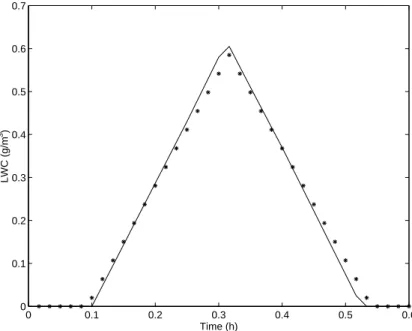
tion. Treating each section separately is necessary since the chemical composition of the particles can differ between the sections. Instead of assuming that the cloud liquid water content is a constant function of height, we assumed that the profile increases linearly from the bottom to the top of the cloud. The resulting profile, which can be calculated from the average LWC and the time inside the cloud,∆tcl oud, corresponds
25
to a good accuracy to cases when the updraft velocity is constant (Fig. 1). Further-more, several observations support our choice of a linear increase of cloud liquid water
ACPD
5, 4871–4892, 2005 Clouds in low resolution models H. Korhonen et al. Title Page Abstract Introduction Conclusions References Tables Figures J I J I Back CloseFull Screen / Esc
Print Version Interactive Discussion
EGU
content as a function of height (e.g. Brenguir et al., 2000). With a further assumption that all the activated particles grow to same droplet size, we can use the liquid water content profile to calculate the size of the cloud droplets as a function of height from the cloud base as well as the amount of sulphate produced in aqueous phase reactions during the cloud cycle.
5
The three prescribed parameters, namely Smax, LWC and∆tcl oud, were in this study taken from reference model simulations in order to facilitate the comparison between the simplified model and a reference dynamic cloud model. Any of the previously de-veloped parameterizations that for example calculate Smaxfrom the particle distribution and cloud updraft velocity (e.g. Nenes and Seinfeld, 2003; Abdul-Razzak and Ghan,
10
2002) could be easily incorporated into the simplified scheme.
Aerosol model UHMA offers several ways to describe the particle size distribution. The simulations presented here were conducted with three sectional descriptions: with fixed sections, with full-moving sections, and with moving-center approach (Jacobson, 1997). In all these descriptions the size sections are spaced according to particle dry
15
size, and thus particles do not move between sections due to water condensation. All the particles in a section are internally mixed and have the same size which is called the characteristic size of the section. For fixed and moving center descriptions, the lower and upper boundaries of the sections are fixed in location and spaced logarithmically around the initial characteristic size. For full-moving description the boundaries are
20
determined separately for each cloud cycle from spacing of the characteristic sizes at that moment.
In the standard simulations the model was run in dry particle diameter range 10 nm–1.5 µm with 10 size sections, a resolution that roughly corresponds to or exceeds that of most current global or regional scale models. With such sparse
25
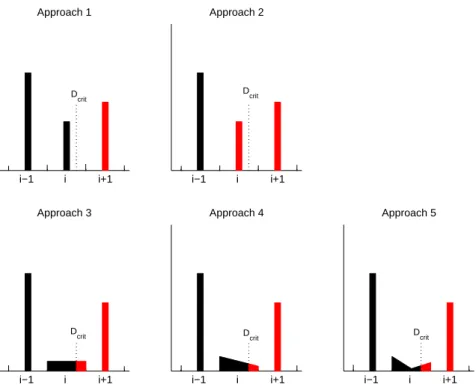
spacing, special attention must be paid to the critical section(s), i.e. size section(s) into which a minimum activation diameter falls. In this study, we tested five approaches to determine the fraction of particles activated in a critical section (Fig. 2):
ACPD
5, 4871–4892, 2005 Clouds in low resolution models H. Korhonen et al. Title Page Abstract Introduction Conclusions References Tables Figures J I J I Back CloseFull Screen / Esc
Print Version Interactive Discussion
EGU
1. all particles in section activate if Smax larger than Scri t of the characteristic size of the section
2. all particles in section activate if Smaxlarger than Scri tof the upper boundary size of the section
3. uniform distribution profile within section that conserves particle number; particles
5
whose Scri tsmaller than Smax activate
4. linear distribution profile within section that conserves particle number and vol-ume; particles whose Scri tsmaller than Smax activate
5. continuous profile that consists of two linear profiles whose slopes take into ac-count the particle concentration in neighbouring sections, and which conserves
10
particle number; particles whose Scri tsmaller than Smaxactivate.
As shown in Fig. 2, approaches 3, 4 and 5 typically activate only a part of the particles in a critical section. In such sections, the particles are split into activated and interstitial subgroups in a mass-conservative way and the two subgroups are treated separately for the duration of the cloud cycle.
15
The results from the simplified scheme were compared against a dynamic adiabatic cloud scheme which solves explicitly for the saturation and liquid water content profiles inside the cloud, as well as for the condensation of water onto the cloud droplets. This dynamic cloud scheme was adapted from Kerminen (2001) and run interactively with the same aerosol dynamics as the simplified scheme.
20
3. Simulation design
We evaluated the five activation approaches in the simplified cloud scheme against the dynamic reference model with 500 size sections. The three prescribed cloud properties needed for the simplified scheme, namely Smax,∆tcl oud and LWC, were taken from the
ACPD
5, 4871–4892, 2005 Clouds in low resolution models H. Korhonen et al. Title Page Abstract Introduction Conclusions References Tables Figures J I J I Back CloseFull Screen / Esc
Print Version Interactive Discussion
EGU
reference simulations for each cloud cycle. Although in the simulations presented in this study we run the models only for condensation, activation of CCNs and aqueous-phase sulphate formation, the scheme can be easily extended to other relevant aerosol processes.
Ideally, the simplified scheme should reproduce the reference results in three
re-5
spects: Firstly, the number of activated particles should be resolved accurately. Sec-ondly, the formation and distribution of sulphate in aqueous phase reactions should be described correctly. Thirdly, the simplified scheme with low resolution in size dis-tribution description should reproduce the particle disdis-tribution after several successive cloud cycles with different saturation conditions.
10
We performed simulations of single and several successive cloud cycles with typical marine, rural, and urban aerosol distributions taken from Jaenicke (1993) and pre-sented in Table 1. For simplicity, the particles were initially assumed to consist of ammonium sulphate and slightly water-soluble organics in a ratio of 1:1. During the simulations the particle composition changed due to condensation of sulphuric acid
15
and due to aqueous-phase oxidation of SO2 with H2O2. Only this oxidation reaction was considered as it is clearly the dominant one in acidic cloud droplets which would form from the assumed dry aerosol. Although our description of aerosol distribution and interaction with the gas phase is highly idealized, using different initial composition or more detailed condensation and sulphate formation mechanisms would not change
20
the main conclusions of the study.
In all the simulations presented below, the initial concentration of H2O2 was set to 500 ppt. On the other hand, the initial concentration of SO2 was adjusted to a typical pollution level of the simulated environment, i.e. 70 ppt for marine conditions, 500 ppt for rural conditions, and 2500 ppt for urban conditions. The concentration of OH, which
25
was responsible for gas-phase oxidation of SO2to sulphuric acid, followed a semisinu-soidal pattern starting at 2·106cm−3and peaking at 5·106cm−3after 9 h. The maximum height that the ascending air parcel reached and the updraft velocity were varied be-tween the cloud cycles.
ACPD
5, 4871–4892, 2005 Clouds in low resolution models H. Korhonen et al. Title Page Abstract Introduction Conclusions References Tables Figures J I J I Back CloseFull Screen / Esc
Print Version Interactive Discussion
EGU 4. Results and discussion
4.1. Single cloud cycle
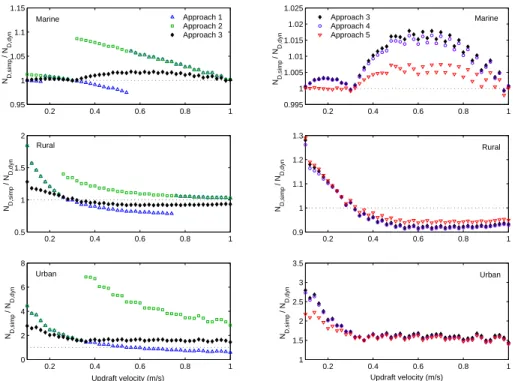
Figure 3 compares the predictions of the five activation approaches in terms of cloud droplet concentration for a single cloud cycle. The results have been normalized by the droplet concentration obtained from the dynamic reference model. The results
5
presented are for moving center description of the particle size distribution but the other two descriptions tested, i.e. fixed and full-moving sections, give essentially the same results.
Firstly, it is evident that the performance of the simplest approaches which assume that either all or none of the particles in each section activate, i.e. approaches 1 and
10
2, varies greatly over the simulated updraft range (Fig. 3, left panel). These two ap-proaches predict exactly the same droplet concentration at times when the maximum supersaturation reached in the cloud falls in the critical section between the critical supersaturation of the lower boundary size and that of the characteristic particle size. For a large majority of the simulated cloud cycles, however, approach 2 generates
15
the greatest deviation from the reference results. This is because it activates all the particles in a section as soon as Smax exceeds the critical supersaturation of the up-per boundary size. In practice this means that approach 2 never underestimates the number of cloud droplets.
On the other hand, the results for approaches 3, 4 and 5 – all of which assume a
20
continuous distribution profile within the critical size section – are very similar (Fig. 3, right panel). Only approach 5, which calculates the profile by taking into account the particle concentration in neighbouring sections, systematically predicts slightly more accurate results than its counterparts. However, even these three approaches perform poorly in some simulations, most notably under urban conditions and with low updraft
25
velocities. Under these conditions, kinetic limitations of droplet formation are often sig-nificant, as discussed in detail by Nenes et al. (2001) and Kulmala et al. (1993). For some particles, situations may arise when the particles activate at first as the
satura-ACPD
5, 4871–4892, 2005 Clouds in low resolution models H. Korhonen et al. Title Page Abstract Introduction Conclusions References Tables Figures J I J I Back CloseFull Screen / Esc
Print Version Interactive Discussion
EGU
tion of water in the air parcel rises above their critical supersaturation. If condensation onto the forming cloud droplets becomes very fast, however, the supersaturation of the parcel may drop below the equilibrium saturation level of these particles and they deactivate to become interstitial particles. This effect cannot be described in simplified cloud schemes, such as ours, which assume instantaneous response of particles to
su-5
persaturation changes and calculate the number of activated droplets directly from the maximum saturation reached during the cloud cycle. Therefore, simplified schemes re-gardless of their activation approach tend to overestimate the number of cloud droplets under conditions when the supersaturation increases slowly compared to the loss of water by condensation.
10
4.2. Several successive cloud cycles
A second set of simulations compared the activation approaches in terms of cloud droplet concentration, out-of-cloud size distribution and production of aqueous-phase sulphate over five successive cloud cycles. The boundary layer depth and updraft velocity were varied between the five cloud cycles and set to 1000, 1200, 1200, 1500
15
and 1000 m, and to 0.2, 0.5, 0.8, 1.0 and 0.4 m/s, respectively. The changing conditions reflect qualitatively the cycling of the aerosol particles in real cloudy atmosphere in which particles experience variant updraft and cloud thickness. Moreover, the variation between the cloud cycles puts the cloud activation and cloud processing schemes to a more stringent test than several cloud cycles with same maximum supersaturations
20
would. Again, the three prescribed cloud properties for the simplified model were taken from the reference simulations. The results presented below are for moving center description of the size distribution unless stated otherwise.
Table 2 summarizes the results from the simplified model regarding the predicted concentration of cloud droplets. The values given are percent differences from the
25
reference model results. In general, this set of simulations confirms the conclusions presented for a single cloud cycle: The number of activated particles is most accurately reproduced by assuming a particle profile inside the size sections, approach 5 yielding
ACPD
5, 4871–4892, 2005 Clouds in low resolution models H. Korhonen et al. Title Page Abstract Introduction Conclusions References Tables Figures J I J I Back CloseFull Screen / Esc
Print Version Interactive Discussion
EGU
slightly better results than the two other profiles. Overall, the deviation of these three approaches from reference model under rural and marine conditions is always less than 13%, which can be considered very satisfactory for a simplified low-resolution model. For urban conditions the ostensibly good results of approach 1 during some of the cloud cycles stem from the overall poor performance of the simplified cloud scheme.
5
As explained above, the neglect of kinetic limitations leads the simplified scheme to overestimate the number of cloud droplets. At the same time, approach 1 tends to underestimate the droplet concentration because it assumes that no activation occurs in a section unless Smaxis larger than Scri t for the characteristic size of that section.
The results presented in Table 2 were obtained with the moving center description.
10
Although not shown here, the other two ways to describe the particle size distribution in the model, namely fixed and full-moving sectional methods, yield very similar results. For a combined data set of the most accurate activation approaches 3, 4 and 5, and of all the three environmental conditions, the median (mean) deviation from the reference results for fixed, full-moving, and moving center approaches are 6.1% (24.0%), 6.3%
15
(24.4%), and 7.4% (20.9%), respectively. The strength of the last two size distribution description becomes, however, evident when we double the number of size sections to 20. Then the cloud droplet numbers from full-moving description agree best with the reference results, the median deviation being 0.8% in comparison with 3.6% for fixed description and 1.7% for moving center description. In aerosol dynamic models,
20
however, the fixed and moving center methods are often preferable over the full-moving one because of their more advantageous description of particle transport, emissions and nucleation. It is also worth note that although doubling the particle size resolution improved the results significantly under marine and rural cases, the deviation from the reference simulations in fact slightly increased under urban conditions for which the
25
kinetic limitations of droplet growth are important.
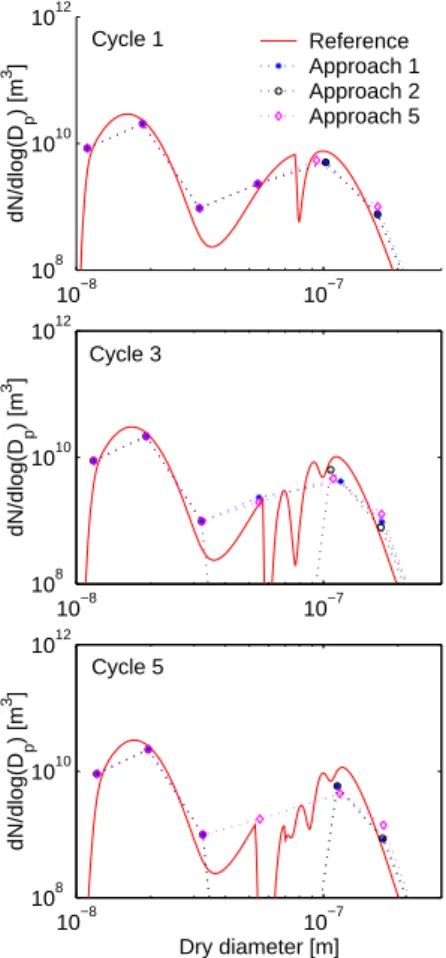
Figure 4 illustrates that the simplified scheme reproduces the general features of the cloud processed aerosol size distribution fairly well but cannot capture the details of the distribution due to the low resolution, as reported earlier by Zhang et al. (2002).
ACPD
5, 4871–4892, 2005 Clouds in low resolution models H. Korhonen et al. Title Page Abstract Introduction Conclusions References Tables Figures J I J I Back CloseFull Screen / Esc
Print Version Interactive Discussion
EGU
For example, the approaches which assume a distribution profile within the critical diameter (here represented by approach 5) do not show Hoppel minimum at all since they activate only some of the particles in the critical sections. At the same time the simpler approaches 1 and 2 predict a much too wide minimum after several cloud cycles.
5
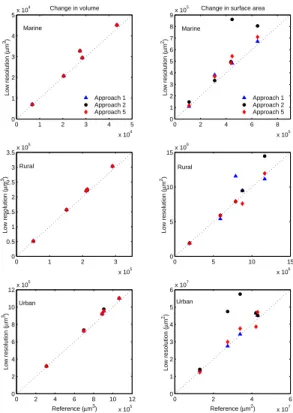
On the other hand, all the activation approaches predict the amount of sulphate formed in the cloud droplets, i.e. the total dry mass change during each cloud cycle, very well (Fig. 5). This is not surprising since the oxidation rate of SO2 is highly de-pendent on the liquid water content of the cloud whose average values is a prescribe parameter in our simplified scheme and whose profile is well captured for constant
up-10
draft velocities. On the other hand, distribution of the formed sulphate onto the droplets, represented in Fig. 5 through the change in total dry surface area during each cloud cy-cle, shows some variation between the activation approaches. Especially approach 2, which often overestimates the number of activated particles (Fig. 3), tends to overes-timate the formed surface area. Approaches 1 and 5 both reproduce the results from
15
the reference simulation relatively well. On average, however, approach 1 performs slightly more accurately in this respect under the simulated conditions.
The results shown in Figs. 4 and 5 are for moving center description. The other two descriptions predict nearly identical dry mass increase with the moving center method (no figure). The fixed description, however, clearly overestimates the dry
sur-20
face area increase during the cloud cycles. This is due to numerical diffusion which originates from splitting the droplet core material between fixed size sections when sulphate formed in the cloud is added to the droplets (Korhonen et al., 2003).
Regarding the mass of sulphate produced in the cloud, it is important to note that the good agreement with the reference model can be partly due to the assumption made
25
about the aerosol dry composition. In real atmosphere, the composition of the effective CCN often is a function of size (Moore et al., 2004). In the simulations presented above, the dry particles consisted only of ammonium sulphate and slightly soluble organic matter. The cloud droplets forming on such particles are acidic and thus the
ACPD
5, 4871–4892, 2005 Clouds in low resolution models H. Korhonen et al. Title Page Abstract Introduction Conclusions References Tables Figures J I J I Back CloseFull Screen / Esc
Print Version Interactive Discussion
EGU
dominant oxidation path of SO2in the droplets is with H2O2, a reaction that is only very weakly dependent on the pH of individual cloud droplets. In less acidic clouds, however, oxidation reactions that depend strongly on the pH, such as the reaction of SO2with O3, become important. It is then advantageous to use size-resolving cloud models which calculate the size and pH distribution of cloud droplets dynamically taking into account
5
the dilution factors and initial dry composition of different sized particles (Kreidenweis et al., 2003; Gurciullo and Pandis, 1997). As our simplified cloud scheme carries separately the dry and wet size of droplets, it could in principal be used to calculate their pH differences to a fair accuracy. In cases when the cloud droplet distribution would not in reality be close to monodisperse, the simplified scheme can, however,
10
lead to deviations from accurate solution.
5. Conclusions
We have evaluated the impact that a low size resolution in sectional aerosol models and a simplified cloud scheme have on simulated cloud droplet number and cloud processing of aerosol particles. The scheme used diagnoses the properties of the
15
cloud from only three input parameters: maximum supersaturation reached inside the cloud, time the air parcel spends in the cloud and average cloud liquid water content. Five approaches to determine the activated fraction of CCN were incorporated into this simplified scheme and compared in their ability to predict the concentration of droplets, sulphate formed in aqueous phase reactions and out-of-cloud dry particle
20
size distribution over one or more cloud cycles.
Overall, the simplified low resolution model agreed fairly well with the reference model under marine and rural conditions. In polluted urban case, the simplified scheme, which cannot resolve the kinetic effects of cloud droplet growth, was not able to predict the cloud droplet number accurately. For marine and rural conditions, the
25
assumption of a distribution profile inside the critical size section(s) clearly improved the prediction of the cloud droplet concentration. In most cases simulated here,
how-ACPD
5, 4871–4892, 2005 Clouds in low resolution models H. Korhonen et al. Title Page Abstract Introduction Conclusions References Tables Figures J I J I Back CloseFull Screen / Esc
Print Version Interactive Discussion
EGU
ever, the shape of the profile was almost irrelevant as a flat profile (approach 3), a tilted linear profile (approach 4) and a profile which in a crude way takes into account the local shape of the particle distribution (approach 5) produced nearly identical results. Approach 5 still performed slightly better than its counterparts, and would be advan-tageous especially in situations when the aerosol size distribution shows steep local
5
slopes in particle concentration in the CCN size range. Although the low resolution scheme cannot reproduce the small details of the cloud processed particle size distri-bution, it predicted the changes of total dry mass and surface area during the cloud cycles to a good accuracy. Only one of the activation approaches (approach 2) was clearly inferior to the others in this respect.
10
The simulations show that a simplified cloud scheme with a size resolution typical to large scale models can describe the CCN activation and cloud processing of aerosol particles fairly accurately. Only under conditions for which the kinetic limitations of the droplet growth are significant, i.e. essentially urban and other highly polluted environ-ments, the simplified scheme clearly overestimates the concentration of forming cloud
15
droplets. Since the vast majority of the Earth’s surface is covered by marine, remote or rural environment, for which the tested scheme agrees well with reference simula-tions, a simplified low-resolution cloud model is well suited for large scale modelling purposes.
Acknowledgements. This work has been supported by Academy of Finland (projects 205798
20
and 208208).
References
Abdul-Razzak, H. and Ghan, S. J.: A parameterization of aerosol activation, 1. Single aerosol type, J. Geophys. Res., 103, 6123–6131, 1998.
Abdul-Razzak, H. and Ghan, S. J.: A parameterization of aerosol activation, 3. Sectional
rep-25
ACPD
5, 4871–4892, 2005 Clouds in low resolution models H. Korhonen et al. Title Page Abstract Introduction Conclusions References Tables Figures J I J I Back CloseFull Screen / Esc
Print Version Interactive Discussion
EGU
Andronache, C.: Precipitation removal of ultrafine aerosol particles from the atmospheric boundary layer, J. Geophys. Res., 109, D16S07, doi:10.1029/2003JD004050, 2004.
Bessagnet, B., Hodzic, A., Vautard, R., Beekman, M., Cheinet, S., Honor ´e, C., Liousse, C., and Rouil, L.: Aerosol modeling with CHIMERE – preliminary evaluation at the continental scale, Atmos. Environ., 38, 2803–2817, 2004.
5
Brenguier, J.-L., Pawlowska, H., Schuller, L., Preusker, R., Fischer, J., and Fouquart, Y.:
Ra-diative properties of boundary layer clouds: droplet effective radius versus number
concen-tration, J. Atmos. Sci., 57, 803–821, 2000.
Gurciullo, C. S. and Pandis, S. N.: Effect of composition variations in cloud droplet populations
on aqueous-phase chemistry, J. Geophys. Res., 102, 9375–9385, 1997.
10
Jacobson, M. Z.: Development and application of a new air pollution modeling system – II. Aerosol module structure and design, Atmos. Environ., 31, 131–144, 1997.
Jaenicke, R.: Tropospheric aerosols, in: Aerosol-cloud-climate interactions, edited by: Hobbs, P. V., Academic Press, San Diego, 1–31, 1993.
Kerminen, V.-M.: Relative roles of secondary sulfate and organics in atmospheric cloud
con-15
densation nuclei production, J. Geophys. Res., 106 (D15), 17 321–17 333, 2001.
Korhonen, H., Lehtinen, K. E. J., Pirjola, L., Napari, I., Vehkam ¨aki, H., Noppel, M., and Kulmala, M.: Simulation of atmospheric nucleation mode: A comparison of nucleation models and size distribution descriptions, J. Geophys. Res., 108 (D15), 4471, doi:10.1029/2002JD003305, 2003.
20
Korhonen, H., Lehtinen, K. E. J., and Kulmala, M.: Aerosol dynamic model UHMA: Model development and validation, Atmos. Chem. Phys., 4, 757–771, 2004,
SRef-ID: 1680-7324/acp/2004-4-757.
Kreidenweis, S. M., Walcek, C. J., Feingold, G., Gong, W., Jacobson, M. Z., Kim, C.-H., Liu, X., Penner, J. E., Nenes, A., and Seinfeld, J. H.: Modification of aerosol mass and size
25
distribution due to aqueous-phase SO2oxidation in clouds: Comparisons of several models,
J. Geophys. Res., 107(D7), 4213, doi:10.1029/2002JD002697, 2003.
Kulmala, M., Laaksonen, A., Korhonen, P., Vesala, T., and Ahonen, T.: The effect of atmo-spheric nitric acid vapor on cloud condensation nucleus activation, J. Geophys. Res., 98, 22 949–22 958, 1993.
30
Lohmann, U. and Feichter, J.: Global indirect aerosol effects: a review, Atmos. Chem. Phys., 5, 715–737, 2005,
ACPD
5, 4871–4892, 2005 Clouds in low resolution models H. Korhonen et al. Title Page Abstract Introduction Conclusions References Tables Figures J I J I Back CloseFull Screen / Esc
Print Version Interactive Discussion
EGU
Moore, K. F., Sherman, D. E., Reilly, J. E., and Collett Jr., J. L. : Drop size-dependent chem-ical composition in clouds and fogs, Part I, Observations, Atmos. Environ., 38, 1389–1402, 2004.
Nenes, A. and Seinfeld, J. H.: Parameterization of cloud droplet formation in global climate models, J. Geophys. Res., 108 (D14), 4415, doi:10.1029/2002JD002911, 2003.
5
Nenes, A., Ghan, S., Abdul-Razzak, H., Chuang, P. Y., and Seinfeld, J. H.: Kinetic limitations on cloud droplet formation and impact on cloud albedo, Tellus, 53B, 113–149, 2001.
Ramanathan, V., Crutzen, P. J., Kiehl, J. T., and Rosenfeld, D.: Aerosols, climate and the hydrological cycle, Science, 294, 2119–2124, 2001.
Rodriguez, M. A. and Dabdub, D.: IMAGES-SCAPE2: A modelling study of size- and chemically
10
resolved aerosol thermodynamics in a global chemical transport model, J. Geophys. Res., 109, D02203, doi:10.1029/2003JD003639, 2004.
Rotstayn, L. D. and Liu, Y.: A smaller estimate of the second indirect aerosol effect, Geophys. Res. Lett., 32, L05708, doi:10.1029/2004GL021922, 2005.
Sekiguchi, M., Nakajima, T., Suzuki, K., Kawamoto, K., Higurashi, A., Rosenfeld, D., Sano,
15
I., and Mukai, S.: A study of the direct and indirect effects of aerosols using global satellite data sets of aerosol and cloud parameters, J. Geophys. Res., 108 (D22), 4699, doi:10.1029/2002JD003359, 2003.
Spracklen, D. V., Pringle, K. J., Carslaw, K. S., Chipperfield, M. P., and Mann, G. W.: A global
off-line model of size-resolved aerosol microphysics: I. Model development and prediction of
20
aerosol properties, Atmos. Chem. Phys. Discuss., 5, 179–215, 2005,
SRef-ID: 1680-7375/acpd/2005-5-179.
Zhang, Y., Easter, R. C., Ghan, S. H., and Abdul-Razzak, H.: Impact of aerosol size distribution on modelling aerosol-cloud interactions, J. Geophys. Res., 107 (D21), 4558, doi:10.1029/2001JD001549, 2002.
25
Zhang, Y., Pun, B., Vijayaraghavan, K., Wu, S.-Y., Seigneur, C., Pandis, S. N., Jacobson, M. Z., Nenes, A., and Seinfeld, J. H.: Development and application of the Model of Aerosol Dynamics, Reaction, Ionization, and Dissolution (MADRID), J. Geophys. Res., 109, D01202, doi:10.1029/2003JD003501, 2004.
ACPD
5, 4871–4892, 2005 Clouds in low resolution models H. Korhonen et al. Title Page Abstract Introduction Conclusions References Tables Figures J I J I Back CloseFull Screen / Esc
Print Version Interactive Discussion
EGU
Table 1. Initial particle size distributions used in the simulations. Values have been taken from
Jaenicke (1993).
Marine Rural Urban
D (µm) N (cm−3) log σ D (µm) N (cm−3) log σ D (µm) N (cm−3) log σ
Mode I 0.008 133 0.657 0.015 6650 0.225 0.013 9.93E+04 0.245
Mode II 0.266 66.6 0.210 0.054 147 0.557 0.014 1.11E+04 0.666
ACPD
5, 4871–4892, 2005 Clouds in low resolution models H. Korhonen et al. Title Page Abstract Introduction Conclusions References Tables Figures J I J I Back CloseFull Screen / Esc
Print Version Interactive Discussion
EGU
Table 2. Percentual error in cloud droplet concentrations from the reference model values
in a simulation of five successive cloud cycles. Results for the simplified scheme have been obtained with 10 size sections in size range 10 nm–1.5 µm and with moving center description.
Approach 1 2 3 4 5 cycle 1 0.8 0.8 0.4 0.4 <0.1 cycle 2 –2.4 6.2 1.3 1.3 0.2 Marine cycle 3 1.1 1.1 0.4 0.4 –0.6 cycle 4 –2.1 26.5 3.6 3.8 2.4 cycle 5 –2.1 26.5 3.6 3.8 2.4 cycle 1 18.4 18.4 8.3 7.7 8.8 cycle 2 –14.5 15.5 –7.4 –7.5 –5.7 Rural cycle 3 –20.6 7.2 –6.5 –6.7 –4.3 cycle 4 4.0 4.0 –4.3 –4.4 –2.4 cycle 5 5.8 5.8 –12.6 –12.7 –10.4 cycle 1 151.9 151.9 107.2 104.7 83.7 cycle 2 48.1 48.1 48.1 48.1 48.1 Urban cycle 3 13.6 441.4 43.0 42.1 40.8 cycle 4 1.2 382.1 57.3 55.8 53.9 cycle 5 45.9 45.9 25.9 39.5 10.5
ACPD
5, 4871–4892, 2005 Clouds in low resolution models H. Korhonen et al. Title Page Abstract Introduction Conclusions References Tables Figures J I J I Back CloseFull Screen / Esc
Print Version Interactive Discussion EGU 0 0.1 0.2 0.3 0.4 0.5 0.6 0 0.1 0.2 0.3 0.4 0.5 0.6 0.7 Time (h) LWC (g/m 3 )
Fig. 1. Liquid water content profile inside the cloud as predicted by the approximate scheme
(stars) and by dynamic adiabatic cloud model for constant updraft velocity and downdraft with the same speed (solid line).
ACPD
5, 4871–4892, 2005 Clouds in low resolution models H. Korhonen et al. Title Page Abstract Introduction Conclusions References Tables Figures J I J I Back CloseFull Screen / Esc
Print Version Interactive Discussion EGU i−1 i i+1 Approach 1 i−1 i i+1 Approach 2 i−1 i i+1 Approach 3 i−1 i i+1 Approach 4 i−1 i i+1 Approach 5 D crit D crit D
crit Dcrit Dcrit
Fig. 2. Schematic figure of CCN activation approaches used. For each approach, the sections
and fractions of sections in red are activated while the sections and fractions of sections in black remain as interstitial. The dotted vertical line corresponds to the critical activation diameter. For approaches 3, 4 and 5, the slopes and the height of the particle distribution profile in the critical section are exaggerated.
ACPD
5, 4871–4892, 2005 Clouds in low resolution models H. Korhonen et al. Title Page Abstract Introduction Conclusions References Tables Figures J I J I Back CloseFull Screen / Esc
Print Version Interactive Discussion EGU 0.2 0.4 0.6 0.8 1 0.5 1 1.5 2 ND,simp / N D,dyn Rural 0.2 0.4 0.6 0.8 1 0.9 1 1.1 1.2 1.3 ND,simp / N D,dyn Rural 0.2 0.4 0.6 0.8 1 0 2 4 6 8 ND,simp / N D,dyn Updraft velocity (m/s) Urban 0.2 0.4 0.6 0.8 1 1 1.5 2 2.5 3 3.5 ND,simp / N D,dyn Urban Updraft velocity (m/s) 0.2 0.4 0.6 0.8 1 0.95 1 1.05 1.1 1.15 ND,simp / N D,dyn Marine Approach 1 Approach 2 Approach 3 0.2 0.4 0.6 0.8 1 0.995 1 1.005 1.01 1.015 1.02 1.025 ND,simp / N D,dyn Marine Approach 3 Approach 4 Approach 5
Fig. 3. Predictions of cloud droplet concentrations from 5 activation schemes normalized with
results from dynamic adiabatic cloud model. All simulations with the simplified scheme have been made independently of each other with 10 size sections in size range 10 nm–1.5 µm and with moving center description. Note that the scale of the y-axis is different in each subplot.
ACPD
5, 4871–4892, 2005 Clouds in low resolution models H. Korhonen et al. Title Page Abstract Introduction Conclusions References Tables Figures J I J I Back CloseFull Screen / Esc
Print Version Interactive Discussion EGU 10−8 10−7 108 1010 1012 dN/dlog(D p ) [m 3] Cycle 1 Reference Approach 1 Approach 2 Approach 5 10−8 10−7 108 1010 1012 dN/dlog(D p ) [m 3] Cycle 3 10−8 10−7 108 1010 1012 Dry diameter [m] dN/dlog(D p ) [m 3] Cycle 5
Fig. 4. Dry aerosol size distribution under rural conditions after 1, 3 and 5 cloud cycles.
Acti-vation approaches 3, 4 and 5 give almost identical results and thus only results for approach 5 are shown. All simulations with the simplified scheme have been made with 10 size sections in size range 10 nm–1.5 µm and with moving center description.
ACPD
5, 4871–4892, 2005 Clouds in low resolution models H. Korhonen et al. Title Page Abstract Introduction Conclusions References Tables Figures J I J I Back CloseFull Screen / Esc
Print Version Interactive Discussion EGU 0 1 2 3 4 5 x 10⁴ 0 1 2 3 4 5x 10 4 Low resolution ( µ m 3) Change in volume Approach 1 Approach 2 Approach 5 0 2 4 6 8 x 10⁵ 0 1 2 3 4 5 6 7 8 9x 10 5 Low resolution ( µ m 2)
Change in surface area
Approach 1 Approach 2 Approach 5 0 1 2 3 x 10⁵ 0 0.5 1 1.5 2 2.5 3 3.5x 10 5 Low resolution ( µ m 3) Rural 0 5 10 15 x 106 0 5 10 15x 10 6 Low resolution ( µ m 2) Rural 0 2 4 6 8 10 12 x 105 0 2 4 6 8 10 12x 10 5 Low resolution ( µ m 3) Urban Reference (µm3) 0 2 4 6 x 10⁷ 0 1 2 3 4 5 6x 10 7 Low resolution ( µ m 2) Urban Reference (µm2) Marine Marine
Fig. 5. Change of total dry mass and total dry surface area during individual cloud cycles.
Activation approaches 3, 4 and 5 give almost identical results and thus only results for approach 5 are shown. All simulations with the simplified scheme have been made with 10 size sections in size range 10 nm–1.5 µm and with moving center description.