HAL Id: hal-01083331
https://hal.inria.fr/hal-01083331
Submitted on 18 Nov 2014
HAL is a multi-disciplinary open access
archive for the deposit and dissemination of
sci-entific research documents, whether they are
pub-lished or not. The documents may come from
teaching and research institutions in France or
abroad, or from public or private research centers.
L’archive ouverte pluridisciplinaire HAL, est
destinée au dépôt et à la diffusion de documents
scientifiques de niveau recherche, publiés ou non,
émanant des établissements d’enseignement et de
recherche français ou étrangers, des laboratoires
publics ou privés.
Semantic Mashup with the Online IDE WikiNEXT
Pavel Arapov, Michel Buffa, Amel Ben Othmane
To cite this version:
Pavel Arapov, Michel Buffa, Amel Ben Othmane. Semantic Mashup with the Online IDE WikiNEXT.
2014, pp.4. �10.1145/2567948.2577010�. �hal-01083331�
Semantic Mashup with the Online IDE WikiNEXT
Pavel Arapov, Michel Buffa, Amel Ben Othmane
Wimmics research group
INRIA and I3S Laboratories
Sophia Antipolis, France
[email protected], [email protected], [email protected]
ABSTRACT
The proposed demonstration requests DBPedia.org, gets the results and uses them to populate wiki pages with semantic annotations using RDFaLite. These annotations are persisted in a RDF store and we will show how this data can be reused by other applications, e.g. for a semantic mashup that displays all collected metadata about cities on a single map page. It has been developed using WikiNEXT, a mix between a semantic wiki and a web-based IDE. The tool is online1, open source2; screencasts
are available on YouTube (look for “WikiNext”).
Categories and Subject Descriptors
K.4.3 [Organizational Impacts]: Computer-supported collaborative work.
Keywords
Semantic Web, Web2.0, Wikis, Semantic Wikis, Knowledge Management, Web Applications
1. Introduction / motivation
Wikis appeared in 1995 with Ward Cunningham’s wiki, changing radically the way people could produce documents on the web. It was the beginning of the web 2.0. Soon many different wiki engines (this is how we call the software that powers wiki web sites) appeared, specialized for writing online encyclopedias (MediaWiki, that powers Wikipedia), or targeted to private organizations [5]. We call these ones “application wikis”, they propose features, such as: database integration, access control, versioning, possibility to embed HTML forms in pages, templates for formatting documents, and the possibility to write small applications using the page editor. Wiki engines such as TWiki, FOSWiki, TikiWiki, Confluence, XWiki, Mindtouch, belong to that category of wikis. In 2005, researchers from the Semantic Web domain introduced the “semantic wikis”: wikis for creating/maintaining ontologies (data models) collaboratively and/or for annotating wiki content with semantic metadata, and enable requesting/reasoning on the embedded data. Overviews of such wikis can be found in [5]. Our group has a strong experience in that field as we developed two semantic wikis over the last seven years. We also wrote for the W3C3 an HTML5 course4 that includes lots examples that
involve HTML/JavaScript/CSS. This course is powered by the
1http://wikinext.gexsoft.com
2https://github.com/pavel-arapov/wikinext
3See http://www.w3devcampus.com
4http://w3devcampus.com
Copyright is held by the International World Wide Web Conference Committee (IW3C2). IW3C2 reserves the right to provide a hyperlink to the author's site if the Material is used in electronic media.
WWW’14 Companion, April 7–11, 2014, Seoul, Korea.
ACM 978-1-4503-2745-9/14/04. http://dx.doi.org/10.1145/2567948.2577010
moodle5 e-learning platform; a CMS specialized for managing
online courses of any kind. Integrating interactive programming examples in moodle turned to be so painful and limited (using, iframes) that we hosted externally the examples on jsbin.com, a popular web-based IDE. Our research group also developed the French version of DBPedia.org6, a semantic database that holds
the data from Wikipedia and accepts SPARQL7. This project
needed a front end for developing examples programs that consume and exploit its data. Here, too, we imagined a wiki engine that could act as a front-end: one could write applications from within the wiki, which can talk to DBPedia.fr, could write tutorials made both of text and application code that can be modified collaboratively. These ideas led to WikiNext, a wiki engine that integrates HTML5/JavaScript, proposes some APIs for exploiting the web of data (request and process data from different sources, cache them, aggregate them, write code that manipulate them for visualization, mashups, annotating text content, etc.). WikiNEXT mixes the editing of “documents” and the editing of “source code of applications within the documents”, provides a templating system, comes with examples, tutorials, has features for adding external JavaScript libraries, etc.
2. State of the art
Semantic Wikis: The first wave of semantic wikis started in 2005, with wiki engines such as Semantic Media Wiki [1], IkeWiki [2] OntoWiki [4] or SweetWiki [3]. They all proposed to add semantic metadata to documents, and used internally some formal language to store them, such as RDF (Resource Description Framework), OWL (Web Ontology Language), or Conceptual Graphs [7]. These metadata can be exploited to add new functionalities to the wiki: augmented navigation, visualization of metadata, search and retrieval or reasoning. The SPARQL language8 is often used internally for querying RDF
data. Wiki engines like Semantic MediaWiki based on the MediaWiki engine, or SemperWiki[8] used wiki markup syntax for adding semantic annotations to wiki pages. OntoWiki is more of an ontology editor, and proposes user-friendly interface that offers different views and browsing and editing interfaces over existing data.
Today, semantic wikis, which are still active [15] either (1) kept adding new functionalities using plugins or extensions or (2) relied on external tools or web services. The Halo9 extension of
Semantic Media Wiki proposes forms, auto-completion, a WYSIWYG editor, the integration of audios and videos files, and the integration of a SPARQL endpoint, or more complex
5 https://moodle.org/
6 http://DBPedia.fr
7 http://www.w3.org/TR/rdf-sparql-query/, the W3C standard for
querying the web of data.
8http://www.w3.org/TR/sparql11-query/
e a a T Ik S p W C a m js ti in h s c th th f a c
3
A to w p th w w c th te a p to la s T e D e to in in3
T e w p w is W th C h 10 1 12 extensions such and OWiki [12] also based on Sem The KiWi projekeWiki, or Sw SweetWiki[3], a project [11], bel Web-Based IDE Code Mirror10, A as syntax highlig many online ID sbin.com, jsfidd ime editing of nstant preview w however, are san small examples course we wrote
he last generatio he browser, etc. for exploiting Lin an RDF data sto code editors pres
3. WikiNEX
Application wiki o mix them all w web application, provided several he JavaScript so with the wiki en wiki page as dat code) can collec hem for annotat ext for suggestin a cache, etc. W process of writin o use any extra ayer that enable standards, an AP The online proto e.g. for writing DBPedia.org, fo enhancing wiki d
ool for teaching nstall any softw ntegrating them
3.1 Archite
The WikiNEXT events and meth within the wiki. I page will be the will be done in t s composed of R WikiNEXT artic hat describe the Contributor, Dat hold metadata cr 0http://codemirror 1http://ace.c9.io/ 2http://ternjs.net/ as MoKi [13] (f (ontology-drive mantic Media W ect (Knowledge weetDeki [11] and has been i
ong to the secon Es: JavaScript b ACE Cloud911 o ghting, auto-com DEs, well known
dle.net or tinkerb HTML/CSS/Ja when files are u ndboxes for tes like the ones w e. WikiNext shar
on of these tool ) and mixes them nked Data and a ore and a NOSQ sent in the WikiN
XT
is, semantic wiki with WikiNEXT composed of H editors in the b ource code, and ngine internals”.
ta: the applicati ct semantic data ting the docume
ng tags, add gra WikiNEXT has b
ng such applicati a tool. It propose es richer data m PI for caching an otype comes wit applications tha or processing th documents, etc. semantic web te are. It is also a g in documents.
ecture overv
T JavaScript AP ods that can be In an MVC para business layer a the HTML/CSS RDF metadata. cles/pages are as eir basic charace, etc. But articl reated manually r.net/ focuses on enter en generation o Wiki, belong to th e in Wiki [10] the wiki that ntegrated in th nd category.
based source co or ternjs12 propo mpletion, and hav
n by web deve bin.com. These I vaScript code updated, etc. Mo ting code onlin we developed f res lots of the fe ls (instant previ m with a wiki ap an original backe QL database. Fig NEXT user inter is, modern onlin T; we considered HTML/CSS/Java browser, for edit d provided an A Consider the t on part of the p a from an exter nt, extract inform phic visualizatio been designed ion easier, and w es a real client anipulation usin d updating data, th many exampl at exploit the se he semantic dat This makes Wi echnologies, wit good tool for col
view
PI provides num used by applica adigm, the JavaS and the Controlle of the page, and ssociated with a teristics: Title, les are also cont y or added auto rprise modeling) of wiki content) he first category ]), successor of t succeeded to he ISICIL ANR ode editors like ose features such ve been used by elopers, such as IDEs enable real in the browser ost of these tools
e or for writing for the HTML5 features found in ew, run code in pproach, an API end that includes gure 1 shows the
face.
ne IDEs: we tried d each page as a aScript code. We ting the text and API for “talking ext content of a page (JavaScript rnal source, use mation from the ons, save data in for making the without the need side application ng semantic web
and more. les and tutorials
mantic database ta collected and kiNEXT a good thout the need to llecting data and
merous objects ations developed Script part of the er, the View part d the Model part set of metadata Article, Author tainers: they can omatically by an ) , . f o R e h y s l , s g 5 n n I s e d a e d g a t e e n e d n b , e d d o d , d e t t a , n n applic descri article RDFa (Unif Know Globa Figu the H The page/ web page annot js [14 conte index
3.2
WikiN relies datab Goog side i No S also acces throug to mi forma proce persis4. D
App
This a them RDFa and w 13http main repr 14http http 15http 16http cation. WikiNE ribe the default se is represented a/RDFalite anno form Resource wledge Base. Th al Knowledge Ba ure 1: WikiNEX HTML editor, t the metadata gene /article, e.g. a lis
services call to as RDFa/RDFaL tations and save
4], which supp ent is stored as xes for the textua
Implement
NEXT has been s on the Node base. Node.js16 (N gle Chrome's Ja implementation SQL document-o persisted in M ssible through RD ugh MongoDB. W
inimize the num ats used in WikiN ess of develop stence, both on t
Demonstrat
plication
application requ to populate wi aLite. These ann we will show p://schema.org/ and n search engine ve resenting persons, p://www.w3.org/T p://www.w3.org/TR p://mongodb.org p://nodejs.orgEXT uses sche structure of artic d semantically a otations, whose Identifiers). We he full stack of ase, the union of
XT page editors the JavaScript library manage erated by appli st of countries re DBPedia.org, Lite14 annotation s them in a mod ports SPARQL s objects in a al page content a
tation
n written from .js HTTP serv Node) is an I/O avaScript runtim of a JavaScript oriented databa MongoDB, then DFstore-js using With these tech mber of languag NEXT: JavaScr pment both fo the client side antion propose
uests DBPedia.o iki pages with notations are per how this data
d http://schema-rd endors and propos
articles, etc. TR/xhtml-rdfa-prim
R/rdfa-lite/
ema.org13 voca
cles, users’ detai as a named grap
name is based e call this graph f wiki articles f all the named g
s, the different editor (current ement tab. ications embed esulting from a are also represe ns. WikiNEXT p dified version of
1.1. The tradi MongoDB15 da
are generated thi scratch in Jav er and on the environment bu me — essentially interpreter. Mo ase. RDFstore-js n, RDF triple g SPARQL, but a hnological choic ges and the num
ipt can be used i or programmin nd on the server
ed: the City
rg, gets the resu semantic annota sisted in the wik a can be reuse
dfs.org have been c se several RDF/S s mer/ and abularies to ls, etc. Each ph made of on its URI h the Local give us the graphs. tabs show t view) and dded in the request or a ented in the parses these f RDFStore-itional page atabase, and is way. vaScript and MongoDB uilt on top of y, a server-ongoDB is a s triples are s are both also directly es, we tried mber of data in the whole ng and for side.
y
ults and uses ations using ki RDF store ed by other
created by the schemas for
a c S f T b
4
T d e s s T U to W In v T W W d e W 17 1 applications, e.g collected metad Screencasts of th for “WikiNext”). Fig This application be run, edited or 1. A View form for informati found inform city already e 2. An applicatio querying DB 3. A template template that 4. Some code information, pages that semantic ann4.1 Retriev
The WikiNEXT displaying RDF example of Figu some “template p structured view o The principle is UI (User Interfac o define the UI i Welcome to {{ n the JavaScript var data = {cThe result will be
Welcome to Ni
WikiNEXT prop data collected fro etc. Figure 2 sh WikiNEXT archi 7http://wikinext.g 8 http://dbpedia.or g. for a seman data about citi
his application a . gure 2: WikiNE is online on the cloned by any u m: as shown in F
ion about a city mation or makes
exists in the wik on code that fin BPedia.org18’s SP
for displaying t gives a nice lay for creating a WikiNEXT of contain both notations.
ing data
T API proposes data, we call thi ure 4. On the othpages” in order of the informatio simple to use an ce) definition fro in the HTML pa
{city}}.
t part data will ta
city: ‘Nice’}
e:
ice.
poses an API wi om external data hows the comp
itecture. exsoft.com/wiki/5 rg/ ntic mashup th ies on a sing are available on EXT Architectur e WikiNEXT we user. It is compos Figure 3, it allow and creates a ne s an update if th i. nds information PARQL endpoin
the data colle yout.
new page: in ffers the possi
information ab some “default s mode “sparql her hand, it is po to have a more on, as shown in F nd permits the d om the data. The art as the exampl
ake this form:
};
ith various featu a sources, refres lete functional
519e04c580194c41
hat displays all gle map page
YouTube (look
re.
eb site17 and can
sed of: ws users to look ew page with the he page for this about a city by nt.
cted, we use a order to reuse bility to create bout cities and
t” rendering for On Fly”, see the ossible to create meaningful and Figure 5.
ecoupling of the e user needs first
e below:
ures to cache the sh existing ones diagram of the 178000001 l . k n k e s y a e e d r e e d e t e , e Fig reque Figu u
4.2
The t DBPe define <span <h1 p … </spa In th “{{_i http:// prope syntax The J var p paged articgure 3: City app est DBPedia.or
ure 4: Results fr using a template
Processing
template both ha edia, and the RD
ed by:
n about={{_i property=”na an>
he code above id}}” and that ha //schema.org/Cit erty “name”, and ax comes from th JavaScript code b pagedata = { data.city = cle = wikine plication, here w g and display th or in a new p rom DBPedia, d e. We call this m
g data
andles the displa DFa Lite annotat
id}} typeof=” ame”>{{city}}
we defined an as an RDF type ty. This vocabul d we will give it he templating en
below fills the te
};
city; // dbp extHelper.cit
we see the form he results in the page.
default renderin mode “sparql O ay of the data ret tions. For examp
”City”> </h1>
object with id “City”, from the lary states that a t the value “{{c ngine we use (mu emplate with rea
pedia result ty(pagedata); m that will e local page ng without On Fly”. trieved from ple, a city is dentification e vocabulary a City has a city}}”. This ustache.js). al values: ;
Figure 5: Results using a template.
4.3 Reusing data
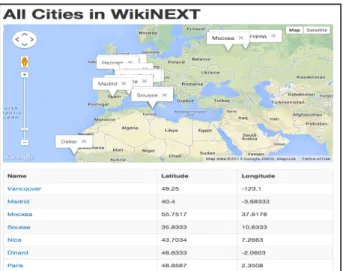
To demonstrate data reuse, we try to recombine data sources on the wiki, creating what is typically known as mash-up by developing a web application that combines all the created cities on WikiNEXT. The Error! Reference source not found. displays the output map of the wiki application that retrieves the location of all cities available in our knowledge base and shows all cities on a map and in a table. WikiNEXT uses SPARQL to query its knowledge base. Hence, queries can be written without having to deal with semantic heterogeneity problems since we use predefined ontologies.
Figure 6: Map view of all cities in WikiNEXT
5. Discussion and Conclusions
WikiNEXT is a “programmable wiki for the Linked Data”: a wiki in which we can write documents with an application layer that exploits the web of Data. Applications are written using standard HTML/CSS/JavaScript, and can be shared, cloned, improved collaboratively. We also designed an API and protocols for keeping a tight, synchronous link between the data embedded in the pages and the databases on the server side. The demonstration we propose consists in presenting live the WikiNEXT principles for writing documents and linked data applications directly in the browser. We propose to reproduce live, the City scenario described in the paper, showing how WikiNEXT simplifies the programming of such applications,
compared to classical solutions that involve Desktop Based tools. WikiNEXT is used now at the University of Nice/France and by the w3devcampus, the online platform that hosts the HTML5 W3C course.
6. REFERENCES
[1] Krötzsch, M., Vrandečić, D., & Völkel, M. (2006). Semantic mediawiki. In The Semantic Web-ISWC 2006 (pp. 935-942). Springer Berlin Heidelberg. [2] Schaffert, S. (2006, June). IkeWiki: A semantic wiki for
collaborative knowledge management. In Enabling Technologies: Infrastructure for Collaborative Enterprises, 2006. WETICE'06. 15th IEEE International Workshops on (pp. 388-396). IEEE.
[3] Buffa, M. Gandon, F., Ereteo, G. Sander, P. & Faron, C., SweetWiki: A semantic wiki, Special Issue of the Journal of Web Semantics on Semantic Web and Web 2.0, Volume 6, Issue 1, February 2008 , Edited by Mark Greaves and Peter Mika, Elsevier, Pages 84-97
[4] Auer, S., Dietzold, S., & Riechert, T. (2006). OntoWiki–A tool for social, semantic collaboration. In The Semantic Web-ISWC 2006 (pp. 736-749). Springer Berlin Heidelberg.
[5] Buffa, M. “Intranet Wikis”, workshop “intrawebs” of WWW 2006, Edinburgh, Scotland
[6] Krotzsch, M., SCHAFFERT, S, & Vrandecic, D.
Reasoning in semantic wikis. In: Reasoning Web. Springer Berlin Heidelberg, 2007. p. 310-329.
[7] Oren, E., Breslin, J. G., & Decker, S. (2006, May). How semantics make better wikis. In Proceedings of the 15th international conference on World Wide Web (pp. 1071-1072). ACM
[8] Oren, E., SemperWiki: a semantic personal Wiki. In SemDesk. 2005.
[9] Kobilarov, G., Scott, T., Raimond, Y., Oliver, S., Sizemore, C., Smethurst, M., ... & Lee, R. (2009). Media meets semantic web–how the bbc uses dbpedia and linked data to make connections. In The semantic web: research and applications (pp. 723-737). Springer Berlin Heidelberg. [10] Schaffert, S., Eder, J. Samwald, M., & Blumauer. A., Kiwi
- knowledge in a wiki. In European Semantic Web Conference 2008, 2008
[11] Buffa, M., Delaforge, N., Erétéo, G., Gandon, F., Giboin, A., & Limpens, F. (2013). ISICIL: Semantics and Social Networks for Business Intelligence. In SOFSEM 2013: Theory and Practice of Computer Science (pp. 67-85). Springer Berlin Heidelberg.
[12] Di Iorio, A., Musetti, A., Peroni, S., Vitali, F.: Ontology-driven generation of wiki content and interfaces. The New Review of Hypermedia and Multimedia 16(1&2): 9-31 (2010)
[13] Rospocher, M., Ghidini, C., Pammer, V., Serafini, L., Lindstaedt, S.: MoKi: the Modelling wiKi. SemWiki 2009 [14] Hernández A.G and García. M. N. M., A JavaScript RDF
store and application library for linked data client
applications. In Proceedings of the 21st International World Wide Web Conference, WWW2012, 2012.
[15] Meilendera, T., Jayb, N., Lieberb, J., & Palomaresa, F. Semantic wiki engines: a state of the art. Semantic-web-journal.net. IOS Press, 2010.