HAL Id: hal-00508405
https://hal.archives-ouvertes.fr/hal-00508405
Submitted on 3 Aug 2010
HAL is a multi-disciplinary open access
archive for the deposit and dissemination of
sci-entific research documents, whether they are
pub-lished or not. The documents may come from
L’archive ouverte pluridisciplinaire HAL, est
destinée au dépôt et à la diffusion de documents
scientifiques de niveau recherche, publiés ou non,
émanant des établissements d’enseignement et de
Experimental plants for very small communities : choice
and design criteria for five different processes
C. Boutin, A. Lienard, J.L. Ramain, L. Beyeler
To cite this version:
C. Boutin, A. Lienard, J.L. Ramain, L. Beyeler. Experimental plants for very small communities :
choice and design criteria for five different processes. 2nd international specialized conference on design
and operation of small wastewater treatment plants, Jun 1993, Trondheim, Norway. p. 35 - p. 42.
�hal-00508405�
93/0093
EXPERIMENTAL PLANTS FOR VERY SMALL COMMUNITIES : CHOICE AND DESIGN CRITERIA FOR FIVE DIFFERENT PROCESSES
C. Boutin*, A. üénard*, J.L Ramain**,L Beyeler**
* CEntre national du Machinisme Agricole, du Génie Rural, des Eaux et des Forêts (CEMAGREF), Division Qualité des Eaux, 3bis, Quai Chauveau, CP 220, 69336 Lyon Cedex 09, France ** Conseil Général de Haute Loire (Haute Loire County Council), Service Départemental de l'Eau,
10, Rue Jules Valès, 43000 Le Puy, France
ABSTRACT
Waste stabilization ponds and land treatment seepage, which are generally used for very small communities, are being used less frequently due to their specificity and their lack of suitability in certain cases (ground characteristics, available space, fragile receiving bodies, etc.)
This article gives the choice criteria for the proposed new series for 5 communities sized between 50 and 400 p.e. (person equivalents), together with a detailed description of the facilities :
- septic tank + covered infiltration bed
- horizontal settling-digestion tank + covered infiltration bed
- settling-digestion tank (Imhof tank) + trickling filter + infiltration bed - pond + covered infiltration bed
- reed bed filters
in addition to the design of the infiltration beds and discussion of the investment costs. All the series had to achieve the following effluent quality levels :
- COD=90 mg/l, BOD5=30 mg/l, TSS=30 mg/l, N-NK=40 mg/l
For the time being, the difficulties encountered are of a technical nature and concern the infiltration beds' feeder devices which do not produce a flat water jet that gives even spreading.
KEYWORDS
Association of processes ; costs ; design criteria ; infiltration-percolation beds ; reed bed filters ; septic tank ; small communities ; wastewater treatment ;
INTRODUCTION
For a long time, the CEMAGREF has taken a great interest wastewater treatment systems for small communities in rural areas that are of a "rustic" and simple type. It has made major contributions to the development of wastewater stabilization ponds. In France the most common wastewater treatment series for very small communities (about 100 p.e.) are :
- seepage
- wastewater stabilization ponds (WSP's)
Land treatment of wastewater uses the local soil's capacity for treatment. Feasibility studies based' on an appraisal of topological and hydrological soil conditions investigate the general nature of the site. It is also necessary to measure soil permeability. It is the conclusions of these prior site surveys that therefore determine whether or not it is possible to use this technique. ; WSP's are not entirely satisfactory for very small communities. Very small communities', wastewater is indeed particularly characterised by its very small quantity (Pujol et ai, 1990). If, in addition, the facilities have been oversized (even by as little as several tens of p.e.), and if the connection rate remains low in the first few years, the pond will only be filled to a very low level and the community will soon be confronted with malfunctioning problems (increasing concentration due to lack of effluent). This situation will become even worse if the prior design studies concerning the tightness (K<10"8 m/s) have not been correctly carried out. In the case of a violent rain storm, since most systems are of combined type, the ponds will be subject to such a hydraulic overload that a "flushing" effect will occur, leading them to discharge an effluent of high organic content. The Conseil Général (County Council) of Haute Loire, a French department with a low population density is aware of the limits of WSP's and is involved in a programme to experiment with various types of wastewater series for very small communities.
The aim of this paper is :
- to explain the choice criteria for each plant - to describe the 5 experimental plants - to give the values used in design
- and to give the initial results collected from monitoring that has been carried out.
CHOICE CRITERIA FOR EACH SERIES
The sizes are small, greater than 50 p.e., but not exceeding 400 p.e (Table 1). Site 3 is subject to a slight seasonal tourist effect which leads to an increase in population by a factor of approximately 2 in the summer period. Small sized communities do not nave specific staff at their disposal to operate their intended wastewater treatment plants. It is thus advisable to install "rustic" series (Ministère de l'Agriculture, 1986) in other words, plant which can be operated by staff (without any particular training) and which has low operating costs.
TABLE 1 Size of the Communities SITES
Population in p.e. . Permanent . Seasonal . Maximum
. Used in the project
1 50 50 50 2 110 40 150 150 3 70 50 120 120 4 270 50 320 400 5 60 20 80 100 All effluent is basically of household type. The effluent quality to be treated is only likely to be changed by a few discharges from agricultural activities.
The sewerage systems are mostly of combined type (sites 3, 4 and 5) or of pseudo-separate type (site 2). Only one installation is fed by a truly separate system (site 1).
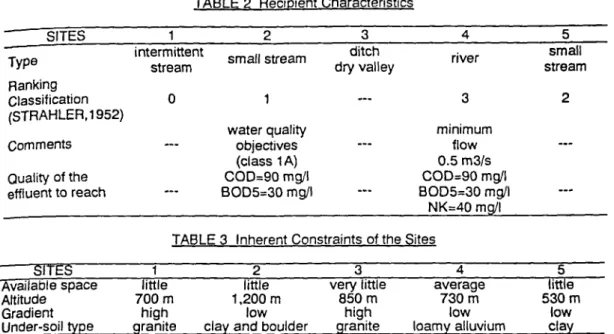
The effluent quality of the intended wastewater treatment plant is defined, as far as possible, in terms of the recipient type (Table 2).
In two of the cases, the recipient requires a relatively thorough treatment be performed, removing organic matter to concentrations s 90 and 30 mg/i respectively for COD and BOD5 (Circulaire interministérielle, 1980). This level cannot be achieved by a conventional 3 pond lagooning series. If possible, it is thus advisable to install a new type of plant. For the other sites, the constraints relating to the chosen location (Table 3) also preclude the use of a lagooning treatment technique due to shortage of space (sites 3 and 5) in conjunction with undulating topography (site 1).
TABLE 2 Recipient Characteristics
SITES
Type
Ranking
Classification
(STRAHLER, 1952)
Comments
Quality of the
effluent to reach
SII hü
Available space
Altitude
Gradient
Under-soil type
1 2intermittent
s m a l ( s t r e a mstream
0 — — 1water quality
objectives
(class 1 A)
COD=90 mg/l
BOD5=30 mg/l
3ditch
dry valley
— ... ... 4river
3minimum
flow
0.5 m3/s
COD=90 mg/l
BOD5=30 mg/l
NK=40 mg/l
TABLE 3 Inherent Constraints of the Sites
1
little
700 m
high
granite
2little
1,200 m
lowclay and boulder
3
very little
850 m
high
granite
4average
730 m
lowloamy alluvium
5small
stream
2 — — 5little
530 m
lowclay
In this particular French département, the climate can be very harsh at higher altitudes. Snow and
intense freezing conditions are not uncommon in winter.
DESCRIPTION OF THE FACILITIES
The above mentioned limits point towards compact types of series (Agences de l'Eau, 1993),
based on processes involving attached growth biological systems on fine media, hereafter called
"infiltration beds" (IB's). The principle is to percolate wastewater vertically through several beds
containing a gravel medium, then the effluent is collected. Aerobic conditions for decomposition of
organic matter are maintained by sequencing the alimentation (a feed period followed by a rest
period). Batch feeding favours air renewal and gives a better spread of the influent.
The 5 plants, all of different design, all include at least one IB treatment stage ; they can be
open-air, covered with top-soil or have reeds (Phragmites commuais) planted on them. Combining this
stage with various technologies allows original series (Schierup et a/., 1990) to be proposed,
enlarging the range of processes adapted to small communities.
The first three sites have relatively similar physical constraints (shortage of available space, high
altitude, granite or heterogeneous type soil).
Plant 1 comprises a septic tank and a covered IB .
Plant 2 is of similar design to 1. A horizontal settling-digestion tank replaces the septic tank : this
choice is influenced by the population size and will enable the two primary treatment stages to be
compared later on. The design of the horizontal settling-digestion tank means that it probably
behaves much as a septic tank since the settling and digestion zones are not separated.
Plant 3 comprises a settling-digestion tank, a low rate trickling filter and an IB with an open-air
feed. On this site, the naturally very steep gradient enabled a trickling filter to be installed without
it creating an eyesore. In this case, the IB, which receives an effluent that is already well treated,
is deliberately left exposed to the weather. In fact it is open-air in order to determine the real
consequences of a harsh climate on such an IB system, at least in terms of operating
considerations.
Plant 4 comprises a pond and a covered IB system. The space available and the type of
under-soil enabled a natural clay-lined lagoon to be constructed. In view of the altitude, the IB's are
covered with top-soil.
Plant 5, located at the lowest altitude of the five, is a two-stage filter of reed bed type, for which
the feed is entirely open to the air (Lienard et al., 1990, in press).
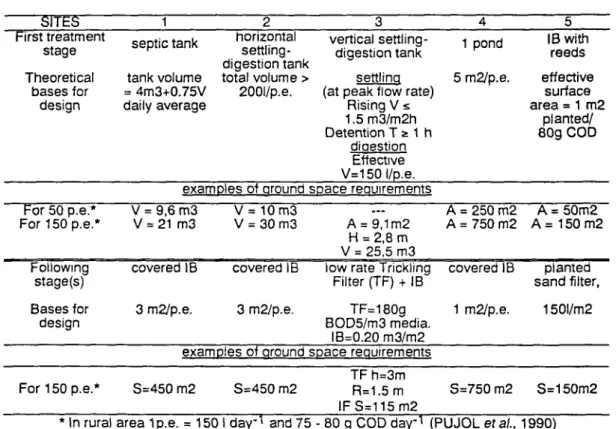
Table 4 below, gives a summary of the series' design and gives the bases for theoretical design.
For vertical settling-digestion tanks, the use of usual values leads to oversizing of the settling
zone and thus to an increase in the detention time. In this layout, the effluent is likely to become
septic.
TABLE 4 The Proposed Series
SITES
First treatment
stage
Theoretical
bases for
design
1septic tank
tank volume
= 4m3+0.75V
daily average
2horizontal
settling-digestion tank
total volume >
200l/p.e.
3vertical
settling-digestion tank
settlina
(at peak flow rate)
Rising V s
1.5 m3/m2h
Detention T a 1 h
diqestion
Effective
V=150l/p.e.
examples of around space reauirements
4
1 pond
5 m2/p.e.
5IB with
reeds
effective
surface
area = 1 m2
planted/
80g COD
For 50 p.e.*
For 150 p.e.*
V = 9,6 m3
V = 21 m3
V = 10m3
V = 30 m3
A = 9,1m2
H = 2,8 m
V = 25,5m3
A = 250 m2 A = 50m2
A = 750m2 A=150m2
Following
stage(s)
Bases for
design
covered IB
3 m2/p.e.
covered IB
3 m2/p.e.
low rate Trickling
Filter (TF) + IB
covered IB
TF=180g 1 m2/p.e.
BOD5/m3 media.
IB=0.20m3/m2
planted
sand filter,
150l/m2
examples of around space reauirements
For 150 p.e.* S=450 m2
S=450 m2
TF h=3m
R=1.5m
IFS=115m2
S=750m2 S=150m2
* In rural area 1 p.e. = 150 I day
1and 75 - 80 g COD d a y ' (PUJOL era/., 1990)
Using the results acquired (Guilloteau et al., in press) concerning infiltration-percolation beds, it is
reasonable to think that the effluents from these five series should in theory at least comply with
the following quality :
- COD s 90 mg/l
- BOD5 s 30 mg/l
- TSS s 30 mg/l
in addition, the Kjeldahl nitrogen level should remain below the 40 mg/l limit (Circulaire
interministérielle, 1980). This limit value could be lower if the initial concentration of the effluent is
relatively low. Plant 5 is likely to give a better quality level due to the design of the second stage
(intermittently immersed).
TABLE 5 Investment Costs (1991 -1992 prices) (excluding the sewerage system)
SITES
Budgeted cost
Real cost
Cost/p.e.
Community
size
UNITS
FF exe. tax
FF exe. tax
FF exe. tax /p.e.
p.e.
1120,000
102,000
2,040
50 2250,000
198,000
1,320
150 3180,000
286,000
2,385
120 4500,000
610,000
1,525
400 5200,000
200,000
2,000
100The series requiring the greatest investment (Table 5) is also the most complicated one since it
includes a trickling filter. This data underlines the disparity of the values encountered, values
which can vary by a factor of two, basically dependant on the inherent constraints of the site.
Within the population range chosen (50 to 400 p.e.) the average investment cost of these series
offering an expected quality mentioned above can however be estimated at approximately
1 860 FF exe. tax, per p.e.This relatively low cost is largely due to availability of filtering materials
used in IB's. The frequent use of pouzzolana is particular to the Haute Loire region, a volcanic
region.
DESIGN OF INFILTRATION BEDS
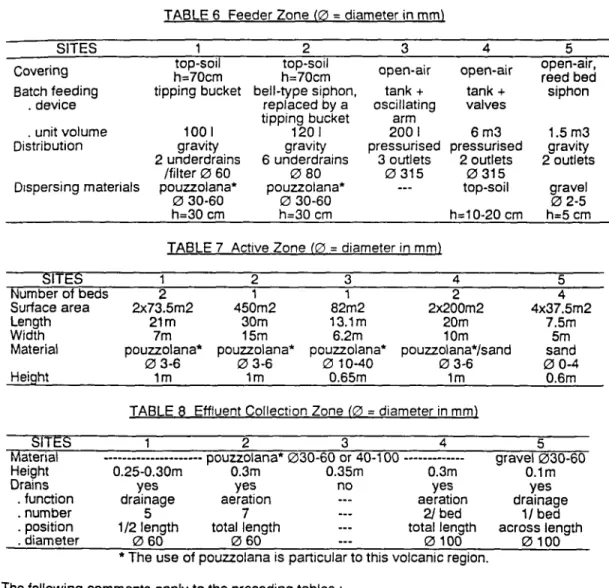
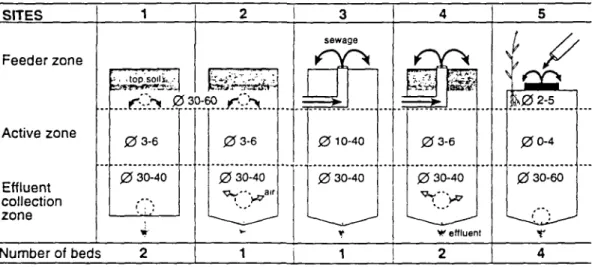
An IB generally comprises 3 zones (Fig.1). A feeder and water spreading zone (Table 6), an
"active" zone (Table 7) which often has a medium of finer granulometry than the previous stage
followed by a collector zone for the treated effluent (Table 8).
TABLE 6 Feeder Zone (0 = diameter in mm)
SITES
1Covering
Batch feeding
. device
. unit volume
Distribution
Dispersing materials
top-soil
h=70cm
tipping bucket
1001
gravity
2 underdrains
/filter 0 60
pouzzolana*
0 30-60
h=30 cm
top-soil
h=70cm
bell-type siphon,
replaced by a
tipping bucket
1201
gravity
6 underdrains
0 80
pouzzolana*
0 30-60
h=30 cm
open-air open-air
tank +
oscillating
arm
2001
pressurised
3 outlets
0315
tank +
valves
6m3
pressurised
2 outlets
0315
top-soil
h=10-20cm
open-air,
reed bed
siphon
1.5 m3
gravity
2 outlets
gravel
0 2-5
h=5 cm
TABLE 7 Active Zone (0 = diameter in mm)
SITES
1Number of beds
Surface area
Length
Width
Material
2
2x73.5m2
21m
7m
1
450m2
30m
15m
1
82m2
13.1m
6.2m
2
2x200m2
20m
10m
pouzzolana* pouzzolana* pouzzolana* pouzzolana*/sand
0 3-6 0 3-6 0 10-40 0 3-6
4
4x37.5m2
7.5m
5m
sand
0 0-4
Height
SITÈS 1mTABLE 8
1 1mI Effluent Collection
20.65m
Zone (0
-3diameter
1min mm)
40.6m
5Material
Height
Drains
. function
. number
. position
. diameter
pouzzolana* 030-60 or 40-100
0.25-0.30m 0.3m 0.35m 0.3m
yes yes no yes
drainage aeration — aeration
5 7 — 2/bed
1/2 length total length — total length
0 60 0 60 — 0 100
gravel 030-60
0.1m
yes
drainage
1/bed
across length
0 100
* The use of pouzzolana is particular to this volcanic region.
The following comments apply to the preceding tables :
- Design of the IB's is dependant on their position in the treatment series. When treating a raw
effluent or one that has simply undergone a settling process, the basis for design depends on
the organic content to be treated. The value used is 1 -3m2/p.e., or in other words 1 -3 m2 of
effective surface area treats 80 g of COD.
For additional treatment the design is based on hydraulic considerations and the value of
150-200 l/m2 is taken.
The height of the active zone varies from 60 cm to 1 m
The material is commonly of a granulometry of between 3 and 6 mm. Use of a coarser material
(10-40 mm), and its use in additional treatment, can only be justified by specific local
constraints (site 3). In order to complete the study, it will certainly be necessary to change this
over-coarse material.
The deepest zone, of high granulometry (0 30-60 or 40-100) often performs a dual function :
drainage and aeration of the active zone (enhanced by installation of drains linked to vents
open to the air.
SITES
Feeder zone
Active zone
Effluent
collection
zone
1 ••. , top soili....-2f--.:> 0 3O-£
03-6
0 30-40
Number of beds 2
>0 / O \
03-6
0 30-40
•j 3 sewage »0
0:
0 30 y -40 -40 1 4¡isf
03-6
0 30-40
* • effluent 2 5i /y
ÍN02-5
00-4
030-60
4Fig.1. Schematic cross sections of IB's.
ALTERNATE FEEDING OF INFILTRATION BEDS
Wherever they are situated in the treatment series, IB's are alternately dosed and rested in order
to maintain the aerobic conditions for decomposition of organic matter (Liénard et al., 1990). The
methods used to achieve this objective are :
- either to multiply the number of independent beds,
- or to individually control the operation of drains or outlets on single beds.
Table 9 below shows for each facility, the theoretical maximum height of water that each batch.
TABLE 9 Theoretical Height of Water for Each Batch
SITES
1
2 3 4 5
Unit batch volume
Minimum unit surface area
Theoretical height of water
These figures highlight the major design difficulty encountered on IB's : the optimal use of the
available surface area. Indeed, in 3 out of 5 cases, the height of water jet is a lot less than the
maximum granulometry of the material. Under these conditions, only a very small portion of the
available surface area is actually wetted on each batch. For sites 4 and 5, the unit batch volume,
assuming that it is inlet in a very short time (one minute) seems to only just account for the initial
O.1 m3
73.5 m2
1.36 mm
0.12 m3
7.5 m2
1.6 mm
0.2 m3
27.3 m2
7.3mm
6 m 3200 m2
30 mm
1.5 m3
37.5 m2
40 mm
permeability of the material used. Using this first approach it would seem that a minimum height of 50 mm could be used. The difficulty is thus to have unit volumes sufficiently large and unit surface areas sufficiently small without overly increasing investment costs.
MONITORING
Only sites 2 and 3 were monitored last summer. Site 2 functioned in conditions close to design values. During the period over which measurements were taken, the effluent quality was as expected (see table 2).
TABLE 10 Change in Nitrogen Composition (in ma/I) wastewater effluent
N-Nk N-Nk N-NH4+ N-NO2- N-NO3- N-NT Site 2 83 12.8 11.0 1.5 26.7 41.0 Site 3 WO 5A 5,0 1_J> 3Z5 39.4 The IB of site 3, operating as a complementary (tertiary) treatment, operated under conditions of significant hydraulic underload (less than 50% of its capacity). With this reservation, the effluent quality also reached the standards.
In terms of nitrogen (Table 10), the results obtained for site 2 are those usually encountered with attached growth biological systems. The high performance level on site 3 is due to successive passage through the deep trickling filter and the IB which gives good nutrient oxidation. Initiation of the recorded denitrification is not controlled and it can thus not be enhanced.
Both plants discharge an effluent whose Kjeldahl nitrogen content is less than the initially fixed 40 mg/i value. The next level (N-Nks10mg/l) could be achieved if IB's are used as an additional treatment process. Further studies will enable this hypothesis to be backed up.
In both cases, phosphorus is mineralized but not absorbed by the "pouzzolana" material. Removal of this substance is thus very poor (20%).
DISCUSSION
The use of infiltration beds (IB's), for which the treatment process is based on aerobic attached growth biological films on a fine medium, would seem to be likely to develop in France for small communities, due to their reduced requirement for ground-space and their "rustic" criteria which are usually attributed to waste stabilization ponds.
IB's can be associated with various primary treatment processes (septic tanks or settling-digestion tanks) or associated with the finishing stage of lagoons and with other rustic processes. Whether covered, open-air or as reed beds, they should very soon see an increase in their use as wastewater treatment plants for all small communities .
Due to the action of mechanical filtration combined with bacterial degradation, the initial results are encouraging in terms of the removal of organic matter, as characterised by the parameters COD - BOD5 and TSS. The effluent concentrations for these parameters should achieve the following levels : 90 mg/l, 30 mg/l and 30 mg/l respectively.
Removal of nitrogen is normal and exceptional removal must not be expected without a specific and controlled denitrification stage.
The greatest difficulty encountered with IB's today, lies in the correct installation of the batch feeder in order to obtain optimal spreading. The appropriate devices (for example : siphon or tipping bucket) must always be "rustic". A balance must be sought between the batch volume and the minimum surface area, without causing the investment costs to rise too high.
ACKNOWLEDGEMENTS
We would like to thank the "Direction Départementale de l'Equipement de la Haute Loire" and the engineering company "Nature et Technique" for the technical data that they were kind enough to supply us with, as well as the 5 communities who were willing to install an innovative wastewater treatment plant in their community.
REFERENCES
AGENCES DE L'EAU (1993). Epuration des eaux usées urbaines par infiltration-percolation (in
preparation).
CIRCULAIRE INTERMINISTERIELLE (1980). Circulaire du 4 Novembre 1980. Journal Officiel de
la République Française, 29 Novembre 1980, pp. 10390 - 10395.
GUILLOTEAU J.A., LIENARD A., VACHON A. and LESAVRE J. (in press). Wastewater treatment by infiltration basins. Case study : Saint Symphorien de Lay (France).
LIENARD A., BOUTIN C , ESSER D. (1990). Domestic wastewater treatment with emergent hydrophyte beds in France, {n : Constructed wetland in Water Pollution Control. Advances in Water Pollution Control, ed Cooper PF et Findlater BC. Pergamon Press, pp. 183 -192. LIENARD A., BOUTIN C , BOIS R., (in press). Coupling of reed bed filters and ponds : an
example in France.
MINISTERE DE L'AGRICULTURE, CEMAGREF QEPP PARIS (1986). : Les stations d'épuration adaptées aux petites collectivités. Documentation technique, FNDAE N° 5, 80 p.
PUJOL R., LIENARD A. (1990). Qualitative and quantitative characterization of waste water for small communities. Wat. Sci. Tech, Vol 22X N ° 3/4, 253 - 260.
SCHIERUP H.H., BRIX H. (1990). Danish experience with emergent hydrophyte treatment systems (EHTS) and prospects in the light of future requirements on outlet quality water.
Wat. Sci. Tech. Vol 22, N ° 3/4, pp. 65 - 72.
STRAHLER A.N. (1952). Hyprometric (area-altitude) analysis of erosional topography. Bull. Geol.