arXiv:1107.4587v1 [hep-ex] 22 Jul 2011
Search for the standard model and a fermiophobic Higgs boson in diphoton final states
V.M. Abazov,35 B. Abbott,73 B.S. Acharya,29M. Adams,49 T. Adams,47 G.D. Alexeev,35 G. Alkhazov,39 A. Altona,61 G. Alverson,60G.A. Alves,2 M. Aoki,48 M. Arov,58A. Askew,47 B. ˚Asman,41 O. Atramentov,65 C. Avila,8 J. BackusMayes,80F. Badaud,13 L. Bagby,48B. Baldin,48 D.V. Bandurin,47 S. Banerjee,29 E. Barberis,60P. Baringer,56 J. Barreto,3J.F. Bartlett,48 U. Bassler,18 V. Bazterra,49 S. Beale,6A. Bean,56 M. Begalli,3 M. Begel,71 C. Belanger-Champagne,41 L. Bellantoni,48 S.B. Beri,27 G. Bernardi,17 R. Bernhard,22 I. Bertram,42 M. Besan¸con,18 R. Beuselinck,43V.A. Bezzubov,38 P.C. Bhat,48 V. Bhatnagar,27 G. Blazey,50 S. Blessing,47 K. Bloom,64 A. Boehnlein,48 D. Boline,70 E.E. Boos,37 G. Borissov,42 T. Bose,59 A. Brandt,76 O. Brandt,23 R. Brock,62 G. Brooijmans,68 A. Bross,48D. Brown,17 J. Brown,17 X.B. Bu,48 M. Buehler,79 V. Buescher,24V. Bunichev,37 S. Burdinb,42 T.H. Burnett,80 C.P. Buszello,41 B. Calpas,15E. Camacho-P´erez,32
M.A. Carrasco-Lizarraga,56B.C.K. Casey,48 H. Castilla-Valdez,32 S. Chakrabarti,70D. Chakraborty,50 K.M. Chan,54A. Chandra,78G. Chen,56 S. Chevalier-Th´ery,18D.K. Cho,75S.W. Cho,31S. Choi,31B. Choudhary,28
S. Cihangir,48 D. Claes,64 J. Clutter,56 M. Cooke,48 W.E. Cooper,48 M. Corcoran,78 F. Couderc,18 M.-C. Cousinou,15A. Croc,18 D. Cutts,75 A. Das,45 G. Davies,43 K. De,76S.J. de Jong,34E. De La Cruz-Burelo,32 F. D´eliot,18M. Demarteau,48R. Demina,69D. Denisov,48 S.P. Denisov,38 S. Desai,48C. Deterre,18K. DeVaughan,64 H.T. Diehl,48 M. Diesburg,48 P.F. Ding,44A. Dominguez,64T. Dorland,80 A. Dubey,28 L.V. Dudko,37 D. Duggan,65
A. Duperrin,15 S. Dutt,27 A. Dyshkant,50 M. Eads,64 D. Edmunds,62 J. Ellison,46V.D. Elvira,48Y. Enari,17 H. Evans,52A. Evdokimov,71 V.N. Evdokimov,38G. Facini,60T. Ferbel,69 F. Fiedler,24 F. Filthaut,34W. Fisher,62
H.E. Fisk,48 M. Fortner,50H. Fox,42S. Fuess,48 A. Garcia-Bellido,69 V. Gavrilov,36P. Gay,13 W. Geng,15, 62 D. Gerbaudo,66C.E. Gerber,49 Y. Gershtein,65 G. Ginther,48, 69 G. Golovanov,35 A. Goussiou,80P.D. Grannis,70
S. Greder,19 H. Greenlee,48 Z.D. Greenwood,58E.M. Gregores,4 G. Grenier,20 Ph. Gris,13 J.-F. Grivaz,16 A. Grohsjean,18S. Gr¨unendahl,48M.W. Gr¨unewald,30 T. Guillemin,16 F. Guo,70 G. Gutierrez,48 P. Gutierrez,73 A. Haasc,68 S. Hagopian,47 J. Haley,60 L. Han,7 K. Harder,44A. Harel,69 J.M. Hauptman,55 J. Hays,43 T. Head,44
T. Hebbeker,21D. Hedin,50 H. Hegab,74 A.P. Heinson,46U. Heintz,75 C. Hensel,23 I. Heredia-De La Cruz,32 K. Herner,61 G. Heskethd,44 M.D. Hildreth,54 R. Hirosky,79 T. Hoang,47 J.D. Hobbs,70 B. Hoeneisen,12 M. Hohlfeld,24 Z. Hubacek,10, 18 N. Huske,17 V. Hynek,10 I. Iashvili,67 Y. Ilchenko,77 R. Illingworth,48A.S. Ito,48
S. Jabeen,75M. Jaffr´e,16 D. Jamin,15 A. Jayasinghe,73R. Jesik,43 K. Johns,45 M. Johnson,48 D. Johnston,64 A. Jonckheere,48 P. Jonsson,43 J. Joshi,27 A.W. Jung,48 A. Juste,40 K. Kaadze,57 E. Kajfasz,15D. Karmanov,37
P.A. Kasper,48I. Katsanos,64R. Kehoe,77 S. Kermiche,15 N. Khalatyan,48A. Khanov,74 A. Kharchilava,67 Y.N. Kharzheev,35M.H. Kirby,51J.M. Kohli,27A.V. Kozelov,38J. Kraus,62S. Kulikov,38 A. Kumar,67 A. Kupco,11
T. Kurˇca,20V.A. Kuzmin,37 J. Kvita,9 S. Lammers,52 G. Landsberg,75 P. Lebrun,20 H.S. Lee,31 S.W. Lee,55 W.M. Lee,48 J. Lellouch,17 L. Li,46 Q.Z. Li,48 S.M. Lietti,5 J.K. Lim,31 D. Lincoln,48 J. Linnemann,62 V.V. Lipaev,38 R. Lipton,48 Y. Liu,7Z. Liu,6 A. Lobodenko,39 M. Lokajicek,11R. Lopes de Sa,70 H.J. Lubatti,80
R. Luna-Garciae,32 A.L. Lyon,48 A.K.A. Maciel,2 D. Mackin,78R. Madar,18 R. Maga˜na-Villalba,32 S. Malik,64 V.L. Malyshev,35Y. Maravin,57 J. Mart´ınez-Ortega,32 R. McCarthy,70 C.L. McGivern,56 M.M. Meijer,34
A. Melnitchouk,63 D. Menezes,50 P.G. Mercadante,4 M. Merkin,37 A. Meyer,21 J. Meyer,23 F. Miconi,19 N.K. Mondal,29 G.S. Muanza,15 M. Mulhearn,79 E. Nagy,15 M. Naimuddin,28 M. Narain,75 R. Nayyar,28 H.A. Neal,61 J.P. Negret,8P. Neustroev,39 S.F. Novaes,5T. Nunnemann,25G. Obrant‡,39 J. Orduna,78N. Osman,15
J. Osta,54 G.J. Otero y Garz´on,1 M. Padilla,46 A. Pal,76 N. Parashar,53V. Parihar,75S.K. Park,31 J. Parsons,68 R. Partridgec,75 N. Parua,52 A. Patwa,71 B. Penning,48 M. Perfilov,37K. Peters,44Y. Peters,44K. Petridis,44 G. Petrillo,69P. P´etroff,16 R. Piegaia,1M.-A. Pleier,71 P.L.M. Podesta-Lermaf,32V.M. Podstavkov,48P. Polozov,36
A.V. Popov,38 M. Prewitt,78 D. Price,52 N. Prokopenko,38S. Protopopescu,71 J. Qian,61 A. Quadt,23 B. Quinn,63 M.S. Rangel,2 K. Ranjan,28 P.N. Ratoff,42 I. Razumov,38 P. Renkel,77 M. Rijssenbeek,70 I. Ripp-Baudot,19 F. Rizatdinova,74 M. Rominsky,48 A. Ross,42 C. Royon,18 P. Rubinov,48 R. Ruchti,54G. Safronov,36G. Sajot,14
P. Salcido,50 A. S´anchez-Hern´andez,32 M.P. Sanders,25 B. Sanghi,48 A.S. Santos,5 G. Savage,48L. Sawyer,58 T. Scanlon,43 R.D. Schamberger,70 Y. Scheglov,39 H. Schellman,51 T. Schliephake,26 S. Schlobohm,80 C. Schwanenberger,44R. Schwienhorst,62J. Sekaric,56 H. Severini,73 E. Shabalina,23 V. Shary,18 A.A. Shchukin,38 R.K. Shivpuri,28 V. Simak,10 V. Sirotenko,48P. Skubic,73 P. Slattery,69 D. Smirnov,54K.J. Smith,67 G.R. Snow,64
J. Snow,72 S. Snyder,71 S. S¨oldner-Rembold,44L. Sonnenschein,21 K. Soustruznik,9 J. Stark,14 V. Stolin,36 D.A. Stoyanova,38M. Strauss,73D. Strom,49L. Stutte,48 L. Suter,44 P. Svoisky,73M. Takahashi,44 A. Tanasijczuk,1
W. Taylor,6 M. Titov,18 V.V. Tokmenin,35 Y.-T. Tsai,69 D. Tsybychev,70 B. Tuchming,18C. Tully,66 L. Uvarov,39 S. Uvarov,39 S. Uzunyan,50R. Van Kooten,52W.M. van Leeuwen,33N. Varelas,49 E.W. Varnes,45 I.A. Vasilyev,38
P. Verdier,20 L.S. Vertogradov,35M. Verzocchi,48 M. Vesterinen,44 D. Vilanova,18 P. Vokac,10 H.D. Wahl,47 M.H.L.S. Wang,48J. Warchol,54G. Watts,80M. Wayne,54 M. Weberg,48 L. Welty-Rieger,51A. White,76 D. Wicke,26
M.R.J. Williams,42 G.W. Wilson,56 M. Wobisch,58 D.R. Wood,60 T.R. Wyatt,44 Y. Xie,48C. Xu,61 S. Yacoob,51 R. Yamada,48 W.-C. Yang,44 T. Yasuda,48 Y.A. Yatsunenko,35 Z. Ye,48 H. Yin,48 K. Yip,71 S.W. Youn,48
J. Yu,76 S. Zelitch,79 T. Zhao,80 B. Zhou,61 J. Zhu,61 M. Zielinski,69 D. Zieminska,52 and L. Zivkovic75 (The D0 Collaboration∗)
1Universidad de Buenos Aires, Buenos Aires, Argentina 2LAFEX, Centro Brasileiro de Pesquisas F´ısicas, Rio de Janeiro, Brazil
3Universidade do Estado do Rio de Janeiro, Rio de Janeiro, Brazil 4Universidade Federal do ABC, Santo Andr´e, Brazil
5Instituto de F´ısica Te´orica, Universidade Estadual Paulista, S˜ao Paulo, Brazil
6Simon Fraser University, Vancouver, British Columbia, and York University, Toronto, Ontario, Canada 7University of Science and Technology of China, Hefei, People’s Republic of China
8Universidad de los Andes, Bogot´a, Colombia 9Charles University, Faculty of Mathematics and Physics,
Center for Particle Physics, Prague, Czech Republic 10Czech Technical University in Prague, Prague, Czech Republic
11Center for Particle Physics, Institute of Physics,
Academy of Sciences of the Czech Republic, Prague, Czech Republic 12Universidad San Francisco de Quito, Quito, Ecuador 13LPC, Universit´e Blaise Pascal, CNRS/IN2P3, Clermont, France
14LPSC, Universit´e Joseph Fourier Grenoble 1, CNRS/IN2P3, Institut National Polytechnique de Grenoble, Grenoble, France 15CPPM, Aix-Marseille Universit´e, CNRS/IN2P3, Marseille, France
16LAL, Universit´e Paris-Sud, CNRS/IN2P3, Orsay, France 17LPNHE, Universit´es Paris VI and VII, CNRS/IN2P3, Paris, France
18CEA, Irfu, SPP, Saclay, France
19IPHC, Universit´e de Strasbourg, CNRS/IN2P3, Strasbourg, France
20IPNL, Universit´e Lyon 1, CNRS/IN2P3, Villeurbanne, France and Universit´e de Lyon, Lyon, France 21III. Physikalisches Institut A, RWTH Aachen University, Aachen, Germany
22Physikalisches Institut, Universit¨at Freiburg, Freiburg, Germany
23II. Physikalisches Institut, Georg-August-Universit¨at G¨ottingen, G¨ottingen, Germany 24Institut f¨ur Physik, Universit¨at Mainz, Mainz, Germany
25Ludwig-Maximilians-Universit¨at M¨unchen, M¨unchen, Germany 26Fachbereich Physik, Bergische Universit¨at Wuppertal, Wuppertal, Germany
27Panjab University, Chandigarh, India 28Delhi University, Delhi, India
29Tata Institute of Fundamental Research, Mumbai, India 30University College Dublin, Dublin, Ireland
31Korea Detector Laboratory, Korea University, Seoul, Korea 32CINVESTAV, Mexico City, Mexico
33Nikhef, Science Park, Amsterdam, the Netherlands
34Radboud University Nijmegen, Nijmegen, the Netherlands and Nikhef, Science Park, Amsterdam, the Netherlands 35Joint Institute for Nuclear Research, Dubna, Russia
36Institute for Theoretical and Experimental Physics, Moscow, Russia 37Moscow State University, Moscow, Russia
38Institute for High Energy Physics, Protvino, Russia 39Petersburg Nuclear Physics Institute, St. Petersburg, Russia
40Instituci´o Catalana de Recerca i Estudis Avan¸cats (ICREA) and Institut de F´ısica d’Altes Energies (IFAE), Barcelona, Spain 41Stockholm University, Stockholm and Uppsala University, Uppsala, Sweden
42Lancaster University, Lancaster LA1 4YB, United Kingdom 43Imperial College London, London SW7 2AZ, United Kingdom 44The University of Manchester, Manchester M13 9PL, United Kingdom
45University of Arizona, Tucson, Arizona 85721, USA 46University of California Riverside, Riverside, California 92521, USA
47Florida State University, Tallahassee, Florida 32306, USA 48Fermi National Accelerator Laboratory, Batavia, Illinois 60510, USA
49University of Illinois at Chicago, Chicago, Illinois 60607, USA 50Northern Illinois University, DeKalb, Illinois 60115, USA
51Northwestern University, Evanston, Illinois 60208, USA 52Indiana University, Bloomington, Indiana 47405, USA 53Purdue University Calumet, Hammond, Indiana 46323, USA 54University of Notre Dame, Notre Dame, Indiana 46556, USA
55Iowa State University, Ames, Iowa 50011, USA 56University of Kansas, Lawrence, Kansas 66045, USA 57Kansas State University, Manhattan, Kansas 66506, USA 58Louisiana Tech University, Ruston, Louisiana 71272, USA 59Boston University, Boston, Massachusetts 02215, USA 60Northeastern University, Boston, Massachusetts 02115, USA
61University of Michigan, Ann Arbor, Michigan 48109, USA 62Michigan State University, East Lansing, Michigan 48824, USA
63University of Mississippi, University, Mississippi 38677, USA 64University of Nebraska, Lincoln, Nebraska 68588, USA 65Rutgers University, Piscataway, New Jersey 08855, USA 66Princeton University, Princeton, New Jersey 08544, USA 67State University of New York, Buffalo, New York 14260, USA
68Columbia University, New York, New York 10027, USA 69University of Rochester, Rochester, New York 14627, USA 70State University of New York, Stony Brook, New York 11794, USA
71Brookhaven National Laboratory, Upton, New York 11973, USA 72Langston University, Langston, Oklahoma 73050, USA 73University of Oklahoma, Norman, Oklahoma 73019, USA 74Oklahoma State University, Stillwater, Oklahoma 74078, USA
75Brown University, Providence, Rhode Island 02912, USA 76University of Texas, Arlington, Texas 76019, USA 77Southern Methodist University, Dallas, Texas 75275, USA
78Rice University, Houston, Texas 77005, USA 79University of Virginia, Charlottesville, Virginia 22901, USA
80University of Washington, Seattle, Washington 98195, USA (Dated: July 22, 2011)
We present a search for the standard model Higgs boson and a fermiophobic Higgs boson in the diphoton final states based on 8.2 fb−1 of p¯p collisions at √s = 1.96 TeV collected with the D0 detector at the Fermilab Tevatron Collider. No excess of data above background predictions is observed and upper limits at the 95% C.L. on the cross section multiplied by the branching fraction are set which are the most restrictive to date. A fermiophobic Higgs boson with a mass below 112.9 GeV is excluded at the 95% C.L.
PACS numbers: 14.80.Bn, 13.85.Rm, 14.80.Ec, 12.60.Fr
In the standard model (SM), the Higgs boson (H) is the last undiscovered particle that provides crucial in-sights on the spontaneous breaking of the electroweak symmetry and the generation of mass of the weak gauge bosons and fermions. The constraints from the direct searches at the CERN e+e− Collider (LEP) [1] and from the measurement of precision electroweak observables [2] result in a preferred range for the SM Higgs boson mass of 114.4 < MH < 185 GeV at 95% C.L. Furthermore, the range 158 < MH < 173 GeV is excluded at 95%
∗with visitors from aAugustana College, Sioux Falls, SD, USA,
bThe University of Liverpool, Liverpool, UK,cSLAC, Menlo Park,
CA, USA, dUniversity College London, London, UK, eCentro
de Investigacion en Computacion - IPN, Mexico City, Mexico,
fECFM, Universidad Autonoma de Sinaloa, Culiac´an, Mexico, and
gUniversit¨at Bern, Bern, Switzerland.‡Deceased.
C.L. by the direct searches at the Fermilab Tevatron p¯p Collider [3]. These experimental constraints are derived assuming SM production and decay modes for the Higgs boson and can be substantially modified in case of signif-icant departures from the SM.
At hadron colliders the dominant production mecha-nisms for a light SM Higgs boson are gluon fusion (GF) (gg → H), associated production with a W or Z bo-son (q ¯q′
→ V H, V = W, Z), and vector boson fusion (VBF) (V V → H). At the Tevatron the most sensitive SM Higgs boson searches rely on the V H(H → b¯b) pro-cess for MH < 125 GeV and on gg → H → W+W− for MH > 125 GeV. At CERN’s Large Hadron Collider (LHC), the strategy at high MH (> 140 GeV) is similar, while at low MH (< 140 GeV) the H → γγ decay mode becomes one of the most promising discovery channels, despite its small branching ratio of B(H → γγ) ≈ 0.2% for 110 < MH < 140 GeV, owing to its clean
exper-imental signature of a narrow resonance on top of a smoothly-falling background in the diphoton mass spec-trum. Some of the most sensitive searches for the SM Higgs boson involve the loop-mediated ggH and/or γγH vertices, which are sensitive to new physics effects. For instance, the addition of a sequential fourth family of quarks can substantially enhance the ggH coupling, lead-ing to an increase in the GF production rate, while de-creasing B(H → b¯b) [4]. Alternatively, other models of electroweak symmetry breaking can involve suppressed couplings to some or all fermions [5], with the extreme case being the fermiophobic Higgs boson (Hf) model, where the GF production mode is absent, decays into fermions are heavily suppressed, and B(Hf → γγ) is significantly enhanced. Therefore, Higgs boson searches in the γγ decay mode can be a sensitive probe of new physics models where the Higgs boson may be difficult to observe in other, a priori more promising, channels.
This Letter presents a search for a Higgs boson decay-ing into γγ usdecay-ing an inclusive diphoton sample collected with the D0 detector in p¯p collisions at√s = 1.96 TeV at the Fermilab Tevatron Collider. In this search both the SM and the fermiophobic Higgs boson models are consid-ered. The most recent searches at the Tevatron for a SM Higgs boson [6] or a fermiophobic Higgs boson [7] in the γγ mode analyzed the diphoton invariant mass spectrum in search for a narrow resonance. This analysis represents a significant step forward in sensitivity by increasing the dataset by nearly a factor of three, as well as by ex-ploiting further kinematic differences between signal and background through a multivariate analysis technique.
The D0 detector is described in detail elsewhere [8]. The subdetectors most relevant to this analysis are the central tracking system, composed of a silicon microstrip tracker (SMT) and a central fiber tracker (CFT) in a 2 T solenoidal magnetic field, the central preshower (CPS), and the liquid-argon and uranium sampling calorime-ter. The CPS is located immediately before the inner layer of the calorimeter and is formed by one radiation length of absorber followed by several layers of scintil-lating strips. The calorimeter consists of three sections housed in separate cryostats: a central section covering up to |η| ≈ 1.1 [9] and two end calorimeters extending the coverage up to |η| ≈ 4.2. They are divided into electro-magnetic (EM) and hadronic layers. The EM section of the calorimeter is segmented into four longitudinal layers with transverse segmentation of ∆η × ∆φ = 0.1 × 0.1 [9], except in the third layer (EM3), where it is 0.05 × 0.05. The calorimeter is well suited for a precise measurement of electron and photon energies, providing a resolution of ≈ 3.6% at electron and photon energies of ≈ 50 GeV. The data used in this analysis were collected using trig-gers requiring at least two clusters of energy in the EM calorimeter and correspond to an integrated luminosity of 8.2 fb−1 [10].
Events are selected by requiring at least two photon
candidates with transverse momentum pT > 25 GeV in the central region of the calorimeter (|η| < 1.1), for which the trigger requirements are close to 100% effi-cient. Photon candidates are selected from EM clusters reconstructed with a simple cone algorithm with radius R = p(∆η)2+ (∆φ)2 = 0.2 that satisfy the following requirements: (i) at least 95% of the cluster energy is de-posited in the EM calorimeter; (ii) the calorimeter isola-tion variable I = [Etot(0.4) − EEM(0.2)]/EEM(0.2) is less than 0.1, where Etot(0.4) is the total energy in a cone of radius R = 0.4 and EEM(0.2) is the EM energy in a cone of radius R = 0.2; (iii) the energy-weighted cluster width in EM3 is consistent with an EM shower; (iv) the scalar sum of the pT of all tracks originating from the primary p¯p interaction vertex in an annulus of 0.05 < R < 0.4 around the cluster is less than 2 GeV; (v) the EM clus-ter is not spatially matched to tracker activity, either to a reconstructed track, or to a set of hits in the SMT and CFT consistent with that of an electron or positron trajectory [11]; and (vi) the output of a photon neural network (ON N) [6, 12], combining information from a set of variables that are sensitive to differences between photons and jets in the tracker, the calorimeter and the CPS, is larger than 0.1. The requirement (vi) rejects ap-proximately 40% of the misidentified jets, while keeping > 98% of real photons. Finally, additional kinematic se-lections are applied in order to select a signal-enriched sample. The diphoton invariant mass, Mγγ, computed from the two highest pT photons in an event, is required to be larger than 60 GeV. The azimuthal angle between the two photons, ∆φγγ, is required to be larger than 0.5, which reduces the background from events where both photons originate from fragmentation, a process that is not well modeled in the simulation, while keeping > 99% of the Higgs boson signal.
The selected data sample is contaminated by back-grounds of instrumental origin such as γ+jet (γj), di-jet (jj) and Z/γ∗ → e+e− (ZDY) production, with jets or electrons misidentified as photons, as well as a background from direct γγ production (DDP) where two isolated photons are produced. The normalization and shape of the γj and jj backgrounds, as well as the over-all normalization of the DDP background, are estimated from data. The Monte Carlo (MC) simulation is used to model the normalization and shape of the signal and ZDY background, as well as the shape of the DDP background. The MC samples used in this analysis are generated us-ing pythia [13] (for signal and ZDY) or sherpa [14] (for DDP) with CTEQ6L1 [15] parton distribution functions (PDFs), followed by a geant-based [16] simulation of the D0 detector. Events from randomly selected beam cross-ings are overlaid on the simulated events to better model contributions from additional p¯p interactions and detec-tor noise. The same reconstruction algorithms are used as on the data. Signal samples are generated separately for the GF, VH and VBF processes and normalized using
TABLE I: Signal, backgrounds and data yields for MH= 100 GeV to 150 GeV in 10 GeV intervals within the [MH - 30 GeV, MH + 30 GeV] mass window. The background yields result from a fit to the data. The uncertainties include both statistical and systematic contributions and take into account correlations among processes. The uncertainty on the total background is smaller than the sum in quadrature of the uncertainties in the individual background sources due to the anti-correlation resulting from the fit.
MH (GeV) 100 110 120 130 140 150 γγ (DDP) 6415 ± 395 4031 ± 286 2779 ± 188 1849 ± 139 1355 ± 99 1026 ± 75 γj + jj 5727 ± 352 3819 ± 252 2265 ± 178 1506 ± 120 964 ± 87 641 ± 63 Z/γ∗ → e+e− 599 ± 91 517 ± 81 361 ± 55 141 ± 23 65 ± 12 34 ± 7 Total background 12741 ± 160 8367 ± 134 5405 ± 95 3496 ± 77 2384 ± 57 1701 ± 48 Data 12746 8380 5406 3500 2383 1696 H boson signal 5.9 ± 0.8 5.8 ± 0.8 5.3 ± 0.7 4.2 ± 0.6 2.9 ± 0.4 1.7 ± 0.2 Hf boson signal 149.7 ± 13.2 39.4 ± 3.5 11.9 ± 1.0 4.4 ± 0.4 1.8 ± 0.2 0.7 ± 0.1
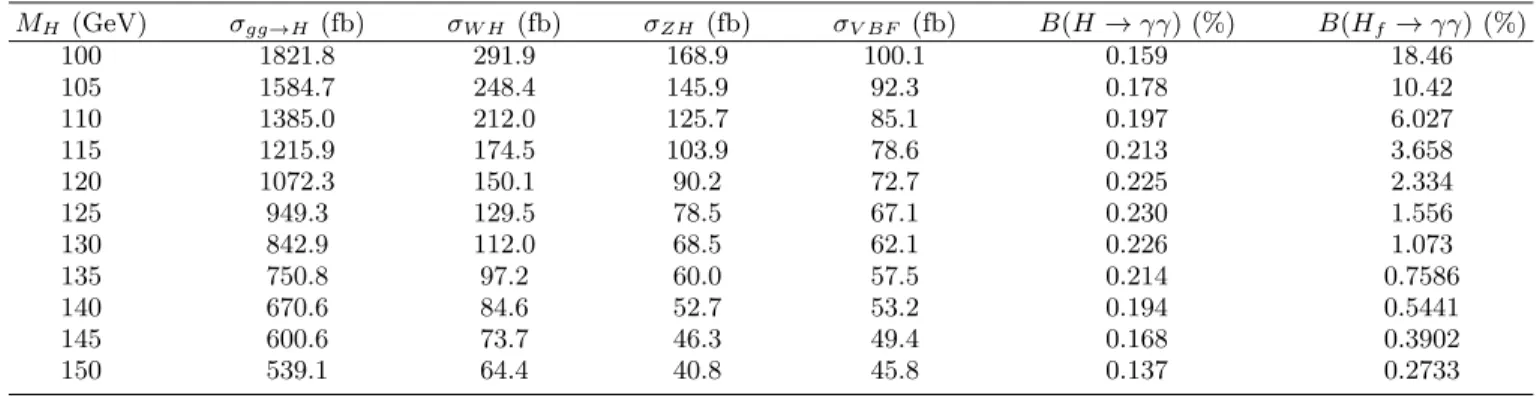
the leading order (NNLO) plus next-to-next-to-leading-logarithm (NNLL) theoretical cross sec-tions for GF and NNLO for VH and VBF processes [17– 19]. The Higgs boson’s branching ratio predictions are from hdecay [20]. The ZDY background estimate from MC is normalized to the NNLO cross section [21].
The γj and jj yields are estimated with data [22]. Fol-lowing the final selection, a tightened ON N requirement (ON N > 0.75) is used to classify the events into four cat-egories: (i) both photons, (ii) only the highest pT (lead-ing) photon, (iii) only the second highest pT (trailing) photon, or (iv) neither of the two photons, satisfy this requirement. The corresponding numbers of events, af-ter subtracting the ZDY contribution, are denoted as (i) Npp, (ii) Npf, (iii) Nf p and (iv) Nf f. The different effi-ciency of the ON N > 0.75 requirement for photons (ǫγ) and jets (ǫjet) is used to estimate the sample composition by solving a linear system of equations:
(Npp, Npf, Nf p, Nf f)T = E × (Nγγ, Nγj, Njγ, Njj)T, where Nγγ (Njj) is the number of γγ (jj) events and Nγj (Njγ) is the number of γj events with the leading (trail-ing) cluster as the photon. The 4 × 4 matrix E contains the efficiency terms ǫγ and ǫjet, parameterized as a func-tion of |η| for each photon candidate and estimated in photon and jet MC samples. We validate ǫγ with data of radiated photon from charged leptons in Z boson decays (Z → l+l−γ, l = e, µ) and ǫ
jet with jet data [23]. The DDP normalization is determined from a fit to the final discriminant distribution used for hypothesis testing, ex-ploiting the difference in shape between signal and back-ground in each MH search region. For each MH hypoth-esis (between 100 and 150 GeV in steps of 2.5 GeV), the search region is defined to be MH± 30 GeV. The shape of the DDP background is obtained from sherpa [14], while the shapes of the γj and jj backgrounds are ob-tained from independent data control samples selected by requiring exactly one photon or both photon candi-dates to satisfy ON N < 0.1, respectively. Table I shows the numbers of data events, expected background, and the expected H boson and Hf boson signals in six of the
search regions resulting from a fit described later in this Letter. The estimated background composition is ≈ 53% from DDP, ≈ 44% from γj+jj and ≈ 3% from ZDY.
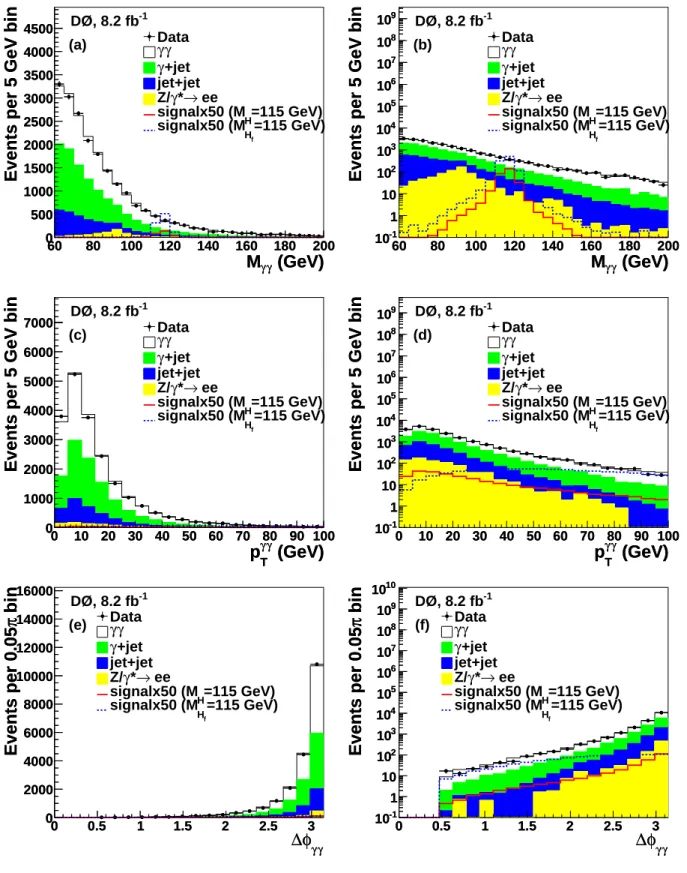
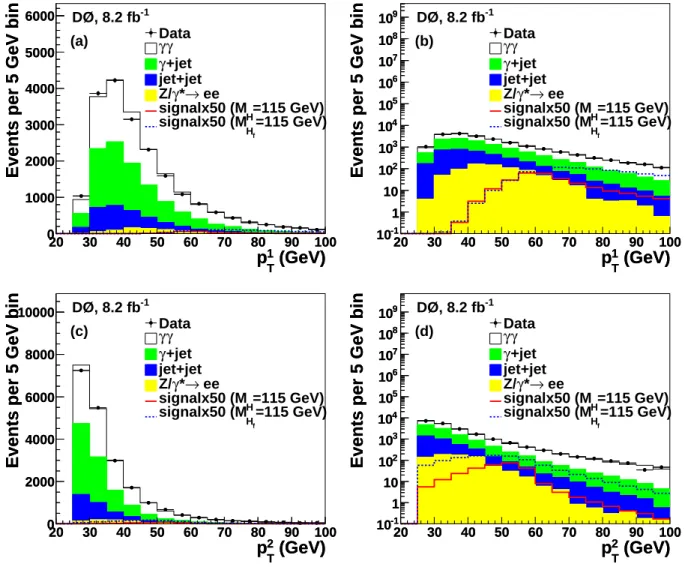
To improve the sensitivity of the search, a total of five well-modeled kinematic variables are used to discrimi-nate between signal and background: Mγγ, ∆φγγ, the transverse momentum of the diphoton system (pγγT ), and the transverse momenta of the leading and trailing pho-tons (p1
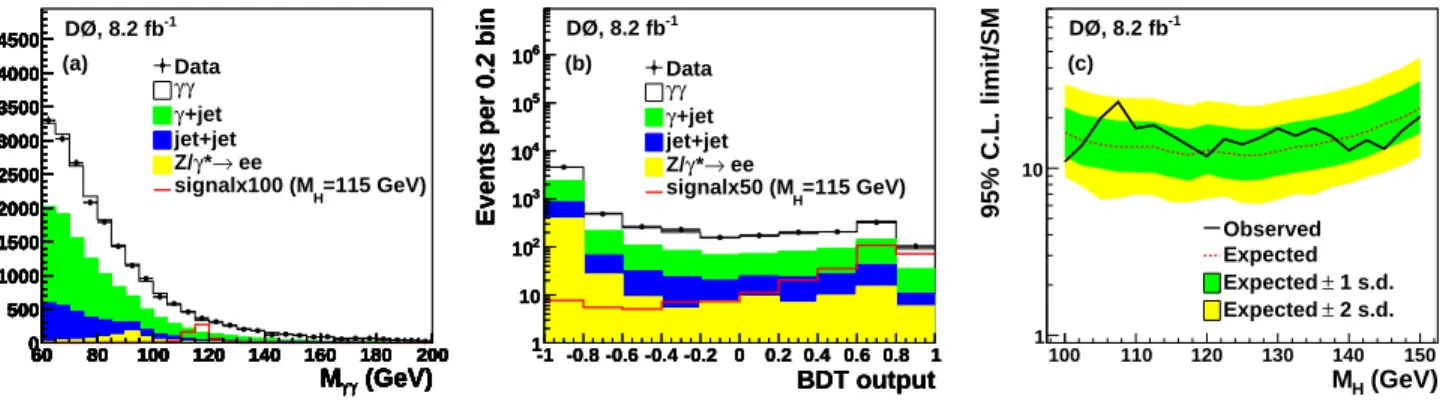
T, p 2
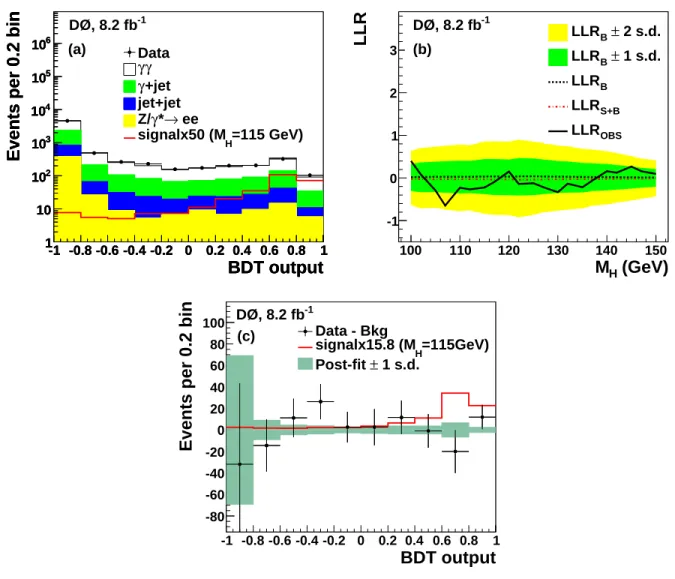
T). Figure 1(a) shows a comparison of the Mγγ distribution between data and the background pre-diction. Comparisons for other kinematic distributions can be found in Ref. [12]. A boosted-decision-tree (BDT) technique [24] is used to build a single discriminant able combining the information from the above five vari-ables. A different BDT is trained for each MH hypoth-esis, separately for the SM and the fermiophobic Higgs boson models. In each model, the training is performed to discriminate between the sum of all relevant signals and the sum of all backgrounds. Figure 1(b) shows a comparison of the BDT output distribution between data and background prediction corresponding to the SM for MH= 115 GeV.
Systematic uncertainties affecting the normalization and shape of the BDT output distribution are estimated for both signal and backgrounds, taking into account cor-relations. The sources of systematic uncertainties affect-ing the signal and ZDY background normalizations in-clude the integrated luminosity (6.1%), photon identifica-tion efficiency for signal (3.9%) or electron misidentifica-tion rate for ZDY (12.7%) and theoretical cross secmisidentifica-tions (including scale and PDF uncertainties) for signal (GF (14.1%), VH (6.2%) and VBF (4.9%)) and ZDY (3.9%) production. The normalization uncertainty affecting the γj+jj prediction is 8.4%. This uncertainty results from propagating the uncertainty on the ON N > 0.75 effi-ciency for photons (1.5%) and jets (10%) and also affects the shape of the γj+jj background at the 1%-2% level through changes in the fractions of γj and jj. Addi-tional systematic uncertainties affecting the differential distributions of data and MC include the relative pho-ton energy scale (1%-5% for signal, 1%-4% for DDP),
(GeV)
γ γ
M
60 80 100 120 140 160 180 200
Events per 5 GeV bin
0 500 1000 1500 2000 2500 3000 3500 4000 4500 Data γ γ +jet γ jet+jet ee → * γ Z/ =115 GeV) H signalx100 (M -1 DØ, 8.2 fb (a) (GeV) γ γ M 60 80 100 120 140 160 180 200
Events per 5 GeV bin
0 500 1000 1500 2000 2500 3000 3500 4000 4500 (GeV) γ γ M 60 80 100 120 140 160 180 200
Events per 5 GeV bin
0 500 1000 1500 2000 2500 3000 3500 4000 4500 (GeV) γ γ M 60 80 100 120 140 160 180 200
Events per 5 GeV bin
0 500 1000 1500 2000 2500 3000 3500 4000 4500 (GeV) γ γ M 60 80 100 120 140 160 180 200
Events per 5 GeV bin
0 500 1000 1500 2000 2500 3000 3500 4000 4500 (GeV) γ γ M 60 80 100 120 140 160 180 200
Events per 5 GeV bin
0 500 1000 1500 2000 2500 3000 3500 4000 4500 (GeV) γ γ M 60 80 100 120 140 160 180 200
Events per 5 GeV bin
0 500 1000 1500 2000 2500 3000 3500 4000 4500 (GeV) γ γ M 60 80 100 120 140 160 180 200
Events per 5 GeV bin
0 500 1000 1500 2000 2500 3000 3500 4000 4500 BDT output -1 -0.8 -0.6 -0.4 -0.2 0 0.2 0.4 0.6 0.8 1
Events per 0.2 bin
1 10 2 10 3 10 4 10 5 10 6 10 Data γ γ +jet γ jet+jet ee → * γ Z/ =115 GeV) H signalx50 (M -1 DØ, 8.2 fb (b) BDT output -1 -0.8 -0.6 -0.4 -0.2 0 0.2 0.4 0.6 0.8 1
Events per 0.2 bin
1 10 2 10 3 10 4 10 5 10 6 10 BDT output -1 -0.8 -0.6 -0.4 -0.2 0 0.2 0.4 0.6 0.8 1
Events per 0.2 bin
1 10 2 10 3 10 4 10 5 10 6 10 (GeV) H M 100 110 120 130 140 150 95% C.L. limit/SM 1 10 Observed Expected 1 s.d. ± Expected 2 s.d. ± Expected -1 DØ, 8.2 fb (c)
FIG. 1: (color online). (a) Mγγ and (b) BDT output distributions for MH = 115 GeV after the final selection comparing data to the background prediction. The expected H boson signal multiplied by a factor of 50 is also shown. (c) Observed and expected 95% C.L. upper limits on σ × B relative to the SM prediction as a function of MH. The bands correspond to the ± 1 and ± 2 standard deviations (s.d.) around the expected limit under the background-only hypothesis.
(GeV)
f HM
100 110 120 130 140 150)
γγ
→
fB(H
-2 10 -1 10 1 Observed Expected 1 s.d. ± Expected 2 s.d. ± Expected prediction f H LEP limit -1 DØ, 8.2 fbFIG. 2: (color online). Observed and expected 95% C.L. upper limits on B(Hf → γγ) as a function of MHf. The defi-nition of the bands are the same as in Fig. 1(c). The blue line represents the branching ratio predictions from hdecay [20]. Also displayed is the exclusion region obtained by the LEP Collaborations [27].
DDP modeling (1%-10%) and Higgs boson pT modeling in GF (1%-5%). Modeling uncertainties are obtained by changing the factorization and renormalization scales by a factor of two with respect to the nominal choice.
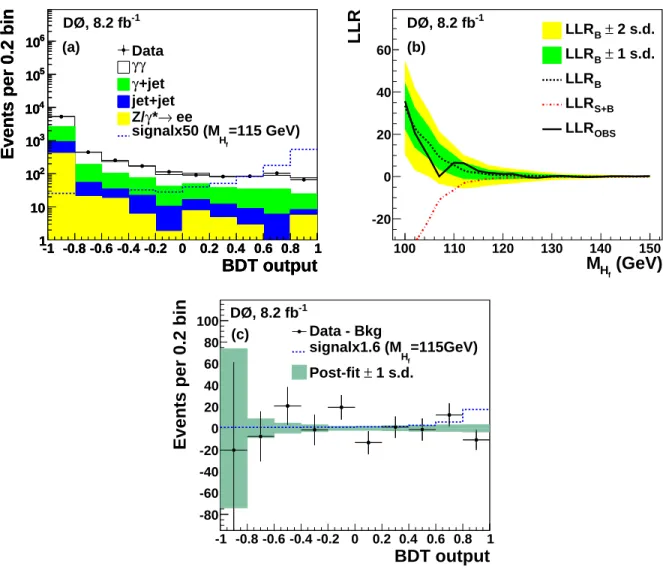
No evidence for a signal, either in the SM or in the fermiophobic interpretations, is found, and the BDT dis-criminants are used to derive upper limits on the produc-tion cross secproduc-tion multiplied by the branching ratio for H → γγ (σ × B) as a function of MH. Limits are cal-culated at the 95% C.L. with the CLSmodified frequen-tist approach using a log-likelihood ratio of the signal-plus-background (S+B) hypothesis to the background-only (B) hypothesis [25]. Systematic uncertainties are
taken into account by convoluting the Poisson probabil-ity distributions for signal and background with the cor-responding Gaussian distributions. The individual like-lihoods are maximized with respect to the DDP back-ground normalization as well as parameters that describe the systematic uncertainties [26]. This fit allows the determination of the normalization for the DDP back-ground from data and significantly reduces the impact of systematic uncertainties on the overall sensitivity.
The resulting upper limits on σ × B relative to the SM prediction as a function of MH are shown in Fig. 1(c), representing the most constraining results for a SM Higgs boson decaying into photons. Upper limits on B(Hf → γγ) as a function of MHf are presented in Fig. 2 and
com-pared to the LEP result [27]. The sensitivity is improved by about a factor of two relative to previous searches at the Tevatron [7], yielding the most stringent limits on a fermiophobic Higgs boson of MHf > 112.9 GeV at
95% C.L.
Supplementary material is provided in [12].
We thank the staffs at Fermilab and collaborating institutions, and acknowledge support from the DOE and NSF (USA); CEA and CNRS/IN2P3 (France); FASI, Rosatom and RFBR (Russia); CNPq, FAPERJ, FAPESP and FUNDUNESP (Brazil); DAE and DST (In-dia); Colciencias (Colombia); CONACyT (Mexico); KRF and KOSEF (Korea); CONICET and UBACyT (Ar-gentina); FOM (The Netherlands); STFC and the Royal Society (United Kingdom); MSMT and GACR (Czech Republic); CRC Program and NSERC (Canada); BMBF and DFG (Germany); SFI (Ireland); The Swedish Re-search Council (Sweden); and CAS and CNSF (China).
[1] R. Barate et al. (LEP Working Group for Higgs Boson Searches), Phys. Lett. B 565, 61 (2003).
[2] LEP, Tevatron ad SLD Electroweak Working Groups, arXiv:1012.2367 [hep-ex].
[3] T. Aaltonen et al. (CDF and D0 Collaborations), Phys. Rev. Lett. 104, 061802 (2010); Tevatron New Phenom-ena and Higgs Working Group, arXiv:1103.3233 [hep-ex]. [4] B. Holdom et al., PMC Phys. A 3, 4 (2009).
[5] S. Mrenna and J. Wells, Phys. Rev. D 63, 015006 (2000). [6] V.M. Abazov et al. (D0 Collaboration), Phys. Rev. Lett.
102, 231801 (2009).
[7] T. Affolder et al. (CDF Collaboration), Phys. Rev. Lett 103, 061803 (2009); V.M. Abazov et al. (D0 Collabora-tion), Phys. Rev. Lett. 101, 051801 (2008).
[8] V.M. Abazov et al. (D0 Collaboration), Nucl. Instrum. Methods Phys. Res. A 565, 463 (2006); M. Abolins et al. (D0 Collaboration), Nucl. Instrum. Methods Phys. Res. A 584, 75 (2008); R. Angstadt et al. (D0 Collaboration), Nucl. Instrum. Methods Phys. Res. A 622, 298 (2010). [9] Pseudorapidity is defined as η = − ln[tan(θ/2)], where θ
is the polar angle relative to the proton beam direction and φ is the azimuthal angle in the plane transverse to the proton beam direction.
[10] T. Andeen et al., FERMILAB-TM-2365 (2007).
[11] V.M. Abazov et al., (D0 Collaboration), Phys. Lett. B 659, 856 (2008).
[12] See supplementary material appended for information on theoretical predictions for signal, comparisons of data and predicted backgrounds, and the cross section limits. [13] T. Sj¨ostrand et al., J. High Energy Phys. 05, 026 (2006). [14] T. Gleisberg et al., J. High Energy Phys. 02, 007 (2009). [15] J. Pumplin et al., J. High Energy Phys. 07, 012 (2002); D. Stump et al., J. High Energy Phys. 10, 046 (2003).
[16] R. Brun and F. Carminati, CERN Program Library Long Writeup W5013, 1993.
[17] C. Anastasiou, R. Boughezal, and F. Petriello, J. High Energy Phys. 04, 003 (2009); D. Florian and M. Grazzini, Phys. Lett. B 674, 291 (2009).
[18] J. Baglio and A. Djouadi, J. High Energy Phys. 10, 064 (2010).
[19] P. Bolzoni, F. Maltoni, S.-O. Moch, and M. Zaro, Phys. Rev. Lett. 105, 011801 (2010).
[20] A. Djouadi, J. Kalinowski, and M. Spira, Comput. Phys. Commun. 108, 56 (1998).
[21] R. Hamberg, W. L. van Neerven, and T. Matsuura, Nucl. Phys. B 359, 343 (1991) [Erratum-ibid. B 644, 403 (2002)].
[22] D. Acosta et al. (CDF Collaboration), Phys. Rev. Lett. 95, 022003 (2005).
[23] V.M. Abazov et al., (D0 Collaboration), Phys. Lett. B 690, 108 (2010).
[24] A. Hoecker et al., arXiv:physics/0703039 [physics.data-an]; A. Hoecker et al., PoS (ACAT) 040 (2007). [25] T. Junk, Nucl. Intrum. Methods A 434, 435 (1999);
A. Read, J. Phys G 28, 2693 (2002). [26] W. Fisher, FERMILAB-TM-2386-E (2006).
[27] A. Heister et al. (ALEPH Collaboration), Phys. Lett. B 544, 16 (2002); P. Abreu et al. (DELPHI Collabo-ration), Eur. Phys. J. C 35, 313, (2004); P. Achard et al. (L3 Collaboration), Phys. Lett. B 568, 191 (2003); G. Abbiendi et al. (OPAL Collaboration), Phys. Lett. B 544, 44 (2002); A. Rosca (LEP Collaborations), arXiv:hep-ex/0212038.
Supplementary material
NN
O
0 0.1 0.2 0.3 0.4 0.5 0.6 0.7 0.8 0.9 1
Fraction of events per 0.05 bin
0.05 0.1 0.15 0.2 0.25 0.3 0.35 0.4
) data
µ
(l=e,
γ
+
-l
+l
→
Z
MC
γ
jet MC
-1DØ, 8.2 fb
FIG. 3: Normalized ON N spectrum for photons from radiative Z boson decays, photons from diphoton MC and jets from dijet MC. The ON N distribution has strong discriminanting power between photons and jets, and the performances in photon data and MC are consistent.
TABLE II: Cross sections for the different Higgs boson production mechanisms and branching fractions for the SM Higgs boson decays into two photons (B(H → γγ)) and for fermiophobic Higgs boson decays into two photons (B(Hf → γγ)) as a function of MH. MH (GeV) σgg→H (fb) σW H (fb) σZH (fb) σV BF (fb) B(H → γγ) (%) B(Hf→ γγ) (%) 100 1821.8 291.9 168.9 100.1 0.159 18.46 105 1584.7 248.4 145.9 92.3 0.178 10.42 110 1385.0 212.0 125.7 85.1 0.197 6.027 115 1215.9 174.5 103.9 78.6 0.213 3.658 120 1072.3 150.1 90.2 72.7 0.225 2.334 125 949.3 129.5 78.5 67.1 0.230 1.556 130 842.9 112.0 68.5 62.1 0.226 1.073 135 750.8 97.2 60.0 57.5 0.214 0.7586 140 670.6 84.6 52.7 53.2 0.194 0.5441 145 600.6 73.7 46.3 49.4 0.168 0.3902 150 539.1 64.4 40.8 45.8 0.137 0.2733
TABLE III: Expected and observed upper limits at 95% C.L. on σ × B (H → γγ) and on the ratio relative to the SM prediction for a SM Higgs boson as a function of MH.
MH (GeV) 100 102.5 105 107.5 110 112.5 115 117.5 120 122.5 125 Expected σ × B (fb) 61.9 55.3 51.4 48.7 47.9 46.6 42.0 38.9 40.1 36.7 33.7 Observed σ × B (fb) 41.6 52.0 73.2 91.0 61.8 62.7 52.9 44.4 36.8 44.3 39.1 Expected σ × B/SM 16.3 14.7 13.9 13.4 13.5 13.5 12.5 12.0 12.9 12.4 12.0 Observed σ × B/SM 11.0 13.9 19.9 25.0 17.4 18.2 15.8 13.7 11.8 15.0 13.9 MH (GeV) 127.5 130 132.5 135 137.5 140 142.5 145 147.5 150 Expected σ × B (fb) 31.7 31.0 30.4 28.4 27.2 25.7 24.5 23.8 22.5 21.6 Observed σ × B (fb) 40.3 42.5 35.4 36.0 29.3 21.4 21.8 16.9 18.8 19.3 Expected σ × B/SM 12.0 12.6 13.4 13.7 14.6 15.4 16.6 18.4 20.2 22.9 Observed σ × B/SM 15.3 17.3 15.7 17.4 15.7 12.8 14.7 13.1 16.8 20.4
(GeV)
γ γ
M
60 80 100 120 140 160 180 200
Events per 5 GeV bin
0 500 1000 1500 2000 2500 3000 3500 4000 4500 Data γ γ +jet γ jet+jet ee → * γ Z/ =115 GeV) H signalx50 (M =115 GeV) f H signalx50 (M -1 DØ, 8.2 fb (a)
(GeV)
γ γM
60 80 100 120 140 160 180 200Events per 5 GeV bin
0 500 1000 1500 2000 2500 3000 3500 4000 4500
(GeV)
γ γM
60 80 100 120 140 160 180 200Events per 5 GeV bin
-1 10 1 10 2 10 3 10 4 10 5 10 6 10 7 10 8 10 9 10 Data γ γ +jet γ jet+jet ee → * γ Z/ =115 GeV) H signalx50 (M =115 GeV) f H signalx50 (M -1 DØ, 8.2 fb (b)
(GeV)
γ γM
60 80 100 120 140 160 180 200Events per 5 GeV bin
-1 10 1 10 2 10 3 10 4 10 5 10 6 10 7 10 8 10 9 10
(GeV)
γ γ Tp
0 10 20 30 40 50 60 70 80 90 100Events per 5 GeV bin
0 1000 2000 3000 4000 5000 6000 7000 Data γ γ +jet γ jet+jet ee → * γ Z/ =115 GeV) H signalx50 (M =115 GeV) f H signalx50 (M -1 DØ, 8.2 fb (c)
(GeV)
γ γ Tp
0 10 20 30 40 50 60 70 80 90 100Events per 5 GeV bin
0 1000 2000 3000 4000 5000 6000 7000
(GeV)
γ γ Tp
0 10 20 30 40 50 60 70 80 90 100Events per 5 GeV bin
-1 10 1 10 2 10 3 10 4 10 5 10 6 10 7 10 8 10 9 10 Data γ γ +jet γ jet+jet ee → * γ Z/ =115 GeV) H signalx50 (M =115 GeV) f H signalx50 (M -1 DØ, 8.2 fb (d)
(GeV)
γ γ Tp
0 10 20 30 40 50 60 70 80 90 100Events per 5 GeV bin
-1 10 1 10 2 10 3 10 4 10 5 10 6 10 7 10 8 10 9 10 γ γ
φ
∆
0 0.5 1 1.5 2 2.5 3bin
π
Events per 0.05
0 2000 4000 6000 8000 10000 12000 14000 16000 Data γ γ +jet γ jet+jet ee → * γ Z/ =115 GeV) H signalx50 (M =115 GeV) f H signalx50 (M -1 DØ, 8.2 fb (e) γ γφ
∆
0 0.5 1 1.5 2 2.5 3bin
π
Events per 0.05
0 2000 4000 6000 8000 10000 12000 14000 16000 γ γφ
∆
0 0.5 1 1.5 2 2.5 3bin
π
Events per 0.05
-1 10 1 10 2 10 3 10 4 10 5 10 6 10 7 10 8 10 9 10 10 10 Data γ γ +jet γ jet+jet ee → * γ Z/ =115 GeV) H signalx50 (M =115 GeV) f H signalx50 (M -1 DØ, 8.2 fb (f) γ γφ
∆
0 0.5 1 1.5 2 2.5 3bin
π
Events per 0.05
-1 10 1 10 2 10 3 10 4 10 5 10 6 10 7 10 8 10 9 10 10 10FIG. 4: Variables used as input to the BDT: (a, b) Mγγ, (c, d) pγγT and (e, f) ∆φγγ, in linear scale (left column) and logarithmic scale (right column). Data are compared to the background prediction. Also shown is the expected signal for a SM Higgs boson (MH= 115 GeV) and a fermiophobic Higgs boson (MHf = 115 GeV) both multiplied by a factor of 50. For the fermiophobic Higgs boson, the GF production is absent and the diphoton system is on average more boosted.
(GeV)
1 T
p
20 30 40 50 60 70 80 90 100
Events per 5 GeV bin
0 1000 2000 3000 4000 5000 6000 Data γ γ +jet γ jet+jet ee → * γ Z/ =115 GeV) H signalx50 (M =115 GeV) f H signalx50 (M -1 DØ, 8.2 fb (a)
(GeV)
1 Tp
20 30 40 50 60 70 80 90 100Events per 5 GeV bin
0 1000 2000 3000 4000 5000 6000
(GeV)
1 Tp
20 30 40 50 60 70 80 90 100Events per 5 GeV bin
-1 10 1 10 2 10 3 10 4 10 5 10 6 10 7 10 8 10 9 10 Data γ γ +jet γ jet+jet ee → * γ Z/ =115 GeV) H signalx50 (M =115 GeV) f H signalx50 (M -1 DØ, 8.2 fb (b)
(GeV)
1 Tp
20 30 40 50 60 70 80 90 100Events per 5 GeV bin
-1 10 1 10 2 10 3 10 4 10 5 10 6 10 7 10 8 10 9 10
(GeV)
2 Tp
20 30 40 50 60 70 80 90 100Events per 5 GeV bin
0 2000 4000 6000 8000 10000 Data γ γ +jet γ jet+jet ee → * γ Z/ =115 GeV) H signalx50 (M =115 GeV) f H signalx50 (M -1 DØ, 8.2 fb (c)
(GeV)
2 Tp
20 30 40 50 60 70 80 90 100Events per 5 GeV bin
0 2000 4000 6000 8000 10000
(GeV)
2 Tp
20 30 40 50 60 70 80 90 100Events per 5 GeV bin
-1 10 1 10 2 10 3 10 4 10 5 10 6 10 7 10 8 10 9 10 Data γ γ +jet γ jet+jet ee → * γ Z/ =115 GeV) H signalx50 (M =115 GeV) f H signalx50 (M -1 DØ, 8.2 fb (d)
(GeV)
2 Tp
20 30 40 50 60 70 80 90 100Events per 5 GeV bin
-1 10 1 10 2 10 3 10 4 10 5 10 6 10 7 10 8 10 9 10
FIG. 5: Variables used as input to the BDT: (a, b) leading photon pT and (c, d) trailing photon pT, in linear scale (left column) and logarithmic scale (right column). Data are compared to the background prediction. Also shown is the expected signal for a SM Higgs boson (MH= 115 GeV) and a fermiophobic Higgs boson (MHf = 115 GeV) both multiplied by a factor of 50. For the fermiophobic Higgs boson, the GF production is absent and the diphoton system is on average more boosted.
TABLE IV: Expected and observed upper limits at 95% C.L. on the cross section times branching ratio for Hf → γγ (σ × B) and on the branching ratio (B) for a fermiophobic Higgs boson as a function of Higgs boson mass.
MHf (GeV) 100 102.5 105 107.5 110 112.5 115 117.5 120 122.5 125 Expected σ × B (fb) 29.5 26.3 23.1 22.4 22.5 23.4 22.5 22.8 20.8 17.8 14.8 Observed σ × B (fb) 26.0 28.4 31.4 37.8 20.7 16.8 20.4 20.2 18.8 16.3 18.7 Expected B (%) 5.2 5.0 4.7 4.9 5.3 6.0 6.3 6.8 6.6 6.1 5.4 Observed B (%) 4.6 5.4 6.5 8.3 4.9 4.3 5.7 6.0 6.0 5.6 6.8 MHf (GeV) 127.5 130 132.5 135 137.5 140 142.5 145 147.5 150 Expected σ × B (fb) 14.5 14.5 14.5 13.9 13.3 12.7 12.5 12.3 11.4 11.2 Observed σ × B (fb) 19.7 14.9 13.1 15.9 16.2 13.4 10.7 10.1 9.6 6.8 Expected B (%) 5.6 6.0 6.3 6.5 6.6 6.6 7.0 7.3 7.1 7.4 Observed B (%) 7.6 6.2 5.7 7.4 8.0 7.0 6.0 6.0 6.0 4.5
BDT output
-1 -0.8 -0.6 -0.4 -0.2 0 0.2 0.4 0.6 0.8 1
Events per 0.2 bin
1 10 2 10 3 10 4 10 5 10 6 10 Data γ γ +jet γ jet+jet ee → * γ Z/ =115 GeV) H signalx50 (M -1 DØ, 8.2 fb (a)
BDT output
-1 -0.8 -0.6 -0.4 -0.2 0 0.2 0.4 0.6 0.8 1Events per 0.2 bin
1 10 2 10 3 10 4 10 5 10 6 10
BDT output
-1 -0.8 -0.6 -0.4 -0.2 0 0.2 0.4 0.6 0.8 1Events per 0.2 bin
1 10 2 10 3 10 4 10 5 10 6 10
(GeV)
HM
100 110 120 130 140 150LLR
-1 0 1 2 3 2 s.d. ± B LLR 1 s.d. ± B LLR B LLR S+B LLR OBS LLR -1 DØ, 8.2 fb (b)BDT output
-1 -0.8 -0.6 -0.4 -0.2 0 0.2 0.4 0.6 0.8 1Events per 0.2 bin
-80 -60 -40 -20 0 20 40 60 80 100 Data - Bkg =115GeV) H signalx15.8 (M 1 s.d. ± Post-fit -1 DØ, 8.2 fb (c)
FIG. 6: SM Higgs search: (a) Distributions of the BDT output after the final selection comparing data to the background prediction. The expected signal multiplied by a factor of 50 is also shown for MH = 115 GeV. (b) Observed log-likelihood ratio (LLR) as a function of MH compared to the expected LLR for the background-only hypothesis and signal+background hypothesis. The bands correspond to the ± 1 and ± 2 standard deviations (s.d.) around the expected LLR for the background-only hypothesis. (c) BDT dependence of the difference between data and expected background for MH = 115 GeV. The expected signal is normalized to the observed limit on σ × B. The bands represent the post-fit systematic uncertainties.
BDT output
-1 -0.8 -0.6 -0.4 -0.2 0 0.2 0.4 0.6 0.8 1
Events per 0.2 bin
1 10 2 10 3 10 4 10 5 10 6 10 Data γ γ +jet γ jet+jet ee → * γ Z/ =115 GeV) f H signalx50 (M -1 DØ, 8.2 fb (a)
BDT output
-1 -0.8 -0.6 -0.4 -0.2 0 0.2 0.4 0.6 0.8 1Events per 0.2 bin
1 10 2 10 3 10 4 10 5 10 6 10
BDT output
-1 -0.8 -0.6 -0.4 -0.2 0 0.2 0.4 0.6 0.8 1Events per 0.2 bin
1 10 2 10 3 10 4 10 5 10 6 10
(GeV)
f HM
100 110 120 130 140 150LLR
-20 0 20 40 60 2 s.d. ± B LLR 1 s.d. ± B LLR B LLR S+B LLR OBS LLR -1 DØ, 8.2 fb (b)BDT output
-1 -0.8 -0.6 -0.4 -0.2 0 0.2 0.4 0.6 0.8 1Events per 0.2 bin
-80 -60 -40 -20 0 20 40 60 80 100 Data - Bkg =115GeV) f H signalx1.6 (M 1 s.d. ± Post-fit -1 DØ, 8.2 fb (c)
FIG. 7: Fermiophobic Higgs search: (a) Distributions of the BDT output after final selection comparing data to the background prediction. The expected signal multiplied by a factor of 50 is shown for MHf = 115 GeV. (b) Observed log-likelihood ratio (LLR) as a function of MHf compared to the expected LLRs for the background-only hypothesis and signal+background hypothesis. The bands correspond to the ± 1 and ± 2 standard deviations (s.d.) around the expected LLR for the background-only hypothesis. (c) BDT dependence of the difference between data and expected background for MHf = 115 GeV. The expected signal is normalized to the observed limit on σ × B. The bands represent the post-fit systematic uncertainties.
![TABLE I: Signal, backgrounds and data yields for M H = 100 GeV to 150 GeV in 10 GeV intervals within the [M H - 30 GeV, M H + 30 GeV] mass window](https://thumb-eu.123doks.com/thumbv2/123doknet/14040251.458941/5.918.185.745.173.307/table-signal-backgrounds-data-yields-gev-intervals-window.webp)