HAL Id: hal-00521132
https://hal.archives-ouvertes.fr/hal-00521132
Submitted on 25 Sep 2010HAL is a multi-disciplinary open access archive for the deposit and dissemination of sci-entific research documents, whether they are pub-lished or not. The documents may come from teaching and research institutions in France or abroad, or from public or private research centers.
L’archive ouverte pluridisciplinaire HAL, est destinée au dépôt et à la diffusion de documents scientifiques de niveau recherche, publiés ou non, émanant des établissements d’enseignement et de recherche français ou étrangers, des laboratoires publics ou privés.
AGENCIES IN EMERGING ECONOMIES
Roselene de Queiroz Chaves, Luiz Carlos Federizzi
To cite this version:
Roselene de Queiroz Chaves, Luiz Carlos Federizzi. TOWARDS A NATIONAL INNOVATION FRAMEWORK FOR AGRICULTURAL SCIENCE AGENCIES IN EMERGING ECONOMIES. ISDA 2010, Jun 2010, Montpellier, France. 10 p. �hal-00521132�
TOWARDS A NATIONAL INNOVATION
FRAMEWORK FOR AGRICULTURAL SCIENCE
AGENCIES IN EMERGING ECONOMIES
Roselene de Queiroz CHAVES*, Luiz Carlos FEDERIZZI** *Brazilian Agricultural Research Corporation (EMBRAPA)
Goiânia – Goiás – Brazil [email protected]
**Federal University of Rio grande do Sul (UFRGS) Porto Alegre – Rio Grande do Sul – Brazil
Abstract - The national science agencies have had a great role in the context of emerging economies catching-up. This paper
addresses the search to a better understanding of strategies for emerging economies whose agricultural sector is a key economic area. The paper presents the context of the emerging economies, noting briefly some of the factors about their agricultural R&D; introduces the concept of a national innovation framework and outlines some insights from the NAIS (national agricultural innovation system). Additionally, the paper will offer a framework for these countries to select and adapt data sets, tools and methodologies needed to assist policy decision makers as they want to invest in national agricultural R&D. This theoretical essay’s key contribution is conceptual and methodological: the development of a framework towards a more evidence-based understanding of what happens to given R&D investments. The applied framework is used in the analysis of the innovativeness and success of past investments that have succeeded, which can help policymakers to develop sound and cost-effective investment strategies, and also mapping the loci were they should apply metrics and evaluations to guide their agricultural science policy decisions. This could be useful as an analytical tool and as a tool for promoting sustainable economic growth and well-being in the emerging economies.
Keywords: public research, NAIS (national agricultural innovation system), science of science policy, STI (Science,
Technology and Innovation), investment strategies.
Résumé - Les organismes fédéraux à vocation scientifique ont un grand rôle dans le contexte des économies émergentes en
phase de rattrapage. Ce document traite de la recherche à une meilleure compréhension des stratégies pour les économies émergentes où le secteur agricole est un secteur économique clé. Le document présente le contexte des économies émergentes, en notant brièvement certains des facteurs de leur R&D pour l’agriculture; introduit le concept d'un cadre pour l'innovation du gouvernement fédéral et décrit quelques aperçus de la NAIS (système national d'innovation agricole). En outre, le document offre un cadre pour ces pays de choisir et d'adapter les ensembles de données, des outils et méthodes nécessaires pour aider les décideurs politiques quand ils veulent investir dans les activités fédérales de R&D agricole Cette essai théorique donne une contribuition conceptuel et méthodologique: l'élaboration d'un cadre vers une compréhension plus factuelle de ce qui arrive à donner des investissements en R&D. Le cadre retenu est utilisé dans l'analyse de l'innovation et le succès des investissements passés qui ont réussi, ce qui peut aider les décideurs à élaborer stratégies rentables de l'investissement. Cela peut être utile comme outil d'analyse et comme outil de promotion de la croissance économique durable et le bien-être dans les économies émergentes.
Mots clés: la recherche publique, NAIS (système national d'innovation agricole), les politiques de recherche, STI (Science,
INTRODUCTION
National investments in science and technology have had an enormous impact on innovation, economic growth, and social health and well-being. Public agricultural science is one of the major science challenges that would benefit from science-technology-innovation (STI) policy analysis and decision making, since it copes with strategically important frontiers such as mitigating the consequences of global climate change, exploring new energy sources, and maintaining international competitiveness. Therefore, the allocation of national resources across the national agricultural research and development (R&D) portfolio must be guided by the best data and analysis available.
The effort to study STI policy as an agent of change require the use of diverse research methods informed by a range of disciplinary, interdisciplinary and multidisciplinary perspectives from a vast array of actors, institutions, and strategies that are involved in knowledge, expertise, and infrastructure (Feller, 2006). To cope with this complex environment the public science agencies need a logical framework which involves organizational establishment, management, deployment, and dissemination of a portfolio of studies and associated findings that provide defensible and relevant information to decision makers.
Government-supported programs have been very effective in the several successful cases of economic catching-up. Looking at the specific case of the national agricultural science agencies, they have had a great role in the context of emerging economies, mainly in the sense of giving a kind of resilience to the agricultural sector of these countries to face the global economic crisis by fostering indigenous technologies tailored to national conditions. In this way, Mazzoleni & Nelson (2007) provide an illuminating picture of the kinds of structures and conditions under which publicly supported research contributes importantly to economic development and cite the case of the Brazilian agricultural R&D public sector corporation (EMBRAPA) like an example that effectively contributed to Brazilian catch-up. Because the agri-food sector plays a vital role in the economic health in many of these countries, and economic catch-up was strongly supported by the R&D from public research institutions (Mazzoleni & Nelson, 2007), a national agricultural innovation system for these countries seems to be a loci of decision-making where better understanding of, and discussion about, the way to develop sound and cost-effective investment strategies might make a difference.
This is a theoretical essay that aims to suggest a strategy for emerging economies, whose agricultural sector is a key economic area, to select and adapt data sets, tools and methodologies needed to assist science policy decision-makers as they invest in national agricultural R&D. The paper proposes a framework towards a more evidence-based understanding of what happens to given R&D investments. The work is organized as follows. Section 1 presents the context of the emerging economies, noting briefly some of the factors about their agricultural R&D. Section 2 introduces the concept of a national innovation framework and gives some steps of the proposed framework and Section 3 outlines some insights from the NAIS (national agricultural innovation system). Section 4 presents the agricultural science agencies as loci of decision-making and as the heart of the proposed framework and Section 5 provides concluding remarks.
1) EMERGING ECONOMIES AND AGRICULTURAL R&D
Much of the world’s scientific research, development, and innovations have been concentrated in the 30 member nations of the Organization for Economic Co-operation and Development (OECD). However, countries outside the OECD have been increasing their scientific and engineering capabilities (S&E) and are rivaling the OECD member countries. The particular interest here is focused on both the top most-rapidly developing economies and also on the major agricultural economies outside the OECD area. Thus, this work by begins looking at four countries that are simultaneously part of the top five most rapidly developing economies, the “+ 5” of the so-called G8+5 (Brazil, China, India, Mexico and South Africa) and the four major agricultural economies outside the OECD area: Brazil, China, India and South Africa.
Towards a national innovation framework for agricultural science agencies in emerging economies
Chaves, RQ and Federizzi, LC
One indicator of scientific research capability is the production of scientific and engineering articles in the world’s leading scientific and engineering journals. Brazil, China, India, Russia, and Taiwan lead S&E article output of non-OECD countries (NSF, 2007). China is now dominant among the five and among all non-OECD countries. The physical sciences (earth and space sciences, including astronomy; chemistry; and physics) and mathematics dominate the S&E portfolio of China, India, and Russia. In contrast, more than half of Brazil’s S&E portfolio is comprised of the life sciences (including agricultural science). With respect to the rate of international collaboration, as measured by the share of published articles with international co-authors during this period (1993-2003), it is increased markedly in Russia and India, rose in Taiwan, showed little change in China and declined in Brazil (NSF, 2007).
From a public policy perspective, the OECD (2008) provides an individual profile of the science and innovation performance of each OECD country and of some emerging economies, in relation to their national context and current policy issues. These profiles enable countries to see some of their relative strengths and weaknesses as compared to others countries’ performance. They focus on research and innovation inputs, scientific and innovation outputs, linkages and networks, including international linkages, and human resources. Brazil’s case is meaningful here because 53% of national expenditure in R&D is government-supported versus 25% in China, for example and agricultural science is a key area of investment of science and technology in Brazil (OECD, 2008). Thus, R&D and innovation issues in Brazilian agricultural science should be a central goal of policy, calling for a careful appreciation of its role in the context of a developing country’s national system of innovation.
Many of the major issues that face both developed and developing economies center around the management of science and technology. The development of countries that have not yet reached the technology frontier requires more than just the rapid diffusion of available technology. To achieve effective use of research and technology, it is necessary to utilize existing knowledge of individual and institutional behavior. Agricultural and rural development also plays an important role in economic advancement below the technology frontier (Ruttan, 2008).
Because food is a basic necessity, the agriculture sector is showing more resilience to the global economic crisis than other industries, though the risks to profit could increase if the economic downturn deepens, according to a new report by the OECD and Food and Agricultural Organization of the United Nations (OECD-FAO, 2009). The pathway for this resilience is strongly based on governments supporting domestic agricultural development through targeted policies such as infrastructure investment and through establishing effective research and development systems. The picture from these data presented thus far shows that the major agricultural emerging economies will face great challenges ahead to cope adequately with the immediate financial crises and simultaneously build the foundation for long-term innovation. The importance of this challenge derives from the magnitude and centrality of the contribution that agricultural science and technology make to their economies. In Brazil, for example, the strong indigenous agricultural R&D enabled agro-food exports to grow rapidly since 2002, and account for 30% of exports in 2008. With a share of only 5%, the agro-food sector is responsible for 97% of the country’s balance of trade surplus (OECD, 2009).
At the same time, public research institutions and research policies in many developing countries have recently gone through major transformations. The changes sought to increase research impacts through the introduction of new priority-setting mechanisms that usually rely on more formal planning methods. These include management by objectives and emphasis on diversifying the sources of funding, especially competitive grants and sales of goods and services, which includes substantial reductions in direct budgetary allocations. The pressure on public research institutions to generate their own resources has forced them to concentrate on research with short-term objectives that responds to political need or to producing goods with market value, thus reducing the production of public goods (Byerlee & Alex, 1998).
Policy makers and researchers leading national agricultural scientific agencies in these countries, however, have to cope with the immediate financial crisis and at the same time solving some dilemmas on the focus of science and innovation like food versus fuel, and between high-yielding, input-intensive production versus low-productivity organic production. Similar struggles are playing out over long term investments in priorities such as climate change mitigation and adaptation, versus short – or medium – term investments in increasing food staple yields. Thus, science and technology policy and the choice of scientific investment in agriculture remain important for these emerging countries. Furthermore, the increasing complexity of technology development and adoption is rapidly changing the effectiveness of scientific and technological policies.
2) THE EMERGENCE AND DEVELOPMENT OF THE CONCEPT OF A NATIONAL INNOVATION FRAMEWORK
The concept of a National Innovation Framework is the heart of the Science of Science Policy (SoSP) initiative. This is an emerging field of interdisciplinary research, which goal is to provide a scientifically rigorous, quantitative basis from which policy makers and researches can assess the impacts of a nation’s scientific and engineering enterprise, improve their understanding of its dynamics, and assess the likely outcomes (OSTP, 2008). Research in SoSP could be utilized by the national government and the wider society in general, to make better R&D management decisions, which will enable them to develop sound and cost-effective investment strategies. The SoSP includes basic and applied research, as well as technology development, demonstration, and deployment.
The fields of science have different scientific cultures, and those differences affect innovation. The understanding of the dynamics of innovation is important to developing valid metrics and to deciding on fruitful policies (Mervis, 2006). So, the criteria most commonly used to date – citation analysis or other bibliometrics – seems to have a significant limitation, because they are science-neutral and field-independent. Explaining about the launching of SoSP, Mervis (2006) said that the initiative will give policymakers the ability to reliably evaluate returns received from past R&D investments and to forecast likely returns from future investments. It should be possible to develop a more evidence-based understanding of what happens to given R&D investments.
This is seen as especially important in regard to politically problematic areas of science and technology (such as over genetically modified organisms), because it is increasingly difficult to translate the surplus of available science information into a clear policy decision (Webster, 2007). Webster suggests a detailed analysis of the epistemic culture found within the social world of science policy making: what forms of knowledge measurement do members of the scientific civil service treat as reliable and robust and how are these performed through the informal and formal institutions of government? According to him, this understanding would provide an invaluable insight into the policy production process, its management of science and its own attempts to simplify—or “purify”—science as an object for policy making.
Since the managerial side of policy making emphasizes that only what can be measured can be managed, the numbers and indicators allow the creation of what is called a metric—a systematically constructed set of relationships between inputs and outputs, incomes and outcomes that purportedly measure efficiency and productivity (Nowotny, 2007). Therefore, according to Nowotny, if the science metrics case was intended as an invitation to enter the policy room, it would be better to keep a close and watchful eye on the new practices under construction in the many small policy rooms which are scattered all over the territory of R&D funding. This multitude of policy rooms in the ongoing construction are distributed (and competing for funding) throughout the government’s science and innovation system.
In order to make more informed and prioritized research investments, National agencies have a need to better understand the value of the knowledge likely to be produced from their research investments in real time. Failure to do so has very real consequences (OSTP, 2008). This was in essence the argument put forth by Maienschein (2006) with
Towards a national innovation framework for agricultural science agencies in emerging economies
Chaves, RQ and Federizzi, LC
respect to the fact that the history of national investments in science and technology in a given country should be used to illuminate the processes and forces that shape and effect change in science and policy, and help assess what sorts of outcome measures have been available, reliable, and informative with respect to defined goals at a given time and place.
In order to bring some coherence to the present discussion, this paper recommends looking at the criteria to measure innovativeness of policy that Altshuler & Zegans (1990) have proposed, as it aims to move towards a more evidence-based understanding of what happens to given R&D investments. The application of Altshuler-Zegans model for analyzing innovative policies will allow a better understanding of the value of the knowledge likely to be produced from research investments and can act as a tool to analyze the impact of policy instruments to understand the effects of national efforts that impact science policy.
Based on Altshuler & Zegans (1990), the criteria of novelty, quality, significance and replicability are useful to identify valuable innovative ways to perform government work at all levels of government agencies, to publicize them as sources of inspiration for other prospective innovators, and to develop curricular materials that may prove useful in training public officials to approach missions creatively. It seems to be useful in public science agencies, since authority is highly fragmented and top management turnover is rapid, and value conflict is endemic (Altshuler & Behn, 1997). Forecasting, however, tends to be perilous.
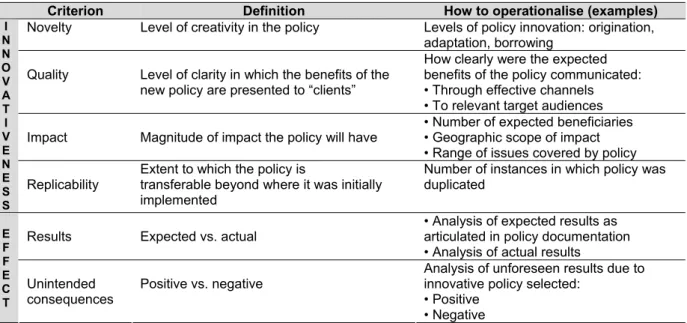
In addition to the methods presented above, Table 1 presents the criteria, the definition and how to operationalize the measure of innovativeness of the policy (cause), by the four criteria (novelty, quality, impact and replicability), and also the same information for measuring the effect of these innovative policies, measured by the results and unintended consequences. Thus, policies with high scores on the former criteria can be considered more innovative than those with lower scores. Similarly, policies with high scores on the later criteria can be considered more successful than those with lower scores.
Table 1. Measuring innovativeness and successfulness in policies.
Criterion Definition How to operationalise (examples)
Novelty Level of creativity in the policy Levels of policy innovation: origination, adaptation, borrowing
Quality Level of clarity in which the benefits of the new policy are presented to “clients”
How clearly were the expected benefits of the policy communicated: • Through effective channels • To relevant target audiences Impact Magnitude of impact the policy will have • Number of expected beneficiaries • Geographic scope of impact
• Range of issues covered by policy
I N N O V A T I V E N E S S
Replicability Extent to which the policy is transferable beyond where it was initially implemented
Number of instances in which policy was duplicated
Results Expected vs. actual • Analysis of expected results as articulated in policy documentation • Analysis of actual results
E F F E C T Unintended
consequences Positive vs. negative
Analysis of unforeseen results due to innovative policy selected:
• Positive • Negative Source: adapted from Altshuler and Zegan (1990).
3) INSIGHTS FROM NATIONAL AGRICULTURAL INNOVATION SYSTEM
Robert Solow (who won the Nobel Prize in Economics for his work on the impact of innovation on economic growth) has developed widely accepted theories that explain how investments in science and technology have a positive impact on economic growth (Solow, 1956). Many recent studies explain that innovation emerges in such “systems of innovation” (Edquist, 2005). The expression “national system of innovation” (NSI) was, in published form, first used in Freeman (1987). He defined it as the network of institutions in the public and
private sectors whose activities and interactions initiate, import and diffuse new technologies. The adoption of the innovation system approach to studying developing countries is a relatively recent phenomenon (Viotti, 2002), leading to a lack of data on many potentially useful aspects.
The innovation systems framework captures something more than a linear interpretation of innovation as a sequence of research, development and dissemination, or as a knowledge embodied in a technology. Innovation here is portrayed as a complex web of related individuals and organizations that all contribute to the generation, exchange and application of new or existing information and knowledge in processes of social and/or economic relevance. Thus, to move towards a more evidence-based understanding of what happens to a given R&D investment and to make science policy decisions, it seems to be useful to plan with this innovation infrastructure as a frame.
Because the innovation systems concept includes this broader set of relationships between actors and contexts, it potentially offers a framework for embedding innovation capacities in the rapidly changing market, technological, social, and political environment of contemporary agriculture in emerging countries (World Bank, 2006). Since one of the big challenges for science policy research, according to Sarewitz (2006), if it has any ambitions toward contributing to the public value of science policy itself, is to begin to seriously tackle the institutional ecology of knowledge creation and use. For a national innovation framework for agricultural science agencies, the agricultural innovation system seems to be a good frame for an institutional ecology. Sarewitz proposed that mapping institutional ecologies of knowledge creation, use, and value could provide a foundation for developing new decision tools that allow policy makers to justify public investments in research in a contextualized environment and tested simply for plausibility (in terms of particular, desirable outcomes).
In order to inform national and regional stakeholders, policymakers, development partners and researchers who are interested in developing or using indicators as a tool for designing evidence-based agricultural innovation policies, Spielman and Birner (2008) proposed a conceptual diagram of an agricultural innovation system (see Figure 1) that captures the essential elements, the linkages between its components, and the institutions and policies that constitute the enabling environment for innovation. Each of these functional arenas has its own highly trained workers, dedicated research funds, and specific outputs. Since SoSP includes basic and applied research, as well as technology development, demonstration, and deployment, the above arenas are meaningful and their usage strongly recommended in the National Innovation Framework here proposed.
The NAIS (national agricultural innovation system) is an emerging agenda carried out by the Agriculture and Rural Development Department of the World Bank since 2004 (Rajalahti et al, 2008). The NAIS instances will not be detailed in this article. They make up a research agenda. However, this paper gives a brief account of the main locus to think about the National Innovation Framework, for agriculture science agencies, in emerging economies. Thus, the focus should be on the arrows influencing the arena of agricultural innovation policies and investments in Figure 1.
4) THE HEART OF THE NATIONAL INNOVATION FRAMEWORK FOR AGRICULTURAL SCIENCE AGENCIES
Building on the insights of the literatures discussed in this paper, and considering the fact that, in general, the emerging economies have a national agricultural science institution that concentrates the R&D&I production and policies, this paper proposes a framework that considers these science agencies as a locus of decision making where better understanding of, and discussion about, the way to develop sound and cost-effective investment strategies might make a difference. Analysis and empirical evidence consistent with this proposition are presented in Nelson (1993) who characterizes science agencies as principal vehicles through which technological advance proceeds.
Keeping in mind the whole institutional ecology of the agricultural innovation system described on the last section (Figure 1), and the challenge from SoSP for data sets, tools and methodologies towards a more evidence-based understanding of the impact of science
Towards a national innovation framework for agricultural science agencies in emerging economies
Chaves, RQ and Federizzi, LC
and technology policy decisions, the framework proposed in this work defines an arena and the criteria to measure innovation policy from Table 1. The focus here is on this locus of metrics building rather than indicators or proxies specifically.
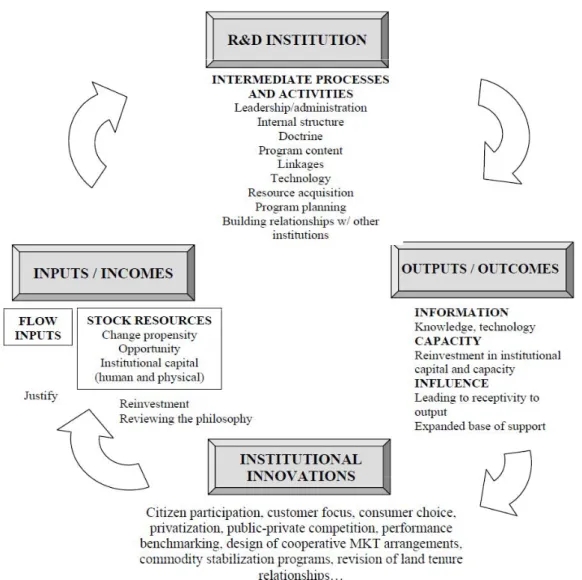
Figure 2 presents a science institution production system adapted from the writings of Evenson & Binswanger (1978) with some contributions from Altshuler (1997) – the meta-innovations. The figure presents greater details of the public agricultural research system of Figure 1, here presented as a virtuous circle of processes involved in a science agency that begins with the research system’s engine that transforms the flow inputs and stock resources into such intermediate processes and activities (as program planning, building relationships). These intermediate activities are then transformed in the final outputs and outcomes, of which the most important and most visible is the information that is generated and released.
Over the long run, the use of resources for agricultural research must be justified in terms of the economic value of the new knowledge that such research produces. If a science agency is to remain a valuable social asset, it must devote a portion of its resources to reinvest in institutional capacity and in its influence (positive public image). The intermediate processes and activities have little direct value to society, but they are indispensable to the institution itself. They may be seen as the research system’s “engine”, which’s functioning, determines the efficiency with which the system makes use of its resources.
Figure 1. A conceptual diagram of an agricultural innovation system
Source: adapted from Spielman & Birner (2008).
General agricultural policies & investments Agricultural innovation policies & investments
Informal institutions, practices, behaviors, and attitudes
Agricultural value chain actors & organizations Bridging
institutions
Agricultural extension system Agricultural research
and education systems Agricultural education system
Agricultural research system
The outputs and outcomes give feedback to the inputs and incomes through the meta-innovations proposed by Altshuler (1997) to broaden the conception of accountable government, placing far greater emphasis on the outcome criteria of efficiency, effectiveness, and public satisfaction. These priorities were summarized in six approaches: citizen participation, customer focus, consumer choice, privatization, public-private competition, and performance benchmarking. The meta-innovations proposed above were added to other institutional innovations to give the appropriate feedback loop to the system.
The measure of the innovativeness and success of policies that have succeeded to make this virtuous circle work in high performance could give policymakers the ability to reliably evaluate returns received from past R&D investments and to forecast likely returns from future investments. Successful public policies in the same area made from other countries can and should serve as broad guides for countries trying to establish their own programs, but as indictors of principles to follow, not as templates. There is first of all the problem that it is very difficult to identify just what features of another country’s successful program were key to its success, and which ones were peripheral. Second, what works in one country setting is unlikely to work in the same way in another.
Figure 2. Virtuous circle of processes involved in a science agency as a heart of the national innovation framework.
Towards a national innovation framework for agricultural science agencies in emerging economies
Chaves, RQ and Federizzi, LC
5) CONCLUDING REMARKS
It is necessary to conduct more institutional case studies of agricultural science agencies from different agricultural innovation systems to help map out the variety of designs that are available, and to develop comparative frameworks and metrics based on the relations among institutional design, and knowledge creation, use and value. Since this initiative would allow a deeper understanding of how to maximize the social benefit of public policy in this area, it is fruitful to make this a sustained effort.
The framework here presented may be useful as an analytical tool and as a tool for promoting sustainable economic growth and well-being in the emerging economies whose agricultural sector is a key economic area, since it illuminates the way to select and adapt data sets, tools and methodologies needed to assist science policy decision makers as they invest in national agricultural R&D. Even if this work doesn’t have a precise answer to the problem as a whole, this framework retains its utility, because of its potential for mapping and suggesting loci where science policy decision makers should apply scientific metrics and evaluations to guide sound and cost-effective investment strategies.
As long as societies have variability in their social systems of production, they will continue to vary in the shape and behavior of their national agricultural innovation system. Societies will attempt to mimic one another in the development of their national innovation framework, but each society’s social system of production and innovation is a configuration of a host of institutional arrangements (Hollingsworth & Boyer, 1997). Although each system is constantly changing and is open to influence from other system, the direction of change is constrained by the society’s existing social system of production and innovation, which has a great deal of historical specificity and persistence. Thus, the same science policy decision strategies and methodologies in the same arenas of the agricultural sector but in different societies will have varying consequences.
ACKNOWLEDGEMENT
The first author is grateful for financial support from the Brazilian Corporation for Agricultural Research (Embrapa) and for has been accepted by Professor Nicholas Vonortas as a Visiting Scholar to the Center of International Science and Technology Policy (CISTP) of George Washington University’s Elliott School of International Affairs, which made possible the current research.
REFERENCES
ALTSHULER, A.A., ZEGAN, M.D. (1990) Innovation and creativity: comparisons between public management and private enterprise. Cities, 7: 16-24.
ALTSHULER, A.A. (1997) Bureaucratic Innovation, Democratic Accountability, and Political
Incentives. In: Innovation in American Government, edited by Alan A. Altshuler and Robert D. Behn. Harrisonburg, VA: Donnelley & Sons, pp. 38-67.
ALTSHULER, A.A., BEHN, R.D. (1997) The Dilemmas of Innovation in American Government. In: Innovation in American Government, edited by Alan A. Altshuler and Robert D. Behn. Harrisonburg, VA: Donnelley & Sons, pp. 3-37.
BYERLEE, D.Y., ALEX, G., (1998) Strengthening National Agricultural Research Systems. Policy Issues and Good Practice. World Bank, Washington, DC.
EDQUIST, C. (2005) System of Innovation. In: The Oxford Handbook of Innovation.
EVENSON, R.E., BINSWANGER, H.P (1978) Technology transfer and research resource allocation. In: Induced Innovation: Technology, Institutions, and Development, edited by Hans P.
Binswanger and Vernon W. Ruttan. Baltimore, VA:Johns Hopkins University Press, pp. FELLER, I. (2006) Notes on a social science research program directed at the scientific study of
science policy. In NSF Workshop on the Social Organization of Science and Science Policy: consolidated essays. Washington, DC: NSF.
FREEMAN, C. (1987) Technology policy and economic performance. London: Pinter.
HOLLINGSWORTH, J.R., BOYER, R. Eds. (1997) Contemporary capitalism: the embeddedness of institutions. New york: Cambridge University Press.
MAIENSCHEIN, J. (2006) On the value of history of science for the social sciences of science policy. . In NSF Workshop on the Social Organization of Science and Science Policy: consolidated essays. Washington, DC: NSF.
MARBURGER, J. (2005) Wanted: Better benchmarks. Science, 308(May): 1087.
MAZZOLENI, R., NELSON, R.R. (2007) Public research institutions and economic catch-up. Research Policy, 36, 1512-1528.
MERVIS, J. (2006) NSF begins a push to measure societal impacts of research. Science April 21, 312: 347.
NELSON, R.R Ed. (1993) National Innovation Systems: a comparative analysis. Oxford University Press: 1993.
NATIONAL SCIENCE FOUNDATION (NSF), Science Resources Statistics (SRS) (2007) InfoBrief NSF 07-328. Arlington VA: National Science Foundation. Retrieved from
http://www.nsf.gov/statistics/infbrief/nsf07328/
NOWOTNY, H. (2007) How Many Policy Rooms are There?: Evidence-Based and Other Kinds of Science Policies. Science Technology Human Values 32, 479-490.
OECD (Organization for Economic Cooperation and Development) (2008). OECD Science, Technology and Industry Outlook. OECD: Paris.
OECD (2009) Agricultural Policies in Emerging Economies: Monitoring and Evaluation, OECD, Paris. OECD-FAO (United Nations Food and Agriculture Organization) (2009), OECD-FAO Agricultural
Outlook 2009-2018: Highlights. OECD/FAO, Paris.
OFFICE OF SCIENCE AND TECHNOLOGY POLICY (OSTP), National Science and Technology Council, Committee on Science, Subcommittee on Social, Behavioral and Economic Sciences. (2008) The Science of Science Policy: A Federal Research Roadmap. Retrieved from:
http://scienceofsciencepolicy.net/uploads/SoSP_Report.pdf.
RAJALAHTI, R., JANSSEN, W., PEHU, E. (2008) Agricultural innovation system: from diagnostics toward operational practices. agriculture and Rural Development discussion paper n. 38. Washington, DC: World Bank.
RUTTAN, V.W. (2008) Productivity growth in world agriculture: sources and constraints. In:The Development Economics Reader, edited by Giorgio Secondi. New York, NY: Routledge, pp.337-358.
SAREWITZ, D. (2006) Institutional Ecology and Societal Outcomes. . In NSF Workshop on the Social Organization of Science and Science Policy: consolidated essays. Washington, DC: NSF. SOLOW, R.M. (1956) A contribution to the Theory of Economic Growth. Quarterly Journal of
Economics. 70 (1), p. 65-94.
SPIELMAN, D.J., BIRNER, R. (2008) How innovative is your agriculture? Using innovation indicators and benchmarks to strengthen national agricultural innovation systems. Agriculture and Rural Development discussion paper n. 41. Washington, DC: World Bank.
VIOTTI, E.B., (2002) National learning systems: a new approach on technological change in late industrialized economies and evidences from the cases of Brazil and South Korea. Technological Forecasting & Social Change 69, 653-680.
WEBSTER, A. (2007) Crossing Boundaries: Social Science in the Policy Room. Science Technology Human Values 32, 458-478.
WORLD BANK. (2006) Enhancing Agricultural Innovation: How To Go beyond the Strengthening of Research Systems. World Bank: Washington, DC.