HAL Id: hal-00295236
https://hal.archives-ouvertes.fr/hal-00295236
Submitted on 21 Feb 2003
HAL is a multi-disciplinary open access
archive for the deposit and dissemination of
sci-entific research documents, whether they are
pub-lished or not. The documents may come from
teaching and research institutions in France or
abroad, or from public or private research centers.
L’archive ouverte pluridisciplinaire HAL, est
destinée au dépôt et à la diffusion de documents
scientifiques de niveau recherche, publiés ou non,
émanant des établissements d’enseignement et de
recherche français ou étrangers, des laboratoires
publics ou privés.
A model for particle formation and growth in the
atmosphere with molecular resolution in size
K. E. J. Lehtinen, M. Kulmala
To cite this version:
K. E. J. Lehtinen, M. Kulmala. A model for particle formation and growth in the atmosphere with
molecular resolution in size. Atmospheric Chemistry and Physics, European Geosciences Union, 2003,
3 (1), pp.251-257. �hal-00295236�
www.atmos-chem-phys.org/acp/3/251/
Chemistry
and Physics
A model for particle formation and growth in the atmosphere with
molecular resolution in size
K. E. J. Lehtinen and M. Kulmala
Helsinki University, Dept. Physical Sciences, P.O. Box 64, 00014 Univ. of Helsinki, Finland Received: 23 August 2002 – Published in Atmos. Chem. Phys. Discuss.: 28 October 2002 Revised: 23 January 2003 – Accepted: 3 February 2003 – Published: 21 February 2003
Abstract. The formation and growth of atmospheric aerosol
particles is considered using an exact discrete method with molecular resolution in size space. The method is immune to numerical diffusion problems that are a nuisance for typical simulation methods using a sectional representation for the particle size distribution. For condensational growth, a slight modification is proposed for the Fuchs-Sutugin expression, which improves the prediction of the growth rate of nano-sized particles by as much as a factor of two. The presented method is applied to particle formation in a Finnish Boreal forest and is shown to capture the essential features of the dynamics quite nicely. Furthermore, it is shown that the growth of the particles is roughly linear, which means that the amount of condensable vapour is constant (of the order 10131/m3).
1 Introduction
The formation and growth of atmospheric aerosols has re-cently received growing experimental and theoretical inter-est due to climate and health related effects of fine particles (Charlson and Wigley, 1994; Dockery and Pope, 1994). The increased aerosol concentrations are largely due to secondary particle production, i.e. homogeneous nucleation and subse-quent growth from vapours. Instrument techniques for mea-suring freshly formed particle concentrations have been re-cently developed, and particles with a diameter of about 3 nm can be detected. These small particles have been found in the free troposphere (Clarke, 1992; Schr¨oder and Str¨om, 1997; Raes et al., 1997), in the marine boundary layer (Covert et al., 1992; Hoppel et al., 1994; O’Dowd et al., 1999), in the vicinity of evaporating clouds (Hegg et al., 1991), in Arc-tic areas (Wiedensohler et al., 1996; Pirjola et al., 1998), Correspondence to: K. E. J. Lehtinen
in urban areas and in stack plumes (Kerminen and Wexler, 1996), in continental boundary layer (Birmilli and Wieden-sohler, 2000) and recently also in boreal forests (M¨akel¨a et al., 1997; Kulmala et al., 1998, 2001a).
The freshly formed aerosols become climatically impor-tant only if they are able to grow to sizes of 50 nm and larger. Particles in this size range can act as cloud condensation nu-clei, and therefore they may contribute to the so-called indi-rect aerosol cooling effect of the climate. Furthermore, if the particles grow to sizes above 100 nm, they become to scatter light very efficiently, and have thereby a direct cool-ing effect on the climate. Whether or not the new particles ever reach these sizes is to a large extent decided while they are still smaller than 10 nm (Kulmala et al., 2000, 2001b). Due to their Brownian movement, particles with diameters of a few nm coagulate very efficiently with larger particles, which implies that the freshly nucleated particles have to grow fairly rapidly (within a few hours) past the 10 nm limit or they will be lost in the collision processes (Kulmala et al., 2000). Such growth is possible only if there is a supersatu-rated vapour present at concentrations above 107molecules per cubic centimeter of air (Kulmala et al., 2001b). In order to determine the climatic importance of atmospheric nucle-ation events, we need to know what are the vapours caus-ing the particle growth, what are the chemical mechanisms controlling their formation, and what if any is the anthro-pogenic influence on their concentrations. At the moment, we only know that the growth of particles after continental nucleation events is with high probability caused by organic vapours (O’Dowd et al., 2002). The longest time sequence of observations is from Hyyti¨al¨a (61◦510N 24◦170E) in Fin-land, where measurements with a differential mobility parti-cle sizer (DMPS, measures the aerosol number concentration from 3–610 nm dry diameter), begun in January 1996. Up to May 2002 there were around 300 days with nucleation. The particle formation is usually observed in the late morning as the appearance of 3 nm particles at the lower size range of
252 K. E. J. Lehtinen and M. Kulmala: Particle formation and growth in the atmosphere the DMPS (M¨akel¨a at al., 1997, Kulmala et al., 2001a).
In this paper we consider the condensational growth of freshly nucleated particles. The methodology includes three novel techniques: (1) an improved model in free molecular regime condensation, based on a simple modification to the well known Fuchs-Sutugin expression (Fuchs and Sutugin, 1971) (2) a discrete method for solving the general dynamic equation (GDE, Friedlander, 2000) for the particle size dis-tribution, that is free of numerical discretization errors and (3) analysis of the time evolution of point wise values of the measured particle size distribution to validate the assumption of a constant concentration of condensable vapour, resulting in linear growth in terms of particle diameter.
2 Theory
2.1 Free-molecular condensation
The traditional way to describe free-molecular condensation (Seinfeld and Pandis, 1998) is to assume vapour molecules as point masses and use the so-called Fuchs-Sutugin expres-sion (Fuchs and Sutugin, 1971) for the particle growth rates. However, this approach induces serious errors when the par-ticles are very small (say, under 10 nm). Then, it is not pos-sible anymore to ignore molecular dimensions in compari-son with particle size. Also, the particle diffusion coeffi-cient, which typically is also assumed negligible, has to be accounted for. Our approach is to use the following equation for the collision rate of molecules with particles β1i:
β1i =2π(d1+di)(D1+Di)
· Kn +1
0.377Kn + 1 +3α4(Kn2+Kn), (1)
which is comprised of the continuum regime condensation rate multiplied by the semi-empirical Fuchs-Sutugin interpo-lation function (Fuchs and Sutugin, 1971) (the last term in the equation). It has been obtained by fitting Sahni’s (1966) numerical results for the solution of Boltzmann’s equation, and extends the validity of Eq. (1) to cover all particle sizes. In Eq. (1), d1and di are the diameters and D1and Dithe
dif-fusion coefficients of the condensing molecule and particle in class i, respectively. The factor α is the mass accommodation coefficient. Traditionally, d1 and Di are left out of Eq. (2)
(Seinfeld and Pandis, 1998) since the molecular diameter is typically negligible compared with particle diameter and par-ticle diffusion coefficient negligible compared with molecu-lar diffusion coefficient. However, if one is interested in the really initial stages of particle growth, i.e. when their diam-eters are of order 1 nm, such approximations are obviously not possible.
In this formulation, to obtain correct asymptotical be-haviour in the small particle limit, the Knudsen number Kn should be defined as
Kn = 2λ (d1+di)
(2) in which the mean free path of the condensation process is
λ = 3(Dq 1+Di) c21+c2i
. (3)
Here c1and ciare the thermal speeds of the molecule and
particle, respectively. The diffusion coefficients are calcu-lated using simple kinetic theory. Again, the difference to the standard way is that now the molecular dimensions as well as particle diffusion are not neglected. This modification of condensation theory approaches free-molecular coagulation theory in the limit of free-molecular particles.
2.2 Discrete solution of the size distribution
Next, we turn to the issue of solving the particle size dis-tribution in detail. The aerosol general dynamic equation (Friedlander, 2000) is typically solved using either a sec-tional method with fixed sections or with moving sections. The idea behind the sectional method is to approximate the particle size distribution with a histogram. Then, the various aerosol dynamical processes (nucleation, condensation, co-agulation, deposition, transport) are treated by modelling the concentration and/or location of each section. Using fixed sections is naturally ideal for nucleation and coagulation pro-cesses. However, for condensation/evaporation this method has a serious drawback, numerical diffusion (Zhang et al., 1999) It can be circumvented by using moving sections -then, however, we might encounter a situation in which there are no sections in a size range of importance (for example, the size of nucleating particles). In this paper, we present an approach that has neither of the abovementioned drawbacks: the size sections are fixed but the spacing is done molecule-by-molecule. Then, the actual physics of the problem are mimicked in detail, and provided that the computational bur-den is not insuperable, the method should, in principle, be free of any discretization errors.
The dynamics of nucleation mode particle size distribution is simulated using a discrete coagulation scheme with appro-priate sources: dN1 dt =I1−k ∗ Ik∗−N1 ∞ X i=k∗ β1iNi (4a) dNk∗ dt =Ik ∗−β1k∗N1Nk∗−Nk∗ ∞ X i=k∗ βk∗,iNk∗Ni (4b) dNk dt =β1,k−1N1Nk−1+ 1 2 k−k∗ X i=k∗ βi,k−iNiNk−i
−β1kN1Nk−Nk ∞ X i=k∗
βikNi (k > k∗) (4c)
using the Fuchs expression (Fuchs and Sutugin, 1971) for the collision frequency functions βij. In our approach, we
select class 1 to represent molecules. I1is a source rate for
the molecules. Class k∗represents the smallest stable parti-cles, with Ik∗as their nucleation rate. The particle dynamics,
in addition to the nucleation source, is driven by coagulation and condensation/evaporation. In this method, condensation is treated as collisions of classes i with class 1, and is thus free of any numerical diffusion problems. The condensation rates β1iare calculated from the modified Fuchs-Sutugin
ex-pressions as explained before. In equations 4, the evapora-tion of particles is not taken into account. However, possible surface pressures of the vapours can be straightforwardly in-troduced into the equations, resulting essentially in the birth and death formalism by Goodrich (1964).
3 Results
An important practical system to investigate the improved growth expression is the growth of particles from nucleation size (say 1 nm in diameter) to 3 nm. The reason for this is that available particle size distribution measurement instru-mentation typically has a cut-off at 3 nm. This means that when trying to obtain the particle nucleation rate from these measurements, one has to back-calculate down to 1 nm (Kul-mala et al., 2001b; Kerminen and Kul(Kul-mala, 2002). As soon as the particles have been formed, they grow by condensa-tion to larger sizes, but at the same time their concentracondensa-tion is diminished because of collisions with other particles (co-agulation). Thus, to get the correct nucleation rate from ex-perimental data, it is essential to know the condensational growth rate in detail.
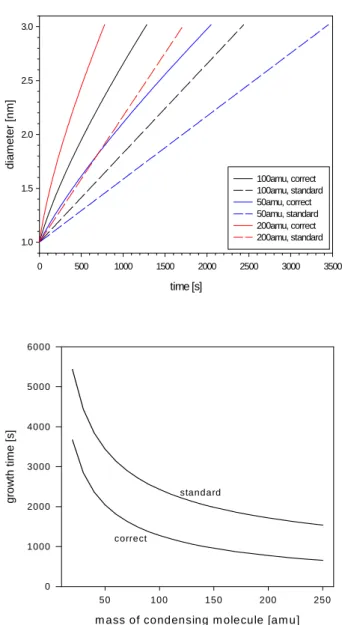
In the atmosphere, in many cases, it is not known what is the vapour that is condensing onto the freshly nucleated particles, thus causing their growth to observable sizes. The parameters affecting the growth rate are mainly the vapour molecular mass and diameter. In our sample calculations, we thus use several different values for the molecular mass, thus not specifying any detailed species. In Fig. 1, the growth of a particle of density 1000 kg/m3is simulated. The condensed material is also assumed to be of the same density, with molecular mass of 50, 100 and 200 amu. The vapour con-centration is assumed constant (4 · 10131/m3). The standard Fuchs-Sutugin results are shown with dotted lines and the re-sults obtained using the corrected model with solid lines. As seen in Fig. 1, it is obvious that particle growth is faster with a vapour with larger molecular size. Also, there is a signifi-cant difference in growth rates, when using the corrected ex-pressions compared with the standard Fuchs-Sutugin model, especially at the initial stages of growth when the particle is still very small. Figure 1a shows the evolution of the particle
time [s] 0 500 1000 1500 2000 2500 3000 3500 di am et er [ n m ] 1.0 1.5 2.0 2.5 3.0 100amu, correct 100amu, standard 50amu, correct 50amu, standard 200amu, correct 200amu, standard
m ass of condensing m olecule [am u]
50 100 150 200 250 g ro w th time [s ] 0 1000 2000 3000 4000 5000 6000 standard correct
Fig. 1. Condensational growth of freshly nucleated particles from
1 nm to 3 nm in diameter, assuming a constant vapour
concen-tration of 4 · 10131/m3: (a) Three different vapour molecular
masses (50 amu, 100 amu, 200 amu) are used for temporal growth,
(b) growth time as a function of molecular mass of condensing
molecule. The label correct refers to the method presented in this paper, standard to the unmodified Fuchs-Sutugin expression.
diameter with time for various values of the molecular mass and Fig. 1b the growth time as a function of vapour molecu-lar mass. In growth time from 1 nm to 3 nm, errors more than 100% can be obtained, if the molecular dimensions and the particle diffusion coefficient are neglected. It must be noted that each simulation is based on assuming constant vapour concentration during growth, and that the same value is used for each run using different molecular masses. Also, since the identity of the vapour(s) causing the growth and thus also their saturation vapour pressures are unknown, a zero surface pressure on the particles was assumed.
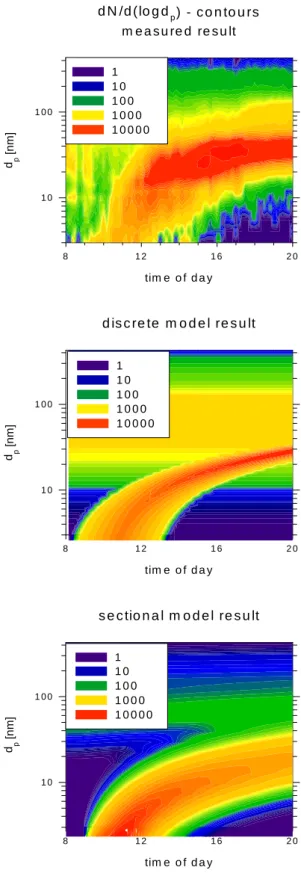
254 K. E. J. Lehtinen and M. Kulmala: Particle formation and growth in the atmosphere d is c re te m o d e l re s u lt tim e o f d a y 8 1 2 1 6 2 0 d [nmp ] 1 0 1 0 0 1 1 0 1 0 0 1 0 0 0 1 0 0 0 0 s e c tio n a l m o d e l re s u lt tim e o f d a y 8 1 2 1 6 2 0 d [np m ] 1 0 1 0 0 1 1 0 1 0 0 1 0 0 0 1 0 0 0 0 d N /d (lo g dp) - c o n to u rs m e a s u re d re s u lt tim e o f d a y 8 1 2 1 6 2 0 d [np m ] 1 0 1 0 0 1 1 0 1 0 0 1 0 0 0 1 0 0 0 0
Fig. 2. The measured vs. the modelled particle size distribution in
20 May 1998 in Hyyti¨al¨a, Finland. The contour-plot color indicates
the particle size distribution height in 1/cm3.
To demonstrate the usefulness of the presented method, we show two simulation results of nucleation events from Hyyti¨al¨a measurement station in Finland, in which clear bursts of particle formation, accompanied with subsequent growth, were observed above a boreal forest. One of the events (20 May 1998) was simulated previously by Kulmala et al. (2000), but using a sectional method with a geometrical spacing of size classes. The qualitative agreement between the experiment and the simulation was satisfactory. However, the used sectional method suffers from numerical diffusion and the size distribution narrowing effect, often present in particle growth driven by vapour condensation, is destroyed. The new result, using the discrete method is shown in Fig. 2, together with the experimental result and the result using the sectional method by Kulmala et al. (2000). When compared with the sectional model result there is one very noticeable difference. Now, the maximum values for the distribution density function are not located at 3 nm (bottom of figure) as is the case for the simulation with numerical diffusion. Instead, now the distribution is first broader, but gradually evolves to a more narrow but higher distribution. The nucle-ation rate for the simulnucle-ation was chosen to be identical with the simulation by Kulmala et al. (2000), which means that it was a result of ternary water – sulfuric acid – ammonia nucle-ation. The background particle concentration was selected to be the measured concentration before the event at 07:00 LT.
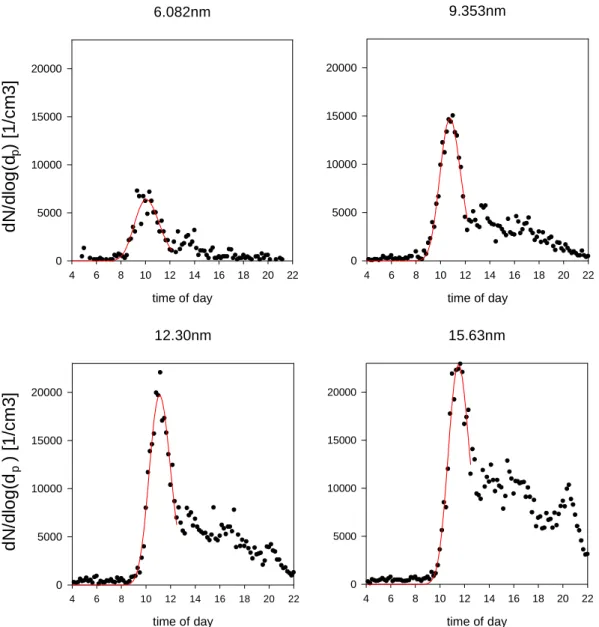
The phenomenon can be seen even more clearly, when the experimental results (for 20 May 1998) are presented as in Fig. 3, in which the point wise values of the size distribution are presented for four different particle diameters (6.082 nm, 9.353 nm, 12.30 nm and 15.83 nm), as a function of time. The values correspond to different classes of the particle-sizing instrument. In all curves the region left of the peak cor-responds to early stages in which the nucleation burst has not even started or growth has not propagated to the size of inter-est yet. Then the concentration starts increasing and reaches its maximum when the actual maximum of the nucleation mode size distribution is at the corresponding location. The region right to the peak corresponds to time when the peak has already passed the corresponding size. There are, how-ever some particles present, which most probably come from mixing of air. The model assumes a homogenous air parcel, in contrast to the experimental set-up in which the measur-ing location is fixed but the air around it moves. The clearly observable nucleation peaks in Fig. 3 were fitted by normal distributions (solid lines), from which the peak locations and heights were then extracted.
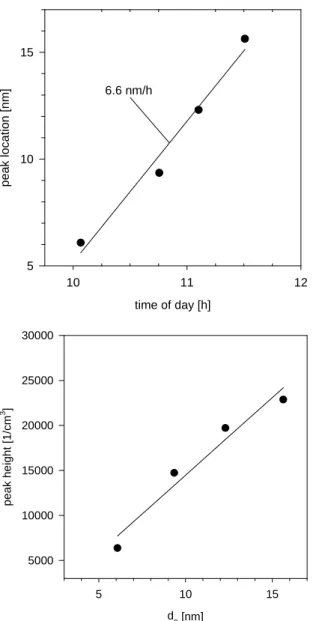
From the data presented Fig. 3, it is possible to analyse the experimental growth process further. In Fig. 4a the lo-cation of the size distribution peak is shown as a function of time, and in Fig. 4b the height of the peak is shown as a function of corresponding particle diameter. From Eq. (1) it is straightforward to deduce that the growth rate of particles in the kinetic regime is almost independent of size, result-ing in linear growth (see, e.g. Seinfeld and Pandis, 1998).
K. E. J. Lehtinen and M. Kulmala: Particle formation and growth in the atmosphere 255 6.082nm time of day 4 6 8 10 12 14 16 18 20 22
d
N
/d
lo
g
(d
p) [
1
/c
m
3
]
0 5000 10000 15000 20000 9.353nm time of day 4 6 8 10 12 14 16 18 20 22 0 5000 10000 15000 20000 12.30nm time of day 4 6 8 10 12 14 16 18 20 22d
N
/d
log
(d
p) [
1
/c
m
3
]
0 5000 10000 15000 20000 15.63nm time of day 4 6 8 10 12 14 16 18 20 22 0 5000 10000 15000 20000Fig. 3. Evolution of point wise values (at 6.082 nm, 9.353 nm, 12.30 nm and 15.63 nm) of the particle size distribution in 20 May 1998 in
Hyyti¨al¨a, Finland. The dots represent the measured data, the lines least-squares-fitted Gaussian peaks.
Based on Fig. 4a, growth indeed is linear, supporting the-ory as well as the assumption that the amount of vapour contributing to the growth process is roughly constant. In Fig. 4b, the peak height value is based on the typical log-arithmic dN/d(log dp)form of the size distribution. Thus, since the growth rate in diameter space is constant, and
dN
d(log dp)
=dpdN ddp
, (5)
the peak height should increase linearly with diameter (of lo-cation). However, this simple chain of thought disregards the fact that the peak height is also lowered because of collisions with background particles. It is, though, evident in Fig. 4b: the peak height increases almost linearly with diameter.
The highest chosen diameter in the analysis, 15.63 nm, corresponds to the size for which there is a clear visi-ble nucleation-originated peak passing through. Above this size, the background particles disturb the analysis. The ex-perimentally observed growth rate (6.6 nm/s), for assumed vapour molecules of 100 atomic mass units, is obtained by using a constant value of 4 · 10131/m3for the vapour concen-tration.
The same analysis works even better for a second mod-elled event day – 19 May 1999, as shown in Figs. 5a and b. In this case the background particle concentration is lower, resulting in a smaller coagulation sink for the formed parti-cles. Thus there is clear linear growth to much higher sizes than in 20 May 1998.
256 K. E. J. Lehtinen and M. Kulmala: Particle formation and growth in the atmosphere b) dp [nm] 5 10 15 pea k h e ig ht [1/c m 3 ] 5000 10000 15000 20000 25000 30000
a)
time of day [h] 10 11 12 pea k lo catio n [nm ] 5 10 15 6.6 nm/h b) dp [nm] 5 10 15 pea k h e ig ht [1/c m 3 ] 5000 10000 15000 20000 25000 30000a)
time of day [h] 10 11 12 pea k lo catio n [nm ] 5 10 15 6.6 nm/hFig. 4. The peak location as a function of time (a) and peak height
as a function of peak location (b) for the nucleation event of 20 May 1998 in Hyyti¨al¨a, Finland.
4 Conclusions
In this paper, a new model for describing nucleation mode particle growth has been presented. The main new features of the work are a new formulation of the Fuchs-Sutugin ex-pressions for condensational particle growth and the use of a discrete, molecule-by-molecule, simulation method to solve the general dynamic equation of aerosols.
The modification of the Fuchs-Sutugin expression consists of taking into account the molecular dimensions in calcu-lating collision cross sections as well as the particle diffu-sion coefficient when calculating relative movement of the particle-molecule-system. There is, in principle, nothing novel in this. It is qualitatively how particle-particle
col-19 May col-1999 peak location vs. time
time of day [h] 10 11 12 13 14 15 16 peak l o c a ti on [nm] 0 5 10 15 20 25
peak height vs. size
peak location [nm] 0 5 10 15 20 25 30 35 p eak he ight [1 /c m 3 ] 0 5000 10000 15000 20000 25000 30000 5.5 nm/h
Fig. 5. The peak location as a function of time (a) and peak height
as a function of peak location (b) for the nucleation event of 19 May 1999 in Hyyti¨al¨a, Finland.
lision frequency functions have been calculated for a long time. However, for condensation it is very typical to use the Fuchs-Sutugin expressions instead of collision theory. It is shown that these effects are far from negligible. For instance, when calculating particle growth from 1 nm to 3 nm, the ef-fect can be more than a factor of two! For many formation-growth occurrences in the nature, the molecules responsible for condensational growth can be complex organic or other rather large molecules. Then it is increasingly important to take the above-mentioned effects into account, as shown in the sample calculations of this paper.
The discrete method used in this paper has the advantage of being very easy to program and being free of artificial nu-merical diffusion problems, that are so often present in
tional models used in particle size distribution studies. The reason is that, in principle, all physically possible particle sizes are chosen to be size classes. Of course the method is computationally heavy, but as shown in this paper, still fea-sible for covering the entire nucleation mode dynamics. A comparison with a real natural nucleation-growth event over a boreal forest in Finland, the method seems to capture the key qualitative behaviour of such a system. In a condensa-tion dominated growth process, the numerical diffusion as-sociated with the fixed sectional method makes the distribu-tion artificially wider. However, as shown by the the detailed analysis of the experimentally obtained size distributions in a Finnish forest, the nucleation mode becomes narrower but higher as it propagates through size space. This effect is nicely captured by the discrete method.
Furthermore, the method can be used to validate more ap-proximate but faster methods, in which nucleation, conden-sation and coagulation are simultaneously present. Analyti-cal solutions for such systems are non-existent, thus a method free of discretisation errors is certainly of value for such val-idation studies.
References
Birmilli, W. and Wiedensohler, A.: New particle formation in the continental boundary layer: Meteorological and gas phase pa-rameter influence, Geophys. Res. Lett., 27, 3325, 2000. Charlson, R. J. and Wigley, T. M. L.: Sulphate aerosol and climatic
change, Scientific American, 270, 48–57, 1994.
Clarke, A. D.: Atmospheric nuclei in the remote free troposphere, J. Atmos. Chem., 14, 479–488, 1992.
Covert, D. S., Kapustin, V. N., Quinn, P. K., and Bates, T. S.: New particle formation in the marine boundary layer, J. Geo-phys. Res., 97, 20 581–20 587, 1992.
Dockery, D. W. and Pope, C. A.: Acute respiratory effects of par-ticulate air pollution, Annu. Rev. Public. Health, 15, 107–132, 1994.
Friedlander, S. K.: Smoke Dust and Haze, Oxford University Press, 2000.
Fuchs, N. A. and Sutugin, A. G.: in: Topics in current aerosol re-search (Part 2), (Eds) Hidy, G. M., and Brock, J. R., Pergamon, New York, 1971.
Goodrich, F. C.: Nucleation rates and the kinetics of particle growth II: The birth and death process. Proc. R. Soc. London A, 277, 167–182, 1964.
Hegg, D. A., Radke, L. F. and Hobbs, P. V.: Measurements of Aitken nuclei and cloud condensation nuclei in the marine atmo-sphere and their relation to the DMS-cloud-climate hypothesis, J. Geophys. Res., 96, 18 727–18 733, 1991.
Hoppel, W. A., Frick, G. M., Fitzgerand, J. W., and Larson, R. E.: Marine boundary layer measurements of new particle formation and the effects nonprecipitating clouds have on aerosol size dis-tribution, J. Geophys. Res., 99, 14 443–14 459, 1994.
Kerminen, N.-M. amd Kulmala, M.: Analytical formulae connect-ing the “real” and the “apparent” nucleation rate and the
nu-clei number concentration for atmospheric nucleation events, J. Aerosol Science, 33, 609–622, 2002.
Kerminen, V.-M. and Wexler, A. S.: The occurrence of sulfuric acid-water nucleation in plumes: Urban environment, Tellus, 48B, 65–82, 1996.
Kulmala M., Pirjola L., and M¨akel¨a J. M.: Stable sulphate clusters as a source of new atmospheric particles, Nature, 404, 66–69, 2000.
Kulmala, M., Toivonen, A., M¨akel¨a, J. M., and Laaksonen A.: Analysis of the growth of nucleation mode particles observed in Boreal forest, Tellus 50B, 449–462, 1998.
Kulmala, M., H¨ameri, K., Aalto, P., M¨akel¨a, J. M., Pirjola, L., Nils-son, E. D., Buzorius, G., Rannik, U., Dal Maso, M., Seidl, W., Hoffmann, T., Jansson, R., Hansson, H.-C., Viisanen, Y., Laak-sonen, A., and O’Dowd, C. D.: Overview of the international project on Biogenic aerosol formation in the boreal forest (BIO-FOR), Tellus 53B, 324–343, 2001a.
Kulmala M., Dal Maso, M., M¨akel¨a, J. M., Pirjola, L., V¨akev¨a, M., Aalto, P., Miikkulainen, P., H¨ameri, K., and O’Dowd, C. D.: On the formation, growth and composition of nucleation mode particles, Tellus 53B, 479–490, 2001b.
M¨akel¨a, J. M., Aalto, P., Jokinen, V., Pohja, T., Nissinen, A., Palm-roth, S., Markkanen, T., Seitsonen, K., Lihavainen, H., and Kul-mala, M.: Observations of ultrafine aerosol particle formation and growth in boreal forest, Geophys. Res. Lett., 24, 1219–1222, 1997.
O’Dowd, C., McFiggins, G., Creasey, D. J., Pirjola, L., Hoell, C., Smith, M. H., Allan, B. J., Plane, J. M. C., Heard, D. E., Lee, J. D., Pilling, M. J., and Kulmala, M.: On the photochemical pro-duction of new particles in the coastal boundary layer, Geophys. Res. Lett., 26, 1707–1710, 1999.
O’Dowd, C., Aalto, P., H¨ameri, K., Kulmala, M., and Hoffmann T.: Atmospheric particles from organic vapours, Nature, 416, 497– 498, 2002.
Pirjola, L., Laaksonen, A., Aalto, P., and Kulmala, M.: Sulfate aerosol formation in the Arctic boundary layer, J. Geophys. Res., 103, 8309–8322, 1998.
Raes, F., Van Dingenen, R., Cuevas, E., Van Velthoven, P. F. J., and Prospero, J. M.: Observations of aerosols in the free tropo-sphere and marine boundary layer of the subtropical Northeast Atlantic: Discussion of processes determining their size distribu-tion, J. Geophys. Res., 102, 21 315–21 328, 1997.
Schr¨oder, F. and Str¨om, J.: Aircraft measurements of submicrome-ter aerosol particles (> 7 nm) in the midlatitude free troposphere and tropopause region, Atmos. Res., 44, 333–356, 1997. Sahni, D. C.: The effect of a black sphere on the flux distribution of
an infinite moderator, J. Nucl. Energy 20, 915–920, 1966. Seinfeld, J. H. and Pandis, S. N.: Atmospheric Chemistry and
Physics, Wiley, New York, 1998.
Wiedensohler, A., Covert, D. S., Swietlicki, E., Aalto, P., Heintzen-berg, J., and Leck, C.: Occurrence of an ultrafine particle mode less than 20 nm in diameter in the marine boundary layer during Arctic summer and autumn, Tellus, 48B, 213–222, 1996. Zhang, Y., Seigneur, C., Seinfeld, J. H., Jacobson, M. Z., and
Binkowski, F.: Simulation of aerosol dynamics: a comparative review of algorithms used in air quality models, Aerosol Sci. Tech. 31, 487–514, 1999.