Evolution of moonwort ferns (Botrychium,
Ophioglossaceae) on local to global scales
Thèse présentée à la Faculté des sciences
Institut de biologie
Laboratoire de génétique évolutive
Université de Neuchâtel, Suisse
Pour l’obtention du grade de DOCTEUR ÈS SCIENCES
Par
Benjamin Dauphin
Présenté aux membres du jury de thèse:
P.D. Dr Grant Jason, directeur de thèse et président du jury
Prof. Daniel Croll, rapporteur
Prof. Donald Farrar, rapporteur
Prof. Felix Kessler, rapporteur
Dr Michael Kessler, examinateur
Prof. Carl Rothfels, examinateur
Faculté des Sciences Secrétariat-décanat de Faculté Rue Emile-Argand 11 2000 Neuchâtel – Suisse Tél : + 41 (0)32 718 21 00 E-mail : [email protected]
IMPRIMATUR POUR THESE DE DOCTORAT
La Faculté des sciences de l'Université de Neuchâtel
autorise l'impression de la présente thèse soutenue par
Monsieur Benjamin DAUPHIN
Titre:
“
Evolution of moonwort ferns
(Botrychium, Ophioglossaceae)
on local to global scales
”
sur le rapport des membres du jury composé comme suit:
MER Jason Grant, directeur de thèse, Université de Neuchâtel Prof. Daniel Croll, Université de Neuchâtel
Prof. Donald R. Farrar, Iowa State University, USA Prof. Felix Kessler, Université de Neuchâtel
Dr Michael Kessler, Universität Zürich
Prof. Carl Rothfels, University of California, Berkeley, USA
«Fais de ta vie un rêve, et d’un rêve, une réalité» Antoine de Saint-Exupéry (1900–1944)
Acknowledgments
This PhD was an intense and marvelous life experience for me. I am grateful to my spouse Lisa who has provided me emotional support and full confidence during the completion of this dissertation. A very special gratitude goes out to my parents Marie-Christine and Daniel who encouraged and supported me during my university studies, especially at a time when I had other interests than science.
I thank my friends for your unconditional support despite the strange world in which I work. For three years, I was lucky to work in such a scientific environment and lead a project that really meant a lot to me. Several people and institutions have contributed greatly in the success of this project and I would like to express my sincerely gratitude in the simplest words.
I warmly thank you Jason for giving me confidence to carry out this project and introducing me to the fern world. Also, thanks a lot for your patience. I know, sometimes it was demanding…
Thank you Don for everything!
Carl, Berkeley is a captivating city, and I am lucky to have studied there on the fascinating topic of polyploidy. Many thanks for your hospitality in California and your precious collaboration, especially your tricks and secrets about the PacBio seq and the use of PURC.
I am also grateful to members of the Evolutionary Genetics lab at the University of Neuchâtel, the Genetic Diversity Center from ETH Zürich, and the Rothfels lab at the University of California at Berkeley, with a special mention to Olivier Bachmann, Forrest Freund, Stella Huynh, Ingrid Jordon-Thaden, Silvia Kobel, Aria Minder, Vinciane Mossion, Frédéric Sandoz, Julien Vieu, Guillaume Wos, and Niklaus Zemp. It was fantastic to work with each of them, especially on NGS data!
Without funding, we can’t go very far in academic research. Therefore, I thank the Swiss National Science Foundation, the University of Neuchâtel, and the University of California at Berkeley for supporting this thesis.
Abstract
Plants have long fascinated biologists by their ability to form cryptic species, hybrids between distinct species, large and stable genome sizes, and a wide variety of mating systems among taxa that have driven to the current plant biodiversity. More than 450 million year ago, vascular plants emerged and colonized the land. Rapidly, they dispersed to explore new habitats and diversified in suitable environments to form over 300,000 extant species. A better understanding of past evolutionary forces that led to the current plant morphologies, ecologies, and genetic diversity is critical for predicting their evolution, especially with the global changes ongoing. In this context, the main goals of this thesis were to investigate the phylogenetic relationships among the early divergent Botrychium taxa and how allopolyploidy and the alternation of mating systems have led to the speciation of these species.
In a multidisciplinary framework, we combined phylogenetics with population genetics and flow cytometry to provide relevant cellular and molecular data for exploring key biological mechanisms taking place at local or global scale. As the backbone of our project, we reconstructed the plastid phylogeny of the genus Botrychium based on a worldwide sampling to investigate relationships among diploid taxa and the maternal origins of allopolyploids. As a second step, we estimated the genome sizes of Botrychium diploids and polyploids to study fluctuations of DNA amounts after allopolyploidization and between ploidy levels. Then, we applied PacBio sequencing to infer a nuclear phylogeny for revealing the evolutionary history for both, the maternal and the paternal lineages of allopolyploids, and drawing the timescale of their bi-parental inheritance based on divergence time estimates. Focusing at a local and regional scale, we genotyped B. lunaria populations in Alps using co-dominant allozymes and ddRADseq data to identify the predominant mode of reproduction as well as its demographic history during the last glacial maximum.
We found unexpected results and major discoveries for the understanding of the biology of early vascular plants. For the species diversity itself, we identified thirteen possibly new taxa and characterized the exceptional haplotype diversity occurring in the Lunaria complex. Also, we presented evidence for multiple origins of several polyploid taxa and highlighted incontestable cases of inter-continental dispersal from North America to Europe and Asia. With flow cytometry, we reported a new hexaploid in Botrychium and described different genome sizes between diploid species of the two major clades Lanceolatum and Lunaria. Besides, our results supported the genome size stability after allopolyploidization, therefore rejecting the scenario of genome downsizing widespread accepted for angiosperms. Probably the most striking outcome of our phylogenetic investigations is the recurrent allopolyploidy in that genus and the strong bias of parental donors in the formation of allopolyploid taxa. Furthermore, our divergence time estimates revealed the recent and rapid
speciation via allopolyploidy in the last two million years, which constitutes a first case of radiation in the old lineage of Ophioglossaceae. For our population genetics study, we found unprecedented genetic diversity within B. lunaria populations with a large number of heterozygotes that supports the outcrossing mating system. Thus, we presented the capabilities of dispersion and diversification of these Botrychium species to better understand the ancestral vascular plant mating system. Being a key element of this speciation model, we found a genetic signature indicative of a refuge for B. lunaria in the central Alps during the last glacial maximum, which has hosted individuals having a high allele richness that was secondarily dispersed after deglaciation with the maintenance of outcrossing in alpine grasslands.
Undeniably, the genus Botrychium offers a unique opportunity to address the role of allopolyploidy and the importance of alternation of mating systems in plant speciation. This work is intended to be the starting point for further studies in evolutionary biology that ultimately will provide a better understanding of the life style of these enigmatic fern species.
Key words: Botrychium; ddRAD sequencing; divergence time dating; ferns; flow cytometry; genome size; low-copy makers; mating system; molecular phylogeny; Ophioglossaceae; PacBio; polyploidy; polyploid network; population genetics; PURC; reticulate evolution.
Résumé
Les plantes ont depuis longtemps fasciné les biologistes par leur capacité à former des espèces cryptiques, des hybrides entre des espèces distinctes, de grandes tailles de génomes stables, et une large variété de systèmes reproducteurs parmi les taxons qui ont conduit à l’actuelle biodiversité des plantes. Il y a plus de 450 millions d’années, les plantes vasculaires ont émergé et colonisé la terre. Rapidement, elles se sont dispersées pour explorer de nouveaux habitats et se sont diversifiées dans des environnements favorables pour former plus de 300 000 espèces vivantes. Une meilleure compréhension des forces évolutives passées qui ont mené aux morphologies, aux écologies, et aux diversités génétiques actuelles des plantes est essentielle pour prédire leur évolution, particulièrement dans le contexte des changements globaux. Ainsi, les objectifs principaux de cette thèse consistaient à étudier les relations phylogénétiques parmi les taxons de Botrychium et comment l’allopolyploïdie et l’alternance des systèmes reproducteurs ont mené à la spéciation de ces espèces.
Dans un cadre multidisciplinaire, nous avons combiné la phylogénétique avec la génétique des populations et la cytométrie en flux pour produire des données cellulaires et moléculaires pertinentes pour l’exploration des mécanismes biologiques clefs prenant place à des échelles locales ou globales. Etant les fondements de notre projet, nous avons reconstruit la phylogénie chloroplastique du genre
Botrychium basée sur un échantillonnage mondiale pour examiner les relations de parentés parmi les
taxons diploïdes et les origines maternelles des allopolyploïdes. Dans une seconde étape, nous avons estimé les tailles de génome des Botrychium diploïdes et polyploïdes pour comparer les variations du contenu en ADN après l’allopolyploïdisation et entre les niveaux de ploïdie. Ensuite, nous avons utilisé le séquençage PacBio pour inférer une phylogénie moléculaire dans le but de révéler l’histoire évolutive des deux, les lignées maternelles et paternelles des allopolyploïdes, et d’établir l’échelle temporelle de leur héritage bi-parentale basée sur les estimations des temps de divergence. Travaillant à une échelle régionale et locale, nous avons génotypé des populations de B. lunaria des alpes en utilisant des variants enzymatiques co-dominants et des données de séquençage ddRAD pour caractériser le mode prédominant de reproduction ainsi que leur histoire démographique durant le dernier maximum glaciaire.
Nous avons trouvé des résultats inattendus et des découvertes majeures pour la compréhension de la biologie des plantes vasculaires précoces. Pour la diversité spécifique elle-même, nous avons identifié treize nouveaux taxons potentiels et caractérisé la diversité exceptionnelle d’haplotypes survenant dans le complexe d’espèce Lunaria. De plus, nous avons présenté des évidences pour l’origine multiple de plusieurs taxons allopolyploïdes et révélé des cas incontestables de dipersion intercontinentale d’amérique du nord vers l’europe et l’asie. Avec la cytométrie en flux, nous avons rapporté un nouveau taxa hexploïde chez Botrychium et avons décrit différentes tailles de génome
entre espèces diploïdes des deux clades majeurs, Lanceolatum et Lunaria. Par ailleurs, nos résultats ont supporté le scénario de stabilité des tailles de génome après l’allopolyploidization, rejetant ainsi l’hypothèse de la réduction des tailles de génome largement acceptée chez les angiospermes. Le résultat le plus frappant dans nos investigations phylogénétiques est probablement la récurrence de l'allopolyploïdie dans ce genre et les contributions asymétriques des donneurs parentaux dans la formation des taxons allopolyploïdes. De plus, nos estimations du temps de divergence ont révélé la spéciation récente et rapide par allopolyploïdie au cours des deux derniers millions d'années, ce qui constitue un premier cas de radiation dans l'ancienne lignée des Ophioglossaceae. Pour notre étude sur la génétique des populations, nous avons trouvé une diversité génétique sans précédent dans les populations de B. lunaria avec un grand nombre d'hétérozygotes qui soutient la prédominance pour la fécondation croisée. Ainsi, nous avons présenté les capacités de dispersion et de diversification des espèces de Botrychium afin de mieux comprendre le système d'accouplement des plantes vasculaires ancestrales. En tant qu'élément clef de ce modèle de spéciation, nous avons trouvé une signature génétique indicative d'un refuge pour B. lunaria dans les alpes centrales lors du dernier maximum glaciaire, lequel a abrité des individus ayant une richesse allélique élevée, qui se sont ensuite dispersés durant la déglaciation tout en maintenant la fécondation croisée.
Indéniablement, le genre Botrychium offre une occasion unique d'aborder le rôle de l'allopolyploïdie et l'importance de l'alternance des systèmes d'accouplement dans la spéciation des plantes. Ce travail est destiné à être le point de départ pour d'autres études en biologie évolutive, lesquelles permettront peut-être de mieux comprendre le cycle de vie de ces espèces de fougères énigmatiques.
Mots clefs: Botrychium; séquençage ddRAD; datation des temps de divergence; fougères; cytométrie en flux; taille de génome; marqueurs en faible copie; système de reproduction; phylogénie moléculaire; Ophioglossaceae; PacBio; polyploïdie; réseau polyploïde; génétique des populations; PURC; évolution réticulée.
Table of contents
General introduction
13
Chapter 1
21
A Worldwide Molecular Phylogeny provides New Insight on Cryptic Diversity within the Moonworts (Botrychium s.s., Ophioglossaceae)
Chapter 2
67
Ploidy Level and Genome Size Variation in the Homosporous Ferns Botrychium s.l. (Ophioglossaceae)
Chapter 3
87
Rapid Allopolyploid Radiation of Moonwort Ferns (Botrychium; Ophioglossaceae) revealed by Pacbio Sequencing of Homologous and Homeologous Nuclear Regions
Chapter 4
117
Dispersal and Diversification in Ancestral Vascular Plants
Chapter 5
149
Recent Postglacial Recolonization from In Situ Survival and Intense Gene Flow within Natural Populations of the Alpine Fern Botrychium lunaria (Ophioglossaceae) revealed by ddRAD Sequencing
Conclusions and perspectives
177
Extra-contributions to the project
181
General introduction
The genetic diversity hidden within cryptic species
Morphological diversity does not systematically reflect genetic diversity or species richness within a group of organisms and therefore challenges the classification system. Testified by deep phylogenetic divergences, similar morphological plants may be unrelated even though botanists may consider them as a single taxon since no clear taxonomic characters were found to differentiate the species. Advances in Next-Generation Sequencing (NGS) technology and relatively inexpensive DNA sequencing have allowed the characterization of cryptic species containing genetically well-differentiated groups or populations (Bickford et al. 2007). The term “cryptic species” is defined as “two or more distinct species that are erroneously classified (and hidden) under one species name” (Bickford et al. 2007). This phenomenon is widespread to all organisms since it has been reported in animals (Pfenninger and Schwenk 2007), fungi (Crespo and Thorsten 2010), protists (Amato et al. 2007), and plants (Bickford et al. 2007). The discovery of cryptic species has several important implications for the understanding of biology of these organisms because ecological conditions and the belonging to a phylogenetic group would determine the frequency of such undetected diversity. In this framework, systematic studies are a powerful approach to reveal hidden species richness in any organism group and track key morphological characteristics for better taxonomic recognition. Similarly in ferns, three criteria are used to define a “cryptic species”: “1) poor morphological differentiation, 2) reproductive isolation, and 3) misinterpretation of taxa as members of a single broader species” (Paris et al. 1989). Based on these considerations, the genus Botrychium is a classical example of cryptic species in ferns with its simple organization and subtle morphological traits that encompass a large species group containing unsuspected haplotype diversity (Dauphin et al. 2014).
Evolution of genome sizes among the earliest vascular plants
Plant genomes are known to be highly labile through evolutionary scales (Leitch et al. 2005). More than 450 million year ago, primitive genomes arose from a common ancestor and pursued different evolutionary trajectories with dramatic genome size reductions or expansions, or both, occurring multiple times, which has led to the current genome diversity. Among the early divergent vascular plants, species have a large range of DNA amount, with the smallest genome size of 0.086 pg found in lycophytes (Selaginella) and the among the biggest ones characterized in monilophytes (also named pteridophytes) with 1C = 72.68 pg for Psilotum nudum (Leitch and Leitch 2013). Fern genomes are particularly large and heterogeneous, especially in whisk ferns and ophioglossoids that have among the largest genomes in vascular plants. Interestingly, enormous genomes of those two
well-distinct lineages, sister to the Marattiidae-Polypodiidae clade (Rothfels et al. 2015), have probably evolved through two different cytological mechanisms. As representative of ophioglossoid ferns, Ophioglossum was characterized by a large number of small chromosomes (1.5–4.5 µm; Abraham et al. 1962), up to 2n = 1440 (Khandelwal 1990), which constitutes the highest chromosome number discovered in the plant kingdom. In contrast, the slightly bigger genomes of whisk ferns were reported with smaller karyotypes (2n = 208 for Psilotum nudum) but larger chromosomes (4.5–18 µm) (Brownsey and Lovis 1987) that are indicative of different cytological mechanisms in fern genomes evolution. Hence, how is such an amount of DNA maintained in a stable karyotype with as many chromosomes? What are the biological mechanisms that allow the genomes evolution?
Polyploidization as the fuel for speciation
Polyploid organisms occur in all major groups of animals, fungi, protists, and plants, and Whole-Genome Duplication (WGD) is recognized as a major process in eukaryote evolution. In fact, WGD events are at the origin of vertebrates (Dehal and Boore 2005) and all flowering plants have undergone one to several polyploid events in their evolutionary history (Jiao et al. 2011). Interestingly, independent WGD events have occurred simultaneously in most plant lineages during the last massive extinction, suggesting that polyploids may have evolutionary advantages to overcome crises (Fawcett et al. 2009). However, on a broader phylogenetic timescale, polyploids have shown higher extinction rates than diploids and recent studies have presented strong evidence in favor of the evolutionary dead end hypothesis of polyploids (Mayrose et al. 2011; Arrigo and Barker 2012).
Polyploid organisms result from one of the two main biological processes that are accompanied by WGD, either via autopolyploidy or allopolyploidy (Stebbins 1947). Autopolyploids are considered to have arisen from intraspecific hybridization by the doubling of similar homologous chromosome sets (AAAA), whereas allopolyploids have involved interspecific hybridization associated with the doubling of homeologous chromosome sets (AABB). This categorization is not intended to be limiting and it is now widely accepted that polyploidization occurred by the merging of more or less divergent original genomes along a continuum. In complement to this traditional view, a more complex model of polyploid formation has been proposed with multiple origins generating genetically variable polyploid lineages from distinct parental genotypes (Soltis and Soltis 1999). Illustrating the evolutionary implications on a short timescale, the allopolyploid Tragopogon miscellus has been independently formed at least 20 times during the past 70 years (Soltis and Soltis 1999), which provided the main source of the genetic diversity found among those allopolyploid lineages and perhaps the genetic basis supporting the success of allopolyploids (Soltis and Soltis 2000). Importantly, allopolyploidy is a drastic speciation process that allows the maintenance of high genetic variation via fixed
heterozygosity (Soltis and Soltis 2009) and the generation of evolutionary novelties through sub- and neo-functionalization arising from gene redundancy (Rastogi and Liberles 2005).
From molecular phylogeny to population genetics
Molecular phylogenetics is a powerful tool to investigate species relationships and build the most comprehensive view of the tree of life. It is the backbone for describing morphological and genetic diversity among related species, and testing many hypotheses in biology based on robust statistical frameworks. However, this approach is inapplicable to study the biological processes themselves taking place in natural populations, which initiate the micro-evolutionary changes that are span along the leaves of the tree of life. How can we fully understand and interpret the phylogenetic relationships of organisms without basis indications on their life cycles and the impact of environment or demographic history on mating systems?
Filling in this gap, population genetics is a promising approach to consider the role of the environment in reproductive isolation and differentiation among populations. Importantly, genetic diversity and gene flow can be investigated by genotyping data to identify the predominant mating system maintained in natural populations and compare the different strategies of life cycles among closely related species. Thus, the use of co-dominant nuclear markers allows the characterization of the heterozygote fraction and bi-parental inheritance of diploids and polyploids (Stensvold and Farrar 2017). Combined, molecular phylogenetics informs us about the demographic history within and among taxa that is a crucial element for interpreting of genetic variation at the population level.
The genus Botrychium as a model in evolutionary biology
The genus Botrychium (Ophioglossaceae) has unique biological features to address the prevalence of cryptic taxa in ferns and how allopolyploidy and the alternation of mating systems have led to speciation. It has been known for a long time that Botrychium has cryptic diploid and polyploid taxa (Paris et al. 1989). The genus still challenges botanists in species identification based on subtle morphological characters such as trophophore shape and pinnae number, orientation, and margin. Also, Botrychium has a broad circumtemperate to circumboreal distribution, with several species having experienced long-range dispersal between Asia, Europe, and North America. Thus, geographic distribution and range size varies considerably among species, although our knowledge of their distribution is limited in Europe and Asia, which greatly complicates species delineation and the characterization of hybrid zones forming polyploids. To date, 35 species have been described and at least three centers of species diversity characterized; the Alps in Europe (Dauphin et al. 2014), and both the Rocky Mountains and the Great Lakes region in North America (Hauk et al. 2012).
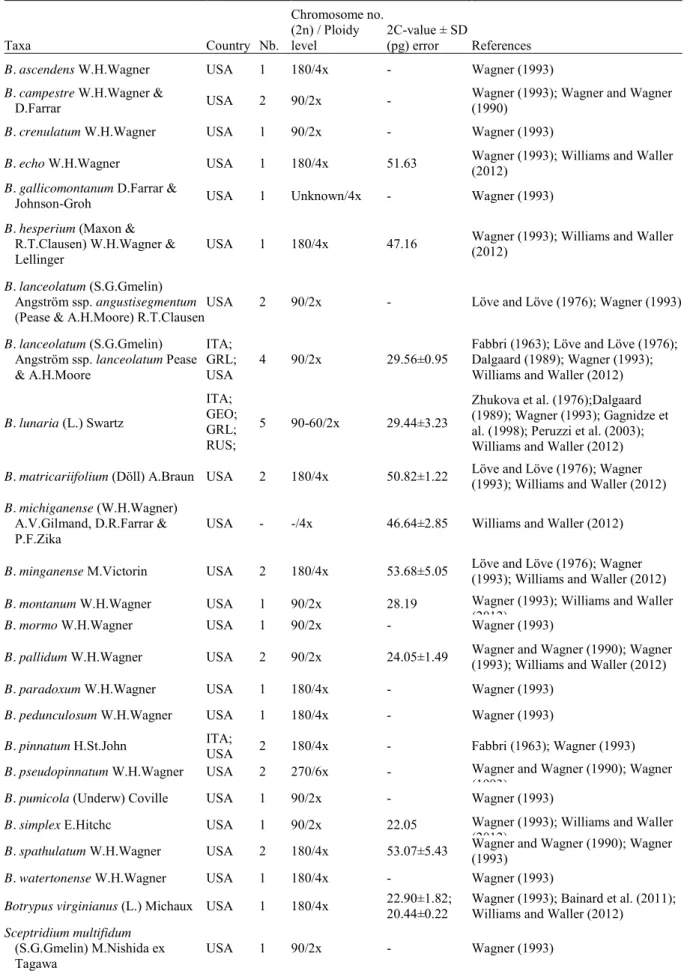
and Wagner 1993), and large genome sizes (2C-value ranging from 22.05 pg to 53.68 pg; Williams and Waller 2012). At broad evolutionary scales, Botrychium species have likely experienced multiple rounds of polyploidy associated with diploidization—restoration of secondary diploid-like behavior of polyploid genomes—that led to the evolution of paleopolyploids, resulting in the current diploid taxa. More recently, neopolyploids—young polyploids without diploidized genomes—have arisen from the interspecific hybridizations between diploid progenitors that currently form half of the species diversity of Botrychium. The rampant allopolyploidy is postulated to play a central role in the contemporary speciation of these species as well as in the older paleopolyploidization events. Those hybrids were hypothesized from morphological characters (Figure 1) (Wagner and Wagner 1981, 1983, 1986), karyological data (Wagner and Lord, 1956; Wagner and Wagner, 1993), allozyme-based investigations (Farrar 2011), and plastid molecular phylogenies (Hauk et al., 2012; Williams and Waller, 2012; Dauphin et al., 2014).
Figure 1 An example of morphological characters intermediate between known putative diploid progenitors. Diploids are in red and allotetraploids are in blue. The “lanceolate” trait of B. lanceolatum and B. angustisegmentum, and the pinna span of B. pallidum given to allopolyploids are symbolized in dashed red lines.
Mating systems of Botrychium are of great interest for understanding the biology of early divergent vascular plants and how primitive plants have colonized and explored new terrestrial habitats. Species have the capability of vegetative reproduction via gemmae produced in leaf axils of their underground stems (B. campestre and B. pallidum, Farrar and Johnson-Groh 1990; B. pumicola, Camacho 1996), and they theoretically support three sexual systems of reproduction; gametophytic selfing, sporophytic selfing, and sporophytic outcrossing (Sessa et al. 2016). Although gametophytic selfing appears predominant in Botrychium (Hauk and Haufler 1999), a recent study has shown evidence of a mixed mating system in several populations of B. campestre var. lineare sampled at high elevations in Rocky Mountains (Farrar and Gilman 2017), which has sparked our curiosity about the Swiss Alps B. lunaria populations that occur in similar habitats along Alpine grassland.
B. pallidum B. lanceolatum
B. hesper ium B. matr icar iifolium
2x
2x 2x
B. angusti segmentum
Outline of the chapters
This PhD thesis aims to better understand the evolution of early divergent vascular plants using the genus Botrychium as a model. It is organized in five chapters and summarized in a last section of conclusion.
Chapter 1 represents the starting point for assessing phylogenetic relationships and genetic diversity among taxa in the genus Botrychium. We tested a series of hypotheses for the recognition of new taxa and reconstructed a chloroplast (maternal) phylogeny for the genus. We characterized the exceptional haplotype diversity occurring in the Lunaria complex and found evidence for multiple origins of several polyploid taxa. In total, our study investigated 47 taxa of which thirteen are discussed for possible taxonomic recognition.
In chapter 2, we applied cytological methods to determine the ploidy level and genome size of representatives of the Botrychium s.l. clade, including Botrychium s.s., Botrypus, and Sceptridium. We found a new hexaploid cytotype for Botrychium boreale, representing only the second report of hexaploidy in the genus, and identified different genome sizes between diploid species of the two major clades in Botrychium (Lanceolatum versus Lunaria). Our results support the hypothesis of genome size stability after allo-polyploidization, therefore rejecting the scenario of genome downsizing, which is generally accepted for angiosperms.
Chapter 3 complements Chapter 1’s chloroplast (maternal) phylogeny, in that we investigate the nuclear (paternal) phylogeny of nearly all species of Botrychium, allowing us to identify the parental lineages of polyploid taxa. Using a new sequencing approach, we inferred phylogenetic relationships among taxa and estimated the divergence time between lineages. We also tested hypotheses of the independent origins of allopolyploid lineages and identified their parental progenitors. Interestingly, we found non-random parental donors in the formation of allopolyploid taxa with strong bias in favor of several key diploid species, which suggests biological mechanisms that determine preferential parental couples in hybrid populations.
Chapter 4 was a major breakthrough of my PhD. Based on a sampling of Swiss Alps populations of Botrychium lunaria, we conducted a population genetics study using allozyme data to characterize their predominant mode of reproduction and put in perspective the alternation of outcrossing and inbreeding mating system among the taxa of the Lunaria complex. We presented the Swiss Alps populations as the second report of the mixed mating system in Botrychium and discussed the
important implications in evolution of their closely related homozygous taxa belonging to the species complex. We propose that Botrychium may be a relevant evolutionary model for a better understanding of dispersion and diversification of early divergent vascular plants.
As a continuation of chapter 4, chapter 5 addresses the role of the last glacial maximum on population genetic structure within the Val d’Hérens valley in the Swiss Alps. We used the new genotyping approach ddRAD (double-digest restriction-associated DNA) sequencing to characterize genetic diversity, gene flow among populations, and breeding system within populations. We found strong evidence for the maintenance of the mixed mating system and a recent colonization of four populations from a central Alps glacial refuge.
Finally, we highlight the main results and conclusions of my PhD dissertation and discuss the perspectives for future work on the evolutionary biology of ferns.
References
Abraham A, Ninan CA, Mathew PM (1962) Studies on the cytology and phylogeny of the pteridophytes VII. Observations on one hundred species of South Indian ferns. J Indian Bot Soc 41: 339–421.
Amato A, Kooistra WH, Ghiron JH, Mann DG, Pröschold T, Montresor M (2007) Reproductive isolation among sympatric cryptic species in marine diatoms. Protist 158: 193–207.
Arrigo N, Barker MS (2012) Rarely successful polyploids and their legacy in plant genomes. Curr Opin Plant Biol 15: 140–146.
Bickford D, Lohman DJ, Sodhi NS, Ng PK, Meier R, Winker K, Ingram KK, Das I (2007) Cryptic species as a window on diversity and conservation. Trends Ecol Evol 22: 148–155.
Brownsey PJ, Lovis JD (1987) Chromosome numbers of the New Zealand species of Psilotum and Tmesipteris, and the phylogenetic relationships of the Psilotales. New Zealand J Bot 25: 439–454.
Camacho FJ, Liston A (2001) Population structure and genetic diversity of Botrychium pumicola (Ophioglossaceae) based on inter-simple sequence repeats (ISSR). Am J Bot 88: 1065–1070.
Crespo A, Lumbsch HT (2010) Cryptic species in lichen-forming fungi. IMA fungus 1: 167–170.
Dauphin B, Vieu J, Grant JR (2014) Molecular phylogenetics supports widespread cryptic species in moonworts (Botrychium s.s., Ophioglossaceae). Am J Bot 101: 128–140.
Dehal P, Boore JL (2005) Two rounds of whole genome duplication in the ancestral vertebrate. PLoS Biology 3: e314.
Farrar D (2011) Moonwort (Botrychium) Systematics. http://www.public.iastate.edu/~herbarium/botrychium
Farrar DR, Gilman AV (2017) Relationships in the Botrychium campestre (Ophioglossaceae) complex. Brittonia 1–11.
Farrar DR, Johnson-Groh CL (1990) Subterranean sporophytic gemmae in moonwort ferns, Botrychium subgenus Botrychium. Am J Bot 77: 1168–1175.
Fawcett J, Maere S, Van de Peer Y (2009) Plants with double genomes might have had a better chance to survive the Cretaceous-Tertiary extinction event. PNAS 106: 5737–5742.
Hauk WD, Haufler CH (1999) Isozyme variability among cryptic species of Botrychium subgenus Botrychium (Ophioglossaceae). Am J Bot 86: 614–633.
Hauk WD, Kennedy L, Hawke HM (2012) A phylogenetic investigation of Botrychium s.s. (Ophioglossaceae): evidence from three plastid DNA sequence datasets. Syst Bot 37: 320–330.
Jiao Y, Wickett NJ, Ayyampalayam S, Chanderbali AS, Landherr L, Ralph PE, dePamphilis CW (2011) Ancestral polyploidy in seed plants and angiosperms. Nature 473: 97–100.
Khandelwal S (1990) Chromosome evolution in the genus Ophioglossum L. Bot J Linn Soc 102: 205–217. Leitch IJ, Leitch AR (2013) Genome size diversity and evolution in land plants. In Plant Genome Diversity
Volume 2 (pp. 307–322). Springer Vienna.
Leitch IJ, Soltis DE, Soltis PS, Bennett MD (2005) Evolution of DNA amounts across land plants (Embryophyta). Ann Bot 95: 207–217.
Mayrose I, Zhan SH, Rothfels CJ, Magnuson-Ford K, Barker MS, Rieseberg LH, Otto SP (2011) Recently formed polyploid plants diversify at lower rates. Science 333: 1257–1257.
Paris CA, Wagner FS, Wagner WH (1989) Cryptic species, species delimitation, and taxonomic practice in the homosporous ferns. Am Fern J 79: 46–54.
Pfenninger M, Schwenk K (2007) Cryptic animal species are homogeneously distributed among taxa and biogeographical regions. BMC Evol Biol 7: 121.
Rastogi S, Liberles DA (2005) Subfunctionalization of duplicated genes as a transition state to neofunctionalization. BMC Evol Biol 5: 28.
Sessa EB, Testo WL, Watkins JE (2016) On the widespread capacity for, and functional significance of, extreme inbreeding in ferns. New Phytol 211: 1108–1119.
Soltis DE, Soltis PS (1999) Polyploidy: recurrent formation and genome evolution. Trends Ecol Evol 14: 348– 352.
Soltis PS, Soltis DE (2000) The role of genetic and genomic attributes in the success of polyploids. PNAS 97: 7051–7057.
Soltis PS, Soltis DE (2009) The role of hybridization in plant speciation. Ann Review Plant Biol 60: 561–588. Stebbins GL (1947) Types of polyploids: their classification and significance. Adv Genet 1: 403–429.
Stensvold MC, Farrar DR (2017) Genetic diversity in the worldwide Botrychium lunaria (Ophioglossaceae) complex, with new species and new combinations. Brittonia 69: 148–175.
Wagner FS 1993. Chromosomes of North American grapeferns and moonworts (Ophioglossaceae: Botrychium). Contributions from the University of Michigan Herbarium 19: 83–92.
Wagner WH, Lord LP (1956) The morphological and cytological distinctness of Botrychium minganense and B.
lunaria in Michigan. Bulletin of the Torrey Botanical Club 83: 261–280.
Wagner WH, Wagner FS (1981) New species of moonworts, Botrychium subg. Botrychium (Ophioglossaceae), from North America. Am Fern J 71: 20–30.
Wagner WH, Wagner FS (1983) Two moonworts of the Rocky Mountains; Botrychium hesperium and a new species formerly confused with it. Am Fern J 73: 53–62.
Wagner WH, Wagner FS (1986). Three new species of moonworts (Botrychium subg. Botrychium) endemic in western North America. Am Fern J 76: 33–47.
Williams EW, Waller DM (2012) Phylogenetic placement of species within the genus Botrychium s.s. (Ophioglossaceae) on the basis of plastid sequences, amplified fragment length polymorphisms, and flow cytometry. Int J Plant Sci 173: 516–531.
Chapter 1
A Worldwide Molecular Phylogeny provides New Insight on Cryptic
Diversity within the Moonworts (Botrychium S.S., Ophioglossaceae)
Benjamin Dauphin1,3, Donald R. Farrar2, Alessio Maccagni1, Jason Grant1
1Université de Neuchâtel, Laboratoire de botanique évolutive, rue Emile-Argand 11, 2000 Neuchâtel, Switzerland
2Iowa State University, Department of Ecology, Evolution, and Organismal Biology, 2200 Osborn Dr., Room 251 Bessey Hall, Ames, Iowa 50011–4009, U.S.A.
Abstract
The moonwort genus, Botrychium s. s., includes diploid and polyploid taxa that occur primarily in the northern hemisphere. Their evolutionary history, morphologically cryptic taxa and deep divergence of the family in the phylogeny of ferns has long fascinated pteridologists. Previous molecular studies did not include a complete taxonomic sampling of the taxa in the genus, nor multiple specimens from throughout the known geographical range of each taxon. Therefore, to investigate evolutionary relationships of the major clades of Botrychium s. s., we increased both taxonomic representativeness (multiple accessions per taxa), as well as phylogenetic resolution by including additional new chloroplast markers. To confirm identification and provide evidence from both maternal and paternal parentage of allopolyploids we also included specimens that have been characterized by allozyme profiles determined by electrophoretic analysis of 20 nuclear enzyme loci for each taxon. We analyzed four chloroplast regions (matK intron, trnHGUG–psbA and trnLUAA
-trnFGAA
intergenic spacers, and rpL16 intron region) of 365 specimens from Asia, Europe, North America, Oceania, and South America, sampling the geographical range of 34 of 35 accepted Botrychium s. s. taxa and thirteen putatively new taxa. We conducted a phylogenetic analysis of maternal lineages based on 2,385 aligned nucleotides using maximum likelihood and Bayesian inference to explore genetic diversity and phylogenetic relationships among taxa. We found strong support for the monophyly of three major clades: Lanceolatum, Lunaria, and Simplex-Campestre, and resolved 15 subclades. Our results suggest multiple origins for at least four polyploid taxa (B. boreale, B.
michiganense, B. yaaxudakeit, and B. watertonense). The Simplex-Campestre clade had the largest
number of species, despite having a similar total number of haplotypes as the Lunaria clade (62 and 59, respectively), which has the broadest worldwide distribution. In total, our new molecular phylogeny comprises 47 taxa, of which thirteen are discussed for possible taxonomic recognition.
Introduction
Botrychium Sw. s. s. is a genus of the fern family Ophioglossaceae with 35 accepted taxa. Ten
genera are currently accepted in the family: Botrychium s. s. (B.), Botrypus Michx., Cheiroglossa C. Presl, Helminthostachys Kaulf., Japanobotrychium Masam., Mankyua B. Y. Sun, M. H. Kim & C. H. Kim, Ophioderma (Blume) Endl., Ophioglossum L. s. s., Rhizoglossum C. Presl, and Sceptridium Lyon (Clausen 1938; Kato 1987; Hauk 1995; Sun et al. 2001; Hauk et al. 2003; Sun et al. 2009; Meza-Torres and Ferrucci 2013; Shinohara et al. 2013; Schuettpelz et al. 2016). Botrypus and Sceptridium are segregates of Botrychium s. l., and Cheiroglossa, Ophioderma, and Rhizoglossum are segregates of
Ophioglossum s. l. (Hauk et al. 2003). The divergence time of the Ophioglossaceae from other extant
ferns is still uncertain at ca. 160 ± 80 MY (Pryer et al. 2004; Rothfels et al. 2015), but two macrofossils attest to an ancient lineage divergence between genera (57 mya, Rothwell and Stockey 1989; 23 mya, Bozukov et al. 2010).
Botrychium occurs mainly in perennial herbaceous meadows of mountainous regions, tundra,
taiga, grasslands, and open forests, and secondarily in similar maintained habitat of older roadsides and utility corridors. The genus has a broad circumtemperate to circumboreal distribution in North America including Mexico (Farrar et al. in press; Wagner and Mickel 1991), Europe, North Africa (Atlas Mountains) (Haroni et al. 2009), and Asia, with several notable range disjunctions to the southern hemisphere in Oceania (Australia, Tasmania, and New Zealand) and temperate South America (Patagonia and the Falkland Islands). At least three centers of species diversity occur; the Alps in Europe (Dauphin et al. 2014), and both the Rocky Mountains and the Great Lakes region in North America (Hauk et al. 2012). Nevertheless, the geographic distribution and range size varies considerably among species. Highlighting the dispersal ability of fern spores, some species display long-range disjunctions, for example the extreme southern hemisphere disjunctions of the indistinguishable B. spathulatum W. H. Wagner and B. dusenii (Christ) Alston from North America to Patagonia and Falkland Islands (Meza-Torres et al. 2017), and B. neolunaria Stensvold & Farrar from Alaska to Australia, Tasmania, and New Zealand (Stensvold 2008; Stensvold and Farrar 2016), which are probably facilitated by way of trans-polar migratory birds (Ballard and Sytsma 2000; Schönswetter et al. 2008; Piñeiro et al. 2012; Lewis et al. 2014). Also, several species have an inter-continental distribution (e.g. B. lanceolatum (Gmel.) Ångstr., B. lunaria (L.) Sw., B. matricariifolium (Döll) A. Braun, B. simplex E. Hitchc., and B. tenebrosum A. A. Eaton) while others have much more restricted ranges (e.g. B. gallicomontanum Farrar & Johnson-Groh, B. montanum W. H. Wagner, and B.
pseudopinnatum W. H. Wagner) (Wagner and Wagner 1990; Farrar and Johnson-Groh 1991).
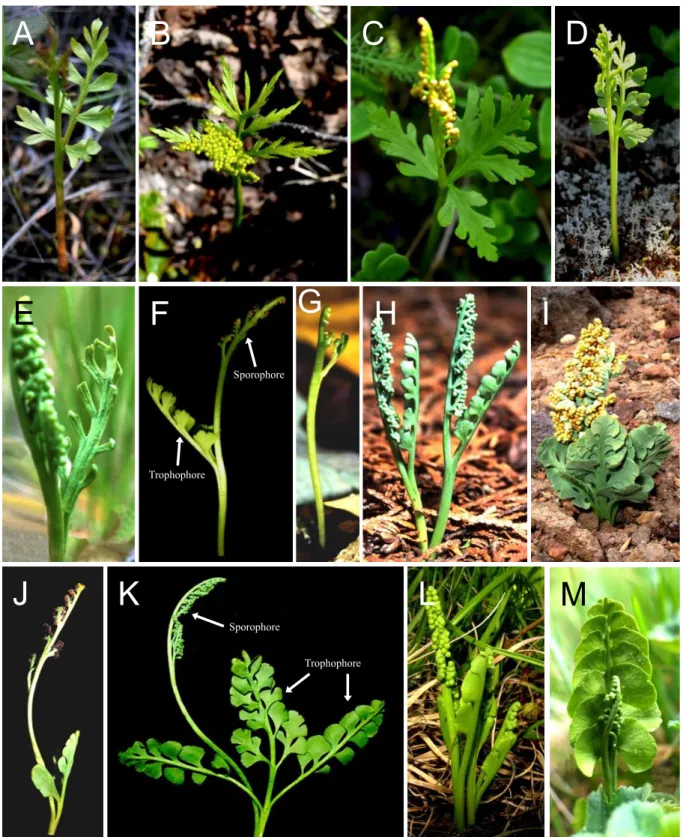
Botrychium s. s. is morphologically simple and each year an underground bud produces a single
leaf that is dichotomously divided into a trophophore (blade) and a sporophore (fertile segment) (Fig. 1). It has a symbiotic relationship with various species of arbuscular mycorrhizal fungi (AMF) (Glomeromycota) that colonize its roots, and some moonwort taxa tend to occur in various associated
soil types and floristic communities (Sandoz 2016). Subtle morphological characters, such as trophophore shape and pinnae number, orientation, and margin, often make it difficult to distinguish taxa and misidentification is frequent. These morphological challenges have led botanists to characterize moonworts as a morphologically cryptic group (Paris et al. 1989), in which [two or more distinct species may be erroneously classified or hidden under a single species name] (Bickford et al. 2007). Botrychium minganense Victorin illustrates these ambiguities, being first described by Victorin (1927) as a distinct species, then relegated to varietal rank (B. lunaria var. minganense) by Clausen (1938). Subsequent investigations of morphological characters combined with karyological analyses based on 14 differentiating morphological traits and different ploidy levels led Wagner and Lord (1956) to recognize B. minganense and B. lunaria as separate and distinct species.
Farrar and coworkers were able to circumvent morphological limitations by using applied genetic analyses of 20 enzyme loci to characterize individual taxa and test relationships within the genus (see Farrar 2011 for overview). These studies led to the discovery of additional cryptic species (Farrar and Johnson-Groh 1991; Stensvold et al. 2002; Stensvold and Farrar 2016), and, because enzyme electrophoresis visualizes codominant alleles, it allowed the detection of both parental taxa of allopolyploid species (Zika and Farrar 2009; Gilman et al. 2015; Williams et al. 2016; Meza-Torres et al. 2017). Based on genetic identity (GI) (Nei 1978) between species, DNA sequences (Dauphin et al. 2014), karyological data to determine ploidy level (Wagner 1993; Dauphin et al. 2016), and ecological and relevant morphological characteristics (Farrar 2011), all these authors used the biological species concept to define species and varieties, and we follow their circumscription of taxa.
Initial identification of taxa by genetic analysis of allozymes has also aided morphological identification enabling recognition of certain diagnostic morphological characters (Farrar and Popovich 2012; Williams et al. 2016). We further evaluated several recently published taxa characterized by genetic data (e.g. B. lunaria var. melzeri Stensvold & Farrar, B. michiganense W. H. Wagner ex A. V. Gilman, Farrar & Zika, B. neolunaria, and B. nordicum Stensvold & Farrar) (Gilman et al. 2015; Stensvold and Farrar 2016). This study also evaluates eight unpublished taxa (B. alaskense var. salchaketense J. R. Grant, var. nov. ined., B. boreale × B. lunaria 4, B. farrarii Legler & Popovich, sp. nov. ined., B. furculatum Popovich & Farrar, sp. nov. ined., B. lanceolatum “red” × B.
pallidum 1, B. lanceolatum “red” × B. pallidum 2, B. lanceolatum “green”, and B. minganense × B. echo), and presents evidence for five more cryptic taxa (B. lunaria 2, B. lunaria 3, B. lunaria 4, B. lunaria 5, and B. simplex 2 (Table 1). The unpublished new taxa we name here are not intended to be
validated in this paper as they are in preparation or in press elsewhere.
Previous molecular phylogenies described relationships in Botrychium s. s. based on more limited geographical representativeness and taxonomic sampling (Hauk et al. 2012; Williams and Waller 2012; Dauphin et al. 2014). The present study expands geographic and taxonomic sampling and uses new markers to support many of the hypotheses generated by earlier studies, but also introduces new
insights into 1) the cladistic relationships among known and proposed taxa, 2) maternal lineages and multiple origins of allopolyploid taxa, 3) congruence of chloroplast and nuclear data in supporting taxa and their relationships, and 4) geographic distributions of clades and clade members, and potential for further analysis of geographic migrations and origins of Botrychium taxa.
Fig. 1. A–M. Morphological diversity in Botrychium. A. B. alaskense var. alaskense (photo by B. Dauphin, U.S.A). Trophophore and sporophore are indicated with arrows on the photos F and K. B. B.
angustisegmentum (photo by B. Dauphin, Sweden). C. B. lanceolatum “green” (photo by J. Grant,
U.S.A.). D. B. boreale (photo by B. Dauphin, Sweden). E. B. campestre var. lineare (photo by D. Barton, U.S.A.). F. B. minganense (photo by D. Farrar, U.S.A.). G. B. mormo (photo by D. Farrar, U.S.A.). H. B. pallidum (photo by S. Mortensen, U.S.A.). I. B. pumicola (photo by D. Farrar, U.S.A.). J. B. simplex var. simplex (photo by D. Farrar, U.S.A.). K. B. simplex var. compositum (photo by D. Farrar, U.S.A.). L. B. tenebrosum (photo by D. Farrar, U.S.A.). M. B. lunaria var. lunaria (photo by A. Maccagni, Switzerland).
A
E
I
B
D
H
F
J
M
G
C
K
L
Sporophore Trophophore Sporophore TrophophoreMaterials and Methods Sampling
Our sampling covers the geographical range of each clade and subclade of Botrychium s. s. as identified by Hauk et al. (2003; 2012) and Dauphin et al. (2014), 34 of the 35 accepted taxa (only B.
tolucaense W. H. Wagner & Mickel from Mexico is missing), as well as several accessions from
potential new species and varieties. We included a specimen from the type locality (Topotype) for most species. At least five species occur in Asia, fourteen in Europe, eighteen in North America, and one each in North Africa, Oceania, and temperate South America (Table 1). In addition, thirteen putatively new taxa are included: B. alaskense var. salchaketense var. nov. ined., B. boreale × B.
lunaria 4, B. farrarii sp. nov. ined., B. furculatum sp. nov. ined., B. lanceolatum “green”, B. lanceolatum “red” × B. pallidum 1, B. lanceolatum “red” × B. pallidum 2, B. lunaria 2, B. lunaria 3, B. lunaria 4, B. lunaria 5, B. minganense × B. echo, and B. simplex 2.
Taxonomic considerations
As determined through enzyme electrophoresis, the taxonomic rank of all published (and many unpublished) Botrychium taxa has been evaluated by Farrar and coauthors (cited herein) employing GI (Nei 1978). In doing so, these studies have followed a general guideline of GI values below 70% as characterizing taxon distinction at the species level and identities above 90% as characterizing populations within a species that do not warrant taxon distinction. Intermediate identities are considered evidence of intermediate rank, e.g., varieties (see Stensvold and Farrar 2016 for review of these criteria). When applied to published Botrychium species, these criteria have been generally supportive of the published ranks, with exception of the taxa discussed below. First, B. lanceolatum was confirmed to be actually composed of three morphologically and genetically distinct species, herein referred to as B. lanceolatum “red” (GI = 77%), B. lanceolatum “green” (GI = 74%), and B.
angustisegmentum (Pease & A. H. Moore) Fernald (GI = 79%) (Stensvold and Farrar 2016). We
accept the provisional name B. lanceolatum “green” (Stensvold and Farrar 2016) applied to the taxon segregated from B. lanceolatum “red” (resolution of whether “red” or “green” morphotypes represent published B. lanceolatum (Gmel.) Angstr. is under study). Second, B. acuminatum W. H. Wagner was not supported as distinct from B. matricariifolium (GI = 99%) (Williams et al. 2015). Third, B. lineare W. H. Wagner was reduced to varietal status under B. campestre W. H. Wagner & Farrar (GI = 83%) (Farrar and Gilman, 2017), and finally, preliminary analysis of both allozyme and chloroplast data suggest that the species pairs B. mormo W. H. Wagner and B. montanum, and B. dusenii and B.
spathulatum have genetic similarity much higher than expected for distinct species and are proposed
herein for reevaluation as to proper rank. Some newly recognized clades in this study that may warrant taxonomic recognition, but have yet to be evaluated for GI, are listed as potentially new taxa warranting further study (Table 1).
The majority of specimens from North America and many from Europe were provided by the herbarium (ISC) at Iowa State University (Ames, Iowa) with their identification confirmed by both morphological characters and genetic profiles based on allozyme analyses (for electrophoresis procedures see Stensvold and Farrar 2016). Most specimens from Alaska and Europe were collected by BD, AM, and JG, while other material, largely from Asia, Oceania, and Sweden, was received dried in silica gel from colleagues (see acknowledgements). Specimen voucher data and GenBank accession numbers are provided in Appendix 1. Three representatives of the sister genera Botrypus and Sceptridium were used as outgroups (Pryer et al. 2004; Rothfels et al. 2015).
Assessment of Ploidy Level
The ploidy level of many described taxa was determined through chromosome counts included in the original descriptions. Ploidy of taxa not determined by chromosome counts was inferred by three methods: allozyme profiles, spore size, and flow cytometry. Visualization of co-dominant alleles through allozyme electrophoresis allows differentiation of recombinational heterozygosity that varies across individuals in a population vs. fixed heterozygosity that is constant in all plants of a taxon. Fixed heterozygosity is characteristic of allopolyploid taxa containing two homoeologous sets of chromosomes derived through polyploidization. Allozyme profiles of taxa with published chromosome counts were consistent with this interpretation. Spore size was measured as a morphological marker for cryptic specimens not examined cytologically or by allozyme profiles. Spore size in Botrychium taxa is consistently smaller in diploid taxa than in polyploid taxa. For example, the range of spore size in diploid B. lunaria and B. neolunaria is 33–39 µm whereas that of their allopolyploid derivative B. yaaxudakeit Stensvold and Farrar is 46–57 µm (Stensvold et al. 2002). Additionally, we investigated the ploidy level of several taxa using flow cytometry analysis (Dauphin et al. 2016).
DNA Extraction, PCR Amplification, and Sequencing
Total genomic DNA was extracted from leaf material dried in silica gel or from herbarium specimens using the DNeasy plant mini kit (Qiagen, Hilden, Düsseldorf, Germany) and the manufacturer’s protocol. Total DNA was quantified with spectrophotometry (NanoDrop 2000, Thermo Scientific, Wilmington, Delaware), and the quality was inspected on agarose gel (1.5%).
For each taxon, the four non-coding chloroplast loci matK intron, trnHGUG–psbA and trnLUAA
-trnFGAA intergenic spacers, and rpL16 intron region were targeted based on amplification success and
informativeness at intraspecific level (Taberlet et al. 1991; Sang et al. 1997; Small et al. 1998; Tate and Simpson 2003; Shaw et al. 2005; Hauk et al. 2012). Protocol and optimized polymerase chain reaction (PCR) programs were used following Dauphin et al. (2014) except for the matK intron. Specific forward matK_F3 (5’ GGA ATC ATC ATC TTT ATG AGT TTG AGG 3’) and reverse matK_R3 (5’ GCA CGT ATT GTA CTT TTG TGT TTG C 3’) primers targeting the matK intron
were designed on GenBank accessions from Botrypus and Sceptridium (Shinohara et al. 2013). This region was amplified using the following PCR program: 180 sec of initial denaturation at 94°C; 35 cycles of 94°C for 60 sec, 56°C for 45 sec, and 72°C for 60 sec; with a final extension at 72°C for 600 sec. All PCR amplifications were carried out in a 25 μL reaction volume containing 17.4 μL of ddH2O, 5 μL of buffer, 0.5 μL of dNTP mix at 10 mM, 0.5 μL of each 10 mM primer, 0.1 μL of GoTaq G2 DNA polymerase (Promega, Madison, Wisconsin), and ~ 10 ng of DNA.
The PCR products were purified using the EZ-seq kit and loci were sequenced on an ABI3130 XL Automated Sequencer by Macrogen Europe (Amsterdam, Netherlands), using the same primer combinations as used in PCR amplifications. Sequencing reactions were carried out on 5 μL purified PCR products with 5 μL of primer at 10 mM. All regions were sequenced with both forward and reverse primers to ensure unambiguous chromatogram profiles.
Sequence Alignment
Sequences were edited and assembled with Geneious V.6.1.6 (Kearse et al. 2012). All sequences were aligned with MAFFT online (Katoh and Standley 2013) using the FFT-NS-1 settings. Indels (insertion/ deletion) present in the final alignment were coded as missing values. All sequences have been deposited in GenBank. The 83 trnHGUG–psbA, trnLUAA
-trnFGAA, and rpL16 sequences already
published (Dauphin et al. 2014) were included in the dataset to complement the geographic range of several taxa. Alignments of each locus were submitted to Dryad (doi:10.5061/dryad.tc07j).
Assessment of Haplotype Number per Geographical Area
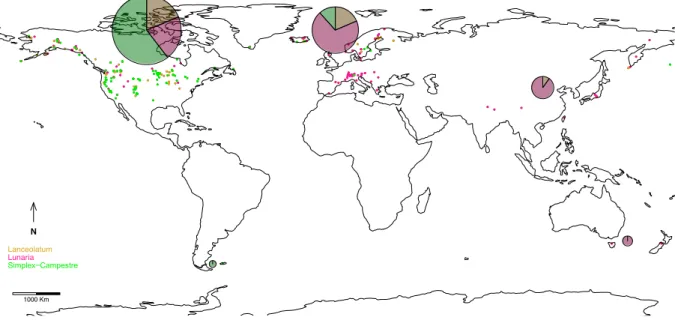
The four cpDNA regions were analyzed as a single concatenated-locus because the chloroplast genome of ferns is basically uniparentally inherited with no recombination (Gastony et al. 1992; Vogel et al. 1998). Outgroups were excluded from this analysis and indels were considered as single mutation events (Simmons and Ochoterena 2000). The number of haplotypes was calculated in DnaSP V.5.10 (Librado and Rozas 2009) for the major clades Lanceolatum (LAN), Lunaria (LUN), and Simplex-Campestre (SIC) distributed across the entire geographical range of the genus. Geographical areas were defined to cover species distribution on five continents: Asia (ASI) [defined as Eurasia east of the Ural and Caucasus Mountains], Europe (EUR), North America (NAM), Oceania (OCE) [as Australia, Tasmania, and New Zealand), and South America (SAM) [as Patagonia and the Falkland Islands) (Fig. 2). Although B. lunaria occurs in North Africa in the Atlas Mountains of Morocco, we have so far been unable to procure material. Each taxon distribution was coded with multiple geographical areas when it had an inter-continental distribution.
Phylogenetic Analyses
Phylogenetic relationships were simultaneously investigated using maximum likelihood (ML) in RAxML V.8 (Stamatakis 2014) and Bayesian inference (BI) in both BEAST V.1.8 (Drummond et al.
each locus with the program jModelTest V.2 (Darriba et al. 2012) according to the AIC (Akaike 1973) and BIC (Posada and Buckley 2004) scores (Table 2). The data were partitioned and the substitution models were unlinked between the four cpDNA loci.
ML was run with the optimal substitution model (GTR+G) implementable in RAxML V.8 and conducted with 1,000 bootstrap replicates. Botrypus virginianus was fixed as the outgroup to root the topology. Bootstrap support values (BS) were reported on the phylogenetic tree (Fig. 3A-C).
BI were conducted with two optimal substitution models, HKY + G for matK and rpL16 and GTR+G for trnLUAA−trnFGAA and trnHGUG–psbA. Two independent runs of 15 million MCMC
generations were completed with each including three heated and one cold chain, and with uniform priors and a chain temp of 0.1. Trees were sampled every 1,000 generations and a burn-in of 33% was set to discard the first 5,000 trees. A 50% majority-rule consensus (MRC) tree of the 10,000 remaining trees was built based on which posterior probabilities (PP) were reported (Fig. 3A-C).
Analyses were independently conducted on the concatenated data partition and on each locus to check the congruence between loci. Incongruence between the tree topology of the concatenated data partition and the topology of each locus was visually inspected with the packages ape and distory in R (R Development Core Team 2015). All phylogenetic analyses were run on the Cyberinfrastructure for Phylogenetic Research (CIPRES) (Miller et al. 2010 ).
Fig. 2. Sampling and geographical distribution of haplotype numbers and their relative proportion for each major clade: Lanceolatum (gold), Lunaria (pink), and Simplex-Campestre (green). Number of haplotypes and their frequencies per taxon are given in Appendix 2.
Lanceolatum
Lunaria
Simplex−Campestre
N
Results
Chloroplast Characteristics
The combined plastid data set consisted of 2,385 aligned nucleotides, of which 515 (21.6%) sites were variable, 389 (16.3%) were parsimony-informative, and 126 (5.3%) were single nucleotide polymorphisms for a total of 368 individuals analyzed including outgroups (Table 2). Within
Botrychium s. s., the two intergenic spacers trnLUAA−trnFGAA and trnHGUG–psbA were the most variable
regions with 13.7% and 12.8%, whereas the introns matK and rpL16 had the lowest variability with 9.1% and 9.7% respectively. From the three major clades, the LAN clade had the lowest variability with 22 variable sites and 16 parsimony-informative sites (0.9% and 0.7%), the LUN clade had 77 and 53 parsimony-informative sites (3.2% and 2.2%), and the SIC clade contained 137 and 102 parsimony-informative sites (5.7% and 4.3%) respectively. One sequence of B. watertonense W. H. Wagner (DF2896) for the rpL16 locus is missing because PCR amplification repeatedly failed.
Number of Haplotypes per Geographical Area
A total of 118 cpDNA haplotypes was found, with 19 from the LAN clade, 59 from LUN and 62 from SIC (Table 3). The number of haplotypes was greatest in North America (96), followed by Europe (43), Asia (10), Oceania (2), and South America (1). While the SIC clade was the most diversified in North America, the LUN clade has its highest genetic diversity in Europe and Asia with 30 and 9 haplotypes respectively (Fig. 2). Details of haplotype frequencies are given in supplementary material (Appendix 2).
Phylogenetic Analyses
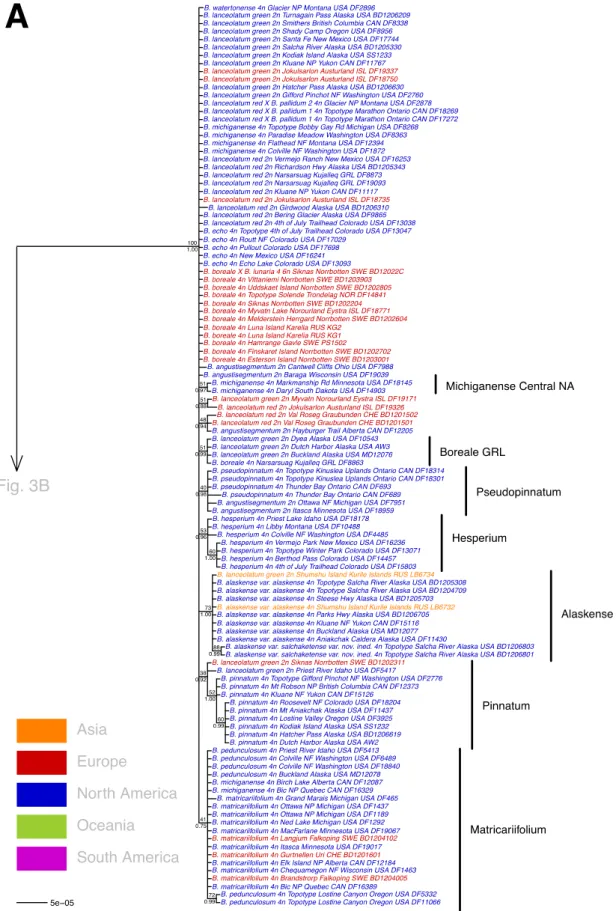
Topologies and support values (BS and PP) between ML and BI analyses were highly congruent (Fig. 3A-C), as well as between the different loci although their phylogenetic resolution varied. The optimal substitution models implementable were identified from the jModelTest ranking as HKY +G for matK (AIC = 4,672.3 and BIC = 7,988.7) and rpL16 (AIC = 6,111.9 and BIC = 9,518.8) and GTR + G for trnLUAA−trnFGAA (AIC = 3,916.9 and BIC = 6,830.6) and trnHGUG–psbA (AIC = 5,710.5 and
BIC = 8,981.1). The best tree produced by ML analysis (ln = – 7,758.150721) and the MRC tree depicted an appropriate phylogenetic resolution for both relationships at inter- and intraspecific level (Fig. 3A-C). A simplified global molecular phylogeny of maternal clades is presented with diploid and polyploid taxa based on the most frequent haplotype per taxon (Fig. 4).
Our phylogenetic tree resolved three major clades LAN (ML-BS/BI-PP = 100/1.00) (Fig. 3A), SIC (78/1.00) (Fig. 3B) and LUN (100/1.00) (Fig. 3C) as well as 15 subclades with a PP > 0.95: Alaskense (73/1.00), Boreale GRL (51/0.99), Campestre (100/1.00), Crenulatum (84/1.00), Farrarii (97/1.00), Hesperium (53/0.96), Lunaria 3 (99/1.00), Lunaria 4 (93/1.00), Michiganense Central NA (51/0.97), Neolunaria (56/0.99), Pallidum (100/1.00), Pseudopinnatum (40/0.98), Pumicola (99/1.00),
Lunaria 1 (64/0.93), Lunaria 2 (41/0.62), Matricariifolium (41/0.75), and Pinnatum (38/0.92) (Fig. 3A-C).
There is a large polytomy in the LAN clade with a single haplotype shared by three diploids (B.
angustisegmentum, B. lanceolatum “green”, and B. lanceolatum “red”) and six allopolyploids (B. boreale J. Milde, B. echo W. H. Wagner, B. lanceolatum “red” × B. pallidum 1, B. lanceolatum “red” × B. pallidum 2, B. michiganense, and B. watertonense). One taxon was monophyletic, B. hesperium
(Maxon & R. T. Clausen) W. H. Wagner & Lellinger, and four taxa were embedded with all their representatives in subclades that included diploids, B. alaskense W. H. Wagner & J. R. Grant var.
alaskense, B. alaskense var. salchaketense var. nov. ined., B. pinnatum H. St. John, and B. pseudopinnatum although their differentiation is relatively recent as indicated by short branches. In
contrast, three polyploid taxa were paraphyletic: B. boreale fell into both the Boreale GRL subclade and the Lanceolatum polytomy, B. michiganense into three positions (the Matricariifolium, Michiganense Central NA subclade and the polytomy), and B. watertonense into the Lanceolatum polytomy and into the Farrarii subclade of the SIC clade (Fig. 3B).
TABLE 1. Botrychium taxa included in this study with their placement into diploid clades and, for allopolyploids, maternal diploid clades and subclades and probable maternal taxa as determined by chloroplast haplotypes. 1Name published or in
preparation; 2Recommend for taxonomic recognition or change in existing taxonomy; 3Recommend for further studies; 4Two origins through hybridization between the same parents with reciprocal maternal parentage; 5Based on our study as
well as previous works using allozyme profiles.
Taxa Diploid clade Subclade or polytomy Distribution Ploidy level (x) Probable maternal progenitor5
B. alaskense W. H. Wagner
& J. R. Grant var. alaskense1Lanceolatum Alaskense North America 4 B. lanceolatum “green”
B. alaskense W. H. Wagner & J. R. Grant var.
salchaketense J. R. Grant, var. nov. ined.1
Lanceolatum Alaskense North America 4 B. lanceolatum “green“ B. angustisegmentum (Pease
& A. H. Moore) Fernald1 Lanceolatum Pseudopinnatum, Lanceolatum
polytomy
North America 2
B. ascendens W. H. Wagner1 Simplex−Campestre Campestre North America 4 B. campestre var. lineare
B. boreale × B. lunaria 43 Lanceolatum Lanceolatum polytomy
Europe 6 B. boreale
B. boreale J. Milde1 Lanceolatum Boreale GRL, Lanceolatum polytomy
Europe
North America 4 B. lanceolatum “green“ B. campestre var. lineare
(W. H. Wagner) Farrar1 Simplex−Campestre Campestre North America 2
B. campestre W. H. Wagner
& Farrar var. campestre1 Simplex−Campestre Campestre North America 2
B. crenulatum W. H.
Wagner1 Lunaria Crenulatum North America 2
B. dusenii (Christ) Alston1,2 Simplex−Campestre Campestre South America 4 B. campestre B. echo W. H. Wagner1 Lanceolatum Lanceolatum
polytomy
North America 4 B. lanceolatum “red“
B. farrarii Legler &
Popovich, sp. nov. ined.1 Simplex−Campestre Farrarii North America 2
B. furculatum Popovich &
Farrar, sp. nov. ined.1 Simplex−Campestre Farrarii North America 4 B. farrarii sp. nov. ined.
B. gallicomontanum Farrar
& Johnson-Groh1 Simplex−Campestre Pallidum North America 4 B. pallidum
B. hesperium (Maxon & R.T.Clausen) W. H. Wagner & Lellinger1
Lanceolatum Hesperium North America 4 B. lanceolatum “red“
B. lanceolatum (Gmel.) Ångstr.1 “green
morphotype/genotype“
Lanceolatum Alaskense, Boreale GRL, Lanceolatum polytomy, Pinnatum
Asia, Europe, North America 2 B. lanceolatum (Gmel.) Ångstr.1 “red morphotype/genotype“ Lanceolatum Lanceolatum
polytomy Europe, North America 2 B. lanceolatum “red“ × B.
pallidum 13
Lanceolatum Lanceolatum polytomy
North America 4 B. lanceolatum “red“
B. lanceolatum “red“ × B. pallidum 23
Lanceolatum Lanceolatum
polytomy North America 4 B. lanceolatum “red“ B. lunaria (L.) Sw. var.
lunaria1
B. lunaria (L.) Sw. var. melzeri Stensvold & Farrar1
Lunaria Lunaria 1 Europe 2
B. lunaria 23 Lunaria Lunaria 2 Asia, Europe, North America
2
B. lunaria 33 Lunaria Lunaria 3 Europe 2
B. lunaria 43 Lunaria Lunaria 4 Europe 2
B. lunaria 53 Lunaria Lunaria 1 Europe 2
B. matricariifolium (Döll)
A.Braun1 Lanceolatum Matricariifolium Europe, North America 4 B.
angustisegmentum B. michiganense
W.H.Wagner ex
A.V.Gilman, Farrar & Zika1
Lanceolatum Matricariifolium, Michiganense Central NA, Lanceolatum polytomy
North America 4 Ancestral “B. lanceolatum“
B. minganense × B. echo3 Simplex−Campestre Minganense North America 4 (8?) B. minganense B. minganense Victorin1 Simplex−Campestre Farrarii North America 4 B. farrarii sp. nov.
ined. B. montanum
W.H.Wagner1,2 Simplex−Campestre Simplex North America 2
B. mormo W.H.Wagner1,2 Simplex−Campestre Simplex North America 2 B. neolunaria Stensvold &
Farrar1 Lunaria Neolunaria North America 2
B. nordicum Stensvold &
Farrar1 Lunaria Lunaria 1 Europe 2
B. pallidum W. H. Wagner1 Simplex−Campestre Pallidum North America 2 B. paradoxum W. H.
Wagner1 Simplex−Campestre Farrarii North America 4 B. farrarii sp. nov. ined.
B. pedunculosum W. H.
Wagner1 Lanceolatum Matricariifolium North America 4 B. lanceolatum “green“
B. pinnatum H. St. John1 Lanceolatum Pinnatum North America 4 B. lanceolatum “green“ B. pseudopinnatum W. H.
Wagner1 Lanceolatum Pseudopinnatum North America 6 B.
angustisegmentum B. pumicola Colville1 Simplex−Campestre Pumicola North America 2
B. simplex 23 Simplex−Campestre Simplex Europe, North
America 2
B. simplex E. Hitchc. var. compositum (Lasch) Milde2
Simplex−Campestre Simplex North America 2 B. simplex E. Hitchc. var.
simplex1
Simplex−Campestre Simplex North America 2 B. spathulatum W. H.
B. tenebrosum A. A. Eaton1 Simplex−Campestre Simplex Europe, North America
2 B. tunux Stensvold & Farrar1 Lunaria Tunux Europe, North
America
2 B. watertonense W. H.
Wagner1,4 Lanceolatum, Simplex−Campestre Lanceolatum polytomy,
Farrarii
North America 4, (8?) B. hesperium B. paradoxum B. yaaxudakeit Stensvold &
Farrar1 Lunaria Neolunaria North America 4 B. neolunaria
Botrypus virginianus (L.)
A.Michx1 North America, Europe 4
Sceptridium multifidum