CX
3
CR1-CX
3
CL1-dependent
cell-to-cell Japanese encephalitis virus
transmission by human microglial
cells
Nils Lannes
1, Obdullio Garcia-Nicol s
2,3, Thomas Démoulins
2,3, Artur Summerfield
2,3&
Luis Filgueira
1The neurotropic Japanese encephalitis virus (JEV) is responsible for Japanese encephalitis, an
uncontrolled inflammatory disease of the central nervous system. Microglia cells are the unique innate immune cell type populating the brain that cross-communicate with neurons via the CX3CR1-CX3CL1
axis. However, microglia may serve as a viral reservoir for JEV. Human microglia are able to transmit JEV infectivity to neighbouring cells in a cell-to-cell contact-dependent manner. Using JEV-treated human blood monocyte-derived microglia, the present study investigates molecular mechanisms behind cell-to-cell virus transmission by human microglia. For that purpose, JEV-associated microglia were co-cultured with JEV susceptible baby hamster kidney cells under various conditions. Here, we show that microglia hosting JEV for up to 10 days were able to transmit the virus to susceptible cells. Interestingly, neutralizing anti-JEV antibodies did not completely abrogate cell-to-cell virus transmission. Hence, intracellular viral RNA could be a contributing source of infectious virus material upon intercellular interactions. Importantly, the CX3CL1-CX3CR1 axis was a key regulator of cell-to-cell virus transmission
from JEV-hosting human microglia. Our findings suggest that human microglia may be a source of infection for neuronal populations and sustain JEV brain pathogenesis in long-term infection. Moreover, the present work emphasizes on the critical role of the CX3CR1-CX3CL1 axis in JEV pathogenesis
mediating transmission of infectious genomic JEV RNA.
Japanese encephalitis (JE) is an uncontrolled inflammatory disease of the central nervous system (CNS) result-ing from the infection by the neurotropic flavivirus, JE virus (JEV). JEV consists of a sresult-ingle stranded positive sense RNA (ssRNA+) encoding for 3 structural proteins (capsid protein (C), precursor to membrane protein (prM) and envelop protein (E)) and 7 non-structural proteins (NS1, NS2A, NS2B, NS3, NS4A, NS4B and NS5)1.
Phylogenetic studies on prM suggest the presence of 5 genotypes for JEV1. JEV is transmitted by mosquito
vec-tors in a zoonotic cycle including pig as amplifiers and water bird as reservoir hosts2. Humans are accidental
dead-end hosts because of low viremia that does not allow further virus transmission1. In regions at risks, JE has
an annual incidence of 70,000 symptomatic cases with 25–30% of mortality rate and 50% of survivors having life-treating neurological problems3,4. JEV is endemic in northern regions and epidemic in southern regions of
the Asia-Pacific5. However, the detection of JEV in Europe6,7 and Africa8, the presence of competent vectors for
JEV in Germany9 as well as the ability of JEV to persist and transmit between pigs in the absence of mosquitos10
are increasing risks for virus spread and persistence in regions with more moderate climate. Therefore, JE may become a worldwide health concern despite the establishment of efficient vaccines and vaccination programs3.
By a still unknown mechanism, JEV enters into the brain and targets neuronal cells with a specific tropism for developing neurons11. In particular, areas of neuronal turn-over, including the thalamus, the brainstem and
the hippocampus, are the main brain regions of JEV–infected neurons found in brain autopsy studies of fatal JE patients12. In the CNS, microglial cells are a unique resident immune cell population able to migrate, phagocyte
and present antigen upon insults13,14. Microglia develop during early development of the foetus, but can also
1Unit of Anatomy, Department of Medicine, University of Fribourg, Route Albert-Gockel 1, Fribourg, Switzerland. 2Institute of Virology and Immunology, Sensemattstrasse 293, Mittelhäusern, Switzerland. 3Department of
Infectious Diseases and Pathobiology, Vetsuisse Faculty, University of Bern, Langassstrasse 122, Bern, Switzerland. correspondence and requests for materials should be addressed to n.L. (email: [email protected])
Received: 5 November 2018 Accepted: 1 March 2019 Published: xx xx xxxx
www.nature.com/scientificreports
www.nature.com/scientificreports/
derive from blood monocytes after birth under specific conditions15. In the JEV context, human microglia do
not release infectious virus particles, but sustain viral RNA during a long period after virus exposure. However, microglia-associated virus remains infectious to susceptible cells under cell-to-cell contact conditions, allowing virus recovery16. Actually, microglia are proposed to play a possible role in long-lasting infection17.
Chemokines have potent chemotactic activities leading to the attraction or repulsion of specific cell types in various body compartments. In the CNS, the CX3CR1-CX3CL1 axis mediates the cross-communication
between CX3CR1-expressing microglia and CX3CL1-expressing neurons18. In the CNS, CX3CR1-CX3CL1
maintains homeostasis and regulates inflammatory responses in compromised brain tissues19. Nevertheless,
CX3CR1-CX3CL1 is protective in herpes simplex virus infection20 whereas it is detrimental in Theiler’s
encepha-lomyelitis virus infection21. Microglia upregulates CX
3CR1 expression in response to JEV exposure16, but the role
of the CX3CR1-CX3CL1 axis remains unknown.
The present study aims to understand and dissect the mechanisms behind virus transmission and recovery from JEV-associated human microglia. In order to achieve this work, human monocyte-derived microglia were exposed to Nakayama JEV strain in vitro until supernatants were free of infectious virus. Virus recovery was subsequently achieved by adding susceptible target baby hamster kidney 21 (BHK-21) cells to JEV-associated microglia. Our results demonstrate that virus recovery from the target cells occurred upon cell contact-mediated virus transmission from JEV-associated microglia up to 10 days after virus exposure. Cell-to-cell virus trans-mission was not affected by the presence of neutralizing anti-JEV antibodies and de novo virus particles produc-tion by target cells could overcome neutralizing activities. Interestingly, viral RNA may be a contributing source of infectious virus material for cell-to-cell virus transmission. The latter virus transmission was dependent on CX3CR1-CX3CL1 interactions. Overall, the present study defines a novel function of human microglia as source
of JEV virus infection via cell-to-cell virus transmission, independently of virus binding to its receptor on target cells.
Results
JEV recovery from JEV-pre-treated human microglia occurs at late periods after virus exposure.
At early periods of exposure e.g. 24 hours, JEV does not alter morphology nor is it cytopathic to human micro-glia16. At later exposure periods of 6 and 8 days, observations under the light microscope demonstrated that bothmock- and JEV-treated human microglia were confluent with variable morphologies of flat and elongated or round cells and exerted equivalent granularity (Fig. 1a and b). Therefore, microglia survived long-term exposure to JEV.
Since supernatants of JEV-treated human microglia were free of infectious virus from 6 days of exposure onwards (data not shown), virus recovery was assessed as previously described16. To this end, human microglia
were pre-treated with JEV for 6, 8, 10 and 12 days and subsequently co-cultured with susceptible target cells such as BHK-21 cells in cell-to-cell contact conditions for 2 additional days in the presence of control porcine serum (Ctrl serum). Virus titres were then determined in supernatants of co-cultures. In the presence of 1:100 of Ctrl serum, virus titres were of 1.41 × 10⁴ TCID
50/mL (±1.46 × 10⁴), 1.13 × 10⁵ TCID50/mL (±2.54 × 10⁵) and
1.82 × 101 TCID
50/mL (±2.98 × 101) at 6, 8 and 10 days of pre-treatment, respectively. In the presence of 1:1000
of Ctrl serum, virus titres were of 4.62 × 10² TCID
50/mL (±5.42 × 10²), 1.87 × 10³ TCID50/mL (±2.68 × 10³) and
0.61 × 101 TCID
50/mL (±1.25 × 101) at 6, 8 and 10 days of pre-treatment, respectively. After a pre-treatment of
12 days, no infectious virus was detected with neither 1:100 nor 1:1000 of Ctrl serum. Overall, JEV recovery was statistically significant compared to mock at 6 and 8 days, but not at 10 days after virus pre-treatment. (Fig. 1c).
Neutralizing anti-JEV antibodies do not completely abrogate cell-to-cell virus transmission and
recovery from human microglia.
In order to evaluate a possible contact of JEV with the extracellular space during the process of cell-to-cell virus transmission between JEV-infected human microglia and suscep-tible cells, neutralizing immune serum of pig vaccinated against JEV was employed22. Importantly, the potencyof antibody-dependent enhancement of infection by JEV22 is circumvented by applying antibodies generated in
pigs on cells of other species, e.g. human and hamster. Neutralizing titres of immune serum was 1:320 to cell-free JEV22 and was used at concentrations of 1:100 and 1:1000. Control (Ctrl) and immune neutralizing (NT) porcine
sera were added at time of co-culture of BHK-21 cells and JEV-infected human microglia for 6 or 8 days. Then, levels of intracellular JEV envelop protein (JEV E) were measured in BHK-21 cells and virus titres were deter-mined in supernatants.
In order to evaluate cell-to-cell virus transmission, intracellular JEV E protein was analysed in BHK-21 cells by flow cytometry. BHK-21 cells were gated as big cells based on their forward/scatter (FSC/SSC) profile (Fig. 2a, upper left panel). Intracellular JEV E protein expression was measured on BHK-21 cells, as exemplified from co-cultures of 6d JEV-pre-treated microglia with BHK-21 cells (Fig. 2a). Upon co-culture with 6d JEV-pre-treated human microglia, significant frequencies of JEV E-bearing BHK-21 cells were 11.19% (±8.1) and 7.32% (±6.00) in the presence of 1:100 and 1:1000 Ctrl serum, respectively, as compared to mock. As expected, 1:100 and 1:1000 of NT serum significantly reduced the frequencies of JEV E-bearing BHK-21 cells to 3.35% (±1.48) and 2.63% (±1.49) respectively, as compared to corresponding Ctrl serum conditions. However, the frequencies of JEV E-bearing BHK-21 cells in the presence of 1:100 NT serum remained significant compared to mock (Fig. 2b). Although none of the Ctrl and NT sera conditions showed significance, similar tendencies were pictured upon co-culture of 8d JEV-pre-treated human microglia with BHK-21 cells (Fig. 2c). Overall, neutralizing antibodies did not completely block cell-to-cell virus transmission.
In order to confirm virus recovery, infectious virus particles from culture supernatants were titrated. After 6d cultured JEV-pre-treated microglia, significant virus titres were measured as compared to mock, i.e. 9.97 × 10⁴
TCID50/mL (±2.35 × 10⁵) and 5.96 × 10⁴ TCID50/mL (±1.17 × 10⁵) in the presence of 1:100 and 1:1000 of Ctrl
Figure 1. JEV recovery from JEV-pre-treated human microglia after late periods of exposure. (a,b) Human microglia were treated with Mock and JEV (Nakayama isolate used at a multiplicity of infection (MOI) of 10 TCID50/cell) at 37 °C for indicated time-periods. Representative micrographs showing cell monolayer and
morphology at magnification of (a) 10x and (b) 40×. Scale bars are of (a) 200 μm and (b) 50 μm. In (c), human microglia were pre-treated with Mock and JEV (Nakayama isolate used at a MOI of 10 TCID50/cell) at 37 °C for
indicated time-periods. The latter cell were intensively washed with cold PBS and subsequently co-cultured with BHK-21 cells for 2 additional days in the presence of indicated concentrations of control porcine serum (Ctrl serum). (c) Curve lines representing virus titres in supernatants. The symbol represents the mean value; the error bars the standard deviation. Micrographs and data are of 3 independent experiments with each condition performed in duplicate cultures. Significant differences between Mock and JEV isolate is indicated by the letters a and b for conditions in the presence of 1:100 and 1:1000 PS, respectively. Statistics are calculated with the Mann-Whitney test (*p < 0.05; **p < 0.01; ***p < 0.001; ****p < 0.0001).
www.nature.com/scientificreports
www.nature.com/scientificreports/
Figure 2. Impact of anti-JEV neutralizing antibodies on virus transmission and recovery. Human microglia were pre-treated with Mock and JEV (Nakayama isolate used at an MOI of 10 TCID50/cell) at 37 °C for indicated
time-periods. Then, cells were washed with cold PBS and subsequently co-cultured with BHK-21 cells for 2 additional days in the presence of indicated concentrations of control (Ctrl) or neutralizing (NT) porcine serum. (a) Upper left panel is a representative density plots showing the gating strategy for the identification of BHK-21 cells based on their FSC/SSC profile. Other panels show representative density plots of intracellular JEV E expression in gated BHK-21cells. Frequency of JEV E+-cells is indicated. (b,c) Box plots representing
frequencies of BHK-21 cells expressing JEV E. The symbols represent replicates where each colour is an individual donor. The black line represents the median value, the red line the mean value and the error bars the standard deviation. (d,e) Scatter dot plots representing virus titres in supernatants. The symbols represent replicates where each colour is an individual donor and the black line represents the mean value. Data are of 4 independent experiments with each condition performed in duplicate cultures. Asterisks on top of a condition show significant differences compared to mock; asterisks on black line show significant differences between the indicated conditions. Statistics are calculated with (b,c) the t-test or (d,e) the Mann-Whitney test (*p < 0.05; **p < 0.01; ***p < 0.001; ****p < 0.0001).
TCID50/mL (±5.09 × 101) and 8.75 × 101 TCID50/mL (±2.40 × 10²) respectively. This diminution in virus titres
was significant compared to corresponding concentration of Ctrl serum (Fig. 2d). Similarly, significant virus titres were measured in 8d cultured JEV-pre-treated microglia compared to mock, i.e. 8.50 × 10⁴ TCID
50/mL
(±2.21 × 10⁵) and 1.03 × 10⁴ TCID
50/mL (±2.35 × 10⁴) in the presence of 1:100 and 1:1000 of Ctrl serum,
respec-tively. Compared to corresponding concentration of Ctrl serum, virus titres significantly decreased to 8.57 × 10²
TCID50/mL (±2.41 × 10³) and 1.87 × 10² TCID50/mL (±3.15 × 10²) in the presence of 1:100 and 1:1000 NT
serum, respectively. However, only the condition of co-cultures of 8d JEV-pre-treated human microglia and BHK-21 cells in the presence of 1:100 NT serum showed significance compared to mock (Fig. 2e). Therefore, infectious virus could be recovered from co-cultures in the presence of NT serum, demonstrating that de novo virus production could overcome neutralizing activities.
Viral RNA may be a contributing source of infectious viral material upon cell-to-cell virus
transmission.
Considering the fact that human microglia do not produce infectious virus particles, but sus-tain the replication of viral RNA16 and that neutralizing antibodies do not completely block virus transmissionand recovery, further experiments aimed to identify the potential source of transmission of infectious viral mate-rial upon intercellular interactions. In confocal microscopy experiments of co-cultures, the Iba-1 marker was used to label microglia cells (Iba-1pos) and to discriminate from BHK-21 cells (Iba-1neg). Immune fluorescence
labelling of intracellular dsRNA allowed detection of replicating viral RNA23,24 and labelling of intracellular JEV E
protein showed viral envelop protein. Mock were free of both dsRNA and JEV E (Fig. 3). Short co-culture periods of 6 hours showed that Iba-1pos microglia contained dsRNA, but no JEV E protein upon pre-treatment with JEV
(Fig. 3a and b). After 24 hours of co-cultures, both Iba-1pos microglia and Iba-1neg BHK-21 cells presented dsRNA
(Fig. 3c). In parallel, JEV E was mostly found in Iba-1neg BHK-21 cells, but was also observed in Iba-1pos microglia
cells (Fig. 3d). This indicates a possible re-infection of the latter cells by de novo JEV particles released from the JEV-producing BHK-21 cells.
In order to assess the role of viral RNA in cell-to-cell virus transmission, RNAse A was applied to degrade RNA content in co-cultures such as viral RNA. Using flow cytometry, BHK-21 cells were gated as big cells and microglia as small cells based on their FSC/SSC profile. Then, intracellular dsRNA and JEV E protein were detected in BHK-21 cells and microglia (Fig. 4a). Treatment of co-cultures with RNAse A decreased the frequen-cies of dsRNA+-BHK-21 cells in a dose dependent manner and a dose of 60 μg/mL of RNAse A was used for
further experiments (Supplementary Fig. 1a). In the absence of RNAse A, frequencies of dsRNA+-BHK-21 cells
were of 1.88% (±0.54) whereas 60 μg/mL of RNAse A significantly reduced the frequencies of dsRNA+-BHK-21
cells to 0.56% (±0.43). Only conditions in the absence of RNAse A showed significance compared to mock with frequencies of 0.45% (±0.16) (Fig. 4b, left panel). In parallel, the absence of RNAse A revealed frequencies of dsRNA+-microglia of 0.98% (±0.39) whereas 60 μg/mL of RNAse A showed frequencies of dsRNA+-microglia
Figure 3. Confocal microscopy analysis of intercellular interactions during virus transmission. Human microglia were adhered with Mock and JEV (Nakayama isolate used at an MOI of 10 TCID50/cell) at 37 °C for
2 hours. Cells were then intensively washed with cold PBS and left in culture at 37 °C for 48 hours. Then, cells were intensively washed with PBS before co-culture with BHK-21 cells in the presence of 1:100 Ctrl serum for various time-periods. Cells were stained for the indicated markers and analysed using confocal microscopy. Micrographs showing fluorescence signals upon co-cultures of (a,b) 6 hours and (c,d) 24 hours. Scale bars are of 60 μm. White arrows focus on microglia and red arrowheads on BHK-21 cells. Micrographs are representative out of 3 independent experiments.
www.nature.com/scientificreports
www.nature.com/scientificreports/
of 0.50% (±0.56). Again, only conditions in the absence of RNAse A showed significance compared to mock with frequencies of 0.37% (±0.24) (Fig. 4b, right panel).
Deeper analysis of JEV E expression revealed that in the absence of RNAse A, frequencies of JEV E+-BHK-21
cells were of 12.39% (±6.93) and 60 μg/mL of RNAse A resulted in frequencies of JEV E+-BHK-21 cells of 4.65%
(±4.05). Both conditions were significant compared to mock with frequencies of 0.34% (±0.16) (Fig. 4c, left panel). In parallel, the absence of RNAse A showed frequencies of dsRNA+-microglia of 2.71% (±2.3) and 60 μg/
mL of RNAse A lead to frequencies of dsRNA+-microglia of 0.78% (±0.42). Again, both conditions were
signifi-cant compared to mock with frequencies 0.35% (±0.18) (Fig. 4c, right panel).
Figure 4. Impact of RNAse A on virus transmission and recovery. Human microglia were pre-treated with Mock and JEV (Nakayama isolate used at an MOI of 10 TCID50/cell) at 37 °C for 6 days. Cells were then washed
with cold PBS and subsequently co-cultured with BHK-21 cells for 2 additional days in the presence of 1:100 Ctrl serum and indicated concentrations of RNAse A. (a) Central panel is a representative density plots of flow cytometry analysis showing the gating strategy for the identification of BHK-21 cells and microglia based on their FSC/SSC profile. Other density plots represents (left panel) intracellular dsRNA and (right panel) JEV E expression in gated (upper panel) BHK-21cells and (lower panel) microglia. Frequency of dsRNA and JEV E+ cells is indicated. (b) Histogram bars representing frequencies of BHK-21 cells and microglia expressing
dsRNA identified as in (a). The bar represents the mean value; the error bars the standard deviation. (c) Box plots representing frequencies of BHK-21 cells and microglia expressing JEV E identified as in (a). The symbols represent replicates where each colour is an individual donor. The black line represents the median value, the red line the mean value and the error bars the standard deviation. (d) Histogram bars representing virus titres in supernatants. The bar represents the mean value; the error bars the standard deviation. Data are of 2 independent experiments with each condition performed in duplicate or triplicate cultures. Asterisks on top of a condition show significant differences compared to mock; asterisks on black line show significant differences between the indicated conditions. Statistics are calculated with (b,c) the t-test or (d) the Mann-Whitney test (n.s.: not significant; *p < 0.05; **p < 0.01; ***p < 0.001; ****p < 0.0001).
However, treatment with RNAse A did not abrogate nor diminished the generation of infectious JEV particles, which titres ranged at 105–106 TCID
50/mL (Fig. 4d and Supplementary Fig. 1b). Overall, RNAse A effectively
reduced intracellular dsRNA in cells but not JEV E. Moreover, the production of de novo virus particles overcome RNAse A activity.
The CX
3CR1-CX
3CL1 axis contributes to intercellular interactions for cell-to-cell virus
trans-mission and recovery.
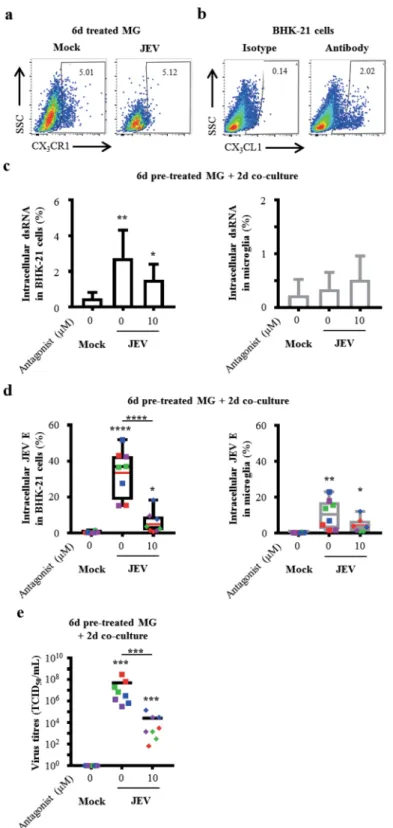
Upon short period of exposure to JEV (e.g. 2 days), human microglia increase their cell surface expression of CX3CR116. After 6 days, ~5% of human microglia expressed CX3CR1 on theircell surface upon JEV exposure and was comparable to mock (Fig. 5a). In counterpart, ~2% of BHK-21 cells expressed CX3CL1 on their surface, the ligand for CX3CR1 (Fig. 5b). Therefore, the role of the CX3CR1-CX3CL1
axis upon intercellular interactions during virus transmission was investigated using a non-competitive, potent and highly specific antagonist for CX3CR1 in co-cultures25,26. Importantly, doses of 10 μM of CX3CR1 antagonist
did not affect the capacity of virus propagation by BHK-21 cells (Supplementary Fig. 2a). Overall, treatment with CX3CR1 antagonist decreased the frequencies of JEV E-expressing cells and virus titres in a dose-dependent
manner. Since 10 μM of CX3CR1 antagonist efficiently inhibited virus transmission and recovery, this dose was
employed for further analysis (Supplementary Fig. 2b and c).
Cell-to-cell virus transmission was investigated by the detection of intracellular dsRNA and JEV E protein in BHK-21 cells and microglia by flow cytometry after 2 days of co-cultures since earlier time-periods of co-cultures did not allow quantification of dsRNA and JEV E protein (Supplementary Fig. 3a and b). In the absence of CX3CR1 antagonist, frequencies of dsRNA+-BHK-21 cells were of 2.75% (±1.57) and treatment with 10 μM
of CX3CR1 antagonist lead to reduced frequencies of dsRNA+-BHK-21 cells to 1.54% (±0.87). Both conditions
showed significance compared to mock with frequencies of 0.49% (±0.34) (Fig. 5c, left panel). In parallel, fre-quencies of dsRNA+-microglia were of 0.35% (±0.31) and 0.51% (±0.45) in the absence and the presence of 10
μM of CX3CR1 antagonist, respectively. No significance was found compared to mock with frequencies of 0.23%
(±0.29) (Fig. 5c, right panel).
Analysis of JEV E expression showed frequencies of JEV E-expressing BHK-21 cells of 33.64% (±13.23) in the absence of CX3CR1 antagonist. As expected, treatment with 10 μM of CX3CR1 antagonist significantly reduced
the frequencies of JEV E-expressing BHK-21 cells to 5.63% (±6.03). Both conditions were significant compared to mock with frequencies of 0.42% (±0.47) (Fig. 5d, left panel). In parallel, frequencies of JEV E+-microglia were
of 10.62% (±8.07) and 4.17% (±4.09) in the absence and the presence of 10 μM of CX3CR1 antagonist,
respec-tively. Both conditions were significant in comparison to mock showing frequencies of 0.17% (±0.19) (Fig. 5d, right panel).
In addition, recovery of infectious virus particles was evaluated by virus titration in supernatants. Importantly, recovery of infectious virus particles was confirmed in the absence of CX3CR1 antagonist by significant titres
of 5.21 × 10⁷ TCID
50/mL (±1.09 × 10⁸) when compared to mock. In line with previous observations by flow
cytometry, treatment with 10 μM of CX3CR1 antagonist significantly reduced virus titres to 2.71 × 10⁴
TCID50/mL (±5.04 × 10⁴) but these titres remained significant compared to mock (Fig. 5e). Upon co-culture
of 8d JEV-pre-treated human microglia with BHK-21 cells, similar picture were observed although no signif-icant changes were obtained regarding the frequencies of JEV E-expressing cells from the various conditions. Otherwise, virus titres in the absence of the CX3CR1 antagonist were significant in comparison to mock.
Importantly, treatment with 10 μM of CX3CR1 antagonist significantly reduced the content of infectious virus
particles in BHK-21 cells (Supplementary Fig. 4a and b). Overall, antagonistic treatment of CX3CR1 inhibited
cell-to-cell virus transmission and recovery.
The CX
3CR1-CX
3CL1 axis may influence the type of intercellular interactions.
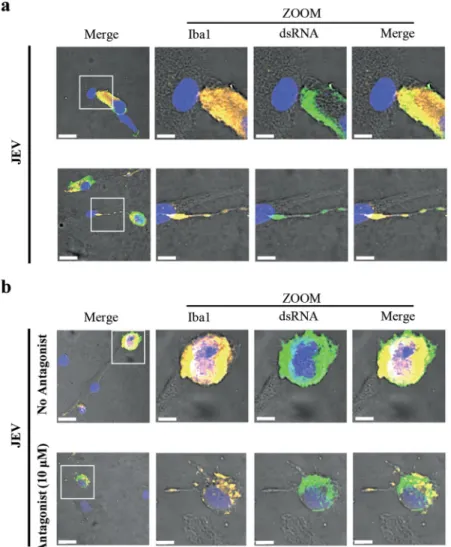
JEV transmissionand recovery requires cell-cell contact16. Already at short co-culture periods, two types of cell-to-cell interactions
were observed between Iba-1pos microglia-containing dsRNA and Iba-1neg BHK-21 cells. In the majority of the
observations, the two cell types were close to each other with a large portion of the surface cell membranes in contact (Fig. 6a, upper panel), indicating virological synapses27. To a lesser extent, the two cell types were more
distant from each other, but forming thin membrane protrusions27 containing dsRNA in the Iba-1pos microglia
tubular extensions, which interacted with BHK-21 cells (Fig. 6a, lower panel).
Co-cultures in the presence or the absence of the CX3CR1 antagonist were also analysed by confocal
micros-copy using a similar approach as described before. In both conditions, Iba-1pos microglial cells contained dsRNA
and interacted with Iba-1neg BHK-21 cells. Intercellular interactions were abundant and of a virological synapses
appearance27 in the absence of the antagonist. Although the frequency had substantially decreased, membrane
protrusions27 were occasionally observed in the presence of CX
3CR1 antagonist (Fig. 6b).
Discussion
Microglia are the first line of defence against CNS insults14. In the context of JE, microglial cells are the major
pro-ducers of antiviral inflammatory mediators within the CNS28. Indeed, human microglia produce various
inflam-matory mediators upon exposure to JEV16. However, microglia may also serve as reservoir for JEV, since they
sustain viral replication for long period after JEV exposure16,17,29. For cell-to-cell JEV transmission, the present
study highlights the potential involvement of human microglia in JEV propagation and spreading in the brain. Cell-to-cell contact-dependent virus transmission may substantially contribute to the spread of the virus infec-tion30. Moreover, virus recovery after late periods may contribute to persistent JEV infection. Persistency of JEV
in the human CNS has been suggested, since infectious virus can be found in the cerebrospinal fluid of patients beyond the third week of illness31. Although it is unknown whether JEV can be reactivated, a biphasic pattern of
JE has been described with a relapse of the disease 14–32 days after illness recovery32. Thus, JEV transmission by
www.nature.com/scientificreports
www.nature.com/scientificreports/
Figure 5. Role of the CX3CR1-CX3CL1 axis in cell-to-cell virus transmission and recovery. (a) Human
microglia were treated with Mock and JEV (Nakayama isolate used at an MOI of 10 TCID50/cell) at 37 °C
for 6 days. Representative density plots of cell surface expression of CX3CR1. Frequency of CX3CR1+ cells is
indicated. (b) BHK-21 were maintained in culture at 37 °C. Representative density plots of steady state surface expression of CX3CL1 by BHK-21 cells. Frequency of CX3CL1+ cells is indicated. Representative plots are out
of 3 independent experiments. (c–e) Human microglia were pre-treated with Mock and JEV (Nakayama isolate used at an MOI of 10 TCID50/cell) at 37 °C for 6 days. Cells were then washed with cold PBS and subsequently
co-cultured with BHK-21 cells for 2 additional days in the presence of 1:100 Ctrl serum and indicated concentrations of CX3CR1 antagonist. In (c,d), cells were analysed by flow cytometry for dsRNA and JEV
expression in BHK-21 cells and microglia identified as in Fig. 4a. (c) Histogram bars representing frequencies of BHK-21 cells and microglia expressing dsRNA. The bar represents the mean value; the error bars the standard deviation. (d) Box plots representing frequencies of BHK-21 cells and microglia expressing JEV E. The symbols
Cell-to-cell contact-dependent virus transmission is a mechanism used for viral escape to immunity. In our study, antibodies efficiently neutralized cell-free JEV22, but were inefficient in blocking cell-to-cell transmission
of microglia-associated JEV. First, resistance to neutralizing antibodies may result from the inefficacy of a cer-tain subset of neutralizing antibodies to inhibit cell-to-cell virus transmission27. Otherwise, resistance to
neu-tralizing antibodies may be due to the inaccessibility of antibodies within intercellular interaction structures. Cytosol-to-cytosol connectivity between cells, as well as cytoplasmic connections-containing vesicles prevent exposure of viral material to the extracellular space33. Finally, the present study used antibodies derived from pigs
treated with a lentivirus-based vaccine against JEV G3 prM and E proteins34. Therefore, other potential sources
of viral material such as genomic material and capsid protein are not recognized by antibodies-derived vaccine. The present study suggests that genomic viral RNA is contributing, but not the exclusive source of infectious viral material, to cell-to-cell virus transmission. In various studies, virus particles have been the source of infec-tivity in cell-to-cell virus transmission35–37. Here, the absence of JEV E protein in JEV-infected microglia cells
reflects the inability of forming virus particles. Thus the absence of virus particles, but the detection of intracel-lular dsRNA demonstrates a replicative form of JEV viral RNA, similar to other ssRNA + viruses24. Viral RNA
in its dsRNA and/or ssRNA forms may be sufficient for cell-to-cell transmission and the recovery of infectious virus including JEV38,39. Despite decreasing intracellular dsRNA content, treatment with RNAse A does not
abro-gate infectious JEV recovery. Because RNAse A degrades ssRNA, this suggests that dsRNA is more likely to be the source of virus material than ssRNA. However, other viral factors may also contribute to cell-to-cell virus transmission.
A cell-to-cell contact-dependent mode of transmission of viral genomic RNA represents an alternative mech-anism enabling the generation of de novo viable virus particles33. Human microglia are inefficient to generate
infectious virus particles and recovery of microglia-associated JEV by target cells depends on cell contact16. JEV
induces virological synapses in a contact-dependent mode of virus transmission between virus-pulsed dendritic cells and T cells35. Here, microglia may use virological synapses and membrane protrusions such as nanotubes
and/or filopodia structures for intercellular interactions. Virological synapses require the contribution of adhe-sion molecules together with microtubules and actin cytoskeleton for stabilization, whereas membrane extenadhe-sion are actin-rich structures27.
Importantly, virus transmission from JEV-treated microglia to target cells involves CX3CR1-CX3CL1
inter-action. In the CNS, microglia express CX3CR1 whereas neurons express CX3CL1 and the CX3CR1-CX3CL1 axis
is a main regulator of chemotaxis and cross-communication between microglia and neurons18. In the present
study, low levels of CX3CR1 expression on microglia allowed cell-to-cell virus transmission indicating an extreme
sensitivity of this mechanism. The fact that JEV-treated microglia transiently up-regulates surface expression of CX3CR116 suggests that cell contact-mediated virus transmission may significantly contribute to infection of
neuronal cells at early time of infection. Therefore, the CX3CR1-CX3CL1 axis could be a potential therapeutic
target candidate in JEV-infected patients. However, CX3CL1 is crucial in the inhibition of the production and
neurotoxicity of JEV-infected microglia-derived inflammatory factors40,41. Moreover, polymorphism of CX
3CR142
may influence the specificity of potential therapeutics. Polymorphism of CX3CR1 may also explain the differences
observed in virus transmission and recovery between cells of blood donors. Nevertheless, the CX3CR1 antagonist
did not completely abrogate cell-to-cell JEV transmission indicating that additional or alternative factors may be involved in transmission. For example, DC-SIGN, which is expressed in human microglia43,44, promotes dendritic
cell-to-T cell JEV transmission35 and mediates cellular modifications such as cytoskeleton remodelling promoting
filopodia extension45.
Methods
Authorization, ethics approval and consent to participate.
The Federal Office for the Environment (FOEN, Bern, Switzerland) provided authorization for the collection of human samples and manipulation of the various cells and viruses (authorization number A130522). Ethics approval 034/13-CER-FR for the characteri-zation and differentiation of human white blood cells has been granted by the Ethics Committee of the Canton of Fribourg according to corresponding laws and regulations, based on the Declaration of Helsinki. No consent form was required as the buffy coats were provided from the Swiss Red Cross Blood Bank. All samples were ana-lysed anonymously.Antibodies and stains.
The viral envelop protein was detected using the pan-immune flavivirus anti-body (mouse IgG1/IgG2a, clone ATCC-HB-112 D1-4G2-4-15 hybridoma, ATCC, Wesel, Germany) and dou-ble stranded RNA (dsRNA) was detected with the anti-dsRNA J2 antibody (mouse IgG2a, Scicons, Budapest, Hungary). Cell markers were detected using anti-human antibodies against CX3CL1 (rabbit polyclonal IgG,clone PA5-23062, Thermofischer Scientific, Waltham, MA), Iba-1 (rabbit polyclonal IgG, Wako, Richmond, VA) and fluorescent-labelled CX3CR1-R-Phycoerythrin (rat IgG2b, clone 2A9-1, Miltenyi Biotec GmbH,
Bergisch-Gladbach, Germany).
represent replicates where each colour is an individual donor. The black line represents the median value, the red line the mean value and the error bars the standard deviation. (e) Scatter dot plots representing virus titres in supernatants. The symbols represent replicates where each colour is an individual donor and the black line represents the mean value. Data are of 2 or 4 independent experiments with each condition performed in triplicate or duplicate or triplicate cultures. Asterisks on top of a condition show significant differences compared to mock; asterisks on black line show significant differences between the indicated conditions. Statistics are calculated with (c,d) the t-test or (e) the Mann-Whitney test (*p < 0.05; **p < 0.01; ***p < 0.001; ****p < 0.0001).
www.nature.com/scientificreports
www.nature.com/scientificreports/
The following secondary antibodies were used for staining: donkey anti-rabbit IgG fluorescent-labelled Alexa Fluor 647 (AF647) (Abcam, Cambridge, UK) and goat anti-mouse IgG2a fluorescent-labelled AF647 for flow cytometry, as well as goat anti-mouse IgG2a fluorescent-labelled AF488 and donkey anti-rabbit IgG fluorescent-labelled AF546 for confocal microscopy (all obtained from Thermofischer Scientific if not men-tioned). Nuclei were stained using DAPI (Sigma-Aldrich, Saint Louis, MO). All concentrations for the use of the antibodies and stains were optimized in our laboratory.
Cell line culture.
Baby Hamster Kidney-21 cells (BHK-21 cells, fibroblasts) ([C-13], ATCC) were cultured in Glasgow’s Minimum Essential Medium (GMEM) (Thermofischer Scientific) supplemented with 10% (v/v) Fetal Bovine Serum (FBS) (Biowest, Nuaillé, France) and Tryptose Phosphate Broth solution (Sigma-Aldrich) at 37 °C and 5% CO2.Virus preparation and titration.
JEV Nakayama isolate (National collection of pathogenic viruses, NCPV, Salibury, UK) was propagated in BHK-21 cells as previously described16. Briefly, 80% confluent BHK-21mon-olayer cell culture was infected with JEV suspended in RPMI-1640 GlutaMAXTM-I medium (Thermofischer
Scientific) supplemented with 2% FBS and cultured until cytopathogenic effects (approx. 36–48 hours). Virus stock suspension was obtained after disruption of remaining cells by freezing and centrifugation of cell soup at 3000 g at 4 °C for 30 minutes to eliminate cell debris. In parallel, mock was prepared accordingly from uninfected BHK-21 cells and served as negative control of virus exposure in experiments.
Figure 6. Role of the CX3CR1-CX3CL1 axis on intercellular interactions. Human microglia were adhered
with JEV (Nakayama isolate used at an MOI of 10 TCID50/cell) at 37 °C for 2 hours. Cells were then intensively
washed with cold PBS and left in culture at 37 °C for 48 hours. Cells were intensively washed with PBS and co-cultured with BHK-21 cells. In (a), co-cultures were performed in the presence of 1:100 Ctrl serum for 6 hours. In (b), co-cultures were performed in the presence of 1:100 Ctrl serum and in the absence or the presence of CX3CR1 antagonist for 6 hours. Cells were stained for the indicated markers and analysed using
confocal microscopy. (a,b) Micrographs showing fluorescence signals on bright field overlay focusing on intercellular interactions. Zoom of white square in left panel is presented. Scale bars are of 20 μm in left panels and of 8 μm in zoom panels. Micrographs are representative out of 3 independent experiments.
Virus titres of virus stocks and experimental supernatants were determined by end-point titration. Briefly, 10-fold serial dilutions of suspension in GMEM supplemented with 10% FBS and Tryptose Phosphate Broth solu-tion were applied on BHK-21 cells at 37 °C, 5% CO2. After 36–48 hours, intracellular viral particles were detected
with the pan-immune anti-flavivirus antibody followed by peroxidase enzymatic reaction.
Generation of human microglial cells.
Human blood monocyte-derived microglia were generated from buffy coats of anonymous healthy donors obtained from Blutspendedienst (Bern, Switzerland) using a protocol adapted from46. Human peripheral blood mononuclear cells (PBMC) were isolated from buffy coatafter Ficoll-Paque density gradient centrifugation (1.077 g/L, Amersham Pharmacia Biotech AG, Dubendorf, Switzerland). Monocytes were enriched using positive selection of CD14+ cells with selection columns and
mag-netic sorting system (Miltenyi Biotech GmbH). CD14+ monocytes were cultured at a concentration of 0.5 × 10⁶
cells/mL in RPMI-1640 GlutaMAXTM-I medium. Medium was supplemented with antibiotic/antimycotic and
bioactive human recombinant granulocyte macrophage colony-stimulating factor (GM-CSF) (10 ng/mL), mac-rophage colony-stimulating factor (M-CSF) (10 ng/mL), nerve growth factor (NGF)-β (10 ng/mL) and CC chemokine ligand 2 (CCL2) (50 ng/mL) (all purchased from Miltenyi Biotech GmbH), at 37 °C and 5% CO2 for 7
days. Half of the medium was renewed after the 3 days of culture.
Treatment of human microglial cells with JEV and co-culture with susceptible target
cells.
Human microglia were treated with Mock or JEV (at a multiplicity of infection (MOI) of 10 TCID50/cell)in RPMI-1640 GlutaMAXTM-I medium at 37 °C and 5% CO
2 during various time-periods. Supernatants were
collected and pre-treated human microglia were washed 5 times with cold PBS. Both supernatants and last wash-ing was verified negative for infectious JEV by end-point titration. Subsequently, susceptible target BHK-21 cells were co-cultured with pre-treated human microglia in RPMI-40 GlutaMAXTM-I medium, at 37 °C in 5% CO
2.
Co-cultures were performed in commercial porcine serum (Thermofischer Scientific). After various time-periods of co-culture, supernatants and cells were collected for further analysis.
In some experiments, immune porcine serum of vaccinated pigs with neutralizing activity against Nakayama isolate at a titre of 1:32022 and previously described commercial porcine serum was used as control. In other
experiments, CX3CR1 antagonist (AZD8797, Axon Biochemicals, Groningen, The Netherlands) suspended in
DMSO (Thermofischer Scientific) and/or RNAse A (Macherey Nagel, Düren, Germany) suspended in PBS were used. DMSO and PBS were respectively used as controls. These reactive were put on top of treated microglial cells before the addition of BHK-21 cells for co-cultures.
Flow cytometry.
Cells were analysed using multi-colour flow cytometry FACSCanto II instrument (BD Biosciences, San Jose, CA). Data were analysed using FlowJo Software (Data analysis Software, Ashland, OR).Bright field and confocal microscopy.
For conventional bright field microscopy, cells were cultured in flat bottom well plates. Cells were analysed and photographed using an EVOS XL Core digital inverted micro-scope with cell imaging system (Thermofischer Scientific). The image acquisitions were performed with the 10x and 40x objectives.For confocal microscopy, cells were alternatively cultured in labteck or on autoclaved coverslips. After stain-ing, slides were then mounted using Mowiol and left overnight at 4 °C for solidification. Cells were analysed and photographed using a confocal microscope A1 combined with an ECLIPSE Ti inverted microscope and a digital imaging NIS-Elements AR 3.30.02software (Nikon AG, Egg, Switzerland). The image acquisitions were performed with the 20x and 40x objectives. Images were treated with Imaris 9.1 software (Bitplane AG, Zürich, Switzerland), applying background subtraction, threshold applications, gamma correction and maxima.
Biosafety.
All experiments using JEV were conducted in a biosafety level 3 bio-containment. After inactiva-tion with 3% paraformaldehyde soluinactiva-tion at room temperature for 15 minutes, samples were further analysed by flow cytometry and microscopy.Statistical analysis.
Significant differences were determined with GraphPad Prism 6 software (GraphPad software Inc., La Jolla, CA) using the student t-Test (p < 0.05) or the Mann-Whitney Test (p < 0.05).Data Availability
The datasets are available upon request
References
1. Misra, U. K. & Kalita, J. Overview: Japanese encephalitis. Progress in neurobiology 91, 108–120, https://doi.org/10.1016/j. pneurobio.2010.01.008 (2010).
2. Solomon, T. Flavivirus encephalitis. The New England journal of medicine 351, 370–378, https://doi.org/10.1056/NEJMra030476
(2004).
3. Campbell, G. L. et al. Estimated global incidence of Japanese encephalitis: a systematic review. Bulletin of the World Health
Organization 89(766–774), 774A–774E, https://doi.org/10.2471/BLT.10.085233 (2011).
4. van den Hurk, A. F., Ritchie, S. A. & Mackenzie, J. S. Ecology and geographical expansion of Japanese encephalitis virus. Annual
review of entomology 54, 17–35, https://doi.org/10.1146/annurev.ento.54.110807.090510 (2009).
5. Wang, H. & Liang, G. Epidemiology of Japanese encephalitis: past, present, and future prospects. Therapeutics and clinical risk
management 11, 435–448, https://doi.org/10.2147/TCRM.S51168 (2015).
6. Ravanini, P. et al. Japanese encephalitis virus RNA detected in Culex pipiens mosquitoes in Italy. Euro surveillance: bulletin Europeen
www.nature.com/scientificreports
www.nature.com/scientificreports/
7. Platonov, A. et al. Does the Japanese encephalitis virus (JEV) represent a threat for human health in Europe? Detection of JEV RNA sequences in birds collected in Italy. Euro surveillance: bulletin Europeen sur les maladies transmissibles = European communicable
disease bulletin 17 (2012).
8. Simon-Loriere, E. et al. Autochthonous Japanese Encephalitis with Yellow Fever Coinfection in Africa. The New England journal of
medicine 376, 1483–1485, https://doi.org/10.1056/NEJMc1701600 (2017).
9. Huber, K. et al. Aedes japonicus japonicus (Diptera: Culicidae) from Germany have vector competence for Japan encephalitis virus but are refractory to infection with West Nile virus. Parasitology research. https://doi.org/10.1007/s00436-014-3983-9 (2014). 10. Ricklin, M. E. et al. Vector-free transmission and persistence of Japanese encephalitis virus in pigs. Nature communications 7, 10832,
https://doi.org/10.1038/ncomms10832 (2016).
11. Kimura-Kuroda, J., Ichikawa, M., Ogata, A., Nagashima, K. & Yasui, K. Specific tropism of Japanese encephalitis virus for developing neurons in primary rat brain culture. Archives of virology 130, 477–484 (1993).
12. Desai, A., Shankar, S. K., Ravi, V., Chandramuki, A. & Gourie-Devi, M. Japanese encephalitis virus antigen in the human brain and its topographic distribution. Acta neuropathologica 89, 368–373 (1995).
13. Ginhoux, F., Lim, S., Hoeffel, G., Low, D. & Huber, T. Origin and differentiation of microglia. Frontiers in cellular neuroscience 7, 45,
https://doi.org/10.3389/fncel.2013.00045 (2013).
14. Yang, I., Han, S. J., Kaur, G., Crane, C. & Parsa, A. T. The role of microglia in central nervous system immunity and glioma immunology. Journal of clinical neuroscience: official journal of the Neurosurgical Society of Australasia 17, 6–10, https://doi. org/10.1016/j.jocn.2009.05.006 (2010).
15. Mildner, A. et al. Microglia in the adult brain arise from Ly-6ChiCCR2+ monocytes only under defined host conditions. Nature
neuroscience 10, 1544–1553, https://doi.org/10.1038/nn2015 (2007).
16. Lannes, N. et al. Interactions of human microglia cells with Japanese encephalitis virus. Virology journal 14, 8, https://doi. org/10.1186/s12985-016-0675-3 (2017).
17. Thongtan, T. et al. Highly permissive infection of microglial cells by Japanese encephalitis virus: a possible role as a viral reservoir.
Microbes and infection/Institut Pasteur 12, 37–45, https://doi.org/10.1016/j.micinf.2009.09.013 (2010).
18. Harrison, J. K. et al. Role for neuronally derived fractalkine in mediating interactions between neurons and CX3CR1-expressing microglia. Proceedings of the National Academy of Sciences of the United States of America 95, 10896–10901 (1998).
19. Luo, P., Chu, S. F., Zhang, Z., Xia, C. Y. & Chen, N. H. Fractalkine/CX3CR1 is involved in the cross-talk between neuron and glia in neurological diseases. Brain research bulletin 146, 12–21, https://doi.org/10.1016/j.brainresbull.2018.11.017 (2018).
20. Menasria, R., Canivet, C., Piret, J., Gosselin, J. & Boivin, G. Protective role of CX3CR1 signalling in resident cells of the central nervous system during experimental herpes simplex virus encephalitis. The Journal of general virology 98, 447–460, https://doi. org/10.1099/jgv.0.000667 (2017).
21. Kaufer, C. et al. Chemokine receptors CCR2 and CX3CR1 regulate viral encephalitis-induced hippocampal damage but not seizures.
Proceedings of the National Academy of Sciences of the United States of America 115, E8929–E8938, https://doi.org/10.1073/ pnas.1806754115 (2018).
22. Garcia-Nicolas, O. et al. A Japanese Encephalitis Virus Vaccine Inducing Antibodies Strongly Enhancing In Vitro Infection Is Protective in Pigs. Viruses 9, https://doi.org/10.3390/v9050124 (2017).
23. Klema, V. J., Padmanabhan, R. & Choi, K. H. Flaviviral Replication Complex: Coordination between RNA Synthesis and 5′-RNA Capping. Viruses 7, 4640–4656, https://doi.org/10.3390/v7082837 (2015).
24. Weber, F., Wagner, V., Rasmussen, S. B., Hartmann, R., Paludan, S. R. & Double-stranded, R. N. A. is produced by positive-strand RNA viruses and DNA viruses but not in detectable amounts by negative-strand RNA viruses. Journal of virology 80, 5059–5064,
https://doi.org/10.1128/JVI.80.10.5059-5064.2006 (2006).
25. Karlstrom, S. et al. Substituted 7-amino-5-thio-thiazolo[4,5-d]pyrimidines as potent and selective antagonists of the fractalkine receptor (CX3CR1). J Med Chem 56, 3177–3190, https://doi.org/10.1021/jm3012273 (2013).
26. Cederblad, L., Rosengren, B., Ryberg, E. & Hermansson, N. O. AZD8797 is an allosteric non-competitive modulator of the human CX3CR1 receptor. Biochem J 473, 641–649, https://doi.org/10.1042/BJ20150520 (2016).
27. Bracq, L., Xie, M., Benichou, S. & Bouchet, J. Mechanisms for Cell-to-Cell Transmission of HIV-1. Front Immunol 9, 260, https://doi. org/10.3389/fimmu.2018.00260 (2018).
28. Lannes, N., Summerfield, A. & Filgueira, L. Regulation of inflammation in Japanese encephalitis. Journal of neuroinflammation 14, 158, https://doi.org/10.1186/s12974-017-0931-5 (2017).
29. Myint, K. S. et al. Neuropathogenesis of Japanese encephalitis in a primate model. PLoS neglected tropical diseases 8, e2980, https:// doi.org/10.1371/journal.pntd.0002980 (2014).
30. Iwami, S. et al. Cell-to-cell infection by HIV contributes over half of virus infection. Elife 4, https://doi.org/10.7554/eLife.08150
(2015).
31. Ravi, V. et al. Persistence of Japanese encephalitis virus in the human nervous system. Journal of medical virology 40, 326–329 (1993). 32. Pradhan, S., Gupta, R. K., Singh, M. B. & Mathur, A. Biphasic illness pattern due to early relapse in Japanese-B virus encephalitis.
Journal of the neurological sciences 183, 13–18 (2001).
33. Zhong, P., Agosto, L. M., Munro, J. B. & Mothes, W. Cell-to-cell transmission of viruses. Curr Opin Virol 3, 44–50, https://doi. org/10.1016/j.coviro.2012.11.004 (2013).
34. de Wispelaere, M. et al. A Lentiviral Vector Expressing Japanese Encephalitis Virus-like Particles Elicits Broad Neutralizing Antibody Response in Pigs. PLoS neglected tropical diseases 9, e0004081, https://doi.org/10.1371/journal.pntd.0004081 (2015). 35. Wang, P. et al. DC-SIGN promotes Japanese encephalitis virus transmission from dendritic cells to T cells via virological synapses.
Virologica Sinica 32, 495–502, https://doi.org/10.1007/s12250-017-4034-3 (2017).
36. Geijtenbeek, T. B. et al. DC-SIGN, a dendritic cell-specific HIV-1-binding protein that enhances trans-infection of T cells. Cell 100, 587–597 (2000).
37. Jain, P. et al. DC-SIGN mediates cell-free infection and transmission of human T-cell lymphotropic virus type 1 by dendritic cells.
Journal of virology 83, 10908–10921, https://doi.org/10.1128/JVI.01054-09 (2009).
38. Boyce, M. & Roy, P. Recovery of infectious bluetongue virus from RNA. Journal of virology 81, 2179–2186, https://doi.org/10.1128/ JVI.01819-06 (2007).
39. Yun, S. I. et al. Engineering the Japanese encephalitis virus RNA genome for the expression of foreign genes of various sizes: implications for packaging capacity and RNA replication efficiency. Journal of neurovirology 13, 522–535, https://doi. org/10.1080/13550280701684651 (2007).
40. Zujovic, V., Benavides, J., Vige, X., Carter, C. & Taupin, V. Fractalkine modulates TNF-alpha secretion and neurotoxicity induced by microglial activation. Glia 29, 305–315 (2000).
41. Das, S., Mishra, M. K., Ghosh, J. & Basu, A. Japanese Encephalitis Virus infection induces IL-18 and IL-1beta in microglia and astrocytes: correlation with in vitro cytokine responsiveness of glial cells and subsequent neuronal death. Journal of neuroimmunology
195, 60–72, https://doi.org/10.1016/j.jneuroim.2008.01.009 (2008).
42. Faure, S. et al. Rapid progression to AIDS in HIV + individuals with a structural variant of the chemokine receptor CX3CR1. Science
287, 2274–2277 (2000).
43. Lambert, C. et al. Dendritic cell differentiation signals induce anti-inflammatory properties in human adult microglia. Journal of
44. Garcia-Vallejo, J. J. et al. CNS myelin induces regulatory functions of DC-SIGN-expressing, antigen-presenting cells via cognate interaction with MOG. The Journal of experimental medicine 211, 1465–1483, https://doi.org/10.1084/jem.20122192 (2014). 45. Nikolic, D. S. et al. HIV-1 activates Cdc42 and induces membrane extensions in immature dendritic cells to facilitate cell-to-cell
virus propagation. Blood 118, 4841–4852, https://doi.org/10.1182/blood-2010-09-305417 (2011).
46. Etemad, S., Zamin, R. M., Ruitenberg, M. J. & Filgueira, L. A novel in vitro human microglia model: characterization of human monocyte-derived microglia. Journal of neuroscience methods 209, 79–89, https://doi.org/10.1016/j.jneumeth.2012.05.025 (2012).
Acknowledgements
We thank Sylvie Python for advices for flow cytometry and safe work under BSL3 conditions. We are thankful to Beatrice Zumkehr for help in the preparation of hybridoma mAb and safe work in the BSL3. We also thank Solange Kharoubi-Hess for the providing and preparation of commercial cytokines and antibodies. The present work was supported by the University of Fribourg (Fonds de recherche, Session of April 2012) and the Stiftung Forschung 3R.
Author Contributions
Study’s conception: N.L., A.S., L.F.; Study’s design: N.L., L.F.; Study’s performance: N.L., O.G.N., T.D.; Writing: N.L.; Revision and approval: N.L., O.G.N., T.D., A.S., L.F.
Additional Information
Supplementary information accompanies this paper at https://doi.org/10.1038/s41598-019-41302-1. Competing Interests: The authors declare no competing interests.
Publisher’s note: Springer Nature remains neutral with regard to jurisdictional claims in published maps and institutional affiliations.
Open Access This article is licensed under a Creative Commons Attribution 4.0 International License, which permits use, sharing, adaptation, distribution and reproduction in any medium or format, as long as you give appropriate credit to the original author(s) and the source, provide a link to the Cre-ative Commons license, and indicate if changes were made. The images or other third party material in this article are included in the article’s Creative Commons license, unless indicated otherwise in a credit line to the material. If material is not included in the article’s Creative Commons license and your intended use is not per-mitted by statutory regulation or exceeds the perper-mitted use, you will need to obtain permission directly from the copyright holder. To view a copy of this license, visit http://creativecommons.org/licenses/by/4.0/.