Publisher’s version / Version de l'éditeur:
LD+A: Lighting Design and Application, 42, 10, pp. 56-58, 2012-10-01
READ THESE TERMS AND CONDITIONS CAREFULLY BEFORE USING THIS WEBSITE.
https://nrc-publications.canada.ca/eng/copyright
Vous avez des questions? Nous pouvons vous aider. Pour communiquer directement avec un auteur, consultez la première page de la revue dans laquelle son article a été publié afin de trouver ses coordonnées. Si vous n’arrivez pas à les repérer, communiquez avec nous à [email protected].
Questions? Contact the NRC Publications Archive team at
[email protected]. If you wish to email the authors directly, please see the first page of the publication for their contact information.
NRC Publications Archive
Archives des publications du CNRC
This publication could be one of several versions: author’s original, accepted manuscript or the publisher’s version. / La version de cette publication peut être l’une des suivantes : la version prépublication de l’auteur, la version acceptée du manuscrit ou la version de l’éditeur.
Access and use of this website and the material on it are subject to the Terms and Conditions set forth at
Daylighting and view effects through residential windows
Veitch, Jennifer A.
https://publications-cnrc.canada.ca/fra/droits
L’accès à ce site Web et l’utilisation de son contenu sont assujettis aux conditions présentées dans le site LISEZ CES CONDITIONS ATTENTIVEMENT AVANT D’UTILISER CE SITE WEB.
NRC Publications Record / Notice d'Archives des publications de CNRC:
https://nrc-publications.canada.ca/eng/view/object/?id=b602fa95-481e-4c40-ac34-ec0dd3b18286 https://publications-cnrc.canada.ca/fra/voir/objet/?id=b602fa95-481e-4c40-ac34-ec0dd3b18286Originally published in Lighting Design + Application, 42(10), October 2012, pp. 56-58.
© 2012, The Crown in Right of Canada. National Research Council of Canada, Ottawa.
Daylighting and View Effects through Residential Windows
Jennifer A. Veitch, Ph.D. NRC Construction
Interest in using light to the benefit of building occupants through daylighting and lighting design has never been higher. In 2001, physiologists discovered a new cell type in the human eye. These cells (known as “intrinsically photoreceptive retinal ganglion cells”) send information about light intensity to the brain centres that are responsible for co-ordinating circadian rhythms to patterns of light and dark. Many phyiological processes follow these daily patterns including digestion, sleeping and waking, and immune responses. This discovery and related research led the Commission Internationale de l'Eclairage (CIE) in 2004 to create five principles of healthy lighting:
1. The daily light dose received by people in Western [i.e., industrialized] countries might be too low.
2. Healthy light is inextricably linked to healthy darkness.
3. Light for biological action should be rich in the regions of the spectrum to which the nonvisual system is most sensitive.
4. The important consideration in determining light dose is the light received at the eye, both directly from the light source and reflected off surrounding surfaces.
5. The timing of light exposure influences the effects of the dose.
The first and second principles together can lead to a critical view of our daily habits, suggesting that people living in industrialized countries receive both too little light by day and too much light by night for optimal well-being. Principles three through five led CIE to suggest a renewed emphasis on architectural daylighting. Daylight is rich in the blue-green area of the visible spectrum (to which the newly-discovered cells are most sensitive) and bright at the times of day that seem most important to regulating circadian rhythms.
As anyone who has attended a lighting conference, read LD+A or Leukos, or examined the publication lists from IES and CIE in the past decade will be aware, the rapid growth in knowledge about the physiological and psychological effects of light through non-visual pathways has spurred activity both among researchers and product developers. Examples are the international lighting industry and regulatory communities to developing novel lighting and daylighting products and proposing new standards and guidelines related to lighting and daylighting. Despite the rapid growth in knowledge, important gaps remain for which industry seeks impartial information to support their product innovations and design applications.
In addition to the 2004 CIE report, the Lighting Research Center completed a major review of the literature in 2003 (Boyce and others 2003). The focus of that report was on the potential benefits to organizations of daylight in offices (the “daylight dividend”), which in a sense complemented the attention to retail and educational environments in the earlier Heschong Mahone investigations (Heschong Mahone Group 1999a; 1999b). As far as we are aware, there was no complementary review of residential
daylighting or window research at that time. To fill that gap, and as a spur to more focused research in support of industry, VELUX A/S (www.velux.com) recently commissioned NRC Construction to review the literature over the decade since the CIE and Boyce reports, particularly focusing on the effects of daylight in residences. i
My colleague Anca Galasiu and I identified three broad processes through which residential windows and skylights can affect people in their homes, for good and ill: visual processes, acting primarily through light detected at the retina by rods and cones; non-visual ocular processes, acting primarily through light detected at the retina by intrinsically photoreceptive retinal ganglion cells; and processes occurring in the skin (Veitch and Galasiu 2012). In this article, we discuss only the first two processes. The effects of windows and skylights on building performance (e.g., thermal and building envelope effects) were largely beyond the scope of the review, but will demand consideration when moving from science to application.
Windows and Well-being / 2
The visual processes go beyond visual performance: Windows and skylights have important effects on our judgments of space appearance, including spaciousness, attractiveness, and privacy. Interestingly, although rooms with windows appear more attractive and more spacious, there are some rooms, such as bathrooms, where fewer, smaller, or less transparent windows are preferred. There may be cultural and climatic differences in preferences for window size and other characteristics. Other influences on our health and well-being relate to the view itself; environmental psychologists have demonstrated beneficial effects of a view of nature through a window on attention focus, recovery from emotional stressors, and physiological measures, although some research suggests that at least part of the benefit relates to the attractiveness of the view, rather than whether it is of a natural or a built scene. An attractive urban view might be as beneficial as an attractive nature view.
Whether or not the resident obtains the benefits of daylight or view depends in part on how potential problems are managed. The most obvious of these is glare control. No one wants direct sun in the eye; people will use shades to protect against visual and thermal discomfort and to avoid disability glare or veiling reflections. Once down, many people will not raise the shades again; shades are also drawn for privacy.
To obtain the benefits of high daylight exposure through the non-visual pathways, of course, one wants the shades to be open and to admit daylight. The review concluded that the most healthful pattern of light and dark is not yet known, although with every publication we move a step closer. We need to know what light exposure pattern would be healthful, together with when and why the shades are drawn, in order to begin to develop daylighting solutions that will enable people to receive that pattern. Even ten years into the lighting-and-health revolution, there remains no shortage of research questions facing photobiologists, psychologists, architects, lighting designers and others in the broad lighting community, whether their interests are general or specific to daylighting for residences. Our conclusions include these points:
• Although a daily pattern of light and dark is most healthful and most efficiently delivered using daylight, uncontrolled daylight also can cause problems: glare from the sun reduces visibility and causes visual and thermal discomfort.
• The optimal pattern of light and dark exposure, as well as the limit at which daylight control is needed, varies by race, age, individual differences, and possibly culture.
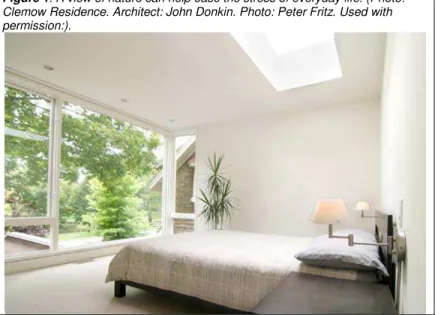
• The desire for daylight as the source of the light exposure also depends on how the openings affect the space appearance, on the function of the space, and on cultural norms about privacy, enclosure, and view (Figure 1).
• A view of the outdoors is also a contributor to well-being, particularly if it is a nature scene or similar pleasing sight. Windowless spaces, separating occupants from the outside world, create monotonous conditions that may be stressful.
Figure 1. A view of nature can help ease the stress of everyday life. (Photo:
Clemow Residence. Architect: John Donkin. Photo: Peter Fritz. Used with permission:).
Windows and Well-being / 3
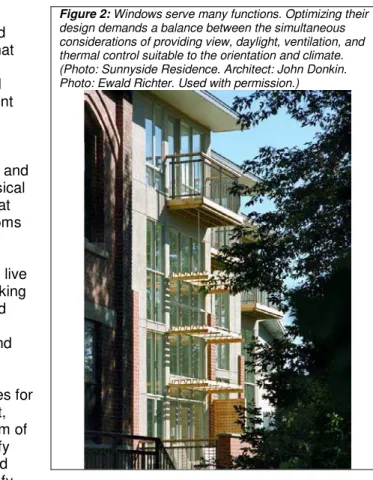
• Using daylight to deliver useful light is sustainable only when balanced against the effects of windows and skylights on the building envelope, ventilation, and overall energy balance (Figure 2). These require climate-based and locally specific solutions that respect other building system considerations and regulations.
Our review includes the development of a detailed research agenda showing the information gaps that are slowing down the development of products, applications, and regulations that deliver healthful lighting in sustainable buildings, taking into account climate and cultural variations. We identified the following three top priority research domains:
1. Establish the optimal daily pattern of light and dark exposures for good mental and physical health. How much light do we need, and at what time? How dark should sleeping rooms be?
2. Determine how our homes can help us to live in the healthy pattern of light and dark, taking into account the way we use windows and shading to control privacy, glare, and temperature as well as light exposures and view.
3. Develop design solutions and technologies for different climates that deliver healthy light, warmth, view and fresh air with a minimum of energy use (Figure 2). Specifically, identify ways to provide suitably-sized and located openings in the building envelope to satisfy
lighting and view needs while not compromising energy performance.
We are using this review to develop new research activities at NRC. The review will also contribute to the work of external groups developing recommendations for buildings, including IES and CIE. It is clear that there is more work to be done than any one research group can complete on their own!
References
Boyce PR, Hunter C, Howlett O. 2003. The benefits of daylight through windows. Troy, NY: Lighting Research Center. Heschong Mahone Group. 1999a. Daylighting in schools: An investigation into the relationship between daylighting and human
performance. San Francisco, CA: Pacific Gas & Electric Co.
Heschong Mahone Group. 1999b. Skylighting and retail sales: An investigation into the relationship between daylighting and human performance. San Francisco, CA: Pacific Gas & Electric Co.
Veitch JA, Galasiu AD. 2012. The physiological and psychological effects of windows, daylight, and view at home: Review and research agenda. Ottawa, ON: NRC Institute for Research in Construction. No. IRC-RR-325.
Jennifer A. Veitch, PhD, Fellow IESNA (Member 1988), is a senior research officer at the National Research Council Canada (NRC). She's best known for her research on lighting quality, individual controls, and
environmental and job satisfaction in open-plan offices. She is active in several professional associations including CIE, where she is Director of Division 3 (Interior Environment and Lighting Design), and vice president of the Canadian National Committee. She serves on the IES Lighting Criteria Committee and is North American Regional Editor for Leukos.
i
The full report is available in PDF at:
http://nparc.cisti-icist.nrc-cnrc.gc.ca/npsi/ctrl?action=shwart&index=an&req=20375039&lang=en.
Figure 2: Windows serve many functions. Optimizing their
design demands a balance between the simultaneous considerations of providing view, daylight, ventilation, and thermal control suitable to the orientation and climate. (Photo: Sunnyside Residence. Architect: John Donkin. Photo: Ewald Richter. Used with permission.)