Ascend: An Architecture for Performing Secure
Computation on Encrypted Data
by
Christopher W. Fletcher
B.S. in Electrical Engineering and Computer Science, University of California,
Berkeley, 2010
Submitted to the Department of Electrical Engineering and Computer Science
in partial fulfillment of the requirements for the degree of
Master of Science in Electrical Engineering and Computer Science
ARCHNVES
MASSACHUrrrS NSTITUTEat the
D-y
MASSACHUSETTS INSTITUTE OF TECHNOLOGY
JU 9
P
June 2013
@
Massachusetts Institute of Technology 2013. All rights reserved.
- I
A u th o r . .... ... .. ...
... .... ...
...
Department of Electrical Engineering and Computer Science
May 22, 2013
Certified by
...
...
Professor of Electrical Engineering and
. . . .
Srinivas Devadas
Computer Science
Thesis Supervisor
Accepted by ...
d
Prfessormn
on G A Kolodziejski
Chair, Department Committee on Graduate StudentsAscend: An Architecture for Performing Secure Computation on
Encrypted Data
by
Christopher W. Fletcher
Submitted to the Department of Electrical Engineering and Computer Science on May 22, 2013, in partial fulfillment of the
requirements for the degree of
Master of Science in Electrical Engineering and Computer Science
Abstract
This thesis considers encrypted computation where the user specifies encrypted inputs to an untrusted batch program controlled by an untrusted server. In batch computation, all data that the program might need is known at program start time. Encrypted computa-tion on untrusted batch programs can be realized through fully homomorphic encrypcomputa-tion (FHE) techniques, but FHE's current overheads limit its applicability. Secure processors (e.g., Aegis), coprocessors (e.g., TPM) or hardware extensions (e.g., TXT) typically require trust in the entire processor, the host operating system and the program that computes on the inputs. In this thesis, we design a secure processor architecture, called Ascend, that guarantees privacy of data given untrusted batch programs.
The key idea in Ascend to guarantee privacy is parameterizable, obfuscated program
execution. From the perspective of the Ascend chip's input/output and power pins, an
untrusted server cannot learn anything about private user data regardless of the program run. Ascend uses Oblivious RAM (ORAM) techniques to hide memory access patterns and differential-power analysis (DPA) resistance techniques to hide data-dependent power draw. For each of the input/output and power channels, an Ascend chip exposes a set of public knobs that fully specify the observable behavior of the chip given any batch program and any
input to that batch program. These knobs (e.g., specifying strict intervals for when external
memory should be accessed) are controlled by the server and can be tuned, based on the server's apriori knowledge of the program, to trade-off performance and power without impacting security.
Experimental results when running Ascend on SPEC benchmarks show an average 3.6x /6.6x and 5.2x /4.7x performance/power overhead-when hiding memory access pat-tern and power draw-using two schemes that capture the server's apriori knowledge in dif-ferent ways. Furthermore-when hiding memory access pattern only-performance/power overheads drop to only 2.6x/2.2x. These surprising results mean that it is viable to only trust hardware and not software in some security-conscious applications.
Thesis Supervisor: Srinivas Devadas
Acknowledgements
For the rest of the thesis, I, Chris Fletcher, will refer to the author as we. This is because Ascend has been a team effort from start to present, and has only been possible through my efforts, combined with those of Srini Devadas, Marten van Dijk, Ling Ren and Xiangyao Yu. I would first like to thank Srini Devadas and Marten van Dijk. Srini, your incredible drive and boundless support has made this last year the best of my academic life so far. Both directly and indirectly, the only reason I am here right now is because you put up with all of those fizzled projects in my first year. For giving me the freedom to try things that would never work, I thank you. Marten, I feel truly lucky to be working with you. This project has been an eye opener for me, especially since I came in with no security background. Thank you for all you have taught me; on the flip side, I hope I have been able to teach some systems design! To Ling and Xiangyao, you guys have been excellent this past term. I can tell how hard you have been working, and it showed with the ISCA submission this last November.
I would also like to thank my peers and members of CSAIL. First, thanks to Rachael Harding and Omer Khan for many very helpful discussions not only computer systems design but also security. Coming out of a security meeting to talk systems design, it is always great to pitch an idea to you and think fantastic, they understand exactly where I
am coming from! Second to other members of CSAIL: Charles O'Donnell, Keun sup Shim,
Ilia Lebedev, Michel Kinsy, Mieszko Lis, Nirav Dave, Raluca Ada Popa, and Alessandro Chiesa. To the entire Hornet group, for putting up with security talks and offering feedback from the perspectives of no less than three areas. I would also like to thank Sanjit Seshia, Omer Khan, and many others for giving me early feedback on the thesis itself.
I feel very privileged to be and have been mentored by some amazing people outside of CSAIL. In particular, I would like to thank Joe Pasquale, John Wawrzynek, Garry Nolan and Greg Gibeling. Without any one of you, I don't know where I would be right now but it certainly wouldn't be here.
Finally, I would like to thank my girlfriend Cassie, my brother and my parents. Cassie, you have been my rock these past two years; I cannot begin to tell you how important your support has been. Nor could I ask for a better girlfriend. To my brother, Sam: you are one of my best friends, and probably the person who knows me the best. Once I turn in this thesis, we're going to Vegas. To Mom and Dad: simply put, I couldn't have had better parents. I consider myself blessed. Without your support and enthusiasm, not only would I not have gotten this far, it would not have been nearly as meaningful.
Contents
1 Introduction
1.1 The Problem with Running Untrusted Programs on Secure Hardware 1.2 Ascend: Program Obfuscation in Hardware . . . .
1.3 Big Idea: Public Parameters that Control Observable Behavior . . .
1.4 Thesis Contributions . . . .
1.5 1.6
O rganization . . . . Conventions and Assumed Background Knowledge 2 Framework
2.1 Modeling the Ascend Chip .
2.2 Two-interactive Protocols . 2.3 Security Model . . . . 2.3.1 Privacy . . . . 2.3.2 Integrity . . . . 2.4 Implementation Principles . 2.4.1 Value Domain . . . . 2.4.2 Time Domain . . . . 2.4.2.1 Public Intervals
3 Protecting the I/O Channel
3.1 Chapter Overview . . . .
3.2 Value Obfuscation: Oblivious RAM (ORAM) . . . . 3.2.1 Path ORAM . . . .
3.2.1.1 Strawman Encryption Scheme . . . .
3.2.1.2 Optimization: Counter-based Encryption
3.2.1.3 Path ORAM Performance and Hardware
3.2.1.4 Path ORAM Space Requirements . . . .
3.2.2 Recursive Path ORAM . . . .
3.2.3 Optimization: Early Completion . . . .
Scheme . .
Assumptions
3.3 Path ORAM Failure Probability . . .
3.4
3.3.1 Properties of and Attacks Against Background Eviction
3.3.1.1 Address Sequence and Local Cache Occupancy
3.3.1.2 Chip Architecture and Local Cache Occupancy
3.3.2 Probabilistic Background Eviction . . . .
3.3.3 Security of Probabilistic Background Eviction . . . .
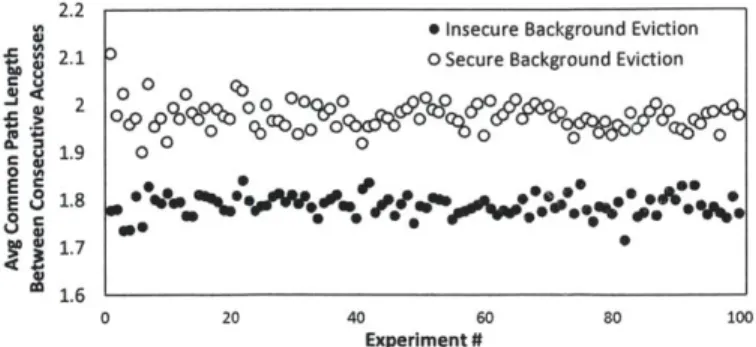
3.3.4 Insecurity of Block Remapping Eviction Schemes . . . .
Time Obfuscation: Public Intervals . . . .
Schemes 1 2 4 4 5 6 6 9 9 . . 10 . . 11 . . 11 . . 12 . . 12 . . 12 . . 13 . . 13 15 16 16 17 19 20 20 21 21 22 . . . . 23 24 24 25 26 27 28 29
4 Protecting the Power Channel 31
4.1 Chapter Overview . . . . 32
4.2 Value Obfuscation: DPA Resistant Circuits . . . . 32
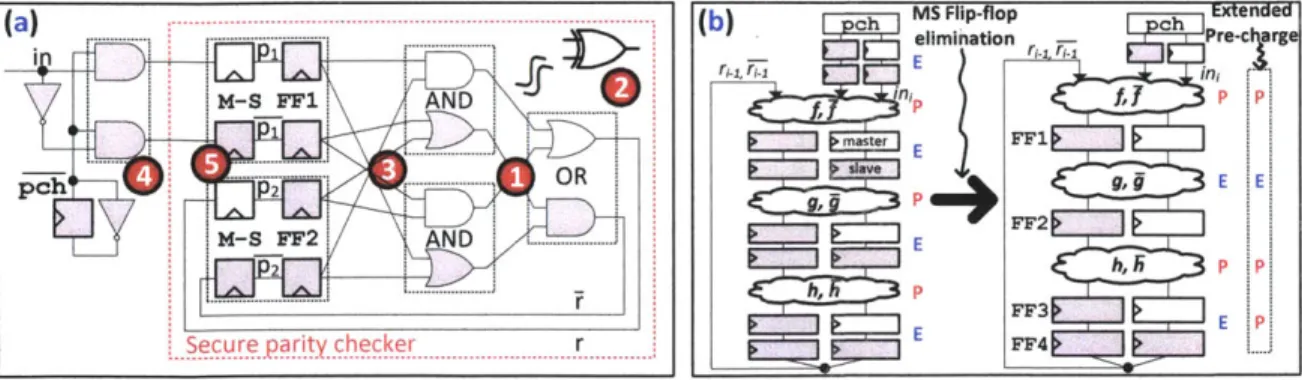
4.2.1 Logic Gates and Flip-Flops . . . . 33
4.2.1.1 Optimization: Flip-flop Elimination . . . . 35
4.2.1.2 Optimization: Extending Pre-Charge . . . . 36
4.2.1.3 Optimization: Additional Flip-flop Elimination . . . . 37
4.2.1.4 Creating Dummy Work . . . . 38
4.2.2 SRAM Arrays . . . . 38
4.2.2.1 Secure SRAM Design and Sources of Leakage . . . . 38
4.2.2.2 Secure SRAM Overheads . . . . 39
4.2.3 Optimization: Controlling Clock Enable . . . . 39
4.2.4 Observable Circuit States . . . . 40
4.3 Time Obfuscation: Public Intervals, Interval Policies and Rate Matching . . 40
4.3.1 Public Intervals for Groups of Circuits . . . . 41
4.3.2 Producer/Consumer Rate Matching . . . . 42
4.3.3 Producer/Consumer Data Dependancies . . . . 42
5 Ascend Microarchitecture 45 5.1 Chip Organization . . . . 45
5.1.1 Request and Eviction Buffers . . . . 45
5.1.2 Flow of Requests, Data and Evictions . . . . 45
5.1.3 Public Intervals . . . . 46
5.2 Instruction Pipeline . . . . 46
5.3 Choosing an ISA . . . . 48
5.4 Cache Hierarchy . . . . 49
5.4.1 Energy Efficiency via Intervals+Extended Pre-Charge . . . . 49
5.4.2 Hiding Cache Inputs/Outcomes . . . . 49
5.4.3 Power Obfuscation and Cache Organization . . . . 52
5.4.4 Where DPA Resistance is Not Needed . . . . 53
5.4.5 Hiding Cache Coherence Behavior . . . . 53
5.4.6 Hiding Cache Outcome for the L2 Cache . . . . 54
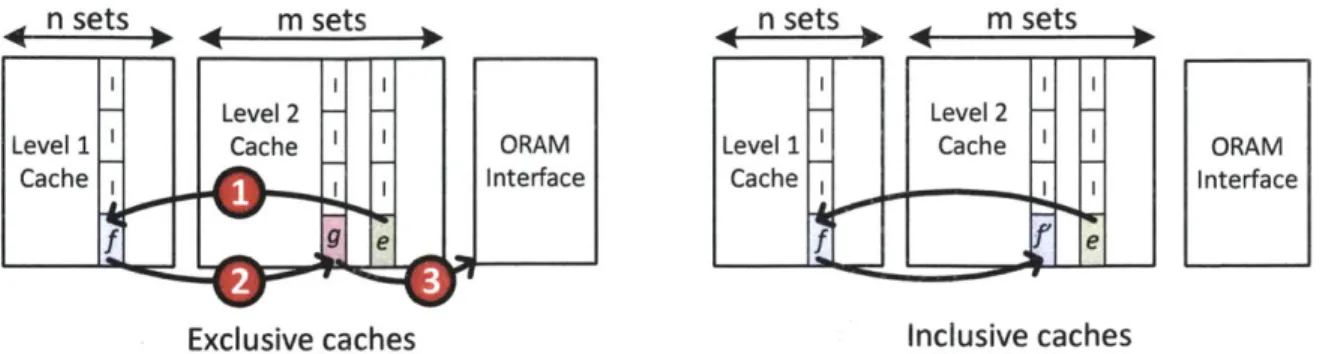
5.4.6.1 Exclusive L2 Caches . . . . 55
5.4.6.2 Inclusive L2 Caches . . . . 56
5.5 ORAM Interface . . . . 56
5.5.1 Security-Related Issues . . . . 56
5.5.2 Systems Integration-Related Issues . . . . 57
5.5.3 Performance-Related Issues . . . . 58
5.6 Interval Policies: Dynamically Trading Off Power & Performance . . . . 59
5.6.1 Interval Policy Gate-level Signal Behavior . . . . 59
5.6.2 Example: Fully Speculative Policies . . . . 61
5.6.3 Example: Fully Conservative Policies . . . . 61
5.6.4 Example: Hybrid Policies . . . . 63
6 Certified Execution 65 6.1 M otivation . . . . 65
7 Evaluation 69
7.1 Security . . . . 69
7.1.1 Circuit Requirements for PA Resistance . . . . 70
7.1.2 Relation to Circuit Primitives . . . . 70
7.2 Performance and Power . . . . 71
7.2.1 M ethodology . . . . 71
7.2.1.1 Benchm arks . . . . 71
7.2.1.2 Comparison Points . . . . 71
7.2.1.3 Simulator and Metrics . . . . 72
7.2.1.4 Cache Energies . . . . 73
7.2.1.5 Additional DPA Resistant Logic Overheads . . . . 73
7.2.2 Path ORAM in Secure Processors . . . . 75
7.2.2.1 Choosing ORAM Block Size . . . . 75
7.2.2.2 Choosing Z, the Number of Blocks Per Bucket . . . . 76
7.2.3 Public Parameter Design Space Exploration . . . . 77
7.2.3.1 Performance/Power for ascend-io . . . . 78
7.2.3.2 The Impact of Intervals and a Fully Speculative Policy . . 78
7.2.3.3 Performance/Power for ascend (Speculative Policy) . . . . 81
7.2.3.4 Case Study: Memory Bound libquantum . . . . 81
7.2.4 Heuristics For Setting Public Parameters . . . . 83
7.2.4.1 Interval Policy Recommendations . . . . 85
8 Related and Future Work 87 8.1 Related W ork . . . . 87
8.1.1 Fully Homomorphic Encryption (FHE) Techniques . . . . 87
8.1.2 Secure Hardware and TCB Minimization . . . . 88
8.1.2.1 TPM-Related . . . . 88
8.1.2.2 Tamper-Resistant (Single-Chip) Processors . . . . 88
8.1.2.3 Untrusted Programs . . . . 88
8.1.2.4 Differences to Ascend . . . . 89
8.1.3 Obfuscating the I/O Channel . . . . 89
8.1.4 Obfuscating the Power Channel . . . . 90
8.2 Future W ork . . . . 90
8.2.1 Program M odel . . . . 90
8.2.2 Operating Systems, Multiple Threads and Multi-Programming . . . 91
8.2.3 Additional Side Channels . . . . 91
8.2.4 More Advanced Microarchitecture . . . . 92
8.2.5 Additional Public Parameters . . . . 93
List of Figures
1-1 Ascend conceptual diagram . . . . 3
2-1 The two-interactive protocol. . . . . 10
3-1 ORAM organization in Ascend . . . . 16
3-2 Path ORAM structure and invariant . . . . 17
3-3 Path ORAM access example . . . . 18
3-4 Local cache occupancy as a function of Z . . . . 23
3-5 Background eviction and cache coherence policy . . . . 25
3-6 Common path length between two ORAM background eviction schemes . . 28
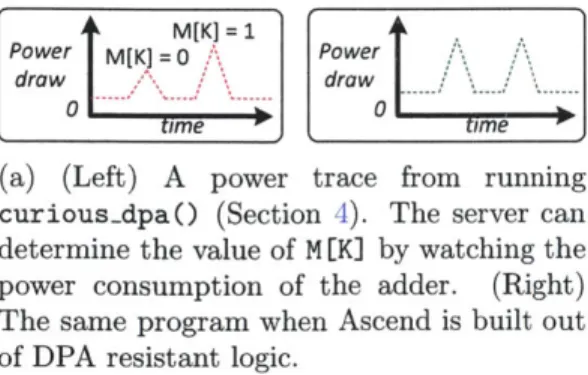
4-1 DPA and SPA resistance. . . . . 33
4-2 A sequential WDDL parity checker and WDDL optimization principles . . . 34
5-1 A power-analysis resistant instruction pipeline . . . . 47
5-2 A power-analysis resistant level 1 data cache . . . . 50
5-3 Power obfuscation's impact on single-core cache coherence . . . . 54
5-4 Out-of-order L2 buffer scheme with lazy LI evictions . . . . 55
5-5 Interval policy gate-level implementation . . . . 60
5-6 Timing diagram comparison for different interval policies . . . . 62
6-1 Integrity verification on top of Path ORAM . . . . 66
7-1 Latency breakdown in cycles in the Recursive Path ORAM construction 76 7-2 Performance impact, varying Z and Path ORAM optimizations . . . . 76
7-3 Power/performance overhead for ascend-io . . . . 79
7-4 Performance/power sensitivity with a fully speculative policy . . . . 79
7-5 The percentage of long real Li DCache requests . . . . 80
7-6 The percentage of dummy requests made to the ORAM . . . . 80
7-7 Power/performance overhead for ascend (fully speculative policy) . . . . 82
7-8 libquantum case study: Pareto curves for different interval policies . . . . . 83
7-9 Power-performance product using interval selection heuristics . . . . 84
List of Tables
1.1 Variable/symbol guide . . . . 7
3.1 The ratio between dummy accesses to real accesses, varying Z . . . . 27
7.1 Benchmark categories . . . . 71
7.2 Processor timing model . . . . 73
7.3 Processor power model . . . . 74
7.4 baseline IPC/power over SPEC reference inputs . . . . 74
7.5 ORAM configurations used for performance comparison . . . . 77
7.6 Benchmark statistics for libquantum . . . . 82
Chapter 1
Introduction
Privacy of data is a huge problem in cloud computing, and more generally in outsourcing computation. From financial information to medical records, sensitive user data is being sent to and computed upon by the cloud. Computation on sensitive data requires that the data be exposed to cloud servers, which may be attacked by malicious applications, hypervisors, operating systems, or by insiders.
This thesis addresses how a computationally-limited user can outsource batch computa-tions on private data to an untrusted (cloud) server without revealing that private data to the server. (For the rest of the thesis, we will use "server" and "adversary" interchangeably). The user is motivated to outsource computation because that user is using an embedded or mobile device-the cost of spending energy or memory on computation is disproportionally higher than the cost of transporting that data to a more powerful server that may itself contain data that the program needs. In a batch computation, all data that the program will need must be present in program memory at program initialization time.1 When out-sourcing a batch computation, the user sends the server an encryption of its private data that will be the input to a batch program. The server then runs the batch program on the user's data, along with any public data that the server thinks the program will need, to produce an encrypted result. This encrypted result is sent back to the user who decrypts it to get the actual result.
One example of such a batch computation determines health diagnoses given a user's private medical records [45]. In this case, a mobile device is constantly monitoring its user's symptoms, and wants to know the likelihood that the user has some condition given these symptoms. To outsource computation, the device sends a cloud server an encryption of {symptoms, condition of interest}, which will be inputs to a program that calculates likelihood of the condition (call this MedComp 0). MedComp () may be proprietary and contain expert knowledge, learned models or access elements from a database of known size. After running MedComp() on the user's private data, the server sends an encryption of the result (e.g., "there is a 55% likelihood that you have the condition") back to the user. To maintain privacy, the server must never learn anything about the user's private inputs-the symptoms or diseases of interest-at any time before, during or after the computation completes. More examples are given in [45].
One way to completely protect private data when outsourcing is for the user to encrypt his/her data and trust that no server entity will see the data in its plaintext form. This ideal
'That is, if the program requires access to a file, that file must be loaded into memory at program start time.
can be achieved with Fully Homomorphic Encryption (FHE) techniques [3, 39], which allow an untrusted server to perform computation directly on an encrypted ciphertext without having access to the decryption key. FHE follows the batch computation model because it evaluates programs as circuits: all input data that the program needs must be present at the start. Data is never decrypted by the server under FHE, and privacy is independent
of the program running on the data. Unfortunately, FHE currently incurs huge overheads,
about a billion times slowdown for straight-line code, and this overhead increases with general-purpose batch programs. Further, FHE approaches by themselves cannot guarantee integrity.
Another candidate solution for achieving data privacy when outsourcing is for the server to use tamper-resistant hardware [60, 12, 20]. Here, the user's computation takes place inside a secure hardware compartment on the server side that protects the user's private data while it is being computed upon. The smaller the trusted computing base (TCB) the better from a security perspective: if a trusted component is compromised, the security of the entire system fails.2
At the same time, removing components from the TCB typically impacts performance and/or energy efficiency because untrusted components in the system need to be retrofitted to prevent information leakage, or the interface to these components has to change. Despite the hit in efficiency, the computationally-limited user is still motivated to outsource computation since compute, energy and memory resources are significantly cheaper for the server than the user.
A serious limitation with current secure hardware solutions is that they (unlike FHE)
assume that the program running on the secure hardware is trusted. Batch applications like MedComp() are seldom trustworthy. To trust the program, the user has to "sign-off" on that program, saying that it is free of malicious code and bugs that may leak sensitive data. Verifying bug-free and malicious behavior is a hard problem-intractable for sufficiently complex programs-and involves more work for the user in any case. Frequent software patches, which are typical in modern software development, only confound the issue. Fur-thermore, the user may not have access to the program in the first place as the program's algorithms may be proprietary. How can a user trust a secure processor system when the
program running on the secure processor cannot be trusted?
In this thesis, we take a step towards solving the problem of placing trust in programs
by designing a secure processor, called Ascends, that can run untrusted programs. This
approach is directly applicable to batch programs like MedComp(). Here, the user would send the server an encryption of its medical information, along with a request to use a program that calculates the likelihood of a certain condition, and would expect the server to send back a meaningful result. The server would then run the user's private data on an Ascend processor with a MedComp() implementation based on the user's request. As with
FHE, privacy leakage is independent of whether the MedComp () program is buggy, malicious
or being patched on a regular basis.
1.1
The Problem with Running Untrusted Programs on
Se-cure Hardware
Today's secure processors (e.g., Intel+TXT, XOM or Aegis) leak private information when untrusted, badly written, or malicious programs are run. Consider the following scenario.
2
In this sense, FHE has no TCB.
3
--- curious(M), traditional secure processor curious(M) and
- - curious(M ), traditional secure processor curious(M') on Ascend
Tamper-esstn curious(M) culosM - I Ak4 crosm
Off-chip teerminate Off-chip Power
Proesor in request --- request da
rate address
--I 100 0
Outside world ime time time
AscOfchip time = T' Off-Chip
Power
(b)
Processor ins request rateI
request drawaddress time =T+ time =
T-Outside world ime tme time
Figure 1-1: Signals from the perspective of (a) a tamper-resistant processor's pins and (b) an Ascend processor's pins when the server runs the curious() program (Section 1.1) on two user inputs M and M'. M satisfies the condition M[I] & Ox1 == 0 and M' satisfies the
condition M' [I] & Ox1 == 1.
A user wants to use the MedComp() program (described above), and sends the server an
encryption of its symptoms and condition of interest (ciphertext M) plus a request to use MedComp(). The user expects the server to run the MedComp() program. If the server is curious and wants to learn about the user's data, however, it may decide to run the program
curious() instead, shown in Program 1.
Program 1 The curious() program. M is the private user memory.
int I = 0; // chosen by the server
void curious(M) {
if (M[I] & Ox1) {
for (nt
j
= 0;;j++) M[j]++;} else { return; }
}
As shown in Figure 1-1(a), curious() forces a tamper-resistant processor to interact differently with the outside world (which is visible to the server) depending on which branch of the if statement is taken. Specifically, a tamper-resistant processor will either appear to run forever and send requests to memory repeatedly or terminate almost instantly. Which event happens depends on a private bit in the user's data, which can be selected by the server by changing I and the bitmask Ox1. Through this attack, the server can learn the value of the bit of interest.
This attack is difficult to prevent. Encrypting data that leaves the secure processor or obfuscating the memory access pattern won't help because the attack succeeds if the server sees either (a) that some external request is made or (b) that curious () is running forever.4 Furthermore, adding on-chip cache to the secure processor (to add noise to the memory access pattern as mentioned in [24]) and/or growing the TCB to include (say) the main memory will not help because the server can just rewrite the curious() program to ensure that visible resources (e.g., disk) will be accessed.
4
The server can repeat this experiment by running curious 0 multiple times, with differ-ent bit masks and values for I, in order to leak multiple bits in the user's data. curious () may be a standalone program, or embedded in MedComp ) by an inside party. Of course, even if the server does run a non-malicious program, program characteristics or bugs can leak private information in the same way as curious().
1.2
Ascend: Program Obfuscation in Hardware
Ascend defeats attacks like those posed by the curious ) program by performing
pro-gram obfuscation in hardware. Formally, Ascend guarantees that: given an untrusted
batch program P, a public length of time T and two arbitrary inputs to P namely M and M': running P(M) for T time is indistinguishable from running P(M') for T time from the perspective of Ascend's external pins. Ascend has both input/output (I/O) and
power pins like a normal processor. We assume that the server can watch these pins, and we will discuss techniques to obfuscate both I/O requests on the I/O pins and the power signature on the power pins. This thesis will not cover invasive attacks on Ascend, nor electromagnetic/radio-frequency-based side-channels (discussed further in Section 2.3).
Unlike a normal processor, Ascend runs for a parameterizable amount of time T that is chosen by the user before the program runs, and is public to the server. (In some settings, the server may also choose T). Since T is set a priori, it may or may not be sufficient to complete the program given the user's inputs. In either case, Ascend's pins must carry signals that leak no information about private user data for the entire T time, regardless of the program run within Ascend. If the program terminates before T time has elapsed, Ascend will perform indistinguishable dummy work so that the server doesn't learn that the program terminated.5 After T time is complete, Ascend will output either the final program state or intermediate program state, encrypted with the user's key. The server therefore cannot determine whether the program completes or how much forward progress was made, provided program completion time depended on private user data.6
Putting these ideas together, Figure 1-1(b) shows how the server cannot learn about the user's input through the curious() program from Section 1.1. Regardless of whether curious () enters the f or loop or not, Ascend runs for T time and behaves in an indistin-guishable way from the perspective of the chip pins.
1.3
Big Idea: Public Parameters that Control Observable
Behavior
A central idea that we will weave throughout the rest of the thesis is that since the pro-gram P is public, the server can collect knowledge about the propro-gram (offline). We will add mechanisms to Ascend so the server can use this knowledge to improve Ascend's perfor-mance/energy efficiency when running P on private (hidden) inputs. This idea plays a role
during three stages: 5
Making dummy work indistinguishable from real work is important and will be discussed throughout the rest of the thesis.
6
Note that in the case of a public program an external observer may be able to tell what instruction is being executed some or all of the time, e.g., at certain points in the program such as the start of the program or if the entire program is made up of straight-line code. Since this is the same for any input M or M', however, it leaks no private information.
At processor manufacturing time, Ascend is architected with a set of public
knobs/-parameters that, when specified, fully characterize Ascend's observable behavior7 given any
program P and input M. (Given any Ascend implementation, we will refer to that Ascend chip's public parameters as the set P). For example, one such parameter might specify the interval at which Ascend's instruction pipeline should access its on-chip memory. (Assume that accessing the on-chip memory causes an observable power signature). Once the cor-responding parameter is specified, Ascend will access the memory at strictly the specified rate, regardless of what is actually needed by the running program. If the memory is not needed when it is accessed, an indistinguishable dummy access will be performed instead
(as introduced in the previous section).
Offline, for each program P, the server is allowed to extract information about
P-e.g., data-independent control flow, coarse-grain program phase behavior, etc-through static analysis, profiling on its (the server's) own inputs or other means. We make no assumptions about the level of analysis, or amount of analysis that the server performs. The server may even skip this step and perform no analysis for some programs.
Online, the server will initialize Ascend with the program P, the user's private inputs (call this M as before), and specific values for each public parameter in P that governs Ascend's observable behavior. Crucially, the server may set each public parameter based on
its offline analysis of program P. Returning to the on-chip memory example, suppose that by profiling program P offline, the server determines that on most inputs to P, the memory
will be accessed once every 100 clock cycles. If the server's profiling is representative of the real behavior for P(M), Ascend becomes more efficient while running P(M): memory is accessed less often than a naYve scheme (which might be to make an access as frequently as possible) and always performs useful work. If the server's profiling is incorrect, Ascend will still access the cache at the same rate, to hide the true behavior of P(M).
The public parameter governing the on-chip memory was just an example-Ascend may support any number of any type of public parameters at any granularity in principle to get more efficiency in different parts of the chip. Furthermore, the server may decide to set these parameters once (at program start time), or dynamically (e.g., if through offline profiling the server sees that program P has temporal phase behavior and can estimate when each phase occurs). The key point is that the public parameter system allows the server to optimize for
common case program behavior.
1.4
Thesis Contributions
This thesis has three primary contributions:
1. First, we introduce and apply the general principle of a processor chip's observable
behavior being fully specified by a set of public knobs, each of which are exposed to and controllable by adversaries.
2. We then introduce principles for designing a general-purpose power and I/O-obfuscated hardware architecture, given untrusted programs, and detail a complete design as an example. The idea of public knobs is applied throughout.
3. Finally, we optimize the primitives (Oblivious RAM for the I/O channel and Wave
Dynamic Differential Logic), that provide the foundation for protecting each channel, 7
for our setting.
As noted in the Acknowledgements section, Ascend has been a collaborative effort and the authors have already published pieces of the work. [51] presents techniques to perform encrypted computation (using FHE as a primitive) while exploiting apriori knowledge of public/untrusted programs. An initial publication on Ascend was published in [50]. Lastly, material in Chapters 3 and 6 appears in [59].
1.5
Organization
The rest of the thesis is organized as follows. We describe our implementation philosophy, security model and a user-server interaction protocol in Chapter 2. Chapter 3 describes optimized primitives to obfuscate signals on Ascend's I/O pins. Chapter 4 discusses op-timized primitives to obfuscate signals on Ascend's power pins. Chapter 5 puts the ideas from Chapters 3 and 4 together and presents a complete microarchitecture for a particular implementation of the Ascend processor. Chapter 6 describes a scheme for guaranteeing integrity of execution. Chapter 7 gives an argument for security and then evaluates perfor-mance and power overheads. In Chapter 8 we discuss related/future work and we conclude with Chapter 9.
1.6
Conventions and Assumed Background Knowledge
We will use capital letters to define variables that have meaning throughout the entire thesis. For example, T will always refer to Ascend's public time threshold, P will always refer to the public/server-specified program, etc. For reader convenience, we have consolidated all capital symbols in Table 1.1, along with where they are defined in the writing. Lower-case italicized symbols are treated as "temporary variables," which will be defined, used for a short period of time, and re-defined as needed in later sections. A function called func is referred to as funco; we refer to the probability that a random variable R = x as
Prob(R = x) and the expected value for R as Expected(R).
The thesis assumes basic knowledge in security and computer architecture. That is, the reader is expected to be familiar with symmetric encryption, key sharing, and hashing. Readers aren't expected to be familiar with side-channel countermeasures: e.g., ORAM and power analysis-resistant logic. Readers are expected to be familiar with basic computer ar-chitecture and digital design: namely that processors contain instruction pipelines, on-chip caching (and that caches are organized in terms of sets, each of which may have multi-ple ways), possibly networks and memory controllers. On the other hand, readers aren't required to know the difference between inclusive and exclusive caches, or the power/per-formance trade-offs in instruction pipeline design (for example). Basic clock terminology (edge behavior, clock gating), flip-flop, logic gate and SRAM memory behavior are also assumed.
Table 1.1: Variables with consistent meaning that are used throughout the thesis.
Symbol name Description Defined in Section...
P The set of public parameters that control Ascend's 1.3
observable behavior
P Public/server-specified program running on Ascend 1.2
M Program memory 1.2
T Public time threshold 1.2
K Secret (symmetric) key, shared with the user 2
R Number of bytes returned by two-interactive protocol 2.2
I Public interval (I E P) 2.4.2.1
Q ORAM transcript (sequence of addresses) 3.2
L Bits per Path ORAM leaf index 3.2.1
N Number of buckets in a Path ORAM tree 3.2.1
Z Blocks per Path ORAM bucket 3.2.1
B Bits per cache line/ORAM block 3.2.1
U Bits per program memory address 3.2.1
C Path ORAM local cache capacity 3.2.1.4
F Cache data bus width 5.4.2
S Public circuit policy (S E P) 5.6
Chapter 2
Framework
To start, we present a general framework for performing computation under encryption for batch programs (Sections 2.1-2.2). Section 2.3 then discusses our attacker model and security assumptions. Finally, Section 2.4 gives an implementation philosophy which we will use throughout the next two chapters.
We assume black-box symmetric-key encryptK(...) and decryptK(...) functions, which take a plaintext/ciphertext and key K (where K has been shared with the user) as inputs and return the corresponding ciphertext/plaintext using probabilistic/randomized' encryp-tion or decrypencryp-tion under K. We will refer to this as randomized encrypencryp-tion/decrypencryp-tion for the rest of the thesis. Time is measured in processor clock cycles.
2.1
Modeling the Ascend Chip
Ascend is a single-chip coprocessor running on the server. While running any program, Ascend stores a symmetric (secret) session key K in an on-chip register. Aside from this register, Ascend chip is composed of symmetric encrypt/decrypt circuits (which use K to perform randomized encryption/decryption), an interface to external memory, and a means to run programs (i.e., an instruction pipeline and on-chip cache memory). The key K is accessible only to the encrypt/decrypt units-not to the program running on Ascend.
Ascend interacts with the server to initialize, terminate and run a program. While Ascend is running, it may communicate over its I/O pins to a fixed-size external memory that is controlled by and visible to the server. All data sent to external memory from Ascend is encrypted under K; further, Ascend decrypts any encrypted data it receives under K. Addresses sent to external memory, and whether a given operation is a read or a write (the
opcode), are always plaintext. That is, off-chip accesses are to public memory locations
whose contents are encrypted. Schemes must be in place to prevent the plaintext address and opcode from leaking private user data-a problem we address in Chapter 3. Ascend has power pins that draw current based on what circuits within the chip are currently being used and what data values are being sent to/from those circuits (like a normal processor).
0 encrypt(x), T, request(P) (1 interaction) Trusted Computing Base
Untrusted Allocate external Server 0 memory & initialization
O(IMoj) interactions Key sharing,
Pu| ,Ascend
U er
Ased0 (several interactions) user]
Program P, [F
Public Inputs y,* Perform computation external RAM 0(i TI) interactions
0 MT' (1 interaction)
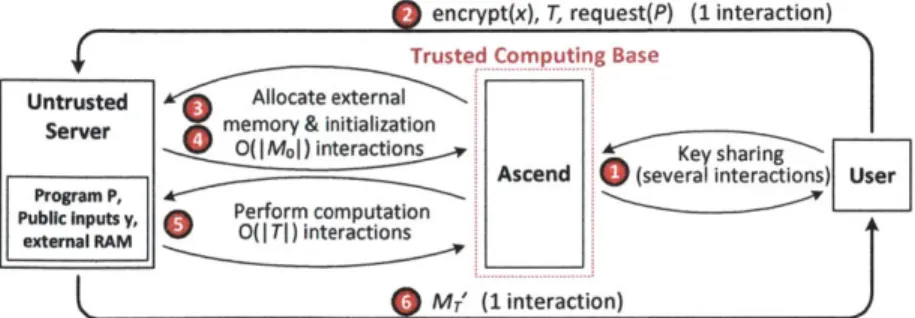
Figure 2-1: The two-interactive protocol between a user, server and Ascend. Numbers follow Section 2.2.
2.2
Two-interactive Protocols
We use a two-interactive protocol to initiate and terminate sessions between a user, an untrusted server and Ascend. The user wants to perform computation on private inputs x using a batch program P. P is stored on the server-side and may have a large amount of public data y associated with it (e.g., the contents of a database). The result of the user's computation is denoted P(x, y), meaning that program P needs only the inputs x and y to run which matches our definition of batch computation from Chapter 1. Formally, a two-interactive protocol for computing P(x, y) works as follows (shown graphically in Figure 2-1):
1. The user shares a secret (symmetric) key K securely with Ascend. We assume that
Ascend is equipped with a private key and a certified public key. As described in Section 2.1, K is used by Ascend's encrypt/decrypt units.
2. The user encrypts its inputs x using K to form ciphertext encryptK (x) and then chooses a number of cycles T, which is the public time budget that the user is willing to pay the server to compute on P. In certain circumstances, the server may choose T. The user then transmits (encryptK(x), T, request(P)) to the server, where request(P) is a request to use the program P.
3. After receiving the pair (encryptK(x), T, request(P)), the server sends encryptK(x), P, y and P2 to Ascend's I/O pins as a stream of data. As Ascend receives each block of data, it decrypts the block (if the data is part of encryptK(x)), (re-)encrypts the block (unless that block contains all or part of P) with a different random pad and writes it to external memory. Each parameter in P is stored in on-chip registers where it will be read by Ascend to create a variety of observable behaviors. At the end of this step: all of x, P and y will be stored in Ascend's external memory and encrypted under K (we refer to this as MO, the program state after 0 time).
4. The server chooses a public size R, which is the number of bytes reserved for the final result/output of P's computation on x and y (R can also be supplied in Step 2 by the
user). The server sends T and R to Ascend in the clear.
5. Ascend spends a number of clock cycles, corresponding to T, making forward progress 2
in P after which Ascend extracts exactly R bytes as indicated3 by P. While running,
Ascend may make requests to its external memory to fetch more instructions or data. During this time the server may also decide to load new values for any parameter in P at any time. Schemes must be in place to prevent leakage of private user data from I/O requests or chip power consumption regardless of the program run or when that program terminates (Chapters 3 and 4).
6. After Ascend runs for T time, the external memory contains MT. The ciphertext
M encryptK (r) (r are the R bytes extracted from MT in the previous step) is sent back to the user.
7. The user decrypts MTI and checks whether T was sufficient to complete P(x, y).
With-out loss of generality, we assume that the algorithm With-outputs an "I am done" message as part of its final encrypted result.
A correct execution of the two-interactive protocol outputs to the user the evaluation P(x, y)
(if T was sufficient) or some intermediate result.
2.3
Security Model
The server in the two-interactive protocol is malicious in that it (a) wants to learn about the user's private data and (b) wants to cheat the user out of its computation.
2.3.1 Privacy
We assume the server can monitor the Ascend chip's I/O and power pins. We make no assumptions as to how the server monitors the pins. That is, an insider might attach an oscilloscope to the pins directly, or create a sniffer program running on another server chip which monitors what bits change in Ascend's external memory. The Ascend chip itself is assumed to be tamper-resistant: the server cannot remove packaging/metal layers and watch bits once they have been decrypted. The server is assumed to know Ascend's architecture and microarchitecture, e.g., its cache block size, cache capacity, the cycle latency for each instruction, etc.
In this thesis, we assume the server cannot learn from side-channels other than the pins (e.g., EM or RF-based channels). These additional leakage channels separate our work from FHE-since FHE has no TCB, it is impervious to all physical side-channels. We consider these additional attack surfaces to be a part of our future work.
To learn about the user's private inputs, the server can perform experiments with Ascend and encryptK(x), and watch Ascend's pins for data-dependent behavior. To perform an experiment, the server initializes Ascend with arbitrary encryptK(x), 4 P, y, T, R and P
(i.e., any of the parameters from Section 2.2) and monitors how Ascend interacts with the outside world through the chip pins.5 While Ascend is running, the server can modify the
3
This can be coded in a separate subroutine in P or can be supplied as a separate extraction algorithm in conjunction with P.
4
Since P is untrusted, the server can force Ascend to produce ciphertexts of x, y, or arbitrary transfor-mations on these quantities. Since encrypt() is probabilistic, however, any ciphertexts manipulated directly by the server (i.e., flipping arbitrary bits) will cause the underlying plaintext to be decrypted to garbage with overwhelming probability.
5
Running the curious ) program from Section 1.1 is an experiment where the server ran a malicious program.
contents of Ascend's external memory at any time, perform a denial-of-service attack by not returning requested data, send any data back to Ascend at arbitrary times, or modify any value in P. The server does not need to return the results of its experiments back to the user. These experiments can be run offline, e.g., after the computation requested by the user takes place. Chapters 3-5 will show how the server learns negligible amounts of information about encryptK(x) by monitoring Ascend's pins, even if the server performs arbitrary experiments of this kind.
2.3.2 Integrity
To cheat the user, the server can send the user the result of running a different program (a program P' different from that corresponding to request(P)), run P or P' for some time threshold not equal to T, or tamper with external memory by changing bits-all of which cause the user to get back some incorrect result. The server is motivated to do the minimal amount of work needed to satisfy the user, or to trick the user into interacting with the server more times in the future. Chapter 6 will show an efficient implementation for certified execution, which allows the user to detect this cheating. Given that the user can detect cheating, the server's motivation changes: it wants as much business from the user as possible and therefore wants to return as complete and correct a result as possible.
2.4
Implementation Principles
There are different implementation strategies that can attain the security level described in Section 2.3. Furthermore, the schemes used to secure the I/O channel may be different than the schemes used to secure the power channel. In general, for either channel to be completely obfuscated for T time, it must be obfuscated in two domains: value and time. That is, when and how signals on that channel change must not give away any private information to the untrusted server for T time.6 We will now explain the ideas for obfuscating value and time for each channel. Chapters 3-5 will detail how these ideas are implemented for each of the I/O and power channels.
2.4.1 Value Domain
To obfuscate a channel in the value domain, any particular operation on that channel must look like a random (data-independent) operation. To accomplish this for the I/O channel, Ascend manages its external memory as an Oblivious-RAM (ORAM) (Section 3.2). At a high-level, ORAM is an encrypted and shuffled memory that has the property that any particular off-chip memory access looks like a random access. To protect the power channel, we build Ascend out of differential power analysis resistant (DPA resistant) circuits (Section 4.2). Each circuit in Ascend, whose behavior can be influenced by user data, must have the following property: when that circuit is accessed with some set of inputs, the power signature emitted from the circuit must be indistinguishable from when that circuit is activated with a random set of inputs. Preventing leakage over the I/O is orthogonal to preventing leakage over the power channel. That is, ORAM does not help secure the power channel and DPA resistant circuits do not help the I/O channel. We note that both ORAM and DPA resistant circuits have computational security assumptions (i.e., based on
6
Recall that after T time, Ascend. stops running and therefore will not leak any information after this
encryption/PRNG/circuit routing primitives/etc). We discuss these assumptions further in Chapters 3-4.
2.4.2 Time Domain
To obfuscate signals in the time domain, both the I/O and power channels apply the following key idea: that security is independent of the rates at which Ascend accesses internal
circuits (e.g., caches, register files, etc) or off-chip memory as long as these rates are data-independent (e.g., specified by the untrusted server). We architect the Ascend chip such
that the rate at which each circuit is activated is controlled by some public parameter in P
(Section 1.3).
Despite the server knowing what program is running inside Ascend, programs in general may have dependent behavior that depend on (private) program input. Thus, a data-independent rate scheme may cause circuits to be accessed when they are not needed by the program. In this case, the circuit performs dummy work which does not help to make forward progress in the program. We call non-dummy work real work for the rest of the thesis. Dummy work must be indistinguishable from real work, which is true if and only if the value domain is obfuscated (see previous section). On the other hand, the program may also need to access a particular circuit before the data-independent rate allows for that circuit to be accessed. In this case, the program will stop making forward progress until the circuit is accessed. Schemes must be in place to prevent the server from determining when or if this ever happens.
2.4.2.1 Public Intervals
One type of public parameter that we will use throughout the thesis is the public
(server-specified) interval. For each circuit x (or group of circuits), we add a public parameter Ix E P which indicates the number of Ascend clock cycles between when the circuit named
x completes its last access and starts its next access.7 As introduced in Section 1.3, the server may decide on a good value for each public interval based on apriori information at the server's disposal: namely P, y, T, etc.
We now give a simple performance model for public intervals to help intuition. Suppose (a) that the server sets the off-chip memory interval to be Imem processor clock cycles,
(b) that each memory access takes taccess cycles to complete and (c) that Ascend runs for T total cycles. T is now broken into epochs, where the nth epoch begins on clock cycle
Tepoch,n = n - (Imem + taccess) for n > 0. Then a new real or dummy memory access is made
on clock cycle Tepoch,n + Imem for n > 0.
Suppose the program needs to make a memory access at some clock cycle t where t < T
and tepoch = Imem + taccess for short. If i = (t mod tepoch), we have the following cases:
1. If i < Imem: the memory access in this epoch will do real work and the program will get a response back in tepoch - i cycles.
2. If i > Imem: the memory access in this epoch will do dummy work and the program
will get a response back in 2 -tepoch - i cycles.
To meet the security requirements from the previous section, the server must never deter-mine t if t depends on the user's private data.
7
Note that this definition does not forbid concurrency, but implies that any circuit that supports
The public interval scheme guarantees that the server learns nothing based on when each circuit is accessed, in an unconditional sense. That is, an interval is a flat rate: when each circuit is accessed does not depend on the security of some primitive (e.g., a PRNG) or any computational assumption.
Implementation note. A simple hardware-based way to implement intervals is with
dedicated hardware finite state machines (referred to as interval FSMs) that behave like counters. The interval FSM increments an internal counter each processor cycle and triggers either a real or dummy request when it reaches the threshold set by the server. Once the behavior set to the interval completes, the FSM resets and the process repeats. In principle, the server may set/change the interval before or during the computation; for the rest of this thesis, we assume that the interval is specified before the computation starts and is not changed.
Chapter 3
Protecting the I/O Channel
Our goal in this chapter is to develop and optimize primitives that make the digital signals on Ascend's I/O pins not leak any information that depends on the user's private data.
Program 2 Curious programs that leak through the I/O channel. M is the private user
memory.
int I = 0; int J = 1; int K = 2; int I = 0; int J = 1;
void curious-addr(M) { void curiousrate(M) {
if (M[I] & 0x1) int a = M[J]; if (M[I] & 0x1) int a = 0;
else int a = M[K]; else int a = M[J];
} }
Ascend makes I/O requests to external memory when it needs more data/instructions and the server may learn about private user data by monitoring the requests themselves (value domain) and/or when requests are made (time domain). Each request is composed of a plaintext address, opcode (read or write) and data block (if the operation is a write). Mitigating leakage over the opcode and data blocks is straightforward: the data block values can be hidden using randomized encryption (Section 2.1) and the opcode can be hidden by forcing each I/O request to perform both a read and a write. Preventing leakage through the plaintext address is a difficult problem. For example, the server can engineer the curious-addr () program shown in Program 2 (left). Here, the server learns whether the branch is taken by watching for address J or K on the pins.1
Of course, even if the server can learn nothing by monitoring the specific logic values
on the I/O pins, it can still learn by watching when the I/O channel is used. For example, the curious-rate () program (Program 2 (right)) either accesses memory once (branch taken) or twice (branch not taken). This example leaks the same amount of information as curious_addrO.
'Most processors group consecutive data words into blocks, which could make J and K map to the same cache block and prevent the second request from being made over the pins. The server can always get around this issue by choosing J and K to correspond to different cache blocks. Recall that the server knows Ascend's
3.1
Chapter Overview
The first part of this chapter, Section 3.2, introduces Oblivious-RAM (ORAM): a primitive from the literature that we use to make any I/O request look like a random request, thereby obfuscating particular logic values on the I/O pins (e.g., address, opcode and data). For readers already familiar with ORAM and Path ORAM (a particular ORAM scheme that we use in constructing Ascend), Sections 3.2.1.2 through 3.2.2 discuss optimizations to Path ORAM to make it implementable in an Ascend setting. Next, Section 3.3, improves the ORAM primitive by creating a zero-failure ORAM based on background eviction and discusses attacks against background eviction schemes. Lastly, Section 3.4 discusses how the public interval introduced in Section 2.4.2.1 is applied to the improved ORAM primitive to prevent leakage over the time domain.
3.2
Value Obfuscation: Oblivious RAM (ORAM)
Oblivious RAM (ORAM), first described in [4, 5, 7], makes any sequence of memory requests look like data-independent requests. Formally: suppose we are given batch program P with input M and any other batch program P' with input M' and compare the first z memory requests made by each. We denote the sequence of requests as Qz(P(M)) and
Q'(P'(M')).2 Each request is composed of an address, operation (read or write) and data (if the operation is a write). Oblivious RAM (ORAM) guarantees that Q,(P(M)) and
Qz(P'(M'))
are computationally indistinguishable. Crucially, this is saying that the accesspattern is independent of the program and data being run, which defeats the attack posed
by curious.addr o from the beginning of the chapter.
Notice that a simple ORAM scheme that satis-fies the above property is to read/write the entire contents of the program memory to perform every load/store. To hide whether a particular block was needed in the memory scan (and if it was, whether the operation was a read or a write), every block must be encrypted using randomized encryption. With this scheme, the access pattern is independent of the program or its data but clearly will have un-acceptable overheads (on order the size of the mem-ory). Modern ORAM schemes use pseudo-random number generation to achieve polylogarithmic over-heads: any address sequence of a fixed length must be computationally indistinguishable from a ran-dom address sequence.
Any ORAM scheme is made up the ORAM
it-Ascend chip
I
Instruction pieline
On-chip
caches
ORMAM Interface
I/o
pins
External memory (ORAM)
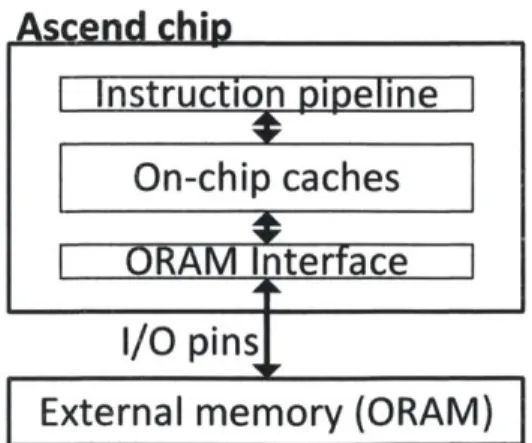
Figure 3-1: ORAM organization in Ascend.
self (implemented on top of some untrusted memory) and trusted ORAM client logic. In our setting, the ORAM is implemented over the external memory from Section 2.1, whose input/output bus and contents are visible to the server at all times. The ORAM client logic (which we refer to as the ORAM interface) is built inside Ascend and is responsible for translating program memory requests into random-looking requests that will be sent to the untrusted memory/ORAM itself. The ORAM interface is analogous to a
mem-2
If zp and zP, are the total number of requests made by P and P' respectively, then min(zp, zp,) ;> z > 0.
ory controller-i.e., all digital communication by Ascend's instruction pipeline and on-chip caches (if any) go through the ORAM interface (Figure 3-1). Thus, I/O channel security in the value domain reduces to the security of the ORAM. We note that the ORAM interface's internal state is trusted and must be hidden from the server.
ORAM was first introduced to maintain software confidentiality. Recently, two new proposals were published in [46, 57]. Stefanov and Shi also constructed a much more simple and practical ORAM construction called Path-ORAM [56] which we use and improve here.
3.2.1
Path ORAM
LeafI LeafI=6 Leaf 2=8
Level L=3 Level 2 Level 1 Z=4blocks Level 0 External memory ORAM interface C= 100 + Z(L+1) ition map
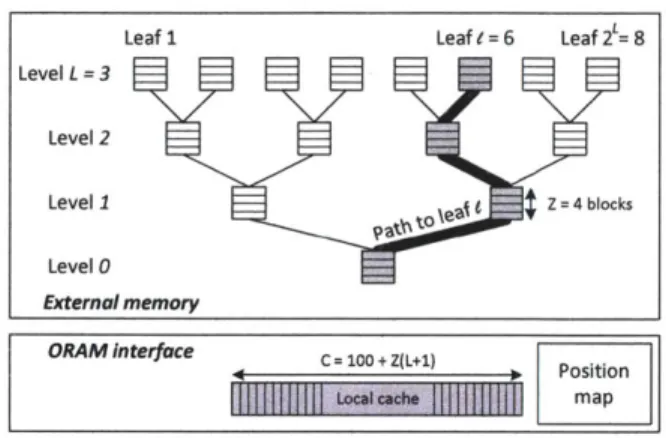
Figure 3-2: A Path ORAM for L 3 levels.
At any time, a block mapped to leaf 1 = 6 can
be located in any of the shaded structures. The local cache capacity (C) is discussed in Section 3.2.1.4.
In Path ORAM, the external memory is structured as a balanced binary tree, where each node is a bucket that can hold up to
Z blocks. The root is referred to as level
0, and the leaves as level L. This gives a tree with L
+
1 levels, holding up to Z(2L+l - 1) data blocks (each of which is analogous to a processor cache block in our setting). The remaining space is filled withdummy blocks that can be replaced with real
blocks as needed. As with data blocks in a nafve memory scan scheme (Section 3.2), each block in the ORAM tree is encrypted with randomized encryption.
The ORAM interface for Path ORAM is composed of three parts: a local cache3, a position map, and associated control logic.
The position map is a lookup table that as-sociates the program address of each data
block with a leaf in the ORAM tree. The local cache is a memory that stores up to a small number of data blocks from the ORAM tree at a time. Since both structures store secret information that the server must never learn (Section 3.2), a strawman approach may implement both in SRAM memory within Ascend.
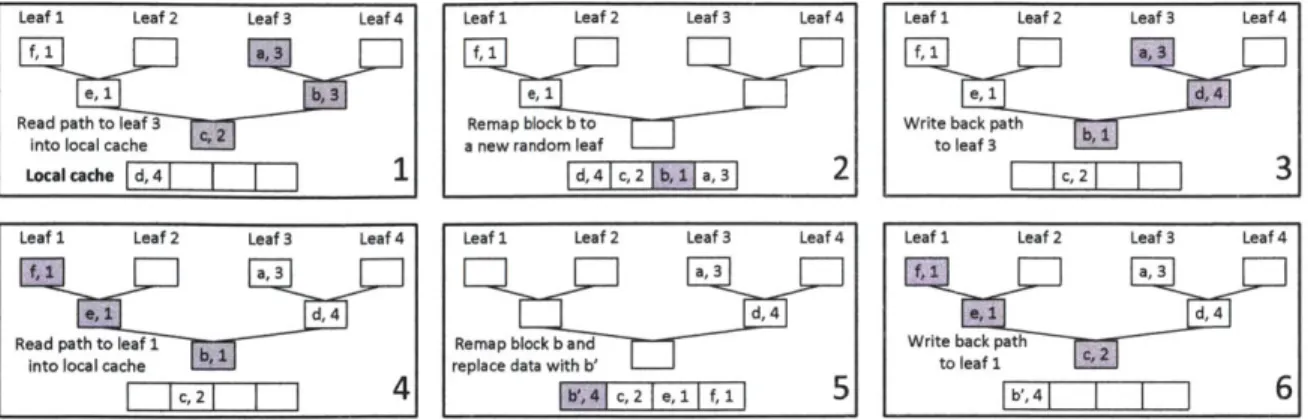
Now we describe how Path ORAM works. Readers can refer to [56] for a more detailed description. At any time, each data block stored in the ORAM is mapped (at random) to one of the 2L leaves in the ORAM tree via the position map (i.e., V leaves 1 and blocks b,
Prob(b is mapped to 1) = 1/2L). Path ORAM's invariant (Figure 3-2) is: If 1 is the leaf
currently assigned to some block b in the ORAM, then b is stored (a) on the path from the root of the ORAM tree to leaf 1 (i.e., in one of a sequence of buckets in external memory), or (b) in the local cache within the ORAM interface.
Initially the ORAM is empty and the position map associates each possible program address with a random leaf. Suppose a program wants to access some block b with program address u and that this block is currently mapped to leaf 1. The program using the ORAM makes requests through the ORAM interface via accessORAM(u, op = read/write, b'):
1. Look up the position map with u, yielding the leaf label 1. 3