Dewey
A DYNAMIC ATTRIBUTE SATIATION MODEL OF VARIETY SEEKING BEHAVIOR*
by Leigh McAlister*
Sloan W.P. No. 1283-82 September 1981
THE MARKETING CENTER
JassachusettsInstituteofTechnologyAlfredP.Sloan SchoolofManagement
50 MemorialDrive
Cambridge, Massachusetts 02139
A DYNAMIC ATTRIBUTE SATIATION MODEL OF VARIETYSEEKING BEHAVIOR*
by LeighMcAlister**
Sloan W.P. No. 1283-82 September 1981
*The author wishes to acknowledge the financial support provided by the University of Washington Graduate School of Business Summer Research Fund and the valuable guidance of Professor James Bettman of UCLA in stimulating, developing and presenting these ideas.
•^Visiting Assistant Professor of Management Science, Alfred P. Sloan School of
Management, Massachusetts Institute of Technology, Cambridge, Massachusetts 02139
- 1
ADYNAMIC ATTRIBUTE SATIATION MODEL OF VARIETY SEEKINGBEHAVIOR
ABSTRACT
This paper presents amodel of individual consumer choice behavior for separate choiceoccasions. Contrary to the popular notion that each choice is essentially independent of its predecessors, that very dependence is proposed as the key to variety seeking behavior. From the consumption history one can inferwhich valued attributes the subject has recently consumed and in what quantities. Comparing this to the ideal amount of each attribute for that subject gives an indication of the attribute combination that would be most preferred by that subject at that point in time. As the consumption history evolves, the pattern ofattribute accumulations will change, leading to preference foritems rich in different attributes at different points in time. Themodel is operationalized and specific parameterizations are inferred from a collection ofsoft-drink consumption diaries. The proposed model is shown to predict choices better than a model which ignores the dependence among choices.
- 2
-ADynamic Attribute Satiation Model of Variety Seeking Behavior
INTRODUCTION
An excerp from a soft drink consumption diary indicates that the subject drank a Coke on Monday, a Coke on Tuesday, a Dr. Pepper on Wednesday, a 7-Up on Thursday, a Pepsi on Friday and a Club Soda on Saturday. Further questioning of the subject reveals that Dr. Pepper was selected on Wednesday because it was offered that day at an especially low price. Seven-Up was chosen Thursday as a change of pace. The subject wanted a Coke on Friday but settled for a Pepsi because Coke was not available. Saturday night the subject chose Club Soda to mix in her Scotch drink.
This patternof switching among brands is not atypical for frequently purchased, non-durablegoods. Switching can be induced by the manipulation of marketing variables, by the accessibility of the product, by the situation in which the product is consumed or by the desire for variety. It is switching for the sake of variety with which this paper is concerned. In particular, it is proposed that such switching is not completely random. A deterministic process which would lead to variety-seeking is proposed,' modelled and empirically tested. Theprocess differs from traditional models in its consideration of the impact of previous selections.
The hypothesized effect of consumption history on variety seeking is based on three assumptions. Following Lancaster (1971) it is assumed that items can be represented by the values they take on for their constituent attributes. Similarly, a collection of items can be represented by the sum of values, across items in the collection, on those constituent attributes.
- 3
A consumptionhistory, which is a collection of items, can therefore be represented by the attribute accumulations or attribute "inventories" it generates.
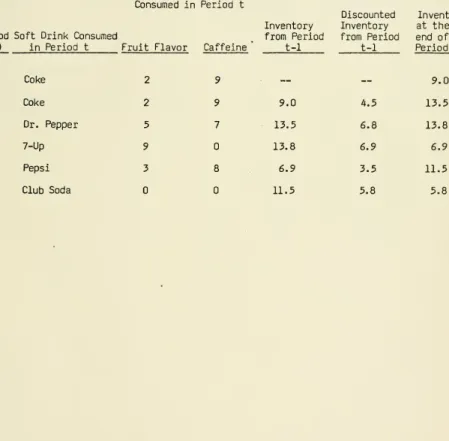
Consider the simplifiedexample in Tables 1 and 2. Individual soft drinks are described by the two attributes fruit flavor and caffeine. At any point in time, the consumption history can be summarized by the amounts of those two attributes that have been accumulated. On day 1 only one Coke has been consumed so the accumulated inventories would be 2units of fruit flavor and 9
units of caffeine. The consumption of another Coke on day 2would raise the inventories by 2 and 9 units respectively. After the consumption ofa Dr. Pepper on day 3 the fruit flavor inventory would be incremented by 5units and the caffeine inventory by 7 units, etc.
[Tables 1 and 2About Here]
The second assumption concerns the continual depletion of the inventories through physiological processing or forgetting. This depletion can be conceptualized as the discounting of older consumption experiences. That is,
the soft drink that a subject consumed a week ago hasa smaller residual impact on her current attribute inventories than one she consumed yesterday. Similarly, that soft drink she consumed yesterday would have a smaller residual impact than one she consumed one hour ago. Figure 1 describes the ups and downs of the inventory of caffeine generated by the consumption history in Table 2. From day to day the inventory drops by half to represent the physiological processing or forgetting of the attribute. With eachconsumption there is a discrete jump upward in the level of the inventory equal in size to the amount of the attribute in the soft drink consumed.
- 4 -[Figure 1 About Here]
Finally, it is assumed that there is a decreasing marginal relationship between the attribute inventories that would result from the consumption of a particular item and preference for that item. Figure 2 depicts two possible
2 decreasing marginal relationships:
1) A finite ideal point that lies within the achievable range of the attribute inventory (given by the dashed curve).
2) A finite ideal point that lies beyond the achievable range of the attribute inventory (given by the broken curve).
Consider a single attribute. When the inventory of that attribute is very low this assumption implies that preference for a unit of that attribute is at its highest. As the inventory of that attribute grows, perference per unit drops. Shouldthe inventory reach its ideal level or point of satiation, the marginal impact of adding a unit of the attribute is zero. Beyond the point of satiation, preference decreases. This phenomenon explains why a cola might be veryappealing at times (when the inventory of caffeine is low and therefore the marginal impact on preference of adding to that inventory is relatively high) and less so at other times (when the inventory is high implying that additions will have a relatively small marginal impact on preference).
[Figure 2About Here]
The amalgamation of these three assumptions is a dynamic attribute satiation process. It holds that preference for an item at a point in time is
a function of the preference contributions of that item's constituent attributes. The preference contribution of each attribute is, however, a
function of the consumption history (summarized by attribute inventories) and the point of satiation for that attribute. Since the configuration of attribute inventories can change dramatically as the consumption history
-5
-evolves, it is not surprising that shifts in preferences among choice alternatives (and resulting variety seeking) are observed.
In this paper the dynamic attribute satiation process is operationalized as an estimatablemodel. Soft-drink consumption diaries are used to infer individual specific parameterizations of that model. The ability of the proposed model to predict actual choices is shown to be superior to that of a
model based on the assumption that each choice is independent of prior selections. The managerial implications of this finding are discussed.
LITERATURE REVIEW
As mentioned earlier, brand switching is sometimes induced by the manipulation of marketing variables (price, product design, promotion, distribution) and sometimes by changes in situational variables. Early studies of brand loyalty (Tucker 1964, McConnell 1968) and a similar study in social psychology (Brickman and D'Amato 1975) controlled for these factors and still reported switching. Inthose studies subjects were asked to make repeated choices from a set ofunfamiliar stimuli. Two distinct phases of switching behavior were apparent in the data. Initially, subjects
systematically explored the stimuli. Later in the experiment, subjects tended to alternate among the elements of their favored subset of the stimuli. Much of the consumerbehavior literature on variety seeking, novelty seeking, innovativeness, etc. focuses on switching like that of the first phase (e.g., Robertson 1971, Venkatesan 1973, Hirschman 1980). This phase can be distinguished from the later one by the information acquisition motive. It
is switching like that of the second phase (switching among familiar items that is done simply for "variety") with which this paper deals.
- 6
-Bass, Pessemier and Lehman (1972) studied choice froma familiar product class controllingthe impact ofmarketing and situational variables. Subjects in their study chose the brand they reported as their favorite only about half the time. The authors attributed the switching to and among reportedly less preferred brands to "a stochastic component of choice which arises because of variety seeking" (Bass, Pessemierand Lehmann 1972, p. 538). This line of reasoning gave rise to Bass' (1974) "Theory of Stochastic Preference and Brand Switching". According to that theory, relative preferencesdictate the proportion of times each brand is chosen. Any particularselection, however, is at the mercy of a "stochastic element in the brain". Blin and Dodson (1980) propose a specific functional relationship between the frequency with which a brand will be chosen and the importance weights in an individual's linear compensatory preference function. In a variation on this theme Huber andReibstein (1978) propose that the item selected is a deterministic function of parameters of the preference function of the person doing the choosing. Those parameters, however, are assumed to change in a random fashion.
Under the theory ofstochastic preference, variety seeking is viewed as non-understandable. Otherparadigms allow explanation of the phenomenon. Predominant among the explanations is the notion of "optimal arousal" (Berlyne 1960, Hansen 1972). Individuals are hypothesized to select that collection of items which will provide just the right amount of stimulation or arousal. Optimal arousal is frequently conceptualized as asingle peaked relationship
(Coombs and Avrunin 1977) between preference and the stimulation provided by the collection selected. McAlister (1979) modelled the stimulation provided by the collection as a function of the stimulation provided by attributes of items in the collection. Her model predicts the collection of items aperson would select at a point in time.
Jeuland (1978) modelled variety seeking behavior across time. He
essentially proposed item (i.e., brand) specific stimulation optima. He
further proposed "inventories" of item stimulation which evolve dynamically in
a manner analogous to the just described evolution of attribute inventories. Implicit in this formulation is the assumption that the consumption of one item has no impact on the inventories of other items. As pointed out by
Hagerty (1980), this ignores the effect of item similarity. Under Jeuland's model the preference for Coke should not be affected by consuming either (Pepsi, Dr. Pepper, RC Cola, Pepsi) or (7-Up, 7-Up, 7-Up, Mountain Dew, Sprite). Changes in preference result from changes in the relevant inventory and in eitherof these cases the inventory of Coke would be zero.
In the proposed dynamic attribute satiation process inventories of attributes rather than inventories of items are accumulated. The first consumption history above would generate a large inventory of caffeine and a
small inventory of fruit flavor. The second consumption history would generate a large inventory of fruit flavor and asmall one of caffeine. The evaluation of the caffeine and fruit flavor contributions of aCoke (and hence theevaluation of Coke itself) will probably be very different with the first consumption history than it would be with the second.
OPERATIONALIZINGTHE DYNAMIC ATTRIBUTESATIATION MODEL
Consistent with models in the traditions of Fishbein (1963) and Lancaster (1971), the Dynamic Attribute Satiation (DAS) model relates preference for an item to the preference contributions" of the attributes of that item. Assuming there are no interactions among the attributes, preference for an item will be defined as the sum of the contributions to
preference made by each of the attributes. That is:
DA%k=j4^Tkj
^1>whereDASy[^ = preference for item kat time T assigned by the Dynamic Attribute Satiationmodel,
J = the numberof attributes over which items are described,
Pjl^j =contribution of attribute j to the level of satisfaction that would result from consuming object kat time T.
Thecontribution ofattribute j to satisfaction from consuming object kat time T, Pji^-, is assumed to be a function of the inventory of attribute j at time T, the ideal level of attribute j, and the amount of attribute j in object k. It was arguedthat the particular functional relationship should be marginally decreasing with a single optimum at the ideal point. A quadratic relationship of the form presented in Equation (2) displays these properties and is easily estimated.
P^kj = Wj [(I,j . X,j) -
XjA-l)
(2)where Pj|^j = contribution of attribute j to the level of satisfaction that would result from consuming object ktime T,
w. = importance weight for attribute j,
I-J-. = inventory of attribute j at time T,
X. . =amount of attribute j in object k,
X. = ideal level for attribute j.
Note that when the current inventory of attribute j plus the amount of
attribute j in object k (ly- + X^.) exactly equals the ideal for attribute
j (X ), the term which is squared equals zero forcing P.,., . to also equal zero.
The more I . + X^. differs from X., the more negative P_ . becomes. That is,
preference peaks at the ideal point. To either add to or diminish the inventory reduces overall preference.
- 9
-Attribute Inventory
The attribute inventory is hypothesized to dwindle continuously and experience discrete increments each time an item containing that attribute is consumed (see Figure 1). A similarprocess was proposed by Little and Lodish (1969) for the cumulative impact of advertising and by Jeuland (1978) for the evolution of "experience" with a brand. The particular functional form used here to convert a consumption history (X ., t=l, 2, ..., T) into an
*^tJ
inventory is given by Equation 3.
where I^. = inventory of attribute j at time T,
\. = inventory retention factor for attribute j, <_x <_1,
k
= item chosen at time t,X, . = amount of attribute j in the itemchosen at time t.
\^
The speed withwhich the inventory dwindles is an inverse function of the inventory retention factor, X.. It seems reasonable that this factor might differ across individuals and across attributes. For instance, one might expect Xo^l-^j^
^
ouenchino ^°^ athletically activp persons to be smaller than X^^..^- i. . . for more sedate persons, indicating a more
rapid dwindling of the inventory of thirst quenchingness for athletically active persons than for the more sedate. (In general the X's for heavy users of a product class might be expected to be lower than x's for light users.) Similarly, onemight expect
\^^^^^^^^ > X^arbination ^°^ ^" individual indicating that the human body divests itself of carbonation more rapidly than calories.
Unfortunately, theestimation procedure employed requires the a priori specification of values for the X-'s. Receiving no guidance on the
10
-selection of such values from those who have proposed similar processes (Little and Lodish 1969; Jeuland 1978) the value for X- was set
arbitrarily at 1/2 for all attributes and all individuals. This arbitrary selection will impede the predictive ability of DAS. However, the objective of thispaper is to demonstrate that a process which considers the
interdependence of choices has greater predictive ability than one which views each choice as independent of all others. If the process incorporating the interdependence (DAS) is able to make better predictions in spite of a
handicap inparameter selection, the point will be made. Future research into the pattern of variation of these parameters should provide insights useful to researchers andmanagers and enhance the predictive ability of such models. Parameters of the Model
Ideal Points. It is important to note that the ideal points in the DAS
model, (X.: j
=1,
2, ..., J), do not necessarily reflect the amount ofattribute j that one would like to find ina single choice alternative. Rather, they indicate the optimal level for the entire inventory of that attribute. As the inventory level of an attribute decreases, the amount of that attribute which is desired in a choice alternative increases.
Importance Weights. The difference between an inventory retention factor
and an importance weight should be noted. An importance weight reflects the degree of disutility associated with being a given number of units from one's ideal level. Comparisons among importance weights allow one to make statements concerning the relative impact of each attribute assuming that all else is held constant. But allelse is not held constant, and inventory
retention factors determine the pattern of that inconstancy. For example, being one unit away from one's ideal level of thirst quenchingness might be less unpleasant than being one unit away from the ideal level of sweetness
-11
-(importance weight for sweetness > importance weight for thirst quenchingness). However, if this individual's X^^.^^^
quenchingness ^"^
X pg4-p,pss^^^^ ^^^^ ^^^^ ^^^ inventory of thirst quenchingness depleted muchmore rapidly than the inventory of sweetness, alternatives offering relatively more thirst quenching ability than sweetness would probably be chosen. This in spite of the fact that sweetness has a higher importance weight than thirst quenching ability.
Confounding of Parameter Estimates when Inventory is Ignored.
Ifpeople do, in fact, evaluate choice alternatives relative to the current state of their attribute inventories, one might expect bias to be introduced by estimation procedures which do not account for those inventories. Inan appendix to this paper it is shown that the failure to account forinventories will not bias importance weights but will bias ideal points. The direction of ideal point bias will be downward from the true ideal by an amount equal to the inventory at that point in time. For that instant the bias in the parameterexactly makes up for the failure to include inventory in the stimulus-attribute matrix. At later points in time the inventory will be at different levels and the parameter's bias will not exactly compensate. The managerial implications of this bias will be explored in the "Discussion of Findings" section.
DATA
Data for the study reported in this paper were collected betweenOctober and December, 1978. Twice in the course of this 81 day study (at the beginning and half way through) subject perceptions of stimuli on relevant attributes were elicited. Twice aweek during the course of this study, subjects were asked to rank order the stimuli from most preferred to least
- 12
-preferred and to report all items from the stimulus product class that they consumed since they last gave data. Data from the first 50 days of the study is used to estimate parameters of different models. These estimated models are then employed to predict actual choices made during the last 30 days of the study. Statistics based on those predictions allow comparison of models. Subject Population
The subjects in this study were 36 graduate and undergraduate students enrolled in the School of Business Administration at the University of Washington during Fall Quarter, 1978. Twenty-two percent of the subjects were females. No economic incentive was offered for participation in the study. Motivation for accurate reporting of information was provided by having the professor in a bi-weeklyclass begin each period by distributing data collection forms and requesting that serious thought be given to the task. Responses to a questionnaire administered at the end of the study indicate that subjects were neither intrigued nor irritated by the tasks and tended
o
to report their preferences accurately. Stimuli
This study, as did Bass, Pessemier and Lehamann's (1972), deals with preferences for and choices among soft drinks. The 10 stimuli selected were: Coke, Diet Pepsi, Dr. Pepper, Mountain Dew, Pepsi, Royal Crown Cola, 7-Up, Sprite, Sugar Free 7-Up and Tab. These soft drinks were reported in Standard and Poor's Industry Survey (1978) as having the ten highest market shares, ranging from ashare of 26.6% for Coke down to 1.2% for Sugar Free 7-Up. The total of market shares for stimulus soft drinks is 69.2% with no excluded soft drink receiving more than .9% of the market. These soft drinks include 6
colas and 4non-colas and 3diet drinks and 7 non-diet drinks.
The subjects were, on average, reasonably familiar with this product class. Their self reported familiarity with the stimulus soft drinks.
- 13
-averaged across subjects and across soft drinks, is 2.8 on a scale on which 1
indicates that the subject had never tasted the soft drink and 5indicates that the subject often drinks it.
The attributes selected to describe the stimulus soft drinks are the same as those used in the Bass, Pessemier and Lehmann (1972) study: carbonation,
9
calories, sweetness, thrist quenching ability, and popularity with others. Seventy-two percent of the subjects indicated that they thought that the selected attributes were not the only factors they considered in selecting a
soft drink. Other attributes that they mentioned as important include (in order of frequency of mention, most frequent first): taste, price, availability, caffeine, saccharine, can size and nutrition. Data Collection Instrument
Thedata collection instrument was made up of three documents. The first document, administered at the beginning of the study and half way through, elicited subject perceptions of attribute values for stimulus soft drinks on 6
point scales (0 to 5). Zero indicated that the brand possessed virtually none of the attribute. Five indicated that the brand possessed agreat deal of the attribute. The order in which stimulus soft drinks were presented was randomized across subjects.
The second document, administered bi-weekly for the 11 weeks of the study, elicited a history of soft drink consumption since the subject last gave data. It also requested that the ten stimulus soft drinks be rank ordered from the brand a subject would most like to consume at that point in time to the brand she would least like to consume at that point in time. The order of presentation of soft drinks for the rank-ordering task was randomized across data collection occasions.
The final document was administered at the end of the study to survey subjects' attitudes about the study. It included questions regarding familiarity with the stimuli, involvement with the experimental tasks, reasons
- 14
-for selecting a soft drink other than the one which had most recently been reported as most preferred and factors other than experimental attributes that influenced the subject's selection of soft drinks.
Model Estimation
The algorithm LINMAP wasused to estimate parameters for DAS. Because not all subjects reportedpreferences at every possible data collection
opportunity (due to class absences, etc.) the number of preference reports per subject in days 1-50 of the study (the time period used to estimate
parameters) ranges from 5to 11. Their respective stimulus-attribute matrices were thereforemade up from 50 to 110 stimuli (10 from each report,
corresponding to the perceptions of the 10 stimulus soft drinks augmented by the inventories). This does not, however provide the information content of a
single ranking of 50 to 110 objects. Since no comparisons were made across report periods, it is impossible to say whether the stimulus ranked third on one day is more or less preferred than one ranked fifth onanother day. The information content of the 50 to 110 stimuli was estimated and the measures were considered sufficient to confidently estimate the 12 parameters (an ideal point and importance weight for each of the six attributes).
Two versions of an alternative model which treated each choice as independent of all others were also estimated using LINMAP. Under this paradigm, attribute inventories did not need to be considered. Therefore the stimulus set facing subjects on each data collection occasion was considered identical. Their multiple reports of preference rankings were then viewed as replications of the same task. The two versions of this alternative model were distinguished by the dependent variables used in their estimation. One was based on the ranking from the first preference report given by a subject. The other was based on a ranking consistent with the average, across preference reports, for that subject.
- 15
-RESULTS
Two types of tests were utilized to assess the .performance of DAS relative
to a model which does not incorporate the impact of past choices. Goodness of fit tests deal with the models' relative abilities to replicate the preference reports (from the first half of the study) which were used in their
estimation. The external validity test compares themodels with respect to theirability to predict actual choices made during the second half of the study.
The statistics used for the goodness of fit comparisons are the Kendall's taus reported by LINMAPin estimating the models' parameters. These statistics measure the correlation between the actual preference reports and the preference rankingpredicted by the estimated model. They are compared in three different ways in Table 3. Column 1 reports the average value forx
across subjects. Column 2 reports the percentage of the subjects for whom the value of T is greater than .8. Column 3 reports the percentage of subjects whose reported preferences correlate more highly with model predictions than with the averagepreference ranking (interpreting the study based market shares as an averagepreference ranking). The measure of external validity (reported in column 4 of Table 3) is the percentage of actual choices made which were correctly predicted bythe various models.
[Table 3About Here]
Among the three models estimated (DAS, Independent Choices based on the First Preference Report, and Independent Choices based on the Average Preference Report), DAS dominates on all measures. Tests for the statistical significance of the differencesbetween the average t for DAS and those of the two variants of the Independent Choices model are significant at the .01
-16
-level. The difference between the two variants of the Independent Choices model is not significant, even at the .1 level. These tests are summarized as
follows:
Average Across 36
- 17
-could very well yield radically different values for ideal points. (Perhaps it was observation of some such phenomenon that led Huber and Reibstein (1978) to hypothesize their random ideal points model.) Each estimated ideal point would be biased by an amount equal to the level of inventory at the time the rank-ordering was elicited. Amodel so estimated should do a good job of predicting choice behavior at that particular point in time. As inventories dwindle and are replenished, however, the preference ranking will very likely change.
The second form of questioning ("preferences generally") will elicit biases equal to average inventories of attributes. These biases, contrasted with those just discussed, should be relatively stable. Model reestimation at different points in time should yield similar values for ideal points. Unfortunately, there is no guarantee that this model will reflect the true preference ranking for any particular choice occasion. For example, on a
given choice occasion onemight have a very high inventory of sweetness, suggesting the choice of anon-sweet object. By the next choice occasion the inventory of sweetness could have dwindled dramatically making a very sweet object appealing. Preferences based on average inventory level would suggest choice of a moderatley sweet object. In fact theone.non-sweet object and one very sweet object were chosen.
The importance of attribute inventories suggests a new class of model parameters, inventory retention factors, to be investigated. Although the values for all inventory retention factors for all subjects in this study were taken to equal 1/2, arguments have been offered concerning the likely variability of those parameters. In summary, it has been proposed that the inventory retention factors are determined by underlying physiological and/or psychological processes. For example, inventory of "sweetness" might be analogous to blood sugar level. The inventory retention factor would be.
- 18
-in that case, a functionof the body's ability to metabolize sugar. Inventory retention factors for non-physiologically based attributes like "popularity with others" or "stylishness" might be a function of self-confidence, innovativeness or similarpsychological constructs. Given these systemic roots for the factors, hypotheses concerning the patterns of values across populations and across time can be posited and tested.
The results of such studies should have far-reaching managerial implications. It will be important to eliminate or at least understand the biases caused by ignoring inventories. Designing new products or
repositioning old ones on the basis of ideal points derived from models which do not consider inventories could be dangerous for the reasons outlined above. It could be similarly misleading to segment the population based on importance weights alone. While the weights are not biased by estimation procedures which ignore inventories (see appendix), they alone do not tell the whole story. For example, sweetness might be twice as important to person A
as to person B. But, if their inventory retention factors indicated that person B'sinventory would drop 6times faster than that of person A, relative choice behavior might be counter to expectation based on importance weights alone.
Even more important than those specific implications, consideration of attribute inventories may provide the manager with aclearer understanding of theprocess by which consumers make choices. It would seem that this better understanding should aid the manager in all aspects of marketing her product.
CONCLUSIONS AND DIRECTIONS FOR FUTURE RESEARCH
As proposed in the introduction, the Dynamic Attribute Satiation (DAS) Model is simply one morestep in the process of explaining individual choice behavior. Consideration of the impact of situational variables in predicting
-19
-individual choice has improved that prediction (e.g., Warshaw 1980). While this is surely a step forward, it is not the end of the process. In the Bass, Pessemier and Lehmann (1972) study, situational factorswere controlled and switching among brands was still observed. DAS was designed specifically to accomodate that non-situationally based switching. The versionof the DAS model empirically tested in this paper was able to expand prediction beyond that ofamodel which does not account for the impact of the consumption history. This is especially encouraging since the inventory retention factors, which are the key toencoding the effect of the consumption history in DAS, were only crudely approximated. Exploration of theseparameters should further improve the predictive ability of the model and provide valuable insight into the process by which individuals make choices.
Further research into the nature of the inventory retention factors and the sensativity ofpredictive ability to a wide range of values for those parameters should be done. Specific hypotheses linking inventory retention parameter values to demographic and psychographic variables should be explored. The estimation procedure used in this paper requires that values for the inventory retention factors be tested by trial-and-error. No convexity or even continuity properties can currently be attributed to the relationship between parameter values and predictive ability. Hence improvement can be noted but global optima cannot be guaranteed. Perhaps a
reformulation of the inventory term (Equation 3) or the creative use of estimation procedures could solve this problem. Better estimation of parameter values should, in turn, lead to questions concerning the specific
implications for different product classes and population segments. The calculation of attribute inventories needs to be extended to acquisition of attributes from products overlapping the product class under study by one or more attributes. For example, the inventory of sweetness
- 20
-relevant to the selection of soft drinks is affected not only by sweetness from historical soft-drink consumption, but also by historical consumption of cake, pie, fruit, etc. In general, any object consumed which has sugar content contributes to that inventory. The large number of items an individual consumes suggests that this extension may be difficult.
Finally, an attempt should be made to consolidate, within the multiattribute framework, the predictive progress made by considering situational factors with that made by considering consumption histories. By capturing these two factors simultaneously and detailing the ways in which they might affect one another, we should move yet one step further along the road toexplaining individual choice behavior.
- 21
BIBLIOGRAPHY
Bass, Frank M. (197A), "The Theory of Stochastic Pre<^erence and Brand Sv/itching," Journal of Marketing Research, 11 (February), 1-20.
Edgar A. Pessemier, and Donald R. Lehmann (1972), "An Experimental Study ofRelationships Between Attitudes, Brand Preference and Choice," Behavioral Science 17 (November), 532-41.
Berlyne, D. C. (1960), Conflict, Arousal and Curiosity, New York: McGraw-Hill. Blin, Jean-Marie and Joe A. Dodson (1980), "The Relationship Between
Attributes, Brand Preference, and Choice: A Stochastic View," Management Science. Vol. 26, No. 6 (June) 606-19.
Brickman, Philip andBarbara D'Amato (1975), "Exposure Effects in a Free-Choice Situation," Journal of Personality and Social Psychology, Vol. 32,
No. 3, 415-420.
Fishbein, Martin (1963), "An Investigation of the Relationship Between Beliefs About An Object and the Attitude Toward that Object," Human Relations, 16 (August), 233-40.
Green, Paul E. and V. Srinivasan (1978), "Conjoint Analysis in Consumer Research: Issues and Outlook," Journal of Consumer Research, 5
(September), 102-23.
Hagerty, Michael R. (1980), "The Situational Model: A Theory of Choice," Ph.D. Dissertation, The University of Illinois.
Hansen, Flemming (1972), Consumer Choice Behavior: A Cognitive Theory,
The Free Press, New York.
Hirschman, Elizabeth C. (1980), "Innovativeness, Novelty Seeking, and Consumer Creativity," Journal of Consumer Research, Vol. 7, No. 3
(December), 283-95.
Huber, Joel and David J. REibstein (1978), "Attitude Measures and Choice Frequency: Some Pitfalls to be Avoided," in John C. Maloney, Attitude Research Plays for High Stakes, Chicago, American Marketing Association. Jain, Arun K., Franklin Acito, Naresh K. Malhotra and Vijay Mahajan (1979),
"A Comparisonof the Internal Validity of Alternative Parameter Estimation Methods in Decompositional Multiattribute Preference Models," Journal of Marketing Research, 14 (August), 313-22.
Jeuland, Abel P. (1978), "Brand Preference Over Time: A Partially Deterministic Operationalization of the Notion of Variety Seeking," AMA Proceedings (August).
Kendall, Maurice (1962), Rank Correlation Methods. New York, Hafner
- 22
-Keon, John W. (1980), "The Bargain Value Model and a Comparison of Managerial Implications with the Linear Learning Model," Management Science, Vol. 26,
No, 11 (November) 1117-30.
Lancaster, Kelvin (1971), Consumer Demand: A New Approach. New York:
Columbia University Press.
Little, John D. C. and Leonard M. Lodish (1969), "AMedia Planning Calculus," Operations Research, Vol. 17, No. 1 (January-February), 1-35.
McAlister, Leigh (1979), "Choosing Multiple Items from a Product Class," Journal of ConsumerResearch, 6 (December), 213-22A.
McConnell, J. Douglas (1968), "The Development of Brand Loyalty," Journal of Marketing Research, 5 (February), 13-19.
Robertson, Thomas S. (1971), Innovative Behavior and Communication, Holt,
Rinehart and Winston, Inc., New York.
Srinivasan, V. and Allan D. Shocker (1973), "Linear Programming Techniques for Multidimensional Analysis of Preferences," Psychometrica, 38 (September), 337-69.
Standard and Poor's (1978). Industry Surveys A-L, Vol. 1, (April).
Tucker, W. T. (1964), "The Development of Brand Loyalty," Journal of Marketing Research, (August), 32-35.
Venkatesan, M. (1973), "Cognitive Consistency and Novelty Seeking," in Scott Ward and Thomas S. Robertson, eds., Consumer Behavior: Theoretical Sources, Prentice-Hall, Inc., Englewood Cliffs, New Jersey, 355-384. Warshaw, Paul R. (1980), "A New Model for Predicting Behavioral Intentions:
- 23
FOOTNOTES
i The fraction of the inventory which carries through from one day to the next might be any value from to 1. In operationalizing the model it was necessary to select a particularvalue. One half was chosen arbitrarily. This issue is discussed further in the section on "Operationalizing the DAS Model".
2A constant marginal relationship is also depicted in Figure2 (the solid line). This relationship implies that each incremental unit of an attribute contributes equally to preference. It is reasonable to believe that some attributes will display such a relationship. They would not, however, contribute to the kinds ofpreference shifts of interest here.
^ Keon (1980) would disagree. He argues that switching among familiar items results from the desire to refresh one's memoryand assure oneself that the usual selection is superior.
^ Ifthere is reason to believe, a priori, that interactions exist between certain attributes, a new attribute, defined as the product of the interacting attributes, can also be used. With this augmentation of the attribute set, theinteraction is accounted for and the proposed model is still valid.
^The estimation procedure to be used is LINMAP. This algorithm selects values for the importance weights and ideal points so as to most closely replicate the original preference ordering. An option available to the algorithm is to set ideal point for agiven attribute at infinity. In
thatcase equation (2) degenerates into a simple linear relationship. (See Srinivasan andShocker 1973, pp. 3A5-346).
^Because of the nature of the data collected and the estimation procedure used, overan hour of CPU time was required to estimate the models presented in this paper. It would be informative to reestimate the models assuming different values for \. Comparison of the predictive ability of such reestimated models would shed light on the nature o-f the inventory retention factor. However, because of the exorbitant data processing requirements, and because the results obtained with X- 1/2 were sufficient to address the central hypothesis in this paper, such reestimation was foregone.
^ Subjects self-reported their level of interest in the tasks on a 1-5 scale on which 1 indicated that they were quite interested in reporting preferences and perceptions and 5 indicated that they were irritated by requests to report perceptions and preferences. The average value for this variable across subjects was 3.03.
^ Subjects self-reported the accuracy of their preference reports on a 1-5 scale on which 1 indicated that theirpreference reports were unrelated to their true preferences and 5 indicated that their preference reports exactly reflected their true preferences. The average value for this variable across subjects was 3.81.
24
^ Forpurpose of analysis a sixth attribute, cola/non-cola was also used. Because the value of that dichotomous attribute was obvious for the stimulus soft drinks, it was not necessary to elicit subject perceptions concerning it.
'•'-'Two criteria were considered formeasuring the information content of a
rank ordering. The first is the numberof inherent paired comparisons: a
ranking of k objects impliesk(k-l)/2 paired comparisons. This measure multiple counts many pieces of information that are apparent via transitivity. Consider a ranking of 4 objects; A, B, C and D. This ranking implies 4(3)/2 = 6paired comparisons (A >B, A > C, A > D,
B>C,
B>D,
C>D;
where > means "is preferredto"). However, given that one knows A > Band B > C, it is redundant to say that A > C (assuming transitivity). The second proposed measure disregards the redundant paired comparisons. It holds that the number of pieces of information in a ranking of k objects is k-1 (1st > 2nd, 2nd > 3rd, ...,k-lst > kth).
According to Green and Srinivasan (1978), in selecting the number of stimuli necessary for accurate parameter estimation one should consider the ratio of (number of stimuli)/(number ofparameters estimated). "Number of stimuli" in that calculation is analogous to the number of objects in a
single rank ordering. The "number ofparameters estimated" fora given subject in this study is 12 (an ideal point and an importance weight for each of the 6 attributes). The relevant ratio using the first measure of information content runs from alower bound of 21/12
=1.75
for the subject providing only 5 preference reports to an upper bound of 31/12= 2.67 for those subjects providing 11 preference reports. Using the second measure of information content, the ratio runs from 46/12 = 3.83 to 100/12 - 8.33.Soft Drink Coke Dr. Pepper 7-Up Pepsi Club Soda 25
TABLE1: SIMPLIFIED DESCRIPTION OF SOFT DRINKS
26
TABLE 2: HYPOTHETICAL CONSUMPTION HISTORY AND RESULTING INVENTORY OF CAFFEINE
Time Period
27
-TABLE 3: TESTS OF MODELS
(n = 36)
I GOODNESS OF FIT 1
EXTERNAL I-VALIDITY-I
Model
(Col. 1) (Col. 2) (Col. 3)
Percent of t's > Corre-DAS Independent Choices 1st Pref (Col. 4) Average t (std. dev.)
28
FIGUFE1: INVENTORY OFCAFFEINE
Inventory of Caffeine
29
-FIGUEE 2: RELATIONSHIP
BEWEEN
ATTRIBUTE INVENTORYAND THE PREFERENCE COOTRIBUriON OFTHAT AITRXBUTE FORFINITE Airo INFINITE IDEAL POINTS
Preference Due to Attribute
^
Achievable Attribute I Range of nventory Attribute InventoryPreference for an Attribute with a Finite Ideal Point that Lies within the Achievable Range of the Attribute Inventory
Preference for an Attribute with a Finite Ideal Point that Lies beyond the Achievable Range of the Attribute Inventory
30
-APPENDIX: THE INTRODUCTION OF BIAS IN PARAMETERESTIMATES BY IGNORING
INVENTORIES
Consider thecontribution ofattribute j from item k at time T when inventory is accounted for and when it is not:
INVENTORY
ACCOUNTED P,, . = w. [(I^. + X. .) - X .]^ (2)
POP '^J J 'J ^J J
(See the original statement of Equation 2 for the explanation of the terms.) INVENTORY
NOT ACCOU^
FOR "j
NOT ACCOUNTED Pj^_ =w• [X, . - X.]^ (4)
where: P. . = contributionof attribute j to the satisfaction that would result from consuming object k, not accounting for inventory;
w. = importanceweight for attribute j not accounting for inventory;
X. = ideal level for attribute j not accounting for inventory.
With the proposed estimationprocedure, these expressions would be
incorporated in the constraints of LINMAP once for each paired comparison in which object k is involved. Consider a specific paired comparison: object k
preferred to object k'. The related constraint accounting for inventory would imply that:
ACCOUNTING J J
FOR Z Pjj^. - Z P^-, ,. + s,., > (5) INVENTORY: j=l
^^
j=l^
J kk-31
-where: J = thenumber of relevant attributes;
P-j-^jj = contribution of attribute j to the satisfaction thai
would result from consuming object k at time T,
J
Z P . = satisfaction that would result from consuming j=l ^ object kat time T,
s^;|^i = artificial variable associated with the paried
comparison (k,k'). (The sum of these artifical variables across all paired comparisons is the objective that LINMAP minimizes. It will equal zero if the paired comparison is satisfied. It
will capture the magnitude of the violation otherwise.
)
Theconstraint would take the following form if inventory were not accounted for:
INVENTORY J ^ J ^ ^ /,n
NOT ACCOUNTED S P . - Z Pyk
M
"^ S.k• > °
FOR j=l "^J j=l '*^ J '^'^
~
where tilded variables are the "not accounting for inventory" counterparts of variables just described.
In order to state the "accounting for inventory" constraint in terms of the parameters to be estimated, substitute Equation <2) into Inequality (5)
yielding: ACCOUNTING FOR INVENTORY:
jl
[Wj(X,/
- X,,.2) - 2wj (Xj - I,j) (X,. - X,,.)] .3,,, >_0 (7) I IA similar substitution of Equation (4) into Inequality (6) and algebraic simplification yields the following constraint when inventory is not accounted for:
32 INVENTORY NOT
ACCOUNTED FOR:
jf/«j
%
-^p-^^iY^i-^'i^^*i^^'-(.e)
In the model not accounting for inventory, w. is estimated as the coefficient
2 2 ~ ~
*
of (X . -X ) and an artificial parameter, v. = -2w X., is estimated as
kj k J J J J
the coefficient of (X - X ,.). The ideal point X is then inferred to
KJ K J J
equal - 1/2 ( ^.i )
.
Ifthe true process involves the evaluation of stimuli relative to an inventory, then reality is reflected in Inequality (7). Estimating the parameters with a model which doesn't account for inventory (Inequality 8),
~ ~ 2 2
will yield w. and v. as coefficients of (X • ~
\i
i ) ^^d (X^^. - ^.i;)
respectively. From Inequality (7), then:
w. = w. (9)
J J
V. = -2w.(X. - I^.) (10)
Xj =
-l/2(_^)
= X. - I,. (11)"j
From Equation (9) it is apparent that no bias is introduced into the importance weights by a model which doesn't account for inventory. Equation (11) shows that the ideal point estimated by a procedure not accounting for inventory
is biased downward from the true ideal by an amount equal to the inventory at that point in time.
~^^^j^^m
HD28.M414 no.l283-82 McAllster,Lei/Adynamic attributesat
743911 Q*BK? 00134223