HAL Id: hal-03210134
https://hal-amu.archives-ouvertes.fr/hal-03210134
Submitted on 28 Apr 2021
HAL is a multi-disciplinary open access archive for the deposit and dissemination of sci-entific research documents, whether they are pub-lished or not. The documents may come from teaching and research institutions in France or abroad, or from public or private research centers.
L’archive ouverte pluridisciplinaire HAL, est destinée au dépôt et à la diffusion de documents scientifiques de niveau recherche, publiés ou non, émanant des établissements d’enseignement et de recherche français ou étrangers, des laboratoires publics ou privés.
Development
Maria Dos Santos, Stefano Moncada, Antonietta Elia, Manolis Grillakis,
Nathalie Hilmi
To cite this version:
Maria Dos Santos, Stefano Moncada, Antonietta Elia, Manolis Grillakis, Nathalie Hilmi. Development. Cramer W, Guiot J, Marini K. Climate and Environmental Change in the Mediterranean Basin – Current Situation and Risks for the Future, Union for the Mediterranean, Plan Bleu, UNEP/MAP, Marseille, France, pp.469-492, 2021, 978-2-9577416-0-1. �hal-03210134�
Climate and Environmental Change in the Mediterranean
Basin – Current Situation and Risks for the Future
First Mediterranean Assessment Report (MAR1)
Chapter 5 Society | Subchapter 5.1 Development
Coordinating Lead Authors:
Maria dos Santos (Portugal), Stefano Moncada (Malta)
Lead Authors:
Antonietta Elia (Spain/Italy), Manolis Grillakis (Greece), Nathalie Hilmi (Monaco)
Contributing Authors:
Shekoofeh Farahmand (Iran), Walid Marrouch (Lebanon), Alain Safa (France), Brice Teisserenc (France)
This chapter should be cited as: Dos Santos M, Moncada S, Elia A, Grillakis M, Hilmi N 2020 Development. In: Climate and Environmental Change in the Mediterranean Basin – Current Situation and Risks for the Future. First Mediterranean Assessment Report [Cramer W, Guiot J, Marini K (eds.)] Union for the Mediterranean, Plan Bleu, UNEP/MAP, Marseille, France, 23pp, in press
Table of Contents
5.1 Development ... 3
Executive summary ... 3
5.1.1 Past trends and current situation ... 3
5.1.1.1 Sustainable development ... 3
5.1.1.2 The institutional framework ... 4
5.1.1.3 The economic dimension of sustainable development ... 4
Economic development and employment ... 4
Tourism ... 5
Agriculture, fisheries and food security ... 6
Economic activities and their impact on inequality, gender and poverty ... 6
5.1.1.4 The social dimension of sustainable development ... 7
5.1.2 Economic vulnerabilities and risks ... 8
5.1.3 Adaptation ... 9
5.1.3.1 National legal and policy framework for adaptation ... 11
5.1.3.2 Economic and financial tools to promote environmental management and climate change adaptation in the Mediterranean region ... 12
Box 5.1.1 Development indicators and terms ... 14
Poverty... 14
Inequality ... 15
Box 5.1.2 Gender-related development indicators and term ... 16
Gender ... 16
Box 5.1.3 Vulnerability ... 18
5.1 Development
Executive summary
Sustainable development seeks to address the needs of current and future generations with the ob-jective of increasing well-being by balancing economic, social and environmental dimensions. Current unsustainable development patterns, such as poverty, increasing population pressure, agricultural in-tensification, land degradation, and air, land, rivers and ocean pollution, will be further exacerbated by climate change impacts.
Environmental and climate change impacts are likely to have an effect on all economic sectors in the Mediterranean Basin, increasing production challenges and costs, affecting low-income cohorts in-creasingly disproportionally, and generally delaying the achievement of the Sustainable Development Goals (SDGs).
Rising temperatures, with more intense and longer heatwaves, and decreasing rainfall patterns, can exert a further strain on important sectors, such as agriculture and tourism, which represent important cultural, economic and heritage assets for Mediterranean economies and societies.
The existence of poverty, inequalities and gender imbalances relate both directly and indirectly to the challenges faced by Mediterranean countries in achieving the SDGs, with current and predicted envi-ronmental and climate change impacts threatening the progress made to date in many areas of the Mediterranean Basin. To address these challenges, a new approach to development must be sought in order to eliminate poverty, sustain economic growth and ensure social protection, while safeguard-ing environmental standards and integratsafeguard-ing mainstream climate change adaptation into policy mak-ing.
The growing challenges of environmental and climate change impacts on economies and societies re-quire an enhanced institutional response, at a local, national and international level. Effective preven-tive and restorapreven-tive policies, including the promotion of context-specific climate change mitigation and adaptation measures, and economic instruments encouraging behavioral changes, can ensure long-term sustainable development in the Mediterranean Basin.
5.1.1 Past trends and current situation
5.1.1.1 Sustainable development
Sustainable development seeks to address the needs of current and future generations, making it pos-sible to access and use natural resources in an equitable manner both now and in the years to come (Zidanšek 2007; Szopik-Depczyńska et al. 2017; Kilkiş 2018). It sets the framework for securing viable and lasting development and decent livelihoods for all. It aims to promote a dynamic economy with high levels of employment and education, health protection, social and territorial cohesion and envi-ronmental protection in a peaceful and secure environment, while respecting cultural diversity (Bontoux and Bengtsson 2015, 2016). Successful societies are known to be built on economic, social and environmental sustainability (Dos Santos 2018; Dos Santos and Mota 2019), ensuring long-term sustainable development.
Traditionally, development has been associated exclusively with increases in income levels, and the conventional manner in which countries, including those located in the Mediterranean Basin, measure progress in development represented by Gross Domestic Product (GDP). While this measurement gives a good indication of the monetary value of the goods and services produced in a specific year, it fails to sufficiently capture other important dimensions of development, especially social and environmen-tal ones. This is mostly due to the fact that GDP, among other things: i) does not capture inequalities in the distribution of income; ii) leaves out some activities (volunteer work) and does not record harm-ful activities (pollution, climate change); and iii) does not seem to improve well-being beyond certain levels of income (Briguglio 2019). The concept of development, and its measurement, vary. Among
these, there is the Human Development Index (HDI), which captures three dimensions: income per capita, health and education (UNDP 2019). Another approach is the OECD better-life index which, along with traditional economic measurements includes other aspects such as quality of health and environmental services (OECD 2017). A further approach is that of measuring happiness. The United Nations Sustainable Development Solutions Network publishes the World Happiness Report annually (Helliwell et al. 2018). The report considers variables for measuring Gross National Happiness (GNH) which are: GDP per capita, social support, healthy life expectancy, freedom to make life choices, gen-erosity, and freedom from corruption. Its ultimate goal is happiness and to ensure a good quality life for the people through people-centric development initiatives. Each variable measured reveals a pop-ulated-weighted average score on a scale running from 0 to 10 that is tracked over time and compared against other countries. The ranking of Mediterranean countries for their GNH in 2018 varies signifi-cantly, from the highest for Israel (7.190), Malta (6.627) and France (6.488) to the lowest for Tunisia (4.592), Egypt (4.419) and Syria (3.466).
Using sustainability development indicators, it appears that for sustainable development, no sacrifices in happiness are required in the interest of future generations, as it is possible to design strategies that improve happiness and sustainability simultaneously (Zidanšek 2007).
The United Nations defines the sustainable development goals as the blueprint to achieve a better and more sustainable future for all. They address the global challenges we face, including those related to poverty, inequality, climate change, environmental degradation, peace and justice. The 17 Goals are all interconnected, and share the goal “to leave no one behind” (UN 2015).
All the European Union (EU) Member States (MS) in general, and all the countries around the Medi-terranean Basin in particular, are facing increasing economic, social, environmental and institutional challenges. The way in which countries are responding to these challenges vary, also according to re-source and governance levels. The EU has a considerable set of laws and regulations aimed at address-ing environmental and climate change concerns, often makaddress-ing them a priority for all MS (Queralt et al. 2017). The heavily regulated environmental legislation within the EU has often been replicated in bi-lateral and regional agreements with countries in the Mediterranean Basin, in an attempt to commonly address transboundary concerns. Furthermore, the EU carbon emission reductions targets of 40% by 2030 and 80% by 2050, are increasingly producing spillover effects in other countries in the Mediter-ranean Basin, prompting the adoption of newer technology and the overall efficient use of energy and an improvement in carbon efficiency (Queralt et al. 2017).
5.1.1.2 The institutional framework
The growing challenges to harmonious development in the Mediterranean Basin have been duly rec-ognized by national and international bodies, prompting an institutional response that eventually led to the creation of the Mediterranean Commission for Sustainable Development (UNEP-MCSD) in 1996. The aim of the MCSD is to provide a bridge between the desire to pursue sustainable development and its effective implementation. It offers a framework in which to define a Mediterranean Strategy for Sustainable Development (MSSD). The MSSD has the objective of pursuing sustainable develop-ment goals so as to strengthen peace, stability, and prosperity. The strategy is structured around ob-jectives and interlinked priority fields of action. Specific indicators are also identified to properly mon-itor and evaluate the strategy. The strategy is regularly reviewed by the parties, and renewed every five years.
5.1.1.3 The economic dimension of sustainable development Economic development and employment
Two out of three people are already living in the urban areas of Mediterranean countries, which is higher than the global average. The United Nations Human Settlements Programme predicts that by around 2050, the urban population will grow to around 170 million in the countries on the northern
shore (140 million in 2005) and to over 300 million to the south and east where they the population was 151 million in 2005 (UNEP/MAP 2016).
Studies demonstrate several projected negative impacts of climate change on economic growth in Mediterranean countries. For instance, based on the severity of the Spanish drought of 1990, it is es-timated that economic damages caused by droughts will exceed damages caused by earthquakes or floods (Handmer et al. 2012). Summer crops are particularly vulnerable (Giannakopoulos et al. 2009). As winters become milder while summers become warmer and longer, more cooling by air condition-ing is needed in summer, that would increase the demand for electricity generation in most Mediter-ranean countries (Section 3.3.3.6) (Jacob et al. 2014; Kovats et al. 2014). Given that the existing infra-structure was implemented assuming a stable climate around the Mediterranean Basin (Scott et al. 2016a), climate change is making it a challenge for the economic infrastructure to adapt fast enough. This fact points out to the need for investments in adaptive infrastructure in the coming decades. Re-search and development might reduce the cost of adaptation (Arent et al. 2014).
The main economic sectors driving development in the Mediterranean coastal regions are resource-based activities (i.e., fisheries, aquaculture, forestry, agriculture, and primary industries), secondary industries (e.g., food processing, housing and construction) and services, especially tourism (UNEP/MAP-Plan Bleu 2009). Current and predicted environmental and climate change impacts are expected, especially in the absence of adaptation measures, to increase production costs and reduce productivity (Teotónio et al. 2020) in key sectors, exerting further pressure on economic development trajectories and employment levels in all countries of the Mediterranean Basin.
Tourism
The Mediterranean has a rich history as well as exceptional natural and cultural landscapes. Over 360 million tourists travelled to the Mediterranean region in 2017 – more than double the number rec-orded in 1995 (Mediterranean Growth Initiative 2017). In the past 20 years the contribution of the tourism sector to GDP has steadily increased by 60% in Mediterranean countries. It should be men-tioned that while most Mediterranean countries have experienced significant economic growth in the sector, the vast majority of economic growth corresponds to north-western Mediterranean countries, such as Spain, France and Italy. However, the countries where the tourism sector contributes the high-est percentage to the national GDP are Malta, Montenegro, Greece and Morocco (UNEP/MAP 2016). France, Spain and Italy account for 17% of inbound tourism worldwide, corresponding to 234 million people for these three countries alone, as they remain the most attractive of the Mediterranean in terms of numbers of visitors (UNWTO 2019).
In the recent past, Mediterranean coastal regions have been characterized as ideal in terms of climate comfort for outdoor activities, especially during the June to August period (Amelung et al. 2007; Grillakis et al. 2016b). Changes in climate can impact tourism flows, directly by affecting the thermal comfort for outdoor recreational activities (Salata et al. 2018), or indirectly by affecting the natural resources of the destination, such as coastal erosion due to sea level rise (Jiménez et al. 2017), or the reduction of freshwater availability. Given that most Mediterranean tourism is based, and marketed, on the basis of the ‘sun, sea and sand’ model (Koutra and Karyopouli 2013), the socio-economic con-sequences of a drop in tourist numbers due to climate change impacts can be severe. As sea-level rise leads to coastal retreat, anticipation is needed in order to adapt to, and mitigate the economic impacts of sea-level rise on tourism and populations living in the affected areas (Enríquez et al. 2017).
Environmental degradation caused by climate change and human pressure can have serious impacts on Mediterranean tourism and, eventually decrease the economic benefits arising from this sector (Dogru et al. 2016). Some Mediterranean countries have started to adapt to the changes brought about by these negative impacts, by, for example, developing tourism strategies that try to attract visitors in the ‘shoulder months’, and not focusing entirely on periods (i.e. Summer) where these impacts can affect demand (Niavis 2020). Overall, the vulnerability of tourism is higher in countries with lower adaptive capacity in terms of economic, social and political conditions (Dogru et al. 2016).
Tourism can also directly or indirectly be a driver of environmental and climate change impacts. This is the case, for example, when the lack of energy and water efficiency measures are put into place, exerting further pressure on local ecosystems (Drius et al. 2019) and increasing the cost of infrastruc-tural maintenance. However, tourism could potentially play an important role in both creating jobs and fostering sustainable development in the Mediterranean, assuming that the right set of policies are adopted and well implemented for comprehensive achievement of the SDGs. According to the World Tourism Organization (UNWTO 2018), 64 countries submitted their Voluntary National Reviews (VNRs) in 2016 and 2017 on the SDGs. In these reports, tourism appears to be largely recognized as a high-impact sector with potential to advance all SDGs. 41 VNRs (64%) make one or more direct refer-ences to tourism. Tourism is most commonly mentioned in relation to SDG 8 (Decent work and eco-nomic growth), SDG 12 (Responsible consumption and production) and SDG 17 (Partnership for the goals) in VNRs on the SDGs among which Mediterranean Cyprus, France, Italy, Monaco, Slovenia, Mon-tenegro and Egypt (UNTWO 2018).
Agriculture, fisheries and food security
International political and economic organizations have become aware that high and volatile food prices and deregulated markets put food security at risk and seriously affect global economic, social and political stability (FAO / IFAD / WFP 2011). The financial crisis in 2007 in the USA affected Medi-terranean countries in 2008 and has led to instability in agricultural markets and a rise in the prices of these goods (Dos Santos 2018; Dos Santos and Mota 2019).
Climate change is expected to threaten food security (see Section 3.2), especially livestock production and fisheries. Livestock production is an important contributor to the economy. Countries with a higher risk of livestock production being impacted by climate change (e.g., increase in diseases and conse-quences of higher temperature on animal health) are those which have lower adaptive capacity (God-ber and Wall 2016).
Fisheries play an important role in the economy of Mediterranean countries. Total fish landings ac-count for more than €3 billion yearly in the Mediterranean Sea, and including all the ancillaries ser-vices, this industry can reach an estimated value of around €10 billion yearly (Sacchi 2011). These val-ues are likely to have been underestimated as significant portion of Mediterranean fish catches are not sold through regulated market outlets (Piante and Ody 2015), not to mention the cultural and tourism value that such an industry adds to local economies.
Economic activities and their impact on inequality, gender and poverty
The presence of poverty and income inequality is interconnected with economic growth (Galor and Zeira 1993; Ncube et al. 2014; Bruckner and Lederman 2015). According to the expectations of the UN SDGs, poverty, in both developed and developing countries, should be abolished by 2030. A priority of governments in this direction is the implementation of policies that enhance economic growth. How-ever, given the tendency of the economic growth process to disproportionally exclude the lower in-come cohorts from accessing the benefits of new wealth, more equitable approaches to such wealth and social protection systems should be implemented, or enhanced.
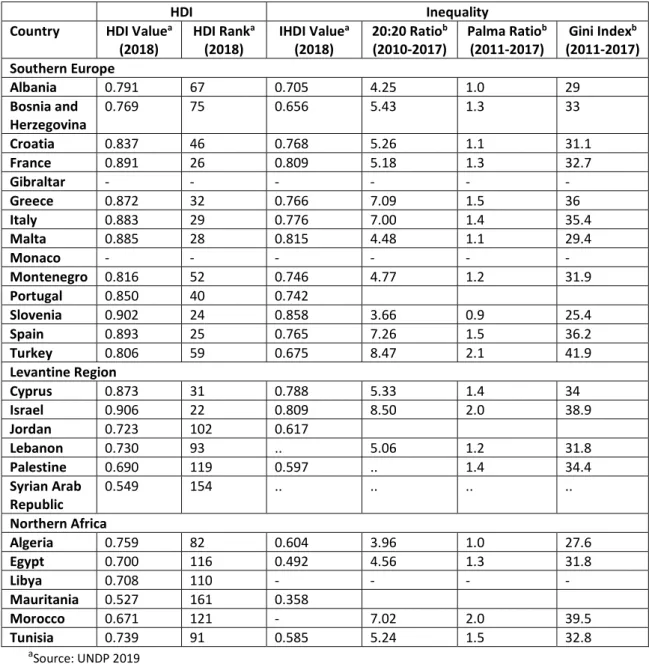
These tendencies are confirmed by the data from the UNDP HDI (2019) when adjusted for inequality (Box 5.1.1; Table 5.1), showing that when considering the distribution of income, the HDI ranking for some countries drops and for others improves, which is likely to be associated with policies that try to address the problem of inequality.
The World Bank (2018) has used poverty lines to determine the headcount ratio and poverty gap. Four bases have been considered for poverty lines in order to determine the headcount ratio and poverty gap: 1.90 USD income per day, 3.20 USD income per day, 5.50 USD income per day, in addition to national poverty lines. Since there are many missing poverty data for some national poverty lines, the data are interpreted and countries are compared using standard poverty lines. Firstly, considering 1.90
USD a day as the poverty line, on average about 0.6% of the Mediterranean people are poor. The highest percent of the poor are in Italy, while the highest poverty gap is in Syria. Regarding this poverty line, there are no poor people in countries like France, Malta, Montenegro, Slovenia, Cyprus, and Leb-anon. By increasing the poverty line to 3.20 USD, the highest percentage of the poor is in Egypt (16.1%), Syria (15.3%), and Albania (7.7%). In contrast, Slovenia and Cyprus have no such poor people and the percentage of people under this poverty line is low in France and Malta (0.2%). The largest poverty gaps are seen in Syria, Italy, and Albania. When 5.50 USD is used as the poverty line, both poverty percentages and poverty gap increase considerably in the region. Accordingly, the highest percentage of the poor lives in Egypt, Albania, and Morocco. Figures show that more than 60% of Egyptians have income of less than 5.50 USD per day. Also, most poverty gaps belong to the same countries. However, the percentage of people under the poverty line is low in France, Malta, and Slovenia.
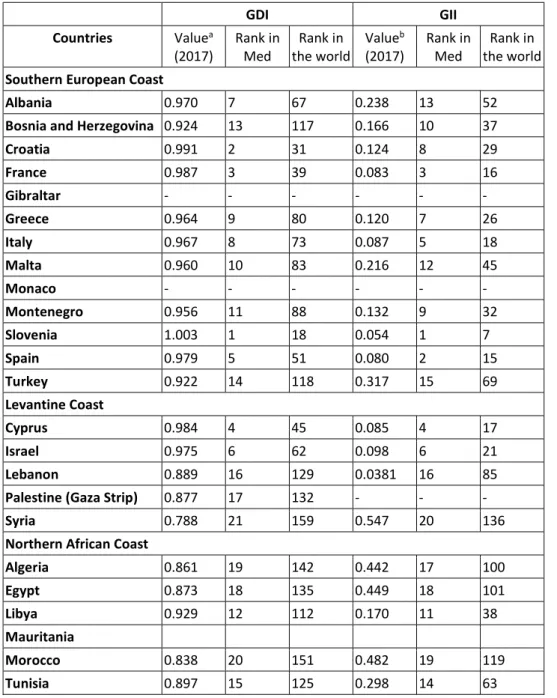
Gender inequality indicators for Mediterranean countries, listed in UNDP human development reports, show a varied and complex situation. In the sample countries of the Mediterranean (Box 5.1.2; Table 5.2), Slovenia has the highest Gender Development Index (GDI), at 1.003 in 2017, which ranks it 18th
out of 164 international countries in the 2017 index. This means that men and women have relatively the same achievement in three basic dimensions of human development. Croatia, France, and Cyprus are in the next positions in the region and have ranked 31st, 39th and 45th in the world. The last rank in
the region belongs to Syria (ranked 159th in the world). The GDI value for Syria demonstrates that there
is inequality in human development in favor of men. In fact, the human development index for Syrian men is almost 21% higher than for Syrian women.
For the Gender Inequality Index (GII), the highest value in the region is Slovenia (0.054), ranking it 7th
out of 160 countries in the 2017 index. After Slovenia, Spain and France have the least gender inequal-ity in the region and are ranked 15th and 16th in the world. According to the indicator, Syria has again
the lowest place in the region and shows the highest gender inequality.
The existence of poverty, inequalities and gender imbalances relate both directly and indirectly to the achievement of sustainable development goals in Mediterranean countries. Significant theoretical and applied research has shown that the presence of these imbalances, both relative and absolute, are obstacles to the expansion of economic development, de facto blocking parts of society from poten-tially enjoying the benefits of higher standards of living (Sen 1999; Sachs 2005). Moreover, the tradi-tional way of measuring economic progress by only taking GDP into account, does not capture the problem in the first place, and the extent to which these imbalances permeate societies. The absence of this specific indicator, especially when measuring economic progress, does not bring about reaction or prevention from policy systems, therefore, overlooking the problems related to these distortions of the market economy.
5.1.1.4 The social dimension of sustainable development
Education is a fundamental prerequisite for addressing all issues related to Sustainable Development (SD). It creates the necessary enabling environment to enhance skills as well as individual and collective social commitment for the desired transformations, by also allowing for the creation of more sustain-able societies (Voegtlin and Scherer 2017). Education can also support the development of better strat-egies for mitigating and adapting to climate change, thus promoting sustainable development (Ander-son 2012).
Education for sustainable development (ESD) is an approach to teaching and learning based on the ideals and principles that underlie sustainability and applicable to all types, levels and settings of edu-cation. As such, ESD promotes multi-stakeholder social learning, emphasizes the empowerment of communities and citizens, engages with key issues such as human rights, poverty reduction, sustaina-ble livelihoods, environmental education and gender equality in an integral way and encourages changes in behavior that will create a more sustainable future (Voegtlin and Scherer 2017).
A further important factor in the social dimension of sustainable development is participation. More active participation of the community, especially children and youth, as agents of change, can increase public authorities’ understanding of problems, and facilitate the implementation of solutions among communities (Anderson 2012).
The removal of social imbalances, such as gender gaps in education and in salaries, can increase productivity and facilitate economic growth. The main results highlight that the educational gender gap hinders economic growth and development as a whole (Tansel and Güngör 2016; Minasyan et al. 2019). The majority of the results confirm a positive effect of female education on economic growth and development (Forbes 2000; Tansel and Güngör 2016).
5.1.2 Economic vulnerabilities and risks
Expected extreme climate conditions and pollution can enhance economic vulnerabilities and risks in the Mediterranean Basin (Chapter 2). In recent decades, a growing number of publications have iden-tified and assessed how natural hazards occurring in the Mediterranean Region interact with its society and economy. This evidence is being produced on a sectoral level, with assessments of biodiversity, agriculture and cultural heritage systems (Palatnik and Lourenço Dias Nunes 2015; Fatorić and Seekamp 2017), according to the type of hazard (Llasat et al. 2013; Iglesias and Garrote 2014; Oliveira et al. 2018), or with a specific geographical scope (Schilling et al. 2012; Radhouane 2013; Monioudi et al. 2017). An underlying common denominator in the available literature seems to point towards the Mediterranean region experiencing a higher intensity of, and associated risks related to specific natural hazards than other European regions.
This seems to be the case of disastrous flash-floods, which are much more recurrent in some areas of the Mediterranean Basin, when compared to the rest of Europe (Section 3.1.3.3) (Llasat et al. 2010). These trends are confirmed by research that looked at flood event mortality in the eastern Mediterra-nean, which, when accounting for ‘high’ number of causalities is higher, and for ‘no-deaths’ is lower, than central Europe (Doocy et al. 2013). In selected areas of the Mediterranean Basin, the economic sectors more prone to be directly affected by floods are agriculture, followed by commerce and artisan trades, tourism, and industry (Llasat et al. 2013).
Current observations show an increase in drought events, and reduced soil moisture and groundwater availability (Sections 3.1.3.1 and 3.1.3.4). These impacts interact negatively, especially with the agri-cultural sector in the Mediterranean, threatening food security in rainfed yields (Tigkas and Tsakiris 2015) (Section 3.1.2.2), economic performance in terms of reduced wheat exports (Dellai and McCarl 2010) and livestock production (Blauhut et al. 2015). Combined with increasing population in Mediter-ranean countries, these impacts could intensify the problem of food security.
Changes to precipitation patterns and increased temperature (Section 2.2.5.3), can also affect the quantity and quality of grazing areas, directly impacting farmers’ income, with a higher negative impact in non-EU Mediterranean countries, especially at the small-scale level (Abdul Malak et al. 2017). The increase in sea temperatures and ocean acidification will likely have a negative impact on the fish-ery industry (Section 3.2.2.2), with these phenomena already linked to mass mortality events in the Mediterranean (Coma et al. 2009), affecting aquaculture by reducing available space to operate busi-nesses (Bird et al. 2016), and potentially increasing mortality rates of the species cultivated, especially due to the increase in heat waves in summer (Rodrigues et al. 2015).
The economic vulnerabilities associated with sea-level rise and coastal erosion have received consid-erable attention in the Mediterranean region, also given the economic implications of tourism, which for some economies represents more than 30% of the aggregate GDP (Koutroulis et al. 2018a). Sum-mer tourism in Mediterranean countries, which is based on beach holidays, can be threatened by hot-ter and drier summers, in turn affecting the comfort levels of tourists (Koutroulis et al. 2018b). How-ever, the degree to which Mediterranean countries’ tourism sectors might be affected by climate change is often a function of income levels, with the highest levels of vulnerability coming from the
lowest income and least resilient countries (Dogru et al. 2019). The effect of sea level rise, together with changes in storm features can seriously affect port operations, slowing down trade operations and productivity levels (Sánchez-Arcilla et al. 2016).
Climate change is expected to cast a shadow of uncertainty over tourism in the Mediterranean. Un-certainties in the assessment of tourism demand under future emission and socio-economic trajecto-ries are subject to factors that affect the visitors’ sensitivity to thermal comfort (age, type of tourism, country of origin) (Dubois and Ceron 2006; Dubois et al. 2016). Additional uncertainties stem from the adaptation and mitigation response to climate change (Koutroulis et al. 2018a), as well as the lack of integrated assessment that considers cross sectoral interactions to climate change (Scott et al. 2016b). Mediterranean summertime thermal comfort is expected to generally negatively affect tourism flows in the core summer tourism months of June to August (Amelung et al. 2007; Grillakis et al. 2016a). Improvement in the climate resource is expected for the same regions in the spring and autumn season (Amengual et al. 2014; Grillakis et al. 2016b).
Limited research has quantified the effect of global warming on the net economic impacts on tourism in the Mediterranean. A tourism climate index has been correlated to the total overnight stays in Eu-ropean summer tourism, quantifying the effect of climate change on future overnights stays under 1.5°C and 2°C of global warming above preindustrial levels (Jacob et al. 2018). It was found that 1.5°C of global warming will have an impact on European Mediterranean summer tourism comfort in the July to August period. For the May to October period, marginal positive changes are projected over the majority of the European region, while for the June to August period, a negative effect over south-ern Spain and Cyprus and for most coastal regions of the Mediterranean is projected. These comfort changes may have a direct impact on the number of overnight stays, with Cyprus and Greece to face a potential decrease of 8% and 2%, respectively. In Spain and Italy, the decrease in comfort over the southern regions of the countries could be compensated by an increase in the north, with a possible northward shift of tourism activity. At 2°C of global warming, this pattern of change is expected to augment further. From an economic perspective, northern Mediterranean regions could exhibit cli-mate induced tourism revenue decreases up to −0.45% of their GDP per year by 2100 (Barrios and Ibañez 2015). A regional temperature increase of 2.2°C in selected regions of Sardinia and Tunisia (Cap Bon) is expected to improve in the shoulder (spring - autumn) season, while increased heat stress may cause a decline in tourism demand in summer (Köberl et al. 2016). The annual net effect is expected to be marginally positive in terms of overnight stays, however the net profit might be less than the present due to the potential increase in the cost of water.
5.1.3 Adaptation
Climate change adaptation can be defined as the process of adjustment to actual or expected climate change and its effects (Smit and Wandel 2006). Climate change adaptation has been identified by the international community as an essential policy response, and its integration into development plan-ning is a key measure for the effective achievement of sustainable development goals. However, the limited resource base of some countries tends to hinder climate change adaptation measures, which are also unlikely to occur automatically in response to observed or expected changes. This kind of response is highly dependent on the specific characteristics of a system, or community, affected by the impacts. The overall long-term adaptive capacity of a population is, in fact, shaped by existing de-velopmental deficits, by exposure to sensitive risks, and by the strategies employed by individuals and communities to cope with these deficits and risks. Existing developmental deficits in some Mediterra-nean countries, such as endemic poverty, limited infrastructure and technology, ecosystem degrada-tion, conflicts and poor health, among others, challenge the capacity to cope with emerging climate change, in turn affecting the way socio-economic adaptation strategies are applied.
Promoting climate change adaptation is believed to be a win-win strategy. The concept of adaptation has become increasingly associated with what can be considered good development. Such actions to improve climate change adaptation span over a spectrum of initiatives involving investments in, for
example, human capital, such as increasing levels of education, skills, and the health status of poor households, or physical capital, such as climate proofing infrastructure projects and investing in self-sustaining renewable energy projects. A lack of human capital, or having poor infrastructure status, can also have a direct impact on labor productivity, and the related capacity to provide secure liveli-hoods, both in more industrialized Mediterranean countries by slowing down economic development, and in less developed Mediterranean countries by also increasing inequalities. Predicted climate change impacts will only exacerbate such circumstances, especially if nothing is done to account for these impacts (Mavromatidi et al. 2018).
Although applied research is increasing (Cramer et al. 2018), how specific regions or communities in Mediterranean countries may be affected by climate change is still partially unknown. A lack of data and research capacity remains a major problem in some Mediterranean countries. Generally, the most impoverished and vulnerable communities are frequently neglected in impacts and adaptation re-search (Satterthwaite 2013; Moncada et al. 2018). Additionally, any available data is frequently inter-polated over large spatial or temporal scales. While such data can provide some initial insight into potential risks, the data may not be meaningful at the scale at which people live. Failure to identify specific local impacts may lead to adaptation activities that are poorly targeted, inadequate, or even maladaptive (Albizua et al. 2019). Maladaptation refers to actions that might lead to increased risks of adverse climate-related outcomes, increased vulnerability to climate change, or diminished welfare, now or in the future (adapted from Agard et al. 2014).
The promotion of climate change adaptation can be achieved by either acting on those constraints that impede the attainment of human needs (Sen 1999), or by directly improving the management of specific climate stressors (Pelling 2011). In this regard, a study by McGray et al. (2007) screened more than 100 projects considered to be climate change adaptation initiatives that mostly occurred in low- and middle-income countries. They subsequently found that the beneficial outcomes of the projects had little difference to what can be considered as good development (Klein 2010). McGray et al. (2007) identify a continuum of actions that can be undertaken in order to address climate change impacts. These range from pure development actions, with usually no intentions to tackle climate change ad-aptation, to purposely designed adaptation efforts. When the first set of actions, aimed at addressing vulnerabilities, can have a positive effect on adaptation, this is known as no-regret, win-win options (Kelly and Adger 2000). On the other hand, the actions targeted to tackle specific climate change im-pacts might not have any effect on development, unless they are effective at tackling climate change adaptation. In between “lies a broad spectrum of activities with gradations of emphasis on vulnerabil-ity and impacts” (Bapna and McGray 2008).
An additional aspect in which climate change adaptation affects development relates to the financial implications for countries to invest in climate change adaptation. External financial and technical as-sistance is needed in order to cope with the impacts of climate change. Interestingly, the tendency of the majority of the international community has been to finance adaptation mostly through tackling climate change impacts, and largely ignoring the benefit of addressing baseline vulnerabilities/deficits, and effectively enhancing long-term adaptive capacities. Increasing the adaptive capacity of a given system, thus raising the overall level of development, reduces the undesirable impacts of climate change, by allowing a system to better cope with changing conditions, risks or opportunities related to climate change (Smit and Wandel 2006). It has therefore been argued that supporting short-term adaptive capacity, especially in poor communities, is an urgent priority (McGray et al. 2007), as well as being increasingly recognized as an essential element of development (Ayers and Dodman 2010). This is especially true for investments that address context-specific vulnerabilities, as highlighted in the previous section. Adaptation, therefore, must permeate all policy areas and not only the environ-ment. Investment decisions that do not consider mitigation and adaptation can block regional and national development for many years. Thus, the success of adaptation strategies will also involve adapting actions to specific regional climatic conditions, in sectoral, political and socio-economic con-texts by ensuring dialogue between stakeholders, through cooperative structures and knowledge
transfer and monitoring progress to support regular reviews of policy objectives and the inclusion of new scientific information when it becomes available (di Gregorio et al. 2017).
Although the links between climate change impacts, climate action and sustainable development are broadly accepted, there has been limited structured investigation in terms of specific SDG Targets, synergies and trade-offs. The Intergovernmental Panel on Climate Change (IPCC) special report on Global Warming of 1.5°C features a chapter that investigates links between certain climate mitigation and adaptation actions and the 17 SDGs (Roy et al. 2018), but it does not assess the specific synergies and trade-offs between climate impacts, climate action and all 169 individual targets of the 2030 Agenda (di Gregorio et al. 2017).
5.1.3.1 National legal and policy framework for adaptation
In accordance with the existing EU framework, EU member States adopted a series of legal measures and a strategic plan of actions to promote adaptation. These measures are related to multiple sectors potentially impacting the environment and aim to reduce and/or mitigate actions affecting climate change. Between them, Spain, Portugal, and Italy, have adopted a few relevant measures. For exam-ple, Spain adopted the Royal Decree-Law n. 15/2018, aiming to accelerate the integration of renewable energies into the economy and to promote energy efficiency. Relevant measures adopted by Portugal include the Law-Decree n. 4/2018 introducing incentives for urban electric mobility (similarly to the Spanish Royal Decree of 16th June 2017, n. 617/2017), Decree-Law n. 64/2017 creating a legal
frame-work for the implementation of biomass plants by municipalities, the Portuguese Strategic Frameframe-work for Climate Policy was adopted through the Resolution of the Council of Ministers n. 56/2015, including the National Program for Climate Change 2020/2030 (in line with the EU law and strategy) and the National Strategy for Adaptation to Climate Change. The Italian case is more complex, because of the legislative powers divided between the central State and Regions (Art. 117 of the Italian Constitution). Even if the Italian Climate Adaptation Strategy was adopted in 2015 by Decree of the Ministry of Envi-ronment, local governments are responsible for its implementation.
Outside the EU, Israel adopted its National Plan for Implementation of the Greenhouse Gas Emissions Reduction Targets and for Energy Efficiency on 10th April 2016, by Government Decision n. 1403/2016. In relation to water resources and the public hydraulic domain, Morocco adopted Law n. 36-15 in 2016, including a total of 163 articles and 12 chapters. Other countries, like Lebanon, adopted two separate national strategies: one related to energy efficiency (with a mid-term scope) and a second broad doc-ument related to renewable energy (both in 2016).
The variants of sustainable urban growth (smart cities, green cities, resilient cities, low carbon cities, sustainable cities) have brought renewed opportunities to create pathways for sustainable urban de-velopment (Rodriguez et al. 2018). However, the proliferation of all these different concepts, often meaning the same thing, has also created competing agendas and confusion for local decision makers, planners, stakeholders, and business communities. Therefore, progress can be made by focusing on key opportunities that create precedents for transformative and sustainable urban development. According to the IPCC Fifth Assessment Report (AR5) the majority of cities’ adaptation plans and strat-egies are based on the construction of defensive infrastructure. Although defensive infrastructure is a relevant element of CCA pathways and building resilient cities, making it the center of adaptation plans limits opportunities (Mimura et al. 2014). According to Rodriguez et al. (2018), SDGs can help create recognition for the wider social, cultural, economic, political, institutional and normative elements of adaptation that can lead to the construction of multidimensional operational approaches on the ground.
5.1.3.2 Economic and financial tools to promote environmental management and climate change adaptation in the Mediterranean region
The use of economic instruments to achieve environmental goals and natural resource management (including the management of water quantity--typically extraction charges or taxes), fisheries (taxes, fees and transferable quotas), forestry (charges and subsidies) and wetlands (financial assistance to owners) has increased significantly since the 1970s. The most common market tools in the Mediterra-nean European countries are charges/taxes (France, Greece, Italy, Spain and Turkey), tradeable per-mits (France), deposit-refund systems (Italy and Turkey), non-compliance fees (Greece and Turkey) and subsidies (France, Greece and Turkey) (Bartels et al. 2016; Carreño 2019).
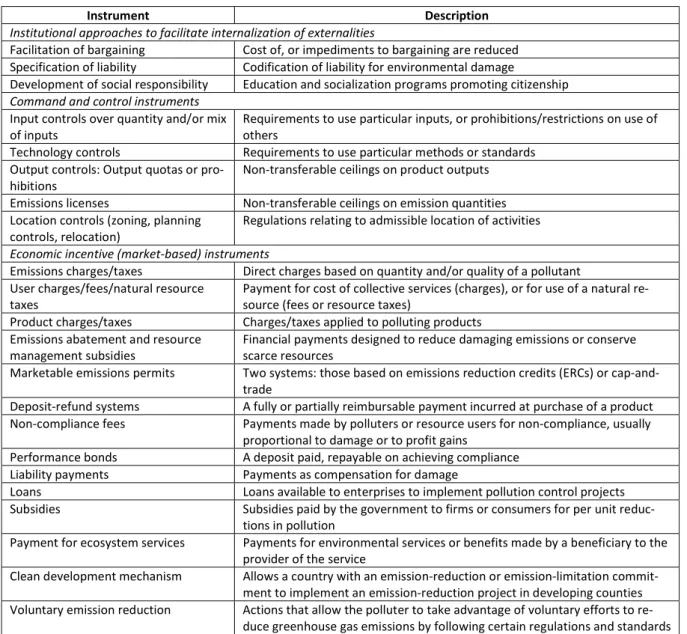
Pollution and climate change control instruments can be classified into three categories: 1) institu-tional approaches to facilitate internalization of externalities; 2) command and control instruments; and 3) economic incentive (market-based) instruments (Table 5.3). Each specific category includes dif-ferent approaches to achieve the goal of environmental management and climate change adaptation. The institutional approach, where institutions use pollution control instruments to prevent damages to third parties (externalities) or to charge the polluters for the damage that has been produced (in-ternalization of externalities), comprises three specific approaches, as follows:
Bargaining between generators and victims of pollution could reduce pollution below the critical threshold, but it requires some Institutional intervention, because bargaining often fails to alle-viate the targeted pollution. In fact, it is difficult to identify all affected parties, to place im-portance on future generations with current generations, etc. (Perman et al. 2003).
The liability principle, which says that the polluter pays to prevent and remedy environmental damage, and includes the use of direct control tools over polluters, such as mandatory obliga-tions or restricobliga-tions on the behavior of firms and individuals. It is the most dominant method for protecting the environment. It is related to property rights and is currently implemented in France (Boivin and Emorine 2019), Italy (Chilosi et al. 2019), Spain (Almenar et al. 2019), Turkey (Perman et al. 2003; Mavioglu et al. 2019), and Slovenia (Justice and Environment 2012). Development of social responsibility, which creates incentives for polluters to voluntarily change
their behavior. In many – but not all – circumstances, economic incentive-based instruments are more cost-effective than command and control instruments (Perman et al. 2003). This approach includes raising public awareness (UNECE 2013 in Cyprus; UNEP 2015) and environmental edu-cation, which is an effective part of the European Union’s environment policy (Stokes et al. 2001), and is also implemented in Slovenia (Kraus 1998), Algeria (Environmental Rights Data-base) and Tunisia (MESD 2018).
The command and control instruments have five key tools, as highlighted in Table 5.3 above. Regula-tions regarding direct control may apply to:
outputs of emissions themselves and to the quantity of final production, e.g., fishing quotas in France, when consumption rates exceed 70%, and Spain (OECD 2003),
the production techniques used, such as regulating industrial emissions within European Union countries, including Spain, under the Industrial Emissions Directive (IED) and Plan AIRE which regulates small installations’ emissions in Spain (UNEP 2015),
the level and/or mix of productive inputs, e.g., input laws in agriculture in Croatia (Grgi et al.); bans on the use of phthalates in toys in France, Greece, and Italy; over 60 PVC-free cities and restrictions on PVC-packing in Spain (Center for Health Environment and Justice (undated)); re-strictions on the use of asbestos in 15 Mediterranean countries (Kazan-Allen 2019); restricted financial support by French banks for coal mining and coal powered generation projects (Little-cott 2015); plans to shut all of France’s coal-fired power plants by 2021 (White 2018; Climate Transparency 2019), as well as reducing fossil fuel use by 30% by 2030 (Littlecott 2015); and the coal phase-out plan compatible with the limit of global warming below 1.5°C in France and Italy and completing full decarbonization by 2050 (Climate Transparency 2019)
emission licenses (e.g., in Turkey) (Mavioglu et al. 2019);
and even to the location of emission sources, e.g., natural regional parks (Salanié and Coisnon 2016) and Zones de Conservation Halieutique (ZCH) in France (OECD 2018); acoustic zoning in Italy (Praščević et al. 2012); and environmental zoning in Bosnia and Herzegovina (Zahumenská et al. 2015).
Table 5.3 | Classification of finance tools to protect the environment and promote sustainable development (Perman et al. 2003)
Instrument Description
Institutional approaches to facilitate internalization of externalities
Facilitation of bargaining Cost of, or impediments to bargaining are reduced
Specification of liability Codification of liability for environmental damage
Development of social responsibility Education and socialization programs promoting citizenship Command and control instruments
Input controls over quantity and/or mix
of inputs Requirements to use particular inputs, or prohibitions/restrictions on use of others
Technology controls Requirements to use particular methods or standards
Output controls: Output quotas or
pro-hibitions Non-transferable ceilings on product outputs
Emissions licenses Non-transferable ceilings on emission quantities
Location controls (zoning, planning
controls, relocation) Regulations relating to admissible location of activities
Economic incentive (market-based) instruments
Emissions charges/taxes Direct charges based on quantity and/or quality of a pollutant
User charges/fees/natural resource
taxes Payment for cost of collective services (charges), or for use of a natural re-source (fees or resource taxes)
Product charges/taxes Charges/taxes applied to polluting products
Emissions abatement and resource
management subsidies Financial payments designed to reduce damaging emissions or conserve scarce resources
Marketable emissions permits Two systems: those based on emissions reduction credits (ERCs) or
cap-and-trade
Deposit-refund systems A fully or partially reimbursable payment incurred at purchase of a product
Non-compliance fees Payments made by polluters or resource users for non-compliance, usually
proportional to damage or to profit gains
Performance bonds A deposit paid, repayable on achieving compliance
Liability payments Payments as compensation for damage
Loans Loans available to enterprises to implement pollution control projects
Subsidies Subsidies paid by the government to firms or consumers for per unit
reduc-tions in pollution
Payment for ecosystem services Payments for environmental services or benefits made by a beneficiary to the
provider of the service
Clean development mechanism Allows a country with an emission-reduction or emission-limitation
commit-ment to implecommit-ment an emission-reduction project in developing counties
Voluntary emission reduction Actions that allow the polluter to take advantage of voluntary efforts to
re-duce greenhouse gas emissions by following certain regulations and standards
Economic incentive (market-based) instruments, include many tools, which interface with prices and markets, which can be summarized as follows:
Emission charges/taxes such as carbon taxes (in France and Slovenia) (CTC (Carbon Tax Center) 2018), as well as SO2 charges and noise pollution charges (Perman et al. 2003).
User charges/fees/natural resource taxes such as congestion pricing in France, which does not require a complex system of monitoring, enforcement and compliance, incentivize responsible use of resources and promotes investments (Milewska 2019).
Product charges/taxes such as costs for plastic bags in Italy (Perman et al. 2003), taxes on energy products in Italy, which earns more than 0.5% of its GDP from taxation of energy products (OECD 2013), taxes on lubricants in France and Italy, and taxes on cadmium batteries in Italy (Barde 1994).
Marketable emissions permits have been used in some Mediterranean countries like Italy (Rec-chini 2016). They are allocated by selling them (e.g., by auction) or by giving them away (Devlin and Grafton 1996). Permits are not financially sustainable instruments and had weak perfor-mance in the EU (Pettinger 2017).
Deposit-refund systems are recommended as components of an overall socially optimal set of policies. They can efficiently control pollution in almost the same way as Pigouvian tax (Walls 2011).
Non-compliance fees are implemented in Greece (Perman et al. 2003), Bosnia and Herzegovina (UNECE 2018), France (Bianco et al. 2015), and Slovenia (OECD 2012b).
Liability payments are used in different forms in countries like France, Italy (OECD 2013), Spain (Justice and Environment 2017), Bosnia and Herzegovina (UNECE 2018), Slovenia (OECD 2012b, 2012a) and Turkey (OECD 2019). Pursuing liability claims is very costly and the outcome is highly uncertain (Anderson 2002).
Green loans are used in France (Zakhartchouk 2019), Italy (Lewenhak 2012), Croatia (UNECE 2014), and Lebanon (SwitchMed 2017). Also, Slovenia has plans to reduce water pollutants through loans (GEF 2019).
Payments for ecosystem services (PES) schemes are implemented in the European Mediterra-nean countries. While PES are a rapidly proliferating mechanism for natural resource manage-ment, their use is sometimes based on an incomplete understanding of their social and eco-nomic impacts (DIE 2014). Early PES experiences reveal some positive equity impacts like im-proved tenure security, community empowerment, organizational and social capital develop-ment (Richards and Jenkins 2007). Clean developdevelop-ment mechanisms (CDM), e.g., the Concen-trated Solar Power plant project in Morocco (ADB and African Development Bank 2011); and CDM or Joint Implementation projects in Annex 1 countries including Croatia, France, Greece, Italy, Spain, and Turkey (UNFCCC 2012).
Voluntary emission reduction is a tool employed by France, Italy, Spain, and Greece, and some for-profit organizations in France, Italy, Spain, and Greece, which reported voluntary carbon off-sets (Hamrick and Brotto 2017). Voluntary emission reductions of CO2, CH4, and N2O have also
been reported in Croatia (Delija-Ružić 2017).
Box 5.1.1 Development indicators and terms
Poverty
There is growing consensus among development experts that poverty is multidimensional. In this con-text, the Multidimensional Poverty Index (MPI) was developed in 2010 by the Oxford Poverty & Human Development Initiative (OPHI) and the United Nations Development Programme (UNDP). The Multidi-mensional Poverty Index (MPI) provides a sound gauge of poverty. The index measures poverty in three dimensions, i.e. education, health and standard of living. This index is computed for Less Devel-oped Countries (LDCs) and developing countries (UNDP 2018e). According to the MPI, there were 66 million poor in Arab countries in 2018 or around 15% of the total Arab population. Intricately related to poverty is income inequality, which is measured by Inequality-adjusted Human Development Index (IHDI).
The poverty headcount ratio is an index which measures the percentage of poor people whose income is less than the absolute or relative poverty line (World Bank 2018). The poverty gap is a ratio showing the average shortfall of the total population from the poverty line. In other words, it reflects the in-tensity of poverty in a nation (World Bank 2019). The poverty line is the minimum level of income required to secure the basic necessities for survival.
Inequality
The loss to human development due to inequality over the past few years (2010 to 2017) is consistently more significant in southern Mediterranean countries than northern Mediterranean countries (UNDP 2018d). There are many indicators for measuring income inequalities. Considering a combination of indices would help to better understand the income distribution, because each index is not complete and each of them has strengths as well as weaknesses: 20:20 ratio, Palma ratio, the Gini index, Human Development Index (HDI) and Inequality-adjusted Human Development Index (IHDI).
An inequality measure is often a function that ascribes a value to a specific distribution of income in a way that allows direct and objective comparisons across different distributions. The “20:20 ratio” com-pares the ratio of the average income of the richest 20 percent of the population to the average income of the poorest 20 percent of the population. In UN reports, it is called “income quintile ratio” (UNDP 2019). The Palma ratio is defined as the ratio of the richest 10% of the population's share of gross national income divided by the poorest 40%'s share (Cobham and Sumner 2013). The Gini index measures the extent to which the distribution of income (or, in some cases, consumption expenditure) among individuals or households within an economy deviates from a perfectly equal distribution. The Gini index measures the area between the Lorenz curve, indicating the inequality in income spread, and the hypothetical line of absolute equality, expressed as a percentage of the maximum area under the line. A Gini index of zero represents perfect equality and 100 perfect inequality (OECD 2006; UNDP 2018d).
The Human Development Index (HDI) is a summary measure of average achievement in key dimen-sions of human development: a long and healthy life, being knowledgeable and have a decent standard of living. The HDI is the geometric mean of normalized indices for each of the three dimensions. The health dimension is assessed by life expectancy at birth, the education dimension is measured by mean of years of schooling for adults aged 25 years and more and expected years of schooling for children of school entering age. The standard of living dimension is measured by gross national income per capita. The HDI uses the logarithm of income, to reflect the diminishing importance of income with increasing Gross National Income (GNI). The scores for the three HDI dimension indices are then ag-gregated into a composite index using geometric mean (UNDP 2018c).
The Inequality-adjusted Human Development Index (IHDI) is a viable measure of inequality produced by the UNDP (2018c). The IHDI combines a country’s average achievements in health, education and income with how those achievements are distributed among a country’s population by “discounting” each dimension’s average value according to its level of inequality. Thus, the IHDI is a distribution-sensitive average level of HD. Two countries with different distributions of achievements can have the same average HDI value.
Under perfect equality, the IHDI is equal to the HDI, but falls below the traditional Human Develop-ment Index (HDI) when inequality rises (UNDP 2018c). The difference between the IHDI and HDI is the human development cost of inequality, also termed – the loss to human development due to inequal-ity. The IHDI allows a direct link to inequalities in dimensions, it can inform policy makers on how to reduce inequality, and leads to a better understanding of inequalities across populations and their contribution to the overall human development cost.
Table 5.1 | Inequality indicators for Mediterranean countries
HDI Inequality
Country HDI Valuea
(2018) HDI Rank a (2018) IHDI Value a (2018) 20:20 Ratio b (2010-2017) Palma Ratio b (2011-2017) Gini Index b (2011-2017) Southern Europe Albania 0.791 67 0.705 4.25 1.0 29 Bosnia and Herzegovina 0.769 75 0.656 5.43 1.3 33 Croatia 0.837 46 0.768 5.26 1.1 31.1 France 0.891 26 0.809 5.18 1.3 32.7 Gibraltar - - - - Greece 0.872 32 0.766 7.09 1.5 36 Italy 0.883 29 0.776 7.00 1.4 35.4 Malta 0.885 28 0.815 4.48 1.1 29.4 Monaco - - - - Montenegro 0.816 52 0.746 4.77 1.2 31.9 Portugal 0.850 40 0.742 Slovenia 0.902 24 0.858 3.66 0.9 25.4 Spain 0.893 25 0.765 7.26 1.5 36.2 Turkey 0.806 59 0.675 8.47 2.1 41.9 Levantine Region Cyprus 0.873 31 0.788 5.33 1.4 34 Israel 0.906 22 0.809 8.50 2.0 38.9 Jordan 0.723 102 0.617 Lebanon 0.730 93 .. 5.06 1.2 31.8 Palestine 0.690 119 0.597 .. 1.4 34.4 Syrian Arab Republic 0.549 154 .. .. .. .. Northern Africa Algeria 0.759 82 0.604 3.96 1.0 27.6 Egypt 0.700 116 0.492 4.56 1.3 31.8 Libya 0.708 110 - - - - Mauritania 0.527 161 0.358 Morocco 0.671 121 - 7.02 2.0 39.5 Tunisia 0.739 91 0.585 5.24 1.5 32.8 aSource: UNDP 2019 bSource: World Bank 2019
End Box 5.1.1
Box 5.1.2 Gender-related development indicators and term
Gender
The Gender Development Index (GDI) measures gender gaps in human development achievements by accounting for disparities between women and men in three basic dimensions of human develop-ment—health, knowledge and living standards - using the same component indicators as in the HDI. The GDI is the ratio of the HDIs calculated separately for females and males using the same methodol-ogy as in the HDI. It is a direct measure of gender gap showing the female HDI as a percentage of the male HDI (UNDP 2018a).
The Gender Inequality Index (GII) measures the importance of gender in inequality. Gender inequality remains a major barrier to human development. Girls and women have made major strides since 1990, but they have not yet gained gender equity. The disadvantages facing women and girls are a major source of inequality. All too often, women and girls are discriminated against in health, education,
political representation or the labor market—with negative consequences for the development of their capabilities and their freedom of choice. The GII measures gender inequalities in three important aspects of human development: i) reproductive health, measured by maternal mortality ratio and ad-olescent birth rates; ii) empowerment, measured by proportion of parliamentary seats occupied by females and proportion of adult females and males aged 25 years and older with at least some sec-ondary education; and iii) economic status, expressed as labor market participation and measured by the labor force participation rate of female and male populations aged 15 years and older. It measures the human development costs of gender inequality. Thus, the higher the GII value the more disparities between females and males and the more loss to human development (UNDP 2018b).
Table 5.2 | Gender indicators for Mediterranean countries (UNDP 2019)
GDI GII
Countries Valuea
(2017) Rank in Med the world Rank in Value
b
(2017) Rank in Med the world Rank in Southern European Coast
Albania 0.970 7 67 0.238 13 52
Bosnia and Herzegovina 0.924 13 117 0.166 10 37
Croatia 0.991 2 31 0.124 8 29 France 0.987 3 39 0.083 3 16 Gibraltar - - - - Greece 0.964 9 80 0.120 7 26 Italy 0.967 8 73 0.087 5 18 Malta 0.960 10 83 0.216 12 45 Monaco - - - - Montenegro 0.956 11 88 0.132 9 32 Slovenia 1.003 1 18 0.054 1 7 Spain 0.979 5 51 0.080 2 15 Turkey 0.922 14 118 0.317 15 69 Levantine Coast Cyprus 0.984 4 45 0.085 4 17 Israel 0.975 6 62 0.098 6 21 Lebanon 0.889 16 129 0.0381 16 85
Palestine (Gaza Strip) 0.877 17 132 - - -
Syria 0.788 21 159 0.547 20 136
Northern African Coast
Algeria 0.861 19 142 0.442 17 100 Egypt 0.873 18 135 0.449 18 101 Libya 0.929 12 112 0.170 11 38 Mauritania Morocco 0.838 20 151 0.482 19 119 Tunisia 0.897 15 125 0.298 14 63 aSource: UNDP 2019 bSource: World Bank 2019
Box 5.1.3 Vulnerability
The term vulnerability relates to the negative consequences of natural hazards, and is used in econom-ics, hazard and disaster management in different ways (Karagiorgos et al. 2016). Economic vulnerabil-ity, at country level, may be defined as inherent proneness to exogenous shocks over which the coun-try can exert little or no control (Briguglio et al. 2009). A widely used measurement of economic vul-nerability has been proposed by Briguglio (2010), through an index which attempts to quantify the factors that lead to exposure to economic shocks, which include, among other variables, proneness to disasters, or natural hazards. There are few comprehensive studies on natural hazards for the entire Mediterranean Region (Lionello 2012; Lionello et al. 2014), and the fragmentation of available data does not always allow comparative studies that can extend applications to the whole Basin (González Tánago et al. 2016).
End Box 5.1.3
References
Abdul Malak D, McGlade K, Pascual D, Pla E 2017 Adapting to Climate Change. An Assessment of Vulnerability and Risks to Human Security in the Western Mediterranean Basin. First. SpringerBriefs in Environmental Science doi:
10.1007/978-3-319-51680-6_5
ADB, African Development Bank 2011 Examples Of CDM Projects. https://www.afdb.org/fileadmin/uploads/afdb/Docu-ments/Generic-Documents/P2_Examples of CDM projects_AfDB_Dba_210911.pdf [Accessed February 1, 2020] Agard J, Schipper ELF, Birkmann J, Campos M, Dubeux C et al. 2014 Glossary, in Climate Change 2014: Impacts, Adaptation,
and Vulnerability. Part B: Regional Aspects. Contribution of Working Group II to the Fifth Assessment Report of the Intergovernmental Panel on Climate Change, eds. Barros VR, Field CB, Dokken DJ, Mastrandrea MD, Mach KJ et al. (Cambridge, United Kingdom and New York, NY, USA: Cambridge University Press), 1757–1758.
Albizua A, Corbera E, Pascual U 2019 Farmers’ vulnerability to global change in Navarre, Spain: large-scale irrigation as mal-adaptation. Reg. Environ. Chang. 19, 1147–1158. doi: 10.1007/s10113-019-01462-2
Almenar J, Alcaraz C, Canseco O 2019 Environmental law and practice in Spain: overview. Thomson Reuters Practical Law. https://uk.practicallaw.thomsonreuters.com/0-521-6274?__lrTS=20200415181111583&transitionType=De-fault&contextData=%28sc.Default%29
Amelung B, Nicholls S, Viner D 2007 Implications of Global Climate Change for Tourism Flows and Seasonality. J. Travel Res. 45, 285–296. doi: 10.1177/0047287506295937
Amengual A, Homar V, Romero R, Ramis C, Alonso S 2014 Projections for the 21st century of the climate potential for
beach-based tourism in the Mediterranean. Int. J. Climatol. 34, 3481–3498. doi: 10.1002/joc.3922
Anderson A 2012 Climate Change Education for Mitigation and Adaptation. J. Educ. Sustain. Dev. 6, 191–206. doi: 10.1177/0973408212475199
Anderson RC 2002 Incentive-based policies for environmental management in developing countries.
Arent DJ, Tol RS, Faust E, Hella JP, Kumar S et al. 2014 Key economic sectors and services, in Climate Change 2014: Impacts, Adaptation, and Vulnerability. Part A: Global and Sectoral Aspects. Contribution of Working Group II to the Fifth As-sessment Report of the Intergovernmental Panel on Climate Change, eds. Field CB, Barros VR, Dokken DJ, Mach KJ, Mastrandrea MD et al. (Cambridge, United Kingdom and New York, NY, USA: Cambridge University Press), 659–708. Ayers J, Dodman D 2010 Climate change adaptation and development I: the state of the debate. Prog. Dev. Stud. 10, 161–
168. doi: 10.1177/146499340901000205
Bapna M, McGray H 2008 Financing Adaptation: Opportunities for innovation and experimentation. Washington, DC Barde JP 1994 Economic Instruments in Environmental Policy. Organisation for Economic Co-Operation and Development
(OECD) doi: 10.1787/754416133402
Barrios S, Ibañez JN 2015 Time is of the essence: adaptation of tourism demand to climate change in Europe. Clim. Change 132, 645–660. doi: 10.1007/s10584-015-1431-1
Bartels W, Kurznack L, Briau L, Krimphoff J 2016 Mainstreaming the green bond market: Pathways towards common stand-ards. The Netherlands https://assets.kpmg/content/dam/kpmg/lu/pdf/mainstreaming-the-green-bond-market-kpmg-wwf-2016.pdf.
Bianco F, Lucifora A, Vagliasindi GM 2015 Fighting Environmental Crime in France: A Country Report. Catania https://ef-face.eu/sites/default/files/EFFACE_Fighting Environmental Crime in France.pdf
Bird DN, Benabdallah S, Gouda N, Hummel F, Koeberl J et al. 2016 Modelling climate change impacts on and adaptation strategies for agriculture in Sardinia and Tunisia using AquaCrop and value-at-risk. Sci. Total Environ. 543, 1019–1027. doi: 10.1016/j.scitotenv.2015.07.035
Blauhut V, Gudmundsson L, Stahl K 2015 Towards pan-European drought risk maps: quantifying the link between drought indices and reported drought impacts. Environ. Res. Lett. 10, 14008. doi: 10.1088/1748-9326/10/1/014008 Boivin JP, Emorine A 2019 Environmental law and practice in France: overview. Thomson Reuters Practical Law.
Bontoux L, Bengtsson AD 2015 2035: Paths towards a Sustainable EU Economy Sustainable Transitions and the Potential of Eco-Innovation for Jobs and Economic Development in EU Eco-Industries 2035. doi: 10.2760/738600
Bontoux L, Bengtsson AD 2016 Using Scenarios to Assess Policy Mixes for Resource Efficiency and Eco-Innovation in Differ-ent Fiscal Policy Frameworks. Sustainability 8, 309. doi: 10.3390/su8040309
Briguglio LP 2010 Defining and assessing the risk of being harmed by climate change. Int. J. Clim. Chang. Strateg. Manag. 2, 23–34. doi: 10.1108/17568691011020238
Briguglio LP, Cordina G, Farrugia N, Vella S 2009 Economic Vulnerability and Resilience: Concepts and Measurements. Ox-ford Dev. Stud. 37, 229–247. doi: 10.1080/13600810903089893
Briguglio M 2019 Wellbeing: an economics perspective, in Perspectives on wellbeing, eds. Vella S, Falzon R, Azzopardi A (Brill | Sense), 145–157. doi: 10.1163/9789004394179_012
Bruckner M, Lederman D 2015 Effects of income inequality on economic growth.
Carreño B 2019 Spain may issue green bonds to finance environmental plan. Reuters, Environ. https://www.reuters.com/ar-ticle/us-spain-economy/spain-may-issue-green-bonds-to-finance-environmental-plan-minister-says-idUSKCN1R81XT Center for Health Environment and Justice (undated) PVC Policies Across the World.
http://www.chej.org/pvcfact-sheets/PVC_Policies_Around_The_World.html [Accessed May 30, 2020]
Chilosi M, Martelli A, Miranti A 2019 Environmental law and practice in Italy: overview. Thomson Reuters Pract. Law. https://uk.practicallaw.thomsonreuters.com/1-503-2608?transitionType=Default&contextData=(sc.De-fault)ac&firstPage=true&bhcp=1
Climate Transparency 2019 Managing the coal phase-out – a comparison of actions in G20 countries. Berlin, Germany Cobham A, Sumner A 2013 Putting the Gini Back in the Bottle? “The Palma” as a Policy-Relevant Measure of Inequality.
Lon-don: King’s College doi: 10.2139/ssrn.2366974
Coma R, Ribes M, Serrano E, Jiménez E, Salat J et al. 2009 Global warming-enhanced stratification and mass mortality events in the Mediterranean. Proc. Natl. Acad. Sci. U. S. A. 106, 6176–6181. doi: 10.1073/pnas.0805801106 Cramer W, Guiot J, Fader M, Garrabou J, Gattuso J-P et al. 2018 Climate change and interconnected risks to sustainable
de-velopment in the Mediterranean. Nat. Clim. Chang. 8, 972–980. doi: 10.1038/s41558-018-0299-2
CTC (Carbon Tax Center) 2018 Where carbon is taxed? Carbon Tax Cent. https://www.carbontax.org/where-carbon-is-taxed/ [Accessed February 2, 2020]
Delija-Ružić W 2017 Report on Implementation of Policies and Measures that Reduce Greenhouse Gas Emissions by Sources or Enhance Removals by Sinks. Republic of Croatia
Dellai I, McCarl BA 2010 The economic impacts of drought on agriculture: The case of Turkey, in Economics of Drought and Drought Preparedness in a Climate Change Context, eds. López-Francos A, López-Francos A (Zaragoza), 169–174. http://om.iamm.fr/om/pdf/a95/00801342.pdf [Accessed April 7, 2019]
Devlin RA, Grafton RQ 1996 Marketable emission permits: Efficiency, profitability and substitutability. Can. J. Econ. 29, S260–S264. doi: 10.2307/135997
di Gregorio M, Nurrochmat DR, Paavola J, Sari IM, Fatorelli L et al. 2017 Climate policy integration in the land use sector: Mitigation, adaptation and sustainable development linkages. Environ. Sci. Policy 67, 35–43. doi: 10.1016/j.en-vsci.2016.11.004
DIE 2014 Why Power Matters in Payments for Environmental Services (PES). https://www.die-gdi.de/uploads/me-dia/BP_9.2014.pdf
Dogru T, Bulut U, Sirakaya-Turk E 2016 Theory of Vulnerability and Remarkable Resilience of Tourism Demand to Climate Change: Evidence from the Mediterranean Basin. Tour. Anal. 21, 645–660. doi:
10.3727/108354216X14713487283246
Dogru T, Marchio EA, Bulut U, Suess C 2019 Climate change: Vulnerability and resilience of tourism and the entire economy. Tour. Manag. 72, 292–305. doi: 10.1016/J.TOURMAN.2018.12.010
Doocy S, Daniels A, Murray S, Kirsch TD 2013 The Human Impact of Floods: a Historical Review of Events 1980-2009 and Systematic Literature Review. PLoS Curr. 5. doi: 10.1371/CURRENTS.DIS.F4DEB457904936B07C09DAA98EE8171A Dos Santos MJPL 2018 Nowcasting and forecasting aquaponics by Google Trends in European countries. Technol. Forecast.
Soc. Change 134, 178–185. doi: 10.1016/j.techfore.2018.06.002
Dos Santos MJPL, Mota M 2019 Sustainable and Smart Cities: The Case Study of African Cities. in The 4th International Con-ference on Organization and Management. The 6th Corporate Social Responsibility (CSR), Ethics, Governance, and Sustainability. (Abu Dhabi, UAE , UAE on 12th and 13th of June 2019: College of Abu Dhabi University).
Drius M, Bongiorni L, Depellegrin D, Menegon S, Pugnetti A et al. 2019 Tackling challenges for Mediterranean sustainable coastal tourism: An ecosystem service perspective. Sci. Total Environ. 652, 1302–1317. doi:
10.1016/j.sci-totenv.2018.10.121
Dubois G, Ceron J-P 2006 Tourism and Climate Change: Proposals for a Research Agenda. J. Sustain. Tour. 14, 399–415. doi: 10.2167/jost539.0
Dubois G, Ceron J-P, Gössling S, Hall CM 2016 Weather preferences of French tourists: lessons for climate change impact assessment. Clim. Change 136, 339–351. doi: 10.1007/s10584-016-1620-6
Enríquez AR, Marcos M, Álvarez-Ellacuría A, Orfila A, Gomis D 2017 Changes in beach shoreline due to sea level rise and waves under climate change scenarios: application to the Balearic Islands (western Mediterranean). Nat. Hazards Earth Syst. Sci. 17, 1075–1089. doi: 10.5194/nhess-17-1075-2017
Environmental Rights Database Environmental Education Programme. http://environmentalrightsdatabase.org/environ-mental-education-programme/.