Are StrengthS the SOLutiOn? An expLOrAtiOn
OF the reLAtiOnShipS AMOng teACher-rAted
STRENGThS, CLASSROOm BEhAVIOUR, AND
ACADEmIC AChIEVEmENT OF YOUNG STUDENTS
JESSICA WhITLEY University of OttawaEDWARD P. RAWANA, mELISSA PYE, & KEITh BROWNLEE Lakehead University
ABStrACt. Strength-based approaches are being increasingly validated for use in clinical settings with children and youth. However, the role that strengths play in educational settings with typically-achieving students has yet to be examined. The present study explored the relationship among strengths, classroom behav-iour, and academic achievement for a sample of 54 students in Grades 1 and 2. Results showed that teachers rated female students as having more strengths than male students. For both sexes, academic achievement was most highly related to strengths in School Functioning and prosocial behaviour. Strengths in Peer Relationships were significantly related to achievement only for male students. Discussion of these findings, as well as implications for practice are presented.
LeS FOrCeS SOnt-eLLeS LA SOLutiOn? expLOrAtiOn deS reLAtiOnS exiStAnt entre LeS FOrCeS identiFiÉeS pAr L’enSeignAnt, Le COMpOrteMent en CLASSe ET LA RÉUSSITE ACADÉmIQUE DES JEUNES ÉLÈVES
RÉSUmÉ. Les approches fondées sur les forces sont de plus en plus reconnues et utilisées dans les milieux cliniques œuvrant auprès d’enfants et de jeunes. Cependant, le rôle joué par les forces dans le domaine éducationnel avec des élèves habituellement performants demeure encore à explorer. La présente étude analyse les relations existant entre les forces, le comportement en classe et la réus-site académique d’un échantillon de 54 élèves de première et deuxième années. Les résultats indiquent que les enseignants évaluent les élèves féminines comme possédant davantage de forces que leurs collègues masculins. Pour les élèves des deux sexes, la réussite académique est fortement liée aux forces relatives au fonctionnement à l’école et au comportement pro-social. Les forces apparentées aux relations avec les pairs ont un effet sur la réussite uniquement dans le cas des élèves masculins. Ces résultats ainsi que leurs implications pratiques sont présentés dans cet article.
S
trength-based approaches are an increasingly supported and accepted perspective for working with students who experience behavioural and academic difficulties (Jimerson, Sharkey, Nyborg, & Furlong, 2004). Originally proposed by Wieck, Rapp, Sullivan, and Kisthardt (1989) as an alternative to deficit oriented models of intervention, strength-based approaches are founded upon the assumption that all individuals, including children, have strengths. Consistent with this assumption is the view that working with a child’s strengths is a preferable way to address behavioural and academic difficulties (Epstein, 2000), that focusing solely on a child’s difficulties is counter productive (Wieck et al., 1989), and that service plans that begin with a focus on strengths are more likely to actively involve families and children in treatment or remedial processes (Epstein & Sharma, 1998). However, the links between the domain and level of strengths demonstrated by the child and issues such as academic achievement or the presence of behaviour problems continue to require clarification (Blyth, 1999; Cosden, Panteleakos, Gutierrez, Barazani, & Gottheil, 2004). A greater understanding of those strengths that are more salient to behavioural or educational outcomes would represent an important step in creating strength-based programs. Definitions of a strengths approach vary depending on the field or context in question. Most, however, relate strengths to the concept of resilience (Mc-Quaide & Ehrenreich, 1997; Saleebey, 1997). Similarly, both approaches are concerned with the various ways in which individuals respond to life experiences that result in positive psychosocial outcomes (McQuaide & Ehrenreich, 1997; Rutter, 2006). Research in this area includes the identification of particular characteristics and resources that lead to or enable individuals to experience said success (e.g., Rutter, 2006; Werner, 1994). What differentiates the two approaches, however, are the elements of a) response to adversity and b) social valuing of attributes (Rawana & Brownlee, 2009). According to Rutter, resilience is concerned with “individual variations in response to comparable experiences” (p. 1). However, strengths theorists Rawana and Brownlee (2009) maintain that a strengths approach recognizes the development of personal attributes and resources without the need for challenging contexts or high-risk situations. They define strengths as “a set of developed competencies and characteristics that is valued both by the individual and society and is embedded in culture” (Rawana & Brownlee, 2009, p. 256). Accordingly, strengths-based approaches can be utilized to improve outcomes for all individuals across settings, includ-ing children and youth in regular classrooms who may not have experienced significant difficulties or have been identified as “at-risk.”Also key to this definition, and in contrast to conceptualizations of resilience, is the criteria of value. Depending on the situation in question, resilience may include behaviours that are not necessarily looked upon as positive or aspects to be fostered. For example, students who are often bullied at school, thus putting them at-risk for negative outcomes, may find strategies to cope
with this situation such as skipping school, being physically aggressive, or emotionally distancing themselves from the event. While the students may ap-pear resilient, in that they do not experience negative psychological outcomes despite adversity, their strategies may not be those that are valued by school or family members. Focusing efforts in the classroom or a clinical setting towards drawing on strengths that are valued and promote a positive sense of self and relationships with others is key to a strengths approach (Rawana & Brownlee, 2009).
Assessments and interventions that are strengths-based have been used primarily among clinical populations, such as in young offender and psychiatric facilities (Anderson, Lyons, Giles, Price & Estle, 2003; Duncan et al., 2007), and with adolescents with emotional and behavioural disorders (Epstein, 2000). Research that has examined the association between strengths and behavioural and emotional functioning among these populations has largely reported a positive link; students with greater strengths had fewer difficulties (Lyons, Uziel-Miller, Reyes, & Sokol, 2000; Walrath, Mandell, Holden, & Santiago, 2004). In an educational context, a strengths-based approach focuses on promot-ing development and well-bepromot-ing through the identification and support of competencies, characteristics and resources both within and surrounding the student (Jennings, 2003; Winter-Messiers et al., 2007). Assumed outcomes of a strengths-based approach are improvements in school engagement, achievement, pro-social classroom behaviour, and reductions in bullying and victimization (Anderson, Rawana, Brownlee, & Whitley, 2009; Donnon, Hammond, & Charles, 2003; Katz & McCluskey, 2003). Recent research has supported the relationships between these constructs (Albrecht & Braaten, 2008; Anderson et al., 2009; Donnon & Hammond, 2007; Farmer et al., 2005).
Although the existing literature would appear to support the relationships between strengths and behavioural and academic difficulties, the theoretical framework allowing prediction of relationships between strengths and school functioning is still developing. For example, strengths consist of both charac-teristics (e.g., personality strengths) and competencies (e.g., school functioning) (Rawana & Brownlee, 2009). Some of these are more highly valued in specific contexts such as school and home as well as being more pertinent to a particular context than others. Accordingly, it can be assumed that within a school set-ting behavioural and academic difficulties may be more strongly predicted by competencies closely linked to the school setting than by strengths that appear relatively more distanced (e.g., leadership abilities, caring for others, ability to cope in difficult situations). However, these relationships between specific strengths and school functioning need to be clarified. While the majority of existing studies have assessed strengths using the Behavioural and Emotional Rating Scale (Epstein, 2004; Epstein & Sharma, 1998), other similar instru-ments have offered a greater breadth and depth of strengths categories than the BERS; these qualities were considered important in the present study.
The current study, therefore, aims to add to the strength-focused research and its underlying theoretical framework by examining the relationships among teacher-reported strengths, classroom behaviour, and academic performance. Given the findings in previous studies of a link between gender and the predic-tive value of specific strengths, an examination of any differences between the sexes was included in the present study. Specifically, the following questions were addressed:
• What are the relationships among student strengths, behaviour problems, and academic achievement?
• Are there sex differences in the relationships among student strengths, behaviour problems, and academic achievement?
MethOd Participants
Principals of three elementary schools in a large, mostly urban school board in Northwestern Ontario agreed to participate in the study, the main goals of which were to explore the relationships between academic achievement, behaviour and strengths. The principals provided a description of the study to teachers of students in grades 1 and 2. Eight teachers in total (out of a possible 10) agreed to take part and gave written consent. Within their classes, a letter describing the study as well as a consent form was sent home with all students. Of the approximately 200 potential participants, 54 agreed to take part in the study, representing a return rate of 27%. While clearly a low response rate, this is typical of that obtained for other studies conducted in the area, which has a number of families with low income and educational levels who also move frequently (e.g., Whitley, Rawana, Brownlee, & Rawana, 2010). The sample included 28 females and 26 males with an average age of 6.67 years (SD = 0.73). The participating students were distributed across the eight classes, with the highest concentration being 10 in a single class. Measures
Student strengths were assessed using the Strength Assessment Inventory (SAI; Rawana, Cryderman, & Thompson, 2000). The SAI contains descriptions of characteristics or behaviours that indicate strength in domains of functioning. Four domains of the SAI were included: (a) School Functioning (12 items), (b) Peer Relationships (10 items), (c) Personality Functioning (18 items), and (d) Personal/Physical Care (8 items). Three other domains (e.g., Leisure/Recreation, Family/Home Functioning, Community Involvement) were excluded as it was believed that teachers would not have enough information to respond to the items contained in these domains. The SAI requires teachers to respond on a four-point scale ranging from “0 = Not At All” to “3 = Very Often”;
teach-ers could also choose “Does Not Apply.” To achieve an accurate comparison between students, percentage scores were calculated for each domain to indicate areas of strength for children. If one or two items in a domain were marked “Does Not Apply” by the teacher, the items were removed from the total score possible for the domain. For example, in the School Functioning domain there were 12 items giving a maximum summed score of 36. If a teacher indicated “Does Not Apply” for two items, the maximum score would be reduced to 30. If the student received the highest rating (3 = Very Often) on the remain-ing 10 items, they would receive a score of 100 percent. However, if a teacher indicated “Does Not Apply” on more than 2 items, the domain was marked “missing” for the student. The SAI has been found to have adequate construct validity (Anderson, Rawana, Brownlee, & Whitley, 2009; Welsh, 2003). For the present sample, reliability for each domain as assessed using Cronbach’s a ranged from .84 to .96.
Student behaviour was assessed using the Teacher Report Form (TRF) of the Achenbach System of Empirically Based Assessment (Achenbach & Rescorla, 2001). Teachers rated the likelihood or extent to which students exhibited 118 externalizing and internalizing behaviours using a three-point Likert-type scale ranging from “Not true,” to “Very true/Often true.” Items included “Can’t concentrate, can’t pay attention for long,” “Gets teased a lot,” and “Talks out of turn.” Composite scores are calculated for externalizing, internalizing, and total behaviour ratings and are transformed into standardized T scores with a mean of 50 and a standard deviation of 10. The TRF has excellent psycho-metric properties with evidence of construct, criterion and content validity (Achenbach & Rescorla, 2001).
Procedures
Teachers complete the SAI and the TRF for each of the consenting students in their class, to a maximum of 10 students. Teachers completed the meas-ures individually, at a time that was convenient for them, and then returned them to the researchers. All measures were completed during the early spring ensuring that teachers had sufficient knowledge of the students to assess their strengths and behaviours. All participating students were assigned a code and their teacher-reported data was entered into SPSS 16.0. Percentage scores were calculated for each of the domains on the SAI and raw scores on the TRF were transformed into T-scores based on guidelines provided by the authors (Achenbach & Rescorla, 2001).
The school principals of the three schools involved with the study provided academic achievement data for each of the participants. This included the students’ most recent report card marks in mathematics, reading, and writ-ing. An overall achievement score was obtained by calculating the mean of the three grades for each student; it is the mean grade that is used in the present analyses.
reSuLtS
Descriptive analyses revealed that the teachers reported strengths for all stu-dents in at least one area of functioning for each domain of the SAI. That is, no student obtained a score of zero in any domain on the SAI. Clearly, levels of strength in some domains may be low and therefore not indicative of high levels of competence or skill either relative to other domains or to other students. However, from the perspective of a teacher or clinician working with a student who is struggling, even a dichotomous view of strength in an area provides direction and leverage with respect to intervention. The lowest ratings were in the Peer Relationships domain, where percentage scores ranged from 27 to a maximum of 100.
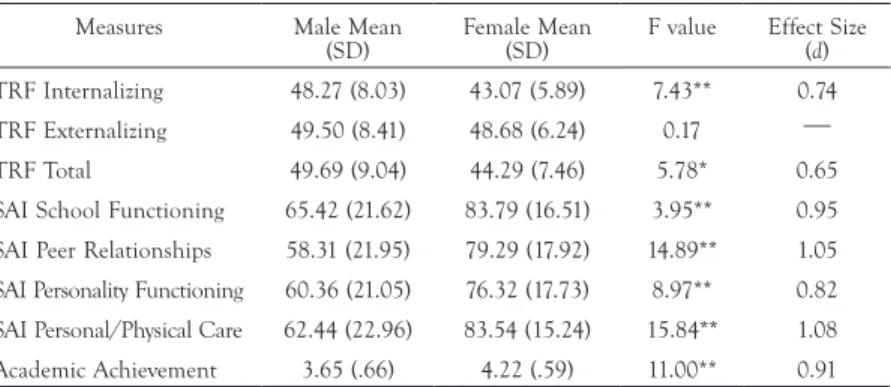
One-way ANOVAs were conducted to compare the mean behaviour, aca-demic and strength scores of male and female students. The mean scores of teacher-rated behaviour (TRF) and strengths (SAI) as well as average academic achievement are presented by gender in Table 1. Mean TRF scores for both male and female students are in the average range (Achenbach & Rescorla, 2001). Significant differences were found between most of the ratings, with females performing more positively than males. The sole exception was teacher reports of externalizing behaviours, where no differences were found. Effect sizes calculated using Cohen’s d (1969) were moderate to large.
TABLE 1. Behaviour, academic and strength ratings by gender
Measures Male Mean
(SD) Female Mean (SD) F value Effect Size (d) TRF Internalizing 48.27 (8.03) 43.07 (5.89) 7.43** 0.74 TRF Externalizing 49.50 (8.41) 48.68 (6.24) 0.17 ⎯
TRF Total 49.69 (9.04) 44.29 (7.46) 5.78* 0.65
SAI School Functioning 65.42 (21.62) 83.79 (16.51) 3.95** 0.95 SAI Peer Relationships 58.31 (21.95) 79.29 (17.92) 14.89** 1.05 SAI Personality Functioning 60.36 (21.05) 76.32 (17.73) 8.97** 0.82 SAI Personal/Physical Care 62.44 (22.96) 83.54 (15.24) 15.84** 1.08 Academic Achievement 3.65 (.66) 4.22 (.59) 11.00** 0.91
* p < .05; ** p < .01
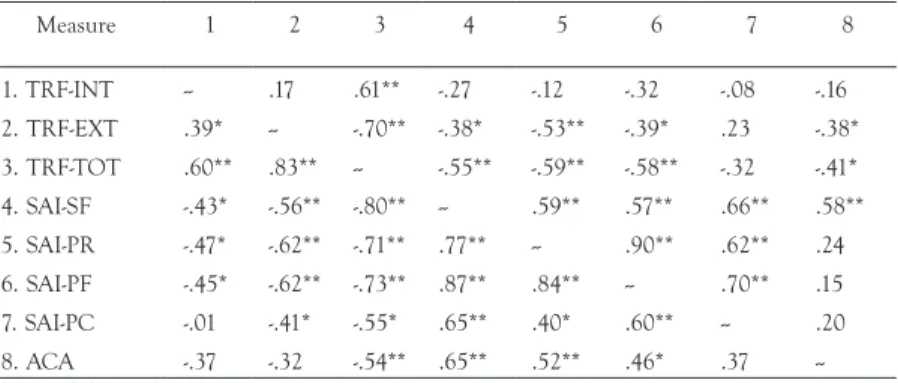
Correlation analyses were used to explore the relationships among teacher-rated behaviour, student strengths, and academic achievement both for the group as a whole and as a function of gender. The results are presented in Tables 2 and 3. For the whole group, correlations were largely significant. Students with fewer total behaviour problems reported greater strengths in School, Personal-ity, Peer Relationships, and Personal/Physical care as well as higher academic achievement. Also, the strengths of students were highly correlated with each other, ranging from coefficients of 0.60 (Peer Relationships and Personal/ Physical Care) to 0.88 (Peer Relationships and Personality Functioning).
TABLE 2. Inter-correlations for scores on TRF, SAI domains and academic achievement Measure 1 2 3 4 5 6 7 1. TRF-INTT --2. TRF-EXT .31* --3. TRF-TOT .65** .76** --4. SAI-SF -.47** -.47** -.73** --5. SAI-PR -.44** -.54** -.70** .76** --6. SAI-PF -.47** -.47** -.69** .78** .88** --7. SAI-PC -.18 -.29* -.51** .72** .60** .70** --8. ACA -.39** -.34* -.55** .67** .51** .42** .44** * p < .05; ** p < .01
TRF-INT = Internalizing Behaviour Score; TRF-EXT = Externalizing Behaviour Score; TRF-TOT; Total Be-haviour Score; SAI-SF; School Functioning; SAI-PR = Peer Relationships; SAI-PF = Personality Functioning; SAI-PC = Personal/Physical Care; ACA = Academic Achievement
TABLE 3. Intercorrelations for scores on TRF, SAI domains and academic achievement as a function of gender Measure 1 2 3 4 5 6 7 8 1. TRF-INT -- .17 .61** -.27 -.12 -.32 -.08 -.16 2. TRF-EXT .39* -- -.70** -.38* -.53** -.39* .23 -.38* 3. TRF-TOT .60** .83** -- -.55** -.59** -.58** -.32 -.41* 4. SAI-SF -.43* -.56** -.80** -- .59** .57** .66** .58** 5. SAI-PR -.47* -.62** -.71** .77** -- .90** .62** .24 6. SAI-PF -.45* -.62** -.73** .87** .84** -- .70** .15 7. SAI-PC -.01 -.41* -.55* .65** .40* .60** -- .20 8. ACA -.37 -.32 -.54** .65** .52** .46* .37 --* p < .05; --*--* p < .01
Intercorrelations for male students are on the left side of the table; female students are on the right TRF-INT = Internalizing Behaviour Score; TRF-EXT = Externalizing Behaviour Score; TRF-TOT; Total Behaviour Score; SAI-SF; School Functioning; SAI-PR = Peer Relationships; SAI-PF = Personality Function-ing; SAI-PC = Personal/Physical Care; ACA = Academic Achievement
Table 3 reveals differences in correlations between male and female students. Male students with less total negative behaviour scores were reported to have higher academic achievement and greater strengths in School and Personality Functioning, Peer Relationships, and Personal/Physical Care domains respec-tively, with correlations ranging from 0.55 to 0.80. Also, the strengths of male students were highly correlated with each other, ranging from coefficients of 0.40 (Peer Relationships and Personal/Physical Care) to 0.87 (School and Personality Functioning).
For female students, negative behaviours were significantly related to academic achievement for the SAI domains of School and Personality Functioning and
Peer Relationships, but not Personal/Physical Care. The correlations were lower than for males, ranging from 0.32 to 0.59. In particular, the correla-tion between total negative behaviour scores and the School domain was significantly lower for female students than male (p < .05), as calculated using Fisher’s z-transformation. Other differences between correlations of male and female students were not found to be significantly different. The strengths of female students were mostly correlated with each other, slightly more so than males, with coefficients ranging from 0.57 (School and Personality Function-ing) to 0.90 (Peer Relationships and Personality FunctionFunction-ing). Using Fisher’s z-transformation, it was confirmed that the correlation between School and Personality Functioning was significantly lower for female than male students (p < .01). Other differences between correlations of male and female students were not found to be significantly different.
diSCuSSiOn
The results showed that teachers rated students as having several strengths in each of the domains of the SAI. This implies that even children with low academic performance scores, and greater teacher-rated behaviour problems, have some resources at their disposal. This supports an important assumption of the strengths perspective that all individuals have some strengths (Epstein & Sharma, 1998), and furthermore, it suggests that most individuals have strengths in more than one domain.
A comparison of strengths, academic achievement, and teacher-rated behav-ioural difficulties showed significant differences between male and female students (see Table 1); female students were rated by teachers as having fewer internalizing behaviour problems, higher academic achievement, and greater strengths in all areas compared to male students. While several studies have documented increasing internalizing behaviours for females and externalizing behaviours for males across childhood and adolescence (e.g., Angold & Rut-ter, 1992; LeadbeaRut-ter, Kuperminc, Blatt, & Hertzog, 1999), it is important to note that the students in the present study are very young and these gender differences are likely not in evidence yet. Differences in teacher ratings may reflect the tendency on the part of teachers to view stereotypically male be-haviours more negatively than female (Cole et al., 2001; McIntyre & Tong, 1998; Miller, Koplewicz, & Klein, 1997) and to perceive female students as generally more successful scholastically (Cole et al., 2001; Fergusson, Lloyd, & Horwood, 1991; Jones & Myhill, 2004). The higher scores for female students may also reflect the “halo effect” (Jackson & King, 2004), where the impact of one characteristic (i.e., academic achievement) affects perceptions of another (i.e., peer relationships).
The relationships between strengths and behaviour problems as well as between strengths and academic achievement showed, as expected, that higher levels of
strengths were significantly correlated with fewer behaviour problems and higher achievement. This finding suggests that students who have some strengths in a variety of domains may experience overall academic success. The strength most highly correlated with academic achievement was School Functioning (r = .67, p < .001), which indicates that students who teachers viewed as exhibit-ing the behaviours necessary to focus on and complete school-related tasks were also those awarded the highest grades. However, academic achievement was also highly correlated with strengths in Peer Relationships (r = .55, p < .001), as well as total behaviour problems (r = .55, p < .001), indicating that students with strengths in domains not directly related to school learning may still benefit indirectly.
This finding confirms those of previous studies that showed that strengths in some domains are related to positive outcomes in other settings (Farmer et al., 2005; Lyons et al., 2000). As well, the significant correlations observed between behaviour ratings, peer relationships, and academic achievement are supported by a line of research that has examined influences on academic achievement. Specifically, a number of studies have shown that, for adoles-cents, peer relationships have significant and positive correlations with student grades and test scores (Austin & Draper, 1984; Green, Forehand, Beck, & Vosk, 1980; Seyfried, 1998) and that this relationship is mediated, in part, by emotional distress (Wentzel & McNamara, 1999), prosocial behaviour (Caprara, Barbaranelli, Pastorelli, Bandura, & Zimbardo, 2000; Wentzel & Caldwell, 1997), perceptions of competence (Guay, Boivin, & Hodges, 1999), and classroom participation and engagement (Buhs & Ladd, 2001; Buhs, Ladd, & Herald, 2006). While likely in part a bi-directional relationship, there is evidence that peer relationships uniquely and significantly impact later achievement, further supporting their influence and importance (Guay et al., 1999; Johnson, 2000).
That the relationship between peer relationships and academic achievement has also been found in the present study with students in grades 1 and 2 adds uniquely to the literature which is focused largely on adolescents. Clearly then, a more ecological view towards increasing academic achievement that includes an emphasis on non-academic strengths such as peer relationships in addition to a traditional focus on curricular mastery may prove more efficacious (Zins, Weissberg, Wang, & Walberg, 2004).
Gender differences were also evident in the correlation analyses, in that higher levels of inter-correlation between several variables were found for male students than female students. For example, many of the aforementioned connections among achievement, peer functioning, and behaviour ratings were stronger for male than female students, although significance was only noted for two of these. While school functioning continues to be the strength area most highly related to academic achievement for both sexes, strengths in peer relationships
are significantly related to achievement only for male students. The same is true for Personal/Physical care. As teachers also rated males as performing less well in all of these domains, it may be the case that it is more difficult for teachers to identify strengths in areas that are of less value to them, given existing weakness in an area that is of high value. As female students are rated as more academically successful, both in terms of their grades and strengths in School Functioning, teachers may be able to better distinguish between the other strengths of these students, for example their Peer Relationships and their Personal/Physical Care.
The research literature cited previously (e.g., Wentzell & Caldwell, 1997) shows strong relationships between academic achievement and peer relationships for adolescents, regardless of sex. There may be developmental implications for younger students, who have not been included in this line of research, in that achievement for male students is more closely aligned with prosocial, behaviourally-based variables, such as school functioning and peer relation-ships. Variables that mediate the interaction between peer relationships and academic achievement may also include characteristics such as attention and direct aggression, which may be seen more frequently in young male students (Björkqvist, Lagerspetz, & Kaukiainen, 1992; Loeber & Hay, 1997; Pope, Bierman, & Mumma, 1991) and thus have a greater impact on achievement. There is little existing research to support these interpretations and further studies will clearly be required to provide greater confirmation.
Implications for practice
Findings from the present study suggest a number of implications for educa-tors and mental health professionals working in schools. The confirmation that all students have strengths in at least one area, and that strengths, posi-tive behaviours, and achievement are strongly related, provides guidance for those planning behavioural interventions and Individual Education Plans (IEPs). The significantly higher ratings of female students by teachers, and the significant relationships between achievement and strengths for male students, highlight the importance of conducting strength-based assessments with boys in particular. By exploring the attributes and resources available to those students who are perceived as performing less well academically and be-haviourally, programming can be tailored to these strengths (Rawana, Latimer, Whitley, & Probizanski, 2009 ) From the perspective of the student, a focus by school staff on the areas where they are successful, be these in recreation, peer relationships, or community participation, may serve to increase hope, self-concept, motivation and optimism (Jimerson, Sharkey, Nyborg, & Furlong, 2004; Sears, 2007) and ultimately school engagement and academic success (Tomlinson & Jarvis, 2006).
Identifying student strengths, styles, and interests is also important for teachers in developing differentiated instruction (DI) and assessment (Hume, 2008;
Tomlinson, 2005a, 2005b). Differentiated instruction “is effective instruction that is responsive to the diverse learning needs and preferences of individual learners” (Hume, p. 1). A move towards incorporating DI into elementary and secondary classrooms is evident across North America and DI is becoming mandatory practice in some Canadian provinces (e.g., Manitoba Education, Citizenship and Youth, 2009; Ontario Ministry of Education, 2008). Key to its success is the engagement of students through groupings and lesson choices that build on their individual strengths. The first step in designing lessons and units based in DI is getting to know students and documenting their unique learning profiles; using strength-based assessments like the SAI is an essential part of this process.
In addition, these results are not only important for educators, but for parents to appreciate the importance of fostering strengths. More specifically, results from this study can show parents that strengths in a variety of settings can help children succeed. For this reason, parents should encourage their children to explore their interests and capabilities in many different activities and settings. Also, educators and parents can engage in discussion with students to help them develop an awareness of their own areas of strength and to encourage them to make academic and extracurricular choices based on these.
Limitations
The generalization of the present findings is impeded by a number of limitations. First is the small sample size, resulting from low levels of participation among teachers and parents as well as the nesting of students within classes. Future studies that include a greater number of participating students and teachers and that allow for more detailed multi-level techniques such as Hierarchical Linear Modeling, would provide stronger support for the current findings. A second issue is that teachers were the only informants used in the current study. In the future it may be useful to collect data regarding students’ strengths from the students themselves and their parents. This information could assist in determining how a teacher’s perception of strengths may be biased as a result of a student’s performance and behaviour, and it will also make it possible to determine how teachers’ ratings may subsequently differ from a parent’s or student’s perspective. It may be the case that teachers are less able to recognize the strengths of students who behave and perform poorly in the classroom, or perhaps they are just less informed about these students. Although parent ratings may reflect similar biases, it would be informative to see the similarities and differences between the ratings of both informants.
On a broader topic, more research is needed that explicitly studies the rela-tionship between observable strengths and psychological constructs such as self-concept and self-efficacy that may mediate the relationship between these and academic achievement. While it was assumed in the current study that
an individual’s strengths directly influence a person’s psychological states, this relationship should be explored in more detail. For example, the relation-ship between strengths and general self-concept may be reciprocal, such that students who feel more positively about themselves are able to identify areas of competence, whereas those who feel more negatively about themselves are unable to do so. Focusing on older students, who may have greater insight into their own beliefs and perceptions will provide greater evidence of the links between strengths and other constructs.
This study is a unique piece of research that illustrates the relationship among student strengths, academic performance, and classroom behaviour, and high-lights the gender differences that are present. This validates previous beliefs that strengths are important, and strength-based approaches are valuable within a school setting.
reFerenCeS
Achenbach, T.M., & Rescorla, L.A. (2001). Manual for the ASEBA School-Age Forms & Profiles. Burlington, VT: University of Vermont, Research Center for Children, Youth, & Families.
Albrecht, S. F. & Braaten, S. (2008). Strength-based assessment of behavior competencies to distinguish students referred for disciplinary intervention from nonreferred peers. Psychology in the Schools, 45(2), 91-103.
Anderson, R. L., Lyons, J. S., Giles, D. M., Price, J. A., & Estle, G. (2003). Reliability of the Child and Adolescent Needs and Strengths – Mental Health (CANS-MH) Scale. Journal of Child and Family Studies, 12(3), 279-289.
Anderson, C., Rawana, E., Brownlee, K., & Whitley, J. (2010). An investigation of the relationship between psychological strengths and the perception of bullying in early adolescents in schools. Alberta Journal of Educational Research, 56(4), 470-481.
Angold, A. & Rutter, M. (1992). Effects of age and pubertal status on depression in a large clinical sample. Development and Psychopathology, 4, 5-28.
Austin, A. M. B., & Draper, D. C. (1984). The relationship among peer acceptance, social impact, and academic achievement in middle childhood. American Educational Research Journal, 21(3), 597-604.
Björkqvist, K., Lagerspetz, K. M. J., & Kaukiainen, A. (1992). Do girls manipulate and girls fight? Developmental trends in regard to direct and indirect aggression. Aggressive Behaviour, 18(2), 117-127.
Blyth, D. A. (1999). Reflections on evaluating strength-based approaches to youth devel-opment. Harvard Family Research project, 5(1), 2-3.
Buhs, E. S., & Ladd, G. W. (2001). Peer rejection as an antecedent of young children’s social adjustment: An examination of mediating processes. Developmental Psychology, 37(4), 550-560.
Buhs, E. S., Ladd, G. W., & Herald, S. L. (2006). Peer exclusion and victimization: Proc-esses that mediate the relation between peer group rejection and children’s classroom engagement and achievement? Journal of Educational Psychology, 98(1), 1-13.
Caprara, G. V., Barbaranelli, C., Pastorelli, C., Bandura, A., & Zimbardo, P. G. (2000). Prosocial foundations of children’s academic achievement. Psychological Science, 11, 302-306.
Cohen, J. (1969). Statistical power analysis for the behavioral sciences. New York: Academic Press. Cole, D. A., Cho, S., Martin, J. M., Seroczynski, A. D., Tram, J., & Hoffman, K. (2001). Effects of validity and bias on gender differences in the appraisal of children’s compe-tence: Results of MTMM analyses in a longitudinal investigation. Structural Equation Modeling, 8(1), 84-107.
Cosden, M., Panteleakos, F., Gutierrez, Lisa., Barazani, S., & Gottheil, E. (2004). Strength-based assessment of adolescents who abuse drugs: Implications for helping high-risk youth. The California School Psychologist, 9, 115-126.
Donnon, T. & Hammond, W. (2007). Understanding the relationship between resiliency and bullying inadolescence: An assessment of youth resiliency from five urban junior high schools. Child and Adolescent Psychiatric Clinics of North America, 16, 449-471. Donnon, T., Hammond, W., & Charles, G. (2003). Youth resiliency: Assessing students’ capacity for success at school. Teaching & Learning, 1(2), 23-28.
Duncan, P. M., Garcia, A. C., Frankowski, B. L., Carey, P. A., Kallock, E. A., Dixon, R. D., & Shaw, J. S. (2007). Inspiring healthy adolescent choices: A rationale for and guide to strength promotion in primary care. Journal of Adolescent Health, 41(6), 525-535. Epstein, M. H. (2004). Behavioral and Emotional Rating Scale (2nd ed.): A strengths-based approach to assessment. Austin, TX: PRO-ED.
Epstein, M. H. (2000). The Behavioral and Emotional Rating Scale: A strength-based approach to assessment. Diagnostique, 25, 249-256.
Epstein, M. H., & Sharma, J. M. (1998). Behavioural and Emotional Rating Scale: A strength based approach to assessment. Austin, Texas: PRO-ED Inc.
Farmer, T. W., Clemmer, J. T., Leung, M. C., Goforth, J. B., Thompson, J. H., Keagy, K., et al. (2005). Strength-based assessment of rural African-American early adolescents: Characteristics of students in high and low groups on the behavioral and emotional rating scale. Journal of Child and Family Studies, 14(1), 57-69.
Fergusson, D. M., Lloyd, M., & Horwood, L. J. (1991). Teacher evaluations of the perfor-mance of boys and girls. New Zealand Journal of Educational Studies, 26(2), 155-163. Green, K. D., Forehand, R., Beck, S. J., & Vosk, B. (1980). An assessment of the re-lationship among measures of children’s social competence and children’s academic achievement. Child Development, 51(4), 1149-1156.
Guay, F., Boivin, M., & Hodges, E. V. E. (1999). Predicting change in academic achieve-ment: A model of peer experiences and self-system processes. Journal of Educational Psychology, 91(1), 105-115.
Hume, K. (2008). Start where they are: Differentiating for success with the young adolescent. Toronto, ON: Pearson Education Canada.
Jackson, D. A. & King, A. R. (2004). Gender differences in the effects of oppositional behavior on teacher ratings of ADHD symptoms. Journal of Abnormal Child Psychology, 32(2), 215-224.
Jennings, G. (2003). An exploration of meaningful participation and caring relationships as contexts for school engagement. California School Psychologist, 8, 43-52.
Jimerson, S. R., Sharkey, J. D., Nyborg, V., & Furlong, M. J. (2004). Strength-based as-sessment and school psychology: A summary and synthesis. California School Psychologist, 9, 9-19.
Johnson, K. A., (2000). The peer effect on academic achievement among public elementary school students. A report of the heritage center for data analysis. Washington, DC: Heri-tage Foundation.
Jones, S., & Myhill, D. (2004). ‘Troublesome boys’ and ‘compliant girls’: Gender iden-tity and perceptions of achievement and underachievement. British Journal of Sociology of Education, 25(5), 547-561.
Katz, H., & McCluskey, K. (2003). Seeking strength-based approaches in Aboriginal educa-tion: The “Three stars and a wish” project. McGill Journal of Education, 38(1), 116-134. Leadbeater, B. J., Kuperminc, G. P., Blatt, S. J., & Hertzog, C. (1999). A multivariate model of gender differences in adolescents’ internalizing and externalizing problems. Developmental Psychology, 35, 1268-1282.
Loeber, R. & Hay, D. (1997). Key issues in the development of aggression and violence from childhood to early adulthood. Annual Review of Psychology, 48, 371-410.
Lyons, J. S., Uziel-Miller, N. D., Reyes, F. & Sokol, P. T. (2000). Strengths of children and adolescents in residential settings: Prevalence and associations with psychopathology and discharge placement. Journal of the American Academy of Child & Adolescent Psychiatry, 39(2), 176-181.
Manitoba Education, Citizenship and Youth (2009). Curriculum: Elements integrated into the curriculum. Winnipeg, MB: Author. Retrieved January 21, 2009 from http://www. edu.gov.mb.ca/k12/cur/elements.html
McIntyre, T., & Tong, V. (1998). Where the boys are: Do cross-gender misunderstandings of language use and behavior patterns contribute to the overrepresentation of males in programs for students with emotional and behavioral disorders? Education & Treatment of Children, 21(3), 321-332.
McQuaide, S. & Ehrenreich, J. H. (1997). Assessing client strengths. Families in Society, 78(2), 201-212.
Miller, L. S., Koplewicz, H. S., & Klein, R. G. (1997). Teacher ratings of hyperactivity, inattention, and conduct problems in preschoolers. Journal of Abnormal Child Psychology, 25(2), 113-119.
Ontario Ministry of Education (2008). Reach every student through differentiated instruction. Toronto, ON: Author.
Pope, A. W., Bierman, K. L., & Mumma, G. H. (1991). Aggression, hyperactivity, and inattention-immaturity: Behavior dimensions associated with peer rejection in elementary school boys. Developmental Psychopathology, 27(4), 663-671.
Rawana, E., & Brownlee, K. (2009). Making the possible probable: A strength-based assessment and intervention framework for clinical work with parents, children and adolescents. Families in Society, 90(3), 255-260.
Rawana, E., Latimer, K., Whitley, J., & Probizanski, M. (2009). Positive classroom strategies for teachers to engage students on their strengths. Canadian Teacher Magazine, 16-17. Rawana, E., Cryderman, B., & Thompson, R. (2000). Manual of probation barrier training. Ministry of Community and Social Services, Province of Ontario.
Rutter, M. (2006). Implications of resilience concepts for scientific understanding. Annals of the New York Academy of Sciences, 1094(1), 1-12.
Saleebey, D. (1997). The strengths perspective in social work practice. Boston, MA: Allyn & Bacon.
Sears, K. L. (2007). The relationship between hope, executive function, behavioral/ emotional strengths and school functioning in 5th and 6th grade students. Dissertation
Abstracts International Section A: Humanities and Social Sciences, 68(5-A), 1832-1930. Seyfried, S. F. (1998). Academic achievement of African American preadolescents: The influence of teacher perceptions. American Journal of Community Psychology, 26(3), 381-402.
Tomlinson, C. A. (2005a). The differentiated classroom: Responding to the needs of all learners. Upper Saddle River, NJ: Pearson Education.
Tomlinson, C. A. (2005b). Grading and differentiation: Paradox or good practice?Theory Into Practice, 44(3), 262-269.
Tomlinson, C. A., & Jarvis, J. (September, 2006). Teaching beyond the book. Educational Leadership, 16-21.
Walrath, C. M., Mandell, D. S., Holden, E. W., & Santiago, R. L. (2004). Assessing the strengths of children referred for community-based mental health services. Mental Health Services Research, 6(1), 1-8.
Weick, A., Rapp, C., Sullivan, W. P., & Kisthardt , W. (1989). A strengths perspective for social work practice. Social Work, 34, 350-354.
Welsh, J. L. (2003). The application and review of a strength-based program in classrooms with behaviour disordered children. Unpublished master’s thesis, Lakehead University, Thunder Bay, ON.
Wentzel, K. R. & Caldwell, K. (1997). Friendships, peer acceptance, and group mem-bership: Relations to academic achievement in middle school. Child Development, 68(6), 1198-1209.
Wentzel, K. R., & McNamara, C. C. (1999). Interpersonal relationships, emotional distress, and prosocial behavior in middle school. Journal of Early Adolescence, 19(1), 114-125. Werner, E. E. (1994). Overcoming the odds. Journal of Developmental and Behavioral Pediatrics, 15(2), 131-136.
Whitley, J., Rawana, E. P., Brownlee, K., & Rawana, J. (2010). A longitudinal exploration of the academic and psychosocial outcomes of students with emotional/behavioural dif-ficulties: The importance of student perceptions of themselves, their peer relationships, and their classrooms. Brock Education Journal, 19(2), 78-96.
Winter-Messiers, M. A., Herr, C. M., Wood, C. E., Brooks, A. P., Gates, M. A. M., Houston, T. L., et al. (2007). How far can Brian ride the daylight 4449 express? A strength-based model of Asperger syndrome based on special interest areas. Focus on Autism and Other Developmental Disabilities, 22(2), 67-79.
Zins, J. E., Weissberg, R. P., Wang, M. C., & Walberg, H. J. (2004). Building academic success on social and emotional learning: What does the research say? New York, NY: Teachers College Press.
JESSICA WhITLEY is an Assistant professor in the Faculty of education at the university of Ottawa. her research interests focus on documenting and improving psychosocial outcomes for students with exceptionalities and improving teacher preparation for inclusive education.
edWArd rAWAnA is an Associate Professor in the Department of Psychology at Lakehead University. he is also Director of the Lakehead Site of the Centre of Excel-lence for Children & Adolescents with Special Needs (CECASN). he is a practicing psychologist with 25 years of experience working with children, adolescents and their families. his research area focuses on the assessment and use of student strengths in treatment and education.
mELISSA PYE (Ball) graduated from Lakehead University with her masters in Clinical Psychology in 2006 after completing her thesis with Dr. Rawana studying the role of strengths in the classroom. Currently she is employed at a children’s mental health agency in Thunder Bay, where she works primarily with youth in long-term residential programs. She is also in the registration process with the College of Psychologists of Ontario to achieve a Psychological Associate designation.
KEITh BROWNLEE is the Director of Research for the Centre of Excellence for Chil-dren and Adolescents with Special Needs and is a Professor in the School of Social Work at Lakehead University. his area of interest includes clinical work with families and children with an emphasis on personal strengths.
JESSICA WhITLEY est professeur adjointe à la Faculté des sciences de l’éducation de l’Université d’Ottawa. Ses recherches ciblent la documentation et l’amélioration des résultantes psychosociales pour les élèves atypiques ainsi qu’une meilleure préparation des maîtres en vue d’enseigner dans un contexte inclusif.
edWArd rAWAnA est professeur agrégé au Département de psychologie de l’Université Lakehead. Directeur de la succursale de Lakehead du Centre d’excellence pour les enfants et adolescents ayant des besoins spéciaux (CECASN), il œuvre comme psy-chologue clinicien depuis plus de 25 ans auprès d’enfants, d’adolescents et de leurs parents. Ses recherches portent sur l’identification et l’utilisation des forces des élèves aux fins de traitement et d’éducation.
mELISSA PYE (Ball) est diplômée de l’Université Lakehead. Elle a obtenu une maîtrise en psychologie clinique en 2006, suite à la rédaction – en collaboration avec le Professeur Rawana – de sa thèse étudiant le rôle joué en classe par les forces des élèves. Actuel-lement à l’emploi d’une agence de santé mentale située à Thunder Bay, elle œuvre principalement auprès de jeunes engagés dans un programme de réhabilitation, résidant dans un centre. Elle a également entrepris le processus d’enregistrement à l’Ordre des psychologues de l’Ontario en vue de recevoir le titre d’associée en psychologie.
KEITh BROWNLEE est le directeur de recherche du Centre d’excellence pour les enfants et adolescents ayant des besoins spéciaux. Il est aussi professeur à l’École de travail social de l’Université Lakehead. Ses travaux de recherche prennent la forme de travail clinique auprès des familles et des enfants avec une emphase sur les forces personnelles.