ENhANCING MENTORs’ EFFECTIVENEss:
The PROMISe Of The AdAptivE MEntorship
©MOdel
EDWIN G. RALPh & KEITh WALKER University of saskatchewan
ABsTRACT.The Adaptive Mentorship (AM) model is described and implications are raised for its wider implementation. The researchers derived the AM model from earlier contingency leadership approaches; and during the last two decades, they have further refined AM through application and research. They suggest the benefits and transferability of AM to any field to assist protégés in developing professional proficiency in their respective contexts.
AMéLIORER L’EFFICACITé DEs MENTORs :
leS PROMeSSeS du MOdèle de MeNTORaT adaPTé©
RéSuMé. Dans cet article, le modèle de mentorat adapté© (MA) est décrit et ses
implications dans l’optique d’une implémentation étendue sont soulevées. Les chercheurs dérivent le modèle MA des approches précédentes de contingence du leadership. De plus, au cours des deux dernières décennies, ils ont raffiné davantage leur modèle via l’application et la recherche. Ainsi, les auteurs ex-posent les bénéfices et la transférabilité du MA dans tous les domaines pour permettre aux protégés de développer des compétences professionnelles dans leurs milieux respectifs.
A
daptive Mentorship© (AM) is a promising model that has proven effective inenhancing the mentorship/supervisory process. We believe that AM (which we formerly called Contextual Supervision or CS, and which we derived from a range of contingency and situational leadership approaches, e.g., Blake & Mouton, 1978; Hersey & Blanchard, 1988; Fiedler & Garcia, 1987) is wor-thy of consideration for application in any mentorship situation in any field (Ralph, Walker, & Wimmer, 2008b). This article will provide a background and description of the Adaptive Mentorship© Model and how it works,
to-gether with a summary of findings from research related to the model. The article concludes with a discussion of the model, including consideration of the authors’ claim that the Adaptive Mentorship© Model warrants further use
BACKGROUND
Adaptive Mentorship© is a model that focuses on mentors adjusting their
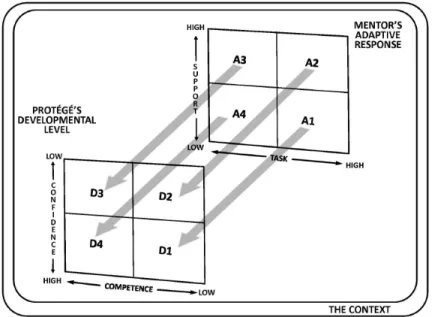
mentorship behaviour in response to the task-specific development level of protégés they are assisting in the learning/employment situation. We represent the AM model in Figure 1.
FIGURE 1. Adaptive Mentorship©. (the mentor matches his/her adaptive response
to coincide with the skill-specific developmental level of his/her protégé.)
The outer border of the diagram represents the context of the mentorship relationship (hence the earlier Contextual Supervision title). These contextual factors include psychological, social, organizational, and cultural aspects within the practicum/work setting. Many of these influences cannot be changed by the mentor or the protégé; however, the key factor over which the participants
do have direct control is their own behaviour. Mentors can change their
mentorship response, which consists of two dimensions shown in the A-grid: their adaptive “task” response (i.e., the degree of direction given regarding the technical, mechanical, or procedural aspect of the protégé’s performance), and their adaptive “support” response (i.e., the degree of expression regarding the “human” or psycho/social/emotional aspect of the protégé’s learning). For the protégés, the key element over which they have most control is their competency-specific developmental level in performing particular skill-sets. This developmental-level consists of two dimensions, as depicted in the D-grid: their developmental “competence” level (i.e., their ability to perform the task), and their developmental “confidence” level (i.e., their degree of self-assurance,
com-posure, and feelings of security and/or safety in performing the skill-set). The core of the AM model is represented by the larger arrows linking the D-grid with the A-grid, which portray the mentor’s matching of one of four basic adaptive “A” responses with a similarly numbered “D” developmental-level exhibited by the protégé in his/her performance of the particular competency.
APPLyING ADAPTIVE MENTORshIP©
Much of the previous research on Adaptive Mentorship© (AM) was conducted
with pre-service teachers and their mentors (i.e., their faculty-based advisors and classroom cooperating teachers) during the four-month internship of their teacher-education program. Other research was conducted in: early childhood education (Watt, 1998); agricultural education Fritz & Miller, 2003, 2004); and business management (Posner, 2004).
In our own research, we studied mentors’ use of AM during the internship, in which protégés developed their instructional proficiency under the guidance of school-based and faculty-based supervisors. Every discipline, however, has its own body of knowledge that new practitioners are expected to internalize as they develop.
The application of AM consists of three phases.
1. Determine development level. The first phase is for the protégé/mentor pair to determine the existing development level of the protégé to perform the specific competency being practiced at the time.
As illustrated in the “D grid” of Figure 1, a protégé’s skill-specific level of development consists of both his/her competence and his/her confidence levels in performing that task. The D1 quadrant reflects an individual with “low competence” and “high confidence” to accomplish the task (i.e., he/she does not know exactly how to perform it, but is confident, willing, and eager to do so). A protégé at D2 is low on both the competence and confidence dimen-sions; a protégé at D3 shows high competence and low confidence in it; while a protégé at D4 is high on both dimensions.
A protégé’s developmental level may be ascertained in three ways: (a) by the mentor’s formal and informal observations of the protégé’s actual perform-ance of the skill; (b) by the pairs’ informal conversations about the protégé’s specific progress in it; and (c) by the protégé’s answers to the mentor’s direct questions about his/her progress in that skill-set.
The levels of a protégé’s development are skill-specific, they are changeable over-time, they may be different for different competencies, and they are not permanent labels of a protégé’s progress (Ralph, 1992, 1996a, 1998, 2000, 2004, 2005). 2. Synchronize mentor response. After determining the protégé’s task-specific level of performance, the mentor must appropriately adapt his/her mentorship
response to correspond to the existing developmental level of the mentee regarding the competency in question. This matching process represents the essence of AM.
As depicted in Figure 1, the mentor’s adaptive response also has two dimen-sions: the amount of support the mentor provides (i.e., the human-relationship aspects of encouragement, positive reinforcement, praise, and psychological/ emotional bolstering of the protégé as he/she attempts to develop the skill). This support consists of genuinely positive words, pleasant facial expressions, affirming gestures, and accepting body language. The other response-element is the task dimension (i.e., direction regarding the technical or mechanical component of mastering a competency), in which the mentor’s response var-ies along a continuum of lesser to greater amounts of guidance or specific technical advice about the performance. This task-dimension involves such behaviours as telling, showing, guiding, demonstrating, advising, directing, or providing procedural strategies regarding the protégé’s “technique.” Task, however, embraces more than refining one’s functional techniques or perform-ance tactics; it also encompasses the broadening and deepening of protégés’ holistic understanding of professional identity and its attending social, ethical, and moral aspects.
The key principle in correctly matching the A and D quadrants is that the mentor’s task response must be inverse in magnitude to the extent of the pro-tégé’s competence level; and simultaneously, the extent of the mentor’s support is similarly inversely proportional to the novice’s level of confidence in performing the skill-set. In short, the degree of mentor response is opposite to that of the protégé’s development.
3. Continually observe and adapt mentor response. The mentorship pair continually and mutually monitor the protégé’s changing level of development, and the mentor would accordingly synchronize his/her adaptive response to match, in inverse degrees, the protégé’s changing development level(s). As a protégé advances from D1 to D2 to D3 to D4, the mentor reciprocates by responding correspondingly with A1, A2, A3 and A4 adaptations.
aM ReSeaRch fINdINGS
Over the past two decades, research has been conducted on Adaptive Mentor-ship© (formerly Contextual Supervision), and we here summarize our findings
in terms of “early,” “later,” and “workshop” categories. Early studies
Ralph (1991, 1992, 1992-1993, 1993, 1994; Ralph & Yang, 1993) conducted research on the effectiveness of the model and reported how he had imple-mented it, personally/privately, to inform his own mentorship/supervisory practice, first as a faculty advisor with several cohorts of pairs in
extended-practicum programs; and also as a peer-consultant for effective teaching with new post-secondary instructors (Ralph, 1995, 1996b, 1996-1997, 1998; Ralph & Konchak, 1996). Later, Ralph (1996a, 1998, 1999, 2000, 2002) reported results from several studies investigating the use of the model by whole cohorts of instructional mentors in K-12 teacher-education.
A synthesis of the key findings of these studies revealed that: (a) a protégé progresses through different developmental levels for each professional com-petency; (b) a mentor who adjusts her/his adaptive response to match the protégé’s changing developmental levels (i.e., A1 with D1, A2 with D2, and so on) enhances the protégé’s professional growth in these skills; (c) interpersonal problems typically arise when mismatching of mentor response and protégé development occurs; (d) these conflicts tend to subside if this misalignment is corrected when the mentor realigns his/her adaptive response with the cor-responding development level of the mentee; and (e) mentors, on the whole, seem to prefer using a high supportive/low directive style (i.e., A3 or A4), but by doing so may limit the professional development of certain protégés who are at a D1 or D2 level in their task-specific performance.
These findings suggested that when mentors are familiar with AM, they are more consistent in their appropriate matching of their mentorship response with the development levels of their mentees. One problem identified by the early research was that even when cohorts had learned the model dur-ing mentorship workshops, a small percentage of the pairs had difficulty in reaching agreement identifying protégés’ actual developmental levels and/or mentors’ correct response level. Yet, it was shown that the AM concepts and principles, once understood and accepted, were relatively easy to apply (Ralph, 1998, 1999; Watt, 1998).
This research has demonstrated AM’s strengths: (a) it helped mentors clarify their conceptualization of the whole mentoring process; (b) it replaced a “one-size-fits-all” approach by allowing mentors to vary their adaptive behaviour according to the developmental needs of their protégés; (c) it was intuitively appealing and relatively easy to learn; (d) it offered both mentors and their protégés a tool to help analyze and alleviate mentoring conflicts (which had typically been misrepresented or distorted by clichés like: “We have a personality clash,” “She is simply ignorant,” or “He is plain stubborn”); and (e) it revealed that such relationship problems were often the result of mentors mismatching their adaptive responses with protégés’ task-specific developmental levels. Although various reasons have been advanced for this recurring mismatching phenomenon (e.g., participant disinterest in the model, misunderstanding of it, inability to apply it, devaluation of it, satisfaction with past practice, or the leader’s ineffectiveness at describing/promoting it, Ralph, 1993, 1996a, 1998, 2000, 2002), our quest was to reduce this limitation.
Later studies
In both the earlier and later studies we collected survey data by having mentor-ship pairs independently mark an “x” on of copies of the A- and D-grids, as to where each participant and their partner thought each was positioned at that point in time. That is, protégés plotted where they thought they were at on a D-grid sheet, and mentors likewise selected on a D-grid form the quadrant in which they thought their protégés were performing for the skill-set being considered (e.g., classroom management, oral-questioning). After each partner independently completed his/her plotting, the pair discussed their “D” choices and rationales.
Next, each partner independently marked an “x” on an A-grid form in a quad-rant they thought the mentor was performing with respect to adapting their response to the protégé for the competency being practiced. They subsequently discussed their “A” markings, and the overall similarities and differences between their respective A and D rankings. We collected each pair’s four grid-forms and analyzed these data.
The self- and partner-plotting for the two AM grids were recorded both at the beginning and near the end of the 4-month period, in order to give a “pre-” and “post- reading” of participants’ perceptions of their own and their partners’ then-current positions on the D and A grids. Our research focused on the mentor-ship relationmentor-ship related to the protégés’ competencies in classroom management/
organization and oral questioning, two skills long considered to be essential to
ef-fective teaching that promotes pupil learning (Eggen & Kauchak, 2009; Kasin Lemlech, 2010). We then collated these data with respect to the total number of individuals whose plotting of their own performance and that of their partners matched similar quadrants (i.e., A1 with D1, or A2 with D2, and so on).
Developmental level. We conducted studies from 1991 to 2009 comparing the
degree of pairs’ matching of mentor adaptive response with protégé development, and we summarized the results in Table 1.
TABLE 1. degree of match between participants’ self- and partner-plotted quadrant locations on the AM grids (at conclusion of practicum, N=166 pairs)
Protégés’ developmental-level grid position
• Consistent match between partnersí plotting 86
• Interns plotted selves higher than did cooperating teachers 9
Mentors’ adaptive-response grid position
• Consistent match between partnersí plotting 75
• Cooperating teachers plotted selves higher than did interns 13 • Cooperating teachers plotted selves lower than did interns 12
NOTE. The values represent percentages of the pairs of mentors and protégés whose plottings of their own performance and that of their partners matched similar quadrants (e.g., A1 with D1, A2 with D2, and so forth). The competency being monitored was either classroom management or oral questioning. There were 99 pairs from 1993 to 1999, 40 pairs from 2000 to 2003, and 27 pairs from 2004 to 2009.
dIScuSSION
An examination of these results showed that there was more consistent matching (86%) regarding the protégés’ development level than there was regarding the grid-position of the mentors’ adaptive response (75%).
Development level. A possible reason for this discrepancy between the D and
A matching was that both sub-groups were typically more familiar with the concepts related to teaching/learning than they were with the relatively new concepts related to adaptive mentorship, with which they had just become acquainted. Hence, this lack of familiarity may have influenced the pairs to be comparatively less certain and therefore less accurate about matching their A-grid rankings than they were for their D-grid designations.
Furthermore, as shown in the upper portion of Table 1, 9% of the protégés ranked themselves higher on the D-scale than did their mentors (or, alternatively, the mentors rated the protégés lower in development than the protégés ranked themselves). Also, 4% of the protégés ranked themselves lower in development than did their mentors. An explanation for this aspect of mismatching may relate to the differences between experts and novices; whereby, experts – because of their accumulated professional experiences, focus more on a sophisticated and holistic picture of the teaching/learning process, while novices tend to be more idealistic, positive, and narrow in their perspective (Eggen & Kauchak, 2009; Shulman, 1987; Veenman, 1984).
Thus, in the 9% category, the protégés may have overestimated their compe-tency level, while for the 4% sub-group, the protégés may have “outwardly” appeared capable, but “inwardly” may have lacked the confidence that their mentors thought they had.
Adaptive response. With respect to pairs’ agreement on the positioning of the
mentors’ responses on the A-grid, as shown in the lower portion of Table 1, a total of 25% of the pairs mismatched their rankings. Thirteen percent of mentors placed themselves numerically higher on the A-grid than their protégés placed them, while 12% ranked themselves lower than did their protégés. The issue at the root of this inconsistency is not so much which partner’s plot-ting was “correct” or “incorrect,” as it was to ascertain why each of the partners saw a difference in the adaptive responses of the mentors. For instance, if the mentor viewed herself as being at A4 (giving low support), but the protégé saw her as being at A3 (giving high support), then there was a possibility of conflict arising between them (e.g., the intern suggesting, “My mentor didn’t give me much encouragement”). As can be seen along the axes of the A-grid in Figure 1, the difference between an A3 and an A4 response is the degree of support given by the mentor to the mentee (i.e., the degree of task orienta-tion is virtually the same for both A3 and A4 styles). Moreover, if the protégé was at a D3 development level (having low confidence), he/she “required” the high support of the mentor’s A3 response, not the lower support of A4. Thus,
mentors need to closely monitor the degree of confidence possessed by their protégés, and reciprocate with inverse proportions of supportive behaviour. The key to resolving this particular style difference is for the pair to re-assess the existing developmental level of the protégé in performing the competency in question.
Mentor response/protégé development mismatch. Ideally, if the AM model functioned
perfectly, there would be a 100% agreement of matching in both the upper and lower portions of Table 1. Some of our previous research (Ralph, 2004, 2005) showed that the mismatching phenomenon could be reduced if the program provided participants with more workshop time to become acquainted with the model, and if the college-based advisor made more deliberate reference to the model during mentoring seminars and site-visits.
Participants’ feedback. In our studies on the model (Ralph, 2004, 2005) when
mentors were asked for their perceptions of the usefulness of the model, they gave positive feedback but also suggested points for improvement.
Comments illustrating these strengths were: “It helped me understand how protégé viewed their own needs;” “It gave both of us a basis for discussion where we both used the same language . . .” and “It helped define my role as a mentor-teacher as [my protégé] developed.”
Suggestions for future improvement were: “I suggest that the model be pre-sented very early in the relationship and in depth prior even to meeting each other . . . ;” and “Tell new pairs to keep reflecting on what stage you and your protégé are at and adjust your support accordingly.”
Workshop results
As a consequence of our recent receipt of a SSHRC Public Outreach Grant for the purpose of disseminating the AM model more widely, we, at the time of this writing, had begun conducting workshops across Canada with interested personnel from a variety of disciplines and educational programs, who desired to enhance the mentorship process in their respective units. Because the work-shop attendees had all been actively involved in mentorship programs (either as educators, mentors, supervisors, coaches, trainers, protégés, or administrators), we considered them to be “panels of experts” (Helmer, 1983; Wiersma & Jurs, 2005) capable of judging the qualities of the AM model. Thus far, the written feedback solicited from the 61 colleagues representing several professions and occupations, who attended one of four AM workshops that we conducted up to the time of this writing (e.g., Ralph, 2009) yielded findings consistent with those from the teacher-education mentorship pairs (Ralph & Walker, 2010). These findings were that AM is, indeed, a helpful conceptual tool to assist mentorship pairs to understand and guide the mentoring process; but that program organizers need to provide time for the pairs to become accustomed with its implementation.
WARRANTs FOR WIDE-sPREAD UsE OF ThE ADAPTIVE MENTORshIP© MOdel There are a number of factors that commend Adaptive Mentorship model to a more wide-spread use and further research.
The first factor is the research that has been accumulating during the past quarter-century regarding the mentorship/supervisory process (Allen & Eby, 2007; Rose Ragins, & Kram, 2007). The research indicated that although the relationship between mentors and protégés was typically positive (Linn, Howard, & Miller, 2004), there was in many cases a persistent deficiency that arose within the mentorship transaction related to such negative elements as: inadequate/inappropriate guidance, unacceptable supervisory interventions, unproductive mentoring responses, or poor leader communication (Lortie, 1975; Taherian & Shekarchian, 2008). There has thus been a subsequent call for better mentorship training and enhancing developmental relationships (Asare, 2008; Myall, Levett-Jones, & Lathlean, 2008).
A second reason for us to advocate wider consideration of application and circulation of AM is our own research that confirmed the findings reported in the general literature. First, in our research on the practicum in teacher education (Ralph, 1994, 2002, 2005; Ralph, Walker, & Wimmer 2009a), we affirmed what other researchers had reported (Clift & Brady, 2005; Hughes, 2004; Lortie, 1975), which was that there have been ongoing weaknesses in practicum and clinical programs. These problems in interrelationships reflected a lack of a clear model to guide the whole mentorship process (Goodlad, 1994; Hughes, 2004). Moreover, our recent interdisciplinary study on the practicum, developmental relationships and experiential learning similarly found that post-practicum students voiced concerns over a deficient of positive mentor-ship experience encountered during their time in pre-service field experiences (Ralph, Walker, & Wimmer, 2007a, 2007b, 2008a, 2008c, 2009b).
The third prompt to disseminate AM is the published endorsement by one of North America’s most prominent management/leadership educators, Dr. Barry Posner. He acknowledged the research record on the model, and issued a public call to scholars and practitioners in management, organizational op-erations, and human resources to consider the model’s further application. He encouraged them to discover “...whether the contextual supervision model [now Adaptive Mentorship Model©] would work for us as well” (Posner, 2004,
p. 151). In addition, he stated: “[w]e’re giving it a try at the Leavey School of Business in one of our peer educators program and in another program that matches talented undergraduates with corporate executives as coaches. Let’s hear from you about your own experience” (p. 151).
The fourth influence is the current initiative of the Carnegie Foundation for the Advancement of Teaching (2006), which has given oversight to a large-scale project called the Preparation for the Professions Program (PPP). The PPP is currently examining the undergraduate education of clergy, engineers, lawyers,
nurses, physicians, and K-12 teachers. Three of these Carnegie reports have already been published (Foster, Dahill, Golemon, & Wang Tolentino, 2005; Sheppard, Macatangay, Colby, & Sullivan, 2008; Sullivan, Colby, Welch Wegner, Bond, & Shulman, 2007). This work has identified the need for professional schools to improve clinical/practical/apprenticeship learning opportunities in the educational preparation of aspiring professionals, which would necessarily include effective mentorship support.
The fifth reason accounting for our advocating increased dissemination efforts is the encouragement of a Social Sciences and Humanities Research Council of Canada to publicize the AM model more widely and to explore its applica-tion in other contexts (e.g., peer mentoring, group mentoring, cross-cultural and cross-gender mentoring, etc) and setting (e.g., mid-career mentoring and an array of professional and technical circumstances). The granting agency endorsed our assertion that AM holds promise for enhancing the mentor-ship process across the professional/occupational spectrum. A sixth factor is our belief that the mentorship process should be refocused on the duality of protégé and mentor interests, rather than primarily on the mentor’s role. Our critique of the earlier contingency leadership approaches (Ralph, 1998, 2004, 2005) indicated that protégés’ distinctive learning qualities, behavior patterns, and developmental stages all suggested that traditional mentorship/supervisory models were “mentor-centric.” Rather, we argued (Ralph, Walker, & Wimmer, 2008a, 2008c, 2009a) for increased consideration of protégé needs/interests/ voice, in order to bring balance within the mentorship process. Consequently, the AM model consists of two reciprocating grids (one each for protégés and mentors) rather than a single leader/supervisor grid that characterized earlier approaches.
CONCLUDING INVITATION
The data we have collected to date suggest that the AM model is useful, but that mentors need to be well versed in its application (Ralph & Walker, 2010). However, a critical question remains: how can the lingering pattern of the mismatching of mentor response with protégé development be reduced? Future studies could be replicated with mentor/protégé cohorts from a variety of fields using the AM model. As indicated, we believe that further research on the efficacy of AM model in different performance settings and networks, together with cultural, gendered and socio-economic contexts will enhance our understanding of productive developmental relationships. We hereby invite interested practitioners and researchers to apply it in their respective mentorship settings, record/analyze the results, and disseminate the findings. As a result, the research base of AM could be expanded, and its potential for enhancing mentorship in all fields could be further developed.
ACKNOWLEDGMENT
The authors acknowledge the Social Sciences and Humanities Research Council of Canada for their support of research and dissemination related to the Adaptive Mentorship Model©
We thank Dr. Anthony Clarke from the Centre for the Study of teacher Education at the Univer-sity of British Columbia, and Brenda Mergel from the College of Education at the UniverUniver-sity of Saskatchewan, for their insight and assistance in formatting Figure 1.
RefeReNceS
Allen, T., & Eby, L. (Eds.). (2007). The Blackwell handbook of mentoring: A multiple perspective approach. Malden, MA: Blackwell.
Asare, A. (2008, April). A few good faculty: Inspiring and preparing contemporary dental educators. New York State Dental Journal, 74(3), 23-27.
Blake, R., & Mouton, J. (1978). The new management grid. Houston, TX: Gulf Publishing. Carnegie Foundation for the Advancement of Teaching. (2006). Undergraduate education: Prepara-tion for the professions (clergy study, engineering study, law study, medical educaPrepara-tion study, nurs-ing study, teacher study).Retrieved January 6, 2006, from http://www.carnegiefoundation.org/ programs/sub.asp?key=30&sub
Clift, R., & Brady, P. (2005). Research on methods, courses, and field experiences. In M. Cochran-Smith & K. Zeichner (Eds.), Studying teacher education: The report of the AERA Panel on Research and Teacher Education (pp.309-424). Mahwah, NJ: American Educational Research Association and Lawrence Erlbaum.
Eggen, P., & Kauchak, D. (2009). Educational psychology: Windows on classrooms (8th ed.). Upper Saddle
River, NJ: Pearson Merrill/Prentice Hall.
Fiedler, F., & Garcia, J. (1987) New Approaches to leadership, cognitive resources and organizational performance. New York: John Wiley and Sons.
Foster, C., Dahill, L., Golemon, L., & Wang Tolentino, B. (2005). Educating clergy: Teaching practices and pastoral imagination (Preparation for the Professions). Stanford, CA: The Carnegie Foundation for the Advancement of Teaching.
Fritz, C. A., & Miller, G. (2003).Supervisory practices used by teacher educators in agriculture. Journal of Agricultural Education, 44(3), 34-46.
Fritz, C. A., & Miller, G. (2004). Supervisory practices used by teacher educators in agriculture: A comparison of doctoral/research extensive and research non-extensive institutions. Journal of Agricultural Education, 45(4), 46-56.
Goodlad, J. (1994). Educational renewal: Better teachers, better schools. San Francisco: Jossey-Bass. Helmer, O. (1967). Systematic use of expert opinions (Report No. P-3721). Santa Monica, CA: The RAND Corporation.
Hersey, P., & Blanchard, K. (1988). Management of organizational behavior: Utilizing human resources (5th ed.). Englewood Cliffs, NJ: Prentice-Hall.
Hughes, C. (2004). The supervisor’s influence on workplace learning. Studies in Continuing Educa-tion, 26(2), 275-287.
Kasin Lemlech, J. (2010). Curriculum and instructional methods for the elementary and middle school (7th
ed.). Upper Saddle River, NJ: Pearson Merrill/Prentice Hall.
Linn, P., Howard, A., & Miller, E. (Eds.). (2004). Handbook for research in cooperative education and internships. Mahwah, NJ: Lawrence Erlbaum.
Lortie, D. (1975). Schoolteacher: A Sociological study. Chicago: University of Chicago.
Myall, M., Levett-Jones, T. & Lathlean, J. (2008). Issues in undergraduate education: Mentorship in contemporary practice: The experiences of nursing students and practice mentors. Journal of Clinical Nursing, 17(14), 1834-1842.
Posner, B. (2004). Reflections on experience: Editor’s introduction. Journal of Management Inquiry, 13 (2), 151.
Ralph, E. (1991). Aboriginal student-teachers in the extended practicum: Contextual supervision. Teaching Education, 4(1), 113-121.
Ralph, E. (1992). Continuous teacher development: A case for contextual supervision. Brock Educa-tion, 2(3), 13-17.
Ralph, E. (1992-1993). Improving practicum supervision: A Canadian experience. Action in Teacher Education, 14(4), 30-38.
Ralph, E. (1993). Sensitive, sensible practicum supervision: A contextual application in Saskatch-ewan. The Alberta Journal of Educational Research, 32, 283-296.
Ralph, E. (1994). Helping beginning teachers improve via contextual supervision. Journal of Teacher Education, 45(5), 354-363.
Ralph, E. (1995).Toward instructional improvement: Reflections and insights on Canadian journey. The Journal of Graduate Teaching Assistant Development, 2, 125-133.
Ralph, E. (1996a). Contextual supervision: Matching supervisory styles with learners’ needs. The Canadian Administrator, 35(5), 1-11.
Ralph, E. (1996b). Improving teaching through cross-college collaboration: Reflections on a Sas-katchewan experience. McGill Journal of Education, 31, 297-318.
Ralph, E. (1996-1997). Improving both GTA (graduate teaching assistant) and instructional developer effectiveness. The Journal of Staff, Program & Organization Development, 14(3), 145-157.
Ralph, E. (1998). Developing practitioners: A handbook of contextual supervision. Stillwater, Oklahoma: New Forums Press.
Ralph, E. (1999). Developing novice teachers’ oral-questioning skills. McGill Journal of Education, 34(1), 29-47.
Ralph, E. (2000). Aligning mentorship style with beginning teachers’ development: Contextual supervision. The Alberta Journal of Educational Research, 46(4), 311-326.
Ralph, E. (2002). Enhancing the professional development of teachers: The promise of “contextual supervision.” Brock Education, 11(2), 1-16..
Ralph, E. (2004). Developing managers’ effectiveness: A model with potential. Journal of Manage-ment Inquiry, 13(2), 151-163.
Ralph, E. (2005). Enhancing managers’ supervisory effectiveness: A promising model. Journal of Management Development, 24(3), 267-284.
Ralph, E. (2009, May). Enhancing practicum/clinical supervision via “adaptive mentorship”: A promising model. Presentation at Third Annual Conference on Teaching and Learning (Promoting Student Learning: Diversity and Student Success), Windsor, ON.
Ralph, E., & Konchak, P. (1996). Implications for improving teaching in the health sciences: Some Canadian findings. Quality in Higher Education, 2(1), 45-55.
Ralph, E., & Walker, K. (2010). Rising with the tide: Applying Adaptive Mentorship© in the
profes-sional practicum. In A. Wright, M. Wilson, & D. MacIsaac (Eds.), Collection of essays on learning and teaching: Between the tides, Volume III (pp. 3-8). Hamilton, ON: McMaster University, Society for Teaching and Learning in Higher Education. Available from http://apps.medialab.uwindsor.ca/ ctl/CELT/vol3/CELTVOL3.pdf.
Ralph, E., Walker, K., & Wimmer, R. (2007a). Positive and negative aspects of the practicum: Post-interns’ views. Journal of Cooperative Education and Internships, 41, 129-142.
Ralph, E., Walker, K., & Wimmer, R. (2007b). The practicum in professional education: Pre-service students’ experiences. Transformative Dialogues, 1 (2), 17 pp. Available from www.kwantlen. ca/academicgrowth/TD/
Ralph, E., Walker, K., & Wimmer, R. (2008a). Clinical and practicum education in the professions: The student voice. In A. Wright, S. Murray, & M. Wilson (Eds.), Collection of essays on learning and teaching, Vol. 1 (CELT, pp. 55-60). Hamilton, ON: Society for Teaching and Learning in Higher Education.
Ralph, E., Walker, K., & Wimmer, R. (2008b). The clinical/practicum experience in professional preparation: Preliminary findings. McGill Journal of Education, 43(2), 157-172. Available from: http:// mje.mcgill.ca/article/view/682/2242
Ralph, E., Walker, K., & Wimmer, R. (2008c). The pre-service practicum: Perspectives of students from three disciplines. Higher Education Perspectives, 4(1), 21 pp. Available from Higher Education Perspectives Web site, http://jps.library.utoronto.ca/index.php/hep
Ralph, E., Walker, K., & Wimmer, R. (2009a). Deficiencies in the practicum phase of field-based education: Students’ views. Northwest Passage: Journal of Educational Practices, 7(1), 74-86. Available from: http://www.vancouver.wsu.edu/programs/edu/NWPassage/spring2009.html
Ralph, E., Walker, K., & Wimmer, R. (2009b). Practicum-education experiences: Post-interns’ views. International Journal of Engineering education, 25(1), 122-130. Available from: http://www.ijee. dit.ie/contents/c250109.html
Ralph, E., & Yang, B. (1993). Beginning teachers’ utilization of instructional media. A Canadian case study. Educational & Training Technology International, 30(4), 299-318.
Rose Ragins, B., & Kram, K. (Eds.). (2007). The handbook of mentoring at work: Theory, research, and practice (pp. 71-91). Los Angeles, CA: Sage.
Sheppard, S., Macatangay, K., Colby, A., & Sullivan, W. (2008). Educating engineers: Designing for the future of the field. San Francisco: Jossey-Bass. Highlights retrieved May 10, 2009, from http://www. carnegiefoundation.org/publications/pub.asp?key=43&subkey=769
Shulman, L. (1987). Knowledge and teaching: Foundations of the new reform. Harvard Educational Review, 57(1), 1-22.
Sullivan, W., Colby, A., Welch Wegner, J., Bond, L., & Shulman, L. (2007). Summary, educating lawyers: Preparation for the profession of law. Retrieved April 28, 2007, from The Carnegie Foundation for the Advancement of Teaching Web site: http://www.carnegiefoundation.org/publications/pub. asp?key=43&subkey=618
Taherian, K., & Shekarchian, M. (2008). Mentoring for doctors: Do its benefits outweigh its dis-advantages? Medical Teacher, 30(4), 95-99.
Veenman, S. (1984). Perceived needs of beginning teachers. Review of Educational Research, 54(2), 143-178.
Watt, S. (1998). An examination of contextual supervision in a preschool practicum setting. Unpublished master’s thesis, Simon Fraser University, Burnaby, British Columbia, Canada.
Wiersma, W., & Jurs, S. (2005). Research methods in education: An introduction (8th ed.) Boston:
Pearson Allyn and Bacon.
edWIN RalPh is a Professor and Supervisor of extended-Practicum in the department of Curriculum studies in the College of Education at the University of saskatchewan. his research and teaching focus on instructional development and mentorship across the professional disciplines.
KEITh WALKER is a Professor in the department of educational administration and the Johnson-shoyama Graduate school of Public Policy at the University of saskatchewan. his areas of research and teaching include leadership, mentorship, policy studies, and organizational life.
edWIN RalPh est professeur et superviseur du programme de stages étendus du département de la recherche en éducation du collège de l’éducation de l’université de la saskatchewan. ses intérêts de recherche et d’enseignement ciblent le dével-oppement de l’enseignement et les initiatives de mentorat à travers les disciplines professionnelles.
KEITh WALKER est professeur au département d’administration de l’éducation et à l’école d’études avancées en politiques publiques Johnson-Shoyama de l’université de la saskatchewan. ses domaines de recherche et d’enseignement portent sur le leader-ship, le mentorat, l’étude des politiques et la vie organisationnelle.