Assays with COllllDerciallyProduced
Trichogramma
(HynIenoptera: Trichogrammatidae) To Determine
Suitability for Obliquebanded Leafroller
(Lepidoptera: Tortricidae) Control
D. S. LAWSON,
J.
P. NYROP, ANDW. H. REISSIGDepartment of Entomology, Cornell University,New York State Agricultural Experiment Station, Geneva, NY14456
Environ.Entomo!.26(3): 684-693 (1997)
ABSTRACT Laboratory assayswere used to compare the ability of commerciallyproduced
Trichogramma spp. to parasitize eggs of the obliquebanded leafroller.Choristoneura rosaceana
(Harris), in the laboratory mld field. Trichogramma platneri Nagarkatti parasitized more obliquebanded leafroller eggs per egg mass than didTrichogmmlrw pretiosum Riley or Trich-ogramllUl minutum Riley produced by either of2insectaries.T millutum produced at 1 in-sectary caused significantlymore host mortality by host feeding and repiercing than by para-sitism. Variation in parasitoid performance frDm different insectaries and among shipments from the same insectary was common. Youngegg masses were more heavilyparasitized than old egg masses. Parasitism increased as the number of conspecific femaleTrichograrnma spp. placed on the same host increased, but the number of eggs parasitized per female decreased. Exposure of host egg masses to femaleTrichogramllUl spp. prevented additional oviposition in the same egg mass by conspecific,ovipositionally experienced females but had no effect on parasitism by conspecific, ovipositionally naive females. The method used to attach sentinel egg masses to foliageinRuenced parasitism rates. Moistening the leaf with water and adhering the egg mass to the moistened leaf had the least impact. Inundative releases ofTricTlOgrarnma
spp. into an apple orchard paralleled laboratory assays by showing greater parasitism of obliquebanded leafroller egg masses byT platneri than \vithT minutum. However, extreme differences observed in field performance between the 2 species was not predicted from the assays.
KEY WORDS Choristolleum rosaceana, TrichogmrnllUl spp., apple, biological control
OBLIQUEBANDEDLEAFROLLER,Choristoneura
ro-saceana (Harris), is a major pest of apples in New
York State. In some orchards, fruit damage from this pest can reach 20%, even when multiple in-secticide applications are used for control (Lawson et al. 1996). One alternative control strategy being investigated for this pest is inundative release of commercially produced egg parasitoids of
Tricho-gramma spp. Casual assessments in
insecticide-treated commercial orchards have revealed as many as 40% of the obliquebanded leafroller egg masses parasitized by endemic Trichogramma spp., with =50 parasitized eggs per located egg mass.
Hassan (1990) suggested that when selecting
Trichogramma spp. for augmentative release,
at-tributes which directly influence field perfor-mance, such as searching ability (habitat location, host location), host preference (recognition, accep-tance, suitability), and tolerance to environmental conditions, should be evaluated. Hassan (1994) outlined a 3-step procedure for assessing the suit-ability of Trichogramma spp. First, the contact and parasitism method for evaluating host preference
was recommended to screen host suitability and preference of Trichogramma spp. quickly in the laboratory. The Trichogramma spp. that indicate high levels of host acceptance would be examined under semi field conditions to assess searching ca-pacity. Finally, Trichogramma spp. possessing good searching ability would then be examined under field conditions to assess efficacy.
We modified the method proposed by Hassan (1994) to identify 1 of the many commercially pro-duced Trichogramma spp. which could be tested in an inundative release program. We examined the following 4 factors thought to influence the ability of Trichogramma spp. to parasitize oblique-banded leafroller egg masses and therefore could be used to rank field performance: (1) host accep-tance and the effect of host age on parasitism, (2) the effect of multiple conspecific female parasit-oids on the same host, (3) the effect of exposing hosts to conspecific females on subsequent para-sitism by another female, and (4) the ability of par-asitoids to locate and parasitize hosts on small pot-ted apple trees with and without provisioning.
Results of these assays were compared with those obtained from inundative releases of
Trichogram-ma spp. into an apple orchard. Materials and Methods
Trichogramma minlltum Riley, T platneri
Na-garkatti, and T pretiosum Riley produced by Rin-con-Vitova insectary (Ventura, CAl and T minutum produced by Bio-Logicals insectary (CIBA-GEI-GY, Guelph, Ontario, Canada) were examined as potential parasitoids of obliquebanded leafroller egg masses. T minutmn produced by Rincon-Vi-tova and Bio-Logicals are indicated with (Rv) and (Bl), respectively. As part of the quality control procedures at these insectaries, specimens were periodically sent to an expert taxonomist for idtification. We relied on these identifications to en-sure our studies were conducted with the appro-priate species. Parasitoids were shipped by overnight delivery to Geneva, NY,where all studies were conducted. Trichogramma spp. from Rincon-Vitova insectary were shipped as pupae in parasit-ized eggs of Angoumois grain moth, Sitotroga
cer-calella (Olivier), and those from Bio-Logicals
insectary were in parasitized eggs of Mediterra-nean flour moth, Ephestia kuehniella Zeller, glued to cardboard. Upon receipt, strips of cardboard containing = 10,000 parasitized eggs were placed into polystyrene snap cap vials (25 by 50 mm) and incubated at 25:23°C, 75% RH, and a photoperiod of 16:8 (L:D) h. Vials were checked daily for emerging adults, and assays were initiated 24 h af-ter 1st adult emergence.
Obliquebanded leafroller egg masses were col-lected from a laboratory colony reared on fava beans (Glass and Helvey 1962). Male and female moths were placed inside plastic bags with moist cotton and held at room temperature and ambient light conditions. Egg masses were deposited on the plastic bags, and each morning new egg masses were circled with a colored marker to indicate age. Appropriately aged egg masses were collected by gently peeling them off the plastic with a probe and small paint brush. Egg masses ranged in size from =70 to 350 eggs per egg mass. Female
Trich-ogramma spp. do not oviposit >50 eggs in a 24-h
period; therefore, the number of available hosts in assays was never limiting (Houseweart et al. 1983, Yu et al. 1984a).
Parasitism by Trichogramma spp. and Effect of Host Age. One 24-h-old gravid female parasit-oid was placed in a vial containing 1 egg mass that was either 24, 48, 72, or 96 h old, and parasitism and host mortality were determined after 24 h. Twenty vials containing eggs of each age were es-tablished for each of 3 separate shipments of each species. Ten vials had a parasitoid added to them and 10 vials served as controls. Vials were placed in the growth chamber previously described and after 24 h, females were removed and assessed as alive or dead. Egg masses were then incubated
un-til parasitized eggs became visible. All parasitized eggs in each egg mass were counted, and the egg masses were returned to the incubator until obli-quebanded leafroller larvae hatched. Larvae were counted as they hatched and removed to prevent cannibalism of the egg mass. The numbers of wasps emerging from parasitized eggs were count-ed and their sex recordcount-ed. All oblique bandcount-ed leaf-roller eggs that failed to hatch also were counted. This procedure also was used to count the number of larvae and unhatched eggs in control vials. To ensure that gravid female parasitoids were used, only parasitized egg masses producing ~ 1 female offspring were included in analyses (Yu et al. 1984a). Although provisioning has been shown to increase longevity and fecundity (Ashley and Gon-zalez 1974, Yu et al. 1984a), we chose not to pro-vision the parasitoids in this study. We expected this to aid in distinguishing effectiveness among the species and to indicate which parasitoids were of higher quality, particularly between the 2 insec-taries.
Host mortality other than parasitism (stings and host feeding) was estimated by subtracting per-centage parasitism from corrected total mortality, calculated using Abbott's (1925) formula. Data were transformed using log (x+1) and analysis of variance (ANOVA)was applied. The ANOVAmod-el included parasitoid species (insectary), a ship-ment factor which allowed for examination of par-asitoid performance among different shipments, interactions, and a covariate that indicated whether the parasitoid was alive or dead at the end of the 24-h exposure. Means were separated using the Fisher protected LSD (Abacus Concepts 1989).
A method of determining parasitism levels with-out counting all eggs per egg mass would greatly reduce the time necessary to evaluate parasitism. Toward identifying such a method, Pearson cor-relations were used to determine the cor-relationship between number and percentage of obliqueband-ed leafroller eggs parasitizobliqueband-ed per egg mass, and between the number of eggs parasitized and the number of eggs per egg mass. Data from all spe-cies and age classes were used.
Multiple Trichogramma Females per Egg Mass. Only T minutum (Rv) and T platneri were used in this study because they caused the greatest parasitism level of all Trichogramma spp. examined (previous assay). Twenty-four-hour-old egg masses (24 h old) were exposed to 1, 2, 3, or 4 24-h-old conspecific female parasitoids simultaneously for 24 h in a vial. The number offemales alive or dead was assessed at the end of the exposure. This study was conducted under the same conditions as the 1st assay with the exception that thin streaks of honey were placed inside the vials to reduce mor-tality of the parasitoids. Parasitism was evaluated as previously described. The study was conducted with 7 different shipments of each parasitoid spe-cies and 3-7 replicates of each treatment per ship-ment.
Individual female Trichogramma oviposition rates were calculated for all egg masses and for only egg masses that had been parasitized. Data were transformed using log (x
+
I) and the effect of species, number of females per egg mass, ship-ment, and interactions were examined using ANO-VA and linear contrasts (Abacus Concepts 1989).Effect of Previous Host Visits. Twenty vials, each containing honey streaks, had one 24-h-old female Trichogramma spp. placed in them. Into 15 of the vials, one 24-h-old obliquebanded leafroller egg mass also was placed. All vials were held under previously described conditions for 24 h. After 24 h, vials were examined for dead or living parasit-oids which were removed. The following 3 treat-ments were used: (1) (previous exposure) the fe-males from 5 vials were placed individually onto fresh 24-h-old egg masses in new vials; (2) (previ-ous exposure
+
experienced) into each of 5 vials containing a visited egg mass, 1 experienced fe-male which had been confined with an egg mass for the previous 24 h was placed; (3) (previous ex-posure+
inexperienced) into another group of 5 vials containing a visited egg mass, 1 naive female which had been held in a vial with just honey was placed. The remaining 5 egg masses were not ex-posed to additional parasitoids. All vials were held under previously described conditions for an ad-ditional 24 h, at which time all parasitoids were removed and rated as dead or alive. Parasitism was assessed by counting the number of parasitized eggs per egg mass. This experiment was performed with 6 different shipments of T platneri and Tminutum (Rv) and 5 replicates of each treatment.
Data were subjected to an ANOVA with treat-ment factors, a shiptreat-ment factor which allowed for the examination of parasitoid performance among different shipments, an interaction term, and a co-variate which indicated whether the Trichogramma female was alive or dead at the end of the assay (48 h). Means were separated using the Fisher pro-tected LSD (Abacus Concepts 1989). Parasitism rates caused by the same female during 2 consec-utive exposures to 24-h-old egg masses were com-pared using a paired t-test.
Trichogramma spp. Searching Ability and
Effect of Provisioning. To determine the most appropriate method for attaching sentinel egg masses to apple leaves for use in the following as-say and for later use in the field, individual 24-h-old egg masses were attached to an apple leaf by affixing a small piece of double sided tape to the apple leaf and placing an egg mass on it; cutting an egg mass out of the plastic rearing bag, and pinning the plastic to the leaf; and moistening the leaf with a small paint brush dipped in distilled water, then placing the egg mass on the leaf. In-dividualleaves with egg masses affixed were placed in individual vials. A small hole in the cap of the vial allowed the leaf petiole to protrude through the cap into moist cotton. On the midrib of the leaf a small streak of honey was placed. Into each
vial, 1 mated female Trichogramma was placed. Two shipments of T platneri and T minutum (Rv) were tested, and 10 replicates per treatment per shipment were completed. All vials were held un-der previously described conditions for 24 h, at which time females were removed and rated as alive or dead. A small piece of leaf containing the egg mass was removed and placed in a vial and incubated until parasitism could be assessed.
Data were transformed as log (x+ 1) and sub-jected to an ANOVA with treatment factors, a ship-ment factor which allowed for an examination of parasitoid performance among different ship-ments, interactions, and a covariate which indicat-ed if the female parasitoid was alive or dead at the end of each assay. Means were separated using the Fisher protected LSD (Abacus Concepts 1989).
Eight screened cages (1 by 1 m) each containing 3 apple seedlings (0.5 m tall) with an average of
7.8 leaves were placed in a large growth chamber with a photoperiod of 16:8 (L:D) h, 25:23°C, and
75% RH.
Onto one of the three seedlings in each cage, one 24 h old egg mass was attached to the top of a midcanopy leaf by moistening the leaf with distilled water and placing the egg mass on the leaf. This method of egg mass attachment had the least effect on parasitism levels. Into each of 4 cag-es, 60 female parasitoids were released from a glass Pasteur pipette. Into the other 4 cages, females were released from glass Pasteur pipettes provi-sioned with honey. After 72 h, all egg masses were collected and placed in individual vials and incu-bated as previously described until parasitism could be assessed. Each of the pipettes were ex-amined after 72 h, and all parasitoids remaining were counted. This assay was conducted with 5 shipments of T platneri and T minutum (Rv), and apple seedlings were randomized before being placed in cages.Data were transformed using log
(x+
1) and sub-jected to an ANOVA with treatment factors, a ship-ment factor which allowed for an examination of parasitoid performance among different ship-ments, interactions, and a covariate consisting of the number of parasitoids remaining in the release container at the end of each assay. Means were separated using the Fisher protected LSD (Abacus Concepts 1989).Parasitism of Oblique banded LeafroUer Egg Masses by Inundatively Released Trichogramma spp. To examine how T platneri and T minutum (Rv) performed under field conditions, inundative releases were made into 4 plots (0.14 ha) of apple trees. Plots contained 'Red Delicious' and 'McIn-tosh' cultivars planted at a density of 1,000 trees per hectare, with an average tree height of 3-4 m. All plots were separated by ~30 m. In the middle of each plot, 5 adjacent trees within the same row and the 2 trees in the row adjacent to the middle tree each had one 24-h-old obliquebanded leaf-roller egg mass placed in them. All sentinel egg masses were placed at midcanopy height near the
Trichogramma platneri caused the greatest
par-asitism, T minutum (Rv) caused an intermediate level of parasitism, and T pretiosum and T
minu-tum (Bl) parasitized similar and the fewest eggs (F
=
69.2; df=
3, 456: P :$ 0.001) (Fig. la). Twenty-four-hour-old egg masses were most heavily para-sitized and parasitism declined as host age in-creased (F = 16.8; df = 3, 456; P :$0.001). Death of female Trichogramma spp. during the course ofFig. 1. (a) Parasitism of 4 obliquebanded leafroller egg mass age classes by gravid T platneri, T pretiostl/lI,
and T minutum produced at 2 different insectaries [(Bl) and (Rv)] and calculated from only parasitized egg mass-es.Trichogramma spp. names preceded by the same ll't-tel' in the legend do not have significantlydifferent par-asitism rates. Host age class sharing the same letter do not have significantlydifferent parasitism rates. (b) Per-centage mortality of4obliquebanded leafroller egg mass age classes caused by T. platneri, T. pretioslt1Jl, and T. minutum produced at 2 different insectaries [(BI) and (Rv)] from factors other than parsitism. Histograms with-in the same age class sharwith-ing the same letter are not sig-nificantlydifferent.
96h
minutum(Rv) platneri minutum(BI) pretiosum 96h a a 72h 72h ab minutum(Rv) platneri minutum(BI) b pretiosum48h
a) 30 til~
25 bll bll 20 4).••.
til bll 15 bll 4) "0 4) 10 N :-S;
5 p... 0 24h 48h c b b) 30 25.e
c -; 20 1:: 0 E 15 C 0 10~
0 p... 5 0 24hParasitism by Trichogramma spp. and Effect of Host Age. In this assay, we measured oblique-banded leafroller egg parasitism and mortality at-tributed to host feeding and repiercing (Manweill-er 1986) by diff(Manweill-erent Trichogramma spp. We also determined the effect of host age on parasitism.
Trichogramma spp. have different host preferences
which may be inherent or influenced by the host on which they were reared (Smith et al. 1986; Has-san 1989, 1990). Host age can have a pronounced effect on parasitism levels, with younger eggs gen-erally more heavily parasitized than older eggs (Houesweart et al. 1982, Yu et al. 1984a). To be effective when released, a species of
Trichogram-ma must be able to parasitize the host and ideally,
parasitism rates would be little affected by host age.
Results and Discussion
center of the tree on the upper side of a leaf by moistening a leaf with distilled water and placing the egg mass on the moistened leaf. Sentinel egg masses were collected and new 24-h-old egg mass-es were placed in the field every 2 d for 8 dafter parasitoid release. Care was taken not to place new egg masses on leaves previously occupied by a
sen-tinel egg mass. .
Cards containing Trichogramma spp. were cut into sections containing =5,000 parasitized eggs and placed individually in vials (25 by 50 mm) that had been provisioned with honey. Vials were held in growth chambers as previously described. Twen-ty'-four hours after the first adult emerged, vials were transported to the field, and 4 vials were at-tached to the lowest scaffold branch (=0.5-1 m above ground) of the middle tree of 2 plots. Caps were removed from the vials and fine mesh placed over the opening to prevent predation of the egg card. One additional vial was placed in each plot and remained capped; it was used to determine sex ratio, percentage brachypterous individuals, and number of parasitoids released. Treatment and control plots were randomized between releases.
T minlltllm (Rv) was released on 9 and 22 August,
whereas T platneri was released on 25 July and 6 September 1995. The 2-wk interval between re-leases was sufficient for most parasitoids to have died or dispersed from the plots. If some individ-uals from previous releases remained in the plots, parasitism in the control plots would account for this, and comparison of treatment to control plots would indicate parasitism levels from the inunda-tive release being examined.
All data were transformed using log (x+ 1) and subjected to a repeated measures ANOVA with a parasitoid species factor, an interaction between time and parasitoid species, and a blocking factor
which accounted for variability in parasitoid
ship-ment and different environship-mental conditions dur-ing each release (Abacus Concepts 1989).
the assay significantly reduced parasitism levels (F
=
9.60; df=
1, 456; P=
0.002). However, no in-teraction between TrichogramTlUl spp. and female death was found, indicating differences amongTrichogramTlUl spp. parasitism rates are not the
re-sult of females dying during the 24-h exposure pe-riod.
Mortality caused by host feeding and repiercing revealed a significant species X host age interac-tion (F =2.16; df
=
9, 456;P=
0.024). Therefore, separate ANOVAs were conducted for each host age. Significant differences among TrichogramTlUl spp. and source were observed for 24-h, 48-h, and 96-h-old egg masses (24 h: F=
9.37; df=
3, 113;P :S0.001. 48 h: F
=
7.17; df=
3, 111; P :S0.001.96 h: F
=
4.52; df=
3, 112; P=
0.005) (Fig. 1b). In general, T minutum (El) caused the greatest mortality followed by T platneri. The lowest mor-tality from factors other than parasitism was caused by T minutum (Rv) and T pretiosum, which pro-duced similar levels. Significant shipment effects were observed when mortality other than parasit-ism was assessed, indicating variable parasitoid quality among shipments from the insectaries (F= 7. 60; df = 2, 455; P :S0.001).Differences in parasitism by different
Tricho-gramTlUl spp. exposed to the same host have been
reported (Hassan 1989). It also has been shown that the same TrichogramTlUl spp. collected from different areas and exposed to the same host show different parasitism levels (Smith et aI. 1986), in-dicating that external factors can influence host ac-ceptance. In our study, T minutum (Rv) was reared on S. cerealella eggs and T. minutum (Bl) was reared on E. kueniella eggs.
Different levels and types of host mortality caused by T. minutum (Rv) and T minutum (El) were observed. T minutum (Rv) caused signifi-cantly greater direct parasitism, whereas T.
minu-tum (Bl) caused significantly greater mortality in
ways other than direct parasitism, likely through host feeding and repiercing (Manweiller 1986).T.
platneri was reported to cause mortality to cabbage
looper, Trichoplusia ni (Hiibner) eggs by host feed-ing and repiercfeed-ing, whereas T. minutum did not host feed or repierce (Manweiller 1986). Our re-sults with these same parasitoid species indicate that T. minutum (El) caused host mortality to ob-liquebanded leafroller eggs by host feeding and re-piercing, whereas T. platneri causes mortality by parasitism.
This assay clearly demonstrated the profound ef-fect that different commercial insectaries or rear-ing methods or both can have on the same para-sitoid species. Differences in performance of T.
minutum (Rv) and T. minutum (Bl) probably result
from different rearing conditions at the 2 com-mercial insectaries and the use of different hosts.
The pronounced effect of host age on parasitism by Trichogramma spp. has been reported (Hou-seweart et al. 1982, Yu et al. 1984a, Pak 1986). However, parasitoiclJhost ratio can influence host
acceptance, with parasitism of older hosts occur-ring more frequently at high parasitoiclJhost ratios (Pak 1986). In our study, a low parasitoiclJhost ratio was used. Therefore, we expected our results to show large differences in host acceptance by the
Trichograrrnna spp. examined.
Inhibition of female Trichogramma oviposition coincides with blastokiness of the host egg (Pak 1986). Eggs may be defended from parasitoids by rapid development which uses nutrients needed by the developing parasitoid, thereby preventing its development (Ruberson et al. 1987). In our study, it appears that either female Trichogramma spp. are choosing not to oviposit in older eggs, or ovi-position is the same in all host age classes but par-asitoid survival is reduced in older hosts. A com-bination of the 2 events is probably occurring. Female parasitoids have been shown to discrimi-nate between hosts and predominantly oviposit into those providing tlle best resources for her progeny (Schmidt 1994). However, we observed a significant (F =2.89; df = 3, 456; P =0.035) host age effect on mortality other than parasitism, ap-parently caused by greater host mortality in older egg masses (Fig. 1b). If oviposition is the same among all host ages but eggs do not have enough time to develop in older hosts, the action of pen-etrating the chorion during oviposition may kill the egg, resulting in the observed trend of greater mortality in older egg masses caused by means oth-er than direct parasitism.
It is desirable for inundatively released paras it-oids to cause mortality to host eggs through para-sitism because offspring from parasitized eggs will cause subsequent parasitism under field condi-tions. T. minutum (Rv) and T. platneri caused tlw greatest parasitism levels of all TrichogramTlUl spp. and sources examined. Therefore, only these 2 spe-cies were used in subsequent assays.
Data from this study were used to determine tlle most appropriate way to evaluate parasitism. A sig-nificant relation between the number and per-centage parasitized eggs per egg mass (r =0.858,
P :S 0.001) was found; however, no relation (r =
-0.026, P= 0.568) between the mean number of
eggs per egg mass and number of parasitized eggs per egg mass was found. Therefore, in tlle ramain-ing studies, we chose to use the number of eggs parasitized per egg mass as a measure of parasitism because counting the number of parasitized eggs is easier than determining percentage parasitism in each egg mass. Similar observations were made for the relation between the number of T. minutum-parasitized spruce budworm eggs and the number of eggs per egg mass (Bai and Smith 1994).
Multiple Trichogramma Females per Egg Mass. In this assay, we measured parasitism levels obtained from exposing an egg mass to single ver-ses multiple parasitoid females. With the large number of oblique banded leafroller eggs per egg mass available for parasitism, and the large number of parasitoids present during inundative releases,
>
1 female Trichogramma may parasitize an egg mass Simultaneously. Yu et al. (1984a) reported that multiple parasitoids per host caused some lev-el of interference in parasitism levels not observed when a single female was present. The determi-nation of how changing numbers of femaleTrich-ogramma per host affects total parasitism and
par-asitism per individual female may contribute to our ability to distinguish among Trichogramma spp. for their suitability as parasitoids of obliquebanded leafroller eggs .
Parasitism, calculated from all eggs, whether parasitized or not, increased as the number of con-specific female Trichogramma per egg mass in-creased (F = 28.15; df = 1, 186; P :s; 0.001) (Fig. 2a). T platneri parasitized significantly more eggs per egg mass than T minutum (Rv) at all parasitoid densities (F
=
9.03; df=
1, 186; P=
0.003). As the number of females per egg mass increased, the number of eggs parasitized (calculated only from parasitized egg masses) by each ovipositing female declined (F=
12.54; df=
1, 123; P :s; 0.001) (Fig. 2b). No differences between T minutum (Rv) andT platneri were recorded. The decline in
parasit-ism per ovipositing female as female density in-creased may indicate interference among females when
>
1 is present. When parasitism per female was calculated from all egg masses, whether par-asitized or not, significantly (F=
10.21; df=
1, 186; P :s; 0.002) fewer eggs were parasitized by Tminutum compared with T platneri with no
inter-action between species and female density (Fig. 2c). This appears to be the result of a greater pro-portion of T platneri females ovipositing (79.4%) compared with T minutum (57.1%). A decline in the level of parasitism per female T minutum as the number exposed to eggs of codling moth,
Cy-dia pomonella (L.), increased also has been
re-ported (Yu et aI. 1984a).
Parasitism levels were significantly (F = 5.12; df =
6.
123;
P
:S0.001)
different among the
ship-ments received from the insectary, ranging from an average of 3.8 to 20.4 parasitized eggs per egg mass. This likely resulted from variation in the commercial production of these parasitoids (New-ton 1993).
Parasitism rates in this study were much lower than those recorded in the Trichogramma spp. and host age study for the same Trichogramma spp. For example, in the previous study, T minutum minutum (Rv) platneri minutum(Rv) platneri minutum(Rv) platneri 1 2 3 4
Female Trichogramma / egg mass
1 2 3 4
Female Trichogramma / egg mass
o
o
b) 30 4.)~ 25
~
8,20
'"
.~ 15•...
.~
~ 10 Q.'"
gg
5
~
c) 20 o'a
8
~ 15..
&
]10
....
.~
~
5
bJ) bJ)~
a) 60'"~
50 E bJ) bJ) 40 4.) •...'"
bJ) 30 bJ) 4.)]
....
20.
~
a
10~
0 123 4Female Trichogramma / egg mass Fig. 2. (a) Parasitism of obliquebanded leafroller egg masses when 4 densities of con'specific female Tricho-gramma sp. were placed simultaneously on 1 egg mass; calculations included all egg masses.Trichogramma spp. names preceded by the same letter in the legend do not have significantlydifferent parasitism rates. (b) Parasitism per femaleTrichogramma when4densities of conspecific females were placed simultaneously on 1 egg mass;
cal-culated from only parasitized egg masses.Trichogram1l1a
spp. names preceded by the same letter in the legend do not have significantlydifferent parasitism rates. (c) Par-asitism per femaleTrichogramma sp. when4densities of conspecific females were placed simultaneouslyon 1 egg mass; calculated from both parasitized and unparasitized egg masses.Trichogramma spp. names preceded by the same letter in the legend do not have significantlydiffer-ent parasitism rates.
Table 1. Parasitism of oblique banded leafroller egg masses, previously visited by conspecific female
Tricho-granuna SlIp., exposed to ovipositionally experienced or inexperienced Trichogranuna spp. females
Table 2. Parasitism of oblique banded leafrollcr eg!li masses by the same Trichogramma sp. female during con-secutive exposures to unexposed 24-h-old oblique banded leafroller egg masses
Mean no. parasitized e!(gs per e!(g mass Mean no. of parasitized
eggs per egg mass
Species Previous Previous Previous Species exposure + exposure + exposure experienced inexperienced (SE) (SE) (SE) T. platneri T. platneri 14.0 (2.7)a 17.1 (3.7)a 26.2 (4.5)b T. minutum (Ry)" T. minlltum (Ry)" 13.9 (2.2)A 18.3 (2.7)A 26.3 (3.4)B
1st 2nd Total for both exposure exposure exposures (SE) (SE) (SE) 17.0 (3.1)a 9.0 (1.6)a 26.0 (2.8) 14.6 (3.4)A 10.9 (2.9)A 23.5 (4.5)
Analyses were performed separately for !'ach Trichograml1Ul spp. Means followed by the same letter are not significantly dif-ferent (Fisher protected LSD, P>0.05).
"T. minutum produced at Rincon-Vitoya insectary (Ventura, CAl.
(Rv) and T platneri parasitized between 20 and 23 eggs per egg mass; however, in the current study, the same species parasitized between 8 and 18 eggs per egg mass. Although these studies were conducted at different times, conditions were
sim-ilar. However, in the current study, all vials were
provisioned with honey. Therefore, we hypothesize that female Trichogramma spp. spent time feeding and not ovipositing in the current study, resulting in lower parasitism rates.
Effect of Previous Host Visits by Female
Trichogramma spp. In this assay, the effect of a
previous host visit on parasitism rates by oviposi-tionally naive or experienced females exposed to the same egg mass was measured. Oblique banded leafroller egg masses contain more eggs than 1 fe-male Trichogramma spp. can parasitize. Therefore, under field conditions, many eggs in an egg mass remain unexploited even after parasitism by a fe-male Trichogramma sp. Host marking by conspe-cific Trichogramma spp. has been shown to pre-vent successive oviposition into solitary eggs by ovipositionally experienced females. But the effect of host marking on parasitism of egg masses is un-known (Salt 1937, Klomp et al. 1980).
Addition of an oviposition ally inexperienced fe-male Trichogramma to an obliquebanded leafroller egg mass previously visited by a conspecific female significantly (F
=
8.67; df=
2, 194; P :5 0.001) increased parasitism in both species (Table 1); however, the 'addition of an ovipositionally experi-enced female did not. One explanation is that ex-perienced females depleted their egg supply dur-ing their 1st host visit. We found that T platneri and T minutum (Rv) parasitized the same number of eggs during their 1st and 2nd exposure to fresh hosts (T platneri: t=
2.02, df=
20, P=
0.057; Tminutum (Rv): t
=
1.442, df=
22, P=
0.163)(Table 2).
It was expected that the total number of para-sitized eggs from the 1st and 2nd exposure would equal that of the 1 exposure plus an experienced female if no inhibition occurred. This was not ob-served (Table 1). However, total parasitism for
Analyses were performed Sf'parately for each TricilOgrammll spp. Means followed bythe same lett!'r are not significantly dif-ferent (Fisher protected LSD. P > 0.05).
"T. minutum produced at Rincon-Vitoya insectary (Ventura. CAl.
both exposures on 24-h-old hosts was similar to that of the 1 exposure plus an inexperienced fe-male. Therefore, egg depletion does not explain the lower parasitism rates observed with oviposi-tionally experienced females.
A 2nd explanation is that host marking occurred
by the 1st female and only experienced females detect or respond to it. Both external and internal host marking by Trichogramma spp. have been re-ported and can prevent conspecific females from ovipositing in a visited host (Salt 1937, Klomp et al. 1980). Klomp et al. (1980), showed that ovipos-itionally experienced T emhryophagum detect host marking, but ovipositionally naive T
emhryophag-um
do not and will oviposit into marked hosts. Their study was conducted with E. kuehniella eggs which are deposited singly. Egg masses of the ob-liquebanded leafroller, used in our studies, contain ""200 eggs per mass. However, our results are sim-ilar, indicating that host marking appears also to be effective on egg masses.External host marking lasts only a few minutes, after which it has no effect (Salt 1937, Klomp et al. 1980). Under field conditions, where many min-utes may pass between parasitoid visits to the same oblique banded leafrolier egg mass, this type of marking may have no effect in preventing addi-tional parasitism. In our study, the 2nd female was placed on the previously visited egg mass imme-diately after removal of the 1st female. It is un-known if the initial contact with external host marking inhibited oviposition by the 2nd female for the 24-h duration of the study, or if 24 h was sufficient time for this host marking to dissipate. However, even if many eggs were not parasitized by the 1st female, multiple oviposition attempts by the 2nd female would greatly increase the proba-bility of contacting a previously parasitized egg and the internal host marking, preventing further par-asitism. As in previous assays, parasitism rates were significantly (F
=
3.23; df=
5, 194; P :5 0.008) different among the shipments of parasitoids, rang-ing from 14.0 to 26.3 parasitized eggs per egg mass.246 8 Number days after release
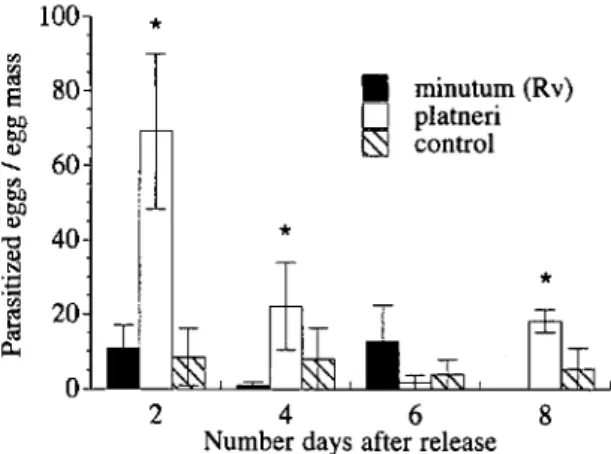
Fig. 3. Parasitism of sentinel obliquebanded leafroller egg masses in an apple orchard following inundative re-lease of Trichogramma spp. Sentinel egg masses were col-lected and replaced every 2 d after release. *, significant treatment effects.
attached to foliage with tape or glue (Dolphin et al. 1972, Yu et al. 1984a, Andow et a1. 1995). The effect these attachment methods have on search-ing and parasitism by natural enemies is unknown. We speculate the plastic ring around the egg masses used in our study interfered with the ability of female Trichogramma spp. to recognize the egg mass. Trichogramma spp. use antennal drumming to perceive information about their surrounding and to locate and examine potential hosts (Schmidt and Smith 1989). Therefore, substances such as wax paper or plastic may interfere with host rec-ognition. Wing scales, pheromones, and secretions left on the foliage and eggs during oviposition are used by parasitoids to locate hosts (Strand and Vin-sion 1983, Kaiser et al. 1989). Therefore, it is pos-sible that the use of water to attach obliquebanded leafroller egg masses to foliage still underestimates actual parasitism rates and should be examined.
Parasitism of Oblique banded Leafroller Egg Masses by Inundatively Released Trichogramma
spp. Approximately 21,500 Trichogramma were re-leased during each trial. Of these, 57% were fe-males, of which 13% were brachypterous. Parasit-ism declined significantly as time after release increased (F
=
2.89; df=
3, 35;P=
0.049) (Fig. 3). An interaction between species and day was observed (F=
2.189; df=
6, 35; P=
0.067). Therefore, contrasts were constructed for each day to determine species effects. On days 2, 4, and 8,T. platneri parasitized significantly more
oblique-banded leafrollers eggs per egg mass then did T.
minutum (Rv) (day 2: F
=
8.528; df=
1, 35; P =0.006; day 4: F
=
4.860, df=
1, 35; P=
0.034; day 8: F=
10.882; df=
1, 35; P = 0.002). No differences were recorded between parasitism rates in the control and T. minutum (Rv) release plots during any sample.Trichogramma minutum (Rv) does not disperse
>50 m from the point of release (Kot 1964). Our
Trichogramma spp. Searching Ability and the Effect of Provisioning. The ability of
Trichogram-ma spp. to locate and parasitize hosts is influenced
by the complexity of the environment and habitat in which the animal searches (Andow and Prokrym 1990). Hassan (1989) recommended that parasit-aid host location experiments be conducted in the presence of plants under field or semifield condi-tions. In this assay, we also evaluated the effect of provisioning. Provisioning Trichogramma spp. has been shown to increase longevity, fecundity, and parasitism rates and may therefore increase para-sitism performance in the field (Ashley and Gon-zales 1974).
The ability of female Trichogramma spp. to search, locate, and parasitize obliquebanded leaf-roller egg masses in a complex environment con-taining apple trees will be more representative of field performance compared with assays conducted in vials. Provisioning with honey increases
Tricho-gramma spp. longevity and fecundity, and it has
been suggested that provisioned wasps may search for hosts whereas unprovisioned wasps search for food (Ashley and Gonzalez 1974). Therefore, this assay should indicate which Trichogramma spp. will perform better under field conditions and what effect provisioning will have.
No significant (F
=
1.89; df=
1, 71;P=
0.174) differences in parasitism rates resulted from visioning. The number of parastized eggs in pro-visioned cages was 12.1 ± 2.6 (mean ± SE), and in nonprovisioned cages 7.1 ± 2.6 eggs were par-asitized. T. platneri parasitized 12.8±
3.4 eggs per cage which was stastically the same (F = 3.13; df = 1, 71;P
=0.081) as the 6.4±
1.9 eggs per cage parasitized by T. minutum.Low parasitism levels in this assay when com-pared with those obtained in previous assays, prob-ably reflects increased searching time in the com-plex environment (Andow and Prokrym 1990). In addition, we used the fewest females per cage that we felt would provide a measurable level of para-sitism. Significant differences in parasitism rates were observed among insectary shipments, indi-cating variability of parasitoid quality from com-mercial insectaries (F
=
2.86; df=
4, 71; P =0.006).
The manner in which obliquebanded leafroller egg masses were attached to apple leaves signifi-cantly affected parasitism levels by T. minutum (Rv) and T. platneri (F
=
5.35; df=
1, 106; P =0.01). Egg masses attached with plastic had fewer parasitized eggs (1.33 ± 0.9) compared with those attached with water (5.7 ± 1.3) or tape (4.3 ± 1.4). Inhibition of parasitism by T. pretiosum has been reported when shellac was used to attach eggs of the bollworm, Heliothis zea (Boddie), to foliage (Orphanides and Gonzalez 1970).
These findings are important because many studies examining inundative releases of
Tricho-gramma spp. use eggs deposited onto wax paper
which is then attached to foliage or eggs directly
100
*
'"'"
os 80 Ei bl) bl) Q.) 60 ...••.'"
bl)~
*
"C 40 Q.) .!:::! .t:::'"
20~
o
• rninutum (Rv)D
platneri ~ control*
treatment and control plots were separated by only 30 m. Therefore, parasitism in control plots may have resulted from endemic Trichogramma spp. or movement of released parasitoids into these plots (Fig. 3). Although endemic Trichogramma spp. may have parasitized some egg masses in this study, the significant increase in parasitism rates in the T. platneri plots compared with the control is attributable to the inundative releases.
The decline in parasitism after day 2 may have resulted from parasitoids moving out of release plots. Additionally, parasitoids were allowed to emerge for 24 h in the growth chamber before being placed in the field. This probably resulted in large numbers of parasitoids emerging from re-lease containers immediately upon placement in the field with little emergence occurring during subsequent days. Mixed-age parasitoid pupae have been used in field releases to maintain a constant emergence rate over time (Andow et al. 1995). Egg cards containing mixed-aged parasitoids are not commercially available, but placing parasitoids in the field every few days would have the same ef-fect.
The lack of qualifiedlersons to identify
Trich-ogramma spp. preclude us from identifying
spe-cies that emerged from sentinel egg masses in this study. However, it was the goal of this study to determine if inundative releases of Trichogramma spp. could be used to increase parasitism of obli-quebanded leafroller egg masses under field con-ditions, rather than to determine what
Trichogram-ma spp. parasitized them. We did not attempt to
relate environmental conditions to Trichogramma spp. performance, because the goal of this research was to obtain baseline data on oblique banded leaf-roller egg mass parasitism rates from inundative releases of Trichogramma spp. Each release was treated as a blocking factor in our experimental design, and variability caused by different condi-tions was controlled for with this design.
Although laboratory results do not always pre-dict accurately the outcome of field trials (Smith et al. 1986), our laboratory results did indicate that
T. platneri would parasitize more obliquebanded
leafroller egg masses than T minlltllm (Rv). How-ever, the magnitude of difference between parasit-ism rates caused by the 2 species in the field was not indicated by our assays. Field performance is probably influenced by factors that are not easily evaluated in laboratory assays such as environmen-tal conditions and plant structure. Therefore, lab-oratory assays should be restricted to evaluating host acceptance and suitability. We assume that
Trichogramma spp. that do not accept hosts under
these conditions will not parasitize the same host under field conditions. Trichogramma spp. that show a high level of host acceptance in laboratory assays should then be released into small field plots and their performance evaluated. This procedure will eliminate all but 1 assay, and Trichogramma spp. performance will be recorded under real field
conditions which are difficult if not impossible to mimic in laboratory assays.
To further our knowledge of how to manipulate inundative releases of Trichogramma in apple or-chards to aid in the control of obliquebanded leaf-rollers, we need to examine factors that can be modified in the field to influence parasitism. In the current study we released only 1 density of para-sitoids from 1 canopy location; the effect of mod-ifying these are .unknown. Increased parasitism of spruce budworm egg masses has occurred by re-leasing more T. minutum, but the relationship was not linear (Smith et al. 1986). Releases of T.
min-urum
into apple at different canopy positions had no effect on the location of parasitized codling moth eggs, which were parasitized to the greatest extent near the bottom of the tree (Yu et al. 1984b). However, Zhilyaeva et al. (1975) reports T.minutum colonized apple trees uniformly. On
bal-sam fir, Abies balsa mea L., T minlltllm caused the greatest level of spruce budworm egg parasitism in the upper canopy (Smith et al. 1986, Smith 1988). These variable results indicate the need to study each Trichogramma spp. in the environment of the targeted host.
Acknowledgment
We thank Cindy Smith (Cornell University) for main-taining the oblique banded leafroller colonies used during this study.
References Cited
Abacus Concepts. 1989. SuperANOVA. Abacus Con-cepts. Berkeley. CA.
Abbott, W. S. 1925. A method of computing the ef-fectiveness of an insecticide.
J.
Econ. Entomol. 18: 265-267.Andow, D. A., and D. R. Prokrym. 1990. Plant stmc-tura] complexity and host-Hnding by a parasitoid. Oec-ologia 82: 162-16.'5.
Andow, D. A., G. C. Klacan, D. Bach, and T. C. Lea-hy. 1995. Limitations of TricllOgramma Iluhilale
(Hymenoptera: Trichogrammatidae) as an inundative biological control of Ostrillia Iluhila/is (Lepidoptera: Crambidae). Environ. Entomol. 24: 1352-13.'57. Ashley, T. R., and D. Gonzalez. 1974. Effect
ofvar-ious food substances on longevity and fecundity of
Trichogrmllllla. Environ. Entomol. 3: 169-171. Bai, B. B., and S. M. Smith. 1994. Patterns of host
exploitation by the parasitoid wasp TricllOgrallllllll
lIIillUtUIII (Hymenoptera: Trichogrammatidae) when attacking eggs of the spmce budworm (Lepidoptera: Tortricidae) in Canadian forests. Ann. Entomol. Soc. Am. 87: 546-553.
Chapman, P.J.,and S. E. Lienk. 1971. Tortricid fau-na of apple in New York. N.Y. State Agricultural Ex-periment Station. Geneva Spec. Publ. 87-90. Dolphin, R. E., M. L. Cleveland, T. E. Mouzin, and
R. K. Morrison. 1972. Releases of TricllOgramllUl
lIIillutum and T.cacoccillCin an apple orchard and the effects on populations of codling moths. Environ. En-tomol. 1: 481-484.
Glass, E. H., and G.E.R. Hervey. 1962. Continuous rearing of the red-banded leafroller, Argyrotaenia
ue-luthuma.
J.
Econ. Entomol. .5.5:336-340.Hassan, S. A. 1989. Selection of suitable Trichogram-ma stains to control the codling moth Cydia
P01ll0-/lelia and the two summer fruit tortrLx moths Adoxo-phyes oralla, Pandemis heparana [Lep.: Tortricidae].
Entomophaga 34: 19-27.
1990. A simple method to select effective
Trichogram-ma strains for use in biological control, pp. 210-204.
In E. Wajnberg and S. B. Vinson [eds.], Trichogram-ma and other egg parasitoids. INRA, Paris 1991 (Les Colloques n°.56).
1994. Strategies to select Trichogram1lla species for use in biological control, pp . .54-71.IIIE. Wajnberg and S. A. Hassan [eds.], Biological control with egg parasitoids. CAB International. BiddIes Ltd. Guild-ford and King's L)~m, Great Britain.
Houseweart, M. W., S. G. Southard, and D. T. Jen-nings. 1982. Availabilityand acceptability of spruce budworm eggs to parasitism by the egg parasitoid
TridlOgramma millutum (Hymenoptera:
Trichogram-matidae). Can. Entomol. 114: 6.57-666.
Houseweart, M. W., D. T. Jennings, C. Welty, and S. G. Southard. 1983. Progeny production by
Trich-ogralllllUl millutu1ll (H~nenoptera: Trichogrammati-dae) utilizing eggs of CllOristolleura fumiferalla (Lep-idoptera: Tortricidae) and Sitotroga cerealella
(Lepidoptera: Gelechiidae). Can. Entomol. 11.5: 1245-12.52.
Kaiser, L. M., H. Pham-Delegue, E. Bakchine, and C. Masson. 1989. Olfactory responses of
Trichogram-ma Trichogram-maidis Pint.: effect of chemical cues and
behav-ioral plasticity.
J.
Insect Behav. 2: 701-712.Klomp, H., B. J. Teerink, and W. C. Ma. 1980. Dis-crimination between parasitized and unparasitized hosts in the egg parasite Tric1lOgramma emb ryophag-!till(Hym., Trichogrammatidae): a matter of learning and forgetting. Neth.
J.
Zool. 30: 2.54-277.Kot, J. 1964. Experiments in the biology and ecology of species of the genus Trichogramma Westw. and their use in plant protection. Ekol. Pol. Ser. A 12: 1-59.
Lawson, D. S., W. H. Reissig, A. M. Agnello, J. P. Nyrop, and W. L. Roelofs. 1996. Interferencewith the mate-finding communication of the oblique band-ed leafroller (Lepidoptera: Tortricidae) using synthetic sex pheromones. Environ. Entomol. 2.5: 89.5-905. Manweiller, S. A. 1986. Developmental and ecological
comparisons of Tric1lOgramma mirwtum and
Tricho-gramma platlleri (H)~nenoptera: TrichoTricho-grammatidae).
Pan-Pac Entomol. 62: 128-139.
Newton, P.]. 1993. Increasing the use of trichogram-matids in insect pest management: a case study from the forests of Canada. Pestic. Sci. 37: 381-386.
Orphanides, G. M., and D. Gonzales. 1970. Effects of adhesive materials and host location on parasitiza-tion by a uniparential race of Trichogramllw
pretios-um.
J.
Econ. Entomol. 63: 1891-1897.Pak, G. A. 1986. Behavioral variations among strains of Trichogramllw SPP.: a review of the literature on host-age selection.
J.
Appl. Entomol. 101: 55-64. Ruberson, J. R., M. J. Tauber, and C. A. Tauber.1987. Biotypes of Eclovum puttleri (Hymenoptera: Eulophidae) responses to developing eggs of the Col-orado potato beetle (Coleoptera: Chrysomelidae). Ann. Entomol. Soc. Am. 80: 451-455.
Salt, G. 1937. The sense used by Tric1wgramllla to distinguish between parasitized and unparasitized hosts. Proc. R. Soc., Lond. 122: 57-75.
Schmidt, J.M. 1994. Host recognition and acceptance by TrichogramllUl, pp. 165-200. In E. Wajnberg and S. A. Hassan [eds.], Biological control with egg para-sitoids. Biddies London.
Schmidt, J. M., and J.J.B. Smith. 1989. Host exam-ination walk and oviposition site selection of
Tlic1w-gramllUl minutum: studies on spherical hosts.
J.
Insect Behav. 2: 143-171.Smith, S. M. 1988. Pattern of attack on spmce bud-worm egg masses by TrichogramllUl minlltum (Hy-menoptera: Trichogrammatidae) released in forest stands. Environ. Entomol. 17: 1009-1015.
Smith, S. M., M. Hubbes, and J. R. Carrow. 1986. Factors affecting inundative releases of TriclwgrmnnUl minlltll1ll Ril. against the spmce budworm, pp. 29-39. S~nposium on Trichogramma and other egg parasites, XVII International Congress of Entomology, Ham-burg, FRG.
Strand, M. R., and S. B. Vinsion. 1983. Analyses of an egg recognition kairomone of Telenomlls heliothidis (Hym: Scelionidae). Isolation and function.
J.
Chern. Eco!. 9: 423-432.Yu, D.S.K, E.A.C. Hagley, and J. E. Laing. 1984a. Biology of Trichogrmnnw minutu1Il Riley collected
from apples in southern Ontario. Environ. Entol11o!.
13: 1324-1329.
Yu, D.S.K, J. E. Laing, and E.A.t. Hagley. 1984b. Dispersal of Trichogramma spp. (Hymenoptera: Tri-chogrammatidae) in an apple orchard after inundative releases. Ell\~ron. Entomo!. 13: 371-374.
Zhilyaeva, V. M., V. I. Pilipyuk, and V. A. Shchepeti-l'nikova. 1975. Influence of behavior of
TricllO-gramma on its parasitism of eggs of the codling moth
in the crown of apple trees, pp. 52-55. In V. 1'. Pris-tavko [ed.], Insect behavior as a basis for developing control measures against pests of field crops and for-est. Naukova Dumka, Kiev.
Received for publication 16 April 1996; accepted 13 December 1996.
![Fig. 1. (a) Parasitism of 4 obliquebanded leafroller egg mass age classes by gravid T platneri, T pretiostl/lI, and T minutum produced at 2 different insectaries [(Bl) and (Rv)] and calculated from only parasitized egg mass-es](https://thumb-eu.123doks.com/thumbv2/123doknet/14919547.662258/4.784.403.708.119.728/parasitism-obliquebanded-leafroller-pretiostl-different-insectaries-calculated-parasitized.webp)