M A J O R A R T I C L E
Increased and Expedited Case Detection by Xpert
MTB/RIF Assay in Childhood Tuberculosis:
A Prospective Cohort Study
Andrea Rachow,1,2,3,aPetra Clowes,1,3,aElmar Saathoff,1Bariki Mtafya,3Epiphania Michael,3Elias N. Ntinginya,3 Dickens Kowour,3Gabriel Rojas-Ponce,3Arne Kroidl,1,3Leonard Maboko,3Norbert Heinrich,1Klaus Reither,1,4,5and Michael Hoelscher1
1Division of Infectious Diseases and Tropical Medicine, Medical Center of the University of Munich (LMU),2National Center for Infectious Diseases of Germany;3National Institute of Medical Research–Mbeya Medical Research Programme, Tanzania;4Swiss Tropical and Public Health Institute, and 5University of Basel, Switzerland
Background. Diagnosis and timely treatment of tuberculosis in children is hampered by the absence of fast
and reliable tests, especially in the era of human immunodeficiency virus (HIV). The aim of this study was to evaluate the diagnostic performance of the Xpert MTB/RIF assay (Xpert) in children with suspected tuberculosis in a high tuberculosis/HIV-burden setting.
Methods. In a prospective study with a minimum follow-up of 12 months, 164 children with suspected
tuberculosis were assigned to predefined diagnostic subgroups, based on microbiological and clinical findings. Results of smear microscopy and culture were compared against diagnostic performance of Xpert.
Results. Twenty-eight of 164 children (17.1%) had confirmed tuberculosis. Xpert detected 100% (95%
confidence interval [CI], 59.0%–100%) of smear-positive cases and 66.6% (95% CI, 43.0%–85.4%) of culture-positive but smear-negative cases. In the per-sample analysis, Xpert displayed a similar sensitivity (54.7% [95% CI, 42.7%–66.2%]) compared with culture methods. Xpert detected 3-fold more confirmed tuberculosis cases than smear microscopy but with equal rapidity. Four additional cases (8.5%) with clinical tuberculosis but negative culture were diagnosed by Xpert. Testing second and third samples increased sensitivity by 20% and an additional 16%, respectively. When tuberculosis was reliably excluded, Xpert’s specificity was 100%. HIV infection did not affect diagnostic accuracy of Xpert.
Conclusions. Xpert was easy to perform and displayed similar diagnostic accuracy as culture methods in
children with suspected tuberculosis. Rapid turnaround times should reduce treatment delay and improve patient outcome, although sensitivity remains suboptimal and access is dependent on local laboratory infrastructure.
Due to the paucibacillary nature of tuberculosis dis-ease in children and the absence of reliable diagnostic methods, tuberculosis diagnosis in children remains
a great challenge. Even under optimized conditions, smear microscopy, which is the standard diagnostic method in developing countries, is positive in ,10%– 15% of children with suspected tuberculosis [1, 2]. Likewise, culture—which is considered the gold stan-dard in adult tuberculosis diagnosis—has been shown to be insensitive in children because it remains negative in 20%–80% of all childhood tuberculosis cases, de-pending on the manifestation and the stage of the disease [1, 3–5]. The tuberculin skin test, although helpful in certain settings, cannot differentiate between latent and active tuberculosis disease [6,7]. Therefore, tuberculosis diagnosis in resource-limited, tuberculosis-endemic a
A. R. and P. C. contributed equally to this study.
Correspondence: Andrea Rachow, MD, Division of Infectious Diseases and Tropical Medicine, Medical Center of the University of Munich (LMU), Leopoldstrasse 5, 80802 Munich, Germany ([email protected]).
Ó The Author 2012. Published by Oxford University Press on behalf of the Infectious Diseases Society of America. All rights reserved. For Permissions, please e-mail: [email protected].
DOI: 10.1093/cid/cis190
Clinical Infectious Diseases 2012; ( ):54101388 96–
Received 19 August 2011; accepted 9 January 2012; electronically published 3 April 2012.
countries is mainly based on clinical and radiological findings, as well as medical history [8].
New methodologies to improve tuberculosis diagnosis in children have been described recently [6,9]. Among them are refined clinical scoring [10,11], enhanced techniques of sample
collection [2, 12], and new microbiological and
immuno-logical methods [13–15]. In particular, the development of nucleic acid amplification tests (NAATs) holds promise. However, although several studies on diagnostic accuracy of (commercial) NAATs in adults were published with con-siderably heterogeneous results [13, 16], very few data are available on children [15,17].
In December 2010, the Xpert MTB/RIF assay (Xpert; Cepheid) was endorsed by the World Health Organization (WHO) for direct tuberculosis screening on sputum samples [18]. This test features many advantages compared with other commercial NAATs, including the possibility for parallel de-tection of Mycobacterium tuberculosis and resistance to rifam-picin, a hands-free cartridge system that can be used after only a brief training period, and a time to result of approximately 2 hours [19]. The Xpert was evaluated in clinical trials in adults, and most recently also in children with suspected tu-berculosis, and showed good sensitivity and specificity in smear-positive and culture-positive and reasonable accuracy in smear-negative but culture-positive sputum samples [20–23]. Looking at these data, as well as the excellent technical char-acteristics, the assay might be considered a promising di-agnostic test in childhood tuberculosis that is simple enough to be used outside central laboratories, and thus could be operated closer to the patients. The aim of this study was to explore the diagnostic performance of the Xpert and to esti-mate its impact on time to diagnosis and treatment initiation in a cohort of children with suspected tuberculosis in a tu-berculosis/human immunodeficiency virus (HIV)–endemic, resource-constrained setting.
METHODS
Ethical Approval and Informed Consent
The study was approved by the local Mbeya Medical Research and Ethics Committee and the National Ethical Committee at the National Institute of Medical Research (NIMR) in Tanzania. Written informed consent for all children was obtained from an accompanying parent or a legal guardian. In addition, children aged $9 years signed an assent form.
Study Setting
The study was conducted at the NIMR-Mbeya Medical Research Programme (MMRP) in close collaboration with the Mbeya Referral Hospital (MRH). The Mbeya region (located in southwest Tanzania) has a high burden of tuberculosis and
HIV, with approximately 3600 cases of tuberculosis detected in 2006, and an HIV prevalence of 16.6% in people between
15 and 49 years of age [24]. HIV prevalence in children
2–15 years of age was 1.5% across the region (our unpublished data, 2006–2009).
Study Population and Clinical Procedures
One hundred eighty children aged 6 weeks to 14 years with clinical signs of tuberculosis were enrolled in the study and prospectively followed up for a minimum of 12 months. All children had at least 1 of the following symptoms: persistent, unremitting cough for .21 days; repeated episodes of fever within the last 21 days; weight loss or failure to thrive within the previous 3 months; or signs and symptoms suggestive of extrapulmonary tuberculosis. Children who had received tu-berculosis treatment within the last 3 months were excluded from the study. Whereas 140 children sought healthcare on their parents’ initiative and presented to the MRH, 40 children with tuberculosis symptoms were identified through contact tracing of smear-positive relatives. Sixty-nine children were recruited while hospitalized.
Recruitment procedures comprised interviews regarding medical history and full clinical examination, both according to standardized data recording forms, anterior-posterior chest radiography, blood sample collection, and HIV pre- and posttest counseling (data-capturing forms are available as onlineSupplementary Material 1). Anthropometric data were measured at baseline, and each follow-up visit and corre-sponding z scores were calculated to monitor the nutritional status of the children, using the WHO child growth standards data as a reference [25,26]. All study participants underwent a tuberculin skin test (TST) in a standardized fashion [14]. At baseline, every patient provided up to 3 sputum samples for analysis. In 41.5% of children who were unable to produce a sputum sample spontaneously, induced sputum was ob-tained in accordance with standardized protocol. Other clinical specimens for microbiological investigations were collected if possible and if clinically indicated.
Based on clinical, radiological, and microbiological findings at baseline and during follow-up, 164 children were assigned to predefined diagnostic classification groups as described previously [14] (Figure 1). Follow-up visits were scheduled at 3, 6, and 12 months after enrollment or in case of tuberculosis treatment at 3, 6, and 12 months after treatment initiation. Patients were asked to make unscheduled visits in case their clinical condition deteriorated.
A decision on tuberculosis treatment initiation was made in liaison with the pediatric department of the MRH and the District Tuberculosis and Leprosy Coordinators and was based on microbiological or histological data, clinical findings (including TST and chest radiography), and clinical history.
Xpert results were not included in the diagnostic algorithm. Antituberculosis therapy was administered following Tanzanian National Guidelines. Patients diagnosed with HIV infection were referred for further staging and treatment to the relevant HIV Care and Treatment Centers.
Laboratory Procedures
Untreated sputum samples were vortexed for 5 minutes and split into 2 aliquots; 1 was stored at 220°C and the other was
de-contaminated by the N-acetyl-L-cysteine–sodium hydroxide
(NALC-NaOH) method (seeSupplementary Figure 1). In brief, the sample was mixed with an equal volume of NALC-NaOH (0.5% NALC, 2% NaOH, 1.45% sodium citrate), incubated at room temperature for 20 minutes, and neutralized with phosphate-buffered saline (total volume, 50 mL). After cen-trifugation (3500g, 20 minutes, 4°C), the resulting pellet was processed for standard sputum microscopy after Ziehl-Neelsen staining and culture on both Lowenstein-Jensen media (LJ) and BACTEC MGIT 960 liquid culture (Becton Dickinson). Species determination was performed by Genotype Myco-bacterium MTBC, CM, and AS tests (Hain Lifescience). Drug susceptibility was tested using SIRE test kits in the BACTEC MGIT system. The remaining decontaminated sputum pellet was stored at 220°C.
Laboratory personnel involved in the evaluation of Xpert were blinded for all other laboratory results of the relevant sputum sample and corresponding clinical diagnosis. All sputum samples tested by Xpert assay were processed according to the manufacturer’s instructions [19].
Statistical Analysis
Stata (version 11; StataCorp) was used for data analysis and to produce graphs. First, diagnostic performance of Xpert was compared with the primary reference standard, which was at least 1 M. tuberculosis–positive culture in up to 3 col-lected respiratory samples. In addition, Xpert performance (and performance of other microbiological tests) was com-pared with clinical diagnosis of tuberculosis. Confidence intervals (CIs) for the mean (eg, sensitivity and negative predictive value) of binary variables were calculated using the formula for exact binomial CIs. Probability values to compare whether the diagnostic performance of Xpert (eg, sensitivity) was significantly different from the perfor-mance of the other methods were calculated using McNemar test. Associations between Xpert positivity (binary outcome variable) and other factors were assessed using univariable and multivariable Poisson regression models with robust (Huber-White) variance estimates adjusted for clustering
Figure 1. Diagnostic classification of children presenting with suspected tuberculosis. *In total, 469 sputum samples, 2 pleural fluid samples, 1 sample from lymph node aspiration, and 1 ascites sample were obtained for microbiological investigations. No gastric aspirates were collected. Abbreviations: CSF, cerebrospinal fluid; HIV, human immunodeficiency virus; TST, tuberculin skin test.
by participant [27,28]. All P values reported in this manu-script are 2-sided.
RESULTS
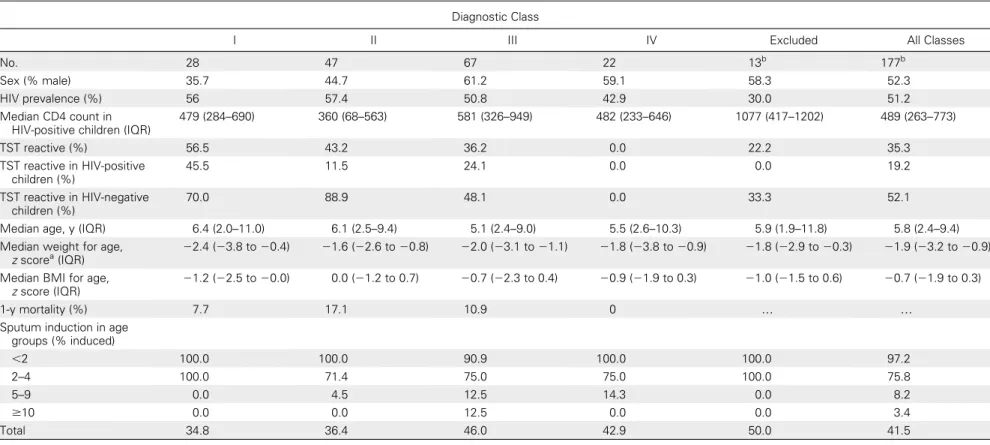
One hundred eighty children with suspected tuberculosis were enrolled between May 2008 and November 2010. Sixteen participants with an incomplete set of data were excluded from further analysis, and 164 children were assigned to 1 of the 4 predefined diagnostic classification groups (Figure 2). Demographical and clinical data of all children at the time of enrollment are displayed inTable 1.
Twenty-eight of 164 children (17.1%) had microbiologi-cally confirmed tuberculosis with at least 1 culture positive for M. tuberculosis. The Xpert detected 21 (75%; 95% CI, 55.1%–89.3%) of these culture-confirmed tuberculosis cases, with 100% sensitivity (95% CI, 59.0%–100%) in the 7 smear-positive children and with 66.6% sensitivity (14 of 21 children; 95% CI, 43.0%–85.4%) in the culture-positive but smear-negative children (Table 2). Compared with LJ and MGIT alone,
Xpert diagnosed 82.6% (95% CI, 65.8%–99.4%) of LJ-positive and 83.3% (95% CI, 67.3%–99.4%) of MGIT-positive cases.
The per-sample analysis of the 77 sputum samples collected from class I illustrates the limitations of all diagnostic tests to consistently find M. tuberculosis in the sputa of children with microbiologically confirmed tuberculosis. Whereas smear microscopy detected tuberculosis in only 19.5% of cases, solid and liquid culture and Xpert had a sensitivity of 55.3%, 54.7%, and 54.7%, respectively. Notably, not all assays were positive in the same samples, and as a consequence the com-bination of all diagnostic tests increased the overall sensitivity to 77.9% (Supplementary Table 1).
Of the 47 children in class II with clinical tuberculosis diagnosis but no microbiological proof, 4 cases (8.5% of 47) were detected by Xpert. According to the definition of the clinical classification, these children had a very high likelihood of active tuberculosis and therefore may be as-sumed as correctly diagnosed tuberculosis cases. Thus, Xpert increased the total diagnostic sensitivity by 5.4% from 37.3% to 42.7% (Table 2). It is important to note that in class I
Figure 2. Recruitment and diagnostic classifications of participants. *Twenty-eight children had microbiological confirmation of Mycobacterium tuberculosis, of whom 7 were positive on acid-fast stains. Twenty-four of 28 children showed sustained clinical improvement after initiation of antituberculosis therapy. Two children were lost to follow-up, and 2 children died either immediately after baseline investigations or soon after tuberculosis treatment initiation. Forty-seven children had highly probable tuberculosis, although no microbiological confirmation was possible; of these, 34 showed sustained clinical improvement after tuberculosis treatment initiation; 2 children were lost to follow-up before treatment could be started; and 4 children died during treatment; 2 children died before treatment could be initiated, and 5 children died despite taking tuberculosis medication during the course of the study. Abbreviations: TST, tuberculin skin test; Xpert, Xpert MTB/RIF assay.
Table 1. Demographic and Clinical Characteristics of Children by Clinical Classification Group
Diagnostic Class
I II III IV Excluded All Classes
No. 28 47 67 22 13b 177b
Sex (% male) 35.7 44.7 61.2 59.1 58.3 52.3
HIV prevalence (%) 56 57.4 50.8 42.9 30.0 51.2
Median CD4 count in HIV-positive children (IQR)
479 (284–690) 360 (68–563) 581 (326–949) 482 (233–646) 1077 (417–1202) 489 (263–773) TST reactive (%) 56.5 43.2 36.2 0.0 22.2 35.3 TST reactive in HIV-positive children (%) 45.5 11.5 24.1 0.0 0.0 19.2 TST reactive in HIV-negative children (%) 70.0 88.9 48.1 0.0 33.3 52.1
Median age, y (IQR) 6.4 (2.0–11.0) 6.1 (2.5–9.4) 5.1 (2.4–9.0) 5.5 (2.6–10.3) 5.9 (1.9–11.8) 5.8 (2.4–9.4)
Median weight for age, z scorea(IQR)
22.4 (23.8 to 20.4) 21.6 (22.6 to 20.8) 22.0 (23.1 to 21.1) 21.8 (23.8 to 20.9) 21.8 (22.9 to 20.3) 21.9 (23.2 to 20.9)
Median BMI for age, z score (IQR)
21.2 (22.5 to 20.0) 0.0 (21.2 to 0.7) 20.7 (22.3 to 0.4) 20.9 (21.9 to 0.3) 21.0 (21.5 to 0.6) 20.7 (21.9 to 0.3)
1-y mortality (%) 7.7 17.1 10.9 0 . .
Sputum induction in age groups (% induced) ,2 100.0 100.0 90.9 100.0 100.0 97.2 2–4 100.0 71.4 75.0 75.0 100.0 75.8 5–9 0.0 4.5 12.5 14.3 0.0 8.2 $10 0.0 0.0 12.5 0.0 0.0 3.4 Total 34.8 36.4 46.0 42.9 50.0 41.5
Site of tuberculosis for clinical classification I [29]: 28 children with intrathoracic tuberculosis: 10 hiliar lymphadenopathy, 4 lymphobronchial tuberculosis, 6 tuberculous bronchopneumonia, 1 miliary tuberculosis, 4 tuberculous pleural effusion; 3 children had no radiograph but had Mycobacterium tuberculosis–positive sputum culture. Site of tuberculosis for clinical classification II [29]: 46 children with intrathoracic tuberculosis: 10 hiliar lymphadenopathy, 12 lymphobronchial tuberculosis, 12 tuberculous bronchopneumonia, 5 miliary tuberculosis, 6 tuberculous pleural effusion, 1 primary cavitating pulmonary tuberculosis; 1 child had inguinal tuberculosis adenitis.
Abbreviations: BMI, body mass index; HIV, human immunodeficiency virus; IQR, interquartile range; TST, tuberculin skin test. a
Only available for children aged #10 years due to lack of reference data for older children. b
For 3 of the 16 children who were excluded, no further clinical data were available.
Rachow d 1 3 d C ID 2 0 1 2 :5 4 (1 5 M ay ) 92
and class II combined, sensitivity of the Xpert assay was higher than that of solid culture or liquid culture alone, both in the per-patient and the per-sample analyses (Table 2;Supplementary Table 1), although this difference was not significant.
When analyzing all received samples (214) in class I and II in order of their collection, there was a substantial gain in sensi-tivity when a second sample was evaluated (Figure 3). This observation was valid for all diagnostic assays: the incremental yield was at least 14.3% for smear (1 case) and maximal 29.2% (7 cases) for MGIT. In case of a third sample analyzed, the
incremental yield was 13% (3 cases) for LJ and 16% (4 cases) for Xpert. However, if all methods had been applied in parallel, 26 of 32 detected cases would have already been identified in the first sample.
Figure 3. Gain in cases per additional analyzed sample. Number of additional cases detected by analyzing a second and third sample from study participants in diagnostic classes I and II (n 5 75), displayed for each diagnostic test. In 65 children, 3 samples were collected; 9 children gave 2 samples; and in 1 child only 1 sample was collected. Abbreviations: LJ, Lowenstein-Jensen culture on solid media, speciation result included; MGIT, BACTEC MGIT 960 liquid culture, speciation result included; smear, sputum smear microscopy after Ziehl-Neelsen staining; Xpert, Xpert MTB/RIF assay.
Table 2. Sensitivity of Each Diagnostic Test in Per-Patient Analysisa,b
Diagnostic Class (no.)
I (28) II (47) I and II Combined (75) III (67)c
Diagnostic Test Positive, no., %, (95% CI), P Value Positive, no., %, (95% CI), P Value Positive, no., %, (95% CI), P Value Positive, no., %, (95% CI) Smear 7 25.0 (10.7–44.9) ,.001 0 0.0 (.0–7.5) .125 7 9.3 (3.8–18.3) ,.001 0 0.0 (.0–5.4) MGIT 24 85.7 (67.3–96.0) .375 0 0.0 (.0–7.5) .125 24 32.0 (21.7–43.8) 1.000 0 0.0 (.0–5.4) LJ 23 82.1 (63.1–93.9) .688 0 0.0 (.0–7.5) .125 23 30.7 (20.5–42.4) .754 0 0.0 (.0–5.5) Xpert 21 75.0 (55.1–89.3) . 4 8.5 (2.4–20.4) . 25 33.3 (22.9–45.2) . 0 0.0 (.0–5.4) MGIT and LJ 28 100 (87.7–100) .016 0 0.0 (.0–7.5) .125 28 37.3 (26.4–49.3) .549 0 0.0 (.0–5.4)
MGIT, LJ, and Xpert 28 100 (87.7–100) .016 4 8.5 (2.4–20.4) 1.000 32 42.7 (31.3–54.6) .016 0 0.0 (.0–5.4)
Abbreviations: CI, confidence interval; LJ, Lowenstein-Jensen culture on solid media, includes speciation result; MGIT, BACTEC MGIT 960 liquid culture, includes speciation result; smear, sputum smear microscopy after Ziehl-Neelsen staining; Xpert, Xpert MTB/RIF assay; %, sensitivity of diagnostic test in percentage.
a
False-positive rate (the percentage of positives in diagnostic class IV) was 0% for all diagnostic tests.
b
Positive predictive value was 100% for all diagnostic tests; negative predictive value for each diagnostic test can be found inSupplementary Table 2A.
c
In clinical class III, LJ was performed in only 65 children.
Evaluation of Xpert Assay in Childhood Tuberculosis d CID 2012:54 (15 May) d 1393 If compared with culture as reference standard (class I, 77 samples), sensitivity of Xpert was 46.4% in the first sample vs 75% sensitivity in culture (LJ and MGIT combined). Xpert’s sensitivity rose to 60.7% vs 96.4% for culture and 75% vs 100% for culture, respectively, if second and third samples were analyzed (data not shown).
Univariable and multivariable Poisson regression showed that a higher age and an increased severity of clinical condition were significantly associated with Xpert positivity. Other variables such as HIV status or sample status might have influenced Xpert performance to a certain degree, although none of these associations were significant when adjusted for other variables. Notably, in univariable analysis, induced sputum samples were found significantly less often to be Xpert positive than non-induced sputum samples. However, when adjusted for age, induced sputum samples appeared .4 times more likely to be
Xpert positive than noninduced sputum samples (
Supple-mentary Table 3).
Xpert identified no child in class IV as positive, which resulted in a false-positive rate of 0%. In addition, of 26 sputum samples growing nontuberculosis mycobacteria on solid or in liquid culture, none were reported as positive by Xpert. In concordance with the results of resistance testing in liquid culture, there was no rifampicin resistance detected by Xpert.
Median time from enrollment to detection of tuberculosis was 1 (range, 1–3) day for smear, 21 (range, 11–59) days for MGIT, and 30 (range, 14–79) days for LJ (Figure 4) for patients in clinical class I. Assuming that Xpert results would be available at the latest 1 day after sample collection (sample turnaround time of 1 day), the median time from enrollment to tuberculosis diagnosis would be 2 (range, 1–12) days for Xpert. The slight difference compared with microscopy reflects the fact that Xpert, as opposed to smear, has the capacity to detect cases with lower bacterial load that were only identified in the second and third samples [21,30].
The median time to tuberculosis treatment initiation in classes I and II was 8.5 days (range, 0–77) and 17 days (range, 1–745), respectively. Although for all children in class I a mi-crobiologically confirmed diagnosis was finally existent, lab-oratory results were the basis for treatment initiation in only 16 of 28 children (57.1%). Seven of these 16 children were smear positive and received treatment within 1 week after enrollment. In the remaining 9 children, antituberculosis therapy was started within 15–59 days after obtaining a positive-culture result. Two of 28 children (7.1%) children in class I did not receive treatment because they were lost to follow-up while culture results were pending for .1 month. Assuming that the interval from a positive result in the labo-ratory to treatment initiation in the clinic would be similar for Xpert and microscopy (1.7 days), it was calculated that 25% of all Xpert-positive cases could have received tuberculosis treatment 31 or more days earlier, and 50% of them could have received treatment 6 or more days earlier, if Xpert had been included in the diagnostic algorithm.
DISCUSSION
Worldwide, the majority of tuberculosis in children is diagnosed and treated on clinical grounds. This is not only due to the constrained diagnostic capacities in most tuberculosis-endemic countries, but also because of multiple shortcomings of the current diagnostic tests in childhood tuberculosis. Here, we present data on a clinical evaluation of Xpert in children. Our study was performed in a high tuberculosis/HIV-burden set-ting, where .50% of the study participants were HIV-positive. In this prospective study, we consecutively enrolled children suspected of having tuberculosis at the moment of their presentation to the healthcare system, without applying any preselection. A long follow-up period of at least 12 months up
Figure 4. Proportion of detected tuberculosis cases versus time to tuberculosis detection. Proportion of detected tuberculosis cases by each diagnostic test and test combinations displayed as percentages of all tuberculosis cases (children in diagnostic classes I and II combined, n 5 75). Time to tuberculosis detection was considered as the number of days from enrollment until positive tuberculosis test result was received in the tuberculosis laboratory. For calculations in Xpert, a sample turnaround time of 1 day (similar to smear microscopy) was considered. All collected samples were included: in 65 children, 3 samples were collected; in 9 children, 2 samples were collected; and in 1 child, only 1 sample was collected. Results positive by a certain test if at least 1 of up to 3 collected samples was positive. Seven (9.3%; 95% confidence interval [CI], 3.8%–18.3%) children were smear positive, 23 (30.7%; 95% CI, 20.5%–42.4%) were LJ positive, 24 (32.0%; 95% CI, 21.7%–43.8%) were MGIT positive, 25 (33.3%; 95% CI, 22.9%–45.2%) were Xpert positive, 28 (37.3%; 95% CI, 26.4%–49.3%) were positive by MGIT and LJ combined, and 32 (42.7%; 95% CI, 31.3%–54.6%) were positive when all diagnostic tests were combined. Abbreviations: Smear, sputum smear microscopy after Ziehl-Neelsen staining; LJ, Lowenstein-Jensen culture on solid media, speciation result included; MGIT, BACTEC MGIT 960 liquid culture, speciation result included; Xpert, Xpert MTB/RIF assay.
to 3 years ensured that the participating children were reliably categorized into the 4 diagnostic classes.
The accuracy data of Xpert in smear-positive (100% sensi-tivity) and smear-negative (66.6% sensisensi-tivity) culture-confirmed tuberculosis cases were similar to data published for hospitalized children in South Africa [23]. In both pediatric study cohorts, Xpert flagged 75% of all culture-confirmed cases. However, the majority of children in this study were diagnosed with tuber-culosis on clinical grounds. Due to its low sensitivity in children, culture is an imperfect reference standard to compare if new, potentially more sensitive, diagnostic tests are evaluated. Xpert detected 4 additional cases among the children with clinical tuberculosis diagnosis. Based on the high specificity of Xpert in children without tuberculosis and the criteria for a clinical tuberculosis diagnosis in this study, these 4 additional cases can be considered as correctly diagnosed. However, when looking at the total number of children with tuberculosis, even the combination of Xpert and culture reached only un-satisfactory sensitivity, which rendered tuberculosis diagnosis still dependent on clinical judgment in most cases.
As reported elsewhere [13,23,31], we also demonstrated that in children, multiple sampling seems to be required to achieve reasonable sensitivity, regardless of the type of investigated specimen and the test under evaluation. Specifically for Xpert, our data showed incremental yields of 20% and 13% for the second and third samples, respectively. In the study by Nicol et al [23], sensitivity was increased by 27.8% by testing a second sample with Xpert in children with smear-negative results only. A third sample was not evaluated. Notably, by testing 2 induced sputum samples, the same sensitivity was reached with Xpert as in our study in which 3 samples were collected in most children. Although less tolerated by older children, the data from the study by Nicol et al and also from our study suggest that a consequent implementation of sputum induction could increase Xpert’s sensitivity.
More importantly, in concordance with our own results in adults [21] and data from Boehme et al [22], HIV status did not influence the diagnostic performance of Xpert in children. Surprisingly, and contrary to our data, the study by Nicol et al showed a 100% Xpert sensitivity in HIV-infected children [23]. In terms of identifying M. tuberculosis in sputum samples of the 75 children with a tuberculosis diagnosis, both culture and Xpert showed very comparable sensitivity: solid culture de-tected 23 cases (30.7%), MGIT dede-tected 24 cases (32.0%), and Xpert detected 25 cases (33.3%). The generally low myco-bacterial load in respiratory samples of children seems to be the limiting factor for all assays. Therefore, the diagnostic potential of Xpert in other types of specimens—such as gastric lavage, stool, urine, blood, or fine-needle aspiration from lymph nodes that may contain a higher number of myco-bacteria or are easier to obtain—should be explored further.
However, the most relevant finding of this study is that the use of the Xpert assay has the potential to shorten time to tuberculosis diagnosis and thus to treatment initiation. With 7 smear-positive but 25 Xpert-positive results among children in our cohort, Xpert has more than tripled the number of cases with an early tuberculosis diagnosis.
We also observed a marked but not significant difference in mortality between classes I and II (Table 1). However, while applying multiple regression analysis in this small number of samples, we were not able to identify time to treatment or any other clinical factor that was associated with mortality.
We demonstrated that the addition of Xpert to the pediatric diagnostic algorithm would not only increase the overall number of microbiologically detected cases, but it would also shorten time to diagnosis. Compared with adults, this effect is more significant in children because the paucibacillary nature of pediatric tuberculosis infection leads to lower initial smear-positivity rates than those seen in adults.
Supplementary Data
Supplementary materialsare available at Clinical Infectious Diseases online (http://www.oxfordjournals.org/our_journals/cid/).Supplementary materials
consist of data provided by the author that are published to benefit the reader. The posted materials are not copyedited. The contents of allsupplementary dataare the sole responsibility of the authors. Questions or messages regarding errors should be addressed to the author.
Notes
Acknowledgments. We thank the staff at the Active Detection of Ac-tive Tuberculosis (ADAT) tuberculosis clinic and the laboratories at NIMR-MMRP (Mbeya, Tanzania) for their dedicated work as well as the children and their parents or guardians who agreed to participate in this study.
Financial support. This work was part of the ADAT project, which is supported by the European Union (contract number SANTE/2006/129-931). This work was also supported by a grant of the German Ministry of Science (BMBF; study number 01KA0902). The funders had no role in study design, data collection and analysis, decision to publish, or prepa-ration of the manuscript.
Potential conflicts of interest. All authors: No reported conflicts. All authors have submitted the ICMJE Form for Disclosure of Potential Conflicts of Interest. Conflicts that the editors consider relevant to the content of the manuscript have been disclosed.
References
1. Starke JR. Pediatric tuberculosis: time for a new approach. Tuberculosis (Edinb) 2003; 83:208–12.
2. Zar HJ, Hanslo D, Apolles P, Swingler G, Hussey G. Induced sputum versus gastric lavage for microbiological confirmation of pulmonary tuberculosis in infants and young children: a prospective study. Lancet 2005; 365:130–4.
3. Hatherill M, Hawkridge T, Zar HJ, et al. Induced sputum or gastric lavage for community-based diagnosis of childhood pulmonary tu-berculosis? Arch Dis Child 2009; 94:195–201.
4. Marais BJ, Pai M. Recent advances in the diagnosis of childhood tuberculosis. Arch Dis Child 2007; 92:446–52.
5. Marais BJ, Hesseling AC, Gie RP, Schaaf HS, Enarson DA, Beyers N. The bacteriologic yield in children with intrathoracic tuberculosis. Clin Infect Dis 2006; 42:e69–71.
6. Zar HJ, Connell TG, Nicol M. Diagnosis of pulmonary tuberculosis in children: new advances. Expert Rev Anti Infect Ther 2010; 8:277–88. 7. Hesseling AC, Schaaf HS, Gie RP, Starke JR, Beyers N. A critical review
of diagnostic approaches used in the diagnosis of childhood tubercu-losis. Int J Tuberc Lung Dis 2002; 6:1038–45.
8. Enarson PM, Enarson DA, Gie R. Management of tuberculosis in chil-dren in low-income countries. Int J Tuberc Lung Dis 2005; 9:1299–304. 9. Marais BJ, Pai M. New approaches and emerging technologies in the diagnosis of childhood tuberculosis. Paediatr Respir Rev 2007; 8:124–33. 10. Marais BJ, Gie RP, Hesseling AC, et al. A refined symptom-based ap-proach to diagnose pulmonary tuberculosis in children. Pediatrics 2006; 118:e1350–9.
11. Pedrozo C, Sant’Anna C, de Fatima March M, Lucena S. Clinical scoring system for paediatric tuberculosis in HIV-infected and non-infected children in Rio de Janeiro. Int J Tuberc Lung Dis 2009; 13:413–5. 12. Chow F, Espiritu N, Gilman RH, et al. La cuerda dulce—a tolerability and
acceptability study of a novel approach to specimen collection for di-agnosis of paediatric pulmonary tuberculosis. BMC Infect Dis 2006; 6:67. 13. Oberhelman RA, Soto-Castellares G, Gilman RH, et al. Diagnostic approaches for paediatric tuberculosis by use of different specimen types, culture methods, and PCR: a prospective case-control study. Lancet Infect Dis 2010; 10:612–20.
14. Liebeschuetz S, Bamber S, Ewer K, Deeks J, Pathan AA, Lalvani A. Diagnosis of tuberculosis in South African children with a T-cell-based assay: a prospective cohort study. Lancet 2004; 364:2196–203. 15. Nicol MP, Zar HJ. New specimens and laboratory diagnostics for
childhood pulmonary TB: progress and prospects. Paediatr Respir Rev 2011; 12:16–21.
16. Ling DI, Flores LL, Riley LW, Pai M. Commercial nucleic-acid ampli-fication tests for diagnosis of pulmonary tuberculosis in respiratory specimens: meta-analysis and meta-regression. PLoS One 2008; 3:e1536. 17. Cuevas LE. The urgent need for new diagnostics for symptomatic
tu-berculosis in children. Indian J Pediatr 2011; 78:449–55.
18. World Health Organization. WHO monitoring of Xpert MTB/RIF roll out. Available at:http://www.who.int/tb/laboratory/mtbrifrollout/ en/index.htm. Accessed 16 February 2012.
19. Helb D, Jones M, Story E, et al. Rapid detection of Mycobacterium tuberculosis and rifampin resistance by use of on-demand, near-patient technology. J Clin Microbiol 2010; 48:229–37.
20. Boehme CC, Nabeta P, Hillemann D, et al. Rapid molecular detection of tuberculosis and rifampin resistance. N Engl J Med 2010; 363:1005–15. 21. Rachow A, Zumla A, Heinrich N, et al. Rapid and accurate detection of Mycobacterium tuberculosis in sputum samples by Cepheid Xpert MTB/RIF assay—a clinical validation study. PLoS One 2011; 6:e20458. 22. Boehme CC, Nicol MP, Nabeta P, et al. Feasibility, diagnostic accuracy, and effectiveness of decentralised use of the Xpert MTB/RIF test for diagnosis of tuberculosis and multidrug resistance: a multicentre im-plementation study. Lancet 2011; 377:1495–505.
23. Nicol MP, Workman L, Isaacs W, et al. Accuracy of the Xpert MTB/RIF test for the diagnosis of pulmonary tuberculosis in children admitted to hospital in Cape Town, South Africa: a descriptive study. Lancet 2011; 11:819–24.
24. Arroyo MA, Hoelscher M, Sateren W, et al. HIV-1 diversity and prevalence differ between urban and rural areas in the Mbeya region of Tanzania. AIDS 2005; 19:1517–24.
25. World Health Organization. The WHO child growth standards. 2011. Available at:http://www.who.int/childgrowth/en/. Accessed 24 July 2011. 26. WHO Multicentre Growth Reference Study Group. WHO Child Growth Standards based on length/height, weight and age. Acta Pædiatrica 2006; 450:76–85.
27. Barros AJ, Hirakata VN. Alternatives for logistic regression in cross-sectional studies: an empirical comparison of models that directly es-timate the prevalence ratio. BMC Med Res Methodol 2003; 3:21. 28. Greenland S. Model-based estimation of relative risks and other
epi-demiologic measures in studies of common outcomes and in case-control studies. Am J Epidemiol 2004; 160:301–5.
29. Donald PR, Grange JM. Tuberculosis in childhood. Pretoria, South Africa: JL van Schaik Publishers, 1999:103–18.
30. Blakemore R, Nabeta P, Davidow AL, et al. A multi-site assessment of the quantitative capabilities of the Xpert(R) MTB/RIF assay. Am J Respir Crit Care Med 2011; 184:1076–84.
31. Gomez-Pastrana D, Torronteras R, Caro P, et al. Comparison of amplicor, in-house polymerase chain reaction, and conventional culture for the diagnosis of tuberculosis in children. Clin Infect Dis 2001; 32:17–22.