Experimental and numerical determination of the
hygroscopic warping of cross-laminated solid wood panels
Thomas Gereke
1,*, Per Johan Gustafsson
2,
Kent Persson
2and Peter Niemz
11
ETH Zurich, Institute for Building Materials (Wood
Physics), Zurich, Switzerland
2
Lund University, Division of Structural Mechanics,
Lund, Sweden
*Corresponding author.
ETH Zurich, Institute for Building Materials (Wood Physics), Schafmattstrasse 6, 8093 Zurich, Switzerland
E-mail: [email protected]
Abstract
The moisture-induced warping of three-layered
cross-laminated solid wood panels made of Norway spruce
was studied. The panels were exposed to different
cli-mate conditions at 65% and 100% relative humidity at
the two panel faces. The results showed increasing cup
deformation with an increasing relative thickness of the
outer layers. The annual growth ring orientation was
found to have a significant influence on the magnitude
of the cup deformation. Measurements and numerical
simulations of the moisture distribution within the panel
were made in order to provide data for numerical
simu-lations of the warping. A distinctive moisture profile with
a conspicuous influence of the adhesive bond lines was
found. The coefficient of diffusion of the adhesive bond
lines was determined from the measurements and
sim-ulations. The mechanical material model used for the
warping simulations takes into account elastic strain,
moisture-induced swelling, and mechano-sorptive strain.
The simulations showed good agreement with the
warp-ing test results. The most important material parameters
for the cup deformation, which were identified in a
para-metric study of a panel with vertically oriented annual
rings, are the moduli of elasticity and the swelling
coef-ficients in the longitudinal and radial direction.
Further-more, the mechano-sorptive coefficient in radial direction
was found to have a significant influence on warp.
Keywords: adhesive joint; cross-lamination; cup;
mois-ture; panel; spruce (Picea abies); warp.
Introduction
This work focuses on moisture-induced deformations in
three-layered cross-laminated solid wood panels with a
symmetrical build-up, where the fiber direction of the
middle layer is oriented perpendicular to that of the outer
layers. Dimensional stability, i.e., the ability of resistance
to warp, is of main interest in the application of wood
panels. The cross-lamination of the layers establishes
advantages to avoid warp. The moisture-induced
expan-sion/contraction of each single layer is partly restrained
by the adjacent layers. The free swelling and shrinkage
of adjacent layers differ circa by a factor of 10 (radial/
longitudinal) to 20 (tangential/longitudinal). As a
conse-quence of this difference, stresses and even cracks may
occur. Warping was observed in large-scale panels. This
reduces the serviceability in the practice. Considerable
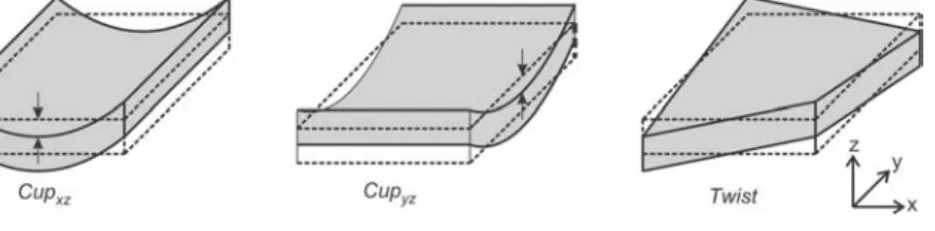
distortions (warp) in the form of cup and twist may occur
due to a climate gradient (Figure 1). The cup deformation
may occur in the xz- and the yz-plane. This is often
termed cup and bow deformation, respectively
(Ormars-son 1999).
Miscellaneous research concerning cross-laminated
wood panels has been carried out in recent years. Mainly
mechanical properties have been tested (Donze´ et al.
2003; Tobisch 2006; Czaderski et al. 2007). Design
re-commendations have been developed (Blass and
Go¨r-lacher 2003; Jo¨bstl and Schickhofer 2007) and elastic
parameters have been determined by eigenfrequency
measurements (Gu¨lzow et al. 2008). Moisture and heat
transport properties, such as diffusion resistance,
equi-librium moisture content, and thermal conductivity, have
been studied as well (Popper et al. 2004a,b; Bader et al.
2007). Tobisch (2006) tested the dimensional stability of
cross-laminated panels exposed to a moisture gradient
in a double climate chamber. The results showed an
increase in warping with an increasing relative thickness
of the outer layers. Gereke et al. (2008) studied the
warp-ing in a climate difference and the moisture-induced
stresses due to a single climate step in cross-laminated
panels made of beech wood and heat-treated beech
wood. The knowledge about the moisture behavior of
cross-laminated panels is, however, still limited.
To model the hygroscopic distortions – e.g., by means
of a finite element simulation – the moisture distribution
in the panel is needed. Moisture transport in wood below
the fiber saturation point is a process governed by
dif-fusion, which may be simulated by Fick’s law (Siau 1995).
The material parameter needed is the diffusion coefficient
D wm s
-2x
. It is well documented in the literature for
Nor-way spruce (Vanek and Teischinger 1989; Siau 1995;
Hukka 1999). Information about the moisture diffusion
coefficient of adhesives is, on the other hand, very
lim-ited. In this study, the diffusion coefficient of the adhesive
was determined by a combination of experimental
meas-urements and numerical simulations of the moisture
dis-tribution in the panels.
Water diffuses into wood through a boundary layer that
provides resistance to the diffusion if airflow at the wood
surface is slow. The flux vector J perpendicular to the
surface with the normal vector n is driven by the
differ-ence in concentration of the wood surface c
surfaceand the
concentration c
airthat corresponds to the relative
humid-ity (RH) of the ambient air:
Figure 1 The types of warp deformation.
Table 1 Panel characteristics.
Group ID Production1 a
BLsaTL(mm)2 aML(mm)2 atot(mm)2 u(8) LR (-)
Annual AR0 A 10 10 30 0 0.67
growth ring AR45 A 10 10 30 45 0.67
orientation AR90 A 10 10 30 90 0.67
Layer LR37 B 7 24 38 90 0.37
ratio LR52 B 7 13 27 90 0.52
LR57 A 10 15 35 90 0.57
1A – laboratory, 1C polyurethane, board width 100 mm; B – industry, urea resin, board width 26"1 mm. 2a – thickness, BL – bottom layer, TL – top layer, ML – middle layer, tot – total.
nJsh c -c
Ž
air surface.
,
(1)
where h wm s
-1x
symbolizes a mass transfer coefficient.
Diffusion is expressed in terms of concentration of water
relative to the dry volume of wood. Thus, the effect of
swelling is omitted from the mass balance.
The mechanical material model
˙
˙
˙
˙
˙
˙
˙
˙
´s´ q´ q´
el v vss
(SsqSs)qavqmsv
(2)
was validated on distortions of sawn timber by
Ormars-son (1999). The total strain rate is the sum of elastic strain
rate ´
˙
el, moisture-induced swelling ´
˙
v, and
mechano-sorptive deformation ´
˙
vs, where a dot denotes the
deriv-ative with respect to time. Creep strains are neglected
from the material formulation. The elastic compliance
matrix S containing the moisture dependent moduli of
elasticity E, shear moduli G, and Poisson’s ratios n (Bodig
and Jayne 1993). Thus, the rate of the compliance matrix
S has to be considered. The vector a containing either
˙
the shrinkage or the swelling coefficients in the
ortho-tropic directions. The mechano-sorptive strain rate
fol-lows an expression proposed by Takemura (1967) and
Leicester (1971). The mechano-sorptive property matrix
is defined as (Ranta-Maunus 1990; Santaoja et al. 1991;
Ormarsson 1999):
wm
-
m
m -
m
m
0
0
0
z L RL R TL T-
m
LRm
Lm
R-
m
TRm
T0
0
0
-
m
LTm -
Lm
RTm
Rm
T0
0
0
ms
.
(3)
0
0
0
m
LR0
0
x
0
0
0
0
m
LT0
|
y0
0
0
0
0
m
RT ~Material and methods
Moisture measurements
The test setup was made according to the standard DIN EN ISO 12572 (2001). Cylindrical specimens corresponding to panel type AR90 (Table 1) were exemplarily investigated, measuring 30 mm in thickness and 140 mm in diameter. They were initially conditioned at 208C and 65% RH. The specimens were fastened with rubber sleeves on cups, which were filled with distilled water. The sleeves prevented the specimens from moisture sorption at the edges. A climate difference of 208C and 65/100% RH was applied by placing the cups in a climate room. After 14, 21, 28, and 170 days, two rectangular samples with a dimension of 40 mm=80 mm were cut from the center of each specimen. Subsequently, they were split into layers of 5 mm thickness, and moisture content (MC) was determined by drying.
Warp measurements
In Table 1, the thicknesses and growth ring orientations of the panels and the individual layers are presented. The panels were made of Norway spruce (Picea abies wL.x Karst.) and glued either in a laboratory with one-component polyurethane (adhesive application 200 g m-2, one-sided, forming pressure 0.8 MPa, pressing time 3 h) or glued by an industrial manufacturer with urea resin. Both the edges of the boards and the layer-to-layer surfaces were glued. The material was conditioned at 208C and 65% RH until equilibrium was reached before and after the gluing.
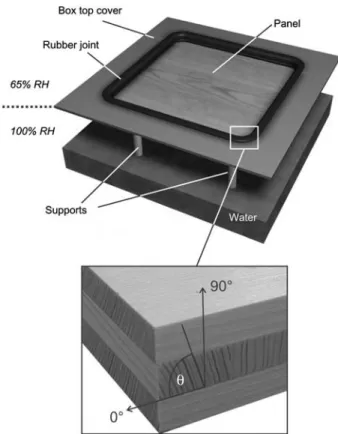
The group of specimens indicated by the abbreviation AR relates to experiments where the influence of the annual growth ring orientation, u, as defined in Figure 2, was studied. Three orientations were tested: 08, 458, and 908. The group of speci-mens indicated by LR relates to testing where the influence of the layer ratio (LR) on cup deformation was studied. LR is defined by
2aOL
LRs , (4)
atot
where 2aOLis the thickness of the two outer layers and atotis the
Figure 2 Test setup of the hygroscopic warping experiments and definition of annual ring angle u.
Figure 3 Dimensions in mm, location of measuring points, and
coordinate system (x: fiber direction of the outer layers, y: fiber direction of the middle layer).
The warping test method used was identical to that described by Gereke et al. (2008). The edges of the samples were sealed with lacquer to enforce the moisture flow within the panels in the thickness direction. The specimens were then placed in a box on three supports as illustrated in Figures 2 and 3. The contact area between the panel edges and the box top cover was insulated by a rubber joint. The climate difference of 65% RH and 100% RH was induced. These two levels of RH were obtained by means of water in the bottom of the box and a constantly conditioned climate room, in which the test setup was stored. Relative displacements in the z-direction of the measuring points, indicated in Figure 3, were recorded by means of dial gauges placed in a steel plate. Stop positions guaranteed identical placement of the steel plate in every measurement. The measurements of displacements were made for 31 days.
The cup deformation in the xz-plane (Figure 1) was determined as: 1 A,D,G C,F,J B,E,H ¯ ¯ ¯ cup sxz
Ž
uz quz.
-uz (5) 2and the cup deformation in the yz-plane as:
1 A,B,C G,H,J D,E,F.
¯ ¯ ¯
cup syz
Ž
uz quz.
-uz (6)2
The notation ¯ui,j,k indicates the mean value of the displace-z
ments in the measuring points i, j, and k as shown in Figure 3. Twist deformation is omitted from the analysis, as it is small compared to cup deformation.
Material data
Moisture model
A one-dimensional diffusion model with a total of 340 eight-node volume elements along the thickness was applied (100 elements in each 10 mm thick wood layer and 20 elements in each 0.1 mm thick adhesive layer). The material parameter necessary for modeling diffusion according to Fick’s law is the diffusion coef-ficient D wm2s-1x. It was implemented into the material model by:
v -11 4 DT
Ž .
vs8.0Ø10 e , tGt* (7) w t z *x
|
DTŽ
v,t sD.
TŽ . Ž
v 1-k.
*qk , t-t*. (8) t y ~The subscript T refers to diffusion in the transverse direction where identical properties in radial and tangential direction were assumed. Eq. (7) is an expression found by Toratti (1992), but the amount of dependency on MC was increased by Hanhija¨rvi (1995). The diffusion coefficient of wood strongly depends on the MC. With increasing MC the resistance to diffusion decreas-es and, thus, D increasdecreas-es. If t-t*, the diffusion coefficient increases linearly fromkDTat the initial state (ts0) to DTat tst*
wEq. (8)x. This reduction of DTin the beginning of the analysis
refers to the effect that water diffuses into wood as water vapor and is then absorbed by the cell walls. During this process, the diffusion rate is lower and the behavior is significant non-Fickian. It is thought that it is an unsteady state phenomenon related to sorption (Wadso¨ 1994). The reduction factor in Eq. (8) isks0.45 w-x and the reduction time is t*s1000 h.
It is assumed that moisture diffuses through the adhesive as water vapor. According to Siau (1995) water vapor diffusion in wood slows down at higher MC. Thus, the following formulation was evaluated from the experimental tests:
-C2
Dadh
Ž .
vsC Ø1v qC3 (9)The diffusion coefficient was determined by fitting the simu-lated curves to the experimental data. The shape factors are C1s9.17•10-13 m2 s-1, C2s0.51 w-x and C3s
-2.39•10-12m2s-1.
The dependency of the concentration c on the relative humid-ity w under isothermal conditions of Ts208C
5 4 3 2
c
Ž .
wsf1wqf2wqf3wqf4wqf5wqf6 (10)has been found for spruce wood with r0,woods450 kg m-3.
The shape factors in Eq. (10) are f1s170.81, f2s
-406.49, f3s366.60, f4s-150.82, f5s32.91, and f6s-1.09 10-3(all
non-dimensional). Consequently, the concentrations corre-sponding to the conditions in ambient air and the initial condi-tions are cinitialscair,tops5.60 kg m-3 relating to ws65% and cair,bottoms13.01 kg m-3relating to ws100% wEq. (1)x. The mass
Table 2 Parameters akof the relation between the moduli
of elasticity E, the shear moduli G, the Poisson’s ratiosn, and moisture content wEq. (13)x according to Neuhaus (1981), 0%FvF28%. Parameter a0 a1 a2 a3 EL(MPa) 12 792 1522 -90 073 188 504 ER(MPa) 1000 361 -20 917 46 665 ET(MPa) 506 500 -13 499 29 733 GLR(MPa) 763 593 -19 861 47 671 GLT(MPa) 881 139 -13 925 27 691 GRT(MPa) 61 -107 -617 1725 nLR(-) 0.046 0.136 -0.456 -0.214 nLT(-) 0.021 0.257 -1.435 2.190 nRT(-) 0.153 1.075 3.980 -19.1
Figure 5 History plots of simulated moisture contents in the
individual layers compared to the measurements. The studied material points of the simulations were located in the middle of each layer.
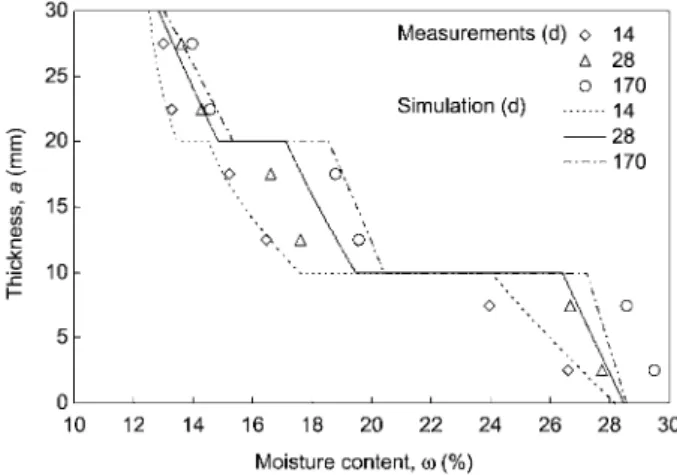
Figure 4 Measured and calculated moisture profiles.
transfer coefficient h wm s-1xof the boundary layer has been pro-posed by Hanhija¨rvi (1995) as:
v -8 4
h
Ž .
vs3.2Ø10 e . (11)Mechanical model
Eight-node volume elements were used for the modeling. The fineness of the element mesh was chosen in order to obtain accurate results. The mesh density (number of elements):
NOEsN ØN Ø 3N q6x y
Ž
z.
(12)was chosen as Nxs60, Nys120, and Nzs5, which are the
num-ber of elements in the global panel directions and the thickness mesh density of one wood layer (Nz). The adhesive layers were
modeled by three volume elements in the thickness. The annual ring orientation was taken into account by rectangular local coordinate systems. Thus, a possible curvature of the annual rings and different lamellas within a layer were not considered.
The elastic parameters describing the compliance matrix S, Eq. (2), depend on the MC. From the findings of Neuhaus (1981) the following relation between the elastic parameters S (may be substituted by E, G orn) and the MC could be found:
2 3
Ssa qa0 1vqa2vqa3v (13)
The shape factors ak(ks0«3) are presented in Table 2. The
data show that the moduli decrease with MC. ET and ER
decrease within the hygroscopic range to approximately 50% of their value at the oven-dry state, while EL only decreases to
85%. The shear moduli also decrease with MC: GLR and GTL
decrease to approximately 50% and GRTdecreases to 30% from
the oven-dry state to the fiber saturation point. The Poisson’s ratio show a differing behavior:nLRremains nearly constant
with-in the hygroscopic range, whilenTLandnTRincrease when the
MC is increased.
The swelling coefficients were chosen according to Neuhaus (1981) and Sell (1997) to aRs1.7•10-3 and aTs3.3•10-3, and
according to Dahlblom et al. (1999) (see also Ormarsson 1999) toaLs5.0•10-5(all non-dimensional).
The mechano-sorptive material parameters are based on results obtained by Santaoja et al. (1991) and Ma˚rtensson (1992) and are set to be independent of the MC. The mechano-sorption coefficients in the orthotropic directions and planes that describe the mechano-sorption material matrix m wEq. (3)x are
mLs1.0•10-4, mRs0.15, mTs0.2, mLRs8.0•10-3, mLTs8.0•10-3,
and mRTs0.8 (all MPa-1). The coupling coefficients between the
different directions are chosen as
m
LRs0,m
LTs0, andm
RTs1.The adhesive, polyurethane, is assumed to act as a linear elastic isotropic material (Konnerth et al. 2007). The adhesive
layers were assumed to be 0.1 mm thick. The elastic properties were chosen according to the tests of Konnerth et al. (2007) as
Eadhs470 MPa andnadhs0.3.
Results and discussion
Moisture
The calculated moisture profiles and the measured MC
are shown in Figure 4. The climate difference resulted in
distinctive moisture profiles. The influence of the glue
lines is obvious and very significant. The largest gradient
in MC could be detected between the bottom and the
middle layer. These two layers showed a rapid increase
in moisture during the first 14 days and also a significant
increase in moisture from day 14 to 170 (Figure 5). The
MC in the top layer did not change very much from day
14 to day 170.
Deformations and stresses
The results of the experimental tests after 31 days are
listed in Table 3. Major cupping was found in the yz-plane
since the perpendicular to fiber direction of the outer
lay-ers is in the y-direction. This results in a dominant
swell-ing of the bottom layer in this direction. Due to the
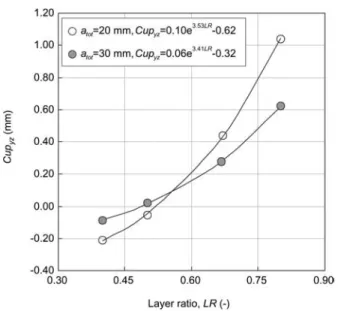
Figure 7 Simulated influence of the layer ratio LR on cupyzfor
the panel thicknesses, 20 mm and 30 mm, ts744 h.
Figure 6 Simulated warp in a panel of series AR90 (one-half
of the panel is displayed, displacements =10, ts744 h).
Table 3 Measured warping after 31 days.
ID n r0(kg m-3) cupxz(mm) cupyz(mm) AR0 6 411 0.06 (0.05) 0.42 (0.05) AR45 6 407 0.06 (0.06) 0.22 (0.08) AR90 6 431 0.10 (0.15) 0.27 (0.08) LR37 6 459 0.11 (0.19) 0.08 (0.02) LR52 6 461 0.07 (0.09) 0.14 (0.04) LR57 3 451 0.04 (0.27) 0.12 (0.08)
Data are mean and (standard deviation), ID according to Table 1. n – number of samples, r0– oven-dry density (dry mass/dry volume).
Figure 8 Non-linear regression of the time variation of the cup deformation in the yz-plane, cupyz. For the denominations AR
and LR, see Table 1 and the experimental section.
hindering by the middle layer, the panel warps in the
yz-plane. The simulated warping of panel AR90 is
dis-played in Figure 6. The Figure shows that the edges
moved upwards while the center moved downwards.
The influence of the annual growth ring orientation on
the cup deformation is conspicuous (Table 3) and
gov-erned by the difference in swelling, stiffness properties,
and material orientation. The largest cup was found for
panels with horizontal annual rings (AR0) reflecting the
large swelling of the bottom layer. Tangential swelling is
approximately two times higher compared to radial
swell-ing as it occurs in series AR90. The smallest cuppswell-ing was
recorded for the panels with us458 (AR45), which most
probably is due to the very small stiffness of softwood in
that direction. It is approximately one-half of the
tangen-tial stiffness and approximately one-quarter of the radial
stiffness as a result of the small G
RT(Keunecke et al.
2008).
The tests of different LRs show increased cupping
cup
yzwith increased LR (Table 3). The simulated results
of a variation of
0.5FLRF0.8
are plotted in Figure 7 for
the panel thicknesses 20 mm and 30 mm. An increased
LR yields an increased ratio of outer layers, i.e., a larger
ratio of transverse oriented fibers in the y-direction. This
effect leads to a larger cup
yzat higher LRs. The results
show an exponential increase in cup deformation.
The experimentally obtained time variation of cup
yzis
illustrated in Figure 8. Almost all panels attain their
max-imum cup between day 3 and day 12. Series AR45 and
LR37 showed no significant maximum. For AR45 cup
yzbecame constant from day 5, whereas for LR37 a slightly
increased cup
yzwas recorded during the whole testing
period. The MC of the bottom layer was found to
increase rapidly (Figure 5). Hence, the expansion of the
bottom layer, which is mainly in the y-direction, leads to
a strong increase in cup
yz. The decrease in cup
yzafter the
maximum is reached is caused by an increase in MC of
the middle layer and later of the top layer. The moisture
increase and, therefore, swelling of these two layers act
in opposition to the deformation of the bottom layer.
Thus, cup
yzdecreases and cup
xzincreases. The
simulat-ed history plot of cupping in AR90 shows good
agree-ment with the experiagree-mental test results (Figure 8).
Compared to beech panels, as investigated by Gereke
et al. (2008), spruce panels showed good dimensional
stability. The maximum cup
yzin three-layered
cross-lam-inated beech panels with layer thicknesses of 10 mm and
LRs0.67 was detected at 1.14 mm. The cup in spruce
panels was measured to be 70% smaller (AR90).
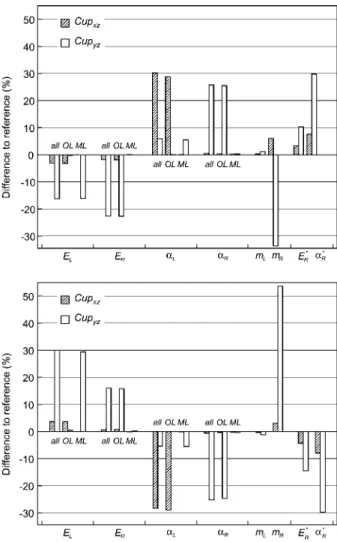
A sensitivity study of the mechanical material
para-meters was performed on panel type AR90. Almost no
influence could be detected for varying the shear moduli
and the Poisson’s ratios. Panel type AR90 also acts
Figure 9 Relative change of the cup of panel type AR90 caused by 30% increase (upper) and 30% decrease (lower) of material parameter values for the complete panel (all) and the individual layers (OL, outer layer, ML, middle layer). *The mechano-sorptive fraction is omitted both in the parameter study and in the reference calculation.
Figure 10 Simulated stress distribution syalong the y-axis in the bottom layer in panel AR90 after 744 h of climate difference 65/100% RH, xs150 mm, zs0 mm (upper), and zs10 mm (low-er), 30% decrease of the material parameter values; ref: refer-ence panel.
slightly sensitive on a modification of E
T. Figure 9 shows
the influence of a 30% increase and a 30% decrease of
E
L, E
R,
a
L,
a
R, m
L, and m
Rin the individual layers and in
the complete panel. The cupping cup
yzis significantly
influenced by a change of the longitudinal parameters E
Land
a
Lin the middle layer and of the radial parameters
E
Rand
a
Rin the outer layers. The cup deformation cup
xzis significantly influenced only by a change of the
para-meters in the outer layers.
The mechano-sorptive strain was found to be very
important for the cup deformation and for the results
obtained in the parameter study. The mechano-sorptive
coefficient m
Raffects cup
yzwith approximately 54%
when decreased and -34% when increased. If omitting
the mechano-sorptive effect, then the simulated cupping
would become approximately 10 times higher and
devi-ate very much from the cupping recorded in the
experi-mental tests.
The mechano-sorptive strain is also important for the
influence on the cupping of E
Rand E
L. Increase of these
two parameters, all other parameters kept constant,
yielded decreased cupping if mechano-sorption is
sidered in the analysis and increased cupping if not
con-sidered. With an increase in the coefficients of
hygroex-pansion,
the
deformations
increase
and
vice
versa. A variation of
a
Lin the outer layers of 30%
influ-ences cup
xzby approximately 30%. In contrast, the
var-iation of E
L, E
R, and
a
Rhas almost no influence on cup
xzif the mechano-sorptive strain increment is considered.
The modification of the coefficient of hygroexpansion
causes a larger expansion of the layers in the appropriate
direction. The longitudinal hygroexpansion influences the
major direction. This results in a larger cup
xz, but only
slightly changes cup
yz. The panel reveals the opposite
behavior when
a
Ris modified. Here, the minor direction
is mainly affected.
The stress distribution s
y(radial direction) along the
y-axis in the middle of the panel (xs150 mm) is displayed
for zs0 mm (bottom face) and zs10 mm (in the bottom
layer at the glue line) in Figure 10. Stresses are
signifi-cantly influenced by a variation of E
Rand a
R, which lead
to increased stresses. The variation of the
mechano-sorptive coefficient m
Rresulted in decreased stresses at
the glue line.
The stiffness of the glue line influences the warping
only in a slight manner. In a range up to E
adhs
10 GPa,
which conforms with results obtained by Konnerth et al.
(2006, 2007), we observed a linear decrease in cup
yzof
5%, while cup
xzis not influenced. Thus, the influence on
warping of potentially different moduli of elasticity of the
two adhesives applied in the experimental tests can be
neglected.
Conclusions
The hygroscopic warping of three-layered
cross-laminat-ed solid wood panels is mainly affectcross-laminat-ed by the stiffness,
the moisture-induced swelling, and the
mechano-sorp-tive coefficient in the minor direction. These parameters
can be altered by changing the layer ratio and the
ori-entation of the annual growth rings. According to the
results of this study, the orientation of the annual growth
rings should be chosen as us458. The low stiffness
per-pendicular to the grain leads to small cuppings. Good
results were obtained for us908 as well. The small
mois-ture-induced swelling in the radial direction leads to small
cuppings. us08 should be avoided in practical
applica-tions. Furthermore, the LR should be chosen as small as
possible but without losing the barrier effect due to the
cross-lamination. Depending on the panel thickness, the
outer layers can become thin. Small thickness results in
increased risk of cracking in the outer layers when the
panel is exposed to drying. Therefore, moisture-induced
stresses and cracking should be studied in future work.
The possibilities and effects of alterations of the panel
structure, e.g., by using some alternative middle layer
material, should also be studied.
Acknowledgements
The authors gratefully acknowledge support from the European Cooperation in the Field of Scientific and Technical Research (COST Action E49).
References
Bader, H., Niemz, P., Sonderegger, W. (2007) Investigation on the influence of the panel composition on selected properties of three-layer solid wood panels. Holz Roh Werkst. 65:173–181. Blass, H.J., Go¨rlacher, R. (2003) Bemessung im Holzbau: Brett-sperrholz – Berechnungsgrundlagen. Holzbau Kalender. 2:580–598.
Bodig, J., Jayne, B.A. Mechanics of Wood and Wood Compos-ites. Krieger Publishing Company, Malabar, FL, 1993. Czaderski, C., Steiger, R., Howald, M., Olia, S., Gu¨lzow, A.,
Niemz, P. (2007) Tests and calculations on 3-layered cross-laminated solid wood panels supported at all edges. Holz Roh Werkst. 65:383–402.
Dahlblom, O., Persson, K., Petersson, H., Ormarsson, S. (1999) Investigation of variation of engineering properties of spruce. In: Proceedings of the 6th International IUFRO Wood Drying Conference: Wood Drying Research and Technology for
Sus-tainable Forestry beyond 2000, Stellenbosch, South Africa. pp. 253–262.
DIN EN ISO 12572. (2001) Hygrothermal performance of building materials and products – Determination of water vapour transmission properties.
Donze´, M., Niemz, P., Hurst, A. (2003) Untersuchungen zu Eigenschaften mehrschichtiger Massivholzplatten. Wood Res. 48:27–36.
Gereke, T., Schnider, T., Hurst, A., Niemz, P. (2008) Identification of moisture-induced stresses in cross-laminated wood pan-els from beech wood (Fagus sylvatica L.). Wood Sci. Technol. Online first: DOI 10.1007/s00226-008-0218-1.
Gu¨lzow, A., Gsell, D., Steiger, R. (2008) Non-destructive evalu-ation of elastic parameters of square-shaped cross-laminat-ed solid wood panels, built up symmetrically with 3 layers. Holz Roh Werkst. 66:19–37.
Hanhija¨rvi, A. (1995) Modelling of creep deformation mecha-nisms in wood. PhD thesis, Technical Research Centre of Finland, Espoo, Finland.
Hukka, A. (1999) The effective diffusion coefficient and mass transfer coefficient of Nordic softwood as calculated from drying measurements. Holzforschung 53:534–540.
Jo¨bstl R.A., Schickhofer, G. (2007) Traglastnachweis fu¨r Brett-sperrholz auf Basis der starren Verbundtheorie unter Beru¨ck-sichtigung von Systemeffekten. In: Proceedings of the 39 Fortbildungskurs SAH ‘‘Praktische Anwendung von Massiv-holzplatten’’, Weinfelden, Switzerland. pp. 9–23.
Keunecke, D., Hering, S., Niemz, P. (2008) Three-dimensional elastic behaviour of common yew and Norway spruce. Wood Sci. Technol. 42:633–647.
Konnerth, J., Ja¨ger, A., Eberhardsteiner, J., Mu¨ller, U., Gindl, W. (2006) Elastic properties of adhesive polymers. II. Polymer films and bond lines by means of nanoindentation. J. Appl. Polym. Sci. 102:1234–1239.
Konnerth, J., Gindl, W., Mu¨ller, U. (2007) Elastic properties of adhesive polymers. Part I: polymer films by means of elec-tronic speckle pattern interferometry. J. Appl. Polym. Sci. 103:3936–3939.
Leicester, R.M. (1971) A rheological model for mechano-sorptive deflections of beams. Wood Sci. Technol. 5:211–220. Ma˚rtensson, A. (1992) Mechanical behaviour of wood exposed
to humidity variations. PhD thesis, Lund University, Lund, Sweden.
Neuhaus, F.-H. (1981) Elastizita¨tszahlen von Fichtenholz in Abha¨ngigkeit von der Holzfeuchtigkeit. PhD thesis, Ruhr-Uni-versity Bochum, Germany.
Ormarsson, S. (1999) Numerical analysis of moisture-related dis-tortions in sawn timber. PhD thesis, Chalmers University of Technology, Go¨teborg, Sweden.
Popper, R., Niemz, P., Eberle, G. (2004a) Equilibrium moisture content and swelling of the solid wood panels. Holz Roh Werkst. 62:209–217.
Popper, R., Niemz, P., Eberle, G. (2004b) Diffusion processes in multilayer solid wood panels. Holz Roh Werkst. 62:253–260. Ranta-Maunus, A. (1990) Impact of mechano-sorptive creep to the long-term strength of timber. Holz Roh Werkst. 48:67–71. Santaoja, K., Leino, T., Ranta-Maunus, A., Hanhija¨rvi, A. (1991) Mechano-sorptive structural analysis of wood by the ABA-QUS finite element program. Research Notes 1276, Technical Research Center of Finland, Espoo.
Sell, J. Eigenschaften und Kenngro¨ssen von Holzarten. Bau-fachverlag AG, Dietikon, 1997.
Siau, J.F. Wood: Influence of Moisture on Physical Properties. Department of Wood Science and Forest Products, Virginia Polytechnic Institute and State University, Blacksburg, USA, 1995.
Takemura, T. (1967) Plastic properties of wood in relation to the non equilibrium states of moisture content. Part II. Mokuzai Gakkaishi 13:77–81.
Eigenschaften von dreilagigen Massivholzplatten aus Nadel-holz. PhD thesis, University of Hamburg, Germany. Toratti, T. (1992) Creep of timber beams in a variable
environ-ment. PhD thesis, Helsinki University of Technology, Finland. Vanek, M., Teischinger, A. (1989) Diffusionskoeffizienten und Dif-fusionswiderstandszahlen von verschiedenen Holzarten. Holzforsch. Holzverwert. 1:3–6.
Wadso¨, L. (1994) Describing non-Fickian water-vapour sorption in wood. J. Mater. Sci. 29:2367–2372.
Received August 29, 2008. Accepted January 12, 2009. Previously published online February 18, 2009.