Interventional cardiology in Europe 1999
1,2
Martin Rotter
a*, Dorothy Pfiffner
a, Willibald Maier
b,
Andreas M. Zeiher
c, Bernhard Meier
a aBern, Switzerland
b
Zurich, Switzerland
cFrankfurt, Germany
Received 7 November 2002; revised 13 March 2003; accepted 3 April 2003
Aims The purpose of this registry is to collect data on trends in interventional cardiology within Europe. Special interest focuses on relative increases and ratios in newer revascularization approaches and its distribution in different regions in Europe. Methods and Results Questionnaires distributed to delegates of the national societies of cardiology represented in the European Society of Cardiology to be completed by local institutions and operators yielded that 1 452 751 angiograms and 452 019 PTCAs were performed in 1999. This is an increase of 28% and 16%, respectively, compared with 1998. Most of these increases are due to high relative increases in eastern European countries. The number of PTCAs per 106 inhabitants rose to 714 in 1999. Coronary stenting increased by 31% to about 313 000 stents implanted in 1999. Complication rates remained stable, the need for emergency coronary artery bypass grafting showing a further slight decrease to currently 0.3%.
Conclusion Interventional cardiology in Europe is still growing, mainly due to rapid growth in countries with lower socio-economical levels. In some central European countries a saturation seemed to be reached with only minor increases in procedures performed. Coronary stenting remains the only noteworthy and growing complement or alternative to balloon angioplasty.
© 2003 Published by Elsevier Science Ltd on behalf of The European Society of Cardiology. KEYWORDS Coronary angiography; PTCA; PCI; Coronary interventions; Coronary stent; Registry
Introduction
The report on interventional cardiology in Europe in 1999 continues the tradition of yearly reports initiated in 1992.1–6 The aim of this report is to show trends in cardiac catheter interventions in Europe over the last few years. It summarizes cardiac catheter interventions and gives an
overview over specific interventional cardiologic activities in 29 countries of Europe, the majority of the members of the European Society of Cardi-ology. Few data exist providing reliable data on field trends in interventional cardiology.7–10
Methods
As in previous years, a detailed questionnaire was sent to the presidents or designated delegates of the national societies of cardiology represented in the European Society of Cardiology to be nationally distributed to all facilities performing diagnostic or interventional cardiac catheterization. Instructions and examples on how to complete the survey were attached to the questionnaire. Completed questionnaires were summarized by the national
1 The coordinators of the countries participating in this survey
are listed in the Appendix
2 On behalf of the Working Group Interventional Cardiology
and Coronary Pathophysiology of the European Society of Cardiology
* Corresponding author: Bernhard Meier, MD, FESC, FACC, Professor and Head of Cardiology, Swiss Cardiovascular Center Bern, University Hospital, 3010 Bern, Switzerland
E-mail address: [email protected] (B. Meier).
European Heart Journal (2003) 24, 1164–1170
0195-668X/03/$ - see front matter © 2003 Published by Elsevier Science Ltd on behalf of The European Society of Cardiology. doi:10.1016/S0195-668X(03)00205-7
representatives on a national summary data sheet. Finally the data were entered into the central database and analysed. In case of missing or incom-plete data, the national representatives were re-peatedly reminded. In February 2002 the registry was closed for the 1999 report. Sufficient data were reported from 29 countries, representing 497 million people. This report was submitted to the country representatives for accuracy. Definitions of pathologies and procedures as well as question-naires were used according to previously published reports.4
Results
Coronary angiography
In Europe roughly 1 452 751 angiograms were formed in 1999. After a decline of angiograms per-formed between 1997 and 1998 this is an increase of 28% compared with 1998 (Fig. 1). As in previous years, the highest absolute and relative numbers were reported from Germany with 567 354 angi-ograms (Fig. 2) i.e., 7092 procedures per million inhabitants (Fig. 3). This is a relative increase of 11% compared with 1998. As in previous years
eastern European countries showed particularly large relative increases (Croatia 42%, Poland 32%, Romania 29%, Latvia 25%). Interestingly the United Kingdom and Iceland offset these countries with a relative increase of 64% and 65%, respectively. This is most probably due to a rebound effect of a previous underuse in invasive coronary approaches in these countries with a high socio-economic level. In many central European countries, the total num-bers of angiograms stabilised or even decreased (France 8%, Switzerland −4%, Austria −5%).
Coronary angioplasty
A total of 452 019 PTCA procedures were per-formed in Europe in 1999, a 16% increase compared with 1998 (Fig. 1). This is an increase compared with a decline of 4% between 1997 and 1998 and the highest absolute number in PTCAs ever performed in Europe within one year. The population-adjusted number of PTCAs increased by 10% from a mean of 649 per 106 inhabitants in 1998 to a mean of 714 per 106 inhabitants in 1999. The highest absolute and population adjusted numbers of PTCAs were re-ported again from Germany with 166 511 pro-cedures (2081 per 106 inhabitants,Figs. 4 and 5).
Fig. 1 Coronary angiograms, coronary angioplasty (PTCA), coronary stenting, and coronary artery bypass grafting (CABG) from 1992 to 1999 in Europe. Some of the surgical data are derived from reference.7
There is still a huge contrast to the countries with the lowest numbers of PTCAs per population (e.g. Romania 55, Bulgaria 81). All countries except Croatia (−3%) and Hungary (−4%) showed a increase as compared with 1998. Again the highest relative increase was reported from eastern European countries with 129% in Romania, 62% in Latvia, and 33% in Estonia. More than 1200 PTCAs per 106 inhabitants were reported in decreasing order from Germany, Iceland, France, and Switzerland.
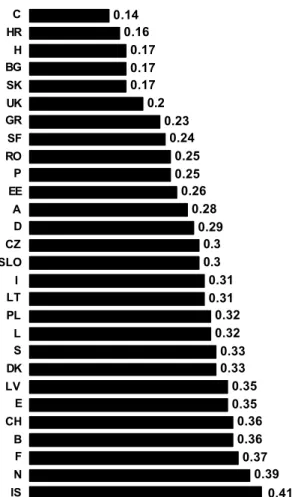
The faster growth of PTCAs compared with coron-ary angiography that was noted in previous years is no longer observed, as the mean ratio of 0.28 PTCAs per coronary angiogram remained stable from 1998 to 1999. The ratio of PTCAs to coronary angiograms ranged from as high as 0.41 in Iceland to as low as 0.14 in Cyprus (Fig. 6). The percentage of PTCA procedures performed at time of the diagnostic study (ad hoc PTCA) increased from 38% in 1998 to
48% in 1999, compared with 41% and 29% in 1997 and 1996, resectively. The highest incidence of ad hoc PTCAs was reported from Switzerland with 83%, fol-lowed by Austria with 72% and Slovenia with 67%. The percentage of multivessel interventions in one session has been stable since 1992 with a current ratio of 0.14 (1998: 0.12, 1997: 0.14, 1996: 0.14) as did the percentage of interventions for acute myocardial infarction with a current ratio of 0.09 (1998: 0.08, 1997: 0.09). The numbers on multi-vessel interventions in one session and interventions for acute myocardial infarction are in keeping with those reported from the National Cardio-vascular Data Registry of the American College of Cardiology for 1998 to 2000.10
Coronary stenting
The number of stent procedures further increased by 31% from 238 000 stent cases in 1998 to 313 000 stent cases in 1999 (Fig. 1). Germany and France by far performed the highest absolute numbers of stent implantations (Fig. 7). The relative increase in all countries is still considerable with 36% as compared to 1998. The highest relative increase
Fig. 2 Coronary angiograms per country in 1999. A=Austria, B=Belgium, BG=Bulgaria, C=Cyprus, CH=Switzerland, CZ=Czech Republic, D=Germany, DK=Denmark, E=Spain, EE=Estonia, F=France, GR=Greece, H=Hungary, HR=Croatia, I=Italy, IS=Iceland, LT=Lithuania, LV=Lativa, L=Luxembourg, N=Norway, NL=Netherlands, P=Portugal, PL=Poland, RO=Romania, S=Sweden, SF=Finland, SK=Slovak Republic, SLO=Slovenia, UK=United Kingdom
Fig. 3 Coronary angiograms per 106inhabitants and country in
1999 (abbreviations as inFig. 2).
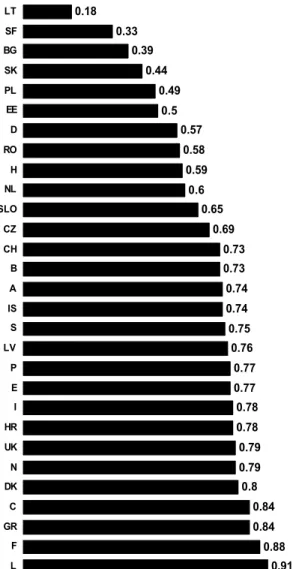
was seen in eastern European countries with in-creases as high as 104%, 96%, and 88% in Lativa, Poland, and Slovenia, respectively. A decrease was reported from three countries (Croatia 27%, Greece 11%, and Finland 6%). The mean European ratio of coronary stenting per PTCA in 1999 was 0.67 with a majority of countries exceeding 0.70 (Fig. 8).
Other devices
The use of other therapeutic devices, such as directional atherectomy, rotablator, laser catheter or wire, brachytherapy, ultrasound therapy and clot catcher/remover was reported in a total of 5984 cases. This is a comparable number of cases to 1998 (5769) and a decrease to 1997 (10 209). The highest absolute number of cases was reported in 1997.
Catheterization facilities
In 1999 there were a mean of 1.7 cardiac catheter-ization facilities per 106 inhabitants in the 29
countries reporting these data. The range was from as low as 0.26 in Romania and 0.4 in Latvia to as high as 5.2 in Switzerland and 4.3 in Germany. A mean of 934 (range from 413 to 1499) diagnostic procedures per catheterization laboratory and 429 angioplasties (range from 130 to 1006) per catheterization laboratory were performed. The number of diagnostic or PTCA operators per 106 inhabitants ranged from 2 or 1 in Romania to 47 or 15 in Iceland, respectively.
Complications
Sufficient data on major complications (myocardial infarction, need for emergency CABG, death) were reported from 19 countries. The percentage of myocardial infarction (1.2%) and death (0.5%) were stable over the past 8 years and are in agreement with data from north American registries.9,10 The need for emergency CABG declined from 1.2% in 1992 to 0.3% in 1999.
Fig. 4 PTCAs per country in 1999 (abbreviations as inFig. 2). Fig. 5 PTCAs per 10
6 inhabitants and country in 1999
(abbreviations as inFig. 2).
Discussion
The working group Interventional Cardiology and Coronary Pathophysiology of the European Society of Cardiology has conducted an annual survey of cardiac interventions since 1992.1–6 This report
summarizes the data reported during 1999. The information provided by the national societies of cardiology was voluntary and not scrutinised. Sufficient data were reported from 29 countries, representing 497 million people in Europe. A total of 1 452 751 diagnostic procedures and 452 019 PTCAs were reported in 1999, corresponding to an increase compared with 1998 of 28% and 16%, respectively. The relative increase is beginning to slow down in an inverse relation to the economic gradient within Europe with practically no change or only slight increases and even decreases in central / western European countries and steep increases in eastern European countries. The only western European countries that showed a huge increase in the utilization of coronary angiogra-phies are the United Kingdom and Iceland which lagged behind other western European countries in
the past years and currently are catching up to levels of coronary angiograms per 106 inhabitants performed in countries with comparable gross national products.
PTCA was the selected method of coronary revascularization in 452 019 procedures in Europe compared with about 210 000 coronary artery bypass grafting procedures (ratio 0.5).7
Single-vessel PTCA still remains the typical procedure in 1999 with a stable percentage of multivessel procedures in the past years of 14% to 16%. The reason for this surprising stability in light of the increasing use of stents is unclear. Partly it is due to staged sessions for a variety of reasons. It is possible but to be confirmed that newer techniques such as drug eluting stents will change this. The ratio of PTCAs per coronary angiograms remained stable with a value of 0.28. Interestingly there is a steady increase in ad hoc PTCAs with a current ratio of nearly 50%. This reflects the fact that more and more operators perform not only diagnostic pro-cedures but are also trained to perform angioplasty.
Fig. 6 PTCAs per coronary angiogram in 1999 (ratio) (abbrevi-ations as inFig. 2).
Fig. 7 Coronary stenting procedures per country in 1999 (abbreviations as inFig. 2).
Moreover, organized surgical standby is obsolete for routine cases and there is a growing patient demand for ad hoc procedures.
The number of stent procedures again showed a large increase of 31% from 238 000 cases in 1998 to 313 000 cases in 1999. In contrast all other comple-mentary or alternative devices to the balloon were reported to be used in 5984 cases only, a decrease of nearly 50% from 1997. A stent was used in 67% of all coronary angioplasties, with percentages as high as 91% in Luxembourg (Fig. 8). Percentages of stenting in other regions of the world seeming to be slightly higher with average values ranging from 77% to 85%.8–10These numbers are comparable to those in central European countries while there is a lower use of stenting in eastern European coun-tries. However it should be noted, that in Germany only in 57% of coronary angioplasties a stent was used, a significant difference to the neighbouring
countries. The ratio of stenting has remained stable since 1997, which makes an underreporting rather unlikely. Capitation is common in Germany and presents a putative cause. Major complications are not showing any increase despite the growing number of procedures per 106 inhabitants and ad hoc PTCAs performed. The need for emergency CABG even decreased with an inverse correlation to the introduction of coronary stenting. This shows that diagnostic and therapeutic procedures can be performed safely even with a lower threshold to-wards ad hoc PTCAs. Our data of complications are comparable to data reported from other countries,8–13 although they are based on retro-spective collection and are certainly under-reported.
The major limitation of this registry is its data acquisition which is voluntary and subject to several sources of error because of its sequential mode of data acquisition (operator to institution to national delegate to working group) and the im-possibility to validate the data. Overall we think that the relative trends can be reliably used.
In summary we found a further increase in diag-nostic and therapeutic cardiac catheter interven-tions in Europe, which is predominantly due to a high relative increase in developing countries with still a rather low absolute number of cases per 106 inhabitants. Stenting seems to be the preferred method of revascularization with a low compli-cation rate despite the growing number of pro-cedures performed. There seems to be a trend towards stabilisation of the numbers of cases in countries with a high socio-economic level, sug-gesting that the revascularization demand can be increasingly met.
Appendix A
We are indebted to all representatives of the national societies of cardiology participating in this survey. Furthermore we acknowledge the tremen-dous effort of all individual centres in collecting the surveyed data and completing the questionnaires. The principal data coordinators of each individual country participating in this survey are in alpha-betical order: Austria: Mu¨hlberger V. Belgium: Heyndrickx G. Bulgaria: Finkov B. Croatia: Mihatov S. Czech Republic: Vojacek J. Denmark: Thayssen P. Estonia: Peeba M. Finland: Romo M. France: Lablanche JM. Germany: Bonzel T. Greece: Foussas S. Hungary: Duba J. Italy: Piscione F. Iceland: Eyjolfsson K. Latvia: Kalnins U. Lithuania: Navickas R. Luxembourg: Beissel J. Netherlands: Suttorp MJ.
Norway: Vik-Mo H. Poland: Ruzyllo W. Portugal: Fig. 8 Coronary stenting procedures per PTCA procedures and
country in 1999 (ratio) (abbreviations as inFig. 2).
Palos JL. Romania: Iacob M, Fotiade B. Slovak
Re-public: Fridrich V. Slovenia: Cijan A. Spain: Soriano
J. Sweden: Albertons P. Switzerland: Roffi M.
United Kingdom: De Belder M.
References
1. Ro¨thlisberger C, Meier B. Coronary interventions in Europe 1992. The Working Group on Coronary Circulation of the European Society of Cardiology. Eur Heart J 1995;16:922–9. 2. Meyer BJ, Meier B, Bonzel T et al. Interventional cardiology in Europe 1993. Working Group on Coronary Circulation of the European Society of Cardiology. Eur Heart J 1996;
17(9):1318–28.
3. Windecker S, Meyer BJ, Bonzel T et al. Interventional cardi-ology in Europe 1994. Working Group Coronary Circulation of the European Society of Cardiology. Eur Heart J 1998;
19(1):40–54.
4. Windecker S, Maier-Rudolph W, Bonzel T et al. Interven-tional cardiology in Europe 1995. Working Group Coronary Circulation of the European Society of Cardiology. Eur Heart
J 1999;20(7):484–95.
5. Maier W, Windecker S, Lablanche JM et al. The European registry of cardiac catheter interventions 1996. Eur Heart J 2001;22(5):373–7.
6. Maier W, Camici P, Windecker S et al. The European Registry of Cardiac Catheter Interventions 1997. Eur Heart J 2002;
22(5)(5):1903–7.
7. Unger F, Ghosh P. Cardiac Interventions in Europe 2000: Surgery and Percutaneous Procedures. European Heart Institute, 2002.
8. Ruygrok PN, Ormiston JA, O'Shaughnessy B. Coronary angio-plasty in New Zealand 1995–1998: a report from the National Coronary Angioplasty Registry. N Z Med J 2000;
113(1117):381–384
9. Laskey WK, Kimmel S, Krone RJ. Contemporary trends in coronary intervention: a report from the Registry of the Society for Cardiac Angiography and Interventions. Catheter
Cardiovasc Interv 2000;49(1):19–22.
10. Anderson HV, Shaw RE, Brindis RG et al. A contemporary overview of percutaneous coronary interventions. The American College of Cardiology-National Cardiovascular Data Registry (ACC-NCDR). J Am Coll Cardiol 2002;39(7): 1096–103.
11. Perleth M, Mannebach H, Busse R et al. Cardiac cath-eterization in Germany. Diffusion and utilization from 1984 to 1996. Int J Technol Assess Health Care 1999;15(4): 756–66.
12. Kimmel SE, Localio AR, Krone RJ et al. The effects of contemporary use of coronary stents on in-hospital mortal-ity. Registry Committee of the Society for Cardiac Angiogra-phy and Interventions. J Am Coll Cardiol 2001;37(2): 499–504.
13. King SB 3rd, Yeh W, Holubkov R et al. Balloon angioplasty versus new device intervention: clinical outcomes. A com-parison of the NHLBI PTCA and NACI registries. J Am Coll
Cardiol 1998;31(3):558–66.