HAL Id: lirmm-00727009
https://hal-lirmm.ccsd.cnrs.fr/lirmm-00727009
Submitted on 12 Jun 2020
HAL is a multi-disciplinary open access
archive for the deposit and dissemination of
sci-entific research documents, whether they are
pub-lished or not. The documents may come from
teaching and research institutions in France or
abroad, or from public or private research centers.
L’archive ouverte pluridisciplinaire HAL, est
destinée au dépôt et à la diffusion de documents
scientifiques de niveau recherche, publiés ou non,
émanant des établissements d’enseignement et de
recherche français ou étrangers, des laboratoires
publics ou privés.
Using Formal Concept Analysis to Extract a Greatest
Common Model
Bastien Amar, Abdoulkader Osman Guédi, André Miralles, Marianne
Huchard, Thérèse Libourel Rouge, Clémentine Nebut
To cite this version:
Bastien Amar, Abdoulkader Osman Guédi, André Miralles, Marianne Huchard, Thérèse Libourel
Rouge, et al.. Using Formal Concept Analysis to Extract a Greatest Common Model. 14th
Interna-tional Conference on Enterprise Information Systems (ICEIS), Jun 2012, Wroclaw, Poland. pp.27-37.
�lirmm-00727009�
Using Formal Concept Analysis to Extract a Greatest Common Model
Bastien Amar
1, Abdoulkader Osman Guédi
1,2,3, André Miralles
1,3,
Marianne Huchard
3, Thérèse Libourel
4and Clémentine Nebut
31Tetis/IRSTEA, Maison de la télédétection, 500 rue J.-F. Breton 34093 Montpellier Cdx 5, France
2Université de Djibouti, Avenue Georges Clemenceau BP: 1904 Djibouti (REP)
3LIRMM, Univ. Montpellier 2 et CNRS, 161, rue Ada, F-34392 Montpellier Cdx 5, France
4Espace Dev, Maison de la télédétection, 500 rue J.-F. Breton 34093 Montpellier Cdx 5, France {bastien.amar, abdoulkader.osman-guedi, andre.miralles, therese.libourel}@teledetection.fr,
{marianne.huchard, clementine.nebut}@lirmm.fr
Keywords: Formal Concept Analysis, FCA, Greatest Common Model, GCM, Pesticide, Environmental Information
System, Model Factorization, Core-concept, Domain-concept
Abstract: Data integration and knowledge capitalization combine data and information coming from different data
sources designed by different experts having different purposes. In this paper, we propose to assist the under-lying model merging activity. For close models made by experts of various specialities, we partially automate the identification of a Greatest Common Model (GCM) which is composed of the common concepts (core-concepts) of the different models. Our methodology is based on Formal Concept Analysis which is a method of data analysis based on lattice theory. A decision tree allows to semi-automatically classify concepts from the concept lattices and assist the GCM extraction. We apply our approach on the EIS-Pesticide project, an en-vironmental information system which aims at centralizing knowledge and information produced by different specialized teams.
1
INTRODUCTION AND
PROBLEMATICS
Elaborating data models is a recurrent activity in many projects in different domains, for various ob-jectives: building dictionaries of the domain, design-ing databases, developdesign-ing software for this domain, etc. Usually, such models of the domain are required by several teams, dealing with different facets of the domain, and potentially stemming from different sci-entific domains. For example, in the IRSTEA insti-tute (in which three of the authors work), the study of pesticide impact on environment involves specialists from different scientific domains: hydrology, agron-omy, chemistry, etc.
Each specialist is able to model the part of the do-main model it is familiar with, and finally, a consol-idated domain model must be built gathering all the specialized models. This gathering activity is com-plex and generally carried out manually. Indeed, it re-quires to detect the common domain-concepts mod-eled in the various specialized models, so as to in-tegrate them without redundancy in the consolidated model named greatest common model (GCM). This
GCM is particularly useful to perform schema inte-gration and knowledge capitalization.
In this paper, we address the issue of assisting this gathering activity, in the context of domain data models designed with UML class diagrams through the automated detection of common domain-concepts (with two levels of confidence) possibly enriched with new domain-concepts automatically extracted from the previous ones. This approach is based on For-mal Concept Analysis (FCA), which is an exact and robust data analysis method based on lattice theory. We use FCA to detect commonalities, redundancies and introduce new abstractions, both inside the mod-els taken individually (intra-model factorization), and inside two distinct data models taken jointly (inter-model factorization). The approach defined in this paper deals with two models, but more generally, it is able to identify the common domain-concepts of several models in order to help the designer to cen-tralize these common concepts into a unique consoli-dated model (the GCM). This approach is under eval-uation on a large project from the IRSTEA institute called Environmental Information System for Pesti-cides (EIS-PestiPesti-cides), in which two teams cooperate
to build a domain data model. The transfer team is specialized in the study of the pesticides transfer to the rivers and the practice team, mainly works on the agricultural practices of farmers.
The rest of the paper is structured as follows. In Section 2 we introduce example models taken from the EIS-Pesticides project. In Section 3, we draw the main lines of our approach, and in Section 4, we pro-vide a short introduction to Formal Concept Analysis (FCA). In Section 5 we explain how FCA is used on input models and how the resulting lattices are an-alyzed so as to provide the final user clear recom-mendations to build the greatest common model. In Section 6, we present our produced greatest common model of our example models and we apply our ap-proach on a larger model to evaluate its scalability. Section 7 presents the related work and Section 8 con-cludes the paper.
2
RUNNING EXAMPLE: THE
TWO MODELS OF
MEASURING STATION
The Environmental Information System for Pesti-cides (EIS-PestiPesti-cides) is a project (Pinet et al., 2010; Miralles et al., 2011) that has the objective to set up an information system allowing to centralize knowl-edge and information produced by Transfer and Prac-tice teams (see Section 1). We illustrate our approach on a small subsystem representing part of the measur-ing activityon the catchment area (drainage basin): measuring stations monitor the major parameters in-volved in the transfer of the pesticides to the rivers.
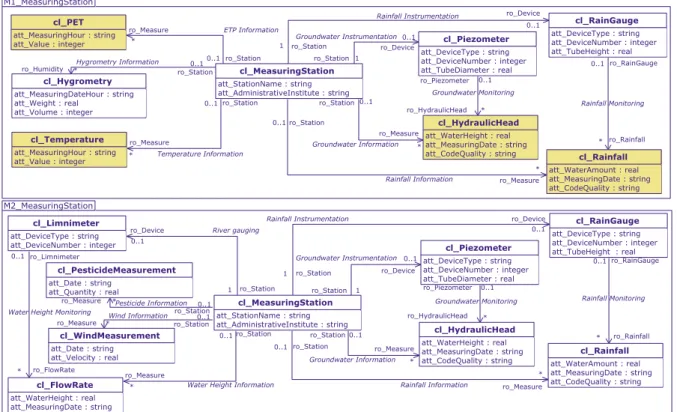
Figure 1 shows the two data models of the mea-suring stations used in this study. They are pro-duced by the two teams involved in the project. As these two models are very close, we have or-ganized them by grouping at the r.h.s of mea-suring station (cl_Meamea-suringStation), the identical domain-concepts (that also have the same relation-ships). In this part of the model, the measured data are associated to the corresponding measur-ing device: the rainfall (cl_Rainfall) and the hy-draulic head (cl_Hyhy-draulicHead) of the ground-water table are continuously recorded respectively by the rain gauge (cl_RainGauge) and by the piezometer (cl_Piezometer). Each of these mea-sures is dated (see property att_MeasuringDate). On the l.h.s. of cl_MeasuringStation, the model M1_MeasuringStation allows to record the data measured by a weather station of Météo-France (a french meteorological institute): temperature
(cl_Temperature), hygrometry (cl_Hygrometry) and potential evapo-transpiration (cl_PET) of the short green crops. These last domain-concepts are not in the model M2_MeasuringStation which has on the other hand a limnimeter (cl_Limnimeter) to measure continuously the flow rate (cl_FlowRate) of rivers. A technician is in charge to take samples in order to de-termine in laboratory the amount of pesticides in the water (cl_PesticideMeasurement). Finally, the wind velocity (cl_WindMeasurement) is a parameter com-ing from a weather station of Météo-France.
3
OVERVIEW OF THE
PROPOSED APPROACH
The main objective of our approach is to assist the task of gathering two or more models independently defined and thus potentially involving common con-cepts. For that we extract from initial models their Greatest Common Model (GCM). The term "greatest common model" is chosen by analogy to the "greatest common divisor (GCD)" in arithmetic; it is more pre-cisely defined in the following. Roughly, it contains all the common domain-concepts that are introduced in all the studied models, in a normal1 (factorized) form.
The proposed approach is illustrated in Figure 2. The input is two (or more) models for a domain, named M1and M2. In a first time, the classes of the
input models are described by their owned character-istics. Formal Concept Analysis (FCA) allows enti-ties sharing characteristics to be grouped into formal-concepts, and results in lattices providing a hierarchi-cal view of those formal-concepts. We apply FCA on several class descriptions, resulting in several lat-tices. These lattices allow the identification of com-mon concepts, specific concepts and eventually new abstractions extracted from intra- or inter- model fac-torization. For instance, if we describe classes by their owned attributes, the resulting lattice (cf Figure 5) extracts the r.h.s. common domain concepts of Fig-ure 1. It also extracts new abstractions. Some new abstractions are present both in M1and M2(e.g. a
de-viceconcept factorizes commonalities of rain gauge, and piezometer: inter-model factorization). Some other extracted abstractions are present only in a same model (e.g. a dated measurement concept factorizes pesticide and wind measurements in M2: intra-model
factorization). For each lattice, we have two levels
1Here, we refer to the relational normal form used in database schema normalization, which has the same objec-tive: eliminate redundancies.
M2_MeasuringStation M1_MeasuringStation 0..1 1 ro_Device Rainfall Instrumentation ro_Station * 0..1 ro_Measure Rainfall Information ro_Station * 0..1 ro_Measure Groundwater Information ro_Station 0..1 1 ro_Device Groundwater Instrumentation ro_Station * 0..1 ro_Rainfall Rainfall Monitoring ro_RainGauge * 0..1 ro_HydraulicHead Groundwater Monitoring ro_Piezometer * 0..1 ro_Rainfall Rainfall Monitoring ro_RainGauge * 0..1 ro_Measure Rainfall Information ro_Station 0..1 1 ro_Device Rainfall Instrumentation ro_Station * 0..1 ro_HydraulicHead Groundwater Monitoring ro_Piezometer * 0..1 ro_Measure Groundwater Information ro_Station 0..1 1 ro_Device Groundwater Instrumentation ro_Station * 0..1 ro_Measure Wind Information ro_Station * 0..1 ro_Measure Pesticide Information
ro_Station
*
0..1
ro_Measure
Water Height Information
ro_Station 0..1
1 ro_Device River gauging
ro_Station
* 0..1
ro_FlowRate
Water Height Monitoring
ro_Limnimeter
* 0..1
ro_Humidity Hygrometry Information ro_Station *
0..1
ro_Measure ETP Information
ro_Station * 0..1 ro_Measure Temperature Information ro_Station cl_Rainfall cl_HydraulicHead cl_RainGauge cl_Piezometer cl_WindMeasurement cl_PesticideMeasurement cl_FlowRate cl_Limnimeter cl_MeasuringStation cl_Rainfall cl_RainGauge cl_HydraulicHead cl_Piezometer cl_Temperature cl_Hygrometry cl_PET cl_MeasuringStation att_CodeQuality : string att_MeasuringDate : string att_WaterAmount : real att_CodeQuality : string att_MeasuringDate : string att_WaterHeight : real att_TubeHeight : real att_DeviceNumber : integer att_DeviceType : string att_TubeDiameter : real att_DeviceNumber : integer att_DeviceType : string att_Velocity : real att_Date : string att_Quantity : real att_Date : string att_MeasuringDate : string att_WaterHeight : real att_DeviceNumber : integer att_DeviceType : string att_AdministrativeInstitute : string att_StationName : string att_CodeQuality : string att_MeasuringDate : string att_WaterAmount : real att_TubeHeight : real att_DeviceNumber : integer att_DeviceType : string att_CodeQuality : string att_MeasuringDate : string att_WaterHeight : real att_TubeDiameter : real att_DeviceNumber : integer att_DeviceType : string att_Value : integer att_MeasuringHour : string att_Volume : integer att_Weight : real att_MeasuringDateHour : string att_Value : integer att_MeasuringHour : string att_AdministrativeInstitute : string att_StationName : string
Figure 1: The two data models of measuring station produced by the two teams
of confidence for those concepts: domain-concepts which are very likely to be in the GCM, and others that have to be precisely analyzed, validated and named by the final expert. As we generate sev-eral lattices, the expert in charge of integration needs to follow a strategy for analyzing them. We propose to order the obtained lattices following the semantic hierarchy of the different factorization criteria. The lattices are then analyzed, so as to categorize formal-concepts and interpret them, if applicable, to form domain-concepts.
The domain-concepts recognized by the experts as being in the GCM are called the core domain-concepts. In Figure 1, the domain-concepts to the right of cl_MeasuringStation are certainly core domain-concepts. The greatest common model (GCM) is defined as the largest model factorizing the core domain-concepts of several models.
4
A SHORT INTRODUCTION TO
FORMAL CONCEPT ANALYSIS
Formal Concept Analysis (FCA) (Ganter and Wille, 1999) is a method of data analysis based on lat-tice theory (Birkhoff, 1940). It is used in many
appli-cations relative to classification including knowledge structuring, information retrieval, association rule ex-traction in the data mining domain, class model refac-toring, or software analysis. FCA studies entities described by their characteristics to discover formal-concepts which are maximal groups of entities shar-ing maximal groups of characteristics. A partial spe-cialization order based on the entity set inclusion pro-vides a lattice structure (the concept lattice).
A formal context K is a triple2 K = (E,C, R), where E is the set of entities and C the set of char-acteristics that describe these entities. R ⊆ E × C as-sociates an entity with its characteristics: (e, c) ∈ R when entity e owns characteristic c. For example, Ta-ble 1 shows the formal context of the sub-model high-lighted in Figure 1 (limited to the four classes cl_PET, cl_Temperature, cl_HydraulicHeadand cl_Rainfall). Classes (the entities) are described by the name of their owned attributes (characteristics).
A formal-concept is a pair (Extent, Intent) where Extent = {e ∈ E|∀c ∈ Intent, (e, c) ∈ R} and Intent = {c ∈ C|∀e ∈ Extent, (e, c) ∈ R}. These two sets represent the entities that own all the
2In the literature, standard notation is K = (G, M, I). We use K = (E,C, R) for readability reasons and to get a better understanding toward our thematic partners.
FCA Based
analysis
M1 M2 GCM Specific Concepts M1 M2 : New AbstractionsFigure 2: A schematic overview of our approach (applied on one formal context)
att_MeasuringHour att_V
alue
att_W
aterAmount
att_MeasuringDate att_CodeQuality att_W
aterHeight
cl_PET × ×
cl_Temperature × ×
cl_Rainfall × × ×
cl_HydraulicHead × × ×
Table 1: The formal context of the reduced model
characteristics (extent) and the characteristics shared by all entities (intent). The specialization or-der between two formal concepts is given by the following equivalence: (Extent_1, Intent_1) < (Extent_2, Intent_2) ⇔ Extent_1 ⊂ Extent_2 (equiv-alently Intent_2 ⊂ Intent_1).
In a lattice, there is an ascending inheritance of en-tities and a descending inheritance of characteristics. The simplified intent of a formal concept is its intent without the characteristics inherited from its super-concept intents. The simplified extent is defined in
a similar way.
Nota: in this article, we distinguish simplified ex-tent from exex-tent. When it is not specified, we are talk-ing about (complete) extent.
For readability reasons, all lattices presented in this paper show simplified extents and intents.
Figure 3 shows the concept lattice built from the formal context presented Table 1. Each formal-concept is represented by a box in three parts: the first contains the generated name of the formal-concept, the second part contains its simplified in-tent, and the last one contains its simplified ex-tent. Let us consider Concept_17: it repre-sents entities (classes) described by the characteris-tic att_WaterHeight and by the characterischaracteris-tics inher-ited from its super-concepts: att_MeasuringDate and att_CodeQuality(from Concept_16).
Intent Extent Concept_13 att_MeasuringHour att_Value cl_PET cl_Temperature M Concept_17 att_WaterHeight cl_HydraulicHead P Concept_14 N Concept_15 att_WaterAmount cl_Rainfall P Concept_16 att_MeasuringDate att_CodeQuality N Concept_12 N
Figure 3: Class/attribute name lattice: result of FCA on Ta-ble 1
In this work, we are interested in three categories of formal-concepts that form a partition of the set of formal-concepts:
Definition 1. Merged formal concepts have more than one entity in their simplified extent. This means that all entities in the extent are described by exactly the same set of characteristics.
In Figure 3, Concept_13 is a merged formal con-cept: cl_PET and cl_Temperature are (exactly) de-scribed by both characteristics att_MeasuringHour and att_Value.
Definition 2. New formal concepts have an empty simplified extent. These are new, more abstract, con-cepts, factoring out characteristics common to several formal-concepts.
In Figure 3, Concept_16 is a new formal concept, factoring out characteristics of both Concept_15 and Concept_17.
Definition 3. Perennial formal concepts have one and only one entity in their simplified extent.
In Figure 3, both Concept_15 and Concept_17 are perennial. In this article, merged, new and peren-nial formal concepts are respectively annotated, in the figures, M, N and P at the right-top corner.
5
APPLYING FORMAL
CONCEPT ANALYSIS TO
EXTRACT CANDIDATES FOR
THE GREATEST COMMON
MODEL
In this section, we propose a methodology based on two automatic steps that uses Formal Concept Analysis (FCA) and an interactive step to extract the greatest common model of two input models. Given two models M1and M2:
• We compute the lattices resulting from FCA ap-plied to several formal contexts extracted from the disjoint union of the two input models
M= M1⊕ M2.
• The concepts of these lattices are analyzed thanks to a decision tree based on the analysis of the con-cept extent, and we obtain six concon-cept lists (cate-gories).
In the interactive step, these six lists are exploited to assist the expert to build the greatest common model. The next subsections precisely describe two auto-matic steps.
5.1
Apply FCA on the two models
As explained in Section 4, formal contexts describe entities by characteristics. Many different formal con-texts can be extracted from a class model: it has to be defined which model elements are chosen to be the studied entities, and which features of those model elements are chosen to be their studied characteris-tics. Here we focus on three formal contexts extracted from the disjoint union of input models M = M1⊕M2:
1. the formal context of classes described by their name,
2. the formal context of classes described by their attributes,
3. the formal context of classes described by their attributes and by their roles.
Figure 4 presents the lattice obtained with the formal context of classes described by their name (class/class name lattice). This lattice groups in a concept the set of classes sharing the same name. For exam-ple, the merged concept Concept_1 represents the set of classes (in extent) sharing the name (in intent) cl_Piezometer. In other words, FCA merged in a sin-gle concept classes that have a same name. Classes that are not duplicated in the models M1and M2
re-main in a perennial concept, like the cl_PET class in Concept_7. In inter-model factorization, the three categories of concepts described in Section 4 exist: the merged concept Concept_1 has more than one entity in its simplified extent. In a similar way, the perennial concept Concept_7 (cl_PET) has exactly one element in its extent. Later we will see the case where new formal concepts appear.
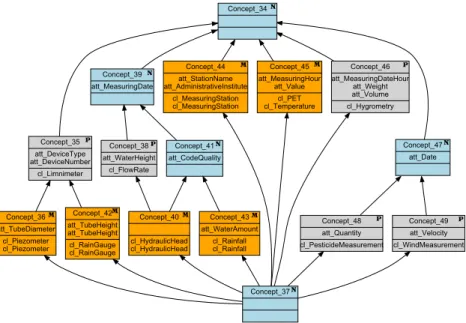
Figure 5 presents the lattice obtained with the for-mal context of classes described by the names of their owned attributes (class/attribute name lattice). In this lattice, a formal concept thus is a group of classes (extent) sharing a group of attribute names (intent). The lattice contains new formal concepts (simpli f ied extent = /0), e.g. Concept_47, that rep-resents a new abstraction: things that are dated.
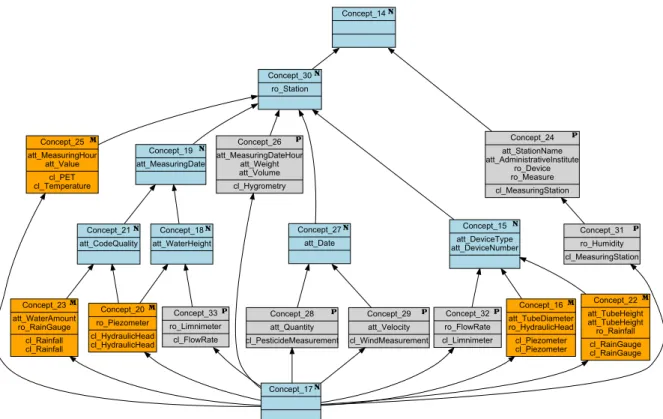
Figure 6 presents the lattice obtained with the for-mal context of classes described by the names of their owned attributes and roles (class/attribute-role name lattice). UML associations are taken into account in this lattice through those roles. For example, class cl_FlowRate has attribute att_WaterHeight and role ro_Station in association Water Height Information. The new formal concept Concept_30 represents the classes that are linked with a Station via the role ro_Station. Class cl_FlowRate belongs to the extent of this concept.
5.2
Analysis of the lattices
In this section, we present the analysis of the lattices using a decision tree to classify each concept. First, the class/class name lattice must be analyzed. This lattice allows the designer to group classes that have a same name. Then, we analyze the class/attribute namelattice that allows us to find attribute-based fac-torizations. As we will see, the class/attribute-role name lattice can be a considerable help to refine the decisions about factorization.
For each formal concept Cok= (Ek, Ik), the
Concept_1 cl_Piezometer cl_Piezometer cl_Piezometer Concept_3 cl_HydraulicHead cl_HydraulicHead cl_HydraulicHead Concept_4 cl_RainGauge cl_RainGauge cl_RainGauge Concept_6 cl_MeasuringStation cl_MeasuringStation cl_MeasuringStation Concept_8 cl_Hygrometry cl_Hygrometry Concept_9 cl_Temperature cl_Temperature Concept_10 cl_Limnimeter cl_Limnimeter Concept_12 cl_PesticideMeasurement cl_PesticideMeasurement Concept_13 cl_WindMeasurement cl_WindMeasurement Concept_0N M M M Concept_5 M P P P P P cl_Rainfall cl_Rainfall cl_Rainfall M Concept_7 cl_PET cl_PET P Concept_11 cl_FlowRate cl_FlowRate P Concept_2N
Figure 4: The class/class name concept lattice
Concept_35 att_DeviceType att_DeviceNumber cl_Limnimeter Concept_36 att_TubeDiameter cl_Piezometer cl_Piezometer Concept_40 cl_HydraulicHead cl_HydraulicHead Concept_42 att_TubeHeight att_TubeHeight cl_RainGauge cl_RainGauge Concept_43 att_WaterAmount cl_Rainfall cl_Rainfall Concept_44 att_StationName att_AdministrativeInstitute cl_MeasuringStation cl_MeasuringStation Concept_45 att_MeasuringHour att_Value cl_PET cl_Temperature Concept_46 att_MeasuringDateHour att_Weight att_Volume cl_Hygrometry Concept_48 att_Quantity cl_PesticideMeasurement Concept_49 att_Velocity cl_WindMeasurement Concept_38 att_WaterHeight cl_FlowRate Concept_39 att_MeasuringDate Concept_41 att_CodeQuality M M M M M P P P P Concept_34N N N P M Concept_37N Concept_47 att_Date N
Figure 5: The class/attribute name concept lattice
to be included in one of these lists:
• LGCM is the list of core-concepts that will be
in-cluded in the greatest common model.
• LpGCM is the list of potential (candidate)
core-concepts to be validated by an expert to be in the greatest common model.
• LM1 and respectively LM2 are the lists of domain
concepts specific to M1(resp. M2).
• LnM1 and respectively LnM2 are new domain
con-cepts specific to M1(resp. M2), factorizing
exist-ing domain concepts. These domain concepts are not intended to be in the greatest common model, but they can be presented to experts to improve the factorization of M1(resp. M2).
Figure 7 presents the decision tree: we define
C
Mi(resp.
C
Mj) as the set of classes in the model Mi(resp.Mj), and the decision tree is designed for two
mod-els Miand Mj where i 6= j. As we apply FCA with
classes as entities (characteristics being class name, attributes, and/or roles), the extent of a concept
con-tains only classes. For each concept, we first check if the concept is a merged concept, a new concept or a perennial concept(nodes 1, 8 and 12 in the decision tree of Figure 7) as defined in Section 4.
1 2 3 4 5 6 7 8 9 10 11 12 13 14 15
Concept_15 att_DeviceType att_DeviceNumber Concept_16 att_TubeDiameter ro_HydraulicHead cl_Piezometer cl_Piezometer Concept_20 ro_Piezometer cl_HydraulicHead cl_HydraulicHead Concept_23 att_WaterAmount ro_RainGauge cl_Rainfall cl_Rainfall Concept_25 att_MeasuringHour att_Value cl_PET cl_Temperature Concept_26 att_MeasuringDateHour att_Weight att_Volume cl_Hygrometry Concept_28 att_Quantity cl_PesticideMeasurement Concept_29 att_Velocity cl_WindMeasurement Concept_31 ro_Humidity cl_MeasuringStation Concept_18 att_WaterHeight Concept_19 att_MeasuringDate Concept_21 att_CodeQuality Concept_24 att_StationName att_AdministrativeInstitute ro_Device ro_Measure cl_MeasuringStation P P P P P N N N N M M M M Concept_14N Concept_30 ro_Station N Concept_27 att_Date N Concept_33 ro_Limnimeter cl_FlowRate P Concept_32 ro_FlowRate cl_Limnimeter P Concept_22 att_TubeHeight att_TubeHeight ro_Rainfall cl_RainGauge cl_RainGauge M Concept_17N
Figure 6: The class/attribute-role name concept lattice
Analysis of merged concepts If the concept is a merged concept, then three cases are possible: its ex-tent contains elements from both models Mi and Mj
(node 2), its extent contains only elements from Mi
(node 6), or its extent is empty (node 7).
If the concept extent contains elements from both models, the cardinality of the intersection between the extent and the set of model classes has to be checked. In the first case, the extent contains only one class from Miand only one class from Mj(node
3) like Concept_1 in the class/class name lattice, Fig-ure 4. Then a corresponding domain concept should be added in LGCM: it can be considered as a
core-concept – a domain core-concept common to both mod-els. If the extent contains only one class from Mi
and several classes from Mj (node 4), or several
el-ements from both models (node 5), then it should be put in the LpGCM list: it is a potential core-concept,
but an expert intervention is necessary. He or she can choose to merge or factorize duplicated classes if they are semantically closed, in a same model (intra-model factorization), and relaunch the process to extract the greatest common model. He or she can also consider these classes as specific domain concepts and keep them in the specific model.
If the merged concept contains only classes from Mi (node 6), like the Concept_45 in the Figure 5, it
should be added to the LnMi list. Its extent contains
a group of elements coming from a same model and that are described exactly by the same characteristics. It can be presented to an expert to improve the model Mi, but it is not a core-concept (they are in one model
only). In the case of Concept_45, FCA suggests to merge the classes cl_PET (representing the Poten-tial Evapo-Transpiration) and cl_Temperature. In this special case, these two classes are semantically differ-ent, and the expert do not want to factorize them, but in other situations he could consider this factorization to be interesting.
The node 7 describes concepts wherein the extent does not contain classes from Mi and Mj. This is
inconsistent: by definition, a merged concept extent contains at least two elements (cf definition 1).
Analysis of new concepts If the concept is a new concept (cf. definition 2, node 8), and if its extent contains elements from both models Miand Mj(node
9) then the concept has to be put in the LpGCMlist: it is
a potential factorization of concepts defined in Miand
Mj, so it is potentially a core-concept. Experts have
to decide if this factorization is valid and if this new concept has to be included in the greatest common model. Concept_39 in Figure 5 is an example of this type of concept. In our case study, the expert validates
this concept to be a greatest common model concept. If the new concept extent contains only classes from one model, it can be added in the LnMi list
(node 10 in the decision tree). This concept corre-sponds to an intra-model factorization. It is the case of Concept_47, representing things that are dated in M2. This kind of concept is not a core-concept and
should not be included in the greatest common model. It can be presented to the Midesigner in order to raise
the quality of its model by a new factorization. If the new concept extent (node 11 in the decision tree) does not contain elements from M1nor M2, this
means that this is the concept Bottom. Concept Bot-tomis present in each lattice (concepts Concept_2, Concept_37 and Concept_17). It represents ele-ments that own all attributes and should not be used in our re-engineering process. Instead, the top con-cept can not be inferred only by extent analysis and it may appear in each branch of the tree. Depending on the configuration of the models analyzed, this concept may be relevant and it is classified as other concepts.
Analysis of perennial concepts Node 13 in the de-cision tree describes perennial concepts that have in their extent classes from Miand Mj, like Concept_35
in Figure 5. This means that there is a potential fac-torization of Concept_36 and Concept_42, and this factorization already exists, cl_Limnimeter in our ex-ample. This kind of concept has to be presented to the expert, it is thus added to the LpGCMlist. In our
example, the designer can make cl_limnimeter be a super-class of cl_piezometer and cl_Raingauge, but this decision is not semantically valid: a piezome-ter is not a limnimepiezome-ter. An analysis of the lattice of classes described by their attributes and role names (Figure 6) shows that it is better to create a new super-class (Concept_15) of data instrumentation, factor-izing the three classes cl_limnimeter, cl_Piezometer and cl_RainGauge. In this case, the lattice of classes described by their attributes/roles names is useful to help the designer to take a decision.
If the perennial concept extent contains only classes from Mi (node 14) then it is a Mi domain
specific concept. This concept must be added to LMi. For example, concepts Concept_7, Concept_8,
Concept_48, and Concept_46 are domain concepts specific to Mi.
A perennial concept cannot have an empty extent (node 15): the definition 3 specifies that a perennial concept has one (and only one) element in its extent.
From both LGCM and LpGCM lists, the expert has
to select the core-concepts that will be included in the GCM.
Our approach has been implemented as a profile in
a case tool. A component transforms the UML mod-els into the different types of formal contexts which are entries of FCA. Another component produces the corresponding lattices. Finally, another component generates the various lists of domain-concepts in ac-cordance with the decision tree.
6
RESULTS
Figure 8 shows the model obtained by applying our approach: the final greatest common model of the M1 and M2 models (Figure 1). This GCM reflects also the interpretation and the validation by an expert of the new concepts. We annotated classes by asso-ciated formal concepts that represent them in the lat-tices (Figures 4, 5 and 6).
As expected, the same domain-concepts in both models M1 and M2 are present in the GCM: cl_MeasuringStation, cl_Piezometer, cl_HydraulicHead, cl_RainGauge and cl_Rainfall. They constitute the core-concepts of the GCM of M1 and M2. So, they are automatically added in the LGCMlist.
Our approach proposes a list of possible factoriza-tions of domain-concepts in the LpGCM list. The
ex-pert must validate the relevance of these concepts. In this example, two new concepts have been considered relevant. They are colored in figure 8.
The first corresponds to formal concepts Concept_15 (Figure 6) and Concept_35 (Fig-ure 5) in the lattices. They factorize attributes att_DeviceTypeand att_DeviceNumber. This concept has been validated by experts as a new cl_Device class.
The second new concept corresponds to formal concepts Concept_41 and Concept_21 in the lat-tices. It factorizes both att_MeasuringDate and att_CodeQuality attributes. Similarly to the first new concept, experts validate this concept as a new cl_Dataclass.
Table 2 quantifies for each formal context the number of concepts in each list defined in the deci-sion tree3.
In order to validate the scalability of our approach, tests have been done on two versions of the com-plete model from the EIS-pesticides project (about 125 classes). Table 3 gives the number of concepts by list of the decision tree3.
With the class/class name and class/attribute name lattices, experts have to analyze and to validate be-tween 34 and 39 concepts present in the LpGCMlist. 3In these tables, new and merged concepts must be still validated by an expert.
Greatest Common Model ro_Station Groundwater Instrumentation ro_Device 1 0..1 ro_Station Rainfall Instrumentation ro_Device 1 0..1 ro_Station
Groundwater Informationro_Measure 0..1
* ro_Station
Rainfall Information ro_Measure
0..1 * ro_RainGauge Rainfall Monitoring ro_Rainfall 0..1 * ro_Piezometer Groundwater Monitoring ro_HydraulicHead 0..1 * cl_Data cl_Device cl_MeasuringStation cl_HydraulicHead cl_Piezometer cl_Rainfall cl_RainGauge att_CodeQuality : string att_MeasuringDate : string att_DeviceNumber : integer att_DeviceType : string att_AdministrativeInstitute : string att_StationName : string att_WaterHeight : real att_TubeDiameter : real att_WaterAmount : real att_TubeHeight : real Concepts 41, 21 Concepts 5, 43, 23 Concepts 15, 35 Concepts 2, 22, 42 Concepts 1, 16, 36 Concepts 6, 31, 44 Concepts 3, 20, 40
Figure 8: The greatest common model of M1 and M2 models (Figure 1)
LGCM LpGCM LnM1 LnM2 LM1 LM2
class/class name 5 1 0 0 3 4
class/attribute name 5 5 1 1 1 2
class/attribute-role name 4 7 1 1 2 4
Table 2: Result of our approach on the MeasuringStation model
They can obtain more precision (with also more anal-ysis work) with the class/attribute-role name lattice, where 119 potential GCM concepts are proposed. We are currently working to assist the expert in this anal-ysis task (Osman Guedi et al., 2011). We can also de-duce from these results that the two versions of pesti-cide model are very close: there are only few specific concepts.
7
RELATED WORK
FCA is used to improve the abstraction quality and the duplication elimination in class models in various domains (software engineering, ontology mapping or merging). This feature led us to propose the construc-tion of a GCM to capitalize the knowledge of various domains.
Many variants have been studied, which take into account different characteristics for classes (the en-tities or domain-concepts in this framework): at-tribute names, atat-tribute types, operation names, oper-ation signatures, type specializoper-ation. . . The relevance of this approach is related to the properties satisfied by the class model after refactoring: all duplications are eliminated and the specialization relation between formal concepts meets the inclusion of features in the class model. These previous approaches only focus on intra-model factorization. In this paper, we use FCA for inter-model factorization, and we need to analyze differently the lattices, to identify categories
of formal-concepts useful to build the greatest com-mon model of several input class models. We define a guide for the expert to assist the building of the GCM. Indeed, in this work, we assume that if two teristics have the same name, then these two charac-teristics are identical. Some work includes semantic analysis (Falleri, 2009; Rouane et al., 2007).
In software engineering, FCA has been used to build and maintain class hierarchies (Godin and Mili, 1993; Dao et al., 2006; Arévalo et al., 2006). In this paper, our objective is different, we want to find com-mon and specific parts between several models. The management of similarities and differences between models has been studied in the domain of model ver-sioning (Altmanninger et al., 2009). The Smover tool uses direct comparison between a model and its pre-vious version to detect syntactic and semantic con-flict (Altmanninger et al., 2010). In order to manage model conflicts in a distributed development context, the work presented in (Cicchetti et al., 2008) proposes the use of a difference model to store differences be-tween two versions of a same model (Cicchetti et al., 2007). These methods allow to show differences be-tween models, but they don’t aim to propose auto-matic core-concept detection. In the approach de-scribed in (Ohst et al., 2003), models and diagrams are considered as syntax trees, which allows the au-thors to design a difference operation between mod-els. Compared to the domain of model versioning, we aim to present the GCM in a normal (factorized) form. This is why FCA is more suitable for our problem.
per-LGCM LpGCM LnM1 LnM2 LM1 LM2
class/class name 111 34 0 0 1 1
class/attribute name 43 39 0 0 1 2
class/attribute-role name 68 119 0 0 8 9
Table 3: Result of our approach on the complete EIS-Pesticides model
form ontology mapping or merging, which is an is-sue close to ours (Kalfoglou and Schorlemmer, 2005; Bendaoud et al., 2008). The approach proposed by (Stumme and Maedche, 2001) uses FCA and linguis-tic analysis to merge ontologies in a semanlinguis-tic web context. In order to align ontologies, there are ap-proaches that use a similarity measure, based on FCA (Formica, 2006) or on ontologies internal structure and association rule mining (Tatsiopoulos and Boutsi-nas, 2009). All these works aim to perform ontology mapping, while we work to extract the mapping result and to abstract new domain-concepts.
Since the early 80s, the database domain has stud-ied the problem of schema integration and data match-ing, particularly in the database integration context. The aim of database integration context is to produce the global schema of a collection of databases (Ba-tini et al., 1986; Rahm and Bernstein, 2001; Shvaiko and Euzenat, 2005). Producing such a global database schema is an issue close to the extraction of a greatest common model in the sense that the search for identi-cal concepts in different schemas is a necessary step. There are a lot of work dealing with this problematic in the literature. Generally, integration is composed of different steps: schema transformation, correspon-dence investigation and schema integration. Our work focuses on correspondence investigation and schema integration (Parent and Spaccapietra, 1998). The inte-grated schema includes the GCM and the specific part of the initial schemas. There are two groups of solu-tions to semi-automatically find matches : rule-based solutions and learning-based solutions. Our approach is similar to rule-based solutions: we search similarity between several model elements based on their char-acteristics (Doan and Halevy, 2005). Unlike these ap-proaches, the use of FCA allows to choose with fi-nesse the way to describe the characteristics that we consider. In this article, we focus on the description of classes by their name, attribute name or role name, but FCA opens many other possibilities.
8
CONCLUSION
During domain modeling activity, several teams with different scientific skills usually make different models of a same domain. Each specialized team
models the part of the domain model it is famil-iar with, and finally, a unique, consolidated domain model has to be built. This model integration requires the identification of the common domain-concepts that are present in the various specialized models.
Our contribution in this paper is an approach to assist the gathering task for several given class dia-grams describing the domain. The proposed method-ology is based on Formal Concept Analysis and the analysis of the formal-concepts using a decision tree. It allows the production of a Greatest Common Model in a normal (factorized) form. Our approach pro-poses two levels of confidence for candidate GCM concepts: domain-concepts which certainly will be in the GCM, and domain-concepts that have to be precisely analyzed, validated and named by experts. Moreover, the approach identifies specific-concepts and proposes possible new concepts that factorize the original models. We have validated the scalability of our approach by applying it on two versions of the EIS-Pesticides model, versions containing about 125 classes. The results of our approach were ana-lyzed, validated and used by A. Miralles, co-author of this paper, who has a dual expertise: computer science and spraying application techniques of pes-ticides (Miralles et al., 1994; Miralles and Polvêche, 1998; Miralles et al., 2011).
One of the major perspective to our work is to im-prove the GCM through the use of Relational Con-cept Analysis (RCA), which is an FCA extension that will allow us to work more precisely on the relation-ships (UML associations) between domain-concepts. In our running example, the use of RCA would enable factorizing the Rainfall Instrumentation and the Groundwater Instrumentation associations with a new association connecting the new domain-concept cl_Devicewith the cl_MeasuringStation class. Simi-larly, RCA would extract a new association between the new cl_Data class and cl_MeasuringStation, fac-torizing both RainFall Information and GroundWater Informationassociations.
Another perspective is the use of natural language processing techniques to improve the name-based de-scription of elements (classes, attributes, roles, etc). The knowledge of semantic relations like hyper-onymy, synhyper-onymy, or homonymy between terms will refine the analysis of domain-concepts.
REFERENCES
Altmanninger, K., Schwinger, W., and Kotsis, G. (2010). Semantics for accurate conflict detection in smover: Specification, detection and presentation by example. International Journal of Enterprise Information Sys-tems, 6(1):68–84.
Altmanninger, K., Seidl, M., and Wimmer, M. (2009). A survey on model versioning approaches. International Journal of Web Information Systems, 5(3):271–304. Arévalo, G., Falleri, J.-R., Huchard, M., and Nebut, C.
(2006). Building abstractions in class models: For-mal concept analysis in a model-driven approach. In Model Driven Engineering Languages and Systems (MoDELS), pages 513–527.
Batini, C., Lenzerini, M., and Navathe, S. B. (1986). A comparative analysis of methodologies for database schema integration. ACM Computer Survey, 18:323– 364.
Bendaoud, R., Napoli, A., and Toussaint, Y. (2008). Formal Concept Analysis: A unified framework for building and refining ontologies. In International Conference on Knowledge Engineering and Knowledge Manage-ment (EKAW), pages 156–171.
Birkhoff, G. (1940). Lattice theory. American Mathemati-cal Society.
Cicchetti, A., Ruscio, D., and Pierantonio, A. (2008). Man-aging model conflicts in distributed development. In Model Driven Engineering Languages and Systems (MoDELS), pages 311–325.
Cicchetti, A., Ruscio, D. D., and Pierantonio, A. (2007). A metamodel independent approach to difference rep-resentation. Journal of Object Technology, 6(9):165– 185.
Dao, M., Huchard, M., Hacene, M. R., Roume, C., and Valtchev, P. (2006). Towards practical tools for mining abstractions in uml models. In International Confer-ence on Enterprise Information Systems: Databases and Information Systems Integration (ICEIS 2006), pages 276–283.
Doan, A. and Halevy, A. Y. (2005). Semantic integration research in the database community: A brief survey. AI Magazine, 26:83–94.
Falleri, J.-R. (2009). Contributions à l’IDM : reconstruc-tion et alignement de modèles de classes. PhD thesis, Université Montpellier 2.
Formica, A. (2006). Ontology-based concept similarity
in Formal Concept Analysis. Information Sciences, 176:2624–2641.
Ganter, B. and Wille, R. (1999). Formal Concept Analysis: Mathematical Foundation. Springer-Verlag Berlin.
Godin, R. and Mili, H. (1993). Building and
maintain-ing analysis-level class hierarchies usmaintain-ing galois lat-tices. In Eighth annual conference on Object-Oriented Programming Systems, Languages, and Applications (OOPSLA), pages 394–410.
Kalfoglou, Y. and Schorlemmer, M. (2005). Ontology map-ping: The state of the art. In Semantic Interoperability and Integration.
Miralles, A., Gorretta, N., Miller, P. C., Walklate, P., Van Zuydam, R. P., Porskamp, H. A., Ganzelmeier, H., Rietz, S., Ade, G., Balsari, P., Vannucci, D., and Planas, S. (1994). Orchard sprayers : an european program to compare testing methods. In International symposium on fruit nut and vegetable production pro-duction engineering, Valencia Zaragoza, ESP, 22-26 mars 1993, pages 117–122.
Miralles, A., Pinet, F., Carluer, N., Vernier, F., Bimonte, S., Lauvernet, C., and Gouy, V. (2011). EIS-Pesticide: an information system for data and knowledge capi-talization and analysis. In Euraqua-PEER Scientific Conference, 26/10/2011 - 28/10/2011, page 1, Mont-pellier, FRA.
Miralles, A. and Polvêche, V. (1998). Effects of the agro-chemical products and adjuvants on spray quality and
drift potential. In 5th International Symposium on
Adjuvants for Agrochemicals - ISAA ’98, volume 1, pages 426–432, Memphis (USA).
Ohst, D., Welle, M., and Kelter, U. (2003). Differences be-tween versions of uml diagrams. SIGSOFT Software Engineering Notes, 28:227–236.
Osman Guedi, A., Miralles, A., Huchard, M., and Nebut, C. (2011). Analyse de l’évolution d’un modèle : vers une méthode basée sur l’analyse formelle de concepts. In XXIXème Congrès INFORSID.
Parent, C. and Spaccapietra, S. (1998). Issues and
ap-proaches of database integration. Communication of the ACM, 41:166–178.
Pinet, F., Miralles, A., Bimonte, S., Vernier, F., Carluer,
N., Gouy, V., and Bernard, S. (2010). The use of
uml to design agricultural data warehouses. In In-ternational Conference on Agricultural Engineering (AgEng 2010), pages 1–10.
Rahm, E. and Bernstein, P. A. (2001). A survey of ap-proaches to automatic schema matching. The VLDB Journal, 10:334–350.
Rouane, M. H., Dao, M., Huchard, M., and Valtchev, P. (2007). Aspects de la réinginierie des modèles uml par analyse de données relationnelles. Ingénierie des Systèmes d’information (RSTI série), 12:39–68. Shvaiko, P. and Euzenat, J. (2005). A Survey of
Schema-Based Matching Approaches Journal on Data Seman-tics IV. In Spaccapietra, S. and Spaccapietra, S., ed-itors, Journal on Data Semantics IV, volume 3730 of Lecture Notes in Computer Science, chapter 5, pages 146–171. Springer Berlin / Heidelberg, Berlin, Hei-delberg.
Stumme, G. and Maedche, A. (2001). Ontology merging for federated ontologies on the semantic web. In In-ternational Workshop for Foundations of Models for Information Integration (FMII-2001), pages 413–418. Tatsiopoulos, C. and Boutsinas, B. (2009). Ontology
map-ping based on association rule mining. In
Inter-national Conference on Enterprise Information Sys-tems: Databases and Information Systems Integration (ICEIS 2009), pages 33–40.
View publication stats View publication stats