HAL Id: hal-00638236
https://hal.archives-ouvertes.fr/hal-00638236
Submitted on 4 Nov 2011
HAL is a multi-disciplinary open access
archive for the deposit and dissemination of
sci-entific research documents, whether they are
pub-lished or not. The documents may come from
teaching and research institutions in France or
abroad, or from public or private research centers.
L’archive ouverte pluridisciplinaire HAL, est
destinée au dépôt et à la diffusion de documents
scientifiques de niveau recherche, publiés ou non,
émanant des établissements d’enseignement et de
recherche français ou étrangers, des laboratoires
publics ou privés.
Enhanced and reduced transmission of acoustic waves
with bubble meta-screens
Alice Bretagne, Arnaud Tourin, V. Leroy
To cite this version:
Alice Bretagne, Arnaud Tourin, V. Leroy. Enhanced and reduced transmission of acoustic waves
with bubble meta-screens. Applied Physics Letters, American Institute of Physics, 2011, pp.221906.
�hal-00638236�
Enhanced and reduced transmission of acoustic waves with bubble meta-screens
Alice Bretagne and Arnaud Tourin
ESPCI ParisTech, CNRS, Institut Langevin, 10 rue Vauquelin, 75005 Paris, France
Valentin Leroy
Laboratoire Mati`ere et Syst`emes Complexes, Universit´e Paris Diderot-Paris 7, CNRS (UMR 7057), France (Dated: November 4, 2011)
We present a class of sonic meta-screens for manipulating air-borne acoustic waves at ultrasonic or audible frequencies. Our screens consist of periodic arrangements of air bubbles in water or possibly embedded in a soft elastic matrix. They can be used for soundproofing, but also for exalting transmission at an air/water interface or even to achieve enhanced absorption.
Soundproofing is a challenging task at low frequen-cies because it involves blocking large-wavelength waves, which requires thick and/or heavy materials. To over-come this difficulty composite materials with locally resonant sub-wavelength structural units have been re-cently developed [1]. Among all possible acoustic sub-wavelength resonators bubbles seem to be very interest-ing candidates. Gas bubbles in liquids or soft solids are indeed well known for exhibiting a low frequency reso-nance, the so-called Minnaert resoreso-nance, whose angular frequency is given by ωM =p(3βg+ 4µ)/ρ/a, where βg
is the longitudinal modulus of the gas, µ and ρ the shear modulus and mass density of the elastic matrix, and a the radius of the bubble. For a 0.1 mm-radius air bub-ble in water, the resonance frequency is around 30 kHz, which corresponds to a wavelength 500 times larger than the radius of the bubble. Recently, experiments have
0 50 100 150 200 10−6 10−4 10−2 100 f (kHz)
energy coefficients transmission
absorption reflection d 2a x z y
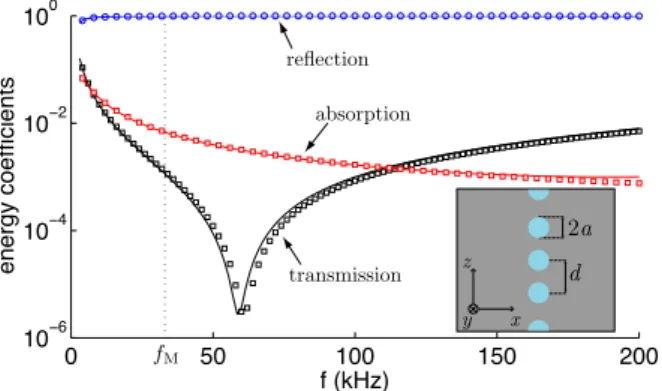
FIG. 1: Energy transmission, reflection and absorption for a layer of bubbles in water with a = 100 µm and d/a = 5, as predicted by the SCA (solid lines) and calculated by MST (markers). The inset shows the geometry of the layer.
shown [2, 3] that a single layer of bubbles was very effi-cient for blocking low frequency ultrasonic waves in wa-ter. An illustration is presented in Fig. 1, in which the reflection, transmission and absorption coefficients pre-dicted by the multiple scattering theory (MST) [4][7] are shown for a plane wave incoming in the x direction, with wave-number k, on a one-layer crystal of bubbles with a
squared lattice (see inset). It appears that this bubble meta-screen acts as a nearly perfect mirror, with a mini-mum of transmission for a frequency close to the resonant frequency of the bubbles (fM = ωM/2π).
One can use a self-consistent approximation (SCA) to obtain analytical expressions for the amplitude reflection r and transmission t, valid for kd ≪ 1: [2]
r = iKa
Ω − i(δ + Ka) (1a) t = Ω − iδ
Ω − i(δ + Ka), (1b) where Ω = (ωM/ω)2−(1−2√πa/d), K = 2π/(kd2), and
δ is the dissipative damping of the bubbles. Eq. (1b) pre-dicts a minimum of transmission at fmin= fM/
√ 1 − A, where A = 2√π(a/d) is a geometrical factor. Note that the viscous and thermal losses δ are generally much smaller than the super-radiative term Ka. For instance, for the meta-screen considered in Fig. 1, δ ≃ 2 × 10⁻² at
50 kHz, whereas Ka ≃ 10. This super-radiative term ex-plains the mirror-like behavior of the bubble meta-screen: Eq. (1a) reduces to r ≃ −1 for Ω, δ ≪ Ka. Experiments with bubble meta-screens in soft elastic materials [2, 3] and MST calculations (see Fig. 1) have confirmed that the SCA was successful, provided that the bubbles were not too close to each other [2] (d/a ≥ 5).
In this letter, we investigate the ability of a bubble meta-screen to block air-borne acoustic waves. The ques-tion is whether the minimum of transmission survives when the meta-screen is close to an interface with air. The answer is not straightforward because the presence of an interface is expected to affect the acoustic response of the bubbles, potentially destroying the desired effect. Let us consider the case depicted in the inset of Fig. 2: the plane wave first goes from a medium with impedance Z1to a medium with impedance Z2before it impinges the
layer of bubbles. It follows that multiple reflections be-tween the interface and the layer of bubbles occur. Not-ing x12= 2Z2/(Z1+Z2) the transmission from medium 1
to medium 2, the total amplitude transmission predicted by the SCA is given by t′ = x
12t/(1 − r(x21− 1)e2ikh),
2 0 50 100 150 200 10−6 10−4 10−2 100 f (kHz) energy coefficients d h 2a Z1 Z2 x z y transmission absorption transmission without bubbles reflection
FIG. 2: Energy transmission, reflection and absorption for an acoustic wave coming at normal incidence on an air-water interface with one layer of bubbles at distance h from the interface (see inset). MST (markers) and SCA (lines) calcu-lations are shown for a = 100 µm, d/a = 5, and h/a = 2.
of Z1 ≪ Z2 (air-water interface, for instance), and if
kh ≪ 1, the energy transmission T′ = (Z1/Z2)|t′|2 then
reduces to: T′= T′ 0 Ω − iδ Ω − B − i(δ + Bkh) 2 , (2) where T′
0= 4Z1/Z2is the transmission in the absence of
bubbles, and B = 4πah/d2. Energy reflection and
ab-sorption can also be calculated with the same scheme. Fig. 2 shows that Eq. (2) is in a good agreement with the predictions of the MST for the layer of bubbles we considered previously placed at a distance h = 2a from an air-water interface. It appears that the presence of the interface does not change the position of the mini-mum of transmission, for which the sound transmission loss (STL) is increased by 34 dB. Note that the reduced transmission with the bubble meta-screen extends over a large range of frequency: even at higher frequencies, the transmission reaches an asymptotic limit which cor-responds to a 12 dB increase of the STL compared to the bubble free interface.
Most interestingly, Eq. (2) also predicts a maximum of transmission at f′
max = fM/
√
1 − A + B. It means that the presence of a layer of bubbles close to an in-terface can enhance the transmission of sound. It is tempting to call this effect an extraordinary acoustical transmission, by analogy with the extraordinary optical transmission (EOT) through perforated opaque metallic films [5]. However, even though they share some char-acteristics, both phenomena have different physical ori-gins. In particular, there is no equivalent of the surface-plasmon-polariton modes in the present case. Indeed, the enhanced transmission is simply due to a Fabry-P´erot resonance. The first multiple reflected wave has a phase
shift of ϕr+π+2kh compared with the direct transmitted
wave, where ϕris the phase shift induced by a reflection
on the bubble meta-screen. Since ϕr ≃ π − Ω/Ka (see
Eq. (1a)), there are constructive interferences at f′ max,
leading to the enhanced transmission.
0 0.5 1 1.5 2 10−5 10−9 100 f (kHz) energy coefficients d h 2a h Z1 Z2 Z1 x z y transmission absorption transmission without bubbles reflection
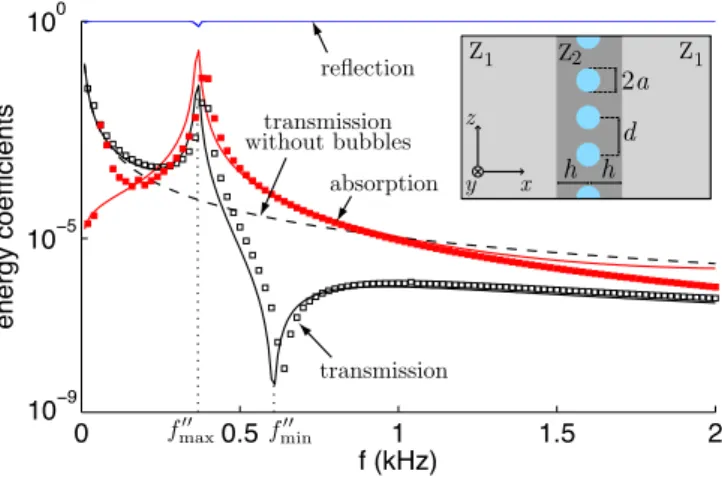
FIG. 3: Energy transmission, reflection and absorption for an acoustic wave coming at normal incidence on an air-water-air system with one layer of bubbles (inset). MST (markers) and SCA (lines) calculations are shown for a = 1 cm, d/a = 5, and h/a = 2.
When a second interface is introduced (see the inset of Fig. 3), even more multiple reflections are involved in the transmission. The algebra is still tractable and, in the Z1 ≪ Z2 and kh ≪ 1 limit, the SCA predicts an
energy transmission given by T′′= T′′ 0 Ω − iδ Ω − B/2 − i(δ + 2Ωkh) 2 , (3) where T′′
0 = Z12/(ρ2ωh)2 is the usual mass density law
for transmission through a high impedance thin wall (ρ2
is the mass density of medium 2). As in the one interface case, Eq. (3) predicts the existence of a minimum and maximum of transmission. To emphasize the possible applications for soundproofing, we show an example in the audible frequency range. As the Minnaert resonance scales as the inverse of the bubble radius, 100 times larger bubbles are required to shift the 60 kHz seen in Fig. 2 to 600 Hz, which makes a radius of 1 cm. Keeping the same d/a and h/a ratios as in Fig 2, we thus consider a 4 cm-thick wall of water embedded with a layer of 1 cm radius bubbles separated by a 5 cm lattice constant (see Fig. 3). Agreement with the calculations by MST is satisfactory. The minimum of transmission is at 600 Hz, as predicted, and it corresponds to an extra 35 dB of transmission loss compared to the mass density law. Besides, the STL is not increased only at resonance: for higher frequencies, bubbles bring on average 10 dB to the loss.
Bubble meta-screens thus appear to be efficient sys-tems for blocking air-borne acoustic waves: the mini-mum of transmission survives to the presence of one or
3 two air interfaces. More surprisingly, a bubble
meta-screen close to an interface can also enhance the trans-mission, which could be useful for impedance matching applications. The question of the feasibility naturally arises. Water walls with arrays of bubbles are of course unrealistic. Nevertheless, it has been confirmed by ex-periments [3] that bubbles can be embedded in a soft elastic matrix without losing their low frequency reso-nance, which means that the practical realization of elas-tic meta-screens is possible. Analyelas-tical expressions for the transmission, reflection and absorption coefficients are then a powerful tool for designing meta-screens. We report in Table 1 the equations that govern the main features of the transmission. They can be used as guide-lines for the choice of parameters a, d and h for a bubble meta-screen. Let us consider for instance a soundproof-ing application. First, a should be chosen so that the resonance frequency of the bubbles is close to the fre-quency one needs to block. Then, the choice of d is a trade-off: a small d makes the minimum of transmission deeper but it shifts it to a higher frequency, which is not desirable for low frequency soundproofing. On the other hand, h should be taken as large as allowed by the prac-tical application (and within the kh ≪ 1 limit): a large h deepens the minimum of transmission, and it shifts the maximum of transmission to a lower frequency. We re-call that the SCA is valid only for d/a ≥ 5. Furthermore, because of limitations of the MST program we used, we were not able to test its validity for h/d < 0.4.
TABLE 1: Equations for the positions and values of the min-imal, maximal and asymptotic transmissions as predicted by the SCA. Factors A = 2√πa/d and B = 4πah/d2 depend only on the geometry of the device.
no interface 1 interface 2 interfaces fmax / fM/√1− A + B fM/p1− A + B/2 Tmax/T0 / [δ/B + kh]−2 (1/4)[δ/B + kh]−2
fmin fM/√1− A
Tmin/T0 (δ/Ka)2 (δ/B)2 4(δ/B)2 Tasy/T0 / [1 + B/(1 − A)]−2 [1 + B/2(1 − A)]−2
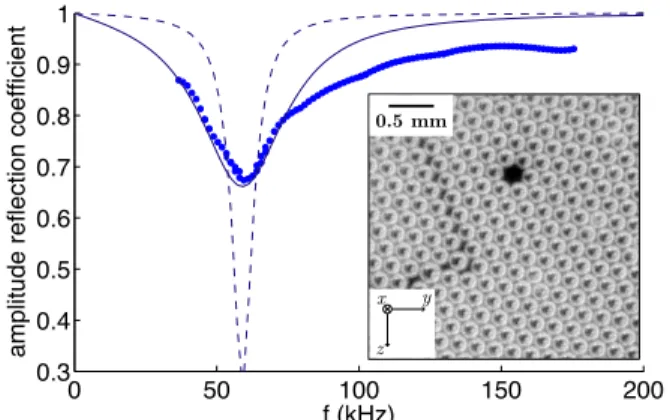
However, MST calculations show that more compact bubble meta-screens qualitatively behave the same way: they still exhibit both a maximum and a minimum of transmission. We checked this point experimentally with the most compact structure one can imagine: a bubble raft [6] (see inset of Fig. 4). As shown in Fig. 2, the en-hanced transmission is expected to be accompanied with a maximum of absorption and a minimum of reflection. Fig. 4 reports the reflection coefficient we measured for a raft of 90 µm-radius bubbles. A minimum is clearly seen at 60 kHz, a position perfectly predicted by the MST calculation. Experiments with different bubble sizes con-firmed that this position scaled as the inverse bubble
ra-dius, as expected. The depth of the minimum is overesti-mated (dashed line in Fig. 4) by the MST. This discrep-ancy may be attributed to a higher effective viscosity of the liquid, due to its confinement between bubbles; an hypothesis which is supported by a better agreement when the viscosity is increased by a factor 250 (solid line in Fig. 4). A side effect of this high effective viscosity is a poor enhancement of the transmission: MST calculation shows that, at normal incidence, only 0.3 % of the en-ergy is transmitted (below our experimental sensitivity). However, absorption is significantly increased: 54.8 % of the energy is absorbed. It indicates that compact bub-ble meta-screens, such as bubbub-ble rafts, might be used as absorbing materials. 0 50 100 150 200 0.3 0.4 0.5 0.6 0.7 0.8 0.9 1
amplitude reflection coefficient
f (kHz)
y z 0.5 mm
x
FIG. 4: Inset: top view of a bubble raft at the surface of a surfactant solution. Monodisperse small bubbles are injected by blowing air through a 20 µm-diameter capillary. Reflection measurements are performed by acoustic pulses emission and reception with a couple of broadband air transducers. Note that, due to the size of the transducers, the incindence was not normal but set to a minimal value of 20◦. Plots: mark-ers are the experimental amplitude reflection coefficient for 90 µm-radius bubbles, compared with the MST calculation for bubbles in water (dashed line) and in a 250 times more viscous fluid (solid line).
[1] Z. Yang, M. Dai, N. H. Chan, G. C. Ma, and P. Sheng, Applied Phys. Lett. 96, 041906 (2010).
[2] V. Leroy, A. Strybulevych, M. G. Scanlon, and J. H. Page, Eur. Phys. J. E 29, 123 (2009).
[3] V. Leroy, A. Bretagne, M. Fink, H. Willaime, P. Tabeling, and A. Tourin, Applied Phys. Lett. 95, 171904 (2009). [4] R. Sainidou, N. Stefanou, I. E. Psarobas, and A. Modinos,
Computer Physics Communications 166, 197 (2005). [5] T. W. Ebbesen, H. J. Lezec, H. F. Ghaemi, T. Thio, and
P. A. Wolff, Nature 391, 667 (1998).
[6] L. Bragg and J. F. Nye, Proc. R. Soc. Lond. A 190, 474 (1947).
[7] Dissipation was included in the MST following the proce-dure described in [2].