HAL Id: hal-00334038
https://hal.archives-ouvertes.fr/hal-00334038v2
Submitted on 24 Oct 2008HAL is a multi-disciplinary open access
archive for the deposit and dissemination of sci-entific research documents, whether they are pub-lished or not. The documents may come from teaching and research institutions in France or abroad, or from public or private research centers.
L’archive ouverte pluridisciplinaire HAL, est destinée au dépôt et à la diffusion de documents scientifiques de niveau recherche, publiés ou non, émanant des établissements d’enseignement et de recherche français ou étrangers, des laboratoires publics ou privés.
Quark Lagrangian diagonalization versus non-diagonal
kinetic terms
Quentin Duret, Bruno Machet, M. I. Vysotsky
To cite this version:
Quentin Duret, Bruno Machet, M. I. Vysotsky. Quark Lagrangian diagonalization versus non-diagonal kinetic terms. Modern Physics Letters A, World Scientific Publishing, 2009, 24 (4), pp.273-275. �10.1142/S0217732309030084�. �hal-00334038v2�
Quark Lagrangian diagonalization versus
non-diagonal kinetic terms
Q. Duret∗, B. Machet†‡, M.I. Vysotsky§¶
October 24th 2008
Abstract
Loop corrections induce a dependence on the momentum squared of the coefficients of the Stan-dard Model Lagrangian, making highly non-trivial (or even impossible) the diagonalization of its quadratic part. Fortunately, the introduction of appropriate counterterms solves this puzzle.
The Standard Model (SM) Lagrangian is determined by its field content and two requirements: local
SU(3) × SU(2)L× U (1) gauge invariance and renormalizability. The kinetic terms of quarks are taken
canonically normalized and diagonal in flavor, while their interactions with the Higgs doublet contain two 3 × 3 complex matrices of Yukawa couplings, respectively for up and down quarks. In this way,
after the Higgs field has acquired a vacuum expectation value, quark mass terms non-diagonal in flavor appear. Since it is much more convenient to deal with fields which have definite masses, one performs a diagonalization of the latter with the help of four unitary3×3 matrices: ULand URacting respectively on
left- and right-handed up quark fields, and DLand DRacting analogously on down quarks. As a result,
one obtains new quark fields with diagonal masses, while the charged quark currents are described by the Cabibbo-Kobayashi-Maskawa (CKM) unitary matrix which equals UL†DL. The matrices URand DR
drop out from the final Lagrangian.
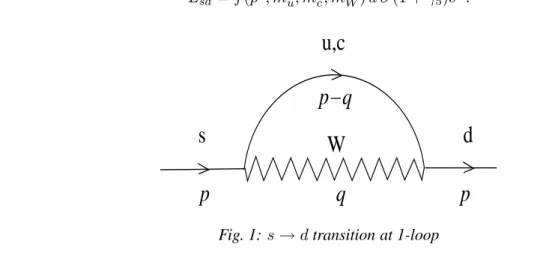
This well-known result needs further consideration when radiative corrections are taken into account. Let us discuss the case of two generations (generalization to three and more generations is straightfor-ward). The point is that, due to the diagram shown in Fig. 1, the following non-diagonal kinetic term is generated1: Lsd = f (p 2 , m2u, m 2 c, m 2 W) ¯d ˆ∂(1 + γ5)s . (1)
u,c
p
p−q
W
q
p
s
d
Fig. 1: s → d transition at 1-loop
LPTHE tour 24-25, 5`eme´etage, UPMC Univ Paris 06, BP 126, 4 place Jussieu, F-75252 Paris Cedex 05 (France), Unit´e Mixte de Recherche UMR 7589 (CNRS / UPMC Univ Paris 06)
‡
§
SSC RF ITEP, lab. 180, Bolshaya Cheremushkinskaya Ul. 25, 117218 Moscow (Russia)
¶
[email protected] 1We use the convention γ
µ(1 + γ5) in the charged currents of the SM.
Of course, diagonal terms are generated as well but, for them, the transformation to canonical fields is simple: it should be performed at p2
= m2
i, see below.
As a result, the canonical form of the kinetic terms is lost. Would we like to diagonalize back the matrix of kinetic terms to its canonical form (equal to the unit matrix), a non-unitary transformation of quark fields would be needed.
It is not a big trouble if, after such a non-unitary transformation, one gets mixed mass terms, since the problem is then reduced to the one which was already solved: after bi-unitarily transforming again the mass matrices, one gets quark fields with definite diagonal masses and non-diagonal charged currents described by a unitary CKM matrix. These quark fields are expressed in terms of the initial (bare) quark fields through non-unitary matrices.
All this works if the function f does not depend on p2; however, it does. Thus, one is forced to introduce rotation matrices for quark fields which depend on p2, and, so, quark mixing angles which also depend on the quark virtuality. For example, different Cabibbo angles then occur at s- and d-quark mass-shells.
The obtained result seems far from the standard CKM phenomenology, such that a natural question arises: how to implement the standard CKM approach to flavor non-diagonal transitions when radiative corrections are taken into account?
The solution lies in paper [1], in which counterterms were found which, when added to the SM La-grangian, cancel the non-diagonal kinetic term (1) on s- and d-quark mass-shells (the non-diagonal quark self-energy sandwiched between quark propagators has no pole on both quark mass-shells). One can easily check that the following counterterms do the job:
Lcsd = −A ¯d ˆ∂(1 + γ5)s − B ¯d ˆ∂(1 − γ5)s − C ¯d(1 + γ5)s − D ¯d(1 − γ5)s , (2) where A= m 2 sf(m 2 s) − m 2 df(m 2 d) m2 s− m 2 d , B= msmd f(m2 s) − f (m 2 d) m2 s− m 2 d , (3) C = −msB , D= −mdB .
As usual, when counterterms are added to a bare Lagrangian, its parameters are to be considered as the renormalized ones. For the case under concern, diagonalizing its quadratic part without the counterterms (2) and (3) yields diagonal d and s fields; the same property subsists at 1-loop because (2) and (3) (which, being proportional to the square of the coupling constant, only play a role when calculating loop corrections) preserve the diagonality of the d and s fields when the term (1) is taken into account.
In the approach reported above, the transition s → d does not occur on d- and s-quark mass-shells (it is absent at tree level and its expression (1) at 1-loop is canceled by the counterterms (2) (3)). That is why a question can be raised: in the standard approach to Flavor Changing Neutral Currents, counterterms are not introduced, such that on mass-shell transitions should be accounted for. For example, in the calculation of the s → dν ¯ν decay amplitude, one should not only take into account the vertex and box
amplitudes, but also Z-boson radiation from external legs: s → s∗Z → dZ and s → d∗ → dZ. By
introducing the counterterms (2) (3), these transitions get canceled and one may think that the expressions for the amplitudes will change. In reality they do not, because the covariant derivatives should be used in (2); in this way, the contribution, in the approach without counterterms, of the non-diagonal s → d transition, is reproduced, in the approach with counterterms, by the gauge boson terms arising in the latter.
Discussions with E.P. Shabalin are greatly acknowledged. We are grateful to L.B. Okun for the sugges-tion to write this short note.
References
[1] E.P. Shabalin, Yad. Fiz. 28 (1978) 151 [Sov. J. Nucl. Phys. 28 (1978) 75].