
HAL Id: insu-01588240
https://hal-insu.archives-ouvertes.fr/insu-01588240
Submitted on 15 Sep 2017HAL is a multi-disciplinary open access archive for the deposit and dissemination of sci-entific research documents, whether they are pub-lished or not. The documents may come from teaching and research institutions in France or abroad, or from public or private research centers.
L’archive ouverte pluridisciplinaire HAL, est destinée au dépôt et à la diffusion de documents scientifiques de niveau recherche, publiés ou non, émanant des établissements d’enseignement et de recherche français ou étrangers, des laboratoires publics ou privés.
Aqueous chemistry of Ce(IV): estimations using actinide
analogues
Rémi Marsac, Florent Réal, Nidhul Lal Banik, Mathieu Pédrot, Olivier
Pourret, Valérie Vallet
To cite this version:
Rémi Marsac, Florent Réal, Nidhul Lal Banik, Mathieu Pédrot, Olivier Pourret, et al.. Aqueous chemistry of Ce(IV): estimations using actinide analogues. Dalton Transactions, Royal Society of Chemistry, 2017, 46 (39), pp.13553-13561. �10.1039/C7DT02251D�. �insu-01588240�
Aqueous chemistry of Ce(IV): estimations using actinide analogues
12
Rémi Marsaca*, Florent Réalb, Nidhu Lal Banikc, Mathieu Pédrota, Olivier Pourretd, Valérie 3 Valletb 4 5 6 a
Géosciences Rennes UMR 6118, Université Rennes 1, CNRS, 35042 Rennes cedex, France 7
b
Univ. Lille, CNRS, UMR 8523 – PhLAM – Physique des Lasers Atomes et Molécules, F-59000 8
Lille, France 9
c
JRC-KARLSRUHE, G.II.6 - Nuclear Safeguards and Forensics, European Commission, P.O.Box 10
2340, D-76125 Karlsruhe, Germany 11
d
HydrISE, UniLaSalle, 60026 Beauvais cedex, France 12
13
*Corresponding author : Géosciences Rennes UMR 6118, Université Rennes 1, CNRS, 35042 14
Rennes cedex, France. E-mail address: [email protected] (R. Marsac). 15
Abstract
17Prediction of Cerium (Ce) aqueous speciation is relevant in many research fields. Indeed, Ce 18
compounds are used for many industrial applications, which may require the control of Ce aqueous 19
chemistry for their synthesis. Aquatic geochemistry of Ce is also of interest. Due to growing 20
industrial use and its release to the environment, Ce is now considered as emerging contaminant. 21
Cerium is also used as a proxy of (paleo)redox conditions due to the Ce(IV)/Ce(III) redox 22
transition. Finally, Ce(IV) is often presented as a relevant analogue of tetravalent actinides 23
(An(IV)). In the present study, quantum chemical calculations were conducted to highlight 24
similarities between the structure of Ce(IV) and tetravalent actinides (An(IV); An = Th, Pa, U, Np, 25
Pu) aqua-ions, especially Pu(IV). Current knowledge of An(IV) hydrolysis, solubility and colloid 26
formation in water were briefly reviewed but important discrepancies observed with available data 27
for Ce(IV). Therefore, new estimation of the hydrolysis constants of Ce(IV) and solubility of 28
Ce(IV)-(hydr)oxides are proposed, by analogy with Pu(IV). By plotting pH-Eh (Pourbaix) 29
diagrams, we showed that the pH values corresponding to the onset of Ce(IV) species formation 30
(i.e. Ce(IV)-(hydr)oxide or dissolved Ce(IV)) agreed with various experimental results. Although, 31
further experimental studies are required to obtain a more accurate thermodynamic database, the 32
present work might yet help to predict more accurately Ce chemical behavior in aqueous solution. 33
Keywords: Cerium, actinide, tetravalent, hydrolysis, solubility, speciation, aqua-ions, quantum 34
chemical calculation. 35
TOC
37
38
Quantum chemical calculations and a comparison of Cerium(IV)/Actinide(IV) justify the 39
estimation of Cerium(IV) aqueous speciation using Plutonium(IV) as analogue. 40
Introduction
42The solution chemistry of actinide (An) ions in aquatic systems relevant for the disposal of 43
nuclear wastes is influenced by hydrolysis reactions and complexation with inorganic and organic 44
anions.1 Actinides can be found in various oxidation states in aqueous solution, which commonly 45
range from +III to +VI depending on the An (i.e., Th, U, Np, Pu). Change in oxidation state has 46
drastic consequences on An aqueous chemistry, solubility and sorption to natural organic and 47
inorganic particles and colloids, which, in turn, affect their mobility in natural systems.2–9 Only 48
Th(IV) exists in aqueous solution. U(IV) and U(VI) prevail in reducing and oxidizing conditions, 49
respectively, the stability field of U(V) (found in moderately reducing conditions) being rather 50
narrow.10 Np(IV) and Np(V) are the prevalent oxidation states of Np but Np(VI) can form in 51
oxidizing alkaline solutions.8,11,12 Pu can be found in oxidation states ranging from +III to +VI in 52
environmentally relevant conditions.3,7,13 For all these An elements, the tetravalent oxidation state 53
is pertinent in near-neutral pH values expected to be found in nature. Because of their high electric 54
charge, tetravalent actinide ions have a strong tendency toward hydrolysis in aqueous solution and 55
undergo polynucleation or further lead to colloid formation.14 Therefore, many studies were 56
dedicated to An(IV) hydrolysis, solubility and colloids formation.15–19 The chemical behavior of 57
An(IV) was found highly consistent across the series, as commonly observed for f-elements 58
(lanthanides (Ln) (4f) and An (5f)) in the same oxidation state, and are thus often considered as 59
chemical analogues (e.g.20–25). 60
Lanthanides are naturally occurring trace elements in the environment. In contrast to its 61
lanthanide neighbors, which predominate in +III oxidation state, Ce(III) can be oxidized to Ce(IV) 62
under oxidizing conditions. Preferential removal of Ce(IV) than Ce(III) from aqueous solution by 63
natural particles can lead to the development of a so-called Ce anomaly (implicitly, by comparison 64
with the behavior of its lanthanide neighbors La(III) and Pr(III)). The presence (under oxidizing 65
conditions) or the absence (under more reducing conditions) of a Ce anomaly in natural samples is 66
widely used as a proxy of (paleo)redox conditions.26–29 Since Ce is also used for many 67
applications,30–34 it is now considered as emerging contaminant that could affect ecosystems, due 68
to its release to the environment.30 Ce(IV) is often presented as a relevant analogue of 69
An(IV).22,24,25 As Ce is not radioactive, experimental studies can be more easily conducted with 70
Ce(IV) than with An(IV), which could improve our scientific knowledge on An(IV) environmental 71
chemistry. Therefore, prediction of Ce aqueous speciation is of great interest for different research 72
fields. 73
However, by contrast with An(IV), there is much less information regarding Ce(IV) 74
aqueous chemistry. In fact, the present situation is such that it might be more appropriate to use 75
An(IV) to shed light on Ce(IV) aqueous chemistry than the contrary. For instance, thermodynamic 76
constants selected by Baes and Mesmer35 are often used to predict Ce(IV) hydrolysis and solubility 77
in water. This database only contains formation constants for CeOH3+(aq) and Ce(OH)22+(aq), and is
78
obviously incomplete because at least the electrically neutral Ce(OH)4(aq) species should be in
79
equilibrium with Ce(IV)-(hydr)oxides at neutral and/or alkaline pH. Omission of such species 80
inevitably leads to drastic underestimation of Ce(IV) solubility. Hayes et al.36 used hydrolysis 81
constants of Ce(IV) more recently determined by Bilal and Müller37 to plot a pH-Eh predominance 82
diagram. According to these results, under ambient conditions (air; = 0.2 atm), Ce(IV) should 83
prevail at pH above ~4.5. This result contrasts with Th(IV) and lanthanide adsorption studies on 84
MnO2(s) which is known to rapidly oxidize Ce(III) to Ce(IV). Almost complete and
85
pH-independent uptake of Th(IV) by MnO2(s) is observed for 3 < pH < 11.38 By contrast, although
86
more efficiently removed from the solution by MnO2(s) than its lanthanide neighbors, only partial
uptake of Ce (initially +III) by MnO2(s) is observed under ambient air and it increases from pH = 4
88
to pH = 6-7.29,39 This suggests that, at 4 < pH < 6-7, although Ce(IV) is associated with the solid 89
phase (precipitated or adsorbed on MnO2(s)), Ce(III) prevails in solution,40 as also observed in
90
previous studies dealing with Pu uptake by clays in moderately reducing conditions (where the 91
Pu(IV)/Pu(III) redox couple was involved).41,42 Therefore, Ce(IV) hydrolysis constants determined 92
by Bilal and Müller37 appear to be questionable. 93
In this study, we briefly summarized current knowledge about An(IV) aqua-ions structure, 94
hydrolysis, solubility and colloids formation in water, in the absence of complexing ligands. 95
Quantum chemical calculations were conducted to highlight similarities between the structure of 96
Ce(IV) and Th/U/Np/Pu(IV) aqua-ions. Because available hydrolysis constants and solubility data 97
for Ce(IV) were found partly inconsistent with those of Th/U/Np/Pu(IV), new estimated 98
thermodynamic constants for Ce(IV) were proposed. 99
100
Materials and methods
101Quantum chemical calculations
102
The quantum chemical methodology used to discuss the structure and relative free energies of 103
Ce(IV) hydrates with 10, 9 and 8 water molecules [Ce(H2O)10]4+, [Ce(H2O)9]4+H2O, and
104
[Ce(H2O)8]4+(H2O)2 is similar to that of our previous study on early tetravalent An species.43 A
105
small-core relativistic effective core potential44 of the Stuttgart-Cologne group was employed for 106
the cerium atom along with the corresponding segmented basis set.45 Augmented 107
correlation-consistent polarization valence triple-ζ (aug-cc-pVTZ) basis sets were used for 108
oxygen,46 and hydrogen atoms.47 The geometries were optimized without symmetry constraints at 109
the restricted MP2 level using the parallel resolution of the identity approximation,48,49 with the 110
appropriate atomic auxiliary basis functions.50,51 Harmonic frequency calculations were computed 111
numerically at the optimized geometry, not only to confirm that the optima found correspond to 112
energy minima, but also to compute the vibrational partition functions at 298.15 K and 0.1 MPa, 113
which are necessary to calculate the enthalpic and entropic contributions to the gas-phase energies. 114
The contribution of hydration to the free energies of all isomers was estimated by single-point 115
COSMO calculations with a dielectric constant of 78.9.52 To comply with the relatively low level 116
of theory (HF or DFT with small basis sets) at which the COSMO model has been parameterized,53 117
a B3LYP based density and small def2-SVP basis sets54 on all atoms are used to compute free 118
energies of solvation. All calculations were performed with the Turbomole 7.1 quantum chemistry 119
package.55 A comparison of the nature of the cerium-water bond with that of the other tetravalent 120
actinide elements was performed using the quantum theory of atoms in molecules (QTAIM) 121
approach, implemented in the AIMAll package,56 that analyzes the appropriate wave function 122
extended files (wfx) obtained with Gaussian09.57 123
124
Geochemical speciation code and thermodynamic database
125
PHREEQC (version 2)58 is a computer code that can perform speciation and 126
saturation-index calculations in water. PHREEQC was used to calculate species distribution plots. 127
Predominance (pH-Eh) diagrams were obtained using PhreePlot,59 which contains an embedded 128
version of PHREEQC. The specific ion interaction theory (SIT60) was used to extrapolate 129
thermodynamic constants at various ionic strengths. In the present work, thermodynamic constants 130
for An aqueous speciation and solubility and SIT parameters were taken from the NEA 131
thermodynamic database2. The metastability of ClO4-, sometimes used as background anion, is
132
avoided in the models by defining perchlorate as a master species. 133
Results and discussion
134Tetravalent actinides and cerium aqua-ions
135
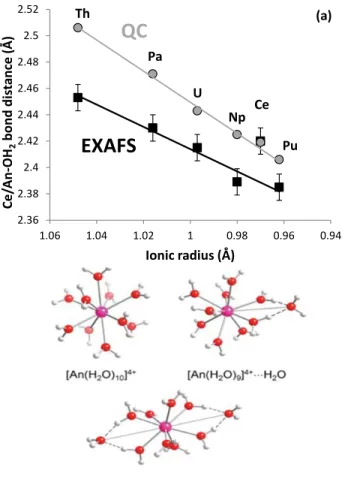
Figure 1a plots the mean An–OH2 bond distances of tetravalent actinide aqua ions determined by
136
L3-edge extended X-ray absorption fine structure (EXAFS) versus their ionic radii for coordination
137
number of eight.43,61 In a previous work, a linear relationship with a slope of about one was 138
observed for the ions from Th4+ to Pu4+.43 Because the An–OH2 bond distances for the ions up to
139
Pu4+ follow closely this line, and hence the actinide contraction, it was assumed that there is no 140
major change in these ions’ hydration number. To obtain detailed information on the preferred 141
coordination structure for An4+ ions in solution quantum chemical calculations were performed on 142
the decahydrates [An(H2O)10]4+, [An(H2O)9]4+·H2O, and [An(H2O)8]4+·(H2O)2 (see Fig. 1b; Table
143
S1 and S2).43 Calculation of relative free energies (Table S2) showed that the nine-coordinate 144
isomer, having distorted tricapped trigonal prismatic first shell geometry, was the most stable 145
species for all ions from Th4+ to Pu4+. Although overestimated (see discussion in Vallet et al.62), 146
calculated An–OH2 bond distances follow a linear relationship with the ionic radii, as observed by
147
EXAFS. 148
With an ionic radius of 0.97 Å, Ce4+ is expected to be an analogue of either Np4+ (0.98 Å) or 149
Pu4+ (0.96 Å).61 Available EXAFS data somehow disagree with this hypothesis (Figure 1a),63 150
Ce4+–OH2 bond distance (= 2.42 Å) being larger than that of Np4+ and Pu4+, but comparable to
151
Pa4+–/U4+–OH2 bond distance (Fig. 1a; see also Table S3 of reference 43). In fact, standard redox
152
potential of Ce4+/Ce3+ ( ) is larger than that of O2/H2O,36,37 hence Ce4+ is not
thermodynamically stable in water at acidic pH. As observed by Sham,63 the solution contained a 154
mixture of Ce4+ and Ce3+ and the Ce4+–OH2 bond distance was only estimated, hence subjected to
155
relatively large uncertainty. By contrast, present quantum chemical calculations confirm that, for 156
aqua-ions, (i) Ce4+ coordination number is 9 like in the early An4+, (ii) relative free energies for the 157
ten- and eight-coordinate isomers of Ce4+ are comparable to that of Np4+ and Pu4+ (Table S2) and 158
(iii) bond distance follow Np4+–OH2 < Ce4+–OH2 < Pu4+–OH2 (Figure 1a). The topological
159
analysis of the electron charge density at the Ce/An4+–OH2 bond critical points, presented in Table
160
S3, reveal that the values of all bonding indicators, the density , its Laplacian 2, the energy 161
density Hb, and the bonding index D(M,L) of Ce superimpose with that of Np and Pu. This further
162
supports the strong resemblance of Ce with Np and Pu, and suggests that, as in tetravalent actinide 163
aqua ion, Ce(IV)-water bonds can be described as electrostatic. Furthermore, the difference from 164
the formal atomic valence f population in [Ce(H2O)9,(H2O)]4+ are very similar to that of the Pu(IV)
165
homologue. The valence d orbitals are however, slightly more populated, simply reflecting the fact 166
the 5d states/orbitals are more energetically accessible in Ce(IV) than the 6d ones in the heavy 167
actinide (Np or Pu) homologues. To stress further the similarity between Ce(IV) and Pu(IV) ions, it 168
is worthy to mention a previous theoretical study, where the objective was to find a surrogate for 169
the Pu(IV) ion in HNO3/TBP solution when it is complexed by nitrate ions, i.e Pu(NO3)62− and
170
Pu(NO3)4(TBP)2.24 It was found that the Ce(IV) complexes have comparable behaviors in term of
171
structures, charge distribution and stabilities to those of Pu(IV), and that Ce(IV) is a priori a better 172
surrogate for Pu(IV) for experimental studies than Th(IV) or U(IV). This conclusion is in line with 173
the observed applicability of cerium dioxide CeO2 as a surrogate for plutonium dioxide PuO2
174
steaming from their structural similarities and comparable redox behavior.64–67 175
177 178
179
Figure 1. (a) Mean An–OH2 or Ce–OH2 bond distance determined by L3-edge extended X-ray absorption fine
180
structure (EXAFS) or by quantum chemical calculations (QC; for [An/Ce(H2O)9]4+·H2O) versus An/Ce(IV) ionic radii
181
(b) (U)-MP2 gas-phase optimized isomeric 10-, 9-, and 8-coordinated clusters, [An(H2O)10]4+, [An(H2O)9]4+·H2O, and
182 [An(H2O)8]4+·(H2O)2.43 183 184 2.36 2.38 2.4 2.42 2.44 2.46 2.48 2.5 2.52 0.94 0.96 0.98 1 1.02 1.04 1.06 Ce/ A n -OH 2 b on d d is ta n ce (Å) Ionic radius (Å) Th U Np Ce Pu Pa
QC
EXAFS
(a) (b)Solubility of Actinide(IV)- and Cerium(IV)-(hydr)oxides
185
Solubility products (at infinite dilution) of amorphous An(IV) precipitates 186
(An(OH)4(am) or AnO·xH2O(am)) and crystalline dioxides AnO2(cr) globally refer to the dissolution
187
equilibrium:14 188
An(OH)4(s) An4+ + 4 OH- (1)
189
A relationships between log of An(OH)4(am) or AnO2(cr) and the ionic radii of An4+ was
190
evidenced.18 Baes and Mesmer35 determined log of CeO2(cr) from data given in the NBS
191
tables,68 which we find in excellent agreement with An(IV) (Figure 2a). 192
As previously demonstrated, the thermodynamically stable crystalline dioxides AnO2(cr)
193
may be the solubility limiting solid phase at very low pH or elevated temperature.14,18,19 However, 194
experimental solubility data in neutral and alkaline solutions at room temperature are 6–7 orders of 195
magnitude higher than the low values of less than 10-15 mol L-1 calculated from the known 196
thermodynamic data. In fact, they correspond to solubility data obtained for An(OH)4(am). It was
197
concluded that hydration of the surface of crystalline AnO2(cr) results in an amorphous solubility
198
limiting surface layer.14,18 By analogy with An(IV), Ce(IV) solubility might be strongly 199
underestimated in near neutral to alkaline solutions when using log of CeO2(cr). It might be
200
more realistic to consider Ce(OH)4(am) as the solubility limiting phase.
201
Actinide(IV) solubility determined in neutral and alkaline solutions by ultracentrifugation 202
(e.g. 5×10⁵g during 1h)19 or ultrafiltration (typically 10 kDa)15 refer to “truly dissolved” An(IV) 203
([An(IV)]aq) and can be ascribed to the following solubility equilibrium:
204
An(OH)4(s) An(OH)4(aq) (2)
Figure 2b shows that experimental values of log [An(IV)]aq tend to decrease with the An(IV) ionic
206
radii. When no or insufficient phase separation is applied, the measured Th(IV) and Pu(IV) 207
concentrations in the aqueous phase are generally ~2.5 orders of magnitude larger.15,19 This was 208
attributed to the formation of small An(IV) eigencolloids. Their size was estimated to be in the 209
range 1.5–2 nm, whereas An(OH)4(am) particles would be 2–5 nm large.15 Experimentally
210
determined apparent Th(IV) and Pu(IV) solubilities in neutral and alkaline solutions in presence of 211
eigencolloids ([An(IV)]coll) are plotted in Figure 2b. A similar trend is found for log [An(IV)]coll
212
and log [An(IV)]aq versusionic radii. Although data are missing for U and Np, this result further
213
highlights the coherence across the An(IV) series. 214
Recently, the solubility of nanocrystalline cerium dioxide (CeO2(cr,nano)) was determined.69
215
At pH > 6, log [Ce(IV)] = -7.5 ± 0.4 (1σ) was found. This result is highly contrasting with log 216
[An(IV)]aq (Fig. 2b). However, the authors performed phase separation by ultracentrifugation
217
during 4 h at 4×10⁴g. By analogy with An(IV), if we assume that Ce(IV) eigencolloids might form, 218
this set-up might be inappropriate to remove such colloids. This hypothesis is supported by the fact 219
that log [Ce(IV)] measured by Plakhova et al.69 is in excellent agreement with log [An(IV)]coll (Fig.
220
2b). 221
223
Figure 2. (a) Solubility products of An(OH)4(am) and AnO2(cr) as a function of ionic radius.18 Available data for CeO2(cr)
224
are also included.35 (b) Measured log [An(IV)] versus ionic radii at neutral to alkaline pH in equilibrium with 225
An(OH)4(am) after ultrafiltration or ultracentrifugation (“truly dissolved An(IV)”) and with insufficient or without
226
phase separation (“with An(IV) colloids”).14 Value of log [Ce(IV)] determined by Plakhova et al.69 at pH > 6 is shown 227 for comparison. 228 229 -12 -11 -10 -9 -8 -7 -6 -5 0.94 0.96 0.98 1 1.02 1.04 1.06 Log [An (IV) ] Ionic radius (Å)
With An(IV) colloids Truly dissolved An(IV) Available Ce(IV) data -70 -65 -60 -55 -50 -45 0.94 0.96 0.98 1 1.02 1.04 1.06 Log K 0 sp Ionic radius (Å) An(OH)4(am) AnO2(cr) Th U Np Ce Pu Am An(OH)4(am) AnO2(cr) (a) (b) Th U Np Ce Pu
Hydrolysis and polynuclear species of Actinide(IV) and Cerium(IV)
230
Actinide(IV) hydrolysis reactions can be written as follows: 231
An4+ + n H2O An(OH)n(4-n) + n H+; βAn,n (3)
232
Where βAn,n is the corresponding hydrolysis constant (at infinite dilution) and 1 ≤ n ≤ 4. There is no
233
evidence for the formation of An(OH)5-(aq). As reviewed by Neck et al.14 values of log βAn,n are
234
consistent in the An(IV) series, and increase from Th(IV) to Pu(IV). An(IV) also tend to form 235
polynuclear species, observed for pH-[An(IV)] values approaching the solubility limit of An(IV) 236
with respect to An(OH)4(am). Polynuclear species formation can be described as follows:
237
x An4+ + y H2O Anx(OH)y(4x-y) + y H+; βAn,x,y (4)
238
In the case of Th(IV), dimers to hexamers (2 ≤ x ≤ 6) could be identified and corresponding 239
formation constants could be determined because of its single oxidation state in water.70 Due to its 240
complex redox chemistry, an extremely large diversity of polynuclear Pu species was observed, 241
including polymers of mixed valence states (Pu(IV) with Pu(III) or Pu(V)).71 Unfortunately, 242
corresponding formation constants could not be determined. Recent studies suggested that the 243
selected hydrolysis constants of Np(IV) and Pu(IV) by the NEA might be overestimated by 244
approximately one log unit (see e.g. reference 72 and references therein) because they might 245
implicitly include polynuclear Np/Pu(IV) species as well as larger Np/Pu(IV) polymers (small 246
colloids) that are hardly removed from the solution. Nevertheless, only the selected hydrolysis 247
constants of Np(IV) and Pu(IV) by the NEA will be discussed below because recently proposed 248
sets of hydrolysis constants are incomplete and polynuclear species formation constants are 249
missing, which does not allow predicting Np/Pu(IV) solubility. 250
Bilal and Müller37 determined Ce(IV) hydrolysis constants by cyclic voltammetric 251
measurement in aqueous HClO4 solutions ([Ce]tot = 1.25×10⁻⁴ mol L-1), which are compared with
252
that of Np(IV) and Pu(IV) in Figure 3a. Although a large diversity of polynuclear Ce (including 253
mixed Ce(IV)-Ce(III)) species have been suggested (e.g. Ce(IV)-dimer)70, corresponding set of 254
formation constants might be incomplete and questionable.35 Bilal and Müller37 did not account for 255
the formation of polynuclear Ce(IV) species. Cerium(IV) hydrolysis constants might implicitly 256
include such species and, therefore, should be somehow comparable to the selected hydrolysis 257
constants of Np(IV) and Pu(IV) by the NEA. Values of log βCe,1 and log βCe,2 are quite similar to
258
that of Np(IV) and Pu(IV), which supports the idea that these elements can be considered as 259
analogues. However, relatively large deviation is observed for the third and a huge one for the 260
fourth hydrolysis constants: βCe,3 (≈ -1.5) and βCe,4 (≈ -4.4) values are, respectively, 0.8 and 4.4
261
orders of magnitude larger on average than the corresponding constants for Pu (-2.3 and -8.5, 262
respectively). Note that these differences would be larger if Pu(IV) hydrolysis constants were 263
overestimated.72 This result is highly contrasting with complexation data with other hard Lewis 264
bases (e.g. OH-, F-, CO32-, Cl-)73. For instance, formation constants of AnF3+(aq), AnF22+(aq),
265
AnF3+(aq) and AnF4(aq) are comparable to those of Ce(IV) (Fig. S1).74,75 In fact, Bilal and Müller37
266
determined log βCe,4 less than 0.5 pH unit below the onset of Ce(OH)4(am) precipitation (determined
267
visually). We suspect that log βCe,3 value determined by Bilal and Müller37 might have been
268
affected by the formation of small Ce(IV) colloids, and that log βCe,4 very likely refers to the
269
reaction Ce4+ + 4 OH- Ce(OH)4(am,fresh), where Ce(OH)4(am,fresh) is a freshly precipitated
270
amorphous (colloidal) Ce(IV) hydroxide. The consequence on Ce(IV) and Pu(IV) aqueous 271
speciation is shown in Figure 3b,c ([NaClO4] = 0.1 mol L-1). Successive Ce(IV) hydrolysis are
272
predicted to occur within a narrow pH-range, and Ce(OH)4(aq) prevails at pH > 3 (Figure 3b). By
273
contrast, Pu(OH)4(aq) prevails only at pH > 6 (Figure 3c).
275
Figure 3. (a) Comparison between hydrolysis constants of Np(IV),2 Pu(IV),2 and Ce(IV).37 Predicted speciation of (b)
276
Ce(IV) and (c) Pu(IV) versus pH ([NaClO4] = 0.1 mol L-1) using the hydrolysis constants given in Table 1.2,37
277 278
Estimated speciation of Ce
279
As previously observed for trivalent actinides (Am and Cm) and relevant trivalent 280
lanthanide analogues (Nd and Eu), the hydrolysis constants are indistinguishable within the given 281
uncertainties.20 The same should be observed between Ce(IV) and Pu(IV) given their similarities. 282 0 20 40 60 80 100 0 1 2 3 4 5 6 7 8 9 10 Specie s di st rib ut ion ( %) pH 0 20 40 60 80 100 0 1 2 3 4 5 6 7 8 9 10 Specie s di st rib ut ion ( %) pH Ce4+ (aq) Ce(OH)22+ Ce(OH)3+ Ce(OH)4(aq) Pu4+ PuOH3+ Pu(OH)22+ Pu(OH)3+ Pu(OH)4(aq) CeOH3+ -10 -8 -6 -4 -2 0 2
log β1 log β2 log β3 log β4
log
βn
val
ue
Np Ce Pu
log β1 log β2 log β3 log β4
(a)
(b)
Because the hydrolysis constants (i) are expected to follow Np(IV) < Ce(IV) < Pu(IV) and (ii) do 283
not significantly differ between Np(IV) and Pu(IV) given the experimental uncertainties, we 284
suggest to simply use the complete thermodynamic database of Pu(IV) to estimate Ce(IV) aqueous 285
speciation. The advantage is that, for further estimations of Ce(IV) behavior in more complex 286
solutions (e.g. in presence of carbonates2 or natural organic matter76), the available database of 287
Pu(IV) can be used for Ce(IV) without any additional corrections. Presently selected hydrolysis 288
constants for Ce(III) and Ce(IV) are listed in Table 1. Although the Pu(IV) speciation model 289
provided by the NEA might not be fully mechanistic (polynuclear species are missing, as discussed 290
above)72, it allows predicting overall Pu(IV) solubility quite accurately,13,15 which is a sufficient 291
information for the present purpose. Because the solubility data of Plakhova et al.69 at pH < 6 refer 292
to the half reaction CeO2(cr,nano) + 4 H+ + e- Ce3+ + 2 H2O, the present estimations have no
293
consequence on the interpretations of the latter authors, as verified by speciation calculations (not 294
shown). In particular, the authors found log (CeO2(cr, nano)) = -59.3 ± 0.3. This value is higher
295
than for larger CeO2(cr) particles, which agree with Schindler equation77 and corresponding analysis
296
of Th(IV) and Pu(IV) data.15 297
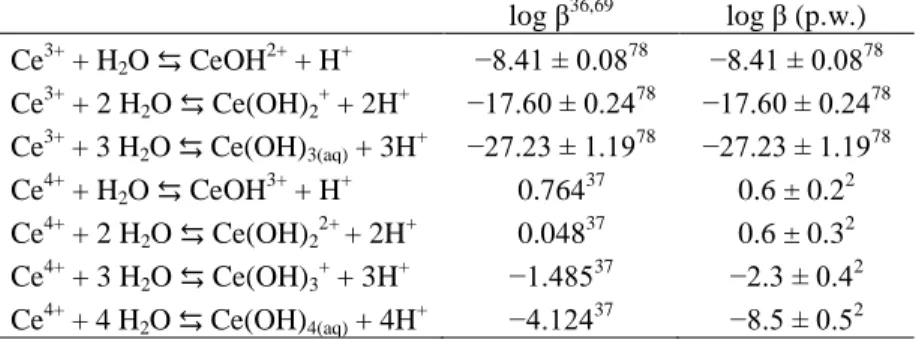
Table 1. Comparison between hydrolysis constants of Ce(III) and Ce(IV) used previously36,69 and in the present work
298 (p.w.). 299 log β36,69 log β (p.w.) Ce3+ + H2O ⇆ CeOH 2+ + H+ −8.41 ± 0.0878 −8.41 ± 0.0878 Ce3+ + 2 H2O ⇆ Ce(OH)2+ + 2H+ −17.60 ± 0.2478 −17.60 ± 0.2478 Ce3+ + 3 H2O ⇆ Ce(OH)3(aq) + 3H+ −27.23 ± 1.1978 −27.23 ± 1.1978 Ce4+ + H2O ⇆ CeOH3+ + H+ 0.76437 0.6 ± 0.22 Ce4+ + 2 H2O ⇆ Ce(OH)22+ + 2H+ 0.04837 0.6 ± 0.32 Ce4+ + 3 H2O ⇆ Ce(OH)3 + + 3H+ −1.48537 −2.3 ± 0.42 Ce4+ + 4 H2O ⇆ Ce(OH)4(aq) + 4H+ −4.12437 −8.5 ± 0.52
300
Figure 4. pH-Eh diagrams of Ce ([Ce] = 1.25×10⁻⁴ mol L-1; [NaClO4] = 0.1 mol L-1) assuming (a) formation of CeO2(cr)
301
(log = -64.16), (b) formation of Ce(OH)4(am,fresh) (log = -56.8) or (c) no formation of Ce(IV)-(hydr)oxide. In
302
(b), the pH-Eh diagram calculated by Hayes et al.36 is shown for comparison (only the Ce(IV)/Ce(III) redox transition 303
is shown). White circles and vertical dotted lines show the pH value corresponding to the Ce(IV)/Ce(III) redox 304
transition under ambient (air) atmosphere. 305
Three different pH-Eh diagrams of Ce are plotted in Figure 4 for [Ce] = 1.25×10⁻⁴ mol L-1 307
([NaClO4] = 0.1 mol L-1; corresponding to the experimental conditions of Bilal and Müller37).
308
When assuming the formation of CeO2(cr) (Fig. 4a), for PO2= 0.2 atm (pH + pe = – log – log
309
= 20.6), Ce(III) prevails at low pH < 2 and rapidly disappears from the solution when pH 310
further increases (not shown; log [Ce(IV)]aq = -16.6 at pH > 7 according to our calculations).
311
Although redox conditions may differ from pH + pe = 20.6, this result is highly contrasting with 312
previous Ce adsorption studies under ambient (air) conditions, where log [Ce]aq > -8 at pH = 6 in
313
MnO2(s) aqueous suspensions, and where little Ce(III) oxidation to Ce(IV) by Fe(III)-(hydr)oxides
314
occured.29 Hence, CeO2(cr) is very likely not the solubility limiting phase in the latter study. Note
315
that the present pH-Eh diagram (Fig. 4a) agrees very well with previous ones,79 although Ce(IV) 316
hydrolysis constants differ, because of the high stability of CeO2(cr).
317
The Ce(IV)/Ce(III) redox transition calculated by Hayes et al.36 is shown as dotted line in 318
Figure 4b. The latter authors used the hydrolysis constants reported by Bilal and Müller,37 which 319
we suspect to account for the precipitation of Ce(OH)4(am,fresh). By using Pu(IV) hydrolysis
320
constants for Ce(IV), we found that both pH-Eh diagrams coincide when log ≈ -56.8. This
321
value agrees with log = -57.6 ± 0.7, which could be estimated for Ce(OH)4(am) using the
322
relationship between log of An(OH)4(am) and An(IV) ionic radii (Fig. 2a). Figure 4c shows the
323
pH-Eh diagram of dissolved Ce. This diagram applies only to Ce aqueous speciation, hence 324
remaining true even when Ce precipitation and/or adsorption to another mineral occur.7,80 When 325
pH + pe = 20.6, Ce(III) prevails up to pH ≈ 6. This result is qualitatively consistent with the 326
observation that Ce(III) prevails in solution under ambient conditions in MnO2(s) aqueous
327
suspensions, while Ce(IV) is associated with the solid phase (precipitated or adsorbed onto 328
MnO2(s)).27,29,39,40 These results further suggest that (i) previously determined hydrolysis
constants37 were inaccurate and (ii) Pu(IV) might be a good analogue of Ce(IV). 330
331
Conclusions
332In summary, we briefly reviewed most relevant mechanisms responsible for An(IV) 333
solubility in water and demonstrated the highly consistent behavior of Ce(IV) and An(IV) with 334
quantum chemical calculations, and more specifically the strong resemblance of Ce(IV) aqua ion 335
with the Np(IV) and Pu(IV) aqua ions. Because discrepancies were sometimes observed between 336
experimentally determined thermodynamic parameters of Ce(IV) and An(IV), we chose to simply 337
use the thermodynamic database of Pu(IV) to predict Ce(IV) speciation and solubility. The present 338
estimations are in good agreement with experimental studies of e.g. Ce adsorption to MnO2(s) and
339
Fe(III)-(hydr)oxides. However, the latter comparisons were only qualitative because of the lack of 340
experimental data on redox potentials in MnO2(s) or Fe(III)-(hydr)oxides aqueous
341
suspensions.27,29,39 Although, further experimental (e.g. solubility or adsorption) studies are 342
required to verify the present assumptions and to obtain more accurate thermodynamic databases 343
for Ce(IV) and An(IV) (including mono- and polynuclear dissolved species), the present work 344
might yet help (i) to predict more accurately Ce speciation and its fate in environmental conditions 345
(ii) to use more accurately Ce as a proxy of (paleo)redox conditions (iii) to use Ce(IV) as analogue 346
for the study of An(IV) (geo)chemical behavior and (iv) to develop new cerium compounds 347
requiring the control of certain key processing factors. 348
Acknowledgements
349This work has been partially supported by the Agence Nationale de la Recherche through the 350
LABEX CaPPA (ANR-11-LABX-0005-01), as well as by the Ministry of Higher Education and 351
Research, Hauts de France council and European Regional Development Fund (ERDF) through the 352
Contrat de Projets Etat-Region (CPER CLIMIBIO). 353
354
References
3551 V. Neck and J. I. Kim, Radiochim. Acta, 2000, 88, 815–822. 356
2 R. Guillaumont, T. Fanghänel, J. Fuger, I. Grenthe, V. Neck, D. A. Palmer and M. H. Rand, 357
Chemical Thermodynamics, Vol. 5, Update on the Chemical Thermodynamics of Uranium,
358
Neptunium, Plutonium, Americium and Technetium, OECD Nuclear Energy Agency, Data
359
Bank, Elsevier, Amsterdam, 2003. 360
3 G. R. Choppin, J. Radioanal. Nucl. Chem., 2007, 273, 695–703. 361
4 H. Zänker and C. Hennig, J. Contam. Hydrol., 2014, 157, 87–105. 362
5 D. W. Efurd, W. Runde, J. C. Banar, D. R. Janecky, J. P. Kaszuba, P. D. Palmer, F. R. Roensch 363
and C. D. Tait, Environ. Sci. Technol., 1998, 32, 3893–3900. 364
6 T. Fanghänel and V. Neck, Pure Appl. Chem., 2002, 74, 1895–1907. 365
7 R. Marsac, N. L. Banik, J. Lützenkirchen, R. A. Buda, J. V. Kratz and C. M. Marquardt, Chem. 366
Geol., 2015, 400, 1–10.
367
8 R. Marsac, N. L. Banik, J. Lützenkirchen, C. M. Marquardt, K. Dardenne, D. Schild, J. Rothe, 368
A. Diascorn, T. Kupcik, T. Schäfer and H. Geckeis, Geochim. Cosmochim. Acta, 2015, 152, 369
39–51. 370
9 N. L. Banik, R. Marsac, J. Lützenkirchen, C. M. Marquardt, K. Dardenne, J. Rothe, K. Bender 371
and H. Geckeis, Geochim. Cosmochim. Acta, 2017, 215, 421–431. 372
10 F. Huber, D. Schild, T. Vitova, J. Rothe, R. Kirsch and T. Schäfer, Geochim. Cosmochim. Acta, 373
2012, 96, 154–173. 374
11 X. Gaona, J. Tits, K. Dardenne, X. Liu, J. Rothe, M. A. Denecke, E. Wieland and M. Altmaier, 375
Radiochim. Acta, 2012, 100, 759–770.
376
12 J. Tits, X. Gaona, A. Laube and E. Wieland, Radiochim. Acta, 2014, 102, 385–400. 377
13 V. Neck, M. Altmaier and T. Fanghänel, Comptes Rendus Chim., 2007, 10, 959–977. 378
14 V. Neck and J. I. Kim, Radiochim. Acta, 2001, 89, 1–16. 379
15 V. Neck, M. Altmaier, A. Seibert, J. I. Yun, C. M. Marquardt and T. Fanghänel, Radiochim. 380
Acta, 2007, 95, 193–207.
381
16 V. Neck, R. Müller, M. Bouby, M. Altmaier, J. Rothe, M. A. Denecke and J.-I. Kim, Radiochim. 382
Acta, 2002, 90, 485–494.
383
17 V. Neck, J. I. Kim, B. S. Seidel, C. M. Marquardt, K. Dardenne, M. P. Jensen and W. Hauser, 384
Radiochim. Acta, 2001, 89, 439–446.
385
18 V. Neck, M. Altmaier, R. Müller, A. Bauer, T. Fanghänel and J.-I. Kim, Radiochim. Acta, 2003, 386
91, 253–262.
387
19 M. Altmaier, V. Neck and T. Fanghänel, Radiochim. Acta, 2004, 92, 537–543. 388
20 V. Neck, M. Altmaier, T. Rabung, J. Lützenkirchen and T. Fanghänel, Pure Appl. Chem., 2009, 389
81, 1555–1568.
390
21 A. Schnurr, R. Marsac, T. Rabung, J. Lützenkirchen and H. Geckeis, Geochim. Cosmochim. 391
Acta, 2015, 151, 192–202.
392
22 Y. Suzuki, T. Nankawa, A. J. Francis and T. Ohnuki, Radiochim. Acta, 2010, 98, 397–402. 393
23 K. B. Krauskopf, Chem. Geol., 1986, 55, 323–335. 394
24 M. Šulka, L. Cantrel and V. Vallet, J. Phys. Chem. A, 2014, 118, 10073–10080. 395
25 A. Loges, T. Wagner, M. Barth, M. Bau, S. Göb and G. Markl, Geochim. Cosmochim. Acta, 396
2012, 86, 296–317. 397
26 C. R. German and H. Elderfield, Paleoceanography, 1990, 5, 823–833. 398
27 M. Bau, Geochim. Cosmochim. Acta, 1999, 63, 67–77. 399
28 O. Pourret, M. Davranche, G. Gruau and A. Dia, Chem. Geol., 2008, 251, 120–127. 400
29 A. Ohta and I. Kawabe, Geochim. Cosmochim. Acta, 2001, 65, 695–703. 401
30 J. T. Dahle and Y. Arai, Int. J. Environ. Res. Public. Health, 2015, 12, 1253–1278. 402
31 V. K. Ivanov, O. S. Polezhaeva and Y. D. Tret’yakov, Russ. J. Gen. Chem., 2010, 80, 604–617. 403
32 T. Montini, M. Melchionna, M. Monai and P. Fornasiero, Chem. Rev., 2016, 116, 5987–6041. 404
33 I. Celardo, J. Z. Pedersen, E. Traversa and L. Ghibelli, Nanoscale, 2011, 3, 1411–1420. 405
34 D. Guyonnet, M. Planchon, A. Rollat, V. Escalon, J. Tuduri, N. Charles, S. Vaxelaire, D. Dubois 406
and H. Fargier, J. Clean. Prod., 2015, 107, 215–228. 407
35 C. F. Baes and R. S. Mesmer, The Hydrolysis of Cations, John Wiley & Sons, New York, 408
London, Sydney, Toronto., 1976. 409
36 S. A. Hayes, P. Yu, T. J. O’Keefe, M. J. O’Keefe and J. O. Stoffer, J. Electrochem. Soc., 2002, 410
149, C623–C630.
411
37 B. A. Bilal and E. Müller, Z. Für Naturforschung A, 1992, 47, 974–984. 412
38 L. Al-Attar and Y. Budeir, Sep. Sci. Technol., 2011, 46, 2313–2321. 413
39 E. H. De Carlo, X.-Y. Wen and M. Irving, Aquat. Geochem., 1997, 3, 357–389. 414
40 M. Bau and A. Koschinsky, Geochem. J., 2009, 43, 37–47. 415
41 N. L. Banik, R. Marsac, J. Lützenkirchen, A. Diascorn, K. Bender, C. M. Marquardt and H. 416
Geckeis, Environ. Sci. Technol., 2016, 50, 2092–2098. 417
42 R. Marsac, N. L. Banik, J. Lützenkirchen, A. Diascorn, K. Bender, C. M. Marquardt and H. 418
Geckeis, J. Colloid Interface Sci., 2017, 485, 59–64. 419
43 N. L. Banik, V. Vallet, F. Réal, R. M. Belmecheri, B. Schimmelpfennig, J. Rothe, R. Marsac, P. 420
Lindqvist-Reis, C. Walther, M. A. Denecke and C. M. Marquardt, Dalton Trans., 2016, 45, 421
453–457. 422
44 M. Dolg, H. Stoll and H. Preuss, J. Chem. Phys., 1989, 90, 1730–1734. 423
45 X. Cao and M. Dolg, J. Mol. Struct. THEOCHEM, 2002, 581, 139–147. 424
46 D. E. Woon and T. H. J. Dunning, J. Chem. Phys., 1994, 100, 2975–2988. 425
47 T. H. J. Dunning, J. Chem. Phys., 1989, 90, 1007–1023. 426
48 C. Hättig, A. Hellweg and A. Köhn, Phys. Chem. Chem. Phys., 2006, 8, 1159–1169. 427
49 C. Hättig, A. Hellweg and A. Köhn, J. Chem. Phys., 2000, 113, 5154–5161. 428
50 C. Hättig, Phys. Chem. Chem. Phys., 2005, 7, 59–66. 429
51 F. Weigend, A. Köhn and C. Hättig, J. Chem. Phys., 2002, 116, 3175–3183. 430
52 A. Klamt and G. Schüürmann, J. Chem. Soc. Perkin Trans. 2, 1993, 799–805. 431
53 J. Ho, A. Klamt and M. L. Coote, J. Phys. Chem. A, 2010, 114, 13442–13444. 432
54 R. Ahlrichs, M. Bär, M. Häser, H. Horn and C. Kölmel, Chem. Phys. Lett., 1989, 162, 165–169. 433
55 TURBOMOLE V7.1 2016, a development of University of Karlsruhe and Forschungszentrum 434
Karlsruhe GmbH, 1989-2007, TURBOMOLE GmbH, since 2007; available from
435
http://www.turbomole.com.
436
56 AIMAll (Version 17.01.25), Todd A. Keith, TK Gristmill Software, Overland Park KS, USA, 437
2017 (aim.tkgristmill.com).
438
57 Gaussian 09, Revision A.02, M. J. Frisch et al, Gaussian, Inc., Wallingford CT, 2016., . 439
58 D. L. Parkhurst and C. A. J. Appelo, User’s guide to PHREEQC (Version 2) : a computer 440
program for speciation, batch-reaction, one-dimensional transport, and inverse geochemical
441
calculations, Water-resources Investigation Report 99–4259. USGS, Denver, Colorado, 1999.
442
59 D. Kinniburgh and D. M. Cooper, PhreePlot, http://www.phreeplot.org. 443
60 L. Ciavatta, Ann. Chim., 1980, 70, 551–567. 444
61 G. R. Choppin and E. N. Rizkalla, Handb. Phys. Chem. Rare Earths, 1994, 18, 559–590. 445
62 V. Vallet, P. Macak, U. Wahlgren and I. Grenthe, Theor. Chem. Acc., 2006, 115, 145–160. 446
63 T. K. Sham, Phys. Rev. B, 1989, 40, 6045–6051. 447
64 H. S. Kim, C. Y. Joung, B. H. Lee, J. Y. Oh, Y. H. Koo and P. Heimgartner, J. Nucl. Mater., 448
2008, 378, 98–104. 449
65 A. K. Tyagi, B. R. Ambekar and M. D. Mathews, J. Alloys Compd., 2002, 337, 277–281. 450
66 J. Gaillard, L. Venault, R. Calvet, S. Del Confetto, N. Clavier, R. Podor, M. Odorico, J.-L. 451
Pellequer, N. Vigier and P. Moisy, J. Nucl. Mater., 2014, 444, 359–367. 452
67 X. Beaudoux, M. Virot, T. Chave, G. Leturcq, G. Jouan, L. Venault, P. Moisy and S. I. 453
Nikitenko, Dalton Trans., 2016, 45, 8802–8815. 454
68 R. H. Schumm, D. D. Wagman, S. M. Bailey, W. H. Evans and V. B. Parker, Selected values of 455
chemical thermodynamic properties [Part 7] Tables for the Lanthanide (Rare Earth) Elements
456
(Elements 62-76) in the standard order of arrangement, National Bureau of Standards, 1973.
457
69 T. V. Plakhova, A. Y. Romanchuk, S. N. Yakunin, T. Dumas, S. Demir, S. Wang, S. G. 458
Minasian, D. K. Shuh, T. Tyliszczak, A. A. Shiryaev, A. V. Egorov, V. K. Ivanov and S. N. 459
Kalmykov, J. Phys. Chem. C, 2016, 120, 22615–22626. 460
70 C. Walther, M. Fuss and S. Büchner, Radiochim. Acta, 2008, 96, 411–425. 461
71 C. Walther, J. Rothe, B. Brendebach, M. Fuss, M. Altmaier, C. M. Marquardt, S. Büchner, H.-R. 462
Cho, J.-I. Yun and A. Seibert, Radiochim. Acta, 2009, 97, 199–207. 463
72 M. Altmaier, X. Gaona and T. Fanghänel, Chem. Rev., 2013, 113, 901–943. 464
73 R. G. Pearson, J. Am. Chem. Soc., 1963, 85, 3533–3539. 465
74 R. M. Sawant, N. K. Chaudhuri and S. K. Patil, J. Radioanal. Nucl. Chem., 1990, 143, 295–306. 466
75 R. M. Sawant, R. K. Rastogi, M. A. Mahajan and N. K. Chaudhuri, Talanta, 1996, 43, 89–94. 467
76 R. Marsac, N. L. Banik, C. M. Marquardt and J. V. Kratz, Geochim. Cosmochim. Acta, 2014, 468
131, 290–300.
469
77 P. W. Schindler, in Equilibrium Concepts in Natural Water Systems, American Chemical 470
Society, 1967, vol. 67, pp. 196–221. 471
78 J. H. Lee and R. H. Byrne, Geochim. Cosmochim. Acta, 1992, 56, 1127–1137. 472
79 P. Yu, S. A. Hayes, T. J. O’Keefe, M. J. O’Keefe and J. O. Stoffer, J. Electrochem. Soc., 2006, 473
153, C74–C79.
474
80 M. Kölling, M. Ebert and H. D. Schulz, in Redox, eds. D. J. Schüring, P. D. H. D. Schulz, P. D. 475
W. R. Fischer, P. D. J. Böttcher and D. W. H. M. Duijnisveld, Springer Berlin Heidelberg, 2000, 476
pp. 55–63. 477
![Figure 4. pH-Eh diagrams of Ce ([Ce] = 1.25×10 -4 mol L -1 ; [NaClO 4 ] = 0.1 mol L -1 ) assuming (a) formation of CeO 2(cr)](https://thumb-eu.123doks.com/thumbv2/123doknet/14607253.544834/19.918.282.633.99.896/figure-eh-diagrams-ce-naclo-assuming-formation-ceo.webp)