Antibiotic treatment of streptococcal and enterococcal
endocarditis: an overview
P. FRANCIOLI
Division of Hospital Preventative Medicine and Department of Internal Medicine, Centre Hospitaller Universitaire Vaudois, 1011 Lausanne, Switzerland
KEY WORDS: Management of endocarditis, resistance.
The management of streptococcal and enterococcal endocarditis has changed in recent years with the development of effec-tive new regimens that are easier to administer, but resistance to commonly used antibiotics has appeared, especially among enterococci. Beta-lactam antibiotics either alone or in combination are suitable for most patients with viridans streptococci Streptococci bovis, and S. pneumoniae, but alternative regimens are necessary for special situations. Group B, C and G streptococci respond best to the combination of a penicillin and an aminoglycoside.
Enterococci are relatively resistant to penicillins and cephalosporins and strains resistant to beta-lactams, glycopeptides and aminoglycosides have become more common lately. Strategies are proposed dependent on the resistance of the organisms, but it is recognized that medical failure is not uncommon and surgical removal of the infected valve may be the only curative treatment.
Introduction
Streptococci account for approximately 50 to 60% of all cases of infective endocarditis, most of which are caused by viridans streptococci or Streptococcus bovis. Enterococci account for approximately 10% of cases of streptococcal endocarditis'1'. During the last few years, changes have occurred that influence the treatment of this disease'21. New regimens that are more convenient to administer have been found to be effective, but resistance to commonly used antibiotics have appeared, especially among entero-cocci, that greatly compromise the success of treatment'31. The purpose of this report is to review the present options for the antibiotic therapy of streptococcal and enterococcal endocarditis.
Viridans streptococci, Streptococcus bovis
Viridans streptococci are a heterogeneous group of microorganisms which include a variety of strep-tococcal species: Streptococcus sanguis, Streptococcus mitis, Streptococcus salivarius, Streptococcus mutans, Streptococcus oralis and others. Although Streptococcus bovis is a non-enterococcal group D streptococcus, its pat-tern of susceptibility to antibiotics is similar to that of viri-dans streptococci. The vast majority of these streptococci are highly sensitive to penicillin and other beta-lactam antibiotics, with minimum inhibitory concentrations of < 0-1 mg.l"1. However, a few strains have minimum inhibitory concentrations to penicillin greater than 1 mg.1"1. Among 142 patients with streptococcal endocardi-tis, Wilson and Geraci observed seven such strains'41. Some
Correspondence. Dr P. Francioli, Division of Hospital Preventative
Medicine and Department of Internal Medicine, Centre Hospitalier Universitaire Vaudois, 1011 Lausanne, Switzerland.
strains have minimum inhibitory concentrations to peni-cillin greater than 0-5 mg.l~', and therapy should be the same as that for enterococci'11.
Although there are reports of successful treatment of streptococcal endocarditis with only a few million units of penicillin administered for a period as short as 6 days'5', a high percentage of cures can only be obtained with pro-longed therapy with high doses of antibiotics or a combi-nation of antibiotics. There are several options for anti-biotic therapy, all of which have certain advantages and disadvantages, and the selection of a specific regimen should be individualized for each patient (Tables 1 and 2). Beta-lactam therapy alone for 4 weeks
If a beta-lactam is used alone, it should be administered for 4 weeks. In early clinical trials, penicillin at a dose of 14 to 16 million units per day and administered for 10 to 14 days still resulted in relapse rates of 15%, whereas the rate for beta-lactam is only in the range of 1 to 2% when ther-apy is given for 4 weeks'4'.
Aqueous crystalline penicillin G in doses of 10 to 20 mil-lion units per day for 4 weeks is a classically recommended regimen. However, recently, ceftriaxone sodium adminis-tered at a once daily dose of 2 g has also been found to be an effective and safe treatment of streptococcal endocardi-tis'2-6'. In hospital, this agent may be more convenient to administer than penicillin G, and some patients may be able to be treated partially or entirely as outpatients. With both of these agents, bacteriological cure can be expected in approximately 99% of the patients'7'.
Beta-lactam for 2 weeks + aminoglycoside for 2 weeks Because of evidence in-vitro and from animal models of synergism between beta-lactams and aminoglycosides, shorter courses of combined therapy have been tested. Although older reports of the combination of penicillin
Table 1 Therapeutic options in streptococcal endocarditis
(A) Viridans streptococci, .£ bovis (2 minimum inhibitory concentrations < 0 1 mg.1 ' 1. Beta-lactam therapy alone X 4 weeks
2. Vancomycin or teicoplanin X 4 weeks
3. Beta-lactam x 2 weeks + aminoglycoside X 2 weeks 4. Combined parenteral and oral regimens
5. Outpatient therapy options (B) Particular cases
Nutritionally deficient variants of viridans streptococci Minimum inhibitory concentration > 0 1 mg.l"' < 0-5 mg.l"1 Duration of symptoms > 3 months
Extracardiac infection, mycotic aneurysm
1. Beta-lactam x 4 weeks + aminoglycoside X 2-4 weeks 2. Vancomycin x 4 weeks + aminoglycoside X 2-4 weeks (C) £ pneumoniae, group A streptococci
1. Beta-lactam X 4 weeks 2. Vancomycin x 4 weeks (D) Group B, C, G streptococci
1. Beta-lactam X 4 weeks + aminoglycoside X 2 weeks 2. Vancomycin x 4 weeks + aminogylcoside X 2 weeks
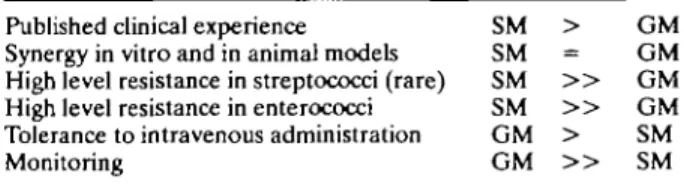
and streptomycin indicated failure rates in the range of 6 to 11%, more recent reports have shown excellent results, with bacteriological cure rates as high as 99% in selected cases'81. Recently, a 14-day course of ceftriaxone combined with netilmicin, both administered as a single daily dose, has been tested in a multicentre trial. Among 43 bacterio-logically assessable cases, only one relapse occurred in a case caused by Gemella morbillorum, a microorganism which has been associated with an unusual course of endo-carditis'9'. Obviously, the combined regimen of ceftriaxone and netilmicin is much more convenient to administer than penicillin plus streptomycin and it may also be less toxic1'1. However, because of the limited experience of once-daily administration of aminoglycoside in endocarditis in humans, this cannot yet be recommended as a standard treatment. Regarding efficacy, streptomycin and genta-micin are probably equivalent'1'. Nowadays, gentamicin is generally preferred because it is better tolerated when administered intravenously and because serum levels can easily be monitored (Table 3).
Unless clearly indicated (see below), regimens including an aminoglycoside should probably not be used in patients with impaired renal or auditory function, or in older
Table 2 Suggested daily dosages for the major antibiotics used in streptococcal and enterococcal endocarditis
Penicillin G Ampicillin Ceftriaxone* Vancomycin Gentamicin Streptomycin 6 X 2-3 million units 6 x 2 g 2 g 2 X 1 5 mg.kg"' ( > 60 min) 3 mg.kg-' (divided in 2-3 (1?) doses) 2 x 7-5 mg.kg-1 (60 min)
* Non-enterococcal streptococci only.
Table 3 Which aminoglycoside in streptococcal and enterococcal endocarditis?
Published clinical experience SM > GM Synergy in vitro and in animal models SM = GM High level resistance in streptococci (rare) SM > > GM High level resistance in enterococci SM > > GM Tolerance to intravenous administration GM > SM Monitoring GM > > SM SM = streptomycin; GM = gentamicin.
patients'1-8-9'. In these patients, sole administration of a beta-lactam for 4 weeks is preferred.
Vancomycin or teicoplanin for 4 weeks
In patients allergic to penicillin, ceftriaxone can be used if hypersensitivity is not of the immediate-type. In any patient with immediate-type hypersensitivity to penicillin or other beta-lactams, vancomycin can be used for 4 weeks at a dose of 15 mg.kg"1 every 12 h (administered intra-venously in over an hour)'1'. Serum levels should be moni-tored, especially in patients with renal dysfunction'9'. However, there is limited published experience with this agent for that indication. Teicoplanin, a glycopeptide with a long half-life allowing once daily administration, has also been used in viridans streptococcal endocarditis. However, of 10 patients who completed a 4-week course of teicoplanin (500 mg every 12 h on the first 2 days and then 10 mg.kg"1 every 24 h), nine were cured but one relapsed. Moreover, among the 20 patients who entered the study, five (25%) experienced drug fever which prompted inter-ruption of treatment'10'. Thus, teicoplanin deserves further investigation before it can be recommended as an alterna-tive once-daily parenteral regimen for the treatment of streptococcal endocarditis.
Combined parenteral and oral regimens
Although oral therapy with high dose oral amoxicillin or ampicillin plus probenecid has been successful in the treat-ment of streptococcal endocarditis, it is not generally rec-ommended because serum levels are lower and less predictable than after parenteral administration1'1. More-over, compliance may be a problem in some patients. However, combined parenteral and oral regimens have been successfully used in some countries161. Thus, Stamboulian et al. successfully treated 15 patients with 14 days of ceftriaxone followed by 14 days of high-dose oral amoxicillin. In these patients, serum bactericidal titres above 1/8 was demonstrated while on oral treatment.
Options for outpatient therapy
Economic constraints have encouraged the treatment of endocarditis in the home'111. This has been made feasible with the use of once-daily administration of ceftriaxone. In one study, among 55 patients treated for 4 weeks with this agent, 23 could be discharged from hospital after less than 2 weeks and seven, who had to stay in hospital for the entire course of treatment, only did so because of an inap-propriate outpatient setting!21. In a study performed in Argentina, seven out of 30 patients could be treated entirely as outpatients and 27 received both inpatient and outpatient treatment'61.
Obviously, outpatient therapy should only be considered in the patient whose condition is stable and for whom med-ical supervision can be maintained1"1, but treatment should probably be initiated in hospital. Patients who are haemo-dynamically unstable, who have large vegetations or other echocardiographic findings associated with high rates of complications, or who are suspected of distant metastatic complications, should stay in the hospital.
Viridans streptococci: special situations
In several situations, a 4-week course of a cell-wall active agent combined with an aminoglycoside for 2-4 weeks is indicated11121. These situations include nutritionally defi-cient variants of viridans streptococci, streptococci with a minimum inhibitory concentration for penicillin greater than 01 mg.r1 but less than 0-5 mg.l"1, patients with extra-cardiac infection such as mycotic aneurysm, patients whose symptoms have lasted more than 3 months, patients who have experienced a relapse with the same organism and patients who are receiving penicillin prophylaxis for rheumatic fever. Some authorities also recommend such a regimen for prosthetic valve endocarditis1121. In the pub-lished experience1121, the cell-wall active agent most com-monly used was penicillin G, but vancomycin has been recommended as an alternative. However, there is no rea-son why ceftriaxone or cefazolin would not work in these situations. The choice of the aminoglycoside has been dis-cussed above.
5. pneumon'iae, group A streptococci
Until recently, all strains of S. pneumoniae and group A streptococci were highly sensitive to penicillin. For these two microorganisms, penicillin G and vancomycin (as an alternative in penicillin-allergic patients) have been
rec-ommended112'. Since these microorganisms are also extremely sensitive to ceftriaxone, this agent can probably also be used. However, due to the increasing incidence of 51 pneumon'iae resistant to penicillin in some parts of the world, careful testing of susceptibility should always be performed.
Group B, C, G streptococci
Group B streptococci are less sensitive to penicillin G than are group A isolates. Synergy between penicillin and an aminoglycoside has been demonstrated in-vitro against non-tolerant as well as tolerant isolates and in animal mod-els of endocarditis. Therefore, a combination of cell-wall active agents combined with an aminoglycoside should be considered in these patients1121. The same holds true for group C and group G streptococci'121.
Enterococci
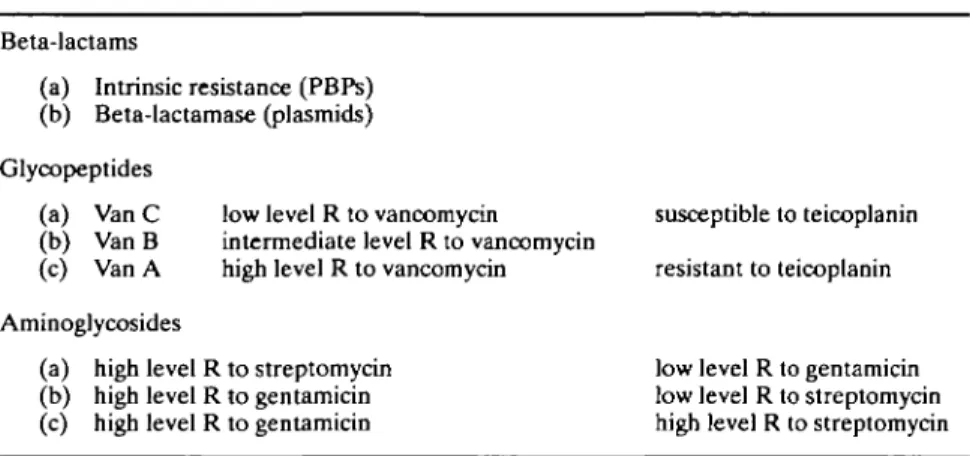
Enterococci are streptococci which belong to Lancefield's group D. They include members of several dif-ferent streptococcal species, such as Enterococcus faecalis, Enterococcus faecium and Enterococcus durans. Treatment of enterococcal endocarditis is complicated, because these microorganisms are more resistant to penicillin G (median minimum inhibitory concentration of 2 mg.l"1) and to extended spectrum penicillins than most other streptococci; they are also uniformally resistant to cephalosporins131. In addition, cell-wall active antibiotics are only bacteriostatic'11. Although enterococci are also resistant to aminoglycoside antibiotics, the combination of penicillin, ampicillin, or vancomycin with certain amino-glycoside antibiotics has been found to exercise a synergis-tic bactericidal effect on these bacteria, provided that they do not display a high level of resistance1131. A few years ago, the problem became much more complicated because of the emergence of strains resistant to one or more of the fol-lowing classes of antibiotics: beta-lactams, glycopeptides and aminoglycosides (Table 4).
Regarding beta-lactams, the resistance can be caused either by decreased affinity of penicillin-binding proteins to the drug (intrinsic resistance) or to beta-lactamase pro-duction13141. Recently, strains resistant to vancomycin and/or teicoplanin have also been identified. The mecha-nism of resistance has not yet been fully characterized, but several phenotypes (Van A, Van B, Van C) ranging from a low to a high-level of resistance, have been described1151.
The degree of resistance to aminoglycosides is highly variable. A minimum inhibitory concentration greater than or equal to 2000 mg.r1 is generally considered to be the limit between a low and a high-level of resistance'1'. Enterococci which are highly resistant to an aminoglyco-side are not killed synergistically when this agent is com-bined with a cell-wall active agent in-vitro or in experimental models'1161. Resistance is due to the presence of various enzymes which modify the structure of the aminoglycoside13'. Since the enzymes involved in the resis-tance to streptomycin and gentamicin are different, some strains resistant to one of the aminoglycosides might be susceptible to the other.
Table 4 Enterococcv resistance (R) to antibiotics
Beta-lactams
(a) Intrinsic resistance (PBPs) (b) Beta-lactamase (plasmids) Glycopeptides
(a) Van C low level R to vancomycin susceptible to teicoplanin (b) Van B intermediate level R to vancomycin
(c) Van A high level R to vancomycin resistant to teicoplanin Aminoglycosides
(a) high level R to streptomycin low level R to gentamicin (b) high level R to gentamicin low level R to streptomycin (c) high level R to gentamicin high level R to streptomycin R = resistance; PBP = penicillin binding protein.
A suggested strategy for the choice of treatment of en- Some strains resistant to vancomycin have retained sus-terococcal endocarditis is outlined in Table 5. It should be ceptibility to teicoplanin131. If the strain is resistant to both kept in mind that combined therapy is required for sue- beta-lactams and glycopeptides, a triple combination of cessful treatment: treatment with penicillin alone has vancomycin, penicillin or ampicillin and aminoglycoside resulted in relapse rates of 25% or more. The minimum can be tried, provided that the strain is not highly resistant duration of treatment should be 4 weeks but many author- to the aminoglycoside'131. Hence, vancomycin has been ities suggest 6 weeks'11. The first step is to choose a cell-wall shown to reduce the minimum inhibitory concentration to active agent. If the strain is sensitive to ampicillin, this penicillin when used with other drugs,
agent should be chosen. Since low levels of beta-lactamase If the strain is not highly resistant to streptomycin or gen-production might not be detected by routine susceptibility tamicin, the synergistic effect provided by these two agents testing, beta-lactamase production should be looked for if is similar11'. Other aminoglycosides cannot routinely be sub-ampicillin is used'ul4'. In some experimental studies, con- stituted. If the strain is highly resistant to gentamicin, strep-tinuous intravenous infusion was found to be more effec- tomycin should be tested. If high levels of resistance are tive than intermittent dosing'16'. If a strain produces present for both agents, the synergistic effect is lost and the beta-lactamase, amoxicillin/clavulanate can probably be aminoglycoside should therefore not be used,
substituted, although there are no data on the clinical effi- Despite encouraging reports adding ciprofloxacin or cacy of this association in this indication. If the strain is rifampicin when dealing with multi-resistant strains pro-intrinsically resistant to beta-lactams, vancomycin should vides no definite benefit'3'. However, recently, the addition be used unless the strain is also resistant to this antibiotic. of chloramphenicol or tetracycline has been found to be
Table 5 Enterococcv. therapeutic options
(A) Cell-wall active agent antibiotics (1) If Amp S and Vanco S, use Amp
(2) If Amp is used—consider continuous intravenous use —look for beta-lactamase
(3) If beta-lactamase +, consider amoxicillin/clavulanate or imipenem (4) If intrinsic beta-lactam R, consider Vanco
(5) If Vanco R, consider Teico
(6) If glycopeptides R, consider triple combination: Amp, Vanco, Genta (B) Aminogylcoside (to be added to (A))
(1) If susceptible, synergistic effect is similar with Genta or Strepto (2) If high genta R, test strepto
(3) If high levels of R to both, do not use them (C) Other regimens
(1) Combination of cell-wall-active agents (2) No definite benefit of adding Cipro or Rif (3) Consider adding Chloro or Terra (4) Test other antibiotics (e.g. pristinamycin)
Amp = ampicillin; Vanco = vancomycin; Teico = teicoplanin; Cipro = ciproxin; Rif = rifampicin; Chloro = chloramphenicol; Genta = gentamicin; Strepto = streptomycin; Tetra = tetracycline; S = sensitive; R = resistant.
useful in some situations. It should be mentioned that trimethoprim sulfamethoxazole appears to have an inhibitory effect against many strains of enterococci when tested in vitro. However, this agent is probably ineffective in-vivo'31.
Despite some success with medical therapy alone in endocarditis due to multi-resistant strains of enterococci, surgical removal of the infected valve is often the only curative treatment.
References
[1] Bisno AL, Dismukes WE, Durack DT et al. Antimicrobial treatment of infective endocarditis due to viridans strepto-cocci, enterostrepto-cocci, and staphylococci. JAMA 1989; 261: 1471-7.
[2] Francioli P, Etienne J, Hoigne R, Thys JP, Gerber A. Treatment of streptococcal endocarditis with a single daily dose of ceftriaxone for 4 weeks: Efficacy and out-patient treatment feasibility. JAMA 1992; 267: 264-7.
[3] Eliopoulos GM. Aminoglycoside resistant enterococcal endocarditis. In: Wilson WR, Steckelberg JM, eds. Infectious Disease Clinics of North America. Philadelphia: W. B. Saunders Company, 1993:117-33.
[4] Wilson WR, Geraci JE. Treatment of streptococcal infective endocarditis. Am J Med 1985; 78(Suppl 6B): 128-13. [5] Durack DT. Review of early experience in treatment of
bac-terial endocarditis, 1940-1955. In: Bisno AL, ed. Treatment of infective Endocarditis. New York: Grune & Stratton, 1981:1-14.
[6] Stamboulian D, Bonvehi P, Arevalo C « al Antibiotic man-agement of outpatients with endocarditis due to penicillin-susceptible streptococci. RID 1991; 13(Suppl 2): S160-3. [7] Wilson WR. Ceftriaxone sodium therapy of penicillin
G-sus-ceptible streptococcal endocarditis. JAMA 1992; 267: 279-80.
[8] Wilson WR, Thompson RL, Wilkowske CJ. Short-term ther-apy for streptococcal infective endocarditis. Combined intra-muscular administration of penicillin and streptomycin. JAMA 1981; 245: 360-3.
[9] Stamboulian D, Ruch W, Francioli P. Treatment of strepto-coccal endocarditis with a single dose of ceftriaxone + netilmicin for 14 days. ESCMID, Sevilla, 1993; (Abstract No 1104, p. 254).
[10] Venditti M, Gelfusa V, Serra P, Brandimarte C, Micozzi A, Martino P. 4-week treatment of streptococcal native valve endocarditis with high-dose teichoplanin. Antimicrob Agents Chemother 1992; 36: 723-6.
[11] Francioli PB. Ceftriaxone and outpatient treatment of infec-tive endocarditis. In: Wilson WR, Steckelberg JM, eds. Infectious disease clinics of North America. Philadelphia: W. B. Saunders Company, 1993: 97-115.
[12] Roberts RB. Streptococcal endocarditis: the viridans and beta hemolytic streptococci. In: Donald K, ed. Infective Endocarditis, 2nd edn. New York: Raven Press, 1992: 191-208.
[13] Caron F, Carbon C, Gutmann L. Triple-combination peni-cillin-vancomycin-gentamicin for experimental endocarditis caused by a moderately penicillin- and highly glycopeptide-resistant isolate of enterococcus faecium. J Infect Dis 1991; 164:888-93.
[14] Goudron PE, Markowitz SM, Wong ES. Isolation of a beta-lactamase-producing, amynoglycoside-resistant strain of enterococcus faecium. Antimicrob Agents Chemother 1992; 36:1125-6.
[15] Derlot E, Courvalin P. Mechanisms and implications of gly-copeptide resistance in enterococci. Am J Med 1991; 91(Suppl 3B): 82S-85S.
[16] Cercenado E, Eliopoulos GM, Wennersten C, Moellering RC Jr. Influence of high-level gentamicin resistance and beta-hemolysis on susceptibility of enterococci to the bacte-rial activities of ampicillin and vancomycin. Antimicrob Agents Chemother 1992; 36: 2526-8.