July 2019
Ministry of Higher Education and Scientific Research
8 MAI 1945 UNIVERSITY / GUELMA ةملاق / 1945 يام 8 ةعماج FACULTY OF LETTERS AND LANGUAGES تاغللا وبادلآا ةيلك DEPARTMENT OF LETTERS & ENGLISH LANGUAGE ةيزيلجنلااةغللا و بادلآا مسق
A Dissertation Submitted to the Department of Letters and English Language in Partial Fulfillment of the Requirements for the Degree of Master in Language and
Culture.
Candidate Supervisor
Hanane BELMICI Ms. Amina EL AGGOUNE
BOARD OF EXAMINERS
Chairwoman: Mrs. Imane TABOUCHE (M.A.A) University of 8 Mai 1945 Guelma Supervisor: Ms. Amina EL AGGOUNE (M.A.B) University of 8 Mai 1945- Guelma Examiner: Mrs. Imane DOUAFER (M.A.B) University of 8 Mai 1945- Guelma
Exploring the Role of Reading Electronic Books in
Vocabulary Learning
The Case of Master Two Students, Department of English, University
DEDICATION
In the Name of Allah the Most Gracious, the Most Merciful all praise is to Allah, the Lord of all the worlds; and peace and blessings are upon our Prophet and Messenger Muhammad
and all His companions.
First and foremost, this work is dedicated to my MOTHER for her constant encouragement and unconditional help.
Without forgetting to tremendously thank my FATHER for his emotional support and financial assistance throughout my whole learning career. May Allah bless both of them. I also dedicate this work to my dearest sister ROUIA and my lovely brothers HAMZA, CHAKIBE, ACHREF and to all those who loved me and kept standing with me in difficult
This modest work would never been accomplished without the persistence support, the valuable advice, and the constructive remarks of my supervisor Ms. EL AGGOUNE Amina. Her precious guidance, assistance, and immense knowledge made me stronger and eager to complete this study because she was my first inspiration for doing this research work.
Additionally, I owe special thanks to the members of the jury: Mrs. DOUAFER Imane, and Mrs. TABOUCHE Imane for devoting their time to read and evaluate my work without forgetting to thank all the teachers belonging to the department of English of Guelma University.
I also want to express my sincere gratitude to all Master two EFL students who have kindly accepted to fulfill my questionnaire and to the teachers who have accepted my request of being part of my interview and for allowing me to take audio recordings without any hesitation.
Finally, I would like to thank anyone who has positively encouraged me by a word, a gesture, a financial help, or any other effort.
Nowadays, no one can deny the effective role of technology in all the fields. Based on this context, researchers have started to seek for innovative ways on how to enhance the students’ vocabulary repertoire through reading electronic books (e-books). Therefore, the widespread use of e-books has attracted the researcher’s attention to conduct this study which aims at investigating the role of reading electronic books in vocabulary learning. In this regard, (35) of Master Two EFL students at the department of English at the University of Guelma have been chosen randomly as a sample for this study. On this basis, we have hypothesized that if students frequently read electronic books, this may lead them to acquire more vocabularies. In order to test this hypothesis, a mixed methodology has been selected, including both qualitative and quantitative descriptive measurements. Particularly, using the questionnaire and the interview in order to gain more data about the sample’s choice of e-books as a new media to read and learn more lexis, in addition to probe the teachers’ attitudes towards the students’ use of these new appliances. The results driven from both tools have confirmed that students admit that they learn new words when they read on screen and they are aware of its strategies and features. In the same regard, teachers have shown positive attitudes towards the use of electronic books. Therefore, this study suggests the implication of the integration of electronic books that can be used anytime and everywhere in the classrooms, especially in reading’s courses to facilitate the process of reading which will automatically improve the linguistic repertoire of students, also to stand as a solution for the non-availability of some printed books and references.
3G/4G: Third Generation/Fourth Generation CD: Compact Disk
E-books/eBooks: Electronic Books E-devices: Electronic Devices E-dictionary: Electronic Dictionary
EFL: English as a Foreign Language E-learning: Electronic Learning
E-reader: Electronic Reader
ESL: English as a Second Language
L1: First Language L2: Second Language
LMD: License-Master-Doctorate
P-books: Paper Books PC: Personal Computer
PDF: Portable Document Format
TL: Target Language
Figure 1.1 Acrobat E-book Reader………..14
Figure 1.2 Rocket E-book Reader………14
Figure 1.3 from Paper Book to Electronic Book………..19
Table 1.1 Reading Types of E-books………..17
Table 2.1 What is Involved in Knowing a Word……….22
Table 3.1 Students’ Age………...42
Table 3.2 Students’ Gender………..42
Table 3.3 Students’ Evaluation of their Level in English………43
Table 3.4 Students’ Appreciation of Reading Skill………..44
Table 3.5 The Frequency of Reading………...44
Table 3.6 The Preferred places for Reading……….45
Table 3.7 The Type of Documents that Students Frequently Read………..46
Table 3.8 The Importance of Learning Vocabulary……….47
Table 3.9 The Areas of Difficulty in Learning L2/FL……….48
Table 3.10 The Most Effective Strategies for Vocabulary Learning………...49
Table 3.11 The Favorite Format of Reading………50
Table 3.13 The Device Mostly Used to Read E-books………51
Table 3.14 The Reasons behind Reading E-books………...52
Table 3.15 The Types of Reading E-books………..53
Table 3.16 Students’ Options for Obtaining E-books from the Internet………..54
Table 3.19 The Students’ Attitudes towards the Role of Reading E-books in Vocabulary Learning………....56 Table 3.20 The Students’ Views about the Effective Kind of Reading for Extensive
DIDECATION………... i ACKNOWLEDGEMENTS……… ii ABSTRACT……….. iii LIST OF ABBREVIATIONS……… iv LIST OF FIGURES……… v LIST OF TABLES……….. vi CONTENTS……….. viii GENERAL INTRODUCTION……… 1
1 Statement of the Problem………..1
2 Aims of the Study………..1
3 Research Questions……… ...2
4 Research Hypotheses………..2
5 Research Method and Data Gathering Tool………..2
6 Sample of the Study………3
7 Significance of the Study………...3
8 Structure of the Dissertation………..3
Chapter One: Reading E-books Introduction……… ………5
1.1 Reading………....5
1.1.2.1 Reading as a Process………...7
1.1.2.2 Reading as a Product………..8
1.1.3 Types of Reading………8
1.1.3.1 Extensive Reading………...9
1.1.3.2 Intensive Reading………9
1.1.4 Models of Reading Process……….9
1.1.4.1 The Bottom-Up Model……….9
1.1.4.2 The Top-Down Model………...10
1.1.4.3 The Interactive Model………11
1.2 E-books………...12
1.2.1 History of E-books……….12
1.2.2 Definition of E-books………15
1.2.3 Features of e-books………....15
1.2.4 Types of Reading E-books……….17
1.2.5 Comparison between E-books and Paper- based Books……….18
Conclusion………19
Chapter Two: Vocabulary Learning Introduction………..20
2.2 Importance of Vocabulary Learning………...23
2.3 Difficulties in Learning a Word…..………..24
2.3.1 Similary to L1………24
2.32 Similarity to English Words already Known………..24
2.3.3 Connotation………25
2.3.4 Spelling and Pronunciation………25
2.3.5 Multi-Word Items………..25
2.3.6 Collocation………26
2.3.7 Appropriate Use………...26
2.4 Vocabulary Learning Strategies………..27
2.4.1 Taxonomy of Vocabulary Learning Strategies………...28
2.4.1.1 Strategies for Explicit Vocabulary Learning………28
2.4.1.1.1 Determination Strategies……….28
2.4.1.1.2 Memory Strategies………31
2.4.1.1.3 Cognitive Strategies………..32
2.4.1.1.4 Metacognitive Strategies………..33
2.4.1.2 Strategies for Implicit Vocabulary Learning……….33
2.5 E-books and Vovabulary Learning………36
Conclusion………...37
Chapter Three: Field Investigation Introduction………...39
3.1 Students’ Questionnaire……….39
3.1.1 Sample Choice………...39
3.1.2 Description of Students’ Questionnaire………40
3.1.3 Administration of Students’ Questionnaire………...41
3.1.4 Analysis of Results and Findings………..42
3.1.5 Summury of Results and Findings from Students’ Questionnaire………59
3.2 Teachers’ Interview ………...60
3.2.1 The Sample………...60
3.2.2 Description of the Interview………..60
3.2.3 Analysis of Results………...61
Conclusion………74
GENERAL CONCLUSION………...75
1. Concluding Remarks……….75
2. Limitations of the Study………75
3. Pedagogocal Implications……….76
APPENDICES
Appendix A: Students’ Questionnaire Appendix B: Teachers’ Interview
FRENCH ABSTRACT
GENERAL INTRODUCTION
As a response to the technological revolution all over the world, the 21st century has witnessed a radical transformation. It has shifted from the traditional to the modern digital one. Accordingly, the technology-based materials have substituted the old printed references. Particularly, the paper-based books have been replaced by digital ones being known as the Electronic books (e-book). The latter are widely considered as an efficient electronic source for reading comprehension and vocabulary learning.
1 Statement of the Problem
Vocabulary is considered as a crucial constituent of language knowledge. It indicates the competency of English as a Foreign Language (FFL) learners as it can help them to comprehend and interpret what is being said and what is being written. However, the problem that arises is that many EFL students still have poor vocabulary and face a difficulty in expressing themselves and their thoughts. Their inability to use appropriate words in a given situation can be obviously observed through their presentations or when they are asked to paraphrase an idea by using their own words, as well as in their deficiency in writing and spelling. Therefore, the focus of the current study is on investigating reading e-books and its role in improving learners‟ lexical account; since e-books can be considered as a supporting resource for vocabulary learning due to their accessibility and availability.
2 Aims of the Study
Vocabulary knowledge is a fundamental component in learning English as (ESL) or (EFL). It reflects students‟ mastery of language. Indeed, having a fully diverse repertoire was and is still learners‟ ultimate goal. Today with the age of electronic references such as e-books,
learners can easily get new words and lexical items with their multi- meanings. This research‟s aims and objectives can be interpreted as follows:
• To explore the students‟ and teachers‟ attitudes towards the role of reading e-books in vocabulary learning.
• To uncover the strategies involved while reading e-books.
3 Research Questions
This current study has mainly conducted to answer the following questions:
Do EFL students consider reading e-books as a facilitating tool in terms of learning vocabulary?
What are the teachers‟ attitudes towards students‟ use of e-books? 4 Research Hypotheses
The present study is based on the following hypotheses:
• It is hypothesized that Students who are reading e-books frequently may consider it as a source for vocabulary acquisition.
• It is also hypothesized that teachers have positive attitudes towards learners‟ use of e- books.
5 Research Method and Data Gathering Tool
This Research would be conducted through the use of the descriptive quantitative and qualitative methods in order to confirm or reject our hypotheses and to achieve objectivity. This carries through administering and analyzing the students‟ questionnaire and the teachers‟ interview which would answer our questions and fulfill the objectives behind this study.
6 Sample of the Study
The sample of the study comprised of Master two students of the department of English at Guelma University. Since they are composed of two groups (70) of students, only (35) of students has been chosen randomly as a sample to achieve reliability and objectivity. The teachers‟ sample includes (6) teachers from the department of English at Guelma University who are kindly invited to be a part of the interview.
7 Significance of the study
The present study is conducted to investigate the role of reading e-books in facilitating the process of vocabulary learning. It is significant as it describes the shift from reading printed materials to reading e-books from electronic devices as a new media among students at the Department of English. It also tries to display the e-books‟ main characteristics that may attract the attention of students. In addition, the results of the study would inspire other studies and help students to understand how electronic reading can effectively enhance their vocabulary repertoire. Therefore, this study encourages them to be updated through reading e-books.
8 Structure of the Dissertation
This research study includes three chapters. The first chapter is divided into two parts. The first part is devoted to the reading skill, where definitions, nature, types, models, strategies, and the relation of reading with other skills are provided. The second part is specified to electronic books. It deals with its history, definitions, and features. In addition to the differences between e- books and paper-based books. The second chapter focuses on vocabulary. Firstly, it introduces, the definitions, the importance of vocabulary knowledge, and discusses the problems behind vocabulary deficiency. Secondly, it presents the vocabulary learning strategies, and the vocabulary expansion through extensive reading. The
third chapter is about the investigation field which involves the description, and the analysis of the data gathered from both the students' questionnaire and the teachers‟ interview and the interpretation of the findings. It concludes with some pedagogical implications and recommendations about the usefulness of reading e-books in vocabulary acquisition.
CHAPTER ONE
READING ELECTRONIC BOOKS
Introduction
In the context of learning a foreign language, reading activity plays an effective role in learners‟ proficiency. Through time and with the emergence of new digital form of books being known as electronic books (e-books), the way of reading has shifted from print to digital. E-books have become more popular among EFL learners. Consequently, this chapter is divided into two parts. The first part seeks to shed light on the definition of the reading and its nature. Then, it highlights the different types of reading and the reading models as well. The second part is devoted to electronic books. It attempts to provide comprehensive account of „e-books‟ in terms of its history and definitions. Moreover, it demonstrates the difference between e-books and paper-based books.
1.1 Reading
1.1.1 Definition of Reading
The concept of reading is still swinging between some researchers. Some has regarded it as a skill, but others have considered it as a process. According to Carrel (1988, p. 1), reading is a skill of a paramount importance in comparison with speaking and writing, particularly in the EFL/ L2 context. Besides, Rao (2009, p. 1) has inserted that reading is a receptive skill by which readers develop their linguistic repertoire and receive new information. He has further confirmed that the status of reading in the learning process to the extent that mastering each language skill either receptive or productive depends mainly on the act of reading. Again another researcher has clearly emphasized that „„reading, whether in academic or non academic settings is one of the most important skills we need in this fast moving world,
together with an ability to access information quickly and intelligently‟‟ (Nur, 2014, p. 114). That is to say reading has become a means which we all constantly use in educational or non-educational settings to be aware of what is happening in the surrounding world.
However, by 1980‟s and 1990‟s the perception of reading has shifted from being a passive skill to an active intellectual process whereby the reader interacts with the text (Nur, 2014, p. 115). In addition, Delbridge (2009) has noted that „„reading is not a technical skill acquired once and for all in the primary but rather a developmental process‟‟ (p. 85), he has simply introduced reading as an endless process through which the readers‟ knowledge get enlarged each time they are exposed to different text types. Furthermore, Grabe (1991) has viewed reading as follows:
An active process of comprehending where students need to be taught strategies to read more efficiently, for example, guess from context, define expectations, make inferences about the text, skim ahead to fill in the context, etc. (p. 377)
That is to say, reading is not a passive but rather a revive process in which the reader needs to employ different strategies such as: guessing, making predictions, inferring, and skimming to end up with a comprehensible meaning of the text. To their side, Urquhart and Weir (2013) have asserted that “reading is the process of receiving and interpreting information encoded in language form via the medium of print” (P. 22). This means that reading is an activity of grasping meaning through decoding the author‟s encoded message.
1.1.2 The Nature of Reading
It is a hard task to identify clearly and precisely the nature of reading, whether it is a process or a result of that process, since in real practice, readers cannot determine when each process starts and ends.
1.1.2.1 Reading as a Process
According to Goodman (1988, p. 16), the brain organ is the responsible one for processing information during the reading activity. In this respect, it determines which information to keep and which one to reject; it sends orders to activate prior knowledge, it decides what strategies to be used, and where to look for information. Also, the brain tends to process the already acquired information with less effort and capacity. In this sense, Goodman (1988, p. 16) has classified five processes which demonstrate how the brain operates while practicing reading. These processes are:
-Recognition-initiation: At this initiative step, the brain recognizes the graphic symbols exhibited in the written language through the eyes.
-Predictions: The brain expects and formulates assumptions as it seeks meaning in the sensory inputs.
-Confirmation: The brain checks its expectations in order to confirm or reject what is predicted.
-Correction: The brain reprocesses when it faces contradictions, or what is anticipated is rejected.
-Termination: When the reading activity is finished, the brain ends the reading. However, readers can apply the termination option whenever they face one of such problems: the difficulty of the task, when the material has no sense, or the reader has already realized the meaning of the story. Also, if the story does not fit the reader‟s purposes.
In short words, the reading process is simply a complicated interactional mental activity, under which the reader passes through different operations: looking at the print material, deciphering the symbols, recognizing the words, then relating them to construct meaning.
1.1.2.2 Reading as a Product
Hollander (1975) has regarded reading as a process and its final outcome is „comprehension of the input‟ (p. 553). Thus, comprehension is the readers‟ mental ability of interpreting and understanding the written letters to build up meaning. In order to do so, readers seek to relate what they are reading to what they already know, i.e., linking new knowledge to prior knowledge and past experiences to infer the invisible meaning (Booth, 1998, p. 10). Therefore, Gray (1960) has distinguished three levels that can contribute in reading comprehension (cited in Alderson, 2000, p. 8).
1. Reading the lines: Which refers to the literal understanding in order to identify the linguistic forms as well as to differentiate between the syntactic structures.
2. Reading between the lines: Which means understanding the invisible meaning by making inferences based on the context or on the knowledge of the world.
3. Reading beyond the lines: Which involves the readers‟ interpretations and evaluations of the text, and it is the higher level of comprehension.
These three levels are ordered in a hierarchical manner. The literal comprehension is considered to be at the bottom of the hierarchy, easy to comprehend in comparison to the other two ones. In the central comes the inferential level which is supposed to be the next step after the reader recognizes the literal meaning, and less difficult than reading beyond the lines. Yet, the upper level is devoted to critical reading which seems to be the most difficult in terms of understanding when being compared with the aforementioned levels.
1.1.3 Types of Reading
1.1.3.1 Extensive Reading
Extensive reading is a skill of reading large quantities of books with extended periods of time (Grabe, 2009, p. 311). Here, learners are supported to read what they want in their free time outside the class for the sake of entertainment (Harmer, 2001, p. 212).
1.1.3.2 Intensive Reading
By contrast, intensive reading is the students‟ ability to read a limited amount of books that is chosen by their teachers in relation to their studies (Eskey, 2005, p. 574). In this kind, learners deliberately focus attention on the language in order to arrive at deep understanding of the text and to perceive some aspects such as grammatical structures and complex vocabulary; doing so, involves the teachers‟ interference or the use of dictionaries. Therefore, intensive reading is accuracy oriented (Nunan, 2015, p. 71).
1.1.4 Models of Reading
With the advent of cognitive psychology in 1970‟s, a significant focus has been given to the reading process that most of its invisible functions operate unconsciously in order to comprehend the visual input. From this point researchers arise the question of what happen inside the readers‟ head, i.e., how our brain works when our eyes meet the page till achieving comprehension. Hence, to answer the above quest, three explicit models of reading have emerged: the bottom-up model, the top-down model, and the interactive model (Samuels and Kamil, 1988, p. 22).
1.1.4.1 The Bottom-Up Model
Nunan (1991) has explained the bottom-up notion of reading as “a matter of decoding a series of written symbols into their aural equivalents” (p. 64). In this model the reader first decodes the smallest units within the text, i.e., letters. These encoded letters, in turn, coincide
with their parallel sounds that the reader is supposed to know. Then, s/he moves to the stage of combining letters into words and associating them together to generate meaningful sentences. Further, Dechant (2013, p.23) has seen this model as a text-driven in which the reader passes through a linear sequence of mechanisms which range from the low-level (text) of processing to the high complex one (comprehension). It is clear that the written piece is analyzed cognitively letter by letter, word by word, then phrase by phrase without the interference of the previous knowledge (Harrison, 2004, P. 36). However, Nunan (1991, p. 65) has criticized this model for many reasons: First, decoding every letter would hinder the process of reading to the point where it would be a challenge for the reader to drive meaning from the text. Moreover, this model would make a charge on the working memory because the reader receives more than 250 words per minute which is too heavy compared with the capacity of working memory that can only store seven items. Consequently, most initial words of sentences will be lost.
1.1.4.2 The Top-Down Model
According to Anderson (2000), the top-down approach is based on schema theory at one hand and on the Goodman‟s (1982) “psycholinguistic guessing game” on the other hand. The former urges the reader to think about his/her past knowledge when interacting with the book in order to perceive the new information, whereas, in the latter the reader is supposed to guess the incoming input. Thus, this model emphasizes the role of the reader in bringing meaning to the text (p. 17). The same perspective has been held by Grabe (2009) who has assumed that the readers‟ interests and expectations towards the content can all facilitate the work of comprehension. According to him, inference is an essential step in the top-down process as the reader predicts and anticipates what is written in the text, and then selects samples of the likely information from the text to confirm or reject these hypotheses. Nevertheless, this approach does not provide a clear explanation for the systems that are utilized to create
relevant inferences (p. 89). In contrast to the Bottom-up model which begins with identifying the written stimuli to gradually reaches the high-level stages, the top-down model starts with making expectations in order to test the lower-level stimulus (Samuels and Kamil, 1988, p. 34).
1.1.4.3 The Interactive Model
Since the bottom-up as well as the top-down models fail in providing an adequate explanation for the reading process, the interactive model has come to combine both models as an attempt to clarify what occurs inside the mind while meeting the text. As Manzo (1990) has claimed “An interactive model views reading as an active, strategic process of questioning, predicting, confirming, and self-correcting” (p. 23). That is to say, readers interact with the printed input through interrelated strategies. In this respect, Dechant (2013) has described the interactive model in terms of readers‟ recognition of graphics and the prediction of the upcoming input simultaneously (p. 28).
Moreover, stanovich (2000, p. 23) has proposed “the interactive compensatory hypothesis” as an extension to the model which assumes that the various processes of reading can compensate each other. Furthermore, this model is interested with readers‟ differences that have not been mentioned in the other two previous models. So that, readers who have disabilities at lower level can be able to compensate them by higher level operations. For example, readers who are unable to recognize words (lower level), can use context (higher level) to facilitate word recognition.
In brief, the interactive model provides a logic explanation in which reading involves processing all levels together. That is to say, the reader decodes graphics and recognizes words by making inferences and interpretations based on what he/she has already experienced and learned.
2.2 E-books
Cavanaugh (2006) has noted that reading is still a stubborn skill in teaching and learning process and the way for acquiring it and the tools learners use evolve from reading traditional paper books to reading digitized ones namely electronic books (p. 3). Apparently, as Enderle (2012) stated that readers‟ accessibility to Wi-Fi and third and fourth generation (3G/4G) enables them to read electronically the book they want either reading online libraries or via downloading the book on their own e-devices such as Smart phones, Tablets, PC. . .etc ( cited in Grant & Midows, 2012, p. 191). Thus, electronic reading today becomes highly related to e-books because of its possibility to engage readers of different ages regardless of the place and time.
1.2.1 History of E- books
Many people think that electronic book is a new phenomenon; however, it dates back to before the Second World War (Manely & Holley, 2012, p. 292). Bush (1945) visualized a supplemental device to human memory called „„Memex‟‟, which is defined as a machine, whereby, users could stock and save their books, records, and information that would be mechanically retrieved when needed. Its content presented on screens as microfilms for reading from a desk (p. 121).
In 1971, the student Michael Hart executed relatively the concept of e-books by typing the “American Declaration of Independence” and “the Bill of Rights (1972)” into the computer of University of Illinois in which he studied. From this successful experience, Hart released the Project Gutenberg as the first online website that offers free books to computer users. At the beginning Hart‟s project was not popular due to its restricted number of books for limited public. Nevertheless, with the birth of the Web in 1990, the internet has simultaneously reinforced the Gutenberg to publish old literary works ((Lebert, 2009, p. 5).
The expansion of the internet has significantly contributed in the development of computing machines and the birth of new products such as the Compact Disk (CDs) with much capacity of storing books than disks (Marcovitz, 2013, p. 23). However, displaying CDs‟ content on desk computers‟ screen handicapped those who were willing to read anywhere. From this point, the technological growth led to the creation of multiple digital electronic reader (e-reader) devices that would offer mobility to readers like “soft-book” and “the rocket-book” (1998). Meanwhile, the high flow of the internet and the technology advancement pushed many American libraries and others to publish their books online (pp. 24-25).
Latter, the foundation of “Adobe Acrobat System Format” in1993 being known as (PDF) was a turning point in the digitized era (Marcovitz, 2013, p. 26). which is defined by Henke (2001) as a system that reads electronically the printed book while keeping its original features like index, table of content, pages number, in addition to annotations, indentations, highlighting, thumbnail views, the right and left flips, and so on. He has further argued that PDF was a pr installed software program which was initially destined to ease buying e-books from publishers, but in 2000 Adobe company adopts “Glass book reader production” and changes its name to Acrobat e-reader (p. 15).
In 2012, the Amazon kindle model of e-reader has become the best device that embraced both the hardware and the software. Then, “Google Company” has created a free universal website being known as “Google books” that consisted of variety of books. At the same time, the bookseller Amazon started selling its e-products and allowing authors to share their works publically via its website Amazon.Com (Miller, 2013, p. 16).
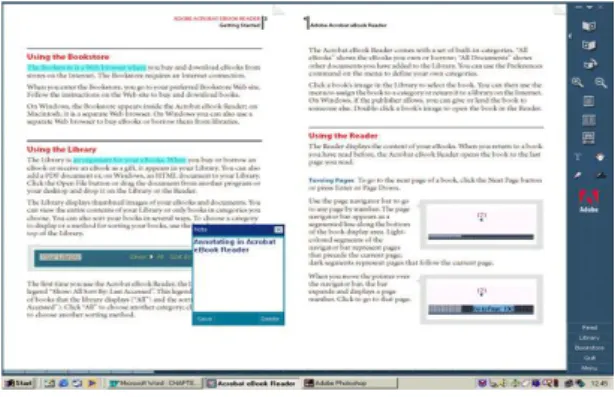
Figure 1.1: Acrobat eBook Reader
(Shiratuddin, Landoni, Gibb, & Hassan, 2003, para. 16).
Figure 1.2: Rocket E-books Reader
(Rao, 2001, p. 251).
1.2.2 Definition of E-books
There are various definitions conducted by multiple scholars and researchers to explain the concept of “e-books”. According to Lynch (2001), e-book is defined as:
The large structured collection of bits that can be transported on CD-ROM or other storage media or delivered over a network connection, and which is designed to be viewed on some combination of hardware and software ranging from dumb terminals to Web browsers on personal computers to the new book reading appliances.( cited in Suarez, 2013, p. 283)
From the e-books‟ definitions we can understand that an e-book can be described as a series of organized written pieces that can be published online over websites, or downloaded on computer devices in which hybrid platforms connected to reproduce the installed documents. Clearly, Grant and Meadows (2012) have introduced e-book as „„the digitized version of the book meant to be read on a computer, e-reader, or a tablet‟‟ (p. 15). For them, e-book is the presentation of p-book on the screens of personal electronic tools that are designed for that purpose.
Vassiliou and Rowley (2008, pp. 360-364) through their analysis study of different definitions, they have ultimately agreed that the meaning of e-book incorporates both; the online format of inked-book, which can be uploaded via hardware and software assisted-programs, also the term e-book can be used to label the new invented e-reader book which is designed to read books electronically with approval features of printed book such as kindle. This definition is subject to change due to the evolution of e-book characteristics day after the other. overall, Rao (2001) has comprehensively introduced e-book as an original print version which is transformed into an electronic format to be submitted on a screen of a digital device, including mobile phone, laptop, and desktop computer, which can also be read over a notebook, or any specific e-reader appliance (p. 249).
From the previous definitions we deduce that an e-book is any created digital version of hardcopy that can be converted in multiple formats to be read through various media and tools with internet connectivity.
1.2.3 Features of E-books
E-books contain a variety of animated standards that make them the most preferred form of reading than p-books. Rao (2001, p. 247) has considered e-books as one of the best inventions in the literary world after the Gutenberg‟s Project. As they offered new facilities for readers to
get over the limitations of paper books in terms of their reactant formats that allow users to renew the content whenever they want (Landoni & Gibb, 2000, p. 192). Cavanaugh (2006, p. 5) has listed common features that any book may include; the first valuable feature of e-books is its availability in a virtual space at no cost, which offer people an opportunity to read free online books. Additionally, some sophisticated e-books have the advantage of allowing users to draw and locate extra information about the difficult words by clicking on web hyperlinks. Besides, the accessibility of dictionaries through which students can easily look up the meaning of unknown words is another benefit of using electronic books. More importantly, teachers who integrate e-books in their courses will directly promote their students‟ reading capacities.
Cavanaugh( 2006) has further mentioned that, the prototype way of representing digital text is no longer as before since the new e-books‟ versions are associated with software and hardware intermediate programs which work together to represent the passage in one block without passing pages. As they were published on web, the pages can be read in a vertical or horizontal orientation with the potential of regulating the text size and highlighting the important parts in the text (p. 17). In addition, (Larson, 2009, p. 255).as mentioned that e-books permit users to type comments that are automatically preserved in one file through pressing on notes or annotations. Furthermore, some e-reader appliances and even laptops and computers offer an audio option which translates print passage into sound to provide users with a correct spelling.
So, e-books provide many features in favor to the students as they create an enthusiastic atmosphere conductive for their studies.
1.2.4 Types of Reading E-books
Marshall (2010) has claimed that “when we talk about electronic books-eBooks- what we are talking about is reading. Reading is the fundamental way that we engage with books” (p. 11), it means that reading is the only method to interact with books. He has also distinguished new types of engaging with electronic books. These types are classified in the table bellow:
Table 1.1: Reading Types of E-books
Types Characteristics
Reading Canonical careful reading. The readers cut the text horizontally in order to comprehend the content.
Skimming Faster than canonical reading. It is a linear reading. Here the reader seeks to obtain the gist of the text without concern to comprehension.
Scanning Quicker than skimming. Reading is fragmented; the reader goes forward and turns back in order to reach what he/she is looking for in short time. Glancing Turning pages very quickly with The aim of getting a look about the key
page elements (as illustrations, headlines, photos).
Seeking The reader scans rapidly for a particular page element in order to have an in-depth understanding to create a general idea about a specific issue in the text.
Rereading This is a meta-type that is introduced in the table as a reminder that any type can be repeated more than ones.
1.2.5 Comparison between E-books and P-based books
E-books differ from paper-based books (p-books) in many areas, in terms of its interactive features that have already been mentioned previously (annotations, highlighting, hypertext, and audio apps) which are not available in paper books. In relation to this point, Zambarbieri and Carniglia (2012, p. 391) have noted that e-books have many advantages over p-books. E-books are renewable since readers can correct mistakes and alter the content by adding or omitting information. They can rapidly get the page or idea within the book itself by entering the number or the first words of the sentence in the search box like in (PDF). More importantly, e-books make the reading task possible and easier for people with special needs such as deaf and visually impaired people as a text can be enlarged via clicking on Zoom or on the voice symbol to hear the text aloud.
Many studies have examined the differences between e-books and p-books. To name but few, Cumaoglu, Sacici, and Torun (2013) have employed a questionnaire to 222 of students. They have found out that most participants (81%) prefer reading e-books for research than p-books because of their accessibility in various formats and media. Inversely to previous studies that have privileged real books over e-books, One study has been conducted by Sackstein, Spark, and Jenkins (2015) based on comparing between screen reading and printed reading in terms of reading speed and comprehension. A quasi experiment has been applied on 68 students‟ reading performance on iPad then on printed book. Yet, the distinction between reading speed of students reveals that reading on iPad is quicker than p-book. Thus, for them, e-books are better devices for promoting effective learning. Moreover, (Kucirkova, 2018, p. 10) has listed a number of e-books‟ interactive features. E-books permit users to scroll pages on screen, whereas, in p-books users turn pages by touching the book itself. Recently, e-books are provided with more animated options like hotspots which are zones on the e-books‟ pages working via users‟ touch. For instance, a reader of a story can touch the
character and the latter can automatically move or change its color. Also, the hotspots can be found within the text in order to give explanations for the word or its spoken form. Thus, the incorporation of multimedia features within e-books has provided an interesting atmosphere of learning.
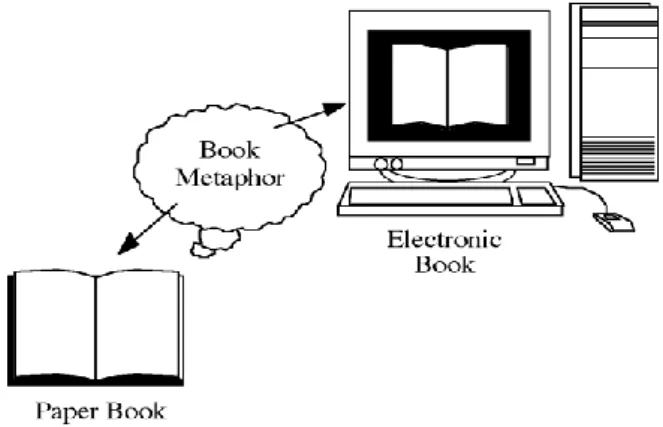
The figure bellow shows and signifies the shift from p-books to e-books. Figure 1.3: From Paper Book to Electronic Book
(Landoni & Gibb, 2000, p. 192)
Conclusion
This chapter has tended to identify the key concepts relating to reading and electronic books. In the first part, it has demonstrated the nature of reading as a process and then, as a product. It has also discussed the two types of reading in terms of intensive and extensive reading. Furthermore, a special concern has been directed to the processes of reading because they present the basis to fully understand the abstract mechanisms that happen inside our brains. Concerning the second part, it has shed light on e-books in terms of their historical background, definitions of e-books, and then, it has presented a variety of features that form the electronic device. At the end, it has distinguished between reading digital books and p-books. In sum, this chapter has investigated reading e-books as a new form of literacy.
CHAPTER TWO
VOCABULARY LEARNING
Introduction
Vocabulary mastery is an important parameter in any target language because it is impossible to comprehend and interpret what is being said or written without having a lexical repertoire. In other words, the more vocabulary a learner has the most proficient he will be. Therefore, learning vocabulary is fundamental for understanding texts and communicating effectively in the TL. Consequently, this chapter attempts to provide definitions and conceptualizations of vocabulary learning. Also, it addresses the different issues that may complicate the process of learning lexicon. Then, a special consideration is given to different strategies to overcome the vocabulary learning difficulties. Finally, a short review on the relationship between e-books and vocabulary is given.
2.1 Definition of Vocabulary Learning
Basically, vocabulary is difficult to be defined accurately since words come into two forms: oral and print. Oral vocabulary is the amount of words that we catch their meanings while speaking or listening. Print vocabulary, on the other hand, involves the set of words that we understand and use in writing or reading (Hiebert & Kamil, 2005, p. 3). Therefore, the concept „vocabulary‟ has a range of definitions. It is either knowing the multiple meanings of new items or realizing the words in written text (Beck, Mckeown, & Kucan, 2008, p. 1). Another definition is provided in Oxford dictionary (2018) as „„all the words used in a particular language or known to an individual person‟‟. Linse and Nunan (2005) have also argued that vocabulary is the body of words that someone learns (p. 121). Moreover, it is
claimed that knowing the meanings of words is not enough, knowledge about their forms (spoken and written), their grammatical and lexical aspects is also needed (Cook, 2008, p. 50). In addition, DeCarrico (2001) has argued that learning vocabulary can be done implicitly by inferring meaning from context while reading or listening which is called an incidental learning. Also, vocabulary learning can be occurred explicitly with a conscious focus on language and this does not include guessing from context (pp. 286-289). It is proved that learning incidentally from context has the advantage of getting wider vocabulary than learning intentionally. However this claim does not exclude the fact that each type completes the other (Nezhad, Moghali, & Soori, 2015, p. 23). According to Nation (2001), Heibert and Kamil (2005) vocabulary comes into two forms:
Receptive vocabulary: is the collection of words that the learner conceives their forms, and apprehends their meanings while reading and listening. It is generally wider than productive vocabulary.
Productive vocabulary: it is well-known words that are recognized and used frequently in speaking and writing.
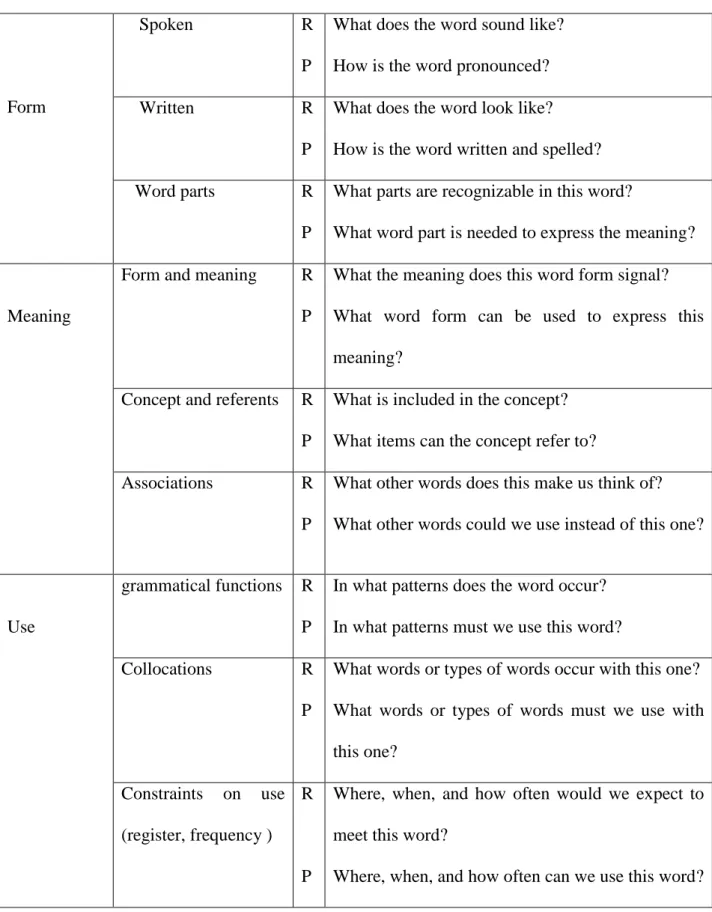
Nation (2001) has explained nine different aspects of vocabulary knowledge that are required to know a word (p. 40). They are summarized in the table bellow:
Table 2.1: What is Involved in Knowing a Word
Form
Spoken R
P
What does the word sound like? How is the word pronounced?
Written R
P
What does the word look like? How is the word written and spelled?
Word parts R
P
What parts are recognizable in this word?
What word part is needed to express the meaning?
Meaning
Form and meaning R P
What the meaning does this word form signal? What word form can be used to express this meaning?
Concept and referents R P
What is included in the concept? What items can the concept refer to?
Associations R
P
What other words does this make us think of? What other words could we use instead of this one?
Use
grammatical functions R P
In what patterns does the word occur? In what patterns must we use this word?
Collocations R
P
What words or types of words occur with this one? What words or types of words must we use with this one?
Constraints on use (register, frequency )
R
P
Where, when, and how often would we expect to meet this word?
Where, when, and how often can we use this word?
In column 3, R = receptive knowledge, P = productive knowledge.
The table shows that knowing a word does not only mean recognizing its meaning, but rather it involves having knowledge about the following components:
-Knowing how to spell and pronounce words.
-Knowing how to write words with its correct spelling. -Knowing how to make right structures in appropriate forms.
-Knowing how to connect between the form and its meaning.
-Knowing how to relate a particular word to different lexis.
-Knowing the concepts of a word that may help us to get the meaning of the other contexts in which happens.
-Knowing the grammatical functions of words.
-Knowing how to correctly collocate words with each other.
-Knowing the frequency of the words that may use or meet.
2.2 The Importance of Vocabulary Learning
Vocabulary importance has been investigated by many researchers in language learning. They agree that vocabulary has a vital position in language learning and “it is the core of the heart of language” (Lewis, 1993, p. 89). In addition, Wilkins (1972) wrote that “without grammar very little can be conveyed, without vocabulary nothing can be conveyed” (p. 111). This means that vocabulary is a central component of language, even without grammar, with just few words the message can be transmitted successfully. This is also has been confirmed by McCarthy (1990) who has claimed that “no matter how well the students learn grammar, no matter how successfully the sounds of L2 are mastered, without words to express a wide
range of meanings, communication in an L2 just cannot happen in any meaningful way”. That is to say communication cannot occur without having enough vocabulary. Thus, according to their claims, mastering of vocabulary can be placed before learning grammar rules because it is the key of communication.
Moreover, Cameron (2001) has reported that “vocabulary is the central of learning a foreign language and primarily level” (p. 72), i.e., it has priority in the EFL context. Therefore, Silverman & Hartranfet (2014, pp. 1-2) have considered vocabulary as a vehicle to master other skills since learners‟ proficiency in productive and receptive skills depends mainly on their vocabulary knowledge.
2.3 Difficulties in Learning a Word
Gower, Walters, and Phillipis (1995, p. 143) have discussed a number of factors that can probably make a word easy or difficult to be learnt. These factors are:
2.3.1 Similarity to L1
One factor that contributes in the difficulty of learning new words is the existing equivalence between L2 and L1 in the form and meaning of an item. It seems very helpful for those whose mother tongue and second language share the same word aspects. However, it is not always the case because sometimes similarity of words between L1 and L2 may be misleading rather than helping.
2.3.2 Similarity to English Words Already Known
The student can easily recognize words with negative prefixes if he/she is already familiar with their stems. For instance, if the student has already known the word „friendly‟, he/she should be able to infer the meaning of „unfriendly‟ (Gower, et al., 1995, p. 143).
2.3.3 Connotation
Another difficulty that learners should take into consideration is the connotation of words, i.e., sometimes one word in L1 may have multiple translations in L2, each meaning may carry positive or negative connotation like in the case of describing a thin person by using the word skinny or slim, both are used interchangeably without realizing that skinny has a negative connotation, whereas slim indicates a positive notion (Gower, et al., 1995, p. 143).
2.3.4 Spelling and Pronunciation
The irregular system of spelling in the L2 may cause obstacles for students whose first language spelling system is constant. Laufer (1990) has noted that “Words with phonemes non-existent in L1 may be difficult to perceive correctly; in production, they are often mispronounced or avoided altogether by learners who are over-conscious of their pronunciation errors” (p. 148). That is to say, words in L2 may contain letters that do not exist in the first language which can lead to the production of incorrect spoken or written forms as for these words: „through, though, thought, tough, thorough‟.
2.3.5 Multi-Word Items
Gower et al. (199, p. 143) have argued that the lexical item may come in pairs or a group of words such as compound noun as „tennis shoes‟, or phrasal verb such as „to put someone up‟. This type of item may cause confusion for EFL as it combines a series of simple words. Since EFL learners are not aware about the meaning of all sequences, they usually translate each word alone in their first language attempting to understand the whole meaning of the words. This cannot be applied with all groups of words.
2.3.6 Collocation
Collocation is defined by McCarthy, O‟ keeffe, and Walsh (2010) as “two words will occur next to each other, or very near each another” (p. 28). The association of two or more words can also be a problem for EFL learners who are poor in placing appropriately two pairs together. For example, they say „light coffee‟ and „weak wind‟, but respectively it is „weak coffee‟ and „light wind‟ (Gower, et al., 1995, p. 143).
2.3.7 Appropriate Use
Synonymy of words can also result in a difficulty because students can learn one synonymy and use it with all contexts. However, the meanings of words can be changeable from one context to another. For example, using the word pushing to mean almost, He’s pushing fifty. But pushing can only be used in this context for older people, it is not appropriate to say he is pushing three years old. Moreover, students should be aware of the style whether being formal or informal and the specific words that are used in a particular domain in order not to get confused (Gower, et al., 1995, p. 143).
Webb and Nation (2017, p. 37) have described these difficulties as a learning burden that the learner may face in learning new words. For them, what contributes in this difficulty is related to one or more of the following factors:
It has irregular spelling It is difficult to pronounce It contains unfamiliar word parts
There is no obvious connection between its form and its meaning Understanding its meaning requires specialist knowledge
It requires specific collocations
There are constraints on its use, such as being used in only a particular dialect of the language.
2.4 Vocabulary Learning Strategies
Learning vocabulary is a necessary task to master any foreign language; doing so implies challenging the burdens that any language learner may face in the way of processing words. As a solution to relieve the above noted difficulties, a variety of strategies can play an important role in facilitating the process of vocabulary learning (Schmitt, 2000, p. 143). Generally, O‟Malley and Chamot (1990) have referred to learning strategies as a set of mental actions that are applied in learning English as a L2/ FL in order to understand, learn, and retain information. Similarly, Oxford (1990) has stated that “learning strategies are steps taken by students to enhance their own learning” (p. 1). That is to say, learning strategies are specific tools that are used by independent learners to achieve their learning goal.
By 1970‟s, there was a special focus on one type of learning strategies namely vocabulary learning strategies (VLS). This period has witnessed a remarkable shift from teacher-centeredness to focus on learner‟s autonomy, in addition to how learners could use multiple conscious techniques to access vocabulary by their own selves (Eder, 2006, p. 4).
According to Cameron (2001) VLS are “actions that learners take to help themselves understand and remember vocabulary items” (p. 92). This means that VLS are behaviors that learners depend on to facilitate vocabulary learning and its retention. In addition, Takac (2008) has noted that vocabulary learning strategies are “specific strategies utilized in the isolated task of learning vocabulary in the target language” (p.52). That is to say, VLS are
methods designed especially to figure out the meaning of unknown words in the target language.
2.4.1 Taxonomy of Vocabulary Learning Strategies
Years ago, many scholars have tried to collect VLS under one umbrella. Schmitt (1997) as reported in (Klapper, 2008, p.166) has to certain extent succeeded in classifying VLS to correspond with the above-mentioned explicit and implicit types of vocabulary learning. Each type involves a specific category which the learner should follow to achieve the intended type of learning.
2.4.1.1 Strategies for Explicit Learning Vocabulary
These strategies are based on the conscious involvement of the learner in decoding the unknown words by his own self. This type includes:
2.4.1.1.1 Determination Strategies: Which are made up of two strategies
Analyzing word parts: Since the word in English language has a complex combination in terms of prefixes/suffixes and roots. The English learner can develop a wide range of vocabulary through using his knowledge about the word parts of familiar words to recognize the unknown ones. For example, for learners with a vocabulary of 2,000 words, the high frequency known word respect shares the same root -spect-with the lower frequency words aspect, inspect, prospect, suspect, spectacle, perspective spectrum, respect-tive, retrospect, etc. These words are similar in form as they all have the word part -spect-in them. Moreover, they are closely related in meaning because the meaning constant look can be found in all of them (Wei, 2014, p. 4).
Respect: to look upon somebody with admiration.
Aspect: a particular way in which something may be looked at. Inspect: to look at something closely.
Prospect: something looked forward to. Suspect: to look at something with doubt. Spectacle: a striking sight worth looking at.
Speculate: to look at something and form opinions. Perspective: a particular way of looking at things.
Spectrum: colors you see when you look at a rainbow. Respective: looking at each as individuals.
Retrospect: to look back at past events.
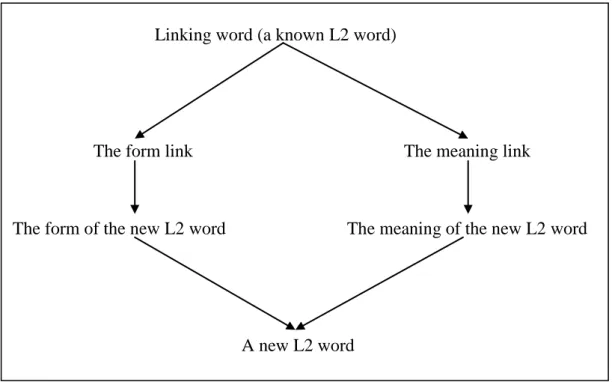
So that, Wei (2014, p.4) has demonstrated that the shared stem spect relates the known words with to be learned words in terms of form and meaning, i.e., they shared the same verb to look. Moreover, this strategy contains two steps. The first one, demands from learners to determine the common forms between the new word and the known word to build a form-based association. The second step involves them to understand and realize the shared meaning between the known word and the word to be learned. Wei have explained and itemized the word part technique in the figure bellow:
Figure 2.1: Analysis of the word part technique
Wei (2014, p. 5).
The figure shows that there are two links in the word part technique; the form link and the meaning link of the high frequency L2 word, which are related together to link the new L2 word with the known linking L2 word.
Dictionary use: According to Klapper (2008), dictionaries are useful sources for learning vocabulary. He was mentioned many studies that support the advantage of the two types of dictionaries, monolingual and bilingual dictionaries. On one hand, a Monolingual dictionary can provide multiple meanings about the unfamiliar words. On the other hand, a Bilingual dictionary can translate words and phrases from one language to another. He has also named the new version „bilingualized‟ dictionaries as hybrid tools that encompass features of monolingual and bilingual dictionary (pp. 167-168). Schmitt (2010) held that “learners carry around dictionaries and not grammar books” (p. 4) which means that learners are more interested in learning new words and not grammar rules. Therefore, dictionaries
Linking word (a known L2 word)
The form link The meaning link
The form of the new L2 word The meaning of the new L2 word
assist students to quickly access the meaning of unfamiliar words that may be encountered in various contexts. Furthermore, they have the potential to foster the vocabulary repertoire of those who learn by their own outside the classroom (Thornbury, 2002, p. 151). ). Moreover, Gu (2003) has stressed what being known as „E-dictionary‟ which makes looking up for words more easier and efficient (p. 7). Thus, whatever the type of dictionary, it is agreed that they are effective and helpful tools for vocabulary learning.
2.4.1.1.2 Memory Strategies
Memory strategies are also called mnemonics. They are considered as excellent mental aids in terms of storing and remembering a large amount of vocabulary (Oxford, 1990, p. 132). Memory strategies encompass a variety of sub-techniques but the most popular ones in the field of research are semantic associations and the keyword technique (Klapper, 2008, p. 168).
Semantic associations: Here the learner links the new words relatively with its previous representation in the mind in order to be retained like the word fine is connected with law, arrest, police, accused…etc. This technique generates a significant linkage between words. It is also a mind-map when it is used to relate new items to concrete materials like pictures. However, in some cases, the technique will be a source of confusion for learners who cannot differentiate between the meanings of words that they have been already learned together. For example the synonym broad / wide (Klapper, 2008, p. 168).
The keyword technique: It is a well thorough area of learning vocabulary. It implies linking the form of the word to its meaning “a mother tongue is chosen that sounds like the L2 item to be learnt and allows the learner to make association between the two” (Klapper, 2008, p. 168). In this context, Oxford (1990) has mentioned two stages that contribute in the key word technique. Firstly, the learner recognizes the acoustic link between
L1 word and L2 word, i.e., they have a similar equivalent sound. In the second stage, he/she visualizes a logical association between L2 word and its familiar word in L1. For example, to learn the new French word potage (soup), the learner of English links it with a pot and then pictures a pot full of potage (p. 41-42). Unlike the word part technique which is a known L2 word, the keyword technique is a known L1 word.
2.4.1.1.3 Cognitive Strategies
These strategies are a little bit similar to memory strategies, but they are not based only on mental procedures; rather they also involve practical means that the learner uses to figure out the meaning of complex words (Schmitt, 2000, p. 136). According to Klapper (2008), the mechanical techniques that the independent learner overuses are: rote learning and rehearsal, making word cards, and the list learning strategies (p. 170).
The Words Cards: This technique is more efficient than the keyword method because some EFL learners are deficient in imagining, but all can be trained to use word cards. It involves writing the L2 word on the front of the small card and the L1 word on its back side. In this technique, the learners move through a sequence of processes. First, they try to remember the meaning of the new words and if they cannot retrieve its meaning they turn the card to see its equivalent translation. Then, they use the translation to prove the form of new word. By the end, the words that are learned should be omitted, then, they create new word cards (Thornbury, 2002, p. 146).
Rote Learning and Rehearsal: As Klapper (2008) has maintained, extensive repetition of L2 words is an effective method to retain wider vocabulary and the majority of students are supposed to do so unconsciously. To support that claim he has referred to a study conducted by Crothers and Suppes (1967) which approves that 100 Russian-English word pairs (L2-L1) reminded over seven repetitions. Therefore, the more words are repeated, the
better they are learned, as Nation (2001) has recommended that “repetition thus adds to the quality of knowledge and also to the quantity or strength of this knowledge” (p. 114).
List Learning: It is suggested that learners break down the list into groups, each group consists of three or four words. Then, they test their learned- words on each group in turn with the rote learning; however, this strategy is not very helpful since the items in the list cannot be changed. (Klapper, 2008, p. 170).
2.4.1.1.4 Metacognitive Strategies
By contrast to what is noted above, Klapper (2008) believed that metacognitive strategies are indirect techniques used to boost vocabulary size, whereby using vocabulary books as an advantageous source for independent learning (p. 171). Moreover, Oxford (1990) has noted that metacognitive strategies are steps used consciously by learners to support the cognitive strategies, especially those who feel lost when learning the target language including paying attention either by directing it to learn the whole task or by focusing only on some aspects of language. Also, over-viewing the learning procedures and relating them in logical manner. This latter would be more effective if the following guidelines are followed: (1) setting the reason behind doing a particular task, (2) choosing the words to be learnt, (3) make the linkage. In addition to, other metacognitive strategies including: deciding a well-planned and organized way for language learning and then evaluating the method efficacy (pp. 136-137).
2.4.1.2. Strategies for Implicit Vocabulary Learning
Conversely to the explicit /direct vocabulary learning, implicit strategies refer to the incidental learning while reading or listening in which the message is the focus of the learner and not the language as in the intentional learning. Extensive and intensive reading and guessing from context are examples of implicit strategies that the learner can use by his own to optimize vocabulary learning (Klapper, 2008, p. 171).
2.4.1.2.1 Reading
It is agreed that learners who read frequently from texts that they are interested in, they gain intrinsic vocabulary as Klapper (2008) has displayed many studies to confirm that learning vocabulary incidentally through extensive or intensive reading has a significant contribution in the reinforcement of repeated words.
Extensive reading is considered as one of the best methods that assist learners‟ access to a variety of words since the same word may be encountered in different books which can lead to the memorization of this word (Jeffries & Mikulecky, 2007, p. 30). Similarly, Nation (2001) has recommended that the research on extensive reading uncovers many advantages not only in reading, but also upon the development of language learning (p. 251). Furthermore, Tiryaki and Tütüniş (2012) have conducted a study about the role of extensive reading in the improvement of vocabulary. The study has been carried out on 100 EFL students. The results show that extensive reading has a large effect on the EFL learners‟ vocabulary development. Also, it plays an essential role in learning the lexical items. In the EFL context, students‟ restricted input may limit their incidental learning output, and enlarge their lexical input (Webb & Nation, 2017, p. 61).
Intensive reading, on the other hand, is a form-focused learning activity in which learners depend on direct strategies like the above mentioned ones to be able to understand the words that they are not familiar with. In addition, gaining vocabulary through intensive reading requires more effort because some encountered words in one context will not be found again in other exposures. Thus, they will be disappeared through time (p. 122).
2.4.1.2.2 Guessing from Context
It is a strategy for facilitating vocabulary learning. It entails inferring the meaning of unknown words from the context. Students recognize the full meaning of a new word by meeting it in multiple contexts. The exposure should contain clues that assist students in