Publisher’s version / Version de l'éditeur:
Vous avez des questions? Nous pouvons vous aider. Pour communiquer directement avec un auteur, consultez la
première page de la revue dans laquelle son article a été publié afin de trouver ses coordonnées. Si vous n’arrivez pas à les repérer, communiquez avec nous à [email protected].
Questions? Contact the NRC Publications Archive team at
[email protected]. If you wish to email the authors directly, please see the first page of the publication for their contact information.
https://publications-cnrc.canada.ca/fra/droits
L’accès à ce site Web et l’utilisation de son contenu sont assujettis aux conditions présentées dans le site LISEZ CES CONDITIONS ATTENTIVEMENT AVANT D’UTILISER CE SITE WEB.
Research Paper (National Research Council of Canada. Division of Building
Research); no. DBR-RP-597, 1974-01
READ THESE TERMS AND CONDITIONS CAREFULLY BEFORE USING THIS WEBSITE.
https://nrc-publications.canada.ca/eng/copyright
NRC Publications Archive Record / Notice des Archives des publications du CNRC :
https://nrc-publications.canada.ca/eng/view/object/?id=f989c8da-dcf6-4a4e-9498-d8552ed6b393 https://publications-cnrc.canada.ca/fra/voir/objet/?id=f989c8da-dcf6-4a4e-9498-d8552ed6b393
NRC Publications Archive
Archives des publications du CNRC
This publication could be one of several versions: author’s original, accepted manuscript or the publisher’s version. / La version de cette publication peut être l’une des suivantes : la version prépublication de l’auteur, la version acceptée du manuscrit ou la version de l’éditeur.
For the publisher’s version, please access the DOI link below./ Pour consulter la version de l’éditeur, utilisez le lien DOI ci-dessous.
https://doi.org/10.4224/40001665
Access and use of this website and the material on it are subject to the Terms and Conditions set forth at
Fire endurance of concrete protected steel columns
Lie, T. T.; Harmathy, T. Z.
S e r
THl
N21r2 no.597
c . 2 BLDGBB-YZED
NATIONAL RESEARCH COUNCIL O F CANADA CONSEIL NATIONAL D E RECHERCHES DU CANADA
FLRE ENDURANCE O F CONCRETE-PROTE CTED S T E E L COLUMNS by T. T. L i e and T . Z. H a r m a t h y R e p r i n t e d f r o m J o u r n a l of the A m e r i c a n C o n c r e t e I n s t i t u t e ' No. 1 , P r o c e e d i n g s V. 71, J a n u a r y 1974 p. 29
-
32 R e s e a r c h P a p e r No. 597 of the Division of Building R e s e a r c h , -P r i c e 10 cents Ottawa NRCC 13876LIENDURANCE AU FEU DES COLONNES DIACIER PROTEGEES PAR DU BETON
On klabore une f o r m u l e e m p i r i q u e s e r v a n t
'a
p r k d i r e l l e n d u r a n c e au feu d e s colonnes d l a c i e r p r o t & g 6 e s p a r du b&ton. P a r e n d u r a n c e a u feu on entend l e temps que met l e noyau d l a c i e r5
a t t e i n d r e une t e m p k r a t u r e d e 538OC (1, 000°F). A l a lumi'5ere d e nombreux r k s u l t a t s d l e s s a i s a u f e u , l a p r k c i s i o n d e l a f o r m u l e s l e s t montrke s a t i s f a i s a n t e .-
TITLE
NO. 71-8
Fire Endurance
Concrete-Protected
Columns
By T. T. LIE and T. 2. HARMATHY
An empirical formula i s developed for the pre- diction of the fire endurance of concrete-protected steel columns. Fire endurance i s interpreted as the time during a standard fire test required for the temperature of the steel core to reach 1000 F (538 C). In the light of numerous fire test results, the accuracy of the formula appears to be satis- factory. A numerical example is included to show the application of the formula.
Keywords: columns (supports); concretes: f i r e resistance; f i r e tests: lightweight concretes: steels: structural design: temperature.
W IN A RECENT PUBLICATION^ the authors described a numerical procedure by which the temperature history of protected steel columns can be calcu- lated during fire exposure. The most important information that one can derive from such a nu- merical study is "fire endurance," i.e., the time a t which structural failure of a column occurs during a standard fire test.
As the direct cause of structural failure is the buckling of the load-bearing steel core of the col- umn, calculations aimed a t predicting time of failure in a standard fire exposure should normal- ly consist of two steps: the calculation of the temperature history of the column, followed by a study of its stress-deformation history. The re- sults of numerous fire tests indicate, however, that structural failure usually occurs when the average
i n g Research Institute in J a p a n during 1962. M r . Lie is a t present engaged in research in the field o f structural f i r e protection a n d has published several papers on this subject a n d is author o f a book on Fire and Buildings.
T. Z. Harrnathy has been a research o f f i c e r w i t h the Fire Section, Civision o f Building Research, N a t i o n a l Research Council of Canada, O t t a w a , since 1958. H e obtained a d e g r e e i n mechanical engineering from the Budapest U n i - versity o f Technology in 1946, a n d a Doctor o f Engineering degree f r o m t h e Vienna University o f Technology i n 1967. Dr. Harrnathy's current research includes investigating the physical properties o f building maferials a t elevated tem- peratures and the behavior o f building elements in fire. The author of numerous technical papers, currently he is a
member o f A C I C o m m i t t e e 216. Fire Resistance a n d Fire Protection o f Structures.
temperature of the steel core reaches about PO00 F (538 C ) , so that it is possible to dispense with the second part of the calculations and determine the time of failure of columns directly from tempera- ture studies.*
COMPUTER STUDlES
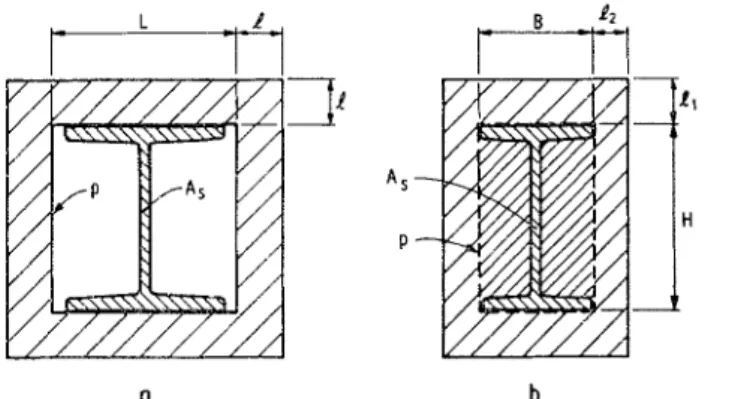
The numerical procedure was devised primarily for computer execution. To keep calculations to a minimum, the computer studies were restricted to columns with square box-type protection. Fig. Pa shows a cross section of such a column. Pro- visions were made in the computer program to
allow an air gap between the flange of the steel core and the protection. Preliminary runs re- vealed, however, that the degree of contact between the core and the protection had no sig- nificant influence on the temperature history of the assembly. Consequently, all subsequent com- putations were based on an arbitrarily selected degree of contact, namely 50 percent of the inner surface of the insulation.
Four kinds of concrete were selected as pro- tective material in the computer studies. Two could be regarded as upper and lower limiting cases for normal-weight concretes from the point
Fig. \--Types 04 concrete-protected steel columns: (a) columns with box-type protection; (b) columns with mas- sive protection
of view of thermal properties. Similarly, the other two were limiting cases for lightweight concretes. Information on their thermal properties a t room temperature and a t elevated temperature has been reported.*
The effect of moisture on the temperature his- tory of the steel core was examined with the aid of a simplified mathematical model. I t was found that the gain in fire endurance [i.e., the time delay for the core to reach 1000 F (538 C ) ] is about 3 percent for every percent (by volume) of mois- ture.' I t should be noted that among inorganic building materials concrete is the only one that can hold moisture in amounts significant enough to affect the result of standard fire tests.
EMPIRICAL RELATION
One hundred and sixty-eight computer calcula- tions were performed in a program planned to provide information on the effect of material prop- erties and certain geometric variables on the time of failure of box-type concrete-protected steel col- umns in fire. Failure was regarded as the attain- ment of 1000F (538 @) by the steel core. The results of the computations were then processed to discover whether they could be correlated with the aid of an empirical formula.
In an earlier study Harmathy3 pointed out that the quasi-congruency of the thermal property versus temperature relation for the materials is a necessary condition of the feasibility of correlat- ing experimental or computer results. He also em- phasized that if this condition is fulfilled it is per- mis4"ble to use in the resulting empirical expres- sions thermal property values pertaining to room temperature, instead of average or high-tempera- ture values. Because of the laws governing the temperature dependence of the thermal conduc- tivity of crystalline and amorphous materials (see for example Reference 2), the quasi-congruency of thermal conductivities is generally fulfilled for most building materials. Owing to the possible latent heat effect accompanying the heating of building materials, many of which become chemi- cally unstable at elevated temperatures, the quasi- congruency of the apparent specific heat versus temperature relation is normally satisfied only within certain related groups of materials. @on- sequently, care should be exercised when applying an empirical formula to materials not covered in the original studies.
In processing the results of the computer runs the usual trial and error procedures were em- ployed. The results were plotted on selected graph papers in an effort to find an appropriate empiri- cal expression. When many variables are involved,
as in the present studies, it is inevitable that one
has some idea of the possible groupings of varia-
bles prior to carrying out trial and error proced- ures. Unfortunately, since a fire test (which the computer calculations were intended to simulate) is far from being a classical heat transmission process, the originally assumed dimensionless groups, (i.e., the Fourier and Nusselt numbers for the concrete) did not prove to be satisfactory cor- relating factors. On the other hand, the group
(see Fig. 1 and notation)
used by Lieq in earlier analytical studies did prove useful in correlating data.
After many trials, the following empirical equa- tion was finally adopted for the fire endurance of box-type concrete-protected steel columns in the dry condition:
where C is the heat capacity of the inner core within the box protection (i.e., the steel core, in this case) per unit length,
and p is the inner perimeter of the protection,
p = 4L (3)
t, is the intrinsic fire endurance of the steel core
that can be described by the following equation:
Eq. (4) was derived from equations presented by Stanzak and Lie on unprotected steel column^.^
I t should be noted that the constants 15.2 and 0.03 in Eq. (1) and (4), respectively, are valid only if the variables are expressed in the units shown in .the notation. As mentioned earlier, gain in fire endurance is roughly 3 percent for every percent (by volume) of moisture, so that fire endurance in the moist condition is attained as,
A closer examination of Eq. (1) will reveal that as 1 -+ 0, ( t - t,) + and a s 1 + co (or p , A , / p + 0)
,
(t -- t,) -+ 1 I . t These findings are in agreement
with conclusions derived by McGuire et al.* using electrical analogue simulation of fire endurance problems.
The average error when using Eq. (1) for cal- culating the fire endurance of square box-type concrete-protected steel columns is 4 percent, evaluated on the basis of results of computer runs. Square, box-type concrete protection was selected for computer studies because of the simplicity of the computer simulation of heat flow through such
'McGuire. J. H.. Stanzak. W. W.. and Law, Margaret, "The Scaling of Fire Resistance Problems." (to be published).
protection. Unfortunately, box-type protection is not commonly used. The "massive protection" shown in Fig. l b is a more popular method of construction, so that it seemed desirable to dis- cover whether Eq. (1) could be extended to col- umns built in this way.
The following argument can be used: massive protection is, in fact, a particular form of box- type protection that evolves when the cavity be- tween the inner surfaces of the protection and the steel core (i.e., the space between the dashed rec- tangle and the steel core in Fig. l b ) is filled with the same protecting material. This fact can be taken into account by adding to the heat capacity of steel that of the concrete inside the dashed rectangle, in other words, by defining C as fol- lows:
C = p.qcyA,
+
(BH - A,) (6)Account can also be taken of the fact that, for columns with massive protection, the area inside the dashed line is normally not equilateral and the thickness of the insulating cover itself (i.e., the thickness of the hollow rectangle outside the dashed line) is not the same all around. Under these circumstances 1 and L may be interpreted as averages, for example
Naturally, the latter expression has to be used in Eq. (3) in describing the inner perimeter of the protection proper.
As computer calculations were not performed on columns with massive protection, the validity of Eq. (1) and of the complementary Eq. (6), (7), and (8), have been proved by means of experi- mental fire test results.
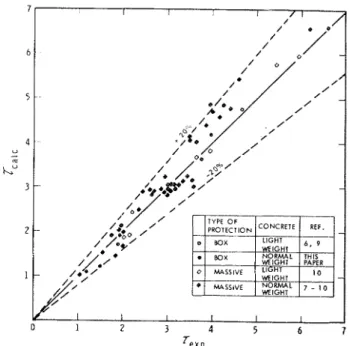
A comparison of calculated and experimental fire endurance data is given in Fig. 2. Most of the experimental data were evaluated using in- formation from fire tests done in other labora- t ~ r i e s . ' ' - ' ~ Such evaluation was rendered rather difficult by the paucity of information concerning the thermal properties and moisture content of the concrete protection, and by the fact that in most tests failure of a column was interpreted as failure by collapse, not as attainment of 1000 F (538 C) by the steel core. It was necessary, therefore, to estimate either moisture content or the properties k and p c of the concrete, or to determine the point of failure by interpolation or extrapolation after examining the temperature history of the steel core during the fire test.
Fig. 2 shows that the agreement between cal- culated and experimental fire endurance data is
' e x p
Fig. 2-Comparison of calculated and experimental in- formation on the fire endurance of concrete-protected steel columns
very good for columns with box-type protection. This can be attributed partly to the fact that Eq. (1) was originally developed for this type of column, and partly to the fact that most of the tests were performed in the authors' laboratory where all the information necessary for solving Eq. (1) was available. The average error in the calculated results for columns with box-type pro- tection was 6.7 percent, evaluated on the basis of test results.
For columns with massive concrete protection, the accuracy of calculated fire endurance data was somewhat poorer, the average error being 9.3 per- cent.
NUMERICAL EXAMPLE
I t may be useful to illustrate the calculation pro- cedure through a numerical example. The task is to calculate the fire endurance of a steel column (6 x 4% in., weight: 20 lb/ft, British Standard section, B.S. 4 ) , provided with normal weight concrete protection, a t 10 percent (by volume) moisture content. The column is of the type shown in Fig l b . The following information has been recorded.
H
-
0.5 f t (15.24 c m ) , B = 0.375 f t (11.43 c m ) , 1, = l2 = 1 = 0.1667 ft (5.08 cm), A, = 0.0411 ft"38.2 cm'), p , = 2.5 ft (76.2 cm).The material properties are estimated as fol- lows:
p, = 487 Ib/ft" (7.8 g/cm3)
c, = 0.138 Btu/lb deg F or cal/g deg C p = 144.8 lb/ft" (2.32 g/cm3)
c = 0.183 Btu/lb deg F or cal/g deg C k = 0.718 Btu/hr f t deg F (0.003 callsec cm
2% C)
From Eq. (1) :
L =%
x
(0.5+
0.375)=
0.4375 f t (13.335 cm)and from Eq. (3) :
p = 4 X 0.4375 = 1.75 ft (53.34 cm)
From Eq. (6) the heat capacity of the inner core (including the steel core and the concrete within the dashed rectangle shown in Fig. l b ) is calculated as
(7 = 487
x
0.108x
0.0411+
144.8x
0.183x
(0.375 X 0.5 - 0.0411) = 6.041 Btu/f t deg F (89.9 cal/cm deg C)
From Eq. (4) thd intrinsic fire endurance of the steel core is:
T, = 0.03 X (487 X 0.0411/2.5)0.7 = 0.129 h r
Thus, from Eq. ( I ) , the fire endurance of the column in dry condition is obtained as:
Finally, from Eq. (5), the fire endurance a t 10 percent (by volume) moisture content is:
A standard test performed on this column yield- ed 2.35 h r fire endurance.
SUMMARY
Based on 168 computer calculations, an empiri- cal farmula has been developed for the prediction of the fire endurance of box-type, concrete-pro- tected steel columns. In this development fire en- durance was interpreted as the time at which the temperature of the steel core reached 1000 F
(538 C)
.
Numerous available data on the performance of steel columns in actual fire tests have made it possible to extend the validity of the formula to columns with massive concrete protection. The accuracy of the formula was shown to be satis- factory from an engineering point of view.
ACKNOWLEDGMENT
The authors wish to thank Messrs. E. 0 . Porteous and J. E. Berndt for their help in the experimental work and in the evaluation of results.
This paper is a contribution from the Division of Building Research, National Research Council of Can- ada, and is published with the approval of the Director of the Division.
A = cross-sectional area, ft2
B = width of flange of steel section, ft
c = specific heat at room temperature; without sub- script: that of concrete, B t u l l b deg F
C = heat capacity of the inner core of column per unit height, Btu/ft deg F
H = depth of steel section, f t
k = thermal conductivity of concrete a t room tem- perature, B t u l f t hr deg F
1 = thickness of concrete cover, f t
L = one-fourth of the inner periphery of concrete protection, ft
p = periphery; without subscript: inner periphery of concrete protection, ft
p = density a t room temperature; without subscript:
that of concrete, lbIft3 z = fire endurance, hr
cp = volumetric moisture content of concrete protec-
tion, ft31ft3 Subscripts
o =. in dry (moistureless) condition
s = of steel, of steel section, intrinsic for the steel core
REFERENCES
1. Lie, T. T., and Harmathy, T. Z., "A Numerical Procedure to Calculate the Temperature of Steel Col- umns Exposed to Fire," Fire Study No. 28 (NRCC 125351, Division of Building Research, National Re- search Council of Canada, Ottawa, 1972, 26 pp.
2. Harmathy, T. Z., "Thermal Properties of Concrete at Elevated Temperatures," Journal of Materials, V. 5, No. 1, Mar. 1970, pp. 47-74.
3. Harmathy, T. Z., "Thermal Performance of Con- crete Masonry Walls in Fire," Fire Test Performance, STP-464, American Society for Testing and Materials, Philadelphia, 1970, pp. 209-'243.
4. Lie, T. T., "Temperature of Protected Steel in Fire," Symposium No. 2, Ministry of Technology and Fire Offices' Committee, Joint Fire Research Organiza- tion (London, 1967), Her Majesty's Stationery Office, London, 1968.
5. Stanzak, W. W., and Lie, T. T., "Fire Resistance of Unprotected Steel Columns," Proceedings, ASCE, V. 99, ST5, May 1973, pp. 837-852.
6. Harmathy, T. Z., and Blanchard, J. A. C., "Fire Test of a Steel Column of 8-in. H Section, Protected with 4-in. .Solid Haydite Blocks," Fire Study No. 6
(NRCC 6668), Division of Building Research, National Research Council of Canada, Ottawa, 1962, 10 pp.
7. Ingberg, S. H., Griffin, H. K., Robinson, W. C., and Wilson, R. E., "Fire Tests of Building Columns," Tech- nical Paper No. 184, National Bureau of Standards, Washington, D. C., Apr. 1921, 375 pp.
8. Mitchell, Nolan D., "Fire Tests of Steel Columns Protected with Siliceous Aggregate Concrete," Building Materials and Structures Report No. BMS124, National Bureau of Standards, Washington, D. C., May 1951, 12 PP.
9. Davey, N., and Ashton, L. A., "Investigations on Building Fires, P a r t V. Fire Tests on Structural Ele- ments," Research Paper No. 12, National Building Studies, Her Majesty's Stationery Office, London, 1953, pp. 150-188.
10. Malhotra, Harbans L., and Stevens, Robert F., "Fire Resistance of Encased Steel Stanchions," Pro- ceedings, Institution of Civil Engineers (London). V. 27, Jan. 1964, pp. 77-98.
This p a p e r was r e c e i v e d by t h e I n s t i t u t e Jan. 15, 1973
This publication is being distributed by the Division of Building R e s e a r c h of the National R e s e a r c h Council of Canada. I t should not be reproduced in whole o r in p a r t without p e r m i s s i o n of the original publisher. The Di- vision would be glad to be of a s s i s t a n c e in obtaining
such p e r m i s s i o n .
Publications of the Division m a y be obtained by m a i l - ing the a p p r o p r i a t e r e m i t t a n c e ( a Bank, E x p r e s s , o r P o s t Office Money O r d e r , o r a cheque, m a d e payable to the R e c e i v e r General of Canada, c r e d i t NRC) to the National R e s e a r c h Council of Canada, Ottawa. K1A OR6. Stamps a r e not acceptable.