SSU rRNA reveals major trends in oomycete evolution
Enrique Lara&Lassaad BelbahriReceived: 24 January 2011 / Accepted: 9 March 2011 / Published online: 5 April 2011 # Kevin D. Hyde 2011
Abstract Oomycetes are a group of heterokonts that have a huge impact on the environment as well as on human welfare, due the parasitic nature of many species. However, their evolutionary patterns are still not well understood, due in part to the lack of molecular markers suited to resolve the deep phylogeny of this group. Here, we propose a phylogeny of the whole clade based on the nuclear ribosomal small subunit gene, that comprises both culture and environmental studies derived sequences. Our analysis shows notably that i) plant pathogenesis occurred only rarely in oomycete evolution in comparison to animal parasitism ii) obligate symbiosis happened only in a few derived groups and iii) transitions from soil/freshwater to marine environment (and viceversa) are common unlike for most eukaryotic groups. This study illustrates the complex-ity of evolutionary patterns and will help to better understand the emergence of pathogenicity in the different oomycete groups.
Keywords Oomycetes . Pythium . Phytophthora . Albugo . Phylogeny . Plant diseases . Evolution
Introduction
Oomycetes are a large and ubiquitous group of eukaryotic microorganisms. Its most famous representatives are cer-tainly the plant pathogenic species, like Phytophthora infestans, which had a dramatic impact on agriculture which resulted historically in famines and massive emi-gration (Kamoun 2001). In present times, a species like
Phytophthora sojae is hampering soybean production in several continents (Kamoun2001). Other plant pathogens, such as Phytophthora cinnamomi, P. pinifolia and P. ramorum are causing major damages to forest ecosystems and to the wood industry in Australia, Chile and the USA (Duran et al. 2010; Rizzo et al.2005). In addition, several species are pathogenic to animals, such as Saprolegnia parasitica, which has a major impact on salmon farming (Phillips et al. 2008), Pythium insidiosum, a human pathogen (Mendoza and Newton 2005) or Leptolegnia chapmani, a parasite of mosquito larvae (Zattau and McInnis 1987). Other hosts than plants and animals are red and brown algae (Gachon et al. 2009), and diatoms (Thines and Kamoun 2010). Finally, several species are saprotrophic and can be found in soils without being able to parasitize a host. Thus, they can be considered as one of the eukaryotic groups which have the greatest impact on human health and welfare, and also on the ecosystems.
Oomycetes have been traditionally considered as fungi because of their morphology (mycelial growth) and their ecology. However, molecular phylogeny placed them within the eukaryotic supergroup heterokonta (also called stramenopiles), which comprises also the diatoms and the brown algae (Ben Ali et al.2001,2002), a relationship that appears more obvious when the biflagellated life stage and its typical heterokont morphology is inspected. This aspect had already been noticed by early researchers such as Karling (1942) and Bessey (1942) who hypothesised, respectively, that oomycetes had evolved from heterotro-phic flagellates and photosynthetic algae, both categories having representatives within in the heterokonts. The shape and size of oogonia, antheridia, and oospores has been retained as one of the criteria to define genera within the oomycetes, together with the shape of the sporangium (Uzuhashi et al.2010). With the use of molecular methods in taxonomy, several previously acknowledged genera
E. Lara
:
L. Belbahri (*)Institute of Biology, Laboratory of Soil Biology, University of Neuchâtel,
CH-2009 Neuchâtel, Switzerland e-mail: [email protected]
appeared to be paraphyletic, such as for instance Pythium and Peronospora, which implied several taxonomic emen-dations which are still ongoing (van der Plaats-Niterink 1981). However, the whole oomycete tree remained still poorly resolved.
Genetic markers used in oomycete research are generally highly variable ones, such as ITS, cox2 or partial 28S rRNA sequences (Cooke et al. 2000). This is justified by the need to discriminate closely related strains that can be potential pests. However, such markers are too variable to build an overall picture of the oomycete tree that shows their major evolutionary trends, due to the impossibility to build reliable sequence alignments. Here, we propose a recon-struction of the whole oomycete phylogeny which relies on complete sequences of the SSU rRNA, the most commonly used marker for eukaryotic phylogeny, a slow-evolving gene. For this purpose, we added sequences obtained from environmental DNA surveys to the database of sequenced identified strains provided by GenBank. In addition, we sequenced the SSU rRNA gene of Albugo candida, an obligate plant pathogen whose taxonomic affiliation was considered as unresolved (Thines and Kamoun 2010). These results offered us the possibility to draw conclusions on evolutionary pathways followed by oomycetes with special emphasis on their parasitic functions, and also on their ecology.
Materials and methods
DNA extraction, amplification and sequencing
Spores were extracted from Albugo candida which grew on turnip leaves (Brassica rapa). DNA was extracted using a guanidine thiocyanate protocol (Chomczynski and Sacchi 1987). Almost complete SSU rRNA gene was amplified through PCR using the eukaryotic domain-specific primers EK 82F and EK1498R (Medlin et al. 1988), with the following cycling profile: initial denaturation of 95°C for 5 min, followed by 40 cycles of 95°C for 15 s, 58°C for 15 s and 72°C for 90 s, with a final elongation of 72°C for 7 min. PCR products were then purified and sequenced directly using a BigDye197 Terminator Cycle Sequencing Ready Reaction Kit (Applied Biosystems) and analysed with an ABI-3130xl 48-capillary DNA sequencer (Applied Biosystems).
Database construction and phylogenetic analysis
An alignment with 238 SSU rRNA gene sequences comprising also Albugo candida (both environmental and culture-derived) was constructed using using the BIOEDIT 7.0.9 sequence alignment editor (Hall1999) and manually
refined. Publicly available oomycete SSU rRNA environ-mental sequences were downloaded from GenBank through the taxonomy web site at National Center for Biotechnol-ogy Information (http://www.ncbi.nlm.nih.-gov). The sequences were found by BLAST searches using query sequences from all main oomycete genera from which SSU rRNA sequences were available, including the most divergent ones (i.e., Peronospora, Pythium, Saprolegniales, Haptoglossa, Eurychasma, Olpidiopsis, Haliphthoros, Halocrusticida). In turn, all sequences derived from environmental surveys were checked against the database to ensure that all available sequences, even the most derived ones, were included in our analyses. These searches were finalized on May 11th 2010.
All ambiguously aligned positions were not taken into account for the phylogenetic analysis; we used a total of 1,549 positions. Developayella, Pirsonia and the hypho-chytrids plus some environmental clones were proposed as outgroups, following the heterokont phylogeny proposed by Cavalier Smith and Chao (2006) Trees were constructed by maximum likelihood using the program TREEFINDER (Jobb et al. 2004), applying a GTR+G+I model of nucleotide substitution (Rodriguez et al. 1990). All neces-sary parameters were estimated from the data sets. Bootstrap values were calculated from 1,000 replicates. Alternatively, we built a tree using the program RAxML (Stamatakis et al. 2008) and compared the topologies obtained for the two trees.
Results
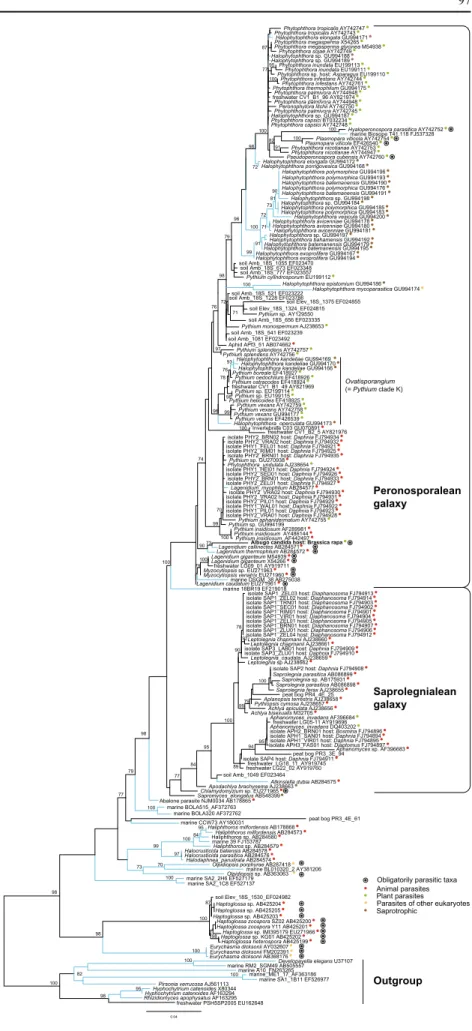
The topologies of the trees obtained independently with RAxML and TREEFINDER were identical; therefore, we will refer in the following of the manuscript only to the tree obtained with TREEFINDER. Our phylogeny confirms the existence of two main groups corresponding to the informally called peronosporalean and saprolegnialean “galaxies” (Sparrow 1976), supported 100% boostrap values. These two groups formed together a robust clade (98%), together with some sequences with an unidentified abalone parasite (AB178865) and Sapromyces elongatus (AB548399) whose affiliation to any of the galaxies remained uncertain.
Some sequences derived from environmental surveys were included within each of these “galaxies”. The environmental clones DGSM_38 and 18BR19 (respective-ly, AB275038 and EF219018), of marine origin, branched both within the peronosporalean “galaxy” as well many clone sequences derived from freshwater and soil environ-ment. Many clones derived from freshwater and peat-bog environment (but no sequence from soil or marine environment) branched within the saprolegnialean
“galaxy”. In addition, several taxa which were previously unassigned branched with relatively good support with the saprolegnialean “galaxy”: Chlamydomyzium sp. (EU271965), Apodachlya brachynema (AJ238663) and Atkinsiella dubia (AB284575).
At a basal position with respect to these two groups, appear three diversely supported clades, which comprise some sequences derived from identified species: these are (1) the group of Haliphthoros, Halocrusticida and Halodaphnea (99% bootstrap) (2) Olpidiopsis (73% bootstrap) and (3) Haptoglossa and Eurychasma (98% bootstrap). Each of these clades includes at least one environmental clone sequence. Besides these groups, several environmental sequences with no close affinities to any of the mentioned clades also occupy basal positions with respect to the aforementioned “galaxies”. These environmental sequences are originating mostly from marine environments, with exception of PR3_4E_61 (GQ330583), which derived from a molecular diversity survey of a peat bog (Lara et al.2010). The peronosporalean “galaxy” appears in our tree composed of the following robustly supported clades: (1) Phytophthora and related genera. The Peronosporales sensu Sparrow (Sparrow1976; called Peronosporales in short for clarity reasons), retrieved with maximum bootstrap support branched together with most Halophytophthora species, Pythium monospermum, P. cylindrosporum and many environmental soil and freshwater clones in a robust clade (bootstrap support =98)(2) Pythium boreale and related genera (3) Pythium insidiosum and P. aphanidermatum clade and (4) Lagenidum callinectes and L. thermophilum. Albugo candida branches robustly within this last clade. Next to these clades, a variety of environmental and cultured derived sequences show no clear affinity to each other. The monophyly of the Lagenidiales (i.e. Lagenidium + Myzocytiopsis) was not retrieved; genus Lagenidium appears paraphyletic. Neither was the monophyly of genus Halophy-tophthora, with some sequences branching inside the Peronosporales and some others with (2). Some species, like Halophytophthora elongata, H. polymorphica and H. batemanensis do not appear monophyletic.
In contrast, the genera composing the saprolegnialean “galaxy” (Leptolegnia, Sapromyces, Aphanomyces and others) are robustly supported, with the exception of Achlya and of one Leptolegnia isolate (AJ238662) which falls outside the Leptolegnia cluster, but whose affinities appear uncertain.
Discussion
General oomycete phylogeny
The picture of the oomycete tree obtained here is, broadly, congruent with previous phylogenies obtained with other
markers such as cox2 and LSU (Hudspeth et al. 2000; Riethmüller et al.2002), which also show the“galaxy split” described by Sparrow (1976) which separates the Perono-spora-related clades from the Saprolegnia-related, and also some basal-branching groups.
As shown in other studies (Beakes and Sekimoto2009; Uzuhashi et al. 2010), genus Pythium appears para-phyletic. One of the main characteristics that define this genus is the formation of zoospores (i.e. the flagellated stage) within a vesicle, a feature which is used to discriminate this genus from the morphologically similar Phytophthora and Halophytophthora (Van der Plaäts-Niterink 1981). However, our tree suggests that this character might be an ancestral feature in the peronospor-alean “galaxy”, because it is also shared by genus Lagenidium, whose sequences are also basal in the peronosporalean “galaxy”. More derived genera might have lost it in the course of evolution. Other characters, such as hyaline and coenocytic hyphae without cross septa are also shared by most peronosporales and also other oomycetes (Beakes and Sekimoto2009). Thus, there is a lack of valid synapomorphies that can be used to define genus Pythium sensu lato, it can be considered invalid as it is.
Uzuhashi et al. (2010) have proposed to split genus Pythium into five different taxonomic units based on the shape of the sporangium and on LSU rRNA gene and cox2-based phylogenies. One of these units is genus Ovatispor-angium, and corresponds actually to the K clade suggested by Lévesque and De Cock on the base of ITS sequences (2004). Members of this genus are characterised by an oval or at least oboval sporangium. This clade was highly supported in the LSU and cox2 trees, and appears also robust in our SSU rRNA gene-based analysis (bootstrap value 96%). Our analysis differs nevertheless from the one of these authors concerning the clade for which they chose to keep the name Pythium. If our analyses show a robust clade (bootstrap value 99%) that unites Pythium insidiosum, P. aphanidermatum,“Lagenidium” myophilum and several parasites isolated from Daphnia (Wolinska et al. 2009), they disagree on the inclusion of Pythium monospermum within that clade (left within genus Pythium by Uzuhashi et al. 2010). Likewise, our analysis does not support the reunion of P. splendens and P. cylindrosporum in a single clade (called Globisporangium, Uzuhashi et al. 2010). These last two clades are only weakly supported in the original study of Uzuhashi et al. (2010), both with LSU rRNA and cox2 genes. In our study, Pythium monosper-mum and P. cylindrosporum branch together with the Peronosporales and several environmental clones in a robust clade (bootstrap value 98%).
Genus Halophytophthora appears also paraphyletic in our analysis. Although most of the sequences branch in a
robust (bootstrap value 100%) clade at the base of the Peronosporales, several other sequences branch within well-defined clades. One example is H. kandeliae, a marine species which branches in our tree within the Ovatisporan-gium/clade K clade. This species forms zoospores within a vesicle, and this feature should be sufficient to exclude it from Halophytophthora. However, its inclusion within genus Ovatisporangium would be justified by the charac-teristic oval shape of its sporangium (Ho et al.1991), and also its SSU rRNA gene sequence. In addition to the misplacement of certain strains within Halophytophthora, certain species appear paraphyletic in our analyses (like Halophytophthora elongata, H. polymorphica and H. batemanensis). This might be due to misidentification of strains deposited in culture collections.
Our analyses show also that several genera described as of uncertain affinities branch robustly together with the saprolegnialean “galaxy”: Atkinsiella dubia, Apodachlya brachynema plus several environmental clones. These genera share together with Sapromyces elongatus (whose phylogenetic position still remains uncertain) and the saprolegnialean“galaxy” the capacity to synthesize sterols de novo, a biochemical pathway which is absent in the peronosporalean “galaxy” (Ludwig-Köhn et al. 1982; Petersen and Rosendahl2000). Chlamydomyzium, a nem-atode parasite, also branches together with these genera, albeit with moderate support. A study of its sterol metabolism would confirm its position within an enlarged saprolegnialean“galaxy”.
Position of Albugo candida
Our analysis showed that Albugo candida branched within the peronosporalean “galaxy”, together with the marine parasitic Lagenidium thermophilum and L. callinectes with a strong support (90%). This result is in agreement with a phylogeny obtained with LSU rRNA sequences, although the relationship was not supported. In contrast, cox2 placed Albugo with some Pythium isolates, without statistical support (Uzuhashi et al. 2010). This situation can be explained by the long branches formed by Albugo spp. with those genes, whereas SSU rRNA gene gives shorter branches and seems to be, therefore, a better suited genetic marker to solve this particular problem.
In our tree, the order Myzocytiopsidales (which com-prises, amongst others, genera Lagenidium and Myzocy-tiopsis; Glockling and Beakes 2006) does not appear monophyletic. Our analyses, however, do not support the opposite assumption, i.e. that genus Lagenidium is para-phyletic. Therefore, based on the morphological assump-tions by Glockling and Beakes (2006), we consider it as a natural grouping (to the exclusion, however, of Lagenidium myophilum AB284577, whose sequence might be the
product of a misidentification). The placement of Albugo candida within Myzocytiopsidales contradicts traditional taxonomy, which tended to classify it within its own group, separately from the other oomycete groups (Gaumann and Bünzli 1986). Some morphological characters, like the irregular structure on the mature oospore wall of Myzocy-tiopsis are found solely in Albugo candida, and not on any Pythium-related species (Beakes1981). In addition, several species of Myzocytiopsis and Lagenidium are obligate (animal) parasites, a feature which would prefigure the adaptation of Albugo to obligate plant parasitism.
Uncultured diversity
The addition of environmental clones to phylogenies that are based solely on sequences derived from cultured strains has already proved to be useful by reducing the phyloge-netic artefacts caused by taxonomic undersampling (Moreira et al. 2004). In addition, this practice can reveal the existence of uncultured clades whose existence was previously ignored (Holzmann et al. 2003; Berney and Pawlowski 2004; Massana et al. 2004; Lara et al. 2010, 2011), or an unsuspected diversity (Bass and Cavalier-Smith 2004; Lara et al.2011; Brate et al.2010a).
Here, the existence of six environmental clones at base of the“galaxies” that are not related to any known isolate strongly suggests the existence of major oomycete clades for which there are no sequences available. It is probable that these clades, for which most of the clones derive from the marine environment (largely undersampled for oomy-cetes), are still completely unknown. It is also very likely that an unsuspected diversity will be retrieved if oomycete-specific SSU rRNA primers are used for marine environ-ments. This approach has already proved to be fruitful for other clades (see references above). The occurrence of marine clades at the base of the oomycete tree is already known, and has lead Beakes and Sekimoto (2009) to propose a marine origin for oomycetes, in spite of the fact that the also basal-branching genus Haptoglossa has mostly terrestrial representatives. Here, clone PR3_4E_61 (GQ330583) from an acidic, mineral-poor peat-bog has also a basal position with respect to the “galaxies”. We suggest that a larger sampling effort should be undertaken before assigning a freshwater, terrestrial or marine origin to the oomycetes.
Oomycetes from the peronosporalean “galaxy” are noticeably present in the marine environment; several sequences from cultured marine organisms are interspersed within that group (such as Lagenidium callinectes, L. thermophilum, Halophytophthora spp.). In addition, three clones are derived from surveys of marine molecular diversity (T41.118, DGSM_38 and 18BR19). Most inter-estingly, marine clone Biosope T41.118 (FJ537328)
Fig. 1 Phylogenetic tree of the oomycetes, based on culture-derived and environmental sequences. Branches leading to marine taxa are illustrated in light blue. Identical environ-mental clone sequences are not illustrated. Rounded symbols indicate obligatory parasitic taxa. Red, green, yellow and brown dots refer to animal parasites, plant parasites, other eukaryotes parasites and sapro-trophic taxa. The numbers at the nodes indicate bootstrap values as obtained with the TREE-FINDER Maximum Likelihood algorithm
clusters strongly with Hyaloperonospora parasitica, an obligate parasite of members of the Brassicaceae family; this suggests that new Hyaloperonospora species infecting unsuspected hosts are likely to be discovered in the future. The saprolegnialean “galaxy” in a strict sense does not include sequences from marine environment. However, Atkinsiella dubia, a marine crustacean pathogen, is basal to that clade with a strong support (95%) in our analysis, and could thus be associated to that clade. Altogether, it seems therefore that transitions from marine to freshwater environment happened relatively often in the evolutionary history of the oomycetes, in sharp contrast to what has been observed in most eukaryotes, such as the thalassiosiroid diatoms (Alverson et al.2007), dinoflagellates (Logares et al.2007), cryptomonads (Shalchian-Tabrizi et al.2008) and euglyphid testate amoebae (Heger et al. 2010). The
parasitic nature of many oomycetes does not explain alone their tendency to cross easily the salinity barriers; the equally parasitic Perkinsea show very few transitions (Brate et al. 2010b) and the Syndiniales have no known representative or environmental sequences in freshwater environments (Guillou et al. 2009).
However, the largest part of the diversity is still encountered in soil and freshwater environments, were a large amount of environmental clones have been retrieved, showing a diversity of potentially new species or even higher clades which remain still unexplored.
Evolution of parasitism in oomycetes
Parasitism is thought to have evolved early in the oomycetes (Beakes and Sekimoto 2009). In this, they can
be easily compared to fungi, which are also osmotrophic organisms and show the same evolutionary tendency. However, most oomycete parasites behave as opportunistic pathogens; only a small part of the oomycete diversity is obligatorily symbiotic (here represented by genera Hyalo-peronospora, PseudoHyalo-peronospora, Plasmopara, Albugo, Lagenidium, Myzocytiopsis, Chlamydomyzium, Olpidiopsis, Haptoglossa and Eurychasma). Several species are entirely saprotrophs and have never been reported to be linked to any host, such as for instance Apodachlya brachynema or Sapromyces elongatus. It is likely that ancestral species started with such a saprotrophic condition, occasionally being able to grow on wounded, stressed or weakened hosts, like modern Halophytophthora sp. do (Göker et al. 2007). A step further implies development of specialised structures and biochemical pathways to be able to infect healthy hosts (like in Phytophthora), which eventually turns into an obligate symbiosis (like in Hyaloperonospora). All these intermediate steps can be found in a single clade, like the one where these examples come from (see Fig.1).
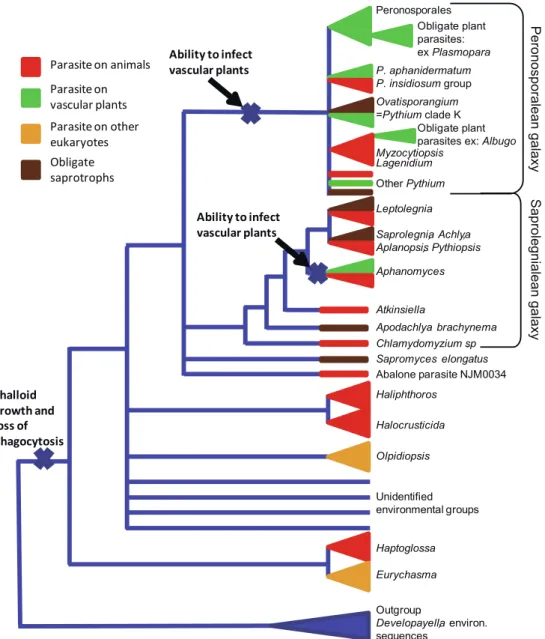
However, it seems that not every host is equal against infection. Our tree shows that the ability to infect plant cells has appeared only twice independently in oomycetes, once at the base of the peronosporalean“galaxy” and once at the emergence of genus Aphanomyces (see Fig.2). This is in contrast with the ability to infect animal cells, which is found in almost all clades, except in the obligate plant pathogens; it seems therefore“easier” for an oomycete to infect plant tissue than animal tissue. The reasons do not seem to be related to the presence of RXLR effectors, given that these effectors have been described in both plant pathogen Phytophthora spp. (Kamoun et al.2009) and on the fish pathogen Saprolegnia (Van West et al. 2010). Future studies targeting oomycete animal pathogens and non-symbiotic species that received less attention than plant infecting species could provide clues to explain such discrepancy (Phillips et al.2008).
Acknowledgement This work was supported by the Swiss State Secretariat for Education and Research (grant reference: SER No. C09.0139) and the European Union for the projects ISEFOR “Increasing Sustainability of European Forests: Modelling for Security against Invasive Pests and Pathogens under Climate Change (FP7-KBBE-2009-3 call, Proposal number: 245268) and the COST action FP0801“Established and Emerging Phytophthora: Increasing Threats to Woodland and Forest Ecosystems in Europe”. The authors would like to thank Mário Rui Proença Santos (Universidade Tecnica de Lisboa - Portugal) for the Albugo infected Brassica rapa plant material.
References
Alverson AJ, Jansen RK, Theriot EC (2007) Bridging the Rubicon: phylogenetic analysis reveals repeated colonizations of marine
and fresh waters by thalassiosiroid diatoms. Mol Phylogenet Evol 45:193–210
Bass D, Cavalier-Smith T (2004) Phylum-specific environmen-tal DNA analysis reveals remarkably high global biodi-versity of Cercozoa (Protozoa). Int J Syst Evol Microbiol 54:2393–2404
Beakes GW (1981) Ultrastructural aspects of oospore differentiation. In: Hohl HR, Turian G (eds) The fungal spore: morphogenetic controls. Academic Press, London and New York, pp 71–94 Beakes GW, Sekimoto S (2009) The evolutionary phylogeny of
Oomycetes—insights gained from studies of holocarpic parasites of algae and invertebrates. In: Lamour K, Kamoun S (eds) Oomycete genetics and genomics: diversity, interactions, and research tools. Wiley-Blackwell, London, pp 1–24
Ben Ali A, De Baere R, Van der Auwera G, De Wachter R, Van de Peer Y (2001) Phylogenetic relationships among algae based on complete large-subunit rRNA sequences. Int J Syst Evol Micro-biol 51:737–749
Ben Ali A, De Baere R, De Wachter R, Van de Peer Y (2002) Evolutionary relationships among heterokont algae (the autotro-phic stramenopiles) based on combined analyses of small and large subunit ribosomal RNA. Protist 153:123–132
Berney C, Fahrni J, Pawlowski J (2004) How many novel eukaryotic kingdoms? Pitfalls and limitations of environmental DNA surveys. BMC Biology 2:1–13
Bessey EA (1942) Some problems in fungus phylogeny. Mycologia 34:355–379
Brate J, Klaveness D, Rygh T, Jakobsen KS, Shalchian-Tabrizi K (2010a) Telonemia-specific environmental 18S rDNA PCR reveals unknown diversity and multiple marine-freshwater colonizations. BMC Microbiol 10:168
Brate J, Logares R, Berney C, Ree DK, Klaveness D, Jakobsen KS, Shalchian-Tabrizi K (2010b) Freshwater Perkinsea and marine-freshwater colonizations revealed by pyrosequencing and phy-logeny of environmental rDNA. ISME J 4:1144–1153
Cavalier-Smith T, Chao EEY (2006) Phylogeny and megasystematics of phagotrophic heterokonts (kingdom Chromista). J Mol Evol 62:388–420
Chomczynski P, Sacchi N (1987) Single-step method of RNA isolation by acid guanidium thiocyanate phenol chloroform extraction. Anal Biochem 162:156–159
Cooke DEL, Drenth A, Duncan JM, Wagels G, Brasier CM (2000) A molecular phylogeny of Phytophthora and related oomycetes. Fungal Genet Microbiol 30:17–32
Duran A, Gryzenhout M, Drenth A, Slippers B, Ahumada R, Wingfield BD, Wingfield MJ (2010) AFLP analysis reveals a clonal population of Phytophthora pinifolia in Chile. Fungal Biol 114:746–752
Gachon CMM, Strittmatter M, Muller DG, Kleinteich J, Kupper FC (2009) Detection of differential host susceptibility to the marine oomycete pathogen Eurychasma dicksonii by real-time PCR: not all algae are equal. Appl Environ Microbiol 75:322–328 Glockling SL, Beakes GW (2006) An ultrastructural study of
development and reproduction in the nematode parasite Myzocy-tiopsis vermicola. Mycologia 98:1–15
Göker M, Voglmayr H, Riethmuller A, Oberwinkler F (2007) How do obligate parasites evolve? A multi–gene phylogenetic analysis of downy mildews. Fungal Genet Biol 44:105–122
Hall TA (1999) BioEdit: a user-friendly biological sequence alignment editor and analysis program for Windows 95/98/NT. Nucleic Acids Symp Ser 41:95–98
Ho HH, Chang HS, Hsieh SY (1991) Halophytophthora kandeliae, a new marine fungus from Taiwan. Mycologia 83:419–424 Holzmann M, Habura A, Hannah G, Bowser SS, Pawlowski J (2003)
Freshwater foraminiferans revealed by analysis of environmental DNA samples. J Eukaryot Microbiol 50:135–139
Hudspeth DSS, Nadler SA, Hudspeth MES (2000) A COX2 molecular phylogeny of the peronosporomycetes. Mycologia 92:674–684
Jobb G, von Haeseler A, Strimmer K (2004) TREEFINDER: a powerful graphical analysis environment for molecular phyloge-netics. BMC Evol Biol 4:18
Kamoun S (2001) Nonhost resistance to Phytophthora: novel prospects for a classical problem. Curr Opin Plant Biol 4:295–300 Kamoun S (2009). The secretome of plant-associated fungi and
oomycetes. In 'Plant Relationships, 2nd Edition, The Mycota V' H. Deising (Ed.), Springer-Verlag Berlin Heidelberg Karling JS (1942) The simple holocarpic biflagellate phycomycetes.
Columbia University Press, New York
Lara E, Moreira D, López García P (2010) The environmental clade LKM11 and Rozella form the deepest branching clade of Fungi. Protist 161:116–121
Lara E, Mitchell EAD, Moreira D, López García P (2011) Highly diverse and seasonally dynamic protist community in a pristine peat bog. Protist 162:14–32
Logares R, Shalchian-Tabrizi K, Boltovskoy A, Rengefors K (2007) Extensive dinoflagellate phylogenies indicate infrequent marine-freshwater transitions. Mol Phylogenet Evol 45:887–903 Ludwig-Köhn H, Jahnke KD, Bahnweg G (1982) Sterol composition
and sterol metabolism of Haliphthoros milfordensis and Atkin-siella dubia, fungal parasites of marine crustaceans. Biochimica et Biophysica Acta (BBA) - Lipids and Lipid Metabolism 713:463–469
Massana R, Castresana J, Balague V, Guillou L, Romari K, Groisillier A, Valentin K, Pedro-Alio C (2004). Phylogenetic and ecological analysis of novel marine stramenopiles. App Environ Microbiol 70:3528–3534
Medlin L, Elwood HJ, Stickel S, Sogin ML (1988) The characteriza-tion of enzymatically amplified eukaryotic 16S-like rRNA coding regions. Gene 71:491–499
Mendoza L, Newton JC (2005) Immunology and immunotherapy of the infections caused by Pythium insidiosum. Med Mycol 43:477–486
Moreira D, Lopez-Garcia P, Vickerman K (2004) An updated view of kinetoplastid phylogeny using environmental sequences and a closer outgroup: proposal for a new classification of the class Kinetoplastea. Int J Syst Evol Microbiol 54:1861–1875 Petersen AB, Rosendahl S (2000) Phylogeny of the
Peronosporomy-cetes (Oomycota) based on partial sequences of the large ribosomal subunit (LSU rDNA). Mycol Res 104:1295–1303
Phillips AJ, Anderson VL, Robertson EJ, Secombes CJ, van West P (2008) New insights into animal pathogenic oomycetes. Trends Microbiol 16:13–19
Riethmuller A, Voglmayr H, Goker M, Weiss M, Oberwinkler F (2002) Phylogenetic relationships of the downy mildews (Per-onosporales) and related groups based on nuclear large subunit ribosomal DNA sequences. Mycologia 94:834–849
Rizzo DM, Garbelotto M, Hansen EA (2005) Phytophthora ramorum: Integrative research and management of an emerging pathogen in California and Oregon forests. Annu Rev Phytopathol 43:309–335
Rodriguez F, Oliver JL, Marin A, Medina JR (1990) The general stochastic-model of nucleotide substitution. J Theor Biol 142:485–501
Shalchian-Tabrizi K, Brate J, Logares R, Klaveness D, Berney C, Jakobsen KS (2008) Diversification of unicellular eukaryotes: cryptomonad colonizations of marine and fresh waters inferred from revised 18S rRNA phylogeny. Environ Microbiol 10:2635– 2644
Sparrow FK (1976) The present status of classification in biflagellate fungi. In: Gareth-Jones EB (ed) Recent advances in aquatic mycology. Elek Science, London, pp 213–222
Stamatakis, A., Hoover, P. and Rougemont, J., (2008). A Rapid Bootstrap Algorithm for the RAxML Web Servers. Syst Biol 57 (5):758–771
Thines M, Kamoun S (2010) Oomycete-plant coevolution: recent advances and future prospects. Curr Opin Plant Biol 13:427–433
Uzuhashi S, Tojo M, Kakishima M (2010) Phylogeny of the genus Pythium and description of new genera. Mycoscience 51:337– 365
Van der Pläats-Niterink AJ (1981) Monograph of the genus Pythium. Studies in Mycology 21:1–242
van West P, de Bruijn I, Minor KL, Phillips AJ, Robertson EJ, Wawra S, Bain J, Anderson VL, Secombes CJ (2010) The putative RxLR effector protein SpHtp1 from the fish pathogenic oomy-cete Saprolegnia parasitica is translocated into fish cells. FEMS Microbiol Lett 310:127–137
Wolinska J, Giessler S, Koerner H (2009) Molecular identification and hidden diversity of novel daphnia parasites from European Lakes. Appl Environ Microbiol 75:7051–7059 Zattau WC, McInnis T (1987) Life-Cycle and mode of infection of
Leptolegnia chapmanii (oomycetes) parasitizing Aedes aegypti. J Invertebr Pathol 50:134–145