People’s Democratic Republic of Algeria
Ministry of Higher Education& Scientific Research
Abd-elhamid Ibn Badis University of Mostaganem
Faculty of Arts & Letters
Department of EnglishDissertation Submitted in Partial Fulfillment for the Requirements of
the Degree of Master in English
Submitted by:
Hamar Fatima
Board of Examiners:
Chair: Mrs. Sarnou Hanane Mostaganem University
Supervisor: Mrs. ElOuchedi Ilhem Mostaganem University
Examiner: Mrs. Kharoubi Mounira Mostaganem University
Academic year: 2016/2017
The Effect of Arabic on EFL Students’
Writing
I
DEDICATIONS
I dedicate this work:
To my parents for their caring and support, to my dear brothers Djelloul,
M’hamed, Djilali and Abd Errahmen for lending me a helping hand during
my whole life.
To my dear sisters Aicha, zahra and Bakhta.
To my cousin Karima and Fatiha. Finally, a special dedication to my friend
and real sister, Amina for her interest and assistance.
.
II
My greatest gratitude goes to my teacher and supervisor Mrs. Ilhem, El
Ouchdi. Thank you for lending the helping hand.
I do appreciate your whole sincerity towards your work. A special thank goes
to my teacher Ms. Djoub for the efforts she made to show us the right
research methodology.
I am also thankful for third year students whose collaboration assisted me in
gathering data. Special thanks to my friends who have been always there for
me to share my ups and downs in completing this dissertation.
III
Abstract
This study focuses on language interference by means of studying how English writing is affected by Arabic language with a special attention is paid to the major errors made by EFL learners. The investigation is divided into three chapters, the first has provided an overview about language interference and language transfer, the second one is practical part in which we have used two instruments: a questionnaire and a test as we have analyzed the data collected. Whereas, in the third chapter, we attempt to give some recommendations and suggested solutions to be adapted by both teachers and students in order to avoid the negative transfer errors. Thus, results show that Arabic affect students when writing English to some extent, as they commit mistakes in vocabulary (word choice), grammar (tenses), and even punctuation.
Key words:
Linguistic Interference, English Writing, EFL Classroom.
IV
EFL: English as a Foreign Language ESL: English as a Second Language L1: Language 1 L2: Language 2 L3: License 3 ND: Not Dated P: page %: percentage
V
List of tables
Table 1.1: Chinese language influence on English writing process
………...05
Table 2.1:
Students ‘opinion about English language………18
Table 2.2:
Learners’ attitude towards the English field………..19
Table 2.3: Students read in leisure times
………20
Table 2.4: The language skills that students like to improve
……….21
Table 2.5: the main English writing difficulties
……….22
Table 2.6:
students ‘opinion about how do they like to sound when speaking
or writing in English
………23
Table 2.7: Students first language translation into English
……….23
VI
Figure 2.1:
Student’s point of view about English……….19
Figure 2.2:
Learners’ attitude towards the English field………19
Figure 2.3: Students read in their leisure times
………..21
Figure 2.4: The language skills that students like to improve
……….21
Figure 2.5: the main English writing difficulties that students find
………...22
Figure 2.6:
Students’ point of view about how do they like to sound when
speaking or writing in English
……….23
VII
Table of content
DEDICATIONS………..….………...I AKNOWLEDGEMENT……….………...II ABSTRACT………..…………...I.I I LIST OF ABBREVIATIONS………..IV LIST OF TABLES ………..……….………...V LIST OF FIGURES………...………..……....VIII TABLES OF CONTENTS………..……VIII General Introduction………...1Chapter one:
the Effect of Arabic on EFL Students’ Writing
Introduction……….051.1Definition of Language Transfer……….05
1.2 Cognitive Transfer and English Writing………06
1.2.1The Application of Cognitive Theory on Second Language Transfer…………07
1.2.2 The Phenomenon of Transfer in Foreign Language Learning from Psycholinguistic Perspective………08
1.3 The Role of Transfer in Interlanguages………...09
1.3.1 The Role of the First Language in the Second Language Acquisition………11
1.4 The Difference between Semantics and Pragmatics………...11
1.5 Cross Linguistic Influence in Language and Cognition……….11
1.6 Language Transfer and Interference………...12
1.7 Writing as Cognitive Process………....13
1.8 Writing as Personal Expression………14
1.8.1 Correcting Errors………14
VIII
Chapter two: Data collection Analysis
Introduction………..20
2.1
Research Design………....202.2 The Sample……….20
2.3 Description of the data tools………...21
2.4 Data Analysis of the Students’ Questionnaire………21
2.5 Data Analysis of the Test………...28
Conclusion………30
Chapter Three: Suggestion and Recommendations
Introduction ………...333.1 Research Findings………..33
3.2 Discussion of the Findings………...33
3.3The Teacher’s Role………...34
3.4 Techniques in Responding to Students ‘Writing………....35
3.4.1 Self-editing………...36
3.4.2 Ways of Dealing with Errors………37
3.5 Feedback on Written Work………37
3.6 Translation Activities in the Language Classroom………38
3.7 Preventive Measures Require………...39
3.8 Homework………..40
3.9 Suggested Solutions………...41
IX
Conclusion………....43
General Conclusion………44
Bibliography………45
1
General Introduction
Modern educational system in Algeria aims to train learners with different abilities as
English language is concerned; these capacities include mastering listening and reading (the receptive skills) , speaking and writing( the productive skills) , the latter are very crucial in the process of English learning and teaching, as also to develop thinking skills (cognitive, metacognitive, and social skills).
It is not easy to be competent in all skills, some learners find difficulties to speak English, others find in reading and most in writing. When students cannot express themselves in English, they try to transfer ideas from Arabic into English which results a plenty of errors by the end.
It is clearly noticed by written expression teachers that most of EFL students find difficulties, and one of the major causes of failure is the student’s L1 interference in English writing production. That is why different transfer errors occur. The study seeks to provide significant evidence about: do EFL students are influenced by Arabic while writing? And what are the transfer errors they make? We suggest that Arabic language influences learners in English writing, so they make grammatical, lexical transfer errors. A questionnaire and a test have been used to explore the hypothesis. Twenty one (21) students of L3 (males and females) are chosen randomly from the whole population of 186, Department of English, Mostaganem University.
The research is divided into three chapters: The first chapter provides an overview
about what is language transfer, its definition from cognitive point of view, its role in interlanguages. Second chapter is practical part which aims to give reliable data from the students, it is considered as real evidence about the influence of Arabic on students’ writing as it helps us to identify the main errors that learners make when they write English. The third chapter begins with the discussions of the research and interpretations of the result, the role of the teacher as well. Then, it shows some techniques in responding to students ‘writing followed by the ways of dealing with errors. Moreover, it provides preventive measures, and finally the researcher will suggest some solutions which help EFL students to reduce mistakes when they produce any piece of writing. As they help teachers also to be aware of the types of language interference mistakes their learners make in order to look for suitable teaching techniques not to avoid them completely, but to
General Introduction
2
reduce these transfer errors in the English language learning classes. The chapter ends up with limitation of the research.
CHAPTER ONE:
The Effect of Arabic
on EFL Students’
CHAPTER ONE: the Effect of Arabic on EFL Students’ Writing
Introduction
Definition of Language Transfer
Cognitive Transfer and English Writing
The Application of Cognitive Theory on Second Language
Transfer
The phenomenon of Transfer in foreign language learning
from psycholinguistic perspective
The Role of Transfer in Interlanguages
The Role of the First language in the Second Language
Acquisition
The Difference between Semantics and Pragmatics
Cross Linguistic Influence in Language and Cognition
Language Transfer and Interference
Writing as Cognitive Process
Writing as Personal Expression
How to Deal with Language Transfer in the English Classroom
5
Introduction:
In EFL classroom, many students may have difficulties when writing in the target language, they try hardly to translate their ideas from the mother tongue into English for a simple reason that they have a poor vocabulary, what is meant here by Language transfer that could be in writing and speaking English as a Foreign Language, which is our scope of study.
This chapter provides an overview about language transfer. It starts with the definition of language transfer and how it is seen from the cognitive point of view. In addition, the application of cognitive theory on language transfers. Moreover, it deals also with the role of the first language in second language acquisition. Therefore, this chapter shows the role of transfer in inter languages, writing as a cognitive process, and finally how to deal with language transfer in EFL Classroom.
1.1 Definition of Language Transfer
According to Holmes (2008) as claimed by (Forsyth, 2014, p. 430) Transfer differs from “code switching” or “lexical borrowing”, which occurs when two languages are in contact to each other. Lexical borrowing “implies of whole words from the learner’s L1
into the L2, often due to a “lack of vocabulary in a language”
Marian and Koushanskaya (2007) as stated in (Aleeva, 2012, p. 369) define language transfer as: “the use of semantic or syntactic structures from the other language without
active switching to that language”. According to (Judit, 2006, P. 124) “language transfer refers to the influence of the mother tongue on the learning of the foreign language”. Accordingly the learner of the second language is affected by his native language that is considered as a barrier to acquire the new one. Language Interference:
Is the process the learner goes through from the initial stage when he knows very little about the language getting a final stage when he processes almost complete fluency? It shows a transitional stage of the learners’ development towards l2 competence. It is a system that the learners construct at any stage in their development, students ‘errors are very useful way of giving evidence of what they have learnt and haven’t learnt.
( Vadnay, Cited in Bolcsés,2006, p.123 )
In the sense, the interference between student’s language and the foreign language is so beneficial which helps teachers to recognize what he/she lacks or need to learn, instead
Chapter One:
The
Effect of Arabic on EFL Students ‘Writing
6
of considering the transfer as a failure, teachers can see it from a positive angel so that they correct the students’ errors from time to time .
1.2 Cognitive Transfer and English Writing
Li (2008) states that
s
ome of psychologists like Piaget and Bloom dig deeper in language transfer, they study it in relation to the cognitive point of view. They agree on the same notion that writing is a mental process which starts at the level of human’s brain, i.e., learners need to think and look for which word is more appropriate to use in order to write a paragraph while students are asked to do a specific task for instance, the teacher gives them an instruction and they are supposed to construct a paragraph or sentences to complete etc. Before doing the task they think of what to write, what the most appropriate words to use are and how to use them. A research was conducted on Chinese pupils writing in English to check the cognitive theory. The latter is concerned with how knowledge, logical thinking, and understanding takes place in teaching and learning English as a Foreign Language( hence forth EFL) and English as a Second Language( hence for ESL) . In the late 1960s researchers look further and go beyond the language, linguists like Bloom and Piaget targeted, in their research, the linguistic behavior. Piaget considers the cognitive development as result from the child’s interaction with the environment, and linguistic experience. Bloom (nd), on the other hand, remarked that all what a child knows is found out what they learn concerning speaking and understanding any message.Ausubel (1964) noted that the mother tongue of learners could be very beneficial in learning a foreign language, so it helps students to guess or deduce the grammatical rules in written form. Piaget (nd) , mentioned two organizational functions:A) Functional invariant is concerned with the inherited actions, how human being act and react in different situations.
B) Cognitive Schemata has to do with how a human learn from the environment all what surroundings.
(Durgunoglu and Oney, 2000) claim that writing effectively in a foreign language is not only knowing spelling and punctuation, but rather knowing how to express ideas in appropriate and coherent way in order to enable the reader know what it is about. Students
7
cannot write without reading because both skills require understanding the spoken form of language and how it is written.
1.2.1 Application of Cognitive Theory on Second Language Transfer:
Cognitive theory brings a new perception for language transfer with taking transfer of learning method into consideration; Chelala (nd) obtained some analogical performance when the learner writes in the native language and English. Researchers attempt to see language transfer from the cognitive point of view, in other words, the cognitive process of the influence of the mother tongue on the second language writing. According to Gourong (2002), the main reason of the influence of Chinese writing in English writing is that students process information in the mother tongue; for him there are two kinds of information process. Surface processing and deep processing, student’s L2 background system is not enough or very week, but the mother tongue background system is highly developed which makes him rely on it and then transfer it when writing in English.(Li, 2008, p.115), in his research, compared Chinese writing with English, he found that the language information process is affected by the learner’s L1 system, for a simple reason that backgrounds about L2 are not enough, which leads to making him rely on his mother tongue and transfer them to the target language, this needs too much efforts to write in L2. Here is a table which illustrates better:
Changes L1 percentage of total L2
Word 59 69%
Phrase 29 26%
Information 52 % 51%
Grammar 38 % 42%
Table 1.1 Chinese language influence on English writing process.
From the table above, it is clear that most of changes were brought from the L1, for a simple reason that they may have a poor baggage as the English language is concerned what makes them struggle to write correctly and effectively.
Chapter One:
The
Effect of Arabic on EFL Students ‘Writing
8
1.2.2 The Phenomenon of Transfer in Foreign Language Learning
from Psycholinguistic perspective
A research was done by Nagy, et al. (1995) on Spanish-English bilinguals; they deduced that the Spanish-English bilinguals make more errors than monolingual English students, they grouped these errors into different categories: Non transfer errors that have a relation with reading skill or proficiency in both languages (English and Spanish). Unlike, transfer errors have no relation with reading, but they are related with Spanish proficiency.
According to (Al Zoubi and Abu-Eid, 2014.p, 357) “transfer is psycholinguistic
process in which L2 learners activate their previous linguistic knowledge to develop and use their Interlingua”, i.e., the emergence of transfer refers to the previous knowledge of
L1 that affects L2 learning. The common grammatical errors made have become a very important aspect that shows learners’ interlanguage system. According to Lightbown and Spada (2006) foreign language learners make errors in unconscious way; they think they are true that cannot correct them by their own.Smith (1979) brought three eras concerning L1and L2 learning: First, the influence of structural linguistics and behaviorist and behaviorist psychology, at that period, transfer from the mother tongue to the foreign language is a matter of a custom. Negative transfer would appear if there is a difference between students’ language and the foreign one. Eisouh (2011) had examined the notion of the English negation the research was done on students in Jordan University to see if these negative sentences are influenced by Arabic syntactic structures, he deduced that Arabic affected their English writing performance.
The second period is characterized by Cognitivism in psychology and language acquirement as well; L1 plays a great role in L2 learning, the former is considered as a creative process called creative construction hypothesis.
The third one is the corrective movement within the cognitive approach to language learning, i.e., the mother tongue function in theory building has been revived, the concepts of creativity in learning have enlarged include inter lingual transfer. According to Odlen (1989), the student is a part taker in the learning process. (As stated in Al zoubi and Abu Eid, 2014)
9
1.3 The Role of Transfer in Interlanguage
The concept of interlanguage was first introduced by Selinker (1972), and then it was raised by Carder (1967). Accordingly, making errors when the learner is producing writing are not seen from negative side, but it can be valuable in the classroom for EFL teachers, the researcher agrees on that, since it helps a lot the teacher to identify the learner’s needs and looking for what is important to be taught.
Errors can be either written or spoken, as described by Dulay and Burt (1974) there are plenty of errors: lexical, grammatical ones that are committed at the level of transfer. As they link the term Interlanguage with universal grammar. For universals, there are two approaches: The Chomskyan approach which deals with the notion of universal grammar, I, e, all the human languages share common rules through which children can guess the rules easily. Whereas, the Greenbergian approach (1966) is concerned with the notion of Language variation, in the sense that all languages are different from each other what leads to misconstruction of grammar rules.
According to Dulay, et al. (1982), language transfer is seen from two different points of view. The former is the psychological effect in which there is an effect of the L1 when the L2 is learned. Second, the sociolinguistic side deals with the notion that when two speech communities get in touch, language interaction appears for instance borrowing and code switching. These two scholars share the same view with Abu Eid and Al Zoubi. Here are some common mistakes made by Arabic learners when they write in English as a foreign language. These errors were grouped into four categories by (Murad, Khalil, 2015, p. 478). First, Content and organization, it includes: topic error and errors in semantics, the former is concerned with writing out of the topic or the ideas have no relation with the topic, whereas the latter is concerned with literal or word for word translation, they gave some examples as in “I asked what my destiny.”Instead of “I wondered about my destiny.”
Second, vocabulary which is subdivided into four types: using one word many times without using its synonym. Error in word choice, for instance “my health is right” instead of “I’m healthy."
No articles used as in the Arabic language they say I saw man; the students didn’t use the indefinite article when writing in English.
Chapter One:
The
Effect of Arabic on EFL Students ‘Writing
10
Prepositions are misused, for example, “I uploaded the file in the net instead of “on the internet”, and this is a very common mistake made by the majority of students because they are less aware of English prepositions which differ from the Arabic ones. Third, language use category that is subdivided into seven subdivisions as follows:
Errors in word order( noun, adjective) Verbal error (the sequence of tenses)
Error in omitting the auxiliary( the progressive and perfect tenses, negation structures)
Errors in using the infinitive after models (can to, should to…) Omitting the copula( the verb in the sentence)
Errors in subject verb agreement (no –s of third person singular) following the L1 rules.
Mechanism error includes spelling (omitting the silent letters) because they don’t exist in the source language, punctuation (putting full stop instead of question mark at the end of interrogative sentences), Errors in capitalization. (Murad, Khalil, 2015, p. 478).
Accordingly, the major cause of committing the written errors is the source language interference. Scott and Tuker (1974) state that interference comes from (alfusha), but the spoken English interference result is resulted from of colloquial Arabic interference. In addition, Al-Zoubi, AM. Abu-Eid (2014) find, in their research, eight areas as the first language (Arabic) influence on learning English is concerned. These mistakes are: nominal and verbal sentences, conjunction, and passive voice, assimilation and dissimilation, verb to be, and numbers. Thus, we can say that both English and Arabic go hand in hand or resemble in the sense of irregularity and they are distinct in the sense of regularity, so despite of their serious differences in terms of everything; they have one similarity in the sense of written production is the interference of L1. Interference or transfer from the native to the target language could be taken as 'a matter of habit' or negative transfer especially in cases of differences between the L1 and the L2, so any code can be exposed to irregularity, variety is living.
11
1.3.1 The Role of the First language in Second Language Acquisition
Lado (1957), in his theories of contrastive analysis, claimed that the only cause of syntactic errors when performing the second language by the adult is the first language performance. English language learners make grammatical mistakes due to interference from their native languages. For instance, in Spanish language the adjective comes after the noun, while English language learners say “the man handsome” instead of “the handsome man”. Another example of the verb form, in English the verb changes according to the pronoun, it takes /s/ with the third person singular, whereas in some Asian languages, the verb remains the same with all pronouns; even if the learners know the grammatical rules but it is difficult to apply them in spoken English. Teachers should be aware of students’ sociocultural background that influences pronunciation. This view studied transfer through grammar, lexis, and pronunciation as well.
1.4 The Difference between Semantics and Pragmatics
The terms Semantics and pragmatics are viewed in different meaning; each of them differs from the other, what is meant by Semantics:
“the study of meaning in language, it is concerned with what language means This is not the same as what people mean by the language they use, how they actualize its meaning potential as a communicative resource. This is the concern of pragmatics”.
Widdowson (1996) as stated by (Bouhaka, 2010, p.61)
According to this linguist, this branch is more concerned with the meaning of the linguistic expressions and words specifically and the language in general. However, Pragmatics is concerned with “the study of the use of language in a social context”. ( Wiktionary Englih dictionary), its interest is on both the speaker and the hearer and how they negotiate meanings. Arabic and English have different pragmatic meanings, these differences cause committing errors.
1.5 Cross Linguistic Influence in Language and Cognition
Most linguistic theories viewed that languages have homogenous specifications. But all are affected when they get in touch with other languages in a way or another. Language contact is not precised to one language system contacting other language system but rather
Chapter One:
The
Effect of Arabic on EFL Students ‘Writing
12
with people who have different varieties using their own when communicate to each other. Thus, language contact caused language change.
Clyne (1987) spoke about the pertinence of structural and typological factors which caused that language change; sociolinguistic factor on the other hand affected contact-induced language change. (Weinreichn, 1966, p. 71) said that: “the bilingual brain is the
locust of languagecontact”, in the sense that he made a connection between the cognitive
dimension of bilingualism and language contact. However, there were other theories such as monolingualism that rejected the notion of language change, it highlighted the idea of the sameness of all languages; from linguistic point of view, this perception of all language systems are alike in all speech communities is false, the more we deal with multilingual speaker, the more it becomes difficult to know what is the mother tongue.
Heine and Kuteva (2005) refer to contact-induced change as “language transfer of
morpho-syntactic equivalence between the model and the replica languages”. Jarvis and Pavlenko (2008, p. 605).They agreed on agreed on upon one idea with Lado.
Whinney (1992) brought a model entitles the completion model, which is concerned with generating new words with matching them to the old lexical units and phonological ones.
1.6 Language Transfer and Interference
The main reason of making errors in writing is the mother tongue interference.
According to Norris (1987), learning a new language is considered as a habit, so the student attempts to learn a new habit, he associates it automatically with the old one. In addition to that, it becomes so difficult to master this new language very well and it becomes impossible to express all ideas in English. The learner relies on the mother tongue to convey the meaning.
Tawalbeh (2013), in his research, found that the Jordanian Arabic affects the learners; he identified some errors such as the definite article and the use of negation, etc. whereas, Zombi (1982) stated that the interference of learner’s mother tongue is the source of making different errors, for him there are transfer errors which appear since the learner cannot differentiate between L1 and L2 or they depend on L1 because they are less
13
professionals in English. But, the developmental errors came and reinforced after, when there is a similar structure between the two languages.
1.7Writing as a Cognitive Process
Writing is a result of thinking process that any writer organizes in a form of ideas and goals by the end. In philosophy of science there is a model related with how ideas relate to one another and dealing with how scientific research is carried out. Flower and Hayes (1988) brought a linear model, according to their model writing process goes through three stages: Pre-writing (before starting), writing (the action of writing), and re-writing (reviewing what is written). The research showed three elements: the task environment, the writer’s long-term memory, and the writing process. Taking these elements into consideration, researchers brought a new modal with three processes: plan, translate, and review, i.e., authors may change ideas after thinking twice of what they wrote, then replace ideas by others. They use such skills when they are producing any kind of writing. Flower and Hayes stated that most of writers set two objectives before starting: process aims and content aims, the former are concerned with questions which are raised by the writer such as: to whom I write? Which idea comes first? How should they be organized? The latter are dealing with what the writer wants to reach by the end either to defend something, or to explain a phenomenon to the audience.
Harmer (2004) stated that writing skill could be for many purposes and in different ways that any writer should have a clear mind about the audience to write to. In addition to that, any writer might change his mind more than one time by adding or omitting items, this process goes through four stages:
The first step is planning; skillful writers often decide and think of what is going to be said by making detailed notes and/or writing down some important words, some have everything in mind, they do not need to jot down any idea before starting.
Second, drafting is the first version or the starting point of a text which will be modified later, before finishing writing there are many drafts produced by the author.
Third, Editing( reflecting and revising), after drafting any text, writers usually review what has been written for many times to see what works, what is unclear, what is missed to be mentioned then. Most of competent writers mainly focus on general meaning rather than
Chapter One:
The
Effect of Arabic on EFL Students ‘Writing
14
the detailed one such as individual words and correct grammar though they are very important in the core of writing. The reader, of course, takes a great part in the process that may bring some suggestions that will help the writer in producing an effective writing. Finally, after planning, drafting, and bringing some changes any piece of writing, the next step will be the last vision which is ready to the readers.
1.8 Writing as Personal Expression
Doff (1988) writing skill is one of the most important skills that need some sub skills like know how to spell words, how to apply the grammatical rules of a given language. There are some learners who have never be trained to write even in their first language, trainees as teachers should focus on activities to get students practise writing and enhance their skills then.)
Most of students face difficulties when they are asked to produce writing even if about topics they already know as describing their daily life...etc. Besides, writing can be learnt through different techniques and frequent practice. Nevertheless, lesson observations show that lessons usually are represented in oral interactions in the class and written tasks are assigned to homework that is the major cause which encourages them to make errors when writing by their own without any help. There are different ways for self expression which includes essays, poems, and articles.
1.8.1 Correcting Errors
According to (Doff, 1988, p.188), there are systematic techniques to correct both spoken and written errors made by learners to help them in future, these are mainly the basic procedures of how to correct the written tasks in the classroom:
A) The teacher writes the correct answers on the board, or asks students to deduce and write them. B) As the teacher gives the answers, students correct their own work and the teacher moves around the class to supervise what are they doing; or students can exchange books and correct each other’s work.
C) In case that the teacher discovers errors made by some students, he can draw attention to these for the benefit of the whole class.
15
D) Concerning students with advanced level, it is better to the teacher to correct the work individually.
Thornbury (1999) supposed a classroom activity in which the teacher has faced an error while the student is describing some one’s appearance by saying “she has a brown eyes”.
1) In order to correct this mistake, it is not necessary to the teacher to say: “no, it is wrong”, but it is better to indicate this by shaking his/her head or through facial expression instead, this is less threatening. But still an ambiguity to the student where is the mistake. 2) No article, here the teacher might prompt the learner to self-correction, peer work is also helpful that students help each other.
3) Another procedure, the teacher is repeating the student’s utterance with showing where the error occurred. This can be reinforced by using finger-coding, where the teacher classifies each word on his fingers, clarifying which part of the sentence needs correction. 4) Using reactive teaching would be supportive, a brown eye is just one, but we have two
eyes, you wouldn’t use the article “a” with plural nouns: she has brown eyes.
5) Reformulation is another technique concerned with giving feedback to students wishing that they won’t repeat the same error. For example, oh, she has brown eyes, has she?
These techniques are proposed by experts to reach positive outcomes as English teaching and learning are concerned.
1.9 How to Deal with Language Transfer in English Classroom
EFL and ESL teachers should be aware of transfer in their classes which leads students to make different errors in English and also should know the difference between language and cultures because it is important in paving the way to teachers. Thus, know how to deal with it. Beside, as they help teachers to have a clear mind about what students lack and/or need to know as language is concerned.
Mingorance (nd) views that Transfer can be positive when there are similarities between student’s language and the target language, and be negative when there is a difference between the two languages in question. Researchers suggested some ways to
Chapter One:
The
Effect of Arabic on EFL Students ‘Writing
16
deal with both transfers in the class. Before doing so, they tried to identify the reason behind, they found that lexical transfer is because lexical errors and language transfer is due to the morphosyntactic reasons. Both positive and negative transfer are caused by lexical reasons; they explained that through a very good example which is the cognates and false cognates to illustrate better, the word cognates, according to Mingorance( nd), is derived from Latin “cognatus” meaning “Blood relatives” words have the same etymological origin and it is not required to have the same meaning.
Students will find one language easier to learn in case there are lexical terms in common with their native language (Spanish speakers). This would be very beneficial for them to learn English, as they become more motivated to learn a new vocabulary by using these cognates. False cognates, on the other hand, lead to negative transfer which becomes an issue in teaching and learning English.
In order to deal with false cognates, here are some helpful activities, by using visual differences in meaning:
Task: what is actually happening?
Objective: learning false cognates and eliminating negative transfer. Content: false cognates.
Procedure: the teacher may present some false cognates through pictures with two choices, one is true and real and the other is false, and the students are supposed to choose the right answer. The objective is to create a kind of visual effect by matching the new concept with its image in order to avoid the negative transfer caused by the word-form.
In addition to the lexical and morphological errors that cause negative transfer. Word meaning (Semantic dissimilarities) is another issue. For instance, in Spanish language, the verb “hacer” meaning “do” or “make” in English, it will become very difficult to Spanish students to transfer the verb into English they might be confused to choose the suitable one and by the end, this leads to language interference. Dealing with negative semantic transfer in EFL classroom, Mingorance has proposed an activity:
17
Objective: learning how to differentiate between “make” and “do”, narrowing the student’s “hacer” semantic field and avoiding negative transfer.
Contents: make and do uses.
Procedure: the EFL teacher could draw a map that shows the different uses of the verb “hacer”, and another one about do and make uses. Then, the students are supposed to guess the different meanings by their own, with the help of the teacher, they will add examples for each that were be given to them.
The plural adjectives are another example that result negative transfer too; in Spanish language adjectives must agree in number of nouns they refer to, in English it is not the case which may become somehow difficult to the students to acquire this easily. For example, John tiene los ojos verdes, in English they say: John has got blues eyes instead of green eyes. The Spanish students mostly make such errors because of the influence of their native language in learning English.
Conclusion
Language transfer from Arabic to English has been treated by many researchers from different perspectives. It would better say that language reflects the individual’s thoughts and knowledge about the target society and culture as well.
In this theoretical chapter, the concepts which have been discussed; Language interference, and Interlanguages are under the umbrella term “language transfer”. The latter is more concerned with writing skill rather than speaking one in EFL and ESL context. Then, it dug deeper on the very common errors that students make when they are asked to produce any piece of writing either for exams and tests or written homework.
Chapter two:
Data collection
Analysis
Introduction
Research Design
The Sample
Description of the data tools
The Students’ Questionnaire
The test
Data Analysis
of the Students’ Questionnaire
Data Analysis of the Test
20
Introduction
This chapter is devoted to test the hypothesis of this study whether the students’ mother tongue (Arabic) affects their English writing or not. It starts with the research design, the hypothesis, the description of the participants, and the data tools as well. And then, the researcher describes, analysis, and
interprets the data collected from both the questionnaire and the test. It will to confirm or disconfirm the hypothesis about the effect of the mother tongue on English writing. We start with analyzing the questionnaire, then the test.
2. 1Research Design
In this research, we have followed two methods that help us in gathering reliable data about to what extent the Arabic language influences students when writing English, i. e, these provide us with different information as language transfer is concerned and to identify the different written mistakes as well, as some statistics that will help in collecting data. Using the two types of data paves the way to researchers to get a general aspects, and different views from a number of informants to the whole population, as also to dig deeper in confirming or disconfirming the research hypothesis.
Hypothesis:
In this current study, we hypothesized that the Arabic language affects EFL (English as a Foreign Language) students in English writings.
2.2 The Sample
In the investigation, the questionnaire and the test are designed for of L3, in English department at Mostaganem University. Twenty one (21) students (males and females) are chosen randomly from the whole population of 186. Their age is between 21 and 25 years old. The testees were five, only three of them did the test and the rest didn’t do it. The aim of selecting L3 in this investigation is because of their medium level in English language especially writing skill.
Chapter two: Data Collection and Analysis
21
2.3The Description of the Data Tools:
The data are collected through a questionnaire and a test in order to get enough data
A) Questionnaire:
It is very useful data that contains different questions given to the informants, which
helps the researcher to get information in a short period of time in which the participants are supposed to answer different questions. Besides, questionnaires are mostly used by researchers. Students’ questionnaire contains eleven (11) questions. (See Appendix 01,
pp.44:45). Each one has its own purpose; some of them are multiple choices where the
respondents tick the right answer. The other questions are open-ended questions where the students fill the space.
B) Test
The test is a kind of translation task which helps the researcher to get more data as it
helps him to identify the type of errors students make when translating from one language to another; it is an activity which contains two parts, in the first part they are asked to translate five sentences from Arabic into English, whereas in the second one they are supposed to translate five sentences from English to Arabic (See Appendix 02, p. 46), aiming to know or categorize the errors they make.
2.4
Data Analysis of the Students’ Questionnaire
Question one: Do you like English?
The objective of this question is to know the students ‘opinion about English language.
Yes No Total
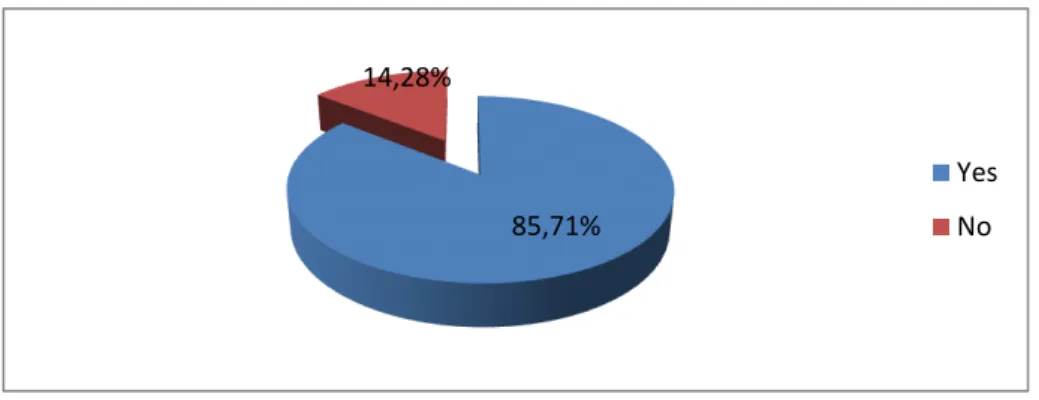
Number of students 18 3 21 Percentage 85,71 14,28 100%
22
Figure 2.1: Student’s point of view about English.
Most of students (85, 71%) opted for “yes” they like English, and (14, 28%) of them don’t like it, this makes us know that they have a positive attitude, and the majority of students are intrinsically motivated to learn English. The rest (14, 71%) don’t like the language. Which can interpreted that some students are less motivated and they have a negative attitude towards learning English.
Question two: have you chosen this field? Justify your answer.
The objective is to know the students ‘attitude towards the field.
Yes No Total
Number of students 16 5 21
Percentage 76.19 23.80 %
Table 2.2: Learners’ attitude towards the English field.
Figure 2.2: Learners’ attitude towards the English field.
The analysis therefore shows that (76, 19%) of the respondents have chosen the English field according to “Yes” answers, because, according to them, they do like that language itself, and to improve the four Skills (Speaking, Writing, Reading, and Listening)
76,19% 23,08% Yes No 85,71% 14,28% Yes No
Chapter two: Data Collection and Analysis
23
as they also want to learn it because it is an international language. (23,80%) of students haven’t chosen this field of study, according to their answers, some claimed that they have no chance to study another field, they were obliged to study it, for others just to spend time rather than doing anything else.
Question three: what is the reason(s) behind studying English at university?
It aims to know why they are studying at university and for what purpose.
The reason behind studying English at university differs from one student to another; some would like to improve their Speaking and writing skills, others for a future job especially teaching.
Some students have an aim to work with natives in different companies, and the rest aim to be interpreters.
Question four: what kind of dictionaries do you use?
To see the dictionaries they use most.
According to the answers, some students use Oxford and Longman dictionary
(monolingual), others use bilingual dictionaries either English Arabic or Arabic English or English French.
Question five: do you read books in English?
To see whether the students read English books in leisure time.
Yes No Total
Number of students 11 10 21
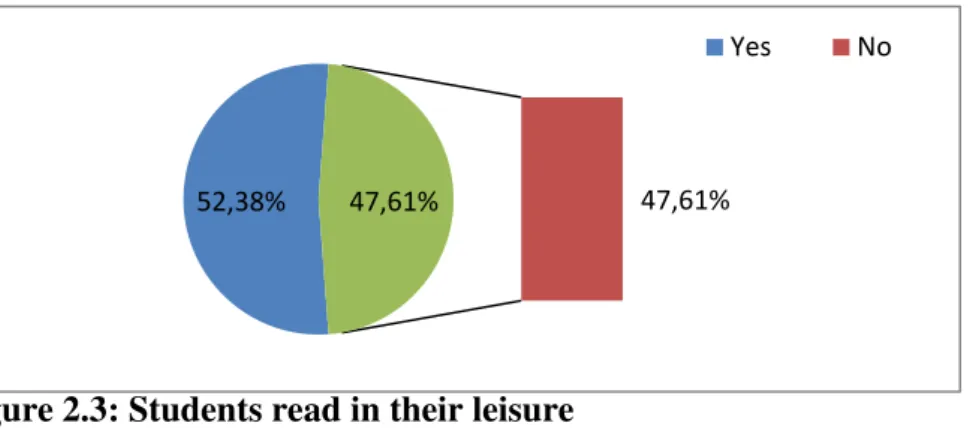
Percentage 52,38 47,61 100%
24
Figure 2.3: Students read in their leisure times.
It is noticed that the majority of learners, with a percentage (52, 28%) of the whole participants read books in English in leisure time by opting for “yes”, and the rest (47, 61%) don’t read, results show that even if the majority read books, but still have difficulties and weaknesses in grammar, vocabulary, ns spelling.
Question six: which skills do you like most to improve?
Speaking Writing
To see which skills do they want to be good at.
Writing Speaking Speaking and
writing Total Number of students 11 8 2 21 Percentage 52,38 38,09 9,52 100%
Table 2.4: The language skills that students like to improve.
Figure 2.4: The language skills that students like to improve.
Most of learners (52, 38%) wanted to improve their writing skills, whereas (38, 09%) wanted to enhance speaking skill, and (9, 52%) like to improve both speaking and writing
52,38% 47,61% 47,61% Yes No 52,38% 38,09% 9,52% Writing Speaking Speaking and writing
Chapter two: Data Collection and Analysis
25
skills, we could know that they are weak in writing and they find difficulties, as they need some training.
Question seven: what are the main difficulties you find in writing?
Grammar Vocabulary Spelling
It aims to know the difficulties they find in English writing.
grammar Vocabulary Spelling Grammar
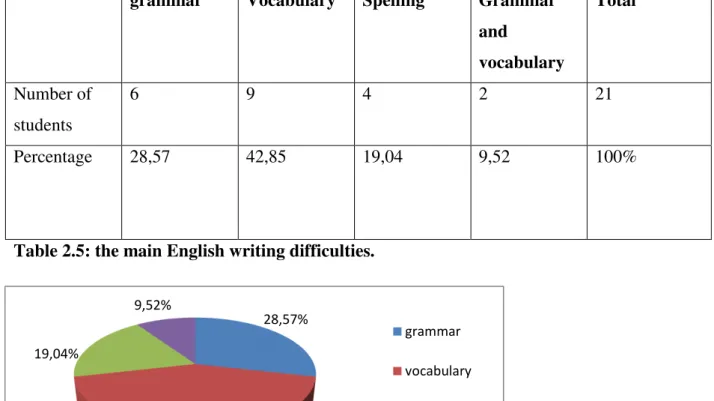
and vocabulary Total Number of students 6 9 4 2 21 Percentage 28,57 42,85 19,04 9,52 100%
Table 2.5: the main English writing difficulties.
Figure 2.5: the main English writing difficulties that students find.
The majority (42%) opted for “vocabulary”, around (28, 57%) of them find difficulties in grammar, (19, 04%) have problems in spelling, and (9, 52%) in both grammar and vocabulary. According to these data we know that the lack of reading is the main cause, since in order to have a rich vocabulary and good spelling and grammar requires much reading in English.
28,57% 42,85% 19,04% 9,52% grammar vocabulary Spelling Grammar and vocabulary
26 Question eight: if I don’t know a word in English, I try to look for one that is similar in
what language?
In order to see what is the language that students use in case they find English new words.
Question nine: I don’t like to sound as if I’m using my native language when speaking or
writing in English?
Yes No Total
Number of students 16 5 21 Percentage 76,19 23,80 100%
Table 2.6: students ‘opinion about how do they like to sound when speaking or writing in English.
Figure 2.6: students’ point of view about how do they like to sound when speaking or writing in English.
Question ten: do you translate from your mother tongue to English?
To see whether the students translate from the first language into English or no.
Always sometimes Usually Total
Number of students
2 16 3 21 Percentage 9,52 76,19 14,28 100%
Table 2.7: Students first language translation into English. 76,19%
23,80%
Yes
Chapter two: Data Collection and Analysis
27Figure 2.7: Students’ first language translation into English
(76, 19%) of the whole students have chosen “sometimes”, whereas (14, 28 %) opted
for “usually”, the rest (09, 52%) of them translate from their mother tongue into English, we could guess that the students’ mother tongue has a great effect on learning English and speaking or writing production.
Question eleven: what is your mother tongue?
The students’ mother tongue is Arabic, this is what they have answered, and we may better say that Arabic affects them negatively when writing or speaking English. Thus, they translate the ideas from Arabic into English which cause different errors.
9,52% 76,19% 14,28% Always sometimes usually
28
2.5 The Data Analysis of the Test:
/qaema bi dawr bariz wa djohd kabir/
The subjects refer to the Arabic language to translate this sentence by using word for word method, the sentences are grammatically correct but they are meaningless to some extent as in he did a good role instead of he played a prominent role and exerted a highly appreciated effort. They have translated the sentence differently. According to the first participant: He played great role and thankful efforts. According to the second one, He did a good scroll and a big effort. While for the third one, He did a good role and great efforts. /Tadahwara lmawqif bichida /
Students have chosen literal translation method to transfer this sentence from Arabic to English, each one has translated this in his own way, the situation is very bad, the situation deteriorated in a strongly way, and the situation was deteriorated sharply. I. e, according to the data collected, students didn’t take the present perfect tense into account for a simple reason that in the source language (Arabic) it doesn’t exist, and they focus only on the form and meaning of the sentence.
/ Ishtada alayha lmarad amss/
The respondents didn’t follow the English language sentence patterns (subject, verb, adverb) when translating the sentences. Instead of saying “she got seriously ill last night.” According to the data, the direct transfer is very obvious, in the sense that, in Arabic, the inversion is true, but in English we cannot say: in last night, she was very sick. We can deduce that learners find some difficulties in grammar.
/Satadfaou el thaman ghali/
The students translate the given sentence using word for word; they are grammatically correct but meaningless, so the right answer is “you will pay the darling for something” instead of “you will pay the expensive price.” The data show the way students process ideas when they write or translate English words. Error is in word choice as in “the expensive price.”
Chapter two: Data Collection and Analysis
29 /Dhahabna li nozhatin fil hadikha/
Error in the tense, students used the future tense to refer to this sentence, in fact, it happened in the past “we will go” instead of “we went”.
She looks like a flower.
The subjects have managed to translate this sentence into English, it is correct but the adjective “as beautiful as” is missing. In order to describe the beauty of the girl, we should look for a suitable adjective which gives more details about the girl unlike in Arabic. It is possible to omit the adjective and the meaning is clear from the word “flower”, no need to add another adjective.
I read all the books on the shelves.
Here the learners have managed well to translate the sentence, there are no mistakes found, because using literal translation is very helpful and both languages have some similarities in common.
He gave up his seat to the old man.
Errors in word order, the informants have followed the (Subject, Verb, Object) English sentence order, they have written /howa takhala an korsiyihi li rajol lmosin/ it is clear that the Arabic sentence pattern starts with the verb, then the subject then the object. They transferred immediately word by word without taking the source language grammar rule in account.
She was in the verge of tears.
The meaning of the sentence wasn’t kept as it is after the translation; the testees have translated it word for word without taking its meaning into consideration. Error in word choice, they say /lakad kanat ala wachk domoue/, it is logical grammatically, but the word is misused. The type of error is vocabulary.
They wanted to go to the party, but I was denied.
30
The category of error committed by the participants is "vocabulary". They say/dawni
ila lhafla lakini rafadht/ instead of / aradu edhahaba ila lhafla/
Conclusion:
In the previous chapter, we have provided a literature view about language transfer, and transfer errors in general, while in this chapter we have presented the methods of data collection, the research design, and a detailed analysis of the written errors made by students after analyzing the questionnaire and the test, we have discussed them briefly, the researcher has recognized different types of errors when students are asked to translate or transfer some utterances from both English and Arabic languages.
Chapter Three:
Suggestion and
Introduction
Research Findings
Discussion of the Findings
The Teacher’s Role
Techniques in Responding to Students ‘Writing
Self-editing
Ways of Dealing with Errors
Feedback on Written Work
Translation Activities in the Language Classroom
Preventive Measures Require
Homework
Suggested Solutions
Limitations and Suggestions for Further Studies
Chapter three: Suggestions an Recommendations
33
Introduction
After investigating the possibility of Arabic effect on writing English as a foreign
language, in this chapter we are going to discuss the research findings and the implications of this study, followed by the teacher’s role to reduce and avoid negative transfer in EFL classroom, then we will shed light on the main techniques in responding to students’ writing, then different ways of dealing with errors are helpful for teachers. Then, we will suggest some solutions for the learners to master the English writing skill. Finally, we conclude with the major hindering limitations of this investigation.
3.1
Research Findings
After giving questionnaire to the informants and testing them, we have found that students like English and they have chosen it as a field at university except few of them have not, since they had no opportunity to study another field, they find some difficulties in writing especially vocabulary and grammar even if they read English books in leisure time, so the L1 (Arabic) has an influence on EFL students because:
Students use bilingual dictionaries (Arabic, English or English Arabic). In case they find a new word in English, they try to look for it in Arabic,
sometimes in French or English.
They translate from their mother tongue into English when they write in English.
Some don’t mind if they sound as if they are using their mother tongue when they speak or write in English.
After analyzing the written product, we have noticed that negative transfer apparently occurs, and we have recognized different types of errors.
3.2 Discussion of the Findings
T
his study aims at exploring the negative transfer phenomenon from Arabic into English; it tries to answer the following questions:1) Do the Algerian learners translate from their native language into English as foreign
language writing?
2) What are the most common transfer errors made by the students?
34
The investigation evidenced that the Arabic language has an effect in way or another, we designed a questionnaire aiming to take the students’ opinion about what is the purpose behind studying English in order to know which skill or skills they need most in the future because they must have the potential to be good at writing and speaking English and even listening and reading as well. The big majority wanted to improve Writing skill that made us get to know that they are weak, so they will graduate and have to enhance their level. Our purpose from designing a test is to test the trainees, which helps us to recognize and categorize the common transfer errors from Arabic to English and the way around. They are classified in terms of grammar including the tense, the sentence pattern, vocabulary that are common among the participants.
We have deduced that most of the informants are satisfied and have different aims in the future, they also read books but they still find big troubles in writing, this according to the translated sentences in the test especially grammar and vocabulary. De Angelis (2007)
has classified the following areas of both positive and negative L2 transfer that may appear: Lexis, Phonetics, Morphology, and Syntax.
Our findings in this investigation are very crucial for EFL teachers to be aware of transfer phenomenon in their classes including both positive and negative transfer that occur, and they should be able to know the gap between the two codes (Arabic and English). Carder (1967) viewed that making errors when the learner is producing writing are not seen from negative side, but it can be valuable in the classroom for EFL teachers.
3.3
The Teacher’s Role
According to Sárosdy et, al. (2006) The teacher’s role as an assessor is to evaluate the students ‘performance what they succeed in and well performed or what they fail to perform in a very wise way in order not to embarrass them in front of the whole class, so that they must correct one during the production stage of the lesson. There is a difference between the two categories of feedback content and form that the trainers must distinguish between the two; the first one is related to assessing how well the students do the activity, this one should comes first, while the second is concerned with how well the learners use the language, this might depend on the teacher himself when it is suitable or not, because it’s not important as content feedback
.
Chapter three: Suggestions an Recommendations
35
Teacher as a motivator, according to Harmer (2001), is one among the roles in writing tasks that motivate students to create and generate new ideas, and encourage them to do so as much as possible. It needs much effort for longer process-writing sequence. In writing activities, some students find difficulties to generate ideas, whereas others find it easier, the teacher may suggest ideas for those who can’t think of anything. Providing feedback also requires a big interest, when giving correction, teacher should focus on what students need in their studies and in the task as well.
.
3.4 Techniques in Responding t
o Students ‘Writing
According to Harmer (1998), teaching writing to EFL students has several reasons among these: reinforcement, language development, learning style, and the last reason is writing as a skill.( Raimes, 1983, pp139:143) stated that responding to learners’ writing is one part of teaching, the teacher can correct and evaluate the written paper by giving a score with mentioning remarks then correcting mistakes, writing must be communicative and transforms a written task into an interaction between the writer and the reader, there are five principles that teachers consider before responding to the students’ writing:
When you pick up a students’ piece of writing, don’t immediately reach for a pan. Read the whole piece through first before you write anything. It is surprising how difficult it is for teachers to approach student writing unless they are armed with a pen.
Look for strengths as well as weaknesses, and let the student know what the strengths are.
If you use any editing symbols, make sure that the students are familiar with all of them and know what to do when they see one. Provide opportunities for the learners to use the symbols, too.
Work out your own strategy for handling errors and explain it to your students Decide if you will correct errors or simply indicate where they occur, if you will deal only with the errors you have discussed in class, with errors of a certain type, or with all errors; decide what importance you attach to grammatical errors and let your students know.
Remember that when you or any other reader responds to a student’s piece of writing, your main job is not to pass judgment on its quality (unless you are an
36
examiner and not a teacher), but to help the writer see what to do next. Ask yourself: what should the writer do now to improve his paper? What does this paper need most? , here we are speaking about compositions and paragraphs.
3.4.1 Self-editing
Students need to improve their critical thinking concerning how to express, the ability find and correct their writing mistakes of their own without relying on the teacher, the following techniques are designed by (Raimes, 1983, pp. 149:50) for students to develop the critical skills while writing production:
1) In the first draft, they should write all the ideas down on the paper, teachers would
better to encourage them that shouldn’t focus on grammar and spelling. If they don’t know how to spell a word, they can out a question mark in the margin so that they can check the spelling later. If they don’t know a word, they should feel free to write it in their first language and look for an English one later. They should know that this first draft can’t be perfect without mistakes, and any of them are acceptable. After writing ideas on the paper, they can begin to group them, and deal with sentence accuracy as they progress from draft to draft.
2) Urge students to write a draft and then and to put it away for a day or so before
looking at again. Then they read it aloud to themselves. Students report that when they do this, they often catch deviations, incomplete sentences, omitted words, misspellings, and grammatical errors. Sometimes teachers collect a composition draft and then keep it for two weeks and give it back to students unmarked. The students’ job is then to look at their own wok again and read it carefully. Through the composition are unmarked, it doesn’t mean that they are unread. From first drafts, teachers make a list of problems that their students need to work on.
3) Encourage students to check a written text for errors in spelling and grammar by
covering all the lines below the one they are reading and pointing at each word with a pencil.
4) Teach students how to use a dictionary and a grammar reference book.
5) Give students enough time to use checklists, read their work aloud, make an outline