Dissertation zur Erlangung der Doktorwürde an der Philosophischen Fakultät der Universität Freiburg (Schweiz)
Processes and Performance
in Healthcare Teams
Team Processes, Tasks and Clinical Performance in
Interdisciplinary Action Teams
Jan Schmutz, Vechigen BE
Genehmigt von der Philosophischen Fakultät auf Antrag der Professoren Tanja Manser (1. Gutachter) und Tom Reader (2. Gutachter).! Freiburg, den 17. November 2014 (Datum der Thesenverteidigung).! Dekan Prof. Dr. Marc-Henry Soulet
iii
“It is not a question of how well each process works, the question is how well they all work together.”
Danke – Merci - Graçias - Thank you to…
…Tanja; für die lehrreichen, spannenden und auch immer wieder amüsanten letzten drei Jahre, die jederzeit vorhandene Unterstützung in fachlicher sowie in sozialer Hinsicht, das immer schnelle Feedback und die guten Ratschläge
...Alexandra; für die vielen Stunden, welche sie in den letzten drei Jahren stets interessiert meinen (für einen Laien manchmal etwas weltfremden) Ideen und Erlebnissen zugehört hat und mich immer in meinem Tun bestärkt und unterstütz hat. Darüber hinaus wusste sie immer rat, wenn es darum ging meine „spannenden“ Resultate in ästhetischer und verständlicher Form darzustellen. ...Johanna; für die tolle Unterstützung in meinem Projekt vor allem in der Endphase meiner Dissertation, das extrem effektive und seriöse Aufbereiten von zahlreichen Datensätzen und Excel-Dateien, das Codieren von Videos und für die immer unterhaltsame Gesellschaft im vierten Stock
...Steven und Surabhi; für ihre Unterstützung bei der Videocodierung
...Mariel; für ihre Unterstützung beim Durchschauen von zahlreichen Literatur-listen
...Laurenz; für sein Coaching in allen statistischen und methodischen Ange-legenheiten
...Sven; für seine fachlichen wertvollen Anregungen zur Dissertation und sein Verständnis für meine Nachlässigkeit in haushaltlichen Angelegenheiten in der Endphase dieser Dissertation
...Denise; für ihre professionellen sprachlichen und fachlichen Anmerkungen zur ganzen Dissertation
...allen Koautoren; für die Zusammenarbeit und Unterstützung in allen medizinischen/praktischen Angelegenheiten
v
Table of Contents
1. Introduction and Overview ... 1
2. The Study of Small Groups in Industrial and Organizational Psychology ... 3
2.1 Definitions ... 4
2.2 Theoretical models for understanding teams based on an IPO approach ... 7
2.2.1 Other theoretical models of teams ... 11
2.3 The role of the task ... 12
2.4 Performance as team output ... 13
2.4.1 Performance measures in healthcare ... 15
3. The Present Study ... 16
3.1 Summary of thesis studies ... 17
3.1.1 Study A ... 17
3.1.2 Study B ... 19
3.1.3 Study C ... 20
3.1.4 Study D ... 21
3.2 Integrating and linking studies under an IPO view ... 22
3.2.1 Team inputs ... 23
3.2.2 Team processes ... 24
3.2.3 Team outputs ... 24
3.3 Author’s contribution to thesis articles ... 26
4. General Discussion ... 28
4.1 Limitations and outlook ... 30
4.2 Conclusion ... 32
5. Thesis Articles ... 34
5.1 Study A: Do team processes really have an effect on team performance? A systematic literature review ... 35
5.2 Study B: Five steps to develop checklists for evaluating clinical performance: An integrative approach ... 43
5.3 Study C: Coordination in healthcare action teams: Utilizing expert understanding of task and team performance requirements ... 53
5.4 Study D: Effective team coordination in emergency care: The moderating role of task type ... 86
1. Introduction and Overview
Teams are everywhere today in the world of labour, from aviation to medicine to fire service, in management and in government, and in all kinds of professional sports. A world without teamwork is unimaginable, and teams carry out much of the work of modern life (Brannick & Prince, 1997). Even in research itself evidence shows that in the last 60 years teams of authors increasingly dominate solo authors in producing knowledge of all kinds in terms of frequency and quality (Wuchty, Jones, & Uzzi, 2007). The field of industrial and organizational psychology aims to understand the individual, his behaviour, and his perceptions in the work environment (Landy & Conte, 2009). Since individuals must work in teams in nearly any organization, it is not surprising that team research has become integral to industrial and organizational psychology.
Adverse events like airplane crashes, deaths by friendly fire due to errors in military command and control, and false diagnoses in hospitals have often been attributed to poor teamwork and thus have contributed to widespread interest in researching teams (Ilgen, 1999). But the goal of this research has not been solely to investigate effects of teamwork on individuals’ wellbeing or the productivity of the team in an organization. Teams and the processes within a team are studied to prevent errors and thus to design safer environments in fields such as aviation and hospital care, among many others.
The last decade has seen an increase in literature about teams in the context of safety management in high-risk organizations. This research has centred on teams in a wide variety of industries, including aviation (Grote, Kolbe, Zala-Mezo, Bienefeld-Seall, & Kunzle, 2010), the nuclear power industry (Waller, Gupta, & Giambatista, 2004), and various healthcare sectors like surgery (Pronovost & Freischlag, 2010), anaesthesia (Burtscher, Manser, et al., 2011) and resuscitation (Fernandez Castelao, Russo, Riethmüller, & Boos, 2013), among many others.
This Ph.D. thesis contributes to this line of research by focusing explicitly on healthcare teams. This work aims to continue the existing research in this field and to contribute to a deeper understanding of
Introduction and Overview 2
team processes and the related variables (i.e. team inputs, team outputs, and the task itself).
The first part of this thesis introduces team research in industrial and organizational psychology (Chapter 2), including relevant definitions (Chapter 2.1) and models (Chapter 2.2), the role of the task (Chapter 2.3), and performance as a team output (Chapter 2.4). Chapter 3 examines the present study including an overview (Chapter 3.1) of the four scientific studies (Studies A, B, C, and D) that form the main part of this Ph.D. thesis. Chapter 3.2 links and integrates them under an Input-Process-Output (IPO) view. Chapter 4 provides a general discussion, and Chapter 5 presents the four original study articles.
Figure 1. Basic Input-Process-Output model of group processes
All four studies can be integrated into an IPO model of teams (McGrath, 1964) and will cover different aspects of this model (Figure 1). The IPO model postulates that inputs (e.g. team or task characteristics) are transformed into outputs (e.g. finished projects, healthy patients) through team processes (e.g. coordination, communication).
Study A is a systematic review of the literature and investigates the statistical relationships between processes and outputs. Study B deals with the output itself, in particular the measurement of clinical performance. Study C uses team task analysis to examine a task as well as the team process requirements a task places on the team in three different medical scenarios. Finally Study D investigates the relationship of team processes and outcomes with task type as a moderator of this relationship.
PROCESS OUTPUT
2. The Study of Small Groups in Industrial
and Organizational Psychology
Originally the study of groups was mostly the province of the field of social psychology, where researchers investigated phenomena like deindividuation in groups (Diener, Fraser, Beaman, & Kelem, 1976), conformity to majority opinion within a group (Asch, 1955), or the effect of groupthink (Janis, 1972). When Levin and Moreland (1990) later reviewed small group research, they concluded that “teams are alive, but living elsewhere” (p. 620). What they meant was that research about small groups had begun to decline in the field of social psychology but was increasing in journals devoted to industrial and organizational psychology.
An early example of the study of groups within this latter field was the Hawthorne studies (Roethlisberger & Dickson, 1939), which first drew attention to the role of work groups in an organizational context and to their potential to influence productivity and attitudes of individual workers. Initially the Hawthorne studies were simple, but they grew more complex as the research began to target unanticipated social influences on the work groups and the individual (Guzzo & Shea, 1992). Social psychology usually considered groups independently from their context. In contrast, industrial and organizational psychology uses a more holistic approach that focuses on individuals, teams, and context and argues that groups always interact with their environments and that the context of a group cannot be ignored. Especially in work groups, it cannot be assumed that the same processes are present in different work environments or types of organizations. A project team developing new software, for example, is confronted with different challenges than a team of paramedics resuscitating a patient.
Guzzo and Shea (1992) use the metaphor of a cloud to illustrate the dynamics within a group as well as how it interacts with its environment. This idea is based on a discussion about social systems by Karl Popper (1972), who distinguishes between systems that function like clockwork and systems that function
The Study of Small Groups 4
like clouds. Unlike clockwork, which is regular and rigid, clouds change form and size and are strongly affected by environmental conditions. It is almost impossible to predict precisely the movements of the molecules in a cloud. Guzzo and Shea (1992) argue that work groups are similar to clouds: although they have some regularity, like clouds they are disorderly and highly responsive to environmental influences. Thus, knowledge of one individual does not give us an understanding of the entire group, and the behaviour of one group member only tenuously predicts the behaviour of others. Furthermore, the behaviour of a group is not regular and predictable like clockwork; rather, variation is the norm. This variation is mostly caused by the work environment of groups (Guzzo & Shea, 1992).
This image of work groups as clouds illustrates the complexity and dynamic nature of the group and makes clear that group research in industrial and organizational psychology is challenging. This complexity results not only from dynamics within the team (e.g. group members’ interaction and attitudes) but also from contextual dynamics (e.g. the adaptation of the group to embedding contexts, according to Arrow, McGrath, & Berdahl, 2000). To master these challenges and understand group performance in organizations, clear definitions of the constructs (in this case, groups, small groups, and teams) as well as well-founded theoretical models of teams are necessary.
2.1 Definitions
The use of the terms group, small group, and teams is sometimes vague and overlapping (McGrath, 1984). This section provides important definitions of the terms used throughout the thesis.
Group and small group. In the literature the use of the word group is sometimes vague, and different definitions exist. In industrial and organizational psychology the terms group and small group are often used as synonyms (Arrow et al., 2000; McGrath, 1984). Some confusion arises when the terms are used synonymously, since a group can be seen as a broader term than a small group (as the word “small” already implies). Groups but not small groups can include large sets of people who belong to a social category (e.g. lower-class citizens) or people in physical proximity to each other or with a common destiny who do not necessarily interact with each other (e.g. students in the same classroom, people riding a bus). Since these large sets of persons
are usually the subjects of social psychology or sociology and not the subject of industrial and organizational psychology, the term small group might be more accurate in an industrial and organizational psychology context (Arrow et al., 2000).
Shaw (1971) defines small groups as “two or more persons who are inter-acting with one another in such a manner that each person influences and is influenced by each other” (p. 8). Hackman (1987) provides a definition of a small group, defining it as an entity that is perceived by its members and by non-members as a group; furthermore, its members have interdependencies but also a differentiation of roles and duties within the group. Arrow et al. (2000), based on the work of McGrath (1984), provide a more comprehensive definition. They define a small group as a system with loosely coupled individuals mutually interacting, interdependent members, projects, and technology with a shared collective identity. Small groups have psychological and temporal boundaries, and the members of the group are aware of the group as an entity and of their membership in it. Furthermore, members’ behaviour is linked with shared consequences for the whole group (Arrow et al., 2000).
Arrow et al. (2000) as well as other researchers (Ilgen, Hollenbeck, Johnson, & Jundt, 2005) treat small groups in the work setting as complex, dynamic, and adaptive systems. Complexity theorists describe system complexity as a system with many interconnected parts and a complicated structure (Gell-Mann, 1995). As mentioned above, small groups are interdependent and have a differen-tiation of roles and duties. The more distinct the group members, their roles, and their actions are, the more complex the group is. A typical example for a complex system is a project team consisting of members of different organizations coming together for one specific project. Members have different educational backgrounds and roles (e.g. project manager, IT specialist, personnel manager), and their actions are highly linked with each other (e.g. the personnel manager telling the IT specialist what functions a specific software program needs). Small groups are considered dynamic, because they do not remain the same over time. Processes within the group change due to members’ permanent adaptation to the embedded environment (Burke, Stagl, Salas, Pierce, & Kendall, 2006) or just because of automation of processes over time. Furthermore, the composition of a small group is dynamic because members who
The Study of Small Groups 6
have a specific role or roles can be replaced by one or more other members who can play the same role or roles and who join the group once project implementation is underway (McGrath, Arrow, & Berdahl, 2000).
Teams. Authors use the term team for a group in a work context (e.g. project teams, surgical teams, police teams) whereas small groups include also teams in a non-working context. Salas, Rosen, and King (2007) define teams as identifiable work units consisting of two or more people with several character-istics including dynamic social interactions, with meaningful interdependencies, valued and shared goals, a particular lifespan, distributed expertise, and clearly assigned roles and responsibilities. One important attribute of this definition of teams is members’ distinct functions, whereas in a group, members could be interchangeable and all have the same function, such as a group whose task is to solve anagrams (Brannick & Prince, 1997). However, some teams may divvy up tasks and replace specific positions. For example, the person in an aircrew who talks to air traffic control may change during the flight; however, only one person at a time is responsible for the radio.
One specific type of team is the interdisciplinary action team (IAT). In an IAT, members with different backgrounds, skills, and roles have to coordinate their actions in intense and unpredictable situations (Edmondson, 2003; Sundstrom, De Meuse, & Futrell, 1990). By definition IATs must respond to unexpected incidents in a coordinated way, often requiring an open transfer of information to make real-time coordination of actions possible. IATs typically work in high-risk environments like aviation, healthcare, or the power industry. They are formed ad hoc and work together for a specific task (e.g. a surgical operation), and then the team dissolves once a job has been completed. The present thesis investigates typical IATs in different healthcare settings like cardiac anaesthesia, live trauma resuscitation (as shown in Study C), and paediatric emergency (as shown in Studies B, C, and D).
2.2 Theoretical models for understanding teams based on an IPO approach
This chapter aims to present theoretical models for understanding teams and the processes occurring within a team.1 There have been a variety of schools of thought on teams and groups.2 This chapter focuses on theories based on the IPO (Input-Process-Output) model that has dominated team research and theory to the present day (McGrath, 1964). The IPO model was also the underlying framework for all four studies in this thesis. Furthermore, this chapter explains two specific variables that are part of the IPO model in more detail, because they play an important role in the following studies: clinical performance as an output (Study B) and the role of the task (Study C and D).
Input typically refers to the things team members bring to the group, including status, personality attributes, level of experience, demographic attrib-utes, and others. These inputs are often referred to as team characteristics. Other inputs are the characteristics of the task, like the type of task (e.g. routine vs. non-routine) or the resources a specific task brings with it (Guzzo & Shea, 1992). The process refers to the interactions among team members that transform inputs into outputs (e.g. exchange of information, distribution of tasks). Output then refers to the product resulting from the team’s work. This product can include ideas, decisions, a finished project, or the successful treatment of a patient. The IPO model in this basic formulation is explicitly causal and rather static. Output is a consequence of the nature of team processes, which themselves result from inputs brought into the team setting (Guzzo & Shea, 1992).
Although this static IPO model governed much early research in the field, researchers have developed alternative models that consider team processes as more dynamic systems. Hackman (1987) formulated two alternative models. He states that processes do not mediate all input variables, although there is a direct line from inputs to outputs. For example, the work experience of one team member could lead directly to a good output without mediation by team processes. Hackman (1987) further proposes a
1 The terms model and framework are used interchangeably throughout this thesis. The same terms as in the corresponding reference will be used. 2
For a comprehensive review, see Guzzo and Shea (1992) and Arrow et al. (2000).
The Study of Small Groups 8
model that deviates even more from the basic IPO formulation whereby inputs influence both processes and outputs; in this case, team processes are not integral to explaining team outputs. But today such a model would not pass muster, since numerous studies have scientifically proved a relationship between team processes and team outputs (DeChurch & Mesmer-Magnus, 2010; Schmutz & Manser, 2013).
Kozlowski, Gully, Nason, and Smith (1999) propose the theory of compilation and performance, in which time becomes an important factor: input, process, and output develop over time as the team as a whole interacts with its environment and with the team members themselves. Knowledge, attitudes, and behaviours in a developmental stage are both inputs and processes that impact team performance (output). The whole process is not one but several reciprocal cycles where the output influences the input of a subsequent cycle. Processes are not static, but rather unfold over time.
Marks, Mathieu, and Zaccaro (2001) extend the classical IPO model and provide a more detailed framework for team processes. They define team processes as members’ interdependent acts that convert input to output through cognitive, verbal, and behavioural activities directed toward organizing taskwork to achieve collective goals. Taskwork in this case is defined as the teams’ interaction with tasks, tools, machines, and systems. Thus team processes are used to direct, monitor, and align taskwork to achieve a meaningful outcome. The central point of this conception of team processes is the interaction of team members with each other and with the task environment. The authors state that some research investigating IPO relationships has considered constructs like collective efficacy, potency, cohesion, and situational awareness as team processes. They argue, however, that these constructs do not represent actual interaction processes in the team but rather describe qualities of a team that reflect members’ attitudes. Marks et al. (2001) defined these types of variables as “emergent states” that need to be distinguished from actual team processes in the IPO model. The authors’ understanding of a more dynamic view of team processes aligns with Kozlowski et al. (1999).
Researchers traditionally adopted a static view of the IPO model and investigated IPO relationships within one task, without considering temporal influences. Time is always a component in
processes involving work teams when striving toward a common goal (Locke & Latham, 1990). Through successfully reaching a goal, a team gains experience or develops new routine actions over time that function as inputs in future tasks. Based on these thoughts Marks et al. (2001) propose that the basic formulation of the IPO model is inadequate to represent the entire life cycle of a team project. Instead a team passes through several episodes where IPO cycles run sequentially and simultaneously and where the output serves as input for the next cycles. In addition, the authors define two types of episodes where IPO cycles run: an action phase during which teams engage in acts that contribute to accomplishing a goal and a transition phase during which teams primarily focus on evaluating and/or planning activities. Depending on the episode, a team performs different kinds of team process behaviour.
Ilgen et al. (2005) see three types of limitations in the basic IPO model. First, interactions have been documented between inputs and processes as well as between different processes. Such interactions contradict the linear view of the basic IPO model. Second, like others before them (Kozlowski et al., 1999; Marks et al., 2001), they criticise the single-cycle path of the model. Although the authors of the classical work mention the possibility of different feedback loops within the model (Hackman, 1987), it should be seen more as a multi-cycle model where outputs like team performance are treated as inputs for future team processes. Third, the term “team processes” itself limits research, because constructs often described in the literature are emergent cognitive or affective states that lack the character of a process, as Marks et al. (2001) previously criticised.
As an alternative to the classical IPO model, Ilgen et al. (2005) suggest instead the Input-Mediator-Output-Input (IMOI) model. Replacing process with mediator reflects a broader range of variables that can mediate the relationship between inputs and outputs (including emergent states). The extra “I” (for input) at the end invokes the notion of cycling causal feedback in terms of outputs that will serve as inputs for a future team process. Furthermore, the authors explicitly reject using hyphens between the letters (IMOI) as some authors have done when identifying the IPO model (as I-P-O). Their refusal to use hyphens signifies that the linkage between the variables may not be linear.
The Study of Small Groups 10
Burke et al. (2006) present another alternative, the Input-Throughput-Output model, which is based on an IPO model but focuses on the dynamic abilities of a team to adapt to its environment. The aim of the model is to explain adaptive team performance as the dependent variable of interest. The authors define adaptive team performance as an emergent phenomenon that develops over time as a result of recursive cycles whereby one or more team members use their resources to functionally change current cognitive or behavioural goal-directed actions or structures to meet expected or unexpected demands. The model describes individual characteristics (i.e. knowledge, attitudes, traits, and abilities) and job design characteristics as inputs. The throughput phase is an adaptive cycle in which the team assesses the situation, formulates a plan, executes the plan, and then learns from the process. In addition, the throughput phase includes emergent states (i.e. shared mental models, situational awareness, and psychological safety) that influence the adaptive cycle as proximal outcomes as well as inputs for the next cycle. This condition explains the replacement of the term process with the term throughput in this model, because the throughput phase also includes emergent states that do not show characteristics of a process per se, as Ilgen et al. (2005) and Marks et al. (2001) already stated before. The ultimate result of the interaction of the adaptive cycle and emergent states in the throughput phase is team adaptation. Team adaptation in turn is linked through feedback loops with inputs again, which is in line with previous theories that see the IPO model as a dynamic multi-cycle framework where outputs of the previous cycle influence the inputs in a subsequent cycle (Ilgen et al., 2005; Marks et al., 2001).
As outlined above there is a trend toward more complex theoretical models for understanding and representing teams and their processes. Although these models differ in specific aspects, they reflect the underlying notion that teams are complex, dynamic systems, existing in larger systemic contexts of tasks, people, technologies, and settings (Ilgen et al., 2005). This notion is in line with other theoretical models not based on the IPO model.
2.2.1 Other theoretical models of teams
Arrow et al. (2000) present a general theory of small groups (including teams) as complex, adaptive, dynamic systems. They present a theory based on concepts borrowed from several other fields like systems theory, dynamical systems theory, complexity and chaos theory. The authors state that throughout a group’s life three levels of causal dynamics—local, global, and contextual— constantly form the group.
Local dynamics refer to the activity of a group’s constituent local variables. That involves the activity of the system parts and the rules that govern these activities. These rules include implicit norms or procedures (e.g. stereotypes, intentions) or more explicit norms like the distribution of different tasks according to the team members’ background. The central concept of local dynamics is coordination (i.e. coordination of actions, coordination of understanding, and coordination of goals). In the first type, actions are coordinated among team members so that all actions fit together into an intended spatial and temporal pattern. Coordination of understanding, the second type, means achieving an agreement among group members regarding more cognitive processes. That means coordinating information about the process, norms, and division of labour to achieve the goal. The third type of coordination, coordination of goals, includes the mutual adjustment of individual purposes, interests, and intentions among group members.
Global dynamics are rules and activities on a systemic level emerging out of local dynamics. The term describes the state of a group as a whole. The literature often refers to global dynamics as group development investigating variables like group performance, cohesiveness, or conformity.
Last, contextual dynamics are described as the features of groups that embed context that shapes and constrains global and local dynamics. A small group has to adapt to a variety of contextual influences like adding or removing new projects within a team, changing its composition, or allocating resources to different teams in an organization. A team is constantly interacting with its environment and thus has to adapt to it if necessary (e.g. a surgical team has to adapt the team organisation to the size and arrangement of the operating room).
The Study of Small Groups 12 2.3 The role of the task
The task itself is a central variable in team research and appears in the literature based on an IPO approach in either of two ways (Guzzo & Shea, 1992). First, as already stated, task characteristics can be interpreted as inputs that determine the team processes necessary to master a specific task. Second, a task can be interpreted as a moderator of the relationship between process and output. Depending on the nature of the task, specific team processes may be effective and lead to good outcomes or not. Statistical models with task as a moderator between team process variable and an output variable already have been tested (DeChurch & Mesmer-Magnus, 2010; Schmutz, Hoffmann, Heimberg, & Manser, under review).
Teams that are dynamic, adaptive systems not only have to adapt the team processes to contextual influences or cues (Arrow et al., 2000; Burke et al., 2006) but also to the task itself. A task involving resuscitating a patient demands different processes from a team than a routine check of a patient does. In this context authors talk about task adaptive behaviour (Tschan, Semmer, Nägele, & Gurtner, 2000). Thus it is important to identify the team process requirements that a specific task demands from a team (Parker, Schmutz, & Manser, under review).
Various taxonomies of team tasks exist in the literature (McGrath, 1984; Steiner, 1972). For example, Steiner (1972) proposes the following sets of distinctions. He distinguishes between unitary tasks that require no single group output and divisible tasks that do require one. Additive tasks require that the groups’ resources get pooled together, whereas disjunctive tasks require that only one member does the task for the group. In conjunctive tasks all group members must individually succeed, and in discretionary tasks resources can be combined in any way to reach the common goal.
Because tasks in organizations are much more complex than Steiner’s task categories imply, they have seen no use in organizational settings (Guzzo & Shea, 1992). They may be useful in a standardised laboratory setting but of little help in theoretical research in the field. These taxonomies fail to describe the work that teams in real-life organizations do. Taxonomy of tasks must be able to create categories of similar tasks but still reflect the specific characteristics of each task. Teams in different organizations have to deal with very different tasks. Due to the
different nature of tasks, it might be difficult to develop a task taxonomy that can be used for project teams as well as surgical teams. Thus taxonomies should be developed that are domain-specific. This is only possible if the researcher thoroughly understands the investigated task through team task analysis (Annett, 2003; Parker et al., under review). Such an analysis enables the understanding of the task and the similarities as well as the differences among tasks so as to help develop suitable and reasonable task taxonomies.
2.4 Performance as team output
Measuring the performance of a team is important for research testing the process-output relationship as well as to evaluate teamwork training. Team training literature often focuses on the quality of specific team process behaviours like backup behaviour, communication, or team monitoring (Dickinson & McIntyre, 1997). This approach is appropriate if it is well known what process behaviours are effective in a given situation. To identify what team processes are effective in what situations, each process first has to be linked with a performance outcome. To do this, team processes (e.g. giving feedback, distributing tasks) should be assessed objectively without any evaluation and linked to objective performance measures that identify good performance in a specific team task. But what is good performance, and how can it be assessed?
Job performance is a core concept in industrial and organizational psychology (Campbell, 1990; Nerdinger, Blickle, & Schaper, 2011; Viswesvaran, 2001). The importance of this construct is reflected in the large volume of literature concerning job performance and particularly job performance assessment. Job performance data can be used for administrative purposes including salary administration, promotions, or layoffs. It can also be used as a basis for feedback by identifying individual strengths and weaknesses and also for research purposes that include evaluation of interventions or validation of a new selection technique (Cascio, 1987).
The literature defines job performance in various ways. Because there are no universal measures of performance for all jobs, performance in a given job is measured in the context and is closely it related to a company’s goals (Campbell, 1990). For example, the medical staff of a hospital will behave differently if
The Study of Small Groups 14
management communicates a goal, such as to reduce treatment costs or to increase patient satisfaction. Campbell (1990) defines performance as follows: “Performance is behavior. It is something that people do and is reflected in the actions that people take” (p. 704). This definition, which focuses on action, can be seen as a behaviour-centred view of performance. On the other hand authors agree that performance also has outcome-related aspects (Anderson, Ones, Sinangil, & Viswesvaran, 2001; Nerdinger et al., 2011; Sonnentag & Frese, 2002). The outcome-related aspect refers to the results of one’s behaviour. In our example, an outcome-related aspect could be the treatment costs or the percentage of satisfied patients after one year during which the medical staff members have modified their behaviour.
This distinction is important for performance assessment: one can rate the behaviour of a team and/or the outcome of this behaviour. The rating of performance behaviour can be achieved through observation by experts in the field. An expert knows the critical behaviours for high performance in his area (Nerdinger et al., 2011). Furthermore, specific rating systems or checklists that include what critical behaviour is expected to be performed can be useful in-struments to assess the behaviours related to performance of an employee or a team (Donoghue et al., 2011; DuPaul, Rapport, & Perriello, 1991).
Performance outcomes depend highly on organizational context and can be very specific. Examples for performance outcomes could be number of sales, number of publications, turnover of employees, number of successful heart operations by a surgical team, or reduced patient mortality in a hospital. The problem of outcome-related aspects is that they are hard to attribute conclusively to changes in team members’ behaviour (Campbell, 1990; Ner-dinger et al., 2011; Sonnentag & Frese, 2002). Outcome performance measures are related to the result of the actions and depend on more than just individuals’ behaviour. Of course, a relationship exists between the behaviour and the outcome, but these two metrics never overlap completely. Nerdinger et al. (2011) refer to this as the “attribution problem” and states that performance should be measured exclusively by the behaviour criteria and not by the outcome, because confounders influence the outcome.
For example, a sales consultant could accomplish a consultation with a potential customer perfectly, but if the customer has no
money or gets a better offer from another company, he will never buy the product. In another example, the survival of a resuscitated patient is better predicted by factors such as the duration of the patient’s cardiac arrest, the type of heart arrhythmia, and the patient’s age than by the performance of the clinical team performing the resuscitation (Cooper & Cade, 1997).
Thus in these cases it would be more accurate to measure the actions and not the outcome. Of course, good process performance should be and is related with outcome performance. But in field research it is often impossible to control for all the confounding variables, and thus it might be difficult to interpret a negative outcome because it is unclear if it resulted from the incorrect behaviour of the team or from confounding variables.
2.4.1 Performance measures in healthcare
In healthcare literature many different performance measures are used. Typical examples are mortality, morbidity (Davenport, Henderson, Mosca, Khuri, & Mentzer Jr, 2007), length of hospital stay (McCulloch et al., 2009), task execution time (Catchpole et al., 2007), or ratings of specific behaviours according to medical guidelines (Burtscher, Kolbe, Wacker, & Manser, 2011). Especially in healthcare, it is hard to attribute specific outcomes to the behaviour of an individual or a team. The success of patient treatment relies on many aspects, and it is hard to control all potential factors.
Due to this fact it is common in healthcare to assess the behaviour aspect of performance with tools like checklists based on medical guidelines (Donoghue, Nishisakia, Suttona, Halesc, & Boulet, 2010), global rating instruments, time-to-event assessments, or achievement of key steps/goals (Holmboe & Hawkins, 2008). Performance based on behaviour aspects can be assessed in almost every setting. During a medical simulation, where it is hardly possible to assess patient-related outcomes, behaviour performance measures are preferable.3
3
In medical simulations an actor or a mannequin that does not show actual symptoms replaces the patient.
The Present Study 16
3. The Present Study
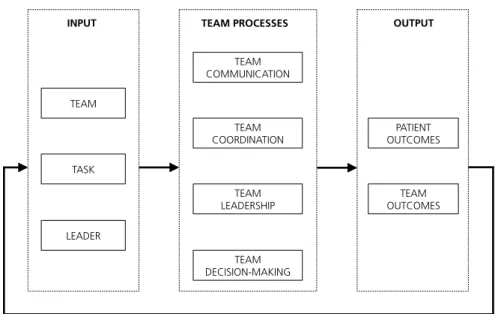
The aim of this thesis is to build on existing research on teams in healthcare and to contribute to a deeper understanding of team processes and the related variables, especially clinical performance and the team task. The four studies included in this thesis investigate various aspects of the IPO model of teams. This model has already been the basis for studies in healthcare. Based on a IPO model Reader, Flin, Mearns, and Cuthbertson (2009) provide the team performance framework for the intensive care unit (ICU; Figure 2). The authors specify inputs as team characteristics (e.g. team climate, team hierarchies), task characteristics (e.g. time pressure, protocols for completion of tasks), and leader characteristics (e.g. leadership style, personality). They specify four team processes as team communication, team leadership, team coordination, and team decision-making that lead to two types of outputs: patient outcomes and team outcomes. Team outcomes include all outcomes concerning the team or team members as a result of the team process (e.g. stress, job satisfaction). Patient outcomes include the results of the team processes concerning the patient (the result of the treatment by the team). As in other IPO theories presented earlier, a feedback loop links the output with inputs, implying a multi-cycle understanding of the framework.
Figure 2. Team performance framework (Reader et al. 2009). This framework, although developed for an ICU environment, can be used for other healthcare environments where teams are treating a patient (e.g. surgery, paediatrics). Thus this IPO framework serves as the basic theoretical model for this thesis, which investigates multiple variables and relationships concerning it.
3.1 Summary of thesis studies 3.1.1 Study A
Do team processes really have an effect on clinical Performance? A systematic literature review
Jan Schmutz and Tanja Manser (2013)
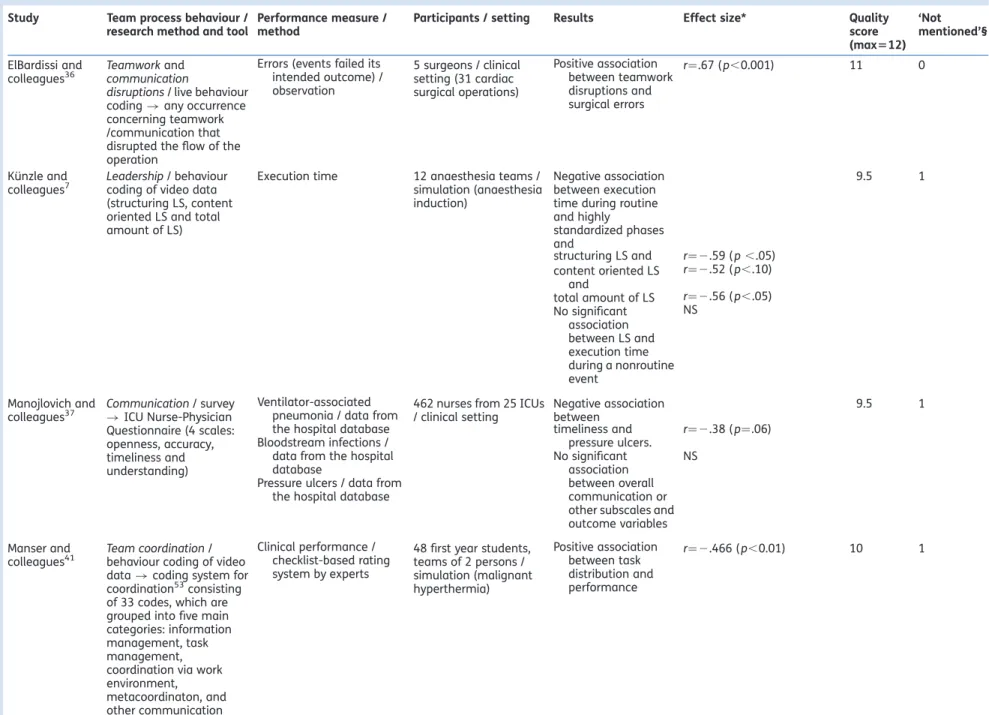
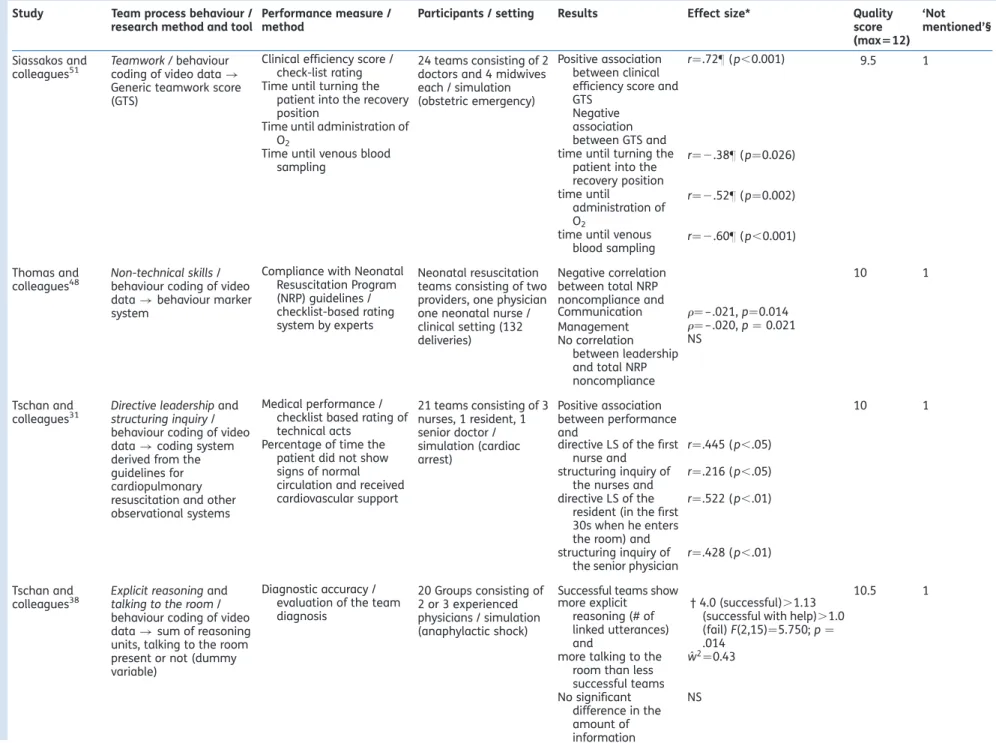
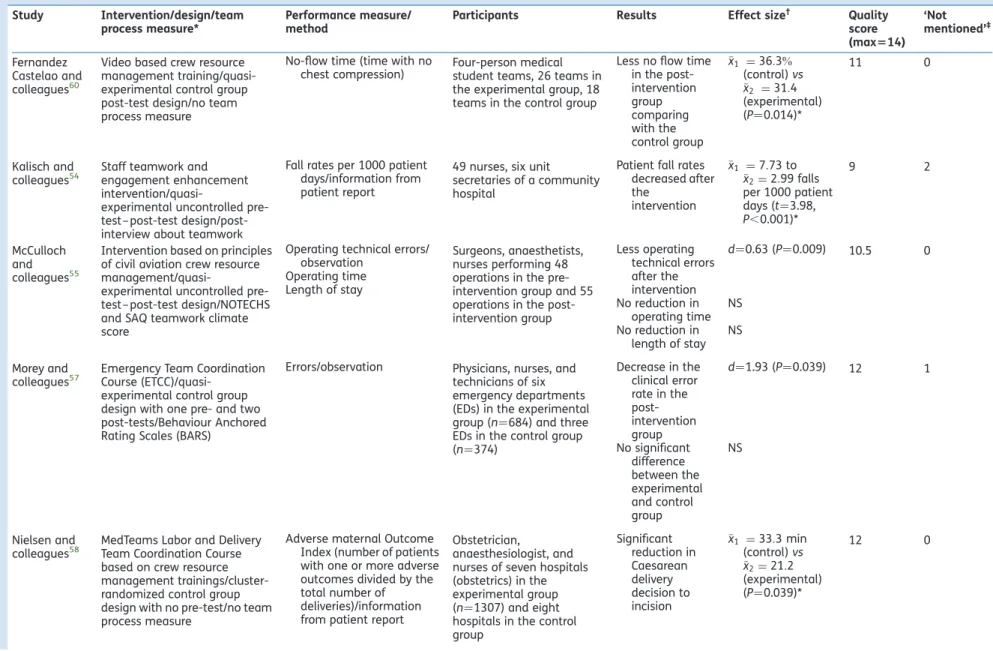
The first study is a systematic literature review summarizing articles that examined the impact of team process behaviour on clinical performance in healthcare teams. There has been other literature reviews indicating that team processes play an important role in medical teams (Manser, 2009; Reader et al., 2009). To date this is the only literature review that focuses solely on statistical relationships between the two variables in a variety of healthcare teams.
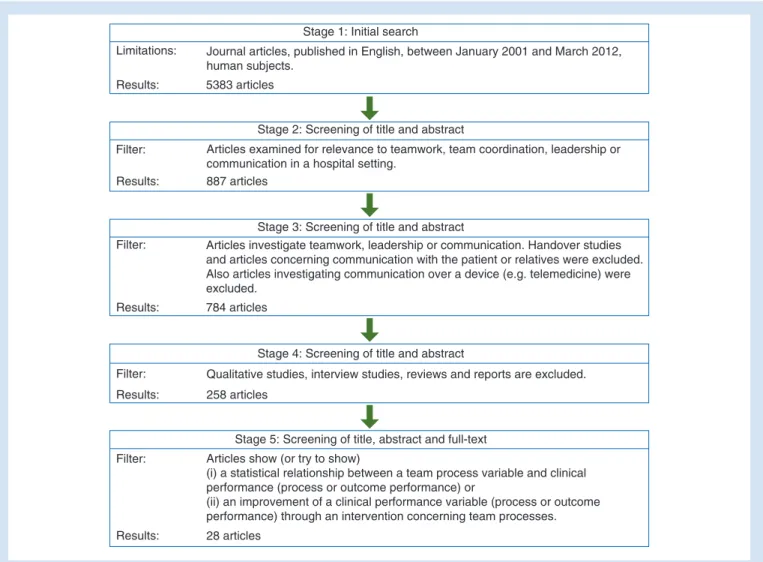
A literature search in five major databases was conducted. Inclusion criteria were: Peer-reviewed papers in English published
TEAM TASK LEADER INPUT TEAM COORDINATION TEAM LEADERSHIP TEAM DECISION-MAKING TEAM COMMUNICATION TEAM PROCESSES PATIENT OUTCOMES TEAM OUTCOMES OUTPUT
The Present Study 18
between January 2001 and March 2012, which showed or tried to show a) a statistical relationship of a team process variable and clinical performance or b) an improvement of a performance variable through a team process intervention. Study quality was assessed using predefined quality indicators. For every study we calculated the relevant effect sizes. Team processes included in the study were defined according to Reader et al.’s framework (Reader et al., 2009).
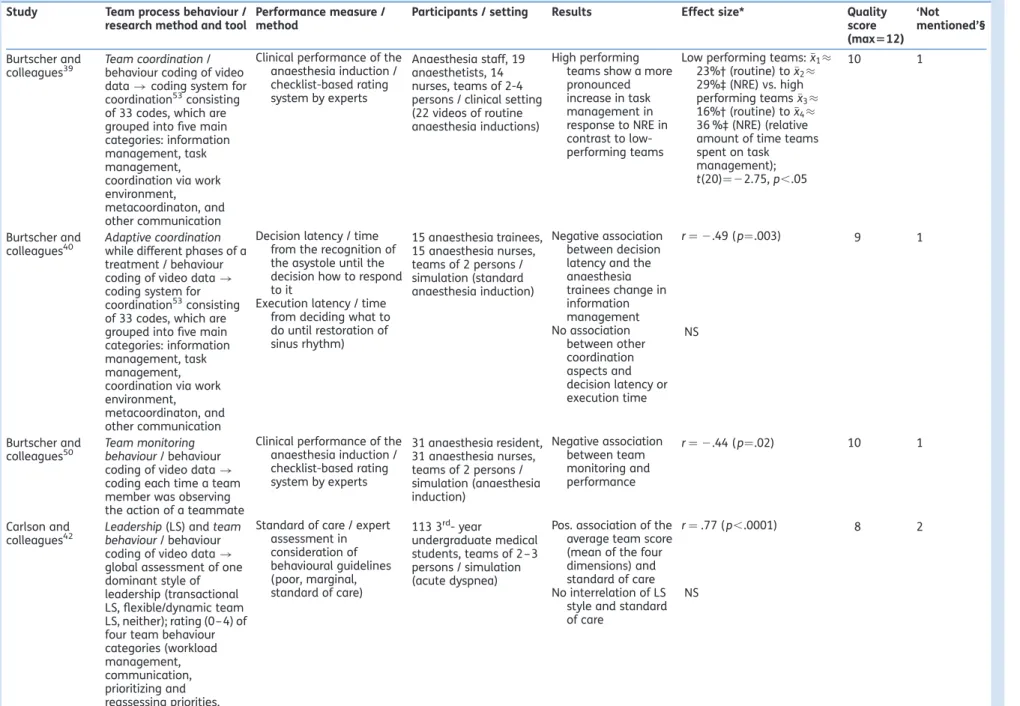
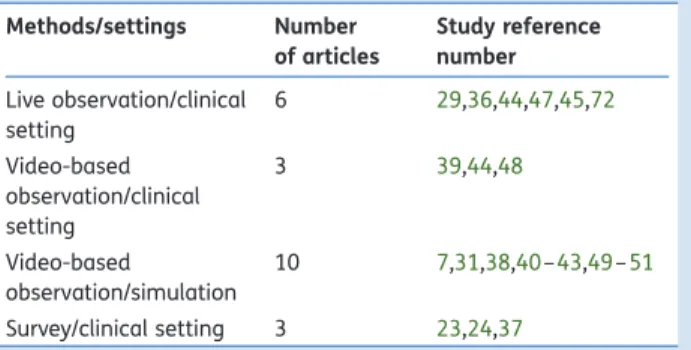
Twenty-six studies were included in the review, six of which were intervention studies. Every study reported at least one significant relationship between team processes or between an intervention and performance. Some nonsignificant effects were reported. Most of the reported effect sizes were medium or large. The study quality ranged from medium to high. The studies were highly diverse regarding both the specific team process behaviours investigated and the methods used. However, they suggest that team process behaviours do influence clinical performance and that training results in increased performance. Future research should rely on valid and reliable methods to assess processes such as teamwork or coordination and focus on developing adequate tools to assess process performance in the clinical setting, linking them with high-quality outcomes.
3.1.2 Study B
Five steps to develop checklists for evaluating clinical performance: An integrative approach
Jan Schmutz, Walter J. Eppich, Florian Hoffmann, Ellen Heimberg, and Tanja Manser (2014)
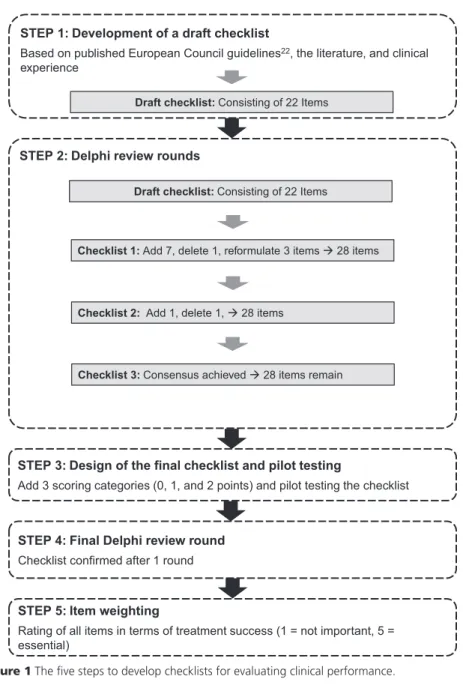
Study A outlines the high diversity in team processes and investigated outcomes. Based on the premise that valid team process measures are as important as valid outcome measures. Study B focuses on clinical performance assessment and more particularly on the process of developing checklists for evaluating clinical scenarios. The process of developing checklists to rate clinical performance is essential to ensure their quality, thus an integrative approach for designing checklists that evaluate clinical performance has been developed.
The approach consists of five predefined steps. Step 1: Based on the relevant literature and their clinical experience, the authors drafted a preliminary checklist. Step 2: The authors sent the draft checklist to five experts who reviewed it using an adapted Delphi technique (Gordon, 1994). Step 3: Three scoring categories were devised for items following pilot testing. Step 4: To ensure that the changes made after pilot testing were valid, the checklist was submitted to an additional round of Delphi reviews. Step 5: To weight items needed for accurate performance assessment, ten paediatricians rated all checklist items in terms of their importance on a scale from 1 (not important) to 5 (essential).
Study B used the example of a checklist for a simulation scenario of septic shock in an infant. Inter-rater reliability and validity were calculated. The five-step approach resulted in a valid, reliable tool and proved to be an effective method to design evaluation checklists.
This approach integrates published evidence and the knowledge of domain experts. A robust development process is a necessary prerequisite of valid performance checklists. Establishing a widely recognised standard for developing evaluation checklists will likely support the design of appropriate measurement tools. This approach provides a method to design a tool to rate the clinical performance of a team. This approach further formed the basis for a valid and reliable team performance assessment in Study D.
The Present Study 20 3.1.3 Study C
Coordination in healthcare action teams: Utilizing expert understanding of task and team performance requirements Sarah Henrickson Parker, Jan Schmutz, and Tanja Manser (under review)
Study C focuses on team coordination as a team process and on the task itself, where coordination is needed. Expert action teams in healthcare are often confronted with situations that are dynamic, require real-time reactions, and must be continually assessed and reassessed. These situations require coordination among team members to achieve task goals. Thus the goal of this study is to identify specific coordination requirements for three clinical contexts: 1) clinical work in cardiac anaesthesia, 2) medical emergency with a clear treatment protocol in paediatrics (i.e. sepsis scenario), and 3) live trauma resuscitations.
Each part of Study C used task analysis to define the team tasks and to then elicit expert knowledge on coordination requirements. Comparing and collating the findings across these diverse clinical settings, the study revealed that expert teams must 1) continually reassess their current state and goals using multiple, sometimes overlapping work templates, 2) coordination requirements must be made explicit at certain points in a clinical task, though not every clinical task requires “anchors,” and 3) the occurrence of a non-routine situation requires explicit coordination.
To date, research on healthcare action teams has focused on detailing the exact nature of coordination. This study takes the next step in understanding coordination by synthesising the results of coordination studies in three different healthcare action team environments. Defining critical coordination requirements without an understanding of the exact nature of the task is of limited utility. Rather, coordination requirements are highly situation-dependent in action teams. Therefore, further refined analytic approaches that combine temporal variability and task variability with coordination assessment are necessary.
3.1.4 Study D
Effective Team Coordination in Emergency Care: The Moderating Role of Task Type
Jan Schmutz, Florian Hoffmann, Ellen Heimberg, and Tanja Manser (2014)
Study D, the fourth study, focuses on the relationship between team process behaviour and clinical performance, with task type as a moderator. Like Study C, this article focuses on team coordination as a predictor for clinical team performance. Study A has shown that authors investigating coordination report different and sometimes even contradictory results. One reason for these diverse results might be the task in which coordination is investigated. Study C already stated that coordination is task dependent, and different tasks place different coordination demands on the team. Studies by other researchers have also suggested that teams have to adapt the coordination process to the task (Tschan, Semmer, Hunziker, & Marsch, 2011), but until now no consensus exists about what coordination behaviours are effective in what tasks.
Three coordination behaviours (i.e. task distribution, acknowledgement, and provide information without request [PIWR]) were investigated in 68 interprofessional teams of fully qualified clinicians during simulation-based in-situ paediatric emergency training. Based on task analyses the four training scenarios were grouped into rule-based (i.e. focused on task execution and mostly based on predefined algorithms) and knowledge-based tasks (i.e. focused on gathering and integrating information to establish diagnosis) according to Rasmussen’s model for human performance (Rasmussen, 1983). Hierarchical regression analysis was used to investigate the relationship of task distribution, acknowledgement, and PIWR to clinical performance, with task type as a moderator.
Task distribution is related with clinical performance (β = .24, p = .04) but no moderation of task type (β = -.06, p = .74), and acknowledgment is moderated by task type (β = -.49, p = .02). Additional simple slope analysis revealed that acknowledgement is related with clinical performance only in rule-based tasks (B =
The Present Study 22
2.09, SD = .59, p < .01). PIWR was not related with clinical performance (β = -.08, p = .41), nor was this relationship moderated by task type (β = -.10, p = .59).
Explicitly distributing tasks seems to be important in different kinds of emergency tasks, because it ensures that all treatment actions are performed. Acknowledgement closes the communication loop, giving feedback to the sender that information or orders have been understood. This is especially important in rule-based tasks, in which the focus is on the distributed tasks that can be acknowledged, thus resulting in more effective coordination. These results are in line with similar concepts commonly taught during medical communication training (Härgestam, Lindkvist, Brulin, Jacobsson, & Hultin, 2013). PIWR should be investigated with an emphasis on the broader context of the task and its goals. We propose that PIWR can be effective under some circumstances but also can be distracting, depending on the personnel makeup of the team. Overall the results suggest that task distribution and acknowledgement are important coordination behaviours that are related with clinical performance and thus may contribute to patient safety. Furthermore, this study has important practical implications for training teams in healthcare.
3.2 Integrating and linking studies under an IPO view
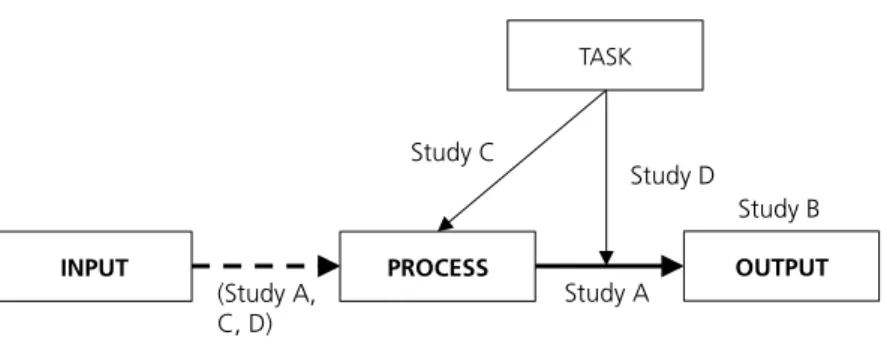
All four studies cover different aspects of the IPO model for teams. Studies A and C focus more on the P-O relationship, Study B on the output itself, and Studies C and D on processes related to the task. The following paragraph states the contribution of each study to a better understanding of healthcare teams under an IPO approach. Figure 3 provides an illustration of all four studies integrated in the IPO model according to their research topic.
Figure 3. Studies integrated in the IPO model4
3.2.1 Team inputs
Team inputs are not the main focus of this research (dashed arrow in Figure 3). Nevertheless team processes cannot be investigated independently from inputs. Team processes always happen in a certain environment (with specific task characteristics) and employing a certain team (with specific team characteristics) that may potentially influence the team process. The nature of the process is grounded and bounded to specific inputs that are critical in the organizational setting (Ilgen, 1999). The specific setting in which a study has been carried out serves as an important input variable that should not be ignored.
Study A focuses on statistical relationships between a team process variable and an outcome variable. Input factors like characteristics of the investigated sample (team size, education) as well as the environment in which the study has been conducted (e.g. the ICU, surgery) are listed and included in the interpretation of the results. Study C investigates team coordination require-ments in three different healthcare contexts, concluding that different tasks and their different characteristics imply different coordination requirements. Study D investigates the task as a moderator and not as an input. Nevertheless team characteristics (e.g. team size, leader experience) and the duration of a task (as a task characteristic) were assumed to influence team process be-haviour and clinical performance. For this reason these variables were included as control variables in the regression model.
4
Please note: Figure 3 is an illustration and should not be seen as a
PROCESS OUTPUT INPUT TASK Study A Study B Study C Study D (Study A, C, D)
The Present Study 24 3.2.2 Team processes
Team processes have a central role in this thesis. Study A first provides an overview about the literature investigating team processes, as defined in the team performance framework (Reader et al., 2009), in relation with outcomes in healthcare teams. Studies included in the review investigated the following process constructs: team coordination, adaptive coordination, team monitoring, leadership, communication, nontechnical skills, explicit reasoning, and teamwork. Studies C and D both focus on team coordination, Study C in a more general way in relation to the task whereas Study D investigated in particular the three coordination behaviours: feedback, acknowledgement, and task distribution.
3.2.3 Team outputs
All four studies in this thesis focus on the safety of the patient and thus include only patient outcomes and no team outcomes. Study A provides an overview of the different patient outcome measures used in the team process literature and includes process performance as well as outcome performance. Studies B and D then focus solely on process performance that is also interpreted as a patient outcome. By definition this interpretation might be incorrect, but it can be assumed that a good process performance measure correlates strongly with patient outcomes.
The development of a good performance measurement tool (performance checklists) is the main focus of Study B. Performance checklists take into account the important actions for a specific treatment and evaluate those actions across the whole process, providing a valid and reliable method to assess performance if developed systematically (Stufflebeam, 2000). This includes a theoretical foundation and an integration of official guidelines and the experiences of several experts. Based on many years of experience, experts tend to know which behaviour is important for the success of patient treatment. All these factors are integrated in the development approach presented in Study B. The performance measures in Study D resulted in a checklist rating with lists developed according to the approach developed in Study B. No patient outcomes were assessed, because Study D was conducted in a setting with a simulated patient, thus process
performance assessment was the most appropriate way to measure performance.
The Present Study 26 3.3 Author’s contribution to thesis articles
Table 1 lists Ph.D. candidate’s contribution for study A-D. TABLE 1
Overview of author’s contributions to thesis articles Paper Ph.D. candidate’s contribution
Study A Schmutz & Manser (2013)
• Substantial contribution to conception and design
• Substantial contribution of acquisition of data
• Substantial contribution to data analysis and interpretation
• Substantial contribution to drafting and revising the article for important
intellectual content Study B Schmutz, Eppich, Hoffmann, Heimberg & Manser (2014)
• Substantial contribution to conception and design
• Substantial contribution of acquisition of data
• Substantial contribution to data analysis and interpretation
• Substantial contribution to drafting and revising the article for important
intellectual content Study C Parker, Schmutz & Manser (under revision)
• Substantial contribution to conception and design
• Substantial contribution of acquisition of data (Sub-study in paediatric emergency) • Substantial contribution to data analysis
and interpretation (Sub-study in paediatric emergency)
• Supportive contribution to drafting and revising the article for important
intellectual content Study D
Schmutz,
• Substantial contribution to conception and design
Hoffmann, Heimberg & Manser (under revision)
• Substantial contribution of acquisition of data
• Substantial contribution to data analysis and interpretation
• Substantial contribution to drafting and revising the article for important
General Discussion 28
4. General Discussion
This thesis builds upon existing research on healthcare teams and aims to contribute to a deeper understanding of team processes and relevant variables, in particular the task as well as the clinical performance as an output. The IPO model provided a useful framework for this thesis, allowing the research and its results to be integrated.
Study A revealed, among other things, that most studies investigating team processes lack a theoretical model or a concept common to all researchers, which makes comparing the results among studies difficult. A group of unrelated studies may investigate variables under the same construct (e.g. communication), but the researchers define the variables differently from study to study. For example, Davenport, Henderson, Mosca, Khuri, and Mentzer Jr (2007) defined teamwork as a climate variable characterized by a perceived quality of collaboration among team members, whereas Siassakos et al. (2011) assess teamwork within a simulation as a concrete behaviour that team members exhibit. These variations strongly suggest a need within the field of industrial and organizational psychology for clear definitions and consistent use of terms and theoretical concepts.
The four studies in this thesis incorporate a theoretical approach based on the IPO model. Such a model has proved essential to study design and planning as well as to comparing and interpreting results. Although the need to ground research in the field of industrial and organizational psychology in theoretical models may seem self-evident, we cannot say the same for a large portion of articles in the field of medicine, which often take a highly practical approach. But theory and practice should not be mutually exclusive, and a compromise needs to be found to advance research in this field.
Study A of this thesis investigates team processes in general. The construct of team processes (defined as all interactions going on in the team) is a broad term. The team performance framework
provides more concrete ideas about what team processes include (i.e. coordination, leadership, communication, decision making). However, these four concepts, as formulated by Reader, Flin, Mearns, & Cuthbertson (2009), are not exclusive. Giving orders to one’s team members can be defined as “leadership,” but can also be interpreted as a way to communicate with the team members or to coordinate their actions. Marks, Mathieu, and Zaccaro (2001) provide a more detailed taxonomy of team processes, including 10 team process dimensions divided into transition processes (i.e. planning, goal specification, strategy formulation), action processes (i.e. progress, action and team monitoring, coordination), and interpersonal processes (i.e. conflict and action management, confidence building).
Whereas Study A investigates team processes in general, Studies C and D focus more specifically on team coordination. In the taxonomy of Marks et al. (2001), coordination is understood as an action process that orchestrates the sequence and timing of actions only. More recent studies, as well as this thesis, that investigate coordination have adapted a broader definition of coordination (Burtscher et al., 2011; Manser, Howard, & Gaba, 2008). In this broader definition, coordination is not limited to actions but also includes marshalling information. Coordination of information includes processes from other dimensions of the taxonomy of Marks et al. (2001), such as planning and strategy formulation. This broader definition is also in line with the interpretation by Arrow, McGrath, and Berdahl (2000), who argue that coordination is the central dynamic within a team. The authors identify three types of coordination into which all types of coordination within a team process would fall: coordination of actions, coordination of understanding, and coordination of goals. Coordination of information, for example, would fall under the category of coordination of understanding.
The four studies in this thesis have demonstrated that the task plays an important role in team processes. In particular, Study C demonstrates that the task not only elicits specific coordination requirements as an input, but can also act as a moderator, defining what process behaviour is effective in what kind of task. As noted earlier, industrial and organizational psychology aims to understand the individual (or a team), his or her or its behaviour and cognitions in the work environment. Of course, the task is
General Discussion 30
central to the work environment, and thus researchers need a profound understanding of the specifics of whatever task they use to investigate team processes. This thesis has shown that analysing the task a team must undertake is essential to assessing and interpreting team processes in a given setting. Analysis of the task itself not only helps us to understand the nature of the task, but also provides essential information about actions, coordination requirements, cues, and work processes within the team.
4.1 Limitations and outlook
Although theories centred on the IPO model propose a more dynamic and multi-cycle approach, most studies (including this thesis) about team processes in healthcare employ a rather static interpretation of the model. Usually researchers investigate team processes within a single cycle of task per-formance, and thus the feedback loop of the output to the input of a future IPO cycle is ignored, even studies gathering team process data over a long period aggregate data into a summary index that displays only one process-outcome relationship (Marks et al., 2001). One step toward interpreting team processes more dynamically lies in research about adaptive team behaviour in which processes change depending on the stage of a task or, alternatively, in which different processes are effective at different stages of a task (Burtscher, Wacker, Grote, & Manser, 2010; Grote, Kolbe, Zala-Mezo, Bienefeld-Seall, & Kunzle, 2010).
Furthermore, future studies should investigate team processes and their development over the long term. Riethmüller, Fernandez Castelao, Eberhardt, Timmermann, and Boos (2012) published one of the first studies investigating clinical teams over a long period (specifically, on the development of adaptive coordination mechanisms). They found that in routine phases of a treatment the amount of explicit coordination over time decreased, whereas implicit coordination increased due to the development of routines within the team.
The study of Riethmüller, et al. (2010) was conducted using six teams of medical students. The authors investigated the development of coordination mechanisms within the same teams during four different training sessions. Over this time the processes within each team evolved as team members
accumulated task and interactive experience. A criticism of this study could be that in real medical teams, the team members often change with every new task. A surgical team almost never has an identical constellation of members every time; sometimes the members of different sub teams (e.g. nurses, surgeons) barely know each other. We can therefore conclude that medical teams with changing constellations of members do not develop specific processes for their team in the way that an experienced sports team does (e.g. team-specific strategies or moves). That said, through repeated practice every team member gains more experience using technical skills (task experience) as well as nontechnical, team-process-centred skills (interactive experience).
Experience can influence team processes in two ways. First, team members can directly learn effective team processes over time. For example, a resident can learn to use direct and clear communication or can acknowledge orders to prevent communication errors. Second, team members develop better technical skills over time and thus free up cognitive resources to engage in team process behaviour. Team monitoring and situation awareness are overlapping con-structs that profit when team members have free cognitive resources. Each describes the awareness of a team member (or a whole team) about what is happening around him or her (Dickinson & McIntyre, 1997; Schulz, Endsley, Kochs, Gelb, & Wagner, 2013). Only if a team member knows what is going on can he or she anticipate and thus prepare for future actions. When an unexpected event occurs during an operation, an experienced nurse stays calm, knows what to do, anticipates future actions, and can provide direct help to the surgeon to help the patient before the surgeon has to give him or her an order or even explain what to do next.
These findings indicate that future studies should focus on the experience level of the team or specific team members. Experience can be investigated as an input factor influencing team processes or as a moderator of the process-outcome relationship. Some process behaviours might be effective for experienced teams but not for inexperienced ones. The converse is also likely. For example, explicit sharing of information could help an inexperienced team to develop a shared mental model of a situation and thereby increase per-formance but could distract an experienced team where all team members already have the