DOI: 10.1126/science.1175822
, 67 (2009);
326
Science
et al.
Tim D. White,
Ardipithecus ramidus
Habitat of
Macrovertebrate Paleontology and the Pliocene
www.sciencemag.org (this information is current as of October 14, 2009 ):
The following resources related to this article are available online at
http://www.sciencemag.org/cgi/content/full/326/5949/67
version of this article at:
including high-resolution figures, can be found in the online
Updated information and services,
http://www.sciencemag.org/cgi/content/full/326/5949/67/DC1
can be found at:
Supporting Online Material
found at:
can be
related to this article
A list of selected additional articles on the Science Web sites
http://www.sciencemag.org/cgi/content/full/326/5949/67#related-content
http://www.sciencemag.org/cgi/content/full/326/5949/67#otherarticles
, 2 of which can be accessed for free:
cites 25 articles
This article
http://www.sciencemag.org/cgi/content/full/326/5949/67#otherarticles
2 articles hosted by HighWire Press; see:
cited by
This article has been
http://www.sciencemag.org/cgi/collection/anthro
Anthropology
:
subject collections
This article appears in the following
http://www.sciencemag.org/about/permissions.dtl
in whole or in part can be found at:
this article
permission to reproduce
of this article or about obtaining
reprints
Information about obtaining
is a
Science
2009 by the American Association for the Advancement of Science; all rights reserved. The title
Copyright
American Association for the Advancement of Science, 1200 New York Avenue NW, Washington, DC 20005.
(print ISSN 0036-8075; online ISSN 1095-9203) is published weekly, except the last week in December, by the
Science
on October 14, 2009
www.sciencemag.org
www.sciencemag.org SCIENCE VOL 326 2 OCTOBER 2009
67
AUTHORS’SUMMARIES
Macrovertebrate Paleontology and the
Pliocene Habitat of Ardipithecus ramidus
Tim D. White, Stanley H. Ambrose, Gen Suwa, Denise F. Su, David DeGusta, Raymond L. Bernor, Jean-Renaud Boisserie, Michel Brunet, Eric Delson, Stephen Frost, Nuria Garcia, Ioannis X. Giaourtsakis, Yohannes Haile-Selassie, F. Clark Howell, Thomas Lehmann, Andossa Likius, Cesur Pehlevan, Haruo Saegusa, Gina Semprebon, Mark Teaford, Elisabeth Vrba
E
ver since Darwin, scholars have speculated about the role that environment may have played in human origins, evolution, and adapta-tion. Given that all living great apes live and feed in trees, it has been assumed that the last common ancestor we shared with these forms was also a for-est dweller. In 1925, Raymond Dart described the first Australopithecus, a child’s skull, at Taung, South Africa. Its occurrence among other fossils indicative of a grassland environment prompted speculation that the open grasslands of Africa were exploited by early hominids and were therefore somehow integrally involved with the origins of upright walking.The Ardipithecus-bearing sediments at Aramis now provide fresh evidence that Ar. ramidus lived in a predomi-nantly woodland setting. This and cor-roborative evidence from fossil assem-blages of avian and small mammals imply that a grassland environment was not a major force driving evolution of the earliest hominids. A diverse assem-blage of large mammals (>5 kg body weight) collected alongside Ardipithe-cus provides further support for this conclusion. Carbon isotopes from tooth enamel yield dietary information
because different isotope signatures reflect different photosynthetic pathways of plants consumed during enamel development. Therefore, animals that feed on tropical open-environment grasses (or on grass-eat-ing animals) have different isotopic compositions from those feedgrass-eat-ing on browse, seeds, or fruit from shrubs or trees. Moreover, oxygen isotopes help deduce relative humidity and evaporation in the environment.
The larger-mammal assemblage associated with Ardipithecus was systematically collected across a ~9 km transect of eroding sediments sandwiched between two volcanic horizons each dated to 4.4 million years ago. It consists of ~4000 cataloged specimens assigned to ~40 species in 34 genera of 16 families.
There are only three primates in this assemblage, and the rarest is Ardipithecus, represented by 110 specimens (a minimum of 36 individ-uals). Conversely, colobine monkeys and a small baboon-like monkey
(red crosses in figure) account for nearly a third of the entire large mam-mal collection. Leaf-eating colobines today exhibit strong preferences for arboreal habitats, and the carbon iso-tope compositions of the fossil teeth are consistent with dense to open forest arboreal feeding (see figure).
The other dominant large mammal associated with Ar. ramidus is the spiral-horned antelope, Tragelaphus (the kudu, green circle). Today, these antelopes are browsers (eating mostly leaves), and they prefer bushy to wooded habitats. The dental morphol-ogy, wear, and enamel isotopic com-position of the Aramis kudu species are all consistent with such place-ment. In contrast, grazing antelopes (which eat mostly grass) are rare in the Aramis assemblage.
The large-mammal assemblage shows a preponderance of browsers and fruit eaters. This evidence is con-sistent with indications from birds, small mammals, soil isotopes, plants, and invertebrate remains. The emer-gent picture of the Aramis landscape during Ar. ramidus times is one of a woodland setting with small forest patches. This woodland graded into nearby habitats that were more open and are devoid of fossils of Ardipithecus and other forest-to-woodland– community mammals. Finally, the carbon isotopic composition of Ar. ramidus teeth is similar to that of the predominantly arboreal, small, baboon-like Pliopapio and the woodland browser Tragelaphus, indi-cating little dietary intake of grass or grass-eating animals. It is there-fore unlikely that Ar. ramidus was feeding much in open grasslands.
These data suggest that the anatomy and behavior of early hominids did not evolve in response to open savanna or mosaic set-tings. Rather, hominids appear to have originated and persisted within more closed, wooded habitats until the emergence of more ecologically aggressive Australopithecus.
Carbon and oxygen isotope analyses of teeth from the Ar. ramidus
localities. Species are listed in order of abundance, and isotopic data separate species by what they ate and their environment.
When citing, please refer to the full paper, available at DOI 10.1126/science.1175822.
on October 14, 2009
www.sciencemag.org
Macrovertebrate Paleontology
and the Pliocene Habitat
of Ardipithecus ramidus
Tim D. White,1* Stanley H. Ambrose,2Gen Suwa,3Denise F. Su,4David DeGusta,5 Raymond L. Bernor,6,7Jean-Renaud Boisserie,8,9Michel Brunet,10Eric Delson,11,12 Stephen Frost,13Nuria Garcia,14Ioannis X. Giaourtsakis,15Yohannes Haile-Selassie,16 F. Clark Howell,17† Thomas Lehmann,18Andossa Likius,19Cesur Pehlevan,20Haruo Saegusa,21 Gina Semprebon,22Mark Teaford,23Elisabeth Vrba24
A diverse assemblage of large mammals is spatially and stratigraphically associated with Ardipithecus ramidus at Aramis. The most common species are tragelaphine antelope and colobine monkeys. Analyses of their postcranial remains situate them in a closed habitat. Assessment of dental mesowear, microwear, and stable isotopes from these and a wider range of abundant associated larger mammals indicates that the local habitat at Aramis was predominantly woodland. The Ar. ramidus enamel isotope values indicate a minimal C4vegetation component in its diet (plants using the C4photosynthetic pathway), which is consistent with predominantly forest/woodland feeding. Although the Early Pliocene Afar included a range of environments, and the local environment at Aramis and its vicinity ranged from forests to wooded grasslands, the integration of available physical and biological evidence establishes Ar. ramidus as a denizen of the closed habitats along this continuum.
C
ircumscribing the ecological habitat of the earliest hominids is crucial for un-derstanding their origins, evolution, and adaptations. Evidence integrated from a variety of independent geological and paleontological sources (1–3) help to place Ardipithecus ramidus in its regional and local Pliocene environmental settings. Here, we assess fossils of the larger vertebrates (mammalian families in which most species exceed 5 kg adult body weight) to reveal characteristics of their diets, water use, and hab-itat preferences.At Aramis 4.4 Ma (million years ago), pre-dominantly terrestrial plants, invertebrates, and vertebrates were buried relatively rapidly on a low-relief aggrading floodplain, away from pe-rennially moving water capable of displacing most remains (2, 3). Collection bias was avoided by a systematic 100% collection strategy (1). Therefore, the large mammal assemblage spa-tially associated with Ardipithecus in the Lower Aramis Member allows for relatively robust and precise environmental inference compared with many other hominid-bearing occurrences.
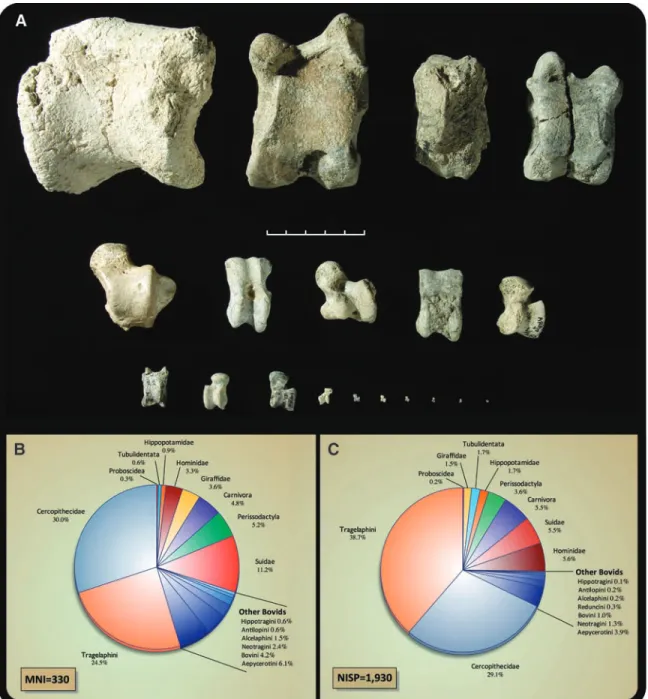
The assemblage was carnivore-ravaged and is consequently dominated by bone and dental fragments (3). It represents an attritionally de-rived fauna collected between two widespread marker tuffs that are today exposed along an extended erosional arc (2, 3). The larger mam-mal fossil assemblage (4) comprises 3837 in-dividually cataloged specimens assigned to 42 species (6 of them newly discovered), in 34 genera of 16 families (1, 5), across a wide body size range (Fig. 1A). Many of the sampled taxa provide evidence for the evolution of African vertebrates.
We consider ecological habitat to mean the biological and physical setting normally and regularly inhabited by a particular species. Our floral definitions follow the United Nations Edu-cational, Scientific, and Cultural Organization (UNESCO) classification of African vegetation (6). Forests have continuous stands of trees with overlapping crowns, forming a closed, often multistory canopy 10 to 50 m high; the sparse ground layer usually lacks grasses. Forests grade into closed woodlands, which have less contin-uous canopies and poorly developed grass layers. Woodlands have trees with canopy heights of 8 to 20 m; their crowns cover at least 40% of the land surface but do not overlap extensively. Woodland ground layer always includes heli-ophilous (sun-loving, C4) grasses, herbs/forbs, and incomplete small tree and shrub under-stories. Scrub woodland has a canopy height less than 8 m, intermediate between woodland and bushland. As proportions of bushes, shrubs, and grasses increase, woodlands grade into bushland/thickets or wooded grasslands.
Reconstructing the Aramis biotope. Recon-structing an ancient environment based on ver-tebrate macrofossils is often imprecise (7). Even assemblages from a single stratigraphic interval may sample thousands of years and thus repre-sent artificial amalgamations of different biotopes shifting on the landscape through time. Even in a geologically isochronous assemblage, animals from different habitats may be mixed by moving water or by a moving lake or river margin. Eco-logical fidelity can be further biased through unsystematic paleontological recovery, for ex-ample, when only more complete, identifiable, and/or rare specimens are collected.
Consequently, most early hominid-bearing open-air fossil assemblages conflate multiple bi-otopes (7). Under such circumstances, it is not surprising that many Pliocene hominid habitats have been referred to as a“mosaic” or “a changing mosaic of habitats” (8). Such characterizations risk confusing noise for signal and local for regional environment, particularly for collection-biased as-semblages lacking temporal and spatial resolution. Initial assessment of the fauna associated with Ar. ramidus indicated“a closed, wooded” environ-ment (9), an inference subsequently misquoted as “forest” (10). This interpretation was criticized on the basis that colobine monkeys and tragelaphine bovids might be unreliable indicators (11, 12).
Taxonomic abundance. Several aspects of Lower Aramis Member larger mammal assem-blage abundance data constitute strong indica-tors of ancient biofacies and biotope (13). The locality-specific subassemblages are remarkably
RESEARCH ARTICLES
1Human Evolution Research Center and Department of
In-tegrative Biology, 3101 Valley Life Sciences Building, Uni-versity of California, Berkeley, CA 94720, USA.2Department
of Anthropology, University of Illinois, 607 South Matthews Avenue, Urbana, IL 61801, USA.3The University Museum,
Uni-versity of Tokyo, Hongo, Bunkyo-ku, Tokyo 113-0033, Japan.
4
Department of Anthropology, Bryn Mawr College, Bryn Mawr, PA 19010–2889, USA.5Department of Anthropology, Stanford
University, Stanford, CA 94305–2034. 6National Science
Foundation, Sedimentary Geology and Paleobiology Program, Arlington, VA 22230, USA.7College of Medicine, Department of Anatomy, Laboratory of Evolutionary Biology, Howard University, 520 W Street, Washington, DC 20059, USA.8Paléobiodiversité
et Paléoenvironnements, UMR CNRS 5143, USM 0203, Muséum national d’histoire naturelle, 8 rue Buffon, CP 38, 75231 Paris cedex 05, France.9Institut de paléoprimatologie et
paléonto-logie humaine, évolution et paléoenvironnements, UMR CNRS 6046, Université de Poitiers, 40 avenue du Recteur-Pineau, 86022 Poitiers cedex, France.10Collège de France, Chaire de
Paléontologie humaine, 3 Rue d’Ulm, F-75231 Paris cedex 05, France.11Department of Anthropology, Lehman College, City University of New York, Bronx, NY 10468, USA.12Department
of Vertebrate Paleontology, American Museum of Natural History, New York, NY 10024, USA. 13Department of Anthropology, University of Oregon, Eugene, OR, 97403– 1218, USA. 14Departamento Paleontología, Universidad
Complutense de Madrid y Centro de Evolución y Comporta-miento Humanos, ISCIII, C/ Sinesio Delgado 4, Pabellón 14, 28029 Madrid, Spain. 15Ludwig-Maximilians-University of
Munich, Department of Geo- and Environmental Sciences, Section of Paleontology, Richard-Wagner-Strasse 10, D-80333 Munich, Germany.16Department of Physical Anthropology,
Cleveland Museum of Natural History, 1 Wade Oval Drive, Cleveland, OH 44106, USA.17Human Evolution Research Center and Department of Anthropology, 3101 Valley Life Sciences Building, University of California, Berkeley, CA 94720, USA.18Senckenberg Forschungsinstitut, Senckenber-ganlage 25, D-60325 Frankfurt am Main, Germany.19
Départe-ment de Paléontologie, Université de N’Djamena, BP 1117, N’Djamena, Chad.20University of Yuzuncu Yil, Department of
Anthropology, Faculty of Science and Letters, Zeve Yerlesimi 65080 Van, Turkey.21Institute of Natural and Environmental
Sciences, University of Hyogo, Yayoigaoka, Sanda 669-1546, Japan.22Science and Mathematics, Bay Path College, 588 Longmeadow Street, Longmeadow, MA 01106, USA.23Center
for Functional Anatomy and Evolution, Johns Hopkins University School of Medicine, 1830 East Monument Street, Room 303, Baltimore, MD 21205, USA. 24Department of
Geology and Geophysics, Yale University, New Haven, CT 06520, USA.
*To whom correspondence should be addressed. E-mail: [email protected]
†Deceased
on October 14, 2009
www.sciencemag.org
consistent in their taphonomy and taxonomy across the ~7 km distance from the easternmost (SAG-VP-7) to westernmost (KUS-VP-2) Ar. ramidus localities (3).
Contemporaneous localities between the two tuffs farther south of the modern Sagantole drain-age (SAG-VP-1 and -3, at the southeastern paleo-transect pole) are relatively impoverished. They lack this diverse and abundant mammal assem-blage and contain no tragelaphines, no monkeys, no fossil wood or seeds, no birds, no micromam-mals, and no Ardipithecus (table S1). Comple-mentary structural, taphonomic, and isotopic data from localities on this pole of the paleotransect suggest a more open landscape that supported more crocodilians, turtles, and hippopotamids, presumably associated with water-marginal set-tings more axial in the drainage basin (2, 3).
Relative and absolute abundance measures for the large mammals in our collections from the Ardipithecus-bearing Lower Aramis Member localities were assessed by the number of iden-tified specimens (NISP) (n = 1930) and the mini-mum number of individuals (MNI) based on teeth (n = 330). Proboscideans, giraffids, and hippopotamids are rare (Fig. 1, B and C). The rhinos Ceratotherium efficax and Diceros are rep-resented by few specimens (NISP 6 and 1, MNI 4 and 1, respectively). Unlike most other waterside Plio-Pleistocene assemblages, rhinos are more abundant than hippos at Aramis. The dental meso-wear pattern and occlusal morphology of Pliocene Ceratotherium efficax suggest that it was predomi-nantly a grazer but ate less abrasive forage with respect to its highly specialized Pleistocene and extant descendant Ceratotherium simum. The
morphological and functional properties of the recovered Diceros sp. molars are similar to those of the extant browsing Diceros bicornis.
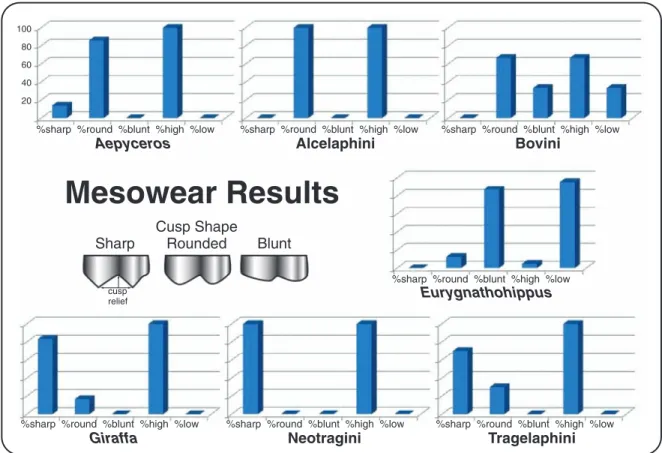
Equids are rare. One, Eurygnathohippus sp. nov., is distinguished by its distal limb, which is adapted to open-country running. Its elongate-narrow snout with parabolic symphysis suggests adaptation to selective feeding. The teeth of this equid bear a low-blunt cusp morphology reflect-ing habitual grazreflect-ing. Large carnivores and aardvarks are rare, in keeping with their trophic level (as in most other eastern African Plio-Pleistocene assemblages).
Ardipithecus ramidus is represented at Aramis and environs by >110 cataloged specimens repre-senting a minimum number of 36 individuals [14 by upper second molar (M2) count] in the Lower Aramis Member. These numbers are
rel-Fig. 1. Aramis large mammals. (A) Size range illustrated by astragali. The Lower Aramis Mem-ber contains a wide range of mammalian taxa, illus-trated by this image. Top left, Rhinocerotidae; middle left, Ardipithecus ramidus (ARA-VP-6/500); lower left, small bovid. Included are other artio-dactyls, carnivores, and rodents. (B) Relative abun-dance of larger mammal taxa at Aramis based on dental MNI. (C) Dental NISP based on dental individuals whose tooth crowns are more than half complete. The NISP value reflects all collected specimens identified to the taxon and excludes bulk specimens (tooth crowns less than half com-plete). Associated dental specimens are counted as one. The MNI values use permanent molars segregated into upper and lower first, second, and third molars, respec-tively. Numbers for each taxon vary between NISP and MNI, but the relative proportions hold similar. Tragelaphine bovids and cercopithecid monkeys dominate, accounting for more than half of the assemblage, however counted.
Ardipithecus ramidus
on October 14, 2009
www.sciencemag.org
Downloaded from
atively low compared with many of the other macrovertebrate fossil species we collected. This rarity is consistent with that observed for hom-inids in other well-known vertebrate assem-blages (7). Kuseracolobus aramisi and Pliopapio alemui are ubiquitous in the assemblage, ac-counting for 30% of both the larger mammal NISP and MNI. The colobine is numerically dominant within nearly all of the localities, and
overall by a ratio of 1.4 to Pliopapio (colobinae NISP:cercopithecinae NISP). It is slightly larger (12 kg female, 18 kg male) than this papionin (8.5 kg, 12 kg) based on dental regressions (14). Extant colobines exhibit strong preferences for arboreal habitats; extinct African taxa range from fully arboreal to highly terrestrial (15).
Bovids and primates, particularly tragelaphines and cercopithecids, dominate the larger mammal
assemblage based on taxonomically diagnostic craniodental elements (Fig. 1). Together, these taxa account for more than half of the larger mammal specimens, whether counted by NISP or dental MNI. Both cercopithecid and bovid as-semblages appear to be attritional and were rav-aged heavily by carnivores after death (3).
Bovids help illuminate the local Aramis en-vironment of the Ardipithecus-bearing localities. One useful index is the relative abundance of grazing versus browsing taxa, which can indi-cate the presence of open or closed conditions, respectively (16–19). The most ecologically sen-sitive of these taxa include grazing, open-habitat tribes such as Alcelaphini and Hippotragini ver-sus the primarily browsing Tragelaphini or the riparian-associated Reduncini. Reduncine bovids commonly dominate in African Plio-Pleistocene faunal assemblages (Fig. 2), in keeping with fluviatile, swampy, or lake marginal depositional conditions.
Whether counted by NISP or dental MNI, Tragelaphus (whose modern congeners are as-sociated with wooded habitats) (20) is the nu-merically dominant Aramis bovid, comprising 85% (NISP) of the bovid assemblage (Fig. 1), followed by Aepyceros (whose modern form favors grassy woodland to wooded grassland en-vironments). In contrast, alcelaphine and reduncine bovids that are plentiful at other Plio-Pleistocene sites are rare at Aramis, accounting for a mere 1% (NISP) and 4% (MNI) of all bovids. Aramis is unlike any other known African fossil assem-blages in that Tragelaphus dominates the un-gulates. (20–23) (Fig. 2).
Alcelaphines and reduncines were found at slightly higher frequencies at locality SAG-VP-7 at the eastern end of the Ardipithecus distribution (although tragelaphines and aepycerotines still dominate there). This subtle difference between SAG-VP-7 and other more westerly hominid-bearing localities is also indicated by cercopithecid abundance. SAG-VP-7 has relatively fewer cer-copithecids and more alcelaphine and reduncine bovids (Fig. 2), potentially signaling that this east-ernmost Ardipithecus locality was a transition zone between two biotopes.
Functional morphology. Taxon-based ap-proaches to the inference of paleohabitats are usually restricted to using identifiable cranioden-tal remains and assume that habitat preference persists through evolutionary time. Another ap-proach is to evaluate the anatomy of fossils with respect to its implications for functional adapta-tions. These methods presume that mammals exhibit skeletal and dental adaptations for lo-comotion and feeding that correlate with their preferred environment (24). Samples of extant taxa are used to quantify the relations between skeletal/dental traits and environmental variables, with the results then applied to fossil forms (25). Here, we evaluate the“ecomorphology” of the most common large mammals at Aramis, the bovids and cercopithecid monkeys. For the Aramis bovids, we evaluated the astragali and
0% 10% 20% 30% 40% 50% 60% 70% 80% 90% 100%
ALL ARAMIS ARA-VP-1 ARA-VP-6 KUS-VP-2 SAG-VP-7
Hippotragini Antilopini Alcelaphini Reduncini Bovini Neotragini Aepycerotini Tragelaphini Kuseracolobus aramisi Pliopapio alemui (1441) (1073) (218) (53) (79) 0% 10% 20% 30% 40% 50% 60% 70% 80% 90% 100% Aramis Basal Member Sidi Hakoma Denen Dora
Shungura B Apak Kaiyumung Kanapoi Laetoli
Hippotragini Antilopini Alcelaphini Reduncini Bovini Neotragini Aepycerotini Tragelaphini (879) (66) (129) (429) (171) (64) (57) (125) (1061) A B
Fig. 2. Aramis taxonomic abundance. (A) Comparison between the relative abundance (dental) of bovid taxa at Aramis and other Plio-Pleistocene sites (21, 23, 45). The bovid fauna at Aramis is markedly different due to the dominance of tragelaphines. All frequencies are based on NISP, except for Hadar, which is based on MNI. (B) Within-site comparison of the relative abundances of bovids and cerocopithecids. Among Lower Aramis Member localities, SAG-VP-7 has relatively lower abundances of cercopithecids and higher abundances of alcelaphines and reduncines, potentially indicative of ecotonal conditions at this easternmost locality of the Ardipithecus distribution.
RESEARCH ARTICLES
on October 14, 2009
www.sciencemag.org
phalanges (25, 26) because other elements that can be revealing (metapodials and femora) were not preserved in sufficient numbers. We used a four-habitat grouping scheme (26) (SOM text S1). Of the 11 available intact bovid astragali with statistically significant habitat predictions (accuracy >95%), 10 are classified as“forest” and one as“heavy cover.” This is a clear signal, since these methods typically produce more varied habitat predictions when applied to fossil sam-ples (27, 28). To lessen possible biases introduced by confining the analysis to specimens sufficient-ly complete for measurement, we also examined nonmetric traits of the phalanges and classified the entire astragali/phalangeal sample by mor-photype (SOM text S1, tables S2 and S3, and fig. S1). These results independently support the conclusion from metric prediction that these animals inhabited a “forest” (in the analytical, not floral, sense).
As with bovids, cercopithecid postcranial fea-tures are routinely posited to indicate locomo-tion (29–31). However, systematic studies of large samples of extant taxa are generally lacking. We therefore consider most proposed correlations between cercopithecoid anatomy and locomotor mode to be of unknown reliability, pending ad-ditional study. Even so, the elbow is clearly a key joint for distinguishing between arboreal and terrestrial primate locomotion. Of 10 available Aramis cercopithecoid distal humeri, 9 are clearly consistent with“arboreal” substrate, whereas only one is consistent with“terrestrial” substrate based on current criteria. Of 9 proximal ulnae, all are
arboreal. There was no clear evidence of terres-trial adaptation in 18 proximal radii. Hence, based on current criteria, there is clear evidence of arboreal locomotor adaptations, and a paucity of terrestrial indicators, in the overwhelming majority of the Aramis cercopithecoid postcranial sample (SOM text S2).
Dental wear. The morphology, occlusal wear, and stable isotope composition of dental re-mains also reveal the diet—and, indirectly, hab-itat preferences—of some Aramis mammals. Differences in mesowear can distinguish among extant browsers, grazers, and mixed feeders (32). The Aramis neotragines, Giraffa, and Tragelaphus cluster with extant browsers (Fig. 3 and table S3), whereas Aepyceros falls between extant mixed feeders and nonextreme grazers. Rare Aramis alcelaphines cluster with nonextreme grazers, whereas the rare bovine and equid fossils are closest to extant coarser grass grazers.
The high cusps and colobine-like morphology of Pliopapio alemui (tall molars with high relief and little basal flare) suggest that the two Aramis monkey taxa had similar diets. We sampled a mixed set of colobine and cercopithecine molars for a blind test of microwear. No significant dif-ferences were found between the two taxa. Micro-wear on the Aramis monkey molars is consistent with both frugivory and folivory but not hard object feeding. A diet of soft (but perhaps tough) foods would be typical of colobines, and the same may have been the case for the papionin (33).
Enamel isotopes. The carbon isotopic com-position of a mammal’s tooth enamel reflects the
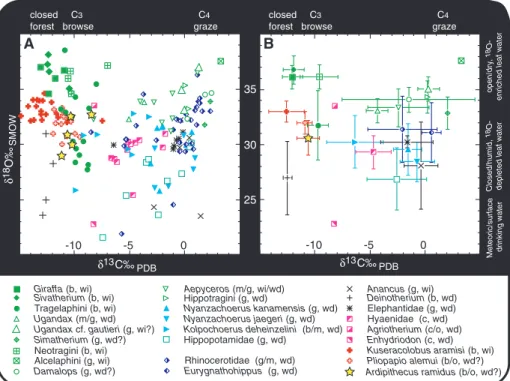
relative contributions of grass, trees, and shrubs to its diets. Oxygen isotopes can reveal the de-gree that a species lives in, or consumes, water from different sources (34). We sampled tooth enamel bioapatite from 177 specimens encom-passing a wide range of mammalian taxa within the Ar. ramidus–bearing unit (Fig. 4, SOM text S3, and table S4). These were analyzed blind to taxon. Carbon isotopic ratios for grazers are high, whereas those for mixed feeders, browsers, and forest floor feeders decrease systematically (SOM text S4). Oxygen isotope vales are low for water-dependent species such as carnivores and hippos in wet riparian habitats and higher for water-independent browsers and open dry-habitat species.
In the Ardipithecus-bearing Lower Aramis Member assemblage, the aquatic carnivore Enhydriodon (an otter) has the lowest d18O of all species. Conversely, the ursid Agriotherium (a bear) has the highest carnivore d18O, consistent with anatomical evidence for an omnivorous diet (35). Among herbivores, giraffids (Giraffa and Sivatherium) have the highest d18O and lowest d13C values, whereas grazing equids (Eurygnathohippus), alcelaphines, bovines, hip-potragines, and rhinocerotids show the converse. Among primates, Kuseracolobus has higher d18O and lower d13C than Pliopapio, which re-sembles the difference between modern folivo-rous Colobini and more omnivofolivo-rous Papionini (36, 37).
The carbon isotopic composition of four of five Ardipithecus ramidus individuals is close to
Fig. 3. Mesowear analysis results for the second molar paracone apex of fossil ungulates. Cusp shape was scored qualitatively as sharp, rounded, or blunt. The relative difference in height between tooth cusp apices and inter-cusp valleys (occlusal relief) was qualitatively scored as either high or low (large or small distance between cusp apex and intercusp val-ley, respectively). Histo-grams show the results on the mesowear vari-ables measured (i.e., the percentages of sharp versus rounded versus blunt cusp shapes and the percentages of high versus low oc-clusal relief).
Sharp Rounded Blunt
cusp relief
Cusp Shape
Aepyceros Alcelaphini Bovini
Neotragini Tragelaphini
Giraffa
%sharp %round %blunt %high %low %sharp %round %blunt %high %low %sharp %round %blunt %high %low
%sharp %round %blunt %high %low
%sharp %round %blunt %high %low %sharp %round %blunt %high %low %sharp %round %blunt %high %low
Mesowear Results
Eurygnathohippus 100 80 60 40 20Ardipithecus ramidus
on October 14, 2009
www.sciencemag.org
Downloaded from
that of Pliopapio, reflecting diets that included small amounts of13C-enriched plants and/or ani-mals that fed on such plants. Ardipithecus con-sumed slightly more of these resources than modern savanna woodland chimpanzees (38) but substantially less than later Plio-Pleistocene hominids (39, 40). The fifth individual has a d13C value of–8.5 per mil (‰), which is closer to, though still lower than, the means for Aus-tralopithecus africanus, Au. robustus, and early Homo (39, 40). Slightly lower d18O compared with Pliopapio and Kuseracolobus suggests that Ardipithecus obtained more water from fruits, bulbs, tubers, animals, and/or surface sources.
The isotopic composition of the Aramis mam-mals between the two tuffs (Fig. 4 and table S4) conforms broadly to patterns expected for their modern congeners across the forest-woodland-savanna spectrum (37, 38) in the East African rift and is consistent with other early Pliocene assemblages (39, 40). Relatively low primate, giraffid, tragelaphine, and Deinotherium d13C values indicate that small patches of closed can-opy forests were present, although woodlands to wooded grasslands probably dominated. Low d13C values for hyaenids suggest that browsing
prey contributed more to their diet compared to their modern congeners in grazer-dominated open savanna environments (37). This is congruent with the numerical dominance of browsing tra-gelaphines and accords with other evidence for the dominance of woodlands in the 4.4 Ma local environment occupied by Ardipithecus (2, 3). A small number of rare grazing species—mainly equids, alcelaphines, hippotragines, and some impala, rhino, and bovines—have high d13C and d18O, indicating that they fed on water-stressed C4plants in drier, open environments (41). These taxa comprise a small portion of the overall assemblage.
The large range of d18O, particularly the large difference (9.6‰) between water-independent (evaporation-sensitive) Giraffidae (Giraffa and Sivatherium) and water-dependent (evaporation-insensitive) Hippopotamidae, suggests a mean annual evaporative water deficit of ~1500 mm (41). Therefore, Aramis was a generally dry wood-land setting far from riparian environments. Enamel isotopes of these taxa from nearby pene-contemporary sites at Gona (42) (SOM text S3 and fig. S2) have a d18O difference of only 4.6‰, reflecting an annual water deficit of ~500 mm
(41). Consistently lower oxygen isotope ratios sup-port geological evidence that Gona was close to permanent water (43), but higher carbon isotope ratios for all Gona browsers are inconsistent with greater water availability (SOM text S3).
Other ecological approaches. An approach to deducing ancient environment is to first as-sign each mammal taxon in a fossil assemblage to an ecological category (usually based on diet and locomotion) and then compare the propor-tions of these categories in the fossil sample to a range of similarly categorized extant communi-ties (44, 45). This approach uses only the presence or absence of taxa, so it is subject to taxonomic and taphonomic biases involving small samples and mixing. Furthermore, the results are often of low resolution because biased local fossil as-semblages are compared to variably recorded modern communities that pool multiple habitats (21). Ardipithecus ramidus was previously inter-preted as inhabiting a woodland or dry forest based on a preliminary Aramis faunal list (about 10% of the sample now available) (46). Al-though the full faunal list produces results con-sistent with this finding, these results are not highly robust because the data broadly overlap among distinct environments (e.g., open, riparian, medium-density, and closed woodland) (47).
Other measures of abundance also provide information on the trophic structure of mamma-lian community represented by the Ardipithecus-bearing Lower Aramis Member. Although there are many grazing and carnivorous species (Fig. 5), these taxa are rare (48), so a strict presence/ absence evaluation distorts the ecological signal. When measures of relative abundance (NISP and MNI) are included, along with direct informa-tion on trophic levels from the stable isotope and mesowear results, a different picture emerges.
These combined data show that the large mammal biomass at Aramis was dominated by browsers and frugivores (including frugivorous animals that consume leaves as a substantial part of their diet). It is unlikely that a plethora of mam-mals dependent on browse and fruit would have been able to subsist in an environment without abundant trees, the presence of which is witnessed by fossil pollen as well as abundant seeds, wood, phytoliths, and rhizoliths (2).
Hominid habitat. Establishing habitat (as opposed to general environment) is crucial for illuminating the paleobiology of any fossil spe-cies, including hominids. On the basis of mixed fossil faunas, it has been previously proposed that “early hominids were apparently not restricted to a narrow range of habitats.” [(8), p. 571]. However, this raises the question of whether the hominids actually occupied a wide range of habitats or whether taphonomic processes and sampling biases have mixed hominid remains with those of species from biotopes that hominids rarely, if ever, frequented. Many fossil assemblages sim-ply do not preserve the necessary temporal and spatial resolution needed to determine whether hominids preferred the riverine forest, lake margin,
δ13C‰ PDB -10 -5 0 -10 -5 0 closed forest C3 browse C4 graze closed forest C3 browse C4 graze open/dry , 18
O-enriched leaf water
Closed/humid,
18
O-depleted leaf water
Meteoric/surface drinking water
25 30 35 δ 18 O‰ SMOW δ13C‰ PDB
Pliopapio alemui (b/o, wd?) Kuseracolobus aramisi (b, wi) Enhydriodon (c, wd) Agriotherium (c/o, wd) Hyaenidae (c, wd) Eurygnathohippus (g, wd) Elephantidae (g, wd) Deinotherium (b, wd) Anancus (g, wi)
Ardipithecus ramidus (b/o, wd?) Kolpochoerus deheinzelini (b/m, wd) Nyanzachoerus jaegeri (g, wd) Nyanzachoerus kanamensis (g, wd) Rhinocerotidae (g/m, wd) Hippotragini (g, wd) Aepyceros (m/g, wi/wd) Alcelaphini (g, wi) Simatherium (g, wd?) Neotragini (b, wi) Ugandax (m/g, wd) Tragelaphini (b, wi) Sivatherium (b, wi) Giraffa (b, wi) Hippopotamidae (g, wd)
Ugandax cf. gautieri (g, wi?) Damalops (g, wd?)
A B
Fig. 4. Carbon and oxygen isotopic composition of mammal tooth enamel from the Lower Aramis Member of the Sagantole Formation in the Middle Awash Valley. (A) Individual d13
C and d18O values plotted by taxon. (B) Bivariate meansT1 SD. See SOM text S3 for methods and interpretations, table S3 for raw data and statistics, and fig. S1 for comparison with species also occurring in roughly con-temporaneous deposits at Gona (42). Food and drinking habits are inferred from closest living relatives and from carbon and oxygen isotope ratios. b, browser (C3feeder); m, mixed grazer/browser (C3and C4 feeder); g, grazer (mainly C4grasses); wi, water-independent (evaporation-sensitive) (41) or obtaining substantial amounts of water from green leaves; wd, water-dependent (evaporation-insensitive) (41), relying on drinking water when plant leaves are dry; c, carnivore; o, omnivore, including diets with leaves fruit, tubers, roots, flowers (all predominantly C3), seeds, fungi, and vertebrate and invertebrate animal matter. Diets, water use, and habitat preferences of species of extinct genera and families are indicated in italics because they are more intrinsically uncertain. Interpretations are described and justified in detail in SOM text S3.
RESEARCH ARTICLES
on October 14, 2009
www.sciencemag.org
bushland, savanna, and/or woodland habitats demonstrably available within a few kilometers of most depositional loci within rift valley settings. For example, Ardipithecus ramidus has also been found at Gona, about 70 km to the north of Aramis, in a valley margin environment where lake deposits interfingered with small fluvial channels or lapped onto basaltic cones and flows (43). At Gona, the dominance of C3plants indi-cated by paleosol isotopes contrasts with the C4 plant signal in many associated ungulate grazers (indicated by enamel isotopic data). Levin et al. thus concluded that Ardipithecus “...may have inhabited a variety of landscapes and was not as ecologically restricted as previous studies suggest” [(42), p. 232]. The Gona paleontological and isotopic data show only that a range of habitats was present, and the attribution of Ardipithecus to any particular set of the available biotopes is problematical in this mixed assemblage (49). Fish, birds, browsers, horses, and hominids are all fre-quently found in a single mixed fossil assem-blage in a fluviatile or near-shore deposit. This does not mean that the fish were arboreal or that horses were aquatic. Neither do such data mean that the hominids exploited all potentially avail-able habitats.
The Lower Aramis Member deposits provide fossil samples that evidence a range of environ-ments in the region at 4.4 Ma (2, 3). However, the consistent association of Ar. ramidus with a particular fauna and flora in deposits between SAG-VP-7 and KUS-VP-2 suggests its persistent occupation of a woodland with patches of forest across the paleolandscape (2, 3). Ardipithecus
has not been found in the apparently more open settings to the southeast. There is no evidence of any taphonomic bias related to Ardipithecus that might produce this pattern (3) and no evi-dence of any other spatial or stratigraphic clus-tering within the 4.4 Ma Lower Aramis Member interval.
Based on a range of independent methods for inferring habitat-based large samples of con-silient spatial, geological, and biological evidence generated from diverse sources, we therefore conclude that at Aramis, Ar. ramidus resided and usually died in a wooded biotope that included closed through grassy woodlands and patches of true forest [sensu (6)]. There is no evidence to associate this hominid with more open wooded grasslands or grassland savanna.
Isotopic data indicate that the Ar. ramidus diet was predominantly forest- to woodland-based. This interpretation is consistent with evidence of the dental and skeletal biology of this primate (1). The ecological context of 4.4 Ma Aramis hominids, combined with their absence or extreme rarity at Late Miocene and Early Pliocene sites, suggest that the anatomy and behavior of the earliest hominids did not evolve in response to open savanna or mosaic settings. Rather, this clade appears to have originated within more closed habitats favored by these peculiar primates until the origin of Australopithecus, and perhaps even beyond (50).
References and Notes
1. T. D. White et al., Science 326, 64 (2009). 2. G. WoldeGabriel et al., Science 326, 65 (2009). 3. A. Louchart et al., Science 326, 66 (2009).
4. This assemblage is the one co-occurring with Ardipithecus and excludes the small contemporary samples of fossils from the more easterly localities of SAG-VP-1 and -3; see (2, 3) and table S1 for details.
5. Included in the larger mammal subassemblage analyzed here are the following taxa: Artiodactyla, Perissodactyla, Proboscidea, Primates, Carnivora (except Viverridae), and Tubulidentata.
6. F. White, The Vegetation of Africa, Natural Resources Research, Vol. 20. (United Nations Scientific and Cultural Organization, Paris, 1983).
7. T. White, in Evolutionary History of the Robust Australopithecines, F. Grine, Ed. (Aldine de Gruyter, New York, 1988), pp. 449–483.
8. M. G. Leakey, C. S. Feibel, I. McDougall, A. Walker, Nature 376, 565 (1995).
9. G. WoldeGabriel et al., Nature 371, 330 (1994). 10. N. E. Sikes, B. A. Wood, Evol. Anthropol. 4, 155 (1995). 11. B. R. Benefit, in African Biogeography, Climate Change,
and Human Evolution, T. Bromage, F. Schrenk, Eds. (Oxford Univ. Press, New York, 1999), pp. 172–188. 12. M. G. Leakey, in African Biogeography, Climate Change,
and Human Evolution, T. Bromage, F. Schrenk, Eds. (Oxford Univ. Press, New York, 1999), pp. 271–275. 13. Taphonomic and curatorial biases inevitably compromise
quantitative interpretations of any assemblage, including Aramis. For example, a single hominid canine may break into only a few identifiable fragments, whereas one elephantid’s tusk or molar can shatter into thousands of identifiable fragments. Simple comparisons of fragment abundance can therefore be misleading. Our abundance data take these potential problems into account (see Fig. 1 for details).
14. S. R. Frost, Am. Mus. Novit. 3350, 1 (2001). 15. J. F. Oates, A. G. Davies, E. Delson, in Colobine Monkeys:
Their Ecology, Behaviour, and Evolution, A. G. Davies, J. F. Oates, Eds. (Cambridge Univ. Press, Cambridge, 1994) pp. 45–74.
16. P. Shipman, J. Harris, in Evolutionary History of the Robust Australopithecines, F. Grine, Ed. (Aldine de Gruyter, New York, 1988), pp. 343–381.
17. E. S. Vrba, in Fossils in the Making, A. Behrensmeyer, A. P. Hill, Eds. (Univ. of Chicago Press, Chicago, 1980), pp. 247–271.
18. R. Bobe, G. G. Eck, Paleobiology 27, 1 (2001). 19. G. Suwa et al., J. Vert. Paleontol. 23, 901 (2003). 20. The Aramis Tragelaphus cf. moroitu has a body size close
to that of the living nyala (T. angasii) and is likely a direct descendent of the T. moroitu recorded from the Mio-Pliocene of Asa Koma and Kuseralee.
21. D. Su, thesis, New York University (2005). 22. R. Bobe, J. Arid Environ. 66, 564 (2006). 23. K. E. Reed, J. Hum. Evol. 54, 743 (2008).
24. H. A. Hespenheide, Annu. Rev. Ecol. Syst. 4, 213 (1973). 25. D. DeGusta, E. S. Vrba, J. Archaeol. Sci. 30, 1009
(2003).
26. D. DeGusta, E. S. Vrba, J. Archaeol. Sci. 32, 1099 (2005).
27. Y. Haile-Selassie et al., Geobios 37, 536 (2004). 28. L. J. Hlusko, Y. Haile-Selassie, D. DeGusta, Kirtlandia 56,
163 (2007).
29. J. G. Fleagle, Yearb. Phys. Anthropol. 20, 440 (1976). 30. H. B. Krentz, in Theropithecus, N. Jablonski, Ed.
(Cambridge Univ. Press, Cambridge, 1993), pp. 383–422.
31. S. Elton, Folia Primatol. (Basel) 73, 252 (2002). 32. M. Fortelius, N. Solounias, Am. Mus. Novit. 3301,
1 (2000).
33. Crushing and shearing areas of 10 cercopithecoid molars yielded surfaces that could be included in this analysis. Surface images were made using an SEM at ×500 magnification, and microwear features were collected using the“Microwear” software (v. 2.2, 1996). Microwear features included relatively few pits, with narrow pits and scratches. The microwear on the molars of the Aramis monkeys is consistent with both frugivory and folivory, but they were not routinely feeding on hard objects. A diet of soft, but perhaps tough, foods would be typical of colobines, and the same might be true for the papionin, which has tall molars with a large amount of
0% 10% 20% 30% 40% 50% 60% 70% 80% 90% 100% NISP MNI Faunal List RT O I C Fg FG MF G B
Fig. 5. Trophic ecovariable distributions by faunal list, dental NISP, and dental MNI. Comparisons of the Aramis trophic structure based on the faunal list versus specimen-level, dental relative abundance data as measured by NISP and MNI. Grazing and carnivorous species are abundant in the faunal list– based trophic structure, whereas browsers and frugivores dominate when NISP and MNI data are incorporated. B, browser; G, grazer; MF, mixed feeder; FG, fresh grass grazer; Fg, Frugivore (includes fruit and leaves); C, carnivorous; I, insectivorous; O, omnivorous; RT, root and tuber.
Ardipithecus ramidus
on October 14, 2009
www.sciencemag.org
relief and has a low level of basal flare in comparison with other papionins.
34. T. E. Cerling, J. M. Harris, Oecologia 120, 347 (1999). 35. B. Sorkin, Hist. Biol. 18, 1 (2006).
36. M. L. Carter, thesis, University of Chicago (2001). 37. S. H. Ambrose, M. J. DeNiro, Oecologia 69, 395 (1986). 38. M. Sponheimer et al., J. Hum. Evol. 51, 128 (2006). 39. M. Sponheimer, J. A. Lee-Thorp, in Handbook of
Paleoanthropology, W. Henke, I. Tattersall, Eds. (Springer, Berlin, 2007) pp. 555–585.
40. N. J. Van Der Merwe, F. T. Masao, M. K. Bamford, S. Afr. J. Sci. 104, 153 (2008).
41. N. E. Levin, T. E. Cerling, B. H. Passey, J. M. Harris, J. R. Ehleringer, Proc. Natl. Acad. Sci. U.S.A. 103, 11201 (2006).
42. N. E. Levin, S. W. Simpson, J. Quade, T. E. Cerling, S. R. Frost, in The Geology of Early Humans in the Horn of Africa, J. Quade, J. Wynn, Eds. (Geological Society of America Special Papers, 2008), vol. 446, pp. 215–234. 43. J. Quade et al., in The Geology of Early Humans in the
Horn of Africa, J. Quade, J. Wynn, Eds. (Geological Society of America Special Papers, 2008), vol. 446, pp. 1–31.
44. P. J. Andrews, J. M. Lord, E. M. Nesbit Evans, Biol. J. Linn. Soc. Lond. 11, 177 (1979).
45. K. Kovarovic, P. Andrews, L. Aiello, J. Hum. Evol. 43, 395 (2002). 46. P. Andrews, L. Humphrey, in African Biogeography,
Climate Change, and Human Evolution, T. Bromage, F. Schrenk, Eds. (Oxford Univ. Press, New York, 1999), pp. 282–300.
47. Our analysis also raised numerous questions about the assumptions and procedures underlying such efforts. 48. For example, there are 12“grazing” taxa compared to
only 5“browsing” taxa, but the former are represented by only 152 specimens, whereas the latter are represented by 758 (NISP).
49. It is evident that in most rift-valley depositional settings, a variety of environments would almost always have been available to hominids. Of primary interest is determining whether any one of these environments was the preferred habitat of these primates. Mixed assemblages cannot usually do this.
50. T. D. White et al., Nature 440, 883 (2006). 51. Supported by NSF (grants SBR-82-10897, 93-18698,
95-12534, 96-32389, 99-10344, and 03-21893
HOMINID-RHOI; and grant SBR 98-71480 for mass spectrometry instrumentation at the Environmental Isotope Paleobiogeochemistry Laboratory) and the Japan Society for the Promotion of Science (G.S. and H.S.). We thank L. Bach, H. Gilbert, and K. Brudvik for illustrations; the Ministry of Tourism and Culture, the Authority for Research and Conservation of the Cultural Heritage, and the National Museum of Ethiopia for permissions and facilitation; and the Afar Regional Government, the Afar people of the Middle Awash, and many other field workers for contributing directly to the data.
Supporting Online Material
www.sciencemag.org/cgi/content/full/326/5949/67/DC1 SOM Text
Figs. S1 and S2 Tables S1 to S5 References
4 May 2009; accepted 14 August 2009 10.1126/science.1175822