Growth of ice nanoparticles via uptake of individual molecules:
pickup cross sections
J. Fedor∗1, J. Lengyel†, J. Koˇciˇsek†, V. Poterya†, A. Pysanenko†, P. Svrˇckov´a†, M. F´arn´ık†
∗ Department of Chemistry, University of Fribourg, Chemin du Mus´ee 9, 1700 Fribourg, Switzerland †J. Heyrovsk´y Institute of Physical Chemistry v.v.i., Academy of Sciences of the Czech Republic, Dolejˇskova
3, 18223 Prague, Czech Republic
Synopsis We present cross sections for pickup of several atmospherically relevant molecules on ice nanoparticles with the 0.5-3 nm diameter range. The experimental values are supported by molecular dynamics simulations and analytical calculations based on long-range cluster-molecule potentials. The cross sections are all considerably larger than the geometrical cross section of nanoparticle and vary significantly for different guest molecules.
A recent investigation of atmospheric aerosol nucleation [1] has shown that the key steps for the aerosol formation occur in the sub-2-nanometer size range and that the nucleation-driving species are neutral clusters with small ad-mixtures of organic compounds. We have investi-gated the growth process of such clusters in a lab-oratory experiment where the cluster beam with well-defined size distributions passes through a pickup cell filled with a gas of guest molecules. The quantity extracted from the experiment is the pickup cross section. It is deduced from the velocity decrease of the cluster beam due to momentum transfer during the pickup events. We have previously shown that this method pro-vides reliable pickup cross sections for argon clus-ters [2], in contrary to other commonly used method for their determination (Poisson distri-bution of pickup fragments).
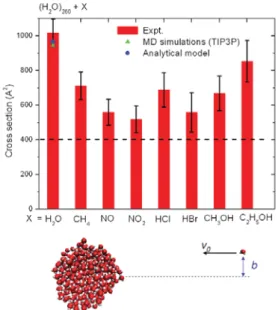
The present experiments focus on water clus-ters (ice nanoparticles) and pickup of atmospher-ically relevant molecules (H2O, methane, NOx, VOCs) on them at the COM collision energies up to 0.5 eV. The experimental cross sections vary considerably for individual guest molecules and are all significantly larger than the geomet-rical cross section of the nanoparticle [3]. For the pickup of water molecules, the experimental re-sults were supported by the molecular dynamics (MD) simulations using the TIP3P water model. The MD cross section was obtained by simulat-ing trajectories with varysimulat-ing impact parameters of the guest molecule. The MD results agree very well with the experimental data.
We have additionally developed analytical approach for calculating the cross section (by ap-proximating the cluster by a sphere of evenly dis-tributed van der Waals centers). The analytical model also agrees very well with the experimental
results (figure 1). This model was additionally used to calculate the size- and velocity depen-dence of the pickup cross sections - informations that are necessary in modeling the formation of atmospheric nanoparticles.
Figure 1. Top: Cross sections for pickup of
vari-ous molecules on water clusters with the mean size of 260. The horizontal dashed line indicates the ge-ometrical cross section of such clusters. Bottom: Illustration of cross section calculation with molec-ular dynamics simulations.
References
[1] M. Kulmalaat al 2013 Science339 943
[2] J. Fedorat al 2011 J. Chem. Phys.135 104305
[3] J. Lengyelat al 2012 J. Chem. Phys.137 034304
104305
1E-mail:[email protected]
XXVIII International Conference on Photonic, Electronic and Atomic Collisions (ICPEAC 2013) IOP Publishing Journal of Physics: Conference Series 488 (2014) 102016 doi:10.1088/1742-6596/488/10/102016
Content from this work may be used under the terms of theCreative Commons Attribution 3.0 licence. Any further distribution of this work must maintain attribution to the author(s) and the title of the work, journal citation and DOI.